
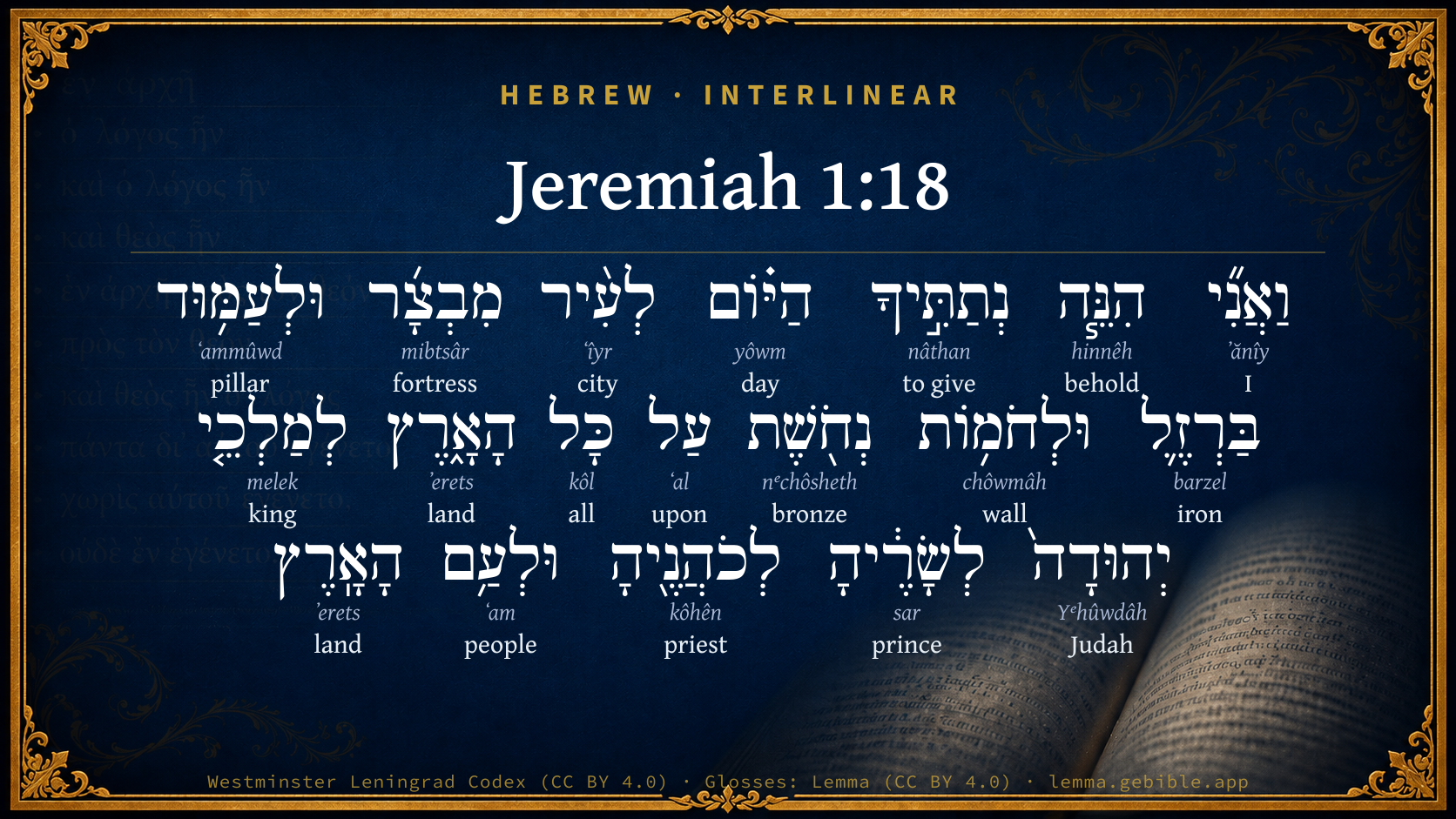
Jeremiah 1:18

Hebrew (Westminster Leningrad Codex) Jeremiah 1:18 appears in the Hebrew Old Testament. The text above is from the Westminster Leningrad Codex. Each word links to its Strong’s number, a concise gloss, and parsing drawn from the Open Scriptures Hebrew Bible morphology. Click any word for its full Brown-Driver-Briggs (BDB) entry.
Download image
Cite this verse

Jeremiah 1:18 (World English Bible). Public Domain. Lemma interlinear Bible study tool, https://lemma.gebible.app/v/jeremiah/1/18.

Show BibTeX & RIS
BibTeX
RIS
English Translation
For, behold, I have made you this day a fortified city, and an iron pillar, and brazen walls, against the whole land, against the kings of Judah, against the princes of it, against the priests of it, and against the people of the land.
World English Bible · Public Domain
Download a study sheet

One document with this verse’s original text, its word-by-word gloss line, the meaning frame, cross-references with their text, attributed commentary, and full source and license credits — printable, and it pastes into notes with its structure intact.

This verse Autodidact and up

Study sheet (.html) Plain text (.txt)

A passage Seminary Student

Up to 50 verses in one chapter. A passage sheet keeps up to 6 commentary sources and 12 cross-references per verse, in the order this page ranks them, and says so on the sheet whenever that leaves anything out. Ask for a single verse and you get the Autodidact verse sheet above.

Everything on this page stays free to read, with no account — the sheet is a download of what is already on screen, not access to it.

Want to remove ads? Support Godless Engineer
Compare translations 3

The same verse in 3 English versions, stacked beneath the original-language interlinear above. Click any original word for its lexicon entry.

Each is an independent rendering of the whole verse — the interlinear is not word-aligned to these translations.

Highlighted words mark where these versions differ — a whole-verse word diff, not a word-by-word alignment.

  • World English Bible Public Domain
    For, behold, I have made you this day a fortified city, and an iron pillar, and brazen walls, against the whole land, against the kings of Judah, against the princes of it, against the priests of it, and against the people of the land.
  • King James Version Public Domain
    For, behold, I have made thee this day a defenced city, and an iron pillar, and brasen walls against the whole land, against the kings of Judah, against the princes thereof, against the priests thereof, and against the people of the land.
  • unfoldingWord Literal Text CC BY-SA 4.0
    And I—behold!—I have made you this day a city of fortification and an iron pillar and bronze walls against all the land—against the kings of Judah, against its officials, against its priests, and against the people of the land.

unfoldingWord Literal Text — © unfoldingWord, licensed CC BY-SA 4.0. Word-aligned USFM3 via Door43 (git.door43.org/unfoldingWord/en_ult).

Versions to compare (up to 4)

3 of 4 selected

Show all 18 translations

Every available English version of this verse, each an independent rendering of the whole verse.

  • World English Bible Public Domain
    For, behold, I have made you this day a fortified city, and an iron pillar, and brazen walls, against the whole land, against the kings of Judah, against the princes of it, against the priests of it, and against the people of the land.
  • Berean Standard Bible Public Domain
    Now behold, this day I have made you like a fortified city, an iron pillar, and bronze walls against the whole land—against the kings of Judah, its officials, its priests, and the people of the land.
  • Majority Standard Bible Public Domain
    Now behold, this day I have made you like a fortified city, an iron pillar, and bronze walls against the whole land—against the kings of Judah, its officials, its priests, and the people of the land.
  • King James Version Public Domain
    For, behold, I have made thee this day a defenced city, and an iron pillar, and brasen walls against the whole land, against the kings of Judah, against the princes thereof, against the priests thereof, and against the people of the land.
  • American Standard Version (1901) Public Domain
    For, behold, I have made thee this day a fortified city, and an iron pillar, and brazen walls, against the whole land, against the kings of Judah, against the princes thereof, against the priests thereof, and against the people of the land.
  • Revised Version (1885) Public Domain
    For, behold, I have made thee this day a defenced city, and an iron pillar, and brasen walls, against the whole land, against the kings of Judah, against the princes thereof, against the priests thereof, and against the people of the land.
  • Geneva Bible (1599) Public Domain
    For I, beholde, I this day haue made thee a defenced citie, and an yron pillar and walles of brasse against the whole lande, against the Kings of Iudah, and against the princes thereof, against the Priestes thereof and against the people of the lande.
  • Douay-Rheims (1899) Public Domain
    For behold I have made thee this day a fortified city, and a pillar of iron, and a wall of brass, over all the land, to the kings of Juda, to the princes thereof, and to the priests, and to the people of the land.
  • Young's Literal Translation Public Domain
    And I, lo, I have given thee this day for a fenced city, and for an iron pillar, and for brazen walls over all the land, to the kings of Judah, to its heads, to its priests, and to the people of the land;
  • Literal Standard Version CC BY-SA 4.0
    And I, behold, have given you this day for a fortified city, and for an iron pillar, and for bronze walls over all the land, to the kings of Judah, to its heads, to its priests, and to the people of the land;
  • Unlocked Literal Bible CC BY-SA 4.0
    Behold! Today I have made you a fortified city, an iron pillar, and bronze walls against the whole land—against the kings of Judah, its officials, its priests, and the people of the land.
  • unfoldingWord Literal Text CC BY-SA 4.0
    And I—behold!—I have made you this day a city of fortification and an iron pillar and bronze walls against all the land—against the kings of Judah, against its officials, against its priests, and against the people of the land.
  • Darby Bible Public Domain
    And I, behold, I appoint thee this day as a strong city, and an iron pillar, and brazen walls, against the whole land; against the kings of Judah, against its princes, against its priests, and against the people of the land.
  • World Messianic Bible Public Domain
    For behold, I have made you today a fortified city, an iron pillar, and bronze walls against the whole land—against the kings of Judah, against its princes, against its priests, and against the people of the land.
  • Webster's Bible Public Domain
    For behold, I have made thee this day a fortified city, and an iron pillar, and brazen walls against the whole land, against the kings of Judah, against her princes, against her priests, and against the people of the land.
  • Free Bible Version CC BY-SA 4.0
    Look! Today I have made you like a fortified city, a pillar of iron, a wall of bronze to stand against the whole country—against the kings of Judah, its officials, its priests, and the people of the country.
  • Bible in Basic English Public Domain
    For see, this day have I made you a walled town, and an iron pillar, and walls of brass, against all the land, against the kings of Judah, against its captains, against its priests, and against the people of the land.
  • JPS Tanakh (1917) Public Domain
    For, behold, I have made thee this day a fortified city, and an iron pillar, and brazen walls, against the whole land, against the kings of Judah, against the princes thereof, against the priests thereof, and against the people of the land.

Literal Standard Version (2020), Covenant Press — licensed CC BY-SA 4.0. Text via the HelloAO Bible API (eBible.org). Unlocked Literal Bible (unfoldingWord) — licensed CC BY-SA 4.0. Text via the HelloAO Bible API (eBible.org). unfoldingWord Literal Text — © unfoldingWord, licensed CC BY-SA 4.0. Word-aligned USFM3 via Door43 (git.door43.org/unfoldingWord/en_ult). Free Bible Version, Dr. Jonathan Gallagher — licensed CC BY-SA 4.0. Text via the HelloAO Bible API (eBible.org).

Word by word

More ways to search: Search by grammar → Find every occurrence → Compare this word →

Practice this passage: Drill this verse → Learn its vocabulary →

מִבְצָ֜ר
mibtsâr
H4013
“fortress”
Noun, Common, Masculine, Singular, Absolute
Part of Speech
Noun
Type
Common
Gender
Masculine
Number
Singular
State
Absolute
Full BDB Definition

Origin: from H1219

TWOT: 270g

fortification, fortress, fortified city, stronghold
  1. וַאֲנִ֞י ʼănîy H589 “and · I” Conjunction + Pronoun, Personal, 1st Person, Common, Singular
  2. הִנֵּ֧ה hinnêh H2009 “behold” Particle, Demonstrative
  3. נְתַתִּ֣יךָ nâthan H5414 “to give · you” Verb, Qal, Perfect, 1st Person, Common, Singular + Suffix, Personal, 2nd Person, Masculine, Singular
  4. הַיּ֗וֹם yôwm H3117 “the · day” Particle, Definite Article + Noun, Common, Masculine, Singular, Absolute
  5. לְעִ֨יר ʻîyr H5892 “to/for · city of” Preposition + Noun, Common, Feminine, Singular, Construct
  6. וּלְעַמּ֥וּד ʻammûwd H5982 “and · to/for · pillar of” Conjunction + Preposition + Noun, Common, Masculine, Singular, Construct
  7. בַּרְזֶ֛ל barzel H1270 “iron” Noun, Common, Masculine, Singular, Absolute
  8. וּלְחֹמ֥וֹת chôwmâh H2346 “and · to/for · walls of” Conjunction + Preposition + Noun, Common, Feminine, Plural, Construct
  9. נְחֹ֖שֶׁת nᵉchôsheth H5178 “bronze” Noun, Common, Feminine, Singular, Absolute
  10. עַל ʻal H5921 “upon” Preposition
  11. כָּל kôl H3605 “all of” Noun, Common, Masculine, Singular, Construct
  12. הָאָ֑רֶץ ʼerets H776 “the · land” Particle, Definite Article + Noun, Common, Both, Singular, Absolute
  13. לְמַלְכֵ֤י melek H4428 “to/for · kings of” Preposition + Noun, Common, Masculine, Plural, Construct
  14. יְהוּדָה֙ Yᵉhûwdâh H3063 “Judah” Noun, Proper
  15. לְשָׂרֶ֔יהָ sar H8269 “to/for · princes · her” Preposition + Noun, Common, Masculine, Plural, Construct + Suffix, Personal, 3rd Person, Feminine, Singular
  16. לְכֹהֲנֶ֖יהָ kôhên H3548 “to/for · priests · her” Preposition + Noun, Common, Masculine, Plural, Construct + Suffix, Personal, 3rd Person, Feminine, Singular
  17. וּלְעַ֥ם ʻam H5971 “and · to/for · people of” Conjunction + Preposition + Noun, Common, Masculine, Singular, Construct
  18. הָאָֽרֶץ ʼerets H776 “the · land” Particle, Definite Article + Noun, Common, Both, Singular, Absolute

About this verse

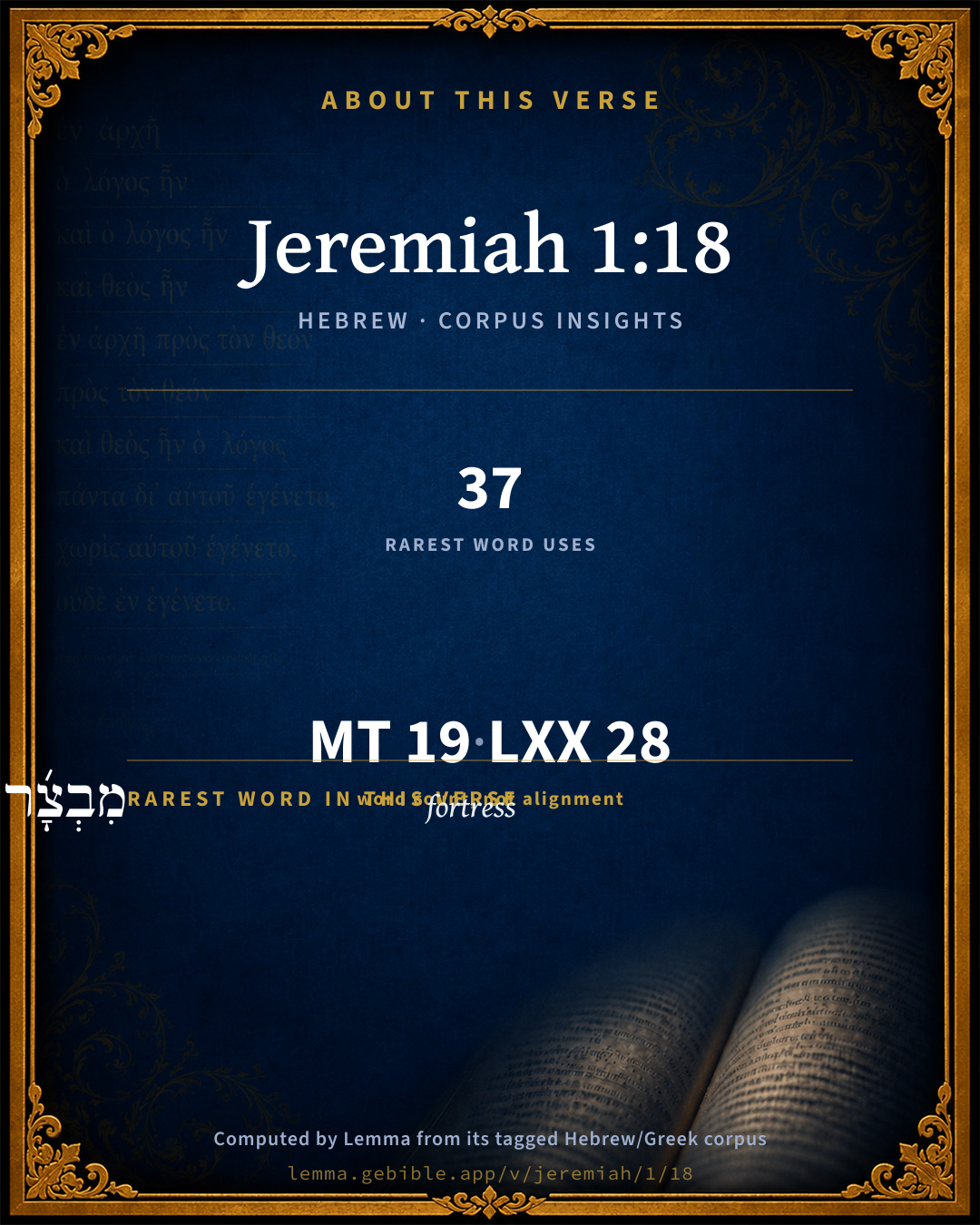
These counts appear in no published source. They are computed here, from the morphology-tagged text and Lemma’s own curated glosses. What Lemma adds →

19
words
18
distinct lemmas
Prophets
section

Shared distinctive vocabulary

מִבְצָ֜ר fortress H4013 occurs in 37 verses of the Hebrew Bible. Also found in:

Grammatical profile

  • 1 verb
  • 15 nouns
  • 1 pronoun
  • 1 preposition
  • 1 particle

Verb forms

  • נְתַתִּ֣יךָ Qal · Perfect

Repetition

A word recurs within this verse — often emphatic in Hebrew:

  • הָאָ֑רֶץ land H776 ×2

Hebrew & Septuagint length

In the original languages it is 19 Hebrew tokens and 28 Greek tokens — but the two are counted differently (Hebrew bundles its prefixes and suffixes into one token; the Greek is in lemma form), so that isn’t a like-for-like length.

Cross-references

14

Topical passages linked to Jeremiah 1:18 in the Treasury of Scripture Knowledge — connected by theme and wording, ordered by reader-vote popularity; previews shown in the World English Bible.

  • Isaiah 50:7 For the Lord Yahweh will help me; therefore I have not been confounded: therefore have I set my face like a flint, and I know that I shall not be disappointed.
  • Ezekiel 3:8–9 Behold, I have made your face hard against their faces, and your forehead hard against their foreheads.
  • Jeremiah 15:20 I will make you to this people a fortified brazen wall; and they shall fight against you, but they shall not prevail against you; for I am with you to save you and to deliver you, says Yahweh.
  • Jeremiah 6:27 I have made you a tester of metals [and] a fortress among my people; that you may know and try their way.
  • Micah 3:8–9 But as for me, I am full of power by the Spirit of Yahweh, And of judgment, and of might, To declare to Jacob his disobedience, And to Israel his sin.
  • Jeremiah 34:20–22 I will even give them into the hand of their enemies, and into the hand of those who seek their life; and their dead bodies shall be for food to the birds of the sky, and to the animals of the earth.
  • Jeremiah 36:27–32 Then the word of Yahweh came to Jeremiah, after that the king had burned the scroll, and the words which Baruch wrote at the mouth of Jeremiah, saying,
  • Jeremiah 37:7 Thus says Yahweh, the God of Israel, Thus shall you tell the king of Judah, who sent you to me to inquire of me: Behold, Pharaoh's army, which is come forth to help you, shall return to Egypt into their own land.
  • Jeremiah 26:12–15 Then spoke Jeremiah to all the princes and to all the people, saying, Yahweh sent me to prophesy against this house and against this city all the words that you have heard.
  • Jeremiah 38:2 Thus says Yahweh, He who remains in this city shall die by the sword, by the famine, and by the pestilence; but he who goes forth to the Chaldeans shall live, and his life shall be to him for a prey, and he shall live.
  • Jeremiah 21:4–22:30 Thus says Yahweh, the God of Israel, Behold, I will turn back the weapons of war that are in your hands, with which you fight against the king of Babylon, and against the Chaldeans who besiege you, without the walls; and I will gather them into the midst of this city.
  • Jeremiah 34:3 and you shall not escape out of his hand, but shall surely be taken, and delivered into his hand; and your eyes shall see the eyes of the king of Babylon, and he shall speak with you mouth to mouth, and you shall go to Babylon.
  • Jeremiah 42:22 Now therefore know certainly that you shall die by the sword, by the famine, and by the pestilence, in the place where you desire to go to sojourn there.
  • John 1:42 He brought him to Jesus. Jesus looked at him, and said, "You are Simon the son of Jonah. You shall be called Cephas" (which is by interpretation, Peter).

Cross-references courtesy of OpenBible.info (CC BY 4.0).

Hebrew and Greek witnesses Masoretic Hebrew ↔ Greek Septuagint

The same verse in the two great witnesses to the Old Testament, shown verse-for-verse.

These are two independent witnesses, not word-aligned to each other, and the Septuagint is shown in lemma (dictionary) form.

Hebrew Jeremiah 1:18 Masoretic · Westminster Leningrad Codex

וַאֲנִ֞י הִנֵּ֧ה נְתַתִּ֣יךָ הַיּ֗וֹם לְעִ֨יר מִבְצָ֜ר וּלְעַמּ֥וּד בַּרְזֶ֛ל וּלְחֹמ֥וֹת נְחֹ֖שֶׁת עַל כָּל הָאָ֑רֶץ לְמַלְכֵ֤י יְהוּדָה֙ לְשָׂרֶ֔יהָ לְכֹהֲנֶ֖יהָ וּלְעַ֥ם הָאָֽרֶץ

For, behold, I have made you this day a fortified city, and an iron pillar, and brazen walls, against the whole land, against the kings of Judah, against the princes of it, against the priests of it, and against the people of the land.

World English Bible · Public Domain

Greek LXX Structure differs

In the Septuagint, Jeremiah is about an eighth shorter than the Hebrew and arranges its material differently — the Oracles Against the Nations (Hebrew chapters 46–51) appear in the middle of the Greek book, after 25:13. Because the chapter and verse boundaries do not line up, a verse-for-verse comparison with the Hebrew is not shown.

A verse-for-verse comparison isn’t shown here because the chapters and verses don’t line up. Switch to the LXX edition with the MT / LXX toggle above to read the Greek directly.

On this verse, The Cambridge Bible for Schools and Colleges discusses the Septuagint’s reading. Read the note in Commentary ↓

Hebrew: Westminster Leningrad Codex (CC BY 4.0). Greek: Septuagint (public domain); English from a public-domain English Septuagint. How the Septuagint differs from the Hebrew →

Targum (Aramaic paraphrase)

1

The Targum is the ancient Jewish Aramaic paraphrase of the Hebrew Scriptures — an interpretive translation, not the Hebrew text itself. Onkelos (literal) and Pseudo-Jonathan (expansive) render the Torah, and Jonathan the Prophets. Coverage is partial: where no permissively-licensed English translation exists for a verse, only the Aramaic is shown. This is verse-level text, not a word-by-word alignment to the Hebrew.

  1. Targum Jonathan Prophets (Joshua–Malachi)
    וַאֲנָא הָא יְהַבְתָּךְ יוֹמָא דֵין תַּקִיף כְּקִרְיָה כְרִיכָא וּכְעַמוּדָא דְבַרְזֶל וּכְשׁוּר דִנְחָשׁ לְאַשְׁקָאָה כָּס דִלְוָט לְכָל יַתְבֵי אַרְעָא לְמַלְכָּא דְבֵית יְהוּדָה לְרַבְרְבָהָא לְכַהֲנָהָא וּלְעַמָא דְאַרְעָא:

    (no public-domain English translation for this verse)

    Targum Jonathan — Aramaic: “Mikraot Gedolot” (public domain). English: “Sefaria Community Translation” (CC0 1.0 (public-domain dedication)); “London "Chaldee Paraphrase," 1871” (public domain). Text via Sefaria.

Commentary

Notes on Jeremiah 1:18 from classic Christian and Jewish commentators (each source and its license shown beneath its notes). The classic Christian expositions comment on the surrounding passage and are grouped to its opening verse, so a note may address several verses; the Jewish commentaries on the Tanakh (Rashi and others) are per-verse, so they appear only where the commentator wrote on this verse.

Lemma curates 59 commentaries, every one of them public domain or Creative Commons licensed, each selected and text-cleaned for this edition rather than reprinted as found. About our sources →

Trapp's Complete Commentary

John Trapp

Jer 1:18 For, behold, I have made thee this day a defenced city, and an iron pillar, and brasen walls against the whole land, against the kings of Judah, against the princes thereof, against the priests thereof, and against the people of the land.

Ver. 18. For, behold, I have made thee this day a defenced city,] i.e., Impregnable, inexpugnable, the bulwark of truth, {a} as one said of Basil, such as could not be battered. And of Ambrose Stilico the earl said, that he was the walls of Italy. Peter and John are called pillars; {Gal 2:9} Athanasius the Church’s champion,

“ Ille velut pelagi rupes immota resistis. ” - Virg.

Against the kings of Judah, against the princes, &c.] There was a general defection of all sorts; and Jeremiah was to declaim against them all, and proclaim their utter destruction in case they repented not. Well might Luther say, for he had the sad experience of it, Praedicare nihil aliud est quam totius mundi furorem in se derivare, To preach is nothing else but to derive upon a man’s self the rage of all the world. He met with some even at Wittenberg, where he lived, who were so wicked and uncounsellable, that the four elements could not endure them. {b} So did good Jeremiah, &c.

{a} της αληθειας προβολον.

{b} Ut iam quatuor elementa ferre nequeant.

John Trapp, A Commentary or Exposition upon All the Books of the Old and New Testament (1647–1656) — public domain. Text from a community e-Sword module.

The Biblical Illustrator

Joseph S. Exell

Jer_1:18

I have made thee this day a defenced city, etc.

A sure stronghold is God

Though thou shalt be exposed to persecutions and various indignities, they shall not prevail against thee. To their attacks thou shalt be as an impregnable city; as unshaken as an iron pillar; and as imperishable as a wall of brass. None, therefore, can have less cause to apprehend danger than thou hast. The issue, in Jeremiahs case, proved the truth of this promise; he outlived all their insults; and saw Jerusalem destroyed, and his enemies, and the enemies of the Lord, carried into captivity. (Adam Clark.)

The Biblical Illustrator, edited by Joseph S. Exell (c. 1880s–1900s) — public domain. Text from a community e-Sword module.

Joseph Benson's Commentary

Jer 1:18-19. For I have made thee this day a defenced city — That is, from this day I will so defend thee that they shall be no more able to hurt thee than they would be if thou wast in a strongly-fortified and impregnable city. And brazen walls — Which cannot be broken or battered down with any force. Against the whole land, against the kings, &c. — All its inhabitants in general; intimating that, though men of all degrees should set themselves against him, yet God would support him against them all, and would carry him through his work, although his troubles would not only be great, but long, extended through several kings’ reigns. And they shall fight against thee — Shall oppose thee, and manifest much hostile hatred against thee; but they shall not prevail — They shall not be able, by all their devices, to shorten thy days, or to prevent thy executing the charge given thee. For I am with thee, to deliver thee — I will show my power in protecting and delivering thee out of all thy troubles, when thy adversaries shall become a prey to their enemies.

Joseph Benson's Commentary on the Old and New Testaments (1811–1818) — public domain. Text from a community e-Sword module.

Tyndale Open Study Notes

Tyndale Open Resources

1:18 A fortified city could hold out for a long time against a siege, often until the besieging army left to deal with a crisis elsewhere in the empire.

Tyndale Open Study Notes — © Tyndale Open Resources, licensed CC BY-SA 4.0. Text via the HelloAO Bible API.

Geneva Bible (1599)

Geneva Bible translators

Signifying, on the one part, that the more that Satan and the world rage against God’s Ministers, the more present will he be to help them, Josh. 1:5; Heb. 13:5, and on the other part, that they are utterly unmeet to serve God in his Church, which are afraid, and do not resist wickedness, whatsoever danger depend thereon, Isa. 50:7; Ezek. 3:8.

Geneva Bible (1599) marginal notes — public domain. Text via Bolls.life.

Jamieson, Fausset & Brown

Robert Jamieson, A. R. Fausset & David Brown

defenced city, &c.--that is, I will give thee strength which no power of thine enemies shall overcome (Jer 6:27; Jer 15:20; Isa 50:7; Isa 54:17; Luk 21:15; Act 6:10).

walls--plural, to express the abundant strength to be given him. DE ROSSI'S'S manuscripts read singular, "wall."

people of the land--the general masses, as distinguished from the princes and priests.

Probably in the thirteenth year of the reign of Josiah (Jer 1:2; compare Jer 3:6, "also . . . in . . . days of Josiah"). The warning not to rely as they did on Egypt (Jer 2:18), was in accordance with Josiah's policy, who took part with Assyria and Babylon against Egypt (Kg2 23:29). Jeremiah, doubtless, supported the reformation begun by Josiah, in the previous year (the twelfth of his reign), and fully carried out in the eighteenth.

Next: Jeremiah Chapter 2

Jamieson, Fausset & Brown — Commentary Critical and Explanatory on the Whole Bible (1871) — public domain (CC PDM 1.0). Text via the HelloAO Bible API.

Adam Clarke's Commentary

Verse 18. I have made thee this day a defenced city, and an iron pillar, and, brazen walls] Though thou shalt be exposed to persecutions and various indignities, they shall not prevail against thee. To their attacks thou shalt be as an impregnable city; as unshaken as an iron pillar; and as imperishable as a wall of brass. None, therefore, can have less cause to apprehend danger than thou hast. The issue proved the truth of this promise: he outlived all their insults; and saw Jerusalem destroyed, and his enemies, and the enemies of his Lord, carried into captivity. Instead of חמות chomoth, walls, many MSS. and editions read חמת chomath, a wall, which corresponds with the singular nouns preceding.

Adam Clarke's Commentary on the Bible (1810–1826) — public domain. Text from a community e-Sword/MySword module.

John Calvin's Commentaries

God supplies here his servant with confidence; for courage was necessary in that state of trembling which we have observed. Jeremiah thought himself unfit to undertake a work so onerous; he had also to do and to contend with refractory men, and not a few in number; for the whole people had already, through their ungodly and wicked obstinacy, hardened themselves in the contempt of God. As, then, there was no more any care for religion, and no regard manifested by the people for heavenly truth, Jeremiah could not, diffident as he was, undertake so heavy a burden, without being supported by the hand of God. For this reason, then, God now declares that he would make him like a fortified city and an iron pillar Indeed, the word prop would be more proper; for עמור omud, comes from the root עמד, omed; and the Prophet understands by it, not a pillar that is raised and stands by itself, but that which sustains a building or a wall. There is no ambiguity in the meaning; for God means that his servant would be invincible, and that whatever his enemies might devise against him, they would not yet prevail, as we find it said in the next verse.

Now, though this was said formerly to Jeremiah, yet godly teachers may justly apply it to themselves, who are honestly conscious of their Divine call, and are fully persuaded that they do nothing presumptuously, but obey the bidding of God. All, then, who are thus confirmed in their legitimate call from God, can apply to themselves this promise — that they shall be made invincible against all the ungodly.

But the particulars of this passage deserve to be noticed. It might have seemed enough that God called his servant a fortified city; but he compares him also to an iron pillar or column, and to a brazen wall This repetition only confirms what we have explained, — that Jeremiah would be victorious, and that though Satan might rouse many to assail him, yet the issue would be prosperous and joyful, as he would fight under the protection of God.

It is at the same time added, Over the whole land God doubtless speaks not of the whole world, but of the land of Judah; for Jeremiah was chosen for this purpose, — that he might bestow his labor on the chosen people. It is then said that he would be a conqueror of the whole of Judea. It then follows, against the kings of Judah We know, indeed, that there was only one king in Judea; but God encourages his Prophet to be firm and persevering, as though he had said, that the course of his warfare would be long; and he said this, that he might not faint through weariness. The meaning then is, that the Prophet would not have to contend with one king only, but that as soon as one died, another would rise and oppose him; so that he was to know that there would be no hope of rest until that time had passed which God himself had appointed. We indeed know that those who are sincerely disposed to obey, do yet look for some definite period, when, like soldiers who have served their time, they may obtain a discharge; but God declares here to his Prophet, that when he had strenuously contended to the death of one king, his condition would be nothing better; for others would succeed, with whom he would have to fight, as the same wickedness and obstinacy would be still continued. To kings, he adds princes and priests; and, lastly, the whole people

When a king forgets his office and rules tyrannically, it often happens that there are moderators who check his passions, when they cannot wholly restrain them: we indeed see, that the most cruel tyrants are sometimes softened by good counselors. But God here reminds his Prophet that the state of things in Judea would be so desperate, that ungodly and wicked kings would have counselors endued with the same disposition. When priests are added, it might seem still more monstrous; but the Scripture everywhere testifies, that the Levitical priests had almost all degenerated and become apostates, so that hardly one in a hundred shewed the least sign of religion. Since, then, that order had become thus corrupt, it is no wonder that Jeremiah had to declare war against the priests; and we shall hereafter see that this was done. Now the common people might have seemed to be excusable, as there was greater simplicity among them than among the higher orders; (for they who are elevated above others transgress through pride or cruelty, and often allow themselves too much liberty, relying on their own eminence; but the common people, as I have said, seemed apparently to have more modesty;) but God here declares that impiety had so greatly prevailed in Judea, that all, from the least to the greatest, were become perversely wicked. It was, therefore, necessary, as I have before stated, that the Prophet should be fully armed; for what could he have thought, had he not in time been warned, on finding afterwards such insolence, yea, such fury in high and low, as to constrain him to contend with God’s chosen people no otherwise than with devils? It afterwards follows —

John Calvin's Commentaries (1540-1563) — public domain. Text from the Calvin Translation Society English edition (1840s-50s) via the Christian Classics Ethereal Library (ccel.org). Calvin's coverage is partial (roughly two-thirds of the Bible); uncommented books and verses are honest gaps, never fabricated. The 19th-century editor's footnotes and remarks are omitted so the notes are faithfully Calvin's own voice.

Ellicott's Commentary for English Readers

(18) I have made thee . . . a defenced city . . .—Images of strength are heaped one upon another. The prophet is represented as attacked by kings, princes, priests, and people, as the cities of Judah are by the invading armies. But the issue is different. They fall: he will hold out. The iron pillar is that which, rising in the centre of an Eastern house or temple (as, e.g., in Jdg_16:25; 1Ki_7:21), supports the flat roof, and enables it to be used as a terrace or platform on which men may meet. The “brasen walls” probably refer to the practice of fastening plates of copper over the brick or stonework of a fortification.

A Bible Commentary for English Readers, edited by Charles John Ellicott (1878–1897) — public domain. Text from a community e-Sword module.

The Cambridge Bible for Schools and Colleges

gen. ed. J. J. S. Perowne

18. a defenced city, and an iron pillar; and brasen walls] Jeremiah was to be fortified by divine strength against the attacks which he would have to confront throughout his prophetic life. The assaults would be severe, and hence the force of the figures under which he is described. Jeremiah would need a pre-eminent degree of strength. Cp. Eze_3:9. The words “and an iron pillar” are probably to be omitted (with LXX), as inconsistent with the idea of a siege. If we retain them, we may explain the sentence as expressing in the strongest manner what is impregnable and cannot be overthrown.

against the kings of judah] Josiah, Jehoahaz, Jehoiakim, Jehoiachin, Zedekiah.

The Cambridge Bible for Schools and Colleges (gen. ed. J. J. S. Perowne; Cambridge University Press, 1878–1918) — public domain. Text from a community e-Sword module.

John Gill's Exposition

For, behold, I have made thee this day a defenced city,.... Or, "as" one; so read the Targum, Septuagint, Syriac, and Arabic versions; which is inexpungible, and cannot be taken:

and an iron pillar; which cannot be removed out of its place:

and brasen walls; which cannot be broken down. All these metaphors show the safety and security of the prophet, being surrounded by the power of God; his constancy, immovableness, and invincibleness in the work of the Lord, having such a spirit of power, fortitude, and of a sound mind, that nothing was able to move and shake him, or to deter him from the execution of his office; and that he should stand inflexible

against the whole land; of Judea, and all the inhabitants of it:

against the kings of Judah; in successive reigns, as Jehoahaz, Jehoiakim, Jehoiachin, or Jechonias, and Zedekiah:

against the princes thereof; who desired he might be put to death, Jer 38:4,

against the priests thereof; who all of them dealt falsely, and were given to covetousness, Jer 8:10,

and against the people of the land; who were grievously addicted to idolatry, and all manner of wickedness.

John Gill's Exposition of the Whole Bible (1746–1763) — public domain (CC PDM 1.0). Text via the HelloAO Bible API.

Albert Barnes' Notes on the Bible

Metaphorically the walls and fortifications of the city represent the prophet’s power of patiently enduring the attacks of his enemies; while the iron pillar, supporting the whole weight of the roof Jdg 16:29; 1Ki 7:21), signifies that no trials or sufferings would crush his steadfast will.

Albert Barnes' Notes on the Bible (1834–1885) — public domain. Text from a community e-Sword/MySword module.

Matthew Poole's English Annotations

For, behold; Heb. For I, lo: q.d. For my part, I will not fail to do what I have promised, to stand by thee.

A defenced city, Heb. city of defence, impregnable, which the two following expressions do import; it should be supported with pillars, not of wood, but of iron, and encompassed with walls, not of stone, but of brass, noting hereby both great uprightness and also strength.

Against the whole land, i.e. all its inhabitants in general, none to be spared, as he doth particularly rank them in their several degrees in the following words, intimating hereby, that though men of all degrees should set themselves against him, yet God would support him against them all, and that he would carry him through his work, though his troubles and trials would be not only great, but long, viz. passing through several kings’ reigns, therefore possibly said kings here, in the plural.

Matthew Poole's English Annotations on the Holy Bible (1683–1685) — public domain. Text from a community e-Sword/MySword module.

The Pulpit Commentary

Brasen walls. The plural is used instead of a collective term for the whole circle of fortifications. In the parallel passage (Jer_15:20) the singular occurs; the same alternation of plural and singular as in 2Ki_25:10 1Ki_3:1. The combination of figures strikingly expresses the invincibility of one whose strength is in his God. The kings of Judah. Why the plural? Most reply, Because Jeremiah would have to do with successive sovereigns. But this meaning would have been just as well conveyed by the singular: "the king of Judah," without any name being added would moan the king who from time to time happened to be reigning. "Kings of Judah" in Jeremiah seems to have a special meaning, and to include all the members of the royal family, who formed a numerous and powerful class. (see on Jer_17:20)

The Pulpit Commentary (1880–1919), ed. H.D.M. Spence-Jones & Joseph S. Exell — public domain. Text from a community e-Sword module.

John Wesley's Explanatory Notes

This whole land - All its inhabitants in general; intimating, that though men of all degrees should set themselves against him, yet God would support him against their all, and would carry him thro' his work, tho' his troubles would not be only great, but long; passing thro' several king's reigns.

John Wesley, Explanatory Notes Upon the Whole Bible (1754–1765) — public domain. Text via the GEBible commentary corpus.

Rashi

Rabbi Shlomo Yitzchaki (Rashi)

against the Kings of Judah lit. to the Kings of Judah.

Rashi on the Tanakh — English translations: “The Judaica Press complete Tanach with Rashi, translated by A. J. Rosenberg” (CC BY 4.0); “Pentateuch with Rashi's commentary by M. Rosenbaum and A.M. Silbermann, 1929-1934” (public domain); “The Metsudah Tanach series, Lakewood, N.J” (CC BY 4.0); and “The Book of Joshua, Metsudah Publications, 1997” (CC BY 4.0). Text via Sefaria.

Lesson kit

Teaching starters — assembled from the data on this page, not authored interpretation. Every prompt links to the verse data it draws on. Edit before teaching.

Jeremiah, in the Prophets, opens this verse with 19 words (18 distinct Hebrew lemmas). Its most distinctive word is mibtsâr (“fortress”). A historical commentator’s framing appears above. Read the whole chapter for the surrounding context.

Discussion questions

  1. How does “fortress” (mibtsâr) shape what this verse is saying?
  2. How does Numbers 13:19, which shares the word «fortress», read alongside this verse?
  3. What does the repetition of “land” (2× in this one verse) do in this verse?
  4. These translations render this verse differently; the difference is in the English rendering, not the original. What questions does that raise?
  5. «נְתַתִּ֣יךָ» is a Qal Perfect verb. How does that grammatical form shape the action described?
  6. Compare how Trapp's Complete Commentary and The Biblical Illustrator read this verse. Where do they agree or differ?

Things to notice

Reading settings

Reading text

Shown beneath each verse's original-language words.

Old Testament
Old Testament edition

Read the OT as the Masoretic Hebrew (MT) or the Greek Septuagint (LXX).

English shown for the Greek Septuagint (in the Hebrew ↔ Greek comparison).

Comparing translations? Open the Compare panel on any verse page to stack up to four side by side.