Zechariah 2:5

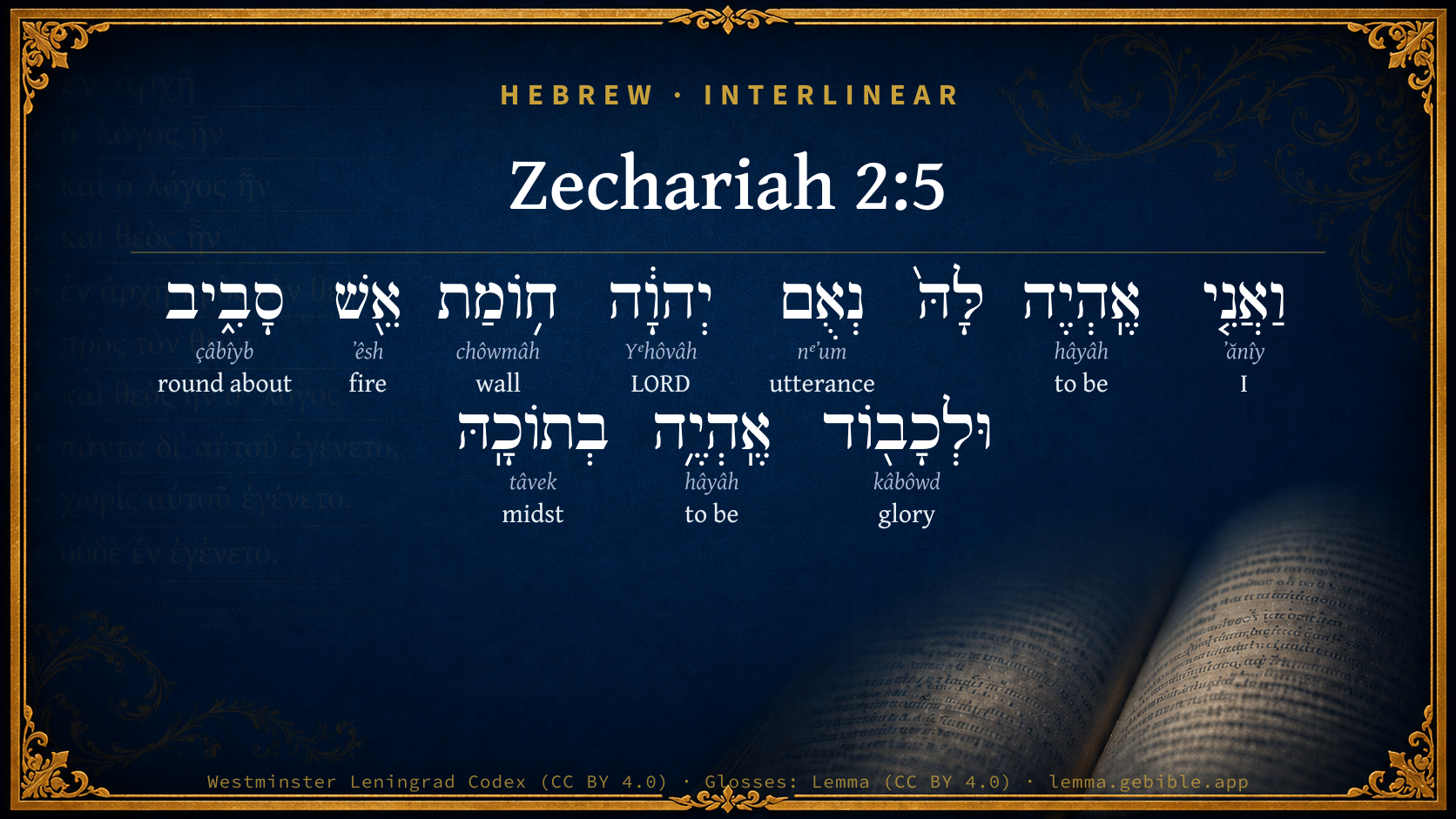
Hebrew (Westminster Leningrad Codex) Zechariah 2:5 appears in the Hebrew Old Testament. The text above is from the Westminster Leningrad Codex. Each word links to its Strong’s number, a concise gloss, and parsing drawn from the Open Scriptures Hebrew Bible morphology. Click any word for its full Brown-Driver-Briggs (BDB) entry.
Download image
Cite this verse

Zechariah 2:5 (World English Bible). Public Domain. Lemma interlinear Bible study tool, https://lemma.gebible.app/v/zechariah/2/5.

Show BibTeX & RIS
BibTeX
RIS
English Translation
For I,' says Yahweh, 'will be to her a wall of fire around it, and I will be the glory in the midst of her.
World English Bible · Public Domain
Download a study sheet

One document with this verse’s original text, its word-by-word gloss line, the meaning frame, cross-references with their text, attributed commentary, and full source and license credits — printable, and it pastes into notes with its structure intact.

This verse Autodidact and up

Study sheet (.html) Plain text (.txt)

A passage Seminary Student

Up to 50 verses in one chapter. A passage sheet keeps up to 6 commentary sources and 12 cross-references per verse, in the order this page ranks them, and says so on the sheet whenever that leaves anything out. Ask for a single verse and you get the Autodidact verse sheet above.

Everything on this page stays free to read, with no account — the sheet is a download of what is already on screen, not access to it.

Want to remove ads? Support Godless Engineer
Compare translations 3

The same verse in 3 English versions, stacked beneath the original-language interlinear above. Click any original word for its lexicon entry.

Each is an independent rendering of the whole verse — the interlinear is not word-aligned to these translations.

Highlighted words mark where these versions differ — a whole-verse word diff, not a word-by-word alignment.

  • World English Bible Public Domain
    For I,' says Yahweh, 'will be to her a wall of fire around it, and I will be the glory in the midst of her.
  • King James Version Public Domain
    For I, saith the LORD, will be unto her a wall of fire round about, and will be the glory in the midst of her.
  • unfoldingWord Literal Text CC BY-SA 4.0
    And I, I will be for her—the declaration of Yahweh—a wall of fire all around, and for glory I will be in her midst.’”

unfoldingWord Literal Text — © unfoldingWord, licensed CC BY-SA 4.0. Word-aligned USFM3 via Door43 (git.door43.org/unfoldingWord/en_ult).

Versions to compare (up to 4)

3 of 4 selected

Show all 18 translations

Every available English version of this verse, each an independent rendering of the whole verse.

  • World English Bible Public Domain
    For I,' says Yahweh, 'will be to her a wall of fire around it, and I will be the glory in the midst of her.
  • Berean Standard Bible Public Domain
    For I will be a wall of fire around it, declares the LORD, and I will be the glory within it.’”
  • Majority Standard Bible Public Domain
    For I will be a wall of fire around it, declares the LORD, and I will be the glory within it.’”
  • King James Version Public Domain
    For I, saith the LORD, will be unto her a wall of fire round about, and will be the glory in the midst of her.
  • American Standard Version (1901) Public Domain
    For I, saith Jehovah, will be unto her a wall of fire round about, and I will be the glory in the midst of her.
  • Revised Version (1885) Public Domain
    For I, saith the LORD, will be unto her a wall of fire round about, and I will be the glory in the midst of her.
  • Geneva Bible (1599) Public Domain
    For I, saith the Lord, will be vnto her a wall of fire round about, and wil be the glory in the middes of her.
  • Douay-Rheims (1899) Public Domain
    And I will be to it, saith the Lord, a wall of fire round about: and I will be in glory in the midst thereof.
  • Young's Literal Translation Public Domain
    And I -- I am to her -- an affirmation of Jehovah, A wall of fire round about, And for honour I am in her midst.
  • Literal Standard Version CC BY-SA 4.0
    And I am to her—a declaration of YHWH—A wall of fire all around, || And I am for glory in her midst.
  • Unlocked Literal Bible CC BY-SA 4.0
    For I—this is Yahweh's declaration—will become for her a wall of fire around her, and I will be the glory in her midst.
  • unfoldingWord Literal Text CC BY-SA 4.0
    And I, I will be for her—the declaration of Yahweh—a wall of fire all around, and for glory I will be in her midst.’”
  • Darby Bible Public Domain
    and I, saith Jehovah, I will be unto her a wall of fire round about, and will be the glory in the midst of her.
  • World Messianic Bible Public Domain
    For I,’ says the LORD, ‘will be to her a wall of fire around it, and I will be the glory in the middle of her.
  • Webster's Bible Public Domain
    \\2:1\\I lifted up my eyes again, and looked, and behold a man with a measuring line in his hand.
  • Free Bible Version CC BY-SA 4.0
    The Lord declares, I myself will be a wall of fire all around the city, and I will be the glory inside it.
  • Bible in Basic English Public Domain
    And lifting up my eyes, I saw a man with a measuring-line in his hand.
  • JPS Tanakh (1917) Public Domain
    (2-9) For I, saith the LORD, will be unto her a wall of fire round about, and I will be the glory in the midst of her.

Literal Standard Version (2020), Covenant Press — licensed CC BY-SA 4.0. Text via the HelloAO Bible API (eBible.org). Unlocked Literal Bible (unfoldingWord) — licensed CC BY-SA 4.0. Text via the HelloAO Bible API (eBible.org). unfoldingWord Literal Text — © unfoldingWord, licensed CC BY-SA 4.0. Word-aligned USFM3 via Door43 (git.door43.org/unfoldingWord/en_ult). Free Bible Version, Dr. Jonathan Gallagher — licensed CC BY-SA 4.0. Text via the HelloAO Bible API (eBible.org).

Word by word

More ways to search: Search by grammar → Find every occurrence → Compare this word →

Practice this passage: Drill this verse → Learn its vocabulary →

ח֥וֹמַת
chôwmâh
H2346
“wall of”
Noun, Common, Feminine, Singular, Construct
Part of Speech
Noun
Type
Common
Gender
Feminine
Number
Singular
State
Construct
Full BDB Definition

Origin: act. participle of an unused root apparently meaning to join

TWOT: 674c

wall
  1. וַאֲנִ֤י ʼănîy H589 “and · I” Conjunction + Pronoun, Personal, 1st Person, Common, Singular
  2. אֶֽהְיֶה hâyâh H1961 “to be” Verb, Qal, Imperfect, 1st Person, Common, Singular
  3. נְאֻם nᵉʼum H5002 “utterance of” Noun, Common, Masculine, Singular, Construct
  4. יְהוָ֔ה Yᵉhôvâh H3068 “LORD” Noun, Proper
  5. אֵ֖שׁ ʼêsh H784 “fire” Noun, Common, Both, Singular, Absolute
  6. סָבִ֑יב çâbîyb H5439 “round about” Noun, Common, Both, Singular, Absolute
  7. וּלְכָב֖וֹד kâbôwd H3519 “and · to/for · glory” Conjunction + Preposition + Noun, Common, Both, Singular, Absolute
  8. אֶֽהְיֶ֥ה hâyâh H1961 “to be” Verb, Qal, Imperfect, 1st Person, Common, Singular
  9. בְתוֹכָֽהּ tâvek H8432 “in/at · midst · her” Preposition + Noun, Common, Masculine, Singular, Construct + Suffix, Personal, 3rd Person, Feminine, Singular

About this verse

These counts appear in no published source. They are computed here, from the morphology-tagged text and Lemma’s own curated glosses. What Lemma adds →

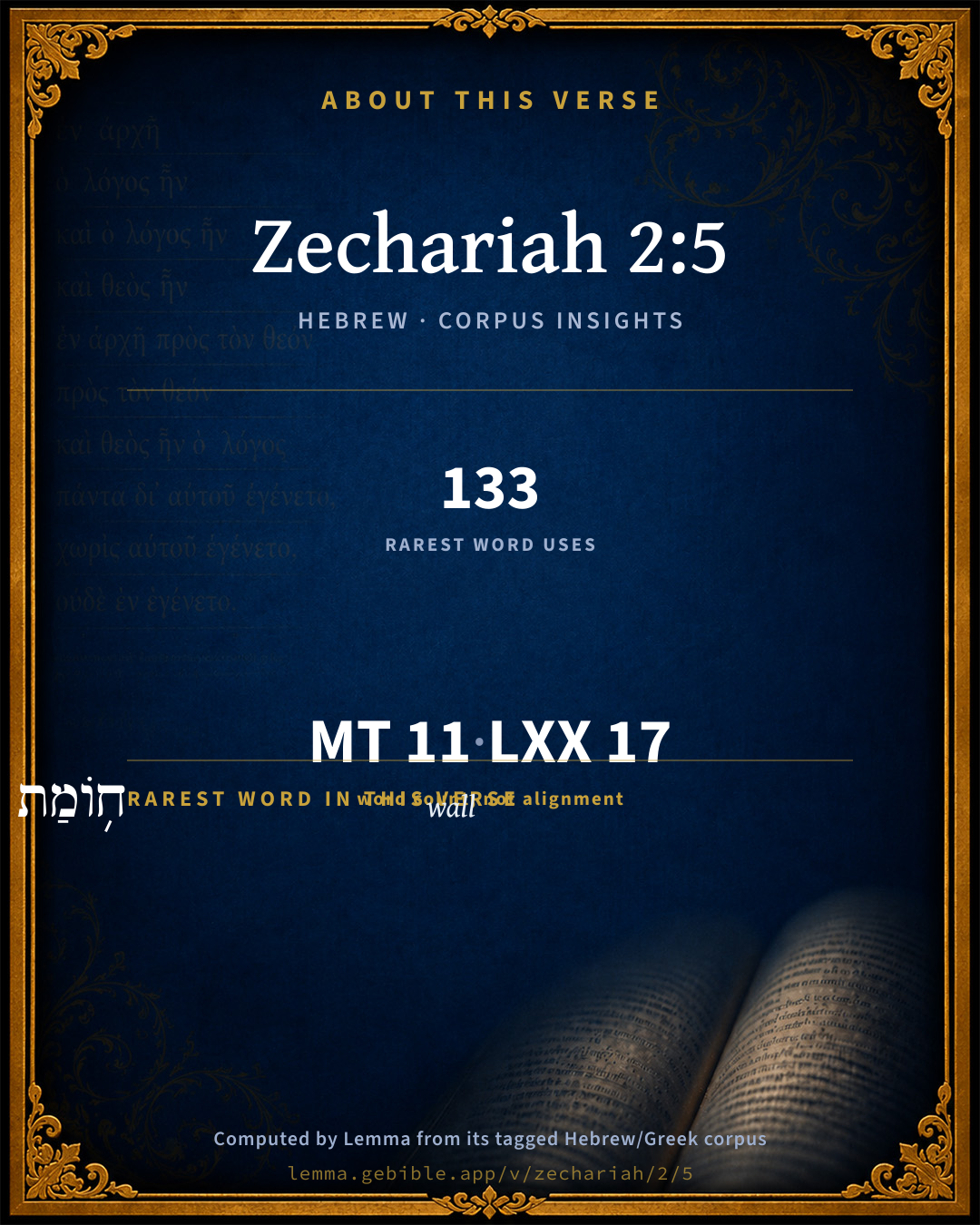
11
words
9
distinct lemmas
Prophets
section

Grammatical profile

  • 2 verbs
  • 7 nouns
  • 1 pronoun
  • 1 preposition

Verb forms

  • אֶֽהְיֶה Qal · Imperfect
  • אֶֽהְיֶ֥ה Qal · Imperfect

Repetition

A word recurs within this verse — often emphatic in Hebrew:

  • אֶֽהְיֶה to be H1961 ×2

Hebrew & Septuagint length

In English translation the verse runs 25 words from the Hebrew and 27 from the Septuagint (LXX English) — closely comparable.

A rough comparison of the two English renderings, which tokenize alike — not a word-level alignment.

Word counts can differ between the Hebrew and the Greek without any difference in meaning — e.g. the Hebrew direct-object marker אֵת has no separate Greek word, and Greek often adds the article ὁ.

In the original languages it is 11 Hebrew tokens and 17 Greek tokens — but the two are counted differently (Hebrew bundles its prefixes and suffixes into one token; the Greek is in lemma form), so that isn’t a like-for-like length.

Cross-references

15

Topical passages linked to Zechariah 2:5 in the Treasury of Scripture Knowledge — connected by theme and wording, ordered by reader-vote popularity; previews shown in the World English Bible.

  • Isaiah 4:5 Yahweh will create over the whole habitation of Mount Zion, and over her assemblies, a cloud and smoke by day, and the shining of a flaming fire by night; for over all the glory will be a canopy.
  • Psalms 3:3 But you, Yahweh, are a shield around me, My glory, and the one who lifts up my head.
  • Zechariah 9:8 I will encamp around my house against the army, That none pass through or return; And no oppressor will pass through them any more: For now I have seen with my eyes.
  • Isaiah 60:18–19 Violence shall no more be heard in your land, desolation nor destruction within your borders; but you shall call your walls Salvation, and your gates Praise.
  • Revelation 21:23 The city has no need for the sun, neither of the moon, to shine, for the very glory of God illuminated it, and its lamp is the Lamb.
  • Isaiah 12:6 Cry aloud and shout, you inhabitant of Zion; for great in the midst of you is the Holy One of Israel!"
  • Psalms 46:7–11 Yahweh of Hosts is with us. The God of Jacob is our refuge. Selah.
  • Isaiah 26:1–2 In that day shall this song be sung in the land of Judah: we have a strong city; salvation will he appoint for walls and bulwarks.
  • Isaiah 33:21 But there Yahweh will be with us in majesty, a place of broad rivers and streams, in which shall go no galley with oars, neither shall gallant ship pass thereby.
  • Psalms 48:3 God has shown himself in her citadels as a refuge.
  • Psalms 48:12 Walk about Zion, and go around her. Number its towers;
  • Haggai 2:7–9 and I will shake all nations. The precious things of all nations will come, and I will fill this house with glory, says Yahweh of Hosts.
  • Luke 2:32 A light for revelation to the Gentiles, And the glory of your people Israel."
  • Revelation 21:10–11 He carried me away in the Spirit to a great and high mountain, and showed me the holy city, Jerusalem, coming down out of heaven from God,
  • Revelation 22:3–5 There will be no curse any more. The throne of God and of the Lamb will be in it, and his servants serve him.

Cross-references courtesy of OpenBible.info (CC BY 4.0).

Hebrew and Greek witnesses Masoretic Hebrew ↔ Greek Septuagint

The same verse in the two great witnesses to the Old Testament, shown verse-for-verse.

These are two independent witnesses, not word-aligned to each other, and the Septuagint is shown in lemma (dictionary) form.

Hebrew Zechariah 2:5 Masoretic · Westminster Leningrad Codex

וַאֲנִ֤י אֶֽהְיֶה לָּהּ֙ נְאֻם יְהוָ֔ה ח֥וֹמַת אֵ֖שׁ סָבִ֑יב וּלְכָב֖וֹד אֶֽהְיֶ֥ה בְתוֹכָֽהּ

For I,' says Yahweh, 'will be to her a wall of fire around it, and I will be the glory in the midst of her.

World English Bible · Public Domain

Greek LXX Zechariah 2:5 Septuagint · lemma form

καί αἴρω ὁ ὀφθαλμός ἐγώ καί ὁράω καί ἰδού ἀνήρ καί ἐν ὁ χείρ αὐτός σχοινίον γεωμετρικόν

And I will be to her, says the Lord, a wall of fire round about, and I will be for a glory in the midst of her.

LXX2012 (modern English Septuagint) · Public Domain

On this verse, The Pulpit Commentary discusses the Septuagint’s reading. Read the note in Commentary ↓

Hebrew: Westminster Leningrad Codex (CC BY 4.0). Greek: Septuagint (public domain); English from LXX2012 (modern English Septuagint) (Public Domain). How the Septuagint differs from the Hebrew →

Targum (Aramaic paraphrase)

1

The Targum is the ancient Jewish Aramaic paraphrase of the Hebrew Scriptures — an interpretive translation, not the Hebrew text itself. Onkelos (literal) and Pseudo-Jonathan (expansive) render the Torah, and Jonathan the Prophets. Coverage is partial: where no permissively-licensed English translation exists for a verse, only the Aramaic is shown. This is verse-level text, not a word-by-word alignment to the Hebrew.

  1. Targum Jonathan Prophets (Joshua–Malachi)
    וּזְקָפֵית עֵינַי וַחֲזֵית וְהָא גַבְרָא וּבִידֵיהּ חוּט דִמְשַׁחְתָּא:

    (no public-domain English translation for this verse)

    Targum Jonathan — Aramaic: “Mikraot Gedolot” (public domain). English: “Sefaria Community Translation” (CC0 1.0 (public-domain dedication)); “London "Chaldee Paraphrase," 1871” (public domain). Text via Sefaria.

Commentary

Notes on Zechariah 2:5 from classic Christian and Jewish commentators (each source and its license shown beneath its notes). The classic Christian expositions comment on the surrounding passage and are grouped to its opening verse, so a note may address several verses; the Jewish commentaries on the Tanakh (Rashi and others) are per-verse, so they appear only where the commentator wrote on this verse.

Lemma curates 59 commentaries, every one of them public domain or Creative Commons licensed, each selected and text-cleaned for this edition rather than reprinted as found. About our sources →

Trapp's Complete Commentary

John Trapp

Zec 2:5 For I, saith the LORD, will be unto her a wall of fire round about, and will be the glory in the midst of her.

Ver. 5. For I, saith the Lord, will be unto her a wall of fire] Igneus qui et cominus arceat et eminus terreat (Theodor.). The Church (Christ’s garden) may seem to lie open to all incursions and disadvantages; but as it hath a well within it, Son 4:15, so it hath a wall without it, yea, round about it, better and stronger than that about Babylon, or Susa in Persia; the stones whereof were joined together with gold, as Cassiodorus testifieth. The Lacedaemonians were forbidden to wall in their city of Sparta; as being sufficiently fortified by the valour of the inhabitants. The Hollanders will not wall the Hague, though it have 2000 households in it; as desirous to have it counted rather the principal village of Europe than a lesser city. China is said to be surrounded with a strong wall of stone; and England with walls of wood, sc. a powerful navy. But what is all this (either for defence or offence) to a wall of fire? who dare venture to scale such a wall? It is not valour, but madness, to fight with a flame. Fire is terrible to the fiercest creatures, as lions, leopards. Shepherds and travellers were used to guard themselves by making great fires round about their night lodgings to keep off wild beasts. Some think the prophet alludeth to that custom; others, to the angels guarding of Paradise with a flaming sword, that is, saith Lactantius, with a wall of fire (Instit. lib. 2, cap. 13.) The Church may sit and sing, "We have a strong city: salvation will God appoint for walls and bulwarks," Isa 26:1. He "maketh his angels spirits, his ministers a flame of fire," Heb 1:7. These met and ministered unto Jacob at Mahanaim, making a lane for him, as the word importeth, Gen 32:1. These fiery chariots and horsemen appeared for Elisha by whole legions, 2Ki 6:17, and do still pitch their camp round about the godly, Psa 34:7. (These are the watchmen over the walls of the new Jerusalem, and of the mountains about the same, Isa 62:6) Who, therefore, cannot but be safe, as being guarded by the peace of God within them, and by the power of God without them, through faith unto salvation.

And will be the glory in the midst of her] God is the Church’s both bulwark and beauty; her muniment and ornament. His presence, his worship, his grace, his protection, is that tower in the midst of her, Isa 5:2, that golden head of the picture, that tower of the flock, and stronghold of the daughter of God’s people, Mic 4:8. Hence the ark is called the glory, Rom 9:4-5, and all comforts without it but Ichabods, 1Sa 4:20. Hence Judea is called the glorious land; and heathens are brought in saying, "Surely this great nation is a wise and understanding people. For what nation is there so great, that hath God so nigh unto them, as the Lord our God is in all things that we call upon him for? And what nation is there so great, that hath statutes and judgments so righteous as all this law?" Deu 4:6-8. Surely as Samson’s strength and glory lay in his hair, so doth the strength and glory of our land consist in the true religion, and God’s sincere service; which if it should be shaved and deprived of, though every shower were a shower of gold, saith a divine, every stone in the land a pearl, every beggar an honourable senator, every fool as wise as Solomon, every weakling as strong as Samson; yet our wealth, honour, strength, wisdom, and glory are gone, and we shall sing a doleful Miserere ditty with Phineas’s wife, Ichabod, The glory of England is gone; for religion is gone.

John Trapp, A Commentary or Exposition upon All the Books of the Old and New Testament (1647–1656) — public domain. Text from a community e-Sword module.

The Biblical Illustrator

Joseph S. Exell

Zec_2:5

I will be unto her a wall of fire

Zions protection

I.

The people that shall be thus defended. It is Jerusalem that is to be defended; and that will include three things: the temple, the habitations of the people, and the people themselves. The people of God are spoken of as the temple of God. Do we belong to the temple of the Lord? If we belong to the temple of the Lord, the Lord Jesus Christ will be our only foundation. There are two things that make the Lord Jesus the foundation--

1. As being the end of the law for righteousness. He brings in everlasting righteousness.

2. As being the end of sin. He is spiritually, legally, properly, and entirely the end of sin; His blood cleanseth from all sin. As is the foundation in character, so the building must accord in character with the foundation. The foundation is one of free grace. Therefore we are not only justified by grace, but saved by grace. The first feature given to this building is mercy. Then it is a free-grace building. The third feature is certainty. We may be upon the right foundation, and yet not rightly built. Gods people are spoken of as a city; they have habitations which require to be defended. Take these habitations as the truths of the Gospel, wherein Gods people dwell. Electing grace; predestination; Christs righteousness; the atonement; Gods promises may all be spoken of as habitations.

II. The defence. Notice the forms under which the Lord represents Himself as round about His people: all indicative of two things, destruction to the adversary, safety to the friend. The Lord is round His people as a hedge; and as mountains; and as a guard of fire, such as men use to protect from wild beasts.

III. The glory in the midst. He is in the midst, the living God, the life-giving God. He is the glory in the midst by being the temple in the midst. (James Wells.)

Protected by God

In one of the great cities of the Continent the regalia are not kept behind iron bars as in the Tower of London, but lie upon an open table. It might appear that any ruthless hand could wrench any jewel or diamond from the glittering array; and yet no man dare put out his hand to take one, because that table is charged with a strong current of electricity. You cannot see the protection, but there it is. And so if a man will only live in daily and hourly communion with Christ, the devil can no more touch him than a thief can touch those jewels. (F. B. Meyer.)

The wall and glory of Jerusalem

In this chapter is a vision of a man with a measuring line in his hand, to show that the Lord was now in readiness to build and restore the city and temple. Two great discouragements the people met with--danger and scorn. The Lord here, by a gracious promise, fortifieth them against the fear of both. Against the fear of danger, by promising to be their protection; and against the fear of scorn, by promising to be their glory. The Lord is to His people whatever good they want. I will be a wall.

1. A wall of partition, to separate the Church from the world.

2. A wall of conjunction, uniting the parts together in one common interest.

3. A wall of protection and defence. The Lord doth as a wall protect His Church--

(1) In a way of promise.

(2) In a way of power.

(3) In a way of providence.

(4) In a way of grace.

His protection is like that of a wall. It is near, adequate, and impregnable. Consider the city walled, the subject of His defence. The Church is His property, His rest, His peculiar treasure. The Lord is the glory in the midst of His people--

1. By His spiritual residence and gracious presence with them.

2. By His holy ordinances.

3. In glorious privileges and immunities belonging to every citizen of the New Jerusalem.

What folly, then, and what wickedness, to oppose the Church of God, briars to contend with flames! We need not make use of carnal wisdom and sinful means for protection. Envy not the glory of the world. Above all, hold fast God and His presence. God will be with you while you are with Him. If God be thus your glory, let your glorying be in Him alone. (T. Hannam.)

The glory in the midst of her--

Inward glory and outward defence

Speak of the bearing of the text upon our individual lives.

1. If we choose, we may have the Divine glory in the deepest heart of us. The glory of the Old Testament was that material but supernatural symbol of the Divine presence which gleamed above the mercy seat in the most holy place. That little house on the temple hill was nothing in sanctity in comparison with the temple of the Christian heart. The true habitation of God is man. Spirit dwells in spirit in a profounder sense than it does in space, or in the material creation. Have you got the glory in the centre of your being? We may all have the indwelling of the glory of God if we will.

2. If God be for glory within, He will be a fiery rampart round. He is not only a wall, but a wall of fire. His protection is not merely of the passive sort which shields from evil, but active and preserving.

3. If God is a wall of fire round about us, we do not want any other walls. God is everything that we need, and do not find anywhere else; and having Him, we do not want anything else. But the lives of most of us do not much look as if we believed that the only necessary thing was God, and that, having Him, we required nothing else. Let us cast all our self-confidences down, and rest ourselves on Him, and Him alone. (A. Maclaren, D. D.)

The city without walls

Zechariah was the prophet of the returning exiles, and his great work was to hearten them for their difficult task, with their small resources and their many foes, and to insist that the prime condition to success, on the part of that portion of the nation that had returned, was holiness. And that exuberant promise was spoken about the Jerusalem over which Christ wept when He foresaw its inevitable destruction. When the Romans had cast a torch into the Temple, and the streets of the city were running with blood, what had become of Zechariahs dream of a wall of fire round about her? Then, can the Divine fire be quenched? Yes. And who quenched it? Not the Romans, but the people that lived within that flaming rampart. If God spared not the natural branches, take heed lest He also spare not thee.

I. I will be a wall of fire round about her. I need not dwell on the vividness and beauty of that metaphor. These encircling flames will consume all antagonism, and defy all approach. But let me remind you that the conditional promise was intended for Judea and Jerusalem, and was fulfilled in literal fact. So long as the city obeyed and trusted God it was impregnable, though all the nations stood round about it like dogs round a sheep. The fulfilment of the promise has passed over, with all the rest that characterised Israels position, to the Christian Church, and today, in the midst of all the agitations of opinion and all the vauntings of men about an effete Christianity and dead churches, it is as true as ever it was that the living Church of God is eternal. If it had not been that there was a God as a wall of fire round about the Church it would have been wiped off the face of the earth long ago. If nothing else had killed it, the faults of its members would have done so. The continuance of the Church is a perpetual miracle, when you take into account the weakness and the errors and the follies and the stupidities and the narrownesses and the sins of the people who in any given day represent it. It does not become any Christian ever to have the smallest scintillation of a fear that the ship that bears Jesus Christ can fail to come to land, or can sink in the midst of the waters. But do not let us forget that this great promise does not belong only to the Church as a whole, but that we have each to bring it down to our own individual lives and to be quite sure of this, that in spite of all that sense says, in spite of all that quivering hearts and weeping eyes may seem to prove, there is a wall of fire round each of us, if we are keeping near Jesus Christ. Only, we have to interpret that promise by faith and not by sense, and we have to make it possible that it shall be fulfilled by keeping inside the wall, and trusting to it. As faith dwindles, the fiery wall burns dim, and evil can get across its embers, and can get at us.

II. A Glory in the midst of us. The one is external defence; the other inward illumination, with all that light symbolises--knowledge, joy, purity. There is even more than that meant by this great promise. For notice that emphatic little word the--the glory, not a glory--in the midst of her. Now, you all know what the glory was. It was that symbolic Light that spoke, of the special Presence of God, and went with the children of Israel m their wanderings, and sat between the cherubim. There was no shekinah--as it is technically called--in that second Temple. But yet the prophet says, the glory--the actual presence of God--shall be in the midst of her, and the meaning of that great promise is taught us by the very last vision in the New Testament, in which the seer of the Apocalypse says, the glory of the Lord did lighten it (evidently quoting Zechariah), and the Lamb is the light thereof. So the city is lit as by one central glow of radiance that flashes its beams into every corner, and therefore there shall be no night there. Now, this promise, too, bears on churches and on individuals. On the Church as a whole it bears in this way--the only means by which a Christian community can fulfil its function, and be the light of the world, is by having the presence of God, in no metaphor, the actual presence of the illuminating Spirit in its midst. The same thing is true about individuals. For each of us the secret of joy, of purity, of knowledge is that we be holding close communion with God.

III. Jerusalem shall be without walls. It is to be like the defenceless villages scattered up and down over Israel. There is no need for bulwarks of stone. The wall of fire is round about. The more a Christian community is independent of external material supports and defences the better. Luther tolls us somewhere, in his parabolic way, of people that wept because there were no visible pillars to hold up the heavens, and were afraid that the sky would upon their heads. No, no, there is no fear of that happening, for an unseen hand holds them up. A Church that hides behind the fortifications of its grandfathers erection has no room for expansion; and if it has no room for expansion it will not long continue as large as it is. It must either grow greater or grow, and deserve to grow, less. The same thing is true about ourselves individually. Zechariahs prophecy was never meant to prevent what he himself helped to further, the building of the actual walls of the actual city. And our dependence upon God is not to be so construed as that we are to waive our own common sense and our own effort. We have to build ourselves round, in this world, with other things than the wall of fire, but in all our building we have to say, Except the Lord build the house, they labour in vain that build it. Except the Lord keep the city, the watchers watch in vain. But yet neither Jerusalem nor the Church nor the earthly state of that believer who lives most fully the life of faith exhausts this promise. It waits for the day when the city shall descend, like a bride adorned for her husband, having no need of the sun nor of the moon, for the glory . . . lightens it. (A. Maclaren, D. D.)

The Biblical Illustrator, edited by Joseph S. Exell (c. 1880s–1900s) — public domain. Text from a community e-Sword module.

The Expositor's Bible

THE THIRD VISION: THE CITY OF PEACE

Zec_2:5-9

Like the Second Vision, the Third follows from the First, another, but a still more significant, supplement. The First had promised the rebuilding of Jerusalem, and now the prophet beholds "a young man"-by this term he probably means "a servant" or "apprentice"-who is attempting to define the limits of the new city. In the light of what this attempt encounters, there can be little doubt that the prophet means to symbolize by it the intention of building the walls upon the old lines, so as to make Jerusalem again the mountain fortress she had previously been. Some have considered that the young man goes forth only to see, or to show, the extent of the city in the approaching future. But if this had been his motive there would have been no reason in interrupting him with other orders. The point is that he has narrow ideas of what the city should be, and is prepared to define it upon its old lines of a fortress. For the interpreting angel who "comes forward" is told by another angel to run and tell the young man that in the future Jerusalem shall be a large unwalled town, and this, not only because of the multitude of its population, for even then it might still have been fortified like Nineveh, but because Jehovah Himself shall be its wall. The young man is prevented, not merely from making it small, but from making it a citadel. And this is in conformity with all the singular absence of war from Zechariahs Visions, both of the future deliverance of Jehovahs people and of their future duties before Him. It is indeed remarkable how Zechariah not only develops none of the warlike elements of earlier Messianic prophecies, but tells us here of how God Himself actually prevented their repetition, and insists again and again only on those elements of ancient prediction which had filled the future of Israel with peace.

"And I lifted mine eyes and looked, and lo! a man with a measuring rope in his hand. So I said, Whither art thou going? And he said to me, To measure Jerusalem: to see how much its breadth and how much its length should be. And lo! the angel who talked with me came forward, and another angel came forward to meet him. And he said to him, Run and speak to yonder young man thus: Like a number of open villages shall Jerusalem remain, because of the multitude of men and cattle in the midst of her. And I Myself will be to her-oracle of Jehovah-a wall of fire round about, and for glory will I be in her midst."

In this Vision Zechariah gives us, with his prophecy, a lesson in the interpretation of prophecy. His contemporaries believed Gods promise to rebuild Jerusalem, but they defined its limits by the conditions of an older and a narrower day. They brought forth their measuring rods to measure the future by the sacred attainments of the past. Such literal fulfillment of His Word God prevented by that ministry of angels which Zechariah beheld. He would not be bound by those forms which His Word had assumed in suitableness to the needs of ruder generations. The ideal of many of the returned exiles must have been that frowning citadel, those gates of everlastingness, {Psalms 24} which some of them celebrated in Psalms, and from which the hosts of Sennacherib had been broken and swept back as the angry sea is swept from the fixed line of Canaans coast. {Isa_17:12-14} What had been enough for David and Isaiah was enough for them, especially as so many prophets of the Lord had foretold a Messianic Jerusalem that should be a counterpart of the historical. But God breaks the letter of His Word to give its spirit a more glorious fulfillment. Jerusalem shall not "be builded as a city that is compact together," {Psa_122:3} but open and spread abroad village-wise upon her high mountains, and God Himself her only wall.

The interest of this Vision is therefore not only historical. For ourselves it has an abiding doctrinal value. It is a lesson in the method of applying prophecy to the future. How much it is needed we must feel as we remember the readiness of men among ourselves to construct the Church of God upon the lines His own hand drew for our fathers, and to raise again the bulwarks behind which they sufficiently sheltered His shrine. Whether these ancient and sacred defenses be dogmas or institutions we have no right, God tells us, to cramp behind them His powers for the future. And the great men whom He raises to remind us of this, and to prevent by their ministry the timid measurements of the zealous but servile spirits who would confine everything to the exact letter of ancient Scripture-are they any less His angels to us than those ministering spirits whom Zechariah beheld preventing the narrow measures of the poor apprentice of his dream?

To the Third Vision there has been appended the only lyrical piece which breaks the prose narrative of the Visions. We have already seen that it is a piece of earlier date. Israel is addressed as still scattered to the four winds of heaven, and still inhabiting Babylon. While in Zechariahs own oracles and visions Jehovah has returned to Jerusalem, His return according to this piece is still future. There is nothing about the Temple: Gods holy dwelling from which He has roused Himself is Heaven. The piece was probably inserted by Zechariah himself: its lines are broken by what seem to be a piece of prose, in which the prophet asserts his mission in words he twice uses elsewhere. But this is uncertain.

"Ho, ho! Flee from the Land of the North (oracle of Jehovah); For as the four winds have I spread you abroad (oracle of Jehovah). He to Zion escape, thou inhabitress of Babel. For thus saith Jehovah of Hosts to the nations that plunder you (for he that toucheth you toucheth the apple of His eye), that, lo! I am about to wave My hand over them, and they shall be plunder to their own servants, and ye shall know that Jehovah of Hosts hath sent me. Sing out and rejoice, O daughter of Zion";

"For, lo! I come, and will dwell in thy midst (oracle of Jehovah). And many nations shall join themselves to Jehovah in that day. And shall be to Him a people. And I will dwell in thy midst (And thou shalt know that Jehovah of Hosts hath sent me to thee). And Jehovah will make Judah His heritage, His portion shall be upon holy soil, And make choice once more of Jerusalem. Silence, all flesh, before Jehovah; For He hath roused Himself up from His holy dwelling."

William Robertson Nicoll, ed., The Expositor's Bible (London: Hodder & Stoughton, 1887–1910) — public domain. 65 of 66 books (1 Corinthians is not separately keyed, as that volume carries no machine-parseable verse references); section-level commentary keyed to the opening verse. Introductory and overview sections not keyed to a specific passage are excluded.

Tyndale Open Study Notes

Tyndale Open Resources

2:5 The wall of fire represents divine protection (cp. 2 Kgs 6:17). • I, myself, will be: The emphatic construction of the verb “to be” might be a direct reference to God’s name (Exod 3:14-15). • Fire and glory allude to the Exodus (see Exod 13:22; 14:20; 40:34).

Tyndale Open Study Notes — © Tyndale Open Resources, licensed CC BY-SA 4.0. Text via the HelloAO Bible API.

Geneva Bible (1599)

Geneva Bible translators

In me they shall have their full felicity and glory.

To defend my Church, to fear the enemies and to destroy them if they approach near.

Geneva Bible (1599) marginal notes — public domain. Text via Bolls.life.

Jamieson, Fausset & Brown

Robert Jamieson, A. R. Fausset & David Brown

I . . . wall of fire round--Compare Zac 2:4. Yet as a city needs some wall, I JEHOVAH will act as one of fire which none durst approach (Zac 9:8; Isa 26:1).

glory in the midst--not only a defense from foes outside, but a glory within (Isa 60:19; Rev 21:23). The same combination of "glory and defense" is found in Isa 4:5, alluding to the pillar of cloud and fire which defended and enlightened Israel in the desert. Compare Elisha in Dothan (Kg2 6:17). As God is to be her "glory," so she shall be His "glory" (Isa 62:3).

Jamieson, Fausset & Brown — Commentary Critical and Explanatory on the Whole Bible (1871) — public domain (CC PDM 1.0). Text via the HelloAO Bible API.

Adam Clarke's Commentary

Verse 5. I - will be unto her a wall of fire] Her safety shall consist in my defence. I shall be as fire round about her. No adversary shall be permitted to touch her. Much of this must refer to the New Jerusalem.

Adam Clarke's Commentary on the Bible (1810–1826) — public domain. Text from a community e-Sword/MySword module.

John Calvin's Commentaries

He confirms in this verse what I have just mentioned — that Jerusalem would be safe, though without any fortifications; for God alone would be sufficient for walls, for towers, for fortresses, according to what is said by other Prophets: “God will be to thee a wall and a fortress”, (Isaiah 26:1), again, “he will be to thee a stronghold”. It is, therefore, a sentence in accordance with other prophecies when Jehovah testifies, that he would be a wall of fire. We indeed know, that though walls may be high and thick, they may be scaled by enemies; but who will dare to throw himself into the fire? It is then the same as though God had spoken thus — “Though there will be no watchmen to defend Jerusalem, no soldiers to protect it, in short, no guardians whatever, yet I alone shall be sufficient; for I shall not only be a wall to keep off enemies, but I shall be also a fire to fill them with terror.”

He then adds, I will be for glory in the midst of her: as though he had said, “the real happiness of Jerusalem, within and without, will be in me alone and in my favor: within, in the midst of her I will be for glory; I will adorn her with every thing praiseworthy; and when there shall be any fear from the assault of enemies, I will be to her a wall of fire. For though she will not excel in strongholds and towers, and be without walls and fortresses, and shall be thus exposed to many evils, I shall yet strike all enemies with terror, so that they shall be kept afar off; and my Church shall be thus preserved safe, though destitute of all human aids, and without any defense.”

We now then perceive the meaning of the Prophet to be this — that though the Jews saw that they were but few in number, weak in strength, wretched and despised, they had yet reason to entertain hope; for though few returned from exile God was yet able to increase the Church and to make it a vast multitude, and that this was certain and decreed, for it was shown by the vision, that however unequal they were to their enemies, God was still sufficiently strong and powerful to defend them; and that however destitute they were of all blessings, God was still rich enough to enrich them, provided they relied on the blessing which he had promised; for he had engaged to render them happy and blessed within, and safe from enemies from without.

John Calvin's Commentaries (1540-1563) — public domain. Text from the Calvin Translation Society English edition (1840s-50s) via the Christian Classics Ethereal Library (ccel.org). Calvin's coverage is partial (roughly two-thirds of the Bible); uncommented books and verses are honest gaps, never fabricated. The 19th-century editor's footnotes and remarks are omitted so the notes are faithfully Calvin's own voice.

Ellicott's Commentary for English Readers

(5) A wall of fire.—This verse is not intended to discountenance the building of walls to Jerusalem, a thing which was actually done under Nehemiah (B.C. 445), but is simply a solemn promise of God’s protection. Many indeed were the troubles which fell on the city in the times which intervened between the days of Zechariah and those of our Lord; but still, abundant proof was given that God had not forgotten His promise to shield it. Such troubles, as at other periods of the history of the Jews, were but chastisements, and even those not in proportion to their transgressions. (For the figurative use of the expression “wall,” see 1Sa_25:16.)

A Bible Commentary for English Readers, edited by Charles John Ellicott (1878–1897) — public domain. Text from a community e-Sword module.

John Gill's Exposition

For I, saith the Lord, will be unto her a wall of fire round about,..... So that she needs no other wall to secure her, the power of God encompassing her about as the mountains did Jerusalem, Psa 125:2 and he being as a wall of fire to terrify and destroy her enemies; for our God is a consuming fire, Heb 12:29. Drusius thinks it is a metaphor taken from travellers in some countries, who kindle fires about their tents, to keep off lions, and other beasts of prey; and observes of lions particularly, that they are exceedingly terrified by fire; for which he refers to John Leo in his description of Africa; and Pliny makes (e) mention of several things that are terrifying to them, but especially fires, he says; and so Dr. Shaw (f), of late, speaking of the lions in Barbary, remarks, fire is what they are the most afraid of; yet, notwithstanding all the precautions of the Arabs in this respect, with others he takes notice of, it frequently happens that these ravenous beasts, outbraving all those terrors, will leap into the midst of an enclosure or fold, and drag from thence a sheep, or a goat; and Tavernier (g) tells a story, by which he thinks it appears to be a vulgar error that lions will not come near the fire; though the relation itself shows it to be not only a received opinion, but a common custom to light fires in the night, to preserve from lions: his story is,

"a party of Dutch soldiers, under the command of a serjeant, far advanced in the country (about the Cape of Good Hope), and night coming on, they made a great fire, as well to keep themselves from the lions, as to warm themselves, and so lay down to sleep round about it; being asleep, a lion seized one of the soldier's arms, which with difficulty was got out, after the lion was shot;''

but this seems to be the case, when these creatures are dreadfully hunger bitten; however, be it as it will, God is the sure and safe protection of his people; who went before the people of Israel in a pillar of a cloud by day, and in a pillar of fire by night, when they passed through a terrible wilderness, in which were beasts of prey; and surrounded Elisha with horses and chariots of fire, when the king of Syria sent a large host to take him; so that he could say, to encourage his servant, "they that be for us are more than they that be with them", Kg2 6:15 who seem to be angels; and the Jews (h) here interpret it of the family of God, his angels, made a wall to Jerusalem to preserve it; the cherubim and a flaming sword, set to keep the garden of Eden, were, according to Lactantius (i), a wall of fire about it; for (he says), when God cast man out of paradise, he walled it about with fire: but that was that man might not enter in; but here he himself is a wall of fire, that his people may be safe; hence they have no reason to fear the wrath of their enemies, the most fierce and furious, savage and cruel, comparable to lions, bears, &c.; for, if God is for them, on their side, and on all sides of them, who can be against them to any purpose? The Targum paraphrases it,

"my Word shall be unto her, saith the Lord, as a wall of fire encompassing her round about:''

and will be the glory in the midst of her: appear glorious in her, be glorified in her, and by her, and be her glory, and make her glorious; as the Lord does by granting his gracious presence with his church and people, in his word and ordinances; see Isa 4:1 Isa 60:13.

(e) Nat. Hist. l. 8. c. 16. (f) Travels, tom. 1. par. 3. c. 2. p. 172. (g) Travels through India, in Harris's Voyages and Travels, vol. 1. p. 848. (h) Pesikta Rabbati apud Yalkut in loc. (i) Institut. Divin. l. 2. c. 13.

John Gill's Exposition of the Whole Bible (1746–1763) — public domain (CC PDM 1.0). Text via the HelloAO Bible API.

Albert Barnes' Notes on the Bible

And I, Myself in My own Being, will be to her a wall of fire - Not protection only, an inner circle around her, however near an enemy might press in upon her, but destructive to her enemies. Isaiah says, “No weapon that is formed against thee shall prosper, and every tongue that shall rise in judgment against thee thou shalt condemn” Isa 54:17. Its defense, Isaiah says, shall be immaterial. “We have a strong city; salvation shall God appoint for walls and bulwarks” Isa 26:1; “thou shalt call thy walls salvation and thy gates praise” Isa 60:18). By a different figure it is said, “I will encamp about mine house because of the army” Zec 9:8.

And glory will I be in the midst of her - As Isaiah says, “The Lord shall be unto thee an everlasting light, and thy God thy glory” Isa 60:19; and of Christ, “In that day shall the Branch of the Lord be Beauty and Glory - to the escaped of Israel” Isa 4:2.

Albert Barnes' Notes on the Bible (1834–1885) — public domain. Text from a community e-Sword/MySword module.

Haydock's Catholic Bible Commentary

Fire, to enlighten and protect it. Arms will be unnecessary, Micheas v. 10., and Isaias ii. 4. The Church shall enjoy peace.

George Leo Haydock (1774–1849), Haydock's Catholic Family Bible and Commentary, 1859 edition — public domain. Excludes Psalms (Douay-Rheims chapter numbering differs from Protestant) and Deuterocanonical books (Catholic canon only).

Matthew Poole's English Annotations

What was promised or foretold in the former verse is ratified in this by an account how it should be performed.

For I, saith the Lord; that a thing so much above the hope of a present dejected people, so much too great for so weak and so few a people, might be believed and expected, God engageth he will perform the word.

A wall of fire; which cannot be scaled, it would consume them that attempt it; nor undermined. none could come so near it: such a wall as once was Elisha’s guard, 2Ki 6:16,17, to which this place may possibly refer. Or it is an allusion to the manner of shepherds and travellers in those countries full of wild beasts, to make fires in the night to secure themselves.

Round about; no part shall be unguarded, or open to the enemy.

And will be the glory in the midst of her; my presence and favour shall make her glorious, Isa 4:5,6.

Matthew Poole's English Annotations on the Holy Bible (1683–1685) — public domain. Text from a community e-Sword/MySword module.

The Pulpit Commentary

A wall of fire. She will not need walls. God will be her protection, not only defending her from attack, but consuming the enemy who may presume to assault her. (comp. Deu_4:24 Psa_68:2) The glory; eiv doxan esomai (Septuagint). God will make his glory conspicuous by the mighty deeds he will do in Jerusalem and the providential care he will take of her. He shall be known to be dwelling there, as he revealed his presence by the pillar of fire and the Shechinah. (comp. Isa_60:1, Isa_60:2, Isa_60:19)

The Pulpit Commentary (1880–1919), ed. H.D.M. Spence-Jones & Joseph S. Exell — public domain. Text from a community e-Sword module.

John Wesley's Explanatory Notes

The glory - My presence and favour shall make her glorious.

John Wesley, Explanatory Notes Upon the Whole Bible (1754–1765) — public domain. Text via the GEBible commentary corpus.

Rashi

Rabbi Shlomo Yitzchaki (Rashi)

a measuring line A measuring line to measure Jerusalem, how much its length and its breadth shall be.

Rashi on the Tanakh — English translations: “The Judaica Press complete Tanach with Rashi, translated by A. J. Rosenberg” (CC BY 4.0); “Pentateuch with Rashi's commentary by M. Rosenbaum and A.M. Silbermann, 1929-1934” (public domain); “The Metsudah Tanach series, Lakewood, N.J” (CC BY 4.0); and “The Book of Joshua, Metsudah Publications, 1997” (CC BY 4.0). Text via Sefaria.

Lesson kit

Teaching starters — assembled from the data on this page, not authored interpretation. Every prompt links to the verse data it draws on. Edit before teaching.

Zechariah, in the Prophets, opens this verse with 11 words (9 distinct Hebrew lemmas). Its most distinctive word is chôwmâh (“wall”). A historical commentator’s framing appears above. Read the whole chapter for the surrounding context.

Discussion questions

  1. The word chôwmâh carries the sense “wall.” How does it shape the verse?
  2. Isaiah 4:5 shares this passage’s theme. How do the two illuminate each other?
  3. “to be” occurs 2× in this one verse. What is the effect of the repetition?
  4. The translations on this page render this verse differently — a whole-verse word diff, not a word-by-word alignment. What might account for the different wordings?
  5. The verb «אֶֽהְיֶה» is Qal Imperfect. How does its form color the action?
  6. Reading how Trapp's Complete Commentary and The Biblical Illustrator read this verse, where do the two commentators agree and where do they part?

Things to notice

Reading settings

Reading text

Shown beneath each verse's original-language words.

Old Testament
Old Testament edition

Read the OT as the Masoretic Hebrew (MT) or the Greek Septuagint (LXX).

English shown for the Greek Septuagint (in the Hebrew ↔ Greek comparison).

Comparing translations? Open the Compare panel on any verse page to stack up to four side by side.