
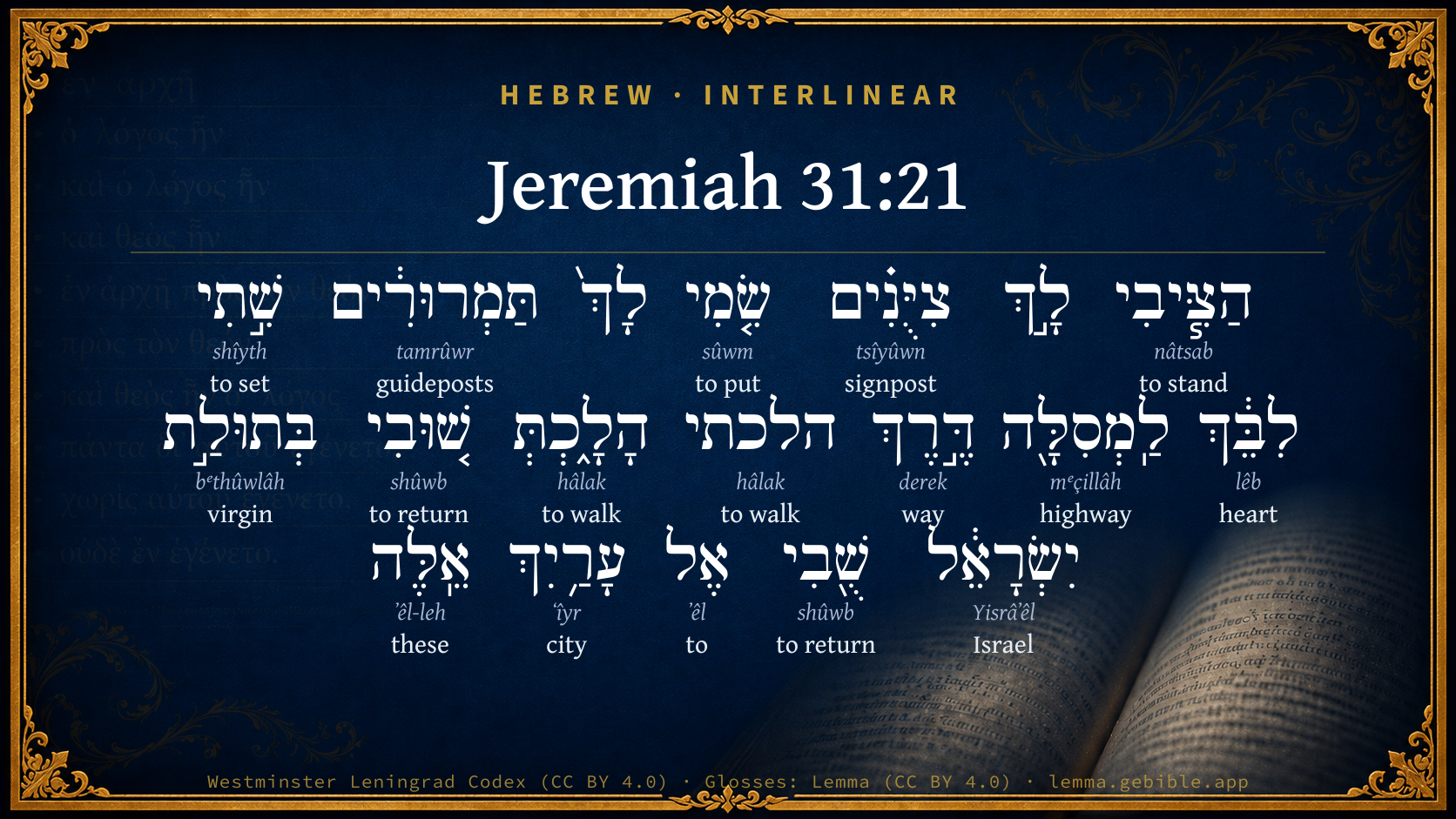
Jeremiah 31:21

Hebrew (Westminster Leningrad Codex) Jeremiah 31:21 appears in the Hebrew Old Testament. The text above is from the Westminster Leningrad Codex. Each word links to its Strong’s number, a concise gloss, and parsing drawn from the Open Scriptures Hebrew Bible morphology. Click any word for its full Brown-Driver-Briggs (BDB) entry.
Download image
Cite this verse

Jeremiah 31:21 (World English Bible). Public Domain. Lemma interlinear Bible study tool, https://lemma.gebible.app/v/jeremiah/31/21.

Show BibTeX & RIS
BibTeX
RIS
English Translation
Set up road signs, make guideposts; set your heart toward the highway, even the way by which you went: turn again, virgin of Israel, turn again to these your cities.
World English Bible · Public Domain
Highlights
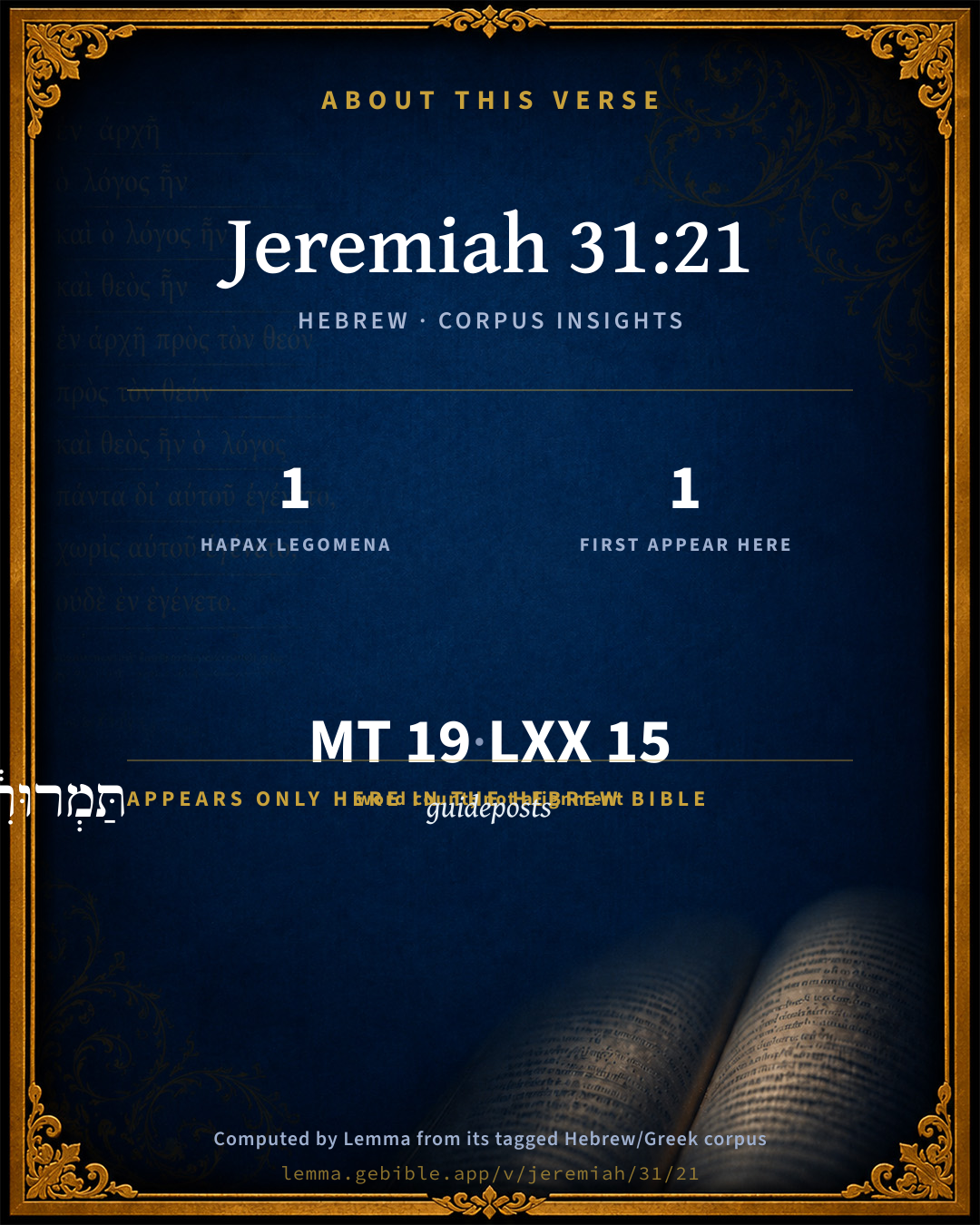
  • 1 hapax legomenon — only here in the Hebrew Bible
  • 1 first appearance in the Hebrew Bible
Full analysis ↓
Download a study sheet

One document with this verse’s original text, its word-by-word gloss line, the meaning frame, cross-references with their text, attributed commentary, and full source and license credits — printable, and it pastes into notes with its structure intact.

This verse Autodidact and up

Study sheet (.html) Plain text (.txt)

A passage Seminary Student

Up to 50 verses in one chapter. A passage sheet keeps up to 6 commentary sources and 12 cross-references per verse, in the order this page ranks them, and says so on the sheet whenever that leaves anything out. Ask for a single verse and you get the Autodidact verse sheet above.

Everything on this page stays free to read, with no account — the sheet is a download of what is already on screen, not access to it.

Want to remove ads? Support Godless Engineer
Compare translations 3

The same verse in 3 English versions, stacked beneath the original-language interlinear above. Click any original word for its lexicon entry.

Each is an independent rendering of the whole verse — the interlinear is not word-aligned to these translations.

Highlighted words mark where these versions differ — a whole-verse word diff, not a word-by-word alignment.

  • World English Bible Public Domain
    Set up road signs, make guideposts; set your heart toward the highway, even the way by which you went: turn again, virgin of Israel, turn again to these your cities.
  • King James Version Public Domain
    Set thee up waymarks, make thee high heaps: set thine heart toward the highway, even the way which thou wentest: turn again, O virgin of Israel, turn again to these thy cities.
  • unfoldingWord Literal Text CC BY-SA 4.0
    Place road signs for yourself. Set up guideposts for yourself. Set your mind on the right path, the way you should take. Come back, virgin Israel! Come back to these cities of yours.

unfoldingWord Literal Text — © unfoldingWord, licensed CC BY-SA 4.0. Word-aligned USFM3 via Door43 (git.door43.org/unfoldingWord/en_ult).

Versions to compare (up to 4)

3 of 4 selected

Show all 18 translations

Every available English version of this verse, each an independent rendering of the whole verse.

  • World English Bible Public Domain
    Set up road signs, make guideposts; set your heart toward the highway, even the way by which you went: turn again, virgin of Israel, turn again to these your cities.
  • Berean Standard Bible Public Domain
    “Set up the roadmarks, establish the signposts. Keep the highway in mind, the road you have traveled. Return, O Virgin Israel, return to these cities of yours.
  • Majority Standard Bible Public Domain
    “Set up the road markers, put up the signposts. Keep the highway in mind, the road you have traveled. Return, O Virgin Israel, return to these cities of yours.
  • King James Version Public Domain
    Set thee up waymarks, make thee high heaps: set thine heart toward the highway, even the way which thou wentest: turn again, O virgin of Israel, turn again to these thy cities.
  • American Standard Version (1901) Public Domain
    Set thee up waymarks, make thee guide-posts; set thy heart toward the highway, even the way by which thou wentest: turn again, O virgin of Israel, turn again to these thy cities.
  • Revised Version (1885) Public Domain
    Set thee up waymarks, make thee guide-posts: set thine heart toward the highway, even the way by which thou wentest: turn again, O virgin of Israel, turn again to these thy cities.
  • Geneva Bible (1599) Public Domain
    Set thee vp signes: make thee heapes: set thine heart towarde the path and way, that thou hast walked: turne againe, O virgine of Israel: turne againe to these thy cities.
  • Douay-Rheims (1899) Public Domain
    Set thee up a watchtower, make to thee bitterness: direct thy heart into the right way, wherein thou hast walked: return, O virgin of Israel, return to these thy cities.
  • Young's Literal Translation Public Domain
    Set up for thee signs, make for thee heaps, Set thy heart to the highway, the way thou wentest, Turn back, O virgin of Israel, Turn back unto these thy cities.
  • Literal Standard Version CC BY-SA 4.0
    “Set up signs for yourself, || Make heaps for yourself, || Set your heart to the highway, the way you went, || Turn back, O virgin of Israel, || Turn back to these cities of yours.
  • Unlocked Literal Bible CC BY-SA 4.0
    Place road signs for yourself. Set up guideposts for yourself. Set your mind on the right path, the way you should take. Come back, virgin Israel! Come back to these cities of yours.
  • unfoldingWord Literal Text CC BY-SA 4.0
    Place road signs for yourself. Set up guideposts for yourself. Set your mind on the right path, the way you should take. Come back, virgin Israel! Come back to these cities of yours.
  • Darby Bible Public Domain
    Set up waymarks, make for thyself signposts; set thy heart toward the highway, the way by which thou wentest: turn again, O virgin of Israel, turn again to these thy cities.
  • World Messianic Bible Public Domain
    “Set up road signs. Make guideposts. Set your heart toward the highway, even the way by which you went. Turn again, virgin of Israel. Turn again to these your cities.
  • Webster's Bible Public Domain
    Set thee up way-marks, make thee high heaps: set thy heart towards the highway, even the way which thou wentest; turn again, O virgin of Israel, turn again to these thy cities.
  • Free Bible Version CC BY-SA 4.0
    Put up markers on the road; make signposts for yourselves. You need to be sure you can find the highway, the road you traveled on. Come back, Virgin Israel, come back to your towns.
  • Bible in Basic English Public Domain
    Put up guiding pillars, make road signs for yourself: give attention to the highway, even the way in which you went: be turned again, O virgin of Israel, be turned to these your towns.
  • JPS Tanakh (1917) Public Domain
    Set thee up waymarks, make thee guide-posts; set thy heart toward the high-way, even the way by which thou wentest; Return, O virgin of Israel, return to these thy cities.

Literal Standard Version (2020), Covenant Press — licensed CC BY-SA 4.0. Text via the HelloAO Bible API (eBible.org). Unlocked Literal Bible (unfoldingWord) — licensed CC BY-SA 4.0. Text via the HelloAO Bible API (eBible.org). unfoldingWord Literal Text — © unfoldingWord, licensed CC BY-SA 4.0. Word-aligned USFM3 via Door43 (git.door43.org/unfoldingWord/en_ult). Free Bible Version, Dr. Jonathan Gallagher — licensed CC BY-SA 4.0. Text via the HelloAO Bible API (eBible.org).

Word by word

More ways to search: Search by grammar → Find every occurrence → Compare this word →

Practice this passage: Drill this verse → Learn its vocabulary →

תַּמְרוּרִ֔ים
tamrûwr
H8564
“guideposts”
Noun, Common, Masculine, Plural, Absolute
Part of Speech
Noun
Type
Common
Gender
Masculine
Number
Plural
State
Absolute
Full BDB Definition

Origin: from the same root as H8558

TWOT: 2523e

guideposts, markers, signposts, high heap - meaning doubtful
  1. הַצִּ֧יבִי nâtsab H5324 “stand” Verb, Hiphil, Imperative, 2nd Person, Feminine, Singular
  2. צִיֻּנִ֗ים tsîyûwn H6725 “signposts” Noun, Common, Masculine, Plural, Absolute
  3. שִׂ֤מִי sûwm H7760 “put” Verb, Qal, Imperative, 2nd Person, Feminine, Singular
  4. שִׁ֣תִי shîyth H7896 “set” Verb, Qal, Imperative, 2nd Person, Feminine, Singular
  5. לִבֵּ֔ךְ lêb H3820 “heart · your” Noun, Common, Masculine, Singular, Construct + Suffix, Personal, 2nd Person, Feminine, Singular
  6. לַֽמְסִלָּ֖ה mᵉçillâh H4546 “to/for the · highway” Preposition, Determined + Noun, Common, Feminine, Singular, Absolute
  7. דֶּ֣רֶךְ derek H1870 “way” Noun, Common, Both, Singular, Absolute
  8. הלכתי hâlak H1980 “to walk” Verb, Qal, Perfect, 2nd Person, Feminine, Singular
  9. הָלָ֑כְתְּ hâlak H1980 “to walk” Verb, Qal, Perfect, 2nd Person, Feminine, Singular
  10. שׁ֚וּבִי shûwb H7725 “return” Verb, Qal, Imperative, 2nd Person, Feminine, Singular
  11. בְּתוּלַ֣ת bᵉthûwlâh H1330 “virgin of” Noun, Common, Feminine, Singular, Construct
  12. יִשְׂרָאֵ֔ל Yisrâʼêl H3478 “Israel” Noun, Proper
  13. שֻׁ֖בִי shûwb H7725 “return” Verb, Qal, Imperative, 2nd Person, Feminine, Singular
  14. אֶל ʼêl H413 “to” Preposition
  15. עָרַ֥יִךְ ʻîyr H5892 “cities · your” Noun, Common, Feminine, Plural, Construct + Suffix, Personal, 2nd Person, Feminine, Singular
  16. אֵֽלֶּה ʼêl-leh H428 “these” Pronoun, Demonstrative, Common, Plural

About this verse

These counts appear in no published source. They are computed here, from the morphology-tagged text and Lemma’s own curated glosses. What Lemma adds →

19
words
15
distinct lemmas
Prophets
section

Notable vocabulary

1 hapax legomenon — a word that appears only here in the entire Hebrew Bible:

  • תַּמְרוּרִ֔ים guideposts H8564

First appearance in Scripture

This word makes its first canonical appearance in the Hebrew Bible here:

  • תַּמְרוּרִ֔ים guideposts H8564

Shared distinctive vocabulary

צִיֻּנִ֗ים signpost H6725 occurs in 3 verses of the Hebrew Bible. Also found in:

Grammatical profile

  • 7 verbs
  • 8 nouns
  • 1 pronoun
  • 3 prepositions

Verb forms

  • הַצִּ֧יבִי Hiphil · Imperative
  • שִׂ֤מִי Qal · Imperative
  • שִׁ֣תִי Qal · Imperative
  • הלכתי Qal · Perfect
  • הָלָ֑כְתְּ Qal · Perfect
  • שׁ֚וּבִי Qal · Imperative
  • שֻׁ֖בִי Qal · Imperative

Repetition

Words recur within this verse — often emphatic in Hebrew:

  • הלכתי to walk H1980 ×2
  • שׁ֚וּבִי to return H7725 ×2

Hebrew & Septuagint length

In the original languages it is 19 Hebrew tokens and 15 Greek tokens — but the two are counted differently (Hebrew bundles its prefixes and suffixes into one token; the Greek is in lemma form), so that isn’t a like-for-like length.

Cross-references

20

Topical passages linked to Jeremiah 31:21 in the Treasury of Scripture Knowledge — connected by theme and wording, ordered by reader-vote popularity; previews shown in the World English Bible.

  • Jeremiah 50:5 They shall inquire concerning Zion with their faces turned toward it, [saying], Come you, and join yourselves to Yahweh in an everlasting covenant that shall not be forgotten.
  • Isaiah 62:10 Go through, go through the gates; prepare you the way of the people; cast up, cast up the highway; gather out the stones; lift up an ensign for the peoples.
  • Psalms 84:5 Blessed are those whose strength is in you; Who have set their hearts on a pilgrimage.
  • Isaiah 48:20 Go you forth from Babylon, flee you from the Chaldeans; with a voice of singing declare you, tell this, utter it even to the end of the earth: say you, Yahweh has redeemed his servant Jacob.
  • Isaiah 52:11–12 Depart you, depart you, go you out from there, touch no unclean thing; go you out of the midst of her; cleanse yourselves, you who bear the vessels of Yahweh.
  • Isaiah 57:14 He will say, Cast up, cast up, prepare the way, take up the stumbling-block out of the way of my people.
  • Jeremiah 3:14 Return, backsliding children, says Yahweh; for I am a husband to you: and I will take you one of a city, and two of a family, and I will bring you to Zion:
  • Jeremiah 31:4 Again will I build you, and you shall be built, O virgin of Israel: again shall you be adorned with your tambourines, and shall go forth in the dances of those who make merry.
  • Jeremiah 51:50 You who have escaped the sword, go you, don't stand still; remember Yahweh from afar, and let Jerusalem come into your mind.
  • Ezekiel 40:4 The man said to me, Son of man, see with your eyes, and hear with your ears, and set your heart on all that I shall show you; for, to the intent that I may show them to you, are you brought here: declare all that you see to the house of Israel.
  • Haggai 1:5 Now therefore this is what Yahweh of Hosts says: Consider your ways.
  • Zechariah 2:6–7 Come! Come! Flee from the land of the north,' says Yahweh; 'for I have spread you abroad as the four winds of the sky,' says Yahweh.
  • Deuteronomy 32:46 He said to them, Set your heart to all the words which I testify to you this day, which you shall command your children to observe to do, [even] all the words of this law.
  • 1 Chronicles 29:3 In addition, because I have set my affection on the house of my God, seeing that I have a treasure of my own of gold and silver, I give it to the house of my God, over and above all that I have prepared for the holy house,
  • 2 Chronicles 11:16 After them, out of all the tribes of Israel, such as set their hearts to seek Yahweh, the God of Israel, came to Jerusalem to sacrifice to Yahweh, the God of their fathers.
  • 2 Chronicles 20:3 Jehoshaphat feared, and set himself to seek to Yahweh; and he proclaimed a fast throughout all Judah.
  • Psalms 62:10 Don't trust in oppression. Don't become vain in robbery. If riches increase, Don't set your heart on them.
  • Proverbs 24:32 Then I saw, and considered well. I saw, and received instruction:
  • Jeremiah 51:6 Flee out of the midst of Babylon, and save every man his life; don't be cut off in her iniquity: for it is the time of Yahweh's vengeance; he will render to her a recompense.
  • Zechariah 10:9 I will sow them among the peoples; And they will remember me in far countries; And they will live with their children, and will return.

Cross-references courtesy of OpenBible.info (CC BY 4.0).

Hebrew and Greek witnesses Masoretic Hebrew ↔ Greek Septuagint

The same verse in the two great witnesses to the Old Testament, shown verse-for-verse.

These are two independent witnesses, not word-aligned to each other, and the Septuagint is shown in lemma (dictionary) form.

Hebrew Jeremiah 31:21 Masoretic · Westminster Leningrad Codex

הַצִּ֧יבִי לָ֣ךְ צִיֻּנִ֗ים שִׂ֤מִי לָךְ֙ תַּמְרוּרִ֔ים שִׁ֣תִי לִבֵּ֔ךְ לַֽמְסִלָּ֖ה דֶּ֣רֶךְ הלכתי הָלָ֑כְתְּ שׁ֚וּבִי בְּתוּלַ֣ת יִשְׂרָאֵ֔ל שֻׁ֖בִי אֶל עָרַ֥יִךְ אֵֽלֶּה

Set up road signs, make guideposts; set your heart toward the highway, even the way by which you went: turn again, virgin of Israel, turn again to these your cities.

World English Bible · Public Domain

Greek LXX Structure differs

In the Septuagint, Jeremiah is about an eighth shorter than the Hebrew and arranges its material differently — the Oracles Against the Nations (Hebrew chapters 46–51) appear in the middle of the Greek book, after 25:13. Because the chapter and verse boundaries do not line up, a verse-for-verse comparison with the Hebrew is not shown.

A verse-for-verse comparison isn’t shown here because the chapters and verses don’t line up. Switch to the LXX edition with the MT / LXX toggle above to read the Greek directly.

Hebrew: Westminster Leningrad Codex (CC BY 4.0). Greek: Septuagint (public domain); English from a public-domain English Septuagint. How the Septuagint differs from the Hebrew →

Targum (Aramaic paraphrase)

1

The Targum is the ancient Jewish Aramaic paraphrase of the Hebrew Scriptures — an interpretive translation, not the Hebrew text itself. Onkelos (literal) and Pseudo-Jonathan (expansive) render the Torah, and Jonathan the Prophets. Coverage is partial: where no permissively-licensed English translation exists for a verse, only the Aramaic is shown. This is verse-level text, not a word-by-word alignment to the Hebrew.

  1. Targum Jonathan Prophets (Joshua–Malachi)
    כְּנִשְׁתָּא דְיִשְׂרָאֵל אֶדְכְּרִי לִיךְ עוֹבָדֵי אֲבָהָתִיךְ תַּקְנַיָא שְׁפוּכִי תַחֲנוּנִין בִּמְרַר שַׁוִיאִי לִבִּיךְ אִסְתַּכָּלִי בְּעוֹבָדִין דַעֲבַדְתְּ אִם תַּקְנִין דְכֵן גְלֵית לְאוֹרַח רְחִיקָא כְּדוֹ תּוּבוּ כְּנִשְׁתָּא דְיִשְׂרָאֵל וּתְתוּבוּן לִקְרְוָךְ אִלֵין:

    Congregation of Israel, remember the righteous deeds of your fathers. Pour out pleading prayers in bitter sorrow. Look upon the deeds you have done, if they were proper; this is why you've had to wander so far. Return, congregation of Israel, and you will return to these, your cities.

    Targum Jonathan — Aramaic: “Mikraot Gedolot” (public domain). English: “Sefaria Community Translation” (CC0 1.0 (public-domain dedication)); “London "Chaldee Paraphrase," 1871” (public domain). Text via Sefaria.

Commentary

Notes on Jeremiah 31:21 from classic Christian and Jewish commentators (each source and its license shown beneath its notes). The classic Christian expositions comment on the surrounding passage and are grouped to its opening verse, so a note may address several verses; the Jewish commentaries on the Tanakh (Rashi and others) are per-verse, so they appear only where the commentator wrote on this verse.

Lemma curates 59 commentaries, every one of them public domain or Creative Commons licensed, each selected and text-cleaned for this edition rather than reprinted as found. About our sources →

Trapp's Complete Commentary

John Trapp

Jer 31:21 Set thee up waymarks, make thee high heaps: set thine heart toward the highway, [even] the way [which] thou wentest: turn again, O virgin of Israel, turn again to these thy cities.

Ver. 21. Set thee up waymarks.] Statue tibi statuas Mercuriales - q.d., I will surely bring thee back by the same way thou wentest hence into captivity; therefore take good notice of the way now, that thou mayest know it again another time. This God saith to quicken their faith, and to ascertain them of his love and favour; which is not like the winter sun, which casteth a goodly countenance when it shineth, but giveth little heat and comfort, &c. We must also set up waymarks, observe how we fell from the Lord, repent and do our first works.

Set thine heart towards the highway.] This is done, saith Augustine, when God is sought for God’s sake. Sed vix diligitur Iesus propter Iesum, saith the same Father; but this is rarely done.

John Trapp, A Commentary or Exposition upon All the Books of the Old and New Testament (1647–1656) — public domain. Text from a community e-Sword module.

Joseph Benson's Commentary

Jer 31:21. Set thee up way-marks — “These words are a call to Israel to prepare for their return. The word צינים, rendered way-marks, means stone pillars, and תמרודים, translated heaps, from המר, a palm-tree, probably signifies tall-poles, like palm-trees, or, perhaps, made of palm- trees; both set up in the roads, at certain distances, for the traveller’s direction, and extremely necessary for those who had to pass wild and spacious deserts,” — Blaney. Set thy heart toward the way which thou wentest — Mind well the way that the Assyrians and Babylonians carried thee captive, for thou shalt return the same way. Turn again — That is, Return to thine own country; O virgin of Israel — See note on Jer 31:14. Turn again to these thy cities — The expression is doubled for the greater certainty of the event.

Joseph Benson's Commentary on the Old and New Testaments (1811–1818) — public domain. Text from a community e-Sword module.

Tyndale Open Study Notes

Tyndale Open Resources

31:21 road signs . . . guideposts: The Lord guided his people physically back to the land of Israel and spiritually back to their covenant relationship with him.

Tyndale Open Study Notes — © Tyndale Open Resources, licensed CC BY-SA 4.0. Text via the HelloAO Bible API.

Geneva Bible (1599)

Geneva Bible translators

Mark by what way thou didst go into captivity, and thou shalt turn again by the same.

Geneva Bible (1599) marginal notes — public domain. Text via Bolls.life.

Jamieson, Fausset & Brown

Robert Jamieson, A. R. Fausset & David Brown

waymarks--pillars to mark the road for the returning exiles. Caravans set up pillars, or pointed heaps of stones, to mark the way through the desert against their return. So Israel is told by God to mark the way by which they went in leaving their country for exile; for by the same way they shall return.

highway-- (Isa 35:8, Isa 35:10).

Jamieson, Fausset & Brown — Commentary Critical and Explanatory on the Whole Bible (1871) — public domain (CC PDM 1.0). Text via the HelloAO Bible API.

Adam Clarke's Commentary

Verse 21. Set thee up waymarks] Alluding to stones, or heaps of stones, which travellers in the desert set up to ascertain the way, that they may know how to return. Mark the way to Babylon: thither ye shall certainly go; but from it ye shall as certainly return.

Adam Clarke's Commentary on the Bible (1810–1826) — public domain. Text from a community e-Sword/MySword module.

John Calvin's Commentaries

He describes what mercy would do, even that God would at length restore the captives and bring them back from exile to their own country. There was however mention made previously of his favor, that we may know that the people were restored for no other reason but because God had mercy on them. The Prophet then having pointed out the fountain of redemption, passes on now to the external effect, by which God proved that he was reconciled to his people. Hence he says, set up for thee titles

We must first understand why the Prophet speaks thus. When the Jews were led away into Chaldea, they thought that a return was closed up against them. Having then given up every concern for their country, they dwelt among foreign nations, as though they were dead to the land of Canaan. They knew that they had forfeited that land; but they did not understand what had been so often said to them by the Prophets, that their punishment was to be temporary. As they had before disregarded all threatenings, so when God began to fulminate against them, despair overwhelmed their minds, so that they did not wish to hear anything about a return. As then they thought that they were never to return to their own country, they had forgotten the way. As when one moves to another place where he intends to dwell all his life, he only seeks to know the way thither, but does not observe the accommodations on the road, in order to use them again, nor does he take notice which way he goes, whether he turns here to the right and there to the left; it is enough for him to reach the place to which he is going; so also it was with the Jews; they had made up their minds to remain in perpetual exile, they were not therefore solicitous about the road, so as to remember their journey. Therefore the Prophet says now, Set up for thee titles, or inscriptions; for those who travel anywhere, if they mean to return, know that such an inn was commodious, and also that there was so much distance between this town or city and that village, and in like manner, that the road was straight or turned more to one side than another. When therefore they think of a return, they attend to such things as these.

It is for this purpose that the Prophet says, Set up for thee titles, that is, that thou mayest assist thy memory, as travelers are wont to do, who intend to return by the same way. Set up then for thee titles, and raise up for thee heaps, or stones, which we call in our language monioyes; as though he had said, “Thou indeed hast hitherto thought that the way has been closed up against thee, so that thou art to return no more: but God will stretch forth his hand and restore thee to thy former state.” We hence see that the similitude is taken from the common practice of men, but employed for this end, that the Jews might not despair of their restoration as they had previously don.

He then says, Apply thy heart — he now explains himself — apply thy heart to the footpath, to the way through which thou hast passed We thus see that the Prophet becomes the interpreter of his own words, even that the people would return along the same road, though they expected no such thing. And he again confirms the same declaration in other words, Return, thou daughter of Israel, return to thine own cities; as though he had said, “Though the land has beea deserted for a time, and reduced to solitude, yet the cities remain, which shall again receive their inhabitants; and through the wonderful favor of God the land still waits for its people.” Though it cast them out for a time, yet the exile was not to be perpetual, for the cities which remained were still by right the property of the people, not because they were worthy of them, but because God had prefixed, as it has elsewhere appeared, a set time for their exile and punishment.

John Calvin's Commentaries (1540-1563) — public domain. Text from the Calvin Translation Society English edition (1840s-50s) via the Christian Classics Ethereal Library (ccel.org). Calvin's coverage is partial (roughly two-thirds of the Bible); uncommented books and verses are honest gaps, never fabricated. The 19th-century editor's footnotes and remarks are omitted so the notes are faithfully Calvin's own voice.

Ellicott's Commentary for English Readers

(21) Set thee up way marks . . .—It will be noted that the figure is changed, and that instead of “Ephraim, the dear son,” we have Israel, the “back-sliding daughter.” The idea of the return of the exiles is still prominent, and she, as represented by the first group of those who came back, is called on to set up “heaps of stones,” after the manner of Eastern travellers, as waymarks for those who followed. (Comp. Eze_39:15.) The way which she had trodden when she was led out into captivity was to be re-trodden in the fulness of joy on her return. She was to pass in her joy through the self-same cities that had then seen her in her shame.

A Bible Commentary for English Readers, edited by Charles John Ellicott (1878–1897) — public domain. Text from a community e-Sword module.

The Cambridge Bible for Schools and Colleges

gen. ed. J. J. S. Perowne

21. That the travellers should themselves be bidden to set up signposts has caused needless trouble to some commentators. Israel is bidden to mark out the way for his return, perhaps by pioneers sent in advance.

guide-posts] The Heb. word occurs here only.

set thine heart] The heart in Heb. denotes the seat of the intellect. Hence the sense is, turn thy attention to the way by which thou wentest into exile, that thou mayest retrace thy steps.

The Cambridge Bible for Schools and Colleges (gen. ed. J. J. S. Perowne; Cambridge University Press, 1878–1918) — public domain. Text from a community e-Sword module.

John Gill's Exposition

Set thee up way marks, make thee high heaps,.... Of stones, raised up as pillars, or like pyramids; or upright, as palm trees, which signification the word (z) has; to be marks and signs, to know the way again upon a return. The Targum is,

"O congregation of Israel, remember the right works of thy fathers; pour out supplications; in bitterness set thy heart.''

And so the Vulgate Latin version interprets the last clause, "put on bitternesses", without any sense; so Cocceius. The design of the words is to put the Jews upon thoughts of returning to their own land, and to prepare for it;

set thine heart towards the highway, even the way which thou wentest; from Judea to Babylon, or into other countries; think of going the same way back again; for, as there was a highway from Judea, there is one to it; let thine heart be upon returning that way. Jarchi reads, "the way which I went"; that is, the way in which the Lord went with the people; the right way in which he guided and directed them; and in which following him, they could not err; see Isa 35:8. The Targum is,

"consider the works which thou hast done, whether they are fight, when thou goest in a way afar off;''

turn again, O virgin of Israel, turn again to these thy cities; an invitation and encouragement to the Jews to turn again to their own land; as from the Babylonish captivity, so from all lands in the latter day; which is yet to be fulfilled, and to which the prophecy more properly belongs.

(z) "columnulas", Schmidt; "pyramidas", Junius & Tremellius, Piscator; "palmulas", Tigurine version, "a palma".

John Gill's Exposition of the Whole Bible (1746–1763) — public domain (CC PDM 1.0). Text via the HelloAO Bible API.

Haydock's Catholic Bible Commentary

Tower, to bewail thy past follies; or signals to know the way, or tombs for thy beloved.

George Leo Haydock (1774–1849), Haydock's Catholic Family Bible and Commentary, 1859 edition — public domain. Excludes Psalms (Douay-Rheims chapter numbering differs from Protestant) and Deuterocanonical books (Catholic canon only).

Matthew Poole's English Annotations

The latter part of this verse expounds the former. Thou shalt (saith God) return again to these cities which thou now leavest, therefore take good notice of the way thou seest, set up some marks by which thou mayst know it again; make thee pillars of some high heaps of stone in the way, which thou mayst know again when thou comest at them; mind well the way that the Assyrians and the Babylonians carried thee, for thou shalt come back the same way. Further to assure them they should return, he calls to them

to turn again, and doubleth his words, for the further confirmation of the thing.

Matthew Poole's English Annotations on the Holy Bible (1683–1685) — public domain. Text from a community e-Sword/MySword module.

Whedon's Commentary on the Bible

Daniel D. Whedon

21. High heaps — Pillars, or signposts.

Daniel D. Whedon (gen. ed.), Commentary on the Old and New Testaments (1874–1909) — public domain. Text from a community e-Sword module.

The Pulpit Commentary

Set thee up waymarks. The "virgin of Israel" is addressed. She is directed to mark out the road for the returning exiles. The command is obviously historical in form; the general sense is that the Israelites are to call to mind the road so familiar to their forefathers, though only known to themselves by tradition. The word rendered "way marks" occurs again in 2Ki_23:17 and Eze_39:15. It apparently means a stone pillar, which might be used either as a way mark or a sepulchral monument. The high heaps seem to mean much the same thing; "signposts" would be a better rendering. Set thine heart toward the highway; rather, turn thy thoughts, etc., for the heart is here evidently the symbol of the intellectual rather than the moral life. (comp. 1Ki_10:2, and many other passages) A passage in the Psalms (Psa_84:6) will occur to every one, in which a psalmist, longing at a distance for the services of the temple, pronounces blessed the man "in whose heart are the highways to Zion;" here, it is true, "heart" has the double meaning of "mind" and "affections," but "highway" has almost exactly the same sense as in the passage before us. To these thy cities. The unseen speaker is supposed to be in Palestine.

The Pulpit Commentary (1880–1919), ed. H.D.M. Spence-Jones & Joseph S. Exell — public domain. Text from a community e-Sword module.

John Wesley's Explanatory Notes

Set up - Thou shalt return to these cities which thou now leavest, therefore take good notice of the way, set up marks by which thou mayest know it again, make thee pillars or some high heaps of stones in the way, mind well the way that the Assyrians and the Babylonians carried thee, for thou shalt come back the same way.

John Wesley, Explanatory Notes Upon the Whole Bible (1754–1765) — public domain. Text via the GEBible commentary corpus.

unfoldingWord translationNotes

Door43 World Missions Community

General Information:

God continues to speak from verse 7.

Place road signs for yourself ... Set up guideposts for yourself ... Set your mind ... you should take ... Come back

These commands and instances of "yourself" and "your" and "you" are addressed to "virgin Israel" and so are singular. (See: Pronouns)

Come back, virgin Israel!

God is referring to a changed Israel. (See: Metaphor)

How long will you waver, faithless daughter?

Yahweh is telling his people that he is becoming impatient with them because they are not obeying him. AT: "Do not hesitate to start obeying me." (See: Rhetorical Question)

waver

Possible meanings are 1) be unable to decide what to do or 2) often go off the correct path, a metaphor for disobeying Yahweh. (See: Metaphor)

new on earth—a woman surrounds a strong man

Possible meanings are 1) the people will be so safe that women will not need anyone to protect them or 2) this is an idiom for something no one would ever expect. AT: "new on earth—something as strange as a woman protecting a man" (See: Idiom)

translationWords

virgin

Israel

faithless

create

unfoldingWord translationNotes — © Distant Shores Media and the Door43 World Missions Community, licensed CC BY-SA 4.0. Source: git.door43.org/Door43/en_tn.

Rashi

Rabbi Shlomo Yitzchaki (Rashi)

Set up markers for yourself Signs in the good ways of your ancestors.

small palms small palms (תְּמָרִים) planted for a sign on the way. And the simple interpretation of the verse is. Make signs to know the way you traversed from Eretz Israel to Babylon, so that you will return by that road; that is to say that you will surely return from there.

the road upon which you went The “kethib” is הָלָכְתִּי, “I went,” and everywhere that you went I went with you Jonathan, however, renders. place “tamrurim” for yourself: Pray with embittered spirit, deriving תַּמְרוּרִים from מַר bitter. (And Menahem [Machbereth p. 119] explained תַּמְרוּרִים as an expression of raising up, and so he explained וְתִמְרוֹת “raising of smoke” (Joel 3:3). In some editions, this is missing.)

Rashi on the Tanakh — English translations: “The Judaica Press complete Tanach with Rashi, translated by A. J. Rosenberg” (CC BY 4.0); “Pentateuch with Rashi's commentary by M. Rosenbaum and A.M. Silbermann, 1929-1934” (public domain); “The Metsudah Tanach series, Lakewood, N.J” (CC BY 4.0); and “The Book of Joshua, Metsudah Publications, 1997” (CC BY 4.0). Text via Sefaria.

Lesson kit

Teaching starters — assembled from the data on this page, not authored interpretation. Every prompt links to the verse data it draws on. Edit before teaching.

Jeremiah, in the Prophets, opens this verse with 19 words (15 distinct Hebrew lemmas). Its most distinctive word is tamrûwr (“guideposts”). A historical commentator’s framing appears above. Read the whole chapter for the surrounding context.

Discussion questions

  1. How does “guideposts” (tamrûwr) shape what this verse is saying?
  2. This verse holds 1 word here found nowhere else in the Hebrew Bible. What might the rare word draw attention to?
  3. The word “guideposts” first appears here in Scripture. What is being introduced at this debut?
  4. 2 Kings 23:17 shares the word «signpost» with this verse. How do the two illuminate each other?
  5. “to walk” occurs 2× in this one verse. What is the effect of the repetition?
  6. The translations on this page render this verse differently — a whole-verse word diff, not a word-by-word alignment. What might account for the different wordings?
  7. The verb «הַצִּ֧יבִי» is Hiphil Imperative. How does its form color the action?
  8. Reading how Trapp's Complete Commentary and Joseph Benson's Commentary read this verse, where do the two commentators agree and where do they part?

Things to notice

  • 1 word in this verse appears nowhere else in the Hebrew Bible.
  • 1 word makes its first canonical appearance in Scripture here.
  • This verse counts 19 Hebrew ↔ 15 Greek words.
  • These translations choose different wording for 28 words in this verse.
  • “to walk” occurs 2× in this single verse.

Reading settings

Reading text

Shown beneath each verse's original-language words.

Old Testament
Old Testament edition

Read the OT as the Masoretic Hebrew (MT) or the Greek Septuagint (LXX).

English shown for the Greek Septuagint (in the Hebrew ↔ Greek comparison).

Comparing translations? Open the Compare panel on any verse page to stack up to four side by side.