
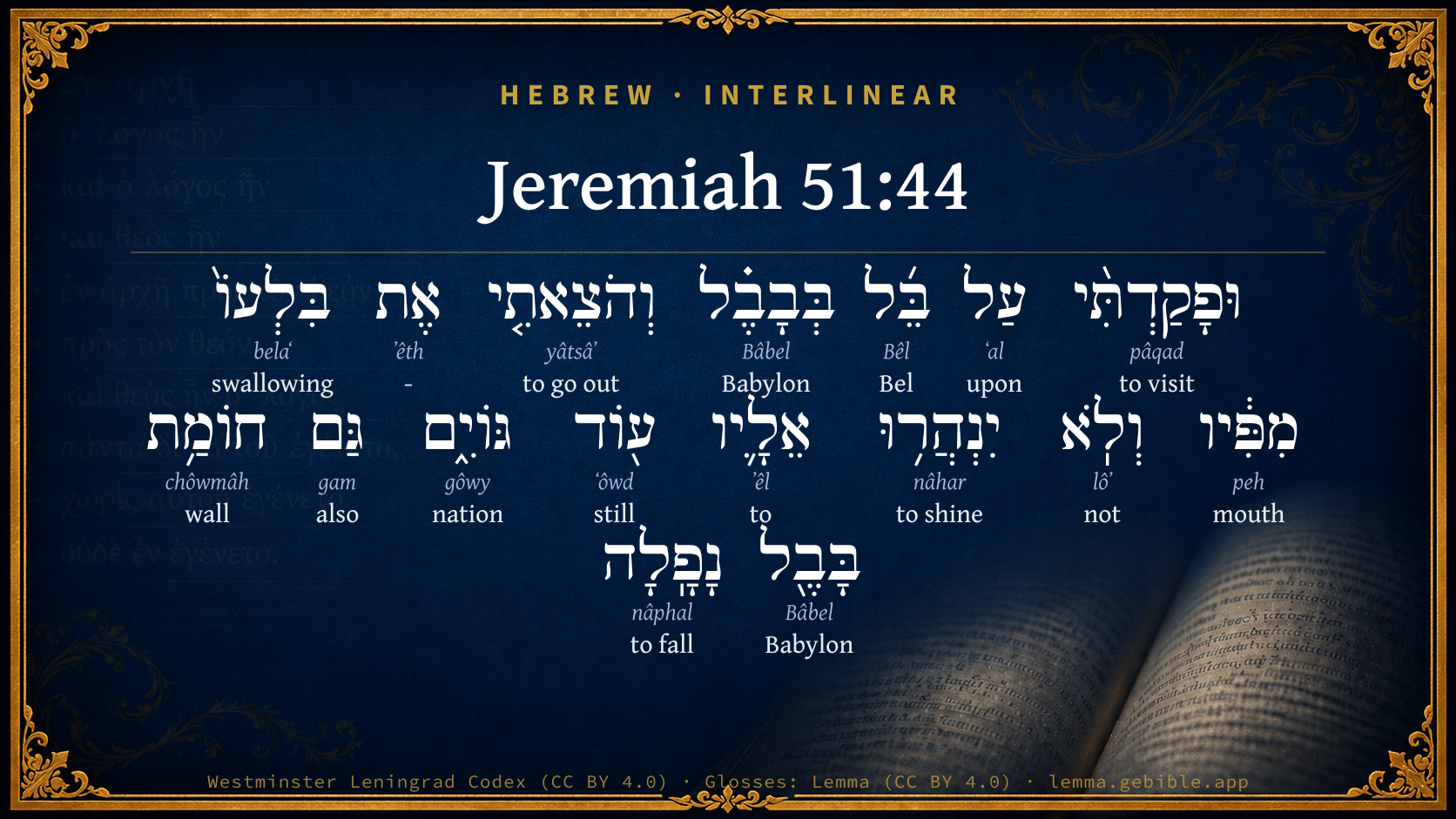
Jeremiah 51:44

Hebrew (Westminster Leningrad Codex) Jeremiah 51:44 appears in the Hebrew Old Testament. The text above is from the Westminster Leningrad Codex. Each word links to its Strong’s number, a concise gloss, and parsing drawn from the Open Scriptures Hebrew Bible morphology. Click any word for its full Brown-Driver-Briggs (BDB) entry.
Download image
Cite this verse

Jeremiah 51:44 (World English Bible). Public Domain. Lemma interlinear Bible study tool, https://lemma.gebible.app/v/jeremiah/51/44.

Show BibTeX & RIS
BibTeX
RIS
English Translation
I will execute judgment on Bel in Babylon, and I will bring forth out of his mouth that which he has swallowed up; and the nations shall not flow any more to him: yes, the wall of Babylon shall fall.
World English Bible · Public Domain
Download a study sheet

One document with this verse’s original text, its word-by-word gloss line, the meaning frame, cross-references with their text, attributed commentary, and full source and license credits — printable, and it pastes into notes with its structure intact.

This verse Autodidact and up

Study sheet (.html) Plain text (.txt)

A passage Seminary Student

Up to 50 verses in one chapter. A passage sheet keeps up to 6 commentary sources and 12 cross-references per verse, in the order this page ranks them, and says so on the sheet whenever that leaves anything out. Ask for a single verse and you get the Autodidact verse sheet above.

Everything on this page stays free to read, with no account — the sheet is a download of what is already on screen, not access to it.

Want to remove ads? Support Godless Engineer
Compare translations 3

The same verse in 3 English versions, stacked beneath the original-language interlinear above. Click any original word for its lexicon entry.

Each is an independent rendering of the whole verse — the interlinear is not word-aligned to these translations.

Highlighted words mark where these versions differ — a whole-verse word diff, not a word-by-word alignment.

  • World English Bible Public Domain
    I will execute judgment on Bel in Babylon, and I will bring forth out of his mouth that which he has swallowed up; and the nations shall not flow any more to him: yes, the wall of Babylon shall fall.
  • King James Version Public Domain
    And I will punish Bel in Babylon, and I will bring forth out of his mouth that which he hath swallowed up: and the nations shall not flow together any more unto him: yea, the wall of Babylon shall fall.
  • unfoldingWord Literal Text CC BY-SA 4.0
    So I will punish Bel in Babylon; I will bring out from his mouth what he swallowed, and the nations will no longer flow to him with their offerings. The walls of Babylon will fall.

unfoldingWord Literal Text — © unfoldingWord, licensed CC BY-SA 4.0. Word-aligned USFM3 via Door43 (git.door43.org/unfoldingWord/en_ult).

Versions to compare (up to 4)

3 of 4 selected

Show all 18 translations

Every available English version of this verse, each an independent rendering of the whole verse.

  • World English Bible Public Domain
    I will execute judgment on Bel in Babylon, and I will bring forth out of his mouth that which he has swallowed up; and the nations shall not flow any more to him: yes, the wall of Babylon shall fall.
  • Berean Standard Bible Public Domain
    I will punish Bel in Babylon. I will make him spew out what he swallowed. The nations will no longer stream to him; even the wall of Babylon will fall.
  • Majority Standard Bible Public Domain
    I will punish Bel in Babylon. I will make him spew out what he swallowed. The nations will no longer stream to him; even the wall of Babylon will fall.
  • King James Version Public Domain
    And I will punish Bel in Babylon, and I will bring forth out of his mouth that which he hath swallowed up: and the nations shall not flow together any more unto him: yea, the wall of Babylon shall fall.
  • American Standard Version (1901) Public Domain
    And I will execute judgment upon Bel in Babylon, and I will bring forth out of his mouth that which he hath swallowed up; and the nations shall not flow any more unto him: yea, the wall of Babylon shall fall.
  • Revised Version (1885) Public Domain
    And I will do judgment upon Bel in Babylon, and I will bring forth out of his mouth that which he hath swallowed up; and the nations shall not flow together any more unto him: yea, the wall of Babylon shall fall.
  • Geneva Bible (1599) Public Domain
    I wil also visite Bel in Babel, and I wil bring out of his mouth, that which he hath swallowed vp, and the nations shall runne no more vnto him, and the wall of Babel shall fall.
  • Douay-Rheims (1899) Public Domain
    And I will visit against Bel in Babylon, and I will bring forth out of his mouth that which he had swallowed down: and the rations shall no more flow together to him, for the wall also of Babylon shall fall.
  • Young's Literal Translation Public Domain
    And I have seen after Bel in Babylon, And I have brought forth that which he swallowed -- from his mouth, And flow no more unto him do nations, Also the wall of Babylon hath fallen.
  • Literal Standard Version CC BY-SA 4.0
    And I have seen after Bel in Babylon, || And I have brought forth that which he swallowed—from his mouth, || And nations no longer flow to him, || Also the wall of Babylon has fallen.
  • Unlocked Literal Bible CC BY-SA 4.0
    So I will punish Bel in Babylon; I will bring out from his mouth what he swallowed, and the nations will no longer flow to him with their offerings. The walls of Babylon will fall.
  • unfoldingWord Literal Text CC BY-SA 4.0
    So I will punish Bel in Babylon; I will bring out from his mouth what he swallowed, and the nations will no longer flow to him with their offerings. The walls of Babylon will fall.
  • Darby Bible Public Domain
    And I will punish Bel in Babylon, and I will bring forth out of his mouth what he hath swallowed up; and the nations shall not flow together any more unto him: yea, the wall of Babylon is fallen.
  • World Messianic Bible Public Domain
    I will execute judgment on Bel in Babylon, and I will bring out of his mouth that which he has swallowed up. The nations will not flow any more to him. Yes, the wall of Babylon will fall.
  • Webster's Bible Public Domain
    And I will punish Bel in Babylon, and I will bring forth out of his mouth that which he hath swallowed: and the nations shall not flow together any more to him: even the wall of Babylon shall fall.
  • Free Bible Version CC BY-SA 4.0
    I will punish Bel in Babylon. I will force him to spit out what he swallowed. People of other nations won't run to worship him anymore. Even Babylon's wall has fallen.
  • Bible in Basic English Public Domain
    And I will send punishment on Bel in Babylon, and take out of his mouth what went into it; no longer will the nations be flowing together to him: truly, the wall of Babylon will come down.
  • JPS Tanakh (1917) Public Domain
    And I will punish Bel in Babylon, and I will bring forth out of his mouth that which he hath swallowed up, and the nations shall not flow any more unto him; yea, the wall of Babylon shall fall.

Literal Standard Version (2020), Covenant Press — licensed CC BY-SA 4.0. Text via the HelloAO Bible API (eBible.org). Unlocked Literal Bible (unfoldingWord) — licensed CC BY-SA 4.0. Text via the HelloAO Bible API (eBible.org). unfoldingWord Literal Text — © unfoldingWord, licensed CC BY-SA 4.0. Word-aligned USFM3 via Door43 (git.door43.org/unfoldingWord/en_ult). Free Bible Version, Dr. Jonathan Gallagher — licensed CC BY-SA 4.0. Text via the HelloAO Bible API (eBible.org).

Word by word

More ways to search: Search by grammar → Find every occurrence → Compare this word →

Practice this passage: Drill this verse → Learn its vocabulary →

בִּלְעוֹ֙
belaʻ
H1105
“swallowing · his”
Noun, Common, Masculine, Singular, Construct + Suffix, Personal, 3rd Person, Masculine, Singular
Part of Speech
Noun
Type
Common
Gender
Masculine
Number
Singular
State
Construct
Full BDB Definition

Origin: from H1104

TWOT: 251a

a swallowing, devouring (figuratively for ruin) - a thing swallowed
  1. וּפָקַדְתִּ֨י pâqad H6485 “and · to visit” Conjunction + Verb, Qal, Sequential Perfect, 1st Person, Common, Singular
  2. עַל ʻal H5921 “upon” Preposition
  3. בֵּ֜ל Bêl H1078 “Bel” Noun, Proper
  4. בְּבָבֶ֗ל Bâbel H894 “in/at · Babylon” Preposition + Noun, Proper
  5. וְהֹצֵאתִ֤י yâtsâʼ H3318 “and · to go out” Conjunction + Verb, Hiphil, Sequential Perfect, 1st Person, Common, Singular
  6. אֶת ʼêth H853 “-” Particle, Direct Object
  7. מִפִּ֔יו peh H6310 “from · mouth · his” Preposition + Noun, Common, Masculine, Singular, Construct + Suffix, Personal, 3rd Person, Masculine, Singular
  8. וְלֹֽא lôʼ H3808 “and · not” Conjunction + Particle, Negative
  9. יִנְהֲר֥וּ nâhar H5102 “to shine” Verb, Qal, Imperfect, 3rd Person, Masculine, Plural
  10. אֵלָ֛יו ʼêl H413 “to · him” Preposition + Suffix, Personal, 3rd Person, Masculine, Singular
  11. ע֖וֹד ʻôwd H5750 “still” Adverb
  12. גּוֹיִ֑ם gôwy H1471 “nations” Noun, Common, Masculine, Plural, Absolute
  13. גַּם gam H1571 “also” Particle, Accusative
  14. חוֹמַ֥ת chôwmâh H2346 “wall of” Noun, Common, Feminine, Singular, Construct
  15. בָּבֶ֖ל Bâbel H894 “Babylon” Noun, Proper
  16. נָפָֽלָה nâphal H5307 “to fall” Verb, Qal, Perfect, 3rd Person, Feminine, Singular

About this verse

These counts appear in no published source. They are computed here, from the morphology-tagged text and Lemma’s own curated glosses. What Lemma adds →

17
words
16
distinct lemmas
Prophets
section

Notable vocabulary

The rarest word here is בִּלְעוֹ֙ swallowing H1105 — appearing just 2 times in the whole Hebrew Bible.

Shared distinctive vocabulary

בִּלְעוֹ֙ swallowing H1105 occurs in 2 verses of the Hebrew Bible. Also found in:

Grammatical profile

  • 4 verbs
  • 7 nouns
  • 2 prepositions
  • 1 adverb
  • 3 particles

Verb forms

  • וּפָקַדְתִּ֨י Qal · Sequential Perfect
  • וְהֹצֵאתִ֤י Hiphil · Sequential Perfect
  • יִנְהֲר֥וּ Qal · Imperfect
  • נָפָֽלָה Qal · Perfect

Repetition

A word recurs within this verse — often emphatic in Hebrew:

  • בְּבָבֶ֗ל Babylon H894 ×2

Cross-references

22

Topical passages linked to Jeremiah 51:44 in the Treasury of Scripture Knowledge — connected by theme and wording, ordered by reader-vote popularity; previews shown in the World English Bible.

  • Jeremiah 51:34 Nebuchadrezzar the king of Babylon has devoured me, he has crushed me, he has made me an empty vessel, he has, like a monster, swallowed me up, he has filled his maw with my delicacies; he has cast me out.
  • Jeremiah 51:58 Thus says Yahweh of hosts: The broad walls of Babylon shall be utterly overthrown, and her high gates shall be burned with fire; and the peoples shall labor for vanity, and the nations for the fire; and they shall be weary.
  • Isaiah 2:2 It shall happen in the latter days, that the mountain of Yahweh's house shall be established on the top of the mountains, And shall be raised above the hills; And all nations shall flow to it.
  • Jeremiah 50:2 Declare you among the nations and publish, and set up a standard; publish, and don't conceal: say, Babylon is taken, Bel is disappointed, Merodach is dismayed; her images are disappointed, her idols are dismayed.
  • 2 Chronicles 36:7 Nebuchadnezzar also carried of the vessels of the house of Yahweh to Babylon, and put them in his temple at Babylon.
  • Ezra 1:7–8 Also Cyrus the king brought forth the vessels of the house of Yahweh, which Nebuchadnezzar had brought forth out of Jerusalem, and had put in the house of his gods;
  • Isaiah 46:1–2 Bel bows down, Nebo stoops; their idols are on the animals, and on the cattle: the things that you carried about are made a load, a burden to the weary [animal].
  • Isaiah 60:5 Then you shall see and be radiant, and your heart shall thrill and be enlarged; because the abundance of the sea shall be turned to you, the wealth of the nations shall come to you.
  • Jeremiah 50:15 Shout against her round about: she has submitted herself; her bulwarks are fallen, her walls are thrown down; for it is the vengeance of Yahweh: take vengeance on her; as she has done, do to her.
  • Jeremiah 51:18 They are vanity, a work of delusion: in the time of their visitation they shall perish.
  • Jeremiah 51:47 Therefore, behold, the days come, that I will execute judgment on the engraved images of Babylon; and her whole land shall be confounded; and all her slain shall fall in the midst of her.
  • Jeremiah 51:53 Though Babylon should mount up to the sky, and though she should fortify the height of her strength, yet from me shall destroyers come to her, says Yahweh.
  • Daniel 1:2 The Lord gave Jehoiakim king of Judah into his hand, with part of the vessels of the house of God; and he carried them into the land of Shinar to the house of his god: and he brought the vessels into the treasure-house of his god.
  • Daniel 3:2–3 Then Nebuchadnezzar the king sent to gather together the satraps, the deputies, and the governors, the judges, the treasurers, the counselors, the sheriffs, and all the rulers of the provinces, to come to the dedication of the image which Nebuchadnezzar the king had set up.
  • Daniel 3:29 Therefore I make a decree, that every people, nation, and language, which speak anything evil against the God of Shadrach, Meshach, and Abednego, shall be cut in pieces, and their houses shall be made a dunghill; because there is no other god who is able to deliver after this sort.
  • Daniel 4:1 Nebuchadnezzar the king, to all the peoples, nations, and languages, who dwell in all the earth: Peace be multiplied to you.
  • Daniel 4:22 it is you, O king, that are grown and become strong; for your greatness is grown, and reaches to the sky, and your dominion to the end of the earth.
  • Daniel 5:2–4 Belshazzar, while he tasted the wine, commanded to bring the golden and silver vessels which Nebuchadnezzar his father had taken out of the temple which was in Jerusalem; that the king and his lords, his wives and his concubines, might drink from it.
  • Daniel 5:19 and because of the greatness that he gave him, all the peoples, nations, and languages trembled and feared before him: whom he would he killed, and whom he would he kept alive; and whom he would he raised up, and whom he would he put down.
  • Daniel 5:26 This is the interpretation of the thing: MENE; God has numbered your kingdom, and brought it to an end;
  • Daniel 5:31 Darius the Mede received the kingdom, being about sixty-two years old.
  • Revelation 18:9–19 The kings of the earth, who committed sexual immorality and lived wantonly with her, will weep and wail over her, when they look at the smoke of her burning,

Cross-references courtesy of OpenBible.info (CC BY 4.0).

Hebrew and Greek witnesses Masoretic Hebrew ↔ Greek Septuagint

The same verse in the two great witnesses to the Old Testament, shown verse-for-verse.

These are two independent witnesses, not word-aligned to each other, and the Septuagint is shown in lemma (dictionary) form.

Hebrew Jeremiah 51:44 Masoretic · Westminster Leningrad Codex

וּפָקַדְתִּ֨י עַל בֵּ֜ל בְּבָבֶ֗ל וְהֹצֵאתִ֤י אֶת בִּלְעוֹ֙ מִפִּ֔יו וְלֹֽא יִנְהֲר֥וּ אֵלָ֛יו ע֖וֹד גּוֹיִ֑ם גַּם חוֹמַ֥ת בָּבֶ֖ל נָפָֽלָה

I will execute judgment on Bel in Babylon, and I will bring forth out of his mouth that which he has swallowed up; and the nations shall not flow any more to him: yes, the wall of Babylon shall fall.

World English Bible · Public Domain

Greek LXX Structure differs

In the Septuagint, Jeremiah is about an eighth shorter than the Hebrew and arranges its material differently — the Oracles Against the Nations (Hebrew chapters 46–51) appear in the middle of the Greek book, after 25:13. Because the chapter and verse boundaries do not line up, a verse-for-verse comparison with the Hebrew is not shown.

A verse-for-verse comparison isn’t shown here because the chapters and verses don’t line up. Switch to the LXX edition with the MT / LXX toggle above to read the Greek directly.

On this verse, The Cambridge Bible for Schools and Colleges discusses the Septuagint’s reading. Read the note in Commentary ↓

Hebrew: Westminster Leningrad Codex (CC BY 4.0). Greek: Septuagint (public domain); English from a public-domain English Septuagint. How the Septuagint differs from the Hebrew →

Targum (Aramaic paraphrase)

1

The Targum is the ancient Jewish Aramaic paraphrase of the Hebrew Scriptures — an interpretive translation, not the Hebrew text itself. Onkelos (literal) and Pseudo-Jonathan (expansive) render the Torah, and Jonathan the Prophets. Coverage is partial: where no permissively-licensed English translation exists for a verse, only the Aramaic is shown. This is verse-level text, not a word-by-word alignment to the Hebrew.

  1. Targum Jonathan Prophets (Joshua–Malachi)
    וְאַסְעַר עַל דְפָלְחִין לְבַל בְּבָּבֶל וְאַבֵּיז יַת נִכְסוֹהִי מִנֵיהּ וְלָא יִשְׁתַּמְעוּן לֵיהּ עוֹד עַמְמַיָא אַף שׁוּרִי בָּבֶל יִתְרְמוּן:

    (no public-domain English translation for this verse)

    Targum Jonathan — Aramaic: “Mikraot Gedolot” (public domain). English: “Sefaria Community Translation” (CC0 1.0 (public-domain dedication)); “London "Chaldee Paraphrase," 1871” (public domain). Text via Sefaria.

Commentary

Notes on Jeremiah 51:44 from classic Christian and Jewish commentators (each source and its license shown beneath its notes). The classic Christian expositions comment on the surrounding passage and are grouped to its opening verse, so a note may address several verses; the Jewish commentaries on the Tanakh (Rashi and others) are per-verse, so they appear only where the commentator wrote on this verse.

Lemma curates 59 commentaries, every one of them public domain or Creative Commons licensed, each selected and text-cleaned for this edition rather than reprinted as found. About our sources →

The Cambridge Bible for Schools and Colleges

gen. ed. J. J. S. Perowne

44. Bel] See on Jer_50:2.

that which he hath swallowed up] the riches of the subjugated nations. Cp. Jer_51:34.

Co. thinks that parallelism requires the mention of a deity, and proposes, with an alteration of MT., to render the Desire-goddess, the chief female deity of Babylon. He compares Dan_11:37, “the desire of women,” which is thought to denote Thammuz (Greek Adonis).

44–49. The LXX omit from “yea, the wall” (Jer_51:44) to “the slain of Israel to fall” (Jer_51:49), but the omission is probably accidental, the scribe’s eye passing from the first “Babylon shall fall” to the second.

The Cambridge Bible for Schools and Colleges (gen. ed. J. J. S. Perowne; Cambridge University Press, 1878–1918) — public domain. Text from a community e-Sword module.

Trapp's Complete Commentary

John Trapp

Jer 51:44 And I will punish Bel in Babylon, and I will bring forth out of his mouth that which he hath swallowed up: and the nations shall not flow together any more unto him: yea, the wall of Babylon shall fall.

Ver. 44. And I will punish Bel in Babylon.] Nimrod was after his death called the Babylonian Saturn; Belus, who succeeded him, the Babylonian Jupiter, as Berosus testifieth. This idol of massy gold, and of a huge size, was carried away by Cyrus; thus Bel was punished.

And I will bring forth out of his mouth that which he hath swallowed up.] Bolum ex ore Bell. Such an elegance there is also in the original. {a} Of the rich presents, spoils, costly furniture found in Bel’s temple, see Diodore, lib. ii. Those taken from God’s temple at Jerusalem, and laid up in his, {2Ch 36:7} he was forced to regurgitate. {Ezr 1:7; Ezr 5:14 Job 20:12; Job 20:15}

Yea, the wall of Babylon shall fall.] Which yet was strong to a miracle, as being two hundred cubits high - of the king’s cubits, which were larger than ordinary - and fifty cubits thick, having a hundred brazen gates, and many stately towers, &c.; all shall down, saith the prophet.

{a} Plotinus ap August., De Civit. Dei, lib. ix. cap. 16.

John Trapp, A Commentary or Exposition upon All the Books of the Old and New Testament (1647–1656) — public domain. Text from a community e-Sword module.

Joseph Benson's Commentary

Jer 51:44. And I will punish Bel in Babylon — The heathen ascribed the honour of all their successes to their idols; and, upon any great victory, offered the best part of the spoils to their gods, and deposited them in their temples, as a grateful acknowledgment that the success was owing to their assistance. So Nebuchadnezzar, upon every victory over the Jews, carried away part of the furniture of the sanctuary and put it in the temple of his idol: see 2Ch 36:7; Dan 1:2. The restoring of the holy vessels to their right owner, and to their former use, is what is here foretold by bringing forth out of his mouth that which he hath swallowed, which was done by Cyrus, upon his proclamation for rebuilding the temple, Ezr 1:7. But the full accomplishment of this prediction Dr. Prideaux places in Xerxes’ demolishing the temple of Belus, and plundering it of its vast wealth, which, from Diodorus Siculus’s account of it, he computes to amount to twenty-one millions of our money: see his Connect., pp. 100, 101. And the nations shall not flow together any more unto him — There shall be no more costly presents brought by foreign nations unto the temple of Bel, as a compliment to that monarchy; just as, under the Roman empire, people that were conquered by it, sent golden crowns to Jupiter Capitolinus: see Lowth.

Joseph Benson's Commentary on the Old and New Testaments (1811–1818) — public domain. Text from a community e-Sword module.

Tyndale Open Study Notes

Tyndale Open Resources

51:44 The defeat of its chief deity, Bel, was the ultimate disaster for Babylon. This idol’s lavish adornments would be taken away, and its supposed power would be exposed as a monumental fraud.

Tyndale Open Study Notes — © Tyndale Open Resources, licensed CC BY-SA 4.0. Text via the HelloAO Bible API.

Geneva Bible (1599)

Geneva Bible translators

That is, his gifts and presents which he had received as part of the spoil of other nations, and which the idolaters brought unto him from all countries.

Geneva Bible (1599) marginal notes — public domain. Text via Bolls.life.

Jamieson, Fausset & Brown

Robert Jamieson, A. R. Fausset & David Brown

Bel . . . swallowed--in allusion to the many sacrifices to the idol which its priests pretended it swallowed at night; or rather, the precious gifts taken from other nations and offered to it (which it is said to have "swallowed"; compare "devoured," "swallowed," Jer 51:34; Jer 50:17), which it should have to disgorge (compare Jer 51:13; Jer 50:37). Of these gifts were the vessels of Jehovah's temple in Jerusalem (Ch2 36:7; Dan 1:2). The restoration of these, as foretold here, is recorded in Ezr 1:7-11.

flow--as a river; fitly depicting the influx of pilgrims of all "nations" to the idol.

Jamieson, Fausset & Brown — Commentary Critical and Explanatory on the Whole Bible (1871) — public domain (CC PDM 1.0). Text via the HelloAO Bible API.

Adam Clarke's Commentary

Verse 44. I will punish Bel in Babylon] Bel or Belus was their supreme deity.

That which he hath swallowed up] The sacred vessels of the temple of Jerusalem, which were taken thence by Nebuchadnezzar, and dedicated to him in his temple at Babylon.

The wall of Babylon shall fall.] It shall cease to be a defense; and shall moulder away until, in process of time, it shall not be discernible.

Adam Clarke's Commentary on the Bible (1810–1826) — public domain. Text from a community e-Sword/MySword module.

John Calvin's Commentaries

God again declares that he would take vengeance on the idols of Babylon; not that God is properly incensed against idols, for they are nothing but things made by men; but that he might show how much he detests all superstitious and idolatrous worship. But he speaks of Bel as though it was an enemy to himself; yet God had no quarrel with a dead figure, void of reason and feeling; and such a contest would have been ridiculous. God, however, thus rises up against Bel for the sake of men, and declares that it was an enemy to himself, not because the idol, as we have said, of itself deserved any punishment.

But we hence learn how detestable was that corruption and that false religion. It appears evident from beathen writers that Bel was the supreme god of the Chaldean nation; nay, that idol was worshipped throughout all Assyria, as all testify with one consent. They thought that there had been a king skillful in the knowledge of the stars, and hence he was placed by erring men among the gods. But we learn from the prophets that this was a very ancient superstition; and it is hardly probable that there had been any king of this name — for otherwise Isaiah and Jeremiah, when predicting the ruin of this idol, would not have been silent on the subject. That common opinion, then, does not appear to me probable; but I think that on the contrary this name was given to the idol according to the fancies of men; for no reason can be found why heathen nations so named their false gods. It is indeed certain that divine honor was given to mortals by the Greeks and the Romans, and by barbarous nations. But the worship of Bel was more ancient than the time when such a thing was done. And in such veneration was that idol held, that from it they called some of their precious stones. They consecrated the eye-stone to the god of the Assyrians, because it was a gem of great price. (See Plin. lib. 37, chap. 10.)

Jeremiah, then, now declares that Bel would be exposed to God’s vengeance, not that God, as we have said, was angry with that statue, but he intended in this way to testify how much he abominated the ungodly worship in which the Chaldeans delighted. Nor did he so much regard the Chaldeans as the Jews; for I have often reminded you that it was a hard trial, which might have easily endangered the faith of the people, to think that the Chaldeans had not obtained so many and so remarkable victories, except God had favored them. The Jews might on this account have had some doubts respecting the temple and the law itself. As then the Babylonians triumphed when success accompanied them, it was necessary to fortify the minds, of the godly, that they might remain firm, though the Babylonians boasted of their victories. Lest the faithful should succumb under their trials, the prophets supplied a suitable remedy, which is done here by Jeremiah. God then declares that he would visit Bel; for what reason and to what purpose? that the Jews might be convinced that that idol could do nothing, but that they had been afflicted by the Babylonians on account of their sins. That true religion, then, might not be discredited, God testified that he would some time not only take vengeance on the Chaldeans themselves, but also on their idol, which they had devised for themselves; I will then visit Bel in Babylon

And he adds, and I will bring or draw out of his mouth what he has swallowed The word בעי, belo, means indeed what is devoured; but the Prophet refers here to the sacred offerings by which Bel was honored until that time. And there is no doubt but that many nations presented gifts to that idol for the sake of the Chaldean nation, as we find that gifts were brought from all parts of the world to Jupiter Capitolinus when the Roman empire flourished; for when the Greeks, the Asiatics, or the Egyptians, wished to obtain some favor, they sent golden crowns, or chandeliers, or some precious vessels; and they sought it as the highest privilege to dedicate their gifts to Jupiter Capitolinus. So, then, there is no doubt but that many nations offered their gifts to Bel, when they wished to flatter the Chaldeans. And hence the Prophet declares that when God visited that idol, he would make it disgorge what it had before swallowed. This is indeed not said with strict propriety; but the Prophet had regard to the Jews, who might have doubted whether the God of Israel was the only true God, while he permitted that empty image to be honored with so many precious offerings; for this was to transfer the honor of the true God to a dead figure. Then he says, I will draw out, as though Bel had swallowed what had been offered to it, — I will draw out from its mouth what it has swallowed Though the language is not strictly correct, yet we see that it was needful, so it might not disturb the minds of the Jews, that almost all nations regarded that idol with so much veneration.

He afterwards expresses his meaning more clearly by adding, the nations shall no more flow together We hence then see what he meant by the voracity of Bel, even because there was a resort from all parts to this temple, for the nations, seeking to ingratiate themselves with the Babylonians, directed their attention to their god. We, indeed, know that the temple of Bel remained even after the city was conquered; there is yet no doubt but that the predictions of Jeremiah and of Isaiah have been accomplished. For Isaiah says,

“Lie prostrate does Bel, Nebo is broken.” (Isaiah 46:1)

He names some other god, who is not made known by heathen writers; but it is sufficiently evident from this testimony that Bel was in high repute. He afterwards says that it would “be a burden to the beasts even to weariness.” We hence learn that Bel was carried away, not that it was worshipped by the Medes and the Persians, but because all the wealth was removed, and probably that idol was made of gold.

It afterwards follows, Even the wall of Babylon has fallen We have said elsewhere that this prophecy ought not to be restricted to the first overthrow of Babylon, for its walls were not then pulled down except in part, where the army entered, after the streams of the Euphrates had been diverted. However, the ancient splendor of the city still continued. But when Babylon was recovered by Darius, the son of Hystaspes, then the walls were pulled down to their foundations, as Herodotus writes, with whom other heathen authors agree. For Babylon had revolted together with the Assyrians when the Magi obtained the government; but when Darius recovered the kingdom, he prepared an army against the Assyrians who had resorted to Babylon; and their barbarous cruelty is narrated, for they strangled all the women that they might not consume the provisions. Each one was allowed to keep one woman as a servant to prepare food and to serve as a cook; but they spared neither matrons nor wives, nor their own daughters. For a time the Persians were stoutly repulsed by them. At length, through the contrivance of Zopyrus, Darius entered the city; he then demolished the walls and the gates, and afterwards Babylon was no better than a village. Then also he hung the chief men of the city, to the number of three or four thousand, which would be incredible were we not to consider the extent of the city; for such a slaughter would be horrible in a city of moderate size, even were men of all orders put to death. But it hence appears what an atrocious cruelty it must have been, when all the chief men were hung or fixed to crosses; and then also the walls were demolished, though they were, as it has been elsewhere stated, of incredible height and width. Their width was fifty feet; Herodotus names fifty cubits, but I rather think they were feet; and yet their feet were longer than common.

As, then, Jeremiah now says, that the wall of Babylon had fallen, there is no doubt but his prophecy includes this second calamity, which happened under Darius; and this confirms what I have referred to elsewhere. It now follows, —

John Calvin's Commentaries (1540-1563) — public domain. Text from the Calvin Translation Society English edition (1840s-50s) via the Christian Classics Ethereal Library (ccel.org). Calvin's coverage is partial (roughly two-thirds of the Bible); uncommented books and verses are honest gaps, never fabricated. The 19th-century editor's footnotes and remarks are omitted so the notes are faithfully Calvin's own voice.

Ellicott's Commentary for English Readers

(44) And I will punish Bel in Babylon.—See Note on Jer_50:2. The god whom Babylon worshipped is, as before, thought of as sharing her downfall. He is made to disgorge his spoil, the vessels of the Temple of Jehovah that had been placed in his temple (Dan_5:2; Ezr_1:7).

The wall of Babylon shall fall.—The words, though they repeat the statement of Jer_50:15, have here a special significance. The two great walls of the city bore, as has been stated above, the names of Imgur-Bel (= Bel protects) and Nimetti-Bel (= the dwelling of Bel), and were thus specially consecrated to him as their tutelary deity (Oppert, Expédit. en Mésop., i. p. 227; Records of the Past, v. 124). The name of the last king of Babylon, Belshazzar, is a further indication of the reverence felt for him as the supreme object of worship.

A Bible Commentary for English Readers, edited by Charles John Ellicott (1878–1897) — public domain. Text from a community e-Sword module.

John Gill's Exposition

And lest your heart faint, and ye fear for the rumour that shall be heard in the land,.... The rumour of war in the land of Chaldea; the report of the Medes and Persians preparing to invade it, and besiege Babylon, in the peace of which city the Jews had peace; and therefore might fear they should suffer in the calamities of it; but, lest they should, they are ordered to go cut of it, and accept the liberty that should be granted by the conqueror, who would do them no hurt, but good; and had therefore nothing to fear from him; and, as a token, assuring them of this, the following things are declared; which, when they should observe, they need not be troubled, being forewarned; yea, might take encouragement from it, and believe that their redemption drew nigh:

a rumour shall both come one year and after that in another year shall come a rumour; in one year there was a rumour of the great preparation Cyrus was making to invade Chaldea, and besiege Babylon; in another year, that is, the following, as the Targum rightly renders it, there was a second rumour of his coming; and who actually did come into Assyria, but was stopped at the river Gyndes, not being able to pass it for want of boats; and, being enraged at the loss of a favourite horse in it, resolved upon the draining it; which he accomplished, by cutting many sluices and rivulets; in doing which he spent the whole summer; and the spring following came to Babylon, as Herodotus (l) relates; when what is after predicted followed:

and violence in the land, ruler against ruler; the king of Babylon came out with his forces to meet Cyrus, as the same historian says; when a battle ensue, in which the former was beat, and obliged to retire into the city, which then Cyrus besieged; and thus violence and devastations were made in the land by the army of the Medes and Persians; and ruler was against ruler; Cyrus against Belshazzar, and Belshazzar against him. Some read it, "ruler upon ruler" (m); that is, one after another, in a very short time; so Jarchi, Kimchi, and Abarbinel; thus two before Belshazzar, then Darius, and, after Darius, Cyrus.

(l) L. 1. sive Clio, c. 189, 190. (m) "dominator super dominatorem", Pagninus, Montanus, Calvin, Junius & Tremellius, Piscator, Schmidt.

John Gill's Exposition of the Whole Bible (1746–1763) — public domain (CC PDM 1.0). Text via the HelloAO Bible API.

Albert Barnes' Notes on the Bible

The sacred vessels plundered from Jerusalem, and laid up in the very temple of Bel, should be restored; the men and women dragged from other lands to people the city, released; and its wall falling would show the insignificance to which it should be reduced.

Albert Barnes' Notes on the Bible (1834–1885) — public domain. Text from a community e-Sword/MySword module.

Haydock's Catholic Bible Commentary

CHAPTER LI.

Down. His priests pretended that he eat, (Daniel xiv. 11.) and a woman of their choice slept in the most retired part of the temple. (Herodotus i. 181.) --- The prophet derides this notion. The idol, or rather his votaries, (Haydock) shall be forced to let go the Israelites. (Calmet) --- Fall, by means of Cyrus and of Darius, chap. l. 3. (Haydock)

George Leo Haydock (1774–1849), Haydock's Catholic Family Bible and Commentary, 1859 edition — public domain. Excludes Psalms (Douay-Rheims chapter numbering differs from Protestant) and Deuterocanonical books (Catholic canon only).

Matthew Poole's English Annotations

And I will punish Bel and Babylon: Bel was the principal Babylonian idol, of which see what is noted Jer 1 2.

And I will bring forth out of his mouth that which he hath swallowed up; all the vessels of the temple, 2Ch 36:7, and whatever gifts the Babylonians had presented to him.

And the nations shall not flow together any more unto him: it was the custom of other nations to send presents to the gods of those nations whom they were in subjection to, or whom they would appease, whence it is that we read the Philistines when they had the ark would not send it home without a present, 1Sa 6:11. God by his prophet foretelleth that the time should come when the nations should come no more to Babylon, neither to pay a homage to their chief idol, nor yet to bring offerings unto him.

Yea, the wall of Babylon shall fall; and the city of Babylon should be also ruined.

Matthew Poole's English Annotations on the Holy Bible (1683–1685) — public domain. Text from a community e-Sword/MySword module.

Whedon's Commentary on the Bible

Daniel D. Whedon

44. Swallowed up — The sacred vessels, the spoil taken from other nations, and the voluntary offerings of the people.

Daniel D. Whedon (gen. ed.), Commentary on the Old and New Testaments (1874–1909) — public domain. Text from a community e-Sword module.

The Pulpit Commentary

Bel; i.e. Merodach, the patron deity of Babylon (see on Jer_50:2). Swallowed up. An allusion to the myth mentioned above (see ver. 34). That which Bel, i.e. Babylon, has "swallowed up" is not only the spoil of the conquered nations, but those nations themselves. Yea, the wall of Babylon shall fall; literally, is fallen (is as good as fallen). The famous wall of Babylon (comp. ver. 58) is described by Herodotus (1:179, 181). From this clause down to the first half of ver. 49 is omitted in the Septuagint.

The Pulpit Commentary (1880–1919), ed. H.D.M. Spence-Jones & Joseph S. Exell — public domain. Text from a community e-Sword module.

John Wesley's Explanatory Notes

Bel - Bel was the principal Babylonian idol. Bring forth - All the vessels of the temple, 2 Chron. xxxvi, 7, and whatever gifts the Babylonians had presented to him. The wall - And the city of Babylon shall be also ruined.

John Wesley, Explanatory Notes Upon the Whole Bible (1754–1765) — public domain. Text via the GEBible commentary corpus.

Keil & Delitzsch

C. F. Keil & F. Delitzsch

With the conquest of Babylon, Bel, the chief deity of the Babylonians (see on Jer 50:2), is punished; and not only is his prey torn from him, but his fame also, which attracted the nations, is destroyed. Under the prey which Bel has swallowed, and which is to be torn out of his mouth, we must include not merely the sacred vessels which had been deposited in the temple of Belus (Dan 1:3), and the voluntary offerings presented him (Hitzig), but all the property which Babylon had taken as spoil from the nations; and the nations themselves, with life and property, Babylon has swallowed (see 34 and Jer 50:17). All this is now to be torn out of his jaws. Bel falls with the fall of Babylon (cf. Isa 46:1), so that nations no longer come in streams to him, to dedicate their goods and treasures to him. The description ends with the sentence, "the wall of Babylon also is fallen," which Hitzig and Graf wrongly suspect, on the ground that it is insipid. Ewald, on the contrary, perceives in the very same expression a brief and emphatic conclusion; because the famous wall of Babylon, strong in every part, was the main defence of this great city of the world. For explaining this sentence, therefore, it is unnecessary to assume that the walls of Babylon seem to have been regarded as sacred to Bel, as Ngelsbach is inclined to infer from the names which are said to be given to these walls in an inscription translated by Oppert.

(Note: Cf. J. Oppert, Expdition en Msopot. i. p. 227, where, on the strength of an inscription of Asarhaddon, which is read, "Imgur-Bel is its (Babylon's) chief wall, Ninivitti-Bel its rampart," the expressions found in the inscriptions of Nebuchadnezzar before the mention of the walls - viz. "Imgur-Bel" (may Bel-Dagon protect him) and "Ninivitti-Bel" (the abode of Bel) - have been explained by Rawlinson and Oppert as names of the first and second lines of fortification round Babylon.)

Keil & Delitzsch — Biblical Commentary on the Old Testament (1861–1891) — public domain (CC PDM 1.0). Text via the HelloAO Bible API. (Old Testament only.)

Rashi

Rabbi Shlomo Yitzchaki (Rashi)

on Bel On the deity of Babylon.

what he has swallowed That all the inhabitants of the land were humbled under him.

shall no longer stream Heb. יהרו, and shall not gather. Cf. “And all the nations shall stream (ונהרוּ) to it” (Isa. 2:2). Like the waters of the river, all of which go to the sea.

Rashi on the Tanakh — English translations: “The Judaica Press complete Tanach with Rashi, translated by A. J. Rosenberg” (CC BY 4.0); “Pentateuch with Rashi's commentary by M. Rosenbaum and A.M. Silbermann, 1929-1934” (public domain); “The Metsudah Tanach series, Lakewood, N.J” (CC BY 4.0); and “The Book of Joshua, Metsudah Publications, 1997” (CC BY 4.0). Text via Sefaria.

Lesson kit

Teaching starters — assembled from the data on this page, not authored interpretation. Every prompt links to the verse data it draws on. Edit before teaching.

Jeremiah, in the Prophets, opens this verse with 17 words (16 distinct Hebrew lemmas). Its most distinctive word is belaʻ (“swallowing”). A historical commentator’s framing appears above. Read the whole chapter for the surrounding context.

Discussion questions

  1. How does “swallowing” (belaʻ) shape what this verse is saying?
  2. How does Psalms 52:4, which shares the word «swallowing», read alongside this verse?
  3. What does the repetition of “Babylon” (2× in this one verse) do in this verse?
  4. These translations render this verse differently. What is at stake in choosing one wording over another?
  5. «וּפָקַדְתִּ֨י» is a Qal Sequential Perfect verb. How does that grammatical form shape the action described?
  6. Compare how The Cambridge Bible for Schools and Colleges and Trapp's Complete Commentary read this verse. Where do they agree or differ?

Things to notice

Reading settings

Reading text

Shown beneath each verse's original-language words.

Old Testament
Old Testament edition

Read the OT as the Masoretic Hebrew (MT) or the Greek Septuagint (LXX).

English shown for the Greek Septuagint (in the Hebrew ↔ Greek comparison).

Comparing translations? Open the Compare panel on any verse page to stack up to four side by side.