Ezekiel 26:4

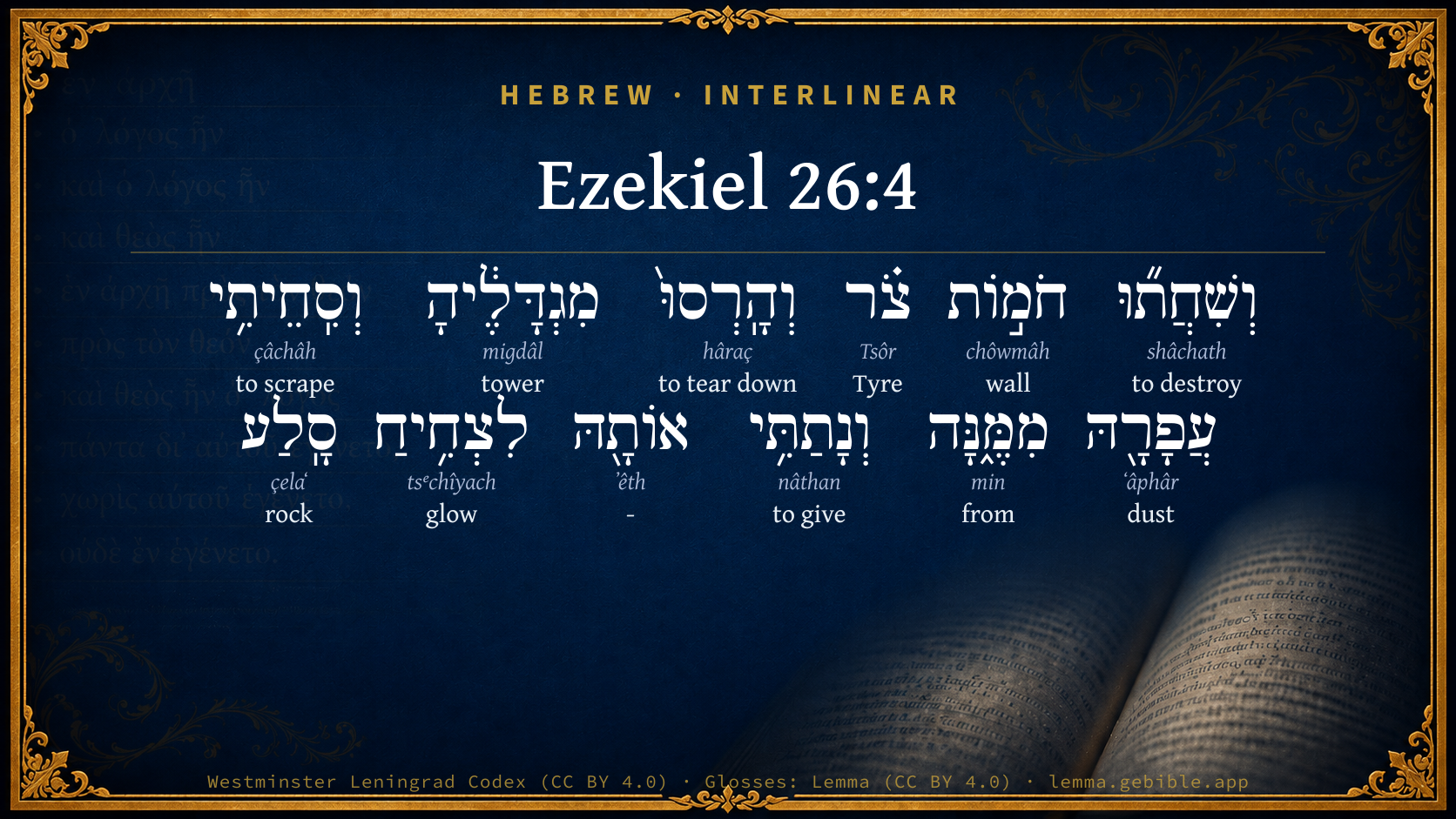
Hebrew (Westminster Leningrad Codex) Ezekiel 26:4 appears in the Hebrew Old Testament. The text above is from the Westminster Leningrad Codex. Each word links to its Strong’s number, a concise gloss, and parsing drawn from the Open Scriptures Hebrew Bible morphology. Click any word for its full Brown-Driver-Briggs (BDB) entry.
Download image
Cite this verse

Ezekiel 26:4 (World English Bible). Public Domain. Lemma interlinear Bible study tool, https://lemma.gebible.app/v/ezekiel/26/4.

Show BibTeX & RIS
BibTeX
RIS
English Translation
They shall destroy the walls of Tyre, and break down her towers: I will also scrape her dust from her, and make her a bare rock.
World English Bible · Public Domain
Highlights
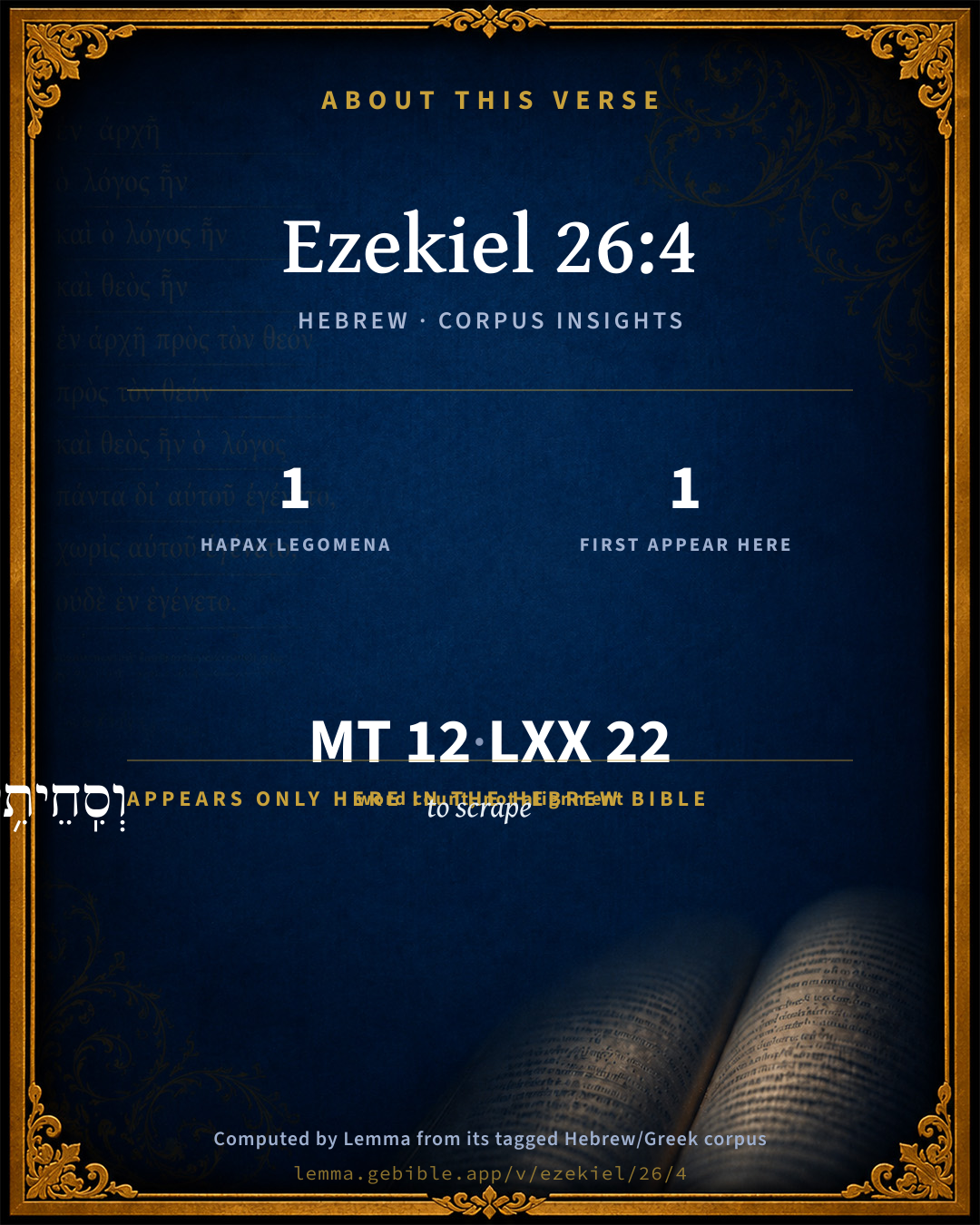
  • 1 hapax legomenon — only here in the Hebrew Bible
  • 1 first appearance in the Hebrew Bible
Full analysis ↓
Download a study sheet

One document with this verse’s original text, its word-by-word gloss line, the meaning frame, cross-references with their text, attributed commentary, and full source and license credits — printable, and it pastes into notes with its structure intact.

This verse Autodidact and up

Study sheet (.html) Plain text (.txt)

A passage Seminary Student

Up to 50 verses in one chapter. A passage sheet keeps up to 6 commentary sources and 12 cross-references per verse, in the order this page ranks them, and says so on the sheet whenever that leaves anything out. Ask for a single verse and you get the Autodidact verse sheet above.

Everything on this page stays free to read, with no account — the sheet is a download of what is already on screen, not access to it.

Want to remove ads? Support Godless Engineer
Compare translations 3

The same verse in 3 English versions, stacked beneath the original-language interlinear above. Click any original word for its lexicon entry.

Each is an independent rendering of the whole verse — the interlinear is not word-aligned to these translations.

Highlighted words mark where these versions differ — a whole-verse word diff, not a word-by-word alignment.

  • World English Bible Public Domain
    They shall destroy the walls of Tyre, and break down her towers: I will also scrape her dust from her, and make her a bare rock.
  • King James Version Public Domain
    And they shall destroy the walls of Tyrus, and break down her towers: I will also scrape her dust from her, and make her like the top of a rock.
  • unfoldingWord Literal Text CC BY-SA 4.0
    They will destroy the walls of Tyre and tear down her towers. I will sweep her dust away and make her like a bare rock.

unfoldingWord Literal Text — © unfoldingWord, licensed CC BY-SA 4.0. Word-aligned USFM3 via Door43 (git.door43.org/unfoldingWord/en_ult).

Versions to compare (up to 4)

3 of 4 selected

Show all 18 translations

Every available English version of this verse, each an independent rendering of the whole verse.

  • World English Bible Public Domain
    They shall destroy the walls of Tyre, and break down her towers: I will also scrape her dust from her, and make her a bare rock.
  • Berean Standard Bible Public Domain
    They will destroy the walls of Tyre and demolish her towers. I will scrape the soil from her and make her a bare rock.
  • Majority Standard Bible Public Domain
    They will destroy the walls of Tyre and demolish her towers. I will scrape the soil from her and make her a bare rock.
  • King James Version Public Domain
    And they shall destroy the walls of Tyrus, and break down her towers: I will also scrape her dust from her, and make her like the top of a rock.
  • American Standard Version (1901) Public Domain
    And they shall destroy the walls of Tyre, and break down her towers: I will also scrape her dust from her, and make her a bare rock.
  • Revised Version (1885) Public Domain
    And they shall destroy the walls of Tyre, and break down her towers: I will also scrape her dust from her, and make her a bare rock.
  • Geneva Bible (1599) Public Domain
    And they shall destroy the walles of Tyrus and breake downe her towres: I will also scrape her dust from her, and make her like the top of a rocke.
  • Douay-Rheims (1899) Public Domain
    And they shall break down the walls of Tyre, and destroy the towers thereof: and I will scrape her dust from her, and make her like a smooth rock.
  • Young's Literal Translation Public Domain
    And they have destroyed the walls of Tyre, And they have broken down her towers, And I have scraped her dust from her, And made her for a clear place of a rock.
  • Literal Standard Version CC BY-SA 4.0
    And they have destroyed the walls of Tyre, || And they have broken down her towers, || And I have scraped her dust from her, || And made her for a clear place of a rock.
  • Unlocked Literal Bible CC BY-SA 4.0
    They will destroy the walls of Tyre and tear down her towers. I will sweep her dust away and make her like a bare rock.
  • unfoldingWord Literal Text CC BY-SA 4.0
    They will destroy the walls of Tyre and tear down her towers. I will sweep her dust away and make her like a bare rock.
  • Darby Bible Public Domain
    And they shall destroy the walls of Tyre, and break down her towers. And I will scrape her dust from her, and make her a bare rock.
  • World Messianic Bible Public Domain
    They will destroy the walls of Tyre, and break down her towers. I will also scrape her dust from her, and make her a bare rock.
  • Webster's Bible Public Domain
    And they shall destroy the walls of Tyre, and break down her towers: I will also scrape her dust from her, and make her like the top of a rock.
  • Free Bible Version CC BY-SA 4.0
    They will destroy the walls of Tyre and tear down her towers. I will scrape off the soil that's on her and turn her into a bare rock.
  • Bible in Basic English Public Domain
    And they will give the walls of Tyre to destruction and have its towers broken: and I will take even her dust away from her, and make her an uncovered rock
  • JPS Tanakh (1917) Public Domain
    And they shall destroy the walls of Tyre, and break down her towers; I will also scrape her dust from her, and make her a bare rock.

Literal Standard Version (2020), Covenant Press — licensed CC BY-SA 4.0. Text via the HelloAO Bible API (eBible.org). Unlocked Literal Bible (unfoldingWord) — licensed CC BY-SA 4.0. Text via the HelloAO Bible API (eBible.org). unfoldingWord Literal Text — © unfoldingWord, licensed CC BY-SA 4.0. Word-aligned USFM3 via Door43 (git.door43.org/unfoldingWord/en_ult). Free Bible Version, Dr. Jonathan Gallagher — licensed CC BY-SA 4.0. Text via the HelloAO Bible API (eBible.org).

Word by word

More ways to search: Search by grammar → Find every occurrence → Compare this word →

Practice this passage: Drill this verse → Learn its vocabulary →

וְסִֽחֵיתִ֥י
çâchâh
H5500
“and · to scrape”
Conjunction + Verb, Piel, Sequential Perfect, 1st Person, Common, Singular
Part of Speech
Conjunction + Verb
Stem
Piel
Form
Sequential Perfect
Person
1st Person
Gender
Common
Number
Singular
Full BDB Definition

Origin: a primitive root

TWOT: 1483

to scrape - (Piel) to scrape clean, scour
  1. וְשִׁחֲת֞וּ shâchath H7843 “and · to destroy” Conjunction + Verb, Piel, Sequential Perfect, 3rd Person, Common, Plural
  2. חֹמ֣וֹת chôwmâh H2346 “walls of” Noun, Common, Feminine, Plural, Construct
  3. צֹ֗ר Tsôr H6865 “Tyre” Noun, Proper
  4. וְהָֽרְסוּ֙ hâraç H2040 “and · to tear down” Conjunction + Verb, Qal, Sequential Perfect, 3rd Person, Common, Plural
  5. מִגְדָּלֶ֔יהָ migdâl H4026 “towers · her” Noun, Common, Both, Plural, Construct + Suffix, Personal, 3rd Person, Feminine, Singular
  6. עֲפָרָ֖הּ ʻâphâr H6083 “dust · her” Noun, Common, Masculine, Singular, Construct + Suffix, Personal, 3rd Person, Feminine, Singular
  7. מִמֶּ֑נָּה min H4480 “from · her” Preposition + Suffix, Personal, 3rd Person, Feminine, Singular
  8. וְנָתַתִּ֥י nâthan H5414 “and · to give” Conjunction + Verb, Qal, Sequential Perfect, 1st Person, Common, Singular
  9. אוֹתָ֖הּ ʼêth H853 “- · her” Particle, Direct Object + Suffix, Personal, 3rd Person, Feminine, Singular
  10. לִצְחִ֥יחַ tsᵉchîyach H6706 “to/for · glow of” Preposition + Noun, Common, Masculine, Singular, Construct
  11. סָֽלַע çelaʻ H5553 “rock” Noun, Common, Masculine, Singular, Absolute

About this verse

These counts appear in no published source. They are computed here, from the morphology-tagged text and Lemma’s own curated glosses. What Lemma adds →

12
words
12
distinct lemmas
Prophets
section

Notable vocabulary

1 hapax legomenon — a word that appears only here in the entire Hebrew Bible:

  • וְסִֽחֵיתִ֥י to scrape H5500

First appearance in Scripture

This word makes its first canonical appearance in the Hebrew Bible here:

  • וְסִֽחֵיתִ֥י to scrape H5500

Shared distinctive vocabulary

לִצְחִ֥יחַ glow H6706 occurs in 5 verses of the Hebrew Bible. Also found in:

Grammatical profile

  • 4 verbs
  • 6 nouns
  • 1 preposition
  • 1 particle

Verb forms

  • וְשִׁחֲת֞וּ Piel · Sequential Perfect
  • וְהָֽרְסוּ֙ Qal · Sequential Perfect
  • וְסִֽחֵיתִ֥י Piel · Sequential Perfect
  • וְנָתַתִּ֥י Qal · Sequential Perfect

Hebrew & Septuagint length

In English translation the verse runs 26 words from the Hebrew and 30 from the Septuagint (LXX English) — closely comparable.

A rough comparison of the two English renderings, which tokenize alike — not a word-level alignment.

Word counts can differ between the Hebrew and the Greek without any difference in meaning — e.g. the Hebrew direct-object marker אֵת has no separate Greek word, and Greek often adds the article ὁ.

In the original languages it is 12 Hebrew tokens and 22 Greek tokens — but the two are counted differently (Hebrew bundles its prefixes and suffixes into one token; the Greek is in lemma form), so that isn’t a like-for-like length.

Cross-references

8

Topical passages linked to Ezekiel 26:4 in the Treasury of Scripture Knowledge — connected by theme and wording, ordered by reader-vote popularity; previews shown in the World English Bible.

  • Isaiah 23:11 He has stretched out his hand over the sea, he has shaken the kingdoms: Yahweh has given commandment concerning Canaan, to destroy the strongholds of it.
  • Amos 1:10 But I will send a fire on the wall of Tyre, And it will devour its palaces."
  • Ezekiel 26:9 He shall set his battering engines against your walls, and with his axes he shall break down your towers.
  • Leviticus 14:41–45 and he shall cause the inside of the house to be scraped round about, and they shall pour out the mortar, that they scraped off, outside of the city into an unclean place.
  • Jeremiah 5:10 Go up on her walls, and destroy; but don't make a full end: take away her branches; for they are not Yahweh's.
  • Ezekiel 24:7–8 For her blood is in the midst of her; she set it on the bare rock; she didn't pour it on the ground, to cover it with dust.
  • Ezekiel 26:12 They shall make a spoil of your riches, and make a prey of your merchandise; and they shall break down your walls, and destroy your pleasant houses; and they shall lay your stones and your timber and your dust in the midst of the waters.
  • Zechariah 9:3 Tyre built herself a stronghold, And heaped up silver like the dust, And fine gold like the mire of the streets.

Cross-references courtesy of OpenBible.info (CC BY 4.0).

Hebrew and Greek witnesses Masoretic Hebrew ↔ Greek Septuagint

The same verse in the two great witnesses to the Old Testament, shown verse-for-verse.

These are two independent witnesses, not word-aligned to each other, and the Septuagint is shown in lemma (dictionary) form.

Hebrew Ezekiel 26:4 Masoretic · Westminster Leningrad Codex

וְשִׁחֲת֞וּ חֹמ֣וֹת צֹ֗ר וְהָֽרְסוּ֙ מִגְדָּלֶ֔יהָ וְסִֽחֵיתִ֥י עֲפָרָ֖הּ מִמֶּ֑נָּה וְנָתַתִּ֥י אוֹתָ֖הּ לִצְחִ֥יחַ סָֽלַע

They shall destroy the walls of Tyre, and break down her towers: I will also scrape her dust from her, and make her a bare rock.

World English Bible · Public Domain

Greek LXX Ezekiel 26:4 Septuagint · lemma form

καί καταβάλλω ὁ τεῖχος σορ καί καταβάλλω ὁ πύργος σύ καί λικμάω ὁ χοῦς αὐτός ἀπό αὐτός καί δίδωμι αὐτός εἰς λεωπετρία

And they shall cast down the walls of Sor, and shall cast down your towers: and I will scrape her dust from off her, and make her a bare rock.

LXX2012 (modern English Septuagint) · Public Domain

Hebrew: Westminster Leningrad Codex (CC BY 4.0). Greek: Septuagint (public domain); English from LXX2012 (modern English Septuagint) (Public Domain). How the Septuagint differs from the Hebrew →

Targum (Aramaic paraphrase)

1

The Targum is the ancient Jewish Aramaic paraphrase of the Hebrew Scriptures — an interpretive translation, not the Hebrew text itself. Onkelos (literal) and Pseudo-Jonathan (expansive) render the Torah, and Jonathan the Prophets. Coverage is partial: where no permissively-licensed English translation exists for a verse, only the Aramaic is shown. This is verse-level text, not a word-by-word alignment to the Hebrew.

  1. Targum Jonathan Prophets (Joshua–Malachi)
    וִיחַבְּלוּן שׁוּרֵי צוֹר וִיפַגְרוּן מִגְדְלָהָא וְאַעְקַר עֲפְרָהּ מִנָהּ וְאֶתֵּן יָתָהּ לִשְׁעִיעוֹת כֵּיף גְלֵי:

    (no public-domain English translation for this verse)

    Targum Jonathan — Aramaic: “Mikraot Gedolot” (public domain). English: “Sefaria Community Translation” (CC0 1.0 (public-domain dedication)); “London "Chaldee Paraphrase," 1871” (public domain). Text via Sefaria.

Commentary

Notes on Ezekiel 26:4 from classic Christian and Jewish commentators (each source and its license shown beneath its notes). The classic Christian expositions comment on the surrounding passage and are grouped to its opening verse, so a note may address several verses; the Jewish commentaries on the Tanakh (Rashi and others) are per-verse, so they appear only where the commentator wrote on this verse.

Lemma curates 59 commentaries, every one of them public domain or Creative Commons licensed, each selected and text-cleaned for this edition rather than reprinted as found. About our sources →

Trapp's Complete Commentary

John Trapp

Eze 26:4 And they shall destroy the walls of Tyrus, and break down her towers: I will also scrape her dust from her, and make her like the top of a rock.

Ver. 4. And they shall destroy the walls of Tyrus.] Which thou holdest to be inexpugnable. Hence this and the two following chapters, purposely to undeceive thee, if it may be.

I will also scrape her dust from her.] Brought from other places, to make her gardens; for she was built upon a rock, et in petram glabram: to a naked rock will God now reduce her.

John Trapp, A Commentary or Exposition upon All the Books of the Old and New Testament (1647–1656) — public domain. Text from a community e-Sword module.

Joseph Benson's Commentary

Eze 26:4-6. They shall destroy the walls of Tyrus, &c. — The expressions of these verses signify that Tyre should be entirely demolished, and that the place where the city stood should be made as bare as the top of a rock, and that it should be employed to no other use but that of a desolate shore, the drying of the fishermen’s nets. Nebuchadnezzar quite demolished old Tyre, and the stones and rubbish of it were afterward made use of by Alexander, to carry on a causeway from the continent to the island where new Tyre stood, by which means he took that. This latter city is since so decayed, that there are no remains of it left but a few huts belonging to fishermen, who are in the habit of hanging out their nets to dry upon the rocks, as is related by travellers that have been upon the place. “The present inhabitants of Tyre.” says Maundrell, page 49, “are only a few poor wretches, harbouring themselves in the vaults, and subsisting chiefly upon fishing.” The Jesuit Hadrianus Parvillerius resided ten years in Syria; and the famous Huetius heard him say, that when he approached the ruins of Tyre, and beheld the rocks stretched forth to the sea, and the great stones scattered up and down on the shore, made clean and smooth by the sun, waves, and winds, and useful only for the drying of fishermen’s nets, many of which happened at the time to be spread on them, it brought to his memory this prophecy: see Newton on the prophecies, Diss. 11.; and note on Isa 23:1, &c. And her daughters shall be slain with the sword — By the daughters of Tyre here are meant the lesser towns, which were under her jurisdiction as the mother city, or metropolis of the kingdom: the inhabitants of these would be slain with the sword.

Joseph Benson's Commentary on the Old and New Testaments (1811–1818) — public domain. Text from a community e-Sword module.

Adam Clarke's Commentary

Verse 4. I will also scrape her dust from her] I will totally destroy her fortifications, and leave her nothing but a barren rock, as she was before. This cannot refer to the capture of Tyre by Nebuchadnezzar. It flourished long after his time.

Adam Clarke's Commentary on the Bible (1810–1826) — public domain. Text from a community e-Sword/MySword module.

Ellicott's Commentary for English Readers

(4) Her dust.—Comp. Eze_26:12. The dust is that of her ruined walls and palaces and temples. “Scraping” expresses their utter destruction. As an historic fact, the ruins of the ancient city have all been thrown into the sea, and what now remains is of mediaeval construction, although the greater part of even the mediaeval ruins have been carried away.

A Bible Commentary for English Readers, edited by Charles John Ellicott (1878–1897) — public domain. Text from a community e-Sword module.

The Cambridge Bible for Schools and Colleges

gen. ed. J. J. S. Perowne

4. like the top of a rock] like a naked rock, ch. Eze_24:7. Tyre stood upon a small island of rock separated from the mainland by a narrow strait. She shall be swept from her place, and her dust scraped into the sea, leaving her island site a bare rock, cf. Eze_26:12.

The Cambridge Bible for Schools and Colleges (gen. ed. J. J. S. Perowne; Cambridge University Press, 1878–1918) — public domain. Text from a community e-Sword module.

John Gill's Exposition

And they shall destroy the walls of Tyrus.... Undermining them, or breaking them down with their battering rams:

and break down her towers; with axes, Eze 26:9 built upon the walls; erected for the defence of the city, and for watchmen to stand in, to look out from them for the enemy, and observe his motions, as well as for soldiers to fight from:

and I will scrape her dust from her, and make her like the top of a rock; a bare smooth rock, which has not any surface of earth upon it. So the Targum,

"I will give her for the smoothness of an open rock.''

Tyre was built upon a rock; and whereas the inhabitants had brought earth thither, and laid it upon it, in order to make gardens and orchards, and plant flowers and trees; this should be all removed, and it should become a bare rock, as it was at first. It denotes the utter destruction of it. It has its name from a word which signifies a rock; See Gill on Isa 23:1.

John Gill's Exposition of the Whole Bible (1746–1763) — public domain (CC PDM 1.0). Text via the HelloAO Bible API.

Haydock's Catholic Bible Commentary

Dust. She shall be demolished, and the rubbish thrown into the sea, to make a road by which New Tyre in the island might be attacked, ver. 12. (Haydock)

George Leo Haydock (1774–1849), Haydock's Catholic Family Bible and Commentary, 1859 edition — public domain. Excludes Psalms (Douay-Rheims chapter numbering differs from Protestant) and Deuterocanonical books (Catholic canon only).

Matthew Poole's English Annotations

Destroy; batter and demolish with their mighty engines, which shall shake, disjoint, and beat down the strongest parts of their walls.

Break down; undermine, that they may tumble at once, or employ hands to take them down, as men pull down buildings.

Towers; watch-towers, and those that were for defence and safety of their city, which from their greatness have their name, Migdol.

I will also scrape her dust from her; I will leave thee nothing, thou shalt be scraped, and brushed, and swept, that not so much as dust shall remain to thee.

And make her like the top of a rock; as bare as was the rock on which thy city is built before wealth, beauty, buildings, and strength was brought to it by man’s industry.

Matthew Poole's English Annotations on the Holy Bible (1683–1685) — public domain. Text from a community e-Sword/MySword module.

Whedon's Commentary on the Bible

Daniel D. Whedon

4. Top of a rock — Or, naked rock. (See Eze_24:7-8.)

Daniel D. Whedon (gen. ed.), Commentary on the Old and New Testaments (1874–1909) — public domain. Text from a community e-Sword module.

John Wesley's Explanatory Notes

Scrape - I will leave thee nothing; thou shalt be scraped, and swept, that not so much as dust shall remain in thee. Like - As bare as was the rock on which thy city is built.

John Wesley, Explanatory Notes Upon the Whole Bible (1754–1765) — public domain. Text via the GEBible commentary corpus.

Rashi

Rabbi Shlomo Yitzchaki (Rashi)

and I shall remove [Heb. וְסִחֵיתִי,] and I shall uproot, like (Prov. 15:25): “The Lord will uproot (יִסַח) the house of the haughty;” (Deut. 28:63); “and you will be uprooted (וְנִסַחְתֶם) from...”

a smooth rock Since it was built on a rock in the midst of the sea, when it will be demolished and its earth will be uprooted into the sea, the rock will be left bare, and so did Jonathan render: a smooth, bare rock.

Rashi on the Tanakh — English translations: “The Judaica Press complete Tanach with Rashi, translated by A. J. Rosenberg” (CC BY 4.0); “Pentateuch with Rashi's commentary by M. Rosenbaum and A.M. Silbermann, 1929-1934” (public domain); “The Metsudah Tanach series, Lakewood, N.J” (CC BY 4.0); and “The Book of Joshua, Metsudah Publications, 1997” (CC BY 4.0). Text via Sefaria.

Lesson kit

Teaching starters — assembled from the data on this page, not authored interpretation. Every prompt links to the verse data it draws on. Edit before teaching.

Ezekiel, in the Prophets, opens this verse with 12 words (12 distinct Hebrew lemmas). Its most distinctive word is çâchâh (“to scrape”). A historical commentator’s framing appears above. Read the whole chapter for the surrounding context.

Discussion questions

  1. What does “to scrape” (çâchâh) contribute to the verse as a whole?
  2. 1 word here appears nowhere else in the Hebrew Bible. Why might the author reach for such rare wording?
  3. This is the first place “to scrape” appears in Scripture (first appears here). What does its debut here establish?
  4. How does Nehemiah 4:13, which shares the word «glow», read alongside this verse?
  5. The translations on this page render this verse differently — a whole-verse word diff, not a word-by-word alignment. What might account for the different wordings?
  6. «וְשִׁחֲת֞וּ» is a Piel Sequential Perfect verb. How does that grammatical form shape the action described?
  7. Compare how Trapp's Complete Commentary and Joseph Benson's Commentary read this verse. Where do they agree or differ?

Things to notice

Reading settings

Reading text

Shown beneath each verse's original-language words.

Old Testament
Old Testament edition

Read the OT as the Masoretic Hebrew (MT) or the Greek Septuagint (LXX).

English shown for the Greek Septuagint (in the Hebrew ↔ Greek comparison).

Comparing translations? Open the Compare panel on any verse page to stack up to four side by side.