
Leviticus 25:29

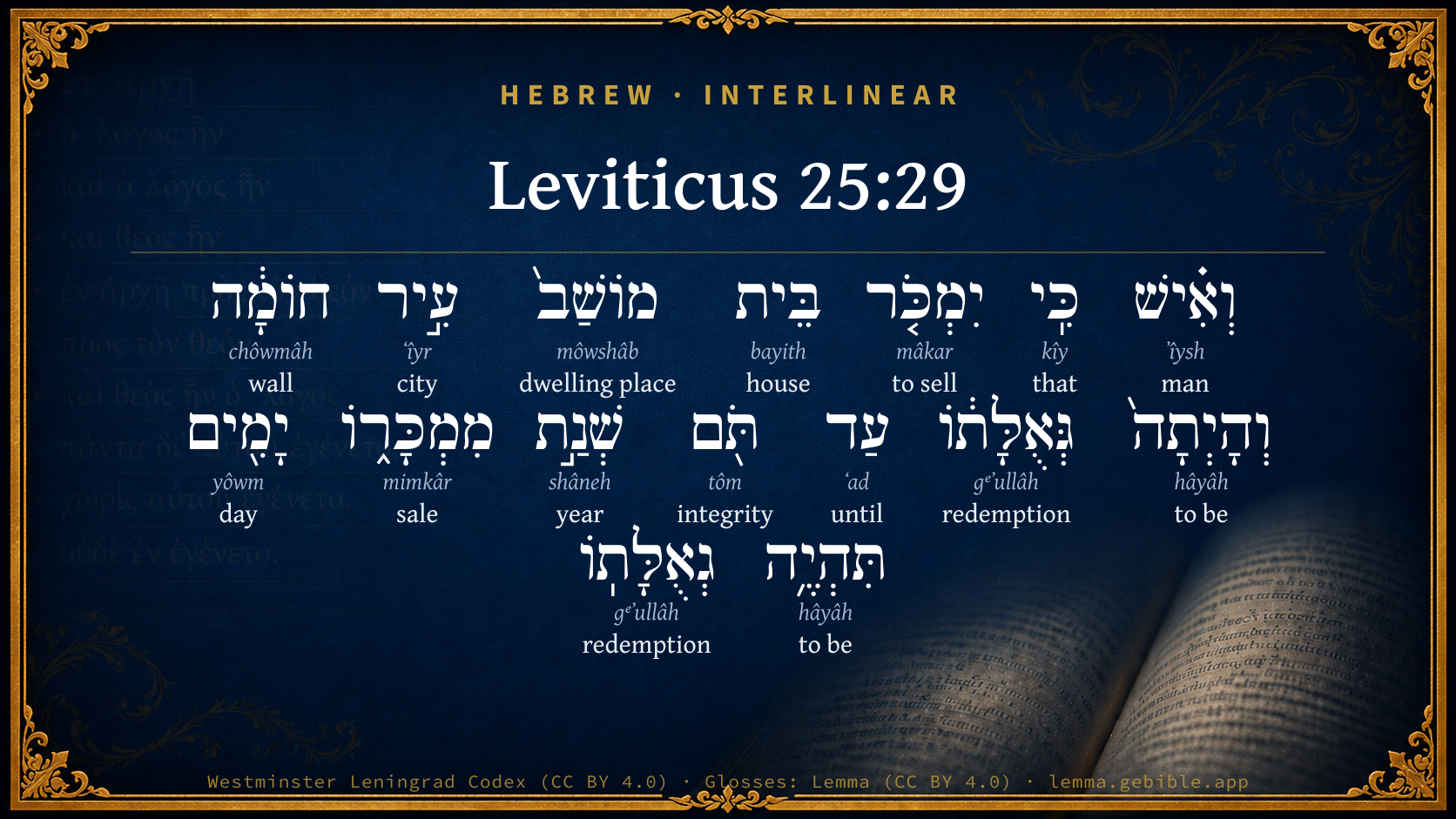
Hebrew (Westminster Leningrad Codex) Leviticus 25:29 appears in the Hebrew Old Testament. The text above is from the Westminster Leningrad Codex. Each word links to its Strong’s number, a concise gloss, and parsing drawn from the Open Scriptures Hebrew Bible morphology. Click any word for its full Brown-Driver-Briggs (BDB) entry.
Download image
Cite this verse

Leviticus 25:29 (World English Bible). Public Domain. Lemma interlinear Bible study tool, https://lemma.gebible.app/v/leviticus/25/29.

Show BibTeX & RIS
BibTeX
RIS
English Translation
"'If a man sells a dwelling house in a walled city, then he may redeem it within a whole year after it has been sold. For a full year he shall have the right of redemption.
World English Bible · Public Domain
Download a study sheet

One document with this verse’s original text, its word-by-word gloss line, the meaning frame, cross-references with their text, attributed commentary, and full source and license credits — printable, and it pastes into notes with its structure intact.

This verse Autodidact and up

Study sheet (.html) Plain text (.txt)

A passage Seminary Student

Up to 50 verses in one chapter. A passage sheet keeps up to 6 commentary sources and 12 cross-references per verse, in the order this page ranks them, and says so on the sheet whenever that leaves anything out. Ask for a single verse and you get the Autodidact verse sheet above.

Everything on this page stays free to read, with no account — the sheet is a download of what is already on screen, not access to it.

Want to remove ads? Support Godless Engineer
Compare translations 3

The same verse in 3 English versions, stacked beneath the original-language interlinear above. Click any original word for its lexicon entry.

Each is an independent rendering of the whole verse — the interlinear is not word-aligned to these translations.

Highlighted words mark where these versions differ — a whole-verse word diff, not a word-by-word alignment.

  • World English Bible Public Domain
    "'If a man sells a dwelling house in a walled city, then he may redeem it within a whole year after it has been sold. For a full year he shall have the right of redemption.
  • King James Version Public Domain
    And if a man sell a dwelling house in a walled city, then he may redeem it within a whole year after it is sold; within a full year may he redeem it.
  • unfoldingWord Literal Text CC BY-SA 4.0
    And a man, when he sells a house of dwelling in a walled city, then its redemption shall be until a year its sale completes. Days shall be its redemption.

unfoldingWord Literal Text — © unfoldingWord, licensed CC BY-SA 4.0. Word-aligned USFM3 via Door43 (git.door43.org/unfoldingWord/en_ult).

Versions to compare (up to 4)

3 of 4 selected

Show all 18 translations

Every available English version of this verse, each an independent rendering of the whole verse.

  • World English Bible Public Domain
    "'If a man sells a dwelling house in a walled city, then he may redeem it within a whole year after it has been sold. For a full year he shall have the right of redemption.
  • Berean Standard Bible Public Domain
    If a man sells a house in a walled city, he retains his right of redemption until a full year after its sale; during that year it may be redeemed.
  • Majority Standard Bible Public Domain
    If a man sells a house in a walled city, he retains his right of redemption until a full year after its sale; during that year it may be redeemed.
  • King James Version Public Domain
    And if a man sell a dwelling house in a walled city, then he may redeem it within a whole year after it is sold; within a full year may he redeem it.
  • American Standard Version (1901) Public Domain
    And if a man sell a dwelling-house in a walled city, then he may redeem it within a whole year after it is sold; for a full year shall he have the right of redemption.
  • Revised Version (1885) Public Domain
    And if a man sell a dwelling house in a walled city, then he may redeem it within a whole year after it is sold; for a full year shall he have the right of redemption.
  • Geneva Bible (1599) Public Domain
    Likewise if a man sell a dwelling house in a walled citie, he may bye it out againe within a whole yeere after it is solde: within a yeere may he bye it out.
  • Douay-Rheims (1899) Public Domain
    He that selleth a house within the walls of a city, shall have the liberty to redeem it, until one year be expired:
  • Young's Literal Translation Public Domain
    `And when a man selleth a dwelling-house `in' a walled city, then hath his right of redemption been until the completion of a year from its selling; days -- is his right of redemption;
  • Literal Standard Version CC BY-SA 4.0
    And when a man sells a dwelling-house [in] a walled city, then his right of redemption has been until the completion of a year from its selling; his right of redemption is [during these] days;
  • Unlocked Literal Bible CC BY-SA 4.0
    If a man sells a house in a walled city, then he may buy it back within a whole year after it was sold. For a full year he will have the right of redemption.
  • unfoldingWord Literal Text CC BY-SA 4.0
    And a man, when he sells a house of dwelling in a walled city, then its redemption shall be until a year its sale completes. Days shall be its redemption.
  • Darby Bible Public Domain
    And if any one sell a dwelling-house in a walled city, then he shall have the right of redemption up to the end of the year of the sale thereof; for a full year shall he have the right of redemption.
  • World Messianic Bible Public Domain
    “‘If a man sells a dwelling house in a walled city, then he may redeem it within a whole year after it has been sold. For a full year he shall have the right of redemption.
  • Webster's Bible Public Domain
    And if a man shall sell a dwelling-house in a walled city, then he may redeem it within a whole year after it is sold: within a full year may he redeem it.
  • Free Bible Version CC BY-SA 4.0
    If someone sells a house located in a walled town, they have the right to buy it back for a full year after selling it. It can be bought back any time during that year.
  • Bible in Basic English Public Domain
    And if a man gives his house in a walled town for money, he has the right to get it back for the space of a full year after he has given it up.
  • JPS Tanakh (1917) Public Domain
    And if a man sell a dwelling-house in a walled city, then he may redeem it within a whole year after it is sold; for a full year shall he have the right of redemption.

Literal Standard Version (2020), Covenant Press — licensed CC BY-SA 4.0. Text via the HelloAO Bible API (eBible.org). Unlocked Literal Bible (unfoldingWord) — licensed CC BY-SA 4.0. Text via the HelloAO Bible API (eBible.org). unfoldingWord Literal Text — © unfoldingWord, licensed CC BY-SA 4.0. Word-aligned USFM3 via Door43 (git.door43.org/unfoldingWord/en_ult). Free Bible Version, Dr. Jonathan Gallagher — licensed CC BY-SA 4.0. Text via the HelloAO Bible API (eBible.org).

Word by word

More ways to search: Search by grammar → Find every occurrence → Compare this word →

Practice this passage: Drill this verse → Learn its vocabulary →

מִמְכָּר֑וֹ
mimkâr
H4465
“sale · his”
Noun, Common, Masculine, Singular, Construct + Suffix, Personal, 3rd Person, Masculine, Singular
Part of Speech
Noun
Type
Common
Gender
Masculine
Number
Singular
State
Construct
Full BDB Definition

Origin: from H4376

TWOT: 1194b

sale, ware, thing sold
  1. וְאִ֗ישׁ ʼîysh H376 “and · man” Conjunction + Noun, Common, Masculine, Singular, Absolute
  2. כִּֽי kîy H3588 “that” Conjunction
  3. יִמְכֹּ֤ר mâkar H4376 “to sell” Verb, Qal, Imperfect, 3rd Person, Masculine, Singular
  4. בֵּית bayith H1004 “house of” Noun, Common, Masculine, Singular, Construct
  5. מוֹשַׁב֙ môwshâb H4186 “dwelling place of” Noun, Common, Masculine, Singular, Construct
  6. עִ֣יר ʻîyr H5892 “city” Noun, Common, Feminine, Singular, Absolute
  7. חוֹמָ֔ה chôwmâh H2346 “wall” Noun, Common, Feminine, Singular, Absolute
  8. וְהָיְתָה֙ hâyâh H1961 “and · to be” Conjunction + Verb, Qal, Perfect, 3rd Person, Feminine, Singular
  9. גְּאֻלָּת֔וֹ gᵉʼullâh H1353 “redemption · his” Noun, Common, Feminine, Singular, Construct + Suffix, Personal, 3rd Person, Masculine, Singular
  10. עַד ʻad H5704 “until” Preposition
  11. תֹּ֖ם tôm H8537 “integrity” Verb, Qal, Infinitive Construct
  12. שְׁנַ֣ת shâneh H8141 “year of” Noun, Common, Feminine, Singular, Construct
  13. יָמִ֖ים yôwm H3117 “days” Noun, Common, Masculine, Plural, Absolute
  14. תִּהְיֶ֥ה hâyâh H1961 “to be” Verb, Qal, Imperfect, 3rd Person, Feminine, Singular
  15. גְאֻלָּתֽוֹ gᵉʼullâh H1353 “redemption · his” Noun, Common, Feminine, Singular, Construct + Suffix, Personal, 3rd Person, Masculine, Singular

About this verse

These counts appear in no published source. They are computed here, from the morphology-tagged text and Lemma’s own curated glosses. What Lemma adds →

16
words
14
distinct lemmas
Pentateuch
section

Notable vocabulary

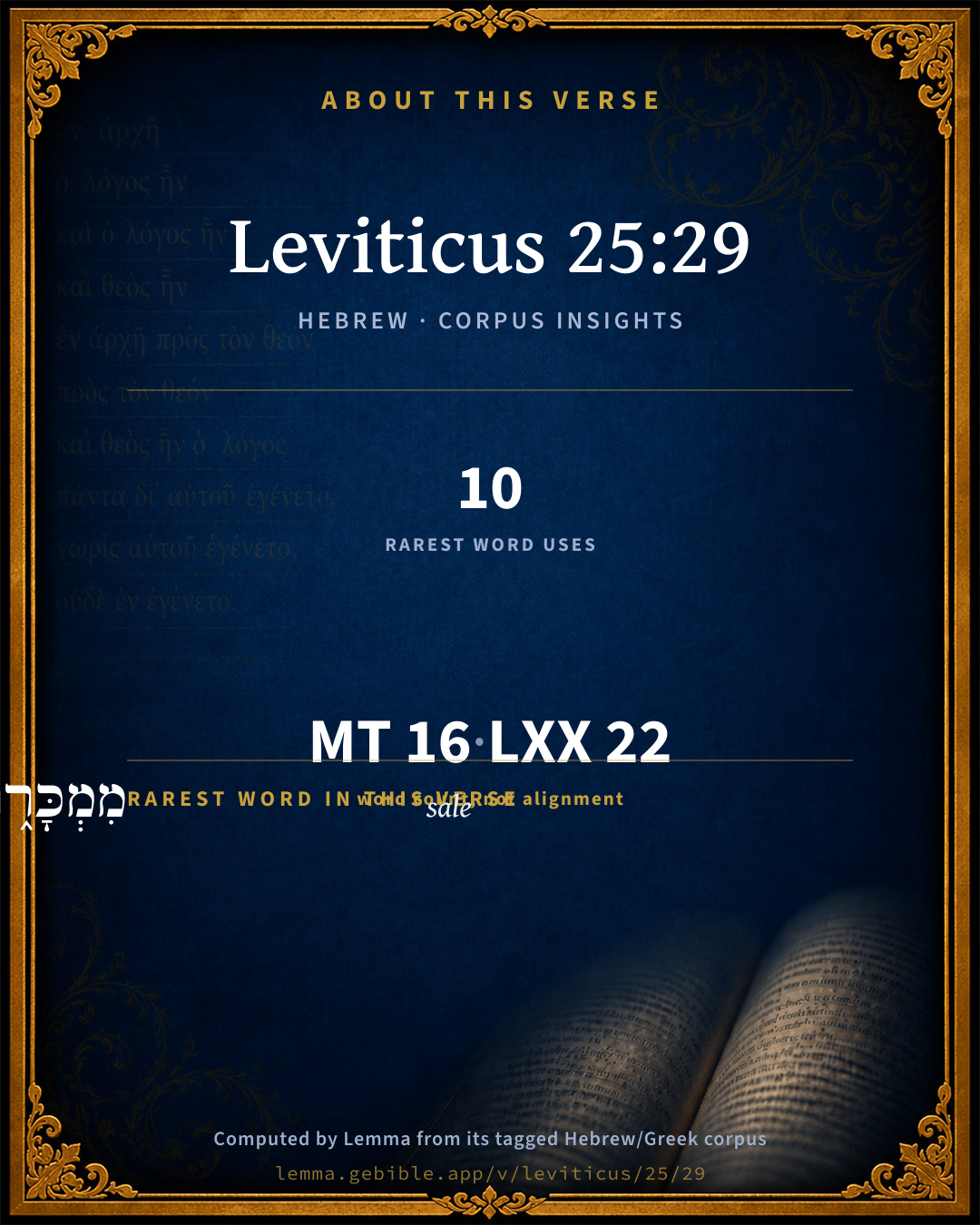
The rarest word here is מִמְכָּר֑וֹ sale H4465 — appearing just 10 times in the whole Hebrew Bible.

Shared distinctive vocabulary

מִמְכָּר֑וֹ sale H4465 occurs in 10 verses of the Hebrew Bible. Also found in:

Grammatical profile

  • 4 verbs
  • 10 nouns
  • 1 preposition
  • 1 conjunction

Verb forms

  • יִמְכֹּ֤ר Qal · Imperfect
  • וְהָיְתָה֙ Qal · Perfect
  • תֹּ֖ם Qal · Infinitive Construct
  • תִּהְיֶ֥ה Qal · Imperfect

Repetition

Words recur within this verse — often emphatic in Hebrew:

  • וְהָיְתָה֙ to be H1961 ×2
  • גְּאֻלָּת֔וֹ redemption H1353 ×2

Hebrew & Septuagint length

In English translation the verse runs 36 words from the Hebrew and 35 from the Septuagint (LXX English) — closely comparable.

A rough comparison of the two English renderings, which tokenize alike — not a word-level alignment.

Word counts can differ between the Hebrew and the Greek without any difference in meaning — e.g. the Hebrew direct-object marker אֵת has no separate Greek word, and Greek often adds the article ὁ.

In the original languages it is 16 Hebrew tokens and 22 Greek tokens — but the two are counted differently (Hebrew bundles its prefixes and suffixes into one token; the Greek is in lemma form), so that isn’t a like-for-like length.

Hebrew and Greek witnesses Masoretic Hebrew ↔ Greek Septuagint

The same verse in the two great witnesses to the Old Testament, shown verse-for-verse.

These are two independent witnesses, not word-aligned to each other, and the Septuagint is shown in lemma (dictionary) form.

Hebrew Leviticus 25:29 Masoretic · Westminster Leningrad Codex

וְאִ֗ישׁ כִּֽי יִמְכֹּ֤ר בֵּית מוֹשַׁב֙ עִ֣יר חוֹמָ֔ה וְהָיְתָה֙ גְּאֻלָּת֔וֹ עַד תֹּ֖ם שְׁנַ֣ת מִמְכָּר֑וֹ יָמִ֖ים תִּהְיֶ֥ה גְאֻלָּתֽוֹ

"'If a man sells a dwelling house in a walled city, then he may redeem it within a whole year after it has been sold. For a full year he shall have the right of redemption.

World English Bible · Public Domain

Greek LXX Leviticus 25:29 Septuagint · lemma form

ἐάν δέ τις ἀποδίδωμι οἰκία οἰκητός ἐν πόλις τειχίζω καί εἰμί ὁ λύτρωσις αὐτός ἕως πληρόω ἐνιαυτός ἡμέρα εἰμί ὁ λύτρωσις αὐτός

And if any one should sell an inhabited house in a walled city, then there shall be the ransom of it, until the time is fulfilled: its time of ransom shall be a full year.

LXX2012 (modern English Septuagint) · Public Domain

Hebrew: Westminster Leningrad Codex (CC BY 4.0). Greek: Septuagint (public domain); English from LXX2012 (modern English Septuagint) (Public Domain). How the Septuagint differs from the Hebrew →

Targum (Aramaic paraphrase)

2

The Targum is the ancient Jewish Aramaic paraphrase of the Hebrew Scriptures — an interpretive translation, not the Hebrew text itself. Onkelos (literal) and Pseudo-Jonathan (expansive) render the Torah, and Jonathan the Prophets. Coverage is partial: where no permissively-licensed English translation exists for a verse, only the Aramaic is shown. This is verse-level text, not a word-by-word alignment to the Hebrew.

  1. Targum Onkelos Torah (Genesis–Deuteronomy)
    וּגְבַר אֲרֵי יְזַבֵּן בֵּית מוֹתַב קַרְתָּא מַקְפָא שׁוּר וּתְהֵי פוּרְקָנֵהּ עַד מִשְׁלַם שַׁתָּא דִזְבִינוֹהִי עִדָן בְּעִדָן תְּהֵי פוּרְקָנֵהּ

    (no public-domain English translation for this verse)

    Targum Onkelos — Aramaic: “Onkelos Genesis” (public domain); “Onkelos Exodus” (public domain); “Onkelos Leviticus” (public domain); “Onkelos Numbers” (public domain); “Onkelos Deuteronomy” (public domain). English: “Sefaria Community Translation” (CC0 1.0 (public-domain dedication)); “J.W. Etheridge. The Targums of Onkelos and Jonathan Ben Uzziel on the Pentateuch. London: Longmans, Green, 1862” (public domain). Text via Sefaria.

  2. Targum Pseudo-Jonathan Torah (Genesis–Deuteronomy)
    וּגְבַר אֲרוּם יִזְבּוֹן בֵּית מוֹתָבָא בְּבוּרְנִין דְמַקְפִין שׁוּר וִיהֵי פּוּרְקָנֵיהּ עַד מִשְׁלַם שַׁתָּא דְזַבִּינוֹי מִן עִידַן לְעִידַן יְהֵי פוּרְקָנֵיהּ

    And if a man sell a dwelling-house, in a town surrounded by a wall, it may have redemption until the completing of the year from its sale: from time to time shall be its redemption.

    Targum Pseudo-Jonathan — Aramaic: “Targum Jonathan on Genesis” (public domain); “Targum Jonathan on Exodus” (public domain); “Targum Jonathan on Leviticus” (public domain); “Targum Jonathan on Numbers” (public domain); “Targum Jonathan on Deuteronomy” (public domain). English: “The Targum of Jonathan ben Uzziel, trans. J. W. Etheridge, London, 1862” (public domain). Text via Sefaria.

Commentary

Notes on Leviticus 25:29 from classic Christian and Jewish commentators (each source and its license shown beneath its notes). The classic Christian expositions comment on the surrounding passage and are grouped to its opening verse, so a note may address several verses; the Jewish commentaries on the Tanakh (Rashi and others) are per-verse, so they appear only where the commentator wrote on this verse.

Lemma curates 59 commentaries, every one of them public domain or Creative Commons licensed, each selected and text-cleaned for this edition rather than reprinted as found. About our sources →

Joseph Benson's Commentary

Lev 25:29-31. A dwelling-house in a walled city — Here the law makes a great difference between houses in walled cities and houses in the country. The former, if sold, were either to be redeemed within a year, or else not at all, but were to be the property of the purchaser for ever; whereas, houses in the villages which had no walls round them were to be counted as the fields of the country — That is, they were to fall under the same law with the lands to which they were an appendage, and for the management of which they were necessary: they might be redeemed at any time. The following seem to be the chief reasons of this distinction: 1st, There was no danger of confusion in tribes or families by the final alienation of houses in cities, as tribes and families were not distinguished by them as they were by those in the country that were annexed to their lands, and therefore to be considered as a part of their inheritance. 2d, The seller had a greater property in houses than in lands, as being commonly built at the owner’s cost, and therefore a fuller power is granted him to dispose of them. 3d, God would hereby encourage persons to buy and possess houses in cities, as the frequency and populousness of them was a great strength, honour, and advantage to the whole land.

Joseph Benson's Commentary on the Old and New Testaments (1811–1818) — public domain. Text from a community e-Sword module.

Whedon's Commentary on the Bible

Daniel D. Whedon

THE REDEMPTION OF HOUSES, Lev_25:29-34.

29. A dwellinghouse in a walled city — The redemption of this is limited to a year, after which it belongs to the purchaser forever, undisturbed by the jubilee. Such property used for mercantile purposes is of special value to the merchant who has built up a lucrative trade therein. Again, city property is liable to greater fluctuations in value in fifty years than country estates, and it is just that the present holder should have the benefit of the increased valuation. The fact that city property was permanently alienable would tend to keep the poor from flocking to the great cities, twice each century, to starve in poverty and to fester in vice. “This provision was made to encourage strangers and proselytes to come and settle among them. Though they could not purchase land in Canaan, yet they might purchase houses in walled cities, which would be most convenient for them who were supposed to live by trade.” — Bush. It is the opinion of some that this law applied only to such cities as were walled in the days of Joshua, and conquered by him. This would exclude Jerusalem.

Daniel D. Whedon (gen. ed.), Commentary on the Old and New Testaments (1874–1909) — public domain. Text from a community e-Sword module.

The Expositor's Bible

THE JUBILEE AND DWELLING HOUSES

Lev_25:29-34

"And if a man sell a dwelling house in a wailed city, then he may redeem it within a whole year after it is sold; for a full year shall he have the right of redemption. And if it be not redeemed within the space of a full year, then the house that is in the walled city shall be made sure in perpetuity to him that bought it, throughout his generations: it shall not go out in the jubilee. But the houses of the villages which have no wall round about them shall be reckoned with the fields of the country: they may be redeemed, and they shall go out in the jubilee. Nevertheless the cities of the Levites the houses of the cities of their possession, may the Levites redeem at any time. And if one of the Levites redeem [not], then the house that was sold, and the city of his possession, shall go out in the jubilee: for the houses of the cities of the Levites are their possession among the children of Israel. But the field of the suburbs of their cities may not be sold; for it is their perpetual possession."

In Lev_25:29-34 is considered the application of the jubilee ordinance to the sale of dwelling houses: first (Lev_25:29-31), to such sale in case of the people generally; secondly (Lev_25:32-34), to sales of houses by the Levites. Under the former head we have first the law as regards sales of dwelling houses in "walled cities"; to which it is ordered that the law of reversion in the jubilee shall not apply, and for which the right of redemption was only to hold valid for one year. The obvious reason for exempting houses in cities from the law of reversion is that the law has to do only with land such as may be used in a pastoral or agricultural way for mans support. And this explains why, on the other hand, it is next ordered (Lev_25:31) that in the case of houses in unwalled villages the law of redemption and reversion in the jubilee shall apply as well as to the land. For the inhabitants of the villages were the herdsmen and cultivators of the soil; and the house was regarded rightly as a necessary attachment to the land, without which its use would not be possible. But inasmuch as God had assigned no landholding to the Levites in the original distribution of the land, -and apart from their houses they had no possession (Lev_25:33), -in order to secure them in the privilege of a permanent holding, such as others enjoyed in their lands, it was ordered that in their case their houses, as being their only possession in real estate, should be treated as were the landholdings of members of the other tribes.

The relation, of the jubilee law to personal rights in the land having been thus determined and expounded, in the next place (Lev_25:35-55) is considered the application of the law to slavery. Quite naturally, this section begins (Lev_25:35-37) with a general injunction to assist and deal mercifully with any brother who has become poor. "If thy brother be waxen poor, and his hand fail with thee; then thou shalt uphold him: as a stranger and a sojourner shall he live with thee. Take thou no usury of him or increase; but fear thy God: that thy brother may live with thee. Thou shalt not give him thy money upon usury, nor give him thy victuals for increase."

The evident object of this law is to prevent, as far as possible, that extreme of poverty which might compel a man to sell himself in order to live. Debt is a burden in any case, to a poor man especially; but debt is the heavier burden when to the original debt is added the constant payment of interest. Hence, not merely "usury" in the modern sense of excessive interest, but it is forbidden to claim or take any interest whatever from any Hebrew debtor. On the same principle, it is forbidden to take increase for food which may be lent to a poor brother; as when one lets a man have twenty bushels of wheat on condition that in due time he shall return for it twenty-two. This command is enforced (Lev_25:38) by reminding them from whom they have received what they have, and on what easy terms, as a gift; from their covenant God, who is Himself their security that by so doing they shall not lose: "I am the Lord your God, which brought you forth out of the land of Egypt, to give you the land of Canaan, to be your God." They need not therefore have recourse to the exaction of interest and increase from their peer brethren in order to make a living, but are to be merciful, even as Jehovah their God is merciful.

William Robertson Nicoll, ed., The Expositor's Bible (London: Hodder & Stoughton, 1887–1910) — public domain. 65 of 66 books (1 Corinthians is not separately keyed, as that volume carries no machine-parseable verse references); section-level commentary keyed to the opening verse. Introductory and overview sections not keyed to a specific passage are excluded.

Tyndale Open Study Notes

Tyndale Open Resources

25:29-31 A house in an unwalled village was apparently considered the same as land. It could be bought back, and if not, ownership reverted in the Year of Jubilee to the family of the individual who sold it. No farm or grazing acreage was involved in the sale of a house inside a walled town. Because such a house could be built on the town wall without having to rest on the earth (Josh 2:15), there was no land to redeem. Therefore, it could not be bought back unless the new owner desired to sell it, nor did it revert to the original owner in the Year of Jubilee.

Tyndale Open Study Notes — © Tyndale Open Resources, licensed CC BY-SA 4.0. Text via the HelloAO Bible API.

Jamieson, Fausset & Brown

Robert Jamieson, A. R. Fausset & David Brown

if a man sell a dwelling house in a walled city, then he may redeem it within a whole year after it is sold--All sales of houses were subject to the same condition. But there was a difference between the houses of villages (which, being connected with agriculture, were treated as parts of the land) and houses possessed by trading people or foreigners in walled towns, which could only be redeemed within the year after the sale; if not then redeemed, these did not revert to the former owner at the Jubilee.

Jamieson, Fausset & Brown — Commentary Critical and Explanatory on the Whole Bible (1871) — public domain (CC PDM 1.0). Text via the HelloAO Bible API.

Adam Clarke's Commentary

Verse 29. Sell a dwelling house in a walled city] A very proper difference is put between houses in a city and houses in the country. If a man sold his house in the city, he might redeem it any time in the course of a year; but if it were not redeemed within that time, it could no more be redeemed, nor did it go out even in the jubilee. It was not so with a house in the country; such a house might be redeemed during any part of the interim; and if not redeemed, must go out at the jubilee. The reason in both cases is sufficiently evident; the house in the city might be built for purposes of trade or traffic merely, the house in the country was built on or attached to the inheritance which God had divided to the respective families, and it was therefore absolutely necessary that the same law should apply to the house as to the inheritance. But the same necessity did not hold good with respect to the house in the city: and as we may presume the house in the city was merely for the purpose of trade, when a man bought such a house, and got his business established there, it would have been very inconvenient for him to have removed; but as it was possible that the former owner might have sold the house rashly, or through the pressure of some very urgent necessity, a year was allowed him, that during that time he might have leisure to reconsider his rash act, or so to get through his pressing necessity as to be able to get back his dwelling. This time was sufficiently long in either of the above cases; and as such occurrences might have been the cause of his selling his house, it was necessary that he might have the opportunity of redeeming his pledge. Again, as the purchaser, having bought the house merely for the purpose of trade, manufacture, c., must have been at great pains and expense to fit the place for his work, and establish his business, in which himself, his children, and his children's children, were to labour and get their bread hence it was necessary that he should have some certainty of permanent possession, without which, we may naturally conjecture, no such purchases ever would be made. This seems to be the simple reason of the law in both cases.

Adam Clarke's Commentary on the Bible (1810–1826) — public domain. Text from a community e-Sword/MySword module.

Ellicott's Commentary for English Readers

(29) A dwelling house in a walled city.—It is, however, quite different in the case of houses in walled cities. These are not the creation of God (see Lev_25:23), allotted by His command to the different tribes of Israel; they are the work of man, who build them up and raze them to the ground at their own will, and according to their fancy. Hence the law of jubile does not apply to these temporary human buildings. Though an Israelite could sell his house without being driven by stress of circumstances to do it, still, as he may feel attached to his home, the Divine law affords him some protection for a limited period, during which he or his family may redeem the building. During the second Temple “a dwelling house in a walled city” was defined to be a house standing within an area of land which was first walled round for the purpose of building upon it human habitations, and in which the houses were afterwards erected. But if the houses were built first, and the city wall afterwards, they do not come within the law here laid down.

Within a full year may he redeem it.—If within a year of the sale he wishes to redeem, the Law gives him the power, or in case he dies empowers his son, to repurchase the property at the same price which he received for it. Besides limiting the period to a year, the Law does not prescribe that the next of kin is to redeem, nor give him the power to do it. During the second Temple it was also enacted that the vendor could not redeem it with borrowed money.

A Bible Commentary for English Readers, edited by Charles John Ellicott (1878–1897) — public domain. Text from a community e-Sword module.

The Cambridge Bible for Schools and Colleges

gen. ed. J. J. S. Perowne

29–34. Law in respect to the redemption of houses (P)

Houses in a walled town, if sold, and not redeemed within a year, were (with the exception of those belonging to the Levites) to be unaffected by the Jubile, and remain the permanent possession of the buyer, but for houses elsewhere there was no restriction as to the time within which they might be redeemed, and in any case the Jubile law was to be in force.

The Cambridge Bible for Schools and Colleges (gen. ed. J. J. S. Perowne; Cambridge University Press, 1878–1918) — public domain. Text from a community e-Sword module.

John Gill's Exposition

And if a man sell a dwelling house in a walled city,.... Which was so from the days of Joshua the son of Nun, as Jarchi:

then he may redeem it within a whole year after it is sold: any time within the year he pleased, either he or any near of kin to him; and if they would, on the day it was sold, or any time after within the compass of the year, even on the day in which the year ended; in this such an house differed from fields, which could not be redeemed under two years; see Gill on Lev 25:15,

within a full year may he redeem it; from the time it was sold, paying what it was sold for: this is to be understood, Maimonides (h) says, of a solar year, which consists of three hundred sixty five days, and within this space of time such an house might be redeemed.

(h) In Misn. Eracin, c. 9. sect. 3.

John Gill's Exposition of the Whole Bible (1746–1763) — public domain (CC PDM 1.0). Text via the HelloAO Bible API.

Haydock's Catholic Bible Commentary

City. These houses are of greater consequence, and therefore God dissuades his people from selling them; though if they think proper to do so, he holds out an encouragement to those who buy, that they may afford a better price, on the prospect of keeping possession for ever. (Menochius)

George Leo Haydock (1774–1849), Haydock's Catholic Family Bible and Commentary, 1859 edition — public domain. Excludes Psalms (Douay-Rheims chapter numbering differs from Protestant) and Deuterocanonical books (Catholic canon only).

The Pulpit Commentary

Vers. 29-31. Houses in walled cities are not subject to the law of restoration at the jubilee, as that law applies only to lands and to men; but houses in the country are subject to the law, as they are regarded only as appurtenances of the land. Houses in cities, being occupied by artisans and built by human industry, not originally assigned in the territorial division, arc not considered in so strict a sense the property of the Lord as the soil is, and may be parted with more readily. Yet the owners, if obliged to part with them, are allowed a year"s grace, during which they are to have the right of buying them back. The expression, within a full year, would be more literally rendered during a fixed time, that fixed time having just before been declared to be a year.

The Pulpit Commentary (1880–1919), ed. H.D.M. Spence-Jones & Joseph S. Exell — public domain. Text from a community e-Sword module.

unfoldingWord translationNotes

Door43 World Missions Community

after it was sold

This can be stated in active form. AT: "after he sold it" (See: Active or Passive)

the right of redemption

The noun "redemption" can be expressed with the verbs "redeem" or "buy back." AT: "the right to redeem it" (See: Abstract Nouns)

If the house is not redeemed

This can be stated in active form. AT: "If he or his family does not redeem the house" (See: Active or Passive)

It is not to be returned

This can be stated in active form. AT: "The man who bought that house will not have to return it" (See: Active or Passive)

the year of Jubilee

"the year of restoration" or "the year to return land and free slaves"

translationWords

descend

generation

unfoldingWord translationNotes — © Distant Shores Media and the Door43 World Missions Community, licensed CC BY-SA 4.0. Source: git.door43.org/Door43/en_tn.

Rashi

Rabbi Shlomo Yitzchaki (Rashi)

בית מושב עיר חומה A DWELLING PLACE IN A CITY WHICH HATH A WALL — i. e. a house situated in a city which has been surrounded by a wall since the days of Joshua the son of Nun (Sifra, Behar, Section 4 1).

והיתה גאלתו THEN IT SHALL HAVE THE RIGHT TO BE REDEEMED [UNTIL THE COMPLETION OF THE YEAR OF ITS SALE] — Because it is stated about a field that one may redeem it after two years from the date of the sale and onwards at any time he pleases, but one may not redeem it during the first two years, Scripture was compelled to state specially with reference to this (the house) that just the opposite is the case — that if one wishes to redeem it in the first year he may do so, but after that he cannot redeem it.

והיתה גאלתו THEN THE REDEMPTION OF IT — of the house — SHALL BE [TILL THE COMPLETION OF THE YEAR].

ימים YEAR (lit., days) — the days of a full year are, briefly, termed “days”. Similar is: (Genesis 24:55) “Let the damsel remain with us a year (‎‎‏."(ימים

Rashi on the Tanakh — English translations: “The Judaica Press complete Tanach with Rashi, translated by A. J. Rosenberg” (CC BY 4.0); “Pentateuch with Rashi's commentary by M. Rosenbaum and A.M. Silbermann, 1929-1934” (public domain); “The Metsudah Tanach series, Lakewood, N.J” (CC BY 4.0); and “The Book of Joshua, Metsudah Publications, 1997” (CC BY 4.0). Text via Sefaria.

Ramban (Nachmanides)

Rabbi Moshe ben Nachman (Ramban / Nachmanides)

AND IF A MAN SELL A DWELLING-HOUSE IN A WALLED CITY. Since a man finds it very difficult to sell his house, and be disconcerted at the time of the sale, therefore the Torah wanted that he [have the right to] redeem it within the first year [after the sale]. And because man is servant to the field, and the bread of his sustenance comes from it, the Torah wanted [that if the seller did not redeem it before the Jubilee], it should go back [to him] in the Jubilee. But with regard to a house [in a walled city], after [the seller] has given up hope [of regaining it], by changing his residence and staying for a year in another house, it can no longer cause him harm [if he cannot redeem it after a year], since his [source of] livelihood will not be diminished if it will be forfeited [to the purchaser]. And the houses of the villages [which have no wall round about them] are made for the purpose of protecting the fields, and to serve as dwelling-places for those who cultivate the earth; therefore their law [of redemption] is similar to that of the fields of the country [i.e., they may be redeemed at any time until the Jubilee, and in the Jubilee they go back without compensation].

Ramban (Nachmanides) on the Tanakh — English translation: “Commentary on the Torah by Ramban (Nachmanides). Translated and annotated by Charles B. Chavel. New York, Shilo Pub. House, 1971-1976” (CC BY 4.0). Text via Sefaria.

Lesson kit

Teaching starters — assembled from the data on this page, not authored interpretation. Every prompt links to the verse data it draws on. Edit before teaching.

Leviticus, in the Pentateuch, opens this verse with 16 words (14 distinct Hebrew lemmas). Its most distinctive word is mimkâr (“sale”). A historical commentator’s framing appears above. Read the whole chapter for the surrounding context.

Discussion questions

  1. The word mimkâr carries the sense “sale.” How does it shape the verse?
  2. Leviticus 25:14 shares the word «sale» with this verse. How do the two illuminate each other?
  3. “to be” occurs 2× in this one verse. What is the effect of the repetition?
  4. The translations on this page render this verse differently — a whole-verse word diff, not a word-by-word alignment. What might account for the different wordings?
  5. The verb «יִמְכֹּ֤ר» is Qal Imperfect. How does its form color the action?
  6. Reading how Joseph Benson's Commentary and Whedon's Commentary on the Bible read this verse, where do the two commentators agree and where do they part?

Things to notice

Reading settings

Reading text

Shown beneath each verse's original-language words.

Old Testament
Old Testament edition

Read the OT as the Masoretic Hebrew (MT) or the Greek Septuagint (LXX).

English shown for the Greek Septuagint (in the Hebrew ↔ Greek comparison).

Comparing translations? Open the Compare panel on any verse page to stack up to four side by side.