
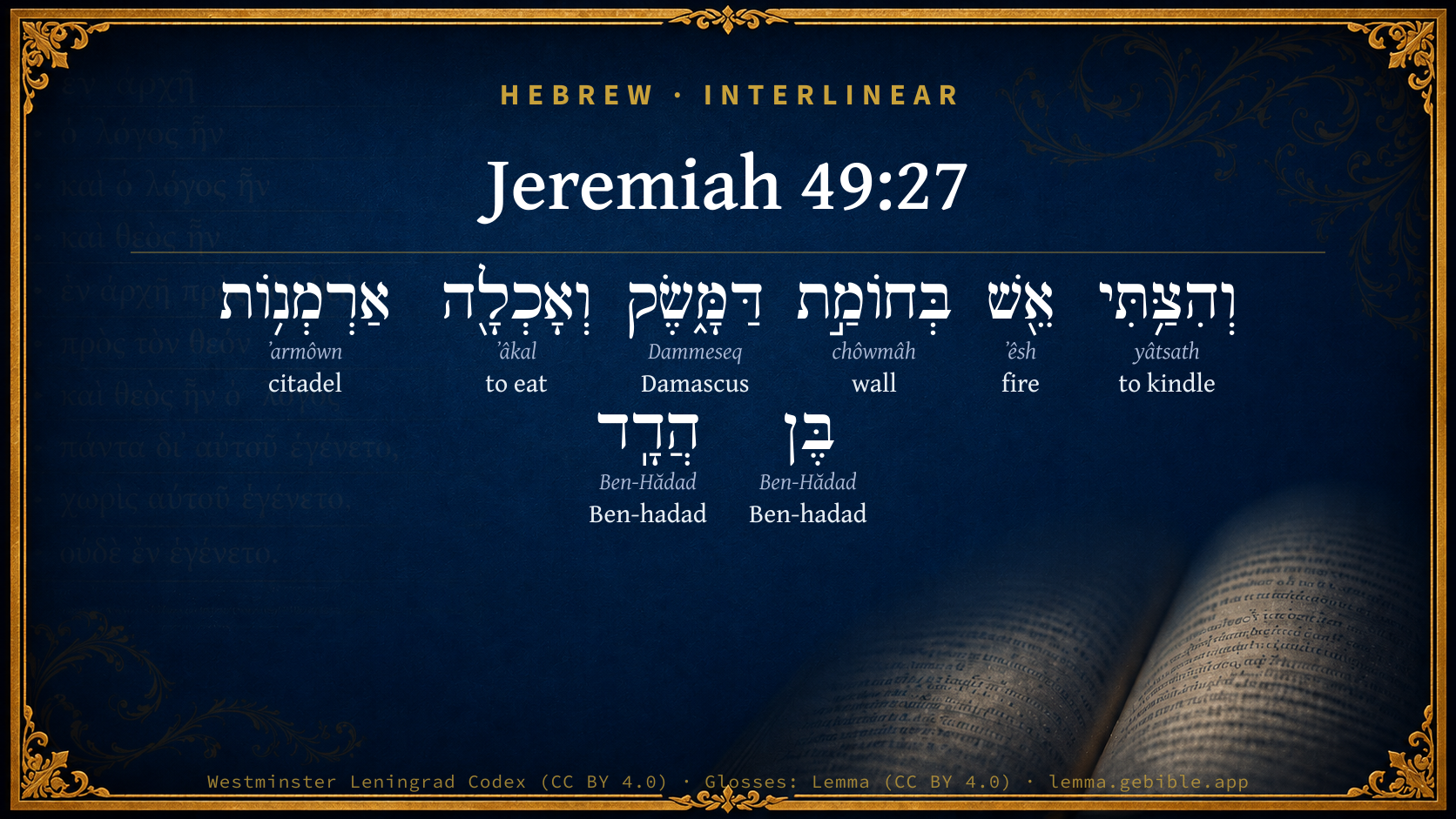
Jeremiah 49:27

Hebrew (Westminster Leningrad Codex) Jeremiah 49:27 appears in the Hebrew Old Testament. The text above is from the Westminster Leningrad Codex. Each word links to its Strong’s number, a concise gloss, and parsing drawn from the Open Scriptures Hebrew Bible morphology. Click any word for its full Brown-Driver-Briggs (BDB) entry.
Download image
Cite this verse

Jeremiah 49:27 (World English Bible). Public Domain. Lemma interlinear Bible study tool, https://lemma.gebible.app/v/jeremiah/49/27.

Show BibTeX & RIS
BibTeX
RIS
English Translation
I will kindle a fire in the wall of Damascus, and it shall devour the palaces of Ben Hadad.
World English Bible · Public Domain
Download a study sheet

One document with this verse’s original text, its word-by-word gloss line, the meaning frame, cross-references with their text, attributed commentary, and full source and license credits — printable, and it pastes into notes with its structure intact.

This verse Autodidact and up

Study sheet (.html) Plain text (.txt)

A passage Seminary Student

Up to 50 verses in one chapter. A passage sheet keeps up to 6 commentary sources and 12 cross-references per verse, in the order this page ranks them, and says so on the sheet whenever that leaves anything out. Ask for a single verse and you get the Autodidact verse sheet above.

Everything on this page stays free to read, with no account — the sheet is a download of what is already on screen, not access to it.

Want to remove ads? Support Godless Engineer
Compare translations 3

The same verse in 3 English versions, stacked beneath the original-language interlinear above. Click any original word for its lexicon entry.

Each is an independent rendering of the whole verse — the interlinear is not word-aligned to these translations.

Highlighted words mark where these versions differ — a whole-verse word diff, not a word-by-word alignment.

  • World English Bible Public Domain
    I will kindle a fire in the wall of Damascus, and it shall devour the palaces of Ben Hadad.
  • King James Version Public Domain
    And I will kindle a fire in the wall of Damascus, and it shall consume the palaces of Benhadad.
  • unfoldingWord Literal Text CC BY-SA 4.0
    “For I will light a fire on the wall of Damascus, and it will devour the strongholds of Ben Hadad.”

unfoldingWord Literal Text — © unfoldingWord, licensed CC BY-SA 4.0. Word-aligned USFM3 via Door43 (git.door43.org/unfoldingWord/en_ult).

Versions to compare (up to 4)

3 of 4 selected

Show all 18 translations

Every available English version of this verse, each an independent rendering of the whole verse.

  • World English Bible Public Domain
    I will kindle a fire in the wall of Damascus, and it shall devour the palaces of Ben Hadad.
  • Berean Standard Bible Public Domain
    “I will set fire to the walls of Damascus; it will consume the fortresses of Ben-hadad.”
  • Majority Standard Bible Public Domain
    “I will set fire to the walls of Damascus; it will consume the fortresses of Ben-hadad.”
  • King James Version Public Domain
    And I will kindle a fire in the wall of Damascus, and it shall consume the palaces of Benhadad.
  • American Standard Version (1901) Public Domain
    And I will kindle a fire in the wall of Damascus, and it shall devour the palaces of Ben-hadad.
  • Revised Version (1885) Public Domain
    And I will kindle a fire in the wall of Damascus, and it shall devour the palaces of Ben-hadad.
  • Geneva Bible (1599) Public Domain
    And I will kindle a fire in the wall of Damascus, which shall cosume the palaces of Benhadad.
  • Douay-Rheims (1899) Public Domain
    And I will kindle a fire in the wall of Damascus, rind it shall devour the strong holds of Benadad.
  • Young's Literal Translation Public Domain
    And I have kindled a fire against the wall of Damascus, And it consumed palaces of Ben-Hadad!'
  • Literal Standard Version CC BY-SA 4.0
    And I have kindled a fire against the wall of Damascus, || And it consumed palaces of Ben-Hadad!”
  • Unlocked Literal Bible CC BY-SA 4.0
    “For I will light a fire on the wall of Damascus, and it will devour the strongholds of Ben Hadad.”
  • unfoldingWord Literal Text CC BY-SA 4.0
    “For I will light a fire on the wall of Damascus, and it will devour the strongholds of Ben Hadad.”
  • Darby Bible Public Domain
    And I will kindle a fire in the wall of Damascus, and it shall consume the palaces of Ben-Hadad.
  • World Messianic Bible Public Domain
    “I will kindle a fire in the wall of Damascus, and it will devour the palaces of Ben Hadad.”
  • Webster's Bible Public Domain
    And I will kindle a fire in the wall of Damascus, and it shall consume the palaces of Ben-hadad.
  • Free Bible Version CC BY-SA 4.0
    I'm going to set fire to the walls of Damascus; that will burn down the fortresses of Ben-hadad.
  • Bible in Basic English Public Domain
    And I will have a fire lighted on the wall of Damascus, burning up the great houses of Ben-hadad.
  • JPS Tanakh (1917) Public Domain
    And I will kindle a fire in the wall of Damascus, and it shall devour the palaces of Ben-hadad.

Literal Standard Version (2020), Covenant Press — licensed CC BY-SA 4.0. Text via the HelloAO Bible API (eBible.org). Unlocked Literal Bible (unfoldingWord) — licensed CC BY-SA 4.0. Text via the HelloAO Bible API (eBible.org). unfoldingWord Literal Text — © unfoldingWord, licensed CC BY-SA 4.0. Word-aligned USFM3 via Door43 (git.door43.org/unfoldingWord/en_ult). Free Bible Version, Dr. Jonathan Gallagher — licensed CC BY-SA 4.0. Text via the HelloAO Bible API (eBible.org).

Word by word

More ways to search: Search by grammar → Find every occurrence → Compare this word →

Practice this passage: Drill this verse → Learn its vocabulary →

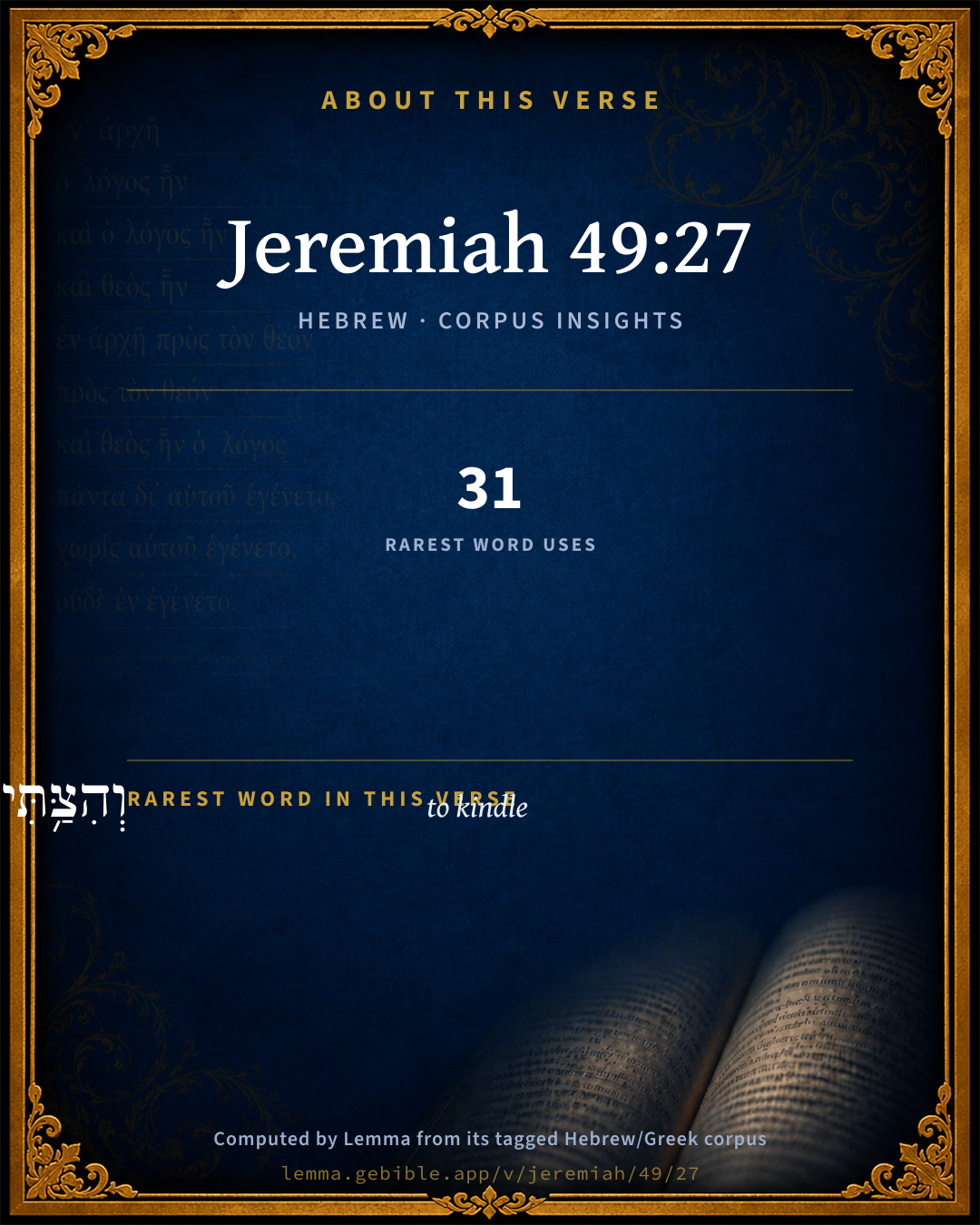
About this verse

These counts appear in no published source. They are computed here, from the morphology-tagged text and Lemma’s own curated glosses. What Lemma adds →

8
words
7
distinct lemmas
Prophets
section

Shared distinctive vocabulary

וְהִצַּ֥תִּי to kindle H3341 occurs in 28 verses of the Hebrew Bible. Also found in:

Grammatical profile

  • 2 verbs
  • 6 nouns

Verb forms

  • וְהִצַּ֥תִּי Hiphil · Sequential Perfect
  • וְאָכְלָ֖ה Qal · Sequential Perfect

Repetition

A word recurs within this verse — often emphatic in Hebrew:

  • בֶּן Ben-hadad H1130 ×2

Cross-references

6

Topical passages linked to Jeremiah 49:27 in the Treasury of Scripture Knowledge — connected by theme and wording, ordered by reader-vote popularity; previews shown in the World English Bible.

  • 1 Kings 15:18–20 Then Asa took all the silver and the gold that were left in the treasures of the house of Yahweh, and the treasures of the king's house, and delivered them into the hand of his servants; and king Asa sent them to Ben Hadad, the son of Tabrimmon, the son of Hezion, king of Syria, who lived at Damascus, saying,
  • Amos 1:3–5 Thus says Yahweh: "For three transgressions of Damascus, yes, for four, I will not turn away its punishment; Because they have threshed Gilead with threshing instruments of iron;
  • 1 Kings 20:1–22 Ben Hadad the king of Syria gathered all his host together; and there were thirty-two kings with him, and horses and chariots: and he went up and besieged Samaria, and fought against it.
  • 2 Kings 13:3 The anger of Yahweh was kindled against Israel, and he delivered them into the hand of Hazael king of Syria, and into the hand of Benhadad the son of Hazael, continually.
  • 2 Kings 13:5 (Yahweh gave Israel a savior, so that they went out from under the hand of the Syrians; and the children of Israel lived in their tents as before.
  • Jeremiah 43:12 I will kindle a fire in the houses of the gods of Egypt; and he shall burn them, and carry them away captive: and he shall array himself with the land of Egypt, as a shepherd puts on his garment; and he shall go forth from there in peace.

Cross-references courtesy of OpenBible.info (CC BY 4.0).

Hebrew and Greek witnesses Masoretic Hebrew ↔ Greek Septuagint

The same verse in the two great witnesses to the Old Testament, shown verse-for-verse.

These are two independent witnesses, not word-aligned to each other, and the Septuagint is shown in lemma (dictionary) form.

Hebrew Jeremiah 49:27 Masoretic · Westminster Leningrad Codex

וְהִצַּ֥תִּי אֵ֖שׁ בְּחוֹמַ֣ת דַּמָּ֑שֶׂק וְאָכְלָ֖ה אַרְמְנ֥וֹת בֶּן הֲדָֽד

I will kindle a fire in the wall of Damascus, and it shall devour the palaces of Ben Hadad.

World English Bible · Public Domain

Greek LXX Structure differs

In the Septuagint, Jeremiah is about an eighth shorter than the Hebrew and arranges its material differently — the Oracles Against the Nations (Hebrew chapters 46–51) appear in the middle of the Greek book, after 25:13. Because the chapter and verse boundaries do not line up, a verse-for-verse comparison with the Hebrew is not shown.

A verse-for-verse comparison isn’t shown here because the chapters and verses don’t line up. Switch to the LXX edition with the MT / LXX toggle above to read the Greek directly.

On this verse, Haydock's Catholic Bible Commentary discusses the Septuagint’s reading. Read the note in Commentary ↓

Hebrew: Westminster Leningrad Codex (CC BY 4.0). Greek: Septuagint (public domain); English from a public-domain English Septuagint. How the Septuagint differs from the Hebrew →

Targum (Aramaic paraphrase)

1

The Targum is the ancient Jewish Aramaic paraphrase of the Hebrew Scriptures — an interpretive translation, not the Hebrew text itself. Onkelos (literal) and Pseudo-Jonathan (expansive) render the Torah, and Jonathan the Prophets. Coverage is partial: where no permissively-licensed English translation exists for a verse, only the Aramaic is shown. This is verse-level text, not a word-by-word alignment to the Hebrew.

  1. Targum Jonathan Prophets (Joshua–Malachi)
    וְאַדְלֵיק אֶשְׁתָּא בְּשׁוּרֵי דַמֶשֶׂק וּתְשֵׁיצֵי בִּירְנְיַת בַּר הֲדָר:

    (no public-domain English translation for this verse)

    Targum Jonathan — Aramaic: “Mikraot Gedolot” (public domain). English: “Sefaria Community Translation” (CC0 1.0 (public-domain dedication)); “London "Chaldee Paraphrase," 1871” (public domain). Text via Sefaria.

Commentary

Notes on Jeremiah 49:27 from classic Christian and Jewish commentators (each source and its license shown beneath its notes). The classic Christian expositions comment on the surrounding passage and are grouped to its opening verse, so a note may address several verses; the Jewish commentaries on the Tanakh (Rashi and others) are per-verse, so they appear only where the commentator wrote on this verse.

Lemma curates 59 commentaries, every one of them public domain or Creative Commons licensed, each selected and text-cleaned for this edition rather than reprinted as found. About our sources →

Trapp's Complete Commentary

John Trapp

Jer 49:27 And I will kindle a fire in the wall of Damascus, and it shall consume the palaces of Benhadad.

Ver. 27. And I will kindle a fire.] See on Amo 1:4.

John Trapp, A Commentary or Exposition upon All the Books of the Old and New Testament (1647–1656) — public domain. Text from a community e-Sword module.

Tyndale Open Study Notes

Tyndale Open Resources

49:27 The city’s walls and palaces were probably built with timbers from the slopes of Mount Hermon. • Ben-hadad (literally son of the mighty one) was the royal title given to a long line of Aramean kings.

Tyndale Open Study Notes — © Tyndale Open Resources, licensed CC BY-SA 4.0. Text via the HelloAO Bible API.

Geneva Bible (1599)

Geneva Bible translators

Who was king of Syria, 1 Kings 20:26, and had built these palaces, which were still called the palaces of Ben-Hadad.

Geneva Bible (1599) marginal notes — public domain. Text via Bolls.life.

Jamieson, Fausset & Brown

Robert Jamieson, A. R. Fausset & David Brown

palaces of Ben-hadad--that palace from which so many evils and such cruelty to Israel emanated; thus implying the cause of Damascus' overthrow. Not the Ben-hadad of Kg2 13:3; Amo 1:4; it was a common name of the Syrian kings (compare Kg1 15:18; meaning "son of Hadad," the idol).

Jamieson, Fausset & Brown — Commentary Critical and Explanatory on the Whole Bible (1871) — public domain (CC PDM 1.0). Text via the HelloAO Bible API.

Adam Clarke's Commentary

Verse 27. The palaces of Ben-hadad.] Damascus was a seat of the Syrian kings, and Ben-hadad was a name common to several of its kings.

Adam Clarke's Commentary on the Bible (1810–1826) — public domain. Text from a community e-Sword/MySword module.

John Calvin's Commentaries

Here God himself speaks, and declares that he would be the author of the destruction of which Jeremiah prophesied. And he employs the similitude of fire, because there is nothing more violent or more dreadful than burning; for we know that the greatest cities are soon consumed and reduced to ashes when fire begins to blaze. God then compares the destruction of the city to burning, though no fire was applied to destroy the walls and the palaces of the king; but the Prophet means by this metaphor, that such would be the destruction of the city, as though it was consumed by fire. He at the same time reminds the faithful of God’s judgment, that they might know that whatever happened to the Syrians proceeded from his hand; because such calamities would have availed but little, except this doctrine was also added, that just punishments are inflicted by God on the wickedness of men.

But when he speaks of the palaces of Ben-hadad, he briefly points out the cause why God would deal so severely with the Syrians. We have said already that they had been always hostile to God’s chosen people. They first tried to overthrow the kingdom of Israel; afterwards they confederated with the kings of Israel, but it was for the purpose of overthrowing the kingdom of Judah; and many were the confederacies for this end. But Ben-hadad, as we read in the first book of Kings, grievously distressed the Israelites. We indeed learn from the history of those times, that there were many kings of Syria who bore this name, for it was a common name, as the kings of Egypt were called Pharaohs; and other kings also took a popular name, as the emperors of Rome called themselves Caesars. But we read that the last Ben-hadad was the son of Hazael, who was also the king of Syria; and as I have said, it was not a private name. Since, then, sacred history clearly shews that there were many who were called Ben-hadad, the Prophet, I have no doubt, refers to the first who began to disturb and harass the Israelites. He then points out the cause why God had determined to destroy Damascus, for he had in his forbearance borne for a long time with the Syrians. But when he saw that they did not repent, but on the contrary added sins to sins, at length ascending his tribunal, he says, that the fire which he would apply to the walls of Damascus, would also consume the palaces of Ben-hadad, that is, the palaces whence so many evils had proceeded, and so much cruelty, by which the miserable Church had been distressed. This is the meaning. It now follows, —

John Calvin's Commentaries (1540-1563) — public domain. Text from the Calvin Translation Society English edition (1840s-50s) via the Christian Classics Ethereal Library (ccel.org). Calvin's coverage is partial (roughly two-thirds of the Bible); uncommented books and verses are honest gaps, never fabricated. The 19th-century editor's footnotes and remarks are omitted so the notes are faithfully Calvin's own voice.

Ellicott's Commentary for English Readers

(27) It shall consume the palaces of Ben-ha-dad.—Three kings of the name appear in Old Testament history; one as warring against Omri (1Ki_20:34), another as a contemporary of Elisha (2Ki_8:7), a third as the son of Hazael, and therefore belonging to a different dynasty (2Ki_13:3). It is possible, as the name was thus associated with the greatness of the kingdom, that it may have been borne also by later kings. It appears in the form Ben-hidri in Assyrian inscriptions. The prophet’s words are, at any rate, a proof that the palaces of Damascus were either built by one of them, probably the first, or at any rate bore their name.

A Bible Commentary for English Readers, edited by Charles John Ellicott (1878–1897) — public domain. Text from a community e-Sword module.

The Cambridge Bible for Schools and Colleges

gen. ed. J. J. S. Perowne

27. I will kindle a fire] Cp. Num_21:28; Deu_32:22. Benhadad (son of Hadad) was the name of several kings of Syria.

palaces] See on Jer_6:5.

The Cambridge Bible for Schools and Colleges (gen. ed. J. J. S. Perowne; Cambridge University Press, 1878–1918) — public domain. Text from a community e-Sword module.

John Gill's Exposition

And I will kindle a fire in the wall of Damascus,.... Signifying either that, a breach being made there the destruction of the city should begin, and be carried on until it was completed; or it may be understood literally, that first the houses built upon the wall should beset on fire by the Chaldeans, through the divine permission, and according to his order and wilt, and therefore ascribed to him, which should proceed further. Compare with this Co2 11:32;

and it shall consume the palaces of Benhadad; not only the houses of the common people in general, but particularly the palaces of their king and his nobles; Benhadad being a name of one of the kings of Syria, Kg1 20:1; and which, according to Kimchi, was the name of the king of Syria at the time of the destruction of Damascus by Nebuchadnezzar. Some think that this was a common name of the kings of Syria, as Pharaoh and Ptolemy with the Egyptians. It signifies the son of Hadad, which was the name of their idol; from whence their kings might be called, as was usual with the Assyrians and Babylonians.

John Gill's Exposition of the Whole Bible (1746–1763) — public domain (CC PDM 1.0). Text via the HelloAO Bible API.

Albert Barnes' Notes on the Bible

See the marginal reference and 1Ki 11:14 note.

Albert Barnes' Notes on the Bible (1834–1885) — public domain. Text from a community e-Sword/MySword module.

Haydock's Catholic Bible Commentary

Benadad. So the kings were usually styled, 3 Kings xv. 8. Septuagint, "the son of Ader."

George Leo Haydock (1774–1849), Haydock's Catholic Family Bible and Commentary, 1859 edition — public domain. Excludes Psalms (Douay-Rheims chapter numbering differs from Protestant) and Deuterocanonical books (Catholic canon only).

Matthew Poole's English Annotations

I will bring a judgment that shall burn in Damascus like a consuming fire, and it shall reach to the royal seat of Benhadad; either that which was the royal seat of Ben-hadad, 2Ki 8:7, or else Ben-hadad (signifying the son of Hadad, which was their idol) was the common name of all the kings of Syria, as Pharaoh was to the kings of Egypt, Amo 1:4

Matthew Poole's English Annotations on the Holy Bible (1683–1685) — public domain. Text from a community e-Sword/MySword module.

The Pulpit Commentary

And I will kindly, etc. A combination of clauses from Amo_1:14 and Amo_1:4. Three several kings of Damascus bore the name of Ben-hadad: one the contemporary of King Baasha of Samaria; another, of Ahab; a third, of Joash. (Ben-hadad, however, should rather be Ben-hadar, agreeably to the Assyrian inscriptions and the Septuagint.)

The Pulpit Commentary (1880–1919), ed. H.D.M. Spence-Jones & Joseph S. Exell — public domain. Text from a community e-Sword module.

John Wesley's Explanatory Notes

Ben-hadad - Was the common name of the kings of Syria.

John Wesley, Explanatory Notes Upon the Whole Bible (1754–1765) — public domain. Text via the GEBible commentary corpus.

Lesson kit

Teaching starters — assembled from the data on this page, not authored interpretation. Every prompt links to the verse data it draws on. Edit before teaching.

Jeremiah, in the Prophets, opens this verse with 8 words (7 distinct Hebrew lemmas). Its most distinctive word is yâtsath (“to kindle”). A historical commentator’s framing appears above. Read the whole chapter for the surrounding context.

Discussion questions

  1. What does “to kindle” (yâtsath) contribute to the verse as a whole?
  2. How does Joshua 8:8, which shares the word «to kindle», read alongside this verse?
  3. What does the repetition of “Ben-hadad” (2× in this one verse) do in this verse?
  4. These translations render this verse differently. What is at stake in choosing one wording over another?
  5. «וְהִצַּ֥תִּי» is a Hiphil Sequential Perfect verb. How does that grammatical form shape the action described?
  6. Compare how Trapp's Complete Commentary and Tyndale Open Study Notes read this verse. Where do they agree or differ?

Things to notice

  • These translations choose different wording for 10 words in this verse.
  • “Ben-hadad” occurs 2× in this single verse.
  • 7 distinct Hebrew lemmas span 8 words in this verse.

Reading settings

Reading text

Shown beneath each verse's original-language words.

Old Testament
Old Testament edition

Read the OT as the Masoretic Hebrew (MT) or the Greek Septuagint (LXX).

English shown for the Greek Septuagint (in the Hebrew ↔ Greek comparison).

Comparing translations? Open the Compare panel on any verse page to stack up to four side by side.