Joshua 2:15

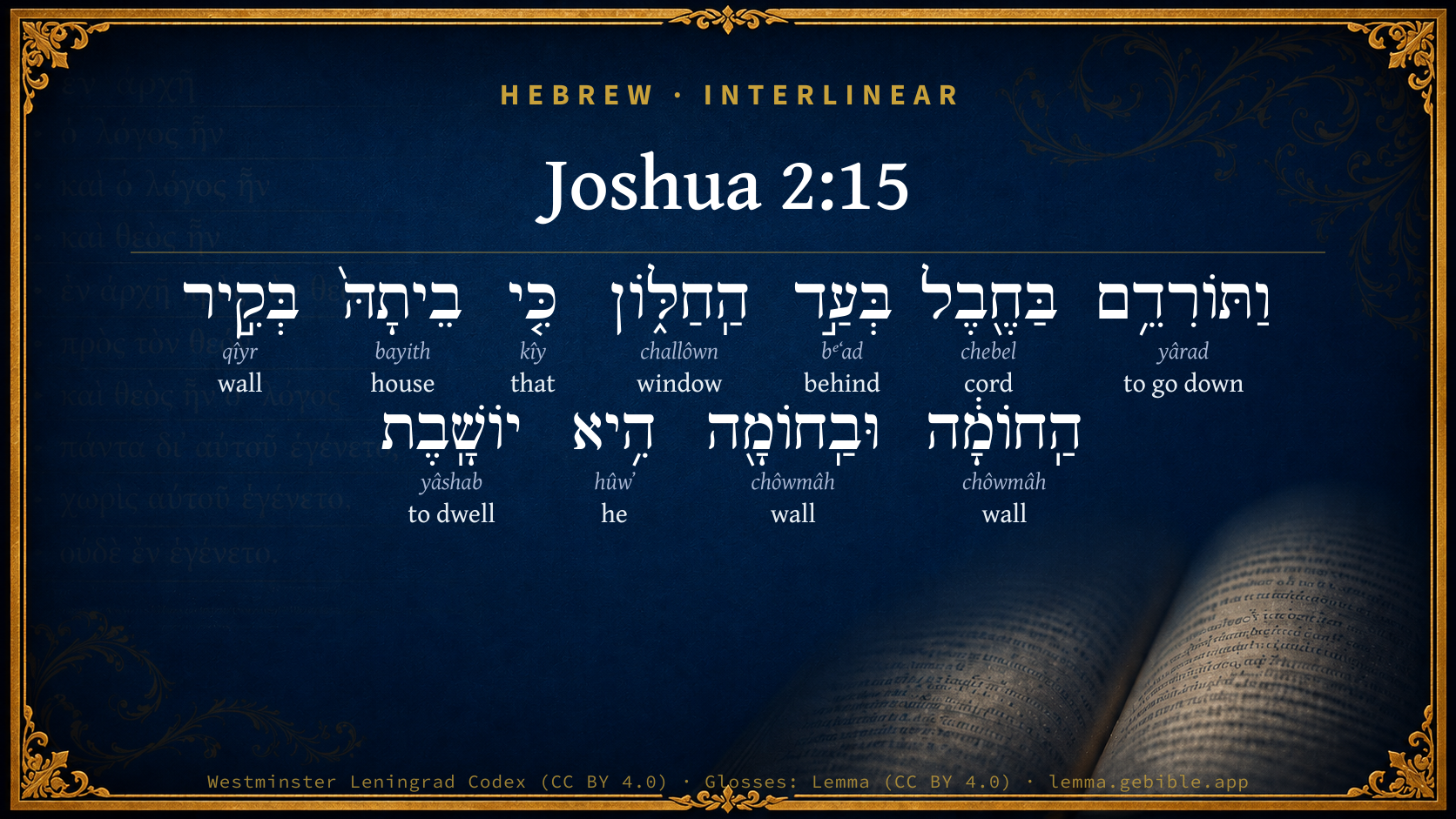
Hebrew (Westminster Leningrad Codex) Joshua 2:15 appears in the Hebrew Old Testament. The text above is from the Westminster Leningrad Codex. Each word links to its Strong’s number, a concise gloss, and parsing drawn from the Open Scriptures Hebrew Bible morphology. Click any word for its full Brown-Driver-Briggs (BDB) entry.
Download image
Cite this verse

Joshua 2:15 (World English Bible). Public Domain. Lemma interlinear Bible study tool, https://lemma.gebible.app/v/joshua/2/15.

Show BibTeX & RIS
BibTeX
RIS
English Translation
Then she let them down by a cord through the window: for her house was on the side of the wall, and she lived on the wall.
World English Bible · Public Domain
Download a study sheet

One document with this verse’s original text, its word-by-word gloss line, the meaning frame, cross-references with their text, attributed commentary, and full source and license credits — printable, and it pastes into notes with its structure intact.

This verse Autodidact and up

Study sheet (.html) Plain text (.txt)

A passage Seminary Student

Up to 50 verses in one chapter. A passage sheet keeps up to 6 commentary sources and 12 cross-references per verse, in the order this page ranks them, and says so on the sheet whenever that leaves anything out. Ask for a single verse and you get the Autodidact verse sheet above.

Everything on this page stays free to read, with no account — the sheet is a download of what is already on screen, not access to it.

Want to remove ads? Support Godless Engineer
Compare translations 3

The same verse in 3 English versions, stacked beneath the original-language interlinear above. Click any original word for its lexicon entry.

Each is an independent rendering of the whole verse — the interlinear is not word-aligned to these translations.

Highlighted words mark where these versions differ — a whole-verse word diff, not a word-by-word alignment.

  • World English Bible Public Domain
    Then she let them down by a cord through the window: for her house was on the side of the wall, and she lived on the wall.
  • King James Version Public Domain
    Then she let them down by a cord through the window: for her house was upon the town wall, and she dwelt upon the wall.
  • unfoldingWord Literal Text CC BY-SA 4.0
    Then she lowered them down by a rope through the window (for her house in the side of the wall, so she was dwelling in the wall).

unfoldingWord Literal Text — © unfoldingWord, licensed CC BY-SA 4.0. Word-aligned USFM3 via Door43 (git.door43.org/unfoldingWord/en_ult).

Versions to compare (up to 4)

3 of 4 selected

Show all 18 translations

Every available English version of this verse, each an independent rendering of the whole verse.

  • World English Bible Public Domain
    Then she let them down by a cord through the window: for her house was on the side of the wall, and she lived on the wall.
  • Berean Standard Bible Public Domain
    Then Rahab let them down by a rope through the window, since the house where she lived was built into the wall of the city.
  • Majority Standard Bible Public Domain
    Then Rahab let them down by a rope through the window, since the house where she lived was built into the wall of the city.
  • King James Version Public Domain
    Then she let them down by a cord through the window: for her house was upon the town wall, and she dwelt upon the wall.
  • American Standard Version (1901) Public Domain
    Then she let them down by a cord through the window: for her house was upon the side of the wall, and she dwelt upon the wall.
  • Revised Version (1885) Public Domain
    Then she let them down by a cord through the window: for her house was upon the town wall, and she dwelt upon the wall.
  • Geneva Bible (1599) Public Domain
    Then she let them downe by a corde thorowe the windowe: for her house was vpon the towne wall, and she dwelt vpon the wall.
  • Douay-Rheims (1899) Public Domain
    That you will save my father and mother, my brethren end sisters, and all things that are theirs, and deliver our souls from death.
  • Young's Literal Translation Public Domain
    And she causeth them to go down by a rope through the window, for her house `is' in the side of the wall, and in the wall she `is' dwelling;
  • Literal Standard Version CC BY-SA 4.0
    And she causes them to go down by a rope through the window, for her house [is] in the side of the wall, and she [is] dwelling in the wall;
  • Unlocked Literal Bible CC BY-SA 4.0
    So she let them down out through the window using a rope. The house in which she lived was built into the wall of the city.
  • unfoldingWord Literal Text CC BY-SA 4.0
    Then she lowered them down by a rope through the window (for her house in the side of the wall, so she was dwelling in the wall).
  • Darby Bible Public Domain
    And she let them down by a cord through the window; for her house was upon the city-wall, and she dwelt upon the wall.
  • World Messianic Bible Public Domain
    Then she let them down by a cord through the window; for her house was on the side of the wall, and she lived on the wall.
  • Webster's Bible Public Domain
    Then she let them down by a cord through the window: for her house was upon the town-wall, and she dwelt upon the wall.
  • Free Bible Version CC BY-SA 4.0
    Then she lowered them down by a rope through the window since the house where she lived was built into the outside of the city wall.
  • Bible in Basic English Public Domain
    Then she let them down from the window by a cord, for the house where she was living was on the town wall.
  • JPS Tanakh (1917) Public Domain
    Then she let them down by a cord through the window; for her house was upon the side of the wall, and she dwelt upon the wall.

Literal Standard Version (2020), Covenant Press — licensed CC BY-SA 4.0. Text via the HelloAO Bible API (eBible.org). Unlocked Literal Bible (unfoldingWord) — licensed CC BY-SA 4.0. Text via the HelloAO Bible API (eBible.org). unfoldingWord Literal Text — © unfoldingWord, licensed CC BY-SA 4.0. Word-aligned USFM3 via Door43 (git.door43.org/unfoldingWord/en_ult). Free Bible Version, Dr. Jonathan Gallagher — licensed CC BY-SA 4.0. Text via the HelloAO Bible API (eBible.org).

Word by word

More ways to search: Search by grammar → Find every occurrence → Compare this word →

Practice this passage: Drill this verse → Learn its vocabulary →

הַֽחַלּ֑וֹן
challôwn
H2474
“the · window”
Particle, Definite Article + Noun, Common, Both, Singular, Absolute
Part of Speech
Particle + Noun
Type
Common
Gender
Both
Number
Singular
State
Absolute
Full BDB Definition

Origin: unknown derivation

TWOT: 660c

window (piercing of the wall)
  1. וַתּוֹרִדֵ֥ם yârad H3381 “and · to go down · them” Conjunction + Verb, Hiphil, Sequential Imperfect, 3rd Person, Feminine, Singular + Suffix, Personal, 3rd Person, Masculine, Plural
  2. בַּחֶ֖בֶל chebel H2256 “in/at the · cord” Preposition, Determined + Noun, Common, Both, Singular, Absolute
  3. בְּעַ֣ד bᵉʻad H1157 “behind” Preposition
  4. כִּ֤י kîy H3588 “that” Conjunction
  5. בֵיתָהּ֙ bayith H1004 “house · her” Noun, Common, Masculine, Singular, Construct + Suffix, Personal, 3rd Person, Feminine, Singular
  6. בְּקִ֣יר qîyr H7023 “in/at · wall of” Preposition + Noun, Common, Masculine, Singular, Construct
  7. הַֽחוֹמָ֔ה chôwmâh H2346 “the · wall” Particle, Definite Article + Noun, Common, Feminine, Singular, Absolute
  8. וּבַֽחוֹמָ֖ה chôwmâh H2346 “and · in/at the · wall” Conjunction + Preposition, Determined + Noun, Common, Feminine, Singular, Absolute
  9. הִ֥יא hûwʼ H1931 “he” Pronoun, Personal, 3rd Person, Feminine, Singular
  10. יוֹשָֽׁבֶת yâshab H3427 “dwelling” Verb, Qal, Participle Active, Feminine, Singular, Absolute

About this verse

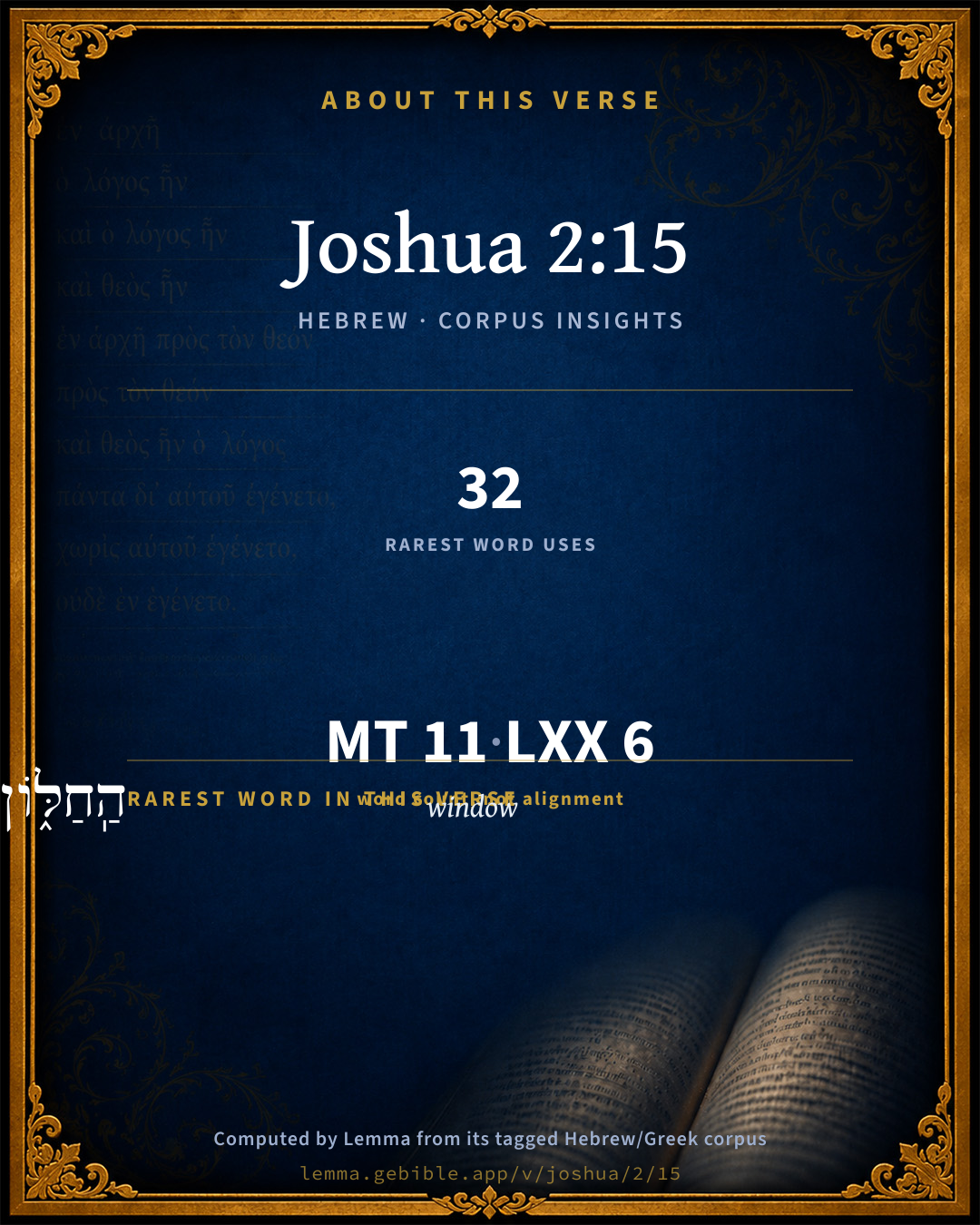
These counts appear in no published source. They are computed here, from the morphology-tagged text and Lemma’s own curated glosses. What Lemma adds →

11
words
10
distinct lemmas
Historical
section

Shared distinctive vocabulary

הַֽחַלּ֑וֹן window H2474 occurs in 27 verses of the Hebrew Bible. Also found in:

Grammatical profile

  • 2 verbs
  • 6 nouns
  • 1 pronoun
  • 1 preposition
  • 1 conjunction

Verb forms

  • וַתּוֹרִדֵ֥ם Hiphil · Sequential Imperfect
  • יוֹשָֽׁבֶת Qal · Participle Active

Repetition

A word recurs within this verse — often emphatic in Hebrew:

  • הַֽחוֹמָ֔ה wall H2346 ×2

Hebrew & Septuagint length

In English translation the verse runs 27 words from the Hebrew and 8 from the Septuagint (LXX English) — the Septuagint runs noticeably shorter here. See the side-by-side →

A rough comparison of the two English renderings, which tokenize alike — not a word-level alignment.

Word counts can differ between the Hebrew and the Greek without any difference in meaning — e.g. the Hebrew direct-object marker אֵת has no separate Greek word, and Greek often adds the article ὁ.

In the original languages it is 11 Hebrew tokens and 6 Greek tokens — but the two are counted differently (Hebrew bundles its prefixes and suffixes into one token; the Greek is in lemma form), so that isn’t a like-for-like length.

Cross-references

4

Topical passages linked to Joshua 2:15 in the Treasury of Scripture Knowledge — connected by theme and wording, ordered by reader-vote popularity; previews shown in the World English Bible.

  • Acts 9:25 but his disciples took him by night, and let him down through the wall, lowering him in a basket.
  • 2 Corinthians 11:33 Through a window I was let down in a basket by the wall, and escaped his hands.
  • Joshua 6:20 So the people shouted, and [the priests] blew the trumpets; and it happened, when the people heard the sound of the trumpet, that the people shouted with a great shout, and the wall fell down flat, so that the people went up into the city, every man straight before him, and they took the city.
  • 1 Samuel 19:12–17 So Michal let David down through the window: and he went, and fled, and escaped.

Cross-references courtesy of OpenBible.info (CC BY 4.0).

Hebrew and Greek witnesses Masoretic Hebrew ↔ Greek Septuagint

The same verse in the two great witnesses to the Old Testament, shown verse-for-verse.

Here the Septuagint runs noticeably shorter than the Hebrew — LXX2012 (modern English Septuagint) 8 words vs World English Bible 27. A rough length comparison of the two English translations, not a word-level alignment — read both below.

These are two independent witnesses, not word-aligned to each other, and the Septuagint is shown in lemma (dictionary) form.

Hebrew Joshua 2:15 Masoretic · Westminster Leningrad Codex

וַתּוֹרִדֵ֥ם בַּחֶ֖בֶל בְּעַ֣ד הַֽחַלּ֑וֹן כִּ֤י בֵיתָהּ֙ בְּקִ֣יר הַֽחוֹמָ֔ה וּבַֽחוֹמָ֖ה הִ֥יא יוֹשָֽׁבֶת

Then she let them down by a cord through the window: for her house was on the side of the wall, and she lived on the wall.

World English Bible · Public Domain

Greek LXX Joshua 2:15 Septuagint · lemma form

καί καταχαλάω αὐτός διά ὁ θυρίς

And she let them down by the window;

LXX2012 (modern English Septuagint) · Public Domain

Hebrew: Westminster Leningrad Codex (CC BY 4.0). Greek: Septuagint (public domain); English from LXX2012 (modern English Septuagint) (Public Domain). How the Septuagint differs from the Hebrew →

Targum (Aramaic paraphrase)

1

The Targum is the ancient Jewish Aramaic paraphrase of the Hebrew Scriptures — an interpretive translation, not the Hebrew text itself. Onkelos (literal) and Pseudo-Jonathan (expansive) render the Torah, and Jonathan the Prophets. Coverage is partial: where no permissively-licensed English translation exists for a verse, only the Aramaic is shown. This is verse-level text, not a word-by-word alignment to the Hebrew.

  1. Targum Jonathan Prophets (Joshua–Malachi)
    וְשַׁלְשְׁלַתְנוּן בְּאַטוּנָא מִן חֲרַכָּא אֲרֵי בֵיתָהּ בְּכוֹתֵל שׁוּרָא וּבְשׁוּרָא הִיא יָתְבָה:

    (no public-domain English translation for this verse)

    Targum Jonathan — Aramaic: “Mikraot Gedolot” (public domain). English: “Sefaria Community Translation” (CC0 1.0 (public-domain dedication)); “London "Chaldee Paraphrase," 1871” (public domain). Text via Sefaria.

Commentary

Notes on Joshua 2:15 from classic Christian and Jewish commentators (each source and its license shown beneath its notes). The classic Christian expositions comment on the surrounding passage and are grouped to its opening verse, so a note may address several verses; the Jewish commentaries on the Tanakh (Rashi and others) are per-verse, so they appear only where the commentator wrote on this verse.

Lemma curates 59 commentaries, every one of them public domain or Creative Commons licensed, each selected and text-cleaned for this edition rather than reprinted as found. About our sources →

Trapp's Complete Commentary

John Trapp

Jos 2:15 Then she let them down by a cord through the window: for her house [was] upon the town wall, and she dwelt upon the wall.

Ver. 15. For her house was upon the town wall.] In an obscure nook, among the poorer sort of people: for this harlot Rahab had not got such an estate as Phryne had, who offered at her own charge to repair the ruined walls of Thebes, if these words only might have been inscribed on them, "Alexander overturned these walls, and Phryne set them up again." {a}

And she dwelt upon the wall.] Where Providence had placed her for such a purpose as this: for it is God that appointeth the bounds of men’s habitations. {Act 17:26}

{a} O μεν Aλεξανδρος κατεσκαψε, η δε φρυνη ανωκοδο μησεν.

John Trapp, A Commentary or Exposition upon All the Books of the Old and New Testament (1647–1656) — public domain. Text from a community e-Sword module.

Joseph Benson's Commentary

Jos 2:15-16. Her house was upon the town-wall — Which gave her the opportunity of dismissing them when the gates were shut. She dwelt upon the wall — Her particular dwelling was there; which may possibly be added, because the other part of her house was reserved for the entertainment of strangers. Get you to the mountain — That is, to some of the mountains wherewith Jericho was encompassed, in which also there were many caves where they might lurk. Three days — Not three whole days, but one whole day, and part of two days.

Joseph Benson's Commentary on the Old and New Testaments (1811–1818) — public domain. Text from a community e-Sword module.

Tyndale Open Study Notes

Tyndale Open Resources

2:15 Because Rahab’s house stood on the town wall, she could hide the men on the flat roof of her house (2:6) and let them out through the window, down the outer side of the wall.

Tyndale Open Study Notes — © Tyndale Open Resources, licensed CC BY-SA 4.0. Text via the HelloAO Bible API.

Jamieson, Fausset & Brown

Robert Jamieson, A. R. Fausset & David Brown

her house was upon the town wall--In many Oriental cities houses are built on the walls with overhanging windows; in others the town wall forms the back wall of the house, so that the window opens into the country. Rahab's was probably of this latter description, and the cord or rope sufficiently strong to bear the weight of a man.

Jamieson, Fausset & Brown — Commentary Critical and Explanatory on the Whole Bible (1871) — public domain (CC PDM 1.0). Text via the HelloAO Bible API.

Adam Clarke's Commentary

Verse 15. Then she let them down by a cord c.] The natural place of this verse is after the first clause of Jos 2:21 for it is certain that she did not let them down in the basket till all those circumstances marked from Jos 2:16-20 inclusive had taken place.

She dwelt upon the wall.] That is, either the wall of the city made a part of her house or her house was built close to the wall, so that the top or battlements of it were above the wall with a window that looked out to the country. As the city gates were now shut there was no way for the spies to escape but through this window; and in order to this she let them down through the window in a basket suspended by a cord, till they reached the ground on the outside of the wall.

Adam Clarke's Commentary on the Bible (1810–1826) — public domain. Text from a community e-Sword/MySword module.

Ellicott's Commentary for English Readers

(15) Her house was upon the town wall—Happily for the two spies. Perhaps, indeed, they selected it for this reason, as it enabled them to leave the town without passing the gate.

A Bible Commentary for English Readers, edited by Charles John Ellicott (1878–1897) — public domain. Text from a community e-Sword module.

The Cambridge Bible for Schools and Colleges

gen. ed. J. J. S. Perowne

15. she let them down by a cord] Comp. the escape of St Paul from Damascus (Act_9:25).

her house was upon the town wall] i.e. her chamber was in the upper story of the house, which rose above the wall, as may be seen even now in old cities along the Rhine.

The Cambridge Bible for Schools and Colleges (gen. ed. J. J. S. Perowne; Cambridge University Press, 1878–1918) — public domain. Text from a community e-Sword module.

John Gill's Exposition

Then she let them down by a cord through the window,.... Which must be large, and the cord strong, as well as she herself a masculine woman, to let down two men by it, unless she employed any of her servants in the affair; though this being so great a secrecy, it is probable she trusted none of her domestics with it as little as possible: in like manner the Apostle Paul was let down by the wall of Damascus in a basket, Act 9:25; Jarchi supposes it was the same cord and window, by means of and in at which her gallants used to come and go:

for her house was upon the town wall; in a suitable and convenient place to receive her guests and gallants: and it is observed, that harlots have had their houses on or under walls: Martial speaks of harlots whom he calls (l) Summoenianae, whores that plied under the walls and in the suburbs of cities:

and she dwelt upon the wall; that part of the house in which she particularly dwelt was built on or over the wall, and the rest towards the city was for the entertainment of persons that resorted to her house.

(l) Epigram. l. 3. Ep. 62.

John Gill's Exposition of the Whole Bible (1746–1763) — public domain (CC PDM 1.0). Text via the HelloAO Bible API.

Albert Barnes' Notes on the Bible

Upon the town wall - The town wall probably formed the back wall of the house, and the window opened therefore into the country. (Compare Paul’s escape, 2Co 11:33).

Albert Barnes' Notes on the Bible (1834–1885) — public domain. Text from a community e-Sword/MySword module.

Matthew Poole's English Annotations

Which gave her the opportunity of dismissing them when the gates were shut.

She dwelt upon the wall; her particular dwelling was there; which may possibly be added, because the other part of her house was reserved for the entertainment of strangers.

Matthew Poole's English Annotations on the Holy Bible (1683–1685) — public domain. Text from a community e-Sword/MySword module.

Whedon's Commentary on the Bible

Daniel D. Whedon

15. Then she let them downs by a cord — [Many interpreters are of opinion that there is a confusion in the order of verses here, and that this verse should follow the first sentence of Jos_2:21. For it is improbable, they urge, that Rahab and the spies continued to converse after the latter were let down from the window, inasmuch as such conversation would have led to their detection and exposure. But against such an opinion are the words, Thou didst let us down, (Jos_2:18;) and as for the confusion of verses, Keil well remarks that “the Hebrews often connect together the principal circumstances attending any particular event, and, after fully describing these, proceed to fill up the details of minor importance. This, however, is nor, a confusion in the order of events, but an anticipation of the result consequent upon a well-arranged division of the subject-matter.”] Some have thought that it was impossible that she could let them down alone, and they have furnished her with “friends or domestics” to assist her. But there is no need of this assistance. By fastening the cord to something within the room they could descend, sailor-like, even without aid from within. Paul was let down in a basket. (2Co_11:33.)

Her house was upon the town wall — בקיר החומה, in the depth of the wall. Her house was so constructed that the city wall formed also the back wall of the house.

She dwelt upon the wall — For her house was built on the wall, and projected beyond its outer edge, so that from one of its outer windows the men could be let down beyond the walls of the city. (See note on Act_9:25.)

Daniel D. Whedon (gen. ed.), Commentary on the Old and New Testaments (1874–1909) — public domain. Text from a community e-Sword module.

The Pulpit Commentary

Then she let them down. The conversation which is related afterwards, no doubt occurred afterwards, as is proved by the use of the perfect WnTedrwOh in ver. 18. There is no reason to suppose the window by which she let them down. to have been so distant from the ground as to preclude a conversation, and it is quite possible that Rahab"s house may have been in a situation in which such a conversation could be carried on without interruption. There are continental cities now surrounded by walls, in which such a conversation would involve no difficulty whatever, especially if the house from which such a conversation was carried on happened to stand a little apart from other houses. And though the spies sent by Moses described the walls of the Phoenician cities in hyperbolical language, it is highly improbable that their fortifications were stronger than those of mediaeval times. The little town of Ahrweiler, in the valley of the Ahr, near Remagen, may serve as an instance in point. It would once have been called a strongly fortified town, but the walls are of no great height, and the houses are built upon them. The same may be seen at Bacharach and Oberwesel, and other well known places where the fortifications have not been modernised. With the escape of the spies we may compare the escape of St. Paul from Damascus, as recorded in Act_9:25, and 2Co_11:32, 2Co_11:33.

The Pulpit Commentary (1880–1919), ed. H.D.M. Spence-Jones & Joseph S. Exell — public domain. Text from a community e-Sword module.

John Wesley's Explanatory Notes

Town-wall - Which gave her the opportunity of dismissing them when the gates were shut. Upon the wall - Her particular dwelling was there: which may possibly be added, because the other part of her house was reserved for the entertainment of strangers.

John Wesley, Explanatory Notes Upon the Whole Bible (1754–1765) — public domain. Text via the GEBible commentary corpus.

Keil & Delitzsch

C. F. Keil & F. Delitzsch

Rahab then let them down by a rope through the window, namely, into the open country; for her house stood against or upon the town wall, so that she lived upon the wall, and advised them to get to the mountains, that they might not meet the men who had been sent out in pursuit of them, and to hide themselves there for three days, when the pursuers would have returned.

Keil & Delitzsch — Biblical Commentary on the Old Testament (1861–1891) — public domain (CC PDM 1.0). Text via the HelloAO Bible API. (Old Testament only.)

unfoldingWord translationNotes

Door43 World Missions Community

General Information:

The Israelite spies continue to talk to Rahab.

if you do not do this

This expresses a condition for the promise the spies had made to Rahab. The word, "this," refers to "tie this scarlet rope in the window" in Joshua 2:18. (See: Hypothetical Situations)

translationWords

house

promise

oath

unfoldingWord translationNotes — © Distant Shores Media and the Door43 World Missions Community, licensed CC BY-SA 4.0. Source: git.door43.org/Door43/en_tn.

Rashi

Rabbi Shlomo Yitzchaki (Rashi)

Then she lowered them down with the rope. With the same rope and through the same window her admirers would use to come up to her. She said: “Master of the World with these I have sinned, with these forgive me.”

Rashi on the Tanakh — English translations: “The Judaica Press complete Tanach with Rashi, translated by A. J. Rosenberg” (CC BY 4.0); “Pentateuch with Rashi's commentary by M. Rosenbaum and A.M. Silbermann, 1929-1934” (public domain); “The Metsudah Tanach series, Lakewood, N.J” (CC BY 4.0); and “The Book of Joshua, Metsudah Publications, 1997” (CC BY 4.0). Text via Sefaria.

Lesson kit

Teaching starters — assembled from the data on this page, not authored interpretation. Every prompt links to the verse data it draws on. Edit before teaching.

Joshua, in the Historical, opens this verse with 11 words (10 distinct Hebrew lemmas). Its most distinctive word is challôwn (“window”). The Greek Septuagint runs shorter here. A historical commentator’s framing appears above. Read the whole chapter for the surrounding context.

Discussion questions

  1. The word challôwn carries the sense “window.” How does it shape the verse?
  2. Genesis 8:6 shares the word «window» with this verse. How do the two illuminate each other?
  3. “wall” occurs 2× in this one verse. What is the effect of the repetition?
  4. Compared with the Hebrew, the Septuagint runs shorter here. What questions does that raise?
  5. These translations render this verse differently. What is at stake in choosing one wording over another?
  6. The verb «וַתּוֹרִדֵ֥ם» is Hiphil Sequential Imperfect. How does its form color the action?
  7. Reading how Trapp's Complete Commentary and Joseph Benson's Commentary read this verse, where do the two commentators agree and where do they part?

Things to notice

Reading settings

Reading text

Shown beneath each verse's original-language words.

Old Testament
Old Testament edition

Read the OT as the Masoretic Hebrew (MT) or the Greek Septuagint (LXX).

English shown for the Greek Septuagint (in the Hebrew ↔ Greek comparison).

Comparing translations? Open the Compare panel on any verse page to stack up to four side by side.