
Ezekiel 42:20

Hebrew (Westminster Leningrad Codex) Ezekiel 42:20 appears in the Hebrew Old Testament. The text above is from the Westminster Leningrad Codex. Each word links to its Strong’s number, a concise gloss, and parsing drawn from the Open Scriptures Hebrew Bible morphology. Click any word for its full Brown-Driver-Briggs (BDB) entry.
Download image
Cite this verse

Ezekiel 42:20 (World English Bible). Public Domain. Lemma interlinear Bible study tool, https://lemma.gebible.app/v/ezekiel/42/20.

Show BibTeX & RIS
BibTeX
RIS
English Translation
He measured it on the four sides: it had a wall round about, the length five hundred, and the breadth five hundred, to make a separation between that which was holy and that which was common.
World English Bible · Public Domain
Download a study sheet

One document with this verse’s original text, its word-by-word gloss line, the meaning frame, cross-references with their text, attributed commentary, and full source and license credits — printable, and it pastes into notes with its structure intact.

This verse Autodidact and up

Study sheet (.html) Plain text (.txt)

A passage Seminary Student

Up to 50 verses in one chapter. A passage sheet keeps up to 6 commentary sources and 12 cross-references per verse, in the order this page ranks them, and says so on the sheet whenever that leaves anything out. Ask for a single verse and you get the Autodidact verse sheet above.

Everything on this page stays free to read, with no account — the sheet is a download of what is already on screen, not access to it.

Want to remove ads? Support Godless Engineer
Compare translations 3

The same verse in 3 English versions, stacked beneath the original-language interlinear above. Click any original word for its lexicon entry.

Each is an independent rendering of the whole verse — the interlinear is not word-aligned to these translations.

Highlighted words mark where these versions differ — a whole-verse word diff, not a word-by-word alignment.

  • World English Bible Public Domain
    He measured it on the four sides: it had a wall round about, the length five hundred, and the breadth five hundred, to make a separation between that which was holy and that which was common.
  • King James Version Public Domain
    He measured it by the four sides: it had a wall round about, five hundred reeds long, and five hundred broad, to make a separation between the sanctuary and the profane place.
  • unfoldingWord Literal Text CC BY-SA 4.0
    He measured it on four sides. It had a wall around it that was five hundred cubits in length, and five hundred cubits in width, to separate the holy from that which is common.

unfoldingWord Literal Text — © unfoldingWord, licensed CC BY-SA 4.0. Word-aligned USFM3 via Door43 (git.door43.org/unfoldingWord/en_ult).

Versions to compare (up to 4)

3 of 4 selected

Show all 18 translations

Every available English version of this verse, each an independent rendering of the whole verse.

  • World English Bible Public Domain
    He measured it on the four sides: it had a wall round about, the length five hundred, and the breadth five hundred, to make a separation between that which was holy and that which was common.
  • Berean Standard Bible Public Domain
    So he measured the area on all four sides. It had a wall all around, five hundred cubits long and five hundred cubits wide, to separate the holy from the common.
  • Majority Standard Bible Public Domain
    So he measured the area on all four sides. It had a wall all around, five hundred cubits long and five hundred cubits wide, to separate the holy from the common.
  • King James Version Public Domain
    He measured it by the four sides: it had a wall round about, five hundred reeds long, and five hundred broad, to make a separation between the sanctuary and the profane place.
  • American Standard Version (1901) Public Domain
    He measured it on the four sides: it had a wall round about, the length five hundred, and the breadth five hundred, to make a separation between that which was holy and that which was common.
  • Revised Version (1885) Public Domain
    He measured it on the four sides: it had a wall round about, the length five hundred, and the breadth five hundred, to make a separation between that which was holy and that which was common.
  • Geneva Bible (1599) Public Domain
    He measured it by the foure sides: it had a wall round about, fiue hundreth reedes long, and fiue hundreth broade to make a separation betweene the Sanctuarie, and the prophane place.
  • Douay-Rheims (1899) Public Domain
    By the four winds he measured the wall thereof on every side round about, five hundred cubits long and five hundred cubits broad, making a separation between the sanctuary and the place of the people.
  • Young's Literal Translation Public Domain
    At the four sides he hath measured it, a wall `is' to it all round about, the length five hundred, and the breadth five hundred, to separate between the holy and the profane place.
  • Literal Standard Version CC BY-SA 4.0
    At the four sides he has measured it; it had a wall all around, the length—five hundred, and the breadth—five hundred, to separate between the holy and the profane place.
  • Unlocked Literal Bible CC BY-SA 4.0
    He measured it on four sides. It had a wall around it that was five hundred cubits in length, and five hundred cubits in width, to separate the holy from that which is common.
  • unfoldingWord Literal Text CC BY-SA 4.0
    He measured it on four sides. It had a wall around it that was five hundred cubits in length, and five hundred cubits in width, to separate the holy from that which is common.
  • Darby Bible Public Domain
    He measured it on the four sides; it had a wall round about, five hundred long, and five hundred broad, to make a separation between that which was holy and that which was common.
  • World Messianic Bible Public Domain
    He measured it on the four sides. It had a wall around it, the length five hundred cubits, and the width five hundred cubits, to make a separation between that which was holy and that which was common.
  • Webster's Bible Public Domain
    He measured it by the four sides: it had a wall around, five hundred reeds long, and five hundred broad, to make a separation between the sanctuary and the profane place.
  • Free Bible Version CC BY-SA 4.0
    So he measured all four sides. There was a wall surrounding it, five hundred cubits long and five hundred cubits wide, separating the holy from the common.
  • Bible in Basic English Public Domain
    He took its measure on the four sides: and it had a wall all round, five hundred long and five hundred wide, separating what was holy from what was common.
  • JPS Tanakh (1917) Public Domain
    He measured it by the four sides; it had a wall round about, the length five hundred, and the breadth five hundred, to make a separation between that which was holy and that which was common.

Literal Standard Version (2020), Covenant Press — licensed CC BY-SA 4.0. Text via the HelloAO Bible API (eBible.org). Unlocked Literal Bible (unfoldingWord) — licensed CC BY-SA 4.0. Text via the HelloAO Bible API (eBible.org). unfoldingWord Literal Text — © unfoldingWord, licensed CC BY-SA 4.0. Word-aligned USFM3 via Door43 (git.door43.org/unfoldingWord/en_ult). Free Bible Version, Dr. Jonathan Gallagher — licensed CC BY-SA 4.0. Text via the HelloAO Bible API (eBible.org).

Word by word

More ways to search: Search by grammar → Find every occurrence → Compare this word →

Practice this passage: Drill this verse → Learn its vocabulary →

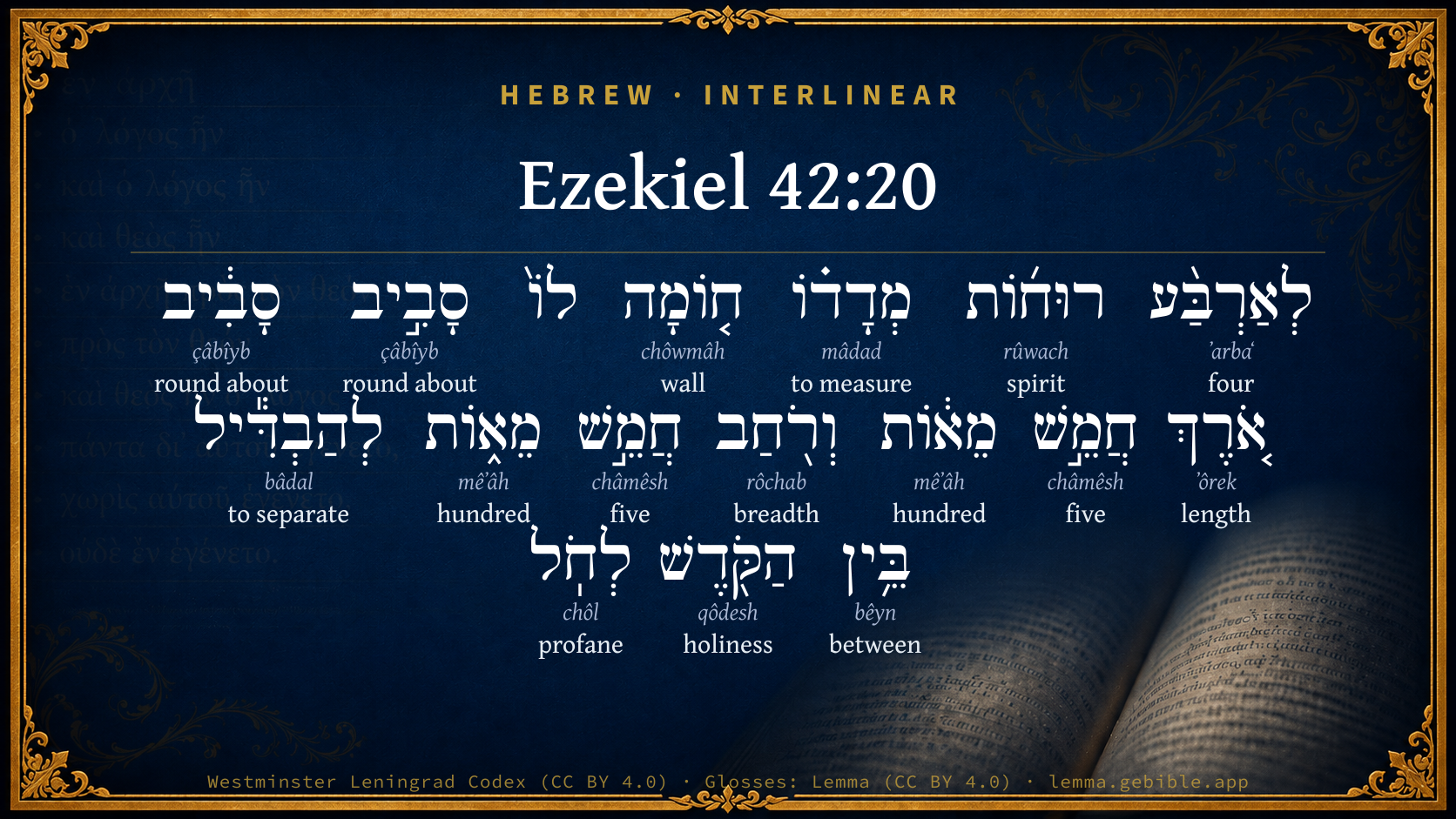
לְחֹֽל
chôl
H2455
“to/for · profane”
Preposition + Noun, Common, Masculine, Singular, Absolute
Part of Speech
Preposition + Noun
Type
Common
Gender
Masculine
Number
Singular
State
Absolute
Full BDB Definition

Origin: from H2490

TWOT: 623a , 661a

profaneness, commonness, unholy, profane, common, sand
  1. לְאַרְבַּ֨ע ʼarbaʻ H702 “to/for · four” Preposition + Adjective, Cardinal number, Feminine, Singular, Absolute
  2. רוּח֜וֹת rûwach H7307 “spirits” Noun, Common, Both, Plural, Absolute
  3. מְדָד֗וֹ mâdad H4058 “to measure · him” Verb, Qal, Perfect, 3rd Person, Masculine, Singular + Suffix, Personal, 3rd Person, Masculine, Singular
  4. ח֤וֹמָה chôwmâh H2346 “wall” Noun, Common, Feminine, Singular, Absolute
  5. סָבִ֣יב çâbîyb H5439 “round about” Noun, Common, Both, Singular, Absolute
  6. סָבִ֔יב çâbîyb H5439 “round about” Noun, Common, Both, Singular, Absolute
  7. אֹ֚רֶךְ ʼôrek H753 “length” Noun, Common, Masculine, Singular, Absolute
  8. חֲמֵ֣שׁ châmêsh H2568 “five” Adjective, Cardinal number, Feminine, Singular, Absolute
  9. מֵא֔וֹת mêʼâh H3967 “hundred” Adjective, Cardinal number, Both, Plural, Absolute
  10. וְרֹ֖חַב rôchab H7341 “and · breadth” Conjunction + Noun, Common, Masculine, Singular, Absolute
  11. חֲמֵ֣שׁ châmêsh H2568 “five” Adjective, Cardinal number, Feminine, Singular, Absolute
  12. מֵא֑וֹת mêʼâh H3967 “hundred” Adjective, Cardinal number, Both, Plural, Absolute
  13. לְהַבְדִּ֕יל bâdal H914 “to separate” Preposition + Verb, Hiphil, Infinitive Construct
  14. בֵּ֥ין bêyn H996 “between” Preposition
  15. הַקֹּ֖דֶשׁ qôdesh H6944 “the · holiness” Particle, Definite Article + Noun, Common, Masculine, Singular, Absolute

About this verse

These counts appear in no published source. They are computed here, from the morphology-tagged text and Lemma’s own curated glosses. What Lemma adds →

17
words
13
distinct lemmas
Prophets
section

Notable vocabulary

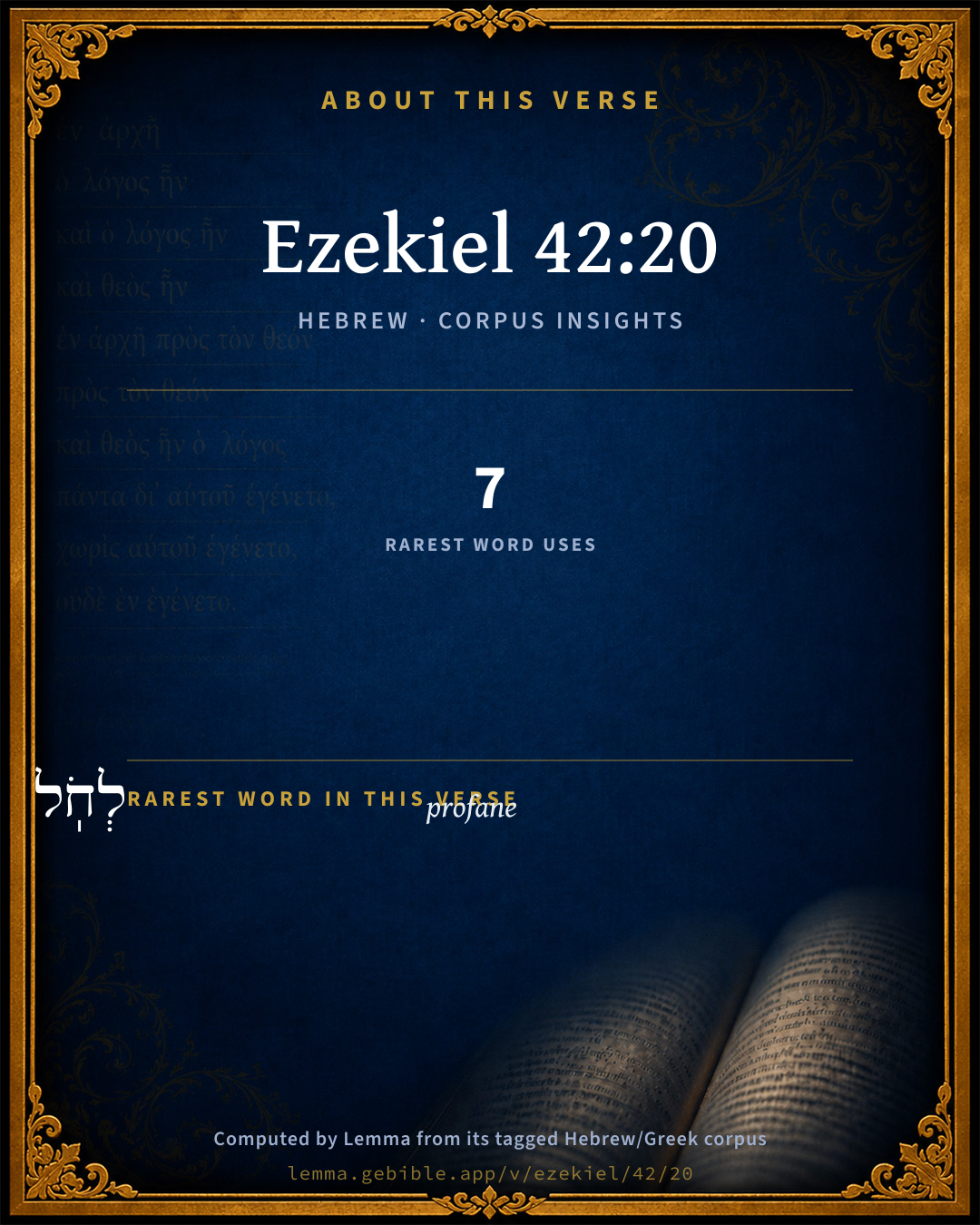
The rarest word here is לְחֹֽל profane H2455 — appearing just 7 times in the whole Hebrew Bible.

Shared distinctive vocabulary

לְחֹֽל profane H2455 occurs in 7 verses of the Hebrew Bible. Also found in:

Grammatical profile

  • 2 verbs
  • 8 nouns
  • 5 adjectives
  • 2 prepositions

Verb forms

  • מְדָד֗וֹ Qal · Perfect
  • לְהַבְדִּ֕יל Hiphil · Infinitive Construct

Repetition

Words recur within this verse — often emphatic in Hebrew:

  • סָבִ֣יב round about H5439 ×2
  • חֲמֵ֣שׁ five H2568 ×2
  • מֵא֔וֹת hundred H3967 ×2

Hebrew & Septuagint length

In English translation the verse runs 36 words from the Hebrew and 56 from the Septuagint (LXX English) — the Septuagint runs noticeably longer here. See the side-by-side →

A rough comparison of the two English renderings, which tokenize alike — not a word-level alignment.

Word counts can differ between the Hebrew and the Greek without any difference in meaning — e.g. the Hebrew direct-object marker אֵת has no separate Greek word, and Greek often adds the article ὁ.

Cross-references

16

Topical passages linked to Ezekiel 42:20 in the Treasury of Scripture Knowledge — connected by theme and wording, ordered by reader-vote popularity; previews shown in the World English Bible.

  • Ezekiel 45:2 Of this there shall be for the holy place five hundred [in length] by five hundred [in breadth], square round about; and fifty cubits for the suburbs of it round about.
  • Ezekiel 22:26 Her priests have done violence to my law, and have profaned my holy things: they have made no distinction between the holy and the common, neither have they caused men to discern between the unclean and the clean, and have hid their eyes from my Sabbaths, and I am profaned among them.
  • Ezekiel 40:5 Behold, a wall on the outside of the house round about, and in the man's hand a measuring reed six cubits long, of a cubit and a handbreadth each: so he measured the thickness of the building, one reed; and the height, one reed.
  • Ezekiel 44:23 They shall teach my people the difference between the holy and the common, and cause them to discern between the unclean and the clean.
  • Ezekiel 48:15 The five thousand that are left in the breadth, in front of the twenty-five thousand, shall be for common use, for the city, for dwelling and for suburbs; and the city shall be in the midst of it.
  • Zechariah 2:5 For I,' says Yahweh, 'will be to her a wall of fire around it, and I will be the glory in the midst of her.
  • Isaiah 60:18 Violence shall no more be heard in your land, desolation nor destruction within your borders; but you shall call your walls Salvation, and your gates Praise.
  • Leviticus 10:10 and that you are to make a distinction between the holy and the common, and between the unclean and the clean;
  • Song of Solomon 2:9 My beloved is like a roe or a young hart. Behold, he stands behind our wall! He looks in at the windows. He glances through the lattice.
  • Isaiah 25:1 Yahweh, you are my God; I will exalt you, I will praise your name; for you have done wonderful things, [even] counsels of old, in faithfulness [and] truth.
  • Isaiah 26:1 In that day shall this song be sung in the land of Judah: we have a strong city; salvation will he appoint for walls and bulwarks.
  • Ezekiel 48:20 All the offering shall be twenty-five thousand by twenty-five thousand: you shall offer the holy offering four-square, with the possession of the city.
  • Micah 7:11 A day to build your walls-- In that day, he will extend your boundary.
  • Luke 16:26 Besides all this, between us and you there is a great gulf fixed, that those who want to pass from here to you are not able, and that none may cross over from there to us.'
  • 2 Corinthians 6:17 Therefore, "'Come out from among them, And be separate,' says the Lord, 'Touch no unclean thing. I will receive you.
  • Revelation 21:10–27 He carried me away in the Spirit to a great and high mountain, and showed me the holy city, Jerusalem, coming down out of heaven from God,

Cross-references courtesy of OpenBible.info (CC BY 4.0).

Hebrew and Greek witnesses Masoretic Hebrew ↔ Greek Septuagint

The same verse in the two great witnesses to the Old Testament, shown verse-for-verse.

Here the Septuagint runs noticeably longer than the Hebrew — LXX2012 (modern English Septuagint) 56 words vs World English Bible 36. A rough length comparison of the two English translations, not a word-level alignment — read both below.

These are two independent witnesses, not word-aligned to each other, and the Septuagint is shown in lemma (dictionary) form.

Hebrew Ezekiel 42:20 Masoretic · Westminster Leningrad Codex

לְאַרְבַּ֨ע רוּח֜וֹת מְדָד֗וֹ ח֤וֹמָה לוֹ֙ סָבִ֣יב סָבִ֔יב אֹ֚רֶךְ חֲמֵ֣שׁ מֵא֔וֹת וְרֹ֖חַב חֲמֵ֣שׁ מֵא֑וֹת לְהַבְדִּ֕יל בֵּ֥ין הַקֹּ֖דֶשׁ לְחֹֽל

He measured it on the four sides: it had a wall round about, the length five hundred, and the breadth five hundred, to make a separation between that which was holy and that which was common.

World English Bible · Public Domain

Greek LXX Ezekiel 42:20 Septuagint · lemma form

ὁ τέσσαρες μέρος ὁ αὐτός κάλαμος καί διατάσσω αὐτός καί περίβολος αὐτός κύκλος πεντακόσιοι πρός ἀνατολή καί πεντακόσιοι πηχύς εὖρος ὁ διαστέλλω ἀνά μέσος ὁ ἅγιος καί ἀνά μέσος ὁ προτείχισμα ὁ ἐν διάταξις ὁ οἶκος

The four sides he measured by the same reed, and he marked out the house and the circumference of the parts round about, a space of five hundred cubits eastward, and a breadth of five hundred cubits, to make a division between the sanctuary and the outer wall, that belonged to the design of the house.

LXX2012 (modern English Septuagint) · Public Domain

Hebrew: Westminster Leningrad Codex (CC BY 4.0). Greek: Septuagint (public domain); English from LXX2012 (modern English Septuagint) (Public Domain). How the Septuagint differs from the Hebrew →

Targum (Aramaic paraphrase)

1

The Targum is the ancient Jewish Aramaic paraphrase of the Hebrew Scriptures — an interpretive translation, not the Hebrew text itself. Onkelos (literal) and Pseudo-Jonathan (expansive) render the Torah, and Jonathan the Prophets. Coverage is partial: where no permissively-licensed English translation exists for a verse, only the Aramaic is shown. This is verse-level text, not a word-by-word alignment to the Hebrew.

  1. Targum Jonathan Prophets (Joshua–Malachi)
    לְאַרְבָּא רוּחַיָא מַשְׁחֵהּ שׁוּרָא לֵיהּ סְחוֹר סְחוֹר אוּרְכָּא חֲמֵשׁ מְאָה וּפוּתְיָא חֲמֵשׁ מְאָה לְאַפְרָשָׁא בֵּין קוּדְשָׁא לְחוֹלָא:

    (no public-domain English translation for this verse)

    Targum Jonathan — Aramaic: “Mikraot Gedolot” (public domain). English: “Sefaria Community Translation” (CC0 1.0 (public-domain dedication)); “London "Chaldee Paraphrase," 1871” (public domain). Text via Sefaria.

Commentary

Notes on Ezekiel 42:20 from classic Christian and Jewish commentators (each source and its license shown beneath its notes). The classic Christian expositions comment on the surrounding passage and are grouped to its opening verse, so a note may address several verses; the Jewish commentaries on the Tanakh (Rashi and others) are per-verse, so they appear only where the commentator wrote on this verse.

Lemma curates 59 commentaries, every one of them public domain or Creative Commons licensed, each selected and text-cleaned for this edition rather than reprinted as found. About our sources →

John Gill's Exposition

He measured it by the four sides,.... Which were equilateral, parallel to each other, each measuring five hundred reeds; which in all made up two thousand reeds, or seven thousand yards: this shows that no material building can be designed; never was an edifice of such dimensions; this seems rather to describe a city than a temple; and denotes the largeness of the Gospel church state in the latter day, when the Jews will be converted, and the fulness of the Gentiles brought in:

it had a wall round about: the same with that in Eze 40:5,

five hundred reeds long, and five hundred broad; it was foursquare, as the building was, and exactly answered to that in its dimensions. The Jews say (l) the mountain of the house was five hundred cubits by five hundred; that is, a perfect square of five hundred cubits on every side, two thousand cubits in the whole compass about. Josephus (m) says the whole circuit was half a mile, every side containing the length of a two hundred and twenty yards. Now, says Doctor Lightfoot (n), if any will take up the full circuit of the wall that encompassed the holy ground, according to our English measure, it will amount to half a mile and about one hundred and sixty six yards; and whosoever will likewise measure the square of Ezekiel, Eze 42:20, will find it six times as large as this, Eze 40:5, the whole amounting to three miles and a half, and about one hundred and forty yards, a compass incomparably larger than Mount Moriah divers times over; and by this very thing is showed that that is spiritually and mystically to be understood; wherefore these measures no doubt did, as Mr. Lee (o) observes, signify the great fulness of the Gentiles, and that compass of the church in Gospel days should be marvellously extended. The use of it was,

to make a separation between the sanctuary and the profane place: the church and the world; the world is profane, and lies in wickedness, and the men of it ought not to be admitted into the church of God, and partake of holy things in it; a difference must be made between the precious and the vile; and greater care will be taken in the latter day of the admission of members into Gospel churches, Isa 52:1; see Gill on Eze 40:5.

(l) Misn. Middot, c. 2. sect. 1. (m) Antiqu. l. 15. c. 11. sect. 3. Ed. Hudson. (n) Prospect of the Temple, c. 2. p. 1051. (o) Temple of Solomon portrayed, &c. p. 241.

Next: Ezekiel Chapter 43

John Gill's Exposition of the Whole Bible (1746–1763) — public domain (CC PDM 1.0). Text via the HelloAO Bible API.

Trapp's Complete Commentary

John Trapp

Eze 42:20 He measured it by the four sides: it had a wall round about, five hundred [reeds] long, and five hundred broad, to make a separation between the sanctuary and the profane place.

Ver. 20. He measured it by the four sides.] The Church is fair and firm, for it is quadrangular; so is every true member thereof homo quadratus, square, steadfast and immovable, ανικητος και ακινητος, always abounding in the work of the Lord, &c. {1Co 15:58} His heart is fixed, trusting in the Lord. {Psa 112:1} He quits himself well in all estates, and comes off a gainer. Gold is purged in the fire, shines in the water; as, on the other side, clay is scorched in the fire, dissolved in the water. The new Jerusalem is said to lie square. {Rev 21:16} {See Trapp on "Rev 21:16"}

John Trapp, A Commentary or Exposition upon All the Books of the Old and New Testament (1647–1656) — public domain. Text from a community e-Sword module.

Joseph Benson's Commentary

Eze 42:20. It had a wall round about — To defend it from being invaded or profaned. Such a square wall as is here described, seems only capable of a mystical sense and interpretation. To make a separation between the sanctuary and the profane place — Between that compass of ground which was included in the precincts of the temple, and was considered as consecrated to the Lord, and where it was not permitted either the heathen, strangers, or impure persons, to present themselves; and that place, here termed profane, which all the world might enter indiscriminately, men, women, pure, impure, Gentiles, and others. We learn from Josephus, that such a place of separation existed at the temple in his time: see Antiq., lib. 15. c. 14, and Calmet.

Joseph Benson's Commentary on the Old and New Testaments (1811–1818) — public domain. Text from a community e-Sword module.

Jamieson, Fausset & Brown

Robert Jamieson, A. R. Fausset & David Brown

wall . . . separation between . . . sanctuary and . . . profane--No longer shall the wall of partition be to separate the Jew and the Gentile (Eph 2:14), but to separate the sacred from the profane. The lowness of it renders it unfit for the purpose of defense (the object of the wall, Rev 21:12). But its square form (as in the city, Rev 21:16) is the emblem of the kingdom that cannot be shaken (Heb 12:28), resting on prophets and apostles, Jesus Christ being the chief corner-stone.

Everything was now ready for His reception. As the Shekinah glory was the peculiar distinction of the old temple, so it was to be in the new in a degree as much more transcendent as the proportions of the new exceeded those of the old. The fact that the Shekinah glory was not in the second temple proves that it cannot be that temple which is meant in the prophecy.

Next: Ezekiel Chapter 43

Jamieson, Fausset & Brown — Commentary Critical and Explanatory on the Whole Bible (1871) — public domain (CC PDM 1.0). Text via the HelloAO Bible API.

Adam Clarke's Commentary

Verse 20. It had a wall round about-to make a separation between the sanctuary and the profane place.] The holy place was that which was consecrated to the Lord; into which no heathen, nor stranger, nor any in a state of impurity, might enter. The profane place was that in which men, women, Gentiles, pure or impure, might be admitted. Josephus says War, lib. vi., c. 14, that in his time there was a wall built before the entrance three cubits high, on which there were posts fixed at certain distances, with inscriptions on them in Latin and Greek, containing the laws which enjoined purity on those that entered; and forbidding all strangers to enter, on pain of death. See Calmet.

Adam Clarke's Commentary on the Bible (1810–1826) — public domain. Text from a community e-Sword/MySword module.

Ellicott's Commentary for English Readers

(20) It had a wall.—Around this vast enclosure on all sides was a wall, not of the slight character of that in Eze_42:7; but the same word is used as in Eze_40:5, of the massive wall surrounding the outer court. The object of this enclosure was to protect the sanctity of the Temple and its courts, “to make a separation between the sanctuary and the profane place.”

A Bible Commentary for English Readers, edited by Charles John Ellicott (1878–1897) — public domain. Text from a community e-Sword module.

The Cambridge Bible for Schools and Colleges

gen. ed. J. J. S. Perowne

20. sanctuary … profane place] Rather: between that which was holy and that which was profane (common). Holy and profane are used here relatively, just as Eze_42:13 the inner court is relatively holy in contrast with the outer to which the people had access. Cf. Eze_43:12, where the limits of the house are said to be “most holy.” In Eze_45:4 the priests’ land surrounding the temple is called holy, and in Eze_48:12 most holy.

The Cambridge Bible for Schools and Colleges (gen. ed. J. J. S. Perowne; Cambridge University Press, 1878–1918) — public domain. Text from a community e-Sword module.

Albert Barnes' Notes on the Bible

The “sanctuary” proper is probably here the most holy place as distinguished from the rest of the temple Eze 41:23; Eze 45:3; but the term was capable of extension first to the whole temple, then to all the ground that was separated to “holy” as distinguished from “profane,” i. e., common uses.

In the vision the courts rose on successive platforms, the outer court being raised seven steps above the precincts, the inner court eight steps above the outer, and the temple itself ten steps above the court of sacrifice.

Albert Barnes' Notes on the Bible (1834–1885) — public domain. Text from a community e-Sword/MySword module.

Haydock's Catholic Bible Commentary

Cubits. This confirms the former correction, ver. 16. (Haydock) --- Hebrew has only, "of five hundred." Maldonat and Cornelius a Lapide would understand reeds, to agree with what goes before. (Menochius) --- Separation. Josephus mentions a wall three cubits high, on the pillars of which was written in Greek and Latin, that such as entered the temple must be pure, (Calmet) and no stranger. (Haydock) --- Into this court all might come. (Philo) (Calmet)

George Leo Haydock (1774–1849), Haydock's Catholic Family Bible and Commentary, 1859 edition — public domain. Excludes Psalms (Douay-Rheims chapter numbering differs from Protestant) and Deuterocanonical books (Catholic canon only).

Matthew Poole's English Annotations

He measured it, the whole wall, by the four sides, repeating the measure of the whole, according to the number of the sides.

It had a wall; the whole had such a wall: had each side been five hundred reeds, the prophet must in propriety of speech have said

they, i.e. the sides, not

it, i.e. the whole compass of the wall.

Five hundred reeds long: in such an equilateral square there is properly no length, for all sides are equal, but because in the temple structure there was length and breadth, therefore that latus, or side, which runs in straight line, parallel with the length of the temple, is here taken for the length; the other, which was parallel to the breadth of the temple, is the breadth of this isopleuron, or equilateral square.

Five hundred broad: he speaks not here of the thickness, though sometimes breadth and thickness are the same.

To make a separation; to distinguish, and accordingly to exclude or admit persons, for all might not go in.

The sanctuary; not the temple, this is not here meant; but we must remember here that the Jews accounted the whole earth profane, i.e. common or unclean, compared with Canaan, and Canaan common or less holy than Jerusalem, and every part nearer the temple the more holy; and so here the outward court was enclosed to distinguish it by its comparative holiness, it was more holy than all without it.

Thus, enveloped in clouds and darkness, thou hast, good reader, a conjecture at many things, which, I need not blush to confess, are more above mine own comprehension than above some others. The mystical sense I refer to thy thoughts.

Matthew Poole's English Annotations on the Holy Bible (1683–1685) — public domain. Text from a community e-Sword/MySword module.

The Pulpit Commentary

To make a separation between the sanctuary and the profane. In these words the prophet indicates the purpose designed to be served by this particular wall; and although it may be said the outer court divided between the "sanctuary," or that which was holy, and the "profane," or that which was common, yet a more decided separation would assuredly be made by extending in the way described the precincts of the house. The objections usually offered to the view which regards the present measurements as those of a larger quadrangle encompassing the outer court, are not sufficient to make that view impossible.

(1) It is said that the "sanctuary" always refers to the house as contrasted with its courts, especially with the outer court, and that in this sense it should here be taken; but the rendering, "that which is holy," shows how the idea of special sanctity might easily be extended to the whole structure, including courts as well as house. (see Psa_114:2; Dan_9:20)

(2) It is urged that there is no other instance in which the measurements are represented as having been taken by "reeds" in the plural; but a glance at Eze_45:1, etc., and Eze_48:16, will show that this is incorrect.

(3) It is represented that in the center of such a huge quadrangle the house, with its courts and gates, would wear an insignificant appearance; but, while this might have been so had the area been crowded with other buildings, it is rather likely that in the midst of so large a vacant space the temple and its courts stand out with increased clearness, if not with augmented size.

(4) It is added that the summit of Mount Moriah could not admit of the construction of such a vast quadrangle; and it is answered that this shows the temple was an ideal house, never meant to be built upon the literal Moriah.

Separation between the holy and the common.

The walls described by the prophet served another purpose than the most obvious one of enclosing a space and supporting a roof. They had a symbolical meaning. They were walls of separation. The several portions of the temple were invested with varying degrees of holiness, and in this arrangement there was no doubt a Divine significance and intention. There were parts reserved for Israelites, parts reserved for the priests, and one part into which the high priest alone was permitted to enter. In this way separation was effected between the more and the less holy, and between the holy and the common.

I SUCH SEPARATION WAS APPOINTED BY DIVINE WISDOM. It Was not, as similar arrangements in heathen temples may have been, a device of human ingenuity and a provision of human and sacerdotal policy. It was part of the Divine intention of which the whole was the outworking and expression.

II SUCH SEPARATION WAS INTENDED FOR HUMAN INSTRUCTION. The Israelites needed to be taught the elements of religious knowledge, and to be trained in rudimentary religious life. The means adopted to this end were in harmony with their condition, and with the stage of intellectual and spiritual development which they had, reached. A wall of separation was certainly something very visible, tangible, and unmistakable; they who looked upon it, and who by it were prevented from approaching some sacred spot, were thereby taught most precious truths as to the character of the God to whose honor the temple was reared, as to the nature of his laws and his worship, as to the conditions of acceptance with him. Discrimination between the good and the wicked, the exclusion of the latter and the admission of the former into Divine favor, such were moral lessons which the provisions connected with the temple precincts were admirably fitted to impress upon the minds of a rude and rebellious people.

III THE LESSONS OF SUCH SEPARATION WERE OFTEN CORRUPTED BY HUMAN PREJUDICE AND UNSPIRITUALITY. The tendency of human nature is to rest in the symbol instead of passing on to that which is symbolized, to mistake the shadow for the substance. The material was designed to lead to the spiritual; but the importance which properly belonged only to the spiritual was sometimes attributed to the material. This was so not only with reference to the case before us, but with reference to all the provisions of a similar and symbolical nature which existed in connection with the temple and its worship. And Christians must not imagine themselves free from a similar liability to error. Even in our spiritual dispensation the same mistake is committed, and church buildings and sacraments are sometimes substituted for the great spiritual realities which they represent.

IV THERE IS A SENSE IN WHICH SUCH SEPARATION WAS TEMPORARY, AND HAS BEEN ABOLISHED BY CHRISTIANITY. One great work of our Divine Savior was to break down the middle wall of partition that fenced off Jews from Gentiles, and to make of two "one new humanity." It was a first lesson of Christianity that men should give up calling any man or any thing "common or unclean." The change was brought about, not by leveling things sacred, but by raising things secular, and by steeping everything in a Divine light, pure and lustrous. All Christians are admitted into the true Israel; all are enrolled in the sacred priesthood; all are welcomed to fellowship with Heaven.

V THERE IS A SENSE IN WHICH SUCH SEPARATION ENDURES, INASMUCH AS GOD EVER ENCOMPASSES AND ENCLOSES HIS PEOPLE WITHIN WALLS OF LIVING HOLINESS. He delights to include, but takes no pleasure in ex clusion. Into the heavenly city, which is a temple, there enters not anything unclean or common. From such contamination the blessed and glorified are forever preserved. There is around the citizens of the heavenly Jerusalem, the worshippers of the heavenly temple, a wall which preserves them forever from all molestation and from every incursion of evil. But within there is no distinction; there is one heart, one service, and one song. T.

The Pulpit Commentary (1880–1919), ed. H.D.M. Spence-Jones & Joseph S. Exell — public domain. Text from a community e-Sword module.

John Wesley's Explanatory Notes

Five hundred broad - Each reed was above three yards and an half, so that it was about eight miles round. Thus large were the suburbs of this mystical temple, signifying the great extent of the church in gospel times. It is in part fulfilled already, by the accession of the Gentiles to the church: and will be throughly accomplished, when the fulness of the Gentiles shall come in, and all Israel shall be saved. A separation - To distinguish, and accordingly to exclude, or admit persons, for all might not go in.

John Wesley, Explanatory Notes Upon the Whole Bible (1754–1765) — public domain. Text via the GEBible commentary corpus.

unfoldingWord translationNotes

Door43 World Missions Community

It had a wall around it

"The house had a wall all around it"

five hundred cubits

Each long cubit was about 54 centimeters. See how you translated this in Ezekiel 40:5. AT: "500 cubits" or "about 270 meters" (See: Biblical Distance)

common

not holy

translationWords

holy

unfoldingWord translationNotes — © Distant Shores Media and the Door43 World Missions Community, licensed CC BY-SA 4.0. Source: git.door43.org/Door43/en_tn.

Rashi

Rabbi Shlomo Yitzchaki (Rashi)

On four sides he measured it Three thousand cubits by three thousand [cubits], for the rod was six cubits long. This is what the Kalir asserted, “The Beloved will stretch out a line of three thousand cubits limited by three thousand cubits.” This is thirty-six times the original dimensions - for the Temple Mount was [originally] five hundred cubits by five hundred cubits; arrange 3,000 times 3,000 as strips of 500 cubits laid vertically and horizontally [forming a solid square], and you will have thirty-six squares of 500 cubits by 500 cubits. [3,000 x 3,000 = 9,000,000. 500 x 500 = 250,000. 9, 000,000 divided by 250,000 = 36.] Therefore, the poet states: “And thirty-six as it was multiplied.”

On four sides he measured it: its wall all around [i.e., the wall] of the Temple Mount.

around...five hundred in length and in width. This was the wall that encompassed the entire mountain.

to separate the people between the holy which was inside, and the profane which was outside. I found the completion of every measure. (This does not appear in other editions.)

Rashi on the Tanakh — English translations: “The Judaica Press complete Tanach with Rashi, translated by A. J. Rosenberg” (CC BY 4.0); “Pentateuch with Rashi's commentary by M. Rosenbaum and A.M. Silbermann, 1929-1934” (public domain); “The Metsudah Tanach series, Lakewood, N.J” (CC BY 4.0); and “The Book of Joshua, Metsudah Publications, 1997” (CC BY 4.0). Text via Sefaria.

Lesson kit

Teaching starters — assembled from the data on this page, not authored interpretation. Every prompt links to the verse data it draws on. Edit before teaching.

Ezekiel, in the Prophets, opens this verse with 17 words (13 distinct Hebrew lemmas). Its most distinctive word is chôl (“profane”). The Greek Septuagint runs longer here. A historical commentator’s framing appears above. Read the whole chapter for the surrounding context.

Discussion questions

  1. The word chôl carries the sense “profane.” How does it shape the verse?
  2. How does Leviticus 10:10, which shares the word «profane», read alongside this verse?
  3. What does the repetition of “round about” (2× in this one verse) do in this verse?
  4. The Septuagint runs longer here than the Hebrew. What might account for the difference?
  5. These translations render this verse differently; the difference is in the English rendering, not the original. What questions does that raise?
  6. «מְדָד֗וֹ» is a Qal Perfect verb. How does that grammatical form shape the action described?
  7. Compare how John Gill's Exposition and Trapp's Complete Commentary read this verse. Where do they agree or differ?

Things to notice

Reading settings

Reading text

Shown beneath each verse's original-language words.

Old Testament
Old Testament edition

Read the OT as the Masoretic Hebrew (MT) or the Greek Septuagint (LXX).

English shown for the Greek Septuagint (in the Hebrew ↔ Greek comparison).

Comparing translations? Open the Compare panel on any verse page to stack up to four side by side.