Joel 2:9

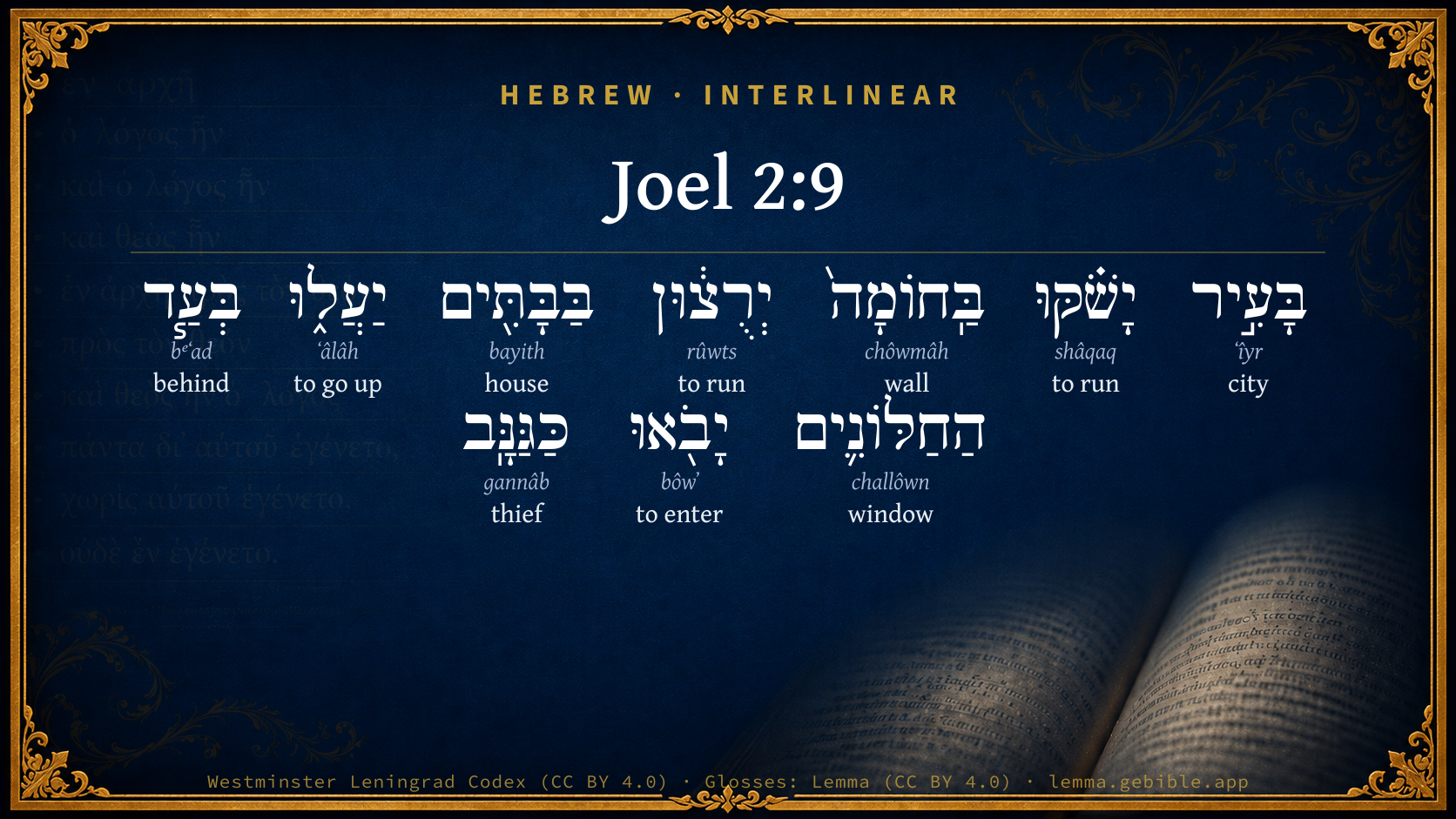
Hebrew (Westminster Leningrad Codex) Joel 2:9 appears in the Hebrew Old Testament. The text above is from the Westminster Leningrad Codex. Each word links to its Strong’s number, a concise gloss, and parsing drawn from the Open Scriptures Hebrew Bible morphology. Click any word for its full Brown-Driver-Briggs (BDB) entry.
Download image
Cite this verse

Joel 2:9 (World English Bible). Public Domain. Lemma interlinear Bible study tool, https://lemma.gebible.app/v/joel/2/9.

Show BibTeX & RIS
BibTeX
RIS
English Translation
They rush on the city. They run on the wall. They climb up into the houses. They enter in at the windows like thieves.
World English Bible · Public Domain
Download a study sheet

One document with this verse’s original text, its word-by-word gloss line, the meaning frame, cross-references with their text, attributed commentary, and full source and license credits — printable, and it pastes into notes with its structure intact.

This verse Autodidact and up

Study sheet (.html) Plain text (.txt)

A passage Seminary Student

Up to 50 verses in one chapter. A passage sheet keeps up to 6 commentary sources and 12 cross-references per verse, in the order this page ranks them, and says so on the sheet whenever that leaves anything out. Ask for a single verse and you get the Autodidact verse sheet above.

Everything on this page stays free to read, with no account — the sheet is a download of what is already on screen, not access to it.

Want to remove ads? Support Godless Engineer
Compare translations 3

The same verse in 3 English versions, stacked beneath the original-language interlinear above. Click any original word for its lexicon entry.

Each is an independent rendering of the whole verse — the interlinear is not word-aligned to these translations.

Highlighted words mark where these versions differ — a whole-verse word diff, not a word-by-word alignment.

  • World English Bible Public Domain
    They rush on the city. They run on the wall. They climb up into the houses. They enter in at the windows like thieves.
  • King James Version Public Domain
    They shall run to and fro in the city; they shall run upon the wall, they shall climb up upon the houses; they shall enter in at the windows like a thief.
  • unfoldingWord Literal Text CC BY-SA 4.0
    Upon the city they rush; on the wall they run; into the houses they climb; through the windows they enter like thieves.

unfoldingWord Literal Text — © unfoldingWord, licensed CC BY-SA 4.0. Word-aligned USFM3 via Door43 (git.door43.org/unfoldingWord/en_ult).

Versions to compare (up to 4)

3 of 4 selected

Show all 18 translations

Every available English version of this verse, each an independent rendering of the whole verse.

  • World English Bible Public Domain
    They rush on the city. They run on the wall. They climb up into the houses. They enter in at the windows like thieves.
  • Berean Standard Bible Public Domain
    They storm the city; they run along the wall; they climb into houses, entering through windows like thieves.
  • Majority Standard Bible Public Domain
    They storm the city; they run along the wall; they climb into houses, entering through windows like thieves.
  • King James Version Public Domain
    They shall run to and fro in the city; they shall run upon the wall, they shall climb up upon the houses; they shall enter in at the windows like a thief.
  • American Standard Version (1901) Public Domain
    They leap upon the city; they run upon the wall; they climb up into the houses; they enter in at the windows like a thief.
  • Revised Version (1885) Public Domain
    They leap upon the city; they run upon the wall; they climb up into the houses; they enter in at the windows like a thief.
  • Geneva Bible (1599) Public Domain
    They shall runne to and from in the citie: they shall runne vpon the wall: they shall clime vp vpon the houses, and enter in at ye windowes like ye thiefe.
  • Douay-Rheims (1899) Public Domain
    They shall enter into the city: they shall run upon the wall, they shall climb up the houses, they shall come in at the windows as a thief.
  • Young's Literal Translation Public Domain
    In the city they run to and fro, On the wall they run, Into houses they go up by the windows, They go in as a thief.
  • Literal Standard Version CC BY-SA 4.0
    In the city they run to and fro, || On the wall they run, || Into houses they go up by the windows, || They go in as a thief.
  • Unlocked Literal Bible CC BY-SA 4.0
    They rush on the city, they run on the wall, they climb in the houses, and they go through the windows like thieves.
  • unfoldingWord Literal Text CC BY-SA 4.0
    Upon the city they rush; on the wall they run; into the houses they climb; through the windows they enter like thieves.
  • Darby Bible Public Domain
    They spread themselves over the city; they run upon the wall; they climb up into the houses; they enter in by the windows like a thief.
  • World Messianic Bible Public Domain
    They rush on the city. They run on the wall. They climb up into the houses. They enter in at the windows like thieves.
  • Webster's Bible Public Domain
    They shall run to and fro in the city; they shall run upon the wall, they shall climb upon the houses; they shall enter in at the windows like a thief.
  • Free Bible Version CC BY-SA 4.0
    They rush to and fro in the city; they run along the walls; they climb into houses, entering through the windows like thieves.
  • Bible in Basic English Public Domain
    They make a rush on the town, running on the wall; they go up into the houses and in through the windows like a thief.
  • JPS Tanakh (1917) Public Domain
    They leap upon the city, they run upon the wall, they climb up into the houses; they enter in at the windows like a thief.

Literal Standard Version (2020), Covenant Press — licensed CC BY-SA 4.0. Text via the HelloAO Bible API (eBible.org). Unlocked Literal Bible (unfoldingWord) — licensed CC BY-SA 4.0. Text via the HelloAO Bible API (eBible.org). unfoldingWord Literal Text — © unfoldingWord, licensed CC BY-SA 4.0. Word-aligned USFM3 via Door43 (git.door43.org/unfoldingWord/en_ult). Free Bible Version, Dr. Jonathan Gallagher — licensed CC BY-SA 4.0. Text via the HelloAO Bible API (eBible.org).

Word by word

More ways to search: Search by grammar → Find every occurrence → Compare this word →

Practice this passage: Drill this verse → Learn its vocabulary →

יָשֹׁ֗קּוּ
shâqaq
H8264
“to run”
Verb, Qal, Imperfect, 3rd Person, Masculine, Plural
Part of Speech
Verb
Stem
Qal
Form
Imperfect
Person
3rd Person
Gender
Masculine
Number
Plural
Full BDB Definition

Origin: a primitive root

TWOT: 2460

to run, run about, rush, run to and fro, be eager or greedy or thirsty - (Qal) roving, ranging, longing, rush out upon (participle) - (Hithpalpel) to rush to and fro, rush back and forth
  1. בָּעִ֣יר ʻîyr H5892 “in/at the · city” Preposition, Determined + Noun, Common, Feminine, Singular, Absolute
  2. בַּֽחוֹמָה֙ chôwmâh H2346 “in/at the · wall” Preposition, Determined + Noun, Common, Feminine, Singular, Absolute
  3. יְרֻצ֔וּן rûwts H7323 “to run” Verb, Qal, Imperfect, 3rd Person, Masculine, Plural + Suffix, n
  4. בַּבָּתִּ֖ים bayith H1004 “in/at the · houses” Preposition, Determined + Noun, Common, Masculine, Plural, Absolute
  5. יַעֲל֑וּ ʻâlâh H5927 “to go up” Verb, Qal, Imperfect, 3rd Person, Masculine, Plural
  6. בְּעַ֧ד bᵉʻad H1157 “behind” Preposition
  7. הַחַלּוֹנִ֛ים challôwn H2474 “the · windows” Particle, Definite Article + Noun, Common, Both, Plural, Absolute
  8. יָבֹ֖אוּ bôwʼ H935 “to enter” Verb, Qal, Imperfect, 3rd Person, Masculine, Plural
  9. כַּגַּנָּֽב gannâb H1590 “like/as the · thief” Preposition, Determined + Noun, Common, Masculine, Singular, Absolute

About this verse

These counts appear in no published source. They are computed here, from the morphology-tagged text and Lemma’s own curated glosses. What Lemma adds →

10
words
10
distinct lemmas
Prophets
section

Notable vocabulary

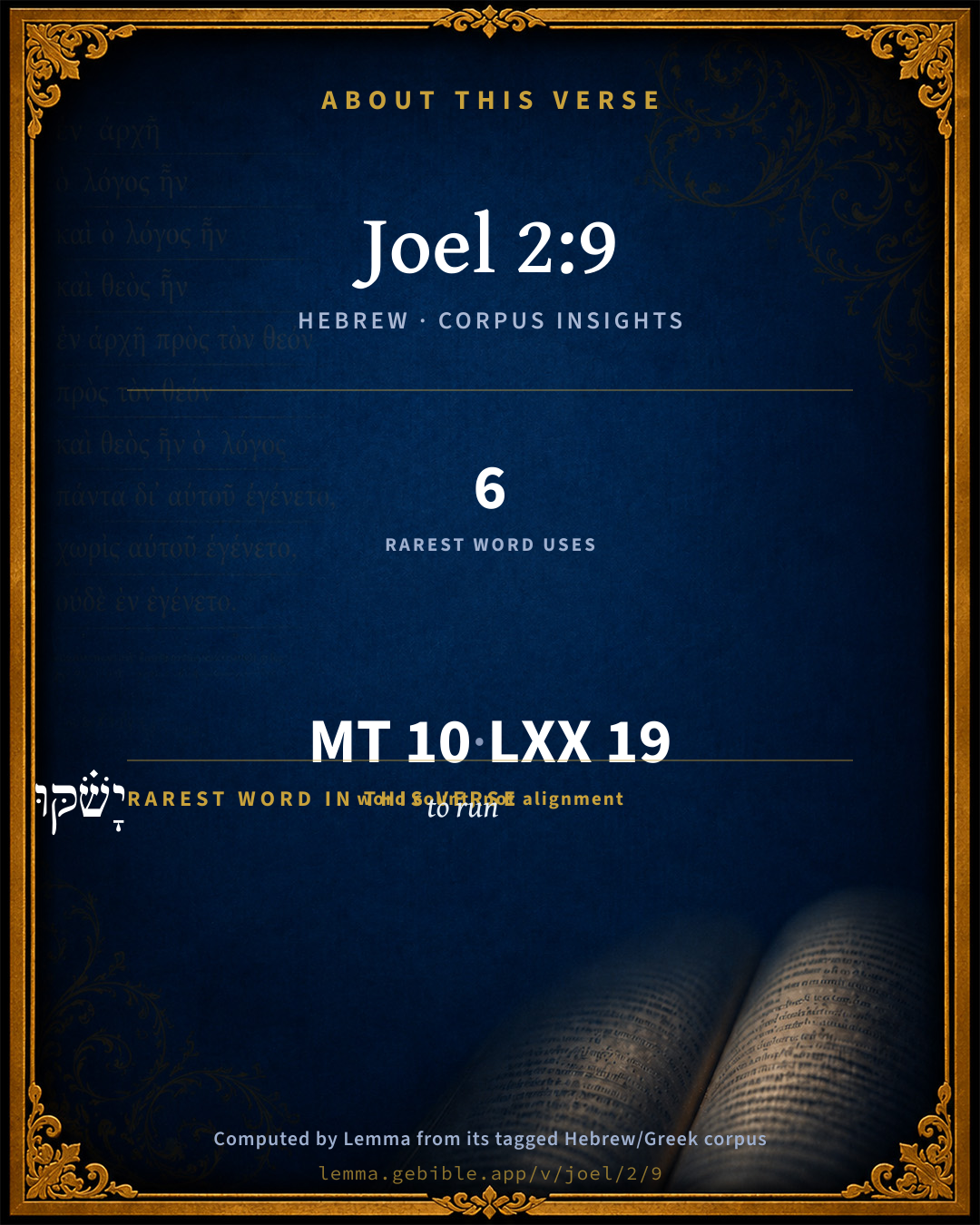
The rarest word here is יָשֹׁ֗קּוּ to run H8264 — appearing just 6 times in the whole Hebrew Bible.

Shared distinctive vocabulary

יָשֹׁ֗קּוּ to run H8264 occurs in 6 verses of the Hebrew Bible. Also found in:

Grammatical profile

  • 4 verbs
  • 5 nouns
  • 1 preposition

Verb forms

  • יָשֹׁ֗קּוּ Qal · Imperfect
  • יְרֻצ֔וּן Qal · Imperfect
  • יַעֲל֑וּ Qal · Imperfect
  • יָבֹ֖אוּ Qal · Imperfect

Hebrew & Septuagint length

In English translation the verse runs 24 words from the Hebrew and 25 from the Septuagint (LXX English) — closely comparable.

A rough comparison of the two English renderings, which tokenize alike — not a word-level alignment.

Word counts can differ between the Hebrew and the Greek without any difference in meaning — e.g. the Hebrew direct-object marker אֵת has no separate Greek word, and Greek often adds the article ὁ.

In the original languages it is 10 Hebrew tokens and 19 Greek tokens — but the two are counted differently (Hebrew bundles its prefixes and suffixes into one token; the Greek is in lemma form), so that isn’t a like-for-like length.

Cross-references

3

Topical passages linked to Joel 2:9 in the Treasury of Scripture Knowledge — connected by theme and wording, ordered by reader-vote popularity; previews shown in the World English Bible.

  • Jeremiah 9:21 For death is come up into our windows, it is entered into our palaces; to cut off the children from outside, [and] the young men from the streets.
  • John 10:1 "Most assuredly, I tell you, one who doesn't enter by the door into the sheep fold, but climbs up some other way, the same is a thief and a robber.
  • Exodus 10:6 Your houses shall be filled, and the houses of all your servants, and the houses of all the Egyptians; as neither your fathers nor your fathers' fathers have seen, since the day that they were on the earth to this day.'" He turned, and went out from Pharaoh.

Cross-references courtesy of OpenBible.info (CC BY 4.0).

Hebrew and Greek witnesses Masoretic Hebrew ↔ Greek Septuagint

The same verse in the two great witnesses to the Old Testament, shown verse-for-verse.

These are two independent witnesses, not word-aligned to each other, and the Septuagint is shown in lemma (dictionary) form.

Hebrew Joel 2:9 Masoretic · Westminster Leningrad Codex

בָּעִ֣יר יָשֹׁ֗קּוּ בַּֽחוֹמָה֙ יְרֻצ֔וּן בַּבָּתִּ֖ים יַעֲל֑וּ בְּעַ֧ד הַחַלּוֹנִ֛ים יָבֹ֖אוּ כַּגַּנָּֽב

They rush on the city. They run on the wall. They climb up into the houses. They enter in at the windows like thieves.

World English Bible · Public Domain

Greek LXX Joel 2:9 Septuagint · lemma form

ὁ πόλις ἐπιλαμβάνω καί ἐπί ὁ τεῖχος τρέχω καί ἐπί ὁ οἰκία ἀναβαίνω καί διά θυρίς εἰςἔρχομαι ὡς κλέπτης

They shall seize upon the city, and run upon the walls, and go up upon the houses, and enter in through the windows as thieves.

LXX2012 (modern English Septuagint) · Public Domain

On this verse, The Pulpit Commentary discusses the Septuagint’s reading. Read the note in Commentary ↓

Hebrew: Westminster Leningrad Codex (CC BY 4.0). Greek: Septuagint (public domain); English from LXX2012 (modern English Septuagint) (Public Domain). How the Septuagint differs from the Hebrew →

Targum (Aramaic paraphrase)

1

The Targum is the ancient Jewish Aramaic paraphrase of the Hebrew Scriptures — an interpretive translation, not the Hebrew text itself. Onkelos (literal) and Pseudo-Jonathan (expansive) render the Torah, and Jonathan the Prophets. Coverage is partial: where no permissively-licensed English translation exists for a verse, only the Aramaic is shown. This is verse-level text, not a word-by-word alignment to the Hebrew.

  1. Targum Jonathan Prophets (Joshua–Malachi)
    בְּקַרְתָּא מִזְדַיְנִין עַל שׁוּרָא רָהֲטִין בְּבָתַּיָא סַלְקִין מִן חֲרַכַּיָא עָלִין כְּגַנְבִין:

    (no public-domain English translation for this verse)

    Targum Jonathan — Aramaic: “Mikraot Gedolot” (public domain). English: “Sefaria Community Translation” (CC0 1.0 (public-domain dedication)); “London "Chaldee Paraphrase," 1871” (public domain). Text via Sefaria.

Commentary

Notes on Joel 2:9 from classic Christian and Jewish commentators (each source and its license shown beneath its notes). The classic Christian expositions comment on the surrounding passage and are grouped to its opening verse, so a note may address several verses; the Jewish commentaries on the Tanakh (Rashi and others) are per-verse, so they appear only where the commentator wrote on this verse.

Lemma curates 59 commentaries, every one of them public domain or Creative Commons licensed, each selected and text-cleaned for this edition rather than reprinted as found. About our sources →

Trapp's Complete Commentary

John Trapp

Joe 2:9 They shall run to and fro in the city; they shall run upon the wall, they shall climb up upon the houses; they shall enter in at the windows like a thief.

Ver. 9. They shall run to and fro] As soldiers do when they have taken a town by assault, and have leave to plunder. En victoriam et hostilem insultationem, saith Mercer here. See the lively portraiture of victory and triumph.

They shall run upon the wall] After they have scaled it (as before) they shall walk or run upon it as conquerors, without fear of an enemy. Alexander the Great would do so.

They shall climb up upon the houses] No longer now the owners’ castles; for they shall be ferreted out of their retiring rooms, or forced to do as Sardanapalus the Assyrian monarch did; who, straited by the enemy, sacrificed himself with his wealth and wenches to Vulcan in a woodpile (as one phraseth it) in his royal palace.

They shall enter in at the windows, as a thief] Whose property is, 1. To climb up some other way and not to enter in by the door, Joh 10:1; death also getteth in by the windows and that way entereth into palaces, Jer 9:21; so doth Satan (that thief of the truth, as Basil calleth him) wind himself into the soul by the eyes, those windows of wickedness and loop holes of lust. 2. To rifle and ransack, and leave little enough behind him. What clean work these insects made, see before, Joe 1:4, and take notice what great matters God Almighty can do by the most contemptible creatures. Quid cimice vilius, saith Philo the Jew, what can be baser than a louse? and yet all the strength of Egypt was brought down by that despicable vermin? Pliny in his eighth book and 24th chapter tells us out of Mr Varro, that a great town of Spain was undermined and overturned by conies; another in Thessaly by moles; a third in France undone by frogs; a fourth in Africa by locusts; a fifth in Italy by serpents, Clara exitii documenta sunt ex contemnendis animalibus (Plin.). Who hath not heard of Hatto, that merciless Archbishop of Mentz, devoured by mice, though he had moated up himself against their invasion in an island? God cannot possibly want a weapon wherewith to beat his rebels.

John Trapp, A Commentary or Exposition upon All the Books of the Old and New Testament (1647–1656) — public domain. Text from a community e-Sword module.

Joseph Benson's Commentary

Joe 2:9-10. They shall run to and fro in the city — No place shall be inaccessible to them, nor free from them. “Every place,” says St. Jerome, “lies open to them; for they infest not only the fields, and the fruits of the earth, but creep into cities, houses, and the most secret recesses.” The earth shall quake before them — The inhabitants of the land of Judea shall be seized with a horrible dread at their approach. The heavens shall look dark and dismal, because they shall come in such swarms as to intercept the rays of the sun, and the light of the moon and stars. By the expression, The heavens shall tremble, is either meant, that the whole state of the kingdom of Judah, of the very highest in rank and dignity, as well as the meanest, should be struck with a panic at this unusual judgment; or else that the locusts should so fill the sky, that, at a great height, it would appear as if the heavens themselves trembled.

Joseph Benson's Commentary on the Old and New Testaments (1811–1818) — public domain. Text from a community e-Sword module.

Rashi

Rabbi Shlomo Yitzchaki (Rashi)

In the city they clatter Heb. יָשֹׁקּוּ. This is an expression of making a din. Cf. (Isa. 33:4) “like the roaring (כְּמַשַּׁק) of the cisterns”; (Prov. 28: 15) “A growling (שּׁוֹקֵק) bear”; (Zeph. 2:9) “the clattering of (מִמְשַׁק) the thorns.” Jonathan, however, renders it as an expression of arms (נֶשֶק). They are armed.

Rashi on the Tanakh — English translations: “The Judaica Press complete Tanach with Rashi, translated by A. J. Rosenberg” (CC BY 4.0); “Pentateuch with Rashi's commentary by M. Rosenbaum and A.M. Silbermann, 1929-1934” (public domain); “The Metsudah Tanach series, Lakewood, N.J” (CC BY 4.0); and “The Book of Joshua, Metsudah Publications, 1997” (CC BY 4.0). Text via Sefaria.

Jamieson, Fausset & Brown

Robert Jamieson, A. R. Fausset & David Brown

run to and fro in the city--greedily seeking what they can devour.

the wall--surrounding each house in Eastern buildings.

enter in at the windows--though barred.

like a thief-- (Joh 10:1; compare Jer 9:21).

Jamieson, Fausset & Brown — Commentary Critical and Explanatory on the Whole Bible (1871) — public domain (CC PDM 1.0). Text via the HelloAO Bible API.

John Calvin's Commentaries

It afterwards follows, Through the city shall they march; over the wall shall they run here and there; into houses shall they climb; through the windows shall they enter like a thief. The Prophet here shows that the Jews in vain trusted in their fortified cities, for the enemies would easily penetrate into them. They shall march, he says, through the city, that is, as though there were no gates to it. The meaning then is, that though Judea abounded in cities, which seemed impregnable and appeared sufficient to arrest the course of enemies, as it had happened almost always, so that great armies were forced to desist when any strong fortified city stood in their way; yet the Prophet says that cities would be no impediment to the Assyrians at their coming to Judea, for they would march through the city, as along a plain road, where no gates are closed against them. They shall then march through the midst of cities as through a plain or open fields. To the same purpose is what follows, They shall run here and there over the wall, he says. These are indeed hyperbolical words; yet, when we consider how slow men are to fear punishment, we must allow that the Prophet in these expressions does not exceed moderation. They shall then run up and down through the city; that is, “In vain you expect that there will be to you any rest or quietness, for ye think that you sill be able for a time to sustain the onsets of your enemies: This,” he says, “will by no means be the case, for they shall run here and there over the wall, as though it were a plain. Besides, they shall climb into the houses, and enter in through the windows, and do this as a thief; that is, though there should be no hostile attack, yet they shall stealthily and secretly penetrate into your houses: when there will be a great tumult, when the whole regions shall meet in arms, and when ye will think yourselves able to resist, they will then as thieves quietly enter into your houses and come in through the windows, and ye shall not be able to close up the passage against them.”

John Calvin's Commentaries (1540-1563) — public domain. Text from the Calvin Translation Society English edition (1840s-50s) via the Christian Classics Ethereal Library (ccel.org). Calvin's coverage is partial (roughly two-thirds of the Bible); uncommented books and verses are honest gaps, never fabricated. The 19th-century editor's footnotes and remarks are omitted so the notes are faithfully Calvin's own voice.

The Cambridge Bible for Schools and Colleges

gen. ed. J. J. S. Perowne

9. They course about in the city; they run upon the wall] no sooner have they gained an entrance than they make the city their own, and take possession of the walls. The exact force of the word rendered course about is not certain: it is used of locusts in Isa_33:4 (“like the attack of locusts, shall they attack it”), of a bear in Pro_28:15 (“A growling lion, and a ranging bear”), and (in a reflexive form) of chariots charging the suburbs of a city in Nah_2:4 (“they justle one another in the broad places”).

climb up into the houses] cf. Exo_10:6. Modern travellers relate the same: e.g. Morier, below, p. 89. Eastern windows, being not glazed, but consisting merely of an opening with lattice-work, would naturally present no obstacle to the entrance of the locusts.

The Cambridge Bible for Schools and Colleges (gen. ed. J. J. S. Perowne; Cambridge University Press, 1878–1918) — public domain. Text from a community e-Sword module.

John Gill's Exposition

They shall run to and fro in the city,.... Leap about from place to place, as locusts do; see Isa 33:4; and as the Chaldeans did when they became masters of the city of Jerusalem; they ran about from place to place to seize upon their spoil and plunder:

they shall run upon the wall; which before they climbed, now they shall run upon, and go from tower to tower, as the Chaldeans did, and broke clown the walls and fortifications:

they shall climb up upon the houses, and enter in at the windows, like a thief; so the locusts entered into the houses of the Egyptians, Exo 10:6; and Pliny says (s), they will eat through everything, and even the doors of houses. Theodoret on the place observes, that not only this may be done by enemies, what is here said,

"but even we have often seen it done by locusts; for not only flying, but even creeping up the walls, they enter into houses at the windows.''

(s) Nat. Hist. l. 11. c. 29.

John Gill's Exposition of the Whole Bible (1746–1763) — public domain (CC PDM 1.0). Text via the HelloAO Bible API.

Albert Barnes' Notes on the Bible

They shall run to and fro in the city - “The city” is questionless Jerusalem. So to the Romans, “the city” meant Rome; to the Athenians, Athens; among ourselves, “town” or “the city” are idiomatic names for the whole of London or “the city of London.” In Wales “town” is, with the country people, the neighboring town with which alone they are familiar. There is no ambiguity in the living language. In Guernsey, one who should call Port Pierre by any other name than “the town,” would betray himself to be a stranger. In Hosea, and Amos, prophets for Israel, “the city” is Samaria Hos 11:9; Amo 3:6. In Solomon Psa 72:16; Pro 1:21; Pro 8:3 and the prophets of Judah (Mic 6:9; Lam 1:1, etc.; Eze 7:23; Eze 33:21), “the city” is Jerusalem; and that the more, because it was not only the capital, but the center of the worship of the One True God. Hence, it is called “the city of God Psa 46:4; Psa 48:1, Psa 48:8; Psa 87:3, the city of the Lord” Psa 101:8; Isa 60:14, then “the city of the Great King Psa 48:2; Mat 5:35, the holy city” Isa 48:2; Isa 52:1; Neh 11:1, Neh 11:18; Dan 9:24; and God calls it “the city I have chosen out of all the tribes of Israel 1Ki 11:32, the city of righteousness” Isa 1:26. So our Lord spake, “go ye into the city” Mat 26:18; Mar 14:13; Luk 22:10, and perhaps, , “tarry ye in the city.” So do His Evangelists Mat 21:17-18; Mat 28:11; Mar 11:1, Mar 11:19; Luk 19:41; Act 7:58; Joh 19:20), and so does Josephus .

All around corresponds with this. Joel had described their approach; they had come over “the tops of the mountains,” those which protected Jerusalem; and now he describes them scaling “the wall,” “mounting the houses,” “entering the windows,” “running to and fro in the city.” Here the description has reached its height. The city is given over to those who assault it. There remaineth nothing more, save the shaking of the heaven and the earth.

They shall enter in at the windows - So in that first great judgment, in which God employed the locust, He said, “They shall cover the face of the earth, that one cannot be able to see the earth; and they shall fill thy houses, and the houses of all thy servants, and the houses of all the Egyptians” Exo 10:5-6. : “For nothing denies a way to the locusts, inasmuch as they penetrate fields, cornlands, trees, cities, houses, yea, the retirement of the bed-chambers.” “Not that they who are victors, have the fear which thieves have, but as thieves are accustomed to enter through windows, and plunder secretly, so shall these, if the doors be closed, to cut short delay, burst with all boldness through the windows.” : “We have seen this done, not by enemies only, but often by locusts also. For not only flying, but creeping up the walls also, they enter the houses through the openings for light.” : “a.d. 784, there came the flying locust, and wasted the corn and left its offspring; and this came forth and crawled, and scaled walls and entered houses by windows and doors; and if it entered the house on the south side, it went out on the north; together with herbs and trees it devoured also woolen clothing, and men’s dresses.”

Modern travelers relate the same. : “They entered the inmost recesses of the houses, were found in every corner, stuck to our clothes and infested our food.” : “They overwhelm the province of Nedjd sometimes to such a degree, that having destroyed the harvest, they penetrate by thousands into the private dwellings, and devour whatsoever they can find, even the leather of the water-vessels.” : “In June 1646, at Novogorod it was prodigious to behold them, because they were hatched there that spring, and being as yet scarce able to fly, the ground was all covered, and the air so full of them, that I could not eat in my chamber without a candle, all the houses being full of them, even the stables, barns, chambers, garrets, and cellars. I caused cannon-powder and sulphur to be burnt, to expel them, but all to no purpose. For when the door was opened, an infinite number came in, and the others went fluttering about; and it was a troublesome thing when a man went abroad, to be hit on the face by those creatures, on the nose, eyes, or cheeks, so that there was no opening one’s mouth, but some would get in. Yet all this was nothing, for when we were to eat, they gave us no respite; and when we went to cut a piece of meat, we cut a locust with it, and when a man opened his mouth to put in a morsel, he was sure to chew one of them.” The eastern windows, not being glazed but having at most a lattice-work , presented no obstacle to this continuous inroad. All was one stream of infesting, harassing foes.

As the windows are to the house, so are the senses and especially the sight to the soul. As the strongest walls and battlements and towers avail not to keep out an enemy, if there be an opening or chink through which he can make his way, so, in vain is the protection of God’s Providence or His Grace , if the soul leaves the senses unguarded to admit unchallenged sights, sounds, touches, which may take the soul prisoner. : “Death,” says Jeremiah, “entereth through the window” Jer 9:21. Thy window is thy eye. If thou seest, to lust, death hath entered in; if thou hearest enticing words, death hath entered in: if softness gain possession of thy senses, death has made his way in.” The arrow of sin is shot through them. : “When the tongue of one introduces the virus of perdition, and the ears of others gladly drink it in, “death enters in;” while with itching ears and mouth men minister eagerly to one another the deadly draught of detraction, “death enters in at the windows.” : “Eve had not touched the forbidden tree, except she had first looked on it heedlessly. With what control must we in this dying life restrain our sight, when the mother of the living came to death through the eyes! The mind of the prophet, which had been often lifted up to see hidden mysteries, seeing heedlessly another’s wife, was darkened,” and fell. “To keep purity of heart, thou must guard the outward senses.” An enemy is easily kept out by the barred door or window, who, having entered in unawares, can only by strong effort and grace be forced out. “It is easier,” said the pagan philosopher , “to forbid the beginnings of feelings than to control their might.”

Like a thief - that is, they should come unawares, so as to take people by surprise, that there should be no guarding against them. As this is the close at this wonderful description, it may be that he would, in the end, describe the suddenness and inevitableness of God’s judgments when they do come, and of the final judgment. It is remarkable that our Lord, and His Apostles from Him adopt this image of the prophet, in speaking of the coming of the Day of Judgment and His own. “Behold I come as a thief. This know that if the goodman of the house had known what hour the thief would come, he would have watched. Be ye therefore ready also, for the Son of man cometh at an hour when ye think not. Yourselves know perfectly that the Day of the Lord so cometh as a thief in the night. Ye are not in darkness, that that Day should overtake you as a thief” (Rev 16:15 (add Rev 3:3.); Mat 24:43-44; Luk 12:39; 1Th 5:2; 2Pe 3:10).

Albert Barnes' Notes on the Bible (1834–1885) — public domain. Text from a community e-Sword/MySword module.

Matthew Poole's English Annotations

In this verse we must discern what is any whir proper to the locusts, and what is applicable more fitly to the soldiers figured by them.

They shall run to and fro: this seems not proper to these insects, which move forward, and alter not their course in such limited and straitened bounds as a city; but this well suits with soldiers that conquer a city, and search all places for plunder and prey.

In the city; in every city that they take.

They shall run upon the wall; to clear the wall of all the besieged who did defend it, to help up others that were scaling the wall, and to seize towers which were built upon the wall: this is better fitted to soldiers that take a city than to locusts.

They shall climb up upon the houses; either forsaken and shut fast up by the inhabitants before they left them, or houses defended by such as are in them, as is usual in cities taken by assault.

They shall enter in at the windows; where they can find the first entrance, there they will through, and nothing shall keep them out.

Like a thief; suddenly, unexpectedly, to spoil at least, if not to kill and destroy: locusts and soldiers will do this.

Matthew Poole's English Annotations on the Holy Bible (1683–1685) — public domain. Text from a community e-Sword/MySword module.

The Pulpit Commentary

They shall run to and fro in the city (or rush to the assault of the city. Wunsche, and so LXX, "They shall seize upon the city"); they shall run upon the wall, they shall climb up upon the houses; they shall enter in at the windows like a thief. In the first clause the comparison with an army still continues. The attack has succeeded, the city has been taken by assault, the victorious troops are running to and fro in the city; so far the locusts are fitly represented by an army vigorous in its advance, steady in its march, resistless in its assault, victorious in its attack, and masters of the captured city. The remainder of the ninth verse is not equally applicable to the figure and the fact in common, but belongs exclusively to the locusts themselves; they creep up the wall, climb up upon the houses, and find ingress even at the windows. "There is no road," says Jerome, "impassable to locusts. They penetrate into fields, and crops, and trees, and cities, and even the recesses of the bedchambers;" while Theodoret remarks of locusts that" not only when flying, but by creeping along the walls, they pass through the windows into the houses themselves." Thus there was no spot to which they could not find access, and no place secure from their assault. Yashoqqu. Aben Ezra and Kimchi both connect this word with shoq, a leg. The latter says, "It has the signification of shoq, a leg, and he mentions this word in respect to the locust, because its legs are long; and further, because it is continually going and seldom resting; and thus he (Isaiah) says, "As the running to and fro of locusts shall he run upon them," as if he said, "a continual going up and down.

The Pulpit Commentary (1880–1919), ed. H.D.M. Spence-Jones & Joseph S. Exell — public domain. Text from a community e-Sword module.

John Wesley's Explanatory Notes

Runs to and fro - This seems not proper to these insects, but it well suits with soldiers, that conquer a city and search all places for plunder. Run upon the wall - To clear the wall of all the besieged. The houses - Either forsaken by the inhabitants, or defended by such as are in them. Like a thief - Suddenly, unexpectedly, to spoil if not to kill.

John Wesley, Explanatory Notes Upon the Whole Bible (1754–1765) — public domain. Text via the GEBible commentary corpus.

Lesson kit

Teaching starters — assembled from the data on this page, not authored interpretation. Every prompt links to the verse data it draws on. Edit before teaching.

Joel, in the Prophets, opens this verse with 10 words (10 distinct Hebrew lemmas). Its most distinctive word is shâqaq (“to run”). A historical commentator’s framing appears above. Read the whole chapter for the surrounding context.

Discussion questions

  1. The word shâqaq carries the sense “to run.” How does it shape the verse?
  2. How does Psalms 107:9, which shares the word «to run», read alongside this verse?
  3. The translations on this page render this verse differently — a whole-verse word diff, not a word-by-word alignment. What might account for the different wordings?
  4. «יָשֹׁ֗קּוּ» is a Qal Imperfect verb. How does that grammatical form shape the action described?
  5. Compare how Trapp's Complete Commentary and Joseph Benson's Commentary read this verse. Where do they agree or differ?

Things to notice

Reading settings

Reading text

Shown beneath each verse's original-language words.

Old Testament
Old Testament edition

Read the OT as the Masoretic Hebrew (MT) or the Greek Septuagint (LXX).

English shown for the Greek Septuagint (in the Hebrew ↔ Greek comparison).

Comparing translations? Open the Compare panel on any verse page to stack up to four side by side.