
Leviticus 25:30

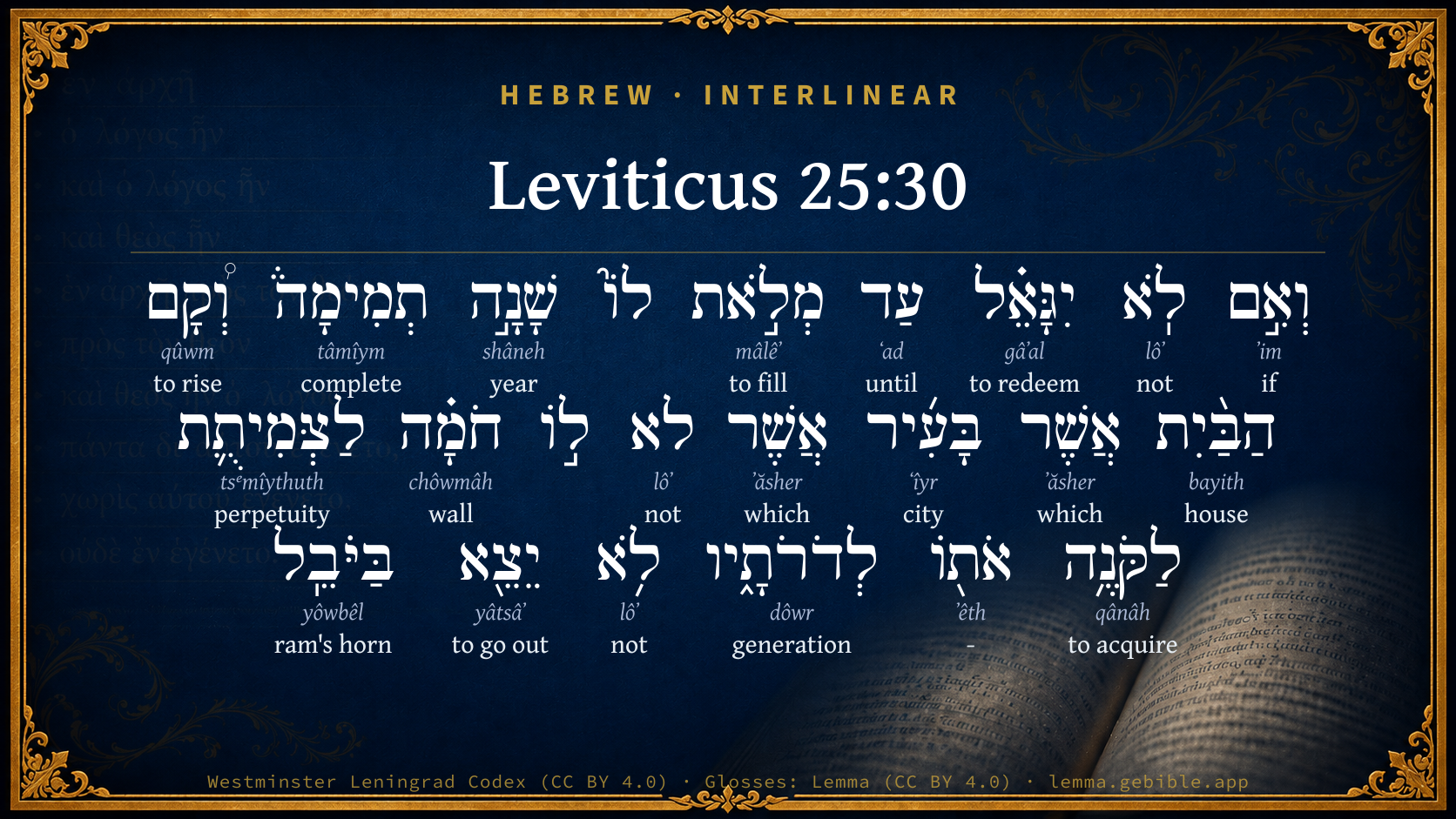
Hebrew (Westminster Leningrad Codex) Leviticus 25:30 appears in the Hebrew Old Testament. The text above is from the Westminster Leningrad Codex. Each word links to its Strong’s number, a concise gloss, and parsing drawn from the Open Scriptures Hebrew Bible morphology. Click any word for its full Brown-Driver-Briggs (BDB) entry.
Download image
Cite this verse

Leviticus 25:30 (World English Bible). Public Domain. Lemma interlinear Bible study tool, https://lemma.gebible.app/v/leviticus/25/30.

Show BibTeX & RIS
BibTeX
RIS
English Translation
If it isn't redeemed within the space of a full year, then the house that is in the walled city shall be made sure in perpetuity to him who bought it, throughout his generations. It shall not be released in the Jubilee.
World English Bible · Public Domain
Download a study sheet

One document with this verse’s original text, its word-by-word gloss line, the meaning frame, cross-references with their text, attributed commentary, and full source and license credits — printable, and it pastes into notes with its structure intact.

This verse Autodidact and up

Study sheet (.html) Plain text (.txt)

A passage Seminary Student

Up to 50 verses in one chapter. A passage sheet keeps up to 6 commentary sources and 12 cross-references per verse, in the order this page ranks them, and says so on the sheet whenever that leaves anything out. Ask for a single verse and you get the Autodidact verse sheet above.

Everything on this page stays free to read, with no account — the sheet is a download of what is already on screen, not access to it.

Want to remove ads? Support Godless Engineer
Compare translations 3

The same verse in 3 English versions, stacked beneath the original-language interlinear above. Click any original word for its lexicon entry.

Each is an independent rendering of the whole verse — the interlinear is not word-aligned to these translations.

Highlighted words mark where these versions differ — a whole-verse word diff, not a word-by-word alignment.

  • World English Bible Public Domain
    If it isn't redeemed within the space of a full year, then the house that is in the walled city shall be made sure in perpetuity to him who bought it, throughout his generations. It shall not be released in the Jubilee.
  • King James Version Public Domain
    And if it be not redeemed within the space of a full year, then the house that is in the walled city shall be established for ever to him that bought it throughout his generations: it shall not go out in the jubilee.
  • unfoldingWord Literal Text CC BY-SA 4.0
    And if it is not redeemed until a complete year fulfills for it, then the house which in the city which a wall to it to the buyer it in perpetuity, to his generations. It shall not go out in the Jubilee.

unfoldingWord Literal Text — © unfoldingWord, licensed CC BY-SA 4.0. Word-aligned USFM3 via Door43 (git.door43.org/unfoldingWord/en_ult).

Versions to compare (up to 4)

3 of 4 selected

Show all 18 translations

Every available English version of this verse, each an independent rendering of the whole verse.

  • World English Bible Public Domain
    If it isn't redeemed within the space of a full year, then the house that is in the walled city shall be made sure in perpetuity to him who bought it, throughout his generations. It shall not be released in the Jubilee.
  • Berean Standard Bible Public Domain
    If it is not redeemed by the end of a full year, then the house in the walled city is permanently transferred to its buyer and his descendants. It is not to be released in the Jubilee.
  • Majority Standard Bible Public Domain
    If it is not redeemed by the end of a full year, then the house in the walled city is permanently transferred to its buyer and his descendants. It is not to be released in the Jubilee.
  • King James Version Public Domain
    And if it be not redeemed within the space of a full year, then the house that is in the walled city shall be established for ever to him that bought it throughout his generations: it shall not go out in the jubilee.
  • American Standard Version (1901) Public Domain
    And if it be not redeemed within the space of a full year, then the house that is in the walled city shall be made sure in perpetuity to him that bought it, throughout his generations: it shall not go out in the jubilee.
  • Revised Version (1885) Public Domain
    And if it be not redeemed within the space of a full year, then the house that is in the walled city shall be made sure in perpetuity to him that bought it, throughout his generations: it shall not go out in the jubile.
  • Geneva Bible (1599) Public Domain
    But if it be not bought out within ye space of a ful yeere, then the house that is in the walled citie, shalbe stablished, as cut off from the familie, to him that bought it, throughout his generations: it shall not goe out in the Iubile.
  • Douay-Rheims (1899) Public Domain
    If he redeem it not, and the whole year be fully out, the buyer shall possess it, and his posterity for ever, and it can- not be redeemed, not even in the jubilee.
  • Young's Literal Translation Public Domain
    and if it is not redeemed until the fulness to him of a perfect year, then hath the house which `is' in a walled city been established to extinction to the buyer of it, to his generations; it goeth not out in the jubilee;
  • Literal Standard Version CC BY-SA 4.0
    and if it is not redeemed to him until the fullness of a perfect year, then the house which [is] in a walled city has been established to extinction to him buying it, throughout his generations; it does not go out in the Jubilee.
  • Unlocked Literal Bible CC BY-SA 4.0
    If the house is not redeemed within a full year, then the house in the walled city will become the permanent property of the buyer and his descendants. It is not to be returned in the year of Jubilee.
  • unfoldingWord Literal Text CC BY-SA 4.0
    And if it is not redeemed until a complete year fulfills for it, then the house which in the city which a wall to it to the buyer it in perpetuity, to his generations. It shall not go out in the Jubilee.
  • Darby Bible Public Domain
    But if it be not redeemed until a whole year is complete, then the house that is in the walled city shall be established for ever to him that bought it, throughout his generations: it shall not go out in the jubilee.
  • World Messianic Bible Public Domain
    If it isn’t redeemed within the space of a full year, then the house that is in the walled city shall be made sure in perpetuity to him who bought it, throughout his generations. It shall not be released in the Jubilee.
  • Webster's Bible Public Domain
    And if it shall not be redeemed within the space of a full year, then the house that is in the walled city shall be established for ever to him that bought it, throughout his generations: it shall not go out in the jubilee,
  • Free Bible Version CC BY-SA 4.0
    If it isn't bought back by the end of a full year, then ownership of the house in the walled town is permanently transferred to the one who bought it and their descendants. It won't be returned in the Jubilee.
  • Bible in Basic English Public Domain
    And if he does not get it back by the end of the year, then the house in the town will become the property of him who gave the money for it, and of his children for ever; it will not go from him in the year of Jubilee.
  • JPS Tanakh (1917) Public Domain
    And if it be not redeemed within the space of a full year, then the house that is in the walled city shall be made sure in perpetuity to him that bought it, throughout his generations; it shall not go out in the jubilee.

Literal Standard Version (2020), Covenant Press — licensed CC BY-SA 4.0. Text via the HelloAO Bible API (eBible.org). Unlocked Literal Bible (unfoldingWord) — licensed CC BY-SA 4.0. Text via the HelloAO Bible API (eBible.org). unfoldingWord Literal Text — © unfoldingWord, licensed CC BY-SA 4.0. Word-aligned USFM3 via Door43 (git.door43.org/unfoldingWord/en_ult). Free Bible Version, Dr. Jonathan Gallagher — licensed CC BY-SA 4.0. Text via the HelloAO Bible API (eBible.org).

Word by word

More ways to search: Search by grammar → Find every occurrence → Compare this word →

Practice this passage: Drill this verse → Learn its vocabulary →

לַצְּמִיתֻ֛ת
tsᵉmîythuth
H6783
“to/for the · perpetuity”
Preposition, Determined + Noun, Common, Feminine, Singular, Absolute
Part of Speech
Preposition + Noun
Type
Common
Gender
Feminine
Number
Singular
State
Absolute
Full BDB Definition

Origin: from H6789

TWOT: 1932a

completion, finality, in perpetuity
  1. וְאִ֣ם ʼim H518 “and · if” Conjunction + Conjunction
  2. לֹֽא lôʼ H3808 “not” Particle, Negative
  3. יִגָּאֵ֗ל gâʼal H1350 “to redeem” Verb, Niphal, Imperfect, 3rd Person, Masculine, Singular
  4. עַד ʻad H5704 “until” Preposition
  5. מְלֹ֣את mâlêʼ H4390 “to fill” Verb, Qal, Infinitive Construct
  6. שָׁנָ֣ה shâneh H8141 “year” Noun, Common, Feminine, Singular, Absolute
  7. תְמִימָה֒ tâmîym H8549 “complete” Adjective, Adjective, Feminine, Singular, Absolute
  8. וְ֠קָם qûwm H6965 “and · to rise” Conjunction + Verb, Qal, Perfect, 3rd Person, Masculine, Singular
  9. הַבַּ֨יִת bayith H1004 “the · house” Particle, Definite Article + Noun, Common, Masculine, Singular, Absolute
  10. אֲשֶׁר ʼăsher H834 “which” Particle, Relative
  11. בָּעִ֜יר ʻîyr H5892 “in/at the · city” Preposition, Determined + Noun, Common, Feminine, Singular, Absolute
  12. אֲשֶׁר ʼăsher H834 “which” Particle, Relative
  13. לא lôʼ H3808 “not” Particle, Negative
  14. חֹמָ֗ה chôwmâh H2346 “wall” Noun, Common, Feminine, Singular, Absolute
  15. לַקֹּנֶ֥ה qânâh H7069 “to/for the · acquiring” Preposition, Determined + Verb, Qal, Participle Active, Masculine, Singular, Absolute
  16. אֹת֖וֹ ʼêth H853 “- · him” Particle, Direct Object + Suffix, Personal, 3rd Person, Masculine, Singular
  17. לְדֹרֹתָ֑יו dôwr H1755 “to/for · generations · his” Preposition + Noun, Common, Masculine, Plural, Construct + Suffix, Personal, 3rd Person, Masculine, Singular
  18. לֹ֥א lôʼ H3808 “not” Particle, Negative
  19. יֵצֵ֖א yâtsâʼ H3318 “to go out” Verb, Qal, Imperfect, 3rd Person, Masculine, Singular
  20. בַּיֹּבֵֽל yôwbêl H3104 “in/at the · ram's horn” Preposition, Determined + Noun, Common, Masculine, Singular, Absolute

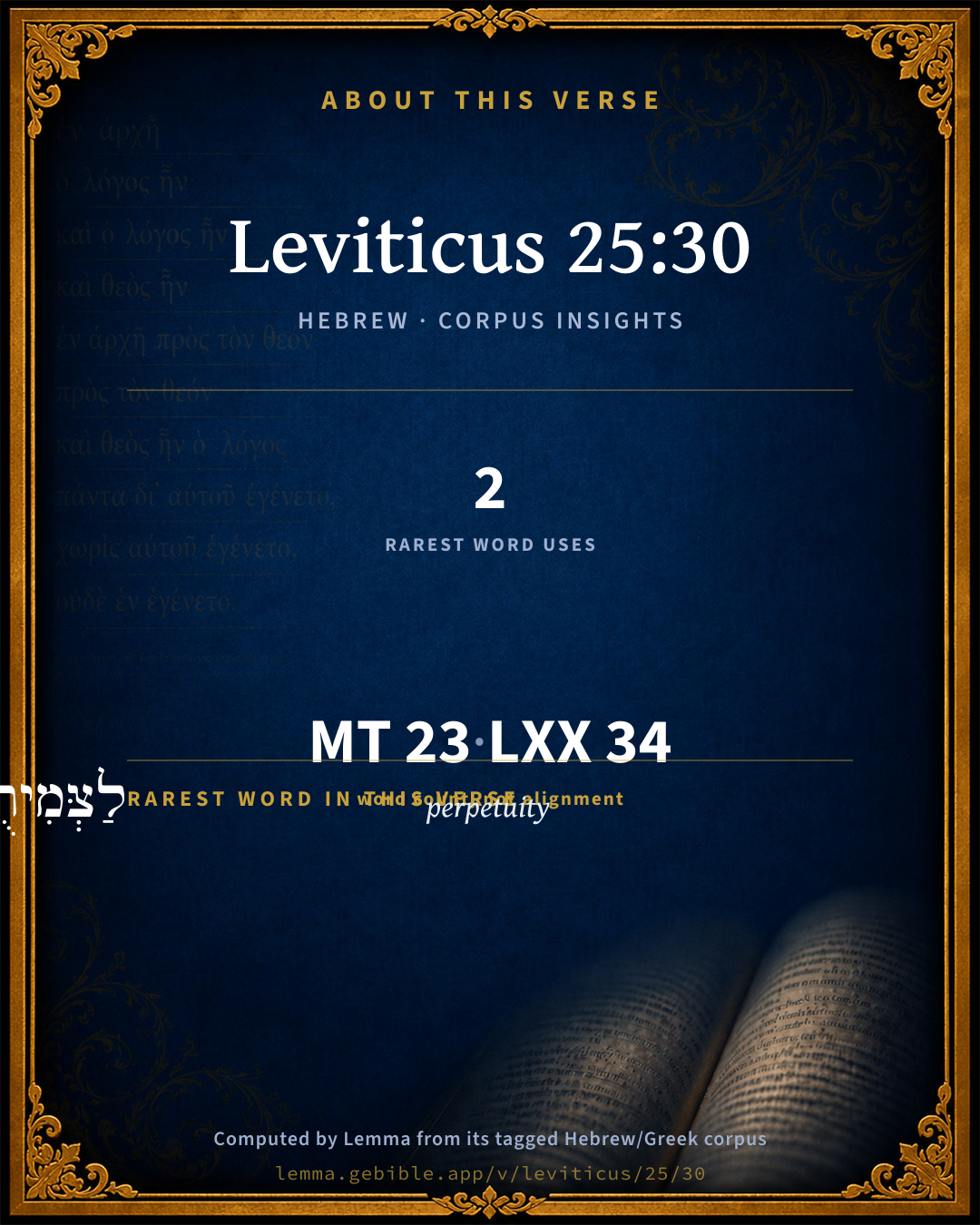
About this verse

These counts appear in no published source. They are computed here, from the morphology-tagged text and Lemma’s own curated glosses. What Lemma adds →

23
words
18
distinct lemmas
Pentateuch
section

Notable vocabulary

The rarest word here is לַצְּמִיתֻ֛ת perpetuity H6783 — appearing just 2 times in the whole Hebrew Bible.

Shared distinctive vocabulary

לַצְּמִיתֻ֛ת perpetuity H6783 occurs in 2 verses of the Hebrew Bible. Also found in:

Grammatical profile

  • 5 verbs
  • 7 nouns
  • 1 adjective
  • 3 prepositions
  • 1 conjunction
  • 6 particles

Verb forms

  • יִגָּאֵ֗ל Niphal · Imperfect
  • מְלֹ֣את Qal · Infinitive Construct
  • וְ֠קָם Qal · Perfect
  • לַקֹּנֶ֥ה Qal · Participle Active
  • יֵצֵ֖א Qal · Imperfect

Repetition

Words recur within this verse — often emphatic in Hebrew:

  • לֹֽא not H3808 ×3
  • אֲשֶׁר which H834 ×2

Hebrew & Septuagint length

In English translation the verse runs 42 words from the Hebrew and 45 from the Septuagint (LXX English) — closely comparable.

A rough comparison of the two English renderings, which tokenize alike — not a word-level alignment.

Word counts can differ between the Hebrew and the Greek without any difference in meaning — e.g. the Hebrew direct-object marker אֵת has no separate Greek word, and Greek often adds the article ὁ.

In the original languages it is 23 Hebrew tokens and 34 Greek tokens — but the two are counted differently (Hebrew bundles its prefixes and suffixes into one token; the Greek is in lemma form), so that isn’t a like-for-like length.

Hebrew and Greek witnesses Masoretic Hebrew ↔ Greek Septuagint

The same verse in the two great witnesses to the Old Testament, shown verse-for-verse.

These are two independent witnesses, not word-aligned to each other, and the Septuagint is shown in lemma (dictionary) form.

Hebrew Leviticus 25:30 Masoretic · Westminster Leningrad Codex

וְאִ֣ם לֹֽא יִגָּאֵ֗ל עַד מְלֹ֣את לוֹ֮ שָׁנָ֣ה תְמִימָה֒ וְ֠קָם הַבַּ֨יִת אֲשֶׁר בָּעִ֜יר אֲשֶׁר לא ל֣וֹ חֹמָ֗ה לַצְּמִיתֻ֛ת לַקֹּנֶ֥ה אֹת֖וֹ לְדֹרֹתָ֑יו לֹ֥א יֵצֵ֖א בַּיֹּבֵֽל

If it isn't redeemed within the space of a full year, then the house that is in the walled city shall be made sure in perpetuity to him who bought it, throughout his generations. It shall not be released in the Jubilee.

World English Bible · Public Domain

Greek LXX Leviticus 25:30 Septuagint · lemma form

ἐάν δέ μή λυτρόω ἕως ἄν πληρόω αὐτός ἐνιαυτός ὅλος κυρόω ὁ οἰκία ὁ εἰμί ἐν πόλις ὁ ἔχω τεῖχος βεβαίως ὁ κτάομαι αὐτός εἰς ὁ γενεά αὐτός καί οὐ ἐκἔρχομαι ἐν ὁ ἄφεσις

And if it be not ransomed until there be completed of its time a full year, the house which is in the walled city shall be surely confirmed to him that bought it, throughout his generations; and it shall not go out in the release.

LXX2012 (modern English Septuagint) · Public Domain

Hebrew: Westminster Leningrad Codex (CC BY 4.0). Greek: Septuagint (public domain); English from LXX2012 (modern English Septuagint) (Public Domain). How the Septuagint differs from the Hebrew →

Targum (Aramaic paraphrase)

2

The Targum is the ancient Jewish Aramaic paraphrase of the Hebrew Scriptures — an interpretive translation, not the Hebrew text itself. Onkelos (literal) and Pseudo-Jonathan (expansive) render the Torah, and Jonathan the Prophets. Coverage is partial: where no permissively-licensed English translation exists for a verse, only the Aramaic is shown. This is verse-level text, not a word-by-word alignment to the Hebrew.

  1. Targum Onkelos Torah (Genesis–Deuteronomy)
    וְאִם לָא יִתְפָּרַק עַד מִשְׁלַם לֵהּ שַׁתָּא שְׁלֶמְתָּא וִיקוּם בֵּיתָא דִי בְקַרְתָּא דִי לֵהּ שׁוּרָא לַחֲלוּטִין לְדִי זְבַן יָתֵהּ לְדָרוֹהִי לָא יִפּוֹק בְּיוֹבֵלָא

    (no public-domain English translation for this verse)

    Targum Onkelos — Aramaic: “Onkelos Genesis” (public domain); “Onkelos Exodus” (public domain); “Onkelos Leviticus” (public domain); “Onkelos Numbers” (public domain); “Onkelos Deuteronomy” (public domain). English: “Sefaria Community Translation” (CC0 1.0 (public-domain dedication)); “J.W. Etheridge. The Targums of Onkelos and Jonathan Ben Uzziel on the Pentateuch. London: Longmans, Green, 1862” (public domain). Text via Sefaria.

  2. Targum Pseudo-Jonathan Torah (Genesis–Deuteronomy)
    וְאִין לָא יִתְפְּרֵיק עַד זְמַן מִישְׁלַם לֵיהּ שַׁתָּא שְׁלֵימְתָּא וִיקוּם בֵּיתָא דִבְקַרְתָּא דִלֵיהּ שׁוּרִין לַחֲלוּטִין לְדִיזְבַּן יָתֵיהּ לְדָרוֹי לָא יִפּוֹק בְּיוֹבְלָא

    But if it be not redeemed at the completing of the full year, the house that is in a walled town shall be confirmed absolutely to him who bought it, unto his generations: it shall not go out at the Jubela.

    Targum Pseudo-Jonathan — Aramaic: “Targum Jonathan on Genesis” (public domain); “Targum Jonathan on Exodus” (public domain); “Targum Jonathan on Leviticus” (public domain); “Targum Jonathan on Numbers” (public domain); “Targum Jonathan on Deuteronomy” (public domain). English: “The Targum of Jonathan ben Uzziel, trans. J. W. Etheridge, London, 1862” (public domain). Text via Sefaria.

Commentary

Notes on Leviticus 25:30 from classic Christian and Jewish commentators (each source and its license shown beneath its notes). The classic Christian expositions comment on the surrounding passage and are grouped to its opening verse, so a note may address several verses; the Jewish commentaries on the Tanakh (Rashi and others) are per-verse, so they appear only where the commentator wrote on this verse.

Lemma curates 59 commentaries, every one of them public domain or Creative Commons licensed, each selected and text-cleaned for this edition rather than reprinted as found. About our sources →

John Gill's Exposition

And if it be not redeemed within the space of a full year,.... Either by the seller or any man of kin to him:

then the house that is in the walled city shall be established for ever to him that bought it, throughout his generation; after twelve months were elapsed it was not redeemable by any, but to be held by the purchaser and his heirs for ever:

it shall not go out in the jubilee; from the purchaser or his heirs, to the seller or his heirs; for houses were not like lands, the gift of God, and held under him, but were built by men, and were their absolute property, and therefore they could dispose of them, and they that bought them could hold them after the above mentioned time; nor was there any danger of confounding tribes and families by retaining them: this law was made to encourage persons to settle in walled towns, to make and keep them populous, and to make owners of them careful not to sell them: the Jewish canon is this; when the day of the twelfth month is come, and it (the house) is not redeemed, it is absolutely his, whether he bought it or whether it was given him, as it is said, Lev 25:30; and if in the beginning of the day of the twelfth month he (the purchaser) hides himself, that it may be confirmed to him or be his absolutely; Hillel, the elder, ordered that he (the seller) should put his money in the chamber (belonging to the sanhedrim) and break open the door, and go in; and when he would, he (the purchaser) might come, and take his money (i); but otherwise, if he suffers this time to pass it is irredeemable, nor will the year of jubilee help him: the Jews except the city of Jerusalem from this law, because, they say, that does not belong to any tribe (k).

(i) Misn. Eracin, c. 9. sect. 4. (k) T. Bab. Bava Kama, fol. 82. 2.

John Gill's Exposition of the Whole Bible (1746–1763) — public domain (CC PDM 1.0). Text via the HelloAO Bible API.

Trapp's Complete Commentary

John Trapp

Lev 25:30 And if it be not redeemed within the space of a full year, then the house that [is] in the walled city shall be established for ever to him that bought it throughout his generations: it shall not go out in the jubile.

Ver. 30. And if it be not redeemed.] This would make the owners the better husbands, and keep the houses in better repair.

John Trapp, A Commentary or Exposition upon All the Books of the Old and New Testament (1647–1656) — public domain. Text from a community e-Sword module.

Geneva Bible (1599)

Geneva Bible translators

That is, forever, read verse 23.

Geneva Bible (1599) marginal notes — public domain. Text via Bolls.life.

Ellicott's Commentary for English Readers

(30) if it be not redeemed within the space of a full year.—That is, either by the vendor or his son. According to the interpretation which obtained during the second Temple, the phrase “full year” is here used for the benefit of the seller, inasmuch as it gives him the advantage of an intercalary year, when he has an additional month, up to the last day of which he could still effect the redemption. Moreover, as the purchaser sometimes concealed himself towards the end of the year, in order to prevent the seller from redeeming his house, it was enacted that the original proprietor should hand over the redemption money to the public authorities when the purchaser could not be found, break open the doors, and take possession of the house; and if the purchaser died during the year, the vendor could redeem it from his heir.

It shall not go out in the jubile.—If the vendor, however, failed to redeem the house within the prescribed period, it was not to be subject to the laws of jubile like the land, but is to remain for ever the property of the purchaser.

A Bible Commentary for English Readers, edited by Charles John Ellicott (1878–1897) — public domain. Text from a community e-Sword module.

Albert Barnes' Notes on the Bible

Not go out - Because most of the houses in cities were occupied by artificers and traders whose wealth did not consist in lands.

Albert Barnes' Notes on the Bible (1834–1885) — public domain. Text from a community e-Sword/MySword module.

Matthew Poole's English Annotations

The reason is from the great difference between such houses and lands. The reasons before alleged for lands do not hold in such houses; there was no danger of confusion in tribes or families by the alienation of houses. The seller also had a greater propriety in houses than in lands, as not coming to him by God’s mere gift, but being commonly built by the owner’s cost and diligence, and therefore had a fuller power to dispose of them. Besides, God would hereby encourage persons to buy and possess houses in such places, which frequency and fulness of inhabitants in cities was a great strength, honour, and advantage to the whole land.

Matthew Poole's English Annotations on the Holy Bible (1683–1685) — public domain. Text from a community e-Sword/MySword module.

John Wesley's Explanatory Notes

It shall not go out - The reasons before alledged for lands do not hold in such houses; there was no danger of confusion in tribes or families by the alienation of houses. The seller also had a greater propriety in houses than in lands, as being commonly built by the owner's cost and diligence, and therefore had a fuller power to dispose of them. Besides, God would hereby encourage persons to buy and possess houses in such places, as frequency and fulness of inhabitants in cities, was a great strength, honour and advantage to the whole land.

John Wesley, Explanatory Notes Upon the Whole Bible (1754–1765) — public domain. Text via the GEBible commentary corpus.

Scofield Reference Notes

C. I. Scofield

redeemed

Heb. "goel," Redemp. (Kinsman type). (See Scofield "Isa 59:20").

The Scofield Reference Bible (1917 edition), notes by C. I. Scofield — public domain. Text from a community e-Sword module.

Rashi

Rabbi Shlomo Yitzchaki (Rashi)

וקם הבית...לצמתת (THEN THE HOUSE… SHALL BE ESTABLISHED ABSOLUTELY [TO HIM THAT OBTAINED IT] — i. e. it leaves the control of the vendor for ever and stands under the exclusive control of the purchaser.

אשר לא חמה — We read the text as though it were written לו (i. e. tradition tells us to do so). Our Rabbis, of blessed memory, said (Arakhin 32a): We do so to intimate that the law applies to a city even if at the present it has not a rampart (אשר לא חמה) since previous to now it had one (אשר לו חמה). It is true that עיר is a feminine noun and the preposition referring to it should have been written לה (not לו), yet because Scripture was bound to write לא in the text for the reason given, the Massora (the traditional Scriptural text without vowels) replaced it by לו (instead of לה), because the sound of the one applies also to the other (they sound similar).

לא יצא ביובל IT SHALL NOT GO OUT IN THE JUBILEE — Rabbi Saphra said, “if the Jubilee happened to fall during that year (the first year of its sale), it shall nevertheless not go out” (Arakhin 31b).

Rashi on the Tanakh — English translations: “The Judaica Press complete Tanach with Rashi, translated by A. J. Rosenberg” (CC BY 4.0); “Pentateuch with Rashi's commentary by M. Rosenbaum and A.M. Silbermann, 1929-1934” (public domain); “The Metsudah Tanach series, Lakewood, N.J” (CC BY 4.0); and “The Book of Joshua, Metsudah Publications, 1997” (CC BY 4.0). Text via Sefaria.

Lesson kit

Teaching starters — assembled from the data on this page, not authored interpretation. Every prompt links to the verse data it draws on. Edit before teaching.

Leviticus, in the Pentateuch, opens this verse with 23 words (18 distinct Hebrew lemmas). Its most distinctive word is tsᵉmîythuth (“perpetuity”). A historical commentator’s framing appears above. Read the whole chapter for the surrounding context.

Discussion questions

  1. What does “perpetuity” (tsᵉmîythuth) contribute to the verse as a whole?
  2. Leviticus 25:23 shares the word «perpetuity» with this verse. How do the two illuminate each other?
  3. “not” occurs 3× in this one verse. What is the effect of the repetition?
  4. The translations on this page render this verse differently — a whole-verse word diff, not a word-by-word alignment. What might account for the different wordings?
  5. The verb «יִגָּאֵ֗ל» is Niphal Imperfect. How does its form color the action?
  6. Reading how John Gill's Exposition and Trapp's Complete Commentary read this verse, where do the two commentators agree and where do they part?

Things to notice

Reading settings

Reading text

Shown beneath each verse's original-language words.

Old Testament
Old Testament edition

Read the OT as the Masoretic Hebrew (MT) or the Greek Septuagint (LXX).

English shown for the Greek Septuagint (in the Hebrew ↔ Greek comparison).

Comparing translations? Open the Compare panel on any verse page to stack up to four side by side.