
1 Kings 4:13

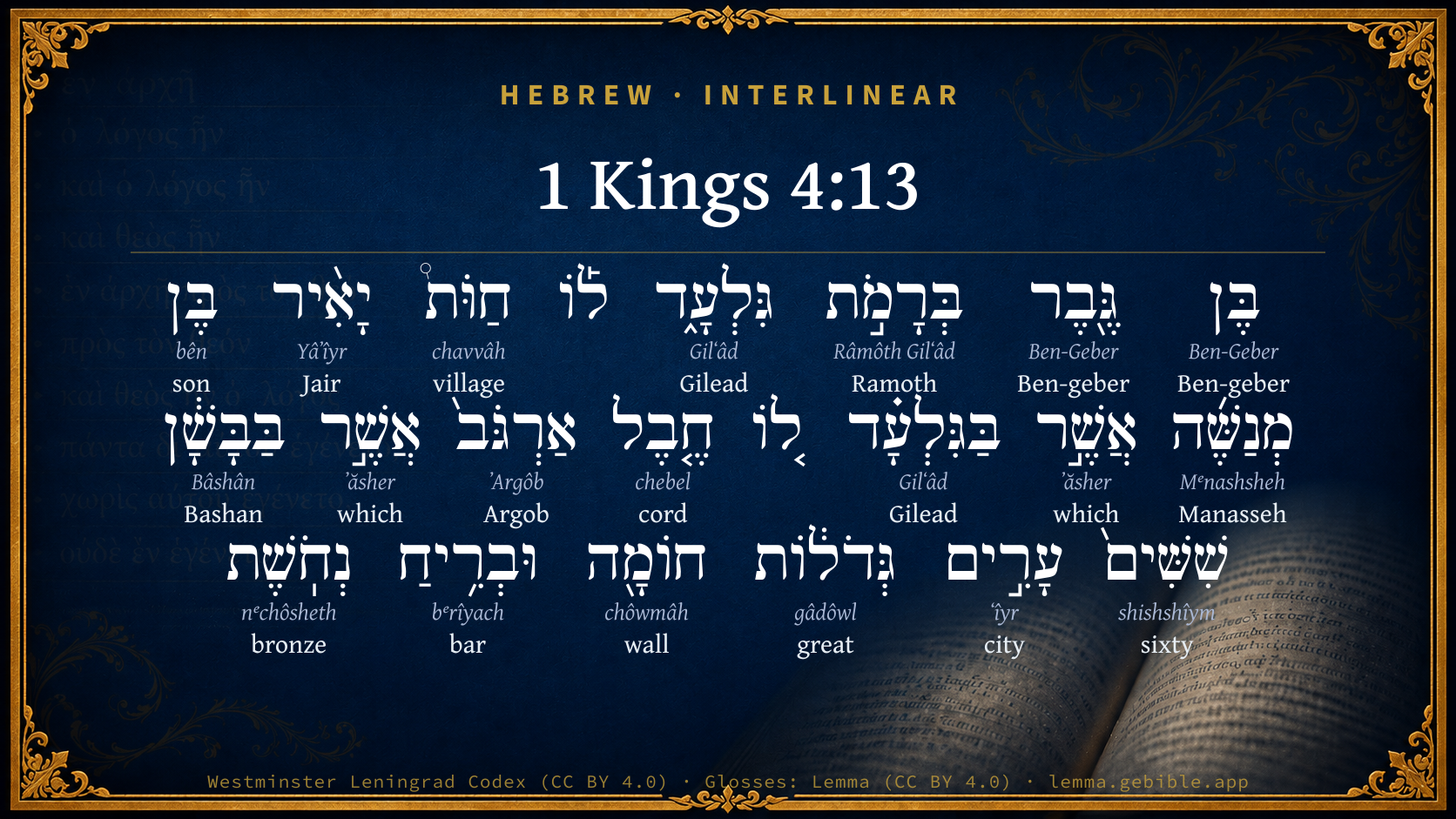
Hebrew (Westminster Leningrad Codex) 1 Kings 4:13 appears in the Hebrew Old Testament. The text above is from the Westminster Leningrad Codex. Each word links to its Strong’s number, a concise gloss, and parsing drawn from the Open Scriptures Hebrew Bible morphology. Click any word for its full Brown-Driver-Briggs (BDB) entry.
Download image
Cite this verse

1 Kings 4:13 (World English Bible). Public Domain. Lemma interlinear Bible study tool, https://lemma.gebible.app/v/1-kings/4/13.

Show BibTeX & RIS
BibTeX
RIS
English Translation
Ben Geber, in Ramoth-gilead (to him [pertained] the towns of Jair the son of Manasseh, which are in Gilead; [even] to him [pertained] the region of Argob, which is in Bashan, sixty great cities with walls and brazen bars);
World English Bible · Public Domain
Highlights Full analysis ↓
Download a study sheet

One document with this verse’s original text, its word-by-word gloss line, the meaning frame, cross-references with their text, attributed commentary, and full source and license credits — printable, and it pastes into notes with its structure intact.

This verse Autodidact and up

Study sheet (.html) Plain text (.txt)

A passage Seminary Student

Up to 50 verses in one chapter. A passage sheet keeps up to 6 commentary sources and 12 cross-references per verse, in the order this page ranks them, and says so on the sheet whenever that leaves anything out. Ask for a single verse and you get the Autodidact verse sheet above.

Everything on this page stays free to read, with no account — the sheet is a download of what is already on screen, not access to it.

Want to remove ads? Support Godless Engineer
Compare translations 3

The same verse in 3 English versions, stacked beneath the original-language interlinear above. Click any original word for its lexicon entry.

Each is an independent rendering of the whole verse — the interlinear is not word-aligned to these translations.

Highlighted words mark where these versions differ — a whole-verse word diff, not a word-by-word alignment.

  • World English Bible Public Domain
    Ben Geber, in Ramoth-gilead (to him [pertained] the towns of Jair the son of Manasseh, which are in Gilead; [even] to him [pertained] the region of Argob, which is in Bashan, sixty great cities with walls and brazen bars);
  • King James Version Public Domain
    The son of Geber, in Ramothgilead; to him pertained the towns of Jair the son of Manasseh, which are in Gilead; to him also pertained the region of Argob, which is in Bashan, threescore great cities with walls and brazen bars:
  • unfoldingWord Literal Text CC BY-SA 4.0
    Ben Geber, in Ramoth Gilead. (To him the villages of Jair, the son of Manasseh, that in Gilead; to him the region of Argob, which in Bashan, 60 great cities a wall and a bar of bronze).

unfoldingWord Literal Text — © unfoldingWord, licensed CC BY-SA 4.0. Word-aligned USFM3 via Door43 (git.door43.org/unfoldingWord/en_ult).

Versions to compare (up to 4)

3 of 4 selected

Show all 18 translations

Every available English version of this verse, each an independent rendering of the whole verse.

  • World English Bible Public Domain
    Ben Geber, in Ramoth-gilead (to him [pertained] the towns of Jair the son of Manasseh, which are in Gilead; [even] to him [pertained] the region of Argob, which is in Bashan, sixty great cities with walls and brazen bars);
  • Berean Standard Bible Public Domain
    Ben-geber in Ramoth-gilead (the villages of Jair son of Manasseh in Gilead belonged to him, as well as the region of Argob in Bashan with its sixty great cities with walls and bronze bars);
  • Majority Standard Bible Public Domain
    Ben-geber in Ramoth-gilead (the villages of Jair son of Manasseh in Gilead belonged to him, as well as the region of Argob in Bashan with its sixty great cities with walls and bronze bars);
  • King James Version Public Domain
    The son of Geber, in Ramothgilead; to him pertained the towns of Jair the son of Manasseh, which are in Gilead; to him also pertained the region of Argob, which is in Bashan, threescore great cities with walls and brazen bars:
  • American Standard Version (1901) Public Domain
    Ben-geber, in Ramoth-gilead (to him `pertained' the towns of Jair the son of Manasseh, which are in Gilead; `even' to him `pertained' the region of Argob, which is in Bashan, threescore great cities with walls and brazen bars);
  • Revised Version (1885) Public Domain
    Ben-geber, in Ramoth-gilead; to him pertained the towns of Jair the son of Manasseh, which are in Gilead; even to him pertained the region of Argob, which is in Bashan, threescore great cities with walls and brasen bars:
  • Geneva Bible (1599) Public Domain
    The sonne of Geber in Ramoth Gilead, and his were the townes of Iair, the sonne of Manasseh, which are in Gilead, and vnder him was the region of Argob, which is in Bashan: threescore great cities with walles and barres of brasse.
  • Douay-Rheims (1899) Public Domain
    Bengaber in Ramoth Galaad: he had the towns of Jair the son of Manasses in Galaad, he was chief in all the country of Argob, which is in Basan, threescore great cities with walls, and brazen bolts.
  • Young's Literal Translation Public Domain
    Ben-Geber, in Ramoth-Gilead, hath the small towns of Jair son of Manasseh, which `are' in Gilead; he hath a portion of Argob that `is' in Bashan, sixty great cities `with' wall and brazen bar.
  • Literal Standard Version CC BY-SA 4.0
    Ben-Geber, in Ramoth-Gilead, has the small towns of Jair son of Manasseh, which [are] in Gilead; he has a portion of Argob that [is] in Bashan—sixty great cities [with] wall and bronze bar;
  • Unlocked Literal Bible CC BY-SA 4.0
    Ben-Geber, in Ramoth Gilead (to him belonged the towns of Jair son of Manasseh, that are in Gilead, and the region of Argob belonged to him, which is in Bashan, sixty great cities with walls and bronze gate bars);
  • unfoldingWord Literal Text CC BY-SA 4.0
    Ben Geber, in Ramoth Gilead. (To him the villages of Jair, the son of Manasseh, that in Gilead; to him the region of Argob, which in Bashan, 60 great cities a wall and a bar of bronze).
  • Darby Bible Public Domain
    Ben-Geber, in Ramoth-Gilead; he had the villages of Jair the son of Manasseh, which are in Gilead; he had the region of Argob, which is in Bashan, sixty great cities with walls and bars of bronze.
  • World Messianic Bible Public Domain
    Ben Geber, in Ramoth Gilead (the towns of Jair the son of Manasseh, which are in Gilead, belonged to him; and the region of Argob, which is in Bashan, sixty great cities with walls and bronze bars, belonged to him);
  • Webster's Bible Public Domain
    The son of Geber, in Ramoth-gilead; to him pertained the towns of Jair the son of Manasseh, which are in Gilead; to him also pertained the region of Argob, which is in Bashan, sixty great cities with walls and brazen bars:
  • Free Bible Version CC BY-SA 4.0
    Ben-geber, in Ramoth-gilead (the towns of Jair, son of Manasseh, in Gilead belonged to him, as well as the region of Argob in Bashan, with sixty great cities having walls and bronze bars);
  • Bible in Basic English Public Domain
    ... the son of Geber in Ramoth-gilead; he had the towns of Jair, the son of Manasseh, which are in Gilead, and the country of Argob, which is in Bashan, sixty great towns with walls and locks of brass.
  • JPS Tanakh (1917) Public Domain
    the son of Geber, in Ramoth-gilead; to him pertained the villages of Jair the son of Manasseh, which are in Gilead; even to him pertained the region of Argob, which is in Bashan, threescore great cities with walls and brazen bars;

Literal Standard Version (2020), Covenant Press — licensed CC BY-SA 4.0. Text via the HelloAO Bible API (eBible.org). Unlocked Literal Bible (unfoldingWord) — licensed CC BY-SA 4.0. Text via the HelloAO Bible API (eBible.org). unfoldingWord Literal Text — © unfoldingWord, licensed CC BY-SA 4.0. Word-aligned USFM3 via Door43 (git.door43.org/unfoldingWord/en_ult). Free Bible Version, Dr. Jonathan Gallagher — licensed CC BY-SA 4.0. Text via the HelloAO Bible API (eBible.org).

Word by word

More ways to search: Search by grammar → Find every occurrence → Compare this word →

Practice this passage: Drill this verse → Learn its vocabulary →

בֶּן
Ben-Geber
H1127
“Ben-geber of”
Noun, Common, Masculine, Singular, Construct
Part of Speech
Noun
Type
Common
Gender
Masculine
Number
Singular
State
Construct
Full BDB Definition

Origin: from H1121 and H1397

TWOT: None

Ben-geber = "the son of Geber" or " the son of a man" - an officer of Solomon
  1. גֶּ֖בֶר Ben-Geber H1127 “Ben-geber” Noun, Proper
  2. בְּרָמֹ֣ת Râmôth Gilʻâd H7433 “in/at · Ramoth” Preposition + Noun, Proper
  3. גִּלְעָ֑ד Gilʻâd H1568 “Gilead” Noun, Proper
  4. חַוֺּת֩ chavvâh H2333 “villages of” Noun, Common, Feminine, Plural, Construct
  5. יָאִ֨יר Yâʼîyr H2971 “Jair” Noun, Proper
  6. בֶּן bên H1121 “son of” Noun, Common, Masculine, Singular, Construct
  7. מְנַשֶּׁ֜ה Mᵉnashsheh H4519 “Manasseh” Noun, Proper
  8. אֲשֶׁ֣ר ʼăsher H834 “which” Particle, Relative
  9. בַּגִּלְעָ֗ד Gilʻâd H1568 “in/at the · Gilead” Preposition, Determined + Noun, Proper
  10. חֶ֤בֶל chebel H2256 “cord of” Noun, Common, Both, Singular, Construct
  11. אַרְגֹּב֙ ʼArgôb H709 “Argob” Noun, Proper
  12. אֲשֶׁ֣ר ʼăsher H834 “which” Particle, Relative
  13. בַּבָּשָׁ֔ן Bâshân H1316 “in/at the · Bashan” Preposition, Determined + Noun, Proper
  14. שִׁשִּׁים֙ shishshîym H8346 “sixty” Adjective, Cardinal number, Both, Plural, Absolute
  15. עָרִ֣ים ʻîyr H5892 “cities” Noun, Common, Feminine, Plural, Absolute
  16. גְּדֹל֔וֹת gâdôwl H1419 “great” Adjective, Adjective, Feminine, Plural, Absolute
  17. חוֹמָ֖ה chôwmâh H2346 “wall” Noun, Common, Feminine, Singular, Absolute
  18. וּבְרִ֥יחַ bᵉrîyach H1280 “and · bar of” Conjunction + Noun, Common, Masculine, Singular, Construct
  19. נְחֹֽשֶׁת nᵉchôsheth H5178 “bronze” Noun, Common, Feminine, Singular, Absolute

About this verse

These counts appear in no published source. They are computed here, from the morphology-tagged text and Lemma’s own curated glosses. What Lemma adds →

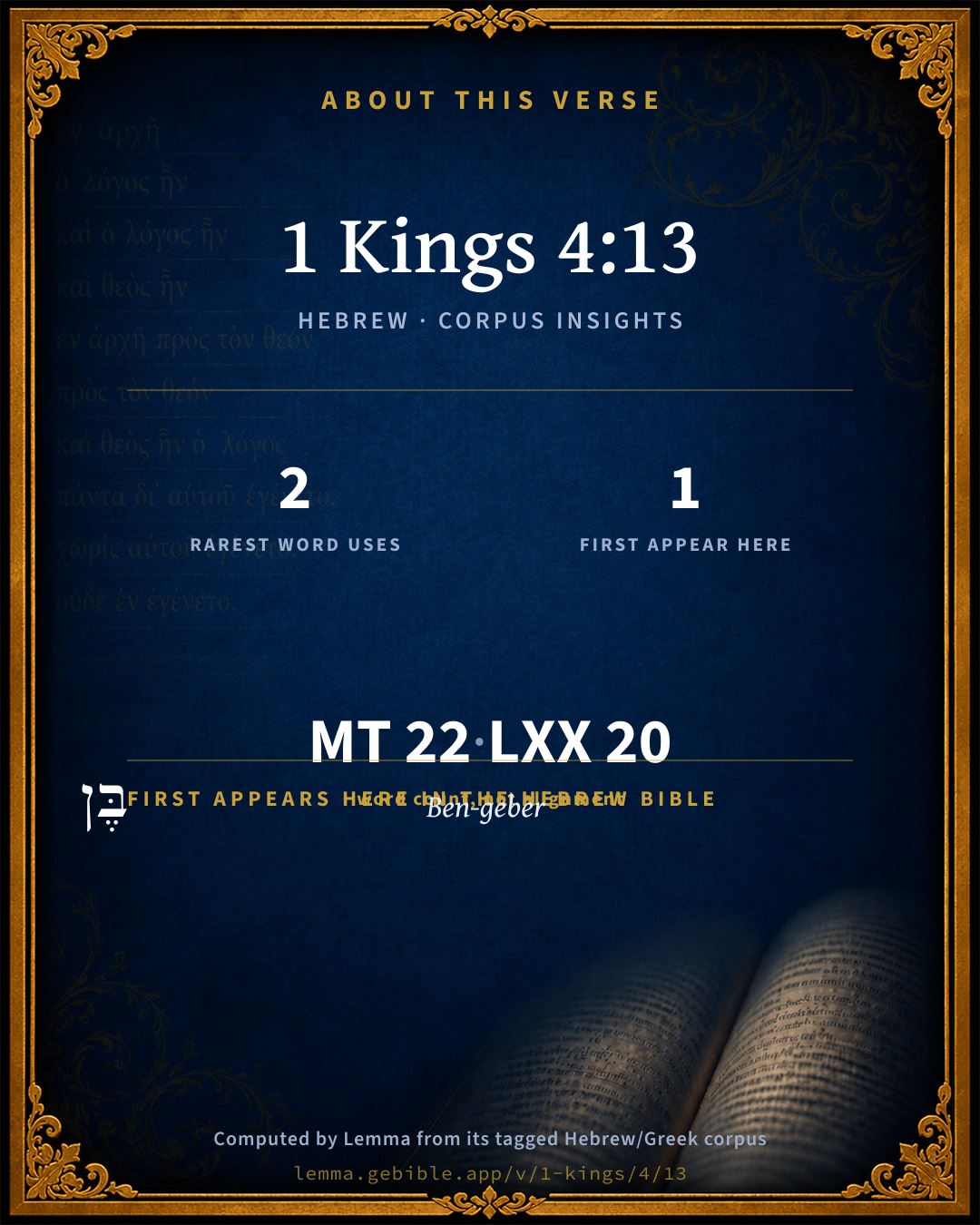
22
words
17
distinct lemmas
Historical
section

Notable vocabulary

The rarest word here is בֶּן Ben-geber H1127 — appearing just 2 times in the whole Hebrew Bible.

First appearance in Scripture

This word makes its first canonical appearance in the Hebrew Bible here:

  • בֶּן Ben-geber H1127

Grammatical profile

  • 16 nouns
  • 2 adjectives
  • 2 prepositions
  • 2 particles

Repetition

Words recur within this verse — often emphatic in Hebrew:

  • בֶּן Ben-geber H1127 ×2
  • גִּלְעָ֑ד Gilead H1568 ×2
  • אֲשֶׁ֣ר which H834 ×2

Hebrew & Septuagint length

In English translation the verse runs 39 words from the Hebrew and 25 from the Septuagint (LXX English) — the Septuagint runs noticeably shorter here. See the side-by-side →

A rough comparison of the two English renderings, which tokenize alike — not a word-level alignment.

Word counts can differ between the Hebrew and the Greek without any difference in meaning — e.g. the Hebrew direct-object marker אֵת has no separate Greek word, and Greek often adds the article ὁ.

In the original languages it is 22 Hebrew tokens and 20 Greek tokens — but the two are counted differently (Hebrew bundles its prefixes and suffixes into one token; the Greek is in lemma form), so that isn’t a like-for-like length.

Cross-references

12

Topical passages linked to 1 Kings 4:13 in the Treasury of Scripture Knowledge — connected by theme and wording, ordered by reader-vote popularity; previews shown in the World English Bible.

  • Numbers 32:41 Jair the son of Manasseh went and took the towns of it, and called them Havvoth Jair.
  • Deuteronomy 3:4 We took all his cities at that time; there was not a city which we didn't take from them; sixty cities, all the region of Argob, the kingdom of Og in Bashan.
  • 1 Kings 22:3 The king of Israel said to his servants, "You know that Ramoth-gilead is ours, and we are still, and don't take it out of the hand of the king of Syria?"
  • Deuteronomy 3:8 We took the land at that time out of the hand of the two kings of the Amorites who were beyond the Jordan, from the valley of the Arnon to Mount Hermon;
  • Deuteronomy 3:13–14 and the rest of Gilead, and all Bashan, the kingdom of Og, gave I to the half-tribe of Manasseh; all the region of Argob, even all Bashan. (The same is called the land of Rephaim.
  • Deuteronomy 4:43 [namely], Bezer in the wilderness, in the plain country, for the Reubenites; and Ramoth in Gilead, for the Gadites; and Golan in Bashan, for the Manassites.
  • Joshua 20:8 Beyond the Jordan at Jericho eastward, they assigned Bezer in the wilderness in the plain out of the tribe of Reuben, and Ramoth in Gilead out of the tribe of Gad, and Golan in Bashan out of the tribe of Manasseh.
  • Joshua 21:38 Out of the tribe of Gad, Ramoth in Gilead with its suburbs, the city of refuge for the manslayer, and Mahanaim with its suburbs,
  • 2 Kings 9:1 Elisha the prophet called one of the sons of the prophets, and said to him, Gird up your loins, and take this vial of oil in your hand, and go to Ramoth-gilead.
  • 2 Kings 9:14 So Jehu the son of Jehoshaphat the son of Nimshi conspired against Joram. (Now Joram was keeping Ramoth-gilead, he and all Israel, because of Hazael king of Syria;
  • Psalms 22:12 Many bulls have surrounded me. Strong bulls of Bashan have encircled me.
  • Psalms 68:15 The mountains of Bashan are majestic mountains. The mountains of Bashan are rugged.

Cross-references courtesy of OpenBible.info (CC BY 4.0).

Hebrew and Greek witnesses Masoretic Hebrew ↔ Greek Septuagint

The same verse in the two great witnesses to the Old Testament, shown verse-for-verse.

Here the Septuagint runs noticeably shorter than the Hebrew — LXX2012 (modern English Septuagint) 25 words vs World English Bible 39. A rough length comparison of the two English translations, not a word-level alignment — read both below.

These are two independent witnesses, not word-aligned to each other, and the Septuagint is shown in lemma (dictionary) form.

Hebrew 1 Kings 4:13 Masoretic · Westminster Leningrad Codex

בֶּן גֶּ֖בֶר בְּרָמֹ֣ת גִּלְעָ֑ד ל֡וֹ חַוֺּת֩ יָאִ֨יר בֶּן מְנַשֶּׁ֜ה אֲשֶׁ֣ר בַּגִּלְעָ֗ד ל֚וֹ חֶ֤בֶל אַרְגֹּב֙ אֲשֶׁ֣ר בַּבָּשָׁ֔ן שִׁשִּׁים֙ עָרִ֣ים גְּדֹל֔וֹת חוֹמָ֖ה וּבְרִ֥יחַ נְחֹֽשֶׁת

Ben Geber, in Ramoth-gilead (to him [pertained] the towns of Jair the son of Manasseh, which are in Gilead; [even] to him [pertained] the region of Argob, which is in Bashan, sixty great cities with walls and brazen bars);

World English Bible · Public Domain

Greek LXX 1 Kings 4:13 Septuagint · lemma form

υἱός γαβερ ἐν ρεμαθ γαλαάδ οὗτος σχοίνισμα ερεγαβα ὅς ἐν ὁ βασαν ἑξήκοντα πόλις μέγας τειχήρης καί μοχλός χαλκοῦς εἷς

The son of Naber in Raboth Galaad, to him fell the lot of Ergab in Basan, sixty great cities with walls, and brazen bars, one.

LXX2012 (modern English Septuagint) · Public Domain

Hebrew: Westminster Leningrad Codex (CC BY 4.0). Greek: Septuagint (public domain); English from LXX2012 (modern English Septuagint) (Public Domain). How the Septuagint differs from the Hebrew →

Targum (Aramaic paraphrase)

1

The Targum is the ancient Jewish Aramaic paraphrase of the Hebrew Scriptures — an interpretive translation, not the Hebrew text itself. Onkelos (literal) and Pseudo-Jonathan (expansive) render the Torah, and Jonathan the Prophets. Coverage is partial: where no permissively-licensed English translation exists for a verse, only the Aramaic is shown. This is verse-level text, not a word-by-word alignment to the Hebrew.

  1. Targum Jonathan Prophets (Joshua–Malachi)
    בַּר גֶבֶר בְּרָמוֹת גִלְעָד דִילֵיהּ כַּפְרָנֵי יָאִיר בַּר מְנַשֶׁה דִי בְגִלְעָד דִילֵיהּ בֵּית פְלַךְ טַרְכוֹנָא דִבְמַתְנָן שִׁתִּין קִרְוִין רַבְרְבָן מַקְפַן שׁוּר רָם דִילְהֶן עַבְּרִין דִנְחָשָׁא:

    (no public-domain English translation for this verse)

    Targum Jonathan — Aramaic: “Mikraot Gedolot” (public domain). English: “Sefaria Community Translation” (CC0 1.0 (public-domain dedication)); “London "Chaldee Paraphrase," 1871” (public domain). Text via Sefaria.

Commentary

Notes on 1 Kings 4:13 from classic Christian and Jewish commentators (each source and its license shown beneath its notes). The classic Christian expositions comment on the surrounding passage and are grouped to its opening verse, so a note may address several verses; the Jewish commentaries on the Tanakh (Rashi and others) are per-verse, so they appear only where the commentator wrote on this verse.

Lemma curates 59 commentaries, every one of them public domain or Creative Commons licensed, each selected and text-cleaned for this edition rather than reprinted as found. About our sources →

Trapp's Complete Commentary

John Trapp

1Ki 4:13 The son of Geber, in Ramothgilead; to him [pertained] the towns of Jair the son of Manasseh, which [are] in Gilead; to him [also pertained] the region of Argob, which [is] in Bashan, threescore great cities with walls and brasen bars:

Ver. 13. With walls and brazen bars.] To keep out the enemies, wherewith they were surrounded.

John Trapp, A Commentary or Exposition upon All the Books of the Old and New Testament (1647–1656) — public domain. Text from a community e-Sword module.

Geneva Bible (1599)

Geneva Bible translators

Which towns bare Jair’s name, because he took them of the Canaanites, Num. 32:41.

Geneva Bible (1599) marginal notes — public domain. Text via Bolls.life.

Adam Clarke's Commentary

Verse 13. Threescore great cities with walls and brazen bars] These were fortified cities: their gates and bars covered with plates of brass. Such were the gates in Priam's palace: -

Ipse inter primos correpta dura bipenni

Limina perrumpit, POSTES que a cardine vellit

AERATOS. VIRG. AEn., lib. ii. ver. 479.

Fierce Pyrrhus in the front, with forceful sway,

Plied the huge axe, and hew'd the beams away;

The solid timbers from the portal tore,

And rent from every hinge the BRAZEN door.

PITT.

Adam Clarke's Commentary on the Bible (1810–1826) — public domain. Text from a community e-Sword/MySword module.

Ellicott's Commentary for English Readers

(13) The sixth division, large, but probably less fertile, crosses the Jordan, and includes a great portion of the territory of Manasseh and Gad. The region of Argob, “the rocky region” (afterwards translated into the Greek name Trachonitis), is noticed in Deu_3:4; Deu_3:13-14, as the land of Og, covered with great cities, taken by Jair, son of Manasseh, and called Havoth-Jair—“the towns of Jair.” Ramoth-gilead was a Levitical city and a city of refuge, in Gad (Deu_4:43; Jos_20:8; Jos_21:38), famous afterwards in the wars with the Syrians (1Ki_22:3; 2Ki_8:28; 2Ki_9:1).

A Bible Commentary for English Readers, edited by Charles John Ellicott (1878–1897) — public domain. Text from a community e-Sword module.

The Cambridge Bible for Schools and Colleges

gen. ed. J. J. S. Perowne

13. the son of Geber] Better, Ben-Geber. The name ‘Geber’ occurs again in 1Ki_4:19, but whether the same person is meant by it there is nothing to shew. It is only found in these two places.

in Ramoth-gilead] We now come to the mountainous district on the eastern side of the Jordan, in which were settled the tribes of Reuben, Gad, and half of Manasseh.

the towns of Jair] As the Hebrew word (havvoth) rendered ‘towns’ is found only in this connexion it is better to treat it as a part of the proper name and render Havvoth-Jair. About these ‘towns’ there is some difficulty. They are first mentioned (Num_32:41) as ‘small towns’ in Gilead, and occupied by Jair the son of Manasseh. They are mentioned again (Deu_3:14) and said (Jos_13:30) to be in Bashan and to be 60 in number, whereas in 1Ch_2:23 they are counted as 60 only with the addition of certain other places. In this chapter the question is, are the Havvoth-Jair included in the region of Argob or not? As there is no conjunction, between the two clauses, it seems most natural to take the latter as a fuller definition of the former. ‘To him belonged Havvoth-Jair, even the region of Argob &c.’ This has the advantage of coupling with Havvoth-Jair the number 60 which plays such a part in the other passages quoted above.

In Jdg_10:4 where the Havvoth-Jair are again mentioned, though they are connected with the history of the judge who was so called, yet there is nothing to indicate that the naming of the cities was due to him. As Jair the son of Manasseh first occupied these places, it is likely that his name would become a common one. The sons of Jair the judge held but half the number of the towns, but that is no evidence that the other thirty were then non-existent or that they were not also included in the name Havvoth-Jair, but in the hands of different governors.

in Gilead] Gilead is the name of that mountainous district, east of the Jordan, which had on the north the country of Bashan and on the south Moab and Ammon. Its chief towns were Ramoth-gilead and Jabesh-gilead. Sometimes also Jaazer is counted as belonging to it.

Argob] The district which in later times was called Trachonitis. (See Deu_3:4.)

Bashan] The country which lay immediately north of Gilead, and stretched northwards to Mount Hermon.

great cities with walls and brasen bars] The cities of this district are so described Deu_3:5, and there still are found in this neighbourhood ruins of walled cities (see Bunsen’s Bibelwerk in loc.). As the armaments and modes of warfare were of a much more primitive character than in later times, we need not picture to ourselves from this description fortifications such as would now deserve the name.

The Cambridge Bible for Schools and Colleges (gen. ed. J. J. S. Perowne; Cambridge University Press, 1878–1918) — public domain. Text from a community e-Sword module.

John Gill's Exposition

Ahinadab the son of Iddo had Mahanaim. Another city on the other side Jordan, where both Ishbosheth and David sometimes dwelt, Sa2 2:8; this and the places adjacent must be very fruitful, since this officer was to furnish the king with provisions for a month once a year from hence,

; this and the places adjacent must be very fruitful, since this officer was to furnish the king with provisions for a month once a year from hence,

1 Kings 4:15

kg1 4:15

kg1 4:15

kg1 4:15Ahimaaz was in Naphtali,.... Out of that tribe he made a monthly provision annually:

he also took Basmath the daughter of Solomon to wife; another daughter of Solomon's, in course of time; See Gill on Kg1 4:11.

John Gill's Exposition of the Whole Bible (1746–1763) — public domain (CC PDM 1.0). Text via the HelloAO Bible API.

Albert Barnes' Notes on the Bible

It will be observed that five out of the twelve prefects are designated solely by their father’s names, Ben-Hur, etc., while one (Ahimaaz, 1Ki 4:15) has no such designation. Probably the document, which the author of the Book of Kings consulted, had contained originally the proper name and father’s name of each prefect; but it was mutilated or illegible in places at the time when he consulted it. If it was in the shape of a list, a single mutilation at one corner might have removed four of the six wanting names.

Albert Barnes' Notes on the Bible (1834–1885) — public domain. Text from a community e-Sword/MySword module.

Matthew Poole's English Annotations

In Ramoth-gilead; Ramoth in the land of Gilead, Deu 4:43; Jos 20:8; 1Ki 22:3; so called to difference it from Ramoth in Issachar, 1Ch 6:73.

Jair; in Manasseh beyond Jordan. See Num 32:41; Deu 3:14.

Great cities with walls and brasen bars: this is added by way of distinction from those towns of Jair; for being without Jordan, they were liable to the attempts of their enemies.

Matthew Poole's English Annotations on the Holy Bible (1683–1685) — public domain. Text from a community e-Sword/MySword module.

Whedon's Commentary on the Bible

Daniel D. Whedon

13. Son of Geber — Perhaps the same Geber mentioned 1Ki_4:19.

Ramoth-gilead — One of the chief cities on the east side of the Jordan, in the tribe of Gad, allotted to the Levites and appointed a city of refuge. Supposed by many to have been at the modern es-Salt, just south of Mount Gilead. See on Deu_4:43; Jos_13:26; and Jdg_10:17.

Jair the son of Manasseh — See on Num_32:41.

Argob — The region north of Mount Gilead, and east and southeast of the sea of Galilee. See on Deu_3:4. “The Bedouins familiarly speak of this whole district as Arkoob or Argoob. Thus they call the mountain on which Urn Keis stands Argoob Um Keis; and although this word is applied to any rough, mountainous country, I have nowhere else heard it thus used in common conversation; and since the kingdom or district of Argob was in this immediate neighbourhood, I think it nearly certain that we have the identical name still preserved among these primitive inhabitants.” — Thomson.

Bashan — The vast region, of which Argob was but a part, extending from Mount Hermon in the north to the Jabbok on the south, and from the Jordan eastward to the desert. See on Deu_3:3.

Threescore great cities with walls and brazen bars — “Such a statement seems all but incredible. It would not stand the arithmetic of Bishop Colenso for a moment. But with my own eyes I have seen that it is literally true. The cities are there to this day. Some of them retain the ancient names recorded in the Bible. Bashan is literally crowded with towns and large villages, and though the vast majority of them are deserted, they are not ruined. Many of the houses in the ancient cities of Bashan are perfect, as if only finished yesterday. The walls are sound, the roofs unbroken, the doors, and even the window shutters, in their places. The walls are from five to eight feet thick, built of large squared blocks of basalt; the roofs are formed of slabs of the same material, hewn like planks, and reaching from wall to wall; the very doors and win-dew shutters are of stone, hung upon pivots projecting above and below. Some of these ancient cities have from two to five hundred houses still perfect, but not a man to dwell in them. On one occasion, from the battlements of the castle of Salcah, I counted some thirty towns and villages, dotting the surface of the vast plain, many of them almost as perfect as when they were built, and yet for more than five centuries there has not been a single inhabitant in one of them.” — PORTER, Giant Cities of Bashan.

Daniel D. Whedon (gen. ed.), Commentary on the Old and New Testaments (1874–1909) — public domain. Text from a community e-Sword module.

The Pulpit Commentary

The son of Geber possibly son of the Geber mentioned in ver. 19 in Ramothgilead two districts east of the Jordan are now enumerated. And first, the territory of Gad. Bamoth-gilead was a Levitical (Deu_4:43; Jos_21:38) Its selection as a city of refuge, (Jos_20:8) and as the seat of Bengeber"s prefecture, together with the constant wars waged for its possession (1Ki_22:3; 2Ki_8:28 2Ki_9:14) show that it was a position of great strength and importance; to him pertained the towns of Jair the Havoth Jair are strictly the lives (i.e., villages, because men live there) of Jair. So Gesenius, who cites Eisleben and similar names the son Manasseh it is doubtful whether the judge of that name (Jud_1:10:3) or Jair, the son of Segub called a "son of Manasseh" in Num_32:41, because his grandmother was a daughter of the great Machir, though his father belonged to Judah, (1Ch_2:21) is intended. Probably it is the latter. They can hardly be one and the same person, though they are often identified, as, e.g., in the Speaker"s Comm. on Jud_1:10:3. But they belong to different periods. Curiously enough, the Havoth Jair are mentioned in connexion with each (see Num_32:41; Deu_3:4, Deu_3:5, Deu_3:14; Jos_13:30; 1Ch_2:22; Jud_1:10:4) but in every ease except the last the reference is to the son of Segub. As the judge was probably one of his descendants, it is not surprising that the judge"s sons should possess some of the villages of Jair, which are in Gilead; to him also pertained the region lb,j, lit., measuring cord, came to signify the region measured of Argob elsewhere "the Argob," i.e., the stony. This is the region subsequently known as Trachonitis, now called the Lejah. It is distinguished here and in Jos_13:30, and 1Ch_2:22 from the Gileadite district just mentioned, with which it is sometimes confounded. Both seem to have been conquered by Jair, but the towns of the former bore the name of Havoth Jair and these of Bashan Havoth Jair. Cf. Deu_3:4, Deu_3:5, 14 with Num_32:41. The latter consisted of threescore cities, with walls, gates, and bars. This remarkable district, twenty-two miles in length by fourteen in breadth, is "wholly composed of black basalt, which appears to have issued from innumerable pores in the earth in a liquid state.... Before cooling, its surface was violently agitated, and it was afterwards shattered and rent by convulsions.... Strange as it may seem, this ungainly and forbidding region is thickly studded with deserted cities and villages" (Porter, "Giant Cities of Bashan," also in Kitto"s Cycl. 3. p. 1032; Dict. Bib. 1:104) which is in Bashan, threescore great cities with walls and brazen bars. These words are a reminiscence of Deu_3:4, Deu_3:5.

The Pulpit Commentary (1880–1919), ed. H.D.M. Spence-Jones & Joseph S. Exell — public domain. Text from a community e-Sword module.

Rashi

Rabbi Shlomo Yitzchaki (Rashi)

The Argov region. He [Gever’s son] was appointed over them to collect the king’s tax, because the rules pertaining to the monarchy allow for his expenditures to be collected from the people, as it is stated in the rules pertaining to the monarchy, in the book of Shmuel.

Rashi on the Tanakh — English translations: “The Judaica Press complete Tanach with Rashi, translated by A. J. Rosenberg” (CC BY 4.0); “Pentateuch with Rashi's commentary by M. Rosenbaum and A.M. Silbermann, 1929-1934” (public domain); “The Metsudah Tanach series, Lakewood, N.J” (CC BY 4.0); and “The Book of Joshua, Metsudah Publications, 1997” (CC BY 4.0). Text via Sefaria.

Lesson kit

Teaching starters — assembled from the data on this page, not authored interpretation. Every prompt links to the verse data it draws on. Edit before teaching.

1 Kings, in the Historical, opens this verse with 22 words (17 distinct Hebrew lemmas). Its most distinctive word is Ben-Geber (“Ben-geber”). The Greek Septuagint runs shorter here. A historical commentator’s framing appears above. Read the whole chapter for the surrounding context.

Discussion questions

  1. What does “Ben-geber” (Ben-Geber) contribute to the verse as a whole?
  2. This is the first place “Ben-geber” appears in Scripture (first appears here). What does its debut here establish?
  3. How does Numbers 32:41, which shares this passage’s theme, read alongside this verse?
  4. What does the repetition of “Ben-geber” (2× in this one verse) do in this verse?
  5. The Septuagint runs shorter here than the Hebrew. What might account for the difference?
  6. The translations on this page render this verse differently — a whole-verse word diff, not a word-by-word alignment. What might account for the different wordings?
  7. Compare how Trapp's Complete Commentary and Geneva Bible (1599) read this verse. Where do they agree or differ?

Things to notice

Reading settings

Reading text

Shown beneath each verse's original-language words.

Old Testament
Old Testament edition

Read the OT as the Masoretic Hebrew (MT) or the Greek Septuagint (LXX).

English shown for the Greek Septuagint (in the Hebrew ↔ Greek comparison).

Comparing translations? Open the Compare panel on any verse page to stack up to four side by side.