Nahum 2:5

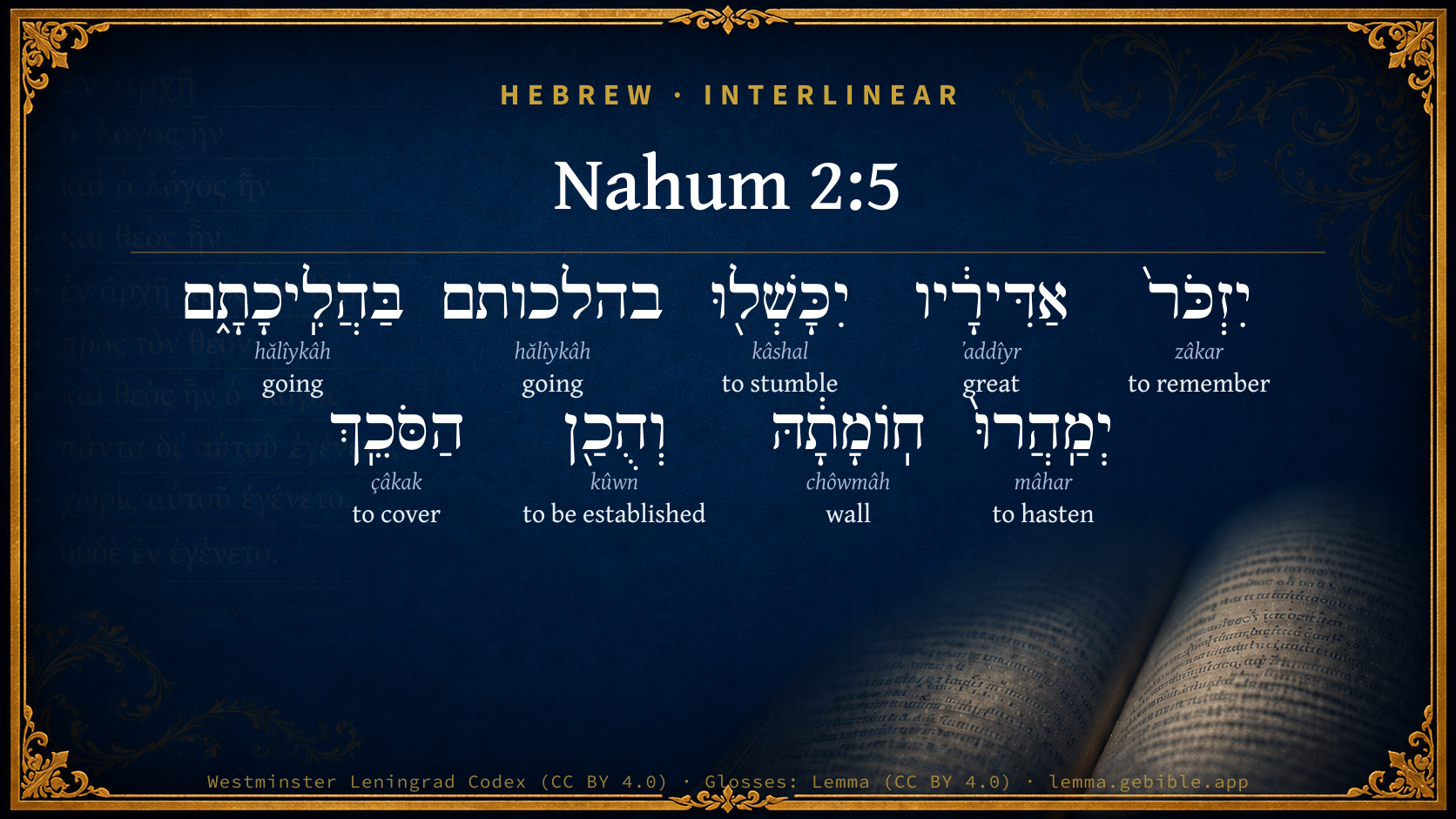
Hebrew (Westminster Leningrad Codex) Nahum 2:5 appears in the Hebrew Old Testament. The text above is from the Westminster Leningrad Codex. Each word links to its Strong’s number, a concise gloss, and parsing drawn from the Open Scriptures Hebrew Bible morphology. Click any word for its full Brown-Driver-Briggs (BDB) entry.
Download image
Cite this verse

Nahum 2:5 (World English Bible). Public Domain. Lemma interlinear Bible study tool, https://lemma.gebible.app/v/nahum/2/5.

Show BibTeX & RIS
BibTeX
RIS
English Translation
He summons his picked troops. They stumble on their way. They dash to its wall, and the protective shield is put in place.
World English Bible · Public Domain
Download a study sheet

One document with this verse’s original text, its word-by-word gloss line, the meaning frame, cross-references with their text, attributed commentary, and full source and license credits — printable, and it pastes into notes with its structure intact.

This verse Autodidact and up

Study sheet (.html) Plain text (.txt)

A passage Seminary Student

Up to 50 verses in one chapter. A passage sheet keeps up to 6 commentary sources and 12 cross-references per verse, in the order this page ranks them, and says so on the sheet whenever that leaves anything out. Ask for a single verse and you get the Autodidact verse sheet above.

Everything on this page stays free to read, with no account — the sheet is a download of what is already on screen, not access to it.

Want to remove ads? Support Godless Engineer
Compare translations 3

The same verse in 3 English versions, stacked beneath the original-language interlinear above. Click any original word for its lexicon entry.

Each is an independent rendering of the whole verse — the interlinear is not word-aligned to these translations.

Highlighted words mark where these versions differ — a whole-verse word diff, not a word-by-word alignment.

  • World English Bible Public Domain
    He summons his picked troops. They stumble on their way. They dash to its wall, and the protective shield is put in place.
  • King James Version Public Domain
    He shall recount his worthies: they shall stumble in their walk; they shall make haste to the wall thereof, and the defence shall be prepared.
  • unfoldingWord Literal Text CC BY-SA 4.0
    He calls his officers; they stumble in their advance; they hurry to her city wall. The siege-shelter is prepared.

unfoldingWord Literal Text — © unfoldingWord, licensed CC BY-SA 4.0. Word-aligned USFM3 via Door43 (git.door43.org/unfoldingWord/en_ult).

Versions to compare (up to 4)

3 of 4 selected

Show all 18 translations

Every available English version of this verse, each an independent rendering of the whole verse.

  • World English Bible Public Domain
    He summons his picked troops. They stumble on their way. They dash to its wall, and the protective shield is put in place.
  • Berean Standard Bible Public Domain
    He summons his nobles; they stumble as they advance. They race to its wall; the protective shield is set in place.
  • Majority Standard Bible Public Domain
    He summons his nobles; they stumble as they advance. They race to its wall; the protective shield is set in place.
  • King James Version Public Domain
    He shall recount his worthies: they shall stumble in their walk; they shall make haste to the wall thereof, and the defence shall be prepared.
  • American Standard Version (1901) Public Domain
    He remembereth his nobles: they stumble in their march; they make haste to the wall thereof, and the mantelet is prepared.
  • Revised Version (1885) Public Domain
    He remembereth his worthies: they stumble in their march; they make haste to the wall thereof, and the mantelet is prepared.
  • Geneva Bible (1599) Public Domain
    He shall remember his strong men: they shall stumble as they goe: they shall make haste to the walles thereof, and the defence shall bee prepared.
  • Douay-Rheims (1899) Public Domain
    He will muster up his valiant men, they shall stumble in their march: they shall quickly get upon the walls thereof: and a covering shall be prepared.
  • Young's Literal Translation Public Domain
    He doth remember his honourable ones, They stumble in their goings, They hasten `to' its wall, and prepared is the covering.
  • Literal Standard Version CC BY-SA 4.0
    He remembers his majestic ones, || They stumble in their goings, || They hurry [to] its wall, || And the covering is prepared.
  • Unlocked Literal Bible CC BY-SA 4.0
    The one who will dash you to pieces calls his officers; they stumble over each other in their march; they hurry to attack the city wall. The large shield is made ready to protect these attackers.
  • unfoldingWord Literal Text CC BY-SA 4.0
    He calls his officers; they stumble in their advance; they hurry to her city wall. The siege-shelter is prepared.
  • Darby Bible Public Domain
    He bethinketh him of his nobles: they stumble in their march; they make haste to the wall thereof, and the shelter is prepared.
  • World Messianic Bible Public Domain
    He summons his picked troops. They stumble on their way. They dash to its wall, and the protective shield is put in place.
  • Webster's Bible Public Domain
    \\2:4\\The chariots shall rage in the streets, they shall jostle one against another in the broad ways: they shall seem like torches, they shall run like the lightnings.
  • Free Bible Version CC BY-SA 4.0
    He shouts orders to his officers. They stumble as they rush to attack the wall. The battering ram is set up.
  • Bible in Basic English Public Domain
    The war-carriages are rushing through the streets, pushing against one another in the wide ways, looking like burning lights, running like thunder-flames.
  • JPS Tanakh (1917) Public Domain
    (2-6) He bethinketh himself of his worthies; they stumble in their march; they make haste to the wall thereof, and the mantelet is prepared.

Literal Standard Version (2020), Covenant Press — licensed CC BY-SA 4.0. Text via the HelloAO Bible API (eBible.org). Unlocked Literal Bible (unfoldingWord) — licensed CC BY-SA 4.0. Text via the HelloAO Bible API (eBible.org). unfoldingWord Literal Text — © unfoldingWord, licensed CC BY-SA 4.0. Word-aligned USFM3 via Door43 (git.door43.org/unfoldingWord/en_ult). Free Bible Version, Dr. Jonathan Gallagher — licensed CC BY-SA 4.0. Text via the HelloAO Bible API (eBible.org).

Word by word

More ways to search: Search by grammar → Find every occurrence → Compare this word →

Practice this passage: Drill this verse → Learn its vocabulary →

בהלכותם
hălîykâh
H1979
“in/at · goings · their”
Preposition + Noun, Common, Feminine, Plural, Construct + Suffix, Personal, 3rd Person, Masculine, Plural
Part of Speech
Preposition + Noun
Type
Common
Gender
Feminine
Number
Plural
State
Construct
Full BDB Definition

Origin: from H1978

TWOT: 498c

going, doing, travelling company, way - going, walk, marching, doings - travelling company, caravan
  1. יִזְכֹּר֙ zâkar H2142 “to remember” Verb, Qal, Imperfect, 3rd Person, Masculine, Singular
  2. אַדִּירָ֔יו ʼaddîyr H117 “great · his” Adjective, Adjective, Masculine, Plural, Construct + Suffix, Personal, 3rd Person, Masculine, Singular
  3. יִכָּשְׁל֖וּ kâshal H3782 “to stumble” Verb, Niphal, Imperfect, 3rd Person, Masculine, Plural
  4. בַּהֲלִֽיכָתָ֑ם hălîykâh H1979 “in/at · going · their” Preposition + Noun, Common, Feminine, Singular, Construct + Suffix, Personal, 3rd Person, Masculine, Plural
  5. יְמַֽהֲרוּ֙ mâhar H4116 “to hasten” Verb, Piel, Imperfect, 3rd Person, Masculine, Plural
  6. חֽוֹמָתָ֔הּ chôwmâh H2346 “wall · her” Noun, Common, Feminine, Singular, Construct + Suffix, Personal, 3rd Person, Feminine, Singular
  7. וְהֻכַ֖ן kûwn H3559 “and · to be established” Conjunction + Verb, Hophal, Perfect, 3rd Person, Masculine, Singular
  8. הַסֹּכֵֽךְ çâkak H5526 “the · covering” Particle, Definite Article + Noun, Common, Masculine, Singular, Absolute

About this verse

These counts appear in no published source. They are computed here, from the morphology-tagged text and Lemma’s own curated glosses. What Lemma adds →

9
words
8
distinct lemmas
Prophets
section

Notable vocabulary

The rarest word here is בהלכותם going H1979 — appearing just 7 times in the whole Hebrew Bible.

Shared distinctive vocabulary

בהלכותם going H1979 occurs in 5 verses of the Hebrew Bible. Also found in:

Grammatical profile

  • 4 verbs
  • 4 nouns
  • 1 adjective

Verb forms

  • יִזְכֹּר֙ Qal · Imperfect
  • יִכָּשְׁל֖וּ Niphal · Imperfect
  • יְמַֽהֲרוּ֙ Piel · Imperfect
  • וְהֻכַ֖ן Hophal · Perfect

Repetition

A word recurs within this verse — often emphatic in Hebrew:

  • בהלכותם going H1979 ×2

Hebrew & Septuagint length

In English translation the verse runs 23 words from the Hebrew and 31 from the Septuagint (LXX English) — closely comparable.

A rough comparison of the two English renderings, which tokenize alike — not a word-level alignment.

Word counts can differ between the Hebrew and the Greek without any difference in meaning — e.g. the Hebrew direct-object marker אֵת has no separate Greek word, and Greek often adds the article ὁ.

Cross-references

7

Topical passages linked to Nahum 2:5 in the Treasury of Scripture Knowledge — connected by theme and wording, ordered by reader-vote popularity; previews shown in the World English Bible.

  • Jeremiah 46:12 The nations have heard of your shame, and the earth is full of your cry; for the mighty man has stumbled against the mighty, they are fallen both of them together.
  • Isaiah 5:27 None shall be weary nor stumble among them; None shall slumber nor sleep; Neither shall the belt of their loins be untied, Nor the latchet of their shoes be broken:
  • Isaiah 21:5 They prepare the table, they set the watch, they eat, they drink: rise up, you princes, anoint the shield.
  • Jeremiah 50:29 Call together the archers against Babylon, all those who bend the bow; encamp against her round about; let none of it escape: recompense her according to her work; according to all that she has done, do to her; for she has been proud against Yahweh, against the Holy One of Israel.
  • Jeremiah 51:27–28 Set up a standard in the land, blow the trumpet among the nations, prepare the nations against her, call together against her the kingdoms of Ararat, Minni, and Ashkenaz: appoint a marshal against her; cause the horses to come up as the rough canker-worm.
  • Nahum 3:3 the horseman mounting, and the flashing sword, the glittering spear, and a multitude of slain, and a great heap of corpses, and there is no end of the bodies. They stumble on their bodies,
  • Nahum 3:18 Your shepherds slumber, king of Assyria. Your nobles lie down. Your people are scattered on the mountains, and there is no one to gather them.

Cross-references courtesy of OpenBible.info (CC BY 4.0).

Hebrew and Greek witnesses Masoretic Hebrew ↔ Greek Septuagint

The same verse in the two great witnesses to the Old Testament, shown verse-for-verse.

These are two independent witnesses, not word-aligned to each other, and the Septuagint is shown in lemma (dictionary) form.

Hebrew Nahum 2:5 Masoretic · Westminster Leningrad Codex

יִזְכֹּר֙ אַדִּירָ֔יו יִכָּשְׁל֖וּ בהלכותם בַּהֲלִֽיכָתָ֑ם יְמַֽהֲרוּ֙ חֽוֹמָתָ֔הּ וְהֻכַ֖ן הַסֹּכֵֽךְ

He summons his picked troops. They stumble on their way. They dash to its wall, and the protective shield is put in place.

World English Bible · Public Domain

Greek LXX Nahum 2:5 Septuagint · lemma form

ἐν ὁ ὁδός καί συνχέω ὁ ἅρμα καί συνπλέκω ἐν ὁ πλατύς ὁ ὅρασις αὐτός ὡς λαμπάς πῦρ καί ὡς ἀστραπή διατρέχω

And their mighty men shall bethink themselves and flee by day; and they shall be weak as they go; and they shall hasten to her walls, and shall prepare their defences.

LXX2012 (modern English Septuagint) · Public Domain

On this verse, Keil & Delitzsch discusses the Septuagint’s reading. Read the note in Commentary ↓

Hebrew: Westminster Leningrad Codex (CC BY 4.0). Greek: Septuagint (public domain); English from LXX2012 (modern English Septuagint) (Public Domain). How the Septuagint differs from the Hebrew →

Targum (Aramaic paraphrase)

1

The Targum is the ancient Jewish Aramaic paraphrase of the Hebrew Scriptures — an interpretive translation, not the Hebrew text itself. Onkelos (literal) and Pseudo-Jonathan (expansive) render the Torah, and Jonathan the Prophets. Coverage is partial: where no permissively-licensed English translation exists for a verse, only the Aramaic is shown. This is verse-level text, not a word-by-word alignment to the Hebrew.

  1. Targum Jonathan Prophets (Joshua–Malachi)
    בְּשׁוּקַיָא מִשְׁתַּגְשְׁגִין רְתִיכַיָא קַל נִקוּשׁ זְיָנֵיהוֹן מִשְׁתְּמַע בִּרְחוֹבֵי קִרְוַיָא חֶזְוֵיהוֹן כִּבְעוּרִין כִּבְרָקִין טְרִידִין:

    (no public-domain English translation for this verse)

    Targum Jonathan — Aramaic: “Mikraot Gedolot” (public domain). English: “Sefaria Community Translation” (CC0 1.0 (public-domain dedication)); “London "Chaldee Paraphrase," 1871” (public domain). Text via Sefaria.

Commentary

Notes on Nahum 2:5 from classic Christian and Jewish commentators (each source and its license shown beneath its notes). The classic Christian expositions comment on the surrounding passage and are grouped to its opening verse, so a note may address several verses; the Jewish commentaries on the Tanakh (Rashi and others) are per-verse, so they appear only where the commentator wrote on this verse.

Lemma curates 59 commentaries, every one of them public domain or Creative Commons licensed, each selected and text-cleaned for this edition rather than reprinted as found. About our sources →

The Cambridge Bible for Schools and Colleges

gen. ed. J. J. S. Perowne

5. It is not easy to say whether this verse refers to the besiegers or the besieged. As Nah_2:3 referred to the preparation, and Nah_2:4 to conflicts before the walls, Nah_2:5 might naturally as the next step describe the assault on the wall by the besiegers. The siege actually lasted two years, but the prophet condenses the whole into a few brilliant successive scenes. The term rendered “worthies” is translated “nobles,” Ch. Nah_3:18, marg. valiant men, viz. those of the king of Assyria. If the meaning were the same here reference would be to the measures of defence taken by the Assyrian king. The expression “they hasten to the wall” might also seem more natural if the defenders were referred to; and the other expression “they stumble in their walk” (or march) is more likely to be said of worn-out defenders than of an eager enemy in the act of delivering an assault. The phrase could hardly describe the pellmell rush of a storming party towards the wall.

recount his worthies] He bethinketh himself of his worthies, or valiant men.

shall stumble in their walk] they stumble in their steps. Their stumbling might be due to the suddenness of their call and weariness from the harassing fatigues of the defence. There is no necessity for supposing that the defenders were sunk in sloth and effeminate from debauchery.

the defence shall be prepared] is prepared. The term “defence” (sokek), lit. coverer, is obscure in two ways: (1) it is uncertain whether it be a thing or a body of men, an engine or a party of troops, called the coverer, as another similar word is the ambush, i.e. the party forming an ambuscade: and (2) it is uncertain whether it belongs to the besiegers or the besieged. If the rest of the verse described the defenders this clause would also most naturally be said of them. In this case it would be either some apparatus of defence against the assault of the enemy or a body of men placed in some position to beat back the storming party. City walls were usually provided with turrets or battlements projecting forward over the walls, from which the besieged could observe the movements of the enemy at the foot, and hurl destructive missiles upon them. A party placed in such a position might be intended. (Figures, Billerb.-Jerem., p. 160.) On the other hand, if the sokek belonged to the besiegers it would probably be some engine for battering the walls, The construction is less natural: they hasten to the wall, but the sokek has been prepared—they find the engines in position and at work. There was great variety of battering machines. Besides the usual ram, a beam with an iron head, suspended by chains and swung against the wall, there were engines run on wheels and generally provided with two wall-breachers armed with lance-shaped heads. These rams were not generally swung horizontally but sloping upwards so as to operate on the foundations of the projecting towers, and bring them down. (Figures in Billerb.-Jerem., p. 180 seq.; Layard, II. 367 seq.) These wheeled breaching engines were of course roofed to protect those who worked the rams. Such an engine has some resemblance to the vinea or mantlet (so R.V. here); the testudo or roof of shields does not seem to have been used in eastern warfare. Moveable towers which put the assailants on a level with the defenders on the wall were also employed, Layard, II. 368 sq.

The Cambridge Bible for Schools and Colleges (gen. ed. J. J. S. Perowne; Cambridge University Press, 1878–1918) — public domain. Text from a community e-Sword module.

Trapp's Complete Commentary

John Trapp

Nah 2:5 He shall recount his worthies: they shall stumble in their walk; they shall make haste to the wall thereof, and the defence shall be prepared.

Ver. 5. He shall recount his worthies] Or gallants, magnificoes. These Esarhaddon, the King of Nineveh, seeing himself straitened, shall muster up, and mind of their duties; bidding them now or never play the men, since the empire was at stake.

They shall stumble in their walk] Through fearfulness and faint heartedness; according to that of the Psalmist, "The stouthearted are spoiled, they have slept their sleep: and none of the men of might have found their hands. At thy rebuke, O God of Jacob, both the chariot and horse are cast into a dead sleep," Psa 76:5-6. God struck a terror into the Ninevites upon the first coming of the Chaldees. See Deu 11:25. Therefore there is no great credit to be given to Diodorus Siculus (cap. 7, lib. 3), who saith, that the Chaldees were thrice overcome in battle by the Assyrians, when as they came in arms to besiege Nineveh.

They shall make haste to the wall thereof] The Chaldees shall; taking advantage of the Ninevites’ fear, that cowardly passion, that disarmeth and disableth a man for his own defence: or, the Assyrians shall hasten to the wall as fast as their fainting and failing legs will carry them; to try what they can do to keep out the enemy. So the Emperor of Constantinople, certainly advertised the Turks’ purpose for the general assault shortly to be given, after that he had many times with tears requested to have borrowed money of his covetous subjects, to have been employed for defence of their city; he first commended himself and them to the Almighty by general fasting and prayer; and afterwards appointed every captain and commander to some certain place of the wall, for defence thereof, &c., but all in vain, as here at Nineveh.

And the defence shall be prepared] Heb. the covering or coverer, Testudo militaris. Some military engine or moveable defence.

John Trapp, A Commentary or Exposition upon All the Books of the Old and New Testament (1647–1656) — public domain. Text from a community e-Sword module.

Albert Barnes' Notes on the Bible

He shall recount his worthies - The Assyrian king wakes as out of a sleep, literally, “he remembers his mighty men” (as Nah 3:18; Jdg 5:13; Neh 3:5); “they stumble in their walk,” literally, paths , not through haste only and eager fear, but from want of inward might and the aid of God. These whom God leads stumble not Isa 63:13. : “Perplexed every way and not knowing what they ought to do, their mind wholly darkened and almost drunken with ills, they reel to and fro, turn from one thing to another, and in all” labor in vain.

They shall make haste to the walls thereof, and the defense - (literally, “the covering”) shall be prepared The Assyrian monuments leave no doubt that a Jewish writer is right in the main, in describing this as a covered shelter, under which an enemy approached the city; “a covering of planks with skins upon them; under it those who fight against the city come to the wall and mine the wall underneath, and it is a shield over them from the stones, which are cast from off the wall.”

The monuments, however, exhibit this shelter, as connected not with mining but with a battering ram, mostly with a sharp point, by which they loosened the walls . Another covert was employed to protect single miners who picked out single stones with a pick-axe . The Assyrians sculptures show, in the means employed against or in defense of their engines, how central a part of the siege they formed . Seven of them are represented in one siege . The “ram” Eze 4:2 is mentioned in Ezekiel as the well-known and ordinary instrument of a siege.

Thus, Nah 2:3 describes the attack; and Nah 2:4 describes the defense; the two first clauses of Nah 2:5 describes the defense; the two last describe clauses the attack. This quick interchange only makes the whole account more vivid.

: “But what avails it to build the house, unless the Lord build it? What helps it to shut the gates, which the Lord unbarreth?” On both sides is put forth the full strength of man; there seems a stand-still to see, what will be, and God brings to pass His own work in His own way.

Albert Barnes' Notes on the Bible (1834–1885) — public domain. Text from a community e-Sword/MySword module.

Joseph Benson's Commentary

Nah 2:5-6. He — The enemy that attacks Nineveh, namely, the king of Babylon; shall recount his worthies — Shall select some of his choicest troops for the siege of it. They shall stumble in their walk — They shall show such forwardness, and be so eager to begin the attack of the city and mount the walls, that they shall stumble and throw one another down in their haste. The defence shall be prepared — Hebrew, הסכךְ, the covering. So the Vulgate, preparabitur umbraculum: “Testudo qua tecti subruant mœnia.” — Grotius. “The testudo, or fence, with which being covered, they might undermine and throw down the walls.” The gates of the river shall be open — See note on Nah 1:8. The palace shall be dissolved — Or, molten; shall be consumed with fire.

Joseph Benson's Commentary on the Old and New Testaments (1811–1818) — public domain. Text from a community e-Sword module.

Keil & Delitzsch

C. F. Keil & F. Delitzsch

The Assyrian tries to repel this attack, but all in vain. Nah 2:5. "He remembers his glorious ones: they stumble in their paths; they hasten to the wall of it, and the tortoise is set up. Nah 2:6. The gates are opened in the rivers, and the palace is dissolved. Nah 2:7. It is determined: she is laid bare, carried off, and her maids groan like the cry of doves, smiting on their breasts." On the approach of the war-chariots of the enemy to the attack, the Assyrian remembers his generals and warriors, who may possibly be able to defend the city and drive back the foe. That the subject changes with yizkōr, is evident from the change in the number, i.e., from the singular as compared with the plurals in Nah 2:3 and Nah 2:4, and is placed beyond the reach of doubt by the contents of Nah 2:5., which show that the reference is to the attempt to defend the city. The subject to yizkōr is the Assyrian (בּליּעל, Nah 2:1), or the king of Asshur (Nah 3:18). He remembers his glorious ones, i.e., remembers that he has 'addı̄rı̄m, i.e., not merely generals (μεγιστᾶνες, lxx), but good soldiers, including the generals (as in Nah 3:18; Jdg 5:13; Neh 3:5). He sends for them, but they stumble in their paths. From terror at the violent assault of the foe, their knees lose their tension (the plural hălı̄khōth is not to be corrected into the singular according to the keri, as the word always occurs in the plural). They hasten to the wall of it (Nineveh); there is הסּכך set up: i.e., literally the covering one, not the defender, praesidium militare (Hitzig), but the tortoise, testudo.

(Note: Not, however, the tortoise formed by the shields of the soldiers, held close together above their heads (Liv. xxxiv. 9), since these are never found upon the Assyrian monuments (vid., Layard), but a kind of battering-ram, of which there are several different kinds, either a moveable tower, with a battering-ram, consisting of a light framework, covered with basket-work, or else a framework without any tower, either with an ornamented covering, or simply covered with skins, and moving upon four or six wheels. See the description, with illustrations, in Layard's Nineveh, ii. pp. 366-370, and Strauss's commentary on this passage.)

The prophet's description passes rapidly from the assault upon the city wall to the capture of the city itself (Nah 2:6). The opened or opening gates of the rivers are neither those approaches to the city which were situated on the bank of the Tigris, and were opened by the overflowing of the river, in support of which appeal has been made to the statement of Diodor. Sic. ii. 27, that the city wall was destroyed for the space of twenty stadia by the overflowing of the Tigris; for "gates of the rivers" cannot possibly stand for gates opened by rivers. Still less can it be those roads of the city which led to the gates, and which were flooded with people instead of water (Hitzig), or with enemies, who were pressing from the gates into the city like overflowing rivers (Ros.); nor even gates through which rivers flow, i.e., sluices, namely those of the concentric canals issuing from the Tigris, with which the palace could be laid under water (Vatabl., Burck, Hitzig, ed. 1); but as Luther renders it, "gates on the waters," i.e., situated on the rivers, or gates in the city wall, which were protected by the rivers; "gates most strongly fortified, both by nature and art" (Tuch, de Nino urbe, p. 67, Strauss, and others), for nehârōth must be understood as signifying the Tigris and its tributaries and canals. At any rate, there were such gates in Nineveh, since the city, which stood at the junction of the Khosr with the Tigris, in the slope of the (by no means steep) rocky bank, was to some extent so built in the alluvium, that the natural course of the Khosr had to be dammed off from the plain chosen for the city by three stone dams, remnants of which are still to be seen; and a canal was cut above this point, which conducted the water to the plain of the city, where it was turned both right and left into the city moats, but had a waste channel through the city. To the south, however, another small collection of waters helped to fill the trenches. "The wall on the side towards the river consisted of a slightly curved line, which connected together the mouths of the trenches, but on the land side it was built at a short distance from the trenches. The wall on the river side now borders upon meadows, which are only flooded at high water; but the soil has probably been greatly elevated, and at the time when the city was built this was certainly river" (see M. v. Niebuhr, Geschichte Assurs u. Babels, p. 280; and the outlines of the plan of the ground oh which Nineveh stood, p. 284). The words of the prophet are not to be understood as referring to any particular gate, say the western, either alone, or par excellence, as Tuch supposes, but apply quite generally to the gates of the city, since the rivers are only mentioned for the purpose of indicating the strength of the gates. As Luther has correctly explained it, "the gates of the rivers, however firm in other respects, and with no easy access, will now be easily occupied, yea, have been already opened." The palace melts away, not, however, from the floods of water which flow through the open gates. This literal rendering of the words is irreconcilable with the situation of the palaces in Nineveh, since they were built in the form of terraces upon the tops of hills, either natural or artificial, and could not be flooded with water. The words are figurative. mūg, to melt, dissolve, i.e., to vanish through anxiety and alarm; and היכל, the palace, for the inhabitants of the palace. "When the gates, protected by the rivers, are broken open by the enemy, the palace, i.e., the reigning Nineveh, vanishes in terror" (Hitzig). For her sway has now come to an end.

הצּב: the hophal of נצב, in the hiphil, to establish, to determine (Deu 32:8; Psa 74:17; and Chald. Dan 2:45; Dan 6:13); hence it is established, i.e., is determined, sc. by God: she will be made bare; i.e., Nineveh, the queen, or mistress of the nations, will be covered with shame. גּלּתה is not to be taken as interchangeable with the hophal הגלה, to be carried away, but means to be uncovered, after the piel to uncover, sc. the shame or nakedness (Nah 3:5; cf. Isa 47:2-3; Hos 2:12). העלה, for העלה (see Ges. 63, Anm. 4), to be driven away, or led away, like the niph. in Jer 37:11; Sa2 2:27.

(Note: Of the different explanations that have been given of this hemistich, the supposition, which dates back as far as the Chaldee, that huzzab signifies the queen, or is the name of the queen (Ewald and Rckert), is destitute of any tenable foundation, and is no better than Hitzig's fancy, that we should read והצּב, "and the lizard is discovered, fetched up," and that this "reptile" is Nineveh. The objection offered to our explanation, viz., that it would only be admissible if it were immediately followed by the decretum divinum in its full extent, and not merely by one portion of it, rests upon a misinterpretation of the following words, which do not contain merely a portion of the purpose of God.)

The laying bare and carrying away denote the complete destruction of Nineveh. אמהתיה, ancillae ejus, i.e., Nini. The "maids" of the city of Nineveh personified as a queen are not the states subject to her rule (Theodor., Cyr., Jerome, and others), - for throughout this chapter Nineveh is spoken of simply as the capital of the Assyrian empire, - but the inhabitants of Nineveh, who are represented as maids, mourning over the fate of their mistress. Nâhag, to pant, to sigh, for which hâgâh is used in other passages where the cooing of doves is referred to (cf. Isa 38:14; Isa 59:11). כּקול יונים instead of כּיּונים, probably to express the loudness of the moaning. Tophēph, to smite, used for the smiting of the timbrels in Psa 68:26; here, to smite upon the breast. Compare pectus pugnis caedere, or palmis infestis tundere (e.g., Juv. xiii. 167; Virg. Aen. i. 481, and other passages), as an expression of violent agony in deep mourning (cf. Luk 18:13; Luk 23:27). לבבהן for לבביהן is the plural, although this is generally written לבּות; and as the י is frequently omitted as a sign of the plural (cf. Ewald, 258, a), there is no good ground for reading לבבהן, as Hitzig proposes.

Keil & Delitzsch — Biblical Commentary on the Old Testament (1861–1891) — public domain (CC PDM 1.0). Text via the HelloAO Bible API. (Old Testament only.)

Tyndale Open Study Notes

Tyndale Open Resources

2:5 The Assyrian king overcomes the initial shock of Nineveh’s being attacked and shouts to his officers. He and the city have been caught off guard and they rush to the walls to thwart the siege. • to set up their defenses (literally the covering is prepared): The meaning of the Hebrew term here is uncertain. Covering probably refers to something the attackers or the defenders used to protect themselves from armaments hurled through the air.

Tyndale Open Study Notes — © Tyndale Open Resources, licensed CC BY-SA 4.0. Text via the HelloAO Bible API.

Geneva Bible (1599)

Geneva Bible translators

Then the Assyrians shall seek by all means to gather their power, but all things shall fail them.

Geneva Bible (1599) marginal notes — public domain. Text via Bolls.life.

Jamieson, Fausset & Brown

Robert Jamieson, A. R. Fausset & David Brown

The Assyrian king. The Assyrian preparations for defense.

shall recount his worthies-- (Nah 3:18). Review, or count over in his mind, his nobles, choosing out the bravest to hasten to the walls and repel the attack. But in vain; for

they shall stumble in their walk--"they shall stumble in their advance" through fear and hurry.

the defence shall be prepared--rather, the covering machine used by besiegers to protect themselves in advancing to the wall. Such sudden transitions, as here from the besieged to the besiegers, are frequent (compare Eze 4:2), [MAURER]. Or, used by the besieged Assyrians [CALVIN].

Jamieson, Fausset & Brown — Commentary Critical and Explanatory on the Whole Bible (1871) — public domain (CC PDM 1.0). Text via the HelloAO Bible API.

Adam Clarke's Commentary

Verse 5. He shall recount his worthies] Muster up his most renowned warriors and heroes.

Shall make haste to the wall] Where they see the enemies making their most powerful attacks, in order to get possession of the city.

Adam Clarke's Commentary on the Bible (1810–1826) — public domain. Text from a community e-Sword/MySword module.

John Calvin's Commentaries

Some interpreters explain this also of the Chaldeans: The king of Babylon then shall remember his mighty men; that is, shall recount his forces and whatever strength he will have under his power; all this he will collect to make war with Nineveh and the Assyrians. Others think that there is here a transposition in the words, (which is too strained,) “Mighty men shall remember,” as though it were a change of number. But I take the words of the Prophet simply as they are, — that he will remember mighty men: but this, as I think, refers to the Assyrians. He then, that is, either the king of Nineveh, or the people, will remember the mighty men; that is, he will gather from every quarter his forces and will omit nothing which may avail for defense; as it is usually done in great danger and in extremities: for they were noted then as warlike men; and every one who had any skill, every one who was endued with courage, every one who was trained up in arms, all these were mustered, that they might give help. So then the Prophet says, that such would be the dread in the land of Assyria, that they would collect together whatever force they had, to defend themselves against their enemies. The king then shall remember his mighty men, that is, he will muster all the subsidies within his reach.

Then he says, They shall stumble in their march; that is, the mighty men, when gathered, shall tremble and stumble like the blind: and this will be occasioned by fear; so that like men astounded, they will move to and fro, and have no certain footing. The Prophet then declares here two things, that the Assyrians would be diligent in gathering forces to repel the assault of their enemies, — but that yet they would effect nothing, for trembling would seize the minds of all, so that mighty men would stumble in their marches. They shall stumble, and then it is said, they shall hasten to its wall, that is, they shall ascend the wall; and it is added, Prepared shall be the covering, as it is usual in defending cities. Some apply this to the Chaldeans; prepared shall be the covering, that is, when they shall come to the wall. It was indeed usual, as it is well known from histories, for those who approached a wall to defend themselves either with turrets or hurdles. But the Prophet, I doubt not, intimates, that the Assyrians would come with great trembling to meet their enemies, but without any success. However then they might defend themselves, their enemies would yet prevail. He therefore subjoins —

John Calvin's Commentaries (1540-1563) — public domain. Text from the Calvin Translation Society English edition (1840s-50s) via the Christian Classics Ethereal Library (ccel.org). Calvin's coverage is partial (roughly two-thirds of the Bible); uncommented books and verses are honest gaps, never fabricated. The 19th-century editor's footnotes and remarks are omitted so the notes are faithfully Calvin's own voice.

Ellicott's Commentary for English Readers

(5) And the defence shall be prepared.—Better, but [there] the storming-shed has been prepared. Here the surprise and disorder of Nineveh is more plainly portrayed. The Assyrian king bethinks him of his stoutest warriors, but they stumble in their paths in nervous perplexity. Men ran to the city wall, but against it the besiegers have already erected their storming-shed—a proceeding which ought to have been prevented by the discharge of stones and other missiles from the walls. The storming-shed protected the battering-rams. Of the representations of these preserved in the monuments of Nineveh, Professor Rawlinson thus writes: “All of them were covered with a framework, which was of osier wood, felt, or skins, for the better protection of those who worked the implement. . . . Some appear to have been stationary, others provided with wheels. . . . Again, sometimes combined with the ram and its framework was a movable tower containing soldiers, who at once fought the enemy on a level, and protected the engine from their attacks (Ancient Monarchies, i. 470).

A Bible Commentary for English Readers, edited by Charles John Ellicott (1878–1897) — public domain. Text from a community e-Sword module.

John Gill's Exposition

He shall recount his worthies,.... Either the dasher in pieces, Nah 2:1, the kings of Babylon and Media, shall call together their general officers, and muster the forces under then, and put them in mind of their duty, and recount the actions of their ancestors in former times, in order to animate and encourage them to the siege and attack of the city of Nineveh; or the king of Assyria shall recount and muster up his nobles, and the troops under them, to sally out against the enemy, and meet him in the field, and give him battle:

they shall stumble in their walk: being many, and in haste to obey the orders of their commander, shall stumble and fall upon one another; or else the Ninevites in their march out against the enemy shall be discomfited and flee before him, or be dispirited and flee back again:

they shall make haste to the wall thereof; of Nineveh; that is, the Medes and Chaldeans shall make haste thither, to break it down or scale it; or the Ninevites, failing in their sally out, shall betake themselves in all haste to their city walls, and defend themselves under the protection of them:

and the defence shall be prepared; or the "covering": the word (h) used has the signification of a booth or tent, to cover and protect; here it signifies something that was prepared, either by the besiegers, to cover them from the darts and stones of the besieged, as they made their approaches to the walls; or which the besieged covered themselves with from the assaults of the besiegers; rather the former.

(h) "operimentum", Pagninus, Montanus; "integumentum", Calvin; "testudo", Vatablus, Grotius, Cocceius, Burkius.

John Gill's Exposition of the Whole Bible (1746–1763) — public domain (CC PDM 1.0). Text via the HelloAO Bible API.

Haydock's Catholic Bible Commentary

Muster. Literally, " remember" (Haydock) the ancient heroes, Salmanasar, &c. (Calmet) --- Stumble, by running hastily on. (Challoner) --- Prepared to defend the city. (Haydock) --- All this represents a city surprised. It attempts to defend itself; but God renders all efforts vain. (Calmet)

George Leo Haydock (1774–1849), Haydock's Catholic Family Bible and Commentary, 1859 edition — public domain. Excludes Psalms (Douay-Rheims chapter numbering differs from Protestant) and Deuterocanonical books (Catholic canon only).

Matthew Poole's English Annotations

This verse may indifferently refer either to Nineveh and its king making their defence, or to the Chaldeans and their king maintaining the siege; both act with rigour and diligence. Recount; muster, and give orders.

Worthies; approved officers and commanders.

They shall stumble; show such forwardness, make such haste, that they shall not stand to pick their way; and there shall be so many, that they shall stumble for want of room.

They shall make haste to the wall; the Assyrians to defend, the Chaldeans to assault, the walls of Nineveh.

The defence; what might defend the besieged, and what might defend the besiegers; all shall be ready on both sides, and what men can do, both will do.

Matthew Poole's English Annotations on the Holy Bible (1683–1685) — public domain. Text from a community e-Sword/MySword module.

The Pulpit Commentary

The prophet turns to the Ninevites and their preparations for defence. He shall recount his worthies; he remembers his nobles. The King of Nineveh calls to mind the mighty captains who have often led his armies to victory, and sends them to defend the walls. (comp. Nah_3:18) The LXX, anticipating the next clause, adds here, kai feuxontai hmerav , "and they shall flee by day." They shall stumble in their walk. In their fear and baste, or half drunken, they totter and stumble as they hasten to the walls of the city. The defence shall be prepared; literally, the covering is prepared. If this refers to the operations of the Ninevites, it means some kind of breastwork or fascine erected between the towers; but it most probably depicts the sight that meets their eyes from the wails. They see the besiegers bringing up their mantelets and towers. As used by the Assyrians, the machine called "the covering" is either a wooden tower or a wicker mantelet in which was suspended a battering ram. It stood on four or six wheels, and the larger sort had archers posted in the various stories, both to annoy the enemy and to defend the engine. The rams were provided with lance headed extremities, and must have rather picked at and loosened the courses of bricks of which the walls were composed than battered them down (see Bonomi, "Nineveh and its Palaces," pp. 160, 234, 243, etc. Layard, "Nineveh," ch. 5. p. 376, etc., figs. 57, 58). The Septuagint rendering applies rather to the besieged, Etoimasousi ta , "They shall prepare their defences."

The Pulpit Commentary (1880–1919), ed. H.D.M. Spence-Jones & Joseph S. Exell — public domain. Text from a community e-Sword module.

John Wesley's Explanatory Notes

He - The king of Babylon. His worthies - Approved officers and commanders. Stumble - Shew such forwardness, that they shall not stand to pick their way. They - The Assyrians to defend, the Chaldeans to assault the walls of Nineveh.

John Wesley, Explanatory Notes Upon the Whole Bible (1754–1765) — public domain. Text via the GEBible commentary corpus.

unfoldingWord translationNotes

Door43 World Missions Community

The one who will dash you to pieces

The word "you" refers to Nineveh. Nahum speaks of an army or military leader destroying Nineveh as if he were to shatter Nineveh like one would shatter a clay pot. See how you translated this in Nahum 2:1. AT: "The one who will destroy you" (See: Metaphor)

in their march

The word "march" can be translated as a verb. AT: "as they march" (See: Abstract Nouns)

The large shield is made ready to protect these attackers

This can be stated in active form. AT: "The attackers make ready the large shield to protect themselves" (See: Active or Passive)

The large shield

This refers to a large cover that those who besieged a city would set up over themselves and their battering rams to protect themselves against the arrows and other projectiles with which the people in the city would attack them.

translationWords

stumble

unfoldingWord translationNotes — © Distant Shores Media and the Door43 World Missions Community, licensed CC BY-SA 4.0. Source: git.door43.org/Door43/en_tn.

Rashi

Rabbi Shlomo Yitzchaki (Rashi)

shall dash about madly—They shall behave madly.

they shall clatter Heb. יִשְׁתַּקְשְׁקוּן. Jonathan renders: The sound of the clattering of their weapons is heard. And that is from the expression (Joel 2:24) “And the vats shall roar (וְהֵשִׁיקוּ),” and (Isa. 33:4) “Like the roaring (כְּמַשַק) of the cisterns.” It is an expression of making a sound heard.

they shatter—They shatter their listeners like these lightnings, which agitate the creatures. So did Jonathan render it.

Rashi on the Tanakh — English translations: “The Judaica Press complete Tanach with Rashi, translated by A. J. Rosenberg” (CC BY 4.0); “Pentateuch with Rashi's commentary by M. Rosenbaum and A.M. Silbermann, 1929-1934” (public domain); “The Metsudah Tanach series, Lakewood, N.J” (CC BY 4.0); and “The Book of Joshua, Metsudah Publications, 1997” (CC BY 4.0). Text via Sefaria.

Lesson kit

Teaching starters — assembled from the data on this page, not authored interpretation. Every prompt links to the verse data it draws on. Edit before teaching.

Nahum, in the Prophets, opens this verse with 9 words (8 distinct Hebrew lemmas). Its most distinctive word is hălîykâh (“going”). A historical commentator’s framing appears above. Read the whole chapter for the surrounding context.

Discussion questions

  1. How does “going” (hălîykâh) shape what this verse is saying?
  2. Job 6:19 shares the word «going» with this verse. How do the two illuminate each other?
  3. “going” occurs 2× in this one verse. What is the effect of the repetition?
  4. These translations render this verse differently; the difference is in the English rendering, not the original. What questions does that raise?
  5. The verb «יִזְכֹּר֙» is Qal Imperfect. How does its form color the action?
  6. Reading how The Cambridge Bible for Schools and Colleges and Trapp's Complete Commentary read this verse, where do the two commentators agree and where do they part?

Things to notice

Reading settings

Reading text

Shown beneath each verse's original-language words.

Old Testament
Old Testament edition

Read the OT as the Masoretic Hebrew (MT) or the Greek Septuagint (LXX).

English shown for the Greek Septuagint (in the Hebrew ↔ Greek comparison).

Comparing translations? Open the Compare panel on any verse page to stack up to four side by side.