
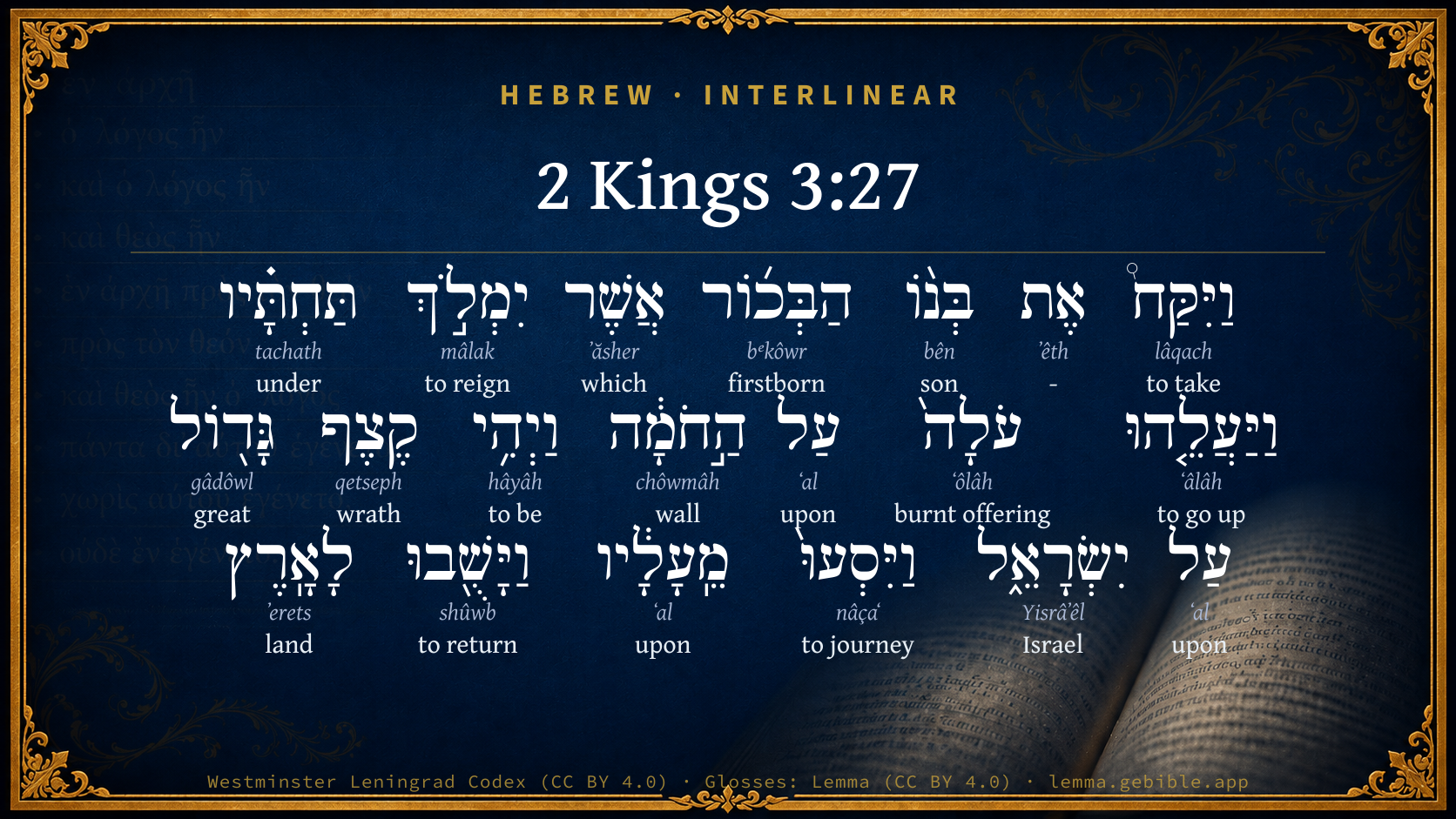
2 Kings 3:27

Hebrew (Westminster Leningrad Codex) 2 Kings 3:27 appears in the Hebrew Old Testament. The text above is from the Westminster Leningrad Codex. Each word links to its Strong’s number, a concise gloss, and parsing drawn from the Open Scriptures Hebrew Bible morphology. Click any word for its full Brown-Driver-Briggs (BDB) entry.
Download image
Cite this verse

2 Kings 3:27 (World English Bible). Public Domain. Lemma interlinear Bible study tool, https://lemma.gebible.app/v/2-kings/3/27.

Show BibTeX & RIS
BibTeX
RIS
English Translation
Then he took his eldest son who would have reigned in his place, and offered him for a burnt offering on the wall. There was great wrath against Israel: and they departed from him, and returned to their own land.
World English Bible · Public Domain
Download a study sheet

One document with this verse’s original text, its word-by-word gloss line, the meaning frame, cross-references with their text, attributed commentary, and full source and license credits — printable, and it pastes into notes with its structure intact.

This verse Autodidact and up

Study sheet (.html) Plain text (.txt)

A passage Seminary Student

Up to 50 verses in one chapter. A passage sheet keeps up to 6 commentary sources and 12 cross-references per verse, in the order this page ranks them, and says so on the sheet whenever that leaves anything out. Ask for a single verse and you get the Autodidact verse sheet above.

Everything on this page stays free to read, with no account — the sheet is a download of what is already on screen, not access to it.

Want to remove ads? Support Godless Engineer
Compare translations 3

The same verse in 3 English versions, stacked beneath the original-language interlinear above. Click any original word for its lexicon entry.

Each is an independent rendering of the whole verse — the interlinear is not word-aligned to these translations.

Highlighted words mark where these versions differ — a whole-verse word diff, not a word-by-word alignment.

  • World English Bible Public Domain
    Then he took his eldest son who would have reigned in his place, and offered him for a burnt offering on the wall. There was great wrath against Israel: and they departed from him, and returned to their own land.
  • King James Version Public Domain
    Then he took his eldest son that should have reigned in his stead, and offered him for a burnt offering upon the wall. And there was great indignation against Israel: and they departed from him, and returned to their own land.
  • unfoldingWord Literal Text CC BY-SA 4.0
    So he took his firstborn son, who would reign in his place, and he offered him a burnt offering on the wall. And great wrath was against Israel, and they departed from upon him, and they returned to the land.

unfoldingWord Literal Text — © unfoldingWord, licensed CC BY-SA 4.0. Word-aligned USFM3 via Door43 (git.door43.org/unfoldingWord/en_ult).

Versions to compare (up to 4)

3 of 4 selected

Show all 18 translations

Every available English version of this verse, each an independent rendering of the whole verse.

  • World English Bible Public Domain
    Then he took his eldest son who would have reigned in his place, and offered him for a burnt offering on the wall. There was great wrath against Israel: and they departed from him, and returned to their own land.
  • Berean Standard Bible Public Domain
    So he took his firstborn son, who was to succeed him, and offered him as a burnt offering on the city wall. And there was great fury against the Israelites, so they withdrew and returned to their own land.
  • Majority Standard Bible Public Domain
    So he took his firstborn son, who was to succeed him, and offered him as a burnt offering on the city wall. And there was great fury against the Israelites, so they withdrew and returned to their own land.
  • King James Version Public Domain
    Then he took his eldest son that should have reigned in his stead, and offered him for a burnt offering upon the wall. And there was great indignation against Israel: and they departed from him, and returned to their own land.
  • American Standard Version (1901) Public Domain
    Then he took his eldest son that should have reigned in his stead, and offered him for a burnt-offering upon the wall. And there was great wrath against Israel: and they departed from him, and returned to their own land.
  • Revised Version (1885) Public Domain
    Then he took his eldest son that should have reigned in his stead, and offered him for a burnt offering upon the wall. And there was great wrath against Israel: and they departed from him, and returned to their own land.
  • Geneva Bible (1599) Public Domain
    Then he tooke his eldest sonne, that should haue reigned in his stead, and offered him for a burnt offring vpon the wall: so that Israel was sore grieued, and they departed from him, and returned to their countrey.
  • Douay-Rheims (1899) Public Domain
    Then he took his eldest son that should have reigned in his stead, and offered him for a burnt offering upon the wall: and there was great indignation in Israel, and presently they departed from him, and returned into their own country.
  • Young's Literal Translation Public Domain
    and he taketh his son, the first-born who reigneth in his stead, and causeth him to ascend -- a burnt-offering on the wall, and there is great wrath against Israel, and they journey from off him, and turn back to the land.
  • Literal Standard Version CC BY-SA 4.0
    and he takes his son, the firstborn who reigns in his stead, and causes him to ascend [as] a burnt-offering on the wall, and there is great wrath against Israel, and they journey from off him, and return to the land.
  • Unlocked Literal Bible CC BY-SA 4.0
    Then he took his oldest son, who should have reigned after him, and offered him as a burnt offering upon the wall. So there was great anger against Israel, and the Israelite army left King Mesha and returned to their own land.
  • unfoldingWord Literal Text CC BY-SA 4.0
    So he took his firstborn son, who would reign in his place, and he offered him a burnt offering on the wall. And great wrath was against Israel, and they departed from upon him, and they returned to the land.
  • Darby Bible Public Domain
    And he took his eldest son, that should have reigned in his stead, and offered him up for a burnt-offering upon the wall. And there was great wrath against Israel; and they departed from him, and returned to [their own] land.
  • World Messianic Bible Public Domain
    Then he took his oldest son who would have reigned in his place, and offered him for a burnt offering on the wall. There was great wrath against Israel; and they departed from him, and returned to their own land.
  • Webster's Bible Public Domain
    Then he took his eldest son that was to reign in his stead, and offered him for a burnt-offering upon the wall. And there was great indignation against Israel: And they departed from him, and returned to their own land.
  • Free Bible Version CC BY-SA 4.0
    So the king of Moab took his firstborn son, who was meant to succeed him, and sacrificed him as a burnt offering on the town wall. Great anger came upon the Israelites, so they left and went back to their own country.
  • Bible in Basic English Public Domain
    Then he took his oldest son, who would have been king after him, offering him as a burned offering on the wall. So there was great wrath against Israel; and they went away from him, back to their country.
  • JPS Tanakh (1917) Public Domain
    Then he took his eldest son that should have reigned in his stead, and offered him for a burnt-offering upon the wall. And there came great wrath upon Israel; and they departed from him, and returned to their own land.

Literal Standard Version (2020), Covenant Press — licensed CC BY-SA 4.0. Text via the HelloAO Bible API (eBible.org). Unlocked Literal Bible (unfoldingWord) — licensed CC BY-SA 4.0. Text via the HelloAO Bible API (eBible.org). unfoldingWord Literal Text — © unfoldingWord, licensed CC BY-SA 4.0. Word-aligned USFM3 via Door43 (git.door43.org/unfoldingWord/en_ult). Free Bible Version, Dr. Jonathan Gallagher — licensed CC BY-SA 4.0. Text via the HelloAO Bible API (eBible.org).

Word by word

More ways to search: Search by grammar → Find every occurrence → Compare this word →

Practice this passage: Drill this verse → Learn its vocabulary →

קֶצֶף
qetseph
H7110
“wrath”
Noun, Common, Masculine, Singular, Absolute
Part of Speech
Noun
Type
Common
Gender
Masculine
Number
Singular
State
Absolute
Full BDB Definition

Origin: from H7107

TWOT: 2058a , 2059b

wrath, anger - of God - of man - splinter, twig, broken twig - meaning dubious
  1. וַיִּקַּח֩ lâqach H3947 “and · to take” Conjunction + Verb, Qal, Sequential Imperfect, 3rd Person, Masculine, Singular
  2. אֶת ʼêth H853 “-” Particle, Direct Object
  3. בְּנ֨וֹ bên H1121 “son · his” Noun, Common, Masculine, Singular, Construct + Suffix, Personal, 3rd Person, Masculine, Singular
  4. הַבְּכ֜וֹר bᵉkôwr H1060 “the · firstborn” Particle, Definite Article + Noun, Common, Masculine, Singular, Absolute
  5. אֲשֶׁר ʼăsher H834 “which” Particle, Relative
  6. יִמְלֹ֣ךְ mâlak H4427 “to reign” Verb, Qal, Imperfect, 3rd Person, Masculine, Singular
  7. תַּחְתָּ֗יו tachath H8478 “under · him” Preposition + Suffix, Personal, 3rd Person, Masculine, Singular
  8. וַיַּעֲלֵ֤הוּ ʻâlâh H5927 “and · to go up · him” Conjunction + Verb, Hiphil, Sequential Imperfect, 3rd Person, Masculine, Singular + Suffix, Personal, 3rd Person, Masculine, Singular
  9. עֹלָה֙ ʻôlâh H5930 “burnt offering” Noun, Common, Feminine, Singular, Absolute
  10. עַל ʻal H5921 “upon” Preposition
  11. הַ֣חֹמָ֔ה chôwmâh H2346 “the · wall” Particle, Definite Article + Noun, Common, Feminine, Singular, Absolute
  12. וַיְהִ֥י hâyâh H1961 “and · to be” Conjunction + Verb, Qal, Sequential Imperfect, 3rd Person, Masculine, Singular
  13. גָּד֖וֹל gâdôwl H1419 “great” Adjective, Adjective, Masculine, Singular, Absolute
  14. עַל ʻal H5921 “upon” Preposition
  15. יִשְׂרָאֵ֑ל Yisrâʼêl H3478 “Israel” Noun, Proper
  16. וַיִּסְעוּ֙ nâçaʻ H5265 “and · to journey” Conjunction + Verb, Qal, Sequential Imperfect, 3rd Person, Masculine, Plural
  17. מֵֽעָלָ֔יו ʻal H5921 “from · upon · him” Preposition + Preposition + Suffix, Personal, 3rd Person, Masculine, Singular
  18. וַיָּשֻׁ֖בוּ shûwb H7725 “and · to return” Conjunction + Verb, Qal, Sequential Imperfect, 3rd Person, Masculine, Plural
  19. לָאָֽרֶץ ʼerets H776 “to/for the · land” Preposition, Determined + Noun, Common, Both, Singular, Absolute

About this verse

These counts appear in no published source. They are computed here, from the morphology-tagged text and Lemma’s own curated glosses. What Lemma adds →

20
words
18
distinct lemmas
Historical
section

Shared distinctive vocabulary

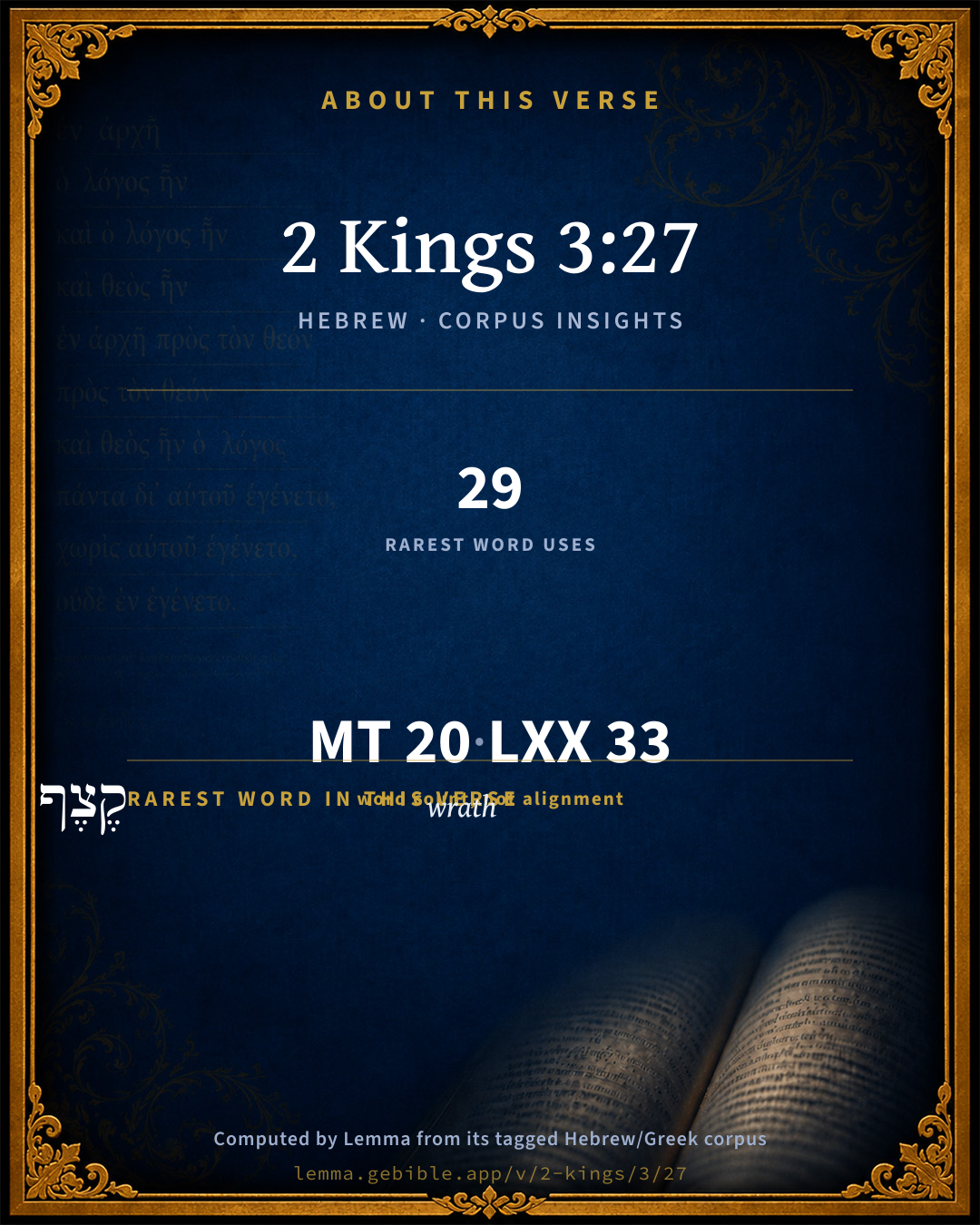
קֶצֶף wrath H7110 occurs in 29 verses of the Hebrew Bible. Also found in:

Grammatical profile

  • 6 verbs
  • 7 nouns
  • 1 adjective
  • 4 prepositions
  • 2 particles

Verb forms

  • וַיִּקַּח֩ Qal · Sequential Imperfect
  • יִמְלֹ֣ךְ Qal · Imperfect
  • וַיַּעֲלֵ֤הוּ Hiphil · Sequential Imperfect
  • וַיְהִ֥י Qal · Sequential Imperfect
  • וַיִּסְעוּ֙ Qal · Sequential Imperfect
  • וַיָּשֻׁ֖בוּ Qal · Sequential Imperfect

Repetition

A word recurs within this verse — often emphatic in Hebrew:

Hebrew & Septuagint length

In English translation the verse runs 40 words from the Hebrew and 45 from the Septuagint (LXX English) — closely comparable.

A rough comparison of the two English renderings, which tokenize alike — not a word-level alignment.

Word counts can differ between the Hebrew and the Greek without any difference in meaning — e.g. the Hebrew direct-object marker אֵת has no separate Greek word, and Greek often adds the article ὁ.

In the original languages it is 20 Hebrew tokens and 33 Greek tokens — but the two are counted differently (Hebrew bundles its prefixes and suffixes into one token; the Greek is in lemma form), so that isn’t a like-for-like length.

Cross-references

13

Topical passages linked to 2 Kings 3:27 in the Treasury of Scripture Knowledge — connected by theme and wording, ordered by reader-vote popularity; previews shown in the World English Bible.

  • Micah 6:7 Will Yahweh be pleased with thousands of rams? With tens of thousands of rivers of oil? Shall I give my firstborn for my disobedience? The fruit of my body for the sin of my soul?
  • Deuteronomy 12:31 You shall not do so to Yahweh your God: for every abomination to Yahweh, which he hates, have they done to their gods; for even their sons and their daughters do they burn in the fire to their gods.
  • Judges 11:31 then it shall be, that whatever comes forth from the doors of my house to meet me, when I return in peace from the children of Ammon, it shall be Yahweh's, and I will offer it up for a burnt offering.
  • Ezekiel 16:20 Moreover you have taken your sons and your daughters, whom you have borne to me, and these have you sacrificed to them to be devoured. Were your prostitution a small matter,
  • Amos 2:1 Thus says Yahweh: "For three transgressions of Moab, yes, for four, I will not turn away its punishment; Because he burned the bones of the king of Edom into lime;
  • Psalms 106:37–38 Yes, they sacrificed their sons and their daughters to demons.
  • Genesis 22:2 He said, "Now take your son, your only son, whom you love, even Isaac, and go into the land of Moriah. Offer him there for a burnt offering on one of the mountains which I will tell you of."
  • Genesis 22:13 Abraham lifted up his eyes, and looked, and saw that behind him was a ram caught in the thicket by his horns. Abraham went and took the ram, and offered him up for a burnt offering instead of his son.
  • Judges 11:39 It happened at the end of two months, that she returned to her father, who did with her according to his vow which he had vowed: and she was a virgin. It was a custom in Israel,
  • 1 Samuel 14:36–46 Saul said, Let us go down after the Philistines by night, and take spoil among them until the morning light, and let us not leave a man of them. They said, Do whatever seems good to you. Then said the priest, Let us draw near here to God.
  • 1 Kings 20:13 Behold, a prophet came near to Ahab king of Israel, and said, Thus says Yahweh, Have you seen all this great multitude? behold, I will deliver it into your hand this day; and you shall know that I am Yahweh.
  • 1 Kings 20:28 A man of God came near and spoke to the king of Israel, and said, Thus says Yahweh, Because the Syrians have said, Yahweh is a god of the hills, but he is not a god of the valleys; therefore will I deliver all this great multitude into your hand, and you shall know that I am Yahweh.
  • 1 Kings 20:43 The king of Israel went to his house sullen and angry, and came to Samaria.

Cross-references courtesy of OpenBible.info (CC BY 4.0).

Hebrew and Greek witnesses Masoretic Hebrew ↔ Greek Septuagint

The same verse in the two great witnesses to the Old Testament, shown verse-for-verse.

These are two independent witnesses, not word-aligned to each other, and the Septuagint is shown in lemma (dictionary) form.

Hebrew 2 Kings 3:27 Masoretic · Westminster Leningrad Codex

וַיִּקַּח֩ אֶת בְּנ֨וֹ הַבְּכ֜וֹר אֲשֶׁר יִמְלֹ֣ךְ תַּחְתָּ֗יו וַיַּעֲלֵ֤הוּ עֹלָה֙ עַל הַ֣חֹמָ֔ה וַיְהִ֥י קֶצֶף גָּד֖וֹל עַל יִשְׂרָאֵ֑ל וַיִּסְעוּ֙ מֵֽעָלָ֔יו וַיָּשֻׁ֖בוּ לָאָֽרֶץ

Then he took his eldest son who would have reigned in his place, and offered him for a burnt offering on the wall. There was great wrath against Israel: and they departed from him, and returned to their own land.

World English Bible · Public Domain

Greek LXX 2 Kings 3:27 Septuagint · lemma form

καί λαμβάνω ὁ υἱός αὐτός ὁ πρωτότοκος ὅς βασιλεύω ἀντί αὐτός καί ἀναφέρω αὐτός ὁλοκαύτωμα ἐπί ὁ τεῖχος καί γίγνομαι μετάμελος μέγας ἐπί ἰσραήλ καί ἀποαἴρω ἀπό αὐτός καί ἐπιστρέφω εἰς ὁ γῆ

And he took his oldest son whom he had designed to reign in his stead, and offered him up for a whole burnt offering on the walls. And there was a great indignation against Israel; and they departed from him, and returned to their land.

LXX2012 (modern English Septuagint) · Public Domain

On this verse, Haydock's Catholic Bible Commentary discusses the Septuagint’s reading. Read the note in Commentary ↓

Hebrew: Westminster Leningrad Codex (CC BY 4.0). Greek: Septuagint (public domain); English from LXX2012 (modern English Septuagint) (Public Domain). How the Septuagint differs from the Hebrew →

Targum (Aramaic paraphrase)

1

The Targum is the ancient Jewish Aramaic paraphrase of the Hebrew Scriptures — an interpretive translation, not the Hebrew text itself. Onkelos (literal) and Pseudo-Jonathan (expansive) render the Torah, and Jonathan the Prophets. Coverage is partial: where no permissively-licensed English translation exists for a verse, only the Aramaic is shown. This is verse-level text, not a word-by-word alignment to the Hebrew.

  1. Targum Jonathan Prophets (Joshua–Malachi)
    וּנְסִיב יַת בְּרֵיהּ בּוּכְרָא דַעֲתִיד דְיִמְלוֹךְ תְּחוֹתוֹהִי וְאַסְקֵיהּ עֲלָתָא עַל שׁוּרָא וַהֲוָה רְגַז רַב עַל יִשְׂרָאֵל וְאִסְתַּלָקוּ מִנֵיהּ וְתָבוּ לְאַרְעָא:

    (no public-domain English translation for this verse)

    Targum Jonathan — Aramaic: “Mikraot Gedolot” (public domain). English: “Sefaria Community Translation” (CC0 1.0 (public-domain dedication)); “London "Chaldee Paraphrase," 1871” (public domain). Text via Sefaria.

Commentary

Notes on 2 Kings 3:27 from classic Christian and Jewish commentators (each source and its license shown beneath its notes). The classic Christian expositions comment on the surrounding passage and are grouped to its opening verse, so a note may address several verses; the Jewish commentaries on the Tanakh (Rashi and others) are per-verse, so they appear only where the commentator wrote on this verse.

Lemma curates 59 commentaries, every one of them public domain or Creative Commons licensed, each selected and text-cleaned for this edition rather than reprinted as found. About our sources →

Trapp's Complete Commentary

John Trapp

2Ki 3:27 Then he took his eldest son that should have reigned in his stead, and offered him [for] a burnt offering upon the wall. And there was great indignation against Israel: and they departed from him, and returned to [their own] land.

Ver. 27. Then he took his eldest son.] The king of Edom’s eldest son, say some, whom he had taken in the late sally, and now spitefully sacrificed. See on Amo 2:1. The king of Moab’s own son and heir, say others, whom he took and sacrificed to his god Chemos, or the sun, that with so precious a sacrifice he might prevail with him for help in this extremity. The like was usually done by the Phoenicians and Carthaginians, as Diodorus and Q. Curtius report, by an apish and hellish imitation, say some, of Abraham’s offering up his son Isaac. R. Solomon, and cut of him Lyra, tell us that the king of Moab asked his priests how the Iraelites came to be so gracious with God, and so victorious. They answered, that Abraham their father, in obedience unto him, sacrificed his only son, and that Mosha thereupon took and sacrificed this his son upon the wall. And the like is reported of Sennacherib, as I have elsewhere noted.

And there was great indignation,] i.e., Great discontent in the other two confederate kings against the king of Israel for his obstinate spleen, the cause of such an abomination.

John Trapp, A Commentary or Exposition upon All the Books of the Old and New Testament (1647–1656) — public domain. Text from a community e-Sword module.

The Biblical Illustrator

Joseph S. Exell

2Ki_3:27

Then he took his eldest son . . . and offered him for a burnt offering.

A kings sacrifice

The King of Moabs sacrifice a picture of the worlds sacrifices. The King of Moab was besieged in Kirharaseth by the allied armies of Israel, and Judah, and Edom. Finding himself hard pressed, he resolved upon a sortie, in hopes of regaining the open country. Selecting seven hundred of the choicest of his troops, he headed an assault against the lines of the King of Edom, but was driven back. Turning in despair to his counsellors, says a Jewish legend, he inquired how it was that such feats of valour could be done by the men of Israel, and how such miracles were wrought in their behalf; to which his counsellors replied, that they sprang from Abraham, who had an only son, and offered him in sacrifice to God. Then I, too, have an only son, said the King of Moab. I also will go and offer him up as a sacrifice to my god; upon which, as it is stated in sacred history, he took his eldest son that should have reigned in his stead, and offered him for a burnt offering upon the wall. It is not probable that the explanation of the Rabbis is correct. More than likely, as already has been hinted, the act of Mesha was done out of pure, blind, debasing superstition--as a peace-offering or bloody propitiation to the Moabitish war-god, Chemosh. Philo tells us it was a custom among the ancients, in times of great national disaster, instead of all being devoted to destruction, for those who had the rule in either town or country to give up the well-beloved child of their families to be put to death, as a ransom price to secure the favour of the gods (cf. Tennysons poem, The Victim. In a time of plague and famine the gods, when consulted, answer--

The king is happy in child and wife.

Take you his nearest; take you his dearest: give us a life.

Cf. also the speech of Caiaphas in Joh_11:49; Joh_11:1); and, doubtless, this was the custom in accordance with which the sheep-master offered up his son. Thus it was a picture of the way in which the unbelieving world has all along endeavoured to make peace with God. How shall I obtain forgiveness? how ever shall a man be justified before God? is the universal cry of the human heart; and thousands upon thousands in every age have answered it like Mesha: By giving the fruit of my body for the sin of my soul. In heathen lands how many myriads of little children have fallen victims to this foul superstition? As if the guilt already incurred by a sinner could be wiped away by the simple process of contracting more! Let us thank God that even those among us who have not yet obtained forgiveness have been delivered from this miserable delusion. At the same time, there is room for inquiring if the dregs, at least, of that very superstition which made a victim of the son of Mesha on the wall of Kirharaseth, be not remaining with us. Do we not sometimes offer, as our atoning sacrifice, with a view to purchase heavens favour, if not the fruit of our bodies, the fruit of our souls--our good deeds, our moral lives, our excellent dispositions, our prayers, our praises, etc.? They are as much a sacrifice of superstition as was that of Mesha. The only difference is, that Meshas sacrifice was offered to an idol; whereas ours is presented to the living God. If there be another point of difference, it is this, that Mesha knew no better, whereas we are well assured that all such sacrifices are vain. (T. Whitelaw, M. A.)

Sacrifice of the first-born

One of the most striking evidences of the widespread conviction among the Israelites of the efficacy of the sacrifice of the first-born son, whether infant or grown, is afforded by the story of the sacrifice of the son of the King of Moab. Each town or nation believed in the existence of its own special god, to whom it stood in a peculiar relation. At times it became necessary to strengthen the hands of that god, as it were, against the gods of hostile nations, who seemed to be too strong for him, or to arouse his interest, which seemed in some way to have been alienated or diverted. He may be offended, because he had not received that which was his due. Or it might be that the god was not able to withstand the power of other gods his adversaries. The King of Moab was sore pressed. As a last resort, whether to appease his deity, Chemosh, or to strengthen Chemoshs hands against the gods of his adversaries, the kings of Israel, Judah, and Edom, Mesha sacrificed on the wall of the city, in sight of the allied hosts, his son and the heir to the throne. The Israelites, Jews, and Edomites who beheld the sacrifice were filled with terror, knowing the meaning and power of this sacrifice, and believing that it would so arouse and strengthen the god of Moab that he would become almost if not quite irresistible. (J. P. Peters, D. D.)

.

The Biblical Illustrator, edited by Joseph S. Exell (c. 1880s–1900s) — public domain. Text from a community e-Sword module.

Joseph Benson's Commentary

2Ki 3:27. He took his eldest son — and offered him for a burnt-offering upon the walls — “Not only the Holy Scriptures, but several heathen writers assure us, that in case of great extremity, it was customary among various people to sacrifice to their gods whatever was most dear to them.” Eusebius and Luctantius mention several nations who used these sacrifices. And “Cesar, in his war with the Gauls, tells us that when they were afflicted with grievous diseases, or in time of war or great danger, they either offered men for sacrifices, or vowed that they would offer them; because they imagined that their gods could never be appeased unless one man’s life was given for another’s. In conformity with this horrid custom, and to appease, no doubt, as he thought, the anger of his idol Chemosh, the king of Moab made this costly sacrifice of his eldest son; a deed which, it is plain from the text, was held in the greatest abhorrence by the Israelites.” — Dodd. For so, it seems, we are to understand the following words, which should be rendered, not, There was great indignation against Israel, but, There was great trouble, or repentance upon (in or among) Israel: that is, they were extremely grieved on account of this barbarous sacrifice, and wished they had not pushed on a war so far, which ended in such a horrid action. They departed from him, and returned to their own land — They resolved to prosecute the war no further; but raised the siege, by common consent, and returned home, for fear any such thing should be done again.

Joseph Benson's Commentary on the Old and New Testaments (1811–1818) — public domain. Text from a community e-Sword module.

Tyndale Open Study Notes

Tyndale Open Resources

3:27 So there was great anger against Israel: The Hebrew phrase translated great anger occurs elsewhere to describe the Lord’s fury against Israel for covenant violations (Jer 21:5; 32:37; Zech 7:12).

Tyndale Open Study Notes — © Tyndale Open Resources, licensed CC BY-SA 4.0. Text via the HelloAO Bible API.

Geneva Bible (1599)

Geneva Bible translators

Some refer it to the king of Edom’s son, whom they say he had taken in that skirmish: but rather it seemed to be his own son, whom he offered to his gods to pacify them: which barbarous cruelty moved the Israelites’ hearts of pity to depart.

Geneva Bible (1599) marginal notes — public domain. Text via Bolls.life.

Jamieson, Fausset & Brown

Robert Jamieson, A. R. Fausset & David Brown

took his eldest son that should have reigned in his stead, and offered him for a burnt offering, &c.--By this deed of horror, to which the allied army drove the king of Moab, a divine judgment came upon Israel; that is, the besiegers feared the anger of God, which they had incurred by giving occasion to the human sacrifice forbidden in the law (Lev 18:21; Lev 20:3), and hastily raised the siege.

Next: 2 Kings Chapter 4

Jamieson, Fausset & Brown — Commentary Critical and Explanatory on the Whole Bible (1871) — public domain (CC PDM 1.0). Text via the HelloAO Bible API.

Adam Clarke's Commentary

Verse 27. Took his eldest son] The rabbins account for this horrible sacrifice in the following way:-

When the king of Moab found himself so harassed, and the royal city on the point of being taken, he called a council of his servants, and asked them how it was these Israelites could perform such prodigies, and that such miracles were wrought for them? His servants answered, that it was owing to their progenitor Abraham, who, having an only son, was commanded by Jehovah to offer him in sacrifice. Abraham instantly obeyed, and offered his only son for a burnt-offering; and the Israelites being his descendants, through his merits the holy blessed God wrought such miracles in their behalf. The king of Moab answered, I also have an only son, and I will go and offer him to my God. Then he offered him for a burnt-offering upon the wall.

Upon the wall] על החמה al hachamah. Rab. Sol. Jarchi says that the letter ו vau is wanting in this word, as it should be written חומה chomah, to signify a wall; but חמה chammah signifies the sun, and this was the god of the king of Moab: "And he offered his first-born son for a burnt-offering unto the sun." This is not very solid.

There was great indignation] The Lord was displeased with them for driving things to such an extremity: or the surrounding nations held them in abomination on the account; and they were so terrified themselves at this most horrid sacrifice, that they immediately raised the siege and departed. In cases of great extremity it was customary in various heathen nations to offer human sacrifices, or to devote to the infernal gods the most precious or excellent thing or person they possessed. This was frequent among the Phoenicians, Romans, and Greeks; and it was the natural fruit of a religious system which had for the objects of its worship cruel and merciless divinities. How different the Christian system! "Wilt thou that we shall bring down fire from heaven and destroy them? Ye know not what manner of spirits ye are of; the Son of man is not come to destroy men's lives, but to save them."

Adam Clarke's Commentary on the Bible (1810–1826) — public domain. Text from a community e-Sword/MySword module.

Ellicott's Commentary for English Readers

(27) Then.—And.

His eldest son—i.e., the despairing king of Moab took his own son and heir.

Offered him for a burnt offering.—To Chemosh, without doubt, by way of appeasing that wrath of the god which seemed bent on his destruction. (Comp. the words of Mesha’s inscription: “Chemosh was angry with his lnd.” Note, 2Ki_1:1.) There is a reference to such hideous sacrifices in Mic_6:7, “Shall I give my firstborn for my transgressions?” In dark times of national calamity the Hebrews were prone, like their neighbours, to seek help in the same dreadful rites. (Comp. the case of Manasseh, 2Ch_33:6; see also Psa_106:37-39.) From the cuneiform records we learn that the sacrifice of children was also a Babylonian practice. (Amo_2:1 refers to a totally different event from that recorded in the text.)

Upon the wall.—Of Kir-haraseth. This was done that the besiegers might see, and dread the consequences, believing, as they would be likely to do, that the Divine wrath was now appeased.

And there was great indignation against Israel.—Or, And great wrath fell upon Israel. This phrase always denotes a visitation of Divine wrath. (Comp. 2Ch_19:10; 2Ch_24:18.) The manifestation of wrath in the present case was apparently a successful sortie of the Moabite garrison, whose faith in this terrible expedient of their king inspired them with new courage, while the besiegers were proportionally disheartened. The result was that “they (i.e., the allied forces) departed from him (raised the siege), and returned to the land” (of Israel). Why did Divine wrath fall upon Israel rather than upon Moab? upon the involuntary cause rather than the voluntary agents in this shocking rite? If the wrath of Jehovah be meant, we cannot tell. But, as the present writer understands the words of the text, they rather indicate that the object of the dreadful expiation was attained, and that the wrath of Chemosh fell upon the Hebrew alliance. It is certain that belief in the supremacy of Jehovah did not hinder ancient Israel from admitting the real existence and potency of foreign deities. (See Note on 1Ch_16:25-26; 1Ch_17:21; and comp. Num_21:29; Jdg_11:24.) This peculiar conception is a token of the antiquity of the record before us. In the second half of Isaiah the foreign gods are called non. entities.

After the events described in this verse we may suppose that Mesha’s successes continued, as described on the stone of Dibon. (See Note on 2Ki_1:1.)

A Bible Commentary for English Readers, edited by Charles John Ellicott (1878–1897) — public domain. Text from a community e-Sword module.

The Cambridge Bible for Schools and Colleges

gen. ed. J. J. S. Perowne

27. his eldest son] i.e. his own eldest son, not as has been explained by some, the eldest son of the Edomite king. His thought was to offer such a sacrifice as would be most acceptable. Hence he gave what was most precious to him. And the offering was made to his own god, Chemosh (see Num_21:29). Among the heathen human sacrifice was not uncommon, and some have thought that from the sight of such offerings Abraham was brought to contemplate the sacrifice of Isaac as required of him to prove that he was not less devoted to Jehovah’s service than the heathen people to their idolatry.

upon the wall] This was no doubt done to shew to the Israelites that every means had been taken by him to secure the aid of the local divinity against his assailants. Such a sacrifice they might think could hardly fail of obtaining the help sought by it.

And there was great indignation [R.V. wrath] against Israel] The word rendered ‘wrath’ or ‘indignation’ is nearly always used of the wrath of God against offenders. But it appears difficult to take it in that sense here. God’s promise through Elisha was that Israel should conquer, and they were bidden to smite every fenced city and every choice city. Therefore unless we conceive that underlying God’s message there was conceived some point beyond which they were not to go, and that the forcing of the king to offer his son was of this character, it is hard to see how they could be held to blame and worthy of God’s wrath. They were in no position to know what the king intended, nor, when they saw him on the wall, to prevent his sacrifice. It seems better therefore to take ‘wrath’ in this place to signify ‘wrath of men’. The word is found in Ecc_5:17, ‘All his days he eateth in darkness, and is sore vexed and hath sickness and wrath’ (R.V.). This can be either of what the man feels himself, or of what others feel towards him. Taking the latter sense, the meaning here would be that in the minds of the men of Judah and Edom there rose indignation that they had been brought to partake in an expedition which led to such a dreadful sacrifice. If we apply the word to the feelings of the Israelites themselves, we get the sense that they were grieved and angry at so terrible a result, and so hastened to leave the dreadful scene. The margin of R.V., ‘There came great wrath upon Israel’, alludes to the anger of God, but it seems, as the preposition is ‘against’, to be better to understand that the allies were grieved at having shared in so disastrous a warfare. Josephus says the kings pitied the need which the Moabite monarch had felt when he offered up his child, and so withdrew.

and they departed from him] i.e. from the king of Moab. This seems to shew that it was the horrible act of the king which made them ready to be gone at once. It was not the land which they left. Had no such sacrifice as is here described taken place they would have prosecuted the siege according to the prophet’s word. But now they withdrew in horror.

The Cambridge Bible for Schools and Colleges (gen. ed. J. J. S. Perowne; Cambridge University Press, 1878–1918) — public domain. Text from a community e-Sword module.

Albert Barnes' Notes on the Bible

Compare the marginal reference. Mesha, when his sally failed, took, as a last resource, his first born son, and offered him as a burnt-offering to appease the manifest anger of his god Chemosh, and obtain his aid against his enemies. This act was thoroughly in accordance with Moabitish notions.

And there was great indignation against Israel - Either the Israelites were indignant with themselves, or the men of Judah and the Edomites were indignant at the Israelites for having caused the pollution of this sacrifice, and the siege was relinquished.

Albert Barnes' Notes on the Bible (1834–1885) — public domain. Text from a community e-Sword/MySword module.

Haydock's Catholic Bible Commentary

Wall, to Chamos, the idol of Moab; (Menochius) or to Moloc, to appease the wrath of the gods. Horrible blindness! The pagans believed, that the most precious thing ought to be sacrificed in very imminent dangers. (Philo Biblius, following Eusebius, præp. iv. 16.) --- The Phœnicians offered such victims to Saturn. Many devoted themselves to death for the safety of the Roman republic; and some were ready to do so, to preserve the lives of Caligula and Nero, before they had given proof of their evil dispositions. (Seutonius xiv.) --- It s thought that Sennacherib intended to treat his two sons in this manner, if they had not prevented him. (Abulensis, in 4 Kings xix. 37.) --- Some imagine that Mesa sacrificed his son to the God of Israel, in imitation of Abraham; (Josephus; Grotius) others, that he slew the son of the king of Edom, out of revenge. (Kimchi, in Amos ii. 1.) --- The Hebrew is ambiguous. (Amama) --- But interpreters generally believe, that the heir of Mesa fell a victim (Calmet) to his father’s mistaken zeal, or to his desire to make the enemy retire, when they saw him reduced to such a state of desperation. It had, at least, this effect. (Haydock) --- Indignation, at such a cruel action. (Menochius) --- Septuagint, "there was great repentance" and sorrow. The text may also imply, that God was displeased at Israel for pushing the king to such an extremity; or, they became an object of horror to the surrounding nations. (Calmet) --- The first explanation seems the best; as the Israelites thought the king had been sufficiently punished, and therefore retired. They had no reason to suspect that he would have given way to such madness, nor were they to blame for it. (Haydock)

George Leo Haydock (1774–1849), Haydock's Catholic Family Bible and Commentary, 1859 edition — public domain. Excludes Psalms (Douay-Rheims chapter numbering differs from Protestant) and Deuterocanonical books (Catholic canon only).

Matthew Poole's English Annotations

His eldest son; either, first, The king of Edom’s son; whom in this eruption he took, and then sacrificed. Compare Amo 2:1. But, first, That place speaks of the king, not of the king’s son; and of the burning of his bones, not of the offering of a living man for a burnt-offering. Secondly, This would not have made the besiegers to raise their siege, but to have followed it more warmly to revenge so barbarous an action. Thirdly, The following clause,

that should have reigned in his stead, agrees not so well to the Edomites, whose king was only Jehoshaphat’s viceroy, and therefore his son had no right to succeed him; as it doth to the Moabites, whose king was revolted from Israel, and intended to keep that kingdom to himself and children. Or rather, secondly, his own son; whom he sacrificed, partly to obtain the favour of his god, according to the manner of the Phoenicians and other people in grievous and public calamities; whereof we have manifest testimonies, both in Scripture, as Psa 106:37; Eze 20:31, and in heathen authors, as Porphyrius, Plutarch, and others; and partly to oblige the Israelites to quit the siege out of compassion, or as despairing to conquer (at least without greater loss of men than it was worth) him who was resolved to defend himself and city to the utmost extremity.

Offered him for a burnt-offering upon the wall, that the besiegers might see it, and be moved by it.

Great indignation against Israel, or, great trouble or repentance upon Israel; i.e. the Israelitish king and people (who was the first cause of the war, and had brought the rest into confederacy with him) were greatly afflicted and grieved for this barbarous action, and resolved to prosecute the war no further, and so withdrew their forces, as also did their allies, and returned to their several homes; which they were the more willing to do, because the kingdom and country of Moab were so ruinated, both as to their men, and cities or villages, and lands, that they were all secure of any great annoyance from him.

Matthew Poole's English Annotations on the Holy Bible (1683–1685) — public domain. Text from a community e-Sword/MySword module.

Whedon's Commentary on the Bible

Daniel D. Whedon

27. Took his eldest son — His own son; not, as some have said, the son of the king of Edom. Amo_2:1, has no reference to this occasion.

Mesha’s eldest son, and heir of the throne, must have been the dearest idol of his heart, and his sacrifice shown the utter despair to which he was driven. The rabbies say, that in his despair the king of Moab asked his servants how Israel could work such miracles, and was told that it was owing to Abraham’s sacrifice of his only son at the command of God. He accordingly hastened to offer up his firstborn son, hoping to receive like favours of Heaven.

Offered him… upon the wall — In sight of his own people and of all the hosts of the besiegers. The offering was doubtless made to the Moabitish god Chemosh, not to the God of Israel. Mesha supposed that his misfortunes were owing to the vengeance of his gods, whom he had in some way offended, and by this costly sacrifice he sought to propitiate them. Human sacrifices were common among many of the ancient heathen nations. The story of Iphigenia sufficiently shows the existence of the practice among the Greeks. It prevailed also among the Carthaginians, the Phenicians, and most of the nations in and around Palestine. Causing children to pass through fire to Molech (2Ki_23:10; Deu_18:10) is an allusion to this abominable custom. Diodorus Siculus relates, that “when Agathocles was going to besiege Carthage the people, seeing the extremities to which they were reduced, ascribed their misfortunes to the anger of their god, in that they had latterly spared to offer him children nobly born, and had fraudulently put him off with the children of slaves and foreigners. To make an atonement for this crime two hundred children of the best families in Carthage were at once offered in sacrifice, and no less than three hundred of the citizens voluntarily sacrificed themselves.” Philo, in a fragment preserved by Eusebius, says: “It was a custom among the ancients, on occasions of great distress, for the rulers of a city or nation, instead of leaving the entire population to destruction, to sacrifice the beloved of their children as a ransom to the vengeful deities.”

There was great indignation against Israel — That is, according to some interpreters, there was great wrath on the part of the besieged Moabites against Israel for having driven them to such a terrible extremity. But why should Moabitish indignation against Israel cause the latter to abandon the siege? Keil, on the contrary, understands that this indignation was the wrath of God against Israel, first for having driven Mesha to such an extremity as to occasion his offering a human sacrifice, and then for abandoning the siege and leaving the city un-subdued. But this absurdly assumes that God was angry with Israel partly for doing the very thing he had, by his prophet, commanded them to do; (see note on 2Ki_3:19;) and surely Israel could not justly be held responsible for the immolation of Mesha’s son. Then, further, the text clearly makes Israel’s abandoning of the siege the consequence, not the cause, of the indignation. It is better, therefore, to take the word here rendered against, (על,) in the sense of over. The meaning then would be: Great indignation — an intense feeling of horror at the sight of the terribly loathsome spectacle on the wall of Kir-haraseth — came over Israel; that is, pervaded the whole Israelitish army.

Departed from him — From the king of Moab. They were so deeply disgusted with the king’s horrible sacrifice that they felt no longer willing to stay and complete the subjugation of his capital, but turned away in utter loathing and contempt. Whether they were justifiable in thus abandoning the siege, the sacred writer does not say.

Daniel D. Whedon (gen. ed.), Commentary on the Old and New Testaments (1874–1909) — public domain. Text from a community e-Sword module.

The Pulpit Commentary

Then he took his eldest son, that should have reigned in his stead the throne of Moab being hereditary, and primogeniture the established law (cf. Moabite Stone, lines 2 and 3, "My father reigned over Moab thirty years, and I reigned after my father")and offered him for a burnt offering. Human sacrifice was widely practiced by the idolatrous nations who bordered on Palestine, and by none more than by the Moabites. A former King of Moab, when in a sore strait, had asked, "Shah I give my firstborn for my transgression, the fruit of my body for the sin of my soul?"; (Mic_6:7) and there is reason to believe that a chief element in the worship of Chemosh was the sacrifice of young children by their unnatural parents. The practice rested on the idea that God was best pleased when men offered to him what was dearest and most precious to them; but it was in glaring contradiction to the character of God as revealed by his prophets, and it did violence to the best and holiest instincts of human nature. The Law condemned it in the strongest terms as a profanation of the Divine Name, (Lev_18:21 Lev_20:1-5) and neither Jeroboam nor Ahab ventured to introduce it when they established their idolatrous systems. The King of Mesh, undoubtedly, offered the sacrifice to his god Chemosh (see Moabite Stone, lines 3, 4, 8, 12, etc.), hoping to propitiate him, and by his aid to escape from the peril in which he found himself placed. HIS motive for offering the sacrifice upon the wall is not so clear. It was evidently done to attract the notice of the besiegers, but with what further object is uncertain. Ewald thinks the king"s intention was to" confound the enemy by the spectacle of the frightful deed to which they had forced him," and thus to "effect a change in their purposes" ("History of Israel," vol. 4. p. 90); but perhaps it is as likely that he hoped to work upon their fears, and induce them to retire under the notion that, if they did not, Chemosh would do them some terrible injury. And there was great indignation against Israel: and they departed. It seems necessary to connect these clauses, and to regard them as assigning cause and effect. The deed done aroused an indignation against Israel, which led to the siege being raised. But an indignation on whose part? Keil thinks, on God"s. But could God be angry with Israel for an act of the King of Moab, which they had no ground for anticipating, and which they could not possibly have pro-vented? especially when the Israelites had done nothing to cause the act, except by carrying out God"s own command to them through his prophet, to "smite every fenced city and every choice city" (ver. 19). The indignation, therefore, must have been human. But who felt it? Probably the Moabites. The terrible act of their king, to which they considered that Israel had driven him, stirred up such a feeling of fury among the residue of the Moabite nation, that the confederates quailed before it, and came to the conclusion that they had best give up the siege and retire. They therefore departed from himi.e. the King of Mesh and returned to their own land; severally to Edom, Judea, and Samaria.

The Pulpit Commentary (1880–1919), ed. H.D.M. Spence-Jones & Joseph S. Exell — public domain. Text from a community e-Sword module.

John Wesley's Explanatory Notes

His son - Or rather, his own son: whom he sacrificed; partly, to obtain the favour of his God, according to the manner of the Phoenicians and other people in publick calamities; and partly, to oblige the Israelites to quit the siege out of compassion; or, as despairing to conquer (at least without greater loss of men than it was worth) him who was resolved to defend the city to the utmost extremity. On the wall - That the besiegers might see it, and be moved by it. There was, &c. - Or, great trouble or repentance upon Israel, the Israelitish king and people (who was the first cause of the war, and had brought the rest into confederacy with him) were greatly grieved for this barbarous action, and resolved to prosecute the war no farther.

John Wesley, Explanatory Notes Upon the Whole Bible (1754–1765) — public domain. Text via the GEBible commentary corpus.

Rashi

Rabbi Shlomo Yitzchaki (Rashi)

And then took his firstborn son. In the Pesikta of the section of Shekalim it is expounded: He asked his servants, “What is the character of this nation, that miracles such as these were performed for them?” They replied, “Their forefather, Avrohom, had an only son. The Holy One, Blessed Is He, said to him, ‘Offer him before me,’ and he wanted to sacrifice him to the Holy One, Blessed Is He.” He said to them, “I too have a firstborn son. I will go and sacrifice him to the gods.”

On the wall. The ‘vav’ [in חֹמָה] is missing, for he worshiped the sun [=חַמָּה].

This caused a terrible anger. For their iniquities were remembered, that they too worship pagan deities and are not worthy of a miracle.

Rashi on the Tanakh — English translations: “The Judaica Press complete Tanach with Rashi, translated by A. J. Rosenberg” (CC BY 4.0); “Pentateuch with Rashi's commentary by M. Rosenbaum and A.M. Silbermann, 1929-1934” (public domain); “The Metsudah Tanach series, Lakewood, N.J” (CC BY 4.0); and “The Book of Joshua, Metsudah Publications, 1997” (CC BY 4.0). Text via Sefaria.

Radak

Rabbi David Kimhi (Radak)

"So he took his eldest son" - My lord father of blessed memory interpreted this to mean that the son of the king of Edom who was fit to rule after him was in the custody of the king of Moab, and that for this reason he [the king of Edom] came with the two kings [of Judah and Israel], since with their help he planned to save his son from captivity under the king of Moab. When the king of Moab planned to break through to the king of Edom and could not, in his wrath he took the son of the king of Edom and brought him up on the wall and burned him before his father's eyes. This is what "he offered him up as a burnt offering" means - that he burned him as one burns a burnt offering.

"A great wrath came upon Israel" - from the king of Edom, since he had thought that with their help he would save his son from captivity under the king of Moab. This is what the scripture "because he burned the bones of the king of Edom into lime" (Amos 2:1) means. And my rabbi and brother, R' Moses of blessed memory interpreted this to mean that when the king of Moab planned to break through to the king of Edom, then and there he took his son captive. In that very war he abducted him from them, and then he brought him up on the wall and burned him before his father's eyes. A great wrath came upon Israel from the king of Edom, since they hadn't helped him save him [his son] from them [Moab]...

Radak on the Tanakh — English translations: “Sefaria Community Translation” (CC0 1.0 (public-domain dedication)); “Eliyahu Munk, HaChut Hameshulash” (CC BY 4.0); “Rabbi Mike Feuer, Jerusalem Anthology” (CC BY 4.0); and “R. David Kimhi on the first book of Psalms, Translated by R.G. Finch, London, 1919” (public domain). Text via Sefaria.

Lesson kit

Teaching starters — assembled from the data on this page, not authored interpretation. Every prompt links to the verse data it draws on. Edit before teaching.

2 Kings, in the Historical, opens this verse with 20 words (18 distinct Hebrew lemmas). Its most distinctive word is qetseph (“wrath”). A historical commentator’s framing appears above. Read the whole chapter for the surrounding context.

Discussion questions

  1. The word qetseph carries the sense “wrath.” How does it shape the verse?
  2. Numbers 1:53 shares the word «wrath» with this verse. How do the two illuminate each other?
  3. “upon” occurs 3× in this one verse. What is the effect of the repetition?
  4. These translations render this verse differently; the difference is in the English rendering, not the original. What questions does that raise?
  5. The verb «וַיִּקַּח֩» is Qal Sequential Imperfect. How does its form color the action?
  6. Reading how Trapp's Complete Commentary and The Biblical Illustrator read this verse, where do the two commentators agree and where do they part?

Things to notice

Reading settings

Reading text

Shown beneath each verse's original-language words.

Old Testament
Old Testament edition

Read the OT as the Masoretic Hebrew (MT) or the Greek Septuagint (LXX).

English shown for the Greek Septuagint (in the Hebrew ↔ Greek comparison).

Comparing translations? Open the Compare panel on any verse page to stack up to four side by side.