Jeremiah 39:8

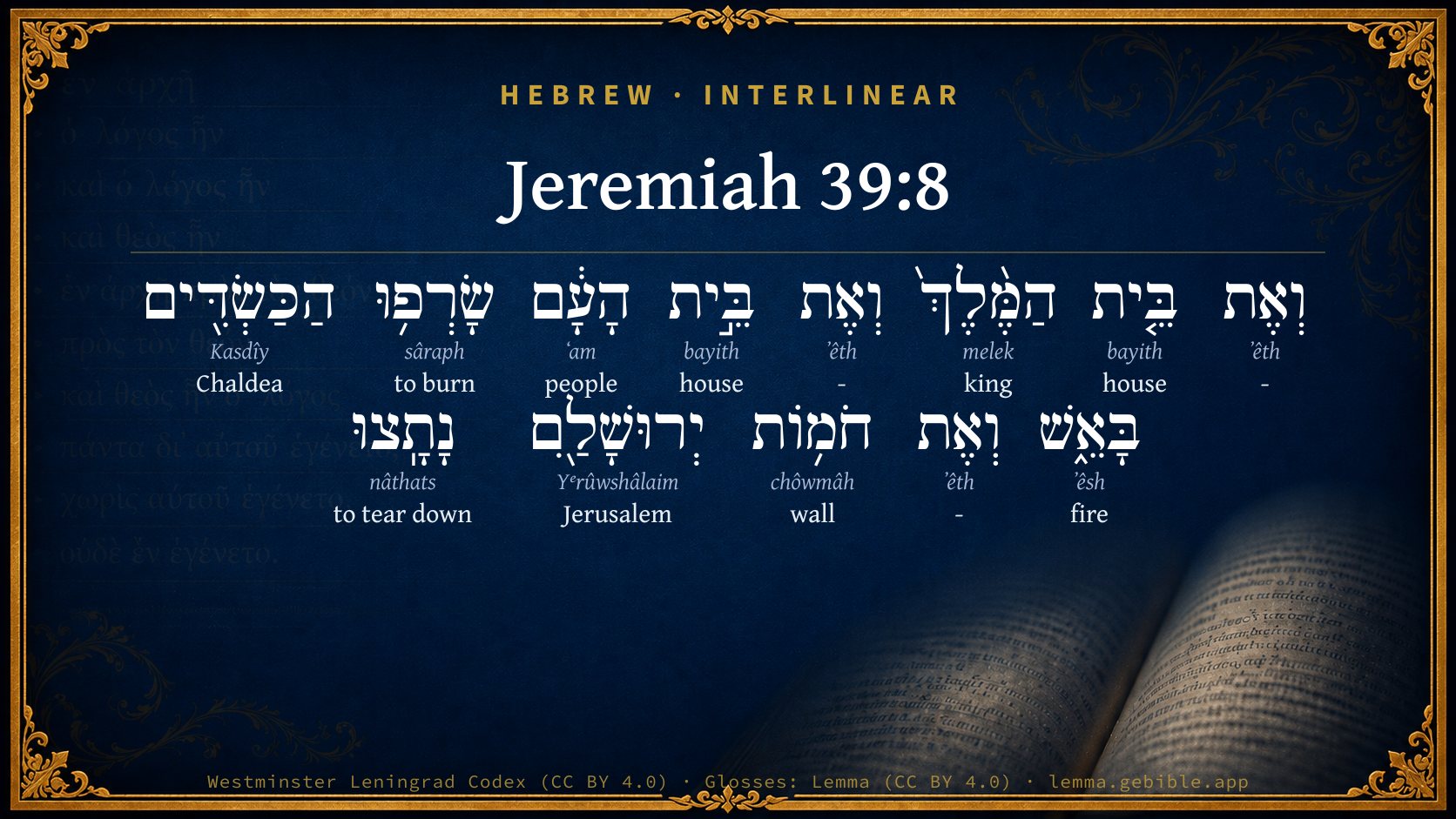
Hebrew (Westminster Leningrad Codex) Jeremiah 39:8 appears in the Hebrew Old Testament. The text above is from the Westminster Leningrad Codex. Each word links to its Strong’s number, a concise gloss, and parsing drawn from the Open Scriptures Hebrew Bible morphology. Click any word for its full Brown-Driver-Briggs (BDB) entry.
Download image
Cite this verse

Jeremiah 39:8 (World English Bible). Public Domain. Lemma interlinear Bible study tool, https://lemma.gebible.app/v/jeremiah/39/8.

Show BibTeX & RIS
BibTeX
RIS
English Translation
The Chaldeans burned the king's house, and the houses of the people, with fire, and broke down the walls of Jerusalem.
World English Bible · Public Domain
Download a study sheet

One document with this verse’s original text, its word-by-word gloss line, the meaning frame, cross-references with their text, attributed commentary, and full source and license credits — printable, and it pastes into notes with its structure intact.

This verse Autodidact and up

Study sheet (.html) Plain text (.txt)

A passage Seminary Student

Up to 50 verses in one chapter. A passage sheet keeps up to 6 commentary sources and 12 cross-references per verse, in the order this page ranks them, and says so on the sheet whenever that leaves anything out. Ask for a single verse and you get the Autodidact verse sheet above.

Everything on this page stays free to read, with no account — the sheet is a download of what is already on screen, not access to it.

Want to remove ads? Support Godless Engineer
Compare translations 3

The same verse in 3 English versions, stacked beneath the original-language interlinear above. Click any original word for its lexicon entry.

Each is an independent rendering of the whole verse — the interlinear is not word-aligned to these translations.

Highlighted words mark where these versions differ — a whole-verse word diff, not a word-by-word alignment.

  • World English Bible Public Domain
    The Chaldeans burned the king's house, and the houses of the people, with fire, and broke down the walls of Jerusalem.
  • King James Version Public Domain
    And the Chaldeans burned the king's house, and the houses of the people, with fire, and brake down the walls of Jerusalem.
  • unfoldingWord Literal Text CC BY-SA 4.0
    Then the Chaldeans burned the king’s house and the people’s houses. They also tore down the walls of Jerusalem.

unfoldingWord Literal Text — © unfoldingWord, licensed CC BY-SA 4.0. Word-aligned USFM3 via Door43 (git.door43.org/unfoldingWord/en_ult).

Versions to compare (up to 4)

3 of 4 selected

Show all 18 translations

Every available English version of this verse, each an independent rendering of the whole verse.

  • World English Bible Public Domain
    The Chaldeans burned the king's house, and the houses of the people, with fire, and broke down the walls of Jerusalem.
  • Berean Standard Bible Public Domain
    The Chaldeans set fire to the palace of the king and to the houses of the people, and they broke down the walls of Jerusalem.
  • Majority Standard Bible Public Domain
    The Chaldeans set fire to the palace of the king and to the houses of the people, and they broke down the walls of Jerusalem.
  • King James Version Public Domain
    And the Chaldeans burned the king's house, and the houses of the people, with fire, and brake down the walls of Jerusalem.
  • American Standard Version (1901) Public Domain
    And the Chaldeans burned the king's house, and the houses of the people, with fire, and brake down the walls of Jerusalem.
  • Revised Version (1885) Public Domain
    And the Chaldeans burned the king’s house, and the houses of the people, with fire, and brake down the walls of Jerusalem.
  • Geneva Bible (1599) Public Domain
    And the Caldeans burnt the Kings house, and the houses of the people with fire, and brake downe the walles of Ierusalem.
  • Douay-Rheims (1899) Public Domain
    And the Chaldeans burnt the king's house, and the houses of the people with fire, and they threw down the wall of Jerusalem.
  • Young's Literal Translation Public Domain
    And the house of the king, and the house of the people, have the Chaldeans burnt with fire, and the walls of Jerusalem they have broken down.
  • Literal Standard Version CC BY-SA 4.0
    And the house of the king, and the house of the people, the Chaldeans have burned with fire, and they have broken down the walls of Jerusalem.
  • Unlocked Literal Bible CC BY-SA 4.0
    Then the Chaldeans burned the king's house and the people's houses. They also tore down the walls of Jerusalem.
  • unfoldingWord Literal Text CC BY-SA 4.0
    Then the Chaldeans burned the king’s house and the people’s houses. They also tore down the walls of Jerusalem.
  • Darby Bible Public Domain
    And the Chaldeans burned the king's house and the houses of the people with fire, and broke down the walls of Jerusalem.
  • World Messianic Bible Public Domain
    The Kasdim burned the king’s house and the people’s houses with fire and broke down the walls of Jerusalem.
  • Webster's Bible Public Domain
    And the Chaldeans burned the king's house, and the houses of the people, with fire, and broke down the walls of Jerusalem.
  • Free Bible Version CC BY-SA 4.0
    The Babylonians burned down the king's palace and the people's houses, and they demolished Jerusalem's city walls.
  • Bible in Basic English Public Domain
    And the Chaldaeans put the king's house on fire, as well as the houses of the people, and had the walls of Jerusalem broken down.
  • JPS Tanakh (1917) Public Domain
    And the Chaldeans burned the king's house, and the house of the people, with fire, and broke down the walls of Jerusalem.

Literal Standard Version (2020), Covenant Press — licensed CC BY-SA 4.0. Text via the HelloAO Bible API (eBible.org). Unlocked Literal Bible (unfoldingWord) — licensed CC BY-SA 4.0. Text via the HelloAO Bible API (eBible.org). unfoldingWord Literal Text — © unfoldingWord, licensed CC BY-SA 4.0. Word-aligned USFM3 via Door43 (git.door43.org/unfoldingWord/en_ult). Free Bible Version, Dr. Jonathan Gallagher — licensed CC BY-SA 4.0. Text via the HelloAO Bible API (eBible.org).

Word by word

More ways to search: Search by grammar → Find every occurrence → Compare this word →

Practice this passage: Drill this verse → Learn its vocabulary →

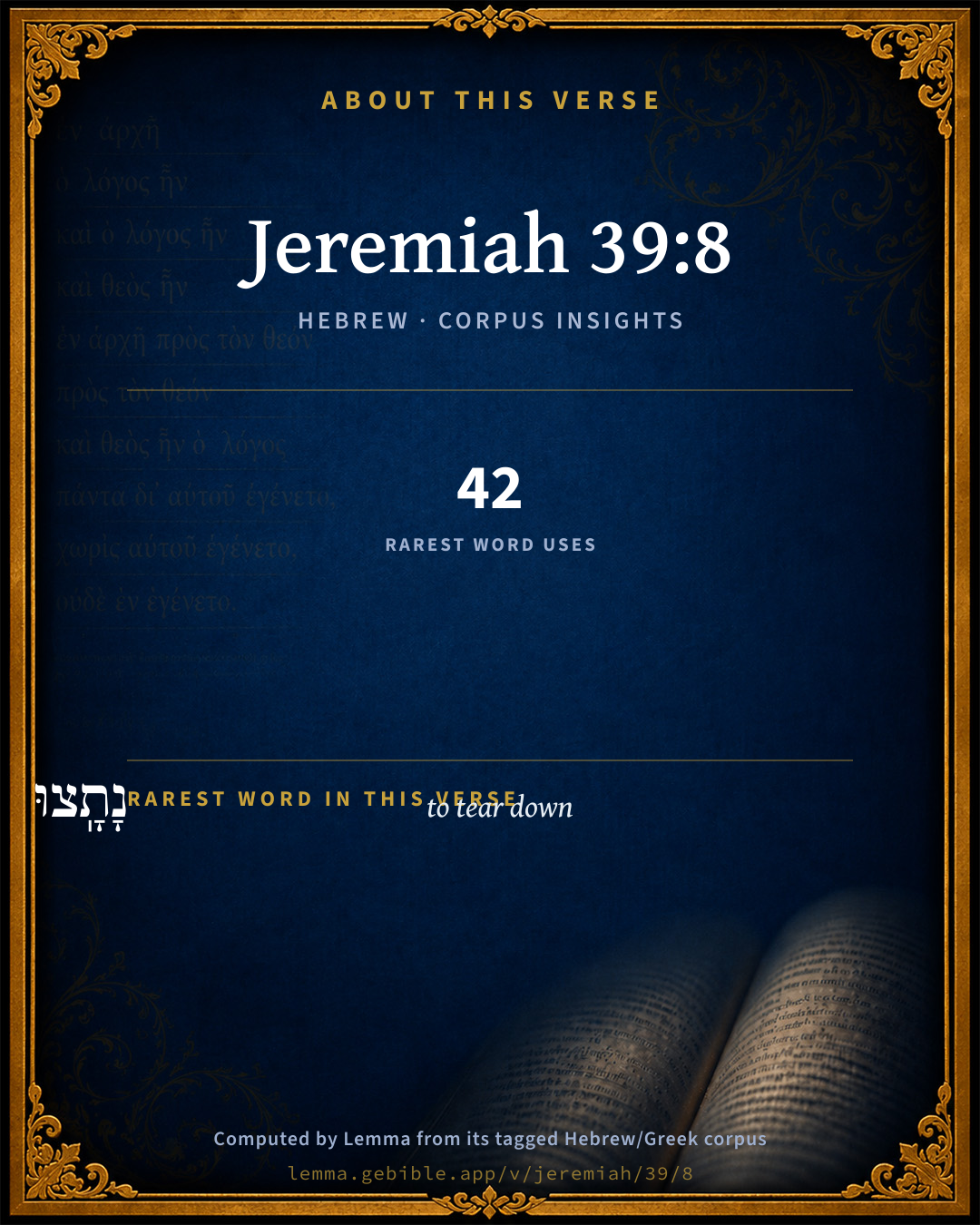
נָתָֽצוּ
nâthats
H5422
“to tear down”
Verb, Qal, Perfect, 3rd Person, Common, Plural
Part of Speech
Verb
Stem
Qal
Form
Perfect
Person
3rd Person
Gender
Common
Number
Plural
Full BDB Definition

Origin: a primitive root

TWOT: 1446

to pull down, break down, cast down, throw down, beat down, destroy, overthrow, break out (teeth) - (Qal) - to pull down - to break down, break off - (Niphal) to be pulled or broken down - (Piel) to tear down - (Pual) to be torn down - (Hophal) to be broken, be broken down
  1. וְאֶת ʼêth H853 “and · -” Conjunction + Particle, Direct Object
  2. בֵּ֤ית bayith H1004 “house of” Noun, Common, Masculine, Singular, Construct
  3. הַמֶּ֨לֶךְ֙ melek H4428 “the · king” Particle, Definite Article + Noun, Common, Masculine, Singular, Absolute
  4. וְאֶת ʼêth H853 “and · -” Conjunction + Particle, Direct Object
  5. בֵּ֣ית bayith H1004 “house of” Noun, Common, Masculine, Singular, Construct
  6. הָעָ֔ם ʻam H5971 “the · people” Particle, Definite Article + Noun, Common, Masculine, Singular, Absolute
  7. שָׂרְפ֥וּ sâraph H8313 “to burn” Verb, Qal, Perfect, 3rd Person, Common, Plural
  8. הַכַּשְׂדִּ֖ים Kasdîy H3778 “the · Chaldea” Particle, Definite Article + Noun, Proper
  9. בָּאֵ֑שׁ ʼêsh H784 “in/at the · fire” Preposition, Determined + Noun, Common, Both, Singular, Absolute
  10. וְאֶת ʼêth H853 “and · -” Conjunction + Particle, Direct Object
  11. חֹמ֥וֹת chôwmâh H2346 “walls of” Noun, Common, Feminine, Plural, Construct
  12. יְרוּשָׁלִַ֖ם Yᵉrûwshâlaim H3389 “Jerusalem” Noun, Proper

About this verse

These counts appear in no published source. They are computed here, from the morphology-tagged text and Lemma’s own curated glosses. What Lemma adds →

13
words
10
distinct lemmas
Prophets
section

Shared distinctive vocabulary

נָתָֽצוּ to tear down H5422 occurs in 41 verses of the Hebrew Bible. Also found in:

Grammatical profile

  • 2 verbs
  • 8 nouns
  • 3 particles

Verb forms

  • שָׂרְפ֥וּ Qal · Perfect
  • נָתָֽצוּ Qal · Perfect

Repetition

A word recurs within this verse — often emphatic in Hebrew:

  • בֵּ֤ית house H1004 ×2

Cross-references

18

Topical passages linked to Jeremiah 39:8 in the Treasury of Scripture Knowledge — connected by theme and wording, ordered by reader-vote popularity; previews shown in the World English Bible.

  • Nehemiah 1:3 They said to me, The remnant who are left of the captivity there in the province are in great affliction and reproach: the wall of Jerusalem also is broken down, and the gates of it are burned with fire.
  • Jeremiah 21:10 For I have set my face on this city for evil, and not for good, says Yahweh: it shall be given into the hand of the king of Babylon, and he shall burn it with fire.
  • Jeremiah 38:18 But if you will not go forth to the king of Babylon's princes, then shall this city be given into the hand of the Chaldeans, and they shall burn it with fire, and you shall not escape out of their hand.
  • 2 Kings 25:9–10 He burnt the house of Yahweh, and the king's house; and all the houses of Jerusalem, even every great house, burnt he with fire.
  • Jeremiah 52:13–14 and he burned the house of Yahweh, and the king's house; and all the houses of Jerusalem, even every great house, burned he with fire.
  • Micah 3:12 Therefore Zion for your sake will be plowed like a field, And Jerusalem will become heaps of rubble, And the mountain of the temple like the high places of a forest.
  • 2 Chronicles 36:19 They burnt the house of God, and broke down the wall of Jerusalem, and burnt all the palaces of it with fire, and destroyed all the goodly vessels of it.
  • Isaiah 5:9 In my ears, Yahweh of Hosts says: "Surely many houses will be desolate, Even great and beautiful, unoccupied.
  • Jeremiah 7:20 Therefore thus says the Lord Yahweh: Behold, my anger and my wrath shall be poured out on this place, on man, and on animal, and on the trees of the field, and on the fruit of the ground; and it shall burn, and shall not be quenched.
  • Jeremiah 9:10–12 For the mountains will I take up a weeping and wailing, and for the pastures of the wilderness a lamentation, because they are burned up, so that none passes through; neither can men hear the voice of the cattle; both the birds of the sky and the animals are fled, they are gone.
  • Jeremiah 17:27 But if you will not listen to me to make the Sabbath day holy, and not to bear a burden and enter in at the gates of Jerusalem on the Sabbath day; then will I kindle a fire in the gates of it, and it shall devour the palaces of Jerusalem, and it shall not be quenched.
  • Jeremiah 34:2 Thus says Yahweh, the God of Israel, Go, and speak to Zedekiah king of Judah, and tell him, Thus says Yahweh, Behold, I will give this city into the hand of the king of Babylon, and he shall burn it with fire:
  • Jeremiah 34:22 Behold, I will command, says Yahweh, and cause them to return to this city; and they shall fight against it, and take it, and burn it with fire: and I will make the cities of Judah a desolation, without inhabitant.
  • Jeremiah 37:10 For though you had struck the whole army of the Chaldeans who fight against you, and there remained but wounded men among them, yes would they rise up every man in his tent, and burn this city with fire.
  • Lamentations 1:10 The adversary has spread out his hand on all her pleasant things: For she has seen that the nations are entered into her sanctuary, Concerning whom you did command that they should not enter into your assembly.
  • Lamentations 2:2 The Lord has swallowed up all the habitations of Jacob, and has not pitied: He has thrown down in his wrath the strongholds of the daughter of Judah; He has brought them down to the ground; he has profaned the kingdom and the princes of it.
  • Lamentations 2:7 The Lord has cast off his altar, he has abhorred his sanctuary; He has given up into the hand of the enemy the walls of her palaces: They have made a noise in the house of Yahweh, as in the day of a solemn assembly.
  • Amos 2:5 But I will send a fire on Judah, And it will devour the palaces of Jerusalem."

Cross-references courtesy of OpenBible.info (CC BY 4.0).

Hebrew and Greek witnesses Masoretic Hebrew ↔ Greek Septuagint

The same verse in the two great witnesses to the Old Testament, shown verse-for-verse.

These are two independent witnesses, not word-aligned to each other, and the Septuagint is shown in lemma (dictionary) form.

Hebrew Jeremiah 39:8 Masoretic · Westminster Leningrad Codex

וְאֶת בֵּ֤ית הַמֶּ֨לֶךְ֙ וְאֶת בֵּ֣ית הָעָ֔ם שָׂרְפ֥וּ הַכַּשְׂדִּ֖ים בָּאֵ֑שׁ וְאֶת חֹמ֥וֹת יְרוּשָׁלִַ֖ם נָתָֽצוּ

The Chaldeans burned the king's house, and the houses of the people, with fire, and broke down the walls of Jerusalem.

World English Bible · Public Domain

Greek LXX Structure differs

In the Septuagint, Jeremiah is about an eighth shorter than the Hebrew and arranges its material differently — the Oracles Against the Nations (Hebrew chapters 46–51) appear in the middle of the Greek book, after 25:13. Because the chapter and verse boundaries do not line up, a verse-for-verse comparison with the Hebrew is not shown.

A verse-for-verse comparison isn’t shown here because the chapters and verses don’t line up. Switch to the LXX edition with the MT / LXX toggle above to read the Greek directly.

Hebrew: Westminster Leningrad Codex (CC BY 4.0). Greek: Septuagint (public domain); English from a public-domain English Septuagint. How the Septuagint differs from the Hebrew →

Targum (Aramaic paraphrase)

1

The Targum is the ancient Jewish Aramaic paraphrase of the Hebrew Scriptures — an interpretive translation, not the Hebrew text itself. Onkelos (literal) and Pseudo-Jonathan (expansive) render the Torah, and Jonathan the Prophets. Coverage is partial: where no permissively-licensed English translation exists for a verse, only the Aramaic is shown. This is verse-level text, not a word-by-word alignment to the Hebrew.

  1. Targum Jonathan Prophets (Joshua–Malachi)
    וְיַת בֵּית מַלְכָּא וְיַת בֵּית עַמָא אוֹקִידוּ כַּסְדָאֵי בְּנוּרָא וְיַת שׁוּרֵי יְרוּשְׁלֵם תָּרָעוּ:

    (no public-domain English translation for this verse)

    Targum Jonathan — Aramaic: “Mikraot Gedolot” (public domain). English: “Sefaria Community Translation” (CC0 1.0 (public-domain dedication)); “London "Chaldee Paraphrase," 1871” (public domain). Text via Sefaria.

Commentary

Notes on Jeremiah 39:8 from classic Christian and Jewish commentators (each source and its license shown beneath its notes). The classic Christian expositions comment on the surrounding passage and are grouped to its opening verse, so a note may address several verses; the Jewish commentaries on the Tanakh (Rashi and others) are per-verse, so they appear only where the commentator wrote on this verse.

Lemma curates 59 commentaries, every one of them public domain or Creative Commons licensed, each selected and text-cleaned for this edition rather than reprinted as found. About our sources →

Trapp's Complete Commentary

John Trapp

Jer 39:8 And the Chaldeans burned the king’s house, and the houses of the people, with fire, and brake down the walls of Jerusalem.

Ver. 8. See on 2Ki 25:8.

John Trapp, A Commentary or Exposition upon All the Books of the Old and New Testament (1647–1656) — public domain. Text from a community e-Sword module.

Jamieson, Fausset & Brown

Robert Jamieson, A. R. Fausset & David Brown

burned . . . the houses-- (Jer 52:12-13). Not immediately after the taking of the city, but in the month after, namely, the fifth month (compare Jer 39:2). The delay was probably caused by the princes having to send to Riblah to know the king's pleasure as to the city.

Jamieson, Fausset & Brown — Commentary Critical and Explanatory on the Whole Bible (1871) — public domain (CC PDM 1.0). Text via the HelloAO Bible API.

John Calvin's Commentaries

Here also the Prophet shews that whatever he had predicted was fulfilled, so that nothing was wanting to render faith sure and fixed. He had said, as we have seen, that if Zedekiah surrendered himself of his own accord, the houses in the city would not be burnt. Zedekiah thought this all vain, or at least he closed up his ears. He now heard, though he was blind, that God had declared nothing in vain by the mouth of Jeremiah; for his palace was burnt, and also all the other houses.

He put בית, bith, in the second clause, the singular for the plural; and so there is here an enallage, for it was not only one house of the people that was burnt, but the fire consumed all the houses. We at last come to the walls, which were beaten down; and thus the city was destroyed as Jeremiah had predicted. It follows, —

John Calvin's Commentaries (1540-1563) — public domain. Text from the Calvin Translation Society English edition (1840s-50s) via the Christian Classics Ethereal Library (ccel.org). Calvin's coverage is partial (roughly two-thirds of the Bible); uncommented books and verses are honest gaps, never fabricated. The 19th-century editor's footnotes and remarks are omitted so the notes are faithfully Calvin's own voice.

Ellicott's Commentary for English Readers

(8) And the Chaldeans burned the king’s house.—In the fuller account of Jer_52:12, we find that this was the work of Nebuzar-adan, who had been sent by Nebuchadnezzar, on hearing of the capture of the city, and that it included the destruction of the Temple as well as the palace.

A Bible Commentary for English Readers, edited by Charles John Ellicott (1878–1897) — public domain. Text from a community e-Sword module.

John Gill's Exposition

And the Chaldeans burnt the king's house,.... His palace: this was a month after the city was taken, as appears from Jer 52:12;

and the houses of the people, with fire; the houses of the common people, as distinct from the king's house, and the houses of the great men, Jer 52:13; though Jarchi interprets of the synagogues. It is in the original text in the singular number, "the house of the people"; which Abarbinel understands of the temple, called, not the house of God, he having departed from it; but the house of the people, a den of thieves; according to Adrichomius (k), there was a house in Jerusalem called "the house of the vulgar", or common people, where public feasts and sports were kept; but the former sense seems best:

and broke down the walls of Jerusalem; demolished all the fortifications of it, and entirely dismantled it, that it might be no more a city of force and strength, as it had been.

(k) Theatrum Terrae Sanct. p. 154.

John Gill's Exposition of the Whole Bible (1746–1763) — public domain (CC PDM 1.0). Text via the HelloAO Bible API.

Matthew Poole's English Annotations

Still it is observable how punctual the Holy Ghost is in recording the fulfillings of the words of the Lord. This prophet had at least four times foretold that this would be one consequent of the king’s and nobles’ stubbornness, in not submitting to the king of Babylon. See Jer 37:8; 38:18,23.

Matthew Poole's English Annotations on the Holy Bible (1683–1685) — public domain. Text from a community e-Sword/MySword module.

The Pulpit Commentary

Vers. 8-10. See homily on Jer_52:8-16

The Pulpit Commentary (1880–1919), ed. H.D.M. Spence-Jones & Joseph S. Exell — public domain. Text from a community e-Sword module.

unfoldingWord translationNotes

Door43 World Missions Community

the king's house

Zedekiah's house

the people's houses

the houses that had belonged to the people of Jerusalem

Nebuzaradan

This is the name of a man. (See: How to Translate Names)

the king's bodyguards

"Nebuchadnezzar's guards"

the rest of the people who were left in the city

This is probably a generalization. AT: "the people who were still living in the city" (See: Hyperbole and Generalization)

who had nothing for themselves

The word "nothing" is probably an exaggeration. AT: "who owned nothing of great value" (See: Hyperbole and Generalization)

translationWords

exile

people group

vineyard

unfoldingWord translationNotes — © Distant Shores Media and the Door43 World Missions Community, licensed CC BY-SA 4.0. Source: git.door43.org/Door43/en_tn.

Rashi

Rabbi Shlomo Yitzchaki (Rashi)

the houses of the people The synagogues.

Rashi on the Tanakh — English translations: “The Judaica Press complete Tanach with Rashi, translated by A. J. Rosenberg” (CC BY 4.0); “Pentateuch with Rashi's commentary by M. Rosenbaum and A.M. Silbermann, 1929-1934” (public domain); “The Metsudah Tanach series, Lakewood, N.J” (CC BY 4.0); and “The Book of Joshua, Metsudah Publications, 1997” (CC BY 4.0). Text via Sefaria.

Lesson kit

Teaching starters — assembled from the data on this page, not authored interpretation. Every prompt links to the verse data it draws on. Edit before teaching.

Jeremiah, in the Prophets, opens this verse with 13 words (10 distinct Hebrew lemmas). Its most distinctive word is nâthats (“to tear down”). A historical commentator’s framing appears above. Read the whole chapter for the surrounding context.

Discussion questions

  1. How does “to tear down” (nâthats) shape what this verse is saying?
  2. How does Exodus 34:13, which shares the word «to tear down», read alongside this verse?
  3. What does the repetition of “house” (2× in this one verse) do in this verse?
  4. These translations render this verse differently. What is at stake in choosing one wording over another?
  5. «שָׂרְפ֥וּ» is a Qal Perfect verb. How does that grammatical form shape the action described?
  6. Compare how Trapp's Complete Commentary and Jamieson, Fausset & Brown read this verse. Where do they agree or differ?

Things to notice

Reading settings

Reading text

Shown beneath each verse's original-language words.

Old Testament
Old Testament edition

Read the OT as the Masoretic Hebrew (MT) or the Greek Septuagint (LXX).

English shown for the Greek Septuagint (in the Hebrew ↔ Greek comparison).

Comparing translations? Open the Compare panel on any verse page to stack up to four side by side.