
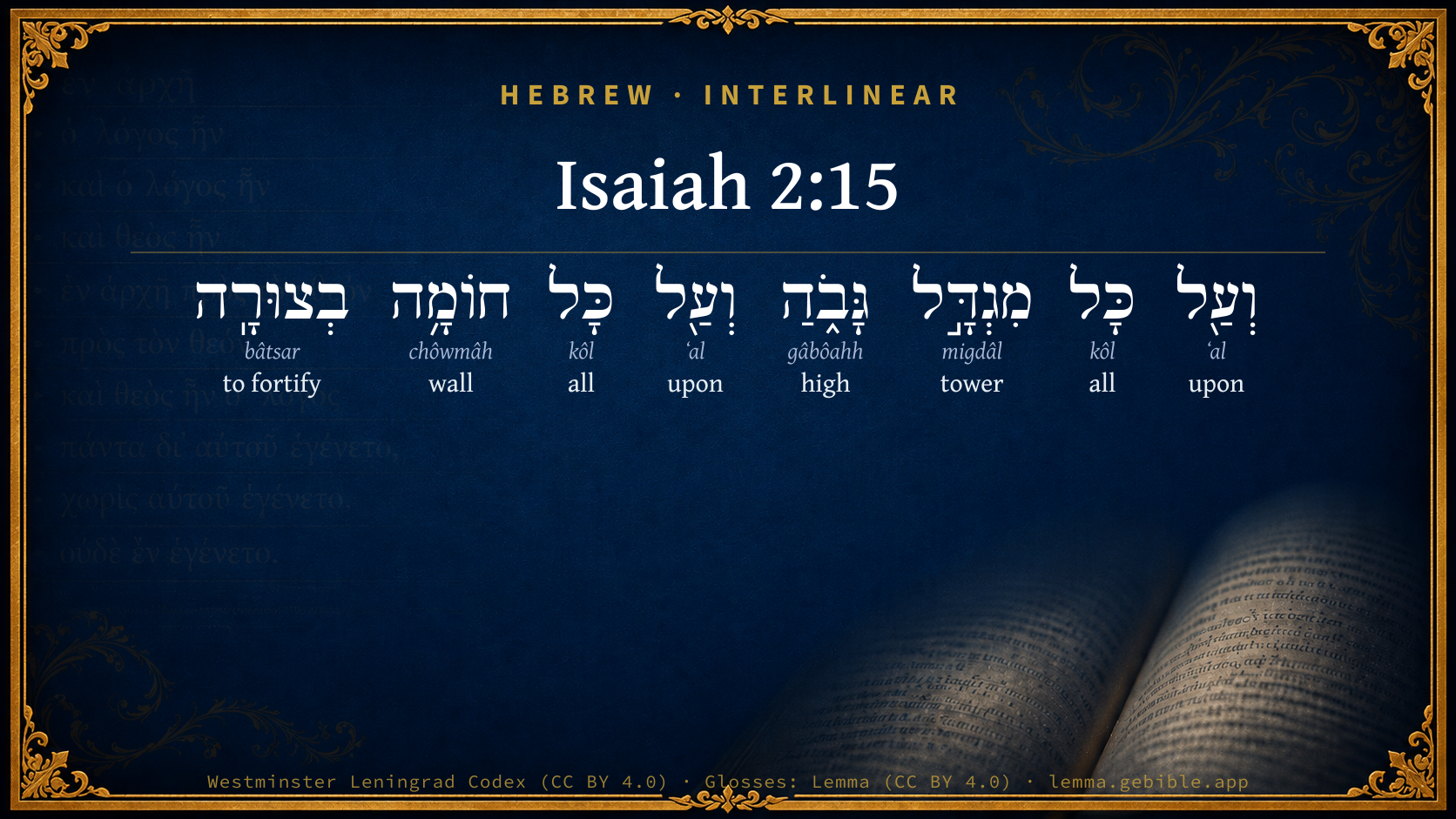
Isaiah 2:15

Hebrew (Westminster Leningrad Codex) Isaiah 2:15 appears in the Hebrew Old Testament. The text above is from the Westminster Leningrad Codex. Each word links to its Strong’s number, a concise gloss, and parsing drawn from the Open Scriptures Hebrew Bible morphology. Click any word for its full Brown-Driver-Briggs (BDB) entry.
Download image
Cite this verse

Isaiah 2:15 (World English Bible). Public Domain. Lemma interlinear Bible study tool, https://lemma.gebible.app/v/isaiah/2/15.

Show BibTeX & RIS
BibTeX
RIS
English Translation
For every lofty tower, For every fortified wall,
World English Bible · Public Domain
Download a study sheet

One document with this verse’s original text, its word-by-word gloss line, the meaning frame, cross-references with their text, attributed commentary, and full source and license credits — printable, and it pastes into notes with its structure intact.

This verse Autodidact and up

Study sheet (.html) Plain text (.txt)

A passage Seminary Student

Up to 50 verses in one chapter. A passage sheet keeps up to 6 commentary sources and 12 cross-references per verse, in the order this page ranks them, and says so on the sheet whenever that leaves anything out. Ask for a single verse and you get the Autodidact verse sheet above.

Everything on this page stays free to read, with no account — the sheet is a download of what is already on screen, not access to it.

Want to remove ads? Support Godless Engineer
Compare translations 3

The same verse in 3 English versions, stacked beneath the original-language interlinear above. Click any original word for its lexicon entry.

Each is an independent rendering of the whole verse — the interlinear is not word-aligned to these translations.

Highlighted words mark where these versions differ — a whole-verse word diff, not a word-by-word alignment.

  • World English Bible Public Domain
    For every lofty tower, For every fortified wall,
  • King James Version Public Domain
    And upon every high tower, and upon every fenced wall,
  • unfoldingWord Literal Text CC BY-SA 4.0
    and against every high tower, and against every fortified wall,

unfoldingWord Literal Text — © unfoldingWord, licensed CC BY-SA 4.0. Word-aligned USFM3 via Door43 (git.door43.org/unfoldingWord/en_ult).

Versions to compare (up to 4)

3 of 4 selected

Show all 18 translations

Every available English version of this verse, each an independent rendering of the whole verse.

  • World English Bible Public Domain
    For every lofty tower, For every fortified wall,
  • Berean Standard Bible Public Domain
    against every high tower, against every fortified wall,
  • Majority Standard Bible Public Domain
    against every high tower, against every fortified wall,
  • King James Version Public Domain
    And upon every high tower, and upon every fenced wall,
  • American Standard Version (1901) Public Domain
    and upon every lofty tower, and upon every fortified wall,
  • Revised Version (1885) Public Domain
    and upon every lofty tower, and upon every fenced wall;
  • Geneva Bible (1599) Public Domain
    And vpon euery hie tower, and vpon euery strong wall,
  • Douay-Rheims (1899) Public Domain
    And upon every high tower, and every fenced wall.
  • Young's Literal Translation Public Domain
    And for every high tower, And for every fenced wall,
  • Literal Standard Version CC BY-SA 4.0
    And for every high tower, || And for every fortified wall,
  • Unlocked Literal Bible CC BY-SA 4.0
    and against every high tower, and against every impregnable wall,
  • unfoldingWord Literal Text CC BY-SA 4.0
    and against every high tower, and against every fortified wall,
  • Darby Bible Public Domain
    and upon every high tower, and upon every fenced wall;
  • World Messianic Bible Public Domain
    for every lofty tower, for every fortified wall,
  • Webster's Bible Public Domain
    And upon every high tower, and upon every fortified wall,
  • Free Bible Version CC BY-SA 4.0
    He will tear down every high tower and every defensive wall.
  • Bible in Basic English Public Domain
    And on every high tower, and on every strong wall;
  • JPS Tanakh (1917) Public Domain
    And upon every lofty tower, and upon every fortified wall;

Literal Standard Version (2020), Covenant Press — licensed CC BY-SA 4.0. Text via the HelloAO Bible API (eBible.org). Unlocked Literal Bible (unfoldingWord) — licensed CC BY-SA 4.0. Text via the HelloAO Bible API (eBible.org). unfoldingWord Literal Text — © unfoldingWord, licensed CC BY-SA 4.0. Word-aligned USFM3 via Door43 (git.door43.org/unfoldingWord/en_ult). Free Bible Version, Dr. Jonathan Gallagher — licensed CC BY-SA 4.0. Text via the HelloAO Bible API (eBible.org).

Word by word

More ways to search: Search by grammar → Find every occurrence → Compare this word →

Practice this passage: Drill this verse → Learn its vocabulary →

About this verse

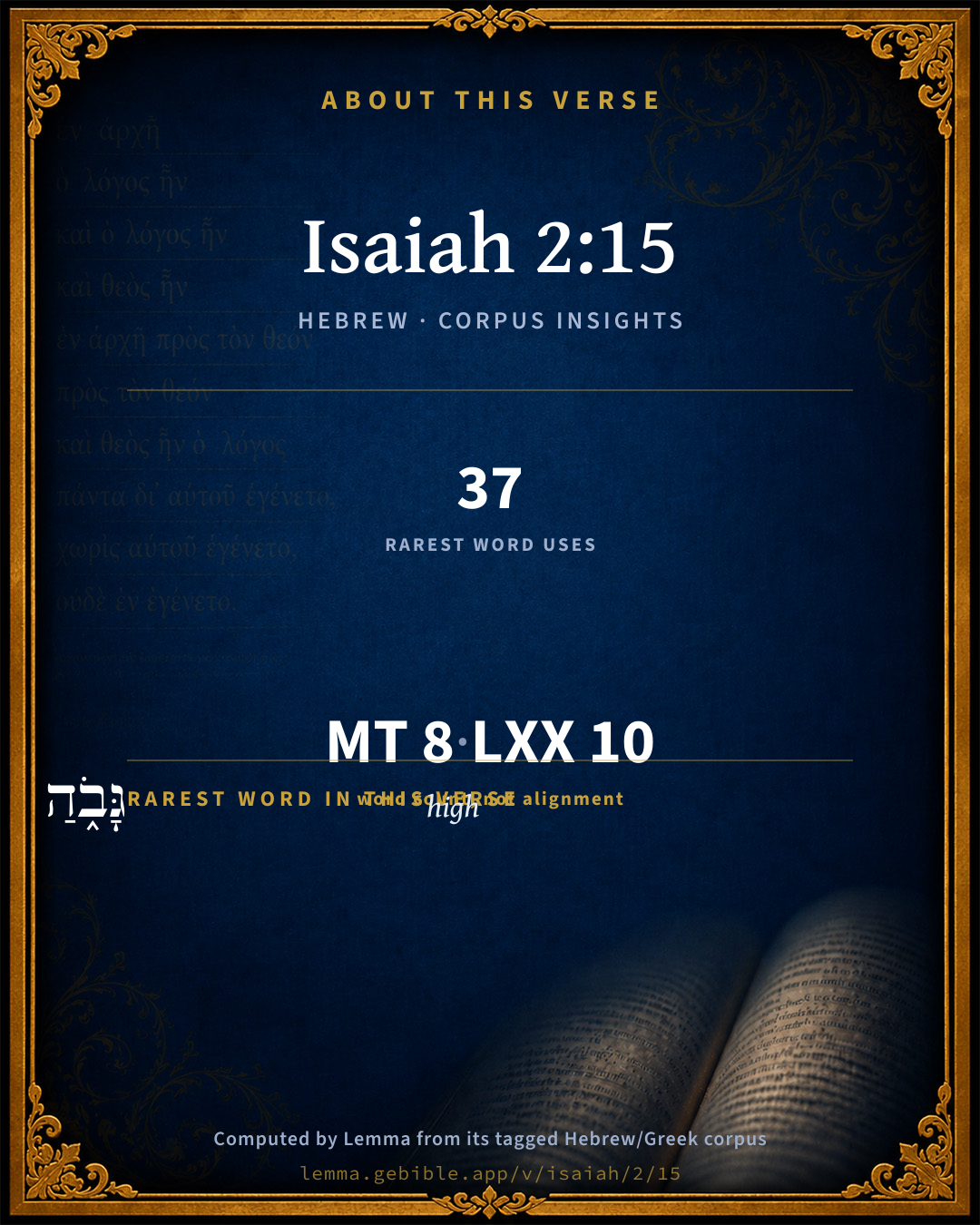
These counts appear in no published source. They are computed here, from the morphology-tagged text and Lemma’s own curated glosses. What Lemma adds →

8
words
6
distinct lemmas
Prophets
section

Shared distinctive vocabulary

גָּבֹ֑הַ high H1364 occurs in 32 verses of the Hebrew Bible. Also found in:

Grammatical profile

  • 4 nouns
  • 2 adjectives
  • 2 prepositions

Repetition

Words recur within this verse — often emphatic in Hebrew:

  • וְעַ֖ל upon H5921 ×2
  • כָּל all H3605 ×2

Hebrew & Septuagint length

In English translation the verse runs 8 words from the Hebrew and 10 from the Septuagint (LXX English) — closely comparable.

A rough comparison of the two English renderings, which tokenize alike — not a word-level alignment.

Word counts can differ between the Hebrew and the Greek without any difference in meaning — e.g. the Hebrew direct-object marker אֵת has no separate Greek word, and Greek often adds the article ὁ.

In the original languages it is 8 Hebrew tokens and 10 Greek tokens — but the two are counted differently (Hebrew bundles its prefixes and suffixes into one token; the Greek is in lemma form), so that isn’t a like-for-like length.

Cross-references

1

Topical passages linked to Isaiah 2:15 in the Treasury of Scripture Knowledge — connected by theme and wording, ordered by reader-vote popularity; previews shown in the World English Bible.

  • Isaiah 25:12 The high fortress of your walls has he brought down, laid low, and brought to the ground, even to the dust.

Cross-references courtesy of OpenBible.info (CC BY 4.0).

Hebrew and Greek witnesses Masoretic Hebrew ↔ Greek Septuagint

The same verse in the two great witnesses to the Old Testament, shown verse-for-verse.

These are two independent witnesses, not word-aligned to each other, and the Septuagint is shown in lemma (dictionary) form.

Hebrew Isaiah 2:15 Masoretic · Westminster Leningrad Codex

וְעַ֖ל כָּל מִגְדָּ֣ל גָּבֹ֑הַ וְעַ֖ל כָּל חוֹמָ֥ה בְצוּרָֽה

For every lofty tower, For every fortified wall,

World English Bible · Public Domain

Greek LXX Isaiah 2:15 Septuagint · lemma form

καί ἐπί πᾶς πύργος ὑψηλός καί ἐπί πᾶς τεῖχος ὑψηλός

and upon every high tower, and upon every high wall,

LXX2012 (modern English Septuagint) · Public Domain

On this verse, John Gill's Exposition discusses the Septuagint’s reading. Read the note in Commentary ↓

Hebrew: Westminster Leningrad Codex (CC BY 4.0). Greek: Septuagint (public domain); English from LXX2012 (modern English Septuagint) (Public Domain). How the Septuagint differs from the Hebrew →

Targum (Aramaic paraphrase)

1

The Targum is the ancient Jewish Aramaic paraphrase of the Hebrew Scriptures — an interpretive translation, not the Hebrew text itself. Onkelos (literal) and Pseudo-Jonathan (expansive) render the Torah, and Jonathan the Prophets. Coverage is partial: where no permissively-licensed English translation exists for a verse, only the Aramaic is shown. This is verse-level text, not a word-by-word alignment to the Hebrew.

  1. Targum Jonathan Prophets (Joshua–Malachi)
    וְעַל כָל דְיָתְבִין בְּמִגְדָל רָם וְעַל כָּל דְשָׁרָן בְּשׁוּר כָּרִיךְ:

    And upon all that dwell in a high tower; and upon all who dwell within fortified walls;

    Targum Jonathan — Aramaic: “Mikraot Gedolot” (public domain). English: “Sefaria Community Translation” (CC0 1.0 (public-domain dedication)); “London "Chaldee Paraphrase," 1871” (public domain). Text via Sefaria.

Commentary

Notes on Isaiah 2:15 from classic Christian and Jewish commentators (each source and its license shown beneath its notes). The classic Christian expositions comment on the surrounding passage and are grouped to its opening verse, so a note may address several verses; the Jewish commentaries on the Tanakh (Rashi and others) are per-verse, so they appear only where the commentator wrote on this verse.

Lemma curates 59 commentaries, every one of them public domain or Creative Commons licensed, each selected and text-cleaned for this edition rather than reprinted as found. About our sources →

Trapp's Complete Commentary

John Trapp

Isa 2:15 And upon every high tower, and upon every fenced wall,

Ver. 15. And upon every high tower.] In these the Jews trusted, as sure help in time of distress, but all in vain.

John Trapp, A Commentary or Exposition upon All the Books of the Old and New Testament (1647–1656) — public domain. Text from a community e-Sword module.

Jamieson, Fausset & Brown

Robert Jamieson, A. R. Fausset & David Brown

tower . . . wall--Towers were often made on the walls of cities.

fenced--strongly fortified.

Jamieson, Fausset & Brown — Commentary Critical and Explanatory on the Whole Bible (1871) — public domain (CC PDM 1.0). Text via the HelloAO Bible API.

Adam Clarke's Commentary

Verse 15. See Clarke on Isa 2:13.

Adam Clarke's Commentary on the Bible (1810–1826) — public domain. Text from a community e-Sword/MySword module.

Ellicott's Commentary for English Readers

(15) Upon every high tower.—Generic as the words are, they have a special reference to the fortifications which were the glory of Uzziah’s reign, and were continued by his successors (2Ch_26:9-10; 2Ch_27:3-4; Hos_8:14; Mic_5:11; comp. also Isa_22:8-11, Psa_48:13).

A Bible Commentary for English Readers, edited by Charles John Ellicott (1878–1897) — public domain. Text from a community e-Sword module.

The Cambridge Bible for Schools and Colleges

gen. ed. J. J. S. Perowne

15, 16. Works of human art are last mentioned as being nearer to the sinful pride of man, which is the ultimate cause of the judgment.

The Cambridge Bible for Schools and Colleges (gen. ed. J. J. S. Perowne; Cambridge University Press, 1878–1918) — public domain. Text from a community e-Sword module.

John Gill's Exposition

And upon all the ships of Tarshish,.... Upon all the merchants and merchandises of Rome. The Targum is,

"and upon all that dwell in the islands of the sea.''

See Rev 16:20. Tarshish, as Vitringa observes, designs Tartessus or Gades in Spain, which must bring to mind the memorable destruction of the Spanish Armada in 1558, as he also notes.

And upon all pleasant pictures; of Christ and the Virgin Mary, of angels, and of saints departed, the Papists make use of to help their devotion. The Targum is,

"and upon all that dwell in beautiful palaces;''

such as those of the pope and his cardinals at Rome, and of archbishops and bishops at other places. The Septuagint version is, "and upon all the sight of the beauty of ships"; such were the ships of the Phoenicians, which were very much ornamented, and beautiful to behold.

John Gill's Exposition of the Whole Bible (1746–1763) — public domain (CC PDM 1.0). Text via the HelloAO Bible API.

Albert Barnes' Notes on the Bible

Every high tower - Towers, or fortresses, were erected for defense and protection. They were made on the walls of cities, for places of observation (compare the note at Isa 21:5), or in places of strength, to be a refuge for an army, and to be a point from which they might sally out to attack their enemies. They were “high” to afford a defense against being scaled by an enemy, and also that from the top they might look abroad for observation; and also to annoy an enemy from the top, when the foe approached the walls of a city.

Every fenced wall - הומה בצוּרה betsûrâh hômâh. The word “fenced,” בצוּרה betsûrâh, is from בצר bâtsar, to make inaccessible, and hence, to fortify. It denotes a wall that is inaccessible, or strongly fortified. Cities were commonly surrounded by high and strong walls to defend them from enemies. The sense is, God would overturn all their strong places of refuge and defense.

Albert Barnes' Notes on the Bible (1834–1885) — public domain. Text from a community e-Sword/MySword module.

Matthew Poole's English Annotations

To which you resorted and trusted for your defence.

Matthew Poole's English Annotations on the Holy Bible (1683–1685) — public domain. Text from a community e-Sword/MySword module.

Whedon's Commentary on the Bible

Daniel D. Whedon

15. High tower — Uzziah had filled the land with these, and with fenced walls of cities and towns; at Jerusalem especially. 2Ch_26:9; Deu_28:52; Hos_8:14.

Daniel D. Whedon (gen. ed.), Commentary on the Old and New Testaments (1874–1909) — public domain. Text from a community e-Sword module.

The Pulpit Commentary

Upon every high tower. Uzziah and. Jotham had, both of them, paid much attention to fortifications, and had especially "built towers," both at Jerusalem and in other parts of Judaea. (2Ch_26:9, 10 27:4) Isaiah means to pour contempt on these indications of "trust in an arm of flesh," and to say that they will be of no avail when the time of calamity arrives. Every fenced wall. "On the wall of Ophel" Jotham had "built much". (2Ch_27:3) Hosea (Hos_8:14) and Micah (Mic_4:11) also notice the trust of Judah in her fortresses, and threaten their destruction.

The Pulpit Commentary (1880–1919), ed. H.D.M. Spence-Jones & Joseph S. Exell — public domain. Text from a community e-Sword module.

John Wesley's Explanatory Notes

Wall - To which you trusted for your defense.

John Wesley, Explanatory Notes Upon the Whole Bible (1754–1765) — public domain. Text via the GEBible commentary corpus.

Keil & Delitzsch

C. F. Keil & F. Delitzsch

The glory of nature is followed by what is lofty and glorious in the world of men, such as magnificent fortifications, grand commercial buildings, and treasures which minister to the lust of the eye. "As upon every high tower, so upon every fortified wall. As upon all ships of Tarshish, so upon all works of curiosity." It was by erecting fortifications for offence and defence, both lofty and steep (bâzur, praeruptus, from bâzar, abrumpere, secernere), that Uzziah and Jotham especially endeavoured to serve Jerusalem and the land at large. The chronicler relates, with reference to Uzziah, in 2 Chron 26, that he built strong towers above "the corner-gate, the valley-gate, and the southern point of the cheesemakers' hollow," and fortified these places, which had probably been till that time the weakest points in Jerusalem; also that he built towers in the desert (probably in the desert between Beersheba and Gaza, to increase the safety of the land, and the numerous flocks which were pastured in the shephelah, i.e., the western portion of southern Palestine). With regard to Jotham, it is related in both the book of Kings (Kg2 15:32.) and the Chronicles, that he built the upper gate of the temple; and in the Chronicles (Ch2 27:1-9) that he fortified the 'Ofel, i.e., the southern spur of the temple hill, still more strongly, and built cities on the mountains of Judah, and erected castles and towers in the forests (to watch for hostile attacks and ward them off). Hezekiah also distinguished himself by building enterprises of this kind (Ch2 32:27-30). But the allusion to the ships of Tarshish takes us to the times of Uzziah and Jotham, and not to those of Hezekiah (as Psa 48:7 does to the time of Jehoshaphat); for the seaport town of Elath, which was recovered by Uzziah, was lost again to the kingdom of Judah during the reign of Ahaz. Jewish ships sailed from this Elath (Ailath) through the Red Sea and round the coast of Africa to the harbour of Tartessus, the ancient Phoenician emporium of the maritime region watered by the Baetis (Guadalquivir), which abounded in silver, and then returned through the Pillars of Hercules (the Straits of Gibraltar: vid., Duncker, Gesch. i. 312-315). It was to these Tartessus vessels that the expression "ships of Tarshish" primarily referred, though it was afterwards probably applied to mercantile ships in general. The following expression, "works of curiosity" (sechiyyoth hachemdah), is taken in far too restricted a sense by those who limit it, as the lxx have done, to the ships already spoken of, or understand it, as Gesenius does, as referring to beautiful flags. Jerome's rendering is correct: "et super omne quod visu pulcrum est" (and upon everything beautiful to look at); seciyyâh, from sâcâh, to look, is sight generally. The reference therefore is to all kinds of works of art, whether in sculpture or paintings (mascith is used of both), which delighted the observer by their imposing, tasteful appearance. Possibly, however, there is a more especial reference to curiosities of art and nature, which were brought by the trading vessels from foreign lands.

Keil & Delitzsch — Biblical Commentary on the Old Testament (1861–1891) — public domain (CC PDM 1.0). Text via the HelloAO Bible API. (Old Testament only.)

J. A. Alexander on Isaiah

Joseph Addison Alexander

To trees and hills he now adds walls and towers, as a third class of objects with which the ideas of loftiness and strength are commonly associated. “And upon every high tower and upon every fenced wall,” literally, cut off (i.e., rendered inaccessible by being fortified).

Joseph Addison Alexander, The Prophecies of Isaiah (1846–1847; New York: Scribner, 1870–1878) — public domain. Text from a community e-Sword module.

Ibn Ezra

Rabbi Abraham ibn Ezra

The tower. The tower on the royal palace..)

Ibn Ezra on the Tanakh — English translations: “Sefaria Community Translation” (CC0 1.0 (public-domain dedication)); “Yalkut, Sifsei Chachomim Chumash, Metsudah Publications, 2009” (CC BY 4.0); and “Commentary of Ibn Ezra on Isaiah - trans. by M. Friedlander, 1873” (public domain). Text via Sefaria.

Lesson kit

Teaching starters — assembled from the data on this page, not authored interpretation. Every prompt links to the verse data it draws on. Edit before teaching.

Isaiah, in the Prophets, opens this verse with 8 words (6 distinct Hebrew lemmas). Its most distinctive word is gâbôahh (“high”). A historical commentator’s framing appears above. Read the whole chapter for the surrounding context.

Discussion questions

  1. What does “high” (gâbôahh) contribute to the verse as a whole?
  2. How does Genesis 7:19, which shares the word «high», read alongside this verse?
  3. What does the repetition of “upon” (2× in this one verse) do in this verse?
  4. These translations render this verse differently; the difference is in the English rendering, not the original. What questions does that raise?
  5. Compare how Trapp's Complete Commentary and Jamieson, Fausset & Brown read this verse. Where do they agree or differ?

Things to notice

Reading settings

Reading text

Shown beneath each verse's original-language words.

Old Testament
Old Testament edition

Read the OT as the Masoretic Hebrew (MT) or the Greek Septuagint (LXX).

English shown for the Greek Septuagint (in the Hebrew ↔ Greek comparison).

Comparing translations? Open the Compare panel on any verse page to stack up to four side by side.