
Proverbs 18:11

Hebrew (Westminster Leningrad Codex) Proverbs 18:11 appears in the Hebrew Old Testament. The text above is from the Westminster Leningrad Codex. Each word links to its Strong’s number, a concise gloss, and parsing drawn from the Open Scriptures Hebrew Bible morphology. Click any word for its full Brown-Driver-Briggs (BDB) entry.
Download image
Cite this verse

Proverbs 18:11 (World English Bible). Public Domain. Lemma interlinear Bible study tool, https://lemma.gebible.app/v/proverbs/18/11.

Show BibTeX & RIS
BibTeX
RIS
English Translation
The rich man's wealth is his strong city, Like an unscalable wall in his own imagination.
World English Bible · Public Domain
Download a study sheet

One document with this verse’s original text, its word-by-word gloss line, the meaning frame, cross-references with their text, attributed commentary, and full source and license credits — printable, and it pastes into notes with its structure intact.

This verse Autodidact and up

Study sheet (.html) Plain text (.txt)

A passage Seminary Student

Up to 50 verses in one chapter. A passage sheet keeps up to 6 commentary sources and 12 cross-references per verse, in the order this page ranks them, and says so on the sheet whenever that leaves anything out. Ask for a single verse and you get the Autodidact verse sheet above.

Everything on this page stays free to read, with no account — the sheet is a download of what is already on screen, not access to it.

Want to remove ads? Support Godless Engineer
Compare translations 3

The same verse in 3 English versions, stacked beneath the original-language interlinear above. Click any original word for its lexicon entry.

Each is an independent rendering of the whole verse — the interlinear is not word-aligned to these translations.

Highlighted words mark where these versions differ — a whole-verse word diff, not a word-by-word alignment.

  • World English Bible Public Domain
    The rich man's wealth is his strong city, Like an unscalable wall in his own imagination.
  • King James Version Public Domain
    The rich man's wealth is his strong city, and as an high wall in his own conceit.
  • unfoldingWord Literal Text CC BY-SA 4.0
    The wealth of the rich one the city of his strength and like a wall set on high—in his imagination.

unfoldingWord Literal Text — © unfoldingWord, licensed CC BY-SA 4.0. Word-aligned USFM3 via Door43 (git.door43.org/unfoldingWord/en_ult).

Versions to compare (up to 4)

3 of 4 selected

Show all 18 translations

Every available English version of this verse, each an independent rendering of the whole verse.

  • World English Bible Public Domain
    The rich man's wealth is his strong city, Like an unscalable wall in his own imagination.
  • Berean Standard Bible Public Domain
    A rich man’s wealth is his fortified city; it is like a high wall in his imagination.
  • Majority Standard Bible Public Domain
    A rich man’s wealth is his fortified city; it is like a high wall in his imagination.
  • King James Version Public Domain
    The rich man's wealth is his strong city, and as an high wall in his own conceit.
  • American Standard Version (1901) Public Domain
    The rich man's wealth is his strong city, And as a high wall in his own imagination.
  • Revised Version (1885) Public Domain
    The rich man’s wealth is his strong city, and as an high wall in his own imagination.
  • Geneva Bible (1599) Public Domain
    The rich mans riches are his strong citie: and as an hie wall in his imagination.
  • Douay-Rheims (1899) Public Domain
    The substance of the rich man is the city of his strength, and as a strong wall compassing him about.
  • Young's Literal Translation Public Domain
    The wealth of the rich `is' the city of his strength, And as a wall set on high in his own imagination.
  • Literal Standard Version CC BY-SA 4.0
    The wealth of the rich [is] the city of his strength, || And as a wall set on high in his own imagination.
  • Unlocked Literal Bible CC BY-SA 4.0
    The wealth of the rich is his fortified city and in his imagination it is like a high wall.
  • unfoldingWord Literal Text CC BY-SA 4.0
    The wealth of the rich one the city of his strength and like a wall set on high—in his imagination.
  • Darby Bible Public Domain
    The rich man's wealth is his strong city, and as a high wall in his own imagination.
  • World Messianic Bible Public Domain
    The rich man’s wealth is his strong city, like an unscalable wall in his own imagination.
  • Webster's Bible Public Domain
    The rich man's wealth is his strong city, and as a high wall in his own conceit.
  • Free Bible Version CC BY-SA 4.0
    Rich people see their wealth as a fortified town—it's like a high wall in their imagination.
  • Bible in Basic English Public Domain
    The property of a man of wealth is his strong town, and it is as a high wall in the thoughts of his heart.
  • JPS Tanakh (1917) Public Domain
    The rich man's wealth is his strong city, and as a high wall in his own conceit.

Literal Standard Version (2020), Covenant Press — licensed CC BY-SA 4.0. Text via the HelloAO Bible API (eBible.org). Unlocked Literal Bible (unfoldingWord) — licensed CC BY-SA 4.0. Text via the HelloAO Bible API (eBible.org). unfoldingWord Literal Text — © unfoldingWord, licensed CC BY-SA 4.0. Word-aligned USFM3 via Door43 (git.door43.org/unfoldingWord/en_ult). Free Bible Version, Dr. Jonathan Gallagher — licensed CC BY-SA 4.0. Text via the HelloAO Bible API (eBible.org).

Word by word

More ways to search: Search by grammar → Find every occurrence → Compare this word →

Practice this passage: Drill this verse → Learn its vocabulary →

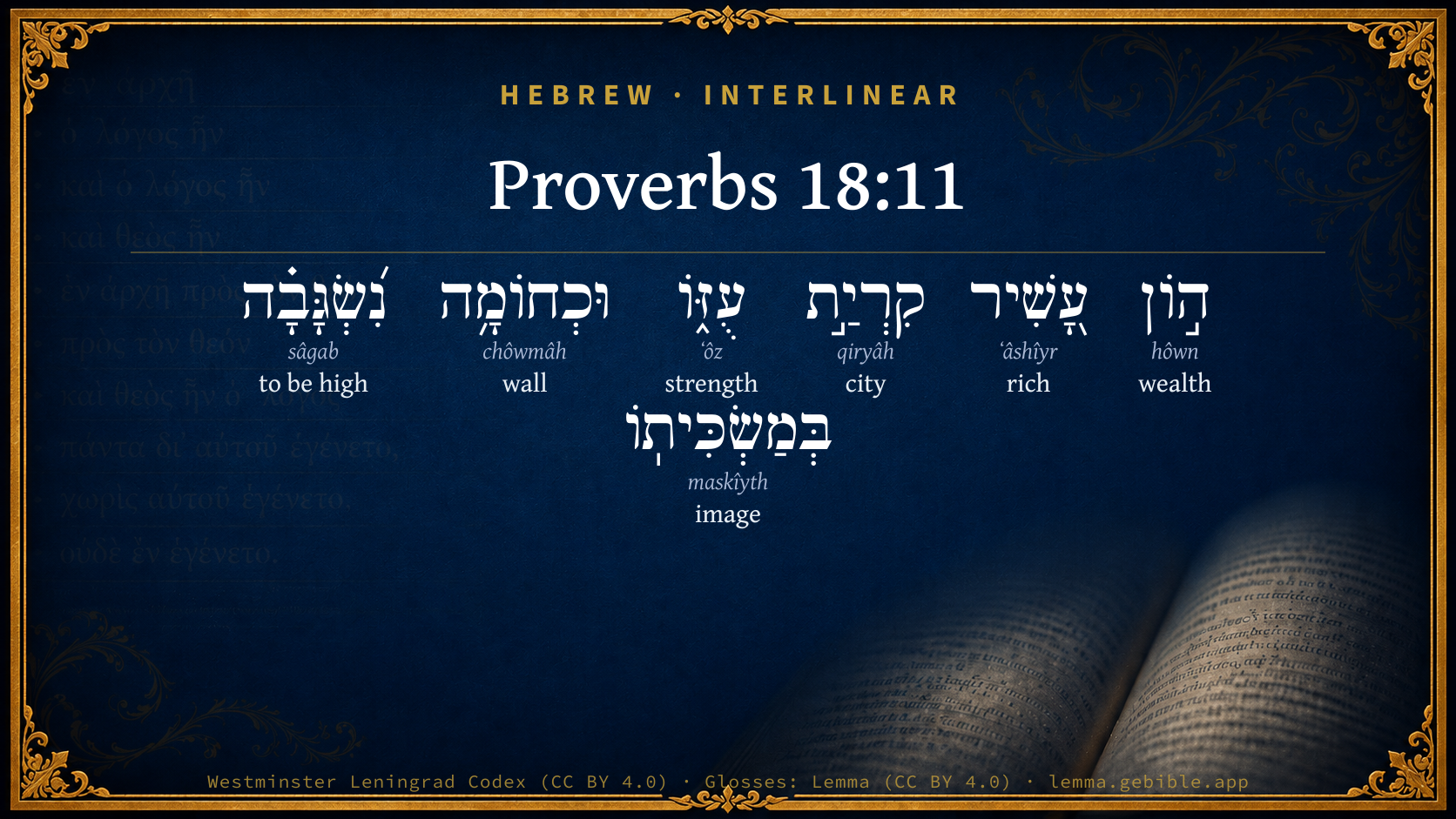
בְּמַשְׂכִּיתֽוֹ
maskîyth
H4906
“in/at · image · his”
Preposition + Noun, Common, Feminine, Singular, Construct + Suffix, Personal, 3rd Person, Masculine, Singular
Part of Speech
Preposition + Noun
Type
Common
Gender
Feminine
Number
Singular
State
Construct
Full BDB Definition

Origin: from the same as H7906

TWOT: 2257c

show-piece, figure, imagination, image, idol, picture - show-piece, carved figure (of idols) - imagination, conceit
  1. ה֣וֹן hôwn H1952 “wealth” Noun, Common, Masculine, Singular, Absolute
  2. עָ֭שִׁיר ʻâshîyr H6223 “rich” Adjective, Adjective, Masculine, Singular, Absolute
  3. קִרְיַ֣ת qiryâh H7151 “city of” Noun, Common, Feminine, Singular, Construct
  4. עֻזּ֑וֹ ʻôz H5797 “strength · his” Noun, Common, Masculine, Singular, Construct + Suffix, Personal, 3rd Person, Masculine, Singular
  5. וּכְחוֹמָ֥ה chôwmâh H2346 “and · like/as · wall” Conjunction + Preposition + Noun, Common, Feminine, Singular, Absolute
  6. נִ֝שְׂגָּבָ֗ה sâgab H7682 “being high” Verb, Niphal, Participle Active, Feminine, Singular, Absolute

About this verse

These counts appear in no published source. They are computed here, from the morphology-tagged text and Lemma’s own curated glosses. What Lemma adds →

7
words
7
distinct lemmas
Wisdom
section

Notable vocabulary

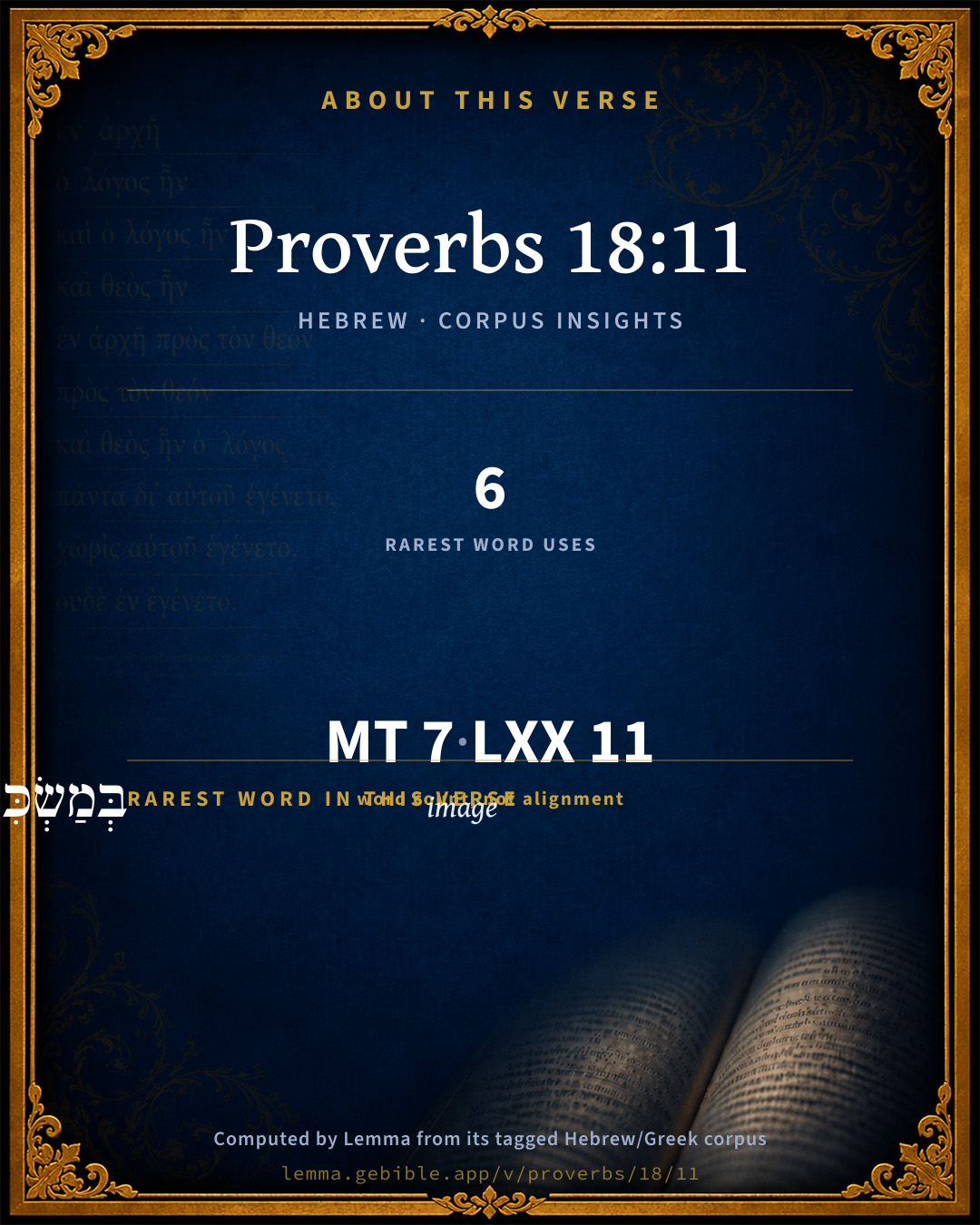
The rarest word here is בְּמַשְׂכִּיתֽוֹ image H4906 — appearing just 6 times in the whole Hebrew Bible.

Shared distinctive vocabulary

בְּמַשְׂכִּיתֽוֹ image H4906 occurs in 6 verses of the Hebrew Bible. Also found in:

Grammatical profile

  • 1 verb
  • 5 nouns
  • 1 adjective

Verb forms

  • נִ֝שְׂגָּבָ֗ה Niphal · Participle Active

Hebrew & Septuagint length

In English translation the verse runs 16 words from the Hebrew and 17 from the Septuagint (LXX English) — closely comparable.

A rough comparison of the two English renderings, which tokenize alike — not a word-level alignment.

Word counts can differ between the Hebrew and the Greek without any difference in meaning — e.g. the Hebrew direct-object marker אֵת has no separate Greek word, and Greek often adds the article ὁ.

In the original languages it is 7 Hebrew tokens and 11 Greek tokens — but the two are counted differently (Hebrew bundles its prefixes and suffixes into one token; the Greek is in lemma form), so that isn’t a like-for-like length.

Cross-references

9

Topical passages linked to Proverbs 18:11 in the Treasury of Scripture Knowledge — connected by theme and wording, ordered by reader-vote popularity; previews shown in the World English Bible.

  • Proverbs 10:15 The rich man's wealth is his strong city. The destruction of the poor is their poverty.
  • Psalms 52:5–7 God will likewise destroy you forever. He will take you up, and pluck you out of your tent, And root you out of the land of the living. Selah.
  • Ecclesiastes 7:12 For wisdom is a defense, even as money is a defense; but the excellency of knowledge is that wisdom preserves the life of him who has it.
  • Deuteronomy 32:31 For their rock is not as our Rock, Even our enemies themselves being judges.
  • Psalms 49:6–9 Those who trust in their wealth, And boast in the multitude of their riches--
  • Luke 12:19–21 I will tell my soul, "Soul, you have many goods laid up for many years. Take your ease, eat, drink, be merry."'
  • Job 31:24–25 "If I have made gold my hope, And have said to the fine gold, 'You are my confidence;'
  • Psalms 62:10–11 Don't trust in oppression. Don't become vain in robbery. If riches increase, Don't set your heart on them.
  • Proverbs 11:4 Riches don't profit in the day of wrath, But righteousness delivers from death.

Cross-references courtesy of OpenBible.info (CC BY 4.0).

Hebrew and Greek witnesses Masoretic Hebrew ↔ Greek Septuagint

The same verse in the two great witnesses to the Old Testament, shown verse-for-verse.

These are two independent witnesses, not word-aligned to each other, and the Septuagint is shown in lemma (dictionary) form.

Hebrew Proverbs 18:11 Masoretic · Westminster Leningrad Codex

ה֣וֹן עָ֭שִׁיר קִרְיַ֣ת עֻזּ֑וֹ וּכְחוֹמָ֥ה נִ֝שְׂגָּבָ֗ה בְּמַשְׂכִּיתֽוֹ

The rich man's wealth is his strong city, Like an unscalable wall in his own imagination.

World English Bible · Public Domain

Greek LXX Proverbs 18:11 Septuagint · lemma form

ὕπαρξις πλούσιος ἀνήρ πόλις ὀχυρός ὁ δέ δόξα αὐτός μέγας ἐπισκιάζω

The wealth of a rich man is a strong city; and its glory casts a broad shadow.

LXX2012 (modern English Septuagint) · Public Domain

On this verse, The Pulpit Commentary discusses the Septuagint’s reading. Read the note in Commentary ↓

Hebrew: Westminster Leningrad Codex (CC BY 4.0). Greek: Septuagint (public domain); English from LXX2012 (modern English Septuagint) (Public Domain). How the Septuagint differs from the Hebrew →

Commentary

Notes on Proverbs 18:11 from classic Christian and Jewish commentators (each source and its license shown beneath its notes). The classic Christian expositions comment on the surrounding passage and are grouped to its opening verse, so a note may address several verses; the Jewish commentaries on the Tanakh (Rashi and others) are per-verse, so they appear only where the commentator wrote on this verse.

Lemma curates 59 commentaries, every one of them public domain or Creative Commons licensed, each selected and text-cleaned for this edition rather than reprinted as found. About our sources →

Trapp's Complete Commentary

John Trapp

Pro 18:11 The rich man’s wealth [is] his strong city, and as an high wall in his own conceit.

Ver. 11. The rich man’s wealth is his strong city.] It is hard to have wealth, and not to trust to it. {Mat 19:24 1Ti 5:17; see the notes there} But wealth was never true to those that trusted it; there is an utter uncertainty, {1Ti 5:17} a nonentity, {Pro 23:5-6} an impotence to help in the evil day, {Zep 1:18} an impossibility to stretch to eternity, unless it be to destroy the owner for ever. {Ecc 5:13 Jas 5:1-2} A wicked man beaten out of earthly comforts is as a naked man in a storm, and an unarmed man in the field, or a ship tossed in the sea without an anchor, which presently dasheth upon rocks, or falleth upon quicksands. Totam igitur anchoram sacram figamus in Deo, qui solus nec potest, nec vult fallere; Cast we anchor therefore upon God, who neither can nor will fail us, saith a learned interpreter.

And as an high wall in his own conceit.] It is "conceit" only that sets a price upon these outward comforts, and bears men in hand, that thereby, as by a high wall, they shall not only be secured, but secreted in their lewdness, from the eyes of God and men. But what said the oracle to bloody Phocas? Though thou set up thy walls as high as heaven, sin lies at the foundation, and all will out - yea, all be overturned. {a}

{a} εαν υψοις τα τειχη εως ουρανου ενδον το κακον, &c. - Cedr.

John Trapp, A Commentary or Exposition upon All the Books of the Old and New Testament (1647–1656) — public domain. Text from a community e-Sword module.

Matthew Henry's Commentary

Having described the firm and faithful defence of the righteous man (Pro 18:10), Solomon here shows what is the false and deceitful defence of the rich man, that has his portion and treasure in the things of this world, and sets his heart upon them. His wealth is as much his confidence, and he expects as much from it, as a godly man from his God. See, 1. How he supports himself. He makes his wealth his city, where he dwells, where he rules, with a great deal of self-complacency, as if he had a whole city under his command. It is his strong city, in which he intrenches himself, and then sets danger at defiance, as if nothing could hurt him. His scales are his pride; his wealth is his wall in which he encloses himself, and he thinks it a high wall, which cannot be scaled or got over, Job 31:24; Rev 18:7. 2. How herein he cheats himself. It is a strong city, and a high wall, but it is so only in his own conceit; it will not prove to be really so, but like the house built on the sand, which will fail the builder when he most needs it.

Matthew Henry's Commentary on the Whole Bible (1708–1710) — public domain (CC PDM 1.0). Text via the HelloAO Bible API.

Jamieson, Fausset & Brown

Robert Jamieson, A. R. Fausset & David Brown

contrasts with Pro 18:10 (compare Pro 10:15). Such is a vain trust (compare Psa 73:6).

Jamieson, Fausset & Brown — Commentary Critical and Explanatory on the Whole Bible (1871) — public domain (CC PDM 1.0). Text via the HelloAO Bible API.

Adam Clarke's Commentary

Verse 11. The rich man's wealth] See Pr 10:15.

Adam Clarke's Commentary on the Bible (1810–1826) — public domain. Text from a community e-Sword/MySword module.

The Cambridge Bible for Schools and Colleges

gen. ed. J. J. S. Perowne

11. his strong city] There is a sense in which it is really so (Pro_10:15); but a sense also in which, in designed contrast to the “strong tower” of the preceding verse, it is only so in his own opinion.

conceit] i.e., imagination, as R.V.

The Cambridge Bible for Schools and Colleges (gen. ed. J. J. S. Perowne; Cambridge University Press, 1878–1918) — public domain. Text from a community e-Sword module.

John Gill's Exposition

The rich man's wealth is his strong city,.... In which he dwells, over which he presides; in which he places his trust and confidence, and thinks himself safe from every enemy and from all trouble: as one (s) observes,

"the abundance of a rich man's wealth he conceives to be as it were the abundance of people in a "city"; the telling of his money he imagines to be the walking of people up and down the streets; his bags standing thick together to be so many houses standing close one to the other; his iron barred chests to be so mary bulwarks; his bonds and bills to be his cannons and demi-cannons, his great ordinance; and in the midst of these he thinketh himself environed with a "great wall", which no trouble is able to leap over, which no misery is able to break through.''

As it follows;

and as a high wall in his own conceit: which not only separates and distinguishes him from others; but, as he imagines, will secure him from all dangers, and will be abiding, lasting, and durable: but all this is only "in his own conceit", or "imagery" (t); in the chambers of his imagery, as Jarchi, referring to Eze 8:12; where the same word is used; for this wall shall not stand; these riches cannot secure themselves, they take wing and fly away; and much less the owner of them, not from public calamities, nor from personal diseases of body, nor from death, nor from wrath to come.

(s) Jermin its loc. (t) "in imaginatione ejus", Pagninus, Montanus, Piscator, Cocceius, Gejerus, Schultens; "in imagine sua", Mercerus.

John Gill's Exposition of the Whole Bible (1746–1763) — public domain (CC PDM 1.0). Text via the HelloAO Bible API.

Albert Barnes' Notes on the Bible

What the name of the Lord is to the righteous Pro 18:10, that wealth is to the rich. He flees to it for refuge as to a strong city; but it is so only “in his own conceit” or imagination.

High - In the Hebrew the same word as “safe” Pro 18:10, and manifestly used in reference to it.

Albert Barnes' Notes on the Bible (1834–1885) — public domain. Text from a community e-Sword/MySword module.

Matthew Poole's English Annotations

He trusts to his wealth, as that which will either enable him to resist his enemy, or at least purchase his favour.

Matthew Poole's English Annotations on the Holy Bible (1683–1685) — public domain. Text from a community e-Sword/MySword module.

Whedon's Commentary on the Bible

Daniel D. Whedon

11. Man’s wealth… strong city — This and the preceding proverb may have been placed in juxtaposition to exhibit the different objects of trust which men have. One makes Jehovah his fortress; another trusts in uncertain riches. Which is the safer? Compare Pro_10:15.

Daniel D. Whedon (gen. ed.), Commentary on the Old and New Testaments (1874–1909) — public domain. Text from a community e-Sword module.

The Pulpit Commentary

In contrast with the Divine tower of safety in the preceding verse is here brought forward the earthly refuge of the worldly man. The rich man"s wealth is his strong city. The clause is repeated from Pro_10:15, but with quite a different conclusion. And as a high wall in his own conceit. The rich man imagines his wealth to be, as it were, an unassailable defence, to preserve him safe amid all the storms of life. wOtKicmB (bemaskitho), rendered "in his own conceit," is, as Venetian has, en fantasia autou , "in his imagination," maskith being "an image or picture," as in Lev_26:1 Eze_8:12; but see on Pro_25:11. Aben Ezra brings out the opposition between the secure and stable trust of the righteous in the Lord"s protection, and the confidence of the rich worldling in his possessions, which is only imaginary and delusive. Vulgate, Et quasi murus validus circumdans eum, "Like a strong wall surrounding him;" Septuagint, "And its glory (doxa ) greatly overshadows him;" i.e. the pomp and splendour of his wealth are his protection, or merely paint him like a picture, having no real substance. The commentators explain the word episkiazei in both senses.

The Pulpit Commentary (1880–1919), ed. H.D.M. Spence-Jones & Joseph S. Exell — public domain. Text from a community e-Sword module.

Keil & Delitzsch

C. F. Keil & F. Delitzsch

11 The possession of the righteous is his strong fort,

And is like a high wall in his imagination.

Line first = Pro 10:15. משׂכּית from שׂכה, Chald. סכה(whence after Megilla 14a, יסכּה, she who looks), R. שׂך, cogn. זך, to pierce, to fix, means the image as a medal, and thus also intellectually: image (conception, and particularly the imagination) of the heart (Psa 73:7), here the fancy, conceit; Fleischer compares (Arab.) tṣwwr, to imagine something to oneself, French se figurer. Translators from the lxx to Luther incorrectly think on שׂכך (סכך), to entertain; only the Venet. is correct in the rendering: ἐν φαντασίᾳ αὐτοῦ; better than Kimchi, who, after Ezr 8:12, thinks on the chamber where the riches delighted in are treasured, and where he fancies himself in the midst of his treasures as if surrounded by an inaccessible wall.

Keil & Delitzsch — Biblical Commentary on the Old Testament (1861–1891) — public domain (CC PDM 1.0). Text via the HelloAO Bible API. (Old Testament only.)

Kretzmann's Popular Commentary

Paul E. Kretzmann

v. 11. The rich man’s wealth is his strong city and as an high wall in his own conceit, his own foolish imagination; for it is not a tower like the name of the Lord.

Paul E. Kretzmann, Popular Commentary of the Bible (1921–1924) — public domain. Text from a community e-Sword module.

unfoldingWord translationNotes

Door43 World Missions Community

The wealth of the rich is his fortified city

This speaks of a rich person depending on his wealth as if his wealth were a fortified wall that protects him. AT: "The wealthy person depends on his wealth as a city depends on its fortified wall" (See: Metaphor)

the rich

This refers to people who are rich. AT: "the rich person" (See: Nominal Adjectives)

fortified city

a city with strong defenses like walls and towers

in his imagination it is like a high wall

This speaks of the rich person believing his wealth will keep him safe like a high wall keeps those inside a city safe. AT: "he thinks it protects him as well as a high wall" (See: Simile)

Before his downfall a person's heart is proud

"First a person's heart is proud, but then comes his downfall"

downfall

This refers to a significant decline in a person's reputation or health.

a person's heart

Here a person is referred to by his heart to emphasize his thoughts and feelings. AT: "a person" (See: Synecdoche)

humility comes before honor

The word "humility" may be expressed as an adjective and the word "honor" may be expressed as a verb. AT: "a person must be humble before he can be honored" (See: Abstract Nouns)

translationWords

heart

proud

humble

honor

unfoldingWord translationNotes — © Distant Shores Media and the Door43 World Missions Community, licensed CC BY-SA 4.0. Source: git.door43.org/Door43/en_tn.

Rashi

Rabbi Shlomo Yitzchaki (Rashi)

and like a strong wall his wealth is to him in his chambers. Since the house is paved with a floor of stones that cover the earth, it is called אבן משכית, a covering stone.

Rashi on the Tanakh — English translations: “The Judaica Press complete Tanach with Rashi, translated by A. J. Rosenberg” (CC BY 4.0); “Pentateuch with Rashi's commentary by M. Rosenbaum and A.M. Silbermann, 1929-1934” (public domain); “The Metsudah Tanach series, Lakewood, N.J” (CC BY 4.0); and “The Book of Joshua, Metsudah Publications, 1997” (CC BY 4.0). Text via Sefaria.

Lesson kit

Teaching starters — assembled from the data on this page, not authored interpretation. Every prompt links to the verse data it draws on. Edit before teaching.

Proverbs, in the Wisdom, opens this verse with 7 words (7 distinct Hebrew lemmas). Its most distinctive word is maskîyth (“image”). A historical commentator’s framing appears above. Read the whole chapter for the surrounding context.

Discussion questions

  1. The word maskîyth carries the sense “image.” How does it shape the verse?
  2. Leviticus 26:1 shares the word «image» with this verse. How do the two illuminate each other?
  3. These translations render this verse differently; the difference is in the English rendering, not the original. What questions does that raise?
  4. The verb «נִ֝שְׂגָּבָ֗ה» is Niphal Participle Active. How does its form color the action?
  5. Reading how Trapp's Complete Commentary and Matthew Henry's Commentary read this verse, where do the two commentators agree and where do they part?

Things to notice

Reading settings

Reading text

Shown beneath each verse's original-language words.

Old Testament
Old Testament edition

Read the OT as the Masoretic Hebrew (MT) or the Greek Septuagint (LXX).

English shown for the Greek Septuagint (in the Hebrew ↔ Greek comparison).

Comparing translations? Open the Compare panel on any verse page to stack up to four side by side.