
2 Chronicles 26:6

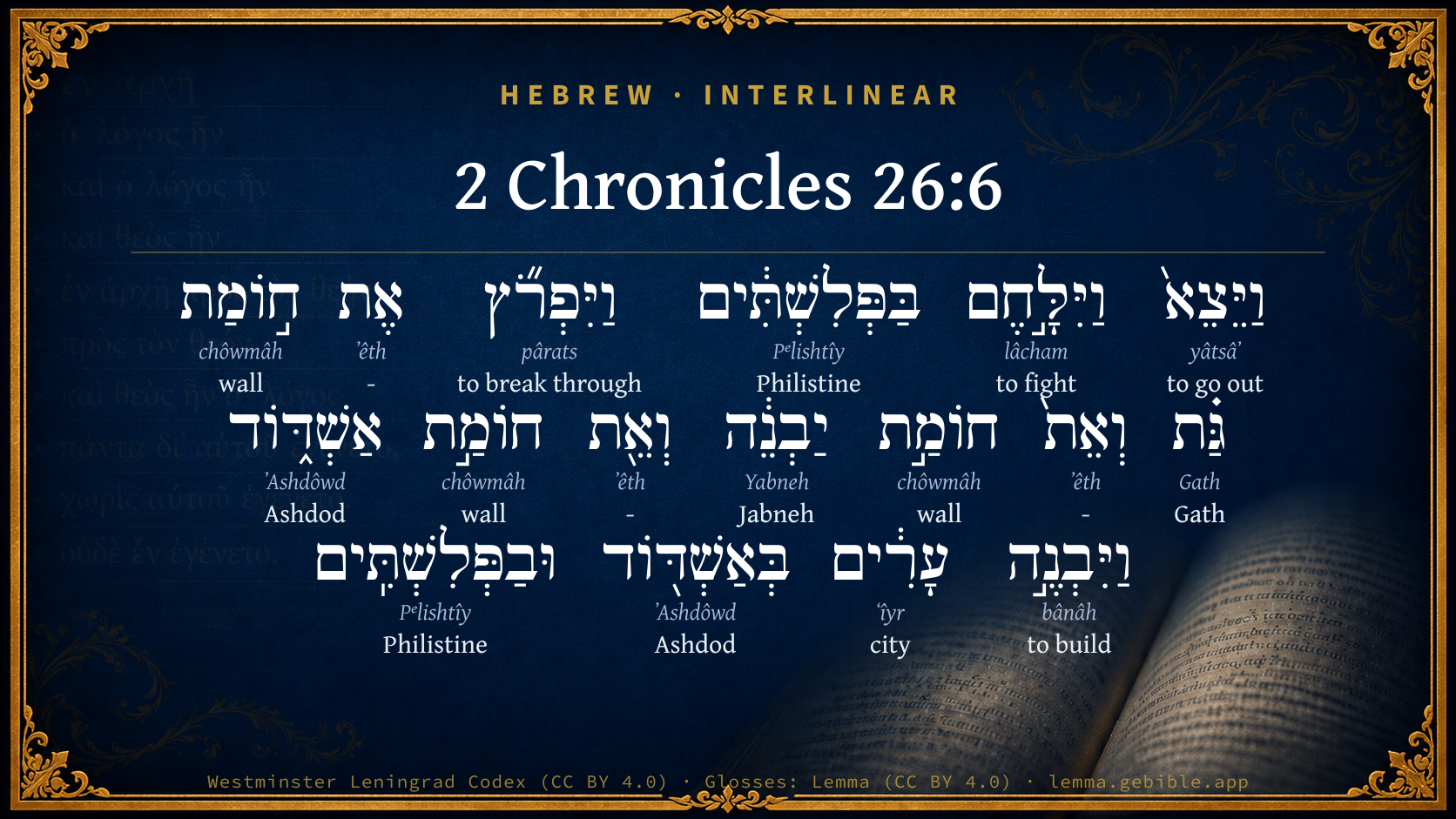
Hebrew (Westminster Leningrad Codex) 2 Chronicles 26:6 appears in the Hebrew Old Testament. The text above is from the Westminster Leningrad Codex. Each word links to its Strong’s number, a concise gloss, and parsing drawn from the Open Scriptures Hebrew Bible morphology. Click any word for its full Brown-Driver-Briggs (BDB) entry.
Download image
Cite this verse

2 Chronicles 26:6 (World English Bible). Public Domain. Lemma interlinear Bible study tool, https://lemma.gebible.app/v/2-chronicles/26/6.

Show BibTeX & RIS
BibTeX
RIS
English Translation
He went forth and warred against the Philistines, and broke down the wall of Gath, and the wall of Jabneh, and the wall of Ashdod; and he built cities in [the country of] Ashdod, and among the Philistines.
World English Bible · Public Domain
Highlights
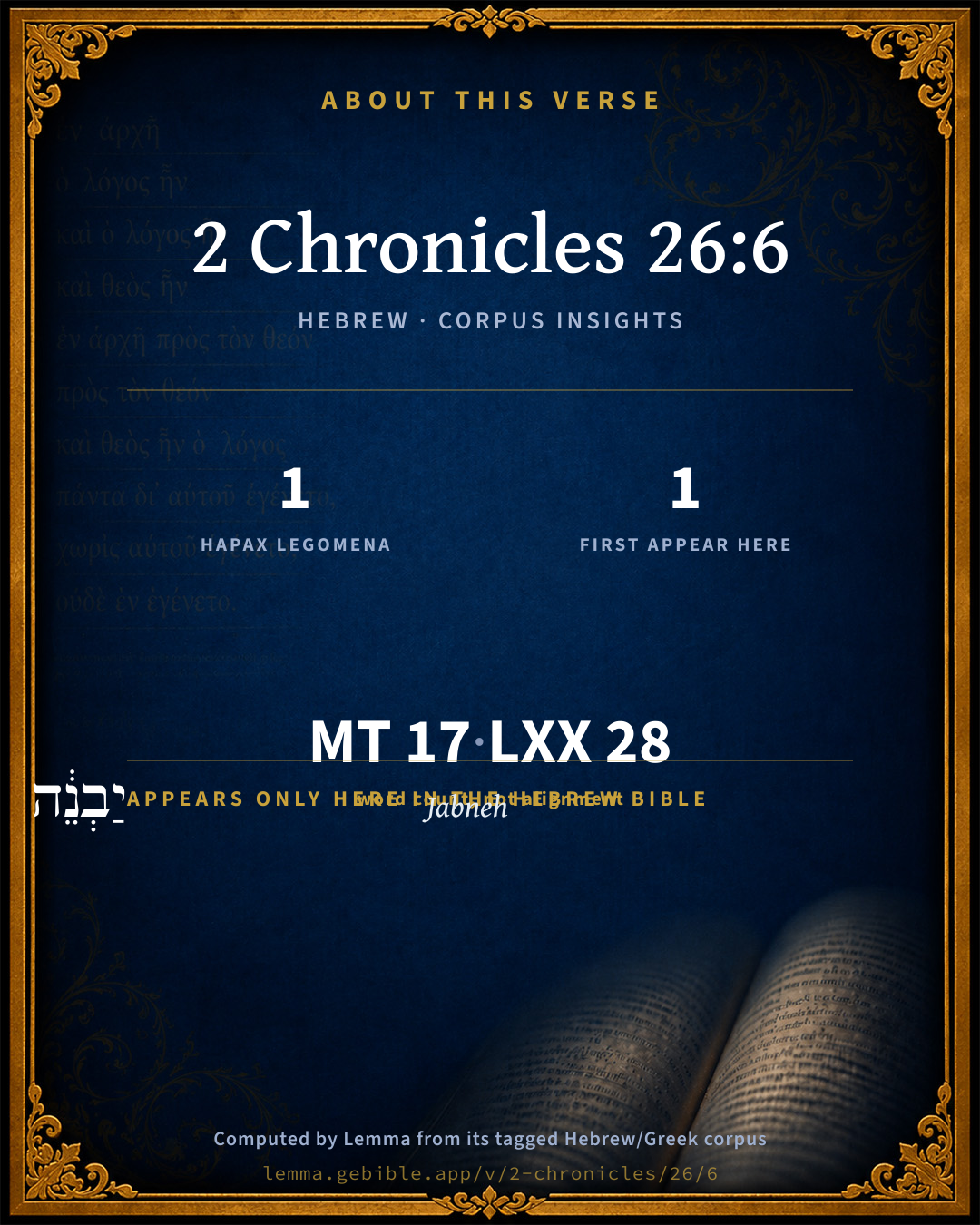
  • 1 hapax legomenon — only here in the Hebrew Bible
  • 1 first appearance in the Hebrew Bible
Full analysis ↓
Download a study sheet

One document with this verse’s original text, its word-by-word gloss line, the meaning frame, cross-references with their text, attributed commentary, and full source and license credits — printable, and it pastes into notes with its structure intact.

This verse Autodidact and up

Study sheet (.html) Plain text (.txt)

A passage Seminary Student

Up to 50 verses in one chapter. A passage sheet keeps up to 6 commentary sources and 12 cross-references per verse, in the order this page ranks them, and says so on the sheet whenever that leaves anything out. Ask for a single verse and you get the Autodidact verse sheet above.

Everything on this page stays free to read, with no account — the sheet is a download of what is already on screen, not access to it.

Want to remove ads? Support Godless Engineer
Compare translations 3

The same verse in 3 English versions, stacked beneath the original-language interlinear above. Click any original word for its lexicon entry.

Each is an independent rendering of the whole verse — the interlinear is not word-aligned to these translations.

Highlighted words mark where these versions differ — a whole-verse word diff, not a word-by-word alignment.

  • World English Bible Public Domain
    He went forth and warred against the Philistines, and broke down the wall of Gath, and the wall of Jabneh, and the wall of Ashdod; and he built cities in [the country of] Ashdod, and among the Philistines.
  • King James Version Public Domain
    And he went forth and warred against the Philistines, and brake down the wall of Gath, and the wall of Jabneh, and the wall of Ashdod, and built cities about Ashdod, and among the Philistines.
  • unfoldingWord Literal Text CC BY-SA 4.0
    And he went out, and he fought against the Philistines. And he broke through the wall of Gath, and the wall of Jabneh, and the wall of Ashdod. And he built cities in Ashdod and among the Philistines.

unfoldingWord Literal Text — © unfoldingWord, licensed CC BY-SA 4.0. Word-aligned USFM3 via Door43 (git.door43.org/unfoldingWord/en_ult).

Versions to compare (up to 4)

3 of 4 selected

Show all 18 translations

Every available English version of this verse, each an independent rendering of the whole verse.

  • World English Bible Public Domain
    He went forth and warred against the Philistines, and broke down the wall of Gath, and the wall of Jabneh, and the wall of Ashdod; and he built cities in [the country of] Ashdod, and among the Philistines.
  • Berean Standard Bible Public Domain
    Uzziah went out to wage war against the Philistines, and he tore down the walls of Gath, Jabneh, and Ashdod. Then he built cities near Ashdod and among the Philistines.
  • Majority Standard Bible Public Domain
    Uzziah went out to wage war against the Philistines, and he tore down the walls of Gath, Jabneh, and Ashdod. Then he built cities near Ashdod and among the Philistines.
  • King James Version Public Domain
    And he went forth and warred against the Philistines, and brake down the wall of Gath, and the wall of Jabneh, and the wall of Ashdod, and built cities about Ashdod, and among the Philistines.
  • American Standard Version (1901) Public Domain
    And he went forth and warred against the Philistines, and brake down the wall of Gath, and the wall of Jabneh, and the wall of Ashdod; and he built cities in `the country of' Ashdod, and among the Philistines.
  • Revised Version (1885) Public Domain
    And he went forth and warred against the Philistines, and brake down the wall of Gath, and the wall of Jabneh, and the wall of Ashdod; and he built cities in the country of Ashdod, and among the Philistines.
  • Geneva Bible (1599) Public Domain
    For he went forth and fought against the Philistims and brake downe the wall of Gath, and the wall of Iabneh, and the wall of Ashdod, and built cities in Ashdod, and among the Philistims.
  • Douay-Rheims (1899) Public Domain
    Moreover he went forth and fought against the Philistines, and broke down the wall of Geth, and the wall of Jabnia, and the wall of Azotus: and he built towns in Azotus, and among the Philistines.
  • Young's Literal Translation Public Domain
    And he goeth forth, and fighteth with the Philistines, and breaketh down the wall of Gath, and the wall of Jabneh, and the wall of Ashdod, and buildeth cities about Ashdod, and among the Philistines.
  • Literal Standard Version CC BY-SA 4.0
    And he goes forth and fights with the Philistines, and breaks down the wall of Gath, and the wall of Jabneh, and the wall of Ashdod, and builds cities [around] Ashdod, and among the Philistines.
  • Unlocked Literal Bible CC BY-SA 4.0
    Uzziah went out and fought against the Philistines. He broke down the city walls of Gath, Jabneh, and Ashdod; he built cities in the country of Ashdod and among the Philistines.
  • unfoldingWord Literal Text CC BY-SA 4.0
    And he went out, and he fought against the Philistines. And he broke through the wall of Gath, and the wall of Jabneh, and the wall of Ashdod. And he built cities in Ashdod and among the Philistines.
  • Darby Bible Public Domain
    And he went forth and fought against the Philistines, and broke down the wall of Gath, and the wall of Jabneh, and the wall of Ashdod; and built cities about Ashdod, and among the Philistines.
  • World Messianic Bible Public Domain
    He went out and fought against the Philistines, and broke down the wall of Gath, the wall of Jabneh, and the wall of Ashdod; and he built cities in the country of Ashdod, and among the Philistines.
  • Webster's Bible Public Domain
    And he went forth and warred against the Philistines, and broke down the wall of Gath, and the wall of Jabneh, and the wall of Ashdod, and built cities about Ashdod, and among the Philistines.
  • Free Bible Version CC BY-SA 4.0
    Uzziah went to war against the Philistines, and he demolished the walls of Gath, Jabneh, and Ashdod. Then he built cities around Ashdod and in other Philistine areas.
  • Bible in Basic English Public Domain
    He went out and made war against the Philistines, pulling down the walls of Gath and Jabneh and Ashdod, and building towns in the country round Ashdod and among the Philistines.
  • JPS Tanakh (1917) Public Domain
    And he went forth and warred against the Philistines, and broke down the wall of Gath, and the wall of Jabneh, and the wall of Ashdod; and he built cities in the country of Ashdod, and among the Philistines.

Literal Standard Version (2020), Covenant Press — licensed CC BY-SA 4.0. Text via the HelloAO Bible API (eBible.org). Unlocked Literal Bible (unfoldingWord) — licensed CC BY-SA 4.0. Text via the HelloAO Bible API (eBible.org). unfoldingWord Literal Text — © unfoldingWord, licensed CC BY-SA 4.0. Word-aligned USFM3 via Door43 (git.door43.org/unfoldingWord/en_ult). Free Bible Version, Dr. Jonathan Gallagher — licensed CC BY-SA 4.0. Text via the HelloAO Bible API (eBible.org).

Word by word

More ways to search: Search by grammar → Find every occurrence → Compare this word →

Practice this passage: Drill this verse → Learn its vocabulary →

יַבְנֵ֔ה
Yabneh
H2996
“Jabneh”
Noun, Proper
Part of Speech
Noun
Type
Proper
Full BDB Definition

Origin: from H1129

TWOT: None

Jabneh = "building of God" - a Philistine city
  1. וַיֵּצֵא֙ yâtsâʼ H3318 “and · to go out” Conjunction + Verb, Qal, Sequential Imperfect, 3rd Person, Masculine, Singular
  2. וַיִּלָּ֣חֶם lâcham H3898 “and · to fight” Conjunction + Verb, Niphal, Sequential Imperfect, 3rd Person, Masculine, Singular
  3. בַּפְּלִשְׁתִּ֔ים Pᵉlishtîy H6430 “in/at the · Philistines” Preposition, Determined + Noun, Gentilic, Masculine, Plural, Absolute
  4. וַיִּפְרֹ֞ץ pârats H6555 “and · to break through” Conjunction + Verb, Qal, Sequential Imperfect, 3rd Person, Masculine, Singular
  5. אֶת ʼêth H853 “-” Particle, Direct Object
  6. ח֣וֹמַת chôwmâh H2346 “wall of” Noun, Common, Feminine, Singular, Construct
  7. גַּ֗ת Gath H1661 “Gath” Noun, Proper
  8. וְאֵת֙ ʼêth H853 “and · -” Conjunction + Particle, Direct Object
  9. חוֹמַ֣ת chôwmâh H2346 “wall of” Noun, Common, Feminine, Singular, Construct
  10. וְאֵ֖ת ʼêth H853 “and · -” Conjunction + Particle, Direct Object
  11. חוֹמַ֣ת chôwmâh H2346 “wall of” Noun, Common, Feminine, Singular, Construct
  12. אַשְׁדּ֑וֹד ʼAshdôwd H795 “Ashdod” Noun, Proper
  13. וַיִּבְנֶ֣ה bânâh H1129 “and · to build” Conjunction + Verb, Qal, Sequential Imperfect, 3rd Person, Masculine, Singular
  14. עָרִ֔ים ʻîyr H5892 “cities” Noun, Common, Feminine, Plural, Absolute
  15. בְּאַשְׁדּ֖וֹד ʼAshdôwd H795 “in/at · Ashdod” Preposition + Noun, Proper
  16. וּבַפְּלִשְׁתִּֽים Pᵉlishtîy H6430 “and · in/at the · Philistines” Conjunction + Preposition, Determined + Noun, Gentilic, Masculine, Plural, Absolute

About this verse

These counts appear in no published source. They are computed here, from the morphology-tagged text and Lemma’s own curated glosses. What Lemma adds →

17
words
11
distinct lemmas
Historical
section

Notable vocabulary

1 hapax legomenon — a word that appears only here in the entire Hebrew Bible:

  • יַבְנֵ֔ה Jabneh H2996

First appearance in Scripture

This word makes its first canonical appearance in the Hebrew Bible here:

  • יַבְנֵ֔ה Jabneh H2996

Shared distinctive vocabulary

אַשְׁדּ֑וֹד Ashdod H795 occurs in 15 verses of the Hebrew Bible. Also found in:

Grammatical profile

  • 4 verbs
  • 10 nouns
  • 3 particles

Verb forms

  • וַיֵּצֵא֙ Qal · Sequential Imperfect
  • וַיִּלָּ֣חֶם Niphal · Sequential Imperfect
  • וַיִּפְרֹ֞ץ Qal · Sequential Imperfect
  • וַיִּבְנֶ֣ה Qal · Sequential Imperfect

Repetition

Words recur within this verse — often emphatic in Hebrew:

  • ח֣וֹמַת wall H2346 ×3
  • בַּפְּלִשְׁתִּ֔ים Philistine H6430 ×2
  • אַשְׁדּ֑וֹד Ashdod H795 ×2

Hebrew & Septuagint length

In English translation the verse runs 38 words from the Hebrew and 36 from the Septuagint (LXX English) — closely comparable.

A rough comparison of the two English renderings, which tokenize alike — not a word-level alignment.

Word counts can differ between the Hebrew and the Greek without any difference in meaning — e.g. the Hebrew direct-object marker אֵת has no separate Greek word, and Greek often adds the article ὁ.

In the original languages it is 17 Hebrew tokens and 28 Greek tokens — but the two are counted differently (Hebrew bundles its prefixes and suffixes into one token; the Greek is in lemma form), so that isn’t a like-for-like length.

Cross-references

6

Topical passages linked to 2 Chronicles 26:6 in the Treasury of Scripture Knowledge — connected by theme and wording, ordered by reader-vote popularity; previews shown in the World English Bible.

  • Isaiah 14:29 Don't rejoice, O Philistia, all of you, because the rod that struck you is broken; for out of the serpent's root shall come forth an adder, and his fruit shall be a fiery flying serpent.
  • 1 Samuel 5:1 Now the Philistines had taken the ark of God, and they brought it from Ebenezer to Ashdod.
  • 1 Samuel 5:6 But the hand of Yahweh was heavy on them of Ashdod, and he destroyed them, and struck them with tumors, even Ashdod and the borders of it.
  • 2 Samuel 8:1 After this it happened that David struck the Philistines, and subdued them: and David took the bridle of the mother city out of the hand of the Philistines.
  • 1 Chronicles 18:1 After this it happened, that David struck the Philistines, and subdued them, and took Gath and its towns out of the hand of the Philistines.
  • 2 Chronicles 21:16 Yahweh stirred up against Jehoram the spirit of the Philistines, and of the Arabians who are beside the Ethiopians:

Cross-references courtesy of OpenBible.info (CC BY 4.0).

Hebrew and Greek witnesses Masoretic Hebrew ↔ Greek Septuagint

The same verse in the two great witnesses to the Old Testament, shown verse-for-verse.

These are two independent witnesses, not word-aligned to each other, and the Septuagint is shown in lemma (dictionary) form.

Hebrew 2 Chronicles 26:6 Masoretic · Westminster Leningrad Codex

וַיֵּצֵא֙ וַיִּלָּ֣חֶם בַּפְּלִשְׁתִּ֔ים וַיִּפְרֹ֞ץ אֶת ח֣וֹמַת גַּ֗ת וְאֵת֙ חוֹמַ֣ת יַבְנֵ֔ה וְאֵ֖ת חוֹמַ֣ת אַשְׁדּ֑וֹד וַיִּבְנֶ֣ה עָרִ֔ים בְּאַשְׁדּ֖וֹד וּבַפְּלִשְׁתִּֽים

He went forth and warred against the Philistines, and broke down the wall of Gath, and the wall of Jabneh, and the wall of Ashdod; and he built cities in [the country of] Ashdod, and among the Philistines.

World English Bible · Public Domain

Greek LXX 2 Chronicles 26:6 Septuagint · lemma form

καί ἐκἔρχομαι καί πολεμέω πρός ὁ ἀλλόφυλος καί κατασπάω ὁ τεῖχος γεθ καί ὁ τεῖχος ιαβνη καί ὁ τεῖχος ἄζωτος καί οἰκοδομέω πόλις ἄζωτος καί ἐν ὁ ἀλλόφυλος

And he went out and fought against the Philistines, and pulled down the walls of Geth, and the walls of Jabner, and the walls of Azotus, and he built cities near Azotus, and among the Philistines.

LXX2012 (modern English Septuagint) · Public Domain

On this verse, John Gill's Exposition discusses the Septuagint’s reading. Read the note in Commentary ↓

Hebrew: Westminster Leningrad Codex (CC BY 4.0). Greek: Septuagint (public domain); English from LXX2012 (modern English Septuagint) (Public Domain). How the Septuagint differs from the Hebrew →

Commentary

Notes on 2 Chronicles 26:6 from classic Christian and Jewish commentators (each source and its license shown beneath its notes). The classic Christian expositions comment on the surrounding passage and are grouped to its opening verse, so a note may address several verses; the Jewish commentaries on the Tanakh (Rashi and others) are per-verse, so they appear only where the commentator wrote on this verse.

Lemma curates 59 commentaries, every one of them public domain or Creative Commons licensed, each selected and text-cleaned for this edition rather than reprinted as found. About our sources →

Ellicott's Commentary for English Readers

(6) And he went forth and warred against the Philistines.—At the outset of his reign this able prince had given promise of his future by seizing and fortifying the port of Elath, and thus probably completing the subjugation of Edom, which his father had more than begun. Afterwards he assumed the offensive against the Philistines, Arabs, and Maonites, who had invaded the country under his predecessors (2Ch_21:16; 2Ch_20:1).

Brake down the wall of Gath.—After taking the city. (As to Gath, see 1Ch_18:1; 2Ch_11:8.)

Jabneh.—The Jamnia of Maccabees and Josephus; now the village of Jebnah, about twelve miles south of Joppa (the same as Jabneel, Jos_15:11).

Ashdod.—Esdûd. (Comp. Jos_13:3.) Like Gath, one of the five sovereign states of the Philistines. It commanded the great road to Egypt; hence its possession was of first-rate importance to the contending military powers of Egypt and Assyria. Sargon captured it B.C. 719. (Comp. Isa_20:1.)

About Ashdod.—In Ashdod, i.e., in the canton so called.

And among the Philistines.—That is, elsewhere in their territory. Uzziah appears to have reduced the Philistines to a state of complete vassalage. They were not, however, annexed to Judah, but ruled by their own kings.

UZZIAH’S CAMPAIGNS, PUBLIC WORKS, AND MILITARY STRENGTH

(2Ch_26:6-15).

This section is peculiar to the Chronicles. Although the book of Kings passes over the facts recorded here, they are essential to forming a right conception of the strength and importance of the southern kingdom during the age of Uzziah and Jotham; and they are fully corroborated, not only by comparison with the data of Isaiah (Isaiah 2-4) upon the same subject, but also by the independent testimony of the cuneiform inscriptions of the period. (See Note on 2Ki_14:28.) Thus we find that the warlike Assyrian Tiglath-pileser II. chastised Hamath for its alliance with Judah during this reign, but abstained from molesting Uzziah himself—“a telling proof,” as Schrader says, “for the accuracy of the Biblical account of Uzziah’s well-founded power.” The name of Uzziah is conspicuously absent from the list of western princes who, in B.C. 738, sent tribute to Tiglath: Hystaspes (Kushtashpi), king of Commagene (Kummuhâ’a), Rezin, king of the country of the Damascenes, Menahem of the city of the Samaritans, Hiram of the city of the Tyrians, Sibitti-bi’li of the city of the Giblites or Byblos, Urikki of Kui, Pisiris of Carchemish, Eniel of Hamath, Panammu of Sam’al, and nine other sovereigns, including those of Tabal and Arabia. The list thus comprises Hittites and Arameans, princes of Hither Asia, Phoenicia, and Arabia. The omission of Uzziah argues that the king of Judah felt himself strong enough to sustain the shock of collision with Assyria in case of need. He must have reckoned on the support of the surrounding states (also not mentioned in the above list), viz., Ashdod, Ascalon, Gaza, Edom, Ammon, Moab, &c. (Schrader, Keilinschr., p. 252, seq.).

A Bible Commentary for English Readers, edited by Charles John Ellicott (1878–1897) — public domain. Text from a community e-Sword module.

Trapp's Complete Commentary

John Trapp

2Ch 26:6 And he went forth and warred against the Philistines, and brake down the wall of Gath, and the wall of Jabneh, and the wall of Ashdod, and built cities about Ashdod, and among the Philistines.

Ver. 6. And the wall of Jabneh.] Which was a strong city by the seaside, not more than three hours’ travel from Gath, saith Adrichomius.

John Trapp, A Commentary or Exposition upon All the Books of the Old and New Testament (1647–1656) — public domain. Text from a community e-Sword module.

Joseph Benson's Commentary

2Ch 26:6. And brake down the wall of Gath — Which had been taken by Hazael, in the days of Joash his grand-father, chap. 2Ki 12:17; but was either relinquished by him, because it lay so far from his other dominions; or retaken by the Philistines, who had now repaired its fortifications and kept it.

Joseph Benson's Commentary on the Old and New Testaments (1811–1818) — public domain. Text from a community e-Sword module.

Tyndale Open Study Notes

Tyndale Open Resources

26:6-8 These verses summarize Uzziah’s international achievements. His conquests were to the west, south, and southeast, but not to the north, where Jeroboam II’s kingdom was powerful (2 Kgs 14:23-29). Uzziah’s strategy, with God’s guidance (2 Chr 26:7), was to achieve control over the coastal highway and then build towns in the conquered territory.

Tyndale Open Study Notes — © Tyndale Open Resources, licensed CC BY-SA 4.0. Text via the HelloAO Bible API.

Jamieson, Fausset & Brown

Robert Jamieson, A. R. Fausset & David Brown

he went forth and warred against the Philistines--He overcame them in many engagements--dismantled their towns, and erected fortified cities in various parts of the country, to keep them in subjection.

Jabneh--the same as Jabneel (Jos 15:11).

Jamieson, Fausset & Brown — Commentary Critical and Explanatory on the Whole Bible (1871) — public domain (CC PDM 1.0). Text via the HelloAO Bible API.

The Cambridge Bible for Schools and Colleges

gen. ed. J. J. S. Perowne

6. the Philistines] Cp. 2Ch_21:16; 2Ch_28:18; 2Ki_18:8; 1Ma_5:66-68; 1Ma_14:34. Wars against the Philistines continned almost down to Roman times.

brake down the wall of Gath] See note on 2Ch_25:23.

Jabneh] Mentioned here only in the O.T., but probably to be Identified with “Jabneel” (Jos_15:11). At a later date It was called “Jamnia” (2Ma_12:8). Its ruins are to be seen about 10 miles south of Jaffa (Joppa) on the coast. The modern Yebna is a few miles inland. Bädeker, p. 159.

Ashdod] Cp. 1Sa_5:1 ff.; Isa_20:1; Zep_2:4; Neh_4:7; Neh_13:23; Act_8:40 (Ἄζωτος). Now Esdud. Bädeker, 159.

about Ashdod] R.V. in the country of Ashdod (lit. “in Ashdod”). Perhaps the name has been repeated through an early scribal error and we should read simply “and built cities among the Philistines.”

The Cambridge Bible for Schools and Colleges (gen. ed. J. J. S. Perowne; Cambridge University Press, 1878–1918) — public domain. Text from a community e-Sword module.

John Gill's Exposition

And God helped him against the Philistines,.... He did not do all before related of himself, and by his own strength, but by the help of God; the Targum is"the Word of the Lord helped him:"

and against the Arabians that dwelt in Gurbaal; the same with Gerar, according to the Targum; which also belonged to the Philistines, and had a king in Abraham's time, Gen 20:1, the same with Askelon, another of the five principalities of the Philistines:

and the Mehunims; or the Minaeans, as the Septuagint, and whom Pliny (n) makes mention of among the Arabians; they seem to be the Scenite Arabs; see Ch2 20:1, or rather, as the Targum, those that dwelt in the plain of Maon, which was in Arabia Petraea.

(n) Nat. Hist. l. 6. c. 28.

John Gill's Exposition of the Whole Bible (1746–1763) — public domain (CC PDM 1.0). Text via the HelloAO Bible API.

Albert Barnes' Notes on the Bible

Uzziah’s expedition was the natural sequel to the Edomite war of Amaziah 2Ch 25:11, which crushed the most formidable of all the tribes of the south. On Jabneh see Jos 15:11 note; and on Ashdod see Jos 13:3 note.

Albert Barnes' Notes on the Bible (1834–1885) — public domain. Text from a community e-Sword/MySword module.

Haydock's Catholic Bible Commentary

In. Prot. "about Ashdod." Sept. "he built (or repaired) the cities of Azotus," to keep under the Philistines, who had revolted under Joram, C. xxi. 16.

George Leo Haydock (1774–1849), Haydock's Catholic Family Bible and Commentary, 1859 edition — public domain. Excludes Psalms (Douay-Rheims chapter numbering differs from Protestant) and Deuterocanonical books (Catholic canon only).

Matthew Poole's English Annotations

Gath had been taken by Hazael in the days of Joash his grandfather, 2Ki 12:17, but was either relinquished by him, because it lay so far from his other dominions; or retaken by the Philistines, who had now repaired its fortifications, and kept it.

Matthew Poole's English Annotations on the Holy Bible (1683–1685) — public domain. Text from a community e-Sword/MySword module.

Whedon's Commentary on the Bible

Daniel D. Whedon

6. Warred against the Philistines — He would avenge, and, as far as possible, restore, the losses his kingdom had sustained from these enemies in Jehoram’s time. Compare 2Ch_21:16-17.

Brake down the wall of Gath — This city had been taken by Hazael of Syria in the days of Joash. 2Ki_12:17.

Jabneh — Represented in the modern Yebna, near the Philistine coast. The same as Jabneel in Jos_15:11, where see note.

Ashdod — The most powerful of the Philistine cities. See note on Jos_11:22.

Daniel D. Whedon (gen. ed.), Commentary on the Old and New Testaments (1874–1909) — public domain. Text from a community e-Sword module.

The Pulpit Commentary

The Philistines. It has been seen how the Philistines, humbled to tribute under Jehoshaphat, (2Ch_17:10-13) had lifted up their heads repeatedly since, as on one occasion in alliance with Arabians (2Ch_21:16, 2Ch_21:17) against Jehoram. Brake down the wall. (see 2Ch_25:23, the first occasion of this exact expression) Gath (see the parallel to our. (2Ch_24:23, 24 in 2Ki_12:17) Jabneh. A city on the coast, northwest of Judah, now Jebna. (see Jos_15:10-12) Ashdod. Also on the coast, about eight miles south of Jabneh. (Jos_15:47) It is now a large village in Philistia, called Esdud, answering to the Azotus of Act_8:40 (see Topographical Index to Conder"s "Handbook to the Bible;" and Dr. Smith"s "Bible Dictionary," sub voc., 1:119). Built cities about Ashdod; Revised Version supplies in italic type" in the country of Ashdod." However, the force of the preposition B before "Ashdod" in this case speaks for itself; on account of the great importance of the place, in respect of its situation, on the road to Egypt, the strength of its position and perhaps the memory of the fact that, allotted to Judah, it had never really been appropriated by her, and incorporated with her, Uzziah saw it expedient to surround it with other fortified cities, or strong forts, which should be a watch upon it.

Vers. 6-15.

A victorious career.

Perhaps it is not well understood that Uzziah was one of the strongest of the kings of Judah, and ran a remarkably successful course. Had not his sun set in some dark clouds, his name and fame would probably have stood far higher than they do. But when we have made necessary allowances, there remains before our eyes the picture of

I A VICTORIOUS CAREER. This, whether we have regard to:

1. The extension of his kingdom; he prevailed against the Edomites, the Philistines, the Arabians (vers. 2, 6-8). Or to:

2. The strengthening of his kingdom by military means by buildingfortifications (vers. 9, 10), by ordering and equipping his army (vers. 11-13), by inventing or adopting the latest weapons of warfare (vers. 14, 15). Or to:

3. His attention to the national produce. It speaks very highly indeed for amonarch of that period that he dug wells, that he had much cattle, that he encouraged the vine-dressers, that he "loved husbandry. These are things which in that age of the world were too often disregarded and even despised by men in high places, especially by monarchs. But it was on such things as these that national prosperity very largely rested. Much of the power of a country comes from its wealth; and its wealth comes from the soil. No wise ruler will be indifferent to the question of the produce of the land. The king that "loves husbandry" is, other things being present, a king that loves his people, and rules for the happiness of their homes. It is probable that Judah never spent so contented and prosperous a half-century as during the long reign of Uzziah.

II ITS EXPLANATION.

(1) It was partly due to the fact that he came under good human influence; that of his father in his better days, that of Zechariah all through that prophet"s life; (perhaps) that of a godly mother.

(2) It was due in part to his own capacity and energy. Had he been a weak prince, giving way to base flatteries and to corrupt companionship, he could not have played the admirable part he did.

(3) It was due, chiefly and primarily, to the favour of Jehovah. "God made him to prosper" (ver. 5). From the Divine resources came intelligence, strength, sagacity, statesmanship. He might well have said, "Thou art the glory of my strength, and in thy favour has my horn been exalted." This is the explanation of every victorious career.

1. There goes toward it individual character and energy. Every man must "bear his own burden," and "have rejoicing in himself alone". (Gal_6:4, Gal_6:5) In some sense and to some degree we must all "fight the good fight" for ourselves, if we would gain the victory and win "the prize of our high calling.

2. There is included in it helpful influence from without; all kindly human help from the home and from the sanctuary, from the father and from the friend.

1. The all-decisive force is the power that works from above on our behalf. God must make us to prosper if we are to gain the victory in the great strife of life. From him must come the guidance and the guardianship, the inspiration and the control, without which we shall faint and fall. And this is to be secured by

1. submission to the gracious sway, and

2. living in the holy service of a Divine Saviour. C.

The Pulpit Commentary (1880–1919), ed. H.D.M. Spence-Jones & Joseph S. Exell — public domain. Text from a community e-Sword module.

unfoldingWord translationNotes

Door43 World Missions Community

Uzziah went out and fought against the Philistines

Here "Uzziah" represents himself and his army that he led. AT: "Uzziah led his army out to fight against the Philistines" or "Uzziah and his army went out and fought against the Philistines" (See: Synecdoche)

He broke down ... he built cities ... God helped him

Here the pronouns "He" and "him" represent Uzziah and his army. AT: "Uzziah and his army broke down ... they built cities ... God helped them" (See: Synecdoche)

Jabneh

This was a town in northern Judah. (See: How to Translate Names)

the country of Ashdod

"the country surrounding Ashdod" or "near Ashdod"

Gurbaal

This was a town in Arabia. (See: How to Translate Names)

Meunites

This is likely people who moved to that area from the kingdom of Maon near Mount Seir. (See: How to Translate Names)

his fame spread, even to the entrance of Egypt

His fame spreading is a metaphor for people in various places learning about him. AT: "people who lived even as far away as the border of Egypt learned about the things he was doing"

translationWords

Philistines

Gath

Ashdod

Arabia

Ammon

tribute

Egypt

power

unfoldingWord translationNotes — © Distant Shores Media and the Door43 World Missions Community, licensed CC BY-SA 4.0. Source: git.door43.org/Door43/en_tn.

Lesson kit

Teaching starters — assembled from the data on this page, not authored interpretation. Every prompt links to the verse data it draws on. Edit before teaching.

2 Chronicles, in the Historical, opens this verse with 17 words (11 distinct Hebrew lemmas). Its most distinctive word is Yabneh (“Jabneh”). A historical commentator’s framing appears above. Read the whole chapter for the surrounding context.

Discussion questions

  1. What does “Jabneh” (Yabneh) contribute to the verse as a whole?
  2. This verse holds 1 word here found nowhere else in the Hebrew Bible. What might the rare word draw attention to?
  3. The word “Jabneh” first appears here in Scripture. What is being introduced at this debut?
  4. Joshua 11:22 shares the word «Ashdod» with this verse. How do the two illuminate each other?
  5. “wall” occurs 3× in this one verse. What is the effect of the repetition?
  6. These translations render this verse differently; the difference is in the English rendering, not the original. What questions does that raise?
  7. The verb «וַיֵּצֵא֙» is Qal Sequential Imperfect. How does its form color the action?
  8. Reading how Ellicott's Commentary for English Readers and Trapp's Complete Commentary read this verse, where do the two commentators agree and where do they part?

Things to notice

  • 1 word in this verse appears nowhere else in the Hebrew Bible.
  • 1 word makes its first canonical appearance in Scripture here.
  • This verse counts 17 Hebrew ↔ 28 Greek words.
  • These translations choose different wording for 10 words in this verse.
  • “wall” occurs 3× in this single verse.

Reading settings

Reading text

Shown beneath each verse's original-language words.

Old Testament
Old Testament edition

Read the OT as the Masoretic Hebrew (MT) or the Greek Septuagint (LXX).

English shown for the Greek Septuagint (in the Hebrew ↔ Greek comparison).

Comparing translations? Open the Compare panel on any verse page to stack up to four side by side.