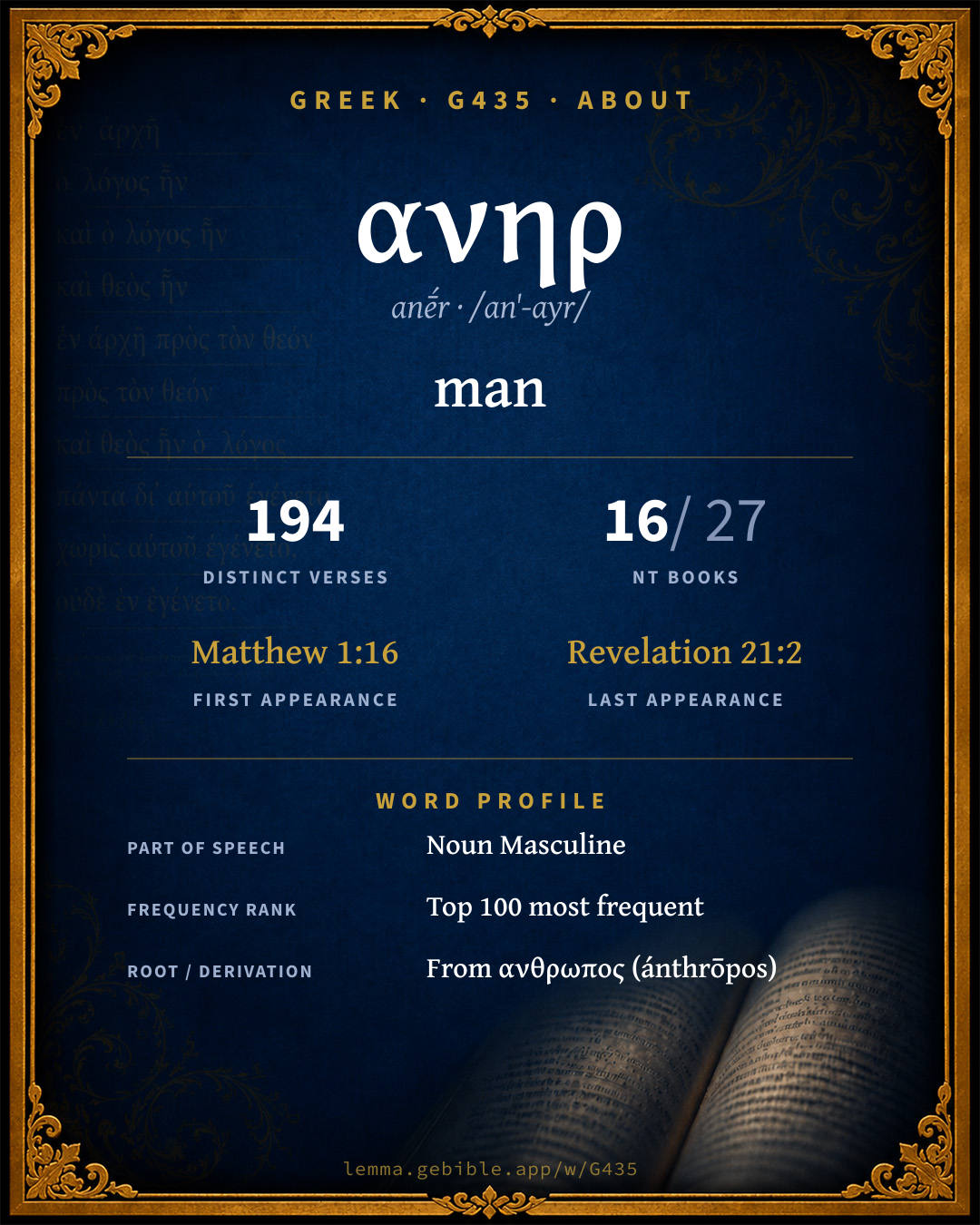
ἀνήρ
man
‘man’ is one of 6 main senses fuller range ↓
Full lexicon entry — Thayer's Greek Lexicon
From Thayer's Greek Lexicon
Where this word appears
See every Accusative-case word in the Greek New Testament →
Grammar key — what these labels mean
Part of speech
- Noun
- A naming word — a person, place, thing, or idea.
Case
- Nominative
- The case of the subject (and the predicate nominative).
- Accusative
- The case of the direct object and of extent.
- Vocative
- The case of direct address (“O Lord”).
- Dative
- The case of the indirect object, means, or location — “to / for / with / in.”
- Genitive
- The case of source, possession, or “of” — answers “whose / from what.”
Gender
- Masculine
- Grammatically masculine.
Number
- Singular
- One.
- Plural
- More than one.
Every verse where G435 appears in the Book of Acts — 98 distinct verses. Click any verse to open its interlinear word-by-word view. Verse text shown in the World English Bible for context — . Each verse’s Greek form is shown with its reference; the English is not keyword-highlighted, since the data carries no word-level English alignment. Use “Compare translations” on any verse to read it across multiple English versions. This concordance covers the Greek New Testament; Septuagint (Greek Old Testament) occurrences of this word are not indexed here.
Acts
- Acts 1:10 ἄνδρες n nom pl masc While they were looking steadfastly into the sky as he went, behold, two men stood by them in white clothing,
- Acts 1:11 ἄνδρες n voc pl masc who also said, "You men of Galilee, why do you stand looking into the sky? This Jesus, who was received up from you into the sky will come back in the same way as you saw him going into the sky."
- Acts 1:16 ἄνδρες n voc pl masc "Brothers, it was necessary that this Scripture should be fulfilled, which the Holy Spirit spoke before by the mouth of David concerning Judas, who was guide to those who took Jesus.
- Acts 1:21 ἀνδρῶν n gen pl masc Of the men therefore who have accompanied us all the time that the Lord Jesus went in and out among us,
- Acts 2:5 ἄνδρες n nom pl masc Now there were dwelling in Jerusalem Jews, devout men, from every nation under the sky.
- Acts 2:14 ἄνδρες n voc pl masc But Peter, standing up with the eleven, lifted up his voice, and spoke out to them, "You men of Judea, and all you who dwell at Jerusalem, let this be known to you, and listen to my words.
- Acts 2:22 Ἄνδρες ἄνδρα n voc pl masc n acc sg masc "Men of Israel, hear these words! Jesus of Nazareth, a man approved by God to you by mighty works and wonders and signs which God did by him in the midst of you, even as you yourselves know,
- Acts 2:29 Ἄνδρες n voc pl masc "Brothers, I may tell you freely of the patriarch David, that he both died and was buried, and his tomb is with us to this day.
- Acts 2:37 ἄνδρες n voc pl masc Now when they heard this, they were cut to the heart, and said to Peter and the rest of the apostles, "Brothers, what shall we do?"
- Acts 3:2 ἀνὴρ n nom sg masc A certain man who was lame from his mother's womb was being carried, whom they laid daily at the door of the temple which is called Beautiful, to ask gifts for the needy of those who entered into the temple.
- Acts 3:12 ἄνδρες n voc pl masc When Peter saw it, he responded to the people, "You men of Israel, why do you marvel at this man? Why do you fasten your eyes on us, as though by our own power or godliness we had made him walk?
- Acts 3:14 ἄνδρα n acc sg masc But you denied the Holy and Righteous One, and asked for a murderer to be granted to you,
- Acts 4:4 ἀνδρῶν n gen pl masc But many of those who heard the word believed, and the number of the men came to be about five thousand.
- Acts 5:1 Ἀνὴρ n nom sg masc But a certain man named Ananias, with Sapphira, his wife, sold a possession,
- Acts 5:9 ἄνδρα n acc sg masc But Peter asked her, "How is it that you have agreed together to tempt the Spirit of the Lord? Behold, the feet of those who have buried your husband are at the door, and they will carry you out."
- Acts 5:10 ἄνδρα n acc sg masc She fell down immediately at his feet, and died. The young men came in and found her dead, and they carried her out and buried her by her husband.
- Acts 5:14 ἀνδρῶν n gen pl masc More believers were added to the Lord, multitudes of both men and women.
- Acts 5:25 ἄνδρες n nom pl masc One came and told them, "Behold, the men whom you put in prison are in the temple, standing and teaching the people."
- Acts 5:35 ἄνδρες n voc pl masc He said to them, "You men of Israel, be careful concerning these men, what you are about to do.
- Acts 5:36 ἀνδρῶν n gen pl masc For before these days Theudas rose up, making himself out to be somebody; to whom a number of men, about four hundred, joined themselves: who was slain; and all, as many as obeyed him, were dispersed, and came to nothing.
- Acts 6:3 ἄνδρας n acc pl masc Therefore select from among you, brothers, seven men of good report, full of the Holy Spirit and of wisdom, whom we may appoint over this business.
- Acts 6:5 ἄνδρα n acc sg masc These words pleased the whole multitude. They chose Stephen, a man full of faith and of the Holy Spirit, Philip, Prochorus, Nicanor, Timon, Parmenas, and Nicolaus, a proselyte of Antioch;
- Acts 6:11 ἄνδρας n acc pl masc Then they secretly induced men to say, "We have heard him speak blasphemous words against Moses and God."
- Acts 7:2 ἄνδρες n voc pl masc He said, "Brothers and fathers, listen. The God of glory appeared to our father Abraham, when he was in Mesopotamia, before he lived in Haran,
- Acts 7:26 ἄνδρες n voc pl masc "The day following, he appeared to them as they fought, and urged them to be at peace again, saying, 'Sirs, you are brothers. Why do you wrong one another?'
- Acts 8:2 ἄνδρες n nom pl masc Devout men buried Stephen, and lamented greatly over him.
- Acts 8:3 ἄνδρας n acc pl masc But Saul ravaged the assembly, entering into every house, and dragged both men and women off to prison.
- Acts 8:9 Ἀνὴρ n nom sg masc But there was a certain man, Simon by name, who used to practice sorcery in the city, and amazed the people of Samaria, making himself out to be some great one,
- Acts 8:12 ἄνδρες n nom pl masc But when they believed Philip preaching good news concerning the Kingdom of God and the name of Jesus Christ, they were baptized, both men and women.
- Acts 8:27 ἀνὴρ n nom sg masc He arose and went; and behold, there was a man of Ethiopia, a eunuch of great authority under Candace, queen of the Ethiopians, who was over all her treasure, who had come to Jerusalem to worship.
- Acts 9:2 ἄνδρας n acc pl masc and asked for letters from him to the synagogues of Damascus, that if he found any who were of the Way, whether men or women, he might bring them bound to Jerusalem.
- Acts 9:7 ἄνδρες n nom pl masc The men who traveled with him stood speechless, hearing the sound, but seeing no one.
- Acts 9:12 ἄνδρα n acc sg masc and in a vision he has seen a man named Ananias coming in, and laying his hands on him, that he might receive his sight."
- Acts 9:13 ἀνδρὸς n gen sg masc But Ananias answered, "Lord, I have heard from many about this man, how much evil he did to your saints at Jerusalem.
- Acts 9:38 ἄνδρας n acc pl masc As Lydda was near Joppa, the disciples, hearing that Peter was there, sent two men to him, imploring him not to delay in coming to them.
- Acts 10:1 Ἀνὴρ n nom sg masc Now there was a certain man in Caesarea, Cornelius by name, a centurion of what was called the Italian Regiment,
- Acts 10:5 ἄνδρας n acc pl masc Now send men to Joppa, and get Simon, who is surnamed Peter.
- Acts 10:17 ἄνδρες n nom pl masc Now while Peter was very perplexed in himself what the vision which he had seen might mean, behold, the men who were sent by Cornelius, having made inquiry for Simon's house, stood before the gate,
- Acts 10:19 ἄνδρες n nom pl masc While Peter was pondering the vision, the Spirit said to him, "Behold, three men seek you.
- Acts 10:21 ἄνδρας n acc pl masc Peter went down to the men, and said, "Behold, I am he whom you seek. Why have you come?"
- Acts 10:22 ἀνὴρ n nom sg masc They said, "Cornelius, a centurion, a righteous man and one who fears God, and well spoken of by all the nation of the Jews, was directed by a holy angel to invite you to his house, and to listen to what you say."
- Acts 10:28 ἀνδρὶ n dat sg masc He said to them, "You yourselves know how it is an unlawful thing for a man who is a Jew to join himself or come to one of another nation, but God has shown me that I shouldn't call any man unholy or unclean.
- Acts 10:30 ἀνὴρ n nom sg masc Cornelius said, "Four days ago, I was fasting until this hour, and at the ninth hour, I prayed in my house, and behold, a man stood before me in bright clothing,
- Acts 11:3 ἄνδρας n acc pl masc saying, "You went in to uncircumcised men, and ate with them!"
- Acts 11:11 ἄνδρες n nom pl masc Behold, immediately three men stood before the house where I was, having been sent from Caesarea to me.
- Acts 11:12 ἀνδρός n gen sg masc The Spirit told me to go with them, without discriminating. These six brothers also accompanied me, and we entered into the man's house.
- Acts 11:20 ἄνδρες n nom pl masc But there were some of them, men of Cyprus and Cyrene, who, when they had come to Antioch, spoke to the Greeks, preaching the Lord Jesus.
- Acts 11:24 ἀνὴρ n nom sg masc For he was a good man, and full of the Holy Spirit and of faith, and many people were added to the Lord.
- Acts 13:6 ἄνδρα n acc sg masc When they had gone through the island to Paphos, they found a certain sorcerer, a false prophet, a Jew, whose name was Bar Jesus,
- Acts 13:7 ἀνδρὶ n dat sg masc who was with the proconsul, Sergius Paulus, a man of understanding. This man summoned Barnabas and Saul, and sought to hear the word of God.
- Acts 13:15 ἄνδρες n voc pl masc After the reading of the law and the prophets, the rulers of the synagogue sent to them, saying, "Brothers, if you have any word of exhortation for the people, speak."
- Acts 13:16 ἄνδρες n voc pl masc Paul stood up, and beckoning with his hand said, "Men of Israel, and you who fear God, listen.
- Acts 13:21 ἄνδρα n acc sg masc Afterward they asked for a king, and God gave to them Saul the son of Kish, a man of the tribe of Benjamin, for forty years.
- Acts 13:22 ἄνδρα n acc sg masc When he had removed him, he raised up David to be their king, to whom he also testified, 'I have found David the son of Jesse, a man after my heart, who will do all my will.'
- Acts 13:26 ἄνδρες n voc pl masc Brothers, children of the stock of Abraham, and those among you who fear God, the word of this salvation is sent out to you.
- Acts 13:38 ἄνδρες n voc pl masc Be it known to you therefore, brothers, that through this man is proclaimed to you remission of sins,
- Acts 14:8 ἀνὴρ n nom sg masc At Lystra a certain man sat, impotent in his feet, a cripple from his mother's womb, who never had walked.
- Acts 14:15 ἄνδρες n voc pl masc "Men, why are you doing these things? We also are men of like passions with you, and bring you good news, that you should turn from these vain things to the living God, who made the sky and the earth and the sea, and all that is in them;
- Acts 15:7 ἄνδρες n voc pl masc When there had been much discussion, Peter rose up and said to them, "Brothers, you know that a good while ago God made choice among you, that by my mouth the Gentiles should hear the word of the Gospel, and believe.
- Acts 15:13 ἄνδρες n voc pl masc After they were silent, James answered, "Brothers, listen to me.
- Acts 15:22 ἄνδρας ἄνδρας n acc pl masc n acc pl masc Then it seemed good to the apostles and the elders, with the whole assembly, to choose men out of their company, and send them to Antioch with Paul and Barnabas: Judas called Barsabbas, and Silas, chief men among the brothers.
- Acts 15:25 ἄνδρας n acc pl masc it seemed good to us, having come to one accord, to choose out men and send them to you with our beloved Barnabas and Paul,
- Acts 16:9 ἀνὴρ n nom sg masc A vision appeared to Paul in the night. There was a man of Macedonia standing, begging him, and saying, "Come over into Macedonia and help us."
- Acts 17:5 ἄνδρας n acc pl masc But the unpersuaded Jews took along some wicked men from the marketplace, and gathering a crowd, set the city in an uproar. Assaulting the house of Jason, they sought to bring them out to the people.
- Acts 17:12 ἀνδρῶν n gen pl masc Many of them therefore believed; also of the prominent Greek women, and not a few men.
- Acts 17:22 Ἄνδρες n voc pl masc Paul stood in the middle of the Areopagus, and said, "You men of Athens, I perceive that you are very religious in all things.
- Acts 17:31 ἀνδρὶ n dat sg masc because he has appointed a day in which he will judge the world in righteousness by the man whom he has ordained; of which he has given assurance to all men, in that he has raised him from the dead."
- Acts 17:34 ἄνδρες n nom pl masc But certain men joined with him, and believed, among whom also was Dionysius the Areopagite, and a woman named Damaris, and others with them.
- Acts 18:24 ἀνὴρ n nom sg masc Now a certain Jew named Apollos, an Alexandrian by race, an eloquent man, came to Ephesus. He was mighty in the Scriptures.
- Acts 19:7 ἄνδρες n nom pl masc They were about twelve men in all.
- Acts 19:25 ἄνδρες n voc pl masc whom he gathered together, with the workmen of like occupation, and said, "Sirs, you know that by this business we have our wealth.
- Acts 19:35 ἄνδρες n voc pl masc When the town clerk had quieted the multitude, he said, "You men of Ephesus, what man is there who doesn't know that the city of the Ephesians is temple-keeper of the great goddess Artemis, and of the image which fell down from Zeus?
- Acts 19:37 ἄνδρας n acc pl masc For you have brought these men here, who are neither robbers of temples nor blasphemers of your goddess.
- Acts 20:30 ἄνδρες n nom pl masc Men will arise from among your own selves, speaking perverse things, to draw away the disciples after them.
- Acts 21:11 ἄνδρα n acc sg masc Coming to us, and taking Paul's belt, he bound his own feet and hands, and said, "Thus says the Holy Spirit: 'So will the Jews at Jerusalem bind the man who owns this belt, and will deliver him into the hands of the Gentiles.'"
- Acts 21:23 ἄνδρες n nom pl masc Therefore do what we tell you. We have four men who have taken a vow.
- Acts 21:26 ἄνδρας n acc pl masc Then Paul took the men, and the next day, purified himself and went with them into the temple, declaring the fulfillment of the days of purification, until the offering was offered for every one of them.
- Acts 21:28 ἄνδρες n voc pl masc crying out, "Men of Israel, help! This is the man who teaches all men everywhere against the people, and the law, and this place. Moreover, he also brought Greeks into the temple, and has defiled this holy place!"
- Acts 21:38 ἄνδρας n acc pl masc Aren't you then the Egyptian, who before these days stirred up to sedition and led out into the wilderness the four thousand men of the Assassins?"
- Acts 22:1 Ἄνδρες n voc pl masc "Brothers and fathers, listen to the defense which I now make to you."
- Acts 22:3 ἀνὴρ n nom sg masc "I am indeed a Jew, born in Tarsus of Cilicia, but brought up in this city at the feet of Gamaliel, instructed according to the strict manner of the law of our fathers, being zealous for God, even as you all are this day.
- Acts 22:4 ἄνδρας n acc pl masc I persecuted this Way to the death, binding and delivering into prisons both men and women.
- Acts 22:12 ἀνὴρ n nom sg masc One Ananias, a devout man according to the law, well reported of by all the Jews who lived in Damascus,
- Acts 23:1 ἄνδρες n voc pl masc Paul, looking steadfastly at the council, said, "Brothers, I have lived before God in all good conscience until this day."
- Acts 23:6 ἄνδρες n voc pl masc But when Paul perceived that the one part were Sadducees and the other Pharisees, he cried out in the council, "Men and brothers, I am a Pharisee, a son of Pharisees. Concerning the hope and resurrection of the dead I am being judged!"
- Acts 23:21 ἄνδρες n nom pl masc Therefore don't yield to them, for more than forty men lie in wait for him, who have bound themselves under a curse neither to eat nor to drink until they have killed him. Now they are ready, looking for the promise from you."
- Acts 23:27 ἄνδρα n acc sg masc "This man was seized by the Jews, and was about to be killed by them, when I came with the soldiers and rescued him, having learned that he was a Roman.
- Acts 23:30 ἄνδρα n acc sg masc When I was told that the Jews lay in wait for the man, I sent him to you immediately, charging his accusers also to bring their accusations against him before you. Farewell."
- Acts 24:5 ἄνδρα n acc sg masc For we have found this man to be a plague, an instigator of insurrections among all the Jews throughout the world, and a ringleader of the sect of the Nazarenes.
- Acts 25:5 ἀνδρὶ n dat sg masc "Let them therefore," said he, "that are in power among you go down with me, and if there is anything wrong in the man, let them accuse him."
- Acts 25:14 ἀνήρ n nom sg masc As he stayed there many days, Festus laid Paul's case before the king, saying, "There is a certain man left a prisoner by Felix;
- Acts 25:17 ἄνδρα n acc sg masc When therefore they had come together here, I didn't delay, but on the next day sat on the judgment seat, and commanded the man to be brought.
- Acts 25:23 ἀνδράσιν n dat pl masc So on the next day, when Agrippa and Bernice had come with great pomp, and they had entered into the place of hearing with the commanding officers and principal men of the city, at the command of Festus, Paul was brought in.
- Acts 25:24 ἄνδρες n voc pl masc Festus said, "King Agrippa, and all men who are here present with us, you see this man, about whom all the multitude of the Jews petitioned me, both at Jerusalem and here, crying that he ought not to live any longer.
- Acts 27:10 ἄνδρες n voc pl masc and said to them, "Sirs, I perceive that the voyage will be with injury and much loss, not only of the cargo and the ship, but also of our lives."
- Acts 27:21 ἄνδρες n voc pl masc When they had been long without food, Paul stood up in the middle of them, and said, "Sirs, you should have listened to me, and not have set sail from Crete, and have gotten this injury and loss.
- Acts 27:25 ἄνδρες n voc pl masc Therefore, sirs, cheer up! For I believe God, that it will be just as it has been spoken to me.
- Acts 28:17 ἄνδρες n voc pl masc It happened that after three days Paul called together those who were the leaders of the Jews. When they had come together, he said to them, "I, brothers, though I had done nothing against the people, or the customs of our fathers, still was delivered prisoner from Jerusalem into the hands of the Romans,
About this entry
At a glance — auto-summarized from this page’s data, not written by a person. Every figure links to its source below. This summary describes the numbers; it doesn’t interpret them.
The Greek noun ανηρ centers on the idea of “man.” The word gravitates to Acts (51%), then Luke and 1 Corinthians. It appears 194 verses across 16 books of the Greek New Testament, among its common vocabulary. Its earliest occurrence is Matthew 1:16. Lexicons map it across 6 senses. Dig into 194-verse concordance and the renderings breakdown below.
Gloss history
Strong's 1890 vs modern scholarship

About this word
Strong's G435 catalogs a Greek word from the Greek New Testament.
These counts are not copied from any lexicon or concordance. They are computed here, from the morphology-tagged Greek New Testament. What Lemma adds →
- 194
- distinct verses
- The word appears in 194 distinct verses.
- 16 / 27
- NT books
- The word appears in 16 of 27 New Testament books.
- #75
- by frequency
- Top 100 most frequent Greek words (rank 75 of 5,347 Greek words by occurrence).
View all 194 occurrences in the concordance →
Most concentrated in
- Acts 98 verses 51%
- Luke 26 verses 13%
- 1 Corinthians 20 verses 10%
By section of the New Testament
By traditional corpus
Conventional, traditional groupings — biblical authorship is debated, so this is a traditional corpus grouping, not an authorship claim. Some books belong to more than one corpus (Luke is in both the Gospels and the Lukan corpus, and so on), so these shares overlap and need not total 100%. Each figure is a share of the word’s 194 distinct verses.
- Lukan (Luke–Acts) 124 verses · 64%
- Gospels 44 verses · 23%
- Pauline corpus 42 verses · 22%
- General (Catholic) Epistles 9 verses · 5%
- Johannine 7 verses · 4%
- Revelation 1 verse · 1%
How translations render this word
Counts come from each version’s own published word-to-Strong’s tagging or interlinear alignment — an approximate guide to how each version renders this word, not a word-level alignment the data otherwise carries. Because each total is that version’s own tagged count, the per-version totals vary from one another and need not match the appearance or distinct-verse counts above. These counts may also differ from a printed concordance because Lemma counts each distinctly tagged rendering and does not collapse phrase taggings into a single head-word total. This is a fixed set of word-tagged versions (KJV, ASV, BSB, ULT) and does not change with the reading translation you choose elsewhere. Each version’s license is shown beside its name below (and on Sources).
- King James Version: Men 72×, Man 66×, Husband 38×
- American Standard Version: Man 68×, Men 56×, Husband 37×
- Berean Standard Bible: Man 64×, Men 64×, Husband 37×
- unfoldingWord Literal Text: Men 85×, Man 75×, Husband 42×
King James Version Public Domain
Renders G435 across 211 tagged occurrences — most commonly:
Plus 4 renderings that appear only once — usually multi-word phrases or single function words the recovered tagging swept in, not distinct renderings. Not rendered by a distinct English word in 4 further occurrences.
American Standard Version Public Domain
Renders G435 across 208 tagged occurrences — most commonly:
Plus 14 renderings that appear only once — usually multi-word phrases or single function words the recovered tagging swept in, not distinct renderings. Not rendered by a distinct English word in 11 further occurrences.
Berean Standard Bible Public Domain
Renders G435 across 183 tagged occurrences — most commonly:
Plus 4 renderings that appear only once — usually multi-word phrases or single function words the recovered tagging swept in, not distinct renderings. Not rendered by a distinct English word in 14 further occurrences.
unfoldingWord Literal Text CC BY-SA 4.0
Renders G435 across 257 tagged occurrences — most commonly:
Plus 6 renderings that appear only once — usually multi-word phrases or single function words the recovered tagging swept in, not distinct renderings.
Senses in Thayer's
The 6 senses Thayer's distinguishes for this word, in lexicon order (not ranked by frequency or importance). The full entry — with sub-senses — is in the Lexicon Entry tab.
- of a male
- of a husband
- of a betrothed or future husband
- with reference to age, and to distinguish an adult man from a boy
- any male
- used generically of a group of both men and women
Word origin
Derived from ανθρωπος (ánthrōpos) (G444) — human being.
A primary word (compare G444 ); a man (properly as an individual male): - fellow husband man sir.
— Strong’s Exhaustive Concordance (1890), public domain.
Forms in the corpus
The 14 distinct written forms G435 takes in the Greek New Testament, most frequent first — each parse links to that case’s occurrences in the concordance.
| Form | Parsing | Example | Uses |
|---|---|---|---|
| ἄνδρες ándres | Noun, Nominative, Plural, Masculine | Matthew 12:41 | 59 |
| ἀνὴρ anḕr | Noun, Nominative, Singular, Masculine | Matthew 1:19 | 36 |
| ἄνδρα ándra | Noun, Accusative, Singular, Masculine | Matthew 1:16 | 31 |
| ἄνδρας ándras | Noun, Accusative, Plural, Masculine | Luke 9:32 | 21 |
| ἀνδρὶ andrì | Noun, Dative, Singular, Masculine | Matthew 7:24 | 17 |
| ἀνήρ anḗr | Noun, Nominative, Singular, Masculine | Luke 8:27 | 12 |
| ἀνδρὸς andròs | Noun, Genitive, Singular, Masculine | Luke 2:36 | 10 |
| ἀνδράσιν andrásin | Noun, Dative, Plural, Masculine | Acts 25:23 | 7 |
| ἀνδρῶν andrō̂n | Noun, Genitive, Plural, Masculine | Luke 11:31 | 7 |
| ἀνδρός andrós | Noun, Genitive, Singular, Masculine | Acts 11:12 | 6 |
| Ἄνδρες Ándres | Noun, Vocative, Plural, Masculine | Acts 2:22 | 4 |
| Ἀνὴρ Anḕr | Noun, Nominative, Singular, Masculine | Acts 5:1 | 3 |
| ἀνδρί andrí | Noun, Dative, Singular, Masculine | 1 Corinthians 7:3 | 2 |
| ἄνερ áner | Noun, Vocative, Singular, Masculine | 1 Corinthians 7:16 | 1 |
Same root — word family
Other Thayer's entries built from the same root as G435, grouped by Strong’s listed origin. These share a root / origin per the lexicon — not necessarily a shared meaning. Each links to that word’s own entry.
Derives from
Shares the same root
- ανθρωπαρεσκος anthrōpáreskos G441 man-pleasing
- ανθρωπινος anthrṓpinos G442 human
- ανθρωποκτονος anthrōpoktónos G443 murderer
Derived from this word
- ανδραποδιστης andrapodistḗs G405 man-stealer
- ανδριζομαι andrízomai G407 to show oneself brave
- ανδροφονος androphónos G409 murderer
- ανθρωπος ánthrōpos G444 human being
Proper names from this root
People and places named from this root — a name, not an additional meaning of the word.
Compare all same-root words → Showing 4 of 10 — not the complete family. 2 of the same-root words are proper names (people or places). They share a root, not necessarily a meaning.
Septuagint usage
The same Greek word ανηρ appears 1,368 times in the Greek Old Testament (Septuagint), across 1,187 verses in 36 books.
- 1,368
- LXX occurrences
- Tagged occurrences of this Greek word in the Septuagint.
- 1,187
- verses
- Distinct Septuagint verses containing this word.
- 36 / 39
- OT books
- The word appears in 36 of the 39 Old Testament books.
Sample Septuagint occurrences
- Genesis 2:23 ἀνήρ
- Exodus 2:13 ἀνήρ
- Leviticus 13:29 ἀνήρ
- Numbers 1:5 ἀνήρ
- Deuteronomy 1:13 ἀνήρ
- Joshua 2:2 ἀνήρ
- Judges 1:4 ἀνήρ
- Ruth 1:1 ἀνήρ
- 1 Samuel 1:8 ἀνήρ
- 2 Samuel 1:2 ἀνήρ
- 1 Kings 1:5 ἀνήρ
- 2 Kings 1:6 ἀνήρ
Septuagint occurrences (same lexeme)
Every verse where the same Strong’s number (G435) appears in the Greek Septuagint — showing the first 50 of 1,187. Verse text shown in the World English Bible for context; the Greek form is the matched word — the English is not keyword-highlighted.
- Genesis 2:23 ἀνήρ The man said, "This is now bone of my bones, and flesh of my flesh. She will be called Woman, because she was taken out of Man."
- Genesis 3:6 ἀνήρ When the woman saw that the tree was good for food, and that it was a delight to the eyes, and that the tree was to be desired to make one wise, she took of the fruit of it, and ate; and she gave some to her husband with her, and he ate.
- Genesis 3:16 ἀνήρ To the woman he said, "I will greatly multiply your pain in childbirth. In pain you will bring forth children. Your desire will be for your husband, and he will rule over you."
- Genesis 4:23 ἀνήρ Lamech said to his wives, "Adah and Zillah, Hear my voice, You wives of Lamech, listen to my speech, For I have slain a man for wounding me, A young man for bruising me.
- Genesis 12:20 ἀνήρ Pharaoh gave men charge concerning him: and they brought him on the way, and his wife, and all that he had.
- Genesis 14:21 ἀνήρ The king of Sodom said to Abram, "Give me the people, and take the goods to yourself."
- Genesis 14:24 ἀνήρ Except only that which the young men have eaten, and the portion of the men who went with me, Aner, Eshcol, and Mamre: let them take their portion."
- Genesis 16:3 ἀνήρ Sarai, Abram's wife, took Hagar the Egyptian, her handmaid, after Abram had lived ten years in the land of Canaan, and gave her to Abram her husband to be his wife.
- Genesis 17:23 ἀνήρ Abraham took Ishmael his son, all who were born in his house, and all who were bought with his money; every male among the men of Abraham's house, and circumcised the flesh of their foreskin in the same day, as God had said to him.
- Genesis 17:27 ἀνήρ All the men of his house, those born in the house, and those bought with money of a foreigner, were circumcised with him.
- Genesis 18:2 ἀνήρ He lifted up his eyes and looked, and saw that three men stood opposite him. When he saw them, he ran to meet them from the tent door, and bowed himself to the earth,
- Genesis 18:16 ἀνήρ The men rose up from there, and looked toward Sodom. Abraham went with them to see them on their way.
- Genesis 18:22 ἀνήρ The men turned from there, and went toward Sodom, but Abraham stood yet before Yahweh.
- Genesis 19:4 ἀνήρ But before they lay down, the men of the city, the men of Sodom, surrounded the house, both young and old, all the people from every quarter.
- Genesis 19:5 ἀνήρ They called to Lot, and said to him, "Where are the men who came in to you this night? Bring them out to us, that we may have sex with them."
- Genesis 19:8 ἀνήρ See now, I have two virgin daughters. Please let me bring them out to you, and do you to them as is good in your eyes. Only don't do anything to these men, because they have come under the shadow of my roof."
- Genesis 19:9 ἀνήρ They said, "Stand back!" They said, "This one fellow came in to live as a foreigner, and he appoints himself a judge. Now will we deal worse with you, than with them!" They pressed hard on the man, even Lot, and drew near to break the door.
- Genesis 19:10 ἀνήρ But the men put forth their hand, and brought Lot into the house to them, and shut the door.
- Genesis 19:11 ἀνήρ They struck the men who were at the door of the house with blindness, both small and great, so that they wearied themselves to find the door.
- Genesis 19:12 ἀνήρ The men said to Lot, "Do you have anybody else here? Sons-in-law, your sons, your daughters, and whoever you have in the city, bring them out of the place:
- Genesis 20:2 ἀνήρ Abraham said about Sarah his wife, "She is my sister." Abimelech king of Gerar sent, and took Sarah.
- Genesis 20:3 ἀνήρ But God came to Abimelech in a dream of the night, and said to him, "Behold, you are a dead man, because of the woman whom you have taken. For she is a man's wife."
- Genesis 24:16 ἀνήρ The young lady was very beautiful to look at, a virgin, neither had any man known her. She went down to the spring, filled her pitcher, and came up.
- Genesis 24:32 ἀνήρ The man came into the house, and he unloaded the camels. He gave straw and provender for the camels, and water to wash his feet and the feet of the men who were with him.
- Genesis 24:54 ἀνήρ They ate and drank, he and the men who were with him, and stayed all night. They rose up in the morning, and he said, "Send me away to my master."
- Genesis 26:7 ἀνήρ The men of the place asked him about his wife. He said, "She is my sister," for he was afraid to say, "My wife," lest, he thought, the men of the place might kill me for Rebekah, because she was beautiful to look on.
- Genesis 27:11 ἀνήρ Jacob said to Rebekah his mother, "Behold, Esau my brother is a hairy man, and I am a smooth man.
- Genesis 29:19 ἀνήρ Laban said, "It is better that I give her to you, than that I should give her to another man. Stay with me."
- Genesis 29:22 ἀνήρ Laban gathered together all the men of the place, and made a feast.
- Genesis 29:32 ἀνήρ Leah conceived, and bore a son, and she named him Reuben. For she said, "Because Yahweh has looked at my affliction. For now my husband will love me."
- Genesis 29:34 ἀνήρ She conceived again, and bare a son. Said, "Now this time will my husband be joined to me, because I have borne him three sons." Therefore was his name called Levi.
- Genesis 30:15 ἀνήρ She said to her, "Is it a small matter that you have taken away my husband? Would you take away my son's mandrakes, also?" Rachel said, "Therefore he will lie with you tonight for your son's mandrakes."
- Genesis 30:18 ἀνήρ Leah said, "God has given me my hire, because I gave my handmaid to my husband." She named him Issachar.
- Genesis 30:20 ἀνήρ Leah said, "God has endowed me with a good dowry. Now my husband will live with me, because I have borne him six sons." She named him Zebulun.
- Genesis 32:7 ἀνήρ Then Jacob was greatly afraid and was distressed: and he divided the people who were with him, and the flocks, and the herds, and the camels, into two companies;
- Genesis 33:1 ἀνήρ Jacob lifted up his eyes, and looked, and, behold, Esau was coming, and with him four hundred men. He divided the children between Leah, Rachel, and to the two handmaids.
- Genesis 34:7 ἀνήρ The sons of Jacob came in from the field when they heard it. The men were grieved, and they were very angry, because he had done folly in Israel in lying with Jacob's daughter; which thing ought not to be done.
- Genesis 34:20 ἀνήρ Hamor and Shechem, his son, came to the gate of their city, and talked with the men of their city, saying,
- Genesis 38:21 ἀνήρ Then he asked the men of her place, saying, "Where is the prostitute, that was at Enaim by the road?" They said, "There has been no prostitute here."
- Genesis 39:1 ἀνήρ Joseph was brought down to Egypt. Potiphar, an officer of Pharaoh's, the captain of the guard, an Egyptian, bought him from the hand of the Ishmaelites that had brought him down there.
- Genesis 39:2 ἀνήρ Yahweh was with Joseph, and he was a prosperous man. He was in the house of his master the Egyptian.
- Genesis 43:15 ἀνήρ The men took that present, and they took double money in their hand, and Benjamin; and rose up, went down to Egypt, and stood before Joseph.
- Genesis 46:32 ἀνήρ These men are shepherds, for they have been keepers of cattle, and they have brought their flocks, and their herds, and all that they have.'
- Genesis 46:34 ἀνήρ that you shall say, 'Your servants have been keepers of cattle from our youth even until now, both we, and our fathers:' that you may dwell in the land of Goshen; for every shepherd is an abomination to the Egyptians."
- Genesis 47:2 ἀνήρ From among his brothers he took five men, and presented them to Pharaoh.
- Genesis 47:5 ἀνήρ Pharaoh spoke to Joseph, saying, "Your father and your brothers have come to you.
- Genesis 49:15 ἀνήρ He saw a resting-place, that it was good, The land, that it was pleasant; He bows his shoulder to the burden, And becomes a servant doing forced labor.
- Exodus 2:13 ἀνήρ He went out the second day, and, behold, two men of the Hebrews were fighting with each other. He said to him who did the wrong, "Why do you strike your fellow?"
- Exodus 10:11 ἀνήρ Not so! Go now you who are men, and serve Yahweh; for that is what you desire!" They were driven out from Pharaoh's presence.
- Exodus 12:37 ἀνήρ The children of Israel traveled from Rameses to Succoth, about six hundred thousand on foot who were men, besides children.
These are occurrences of the same Greek lexeme (G435) in the Septuagint — not a translation of any one Hebrew word. The store carries no word-level Hebrew↔Greek alignment, so no Hebrew original is asserted here. Counts come from the recovered LXX Strong's tagging — high-frequency vocabulary is well covered, while rare or late forms may be untagged — so they reflect tagged occurrences and may slightly undercount.