Acts 22:12

Greek (Tischendorf 8th ed.) Acts 22:12 appears in the Greek New Testament. The text above is from the Tischendorf 8th edition. Each word links to its Strong’s number and a concise gloss. Click any word for its full Thayer’s Greek Lexicon entry.
Download image
Cite this verse

Acts 22:12 (World English Bible). Public Domain. Lemma interlinear Bible study tool, https://lemma.gebible.app/v/acts/22/12.

Show BibTeX & RIS
BibTeX
RIS
English Translation
One Ananias, a devout man according to the law, well reported of by all the Jews who lived in Damascus,
World English Bible · Public Domain
Download a study sheet

One document with this verse’s original text, its word-by-word gloss line, the meaning frame, cross-references with their text, attributed commentary, and full source and license credits — printable, and it pastes into notes with its structure intact.

This verse Autodidact and up

Study sheet (.html) Plain text (.txt)

A passage Seminary Student

Up to 50 verses in one chapter. A passage sheet keeps up to 6 commentary sources and 12 cross-references per verse, in the order this page ranks them, and says so on the sheet whenever that leaves anything out. Ask for a single verse and you get the Autodidact verse sheet above.

Everything on this page stays free to read, with no account — the sheet is a download of what is already on screen, not access to it.

Want to remove ads? Support Godless Engineer
Compare translations 3

The same verse in 3 English versions, stacked beneath the original-language interlinear above. Click any original word for its lexicon entry.

Each is an independent rendering of the whole verse — the interlinear is not word-aligned to these translations.

Highlighted words mark where these versions differ — a whole-verse word diff, not a word-by-word alignment.

  • World English Bible Public Domain
    One Ananias, a devout man according to the law, well reported of by all the Jews who lived in Damascus,
  • King James Version Public Domain
    And one Ananias, a devout man according to the law, having a good report of all the Jews which dwelt there,
  • unfoldingWord Literal Text CC BY-SA 4.0
    And Ananias, a certain devout man according to the law, being attested by all the Jews living there,

unfoldingWord Literal Text — © unfoldingWord, licensed CC BY-SA 4.0. Word-aligned USFM3 via Door43 (git.door43.org/unfoldingWord/en_ult).

Versions to compare (up to 4)

3 of 4 selected

Show all 19 translations

Every available English version of this verse, each an independent rendering of the whole verse.

  • World English Bible Public Domain
    One Ananias, a devout man according to the law, well reported of by all the Jews who lived in Damascus,
  • Berean Standard Bible Public Domain
    There a man named Ananias, a devout observer of the law who was highly regarded by all the Jews living there,
  • Majority Standard Bible Public Domain
    There a man named Ananias, a devout observer of the law who was highly regarded by all the Jews living there,
  • King James Version Public Domain
    And one Ananias, a devout man according to the law, having a good report of all the Jews which dwelt there,
  • American Standard Version (1901) Public Domain
    And one Ananias, a devout man according to the law, well reported of by all the Jews that dwelt there,
  • Revised Version (1885) Public Domain
    And one Ananias, a devout man according to the law, well reported of by all the Jews that dwelt there,
  • Geneva Bible (1599) Public Domain
    And one Ananias a godly man, as perteining to the Lawe, hauing good report of all the Iewes which dwelt there,
  • Douay-Rheims (1899) Public Domain
    And one Ananias, a man according to the law, having testimony of all the Jews who dwelt there,
  • Young's Literal Translation Public Domain
    and a certain one, Ananias, a pious man according to the law, being testified to by all the Jews dwelling `there',
  • Literal Standard Version CC BY-SA 4.0
    and a certain one, Ananias, a pious man according to the Law, being testified to by all the Jews dwelling [there],
  • Unlocked Literal Bible CC BY-SA 4.0
    There I met a man named Ananias, a devout man according to the law and well spoken of by all the Jews who lived there.
  • unfoldingWord Literal Text CC BY-SA 4.0
    And Ananias, a certain devout man according to the law, being attested by all the Jews living there,
  • Darby Bible Public Domain
    And a certain Ananias, a pious man according to the law, borne witness to by all the Jews who dwelt [there],
  • World Messianic Bible Public Domain
    “One Hananiah, a devout man according to the Torah, well reported of by all the Jews who lived in Damascus,
  • Webster's Bible Public Domain
    And one Ananias, a devout man according to the law, having a good report of all the Jews who dwelt there,
  • Free Bible Version CC BY-SA 4.0
    There a man called Ananias came to see me. He was a religious man who observed the law, and was highly respected by the Jews who lived in the town.
  • Bible in Basic English Public Domain
    And one Ananias, a God-fearing man, who kept the law, and of whom all the Jews in that place had a high opinion,
  • Text-Critical English NT CC BY 4.0
    “Now a certain Ananias, a devout man according to the law, who was well spoken of by all the Jews dwelling there,
  • Tyndale New Testament (1534) Public Domain
    And one Ananias a perfect man and as pertayninge to the lawe havinge good reporte of all the Iewes which there dwelt

Literal Standard Version (2020), Covenant Press — licensed CC BY-SA 4.0. Text via the HelloAO Bible API (eBible.org). Unlocked Literal Bible (unfoldingWord) — licensed CC BY-SA 4.0. Text via the HelloAO Bible API (eBible.org). unfoldingWord Literal Text — © unfoldingWord, licensed CC BY-SA 4.0. Word-aligned USFM3 via Door43 (git.door43.org/unfoldingWord/en_ult). Free Bible Version, Dr. Jonathan Gallagher — licensed CC BY-SA 4.0. Text via the HelloAO Bible API (eBible.org).

Word by word

More ways to search: Search by grammar → Find every occurrence → Compare this word →

Practice this passage: Drill this verse → Learn its vocabulary →

εὐλαβὴς
eulabḗs
G2126
“devout”
Adjective, Nominative, Singular, Masculine
Part of Speech
Adjective
Case
Nominative
Number
Singular
Gender
Masculine
Full Thayer's Definition

Origin: from G2095 and G2983

TDNT: 14:31,3

1. taking hold well a. carefully and surely b. cautiously 2. reverencing God, pious, religious
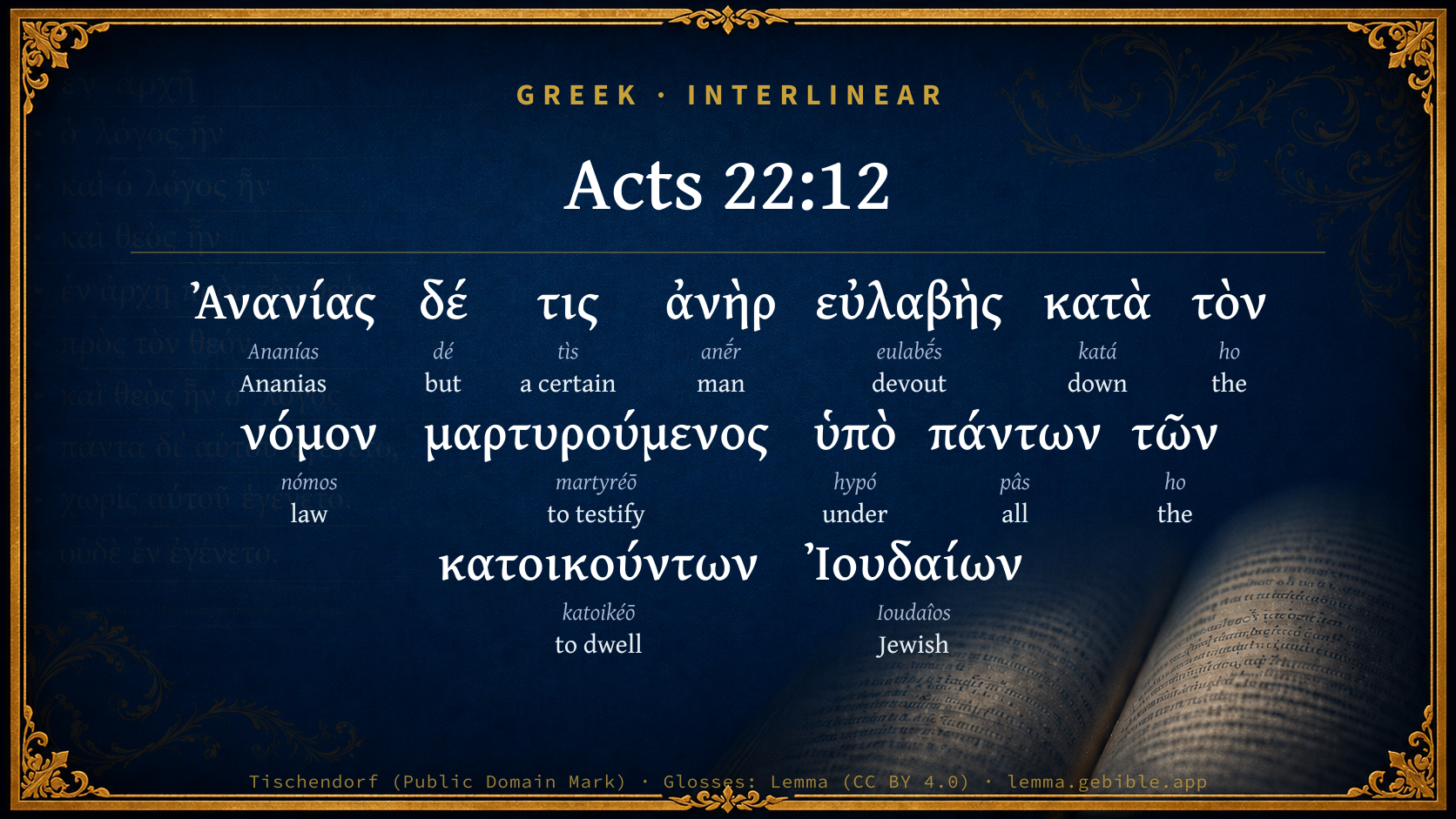
  1. Ἀνανίας Ananías G367 “Ananias” Noun, Nominative, Singular, Masculine
  2. δέ dé G1161 “but” Conjunction
  3. τις tìs G5100 “a certain” Indefinite pronoun, Nominative, Singular, Masculine
  4. ἀνὴρ anḗr G435 “man” Noun, Nominative, Singular, Masculine
  5. κατὰ katá G2596 “down” Preposition
  6. τὸν ho G3588 “the” Article, Accusative, Singular, Masculine
  7. νόμον nómos G3551 “law” Noun, Accusative, Singular, Masculine
  8. μαρτυρούμενος martyréō G3140 “to testify” Verb, Present, Passive, Participle, Nominative, Singular, Masculine
  9. ὑπὸ hypó G5259 “under” Preposition
  10. πάντων pâs G3956 “all” Adjective, Genitive, Plural, Masculine
  11. τῶν ho G3588 “the” Article, Genitive, Plural, Masculine
  12. κατοικούντων katoikéō G2730 “to dwell” Verb, Present, Active, Participle, Genitive, Plural, Masculine
  13. Ἰουδαίων Ioudaîos G2453 “Jewish” Adjective, Genitive, Plural, Masculine

About this verse

These counts appear in no published source. They are computed here, from the morphology-tagged text and Lemma’s own curated glosses. What Lemma adds →

14
words
13
distinct lemmas
Acts
section

Notable vocabulary

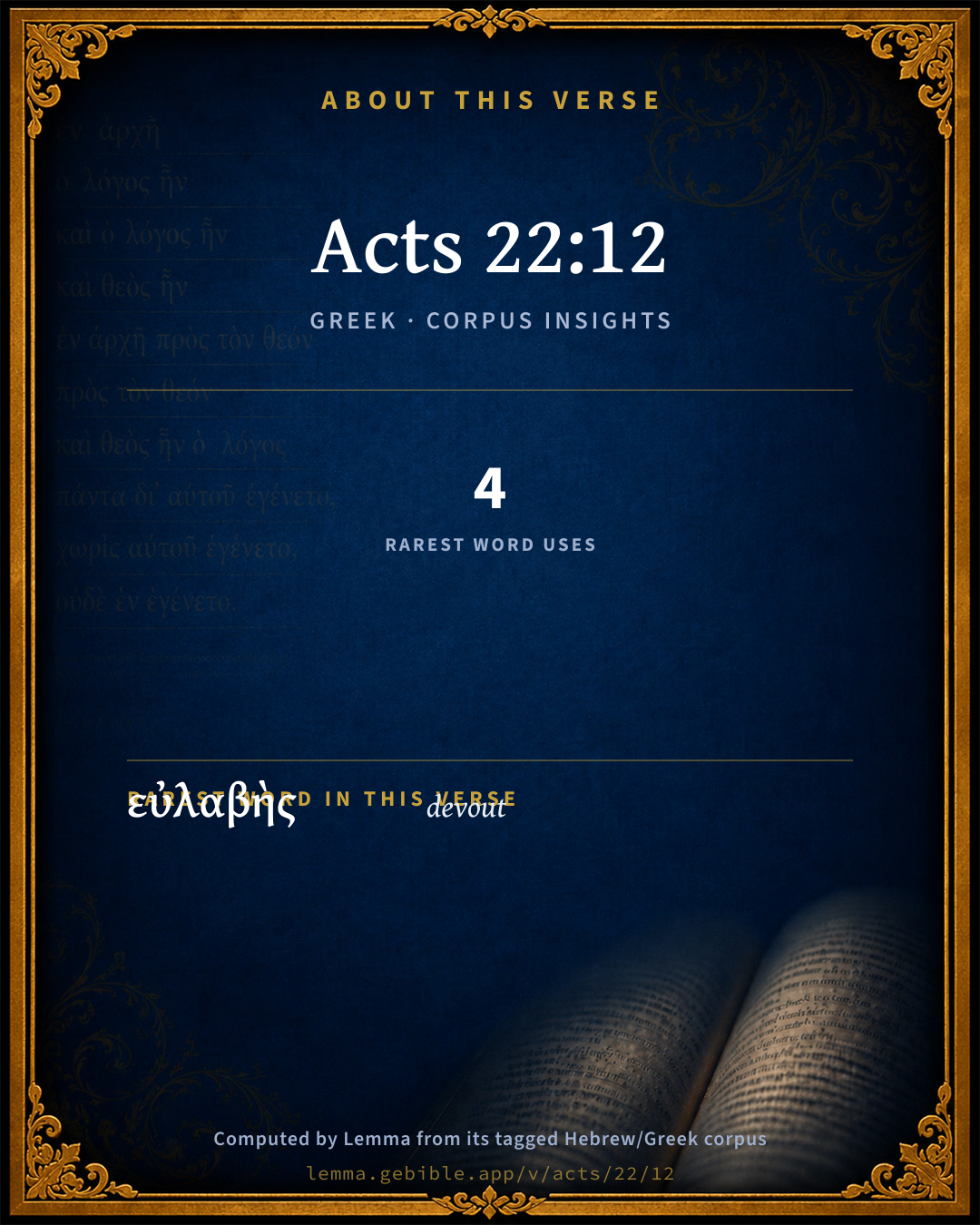
The rarest word here is εὐλαβὴς devout G2126 — appearing just 4 times in the whole Greek New Testament.

Shared distinctive vocabulary

εὐλαβὴς devout G2126 occurs in 4 verses of the Greek New Testament. Also found in:

Repetition

A word recurs within this verse:

Cross-references

10

Topical passages linked to Acts 22:12 in the Treasury of Scripture Knowledge — connected by theme and wording, ordered by reader-vote popularity; previews shown in the World English Bible.

  • Acts 10:22 They said, "Cornelius, a centurion, a righteous man and one who fears God, and well spoken of by all the nation of the Jews, was directed by a holy angel to invite you to his house, and to listen to what you say."
  • Acts 6:3 Therefore select from among you, brothers, seven men of good report, full of the Holy Spirit and of wisdom, whom we may appoint over this business.
  • 3 John 1:12 Demetrius has the testimony of all, and of the truth itself; yes, we also testify, and you know that our testimony is true.
  • Luke 2:25 Behold, there was a man in Jerusalem whose name was Simeon. This man was righteous and devout, looking for the consolation of Israel, and the Holy Spirit was on him.
  • Acts 8:2 Devout men buried Stephen, and lamented greatly over him.
  • Acts 9:10–18 Now there was a certain disciple at Damascus named Ananias. The Lord said to him in a vision, "Ananias!" He said, "Behold, it's me, Lord."
  • Acts 17:4 Some of them were persuaded, and joined Paul and Silas, of the devout Greeks a great multitude, and not a few of the chief women.
  • 2 Corinthians 6:8 by glory and dishonor, by evil report and good report; as deceivers, and yet true;
  • 1 Timothy 3:7 Moreover he must have good testimony from those who are outside, to avoid falling into reproach and the snare of the devil.
  • Hebrews 11:2 For by this, the elders obtained testimony.

Cross-references courtesy of OpenBible.info (CC BY 4.0).

Commentary

Notes on Acts 22:12 from classic Christian and Jewish commentators (each source and its license shown beneath its notes). The classic Christian expositions comment on the surrounding passage and are grouped to its opening verse, so a note may address several verses; the Jewish commentaries on the Tanakh (Rashi and others) are per-verse, so they appear only where the commentator wrote on this verse.

Lemma curates 59 commentaries, every one of them public domain or Creative Commons licensed, each selected and text-cleaned for this edition rather than reprinted as found. About our sources →

The Biblical Illustrator

Joseph S. Exell

Act_22:12-16

And one Ananias … said, The God of our fathers hath chosen thee.

The Divine ordination of human life

The verb here translated, chosen, only occurs in this form in one other place (Act_26:16), where it has the sense of making, or appointing. The idea here is ordination, or setting apart. This ordination is--

I. To an understanding of the highest subject. That thou shouldst know His will. God has a will in relation to all existences and to every individual man. It is the spring of all existence, the rule of all motion, the standard of all character. To understand it is to understand the philosophy of all being, the cause of all phenomena, and the science of all duty. All true subjects of thought are related to it, and lead into it as radia to their centre. It is, therefore, the sublimest subject of thought. It expresses the Divine nature, it reveals the universe. It is, therefore, the great theme for the study of eternity. To the study of this Paul was thus ordained. He began it then, he is at it now, he will continue at it forever.

II. To a vision of the highest existence. Not only to understand the will which is the law of the universe, but to see the Lawgiver Himself (chap. 3:14). Christ is called that Just One, not merely because, as God, He is absolutely just, nor merely because, as man, He did no sin, neither was guile found in His mouth, but as Mediator who has engaged to make unjust men just to themselves, to their fellows, to the universe, to God. Paul wan ordained to Him in order--

1. To renovate him as a sinner. The vision of Christ is the soul transforming force. Beholding, as in a glass, the glory of the Lord, we are changed, etc.

2. To qualify him as an apostle. One of the necessary qualifications of an apostle was that he should have a personal view of Christ. Hence he says, Am I not an apostle? Have I not seen the Lord?

3. To consummate his blessedness as a man. What is the heaven of souls? The beatific vision of Christ (Rev_5:6; Rev_5:12).

III. To a reception of the highest communications. And shouldst hear the voice of His mouth. To have a direct communication with Christ seemed necessary in order to put Paul on a level with the twelve apostles (Act_13:3; Gal_1:1). But whilst this was specially required for Paul as an apostle, it is the high privilege of all good men. Never man spake like this man, they said who heard Him when on earth, when He spoke only the few things that they could bear. But to listen to that voice in heaven, what an ecstasy of joy! What is the voice of your Platos compared with the voice of Christ?

IV. To a discharge of the highest mission. Thou shalt be His witness, etc. To bear witness--

1. Of the highest facts about the greatest Being.

2. Of the highest facts about the greatest Being to all mankind. How earnestly shall we aspire to such an ordination! (D. Thomas, D. D.)

Pauls ordination

From this we see--

I. What the preacher must bring along with him into the ministry.

1. The knowledge of the Divine will.

2. The experience of Divine grace.

II. What the preacher is to do in the ministry--to be a witness to all men in word and deed of what he has seen and heard.

III. On what the preacher may depend in his ministry--on the grace of God which has appointed him to the office and will strengthen him in it. (K. Gerok.)

For thou shalt be His witness.

Witnessing for Christ

Here is--

I. A special department of Christian service. Thou shalt be His witness. Sometimes a Christian is designated a steward, and is left in trust for Christ; sometimes a shepherd, and is commanded to feed the flock of God; but here he is called a witness. A witness is one who bears testimony to that with which he is personally acquainted. The apostle was a competent witness--he was permitted to see and know Christ; he was a courageous witness--he was not ashamed of the gospel of Christ; and he was a consistent witness--both by word and deed he declared the whole counsel of God. How can we witness for Christ?

1. By our self-denying labours. This is the very essence of the Christian religion. Whosoever doth not bear his cross, etc. The need of a spirit of self-abnegation is abundantly manifest. We are surrounded by the ignorant, who must be taught; by the careless, who must be awakened; and by the lost, who must be led to the Saviour.

2. By our holy deportment. The end of Christs death is the holiness of His people. The Christian is commanded to let his light so shine before men, that they may see his good works, and glorify his Father who is in heaven. Holiness is power. Argument may be resisted, entreaty may be disregarded, and eloquence may be scorned; but the exhibition of an exalted piety has a might which nothing can withstand. It is truth embodied; it is the gospel preaching in the lives of its votaries. No sophistry can elude it, no conscience can ward it off, and no bosom wears a mail that can brave the energy of its attack.

II. An extensive sphere of Christian service. To all men. If you examine a map of the countries through which the apostle travelled, you will be amazed at the extent of his labours. Distance did not damp his zeal, nor danger daunt his courage. Where can we witness for Christ?

1. In private. This is a far more important sphere of service than many persons think. Are we diligent in the time of service? Are we patient in the hour of suffering? Are we resigned in the season of bereavement? Then we are witnessing for Christ.

2. In public. This is not only a difficult, but a very delicate task. We may dishonour Christ by our silence, and we may displease men by our speech. But there is greater danger of grieving Christ by our indifference than of offending men by our imprudence. Our testimony must be constant and courageous. Wherever our lot may be cast, there we must be loyal to Christ.

III. An important qualification for Christian service. Of what thou hast seen and heard. An apostle must know the will and experience the grace of God. He had seen the Just One, and heard His voice; and you might as well have tried to reason him out of a belief in his own existence as to reason him out of his belief in the life, death and resurrection of Jesus Christ. If we have seen the glory of God, or enjoyed the fellowship of Christ, we must witness to all men of what we have seen and heard. (J. T. Woodhouse.)

And now why tarriest thou?--

Delay

In the New Testament all who came to Christ at all came straightway. The apostles, Saul of Tarsus, the jailer at Philippi, the eunuch of Ethiopia, Lydia. Those who hesitated never came. Rich young ruler, Agrippa, Felix. This teaches us in a striking manner the danger of delay. Men, however, urge the reasonableness of delay. They declare that a matter so important should be duly weighed. Its responsibilities must not be rashly assumed. On the other hand, there are solemn and pressing arguments for immediate action.

I. The position is one of peril. If your house was in flames, and you were awakened at the dead of night by the cries of firemen calling upon you to escape, would you reply that you must deliberate upon the situation? To use the wise mans image (Pro_23:34), would you, if you were lying on the top of the mast when the vessel was rocking violently and the crew were calling you to come down, respond that you must duly weigh the matter?

II. The position is sinful. It is a sin against the authority of God, who commands you to come; against the love of God, who yearns for you; against Jesus Christ--a rejection of the Divine claims, of His mercy. If it were theft, would you say, I will steal one year more, and then I will stop? Why, then, should you say, I will sin by rejecting Christ one year or one day more, and after that perhaps I will turn from this sin?

III. It may be instantly performed. You cannot stop fighting God gradually. Will you fire a few less guns tomorrow, and only an occasional gun the day after? Is that making peace? As the Roman ambassador drew a circle around the captive princes, and bade them accede to his terms before they passed its bounds, so God requires an immediate response to His overture of mercy.

IV. You have the ability now to perform it. No doubt you think you would prefer to have deeper convictions, stronger desires and all that; but you must learn to act on what you have. A vessel may leave the harbour with a wind of fifteen knots, or ten, or five, or one knot an hour. Act on what you have; think not of what might be. It is better to go out of the harbour of false ease and delusive security upon a wind that merely fills the flapping sails than not to go at all.

V. The difficulties will not be lessened by delay. You remember the countryman in AEsops fable who sat down by a running stream, saying: If this stream continues to flow as it does now for a little while, it will empty itself, and I will walk over dry shod. He waited in vain! and so do you. The difficulties will never become less.

VI. The difficulties will increase. The purchase of heaven is like buying of the Sibyls prophecies--the longer you delay the dearer the price. Men think as they grow older they will grow more virtuous. This is contradicted by the law of habit. Late conversions are rare. Old age is, of all the ages of life, the least fitted for the work of salvation. Facility in goodness does not come from habitually ignoring Christ.

VII. The shortness and uncertainty of life. The vistas of life seen in the perspective of hope may seem long to us; youth may smile at the suggestions of the tomb, and, conscious strength, may repel the insinuations of mortality; but the resistless hand of time is drawing us on. Nature and life are full of reminders of the brevity and incertitude of human existence. The eagle poising a moment on the wing, and then rushing at her prey; the ship that, throwing the spray from her bow, scuds before the wind; the shuttle, flashing through the loom; the shadow of the cloud sweeping the hillside, and then gone forever, not leaving a trace behind; the summer flowers that, vanishing, have left our gardens bare; the falling of the autumn leaf; the rushing of the mountain torrent; the dispersion of the morning mist; the fading of the summer day; these, with many other fleeting things, are emblems by which God through nature is teaching us how frail we are; at the longest, how short our days! (E. S. Prout.)

Arise, and be baptized, and wash away thy sins.--

An argument for baptism, and an appeal

I. Baptism is an ordinance of Christ. It has been a question whether the rite is of Jewish origin. Moses, indeed, ordained divers washings, to which the elders added many more. But these were essentially different from Christian baptism; they being waters of separation, this of initiation; they being repeated on any fresh pollution, this not being on any account repeated. Jewish proselyte baptism is more analogous, but is not mentioned until the Christian era. The baptism of John bears more resemblance to it, being, as he declared, the shadow of it. They certainly are not identical, or Paul would not have baptized again the disciples of John at Ephesus. So we conclude that baptism is exclusively Christian. How or why we can hardly tell, except it were gathered from a few such hints as that prediction of Isaiah--So shall He sprinkle many nations. There prevailed among the Jews an expectation that Christ should institute a new and peculiar baptism. This impression is evident from the question put by the Pharisees to John--Why baptizest thou, then, if thou be not that Christ, etc. It is, therefore, no wonder chat earnest men among them flocked to receive the baptism of repentance, nor Chat afterwards Jesus made and baptized more disciples than John; and from His own baptism, needful only for examples sake, the Teacher from heaven acted out this prevailing idea--an idea which gave an evident and definite meaning to that saying of His to Nicodemus, Except a man be born of water, etc., which agreed exactly with the current expectation, and must be law as long as men have to be translated out of the kingdom of this world into the kingdom of our Lord; which further appears from the very last charge of the Saviour (Mat_28:19-20).

II. Baptism represents the washing away of sins. Nothing can be clearer than this. Sin has ever been regarded as a defilement which required to be washed away to make a man fit to stand in the sight of God. When this purification became possible, through the water and the blood which flowed from the Saviours side, the fact was set forth by a rite in which water was employed; at the same time the Lord declared the Spirit of God, which He came to give, to be essential to that new birth without which there is no personal efficacy in baptism. Yet this is the matter upon which there has been most unaccountable and fatal confusion. The text says, Be baptized, and wash away your sins--two things as different as a sign, and the thing signified. Yet these two have been declared to he the same. If it were so, I myself should have been a new creature in Christ Jesus in virtue of it, without any conversion; but I know that I was not. If it were so, then Simon Magus must have been among the saved. The idea of baptism being the actual remission of sins, or regeneration, or anything whatever beyond a sign of these as needful and possible, is too groundless for argument. But it does show us, as clearly as any earthly image can, the necessity and the possibility of the washing of regeneration.

III. Baptism is of perpetual importance and obligation. Christianity and spirituality are all but synonymous terms, this being emphatically the dispensation of the Spirit. The ceremonial law of Moses was in itself very burdensome; but those who would prefer outward rites to true religion were always heaping up traditions upon it, until it became a yoke of bondage too heavy to be borne. Then the Saviour gave the very character of His economy when He said, God is a Spirit, etc.; in harmony with which He said also, The kingdom of God cometh not with observation, etc., which Paul did but illustrate when he said, The kingdom of God is not meat and drink, etc. Now, from these and a hundred such Scriptures we might have argued that the pure Spirit of Christ, without any figure, was Christianity. But our conceits, however logical they may seem, are not Christianity; and seeing that the thoughts and ways of God are so immeasurably higher than those of men, and wiser, and kinder, it is ever better to inquire what He has decreed than to imagine what He would do. We have already proved that Christ did institute this rite. Its very institution proves its importance then; and if it had any then, it must have as much if not more now; for if ever the outward and visible sign could be dispensed with, it must be while the Divine Teacher was living in our world to explain and to enforce His doctrines. And the most spiritual men have confessed that the two sacraments have proved a real help to their faith. At the dedication of their offspring to God in Christ, as well as at the table of the Lord, they have felt and learnt what they never learnt before, becoming more spiritual than ever. Whether this were so or not, the Divinely attested fact that Jesus decreed the baptism of all nations in His very last words is the proof that it is to have a continuance unto the end of the world. If one may explain away the rites ordained by the Lord, another may explain away the doctrines which they were ordained to teach; and, alas! many do both this day. What the very apostles needed we cannot less need; and it must be a right and safe conclusion that Christ only can unmake any ordinance which He has made, and that until He does so it rests upon all His disciples as an unquestionable obligation.

IV. Baptism is to be administered to all who worship Christ. The last clause of the text is of all importance. It proves, even before it is expounded, that baptism alone, the rite as the outward action of another, cannot save, but that its efficacy depends upon the state of mind and heart in the subject; for there is something else to be done while it is being performed. What this is is now the question. Of course it does not mean the formal mention of His holy name, nor does it mean calling, without any wish or hope of answer. The phrase is one borrowed from the Old Testament, where it always intends the actual worship of God in the prayer of faith. In the Psalms it; is said, I will offer to Thee the sacrifice of thanksgiving, and will call upon the name of the Lord; O give thanks unto the Lord, call upon His name. The phrase in question is also one of those which bind together the two Testaments. Joel says, It shall come to pass that whosoever shall call upon the name of the Lord shall be delivered--which prediction both Peter and Paul quote word for word; and whatever may have been the prophets idea, we know the apostles intention in the name of the Lord. These meant not the Lord Jehovah, but the Lord Jesus. So, then, what Ananias here required from Saul was that with the highest possible intention he should call Jesus Master and Lord; and if any man whatever do this with apparent honesty, and is yet unbaptized, to him every minister of Christ should say, And now why tarriest thou? arise, and be baptized, and wash away thy sins. (J. De Kewer Williams.)

Directions to the awakened sinner

There is this idea in the text, this Divine purport and meaning--All things are ready. A redemption is obtained. A kingdom is purchased;up and take possession.

1. Arise, that is, lift up your hearts to the Redeemer! Lift up your eyes to the hill Calvary, whence cometh your help. Arise, hang down and droop thy head no more as if no balm was in Gilead, or as if there were no Physician there that could heal thee; though thou art a poor prodigal child, and hast been feeding upon the husks, the pleasures and vanities of a sinful world, thou hast a Father that loves thee, arise and go to Him. Thou hast a dear Saviour whose wounds will heal thy spoiled and poisoned nature. Thou hast the Holy Ghost, who will lead thee and comfort thee as a mother comforteth her only son. Arise, leave thy sins, thy lusts, thy dangerous place, and venture to come to the sinners refuge, and it shall go well with thee.

2. Be baptized, be immersed and covered in the bloody sweat of Jesus, be baptized with the baptism wherewith He was baptized, those great drops which fell from Him in His agony shall wash away thy great crimes and frightful offences.

3. Wash away thy sins, that is, come to the blood of the Lamb. No Jordan, no pool of Siloam, no Bethesda is like it. Whoever comes to this laver, to this fountain, though his sins were more than the hairs of his head, or the sands upon the seashore, all shall be washed away and remembered no more: and though his crimes were the most vile and abominable, so that his heart failed him, yet the blood of Christ shall make him whiter than the snow in Salmon, and soften and melt his hard and icy nature, and speak peace and pardon to his guilty conscience.

4. Calling upon the name of the Lord, this is to direct you where to apply, to whom you may address yourselves and make your requests, namely, to the Lord Jesus that appeared to Paul in the way. He is the Friend of sinners. He is the Minister of the true sanctuary, who hears prayer, and has the tenderest heart. Ask of Him and He will give you, seek to Him and you shall find, knock at the door of the sheepfold, and you shall find entrance by the new and living way of His flesh and blood, into the holiest place of all. (John Cennick.)

Getting rid of sin

is--

I. A possible work. Be baptized, and wash away thy sins. The Holy Word represents the sinful state of the soul under different figures--sleep, slavery, disease, death, pollution. Here pollution. The words imply that it is--

1. A cleansable pollution. It is not ingrained. It is something separable from the soul. It can be washed away. Baptism to Saul would symbolise moral cleansing. No water, of course, can wash the soul; all the waters of the Atlantic could not cleanse one moral stain. There is, however, a spiritual water, the truth as it is in Jesus, by which the Eternal Spirit does cleanse (Eze_36:25; Eze_36:27; 1Co_6:11; Tit_3:7; Eph_5:25-26; Rev_1:5-6; Rev_7:14).

2. A pollution of which man must cleanse himself: Wash away thy sins. No one can do it for us.

II. It is a praying work. Calling upon the name of the Lord. Christs name is Himself; to call upon His name is to call upon Him.

1. Christ is the efficient cleanser of human souls. His work is to wash away the sins of the world, to purify the moral garments of humanity.

2. Prayer is the ordained means of attaining His cleansing influence (Rom_10:13). The prayer addressed to Him in the upper room at Jerusalem brought down His cleansing influences on the day of Pentecost. You may get wealth by industry, intelligence by study, wisdom by experience, but moral purity only by prayer.

III. It is an urgent work. Why tarriest thou? Or, more literally, Why art thou about acting, instead of acting really? Do not hesitate a moment. Be prompt. The importance of promptitude may be argued--

1. From the greatness of the work. Eternity depends upon it.

2. From the time already lost. The whole life should have been given to it, but much has run to waste.

3. From the increase of difficulties. Disinclination, insensibility, force of habit--all increase by delay.

4. From the character of the future. It is--

(1) Brief;

(2) uncertain. (D. Thomas, D. D.)

The Biblical Illustrator, edited by Joseph S. Exell (c. 1880s–1900s) — public domain. Text from a community e-Sword module.

Tyndale Open Study Notes

Tyndale Open Resources

22:12-16 Ananias: See study note on 9:17.

Tyndale Open Study Notes — © Tyndale Open Resources, licensed CC BY-SA 4.0. Text via the HelloAO Bible API.

Bengel's Gnomon

Johann Albrecht Bengel

Act 22:12. Κατοικούντων, who dwelt) Understand there, as in ch. Act 13:1, τὴν οὖσαν ἐκκλησίαν, “the church which was there.” They knew Ananias well. These Jews that dwelt (there) may seem to be put in opposition to the Jews οἱ περιερχόμενοι, who wandered about, “vagabond,” ch. Act 19:13.

Bengel's Gnomon of the New Testament — English translation (T&T Clark, Edinburgh, 1860) — public domain. Text from a community e-Sword module.

Meyer's Critical & Exegetical Commentary

Heinrich August Wilhelm Meyer

Act_22:12-15. But Ananias, a religious man according to the law, attested (praised, comp. Act_10:22, Act_6:3) by all the Jews resident (in Damascus), thus a mediator, neither hostile to the law nor unknown!

ἀνάβλεψον … ἀνέβλεψα εἰς αὐτόν] ἀναβλέπειν, which may signify as well to look up, as also visum recuperare (see on Joh_9:11, and Fritzsche, ad Marc. p. 328), has here (it is otherwise in Act_9:17-18) the former meaning, which is evident from εἰς αὐτόν: look up! and at the same hour I looked up to him. We are to conceive the apostle as sitting there blind with closed eyelids, and Ananias standing before him.

προεχειρ.] has appointed thee thereto. See on Act_3:20; comp. Act_26:16.

τὸν δίκαιον] Jesus, on whom, as the righteous (2Co_5:21), the divine will to save (τὸ θέλημα αὐτοῦ) was based. Comp. Act_3:14, Act_7:52.

πρὸς πάντ. ἀνθρ.] Direction of the ἔσῃ μάρτ., as in Act_13:31 : to all men[135]

[135] That is, according to the popular expression: before all the world. Frequently so in Isocrates. See Bremi, ad Panegyr. 23, p. 28. But the universal destination of the apostle is implied therein. Comp. ver. 21.

Meyer — Critical and Exegetical Commentary on the New Testament — English translation by Peter Christie, edited by Frederick Crombie (T&T Clark, 1880) — public domain. Text from a community e-Sword module.

Expositor's Greek Testament

ed. W. Robertson Nicoll

Act 22:12 . Ἀναν ., Act 9:10 . The description is added, ἀνὴρ εὐ . Ἰ ., manifestly fitting before a Jewish audience, and a proof that the brother who came to Saul was no law-breaker, Lewin, St. Paul , ii., 146. On the reading εὐλαβής , cf. Act 2:5 . τῶν κατοικ .: seems to imply that Ananias had dwelt for some time in Damascus, 9.

The Expositor's Greek Testament, edited by W. Robertson Nicoll (1897–1910) — public domain. Text from a community e-Sword module.

Jamieson, Fausset & Brown

Robert Jamieson, A. R. Fausset & David Brown

Ananias, a devout man, according to the law, having a good report of all the Jews which dwelt there--One would not know from this description of Ananias that he was a Christian at all, the apostles object being to hold him up as unexceptionable, even to the most rigid Jews.

Jamieson, Fausset & Brown — Commentary Critical and Explanatory on the Whole Bible (1871) — public domain (CC PDM 1.0). Text via the HelloAO Bible API.

John Calvin's Commentaries

12. One Ananias. Paul proceedeth now unto the fourth point, to wit, that he did not only give his name to Christ, being astonished with miracles, but that he was also well and thoroughly instructed in the doctrine of the gospel. I have already said that Ananias met Paul, not by chance, but through the direction of Christ. And whereas he giveth him the title of godliness as concerning the law, and saith that he was well reported of by the whole nation, in these words he preventeth the wrong opinion which they might conceive. As they loathed the Gentiles, so they would never have allowed any teacher coming from them; and one that had revolted from the law should have been most detestable. Therefore, he witnesseth that he worshipped God according to the law, and that his godliness was known and commended among all the Jews, so that they ought not to suspect him. These words, according to the law, are ignorantly, by some, coupled with the text following, that he was approved according to the law. For Ananias’ religion is rather distinguished by this mark from the superstitions of the Gentiles. Though we must note, that the law is not mentioned to establish the merits of works, that they may be set against the grace of God; but Ananias’ godliness is clearly acquitted of all evil suspicion which might have risen among the Jews. And seeing that he restoreth sight to Paul with one word, it appeareth thereby that he was sent of God, as I have said before.

John Calvin's Commentaries (1540-1563) — public domain. Text from the Calvin Translation Society English edition (1840s-50s) via the Christian Classics Ethereal Library (ccel.org). Calvin's coverage is partial (roughly two-thirds of the Bible); uncommented books and verses are honest gaps, never fabricated. The 19th-century editor's footnotes and remarks are omitted so the notes are faithfully Calvin's own voice.

Ellicott's Commentary for English Readers

(12) A devout man according to the law.—In Act_9:10, Ananias is simply described as “a disciple.” The special description here was obviously given with a view to conciliate those who were listening to the speech. One, such as Ananias was, was not likely to have connected himself with a profane blasphemer, nor to have received the converted persecutor except on evidence that the change had come from God. St. Paul naturally confines himself to what came within his own experience, and does not dwell on the vision which had been seen by Ananias.

A Bible Commentary for English Readers, edited by Charles John Ellicott (1878–1897) — public domain. Text from a community e-Sword module.

The Cambridge Bible for Schools and Colleges

gen. ed. J. J. S. Perowne

12. Ananias, a devout man according to the law, &c.] The Apostle neglects nothing in his address which can conciliate his audience, and so he tells them that the messenger whom God sent to him was “well reported of by all the Jews that dwelt in Damascus.” (For Ananias see note on Act_9:10.) The hostility towards Christians, which was so strong in Jerusalem, had not at the time of St Paul’s conversion manifested itself so greatly in Damascus, since Ananias “a disciple” was still in good repute with the Jews there.

The Cambridge Bible for Schools and Colleges (gen. ed. J. J. S. Perowne; Cambridge University Press, 1878–1918) — public domain. Text from a community e-Sword module.

John Gill's Exposition

And he said, the God of our fathers hath chosen thee,.... From all eternity, in his everlasting purposes and decrees; or "he hath taken thee into his hand"; in order to form, and fit, and qualify him for his service; and may design both his call by grace, and to apostleship. The apostle represents Ananias as speaking of God, as the God of the Jewish fathers, of Abraham, Isaac, and Jacob, to show that the Christian doctrine was not contrary to the faith of the one God of Israel; nor did it introduce any other, or any new deity. The ends of this choice or separation were,

that thou shouldest know his will; his revealed will, concerning the salvation of men by Jesus Christ, which is no other than the Gospel, of which the apostle had been entirely ignorant; for though he knew the will of God, as revealed in the law, or his will of command, yet not spiritually; and he was altogether a stranger, till now, to God's will, way, and method of saving sinners by Christ, of justifying them by his righteousness, and of pardoning their sins through his blood, and of giving them eternal life by him; and the knowledge of this he came at by the spirit of wisdom and revelation, in consequence of his being chosen and called:

and see that just One: Jesus Christ the righteous, who is both as he is God, and as he is man, and also as he is Mediator, having faithfully discharged his office, and performed his engagements; him the apostle saw, both with the eyes of his body, when he met him in the way, and called unto him, and with the eyes of his understanding beholding his beauty, fulness, and suitableness as a Saviour; the former of these was what many kings, prophets, and righteous men desired: and the latter is what is inseparably connected with eternal life and salvation.

And shouldest hear the voice of his mouth; both his human voice in articulate sounds, when he spoke to him in the Hebrew tongue, as in Act 22:7 and the voice of his Gospel, of which he appeared to make him a minister; which is a voice of love, grace, and mercy, of peace, pardon, righteousness, and salvation, and is very powerful when accompanied by the Spirit, and is soul charming, alluring, and comforting.

John Gill's Exposition of the Whole Bible (1746–1763) — public domain (CC PDM 1.0). Text via the HelloAO Bible API.

Albert Barnes' Notes on the Bible

See the notes on Act 9:17-18.

Albert Barnes' Notes on the Bible (1834–1885) — public domain. Text from a community e-Sword/MySword module.

Matthew Poole's English Annotations

According to the law; this is added to distinguish him from a proselyte, and to let them know that he had received the gospel, not from a convert out of Gentilism, (who though they admitted, yet they had a greater jealousy over, and less kindness for), but from one like unto themselves in all things.

Matthew Poole's English Annotations on the Holy Bible (1683–1685) — public domain. Text from a community e-Sword/MySword module.

Whedon's Commentary on the Bible

Daniel D. Whedon

12. A devout man—Paul brings out specially the holy Judaism and wide reputation of Ananias, to show him as a worthy witness to his divine legation from the risen Jesus.

Daniel D. Whedon (gen. ed.), Commentary on the Old and New Testaments (1874–1909) — public domain. Text from a community e-Sword module.

The Pulpit Commentary

Well reported of by for having a good report of, A.V.; that for which, A.V. Well reported of (marturoumenov); see Act_6:3, note.

The Pulpit Commentary (1880–1919), ed. H.D.M. Spence-Jones & Joseph S. Exell — public domain. Text from a community e-Sword module.

John Wesley's Explanatory Notes

A devout man according to the law - A truly religious person, and though a believer in Christ, yet a strict observer of the law of Moses.

John Wesley, Explanatory Notes Upon the Whole Bible (1754–1765) — public domain. Text via the GEBible commentary corpus.

Kretzmann's Popular Commentary

Paul E. Kretzmann

Paul and Ananias:

v. 12. And one Ananias, a devout man according to the Law, having a good report of all the Jews which dwelt there,

v. 13. came unto me, and stood, and said unto me, Brother Saul, receive thy sight. And the same hour I looked up upon him.

v. 14. And he said, The God of our fathers hath chosen thee that thou shouldest know His will and see that Just One, and shouldest hear the voice of His mouth.

v. 15. For thou shalt be His witness unto all men of what thou hast seen and heard.

v. 16. And now, why tarriest thou? Arise, and be baptized, and wash away thy sins, calling on the name of the Lord.

Paul here from his personal experience, from the events which had been impressed upon his mind with indelible characters, gives a fuller account of the words of Ananias than that which had been reported in Chapter 9. This Ananias was by no means a Gentile, nor a Jew without reputation and standing, but, as Paul emphasizes, a devout man, pious in accordance with Jewish law, according to their own standard, vouched for by all the Jews that lived in Damascus. Through him Paul received the commission to preach the Gospel of Christ, especially to the Gentiles, as he here is careful to bring out. For this Ananias came to him and stood by or over him as he lay or sat there, prostrate with sorrow, addressed him as a brother, and by a simple word of command performed the miracle of restoring his sight. In the same hour, that is, in the same instant, his sight was returned to him. And then Ananias had explained to him in just what way the Lord’s plans had been carried out and were to be carried out. The God of their fathers, the true God, as the Jews worshiped Him, had appointed in advance that Paul was to know His will, to find out for what important duty he had been selected. His seeing the Just One and hearing the voice from His mouth in the vision near the city had also been arranged beforehand by God. This is an additional proof that Paul actually did see Jesus Christ. And this same voice of the Lord which had spoken to him before the city was now again addressing him with the commission that he should be a witness to the Lord to all men concerning what he had seen and heard. Why should there then be any cause for hesitation? Ananias had asked him. He had told him to arise, to be baptized, and thereby to have his sins washed away, and at the same time to call upon the name of the Lord. Note: Baptism is not a mere external form or symbol to signify the receipt of the forgiveness of sins before or after, but by the washing of the water in Baptism the sins are taken away, the filth of the soul is washed off; it is a washing of regeneration and renewing of the Holy Ghost, Tit 3:5. Through the name of Jesus and by faith in the Redeemer, which trusts the Word of God in Baptism, the great blessings are conferred and sealed.

Paul E. Kretzmann, Popular Commentary of the Bible (1921–1924) — public domain. Text from a community e-Sword module.

McGarvey & Pendleton's Commentaries

J. W. McGarvey

See notes on verse 3

J. W. McGarvey (with Philip Y. Pendleton), Commentaries on the New Testament (The Fourfold Gospel, 1914; Acts; and the epistles) — public domain. Text from a community e-Sword/MySword module.

The People's New Testament

B. W. Johnson

12–16. One Ananias, a devout man. In the account of 9:10 we are told he was a disciple. Though a disciple, he kept the law strictly.

The God of our fathers. Of the Jews. See that Just One. The Lord Jesus Christ. It was necessary that Paul should see the Lord in order to become a witness. He refers more than once to the fact that he had seen the risen Christ (1 Cor. 9:1; 15:8).

Arise, and be baptized. Dean Howson (Acts, p. 501) says that the verb “baptize” in the Greek is in the middle voice, and that a more accurate rendering would be, “Have thyself baptized.” Wash away thy sins. This language shows that Ananias thought that the penitent sinner was to be baptized for the remission of sins (2:38), and that Paul held the same view. Compare Titus 3:5. Hackett says: “This clause states the result of baptism in language derived from the nature of the ordinance. It answers to eis aphesin hamartion (2:38), i. e., submit to the rite in order to be forgiven.… There can be no question of the mode of baptism in this case, for if it be held that be baptized is uncertain in its meaning, wash away is a definition that removes the doubt.” As the final act of conversion, baptism symbolically, is said to wash away sins.

B. W. Johnson's The People's New Testament with Notes (1889–1891) — public domain. Electronic text from the Christian Classics Ethereal Library (CCEL) ThML edition.

unfoldingWord translationNotes

Door43 World Missions Community

General Information:

The words "He" and "him" refer to Ananias.

Ananias

Though this is not the same Ananias who died earlier in Acts Acts 5:3, you may translate it the same way though as you did in Acts 5:1. (See: How to Translate Names)

devout man according to the law

Ananias was very serious about following God's law.

well spoken of by all the Jews who lived there

This can be stated in active form. AT: "the Jews who lived there spoke well of him" (See: Active or Passive)

Brother Saul

Here "Brother" is a polite way to address someone. AT: "My friend Saul"

receive your sight

The word"sight" can be translated with the verb "see." AT: "see again" (See: Abstract Nouns)

In that very hour

This was a customary way of saying something happened immediately. AT: "At that instant" or "Instantly" or "Immediately" (See: Idiom)

translationWords

law

Jew

brother

hour, hours

unfoldingWord translationNotes — © Distant Shores Media and the Door43 World Missions Community, licensed CC BY-SA 4.0. Source: git.door43.org/Door43/en_tn.

Cambridge Greek Testament for Schools and Colleges

12. Ἀνανίας δέ τις, ἀνὴρ εὐλαβὴς κατὰ τὸν νόμον, and Ananias, a devout man according to the Law. The Apostle neglects nothing in his address which can conciliate his audience, and so he tells them that the messenger whom God sent to him was ‘well reported of by all the Jews that dwelt in Damascus.’ (For Ananias see note on Act 9:10.) The hostility towards Christians, which was so strong in Jerusalem, had not at the time of St Paul’s conversion manifested itself so greatly in Damascus, since Ananias, ‘a disciple,’ was still in good repute with the Jews there.

Cambridge Greek Testament for Schools and Colleges (Cambridge University Press, 1896; 21 vols, various authors incl. Carr, Maclear, Plummer, Farrar, Lumby, Moule, M. R. James, Simcox) — public domain. Text from a community e-Sword module.

Alford’s Greek Testament

Henry Alford

12.] That Ananias was a Christian, is not here mentioned,—and ἀνὴρ … Ἰουδαίων is added: both, as addressed to a Jewish audience. Before the Roman governor in ch. 26, he does not mention him at all, but compresses the whole substance of the command given to Ananias into the words spoken by the Lord to himself. A heathen moralist could teach,—‘Quid de quoque viro, et cui dicas, sæpe videto’ (Hor. Eph 1:18, 68): and a Christian Apostle was not unmindful of the necessary caution. Such features in his speeches are highly instructive and valuable to those who would gather from Scripture itself its own real character: and be, not slaves to its letter, but disciples of its spirit.

Henry Alford, The Greek Testament (1849–1861) — public domain. Text from a community e-Sword module.

Vincent's Word Studies in the New Testament

Marvin R. Vincent

A devout man, etc. In ch. 9 10, he is called a disciple. Paul here "affirms that he was not introduced to Christianity by an opponent of Judaism, but by a strict Jew" (Gloag).

Marvin R. Vincent, Word Studies in the New Testament (1887–1900) — public domain. Text from a community e-Sword/MySword module.

Lesson kit

Teaching starters — assembled from the data on this page, not authored interpretation. Every prompt links to the verse data it draws on. Edit before teaching.

Acts, in the Acts, opens this verse with 14 words (13 distinct Greek lemmas). Its most distinctive word is eulabḗs (“devout”). A historical commentator’s framing appears above. Read the whole chapter for the surrounding context.

Discussion questions

  1. How does “devout” (eulabḗs) shape what this verse is saying?
  2. Luke 2:25 shares the word «devout» with this verse. How do the two illuminate each other?
  3. “the” occurs 2× in this one verse. What is the effect of the repetition?
  4. The translations on this page render this verse differently — a whole-verse word diff, not a word-by-word alignment. What might account for the different wordings?
  5. Reading how The Biblical Illustrator and Tyndale Open Study Notes read this verse, where do the two commentators agree and where do they part?

Things to notice

Reading settings

Reading text

Shown beneath each verse's original-language words.

Old Testament
Old Testament edition

Read the OT as the Masoretic Hebrew (MT) or the Greek Septuagint (LXX).

English shown for the Greek Septuagint (in the Hebrew ↔ Greek comparison).

Comparing translations? Open the Compare panel on any verse page to stack up to four side by side.