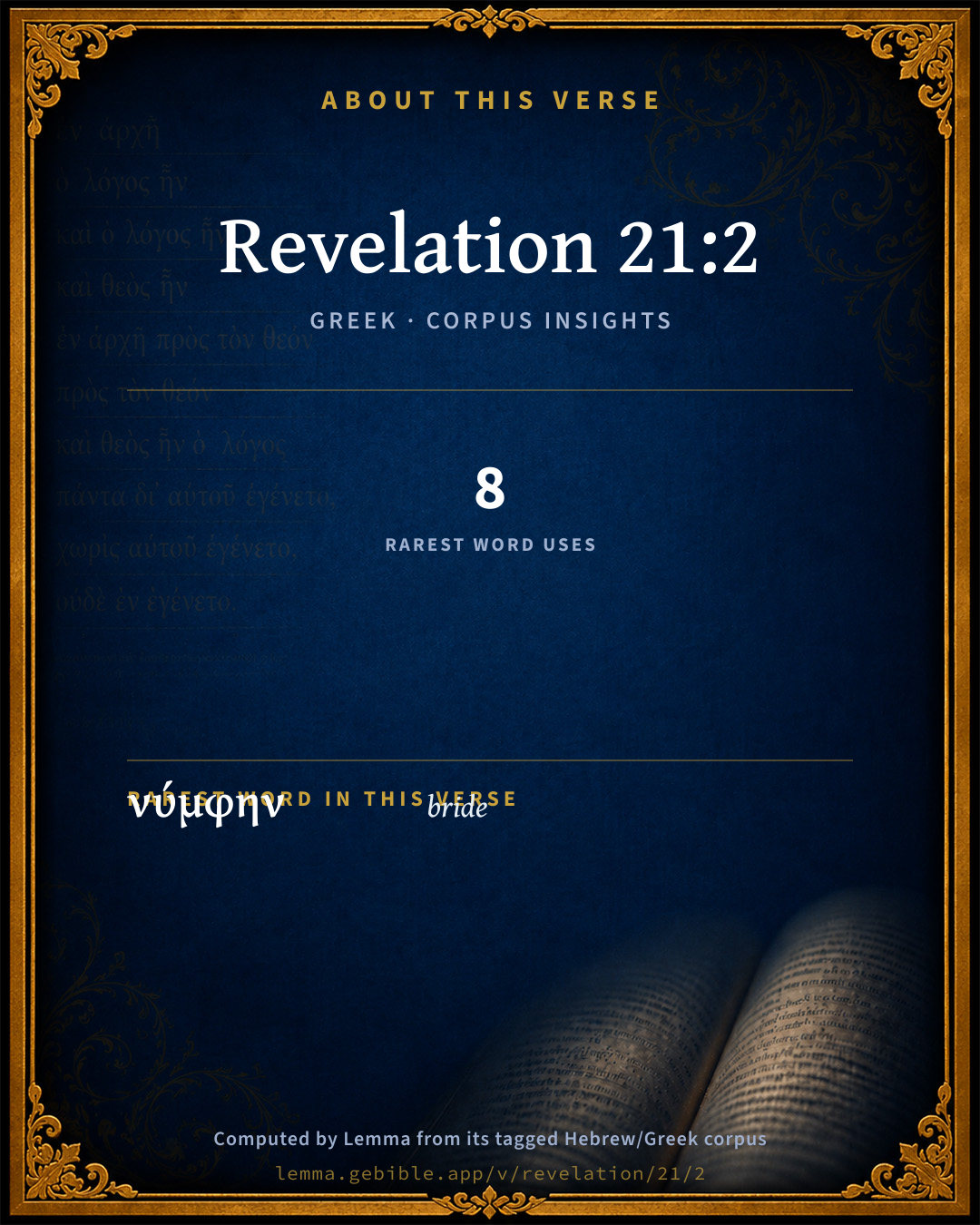
Revelation 21:2

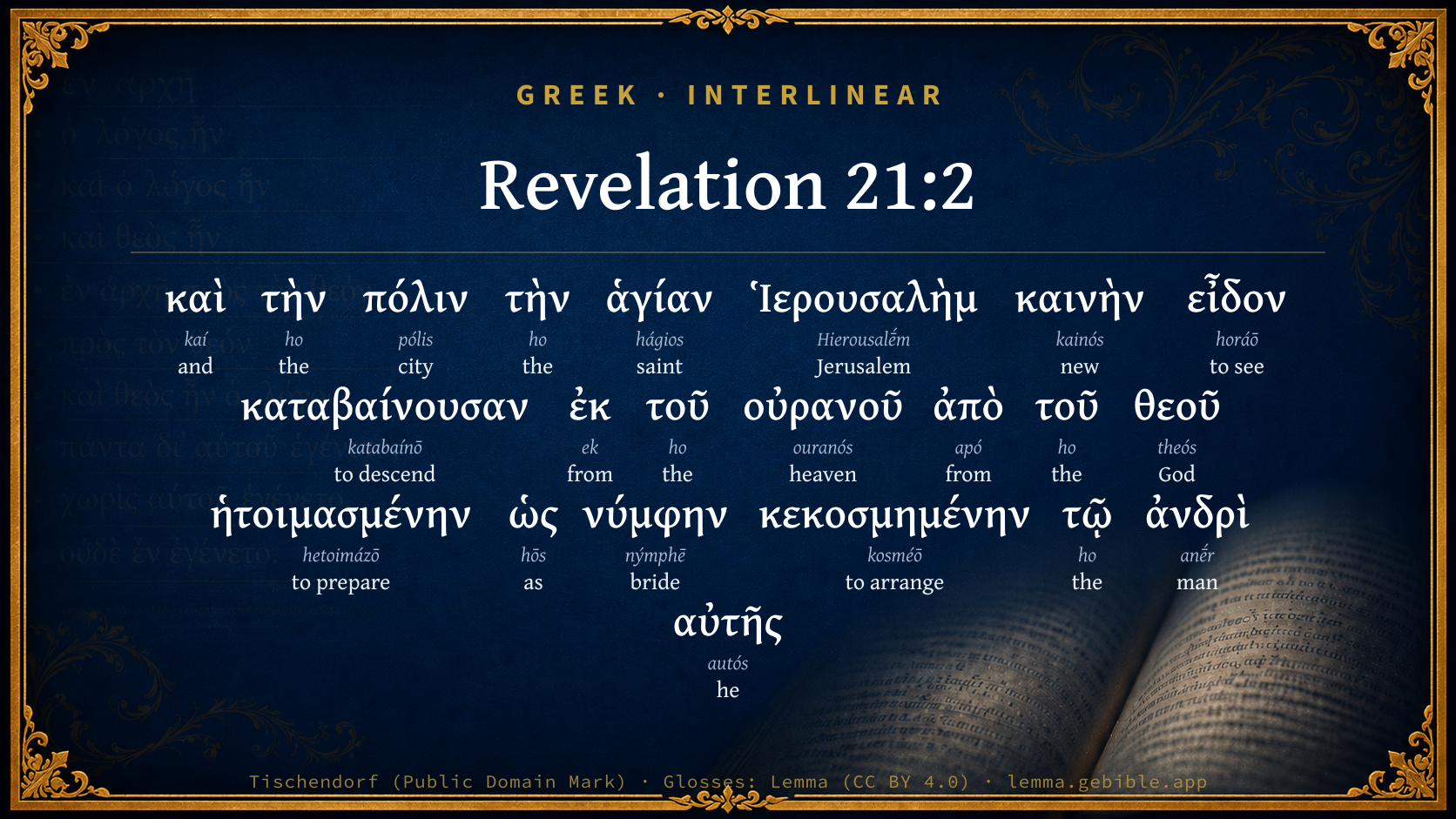
Greek (Tischendorf 8th ed.) Revelation 21:2 appears in the Greek New Testament. The text above is from the Tischendorf 8th edition. Each word links to its Strong’s number and a concise gloss. Click any word for its full Thayer’s Greek Lexicon entry.
Download image
Cite this verse

Revelation 21:2 (World English Bible). Public Domain. Lemma interlinear Bible study tool, https://lemma.gebible.app/v/revelation/21/2.

Show BibTeX & RIS
BibTeX
RIS
English Translation
I saw the holy city, New Jerusalem, coming down out of heaven from God, made ready like a bride adorned for her husband.
World English Bible · Public Domain
Download a study sheet

One document with this verse’s original text, its word-by-word gloss line, the meaning frame, cross-references with their text, attributed commentary, and full source and license credits — printable, and it pastes into notes with its structure intact.

This verse Autodidact and up

Study sheet (.html) Plain text (.txt)

A passage Seminary Student

Up to 50 verses in one chapter. A passage sheet keeps up to 6 commentary sources and 12 cross-references per verse, in the order this page ranks them, and says so on the sheet whenever that leaves anything out. Ask for a single verse and you get the Autodidact verse sheet above.

Everything on this page stays free to read, with no account — the sheet is a download of what is already on screen, not access to it.

Want to remove ads? Support Godless Engineer
Compare translations 3

The same verse in 3 English versions, stacked beneath the original-language interlinear above. Click any original word for its lexicon entry.

Each is an independent rendering of the whole verse — the interlinear is not word-aligned to these translations.

Highlighted words mark where these versions differ — a whole-verse word diff, not a word-by-word alignment.

  • World English Bible Public Domain
    I saw the holy city, New Jerusalem, coming down out of heaven from God, made ready like a bride adorned for her husband.
  • King James Version Public Domain
    And I John saw the holy city, new Jerusalem, coming down from God out of heaven, prepared as a bride adorned for her husband.
  • unfoldingWord Literal Text CC BY-SA 4.0
    And I saw the holy city, new Jerusalem, coming down out of heaven from God, prepared like a bride adorned for her husband.

unfoldingWord Literal Text — © unfoldingWord, licensed CC BY-SA 4.0. Word-aligned USFM3 via Door43 (git.door43.org/unfoldingWord/en_ult).

Versions to compare (up to 4)

3 of 4 selected

Show all 19 translations

Every available English version of this verse, each an independent rendering of the whole verse.

  • World English Bible Public Domain
    I saw the holy city, New Jerusalem, coming down out of heaven from God, made ready like a bride adorned for her husband.
  • Berean Standard Bible Public Domain
    I saw the holy city, the new Jerusalem, coming down out of heaven from God, prepared as a bride adorned for her husband.
  • Majority Standard Bible Public Domain
    I saw the holy city, the new Jerusalem, coming down out of heaven from God, prepared as a bride adorned for her husband.
  • King James Version Public Domain
    And I John saw the holy city, new Jerusalem, coming down from God out of heaven, prepared as a bride adorned for her husband.
  • American Standard Version (1901) Public Domain
    And I saw the holy city, new Jerusalem, coming down out of heaven of God, made ready as a bride adorned for her husband.
  • Revised Version (1885) Public Domain
    And I saw the holy city, new Jerusalem, coming down out of heaven from God, made ready as a bride adorned for her husband.
  • Geneva Bible (1599) Public Domain
    And I Iohn sawe the holie citie newe Hierusalem come downe from God out of heauen, prepared as a bride trimmed for her husband.
  • Douay-Rheims (1899) Public Domain
    And I John saw the holy city, the new Jerusalem, coming down out of heaven from God, prepared as a bride adorned for her husband.
  • Young's Literal Translation Public Domain
    and I, John, saw the holy city -- new Jerusalem -- coming down from God out of the heaven, made ready as a bride adorned for her husband;
  • Literal Standard Version CC BY-SA 4.0
    and I saw the holy city, New Jerusalem, coming down from God out of Heaven, made ready as a bride adorned for her husband;
  • Unlocked Literal Bible CC BY-SA 4.0
    I saw the holy city, new Jerusalem, that came down out of heaven from God, prepared like a bride adorned for her husband.
  • unfoldingWord Literal Text CC BY-SA 4.0
    And I saw the holy city, new Jerusalem, coming down out of heaven from God, prepared like a bride adorned for her husband.
  • Darby Bible Public Domain
    And I saw the holy city, new Jerusalem, coming down out of the heaven from God, prepared as a bride adorned for her husband.
  • World Messianic Bible Public Domain
    I saw the holy city, New Jerusalem, coming down out of heaven from God, prepared like a bride adorned for her husband.
  • Webster's Bible Public Domain
    And I John saw the holy city, new Jerusalem, coming down from God out of heaven, prepared as a bride adorned for her husband.
  • Free Bible Version CC BY-SA 4.0
    I saw the holy city, New Jerusalem, descending from God out of heaven, prepared like a bride made beautiful for her husband.
  • Bible in Basic English Public Domain
    And I saw the holy town, new Jerusalem, coming down out of heaven from God, like a bride made beautiful for her husband.
  • Text-Critical English NT CC BY 4.0
    I also saw the holy city, new Jerusalem, coming down out of heaven from God, prepared like a bride adorned for her husband.
  • Tyndale New Testament (1534) Public Domain
    And I Ihon sawe that holy cite newe Ierusalem come doune from God oute of heven prepared as a bryde garnysshed for hyr husband.

Literal Standard Version (2020), Covenant Press — licensed CC BY-SA 4.0. Text via the HelloAO Bible API (eBible.org). Unlocked Literal Bible (unfoldingWord) — licensed CC BY-SA 4.0. Text via the HelloAO Bible API (eBible.org). unfoldingWord Literal Text — © unfoldingWord, licensed CC BY-SA 4.0. Word-aligned USFM3 via Door43 (git.door43.org/unfoldingWord/en_ult). Free Bible Version, Dr. Jonathan Gallagher — licensed CC BY-SA 4.0. Text via the HelloAO Bible API (eBible.org).

Word by word

More ways to search: Search by grammar → Find every occurrence → Compare this word →

Practice this passage: Drill this verse → Learn its vocabulary →

νύμφην
nýmphē
G3565
“bride”
Noun, Accusative, Singular, Feminine
Part of Speech
Noun
Case
Accusative
Number
Singular
Gender
Feminine
Full Thayer's Definition

Origin: "from a primary but obsolete verb nupto (to veil as a bride, cf Latin "nupto," to marry)"

TDNT: 22:19,7

1. a betrothed woman, a bride 2. a recently married woman, young wife 3. a young woman 4. a daughter-in-law
  1. καὶ kaí G2532 “and” Conjunction
  2. τὴν ho G3588 “the” Article, Accusative, Singular, Feminine
  3. πόλιν pólis G4172 “city” Noun, Accusative, Singular, Feminine
  4. τὴν ho G3588 “the” Article, Accusative, Singular, Feminine
  5. ἁγίαν hágios G40 “saint” Adjective, Accusative, Singular, Feminine
  6. Ἱερουσαλὴμ Hierousalḗm G2419 “Jerusalem” Noun, Proper, indeclinable
  7. καινὴν kainós G2537 “new” Adjective, Accusative, Singular, Feminine
  8. εἶδον horáō G3708 “to see” Verb, Aorist, Active, Indicative, 1st person, Singular
  9. καταβαίνουσαν katabaínō G2597 “to descend” Verb, Present, Active, Participle, Accusative, Singular, Feminine
  10. ἐκ ek G1537 “from” Preposition
  11. τοῦ ho G3588 “the” Article, Genitive, Singular, Masculine
  12. οὐρανοῦ ouranós G3772 “heaven” Noun, Genitive, Singular, Masculine
  13. ἀπὸ apó G575 “from” Preposition
  14. τοῦ ho G3588 “the” Article, Genitive, Singular, Masculine
  15. θεοῦ theós G2316 “God” Noun, Genitive, Singular, Masculine
  16. ἡτοιμασμένην hetoimázō G2090 “to prepare” Verb, Perfect, Passive, Participle, Accusative, Singular, Feminine
  17. ὡς hōs G5613 “as” Adverb
  18. κεκοσμημένην kosméō G2885 “to arrange” Verb, Perfect, Passive, Participle, Accusative, Singular, Feminine
  19. τῷ ho G3588 “the” Article, Dative, Singular, Masculine
  20. ἀνδρὶ anḗr G435 “man” Noun, Dative, Singular, Masculine
  21. αὐτῆς autós G846 “he” Personal pronoun, Genitive, Singular, Feminine

About this verse

These counts appear in no published source. They are computed here, from the morphology-tagged text and Lemma’s own curated glosses. What Lemma adds →

22
words
18
distinct lemmas
Revelation
section

Notable vocabulary

The rarest word here is νύμφην bride G3565 — appearing just 8 times in the whole Greek New Testament.

Shared distinctive vocabulary

νύμφην bride G3565 occurs in 7 verses of the Greek New Testament. Also found in:

Repetition

A word recurs within this verse:

Cross-references

15

Topical passages linked to Revelation 21:2 in the Treasury of Scripture Knowledge — connected by theme and wording, ordered by reader-vote popularity; previews shown in the World English Bible.

  • Hebrews 11:10 For he looked for the city which has the foundations, whose builder and maker is God.
  • Revelation 3:12 He who overcomes, I will make him a pillar in the temple of my God, and he will go out from there no more. I will write on him the name of my God, and the name of the city of my God, the new Jerusalem, which comes down out of heaven from my God, and my own new name.
  • Revelation 21:10 He carried me away in the Spirit to a great and high mountain, and showed me the holy city, Jerusalem, coming down out of heaven from God,
  • Isaiah 61:10 I will greatly rejoice in Yahweh, my soul shall be joyful in my God; for he has clothed me with the garments of salvation, he has covered me with the robe of righteousness, as a bridegroom decks himself with a garland, and as a bride adorns herself with her jewels.
  • Hebrews 13:14 For we don't have here an enduring city, but we seek that which is to come.
  • Hebrews 12:22 But you have come to Mount Zion, and to the city of the living God, the heavenly Jerusalem, and to innumerable hosts of angels,
  • Revelation 19:7–8 Let us rejoice and be exceedingly glad, and let us give the glory to him. For the marriage of the Lamb has come, and his wife has made herself ready."
  • Revelation 22:19 If anyone takes away from the words of the book of this prophecy, may God take away his part from the tree of life, and out of the holy city, which are written in this book.
  • Isaiah 54:5 For your Maker is your husband; Yahweh of Hosts is his name: and the Holy One of Israel is your Redeemer; the God of the whole earth shall he be called.
  • 2 Corinthians 11:2 For I am jealous over you with a godly jealousy. For I married you to one husband, that I might present you as a pure virgin to Christ.
  • Ephesians 5:25–27 Husbands, love your wives, even as Christ also loved the assembly, and gave himself up for it;
  • Isaiah 52:1 Awake, awake, put on your strength, Zion; put on your beautiful garments, Jerusalem, the holy city: for henceforth there shall no more come into you the uncircumcised and the unclean.
  • Psalms 48:1–3 Great is Yahweh, and greatly to be praised, In the city of our God, in his holy mountain.
  • Isaiah 62:4 You shall no more be termed Forsaken; neither shall your land any more be termed Desolate: but you shall be called Hephzibah, and your land Beulah; for Yahweh delights in you, and your land shall be married.
  • Galatians 4:25–26 For this Hagar is Mount Sinai in Arabia, and answers to the Jerusalem that exists now, for she is in bondage with her children.

Cross-references courtesy of OpenBible.info (CC BY 4.0).

Where the printed editions differ

1 variant

Places in this verse where the major printed Greek editions disagree on the wording in a way that affects the translation — a comparison of editions, not a manuscript-by-manuscript collation. The editions are the modern critical texts (Nestlé-Aland 28/27, SBL, Westcott-Hort, Tregelles, Tyndale House) and the traditional texts behind the KJV (the Textus Receptus and the Byzantine/Majority text). It is not a claim about which reading is original.

  1. Extra text
    ἐγὼ Ἰωάννης

    “I myself John”

    In TR Not in NA28NA27TynSBLWHTregByz

    ἐγὼ Ἰωάννης (egō Iōannēs) 'I myself John' is only in traditional manuscripts (TR)

Textual data: Translators Amalgamated Greek New Testament (STEPBible TAGNT) · CC BY 4.0.

Commentary

Notes on Revelation 21:2 from classic Christian and Jewish commentators (each source and its license shown beneath its notes). The classic Christian expositions comment on the surrounding passage and are grouped to its opening verse, so a note may address several verses; the Jewish commentaries on the Tanakh (Rashi and others) are per-verse, so they appear only where the commentator wrote on this verse.

Lemma curates 59 commentaries, every one of them public domain or Creative Commons licensed, each selected and text-cleaned for this edition rather than reprinted as found. About our sources →

The Cambridge Bible for Schools and Colleges

gen. ed. J. J. S. Perowne

The New Jerusalem, Rev_21:2

2. And I John saw] Read simply, and I saw.

new Jerusalem] For the old Jerusalem, though we saw (Rev_20:9, and note) that it is to be again “a holy city” in the last days as of old, will have passed away with “the first earth.”

coming down from God out of heaven] Transpose the two clauses, out of heaven from God. This is the New Jerusalem of which the earthly city is an imperfect copy; see on Rev_4:6, Rev_6:9 for the heavenly Temple. While this world lasts, this true Jerusalem is above (Gal_4:26); and we only know its nature from the earthly copy of it, before Christ came, and the spiritual approach to it (Heb_12:22) since. But in the days here described, it will be realised on earth in all its perfection.

prepared] The building and arrangements of the city serve the same purpose as the dress and ornaments of a bride. Cf. Isa_61:10.

as a bride] See Rev_19:7, and notes thereon.

adorned &c.] Isa_61:10.

The Cambridge Bible for Schools and Colleges (gen. ed. J. J. S. Perowne; Cambridge University Press, 1878–1918) — public domain. Text from a community e-Sword module.

The Biblical Illustrator

Joseph S. Exell

Rev_21:2

The holy city, New Jerusalem.

The descent of the New Jerusalem

When tired of the turmoils of the present, how delightful it is to look up and hear, from the blessed source of all transgression, Behold, I make all things new! (chap. 5). All things--science, literature, arts, philosophies, commerce, trade, intercourse between countries and provinces, and above all, in religion--all things will be made new. This new golden age belongs to a more interior Christianity than earth has yet received: an inner city for the soul, which was imaged by that which John saw, a golden city and a crystal one, descending from the Lord out of heavens a New Church, the Bride, the Lambs wife. Some are startled when they hear of a new Church; yet nothing can be plainer than that such a Church was in due time to be given to men. Jerusalem in the Scriptures signifies the Church: a New Jerusalem must therefore mean a New Church. The magnificent city beheld in spirit by John was a grand symbol of the future new and glorious Church which would bless the earth. It is to descend from God, the Father of His people and the Author of all good out of heaven. It does not originate with man. When the Lord came into the world and planted the kingdom of God within men, as He said (Luk_17:20-21), it is foretold by the prophet in similar terms to those used by John, For, behold, I create new heavens and a new earth, etc. (Isa_65:17-18). To alter the state of society altogether, both as to its principles and practices, is to change heaven and earth. If any man be in Christ, said Paul, he is a new creature; old things have passed away; behold all things have become new (2Co_5:17). And, indeed, when this happy change takes place with any one individually, he feels all things to have a new face and a new reality for him. His view of the Lord is altogether bright and new, where it had before been dark and threatening. His thoughts, his hopes, his prospects, are altogether confident and cheerful, and his outward life is new and virtuous. And may we not look around now, and ask, Is it not so? Has not society, even now, immensely changed? Where are the old bigoted principles which taught men to go out and persecute, and even destroy others, in the name of God? Where all the old maxims which taught each nation to regard others as their natural enemies, and to injure and destroy their power and their trade as a patriotic act and a duty? Where are the selfish maxims which confined power and privilege to a few to whom all others should slavishly bend? These are all gone, or rapidly going; and, instead of their unholy reign, we see constantly advanced and constantly extending sentiments of brotherhood, of reverential remembrance that we are all children of One who is our Father and our Saviour. Every year the mutual intercourse of nations, and the good-will which is its attendant, are extending, and, aided by the victorious march of steam and telegraph, will no doubt ere long unite all nations in the ties of mutual love. A new heaven and a new earth are indeed appearing. And now, therefore, is the time that the New Jerusalem may be expected. Oh, what a hope and a blessing for mankind are unfolded by the descent of this city of God! To those who enter it the perplexities of ages are ended. Enmity gives way to love, anxiety to trust, and crime to virtue. God in His Divine humanity dwells with men. They shall be His people, and God Himself shall be with them, and be their God. (J. Bailey, Ph. D.)

Heaven

I saw the holy city. The words are allegorical of course. But they signify something in which we all believe. A city is a real thing. Not the less real if it be heavenly. The holy city is what we commonly call heaven.

I. Heaven is a state. It is not a place. It may or may not be connected with space: we know not. Certainly that is not its essence. Where God is, where Christ is, there is heaven. If even it have a place, that is not what makes it heaven. Even already, even in this life, we have had experience that neither place nor yet circumstance is a condition of happiness. Such glimpses of happiness as we catch below, whether in others or in ourselves, are absolutely independent of both. Heaven is a state--a state of happiness; of perfect satisfaction for the whole man, in body, soul, and spirit; the entire absence for ever of all that is painful and bitter and sorrowful, and the conscious, the pervading presence of all that is restful and delightful and blessed.

II. Heaven is a society. On the one side we have had trying experiences in this world of companies and co-existences which were not delightful. The wear and tear of life, the rubs and jars of life, the annoyances and wearinesses of life, are connected in our thoughts not with solitude but with society. But when we speak of heaven, of the Holy City, as a society, we must carefully exclude all these experiences. In heaven there will be perfect communion of mind with mind, heart with heart, spirit with spirit.

1. In his vision of the great multitude which no man could number he gives this as the history of them all (Rev_7:14).

2. There will be this also--a unity of employment (Rev_14:4; Rev_22:3). There will be no monotony there--but there will be unbroken harmony; harmony not of praise only but of work.

3. This unity of memory, and this unity of employment in the holy city, will be, further, and yet more briefly, a unity of worship. (Dean Vaughan.)

The New Jerusalem

But why a New Jerusalem? Because the old one failed of its purpose, and was spoiled by the wickedness of man. What is the idea of Jerusalem as depicted in the Bible? Simply a city where everything is at peace because it is under the full enjoyment of Gods presence, a city which is safe and happy because it allows itself to be guided and ruled by God in every detail. As, however, this old Jerusalem failed of its object, it is the work of God in the Christian dispensation to form a new one. And this is going on now; we are still hoping for and working towards the New Jerusalem. But God does not tell us merely to look forward to it. Just as in the wilderness He was with His people, foreshadowing the glory of Jerusalem in the glory of the tabernacle, so now He is still going about with humanity. We are not, then, to look forward to a Jerusalem as something which will be entirely new, or to a heaven which will be absolutely strange, but rather it is our duty in this world to build up a social life upon such principles as we know will form the basis of life in the future state. There are three great principles appearing over and over again in the Apocalypse in its references to this heavenly society, the New Jerusalem; and the first is that it is a life of brotherhood, of social brotherhood. All the beings to be found there are of one mind, of one heart and soul, before the throne of God, all singing one song, all clothed in the same dress. They are a great brotherhood banded together with but one aim, one desire--and that the glory of Almighty God. The second great principle of the New Jerusalem is the awfulness of sin; over and over again we are told that out of it must be cast everything that is unclean; every sin must be banished. God Almighty is the Light of it, and He cannot look upon impurity. Once more, the third great principle is the absolute supremacy of Jesus Christ. Who is the object of worship in heaven? Who is on the throne whom all the saints and angels are worshipping and adoring? Jesus Christ, the Lamb of God, the King of kings, the Lord of lords, the Alpha arid Omega, the Beginning and the End, In the New Jerusalem there is but one object of adoration--the Lord Jesus. There is but one beginning and ending, but one answer to every question--Christ. What we want is greater faith in Jesus Christ; a greater belief that God is as good as His word, and that though the world does present a very sorry appearance, and though the Church may seem to be an utter failure, still God is on His throne, and Jesus is interceding for us, and the saints and angels are on our side. But remember, we must be true to our part of the transaction; He needs our co-operation, and it is only by thus working together that we shall produce the New Jerusalem. (James Adderley, M. A.)

The first city and the last

(with Gen_4:17):--In Genesis we have the first city built by Cain, in Revelation the last city built by Christ. I wish to show how the spirit of Christ will purify and exalt city life, how it will arrest the evil of the multitude within the city walls, how it will develop the good, and bring the corporate life to a glorious perfection. It was said of Augustus that he found Rome brick and left it marble; but Christ shall work a far grander transformation, for, finding the cities of the earth cities of Cain, He shall change them into New Jerusalems, holy cities, cities of God. We must not look for the city that John saw in some future world, strange and distant; we must look for it in the purification of the present order. Now, what makes a great city a sad sight? what is the cause of its terrible and perplexing contrasts? and how will Christ cure these evils, and bring the clean thing out of the unclean?

I. The spirit of Cain was the spirit of ungodliness. It was the spirit of worldliness, it was the fastening to the earthly side of things, and the leaving out of the spiritual and Divine: it made material life a substitute for God, and in all things aimed to make man independent of God. In opposition to this Christ brings into city life the element of spirituality. Coming down out of heaven from God. It is in the recognition of the living God that Christ creates the fairer civilisation. He puts into our heart assurance of Gods existence, government, watchfulness, equity, faithfulness.

II. The spirit of Cain was the spirit of unbrotherliness. The first city was built in the spirit of a cruel egotism, built by a fratricide, and Cains red finger-marks are on the city still. The rich things of commerce are stained by extortion and selfishness--the bloody finger-marks are not always immediately visible, but they are generally there, Yes, the foundation-stone of the city was laid on the corpse of a brother, and ever since has the city been built up in the spirit of rapacity, ambition, and cruelty. And what is the outcome of this selfishness? It creates everywhere weakness and wretchedness and peril. It throws a strange black shadow on all the magnificence of civilisation. And in the end, whatever has the stain of blood on it rots and smells and perishes. The spirit of Christ is the spirit of brotherliness. There are red marks once more on the new city, but this time they are the Builders own blood, teaching us that as He laid down His life for us, so we ought to lay down our lives for the brethren. Oh! what a mighty difference will the working of this spirit make in all our civilisation! How it will inspire men, soften their antagonisms, lighten their burdens, wipe away their tears, make rough places smooth, dark places bright, crooked places plain.

III. The spirit of Cain was the spirit of unrighteousness. Cain acted in untruthfulness, injustice, violence. Our great populations are full of wretchedness, because there is everywhere such lack of truth and equity and mercy. The spirit of Christ is the spirit of righteousness. Christ comes not only with the sweetness of love, but with the majesty of truth and justice. He creates, wherever He is received, purity of heart, conscientiousness, faithfulness, uprightness of spirit and action. And in this spirit of righteousness shall we build the ideal city. Some time ago, in one of the Reviews, a writer gave a picture of the London of the future, when all sanitary and political improvements shall have been perfected. No dust in the streets, no smoke in the air, no noise, no fog, spaces everywhere for flowers and sunlight, the sky above always pure, the Thames running below a tide of silver; but think of the city of the future in whose life, laws, institutions, trade, politics, pleasure the righteousness of Christ shall find full and final manifestation. Where is the poet, the painter who shall paint for us that golden city so holy and clean? It is painted for us here; it is the holy Jerusalem, descending out of heaven, etc. (W. L. Watkinson.)

The Biblical Illustrator, edited by Joseph S. Exell (c. 1880s–1900s) — public domain. Text from a community e-Sword module.

Tyndale Open Study Notes

Tyndale Open Resources

21:2 coming down from God: The new creation is a gift from God. In the beginning, God created everything good, and in the end, God will create a new, unbroken world. • This picture of Jerusalem as a beautiful bride (see Isa 61:10) contrasts starkly with the vision of Babylon (or Rome) as the prostitute (Rev 17:4-5; 18:2-3; see study note on 21:9–22:9).

Tyndale Open Study Notes — © Tyndale Open Resources, licensed CC BY-SA 4.0. Text via the HelloAO Bible API.

Bengel's Gnomon

Johann Albrecht Bengel

Rev 21:2. Ἱερουσαλὴμ) It is not without reason that John always writes in his Gospel Ἱεροσόλυμα, of the old city; in the Apocalypse always Ἱερουσαλὴμ, of the heavenly city. Ἱερουσαλὴμ is a Hebrew name, the original and more holy one: Ἱεροσόλυμα, afterwards in ordinary use, is a Greek name, and rather used in a political sense. St Paul observes the same difference, when refuting Judaism, Gal 4:26 (comp. the same Epistle, Rev 1:17-18, Rev 2:1); Heb 12:22, although at other times he uses them indiscriminately, and says to the Romans and Corinthians, for the sake of σεμνότητος [dignity] and to win their favour, Ἱερουσαλήμ.—εἶδον, I saw) The more recent Editions have incorrectly introduced the name of John in this verse.[224] It was the beginning of an ecclesiastical section [used in the services of the Church]; but the text itself most closely connects together the new heaven, the new earth, and the new Jerusalem. The new city has no connection with the millennium, as Lange and some others judge, Comm. Apoc. f. 241, etc.; but it belongs to the state of perfect renovation and eternity, as is shown by the series of visions, the magnificence of the description, and the opposition to the second death: ch. Rev 20:11-12, Rev 21:1-2; Rev 21:5; Rev 21:8-9, Rev 22:5.—καταβαίνουσαν, coming down) This may be taken in vision, respecting the act of descending: in the reality signified, without reference to that act, it may be understood of the state of the Divine συγκατάβασις to men. For in Topographies, words which convey the idea of motion, often signify a condition, and among them this very verb of descending: Psa 104:8; Jos 15:3; Jos 15:10, etc. The whole city is inclusive and included; in so far as it includes the inhabitants, it descends.

[224] ABh Iren. and best MSS. of Vulg. have not ἐγὼ Ἰωάννης, which Rec. Text has inserted without good authority.—E.

Bengel's Gnomon of the New Testament — English translation (T&T Clark, Edinburgh, 1860) — public domain. Text from a community e-Sword module.

Geneva Bible (1599)

Geneva Bible translators

The state of this glorious Church is first described generally, unto verse 8 and then specially and by parts, in the verses following. The general description consisteth in a vision showed afar off, verse 2, and in speech spoken from heaven. In the general these things are common that the Church is holy, new, the workmanship of God, heavenly, most glorious, the spouse of Christ, and partaker of this glory in this verse.

Geneva Bible (1599) marginal notes — public domain. Text via Bolls.life.

Jamieson, Fausset & Brown

Robert Jamieson, A. R. Fausset & David Brown

And I John--"John" is omitted in A, B, Vulgate, Syriac, Coptic, and ANDREAS; also the "I" in the Greek of these authorities is not emphatic. The insertion of "I John" in the Greek would somewhat interfere with the close connection which subsists between "the new heaven and earth," Rev 21:1, and the "new Jerusalem" in this verse.

Jerusalem . . . out of heaven-- (Rev 3:12; Gal 4:26, "Jerusalem which is above"; Heb 11:10; Heb 12:22; Heb 13:14). The descent of the new Jerusalem out of heaven is plainly distinct from the earthly Jerusalem in which Israel in the flesh shall dwell during the millennium, and follows on the creation of the new heaven and earth. John in his Gospel always writes [Greek] Hierosoluma of the old city; in the Apocalypse always Hierousaleem of the heavenly city (Rev 3:12). Hierousaleem is a Hebrew name, the original and holy appellation. Hierosoluma is the common Greek term, used in a political sense. Paul observes the same distinction when refuting Judaism (Gal 4:26; compare Gal 1:17-18; Gal 2:1; Heb 12:22), though not so in the Epistles to Romans and Corinthians [BENGEL].

bride--made up of the blessed citizens of "the holy city." There is no longer merely a Paradise as in Eden (though there is that also, Rev 2:7), no longer a mere garden, but now the city of God on earth, costlier, statelier, and more glorious, but at the same time the result of labor and pains such as had not to be expended by man in dressing the primitive garden of Eden. "The lively stones" were severally in time laboriously chiselled into shape, after the pattern of "the Chief corner-stone," to prepare them for the place which they shall everlastingly fill in the heavenly Jerusalem.

Jamieson, Fausset & Brown — Commentary Critical and Explanatory on the Whole Bible (1871) — public domain (CC PDM 1.0). Text via the HelloAO Bible API.

Adam Clarke's Commentary

Verse 2. And I John] The writer of this book; whether the evangelist and apostle, or John the Ephesian presbyter, has been long doubted in the Church.

New Jerusalem] See Clarke's notes on Ga 4:24-27. This doubtless means the Christian Church in a state of great prosperity and purity; but some think eternal blessedness is intended.

Coming down from God] It is a maxim of the ancient Jews that both the tabernacle, and the temple, and Jerusalem itself, came down from heaven. And in Midrash Hanaalem, Sohar Gen. fol. 69, col. 271, Rab. Jeremias said, "The holy blessed God shall renew the world, and build Jerusalem, and shall cause it to descend from heaven." Their opinion is, that there is a spiritual temple, a spiritual tabernacle, and a spiritual Jerusalem; and that none of these can be destroyed, because they subsist in their spiritual representatives. See Schoettgen.

Adam Clarke's Commentary on the Bible (1810–1826) — public domain. Text from a community e-Sword/MySword module.

Ellicott's Commentary for English Readers

(2) And I John saw the holy city . . .—Better, And the holy city, new Jerusalem, I saw coming down out of the heaven from God, prepared . . . The name John is omitted in the best MSS. The new Jerusalem is more fully described later on (Rev_21:10 et seq.). The city is also the bride (comp. Rev_21:9-10). Both images—the “city” and the “bride”—are familiar to the Bible student. The sacred city appears linked to God by a sacred bond. (Comp. Psa_45:13-14; Isa_61:10; Isa_62:4-5; Gal_4:26; Eph_5:25-27.) The city-bride is now adorned for her Husband. We know what her ornaments are, now that He is about to present her to Himself a glorious Church: the meekness and gentleness of Christ, and her loving obedience to Him (1Pe_3:4), are her jewels. She is seen, not rising from earth or sea, like the foes of righteousness (Rev_13:1; Rev_13:11), but coming down from heaven. The world will never evolve a golden age or ideal state. The new Jerusalem must descend from God. The true pattern, which alone will realise man’s highest wishes, is the pattern in the mount of God (Act_7:44).

A Bible Commentary for English Readers, edited by Charles John Ellicott (1878–1897) — public domain. Text from a community e-Sword module.

John Gill's Exposition

And I John saw the holy city,.... The same with the beloved city in Rev 20:9 the church of God: sometimes the church militant is called a city, of which the saints are now fellow citizens, governed by wholesome laws, and enjoying many privileges; but here the general assembly and church of the firstborn, or all the elect of God, are intended, the whole body and society of them, being as a city, compact together; called holy, not only because set apart to holiness by God the Father, and their sins expiated by the blood of Christ, or because he is made sanctification to them, or because internally sanctified by the Spirit of God, which now is but in part; but because they will be perfectly holy in themselves, without the being of sin in them, or any spot of it on them: and John, for the more strong ascertaining the truth of this vision, expresses his name, who saw it, to whom God sent his angel, and signified to him by these Apocalyptic visions what should be hereafter; though the name is left out in the Alexandrian copy, and in the Syriac, Arabic, and Ethiopic versions:

new Jerusalem; the church of God, both in the Old and New Testament, is often called Jerusalem, to which its name, which signifies the vision of peace, agrees; it was the city of the great King, whither the tribes went up to worship; it was a free city, and a fortified one: the Gospel church state in its imperfection is called the heavenly Jerusalem, and the Jerusalem above, which is free, and the mother of all; and here the church in its perfect state is called the new Jerusalem, where will be complete peace and prosperity; and which is called new, because it has its seat in the new heaven and new earth: the inhabitants of which will appear in their new and shining robes of immortality and glory; and to distinguish it from the old Jerusalem, and even from the former state of the church; for this will be "the third time" that Jerusalem will be built, as say the Jews, namely, in the time of the King Messiah (r):

coming down from God out of heaven; which designs not the spiritual and heavenly original of the saints, being born from above, on which account the church is called the heavenly Jerusalem; but a local descent of all the saints with Christ from the third heaven into the air, where they will be met by living saints; and their bodies being raised and united to their souls, they will reign with Christ in the new earth: and this is

"the building which the Jews say God will prepare for the Jerusalem which is above, "to descend into" (s):''

prepared as a bride adorned for her husband; Christ is the husband, or bridegroom, and the church is his spouse, and bride; and in these characters they will both appear at this time, when the marriage between them will be consummated: and the church may be said to be prepared as such, when all the elect of God are gathered in, the number of the saints is perfected; when the good work of grace is finished in them all, and they are all arrayed in the righteousness of Christ: and to be "adorned", when not only they are clothed with the robe of righteousness, and garments of salvation, and are beautified with the graces of the Spirit, but also with the bright robes of immortality and glory. The phrase is Jewish, and is to be read exactly as here in the book of Zohar (t).

(r) Zohar in Gen. fol. 126. 4. (s) Ib. fol. 103. 4. (t) Zohar in Gen. fol. 53. 2.

John Gill's Exposition of the Whole Bible (1746–1763) — public domain (CC PDM 1.0). Text via the HelloAO Bible API.

Trapp's Complete Commentary

John Trapp

2 And I John saw the holy city, new Jerusalem, coming down from God out of heaven, prepared as a bride adorned for her husband.

Ver. 2. The holy city] The Church in glory, saith Diodate. The Church wayfaring and warfaring, saith Brightman, whose interpretation of this text, Nitur coniectura optabili magis quam opinabili, saith Pareus, is more to be wished than imagined. The glory of Christ’s bride is fitter to be believed than possible to be discoursed, saith Prosper. The Italians have this proverb among them, He that hath not seen Venice, believes not the bravery of it; and he that hath not lived somewhile there, understandeth it not. This is much more true of Uranople, the New Jerusalem. St John’s New Jerusalem, and Ezekiel’s city and temple, from Eze 40:1-49 to the end, are contemporary (say some), and signify one and the same thing. (Haffen refferus.)

As a bride adorned, &c.] Bishop Ridley, the night before he suffered, invited his hostess and the rest at table to his marriage; for, said he, tomorrow I must be married. Some other martyrs went as merrily to die as ever they did to dine.

John Trapp, A Commentary or Exposition upon All the Books of the Old and New Testament (1647–1656) — public domain. Text from a community e-Sword module.

Albert Barnes' Notes on the Bible

And I John saw the holy city, new Jerusalem, coming down from God out of heaven - See the Analysis of the chapter. On the phrase “new Jerusalem,” see the Gal 4:26 note, and Heb 12:22 note. Here it refers to the residence of the redeemed, the heavenly world, of which Jerusalem was the type and symbol. It is here represented as “coming down from God out of heaven.” This, of course, does not mean that this great city was “literally” to descend upon the earth, and to occupy any one part of the renovated world; but it is a symbolical or figurative representation, designed to show that the abode of the righteous will be splendid and glorious. The idea of a city literally descending from heaven, and being set upon the earth with such proportions - three hundred and seventy miles high Rev 21:16, made of gold, and with single pearls for gates, and single gems for the foundations - is absurd. No man can suppose that this is literally true, and hence this must be regarded as a figurative or emblematic description. It is a representation of the heavenly state under the image of a beautiful city, of which Jerusalem was, in many respects, a natural and striking emblem.

Prepared as a bride adorned for her husband - See the notes on Isa 49:18; Isa 61:10. The purpose here is, to represent it as exceedingly beautiful. The comparison of the church with a bride, or a wife, is common in the Scriptures. See the Rev 19:7-8 notes, and Isa 1:21 note. It is also common in the Scriptures to compare a city with a beautiful woman, and these images here seem to be combined. It is a beautiful city that seems to descend, and this city is itself compared with a richly-attired bride prepared for her husband,

Albert Barnes' Notes on the Bible (1834–1885) — public domain. Text from a community e-Sword/MySword module.

Haydock's Catholic Bible Commentary

From the seventh verse of the foregoing chapter, begins as it were the third part of the Apocalypse containing the coming of antichrist, the great day of judgment, the punishment of the wicked, and the eternal happiness of God’s elect in heaven, or in the celestial Jerusalem, which St. John describes in this chapter as if it were like a large city, beautified and enriched with gold and all manner of precious stones, &c. (Witham)

Coming down from God out of heaven. By the city we must understand its citizens, the Angels and saints. (Witham) --- Justice, innocence, the good works of the saints, are the ornaments of the inhabitants of this new Jerusalem, the Church triumphant. If the world of the old Adam has appeared so beautiful, so magnificent, good God, what will be the riches of that which is made for Jesus Christ, the second Adam, and for his members! O Jesus! Father of the world to come, render us worthy of this new and everlasting world, and give us a disgust, a mortal hatred, for that which perishes, and which is the cause of our perdition.

George Leo Haydock (1774–1849), Haydock's Catholic Family Bible and Commentary, 1859 edition — public domain. Excludes Psalms (Douay-Rheims chapter numbering differs from Protestant) and Deuterocanonical books (Catholic canon only).

Matthew Poole's English Annotations

The holy city, new Jerusalem; that is, the whole chorus or number of the elect of God, answering God’s chosen people in Jerusalem.

Coming down from God out of heaven; not locally coming down, but who had their original from heaven, and were all persons of heavenly minds.

Prepared as a bride adorned for her husband; in their best robes of glory, such as brides use to wear, when on their wedding day they adorn themselves for their bridegrooms.

Matthew Poole's English Annotations on the Holy Bible (1683–1685) — public domain. Text from a community e-Sword/MySword module.

Whedon's Commentary on the Bible

Daniel D. Whedon

2. And I—To our seer who has been narrating the victory over Babylon, the harlot, the first thought to occur is the new Jerusalem, the bride. But after this first outburst he postpones the city to Rev_21:9; while he stops to tell us (Rev_21:3-8) something about the country.

From God—Of this city the builder and maker is God.

Out of heaven—Coming down from above the firmament by an opening in its vast visible concave.

Daniel D. Whedon (gen. ed.), Commentary on the Old and New Testaments (1874–1909) — public domain. Text from a community e-Sword module.

The Pulpit Commentary

And I John saw the holy city, new Jerusalem. "John" must be omitted, according to all the best manuscripts. "The holy city" is the Church of God, (see on Rev_11:2) now glorified and prepared for perfect communion with her Redeemer. (cf. the promise in Rev_3:12, which is now fulfilled; cf. also Gal_4:26 Heb_11:10, Heb_11:16) Contrast this figure of the holy city with that of Babylon. (see on Re 18) Coming down from God out of heaven. Connect "out of heaven" with "coming down." The same words occur in Rev_3:12 (which see). Prepared as a bride adorned for her husband. Here is the contrast to the "harlot", (see on Rev_17:1) Though many of those forming the bride are rewarded according to their works, (see Rev_20:13) yet their own works are insufficient to fit them for their future life; they are prepared by God. This appearance is anticipated in Rev_19:7 (which see).

The Pulpit Commentary (1880–1919), ed. H.D.M. Spence-Jones & Joseph S. Exell — public domain. Text from a community e-Sword module.

John Wesley's Explanatory Notes

And I saw the holy city - The new heaven, the new earth, and the new Jerusalem, are closely connected. This city is wholly new, belonging not to this world, not to the millennium, but to eternity. This appears from the series of the vision, the magnificence of the description, and the opposition of this city to the second death, chap. xx, 11, 12; xxi, 1, 2, 5, 8, 9; xxii, 5. Coming down - In the very act of descending.

John Wesley, Explanatory Notes Upon the Whole Bible (1754–1765) — public domain. Text via the GEBible commentary corpus.

The People's New Testament

B. W. Johnson

2. And I saw the holy city, the new Jerusalem. The glorified and heavenly Church, pure and beautiful as a bride prepared for the bridegroom. This chapter presents a vision of the final condition of the redeemed and triumphant church. This vision points out the contrast between the beginning and the final condition of our race. The career of man began in a garden, the fitting home of a race few in numbers. It ends, as revealed by the prophet, in a city, the home where multitudes gather. Of this city Jerusalem was a type. The redeemed and holy Church, washed by the Savior's blood, and obedient to his will as a faithful bride to her husband, is the new Jerusalem.

B. W. Johnson's The People's New Testament with Notes (1889–1891) — public domain. Electronic text from the Christian Classics Ethereal Library (CCEL) ThML edition.

Expositor's Greek Testament

ed. W. Robertson Nicoll

ἐκ =origin, ἀπὸ = originator. This conception of the new Jerusalem as messiah’s bride in the latter days is an original touch, added by the prophet to the traditional Jewish material ( cf. Volz, 336 f.). In 4 Esd. 6:26 (Lat. Syr.) “the bride shall appear, even the city coming forth, and she shall be seen who is now hidden from the earth”; but this precedes the 400 years of bliss, at the close of which messiah dies. In En. xc. 28 f. a new and better house is substituted for the old, while in 4 Esd. 9 11. the mourning mother rather suddenly becomes “a city builded” with large foundations ( i.e. , Zion). These partial anticipations lend some colour to Dalman’s plea that the conception of a pre-existent heavenly Jerusalem was extremely limited in Judaism, and that John’s vision is to be isolated from the other N.T. hints (see reff.). For a fine application of the whole passage, see Ecce Homo , ch. 24. The vision conveys Christian hope and comfort in terms of a current and ancient religious tradition upon the new Jerusalem ( cf. Charles on Apoc. Bar. iv. 3). The primitive form of this conception, which lasted in various phases down to the opening of the second century, was that the earthly Jerusalem simply needed to be purified in order to become the fit and final centre of the messianic realm with its perfect communion between God and man ( cf. Isa 60 ; Isa 54:11 = Tob 13:16-17 , Ezekiel 40-48, En. x. 16 19, xxv. 1, Ps. Sol. 17:25, 33, Ap. Bar. xxix, xxxix. xl, lxxii, lxxiv, 4 Esd. 7:27 30, 12:32 34, etc.). But alongside of this, especially after the religious revival under the Maccabees, ran the feeling that the earthly Jerusalem was too stained and secular to be a sacred city; its heavenly counterpart, pure and pre-existent, must descend (so here, after En. xc. 28, 29, Ap. Bar. xxxii. 3, 4, Test. Dan 5 , etc.). In rabbinic theology, the vision of the heavenly Jerusalem was taken from Adam after his lapse, but shown as a special favour to Abraham, Jacob and Moses ( cf. Ap. Bar. iv). The Christian prophet John not only sees it but sees it realised among Christian people a brave and significant word of prophecy, in view of his age and surroundings.

The Expositor's Greek Testament, edited by W. Robertson Nicoll (1897–1910) — public domain. Text from a community e-Sword module.

Cambridge Greek Testament for Schools and Colleges

2. τὴν ἁγίαν. Aug. magnam.

2. THE NEW JERUSALEM

This like Rev 21:1 might still be part of a prefatory announcement of what is narrated in detail Rev 21:9 sqq.

2. Ἱερουσαλὴμ καινήν. For the old Jerusalem, though we saw (Rev 20:9, and note) that it is to be again “a holy city” in the last days as of old, will have passed away with “the first earth.”

καταβαίνουσαν … θεοῦ. This is the new Jerusalem of which the earthly city is an imperfect copy; see on Rev 4:6, Rev 6:9 for the heavenly Temple. While this world lasts, this true Jerusalem is above (Gal 4:26); and we only know its nature from the earthly copy of it, before Christ came, and the spiritual approach to it (Heb 12:22) since. But in the days here described, it will be realised on earth in all its perfection.

ἡτοιμασμένην. The building and arrangements of the city serve the same purpose as the dress and ornaments of a bride. Cf. Isa 61:10.

ὡς νύμφην. See Rev 19:7 and notes thereon. The metaphors of a woman and a city are combined as in 17, and in 4 Ezr 10:26-27, in 17 the city is a harlot, in Esdras a widow.

κεκοσμημένην. Isa 61:10.

Cambridge Greek Testament for Schools and Colleges (Cambridge University Press, 1896; 21 vols, various authors incl. Carr, Maclear, Plummer, Farrar, Lumby, Moule, M. R. James, Simcox) — public domain. Text from a community e-Sword module.

Vincent's Word Studies in the New Testament

Marvin R. Vincent

I John. Omit John.

New Jerusalem. Others join new with coming down, and render corning down new out of heaven.

A bride. Compare Isa 61:10; Isa 61:5.

Marvin R. Vincent, Word Studies in the New Testament (1887–1900) — public domain. Text from a community e-Sword/MySword module.

Lesson kit

Teaching starters — assembled from the data on this page, not authored interpretation. Every prompt links to the verse data it draws on. Edit before teaching.

Revelation, in the Revelation, opens this verse with 22 words (18 distinct Greek lemmas). Its most distinctive word is nýmphē (“bride”). A historical commentator’s framing appears above. Read the whole chapter for the surrounding context.

Discussion questions

  1. The word nýmphē carries the sense “bride.” How does it shape the verse?
  2. Matthew 10:35 shares the word «bride» with this verse. How do the two illuminate each other?
  3. “the” occurs 5× in this one verse. What is the effect of the repetition?
  4. These translations render this verse differently. What is at stake in choosing one wording over another?
  5. Reading how The Cambridge Bible for Schools and Colleges and The Biblical Illustrator read this verse, where do the two commentators agree and where do they part?

Things to notice

Reading settings

Reading text

Shown beneath each verse's original-language words.

Old Testament
Old Testament edition

Read the OT as the Masoretic Hebrew (MT) or the Greek Septuagint (LXX).

English shown for the Greek Septuagint (in the Hebrew ↔ Greek comparison).

Comparing translations? Open the Compare panel on any verse page to stack up to four side by side.