Acts 10:28

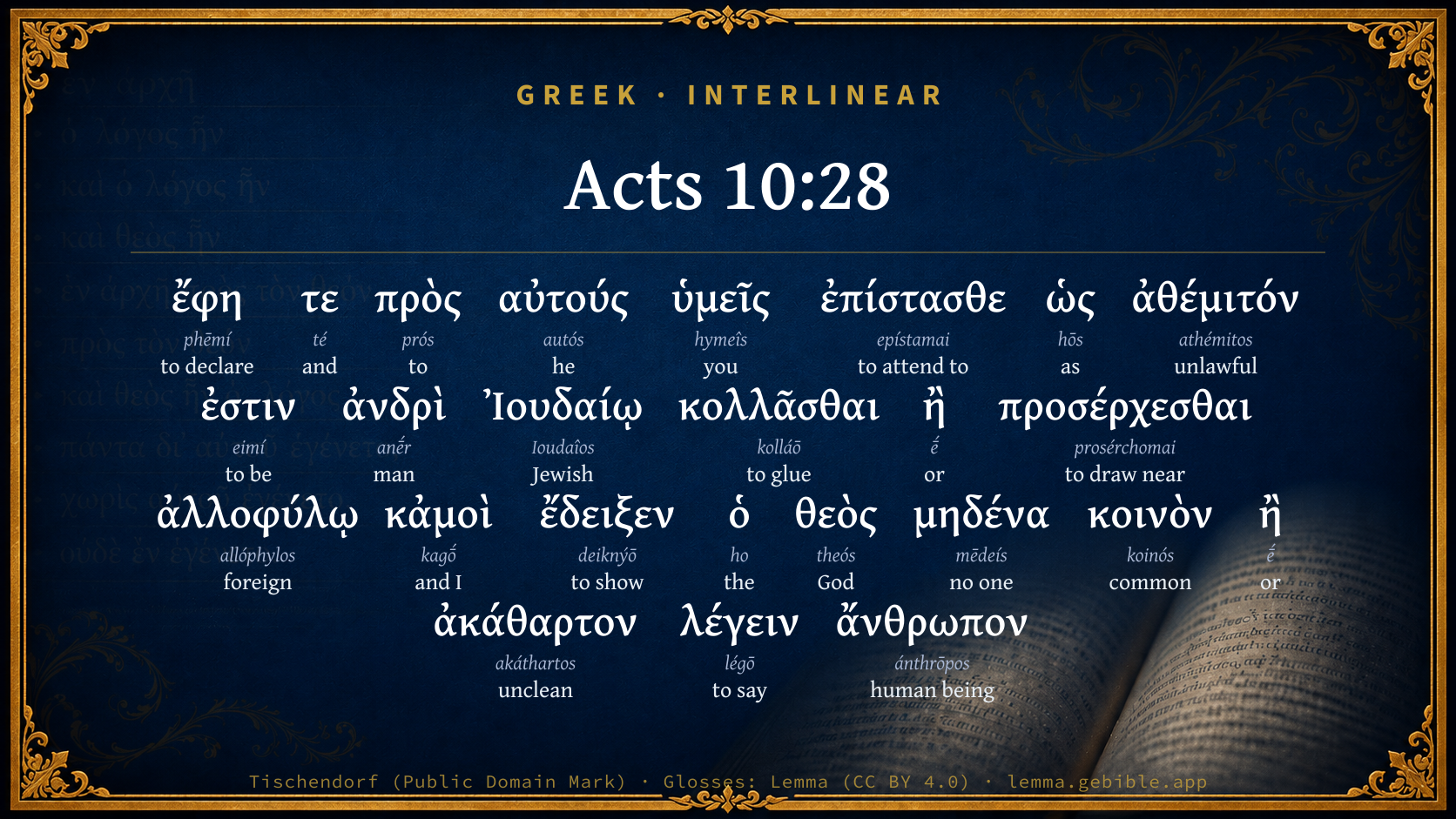
Greek (Tischendorf 8th ed.) Acts 10:28 appears in the Greek New Testament. The text above is from the Tischendorf 8th edition. Each word links to its Strong’s number and a concise gloss. Click any word for its full Thayer’s Greek Lexicon entry.
Download image
Cite this verse

Acts 10:28 (World English Bible). Public Domain. Lemma interlinear Bible study tool, https://lemma.gebible.app/v/acts/10/28.

Show BibTeX & RIS
BibTeX
RIS
English Translation
He said to them, "You yourselves know how it is an unlawful thing for a man who is a Jew to join himself or come to one of another nation, but God has shown me that I shouldn't call any man unholy or unclean.
World English Bible · Public Domain
Highlights
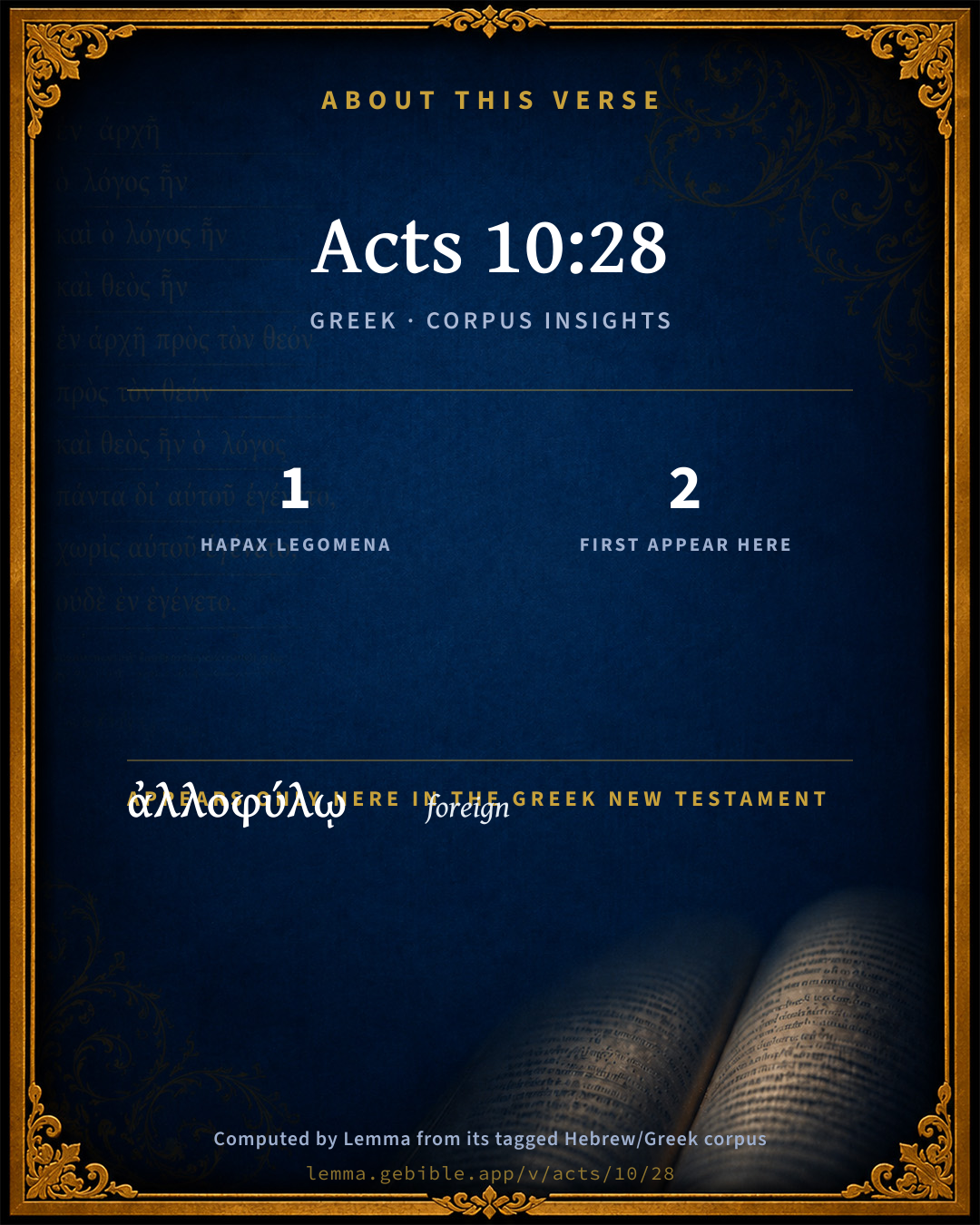
  • 1 hapax legomenon — only here in the Greek New Testament
  • 2 first appearances in the Greek New Testament
Full analysis ↓
Download a study sheet

One document with this verse’s original text, its word-by-word gloss line, the meaning frame, cross-references with their text, attributed commentary, and full source and license credits — printable, and it pastes into notes with its structure intact.

This verse Autodidact and up

Study sheet (.html) Plain text (.txt)

A passage Seminary Student

Up to 50 verses in one chapter. A passage sheet keeps up to 6 commentary sources and 12 cross-references per verse, in the order this page ranks them, and says so on the sheet whenever that leaves anything out. Ask for a single verse and you get the Autodidact verse sheet above.

Everything on this page stays free to read, with no account — the sheet is a download of what is already on screen, not access to it.

Want to remove ads? Support Godless Engineer
Compare translations 3

The same verse in 3 English versions, stacked beneath the original-language interlinear above. Click any original word for its lexicon entry.

Each is an independent rendering of the whole verse — the interlinear is not word-aligned to these translations.

Highlighted words mark where these versions differ — a whole-verse word diff, not a word-by-word alignment.

  • World English Bible Public Domain
    He said to them, "You yourselves know how it is an unlawful thing for a man who is a Jew to join himself or come to one of another nation, but God has shown me that I shouldn't call any man unholy or unclean.
  • King James Version Public Domain
    And he said unto them, Ye know how that it is an unlawful thing for a man that is a Jew to keep company, or come unto one of another nation; but God hath shewed me that I should not call any man common or unclean.
  • unfoldingWord Literal Text CC BY-SA 4.0
    And he was saying to them, “You yourselves know how unlawful it is for a Jewish man to associate or to visit with a foreigner, but God has shown me not to call any man common or unclean.

unfoldingWord Literal Text — © unfoldingWord, licensed CC BY-SA 4.0. Word-aligned USFM3 via Door43 (git.door43.org/unfoldingWord/en_ult).

Versions to compare (up to 4)

3 of 4 selected

Show all 19 translations

Every available English version of this verse, each an independent rendering of the whole verse.

  • World English Bible Public Domain
    He said to them, "You yourselves know how it is an unlawful thing for a man who is a Jew to join himself or come to one of another nation, but God has shown me that I shouldn't call any man unholy or unclean.
  • Berean Standard Bible Public Domain
    He said to them, “You know how unlawful it is for a Jew to associate with a foreigner or visit him. But God has shown me that I should not call any man impure or unclean.
  • Majority Standard Bible Public Domain
    He said to them, “You know how unlawful it is for a Jew to associate with a foreigner or visit him. But God has shown me that I should not call any man impure or unclean.
  • King James Version Public Domain
    And he said unto them, Ye know how that it is an unlawful thing for a man that is a Jew to keep company, or come unto one of another nation; but God hath shewed me that I should not call any man common or unclean.
  • American Standard Version (1901) Public Domain
    and he said unto them, Ye yourselves know how it is an unlawful thing for a man that is a Jew to join himself or come unto one of another nation; and `yet' unto me hath God showed that I should not call any man common or unclean:
  • Revised Version (1885) Public Domain
    and he said unto them, Ye yourselves know how that it is an unlawful thing for a man that is a Jew to join himself or come unto one of another nation; and yet unto me hath God shewed that I should not call any man common or unclean:
  • Geneva Bible (1599) Public Domain
    And he sayd vnto them, Ye know that it is an vnlawfull thing for a man that is a Iewe, to company, or come vnto one of another nation: but God hath shewed me, that I should not call any man polluted, or vncleane.
  • Douay-Rheims (1899) Public Domain
    And he said to them: You know how abominable it is for a man that is a Jew, to keep company or to come unto one of another nation: but God hath shewed to me, to call no man common or unclean.
  • Young's Literal Translation Public Domain
    And he said unto them, `Ye know how it is unlawful for a man, a Jew, to keep company with, or to come unto, one of another race, but to me God did shew to call no man common or unclean;
  • Literal Standard Version CC BY-SA 4.0
    And he said to them, “You know how it is unlawful for a man, a Jew, to keep company with, or to come to, one of another race, but God showed to me to call no man common or unclean;
  • Unlocked Literal Bible CC BY-SA 4.0
    He said to them, “You yourselves know that it is not lawful for a Jewish man to associate with or to visit someone from another nation. But God has shown me that I should not call any man defiled or unclean.
  • unfoldingWord Literal Text CC BY-SA 4.0
    And he was saying to them, “You yourselves know how unlawful it is for a Jewish man to associate or to visit with a foreigner, but God has shown me not to call any man common or unclean.
  • Darby Bible Public Domain
    And he said to them, *Ye* know how it is unlawful for a Jew to be joined or come to one of a strange race, and to *me* God has shewn to call no man common or unclean.
  • World Messianic Bible Public Domain
    He said to them, “You yourselves know how it is an unlawful thing for a man who is a Jew to join himself or come to one of another nation, but God has shown me that I shouldn’t call any man unholy or unclean.
  • Webster's Bible Public Domain
    And he said to them, Ye know that it is an unlawful thing for a man that is a Jew to keep company, or come to one of another nation; but God hath shown me that I should not call any man common or unclean.
  • Free Bible Version CC BY-SA 4.0
    He said to them, “You certainly know that it's not permitted for a Jew to be associated with or to visit foreigners. But God has shown me that it's not for me to call anyone impure or unclean.
  • Bible in Basic English Public Domain
    And he said to them, You yourselves have knowledge that it is against the law for a man who is a Jew to be in the company of one who is of another nation; but God has made it clear to me that no man may be named common or unclean:
  • Text-Critical English NT CC BY 4.0
    Peter said to them, “You know that it is forbidden for a Jewish man to keep company with or associate with a foreigner, but God has shown me that I should call no one defiled or unclean.
  • Tyndale New Testament (1534) Public Domain
    And he sayde vnto them: Ye do knowe how that that ys an vnlawfull thynge for a man that is a Iewe to company or come vnto an alient: But god hath shewed me that I shuld not call eny man commen or vnclene:

Literal Standard Version (2020), Covenant Press — licensed CC BY-SA 4.0. Text via the HelloAO Bible API (eBible.org). Unlocked Literal Bible (unfoldingWord) — licensed CC BY-SA 4.0. Text via the HelloAO Bible API (eBible.org). unfoldingWord Literal Text — © unfoldingWord, licensed CC BY-SA 4.0. Word-aligned USFM3 via Door43 (git.door43.org/unfoldingWord/en_ult). Free Bible Version, Dr. Jonathan Gallagher — licensed CC BY-SA 4.0. Text via the HelloAO Bible API (eBible.org).

Word by word

More ways to search: Search by grammar → Find every occurrence → Compare this word →

Practice this passage: Drill this verse → Learn its vocabulary →

ἀλλοφύλῳ
allóphylos
G246
“foreign”
Adjective, Dative, Singular, Masculine
Part of Speech
Adjective
Case
Dative
Number
Singular
Gender
Masculine
Full Thayer's Definition

Origin: from G243 and G5443

TDNT: 05:27,4

1. foreign
  1. ἔφη phēmí G5346 “to declare” Verb, Imperfect, Active, Indicative, 3rd person, Singular
  2. τε té G5037 “and” Particle
  3. πρὸς prós G4314 “to” Preposition
  4. αὐτούς autós G846 “he” Personal pronoun, Accusative, Plural, Masculine
  5. ὑμεῖς hymeîs G5210 “you” Personal pronoun, 2nd person, Nominative, Plural
  6. ἐπίστασθε epístamai G1987 “to attend to” Verb, Present, Middle or Passive deponent, Indicative, 2nd person, Plural
  7. ὡς hōs G5613 “as” Adverb
  8. ἀθέμιτόν athémitos G111 “unlawful” Adjective, Nominative, Singular, Neuter
  9. ἐστιν eimí G1510 “to be” Verb, Present, Active, Indicative, 3rd person, Singular
  10. ἀνδρὶ anḗr G435 “man” Noun, Dative, Singular, Masculine
  11. Ἰουδαίῳ Ioudaîos G2453 “Jewish” Adjective, Dative, Singular, Masculine
  12. κολλᾶσθαι kolláō G2853 “to glue” Verb, Present, Passive, Infinitive
  13. ἢ ḗ G2228 “or” Particle
  14. προσέρχεσθαι prosérchomai G4334 “to draw near” Verb, Present, Middle or Passive deponent, Infinitive
  15. κἀμοὶ kagṓ G2504 “and I” Personal pronoun, 1st person, Dative, Singular, Aramaic form
  16. ἔδειξεν deiknýō G1166 “to show” Verb, Aorist, Active, Indicative, 3rd person, Singular
  17. ὁ ho G3588 “the” Article, Nominative, Singular, Masculine
  18. θεὸς theós G2316 “God” Noun, Nominative, Singular, Masculine
  19. μηδένα mēdeís G3367 “no one” Adjective, Accusative, Singular, Masculine, Negative
  20. κοινὸν koinós G2839 “common” Adjective, Accusative, Singular, Masculine
  21. ἢ ḗ G2228 “or” Particle
  22. ἀκάθαρτον akáthartos G169 “unclean” Adjective, Accusative, Singular, Masculine
  23. λέγειν légō G3004 “to say” Verb, Present, Active, Infinitive
  24. ἄνθρωπον ánthrōpos G444 “human being” Noun, Accusative, Singular, Masculine

About this verse

These counts appear in no published source. They are computed here, from the morphology-tagged text and Lemma’s own curated glosses. What Lemma adds →

25
words
24
distinct lemmas
Acts
section

Notable vocabulary

1 hapax legomenon — a word that appears only here in the entire Greek New Testament:

  • ἀλλοφύλῳ foreign G246

First appearance in Scripture

These words make their first canonical appearance in the Greek New Testament here:

  • ἀθέμιτόν unlawful G111
  • ἀλλοφύλῳ foreign G246

Shared distinctive vocabulary

ἀθέμιτόν unlawful G111 occurs in 2 verses of the Greek New Testament. Also found in:

Repetition

A word recurs within this verse:

Cross-references

13

Topical passages linked to Acts 10:28 in the Treasury of Scripture Knowledge — connected by theme and wording, ordered by reader-vote popularity; previews shown in the World English Bible.

  • John 4:9 The Samaritan woman therefore said to him, "How is it that you, being a Jew, ask for a drink from me, a Samaritan woman?" (For Jews have no dealings with Samaritans.)
  • Ephesians 3:6–7 that the Gentiles are fellow heirs, and fellow members of the body, and fellow partakers of his promise in Christ Jesus through the Gospel,
  • Galatians 2:12–14 For before some people came from James, he ate with the Gentiles. But when they came, he drew back and separated himself, fearing those who were of the circumcision.
  • Isaiah 65:5 who say, Stand by yourself, don't come near to me, for I am holier than you. These are a smoke in my nose, a fire that burns all the day.
  • John 4:27 At this, his disciples came. They marveled that he was speaking with a woman; yet no one said, "What are you looking for?" or, "Why do you speak with her?"
  • John 18:28 They led Jesus therefore from Caiaphas into the Praetorium. It was early, and they themselves didn't enter into the Praetorium, that they might not be defiled, but might eat the Passover.
  • Acts 11:9 But a voice answered me the second time out of heaven, 'What God has cleansed, don't you call unclean.'
  • Luke 18:11 The Pharisee stood and prayed to himself like this: 'God, I thank you, that I am not like the rest of men, extortioners, unrighteous, adulterers, or even like this tax collector.
  • Acts 10:34–35 Peter opened his mouth and said, "Truly I perceive that God doesn't show favoritism;
  • Acts 11:2–3 When Peter had come up to Jerusalem, those who were of the circumcision contended with him,
  • Acts 15:8–9 God, who knows the heart, testified about them, giving them the Holy Spirit, just like he did to us.
  • Acts 22:21–22 "He said to me, 'Depart, for I will send you out far from here to the Gentiles.'"
  • Acts 10:14–15 But Peter said, "Not so, Lord; for I have never eaten anything that is common or unclean."

Cross-references courtesy of OpenBible.info (CC BY 4.0).

Commentary

Notes on Acts 10:28 from classic Christian and Jewish commentators (each source and its license shown beneath its notes). The classic Christian expositions comment on the surrounding passage and are grouped to its opening verse, so a note may address several verses; the Jewish commentaries on the Tanakh (Rashi and others) are per-verse, so they appear only where the commentator wrote on this verse.

Lemma curates 59 commentaries, every one of them public domain or Creative Commons licensed, each selected and text-cleaned for this edition rather than reprinted as found. About our sources →

The Biblical Illustrator

Joseph S. Exell

Act_10:28

A man that is a Jew.

The Jew

I can conceive of no object more profoundly interesting than this--a man that is a Jew! All that is venerable in antiquity, sacred in religion, rich in story, sublime in poetry, cleaves to this extraordinary race. But for such a man infidelity would have lost one of the most unanswerable proofs of her falsehood and her folly.

I. His common claims as a man. A recent pope was passing through Rome; a Jew, fallen in a fit, lay prostrate on the pavement; the people who saw him, like the priest and the Levite, passed by on the other side; but the sovereign pontiff, alighting from his carriage, ran to his help. He is a Jew! they cried, as if in horror of a contact so contaminating. He is a man! cried the pontiff; and, like the good Samaritan, he hastened to his relief, saw him safely conducted to his home, and sent his own physician to attend him.

1. He is a man as well as a Jew, although he is a Jew, and all the claims that humanity can present to the sympathy of the species belong to him. He, too, may make the appeal, so long urged in vain by the enslaved African, Am I not a man and a brother? You owe to him the performance of a brothers part; and if you fail to render it the voice of your brothers blood will cry against you.

2. He Is a man, the offspring of the same parent, the workmanship of the same Creator, as fearfully and wonderfully made as you are, the same life blood flows in his veins, the same heart throbs in his breast, and to all the ills to which flesh is heir, he is subject as well as you.

3. That man that is a Jew has a soul, precious as yours. Gods breath inspired it; His Spirit endowed it; and He who has emphatically said, All souls are Mine, claims it as His own. Think of the faculties with which it is endowed, its vast capacity of happiness or misery, the perilous circumstances in which it is placed under the curse and condemning sentence of Gods violated law, and the dread eternity it is destined to inherit if it pass into it unforgiven.

4. And was not the same precious blood shed for its redemption? On what other ground than this can you seek with any degree of propriety, or with any hope of success, the salvation of the Jews? And if it be so precious, what an argument does that consideration furnish for our best efforts to promote the salvation of the soul for whose redemption even that was not esteemed a price too great.

II. The claims peculiar to him as a Jew. He belongs to a race--

1. Venerable in antiquity. Who can boast of a heraldry or of a history like theirs? A heraldry whose emblazonment is from heaven, and a history whose records are written by inspired pens. The origin of other nations is veiled in obscurity and so blended with fable that it is hard to separate fact from fiction. But here is a people, all whose story is drawn out in lines of accuracy and in characters of truth. And is it not an affecting spectacle to behold a people, thus hoary with the accumulation of ages, treated with contumely, and left to perish?

2. Which once enjoyed the special tokens of the Divine favour. Now, indeed, they are trodden under foot of the Gentiles. But they were a great nation once. They, and they alone, could boast a pure theocracy, and laws given from heaven. Are a people, then, once thus signally owned and honoured by God, to be regarded with indifference or contempt? A people too, whose abandonment by God is not final, and whose restoration to His favour shall assuredly come. I am not sure that the tardy progress of the Christian cause may not be, in some measure, attributed to the unconcern which Christians have manifested towards Jews.

3. To which we are laid under the deepest obligation. There is nothing great or good that we possess but we are indebted for it to the Jews. The best of books, the best of gifts, we owe to them--the sacred volume and the Saviour of the world. Who is the most ancient and the most authentic of all historians--but a Jew? What poets can compare with theirs? Beloved they must be, for the fathers sake if not for their own; and though we may well despair of ever paying the debt due to them, still, by our efforts for their welfare, we will testify that we are not altogether unconscious of or unwilling to acknowledge it. And think how long this debt has been contracting, while scarcely a fraction of the interest has been paid. Societies there are expending hundreds of thousands on the distant heathen, but how few there are interested in the restoration of the lost sheep of the house of Israel!

4. To whose conversion prodigious advantage must accrue. If the fall of them be the riches of the world, and the diminishing of them the riches of the Gentiles, how much more their fulness? The Jews, in the event of their conversion, will become the most zealous and successful missionaries; while the Church herself, aroused by this event to a life and energy and unanimity unknown to former times, will take the field against the common foe in numbers compared with which all present figures will appear contemptible. Who can go forth and announce the faithful saying, worthy of all acceptation, that Christ Jesus came into the world to save sinners, and add, with the same emphasis as the Jew, of whom I am chief?

5. For whose salvation there has never been a period more favourable than the present. Already there seems to be a shaking amongst the bones in the valley of vision. The Jews begin to be weary of the long delay that attends the coming of their vainly expected Messiah. They have their misgivings as to the correctness of their views. They feel as though the system to which they have so tenaciously clung had waxen old and was ready to vanish away. Hope deferred begins to make the heart sick. They long for some better teaching than their Rabbins give, and for some more satisfying and sustaining influences than their Talmuds and their Targums yield. In this state of things their enlightened and intelligent men are more disposed to converse and argue upon the subject of the Messiahship of Christ in former times. And most assuredly when infidelity, under the guise of rational Christianity, is overspreading the continent, we shall do well to seek the conversion of the Jews. Infidelity can meet no antagonist more formidable than a learned, intelligent, and converted Jew. (T. Raffles, D. D.)

God hath showed me that I should not call any man common or unclean.--

A beautiful faith in the sparks of divinity in every human soul

I. Its good ground.

1. By creation.

(1) After the image of God.

(2) All from one pair.

2. By redemption.

(1) God will have all men to be saved.

(2) Christ sends His apostles to all nations.

3. By experience.

(1) In the heathen world.

(2) In the pastoral oversight of criminals.

II. Its beneficial influence.

1. For the Christian contemplation of the world and conceptions of history in general.

2. For Christian intercourse in daily life.

3. For the Christian ministry. (K. Gerok.)

The value of common things

A rich nobleman was once showing a friend a great collection of precious stones whose value was almost beyond counting. There were diamonds, and pearls, and rubies, and gems from almost every country, and had been gathered by their possessor at the greatest labour and expense. And yet, he remarked, they yield me no income. His friend replied that he had two stones which had only cost him five pounds each, but which yielded him a very considerable income, and he led him down to the mill and pointed to two toiling grey millstones. (W. Baxendale.)

The Biblical Illustrator, edited by Joseph S. Exell (c. 1880s–1900s) — public domain. Text from a community e-Sword module.

Joseph Benson's Commentary

Act 10:28-29. And he said, Ye know how it is an unlawful thing, &c. — A thing not allowed by the Jews; for a man that is a Jew — A native Jew, as I am; to keep company with, or come unto one of another nation — A stranger, and an uncircumcised Gentile. This was not made unlawful by the law of God, but by the precepts of their wise men, which they looked upon to be no less obliging. They did not indeed forbid them to converse with Gentiles, in the way of traffic or worldly business, but to eat with them. With such scorn did the Jews look upon the Gentiles, who in their turn held them in equal contempt, as appears by many passages in the Latin poets. But now, saith Peter, God hath showed me — By a remarkable vision; that I should not call any man common or unclean — Peter thought it necessary to inform them how he came to change his mind in this matter, lest, being thought to have used lightness, his word should have the less authority. Therefore — Having received direction from God; came I unto you without gainsaying — Or delay; as soon as I was sent for — Ready to preach the same gospel to you that I preached to the Jews. I ask, therefore, for what intent ye have sent for me — Although Peter in a great measure knew this already, he puts Cornelius on telling the story, both that his friends, and all that were present, might be informed, and Cornelius himself be more impressed by the narration; the repetition of which, even as we read it, gives a new dignity and spirit to Peter’s succeeding discourse.

Joseph Benson's Commentary on the Old and New Testaments (1811–1818) — public domain. Text from a community e-Sword module.

Bengel's Gnomon

Johann Albrecht Bengel

Act 10:28. Ὑμεῖς) ye yourselves. He addresses all in his own name, not also in the name of those accompanying him.—προσέρχεσθαι, to come unto) an act which is even less than κολλᾶσθαι, to join one’s self with.—ἀλλοφύλῳ, one of an alien nation) Euphemism [for Gentile].—καὶ) for ἀλλὰ, and for but.—ἐμοὶ, to me) This word is emphatic.—[ὁ Θεὸς, GOD) Peter might suppose the knowledge of the true GOD as existing on the part of Cornelius: Act 10:34; Act 10:36.—V. g.]—ἔδειξε, hath showed) The word is employed in the strict sense: Act 10:11. He speaks sparingly as to his own hesitation, and as to the secret vision which he had seen.—ἄνθρωπον, no one that is a man) This is elegantly put last: it involves an Ætiology [the reason assigned], and intensifies the universality of the language.

Bengel's Gnomon of the New Testament — English translation (T&T Clark, Edinburgh, 1860) — public domain. Text from a community e-Sword module.

Expositor's Greek Testament

ed. W. Robertson Nicoll

Act 10:28 . ἀθέμιτον : only once again in N.T., and significantly in 1Pe 4:3 , but cf. for a similar sense to its use here 2Ma 6:5 ; 2Ma 7:1 . On the extent to which this feeling was carried see Edersheim, Jewish Social Life , pp. 26 28; Taylor’s Sayings of the Jewish Fathers , pp. 15, 26, 137 (second edition); Weber, Jüdische Theologie , p. 68; so too Jos., c. Apion , ii., 28, 29, 36; Juvenal, xiv., 103; Tacitus, Hist. , v., 5. κολλᾶσθαι , see on Act 5:13 and Lightfoot, Hor. Heb., in loco . προσέρχεσθαι : objected to by Zeller and Over-beck, because we know of instances where Jews went without scruple into the houses of Gentiles ( cf. Jos., Ant. , xx., 2, 3); but here the whole context plainly shows what kind of intercourse was intended (see also Wetstein). Hilgenfeld too regards the notice as un-historical, but an answer may be found to his objections in the references above and in Feine, pp. 202, 204, although his language seems inconsistent with that on p. 205. ἀλλοφύλῳ : in the LXX and Apocrypha, so in Philo and Josephus as here; nowhere else in N.T. but here with a certain delicate touch, avoiding the use of the word “heathen”; in Act 11:3 no such delicacy of feeling. καὶ : not “but,” A.V., but as in R.V., “and yet,” i.e. , in spite of all these prohibitions and usages. ὁ Θ .: emphatic, preceding ἔδειξε (Weiss). How fully Peter afterwards lived and preached this truth his First Epistle shows, cf. 1Pe 2:17 .

The Expositor's Greek Testament, edited by W. Robertson Nicoll (1897–1910) — public domain. Text from a community e-Sword module.

Jamieson, Fausset & Brown

Robert Jamieson, A. R. Fausset & David Brown

Ye know it is . . . unlawful . . . for . . . a Jew to keep company, or come unto one of another nation, &c.--There was no express prohibition to this effect, and to a Certain extent intercourse was certainly kept up. (See the Gospel history, towards the end). But intimate social fellowship was not practiced, as being adverse to the spirit of the law.

Jamieson, Fausset & Brown — Commentary Critical and Explanatory on the Whole Bible (1871) — public domain (CC PDM 1.0). Text via the HelloAO Bible API.

Adam Clarke's Commentary

Verse 28. Ye know how that it is an unlawful thing, c.] He addressed the whole company, among whom, it appears, there were persons well acquainted with Jewish customs probably some of them were Jewish proselytes.

But God hath showed me, c.] He now began to understand the import of the vision which he saw at Joppa. A Gentile is not to be avoided because he is a Gentile God is now taking down the partition wall which separated them from the Jews.

Adam Clarke's Commentary on the Bible (1810–1826) — public domain. Text from a community e-Sword/MySword module.

John Calvin's Commentaries

28. Ye know that it is not lawful. This seemeth to be no friendly preface, and such as may rather harden than win their hearts, when as they hear that they are accounted so unclean, that with their familiarity and conference they pollute the saints; which must needs be a great reproach for them. But it was needful for Peter thus to speak, lest they should suspect that he had an evil conscience, because, contrary to the custom delivered by the fathers, he came. But when as he affirmeth that he was sent of God, all such suspicion is taken away and purged. Moreover, he mitigateth very well by these words the offense which did stick in their minds, by reason of an old grudge which was between the Jews and the Gentiles, so that he could by no means have entered his speech better, For he pronounceth that those are now clean who were before unclean, so that they have mutual fellowship now with the saints. Furthermore, whereas he said that it was wickedness for the Jews to go in unto the Gentiles, we must know that this came not so much from the law, as from the observation of the fathers. God had forbidden, indeed, that they should (not) entangle themselves with marriages or covenants, (Deuteronomy 7:3;) they were never forbidden to eat with them, or to use the common businesses of life. But lest that familiarity might entice them into that which was forbidden, they observed the custom delivered by the fathers, so that they did not company together. It is to no end to dispute here whether that tradition did bind men’s consciences; for Peter doth not teach what is lawful according to God, but what was commonly used.

No man. He maketh the sum and end of the vision more plain, when he referreth that unto men which was spoken of meats. And whereas he saith, that no man is unclean, it may not be understood of (all) particular persons; for it is certain that all unbelievers are polluted with uncleanness of conscience, so that they pollute those things which are otherwise pure, when as they do but touch them. Paul also saith that their children remain unclean until they be cleansed by faith. Finally, if faith alone do purge and purify the hearts of men, unbelief doth make the same profane. But Peter compareth the Jews and the Gentiles together in this place; and because the wall of separation was pulled down, and the covenant of life is now common to them both alike, he saith that those are not to be counted aliens who are made partakers of God’s adoption.

John Calvin's Commentaries (1540-1563) — public domain. Text from the Calvin Translation Society English edition (1840s-50s) via the Christian Classics Ethereal Library (ccel.org). Calvin's coverage is partial (roughly two-thirds of the Bible); uncommented books and verses are honest gaps, never fabricated. The 19th-century editor's footnotes and remarks are omitted so the notes are faithfully Calvin's own voice.

Ellicott's Commentary for English Readers

(28) Ye know how that it is an unlawful thing.—St. Peter speaks from the standpoint of traditional Pharisaism rather than from that of the Law itself; but the feeling was widely diffused, and showed itself in forms more or less rigorous wherever Jews and heathens came in contact with each other. The strict Jew would not enter a Gentile’s house, nor sit on the same couch, nor eat or drink out of the same vessel. (Comp. Note on Mar_7:3-4.) The very dust of a heathen city was defiling. The Hindoo feeling of caste, shrinking from contact with those of a lower grade, driven to madness and mutiny by “greased cartridges,” presents the nearest modern analogue.

God hath shewed me that I should not call any man common or unclean.—The Apostle had, we find, at last learnt the lesson which the vision had taught him, in all the fulness of its meaning. Humanity as such had been redeemed by the Incarnation and Ascension, and was no longer common or unclean, even in the most outcast heathen. God was willing to receive all men. Sin alone was that which separated men from Him. Impurity was thought of as a moral, not a physical taint, and men were taught to see even in the sinner the potentialities of a higher life. He, too, had been redeemed, and might be justified and sanctified, and to him therefore honour and reverence were due as to one in whom the image of God was not utterly effaced, and might be restored to brightness. It is interesting, in this connection, to note the “Honour all men” of 1Pe_2:17. It is obvious that the pride of class, resting on mere differences of culture, and showing itself in acts and words of contempt, is, from one point of view, even less excusable than that which at least imagined that it rested on a religious basis, while from another, it is less inveterate, and therefore more easily curable.

A Bible Commentary for English Readers, edited by Charles John Ellicott (1878–1897) — public domain. Text from a community e-Sword module.

The Cambridge Bible for Schools and Colleges

gen. ed. J. J. S. Perowne

28. Ye know how that it is an unlawful thing, &c.] It is said expressly by Maimonides, Hilechoth Rozeakh, &c. xii. 7, “It is forbidden to a Jew to be alone with heathens, because they are suspected of (lightly) shedding blood, nor must he associate with them on the road.” And in the Midrash Rabbah on Leviticus, cap. 20 (ad fin.), there is an interesting example of the sort of ceremonial defilement which association with the heathen might bring about, “It happened that Shimeon the son of Kimkhith (who was high-priest) went out to speak with the King of the Arabians, and there came a fleck of spittle from the King’s mouth upon the priest’s garment and so he was unclean; and his brother Judah went in and served instead of him in the high-priest’s office. That day their mother saw two of her sons high-priests.” The Apostle speaks of the prohibition as a thing well known to those who heard him, and the action of the messengers of Cornelius in standing outside the house of Simon and calling out some one to question in the open air shews that they were aware of the dislike of the Jews to associate with Gentiles. We have evidence that this dislike was well known wherever the Jews resided from the words of Juvenal (xiv. 103), “Non monstrare vias eadem nisi sacra colenti.” So Tacitus (Hist. Act_10:5), “separati epulis, discreti cubilibus.”

to keep company] Lit. “to join himself.” The word is the same as in the command to Philip (Act_8:29), “Go near and join thyself to this chariot;” and signifies intimate intercourse. The ordinary dealings of life must constantly have forced Jews to be in the company of Gentiles, but it was to be avoided if possible.

but God hath shewed me that I should not call any man common or unclean] The Spirit’s command “Go with them doubting nothing, for I have sent them” has taught Peter how he is to interpret the figure shewn to him in his vision.

The Cambridge Bible for Schools and Colleges (gen. ed. J. J. S. Perowne; Cambridge University Press, 1878–1918) — public domain. Text from a community e-Sword module.

John Gill's Exposition

And he said unto them,.... The whole company that were met together, who were chiefly, if not altogether Gentiles:

ye know that it is an unlawful thing; what is forbidden by the law of Moses, Deu 7:2 and by the traditions of the elders, which carry the matter further than the law did, and made it very criminal:

for a man that is a Jew, to keep company with, or come unto one of another nation; besides entering into covenants and marriages with them, which were forbidden by the law, though they allowed of trade and commerce with the Gentiles, yet not any familiar conversation with them; it was prohibited to eat and drink any sort of liquor with them in their houses (h), nor might they walk with them in the streets, or on the road; says Maimonides (i),

"it is forbidden a Jew to unite himself to Gentiles, because they are suspected of shedding blood, and he may not join himself with them in the way; if he meets a Gentile in the way, he causes him to turn to the right hand; if they ascend by an ascent, or descend by a descent, the Israelite may not be below, and the Gentile above: but the Israelite must be above, and the Gentile below, lest he should fall upon him and kill him; and he may not go even with (or along side by him) lest he break his skull.''

It is said (k) of some Rabbins, that they saw a certain man coming;

"says R. Chiyah, let us be gone, perhaps this man is an idolatrous Gentile, or one of the people of the earth, and it is forbidden to join with him in the way.''

They looked upon the houses of Gentiles unclean, and therefore would not enter into them: See Gill on Joh 18:28.

yea they say (l), that:

"the court of a stranger (or Gentile) is as the habitation of a beast.''

Such an aversion was there in that people to all civil society with Gentiles: and so Apoltonius says of them (m), that

"they not only departed from the Romans, but from all men, living a separate life from others; nor did they communicate at table with others; neither in things sacred, nor in any ceremonies;''

and this was well known to Jews and Gentiles:

but God hath showed me; partly by the vision he had seen, and partly by discourse with the men that came from Cornelius to him; and by comparing the vision and their message to him together, he saw that he was not obliged to abide by the customs and laws of the Jews: but was showed, as he says,

that I should not call any man common or unclean; that is, in a ceremonial sense; for otherwise, all by nature are morally unclean; and none are pure, but such who are washed in the blood of Christ, and are justified by his righteousness, and sanctified by his Spirit: he saw there was now no difference between Jew and Gentile; that the one was not clean because of his circumcision, nor the other unclean on account of his uncircumcision, or to be avoided for that reason; that the Gospel was to be preached to all; and that every believer of whatsoever nation, was acceptable to God, and ought to be regarded by his ministers and people.

(h) Mitzvot Tora, pr neg. 143. (i) Hilchot Rotzeach, c. 12. sect. 7. (k) Zohar in Exod. fol. 21. 1. (l) T. Bab. Erubin, fol. 62. 2. (m) Philostrat. Vita Apollon. l. 5. c. 11.

John Gill's Exposition of the Whole Bible (1746–1763) — public domain (CC PDM 1.0). Text via the HelloAO Bible API.

Trapp's Complete Commentary

John Trapp

28 And he said unto them, Ye know how that it is an unlawful thing for a man that is a Jew to keep company, or come unto one of another nation; but God hath shewed me that I should not call any man common or unclean.

Ver. 28. Not call any man unclean] Scilicet, quoad communem vitae usum; Nam alioqui omnes natura impuri; i.e. in regard of civil conversation. By nature (it is true) we are all unclean.

John Trapp, A Commentary or Exposition upon All the Books of the Old and New Testament (1647–1656) — public domain. Text from a community e-Sword module.

Albert Barnes' Notes on the Bible

It is an unlawful thing - This was not explicitly enjoined by Moses, but it seemed to be implied in his institutions, and was, at any rate, the common understanding of the Jews. The design was to keep them a separate people. To do this, Moses forbade alliances by contract, or marriage, with the surrounding nations, which were idolatrous. See Lev 18:24-30; Deu 7:3-12; compare Ezr 9:11-12. This command the Jews perverted, and explained it as referring to contact of all kinds, even to the exercise of friendly offices and commercial transactions. Compare Joh 4:9.

Of another nation - Greek: another tribe. It refers here to all who were not Jews.

God hath showed me - Compare Act 15:8-9. He had showed him by the vision, Act 10:11-12.

Any man common or unclean - See the notes on Act 10:14. That no man was to be regarded as excluded from the opportunity of salvation, or was to be despised and abhorred. The gospel was to be preached to all; the barrier between Jews and Gentiles was broken down, and all were to be regarded as capable of being saved.

Albert Barnes' Notes on the Bible (1834–1885) — public domain. Text from a community e-Sword/MySword module.

Haydock's Catholic Bible Commentary

Abominable a thing. The Jews extended their aversion to the Gentiles to an unnatural length; hence the frequent accusations of the latter, that they were a nation the enemies of mankind. Josephus defends his nation against the imputation. He allows that Moses forbids them to admit strangers into their solemnities, and exercises of religion, but not to refuse any thing which common humanity demands of all. (Josephus, lib. ii. contra Apion)

George Leo Haydock (1774–1849), Haydock's Catholic Family Bible and Commentary, 1859 edition — public domain. Excludes Psalms (Douay-Rheims chapter numbering differs from Protestant) and Deuterocanonical books (Catholic canon only).

Matthew Poole's English Annotations

God himself did erect a partition wall betwixt his people and other nations, Jews and Gentiles; hence by God’s own command the Jews might not have any familiar converse with the Gentiles, especially they might not marry with them. The Jews themselves had made this partition wall much larger, and they held it unlawful to eat with any of the Gentiles, or to go so much as into their houses; hence that objection made upon this occasion against St. Peter, Act 11:3.

Unclean; no man is now unclean by any ceremonial uncleanness, because he is not circumcised, or because he is not sprinkled with the blood of bulls, Heb 9:13; yet sin hath defiled the whole mass of mankind, and they are equally by nature morally unclean.

Matthew Poole's English Annotations on the Holy Bible (1683–1685) — public domain. Text from a community e-Sword/MySword module.

Whedon's Commentary on the Bible

Daniel D. Whedon

28. Unlawful—There was nothing in the Mosaic law rendering it in itself unlawful to keep company with one of another nation. Grotius remarks that the word unlawful here corresponds to the rabbinical אסור, signifying the unlawful, not by the law of Moses, but by the decree of the doctors, which was held equal in rank.

God hath showed me—First, by the symbolical sheet; second, by his Spirit bidding me meet your messengers; and, third, by the fact that your angel corresponds with my vision. For these two last facts fully answer Peter’s doubt, Act_10:17. And the whole will receive the closing and conclusive confirmation of Act_10:44.

Any man common—For though the sheet included only animals, he knew that the truth symbolized embraced man. And as the symbol forbade calling any man common, so the sheet symbolically includes all men, and not the Church alone.

Daniel D. Whedon (gen. ed.), Commentary on the Old and New Testaments (1874–1909) — public domain. Text from a community e-Sword module.

The Pulpit Commentary

Ye yourselves for ye, A.V.; to join himself for to keep company, A.V.; and yet unto me hath God showed for but God hath showed me, A.V. Ye yourselves know. It was notorious among the Romans that the Jews kept themselves aloof from other people. Hence the accusation against them, in common with Christians, of being haters of the human race. Tacitus says of them that they hated all people, except their own countrymen, as their enemies, and refused to eat or intermarry with them ("Separati epulis discreti cubilibus;" "Hist.," 5:5). The word ajllofulov, one of another nation, occurs only here in the New Testament, but is common in the LXX often as a synonym for "Philistines". (Jud_1:3:3, etc.) This rather refutes Meyer"s remark that "the designation (of Gentiles) here is tenderly forbearing."

The Pulpit Commentary (1880–1919), ed. H.D.M. Spence-Jones & Joseph S. Exell — public domain. Text from a community e-Sword module.

John Wesley's Explanatory Notes

But God hath showed me - He speaks sparingly to them of his former doubt, and his late vision.

John Wesley, Explanatory Notes Upon the Whole Bible (1754–1765) — public domain. Text via the GEBible commentary corpus.

McGarvey & Pendleton's Commentaries

J. W. McGarvey

28, 29. Upon entering the house of this Gentile, side by side with him, and into the presence of others who were likewise uncircumcised, Peter deemed it proper to inform them of his reason for thus departing from a well-known Jewish custom. (28) " And he said to them, You know that it is unlawful for a Jew to attach himself to, or to come into the house of one of another nation. Yet God has showed me that I should not call any man common or unclean. (29) Therefore, I came without objecting when I was sent for. I ask, then, for what purpose you sent for me? " This speech shows clearly that Peter had interpreted the vision of unclean beasts as referring to men as well as to animal food.

J. W. McGarvey (with Philip Y. Pendleton), Commentaries on the New Testament (The Fourfold Gospel, 1914; Acts; and the epistles) — public domain. Text from a community e-Sword/MySword module.

The People's New Testament

B. W. Johnson

28. Ye know that it is unlawful. Contrary to Jewish customs. Moses prohibited intermarriages and religious intercourse, but the Jews carried their restrictions beyond both the letter and the spirit of the law. They would not eat with the uncircumcised (Gal. 2:12).

B. W. Johnson's The People's New Testament with Notes (1889–1891) — public domain. Electronic text from the Christian Classics Ethereal Library (CCEL) ThML edition.

Cambridge Greek Testament for Schools and Colleges

28. ὑμεῖς ἐπίστασθε, ye know. The pronoun is perhaps meant to be emphatic. Ye, who, though ye be not Jews, have lived in friendship with Jewish people and so know their customs.

ὡς ἀθέμιτόν ἐστιν κ.τ.λ., how that it is an unlawful thing, &c. It is said expressly by Maimonides, Hilechoth Rozeah, &c. Act 12:7 ‘It is forbidden to a Jew to be alone with heathens, because they are suspected of (lightly) shedding blood, nor must he associate with them on the road.’ And in the Midrash Rabbah on Leviticus, cap. 20 (ad fin.), there is an interesting example of the sort of ceremonial defilement which association with the heathen might bring about, ‘It happened that Shimeon the son of Kimkhith (who was high-priest) went out to speak with the king of the Arabians, and there came a fleck of spittle from the king’s mouth upon the priest’s garment and so he was unclean; and his brother Judah went in and served instead of him in the high-priest’s office. That day their mother saw two of her sons high-priests.’ The Apostle speaks of the prohibition as a thing well known to those who heard him, and the action of the messengers of Cornelius in standing outside the house of Simon and calling out some one to question in the open air shews that they were aware of the dislike of the Jews to associate with Gentiles. We have evidence that this dislike was well known wherever the Jews resided from the words of Juvenal (XIV. 103), ‘Non monstrare vias eadem nisi sacra colenti.’ So Tacitus (Hist. Act 10:6) ‘separati epulis, discreti cubilibus.’

κολλᾶσθαι, to keep company. Literally ‘to join himself.’ The word is used in the command to Philip (Act 8:29) ‘Go near and join thyself to this chariot;’ and signifies intimate intercourse. The ordinary dealings of life must constantly have forced Jews to be in the company of Gentiles, but it was to be avoided if possible.

ἀλλοφύλῳ, to one of another nation. In the historical books of the Old Test. (Samuel, Kings, &c.), ἀλλόφυλοι is the constant rendering of the name of the Philistines. This helps us to see what the force of the word would be in a Jew’s mouth when speaking to one of the uncircumcised.

κἀμοὶ ἔδειξεν ὁ θεὸς κ.τ.λ., but God hath shewed me that I should not call any man common or unclean. The Spirit’s command, ‘Go with them doubting nothing, for I have sent them,’ has taught Peter how he is to interpret the figure shewn to him in his vision.

Cambridge Greek Testament for Schools and Colleges (Cambridge University Press, 1896; 21 vols, various authors incl. Carr, Maclear, Plummer, Farrar, Lumby, Moule, M. R. James, Simcox) — public domain. Text from a community e-Sword module.

Alford’s Greek Testament

Henry Alford

28. ὑμεῖς, you, of all men, (best) know: being those immediately concerned in the obstruction to intercourse which the rule occasioned.

ὡς ἀθέμιτον …] that it is unlawful, … or ‘how unlawful it is:’ better the former, because in the order of the words, ἀθέμιτον has the stress on it: the other rendering would more naturally represent ὡς ἔστιν ἀθέμιτον. In both the reff. the ambiguity is the same.

There is some difficulty about this unlawfulness of consorting with those ἀλλόφυλοι who, like Cornelius, worshipped the true God. It rests upon no legal prohibition, and seems, at first sight, hardly consistent with the zeal to gain proselytes predicated of the Pharisees, Mat 23:15,—with Jos. Antt. xx. 2. 3 (Ἰουδαῖός τις ἔμπορος, Ἀνανίας ὄνομα, πρὸς τὰς γυναῖκας εἰσιὼν τοῦ βασιλέως (Monobazus, of Adiabene) ἐδίδασκεν αὐτὰς τὸν θεὸν εὐσεβεῖν), and with the Rabbinical comment Schemoth Rabba on Exo 12:4, “Hoc idem est quod scriptum dicit Jes. Lev_3. Et non dicet filius advenæ qui adhæsit Domino, dicendo: separando separavit me Dominus a populo suo.” But whatever exceptions there may have been, it was unquestionably the general practice of the Jews to separate themselves in common life from uncircumcised persons. We have Juvenal testifying to this at Rome, Sat. xiv. 103, ‘non monstrare vias, eadem nisi sacra colenti: Quæsitum ad fontem solos deducere verpos.’ And Tacitus, Hist. v. 5, ‘adversus omnes alios hostile odium, separati epulis, discreti cubilibus,’ &c.…

κἀμοί], not, ‘but God hath shewed me,’ as E. V.: καί can never have this meaning, and in all cases where it is so rendered we may trace the significance of the simple copula if we examine. Here, for instance:—the two parties concerned are ὑμεῖς, κἀγώ. ‘Ye, though ye see me here, know, how strong the prejudice is which would have kept me away: and I, though entertaining fully this prejudice myself, yet have been taught &c.’

Henry Alford, The Greek Testament (1849–1861) — public domain. Text from a community e-Sword module.

Vincent's Word Studies in the New Testament

Marvin R. Vincent

An unlawful thing [αθεμιτον] . The word is peculiar to Peter, being used only here and 1Pe 4:3. See note there. It emphasizes the violation of established order, being from the same root as tiqhmi, to lay down or establish. The Jews professed to ground this prohibition on the law of Moses; but there is no direct command in the Mosaic law forbidding Jews to associate with those of other nations. But Peter's statement is general, referring to the general practice of the Jews to separate themselves in common life from uncircumcised persons. Juvenal says that the Jews were taught by Moses "not to show the way except to one who practices the same rites, and to guide the circumcised alone to the well which they seek" (Sat., 14, 104, 105). Tacitus also says of the Jews that "among themselves they are inflexibly faithful, and ready with charitable aid, but hate all others as enemies. They keep separate from all strangers in eating, sleeping, and matrimonial connections" (" Histories, " 5, 5).

Of another nation [αλλοφυλω] Only here in New Testament. Used of the Philistines, 1Sa 13:3 - 5 (Sept.).

Emphatic, by contrast with ye. "Ye know," etc., "but God hath showed me."

Marvin R. Vincent, Word Studies in the New Testament (1887–1900) — public domain. Text from a community e-Sword/MySword module.

Lesson kit

Teaching starters — assembled from the data on this page, not authored interpretation. Every prompt links to the verse data it draws on. Edit before teaching.

Acts, in the Acts, opens this verse with 25 words (24 distinct Greek lemmas). Its most distinctive word is allóphylos (“foreign”). A historical commentator’s framing appears above. Read the whole chapter for the surrounding context.

Discussion questions

  1. The word allóphylos carries the sense “foreign.” How does it shape the verse?
  2. This verse holds 1 word here found nowhere else in the Greek New Testament. What might the rare word draw attention to?
  3. 2 words here appear for the first time in Scripture. What is being introduced at this debut?
  4. 1 Peter 4:3 shares the word «unlawful» with this verse. How do the two illuminate each other?
  5. “or” occurs 2× in this one verse. What is the effect of the repetition?
  6. These translations render this verse differently; the difference is in the English rendering, not the original. What questions does that raise?
  7. Reading how The Biblical Illustrator and Joseph Benson's Commentary read this verse, where do the two commentators agree and where do they part?

Things to notice

  • 1 word in this verse appears nowhere else in the Greek New Testament.
  • 2 words make their first canonical appearance in Scripture here.
  • These translations choose different wording for 27 words in this verse.
  • “or” occurs 2× in this single verse.
  • 24 distinct Greek lemmas span 25 words in this verse.

Reading settings

Reading text

Shown beneath each verse's original-language words.

Old Testament
Old Testament edition

Read the OT as the Masoretic Hebrew (MT) or the Greek Septuagint (LXX).

English shown for the Greek Septuagint (in the Hebrew ↔ Greek comparison).

Comparing translations? Open the Compare panel on any verse page to stack up to four side by side.