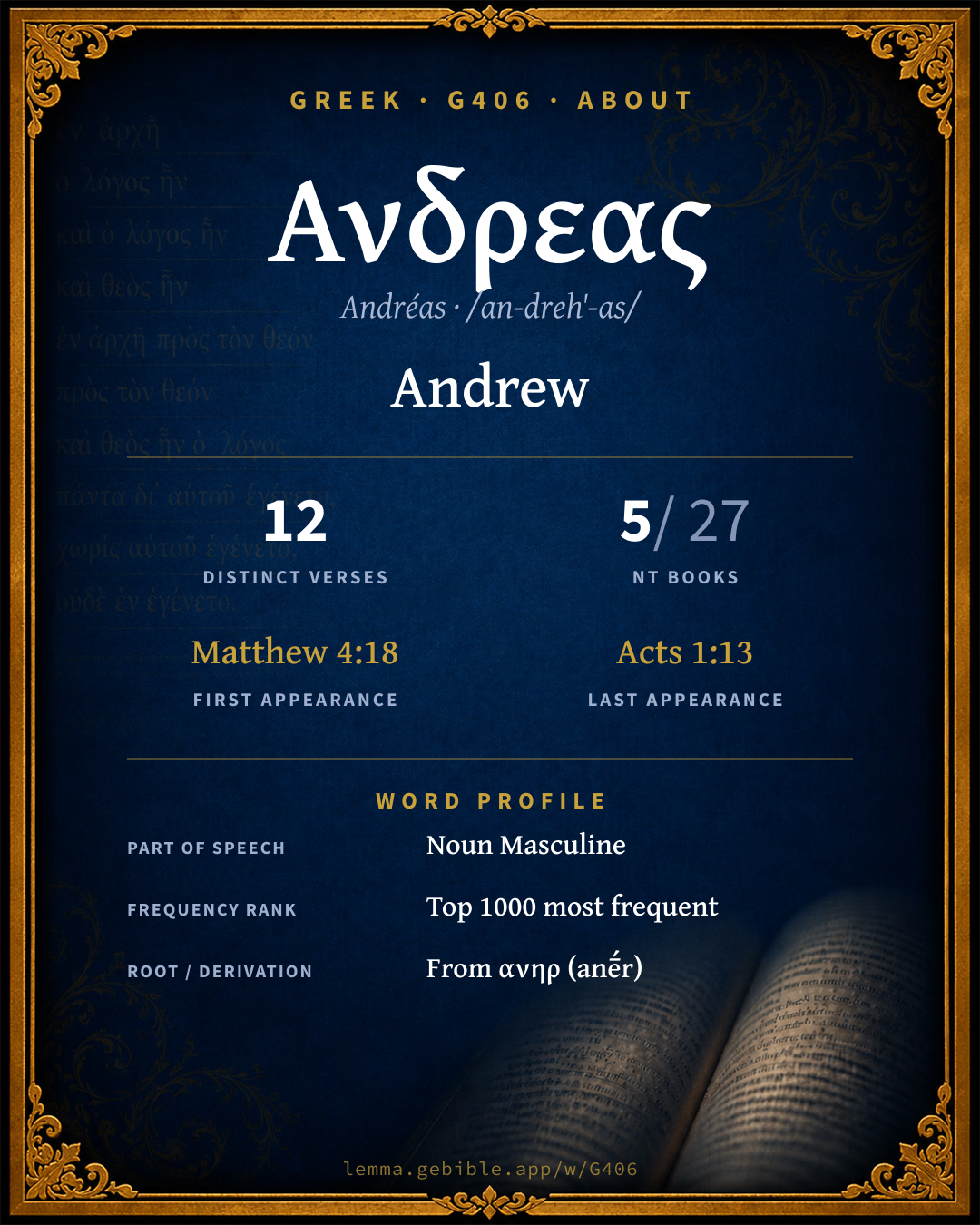
Ἀνδρέας
Andrew
Thayer's lists 2 entries for ‘Andrew’ fuller range ↓
Full lexicon entry — Thayer's Greek Lexicon
From Thayer's Greek Lexicon
Where this word appears
See every Nominative-case word in the Greek New Testament →
Grammar key — what these labels mean
Part of speech
- Noun
- A naming word — a person, place, thing, or idea.
Case
- Nominative
- The case of the subject (and the predicate nominative).
- Accusative
- The case of the direct object and of extent.
- Genitive
- The case of source, possession, or “of” — answers “whose / from what.”
- Dative
- The case of the indirect object, means, or location — “to / for / with / in.”
Gender
- Masculine
- Grammatically masculine.
Number
- Singular
- One.
Grammatical forms
- Noun, Nominative, Singular, Masculine 6 times (46%)
- Noun, Accusative, Singular, Masculine 4 times (31%)
- Noun, Genitive, Singular, Masculine 2 times (15%)
- Noun, Dative, Singular, Masculine 1 time (8%)
Parsed forms decoded from the imported morphology (Robinson–Tischendorf, public domain), counted across 13 parsed occurrences — not distinct verses.
Every verse where G406 appears — 12 distinct verses across 5 books. Click any verse to open its interlinear word-by-word view. Verse text shown in the World English Bible for context — . Each verse’s Greek form is shown with its reference; the English is not keyword-highlighted, since the data carries no word-level English alignment. Use “Compare translations” on any verse to read it across multiple English versions. This concordance covers the Greek New Testament; Septuagint (Greek Old Testament) occurrences of this word are not indexed here.
Matthew 2 verses
- Matthew 4:18 Ἀνδρέαν n acc sg masc Walking by the sea of Galilee, he saw two brothers: Simon, who is called Peter, and Andrew, his brother, casting a net into the sea; for they were fishermen.
- Matthew 10:2 Ἀνδρέας n nom sg masc Now the names of the twelve apostles are these. The first, Simon, who is called Peter; Andrew, his brother; James the son of Zebedee; John, his brother;
Mark 4 verses
- Mark 1:16 Ἀνδρέαν n acc sg masc Passing along by the sea of Galilee, he saw Simon and Andrew the brother of Simon casting a net in the sea, for they were fishermen.
- Mark 1:29 Ἀνδρέου n gen sg masc Immediately, when they had come out of the synagogue, they came into the house of Simon and Andrew, with James and John.
- Mark 3:18 Ἀνδρέαν n acc sg masc Andrew; Philip; Bartholomew; Matthew; Thomas; James, the son of Alphaeus; Thaddaeus; Simon the Zealot;
- Mark 13:3 Ἀνδρέας n nom sg masc As he sat on the Mount of Olives opposite the temple, Peter, James, John, and Andrew asked him privately,
Luke 1 verse
John 4 verses
- John 1:41 Ἀνδρέας n nom sg masc He first found his own brother, Simon, and said to him, "We have found the Messiah!" (which is, being interpreted, Christ).
- John 1:45 Ἀνδρέου n gen sg masc Philip found Nathanael, and said to him, "We have found him, of whom Moses in the law, and the prophets, wrote: Jesus of Nazareth, the son of Joseph."
- John 6:8 Ἀνδρέας n nom sg masc One of his disciples, Andrew, Simon Peter's brother, said to him,
- John 12:22 Ἀνδρέᾳ Ἀνδρέας n dat sg masc n nom sg masc Philip came and told Andrew, and in turn, Andrew came with Philip, and they told Jesus.
Acts 1 verse
About this entry
At a glance — auto-summarized from this page’s data, not written by a person. Every figure links to its source below. This summary describes the numbers; it doesn’t interpret them.
Ανδρεας (Andréas) is a Greek name most often rendered “Andrew.” Scripture first uses it in Matthew 4:18. It turns up in 12 verses across 5 books, an uncommon footprint. It concentrates in Mark, which alone accounts for 33% of its uses. The sections below give every occurrence and version rendering.
Gloss history
Strong's 1890 vs modern scholarship

About this word
Strong's G406 catalogs a Greek word from the Greek New Testament.
These counts are not copied from any lexicon or concordance. They are computed here, from the morphology-tagged Greek New Testament. What Lemma adds →
- 12
- distinct verses
- The word appears in 12 distinct verses.
- 5 / 27
- NT books
- The word appears in 5 of 27 New Testament books.
- #863
- by frequency
- Top 1000 most frequent Greek words (rank 863 of 5,347 Greek words by occurrence).
View all 12 occurrences in the concordance →
By section of the New Testament
By traditional corpus
Conventional, traditional groupings — biblical authorship is debated, so this is a traditional corpus grouping, not an authorship claim. Some books belong to more than one corpus (Luke is in both the Gospels and the Lukan corpus, and so on), so these shares overlap and need not total 100%. Each figure is a share of the word’s 12 distinct verses.
- Gospels 11 verses · 92%
- Johannine 4 verses · 33%
- Lukan (Luke–Acts) 2 verses · 17%
How translations render this word
Counts come from each version’s own published word-to-Strong’s tagging or interlinear alignment — an approximate guide to how each version renders this word, not a word-level alignment the data otherwise carries. Because each total is that version’s own tagged count, the per-version totals vary from one another and need not match the appearance or distinct-verse counts above. These counts may also differ from a printed concordance because Lemma counts each distinctly tagged rendering and does not collapse phrase taggings into a single head-word total. This is a fixed set of word-tagged versions (KJV, ASV, BSB, ULT) and does not change with the reading translation you choose elsewhere. Each version’s license is shown beside its name below (and on Sources).
- King James Version: Andrew 13×
- American Standard Version: Andrew 13×
- Berean Standard Bible: Andrew 12×
- unfoldingWord Literal Text: Andrew 13×
King James Version Public Domain
Renders G406 across 13 tagged occurrences — most commonly:
American Standard Version Public Domain
Renders G406 across 13 tagged occurrences — most commonly:
Berean Standard Bible Public Domain
Renders G406 across 12 tagged occurrences — most commonly:
Not rendered by a distinct English word in 1 further occurrence.
unfoldingWord Literal Text CC BY-SA 4.0
Renders G406 across 13 tagged occurrences — most commonly:
Senses in Thayer's
The 2 senses Thayer's distinguishes for this word, in lexicon order (not ranked by frequency or importance). The full entry — with sub-senses — is in the Lexicon Entry tab.
- Andrew = "manly"
- A native of Bethsaida in Galilee…
Word origin
Derived from ανηρ (anḗr) (G435) — man.
From G435 ; manly ; Andreas an Israelite : - Andrew.
— Strong’s Exhaustive Concordance (1890), public domain.
Forms in the corpus
The 4 distinct written forms G406 takes in the Greek New Testament, most frequent first — each parse links to that case’s occurrences in the concordance.
| Form | Parsing | Example | Uses |
|---|---|---|---|
| Ἀνδρέας Andréas | Noun, Nominative, Singular, Masculine | Matthew 10:2 | 6 |
| Ἀνδρέαν Andréan | Noun, Accusative, Singular, Masculine | Matthew 4:18 | 4 |
| Ἀνδρέου Andréou | Noun, Genitive, Singular, Masculine | Mark 1:29 | 2 |
| Ἀνδρέᾳ Andréa | Noun, Dative, Singular, Masculine | John 12:22 | 1 |
Same root — word family
Other Thayer's entries built from the same root as G406, grouped by Strong’s listed origin. These share a root / origin per the lexicon — not necessarily a shared meaning. Each links to that word’s own entry.
Derives from
Shares the same root
- ανδραποδιστης andrapodistḗs G405 man-stealer
- ανδριζομαι andrízomai G407 to show oneself brave
- ανδροφονος androphónos G409 murderer
- ανθρωπος ánthrōpos G444 human being
Proper names from this root
People and places named from this root — a name, not an additional meaning of the word.
Compare all same-root words → Showing 4 of 7 — not the complete family. 1 of the same-root words is a proper name (a person or place). They share a root, not necessarily a meaning.
Bible dictionary
Public-domain dictionary articles matched to this entry by name (Andrew). A biblical name can be shared by more than one person or place, so an article may treat several.
Easton's Bible Dictionary · M. G. Easton, 1897
Manliness, a Greek name; one of the apostles of our Lord. He was of Bethsaida in Galilee (John 1:44), and was the brother of Simon Peter (Matt. 4:18; 10:2). On one occasion John the Baptist, whose disciple he then was, pointing to Jesus, said, "Behold the Lamb of God" (John 1:40); and Andrew, hearing him, immediately became a follower of Jesus, the first of his disciples. After he had been led to recognize Jesus as the Messiah, his first care was to bring also his brother Simon to Jesus. The two brothers seem to have after this pursued for a while their usual calling as fishermen, and did not become the stated attendants of the Lord till after John's imprisonment (Matt. 4:18, 19; Mark 1:16, 17). Very little is related of Andrew. He was one of the confidential disciples (John 6:8; 12:22), and with Peter, James, and John inquired of our Lord privately regarding his future coming (Mark 13:3). He was present at the feeding of the five thousand (John 6:9), and he introduced the Greeks who desired to see Jesus (John 12:22); but of his subsequent history little is known. It is noteworthy that Andrew thrice brings others to Christ, (1) Peter; (2) the lad with the loaves; and (3) certain Greeks. These incidents may be regarded as a key to his character.
Smith's Bible Dictionary · William Smith, 1863
(manly), one of the apostles of our Lord, (John 1:40; Matthew 4:18) brother of Simon Peter. He was of Bethsaida, and had been a disciple of John the Baptist, leaving him to follow our Lord. By his means his brother Simon was brought to Jesus. (John 1:41) His place among the apostles seems to have been fourth, next after the three Peter, James and John, and in company with Philip. (Mark 3:18; Acts 1:13) The traditions about him are various. He is said to have preached in Scythia, in Greece, in Asia Minor and Thrace, and to have been crucified at Patrae in Achaia.
Hitchcock's Bible Names Dictionary · Roswell D. Hitchcock, 1869
a strong man
Classic public-domain reference works; full attribution on Sources.