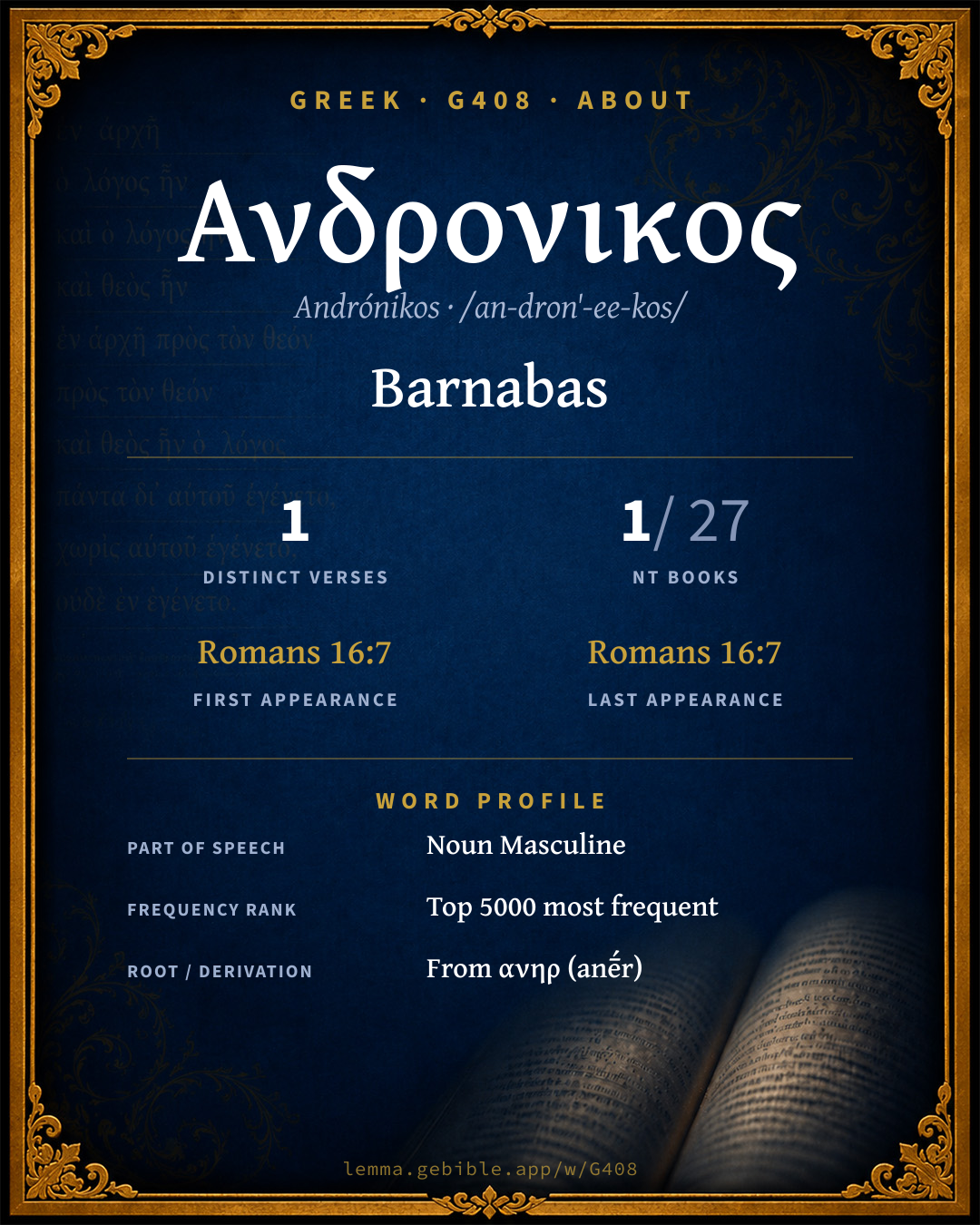
Ἀνδρόνικος
Barnabas
Thayer's lists 2 entries for ‘Barnabas’ fuller range ↓
Full lexicon entry — Thayer's Greek Lexicon
From Thayer's Greek Lexicon
Where this word appears
Grammar key — what these labels mean
Part of speech
- Noun
- A naming word — a person, place, thing, or idea.
Case
- Accusative
- The case of the direct object and of extent.
Gender
- Masculine
- Grammatically masculine.
Number
- Singular
- One.
Every verse where G408 appears — 1 distinct verse across 1 book. Click any verse to open its interlinear word-by-word view. Verse text shown in the World English Bible for context — . Each verse’s Greek form is shown with its reference; the English is not keyword-highlighted, since the data carries no word-level English alignment. Use “Compare translations” on any verse to read it across multiple English versions. This concordance covers the Greek New Testament; Septuagint (Greek Old Testament) occurrences of this word are not indexed here.
Romans 1 verse
About this entry
At a glance — auto-summarized from this page’s data, not written by a person. Every figure links to its source below. This summary describes the numbers; it doesn’t interpret them.
At its core, Ανδρονικος (Andrónikos) means “Barnabas.” With only 1 verse it sits in the long tail of Greek New Testament vocabulary. Its uses cluster heavily in Romans (100% of all occurrences). Scripture uses it exactly once, at Romans 16:7. Each statement above links to its evidence; the full detail follows below.
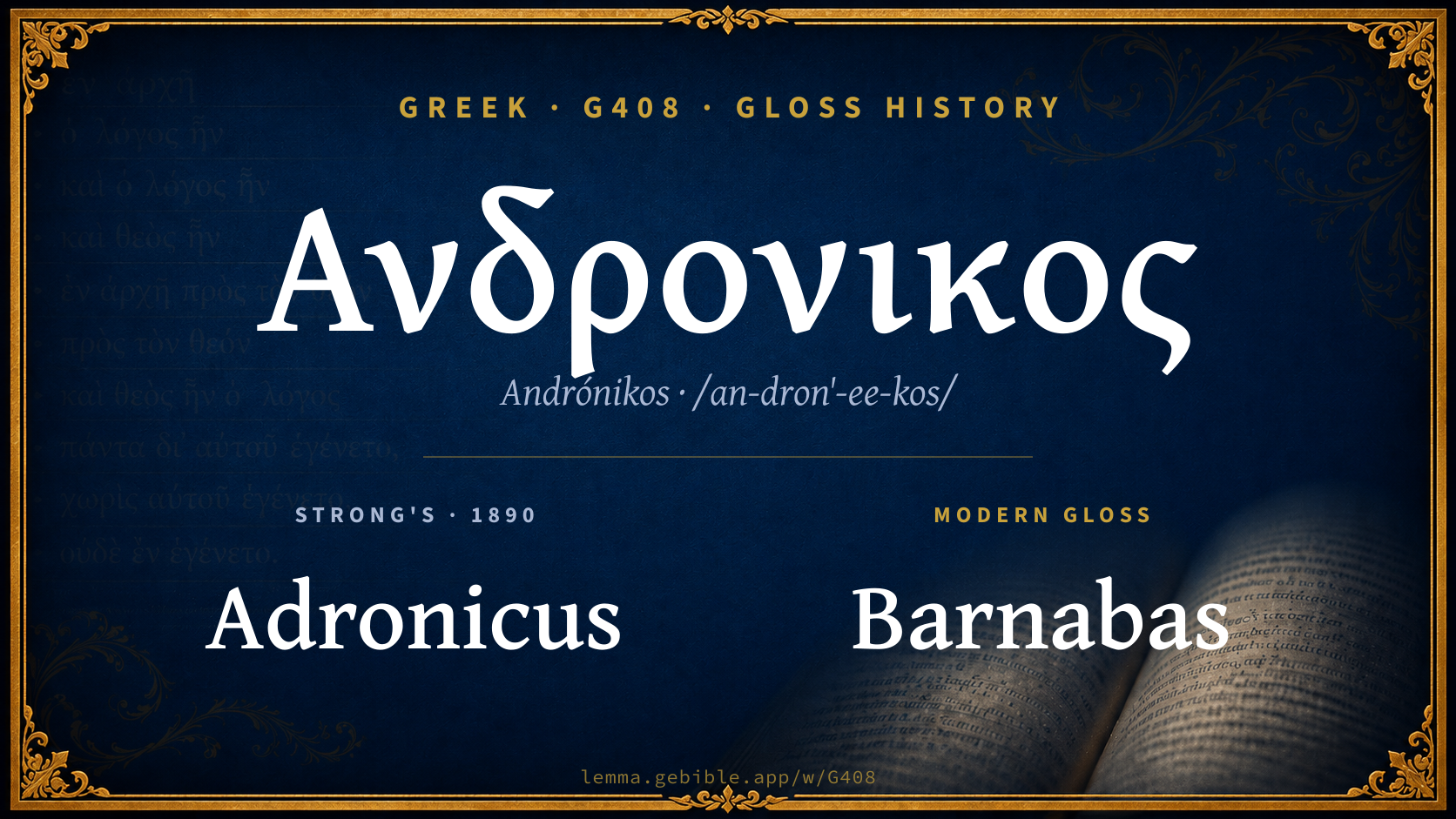
Gloss history
Strong's 1890 vs modern scholarship
About this word
Strong's G408 catalogs a Greek word from the Greek New Testament.
These counts are not copied from any lexicon or concordance. They are computed here, from the morphology-tagged Greek New Testament. What Lemma adds →
- 1
- distinct verses
- The word appears in 1 distinct verse.
- 1 / 27
- NT books
- The word appears in 1 of 27 New Testament books.
- #3,503
- by frequency
- Top 5000 most frequent Greek words (rank 3,503 of 5,347 Greek words by occurrence).
View all 1 occurrence in the concordance →
Most concentrated in
- Romans 1 verse 100%
By section of the New Testament
By traditional corpus
Conventional, traditional groupings — biblical authorship is debated, so this is a traditional corpus grouping, not an authorship claim. Some books belong to more than one corpus (Luke is in both the Gospels and the Lukan corpus, and so on), so these shares overlap and need not total 100%. Each figure is a share of the word’s 1 distinct verse.
- Pauline corpus 1 verse · 100%
How translations render this word
Counts come from each version’s own published word-to-Strong’s tagging or interlinear alignment — an approximate guide to how each version renders this word, not a word-level alignment the data otherwise carries. Because each total is that version’s own tagged count, the per-version totals vary from one another and need not match the appearance or distinct-verse counts above. These counts may also differ from a printed concordance because Lemma counts each distinctly tagged rendering and does not collapse phrase taggings into a single head-word total. This is a fixed set of word-tagged versions (KJV, ASV, BSB, ULT) and does not change with the reading translation you choose elsewhere. Each version’s license is shown beside its name below (and on Sources).
- King James Version: Andronicus 1×
- American Standard Version: Andronicus 1×
- Berean Standard Bible: Andronicus 1×
- unfoldingWord Literal Text: Andronicus 1×
King James Version Public Domain
Renders G408 across 1 tagged occurrence — most commonly:
American Standard Version Public Domain
Renders G408 across 1 tagged occurrence — most commonly:
Berean Standard Bible Public Domain
Renders G408 across 1 tagged occurrence — most commonly:
unfoldingWord Literal Text CC BY-SA 4.0
Renders G408 across 1 tagged occurrence — most commonly:
Senses in Thayer's
The 2 senses Thayer's distinguishes for this word, in lexicon order (not ranked by frequency or importance). The full entry — with sub-senses — is in the Lexicon Entry tab.
- Andronicus = "man of victory"
- a Jewish Christian and a kinsman of Paul
Word origin
Derived from ανηρ (anḗr) (G435) — man.
Same root — word family
Other Thayer's entries built from the same root as G408, grouped by Strong’s listed origin. These share a root / origin per the lexicon — not necessarily a shared meaning. Each links to that word’s own entry.
Derives from
Shares the same root
- ανδραποδιστης andrapodistḗs G405 man-stealer
- ανδριζομαι andrízomai G407 to show oneself brave
- ανδροφονος androphónos G409 murderer
- ανθρωπος ánthrōpos G444 human being
Proper names from this root
People and places named from this root — a name, not an additional meaning of the word.
Compare all same-root words → Showing 4 of 7 — not the complete family. 1 of the same-root words is a proper name (a person or place). They share a root, not necessarily a meaning.
Bible dictionary
Public-domain dictionary articles matched to this entry by name (Barnabas). A biblical name can be shared by more than one person or place, so an article may treat several.
Easton's Bible Dictionary · M. G. Easton, 1897
Son of consolation, the surname of Joses, a Levite (Acts 4:36). His name stands first on the list of prophets and teachers of the church at Antioch (13:1). Luke speaks of him as a "good man" (11:24). He was born of Jewish parents of the tribe of Levi. He was a native of Cyprus, where he had a possession of land (Acts 4:36, 37), which he sold. His personal appearance is supposed to have been dignified and commanding (Acts 14:11, 12). When Paul returned to Jerusalem after his conversion, Barnabas took him and introduced him to the apostles (9:27). They had probably been companions as students in the school of Gamaliel.
The prosperity of the church at Antioch led the apostles and brethren at Jerusalem to send Barnabas thither to superintend the movement. He found the work so extensive and weighty that he went to Tarsus in search of Saul to assist him. Saul returned with him to Antioch and laboured with him for a whole year (Acts 11:25, 26). The two were at the end of this period sent up to Jerusalem with the contributions the church at Antioch had made for the poorer brethren there (11:28-30). Shortly after they returned, bringing John Mark with them, they were appointed as missionaries to the heathen world, and in this capacity visited Cyprus and some of the principal cities of Asia Minor (Acts 13:14). Returning from this first missionary journey to Antioch, they were again sent up to Jerusalem to consult with the church there regarding the relation of Gentiles to the church (Acts 15:2: Gal. 2:1). This matter having been settled, they returned again to Antioch, bringing the decree of the council as the rule by which Gentiles were to be admitted into the church.
When about to set forth on a second missionary journey, a dispute arose between Saul and Barnabas as to the propriety of taking John Mark with them again. The dispute ended by Saul and Barnabas taking separate routes. Saul took Silas as his companion, and journeyed through Syria and Cilicia; while Barnabas took his nephew John Mark, and visited Cyprus (Acts 15:36-41). Barnabas is not again mentioned by Luke in the Acts.
Smith's Bible Dictionary · William Smith, 1863
(son of consolation or comfort) a name given by the apostles, (Acts 4:36) to Joseph (or Jose), a Levite of the island of Cyprus, who was early a disciple of Christ. In (Acts 9:27) we find him introducing the newly-converted Saul to the apostles at Jerusalem. Barnabas was sent to Jerusalem, (Acts 11:19-26) and went to Tarsus to seek Saul, as one specially raised up to preach to the Gentiles. (Acts 26:17) He brought him to Antioch, and was sent with him to Jerusalem. (Acts 11:30) On their return, they were ordained by the church for the missionary work, (Acts 13:2) and sent forth (A.D. 45). From this time Barnabas and Paul enjoy the title and dignity of apostles. Their first missionary journey is related in (Acts 13:14) Returning to Antioch (A.D. 47 or 48), they were sent (A.D. 50), with some others, to Jerusalem. (Acts 15:1,36) Afterwards they parted and Barnabas took Mark and sailed to Cyprus, his native island. Here the Scripture notices of him cease. The epistle attributed to Barnabas is believed to have been written early in the second century.
Hitchcock's Bible Names Dictionary · Roswell D. Hitchcock, 1869
son of the prophet, or of consolation
Classic public-domain reference works; full attribution on Sources.