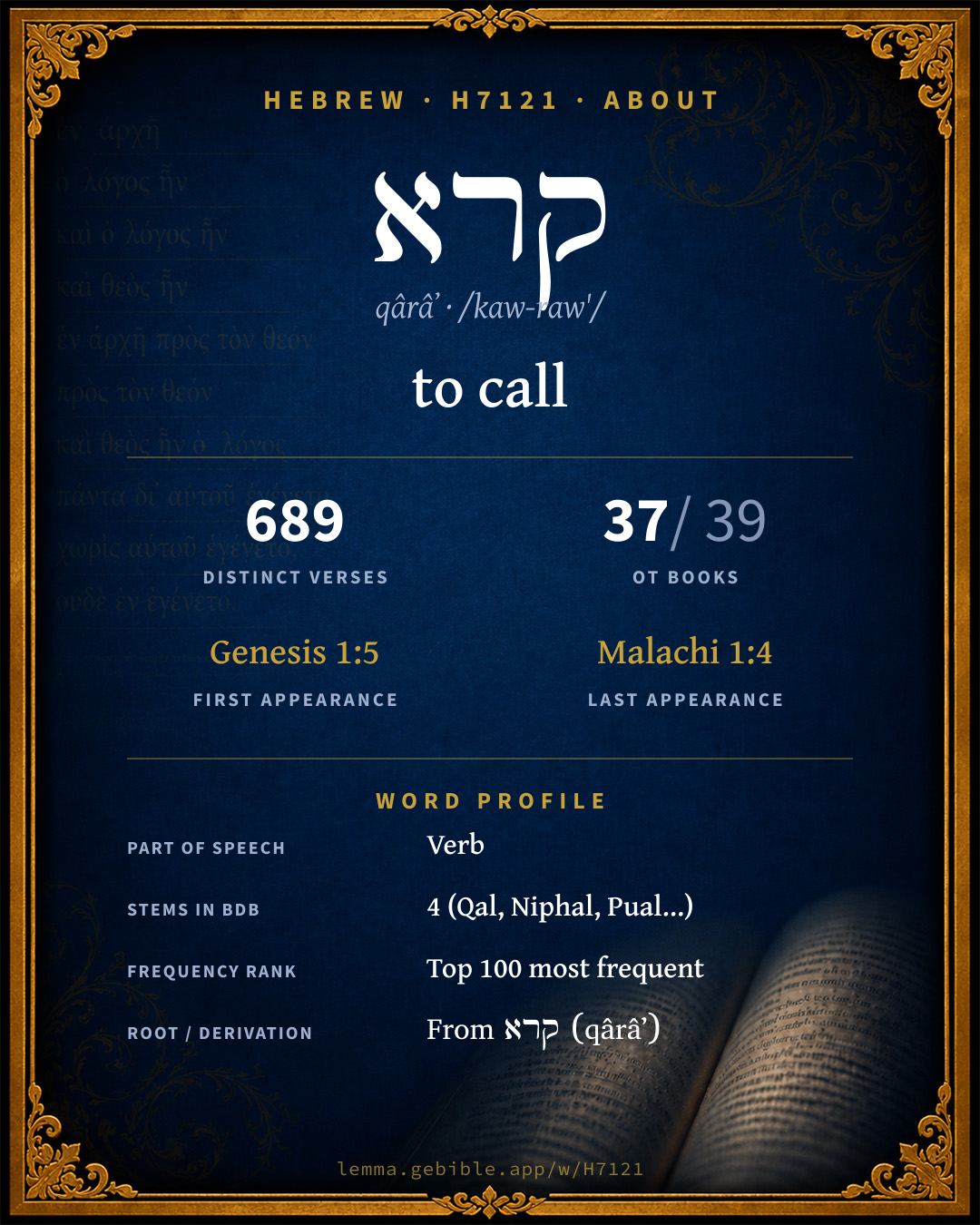
קָרָא
to call
also: call out, recite, read, cry out fuller range ↓
Full lexicon entry — Brown-Driver-Briggs (BDB)
From Brown-Driver-Briggs (BDB)
Where this word appears
See every Qal verb in the Hebrew Bible →
Grammar key — what these labels mean
Part of speech
- Verb
- An action or state-of-being word.
- Preposition
- A relational word (e.g. “in,” “to,” “from”) governing a noun.
Stem
- Qal
- The basic, simple active stem — the plain form of the verb (“he wrote”). Here: ‘call’
- Niphal
- Usually the simple passive or reflexive of the Qal (“he was written”). Here: ‘reflex.’
- Pual
- The passive counterpart of the Piel.
Form
- Sequential Imperfect
- An imperfect with prefixed waw — the standard past-narrative form (waw-consecutive imperfect).
- Perfect
- A completed action or state — Hebrew marks aspect (completeness) more than strict tense (“he wrote”).
- Imperfect
- An incomplete, ongoing, or future action (“he will / would write”).
- Infinitive Construct
- A bound verbal noun, frequently with prepositions (“to write / in writing”).
- Imperative
- A direct command (“write!”).
- Participle Active
- A verbal adjective expressing ongoing or characteristic action (“writing / one who writes”).
- Sequential Perfect
- A perfect with prefixed waw continuing a preceding imperfect or command (waw-consecutive perfect).
- Participle Passive
- A verbal adjective expressing action received (“written”).
- Jussive
- A third- or second-person volitional form expressing wish or command (“let him write”).
State
- Absolute
- The independent form of a noun, not bound to a following word.
- Construct
- A noun bound to a following noun in a possessive / “of” relationship (the construct chain).
Person
- 3rd Person
- The one spoken about (“he / she / it / they”).
- 1st Person
- The speaker (“I / we”).
- 2nd Person
- The one addressed (“you”).
Gender
- Masculine
- Grammatically masculine.
- Feminine
- Grammatically feminine.
- Common
- Either gender — not distinguished for this form.
Number
- Singular
- One.
- Plural
- More than one (in Hebrew, generally three or more).
30 verses where H7121 appears in the Qal stem in the Book of 1 Samuel. Filtered view — show all forms. Click any verse to open its interlinear word-by-word view. Verse text shown in the World English Bible for context — . Each verse’s Hebrew form is shown with its reference; the English is not keyword-highlighted, since the data carries no word-level English alignment. Use “Compare translations” on any verse to read it across multiple English versions. This concordance covers the Hebrew Bible; Septuagint (Greek Old Testament) occurrences are not indexed here.
1 Samuel
- 1 Samuel 1:20 וַ/תִּקְרָ֤א conj + Qal wimpf 3fs It happened, when the time was come about, that Hannah conceived, and bore a son; and she named him Samuel, [saying], Because I have asked him of Yahweh.
- 1 Samuel 3:4 וַ/יִּקְרָ֧א conj + Qal wimpf 3ms that Yahweh called Samuel; and he said, Here am I.
- 1 Samuel 3:5 קָרָ֣אתָ קָרָ֖אתִי Qal pf 2ms Qal pf 1cs He ran to Eli, and said, Here am I; for you called me. He said, I didn't call; lie down again. He went and lay down.
- 1 Samuel 3:6 קְרֹ֣א קָרָ֖אתָ קָרָ֥אתִי Qal inf.cs Qal pf 2ms Qal pf 1cs Yahweh called yet again, Samuel. Samuel arose and went to Eli, and said, Here am I; for you called me. He answered, I didn't call, my son; lie down again.
- 1 Samuel 3:8 קְרֹא קָרָ֖אתָ קֹרֵ֥א Qal inf.cs Qal pf 2ms Qal ptcp.act ms Yahweh called Samuel again the third time. He arose and went to Eli, and said, Here am I; for you called me. Eli perceived that Yahweh had called the child.
- 1 Samuel 3:9 יִקְרָ֣א Qal impf 3ms Therefore Eli said to Samuel, Go, lie down: and it shall be, if he call you, that you shall say, Speak, Yahweh; for your servant hears. So Samuel went and lay down in his place.
- 1 Samuel 3:10 וַ/יִּקְרָ֥א conj + Qal wimpf 3ms Yahweh came, and stood, and called as at other times, Samuel, Samuel. Then Samuel said, Speak; for your servant hears.
- 1 Samuel 3:16 וַ/יִּקְרָ֤א conj + Qal wimpf 3ms Then Eli called Samuel, and said, Samuel, my son. He said, Here am I.
- 1 Samuel 4:21 וַ/תִּקְרָ֣א conj + Qal wimpf 3fs She named the child Ichabod, saying, The glory is departed from Israel; because the ark of God was taken, and because of her father-in-law and her husband.
- 1 Samuel 6:2 וַ/יִּקְרְא֣וּ conj + Qal wimpf 3mp The Philistines called for the priests and the diviners, saying, "What shall we do with the ark of Yahweh? Show us with which we shall send it to its place."
- 1 Samuel 7:12 וַ/יִּקְרָ֥א conj + Qal wimpf 3ms Then Samuel took a stone, and set it between Mizpah and Shen, and called the name of it Ebenezer, saying, Hitherto has Yahweh helped us.
- 1 Samuel 9:13 הַ/קְּרֻאִ֑ים ptcl def.art + Qal ptcp.pass mp as soon as you are come into the city, you shall immediately find him, before he goes up to the high place to eat; for the people will not eat until he come, because he does bless the sacrifice; [and] afterwards they eat who are invited. Now therefore get you up; for at this time you shall find him.
- 1 Samuel 9:22 הַ/קְּרוּאִ֔ים ptcl def.art + Qal ptcp.pass mp Samuel took Saul and his servant, and brought them into the guest-chamber, and made them sit in the best place among those who were invited, who were about thirty persons.
- 1 Samuel 9:24 קָרָ֑אתִי Qal pf 1cs The cook took up the thigh, and that which was on it, and set it before Saul. [Samuel] said, Behold, that which has been reserved! set it before you and eat; because to the appointed time has it been kept for you, for I said, I have invited the people. So Saul ate with Samuel that day.
- 1 Samuel 9:26 וַ/יִּקְרָ֨א conj + Qal wimpf 3ms They arose early: and it happened about the spring of the day, that Samuel called to Saul on the housetop, saying, Up, that I may send you away. Saul arose, and they went out both of them, he and Samuel, abroad.
- 1 Samuel 12:17 אֶקְרָא֙ Qal impf 1cs Isn't it wheat harvest today? I will call to Yahweh, that he may send thunder and rain; and you shall know and see that your wickedness is great, which you have done in the sight of Yahweh, in asking you a king.
- 1 Samuel 12:18 וַ/יִּקְרָ֤א conj + Qal wimpf 3ms So Samuel called to Yahweh; and Yahweh sent thunder and rain that day: and all the people greatly feared Yahweh and Samuel.
- 1 Samuel 16:3 וְ/קָרָ֥אתָ conj + Qal wpf 2ms Call Jesse to the sacrifice, and I will show you what you shall do: and you shall anoint to me him whom I name to you.
- 1 Samuel 16:5 וַ/יִּקְרָ֥א conj + Qal wimpf 3ms He said, Peaceably; I am come to sacrifice to Yahweh: sanctify yourselves, and come with me to the sacrifice. He sanctified Jesse and his sons, and called them to the sacrifice.
- 1 Samuel 16:8 וַ/יִּקְרָ֤א conj + Qal wimpf 3ms Then Jesse called Abinadab, and made him pass before Samuel. He said, Neither has Yahweh chosen this.
- 1 Samuel 17:8 וַ/יִּקְרָא֙ conj + Qal wimpf 3ms He stood and cried to the armies of Israel, and said to them, Why are you come out to set your battle in array? am I not a Philistine, and you servants to Saul? choose you a man for you, and let him come down to me.
- 1 Samuel 19:7 וַ/יִּקְרָ֤א conj + Qal wimpf 3ms Jonathan called David, and Jonathan showed him all those things. Jonathan brought David to Saul, and he was in his presence, as before.
- 1 Samuel 20:37 וַ/יִּקְרָ֨א conj + Qal wimpf 3ms When the boy was come to the place of the arrow which Jonathan had shot, Jonathan cried after the boy, and said, Isn't the arrow beyond you?
- 1 Samuel 20:38 וַ/יִּקְרָ֤א conj + Qal wimpf 3ms Jonathan cried after the boy, Go fast! Hurry! Don't delay! Jonathan's boy gathered up the arrows, and came to his master.
- 1 Samuel 22:11 לִ/קְרֹא֩ prep + Qal inf.cs Then the king sent to call Ahimelech the priest, the son of Ahitub, and all his father's house, the priests who were in Nob: and they came all of them to the king.
- 1 Samuel 23:28 קָֽרְאוּ֙ Qal pf 3cp So Saul returned from pursuing after David, and went against the Philistines: therefore they called that place Sela Hammahlekoth.
- 1 Samuel 24:8 וַ/יִּקְרָ֧א conj + Qal wimpf 3ms David also arose afterward, and went out of the cave, and cried after Saul, saying, My lord the king. When Saul looked behind him, David bowed with his face to the earth, and did obeisance.
- 1 Samuel 26:14 וַ/יִּקְרָ֨א קָרָ֥אתָ conj + Qal wimpf 3ms Qal pf 2ms and David cried to the people, and to Abner the son of Ner, saying, Don't you answer, Abner? Then Abner answered, Who are you who cries to the king?
- 1 Samuel 28:15 וָ/אֶקְרָאֶ֣/ה conj + Qal wimpf 1cs + sfx dem Samuel said to Saul, Why have you disquieted me, to bring me up? Saul answered, I am sore distressed; for the Philistines make war against me, and God is departed from me, and answers me no more, neither by prophets, nor by dreams: therefore I have called you, that you may make known to me what I shall do.
- 1 Samuel 29:6 וַ/יִּקְרָ֨א conj + Qal wimpf 3ms Then Achish called David, and said to him, As Yahweh lives, you have been upright, and your going out and your coming in with me in the host is good in my sight; for I have not found evil in you since the day of your coming to me to this day: nevertheless the lords don't favor you.
About this entry
At a glance — auto-summarized from this page’s data, not written by a person. Every figure links to its source below. This summary describes the numbers; it doesn’t interpret them.
“to call” is the headline sense of the Hebrew verb קרא (qârâʼ). Across 4 stems, its meaning turns on the binyan (Qal, Niphal). It turns up in 689 verses across 37 books, one of the most common footprint. First canonically at Genesis 1:5, it enters the text early. From the same root come קרא, קראה and מקרא. See the sense tree, 689-verse concordance, and the renderings breakdown below.
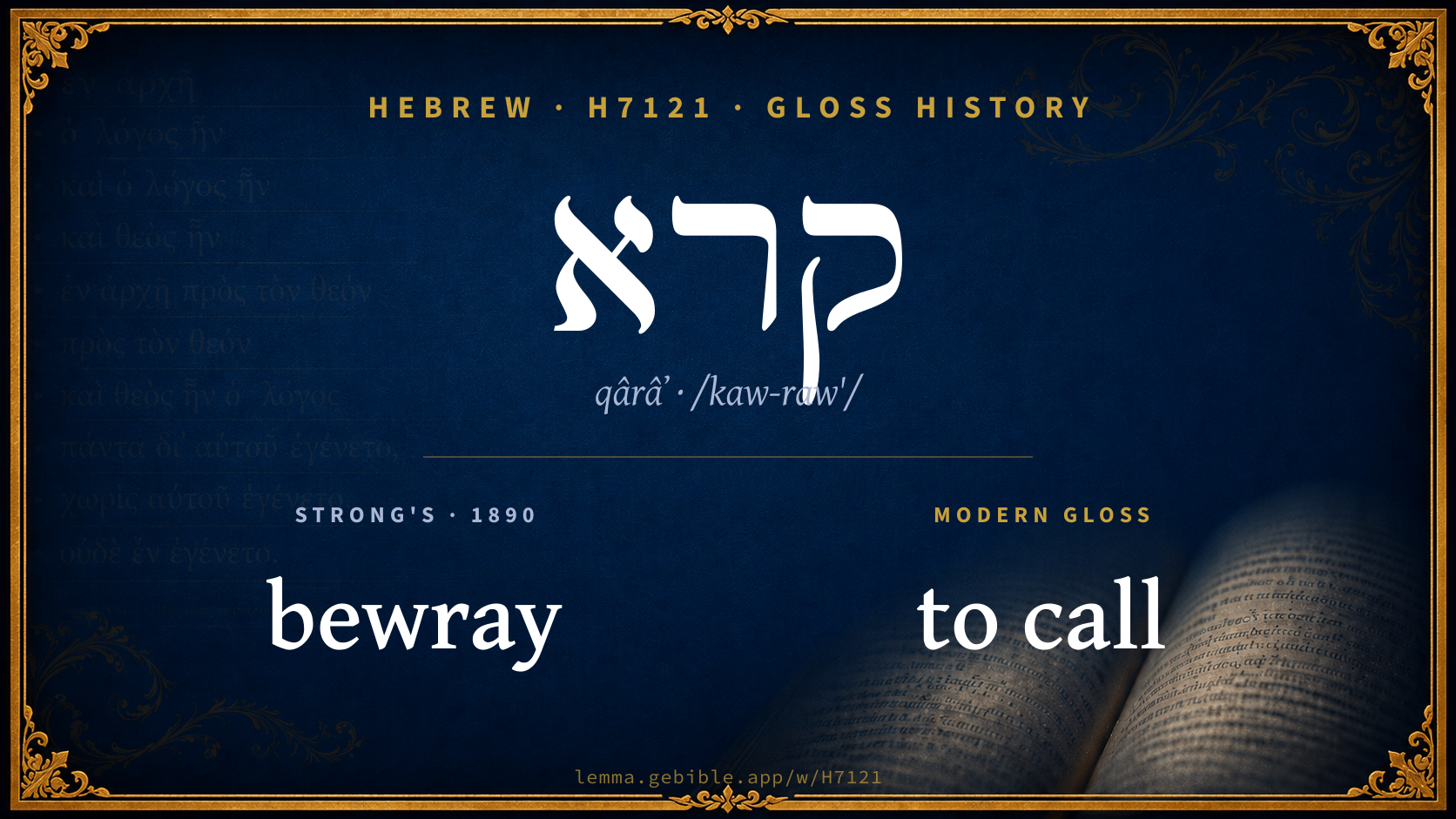
Gloss history
Strong's 1890 vs modern scholarship
About this word
Strong's H7121 catalogs a Hebrew word from the Hebrew Old Testament.
These counts are not copied from any lexicon or concordance. They are computed here, from the morphology-tagged Hebrew Old Testament. What Lemma adds →
- 689
- distinct verses
- The word appears in 689 distinct verses.
- 37 / 39
- OT books
- The word appears in 37 of 39 Old Testament books.
- #69
- by frequency
- Top 100 most frequent Hebrew words (rank 69 of 8,640 Hebrew words by occurrence).
View all 689 occurrences in the concordance →
By section of the Old Testament
By traditional corpus
Conventional, traditional groupings — biblical authorship is debated, so this is a traditional corpus grouping, not an authorship claim. Each share is this word’s portion of its verses in that division of the Hebrew canon. Each figure is a share of the word’s 689 distinct verses.
- Prophets (Nevi'im) 359 verses · 52%
- Torah (Pentateuch) 183 verses · 27%
- Writings (Ketuvim) 147 verses · 21%
How translations render this word
Counts come from each version’s own published word-to-Strong’s tagging or interlinear alignment — an approximate guide to how each version renders this word, not a word-level alignment the data otherwise carries. Because each total is that version’s own tagged count, the per-version totals vary from one another and need not match the appearance or distinct-verse counts above. These counts may also differ from a printed concordance because Lemma counts each distinctly tagged rendering and does not collapse phrase taggings into a single head-word total. This is a fixed set of word-tagged versions (KJV, ASV, BSB, ULT) and does not change with the reading translation you choose elsewhere. Each version’s license is shown beside its name below (and on Sources).
BDB lists this Strong’s number as 2 distinct words (homographs). Each count above pools all of them and is not split by sense — see the Senses section below. A low-frequency rendering may belong to a different one of those words, not the primary meaning.
- King James Version†: Called 156×, Call 52×, He called 40×
- American Standard Version†: Called 146×, Call 46×, He called 35×
- Berean Standard Bible†: Called 53×, Call 35×, Summoned 34×
- unfoldingWord Literal Text†: Called 117×, He called 81×, And 66×
King James Version Public Domain
Renders H7121 across 736† tagged occurrences — most commonly:
Plus other, less common renderings. Plus 144 renderings that appear only once — usually multi-word phrases or single function words the recovered tagging swept in, not distinct renderings. Not rendered by a distinct English word in 1 further occurrence.
American Standard Version Public Domain
Renders H7121 across 734† tagged occurrences — most commonly:
Plus other, less common renderings. Plus 174 renderings that appear only once — usually multi-word phrases or single function words the recovered tagging swept in, not distinct renderings.
Berean Standard Bible Public Domain
Renders H7121 across 708† tagged occurrences — most commonly:
Plus other, less common renderings. Plus 195 renderings that appear only once — usually multi-word phrases or single function words the recovered tagging swept in, not distinct renderings. Not rendered by a distinct English word in 24 further occurrences.
unfoldingWord Literal Text CC BY-SA 4.0
Renders H7121 across 839† tagged occurrences — most commonly:
Plus other, less common renderings. Plus 125 renderings that appear only once — usually multi-word phrases or single function words the recovered tagging swept in, not distinct renderings.
45 senses and sub-senses in the full BDB
Hebrew verbs can shift meaning by stem (binyan): Qal is the basic action, Niphal is often passive or reflexive, Piel often intensifies or makes it factitive, and Hiphil is typically causative. The senses below are grouped under the stem BDB assigns to each. This entry also uses Pual (the passive of Piel).
What do BDB’s symbols mean?
BDB uses these scholarly abbreviations:
| Symbol | Meaning |
|---|---|
| 𝔊 | the Septuagint (the ancient Greek translation, LXX) |
| 𝔙 | the Vulgate (the Latin translation) |
| 𝔖 | the Syriac version (the Peshitta) |
| 𝔗 | the Targum (the Aramaic translation) |
| ψ | the Psalms |
| √ | root (the underlying root or stem) |
| ‖ | parallel passage (a synonymous or contrasted parallel) |
| † | the dagger: every passage where the word occurs is cited |
The 45 senses and sub-senses the full Brown-Driver-Briggs lexicon distinguishes for this word, in lexicon order (not ranked by frequency), with BDB’s own verbatim wording and sub-sense lettering. Shown in Hebrew script with BDB’s own scholarly abbreviations. The condensed entry is in the Lexicon Entry tab. See also the Forms in the corpus table below.
קרא I call, proclaim, read (NH id., read aloud, read
Qal
- Pf. ק׳ Gn 11:9 +, 3 fs. consec. וְקָרָאת Is 7:14 (Ges§ 74 g); 2 ms. קָרָאתָ Ju 12:1 +, etc.; Impf. 3 ms. יִקְרָא Gn 2:19 +; sf. יִקְרְאוֹ Je 23:6, -אֵהוּ Is 41:2 +; 1 s. אֶקְרָא Dt 32:3 +, וָאֶקְרָאֶה 1 S 28:15 (Ges§ 48 d NesMarg. 15); 3 fpl. וַתִּקְרֶאנָה Ru 4:17(×2), וַתִּקְרֶאן Nu 25:2; 2 fpl. תִּקְרֶאנָה Ru 1:20, 21, etc.; Imv. ms. קְרָא Ju 7:3 +, sf. קְרָאֵנִי ψ 50:15, etc.; Inf. cstr. קְרֹא 1 S 3:6 +, קְרֹאות (Baer -אֹת) Ju 8:1 (Ges§ 74 h); sf. קָרְאִי ψ 4:2 +, etc.; Pt. act. קוֹרֵא Am 5:8 +, קֹרֵא Je 1:15 +; pl. קֹרִאים ψ 99:6 (Ges§§ 74 i; 75 oo); pass. קָרוּא Est 5:12; pl. קְרוּאִים 1 S 9:22; Ez 23:23, קְרֻאִים 1 S 9:13 +; cstr. קְרוּאֵי Nu 1:16 Qr (Kt קריאי), 26:9 Kt (Qr קְרִיאֵי, v. קָרִיא);— e.g. Genesis 11:9
- 1.
- a. call, cry, utter a loud sound, Ju 9:7; 2 S 18:25 (in v 28 read וַיִּקְרַב We, confirmed by 𝔊L, so Dr and all recent Comm.), Je 4:5 Dn 8:16 (all + אמר), 2 K 7:11 (on text v. Kit Benz), Is 6:4; for help Gn 39:15, 18 (J); of pleading in court Is 59:4 (ב of manner); explicitly בְּקוֹל גָּדוֹל Gn 39:14 (J), 1 K 18:27, 28; 2 K 18:28 = Is 36:13 = 2 Ch 32:18, קוֹל גָּדוֹל Ez 9:1 (+ בְּאָזְנֵי); c. אַחֲרֵי pers. 1 S 20:37 (+ אָמַר), 24:8 (Gi; v 9 van d. H. Baer; + לֵאמֹר), Je 12:6. e.g. Judges 9:7
- b. call, cry, obj. in orat. recta Ju 7:20 1 S 3:4 (read שְׁמוּאֵל שְׁמוּאֵל; 𝔊 Th We Dr Kit Bu HPS), v 6 (cf. 𝔊), v 8 (agst. accents), v 10 (v. שְׁמוּאֵל), 20:38; 2 S 20:16; 2 K 11:14; Je 20:8; Lv 13:45; = utter, speak Je 36:18; of command Gn 45:1 (E). e.g. Judges 7:20
- 2.
- a. call unto some one: אֶל pers. (often + אָמַר; sometimes c. מִן loc.), Gn 3:9; 19:5; Ex 3:4 Is 6:3 + often; c. עַל (for אֶל) of satyrs Is 34:14 (so Vrss Ges CheComm. al. > recent Comm. from ii. קָרָא or קָרָה which (in Qal) always take accus.); unto (אֶל) י׳ (God), in praise †ψ 66:17 1 Ch 4:10, usually for help, Ju 15:18; 1 S 12:17, 18; Ho 7:7 ψ 3:5; 4:4 +, + עַל pers. against Dt 15:9; 24:15; to (ל) י׳ (God) †Jb 12:4 ψ 57:3; 141:1; to (ל) a servant (for service) 2 K 4:36; Jb 19:16, so (ל) 2 S 1:15; call to (ל) one Je 3:4 (+ orat. rect.), La 4:15 (id.), Pr 2:3 (לְבִינָה); subj. י׳ Mi 6:8; Je 35:17. e.g. Genesis 3:9
- b. cry for help, abs., (poet. and late) Zc 7:13; Is 58:9; 65:24; Jb 5:1; 9:16; Pr 21:13 ψ 4:2; 20:10 + 10 times ψψ (147:9 of young ravens); בְּאָזְנֵי Ez 8:18. e.g. Zechariah 7:13
- c. ק׳ בְּשֵׁם י׳ call with name of י׳ (i.e. use it in invocation): Gn 4:26; 12:8; 2 K 5:11; Je 10:25 = ψ 79:6 + 16 times (1 K 18:24 of specif. appeal to י׳ to display his power), + Is 65:1 (v. Pu.); with name of Baal †1 K 18:24, 25, 26. e.g. Genesis 4:26
- d. late, c. acc. dei Is 43:22 ψ 14:4 + 4 times ψψ; abs. ψ 116:2. e.g. Isaiah 43:22
- 3. proclaim:
- a. c. acc. rei procl. Am 4:5; Gn 41:43; Dt 15:2; Je 31:6; Lv 25:10 +; ק׳ צוֹם proclaim a fast 1 K 21:9, 12 Je 36:9 +, ק׳ מוֹעֲדֵי י׳ Lv 23:2, 4; ק׳ sq. orat. rect. Ex 34:6, etc.; sq. ל pers. Je 34:8, 15, 17(×2) Is 61:1, עַל pers. (against, concerning) 1 K 13:4, 32; Je 49:29; La 1:15; proclaim peace to (ל pers.) Ju 21:13; cf. ק׳ אֵלֶיהָ לְשָׁלוֹם Dt 20:10; ק׳ c. acc. cogn. מִקְרָא Is 1:13, הַקְרִיאָה Jon 3:2 (+ אֶל). e.g. Amos 4:5
- b. ק׳ שֵׁם י׳ Dt 32:3 ψ 99:6; so (earlier) ק׳ בְשֵׁם י׳ Ex 33:19; 34:5 (JE); cf. ק׳ בְּשֵׁם יַעֲקֹב Is 44:5 (but read יִקָּרֵא, Lo Che and most). e.g. Deuteronomy 32:3
- c. ק׳ בְּשׁ׳ עֲלֵי ψ 49:12 proclaim (with) name over landed estates, claim possession (Hup Bae); proclaim one’s own name Ru 4:11 = become famous; pt. pass. proclaimed, i.e. renowned Ez 23:23. e.g. Psalms 49:12
- d. abs. make proclamation (sometimes + אָמַר, לֵאמֹר) Ju 7:3; Je 2:2 (בְּאָזְנֵי) Zc 1:14, 17; Jon 3:4; Is 40:3, 6 +, c. עַל concerning Ne 6:7, against 1 K 13:2 Jon 1:2. e.g. Judges 7:3
- 4.
- a. read aloud, often בְּאָזְנֵי, less often לִפְנֵי, c. ב of roll, book Je 36:6, 8, 14; Ne 8:3, 8, 18; 9:3; 2 Ch 34:18, + acc. of words Je 36:8, 10; obj. om. Ex 24:7 (E) Je 36:15; c. acc. of roll, book v 15, 21; 51:63; 2 K 22:10; 2 Ch 34:24, of letter (סֵפֶר), writing 2 K 5:7 Is 29:11, 12; Je 29:29, columns of manuscript Je 36:23; c. acc. of words Jos 8:34, 35; Je 36:6; 51:61; 2 K 23:2 = 2 Ch 34:30, cf. Dt 31:11. e.g. Jeremiah 36:6
- b. read, to oneself, in (ב) a roll, book, Dt 17:19, so of vision written on tablets Hb 2:2; c. acc. of letter (סֵפֶר) 2 K 19:14 = Is 37:14, book 2 K 22:8; abs. Is 34:16. e.g. Deuteronomy 17:19
- c. read, for hear read, 2 K 22:16. e.g. 2 Kings 22:16
- 5. summon: usually
- a. c. ל pers.: Gn 12:18; 20:8, 9; Nu 22:5, 20, 37; Ju 8:1 1 S 3:5, 6, 8(×2) + often (c. 100 times), + ל reflex. 1 K 1:28, 32, + אֶל loc. Ex 19:20, + אֶל pers. 2 S 9:2, + inf. purpose Jos 24:9; Ju 12:1; 14:15; 1 S 28:15, + מִן loc. Ho 11:1 Ju 4:6; + בִּשְׁמֶ֑ךָ Is 45:4 summon by thy name; specif. summon = invite (especially to feast) Ex 34:15 Ju 14:15 (+ inf. purpose) 1 S 16:3 (+ בַּזָּבַ֑ח, read prob. לַזּ׳ v. HPS), v 5 (+ לַזּ׳), 1 K 1:9, 26 + (c. 17 times). e.g. Genesis 12:18
- b. c. אֶל pers. Ex 10:24 Jos 4:4; 10:24 1 K 13:21 + (c. 20 times); אֶל pers. + ל pers. (diff. persons in same relation) Ex 8:21 Je 42:8; = call for (demand to see), c. אֶל pers. 2 K 18:18; c. ל rei = demand, require Pr 18:6 cf. 27:16 (prob. corrupt, v. Toy). e.g. Exodus 10:24
- c. c. acc. pers. Gn 41:8, 14 Ex 2:7 (+ ל pers.), v 7 Am 5:16 (+ אֶל rei), Is 13:3 (ל rei), 1 S 3:16; 22:11 + (c. 33 times), ins. וַיִּקְרָא in this sense also 2 S 15:12 𝔊L We Dr and most; + inf. purpose Nu 24:10, ק׳ מִמִּזְרָח עַיִט Is 46:11; in weakened sense (to bring response, or bring pers. near) Ct 5:6; specif. invite, 1 S 9:24 (but corrupt, v. especially HPS), 1 K 1:9 (also + ל, MT), v 10; 12:20 (+ אֶל loc), Dt 33:19 (acc. loc.); אֲנִי קָרוּא לָהּ Est 5:12, pt. pass. elsewhere pl., invited ones, guests 1 S 9:13, 22 2 S 15:11 1 K 1:41, 49 Zp 1:7 Pr 9:18; invite or summon (acc. pers.) for help, succour, Ho 7:11; usually obj. י׳ (poet. and late) Je 29:12 2 S 22:4, 7 = ψ 18:4, 7 Is 55:6 La 3:57 Jb 27:10 ψ 50:15; 86:5 + 8 times ψψ, acc. שֵׁם י׳ La 3:55; acc. חכמה Pr 1:28. e.g. Genesis 41:8
- d. abs. call, summon Am 7:4 (+ ל rei), Is 22:12 (id.), 1 S 3:5, 6; Zc 7:13; subj. י׳ (God) Is 50:2; 65:12; 66:4; Jb 13:22; 14:15, קְרוּאֵי הָעֵדָה Nu 1:16 Qr (Kt קְרִיאֵי), 26:9 Kt (Qr קְרִיאֵי!). e.g. Amos 7:4
- e. call and commission, appoint, acc. pers., Is 48:15; 49:1, + בְּשֵׁם by name, specifically, Ex 31:2; 35:30 Is 43:1; 45:3. e.g. Isaiah 48:15
- f. call and endow (with privilege) Is 51:2; 54:6; 55:5. e.g. Isaiah 51:2
- 6. call = name:
- a. (eárly and most common usage), call one’s name (שֵׁם) so and so, 2 acc.: of pers. Gn 3:20; 4:25, 26; 5:2, 3, 29 + 34 times Gn, Ex 2:10, 22 Ho 1:4, 6, 9 Is 7:14; 8:3; 9:5 + 10 times (Je 46:17 read קִרְאוּ שֵׁם 𝔊 Gie al.); of places, etc., Gn 4:17; 11:9 + 17 times Gn, Ju 1:17, 26; 2:5; 15:19; 18:29 + 21 times e.g. Genesis 3:20
- b. c. acc. of appellation only, Ez 39:11. e.g. Ezekiel 39:11
- c. acc. pers. vel loc. + acc. appell. Ho 2:18 Dt 3:14 Je 23:6 Is 58:5 Nu 32:41. e.g. Hosea 2:18
- d. acc. pers. + cl. ψ 89:27. e.g. Psalms 89:27
- e. = give name to, acc. appell. + ל pers. (loc., velrei): (1) pers. Ho 2:18; Gn 35:18; 1 S 4:21; Je 3:19; 30:17; 33:16 + 9 times; (2) loc., vel rei, Ju 18:12 2 S 2:16; 5:9; 6:8 Jos 22:34 (name lost, 𝔖 Heb. Codd. ins. עֵד; cf. DiSteuern), Gn 1:5(×2), 8; 2:19(×2) Ex 33:7 + 30 times + Jb 17:14 (ל + sentence incl. name). e.g. Hosea 2:18
- f. c. בְּשֵׁם + ל Is 40:26, cf. 65:11 (שֵׁם אַחֵר), ψ 147:4 (שֵׁמוֹת), Ru 4:17 (שֵׁם + לֵאמֹר), Gn 2:20; 26:18(×2) (all c. שֵׁם). e.g. Isaiah 40:26
- g. c. ל rei + עַל־שֵׁם 2 S 18:18. e.g. 2 Samuel 18:18
- h. call by (ב) names the names (acc.) of cities Nu 32:38; call to (ל) city, + appell., + בִּשְׁמוֹ v 42. e.g. Numbers 32:38
- i. call cities (acc.) בְּשֵׁם, i.e. specify them, Jos 21:9; 1 Ch 6:50 (בְּשֵׁמוֹת). e.g. Joshua 21:9
Niphal
- Pf. 3 ms. נִקְרָא Je 4:20 +, 1 s. נִקְרֵאתִי Est 4:11, etc.; Impf. 3 ms. יִקָּרֵא Gn 2:23 +, וַיִּקָּרֵא Ez 20:29 +, etc.; Pt. נִקְרָא Is 43:7; Je 44:26; pl. נִקְרָאִים Is 48:1 Est 6:1;— e.g. Jeremiah 4:20
- 1. reflex., מֵעִיר הַקֹּדֶשׁ נִק׳ Is 48:2 from the holy city they call themselves. e.g. Isaiah 48:2
- 2. pass. be called:
- a. be proclaimed (cf. Qal 3), of שֵׁם י׳ Je 44:26 (בְּפֶה instr.); of man’s name = be famous Ru 4:14; = be announced Je 4:20. e.g. Jeremiah 44:26
- b. be read aloud (cf. Qal 4): impers. c. ב of book, + בְּאָזְנֵי Ne 13:1; subj. records Est 6:1 (לִפְנֵי). e.g. Nehemiah 13:1
- c. be summoned (cf. Qal 5): Is 31:4 (עַל against); Est 3:12; 4:11(×2); 8:9; †בְּשֵׁם, i.e. specifically, 2:14. e.g. Isaiah 31:4
- d. be named (cf. Qal 6): (1) appell. subj. + ל pers. Gn 2:23 to her shall be called ‘woman,’ 1 S 9:9; Is 32:5; 62:4, 12; Pr 16:21; + ל loc. 2 S 18:18; Is 1:26; 35:8; Je 19:6. (2) וְנִקְרָא שְׁמוֹ וגו׳ Dt 25:10, so Gn 35:10 Dn 10:1; Ez 20:29 (of place); אֶת־שִׁמְךָ Ez 20:29. (3) וְנִקְרְאָה יְרוּשׁ׳ וגו׳ Zc 8:3, so of land Dt 3:13, temple Is 56:7. (4) especially נִקְרָא שֵׁם י׳ עַל, denoting ownership, of pers. Je 15:16, people Dt 28:10; Je 14:9; Am 9:12; Is 63:19; 2 Ch 7:14, ark 2 S 6:2 (del. 2nd שֵׁם 𝔅 We Dr al.), = 1 Ch 13:6 (adding עָלָיו Oettli Kau; > KitHpt שְׁמוֹ שָׁם), temple 1 K 8:43 = 2 Ch 6:33; Je 7:10, 11, 14, 30; 32:34; 34:15, city Je 25:29; Dn 9:18, city + people v 19; so name of man 2 S 12:28, as given to his wife Is 4:1. (5) be called עַל שֵׁם, i.e. reckoned to, Gn 48:6; Is 54:5; 61:6; עַל־שֵׁבֶט 1 Ch 23:14, cf. Ezr 2:61 = Ne 7:63. (6) be called בְּשֵׁם Is 43:7; 48:1. (7) בְּיִצְחָק יִקּ׳ לְךָ זָ֑רַע Gn 21:12, i.e. in (through) יִצ׳ shall seed be reckoned to thee; וְיִקָּרֵא בָהֶם שְׁמִי 48:16 through them shall my name be called, i.e. perpetuated. (8) be named = mentioned, of pers. Is 14:20. (9) subj. שֵׁם Ec 6:10, i.e. thing is known. e.g. Genesis 2:23
Pual
- (Ez and Is 2) Pf. 3 ms. קֹרָא be called, subj. appell. + ל pers. vel rei = be named, Is 48:8 Ez 10:13 (קוֹ׳); וְקֹרָא consec. Is 58:12; 61:3; 62:2 (שֵׁם חָדָשׁ); גּוֹי לֹא קֹרָא בִּשְׁמִי 65:1 (קָרָא or קֹרֵא [Qal 2 c], Vrss Lo Ew Che Di al.); be called and privileged (cf. Qal 5 f), Pt. יִשׂ׳ מְקֹרָאִי 48:12. e.g. Isaiah 48:8
קרא II encounter, befall (‖ form of קָרָה, q.v.
Qal
- Pf.5 3 ms. sf. קְרָאַנִי Je 13:22 Jb 4:2; 3 fs. קָרָאת Dt 31:29; Je 44:23, etc.; Impf.4 3 ms. יִקְרָא Gn 49:1, sf. יִקְרָאֶנּוּ Gn 42:4; 3 fpl. וַתִּקְרֶאנָה Lv 10:19; Ex 1:10 read 3 fs. sf. תִּקְרָאֵנוּ (Sam Vrss Di Ges§ 47 k SoKau Baen); Inf. cstr.121 לִקְרַאת (Ges§ 19 k Ol§ 137), Gn 15:10 +, etc.; Pt. fpl. sf. קֹרְאֹתַיִךְ Is 51:19;— e.g. Jeremiah 13:22
- 1. meet, encounter, only inf. cstr. לִקְרַאת often = prep. toward, against (Köii. 1, 317), almost always c. acc. pers., after vb. of motion, Is 7:3; Gn 19:1; 24:17; Ju 4:18, 22; 1 K 2:8 +; in war, battle, Ju 7:24; 20:25, 31; 1 S 4:1; 1 K 20:27 +, after עָרַךְ 2 S 10:9, 10, 17 +, ψ 35:3 v. I. סגר 2 b; לְחַזֵּק לִבָּם לִק׳ הַמִּלְחָמָה Jos 11:20 to harden their heart to encounter the war with Isr.; after הִנֵּה (without vb. of motion), †1 S 10:10; 2 S 15:32; 16:1; 1 K 18:7; Pr 7:10; in constr. prægn. וַיִּשְׂמַח לִק׳ Ju 19:3 he rejoiced to meet him, + 1 S 6:13 (𝔊 We Dr al.); חרד לִק׳ 1 S 16:4; 21:2; so c. שׁאג Ju 14:5, הריע 15:14, מצא 2 K 10:15, נצב Ex 5:20; 7:15 Nu 22:34, etc.; redund. יִקָּרֶה י׳ לִק׳ Nu 23:3; implic. of helping, Is 21:14 ψ 59:5 (fig.); לִק׳ נְחָשִׁים Nu 24:1 he did not go to encounter (in expectation of) signs of divination; in metaph. Is 14:9, לִק׳ אֱלֹהֶיךָ Am 4:12. e.g. Isaiah 7:3
- 2. fig. befall c. acc. pers., bad sense Gn 42:4, 38; Dt 31:29; Je 13:22; 44:23; Is 51:19; Jb 4:14; Lv 10:19; of war Ex 1:10 (v. supr.); in gen., Gn 49:1. e.g. Genesis 42:4
Niphal
- meet unexpectedly; Pf. 3 ms. נִקְרָא, c. עַל pers. Ex 5:3; Impf. 3 ms. וַיִּקָּרֵא, c. לִפְנֵי pers. 2 S 18:9; Pf. 20:1, c. שָׁם, chanced to be there; Impf. of bird’s nest Dt 22:6 (לִפְנֵי); Inf. abs. נִקְרֹא v. קרה. e.g. Exodus 5:3
Hiphil
- Impf. 2 ms. וַתַּקְרֵא Je 32:23 thou didst cause all this evil to befall them (acc. pers. et rei). e.g. Jeremiah 32:23
Senses from the full Brown-Driver-Briggs lexicon (Brown, Driver, Briggs; Oxford 1906 — public domain), digitized via Sefaria, supplemented by the OpenScriptures HebrewLexicon (CC BY 4.0). Full attribution on Sources.
Word origin
I. vb. call, proclaim, read (NH id., read aloud, read; Ph. קרא call; Arabic قَرَأَ read aloud, recite (the ‘Ḳorʾān’), القُرْآنُ the Ḳorʾān; Aramaic קְרָא, ܩܪܳܐ call, etc., so Old Aramaic קרא, Nab. id., Palm. id., קרה);—
II. vb. encounter, befall (‖ form of קָרָה, q.v.; SI 4 לקרת to meet, opposite; Arabic قَرَأَ, put part to part; Min. קרא set opposite, HomChrest. 127);—
— Brown-Driver-Briggs (Oxford 1906, public domain), digitized via Sefaria, supplemented by the OpenScriptures HebrewLexicon (CC BY 4.0). See Sources.
Derived from קרא (qârâʼ) (H7122) — to meet.
Jastrow Dictionary
A second Hebrew/Aramaic lexicon for comparison, covering Aramaic and post-biblical (Talmudic, Targumic, Midrashic) usage that the biblical-Hebrew BDB does not. Matched by lemma rather than by Strong’s number, so a lemma may carry more than one Jastrow headword (shown separately below), and the entries cover usage well beyond the Bible.
קָרָא I
- (קְרַר II) pumpkin, gourd. Succ. 56ᵇ; Keth. 83ᵇ, a. e. טב מק׳, v. בּוּצִין. Yoma 78ᵃ מצטנן בק׳ cooled his hands with a pumpkin. Ker. 6ᵃ; Hor. 12ᵃ; a. fr.—Pl. קָרֵי, קָרַיָּא. Meg. 12ᵃ, v. בּוּצִין; Sot. 10ᵃ קָארֵי. Ned. 51ᵃ Rashi (ed. קרא, corr. acc.). B. Mets. 64ᵃ ק׳ בני זרתא pumpkins of the size of a fist. B. Bath. 88ᵃ קארי. Sabb. 129ᵇ מאה ק׳, v. קַרְנָא I; a. e.—קָרַיָּיא וְקָרָוָותָא large and small gourds, all kinds of gourds. Y. Ned. VII, beg. 40ᵇ (not וכרובתא); Y. Orl. III, 63ᵇ top קירייא וקרותוא (corr. acc.).
קָרָא II
- to call, v. קרי.
קְרָא I
- v. קְרֵי
קְרָא II
- (preced.) = h. מִקְרָא, Biblical verse. Targ. Esth. VI, 1.—Ber. 2ᵃ אק׳ קאי, v. קָאֵי. Ib. 27ᵃ אמר ק׳ וכ׳ the text reads babboḳer &c. Ib. 29ᵇ מאי קראה where is the Biblical passage to prove it? Snh. 45ᵇ; 71ᵃ, a. e. בעינן ק׳ וכ׳, v. כְּתַב I. Ker. 11ᵇ bot. ק׳ בעי do we need a Bible verse for it?; a. v. fr.—Ber. 30ᵇ פוק קרא קְרָאָיךְ לברא go out, read thy verse in the street, i.e. thy authority is not recognized at college; Keth. 56ᵃ; Yeb. 40ᵃ קַרְיָיךְ, v. קַרְיָיא.—Pl. קְרָאֵי. M. Kat. 3ᵇ והני … ק׳ נינהו are these traditional rulings? are they not intimated in the Biblical text? Pes. 4ᵇ תרי ק׳ כתיבי there are two verses (seemingly contradictory); a. v. fr.
קַרָא
- (preced.) a Biblical scholar, Bible teacher. Kidd. 49ᵃ אבל אמר לה ק׳ אנא וכ׳ but if he said to her, (thou art betrothed unto me under the condition that) I am a Biblical scholar, she is not betrothed unless he can read the Pentateuch, Prophets and Hagiographa correctly (understandingly), contrad. to קַרְיָנָא. Ber. 30ᵇ, a. e. ר׳ חנינא ק׳ R. Ḥanina, the Bible teacher.—Pl. (h. form) קַרָאִים; (ch.) קַרָאֵי. Pesik. Shubah, p. 165ᵇ ק׳ טובים וכ׳ good Bible teachers, good preachers, like Levi &c.; Yalk. Hos. 533. Ab. Zar. 40ᵃ מתלתא ק׳ שמיע לי (Ar. קיראי) I have it from three authorities (as reliable as the Scriptures, Rashi).—V. קַרָיָיא.—[Meg. 24ᵇ in Mish. דרך הקראים, a censorial change for המינות, as in Mish. ed. IV, 8, a. Ms. M., v. Rabb. D. S. a. l.—In later literature קראים Karaites, a Jewish sect recognizing the Bible as sole authority.]
קרי ²
- (b. h.)
- 1. to call, name; to invite. Ber. 7ᵇ מיום שברא … שקְרָאוֹ … וּקְרָאוֹ אדון from the day that the Lord created the world there was no man that called the Holy One, blessed be He, lord, until Abraham came and called him lord (Gen. XV, 2 אדני). Gen. R. s. 56 אברהם קראו יראה Abraham called it (the Temple site) yeraëh (Gen. XXII, 14), שם ק׳ אותו שלם Shem called it Salem (ib. XIV, 18), הריני קוֹרֵא אותו ירושלם I will call it Jerusalem. Snh. 70ᵇ אין … לִקְרוֹא אבא וכ׳ no sooner does a child know to call ‘father’ and ‘mother’, than it tastes grain food. Num. R. s. 15, beg. ק׳ אותו אוהב he invited that friend. Ib. והיה קורא אומניות, v. אוּמָנוּת; a. v. fr.—Part. pass. קָרוּא, קָרוּי; f. קְרוּאָה, קְרוּיָה; Pl. קְרוּאִים, קְרוּאִין, קְרוּיִים, קְרוּיִם, קְרוּיִין, קְרוּיִן; קְרוּאוֹת, קְרוּיוֹת. B. Mets. 114ᵇ, a. e. (ref. to Ez. XXXIV, 31) אתם ק׳ אדם וכ׳ you are called men, but idolaters &c. Sifra Aḥăré, end כל העריות ק׳ טומאה all illicit connections are called uncleanness; a. fr.—Esp. קְרוּאִים, קְרוּיִין those called up to read from the Torah (v. infra). Gen. R. s. 70 (ref. to Gen. XXIX, 2) אלו שלשה ק׳ this is typical of the three persons called up to read from the Torah (priest, Levite, and Israelite). Y. Meg. III, 74ᵇ ולא שבעה ק׳ אינון are not seven persons called up (on the Sabbath)?; a. fr.—V. קְרוּיוֹת.—2) to read, recite (esp. from the Scriptures). Yoma I, 6 אם רגיל לִקְרוֹת … קוֹרִין לפניו if he (the high priest) is accustomed to read (the Scriptures), he reads himself, if not, they read to him; ובמה קורין לפניו and from what books do they read to him? Ib. פעמים הרבה קָרִיתִי וכ׳ many a time I read to him from Daniel. Meg. II, 1 הקורא את המגילה וכ׳, v. מִפְרֵעַ. Ib. 2 קְרָאָהּ סירוגין, v. סֵירוּג. Ib. 3 קורא כמקומו he must read in accordance with the usage of the place he came from. Ib. 4 הכל כשרין לִקְרוֹת וכ׳ all persons are qualified to recite the Book of Esther (before the congregation). Y. Meg. IV, 74ᵈ bot. וקְרָיָיהּ and read from it; a. fr.—Esp. to read from the Torah at public services. Ib. III, 4 קורין בפרשת שקלים they (those who are called up, v. supra) read the section of Sheḳalim (Ex. XXX, 11-16). Ib. 6 אחד קורא את כולן one person must read the entire chapter (of the curses). Ib. IV, 1 בשני … קורין שלשה on Mondays … three persons read. Ib. 4 הקורא בתורה לא יפחות וכ׳ he who is designated to read from the Torah must read no less than three verses; לא יִקְרָא למתורגמן וכ׳ he must read to the interpreter one verse at a time, but from the Prophets, three verses. Bicc. I, 1 יש מביאין … וקורין וכ׳ there are those who are bound to bring the first-fruits and to read (Deut. XXVI, 5-10), and those who must bring but not read &c. Ib. 4; a. v. fr.—Esp. (את שמע) ק׳ to recite the Sh’mʿa in the morning and in the evening prayer. Ber. I, 1 לא קָרִינוּ וכ׳ we omitted to read the Sh’mʿa. Ib. II, 3 ק׳ וטעה if one read the Sh’mʿa and made a mistake. Ib. 4 האומנין קוֹרְאִין וכ׳ (Bab. ed. 16ᵃ קורין) workingmen read the Sh’mʿa on top of a tree, or on the scaffolding; a. v. fr.—אל תִּקְרֵי … אלא (or תִּיקְרִי Chald. form; abbrev. א"ת) read not … but—, i.e. change the traditional (Massoretic) reading (for homiletical purposes). Ib. 64ᵃ (ref. to Is. LIV, 13 א"ת בָּנַיִךְ אלא בּוֹנַיִךְ read not banayikh (thy children) but bonayikh (thy builders, the scholars). M. Kat. 9ᵇ (ref. to Ps. XLIX, 12) א"ת קִרְבָּם אלא קִבְרָם read not ḳirbam (their innermost) but ḳibram (their grave); a. fr. e.g. Genesis 15:2
- same, to call, invite. Part. pass. מְקוֹרָא, pl. מְקוֹרָאִים, מְקוֹרָאִין. Num. R. s. 13 יש חתן … למק׳ וכ׳ does a bridegroom give a banquet for the invited guests and not sit with them?; a. e.
- 1. to be called. Lev. R. s. 1, beg. נִקְרְאוּ הנביאים וכ׳, v. בַּיִת. Ex. R. s. 1 (ref. to Ex. II, 13) מכאן … נ׳ רשע from here we learn that when a man lifts up his hand to strike his neighbor, even if he does not strike, he is called a wicked man; Snh. 58ᵇ. Ab. Zar. 19ᵃ (ref. to Ps. I, 2) בתחלה נִקְרֵאת … נקראת וכ׳ first it (the Law) is called the Lord’s, and then his (the student’s); a. fr.— to be read, recited. Meg. I, 1 מגלה נקראת וכ׳ the Book of Esther may be read at public service on the eleventh &c. Ib. IV, 10 מעשה ראובן נ׳ ולא וכ׳ the story of Reuben (Gen. XXXV, 22) is read at public service but not translated. Ib. לא נִקְרָאִין וכ׳ (Y. ed. נִיקְרִין) must be neither read nor interpreted. Tosef. ib. IV (III), 31 יש נקראין ומתרגמין וכ׳ certain verses are read but not interpreted &c.; Meg. 25ᵃ נִקְרִין; a. v. fr. e.g. Exodus 2:13
- to cause to call, to lead in reading. Sot. 10ᵃ sq. (ref. to Gen. XXI, 33) א"ת וַיִּקְרָא אלא וַיַּקְרִיא read not vayiḳra (and he called) but vayaḳri (and he made call), מלמד שה׳ וכ׳ intimating that Abraham caused the name of the Lord to be called by the mouth of every passer-by. Y. ib. V, 20ᶜ top קטן שהוא מַקְרֵא וכ׳ a child that reads the Hallel at school, and they (the class) respond by repeating each sentence (v. עָנָה I); גדול שהוא מקרא וכ׳ an adult that leads in reciting …, when the congregation responds with the first sentence (as refrain). Succ. III, 10 מי שהיה … מַקְרִין אותו וכ׳ if a slave, a woman, or a child reads to him, he responds with Hallelujah. Gitt. III, 1 שמע קול סופרים מקרין וכ׳ heard the teaching scribes as they made the practicing children read, ‘such and such … divorces &c.’—Esp. to teach the Scriptures (מִקְרָא). Lam. R. to I, 6 הַקְרינִי דף אחד … השניני וכ׳ teach me a page of the Scriptures, teach me a chapter of the Mishnah; a. fr.—[Erub. 104ᵇ שהקרו, v. קָרַר I.] e.g. Genesis 21:33
קרי ³
- (b. h.) to join.—Denom. קוֹרָה III.—לִקְרַאת to meet. Sabb. 31ᵃ ויצא לִקְרָאתוֹ and came out to meet him. Ib. 119ᵃ; B. Kam. 32ᵃ top לקראת כלה to meet the bride (the Sabbath); a. fr.
- to meet, join, esp. נִקְרֵי, נִיקְרֵי (denom. of קֶרִי) to lose semen. Gen. R. s. 52; s. 74, a. e. אין הלשון הזה וַיִּקָּר אלא לשון טומאה this expression vayiḳḳar (Num. XXIII, 4) has the meaning of uncleanness (by analogy from Deut. XXIII, 11).—Meg. 15ᵃ; Taan. 5ᵇ. Yeb. 76ᵃ e.g. Numbers 23:4
- same, to have (nocturnal) pollution; to lose semen. Y. Snh. II, 20ᵇ top; Midr. Sam. ch. XXIII (ref. to I Sam. XXV, 20) ותפגש אותם הוּקְרוּ כולן ‘she struck them’ (with her charms), all of them met with &c. e.g. 1 Samuel 25:20
A Dictionary of the Targumim, the Talmud Babli and Yerushalmi, and the Midrashic Literature (Marcus Jastrow; London, Luzac, 1903) — Public Domain. Digitized via Sefaria. Digitized via Sefaria. Full attribution on Sources.
Forms in the corpus
The 334 distinct written forms H7121 takes in the Hebrew Bible, most frequent first — each parse links to that stem’s occurrences in the concordance. Hebrew forms include their vowel points and cantillation, so a single lemma takes many written forms.
The 60 most common forms are shown; 274 rarer forms follow in the full concordance.
Same root — word family
Other BDB entries built from the same root as H7121, grouped by Strong’s listed origin. These share a root / origin per the lexicon — not necessarily a shared meaning. Each links to that word’s own entry.
Derives from
Shares the same root
Derived from this word
- מקרא miqrâʼ H4744 convocation
- קרא qᵉrâʼ H7123 to call
- קרא qôrêʼ H7124 partridge
- קריא qârîyʼ H7148 called
- קריאה qᵉrîyʼâh H7150 proclamation
Proper names from this root
People and places named from this root — a name, not an additional meaning of the word.
Compare all same-root words → Showing 4 of 9 — not the complete family. 1 of the same-root words is a proper name (a person or place). They share a root, not necessarily a meaning.
Septuagint verse parallels
This word appears in 653 verses that also exist in the Greek Old Testament (Septuagint), out of the 689 Hebrew verses it occurs in. You can read those verses in Greek by switching the Old Testament edition to the Septuagint.
Read these verses in the Septuagint
- Genesis 1:5
- Exodus 1:18
- Leviticus 1:1
- Numbers 1:16
- Deuteronomy 2:11
- Joshua 4:4
- Judges 1:17
- Ruth 1:20
- 1 Samuel 1:20
- 2 Samuel 1:7
- 1 Kings 1:9
- 2 Kings 3:10
This is a verse-level parallel only — the same verses exist in both the Hebrew and Greek Old Testaments. No word-level Hebrew↔Greek correspondence is claimed: the data carries no such alignment, so no Greek word is shown as this Hebrew word’s translation. Coverage is not total — the Septuagint omits the deuterocanon and renumbers the Psalms, so some Hebrew verses have no direct Greek parallel.