1 Samuel 23:28

Hebrew (Westminster Leningrad Codex) 1 Samuel 23:28 appears in the Hebrew Old Testament. The text above is from the Westminster Leningrad Codex. Each word links to its Strong’s number, a concise gloss, and parsing drawn from the Open Scriptures Hebrew Bible morphology. Click any word for its full Brown-Driver-Briggs (BDB) entry.
Download image
Cite this verse

1 Samuel 23:28 (World English Bible). Public Domain. Lemma interlinear Bible study tool, https://lemma.gebible.app/v/1-samuel/23/28.

Show BibTeX & RIS
BibTeX
RIS
English Translation
So Saul returned from pursuing after David, and went against the Philistines: therefore they called that place Sela Hammahlekoth.
World English Bible · Public Domain
Highlights
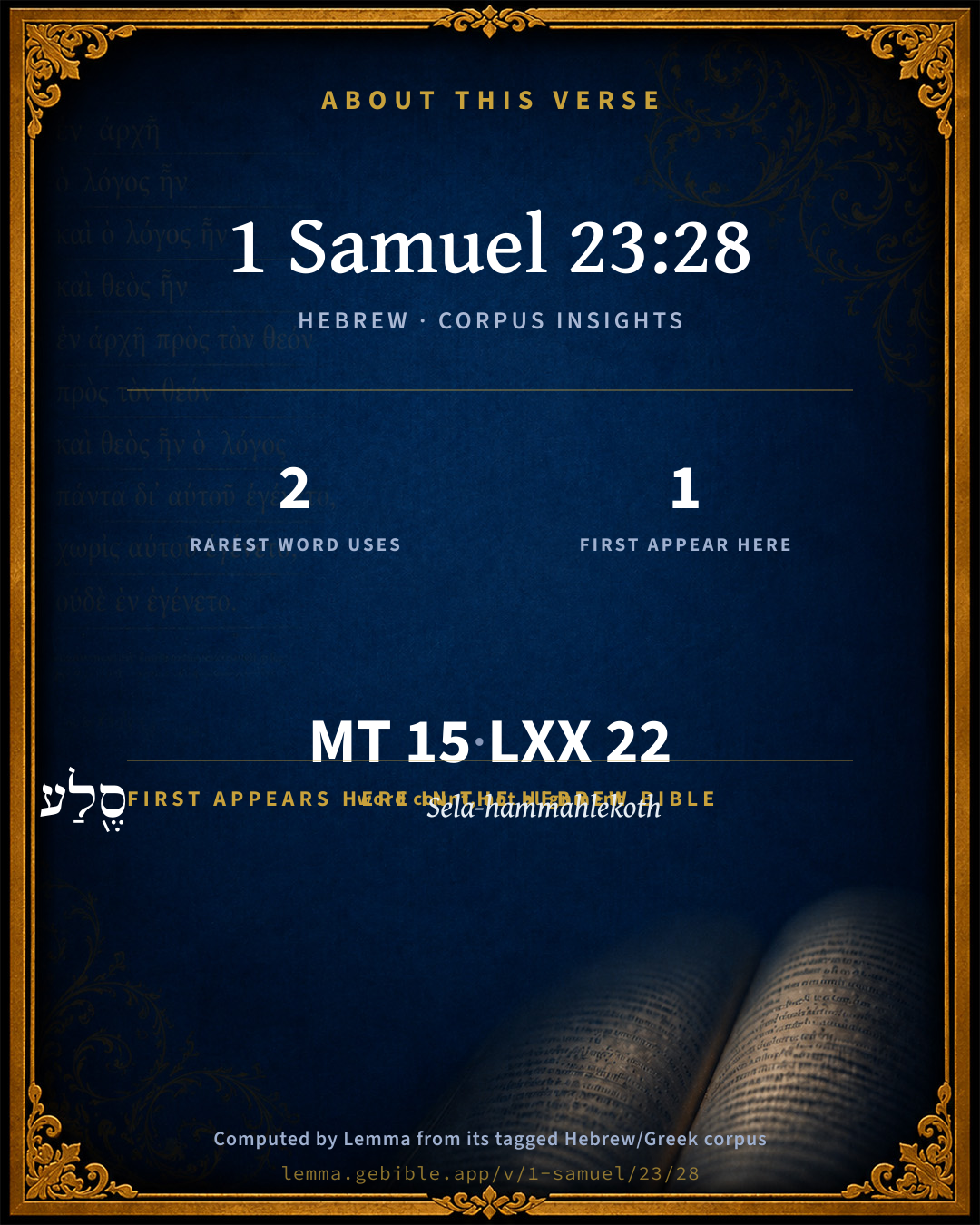
  • 1 first appearance in the Hebrew Bible
Full analysis ↓
Download a study sheet

One document with this verse’s original text, its word-by-word gloss line, the meaning frame, cross-references with their text, attributed commentary, and full source and license credits — printable, and it pastes into notes with its structure intact.

This verse Autodidact and up

Study sheet (.html) Plain text (.txt)

A passage Seminary Student

Up to 50 verses in one chapter. A passage sheet keeps up to 6 commentary sources and 12 cross-references per verse, in the order this page ranks them, and says so on the sheet whenever that leaves anything out. Ask for a single verse and you get the Autodidact verse sheet above.

Everything on this page stays free to read, with no account — the sheet is a download of what is already on screen, not access to it.

Want to remove ads? Support Godless Engineer
Compare translations 3

The same verse in 3 English versions, stacked beneath the original-language interlinear above. Click any original word for its lexicon entry.

Each is an independent rendering of the whole verse — the interlinear is not word-aligned to these translations.

Highlighted words mark where these versions differ — a whole-verse word diff, not a word-by-word alignment.

  • World English Bible Public Domain
    So Saul returned from pursuing after David, and went against the Philistines: therefore they called that place Sela Hammahlekoth.
  • King James Version Public Domain
    Wherefore Saul returned from pursuing after David, and went against the Philistines: therefore they called that place Selahammahlekoth.
  • unfoldingWord Literal Text CC BY-SA 4.0
    And Saul returned from pursuing after David, and he went to meet the Philistines. Therefore they called that place Sela Hammahlekoth.

unfoldingWord Literal Text — © unfoldingWord, licensed CC BY-SA 4.0. Word-aligned USFM3 via Door43 (git.door43.org/unfoldingWord/en_ult).

Versions to compare (up to 4)

3 of 4 selected

Show all 18 translations

Every available English version of this verse, each an independent rendering of the whole verse.

  • World English Bible Public Domain
    So Saul returned from pursuing after David, and went against the Philistines: therefore they called that place Sela Hammahlekoth.
  • Berean Standard Bible Public Domain
    So Saul broke off his pursuit of David and went to meet the Philistines. That is why that place is called Sela-hammahlekoth.
  • Majority Standard Bible Public Domain
    So Saul broke off his pursuit of David and went to meet the Philistines. That is why that place is called Sela-hammahlekoth.
  • King James Version Public Domain
    Wherefore Saul returned from pursuing after David, and went against the Philistines: therefore they called that place Selahammahlekoth.
  • American Standard Version (1901) Public Domain
    So Saul returned from pursuing after David, and went against the Philistines: therefore they called that place Sela-hammahlekoth.
  • Revised Version (1885) Public Domain
    So Saul returned from pursuing after David, and went against the Philistines: therefore they called that place Sela-hammahlekoth.
  • Geneva Bible (1599) Public Domain
    Wherefore Saul returned from pursuing Dauid, and went against the Philistims. Therefore they called that place, Sela-hammahlekoth.
  • Douay-Rheims (1899) Public Domain
    Wherefore Saul returned, leaving the pursuit of David, and went to meet the Philistines. For this cause they called that place, the Rock of division.
  • Young's Literal Translation Public Domain
    And Saul turneth back from pursuing after David, and goeth to meet the Philistines, therefore they have called that place `The Rock of Divisions.'
  • Literal Standard Version CC BY-SA 4.0
    And Saul turns back from pursuing after David, and goes to meet the Philistines, therefore they have called that place “The Rock of Divisions.”
  • Unlocked Literal Bible CC BY-SA 4.0
    So Saul returned from pursuing David and went against the Philistines. Therefore that place was called the Rock of Escape.
  • unfoldingWord Literal Text CC BY-SA 4.0
    And Saul returned from pursuing after David, and he went to meet the Philistines. Therefore they called that place Sela Hammahlekoth.
  • Darby Bible Public Domain
    And Saul returned from pursuing after David, and went against the Philistines; therefore they called that place Sela-hammahlekoth.
  • World Messianic Bible Public Domain
    So Saul returned from pursuing David, and went against the Philistines. Therefore they called that place Sela Hammahlekoth.
  • Webster's Bible Public Domain
    Wherefore Saul returned from pursuing after David, and went against the Philistines: therefore they called that place Sela-hammah-lekoth.
  • Free Bible Version CC BY-SA 4.0
    So Saul had to stop chasing David and went to confront the Philistines. That's why the place is called the “Rock of Escape.”
  • Bible in Basic English Public Domain
    So turning back from going after David, Saul went against the Philistines: so that place was named Sela-hammah-lekoth.
  • JPS Tanakh (1917) Public Domain
    So Saul returned from pursuing after David, and went against the Philistines; therefore they called that place Sela-hammahlekoth.

Literal Standard Version (2020), Covenant Press — licensed CC BY-SA 4.0. Text via the HelloAO Bible API (eBible.org). Unlocked Literal Bible (unfoldingWord) — licensed CC BY-SA 4.0. Text via the HelloAO Bible API (eBible.org). unfoldingWord Literal Text — © unfoldingWord, licensed CC BY-SA 4.0. Word-aligned USFM3 via Door43 (git.door43.org/unfoldingWord/en_ult). Free Bible Version, Dr. Jonathan Gallagher — licensed CC BY-SA 4.0. Text via the HelloAO Bible API (eBible.org).

Word by word

More ways to search: Search by grammar → Find every occurrence → Compare this word →

Practice this passage: Drill this verse → Learn its vocabulary →

סֶ֖לַע
Çelaʻ ham-machlᵉqôwth
H5555
“Sela-hammahlekoth”
Noun, Proper
Part of Speech
Noun
Type
Proper
Full BDB Definition

Origin: from H5553 and the pl. of H4256 with the article interposed

TWOT: None

Sela-hammahlekoth = "the cliff of escapes" or " the cliff of divisions" - a rock or cliff in the wilderness of Maon, southeast of Hebron, the scene of an escape of David from Saul
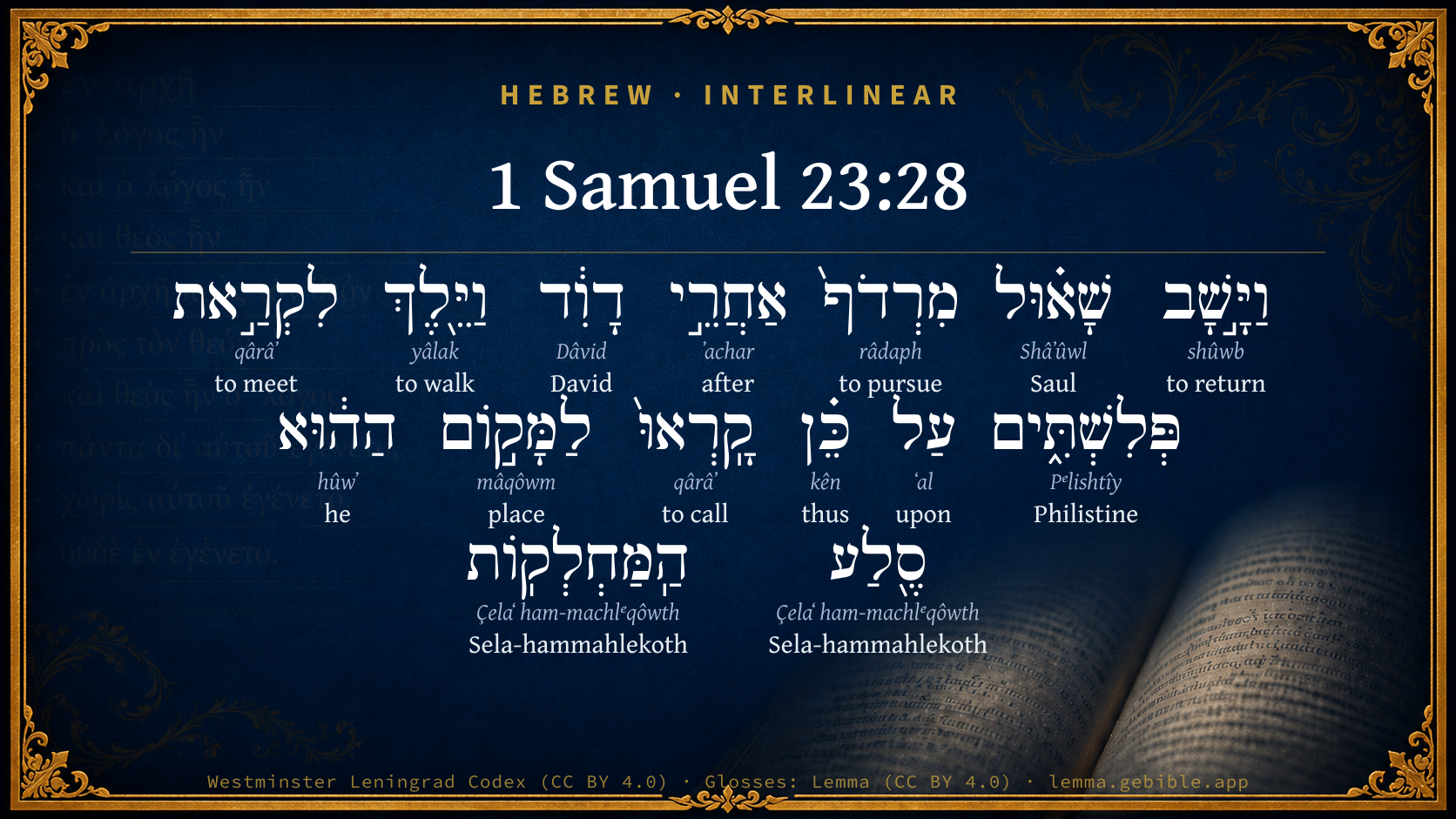
  1. וַיָּ֣שָׁב shûwb H7725 “and · to return” Conjunction + Verb, Qal, Sequential Imperfect, 3rd Person, Masculine, Singular
  2. שָׁא֗וּל Shâʼûwl H7586 “Saul” Noun, Proper
  3. מִרְדֹף֙ râdaph H7291 “from · to pursue” Preposition + Verb, Qal, Infinitive Construct
  4. אַחֲרֵ֣י ʼachar H310 “after” Preposition
  5. דָוִ֔ד Dâvid H1732 “David” Noun, Proper
  6. וַיֵּ֖לֶךְ yâlak H3212 “and · to walk” Conjunction + Verb, Qal, Sequential Imperfect, 3rd Person, Masculine, Singular
  7. לִקְרַ֣את qârâʼ H7122 “to meet” Preposition + Verb, Qal, Infinitive Construct
  8. פְּלִשְׁתִּ֑ים Pᵉlishtîy H6430 “Philistines” Noun, Gentilic, Masculine, Plural, Absolute
  9. עַל ʻal H5921 “upon” Preposition
  10. כֵּ֗ן kên H3651 “thus” Particle, Demonstrative
  11. קָֽרְאוּ֙ qârâʼ H7121 “to call” Verb, Qal, Perfect, 3rd Person, Common, Plural
  12. לַמָּק֣וֹם mâqôwm H4725 “to/for the · place” Preposition, Determined + Noun, Common, Masculine, Singular, Absolute
  13. הַה֔וּא hûwʼ H1931 “the · he” Particle, Definite Article + Pronoun, Personal, 3rd Person, Masculine, Singular
  14. הַֽמַּחְלְקֽוֹת Çelaʻ ham-machlᵉqôwth H5555 “Sela-hammahlekoth” Noun, Proper

About this verse

These counts appear in no published source. They are computed here, from the morphology-tagged text and Lemma’s own curated glosses. What Lemma adds →

15
words
14
distinct lemmas
Historical
section

Notable vocabulary

The rarest word here is סֶ֖לַע Sela-hammahlekoth H5555 — appearing just 2 times in the whole Hebrew Bible.

First appearance in Scripture

This word makes its first canonical appearance in the Hebrew Bible here:

  • סֶ֖לַע Sela-hammahlekoth H5555

Grammatical profile

  • 5 verbs
  • 6 nouns
  • 1 pronoun
  • 2 prepositions
  • 1 particle

Verb forms

  • וַיָּ֣שָׁב Qal · Sequential Imperfect
  • מִרְדֹף֙ Qal · Infinitive Construct
  • וַיֵּ֖לֶךְ Qal · Sequential Imperfect
  • לִקְרַ֣את Qal · Infinitive Construct
  • קָֽרְאוּ֙ Qal · Perfect

Repetition

A word recurs within this verse — often emphatic in Hebrew:

  • סֶ֖לַע Sela-hammahlekoth H5555 ×2

Hebrew & Septuagint length

In English translation the verse runs 19 words from the Hebrew and 21 from the Septuagint (LXX English) — closely comparable.

A rough comparison of the two English renderings, which tokenize alike — not a word-level alignment.

Word counts can differ between the Hebrew and the Greek without any difference in meaning — e.g. the Hebrew direct-object marker אֵת has no separate Greek word, and Greek often adds the article ὁ.

In the original languages it is 15 Hebrew tokens and 22 Greek tokens — but the two are counted differently (Hebrew bundles its prefixes and suffixes into one token; the Greek is in lemma form), so that isn’t a like-for-like length.

Hebrew and Greek witnesses Masoretic Hebrew ↔ Greek Septuagint

The same verse in the two great witnesses to the Old Testament, shown verse-for-verse.

These are two independent witnesses, not word-aligned to each other, and the Septuagint is shown in lemma (dictionary) form.

Hebrew 1 Samuel 23:28 Masoretic · Westminster Leningrad Codex

וַיָּ֣שָׁב שָׁא֗וּל מִרְדֹף֙ אַחֲרֵ֣י דָוִ֔ד וַיֵּ֖לֶךְ לִקְרַ֣את פְּלִשְׁתִּ֑ים עַל כֵּ֗ן קָֽרְאוּ֙ לַמָּק֣וֹם הַה֔וּא סֶ֖לַע הַֽמַּחְלְקֽוֹת

So Saul returned from pursuing after David, and went against the Philistines: therefore they called that place Sela Hammahlekoth.

World English Bible · Public Domain

Greek LXX 1 Samuel 23:28 Septuagint · lemma form

καί ἀναστρέφω σαούλ μή καταδιώκω ὀπίσω δαυίδ καί πορεύομαι εἰς συνάντησις ὁ ἀλλόφυλος διά οὗτος ἐπικαλέω ὁ τόπος ἐκεῖνος πέτρα ὁ μερίζω

So Saul returned from following after David, and went to meet the Philistines: therefore that place was called The divided Rock.

LXX2012 (modern English Septuagint) · Public Domain

Hebrew: Westminster Leningrad Codex (CC BY 4.0). Greek: Septuagint (public domain); English from LXX2012 (modern English Septuagint) (Public Domain). How the Septuagint differs from the Hebrew →

Targum (Aramaic paraphrase)

1

The Targum is the ancient Jewish Aramaic paraphrase of the Hebrew Scriptures — an interpretive translation, not the Hebrew text itself. Onkelos (literal) and Pseudo-Jonathan (expansive) render the Torah, and Jonathan the Prophets. Coverage is partial: where no permissively-licensed English translation exists for a verse, only the Aramaic is shown. This is verse-level text, not a word-by-word alignment to the Hebrew.

  1. Targum Jonathan Prophets (Joshua–Malachi)
    וְתַב שָׁאוּל מִלְמִרְדַף בָּתַר דָוִד וַאֲזַל לִקְדָמוּת פְלִשְׁתָּאֵי עַל כֵּן קְרוֹ לְאַתְרָא הַהוּא כֵּיף פַּלְגוּתָא אַתְרָא דְאִתְפְּלֵיג בֵּיהּ לִבָּא דְמַלְכָּא לְמֵיזַל לְכָא וּלְכָא:

    (no public-domain English translation for this verse)

    Targum Jonathan — Aramaic: “Mikraot Gedolot” (public domain). English: “Sefaria Community Translation” (CC0 1.0 (public-domain dedication)); “London "Chaldee Paraphrase," 1871” (public domain). Text via Sefaria.

Commentary

Notes on 1 Samuel 23:28 from classic Christian and Jewish commentators (each source and its license shown beneath its notes). The classic Christian expositions comment on the surrounding passage and are grouped to its opening verse, so a note may address several verses; the Jewish commentaries on the Tanakh (Rashi and others) are per-verse, so they appear only where the commentator wrote on this verse.

Lemma curates 59 commentaries, every one of them public domain or Creative Commons licensed, each selected and text-cleaned for this edition rather than reprinted as found. About our sources →

Trapp's Complete Commentary

John Trapp

1Sa 23:28 Wherefore Saul returned from pursuing after David, and went against the Philistines: therefore they called that place Selahammahlekoth.

Ver. 28. They called that place Selahammahlekoth.] Petram partitionum, the rock of Diremptions or partitions; because Saul’s forces were forced to forego David’s when they had hemmed them in.

John Trapp, A Commentary or Exposition upon All the Books of the Old and New Testament (1647–1656) — public domain. Text from a community e-Sword module.

Tyndale Open Study Notes

Tyndale Open Resources

23:28 the Rock of Escape: It was not uncommon for a place name to commemorate thankfulness to God (e.g., Gen 22:14; 28:19; 32:30). The exact rock formation that received this name is unknown.

Tyndale Open Study Notes — © Tyndale Open Resources, licensed CC BY-SA 4.0. Text via the HelloAO Bible API.

Geneva Bible (1599)

Geneva Bible translators

That is, stone of division, because there they divided themselves one from another.

Geneva Bible (1599) marginal notes — public domain. Text via Bolls.life.

Adam Clarke's Commentary

Verse 28. They called that place Sela-hammah-lekoth.] That is, the rock of divisions; because, says the Targum, the heart of the king was divided to go hither and thither. Here Saul was obliged to separate himself from David, in order to go and oppose the invading Philistines.

Adam Clarke's Commentary on the Bible (1810–1826) — public domain. Text from a community e-Sword/MySword module.

Ellicott's Commentary for English Readers

(28) Sela-hammahlekoth.—Literally, as in the margin of our Bibles, the rock (or, still better, the cliff) of divisions. Other scholars, with greater reason, prefer the derivation from a Hebrew word signifying to be smooth—the cliff of smoothness: that is, of slipping away or escaping. Ewald rather fancifully interprets the term as the “Cliff of Destiny or of Fate.”

A Bible Commentary for English Readers, edited by Charles John Ellicott (1878–1897) — public domain. Text from a community e-Sword module.

The Cambridge Bible for Schools and Colleges

gen. ed. J. J. S. Perowne

28. Sela-hammahlekôth] Either (1) “Rock of escapes;” or more probably (2) “Rock of divisions,” because there Saul had to relinquish the pursuit of David.

Lieut. Conder thinks he has discovered the scene of David’s escape. Between the ridge of El Kôlah and the neighbourhood of Maon there is a great gorge called “the Valley of the Rocks:” to part of this the name Wady Malâki now applies, and there is no other place near Maon where cliffs, such as are to be inferred from the word Sela, can be found. See Tent Work, II. 91.

The Cambridge Bible for Schools and Colleges (gen. ed. J. J. S. Perowne; Cambridge University Press, 1878–1918) — public domain. Text from a community e-Sword module.

John Gill's Exposition

Therefore Saul returned from pursuing after David,.... Stopped short at once, as soon as ever he received the message:

and went against the Philistines; to stop them in their progress, and drive them out of his country:

therefore they called that place Selahammahlekoth, which signifies the rock of divisions. David and his men, very probably, gave it this name, not only because it divided between Saul and his men, and David and his men, when they were one on one side of it, and the other on the other side of it; but because Saul was, by the providence of God, divided and separated from David here, whereby he escaped falling into his hands. The Targum is,"therefore they called that place the rock of division, the place where the heart of the king was divided to go here and there:''he was divided in his own mind, and at a loss what to do; he was in two minds, as Jarchi says, and did not know which to follow, whether to return and deliver his country from the hands of the Philistines, or to pursue and take David; and others represent the soldiers of Saul as divided, some saying that since the son of Jesse was just falling into their hands, they should not leave him; others, that the war of Israel should be regarded before him, who might be found at any time (u).

(u) Midrash apud Yalkut in loc.

John Gill's Exposition of the Whole Bible (1746–1763) — public domain (CC PDM 1.0). Text via the HelloAO Bible API.

Albert Barnes' Notes on the Bible

Sela-hammahlekoth - See the margin. (Identified by Conder with a narrow and impassable gorge between El Kolah and Maon, called Malaky).

Albert Barnes' Notes on the Bible (1834–1885) — public domain. Text from a community e-Sword/MySword module.

Haydock's Catholic Bible Commentary

Division, as it alone had been between the two rivals. Saul was obliged to leave the place, though he and his men were in suspense what to do. (Calmet)

George Leo Haydock (1774–1849), Haydock's Catholic Family Bible and Commentary, 1859 edition — public domain. Excludes Psalms (Douay-Rheims chapter numbering differs from Protestant) and Deuterocanonical books (Catholic canon only).

Matthew Poole's English Annotations

i.e.

The rock of divisions, because there Saul was separated, and in a manner pulled asunder from David, who was now almost within his reach.

Matthew Poole's English Annotations on the Holy Bible (1683–1685) — public domain. Text from a community e-Sword/MySword module.

Whedon's Commentary on the Bible

Daniel D. Whedon

28. Sela-hammah-lekoth — According to the ancient versions, the rock of divisions, so called because there Saul and David were divided or separated. According to Gesenius and other recent critics, the rock of escapes, from חלק, to be smooth; then, to slip away and escape referring to David’s escape from Saul.

Daniel D. Whedon (gen. ed.), Commentary on the Old and New Testaments (1874–1909) — public domain. Text from a community e-Sword module.

John Wesley's Explanatory Notes

Called, &c. - That is, The rock of divisions, because there Saul was separated, and in a manner pulled asunder from David, who was now almost within his reach.

John Wesley, Explanatory Notes Upon the Whole Bible (1754–1765) — public domain. Text via the GEBible commentary corpus.

Keil & Delitzsch

C. F. Keil & F. Delitzsch

From this occurrence the place received the name of Sela-hammahlekoth, "rock of smoothnesses," i.e., of slipping away or escaping, from חלק, in the sense of being smooth. This explanation is at any rate better supported than "rock of divisions, i.e., the rock at which Saul and David were separated" (Clericus), since חלק does not mean to separate.

Keil & Delitzsch — Biblical Commentary on the Old Testament (1861–1891) — public domain (CC PDM 1.0). Text via the HelloAO Bible API. (Old Testament only.)

Scofield Reference Notes

C. I. Scofield

Selahammahlekoth

i.e. The Crag (or Cliff) of Divisions.

The Scofield Reference Bible (1917 edition), notes by C. I. Scofield — public domain. Text from a community e-Sword module.

unfoldingWord translationNotes

Door43 World Missions Community

pursuing David

"chasing David, trying to catch him"

Rock of Escape

a memorial or marker of David's escape from Saul

translationWords

Saul (OT)

David

Philistines

call

stronghold

unfoldingWord translationNotes — © Distant Shores Media and the Door43 World Missions Community, licensed CC BY-SA 4.0. Source: git.door43.org/Door43/en_tn.

Rashi

Rabbi Shlomo Yitzchaki (Rashi)

The "Rock of Divisions." Shaul's heart was divided by two thoughts, whether to return to save his country from the Philistines, or to pursue and catch Dovid; thus renders Targum Yonoson.

Rashi on the Tanakh — English translations: “The Judaica Press complete Tanach with Rashi, translated by A. J. Rosenberg” (CC BY 4.0); “Pentateuch with Rashi's commentary by M. Rosenbaum and A.M. Silbermann, 1929-1934” (public domain); “The Metsudah Tanach series, Lakewood, N.J” (CC BY 4.0); and “The Book of Joshua, Metsudah Publications, 1997” (CC BY 4.0). Text via Sefaria.

Lesson kit

Teaching starters — assembled from the data on this page, not authored interpretation. Every prompt links to the verse data it draws on. Edit before teaching.

1 Samuel, in the Historical, opens this verse with 15 words (14 distinct Hebrew lemmas). Its most distinctive word is Çelaʻ ham-machlᵉqôwth (“Sela-hammahlekoth”). A historical commentator’s framing appears above. Read the whole chapter for the surrounding context.

Discussion questions

  1. The word Çelaʻ ham-machlᵉqôwth carries the sense “Sela-hammahlekoth.” How does it shape the verse?
  2. This is the first place “Sela-hammahlekoth” appears in Scripture (first appears here). What does its debut here establish?
  3. What does the repetition of “Sela-hammahlekoth” (2× in this one verse) do in this verse?
  4. The translations on this page render this verse differently — a whole-verse word diff, not a word-by-word alignment. What might account for the different wordings?
  5. «וַיָּ֣שָׁב» is a Qal Sequential Imperfect verb. How does that grammatical form shape the action described?
  6. Compare how Trapp's Complete Commentary and Tyndale Open Study Notes read this verse. Where do they agree or differ?

Things to notice

Reading settings

Reading text

Shown beneath each verse's original-language words.

Old Testament
Old Testament edition

Read the OT as the Masoretic Hebrew (MT) or the Greek Septuagint (LXX).

English shown for the Greek Septuagint (in the Hebrew ↔ Greek comparison).

Comparing translations? Open the Compare panel on any verse page to stack up to four side by side.