
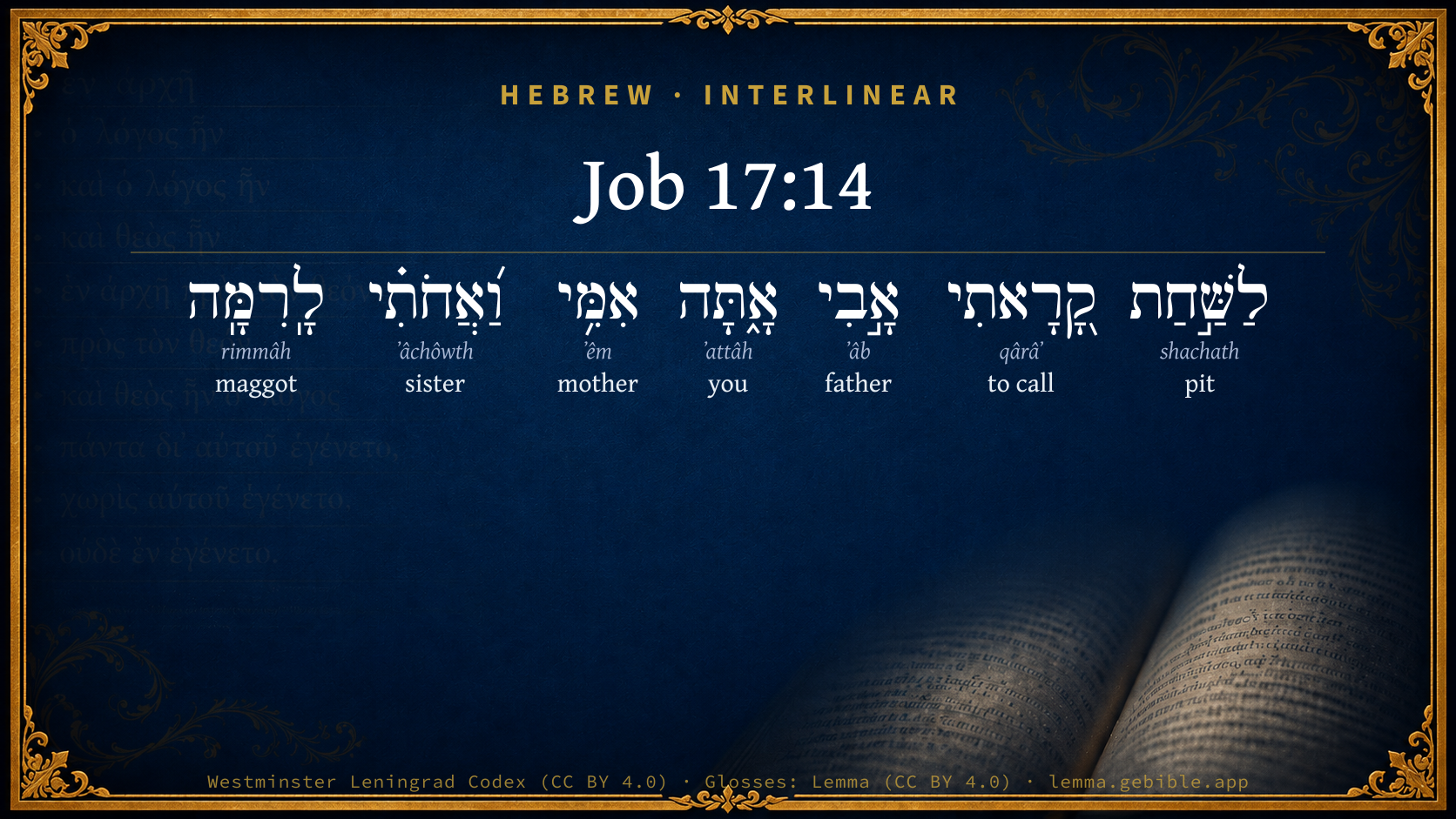
Job 17:14

Hebrew (Westminster Leningrad Codex) Job 17:14 appears in the Hebrew Old Testament. The text above is from the Westminster Leningrad Codex. Each word links to its Strong’s number, a concise gloss, and parsing drawn from the Open Scriptures Hebrew Bible morphology. Click any word for its full Brown-Driver-Briggs (BDB) entry.
Download image
Cite this verse

Job 17:14 (World English Bible). Public Domain. Lemma interlinear Bible study tool, https://lemma.gebible.app/v/job/17/14.

Show BibTeX & RIS
BibTeX
RIS
English Translation
If I have said to corruption, 'You are my father;' To the worm, 'My mother,' and 'my sister;'
World English Bible · Public Domain
Download a study sheet

One document with this verse’s original text, its word-by-word gloss line, the meaning frame, cross-references with their text, attributed commentary, and full source and license credits — printable, and it pastes into notes with its structure intact.

This verse Autodidact and up

Study sheet (.html) Plain text (.txt)

A passage Seminary Student

Up to 50 verses in one chapter. A passage sheet keeps up to 6 commentary sources and 12 cross-references per verse, in the order this page ranks them, and says so on the sheet whenever that leaves anything out. Ask for a single verse and you get the Autodidact verse sheet above.

Everything on this page stays free to read, with no account — the sheet is a download of what is already on screen, not access to it.

Want to remove ads? Support Godless Engineer
Compare translations 3

The same verse in 3 English versions, stacked beneath the original-language interlinear above. Click any original word for its lexicon entry.

Each is an independent rendering of the whole verse — the interlinear is not word-aligned to these translations.

Highlighted words mark where these versions differ — a whole-verse word diff, not a word-by-word alignment.

  • World English Bible Public Domain
    If I have said to corruption, 'You are my father;' To the worm, 'My mother,' and 'my sister;'
  • King James Version Public Domain
    I have said to corruption, Thou art my father: to the worm, Thou art my mother, and my sister.
  • unfoldingWord Literal Text CC BY-SA 4.0
    I call to the pit, ‘You my father,’ to the worm, ‘My mother’ or ‘My sister,’

unfoldingWord Literal Text — © unfoldingWord, licensed CC BY-SA 4.0. Word-aligned USFM3 via Door43 (git.door43.org/unfoldingWord/en_ult).

Versions to compare (up to 4)

3 of 4 selected

Show all 18 translations

Every available English version of this verse, each an independent rendering of the whole verse.

  • World English Bible Public Domain
    If I have said to corruption, 'You are my father;' To the worm, 'My mother,' and 'my sister;'
  • Berean Standard Bible Public Domain
    and say to corruption, ‘You are my father,’ and to the worm, ‘My mother,’ or ‘My sister,’
  • Majority Standard Bible Public Domain
    and say to corruption, ‘You are my father,’ and to the worm, ‘My mother,’ or ‘My sister,’
  • King James Version Public Domain
    I have said to corruption, Thou art my father: to the worm, Thou art my mother, and my sister.
  • American Standard Version (1901) Public Domain
    If I have said to corruption, Thou art my father; To the worm, `Thou art' my mother, and my sister;
  • Revised Version (1885) Public Domain
    If I have said to corruption, Thou art my father; to the worm, Thou art my mother, and my sister;
  • Geneva Bible (1599) Public Domain
    I shall say to corruption, Thou art my father, and to the worme, Thou art my mother and my sister.
  • Douay-Rheims (1899) Public Domain
    If I have said to rottenness: Thou art my father; to worms, my mother and my sister.
  • Young's Literal Translation Public Domain
    To corruption I have called: -- `Thou `art' my father.' `My mother' and `my sister' -- to the worm.
  • Literal Standard Version CC BY-SA 4.0
    To corruption I have called: You [are] my father. To the worm: My mother and my sister.
  • Unlocked Literal Bible CC BY-SA 4.0
    and if I have said to the pit, 'You are my father,' and to the worm, 'You are my mother or my sister,'
  • unfoldingWord Literal Text CC BY-SA 4.0
    I call to the pit, ‘You my father,’ to the worm, ‘My mother’ or ‘My sister,’
  • Darby Bible Public Domain
    I cry to the grave, Thou art my father! to the worm, My mother, and my sister!
  • World Messianic Bible Public Domain
    if I have said to corruption, ‘You are my father,’ and to the worm, ‘My mother,’ and ‘My sister,’
  • Webster's Bible Public Domain
    I have said to corruption, Thou art my father: to the worm, Thou art my mother, and my sister.
  • Free Bible Version CC BY-SA 4.0
    Should I call the grave my father, and the maggot my mother or my sister?
  • Bible in Basic English Public Domain
    If I say to the earth, You are my father; and to the worm, My mother and my sister;
  • JPS Tanakh (1917) Public Domain
    If I have said to corruption: 'Thou art my father', to the worm: 'Thou art my mother, and my sister';

Literal Standard Version (2020), Covenant Press — licensed CC BY-SA 4.0. Text via the HelloAO Bible API (eBible.org). Unlocked Literal Bible (unfoldingWord) — licensed CC BY-SA 4.0. Text via the HelloAO Bible API (eBible.org). unfoldingWord Literal Text — © unfoldingWord, licensed CC BY-SA 4.0. Word-aligned USFM3 via Door43 (git.door43.org/unfoldingWord/en_ult). Free Bible Version, Dr. Jonathan Gallagher — licensed CC BY-SA 4.0. Text via the HelloAO Bible API (eBible.org).

Word by word

More ways to search: Search by grammar → Find every occurrence → Compare this word →

Practice this passage: Drill this verse → Learn its vocabulary →

לָֽרִמָּֽה
rimmâh
H7415
“to/for the · maggot”
Preposition, Determined + Noun, Common, Feminine, Singular, Absolute
Part of Speech
Preposition + Noun
Type
Common
Gender
Feminine
Number
Singular
State
Absolute
Full BDB Definition

Origin: from H7426 in the sense of breeding [compare H7311 ]

TWOT: 2175a

maggot, worm (as cause and sign of decay)
  1. לַשַּׁ֣חַת shachath H7845 “to/for the · pit” Preposition, Determined + Noun, Common, Feminine, Singular, Absolute
  2. קָ֭רָאתִי qârâʼ H7121 “to call” Verb, Qal, Perfect, 1st Person, Common, Singular
  3. אָ֣בִי ʼâb H1 “father · my” Noun, Common, Masculine, Singular, Construct + Suffix, Personal, 1st Person, Common, Singular
  4. אָ֑תָּה ʼattâh H859 “you” Pronoun, Personal, 2nd Person, Masculine, Singular
  5. אִמִּ֥י ʼêm H517 “mother · my” Noun, Common, Feminine, Singular, Construct + Suffix, Personal, 1st Person, Common, Singular
  6. וַ֝אֲחֹתִ֗י ʼâchôwth H269 “and · sister · my” Conjunction + Noun, Common, Feminine, Singular, Construct + Suffix, Personal, 1st Person, Common, Singular

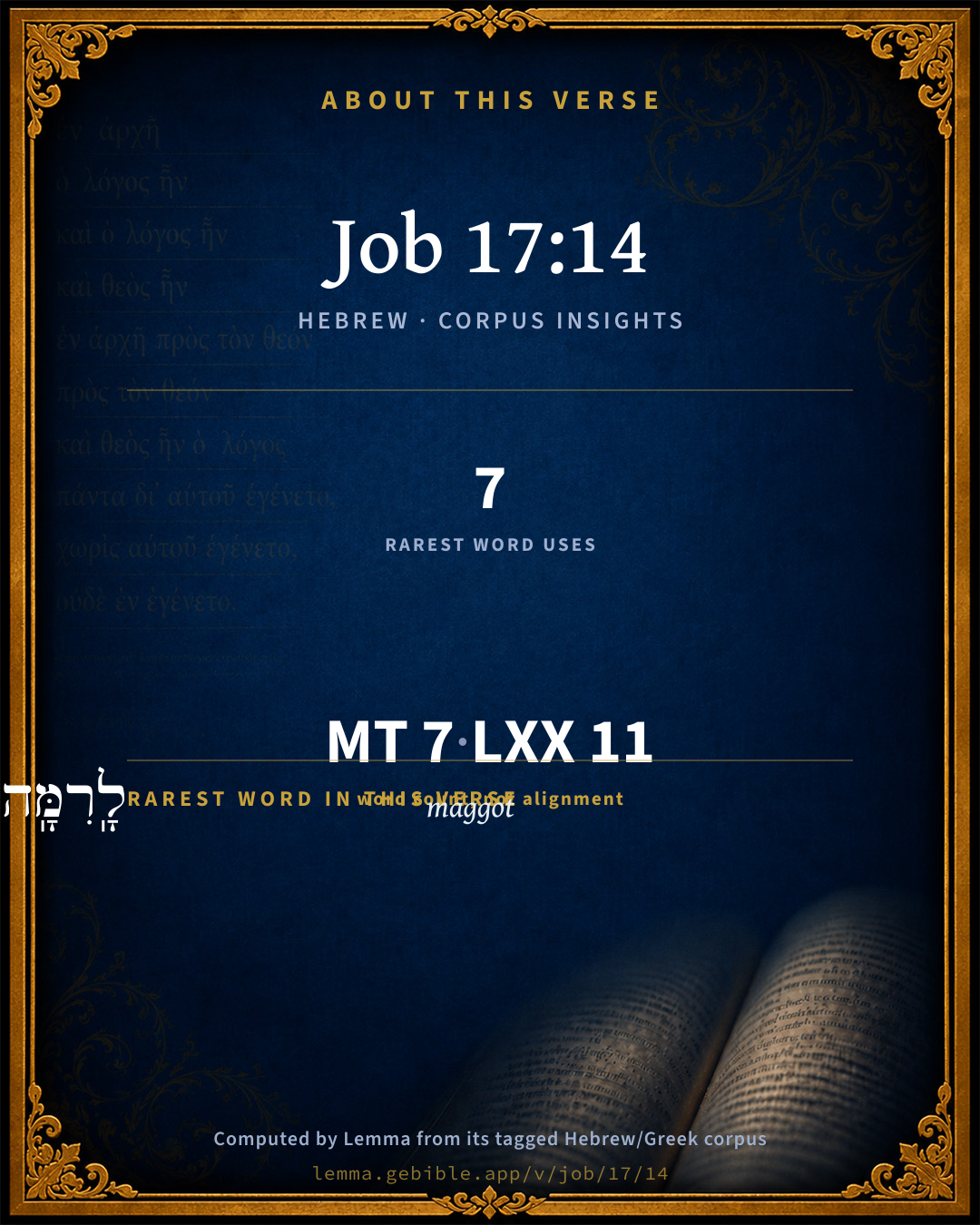
About this verse

These counts appear in no published source. They are computed here, from the morphology-tagged text and Lemma’s own curated glosses. What Lemma adds →

7
words
7
distinct lemmas
Wisdom
section

Notable vocabulary

The rarest word here is לָֽרִמָּֽה maggot H7415 — appearing just 7 times in the whole Hebrew Bible.

Shared distinctive vocabulary

לָֽרִמָּֽה maggot H7415 occurs in 7 verses of the Hebrew Bible. Also found in:

Grammatical profile

  • 1 verb
  • 5 nouns
  • 1 pronoun

Verb forms

  • קָ֭רָאתִי Qal · Perfect

Hebrew & Septuagint length

In English translation the verse runs 18 words from the Hebrew and 17 from the Septuagint (LXX English) — closely comparable.

A rough comparison of the two English renderings, which tokenize alike — not a word-level alignment.

Word counts can differ between the Hebrew and the Greek without any difference in meaning — e.g. the Hebrew direct-object marker אֵת has no separate Greek word, and Greek often adds the article ὁ.

In the original languages it is 7 Hebrew tokens and 11 Greek tokens — but the two are counted differently (Hebrew bundles its prefixes and suffixes into one token; the Greek is in lemma form), so that isn’t a like-for-like length.

Cross-references

13

Topical passages linked to Job 17:14 in the Treasury of Scripture Knowledge — connected by theme and wording, ordered by reader-vote popularity; previews shown in the World English Bible.

  • Psalms 16:10 For you will not leave my soul in Sheol, Neither will you allow your holy one to see corruption.
  • Job 13:28 Though I am decaying like a rotten thing, Like a garment that is moth-eaten.
  • Job 21:26 They lie down alike in the dust, The worm covers them.
  • Job 21:32–33 Yet shall he be borne to the grave, Men shall keep watch over the tomb.
  • Job 24:20 The womb shall forget him. The worm shall feed sweetly on him. He shall be no more remembered. Unrighteousness shall be broken as a tree.
  • Job 30:30 My skin grows black and peels from me. My bones are burned with heat.
  • Psalms 49:9 That he should live on forever, That he should not see corruption.
  • Isaiah 14:11 Your pomp is brought down to Sheol, [and] the noise of your viols: the worm is spread under you, and worms cover you.
  • Acts 2:27–31 Because you will not leave my soul in Hades, Neither will you allow your Holy One to see decay.
  • Acts 13:34–37 "Concerning that he raised him up from the dead, now no more to return to corruption, he has spoken thus: 'I will give you the holy and sure blessings of David.'
  • 1 Corinthians 15:42 So also is the resurrection of the dead. It is sown in corruption; it is raised in incorruption.
  • 1 Corinthians 15:53–54 For this corruptible must put on incorruption, and this mortal must put on immortality.
  • Job 19:26 After my skin is destroyed, Then in my flesh shall I see God,

Cross-references courtesy of OpenBible.info (CC BY 4.0).

Hebrew and Greek witnesses Masoretic Hebrew ↔ Greek Septuagint

The same verse in the two great witnesses to the Old Testament, shown verse-for-verse.

These are two independent witnesses, not word-aligned to each other, and the Septuagint is shown in lemma (dictionary) form.

Hebrew Job 17:14 Masoretic · Westminster Leningrad Codex

לַשַּׁ֣חַת קָ֭רָאתִי אָ֣בִי אָ֑תָּה אִמִּ֥י וַ֝אֲחֹתִ֗י לָֽרִמָּֽה

If I have said to corruption, 'You are my father;' To the worm, 'My mother,' and 'my sister;'

World English Bible · Public Domain

Greek LXX Job 17:14 Septuagint · lemma form

θάνατος ἐπικαλέω πατήρ ἐγώ εἰμί μήτηρ δέ ἐγώ καί ἀδελφή σαπρία

I have called upon death to be my father, and corruption to be my mother and sister.

LXX2012 (modern English Septuagint) · Public Domain

On this verse, Albert Barnes' Notes on the Bible discusses the Septuagint’s reading. Read the note in Commentary ↓

Hebrew: Westminster Leningrad Codex (CC BY 4.0). Greek: Septuagint (public domain); English from LXX2012 (modern English Septuagint) (Public Domain). How the Septuagint differs from the Hebrew →

Commentary

Notes on Job 17:14 from classic Christian and Jewish commentators (each source and its license shown beneath its notes). The classic Christian expositions comment on the surrounding passage and are grouped to its opening verse, so a note may address several verses; the Jewish commentaries on the Tanakh (Rashi and others) are per-verse, so they appear only where the commentator wrote on this verse.

Lemma curates 59 commentaries, every one of them public domain or Creative Commons licensed, each selected and text-cleaned for this edition rather than reprinted as found. About our sources →

Trapp's Complete Commentary

John Trapp

Job 17:14 I have said to corruption, Thou [art] my father: to the worm, [Thou art] my mother, and my sister.

Ver. 14. I have said to corruption, Thou art my father] See how he speaks of corruption and the worms, Ac si iam iuris illorum, et domesticus esset, as if he were of family with them, and nearest of kin to them; so doth he court them, as it were, that they might be willing to receive him; showing by it how willing he was to die; for whither do men in a strange country, and in misery, desire rather to go than to the house of their parents? Here also Job declareth what will be the end of all men, and what shall be their kindred in the grave. From corruption we came (for what else is the seed and blood of generation), to corruption also we go, as sons thereof; and Pulvis et Putredo, we salute for sisters, what shall be most tender to us, and attendant upon us. Why then should any boast of high kindred? To the pit I cry, O father, O sister; O mother, to the worm: so Broughton rendereth it. Why should any boast of bodily beauty, since corruption will shortly seize upon the fairest face, which is now but putrefaction and worms once removed, and to the same must suddenly move back again. Mihi experto credite, saith Austin, Believe me, who have made trial of it: Open a grave, and upon the dead man’s head you shall find toads leaping, begotten of his brains; upon his loins serpents crawling, begotten of his reins; in his belly worms abounding, arising out of his entrails. Behold what now we are, and what we shortly shall be; behold the origin and filthiness of sin (Serm. 48, ad Frat. in Erem.).

John Trapp, A Commentary or Exposition upon All the Books of the Old and New Testament (1647–1656) — public domain. Text from a community e-Sword module.

Joseph Benson's Commentary

Job 17:14-15. I have said to corruption — Hebrew, קראתי, karati, I have called to corruption; to the grave, where the body will be dissolved and become corrupt. Thou art my father — I am near akin to thee, being formed out of thee, and thou wilt receive and embrace me, and keep me in thy house as parents do their children. To the worm, Thou art my mother and my sister — A near relation, being of the same origin, and because of the most strict and intimate union between us. And where is now my hope? — What then is become of that hope which you advised me to entertain?

As for my hope — Or the happiness which you would have me expect; who shall see it? — No man shall see it, it shall never be. The happiness I expect is out of sight, consisting in the enjoyment, not of things that are seen, which are temporal, but of those which are unseen, which are eternal.

Joseph Benson's Commentary on the Old and New Testaments (1811–1818) — public domain. Text from a community e-Sword module.

Tyndale Open Study Notes

Tyndale Open Resources

17:14 my father . . . mother . . . sister: This bitter parody of a family reunion in a graveyard shows how Job envisioned his impending death.

Tyndale Open Study Notes — © Tyndale Open Resources, licensed CC BY-SA 4.0. Text via the HelloAO Bible API.

Geneva Bible (1599)

Geneva Bible translators

I have no more hope in father, mother, sister, or any worldly thing: for the dust and worms shall be to me instead of them.

Geneva Bible (1599) marginal notes — public domain. Text via Bolls.life.

Jamieson, Fausset & Brown

Robert Jamieson, A. R. Fausset & David Brown

Thou art my father, &c.--expressing most intimate connection (Pro 7:4). His diseased state made him closely akin to the grave and worm.

Jamieson, Fausset & Brown — Commentary Critical and Explanatory on the Whole Bible (1871) — public domain (CC PDM 1.0). Text via the HelloAO Bible API.

Adam Clarke's Commentary

Verse 14. I have said to corruption] I came from a corrupted stock, and I must go to corruption again. The Hebrew might be thus rendered: To the ditch I have called, Thou art my father. To the worm, Thou art my mother and my sister. I am in the nearest state of affinity to dissolution and corruption: I may well call them my nearest relations, as I shall soon be blended with them.

Adam Clarke's Commentary on the Bible (1810–1826) — public domain. Text from a community e-Sword/MySword module.

The Cambridge Bible for Schools and Colleges

gen. ed. J. J. S. Perowne

14. to corruption] Rather as above, the pit, or grave, Psa_16:10. The words father, mother and sister, expressing the nearest relationship, indicate how closely Job now feels himself connected with the grave, he wholly belongs to it, and he greets it as taking the place of all related to him on earth.

The Cambridge Bible for Schools and Colleges (gen. ed. J. J. S. Perowne; Cambridge University Press, 1878–1918) — public domain. Text from a community e-Sword module.

John Gill's Exposition

I have said to corruption, thou art my father,.... Not to the corruptible seed, of which he was begotten; nor to the corruption or purulent matter of his boils and ulcers, and the worms his flesh was now clothed with, Job 7:5; but to that corruption his body would turn to in the grave, lying long enough to see it, which Christ's body did not, Psa 16:10; that is, "to the pit of corruption" (c), as it may be rendered, meaning the grave, so called because in it dead bodies corrupt and putrefy: in houses are families consisting of various persons, of different relations, who dwell together in friendship and harmony, very lovingly and familiarly, as father and mother, brother and sister; so in the grave, the dwelling house of men, there are inhabitants that dwell together, as if they were familiar friends and acquaintance; and with these, Job claims kindred, such as corruption, rottenness, dust and worms, and these he speaks unto, not only very familiarly, but very respectfully; the note of Bar Tzemach is,

"I honour the grave as a son a father, that it may receive me quickly;''

yea, he speaks as not ashamed of the relation, but is fond of it; "I called" or "cried" (d) that is, aloud, with great vehemency and affection:

to the worm, thou art my mother and my sister; these are the rather mentioned, because the relation is near, and they are very loving and tender, and abide in the house, see Pro 7:4; he calls these his mother and sister, as the above Jewish commentator observes, because the might lie in their bosom; by all this Job would represent how familiar death and the grave were to him, and how little he dreaded them; yea, how desirable they were to him, since he should be at home, and among his relations and friends.

(c) "foveam", Pagninus, Montanus, Tigurine version, Drusius, &c. (d) "vocavi", Montanus; "clamavi", Mercerus.

John Gill's Exposition of the Whole Bible (1746–1763) — public domain (CC PDM 1.0). Text via the HelloAO Bible API.

Albert Barnes' Notes on the Bible

I have said - Margin, cried, or called. The sense is, “I say,” or “I thus address the grave.”

To corruption - The word used here (שׁחת shachath) means properly a pit, or pit-fall, Psa 7:15; Psa 9:15; a cistern, or a ditch, Job 9:31; or the sepulchre, or grave, Psa 30:9; Job 33:18, Job 33:30. The Septuagint renders it here by θανάτον thanaton - death. Jerome (Vulgate), putredini dixi. According to Gesenius (Lex), the word never has the sense of corruption. Schultens, however, Rosenmuller, and others, understand it in the sense of corruption or putrefaction. This accords, certainly, with the other hemistich, and better constitutes a parallelism with the “worm” than the word “grave” would. It seems probable that this is the sense here; and if the proper meaning of the word is a pit, or the grave, it here denotes the grave, as containing a dead and moulderling body.

Thou art my father - “I am nearly allied to it. I sustain to it a relation like that of a child to a father.” The idea seems to be that of family likeness; and the object is to present the most striking and impressive view of his sad and sorrowful condition. He was so diseased, so wretched, so full of sores and of corruption (see Job 7:5), that he might be said to be the child of one mouldering in the grave, and was kindred to a family in the tomb!

To the worm - The worm that feeds upon the dead. He belonged to that sad family where the body was putrifying, and where it was covered with worms; see the notes at Isa 14:11.

My mother - I am so nearly allied to the worms, that the connection may be compared to that between a mother and her son.

And my sister - “The sister here is mentioned rather than the brother, because the noun rendered worm in the Hebrew, is in the feminine gender.” Rosenmuller. The sense of the whole is, that Job felt that he belonged to the grave. He was destined to corruption. He was soon to lie down with the dead. His acquaintance and kindred were there. So corrupt was his body, so afflicted and diseased, that he seemed to belong to the family of the putrifying, and of those covered with worms! What an impressive description; and yet how true is it of all! The most vigorous frame, the most beautiful and graceful form, the most brilliant complexion, has a near relationship to the worm, and will soon belong to the mouldering family beneath the ground! Christian reader! such are you; such am I. Well, let it be so. Let us not repine. Be the grave our home; be the mouldering people there our parents, and brothers, and sisters. Be our alliance with the worms. There is a brighter scene beyond - a world where we shall be kindred with the angels, and ranked among the sons of God. In that world we shall be clothed with immortal youth, and shall know corruption no more. Then our eyes will shine with undiminished brilliancy forever; our cheeks glow with immortal health; our hearts beat with the pulsations of eternal life. Then our hands shall be feeble and our knees totter with disease or age no more; and then the current of health and joy shall flow on through our veins forever and eye! Allied now to worms we are, but we are allied to the angels too; the grave is to be our home, but so also is heaven; the worm is our brother, but so also is the Son of God! Such is man; such are his prospects here, such his hopes and destiny in the world to come. He dies here, but he lives in glory and honor hereafter forever.

Shall man, O God of light and life,

For ever moulder in the grave?

Canst thou forget thy glorious work,

Thy promise and thy power to save?

Shall life revisit dying worms,

And spread the joyful insects’ wing;

And O shall man awake no more,

To see thy face, thy name to sing?

Faith sees the bright, eternal doors,

Unfold to make her children way;

They shall be clothed with endless life,

And shine in everlasting day.

The trump shall sound, the dead shall wake,

From the cold tomb the slumberers spring;

Through heaven with joy these myriads rise,

And hail their Savior and their King.

Dr. Dwight

Albert Barnes' Notes on the Bible (1834–1885) — public domain. Text from a community e-Sword/MySword module.

Haydock's Catholic Bible Commentary

Sister. I am nearly related to such things, and ready to drop into the grave, as my flesh is already devoured by worms. (Menochius)

George Leo Haydock (1774–1849), Haydock's Catholic Family Bible and Commentary, 1859 edition — public domain. Excludes Psalms (Douay-Rheims chapter numbering differs from Protestant) and Deuterocanonical books (Catholic canon only).

Matthew Poole's English Annotations

To corruption, Heb. to the pit of corruption, the grave.

Thou art my father; I am near akin to time, as being taken out of thee; and thou wilt receive and embrace me, and keep me in thy house, as parents do their children.

Thou art my mother, and my sister; because of the same original, and the most strict and intimate union and conjunction between me and the worms.

Matthew Poole's English Annotations on the Holy Bible (1683–1685) — public domain. Text from a community e-Sword/MySword module.

Whedon's Commentary on the Bible

Daniel D. Whedon

14. Said — Called. The thought of his mouldering body suggested a family likeness to the corruption of the grave.

My father — The Oriental languages abound in like comparisons. The Arabians call Satan the father of bitterness; a husband, the father of a woman; rain, the father of life; the stomach, mother of food; the via lactea, mother of heaven; wine, mother of evils; and death, the mother of vultures. (Golius’ Lex.) Among the touching incidents connected with the burial of a Bedawi is an address of the friends to the deceased as he lies in the grave. “When the twain Green Angels shall question and examine thee, say, ‘The feaster makes merry, the wolf prowls, and man’s lot is still the same; but I have done with all these things. The sidr-tree is thy aunt, and the palm-tree thy mother.’” — PALMER, Dessert of the Exodus, 1:94. Diodorus, Archbishop of Cappadocia, requested that one word should be inscribed on his tombstone — acarus — which means a worm — and it was done. (VICTOR HUGO, Les Miserables.)

Daniel D. Whedon (gen. ed.), Commentary on the Old and New Testaments (1874–1909) — public domain. Text from a community e-Sword module.

The Pulpit Commentary

I have said to corruption, Thou art my father; i.e. I do not murmur; I accept my lot; I am ready to lie down with corruption, and embrace it, and call it "my father," and henceforth remain with it. The idea that the soul is still with the body in the grave, more or less closely attached to it, and sensible of its condition and changes, was widely prevalent in the ancient world. Where bodies were simply buried, the horrible imagination of a close association with corruption naturally and almost necessarily intruded itself, and led to such reflections as those of Job in this verse. It was partly to get rid of this terrible nightmare that the Egyptians were so careful to embalm the bodies of their dead, and that the Babylonians deposited them in baked clay coffins, which they filled with honey (Herod., 1:198); while others still more effectually prevented the process of corruption by cremation. The modern revival of cremation is remarkable as indicating a peculiar form of atavism or recurrence to ancient types. For many ages after the coming of Christ, men so separated between the soul and the body after death that the corruption of the grave had no horror for them. Now materialistic ideas have so far recurred, that many of those who believe the soul to live on after death are doubtful whether it may not still be attached to the body more or less, end, dreading contact with the corruption, of the latter, fall back upon the old remedy. To the worm, Thou art my mother, and my sister. An expansion of the idea contained in the previous clause.

The Pulpit Commentary (1880–1919), ed. H.D.M. Spence-Jones & Joseph S. Exell — public domain. Text from a community e-Sword module.

John Wesley's Explanatory Notes

Corruption - Hebrew. to the pit of corruption, the grave. Father - I am near a-kin to thee, and thou wilt receive and keep me in thy house, as parents do their children.

John Wesley, Explanatory Notes Upon the Whole Bible (1754–1765) — public domain. Text via the GEBible commentary corpus.

Rashi

Rabbi Shlomo Yitzchaki (Rashi)

To the pit I have called, ‘You are my father,’ to lodge there many days as though it was my father, since this is my hope.

Rashi on the Tanakh — English translations: “The Judaica Press complete Tanach with Rashi, translated by A. J. Rosenberg” (CC BY 4.0); “Pentateuch with Rashi's commentary by M. Rosenbaum and A.M. Silbermann, 1929-1934” (public domain); “The Metsudah Tanach series, Lakewood, N.J” (CC BY 4.0); and “The Book of Joshua, Metsudah Publications, 1997” (CC BY 4.0). Text via Sefaria.

Lesson kit

Teaching starters — assembled from the data on this page, not authored interpretation. Every prompt links to the verse data it draws on. Edit before teaching.

Job, in the Wisdom, opens this verse with 7 words (7 distinct Hebrew lemmas). Its most distinctive word is rimmâh (“maggot”). A historical commentator’s framing appears above. Read the whole chapter for the surrounding context.

Discussion questions

  1. What does “maggot” (rimmâh) contribute to the verse as a whole?
  2. Exodus 16:24 shares the word «maggot» with this verse. How do the two illuminate each other?
  3. The translations on this page render this verse differently — a whole-verse word diff, not a word-by-word alignment. What might account for the different wordings?
  4. The verb «קָ֭רָאתִי» is Qal Perfect. How does its form color the action?
  5. Reading how Trapp's Complete Commentary and Joseph Benson's Commentary read this verse, where do the two commentators agree and where do they part?

Things to notice

Reading settings

Reading text

Shown beneath each verse's original-language words.

Old Testament
Old Testament edition

Read the OT as the Masoretic Hebrew (MT) or the Greek Septuagint (LXX).

English shown for the Greek Septuagint (in the Hebrew ↔ Greek comparison).

Comparing translations? Open the Compare panel on any verse page to stack up to four side by side.