
1 Samuel 22:11

Hebrew (Westminster Leningrad Codex) 1 Samuel 22:11 appears in the Hebrew Old Testament. The text above is from the Westminster Leningrad Codex. Each word links to its Strong’s number, a concise gloss, and parsing drawn from the Open Scriptures Hebrew Bible morphology. Click any word for its full Brown-Driver-Briggs (BDB) entry.
Download image
Cite this verse

1 Samuel 22:11 (World English Bible). Public Domain. Lemma interlinear Bible study tool, https://lemma.gebible.app/v/1-samuel/22/11.

Show BibTeX & RIS
BibTeX
RIS
English Translation
Then the king sent to call Ahimelech the priest, the son of Ahitub, and all his father's house, the priests who were in Nob: and they came all of them to the king.
World English Bible · Public Domain
Download a study sheet

One document with this verse’s original text, its word-by-word gloss line, the meaning frame, cross-references with their text, attributed commentary, and full source and license credits — printable, and it pastes into notes with its structure intact.

This verse Autodidact and up

Study sheet (.html) Plain text (.txt)

A passage Seminary Student

Up to 50 verses in one chapter. A passage sheet keeps up to 6 commentary sources and 12 cross-references per verse, in the order this page ranks them, and says so on the sheet whenever that leaves anything out. Ask for a single verse and you get the Autodidact verse sheet above.

Everything on this page stays free to read, with no account — the sheet is a download of what is already on screen, not access to it.

Want to remove ads? Support Godless Engineer
Compare translations 3

The same verse in 3 English versions, stacked beneath the original-language interlinear above. Click any original word for its lexicon entry.

Each is an independent rendering of the whole verse — the interlinear is not word-aligned to these translations.

Highlighted words mark where these versions differ — a whole-verse word diff, not a word-by-word alignment.

  • World English Bible Public Domain
    Then the king sent to call Ahimelech the priest, the son of Ahitub, and all his father's house, the priests who were in Nob: and they came all of them to the king.
  • King James Version Public Domain
    Then the king sent to call Ahimelech the priest, the son of Ahitub, and all his father's house, the priests that were in Nob: and they came all of them to the king.
  • unfoldingWord Literal Text CC BY-SA 4.0
    And the king sent to call Ahimelech, the son of Ahitub, the priest, and all of the house of his father, the priests who in Nob. And all of them came to the king.

unfoldingWord Literal Text — © unfoldingWord, licensed CC BY-SA 4.0. Word-aligned USFM3 via Door43 (git.door43.org/unfoldingWord/en_ult).

Versions to compare (up to 4)

3 of 4 selected

Show all 18 translations

Every available English version of this verse, each an independent rendering of the whole verse.

  • World English Bible Public Domain
    Then the king sent to call Ahimelech the priest, the son of Ahitub, and all his father's house, the priests who were in Nob: and they came all of them to the king.
  • Berean Standard Bible Public Domain
    Then the king sent messengers to summon Ahimelech the priest, the son of Ahitub, and his father’s whole family, who were priests at Nob. And all of them came to the king.
  • Majority Standard Bible Public Domain
    Then the king sent messengers to summon Ahimelech the priest, the son of Ahitub, and his father’s whole family, who were priests at Nob. And all of them came to the king.
  • King James Version Public Domain
    Then the king sent to call Ahimelech the priest, the son of Ahitub, and all his father's house, the priests that were in Nob: and they came all of them to the king.
  • American Standard Version (1901) Public Domain
    Then the king sent to call Ahimelech the priest, the son of Ahitub, and all his father's house, the priests that were in Nob: and they came all of them to the king.
  • Revised Version (1885) Public Domain
    Then the king sent to call Ahimelech the priest, the son of Ahitub, and all his father’s house, the priests that were in Nob: and they came all of them to the king.
  • Geneva Bible (1599) Public Domain
    Then the King sent to call Ahimelech the Priest the sonne of Ahitub, and all his fathers house, to wit, the Priests that were in Nob: and they came all to the King.
  • Douay-Rheims (1899) Public Domain
    Then the king sent to call for Achimelech the priest the son of Achitob, and all his father's house, the priests that were in Nobe, and they came all of them to the king.
  • Young's Literal Translation Public Domain
    And the king sendeth to call Ahimelech son of Ahitub, the priest, and all the house of his father, the priests, who `are' in Nob, and they come all of them unto the king;
  • Literal Standard Version CC BY-SA 4.0
    And the king sends to call Ahimelech son of Ahitub, the priest, and all the house of his father, the priests, who [are] in Nob, and all of them come to the king;
  • Unlocked Literal Bible CC BY-SA 4.0
    Then the king sent someone to summon the priest Ahimelech son of Ahitub and all his father's house, the priests who were in Nob. All of them came to the king.
  • unfoldingWord Literal Text CC BY-SA 4.0
    And the king sent to call Ahimelech, the son of Ahitub, the priest, and all of the house of his father, the priests who in Nob. And all of them came to the king.
  • Darby Bible Public Domain
    Then the king sent to call Ahimelech the priest, the son of Ahitub, and all his father's house, the priests that were in Nob; and they came all of them to the king.
  • World Messianic Bible Public Domain
    Then the king sent to call Ahimelech the priest, the son of Ahitub, and all his father’s house, the priests who were in Nob; and they all came to the king.
  • Webster's Bible Public Domain
    Then the king sent to call Ahimelech the priest, the son of Ahitub, and all his father's house, the priests that were in Nob: and they came all of them to the king.
  • Free Bible Version CC BY-SA 4.0
    The king sent a message to summon Ahimelech the priest, son of Ahitub, and all his family, who were priests at Nob. They all came to the king.
  • Bible in Basic English Public Domain
    Then the king sent for Ahimelech the priest, the son of Ahitub, and for all the men of his father's family who were priests in Nob: and they all came to the king.
  • JPS Tanakh (1917) Public Domain
    Then the king sent to call Ahimelech the priest, the son of Ahitub, and all his father's house, the priests that were in Nob; and they came all of them to the king.

Literal Standard Version (2020), Covenant Press — licensed CC BY-SA 4.0. Text via the HelloAO Bible API (eBible.org). Unlocked Literal Bible (unfoldingWord) — licensed CC BY-SA 4.0. Text via the HelloAO Bible API (eBible.org). unfoldingWord Literal Text — © unfoldingWord, licensed CC BY-SA 4.0. Word-aligned USFM3 via Door43 (git.door43.org/unfoldingWord/en_ult). Free Bible Version, Dr. Jonathan Gallagher — licensed CC BY-SA 4.0. Text via the HelloAO Bible API (eBible.org).

Word by word

More ways to search: Search by grammar → Find every occurrence → Compare this word →

Practice this passage: Drill this verse → Learn its vocabulary →

בְּנֹ֑ב
Nôb
H5011
“in/at · Nob”
Preposition + Noun, Proper
Part of Speech
Preposition + Noun
Type
Proper
Full BDB Definition

Origin: the same as H5108

TWOT: None

Nob = "high place" - a priestly city in the Benjamin situated on some eminence north but near Jerusalem
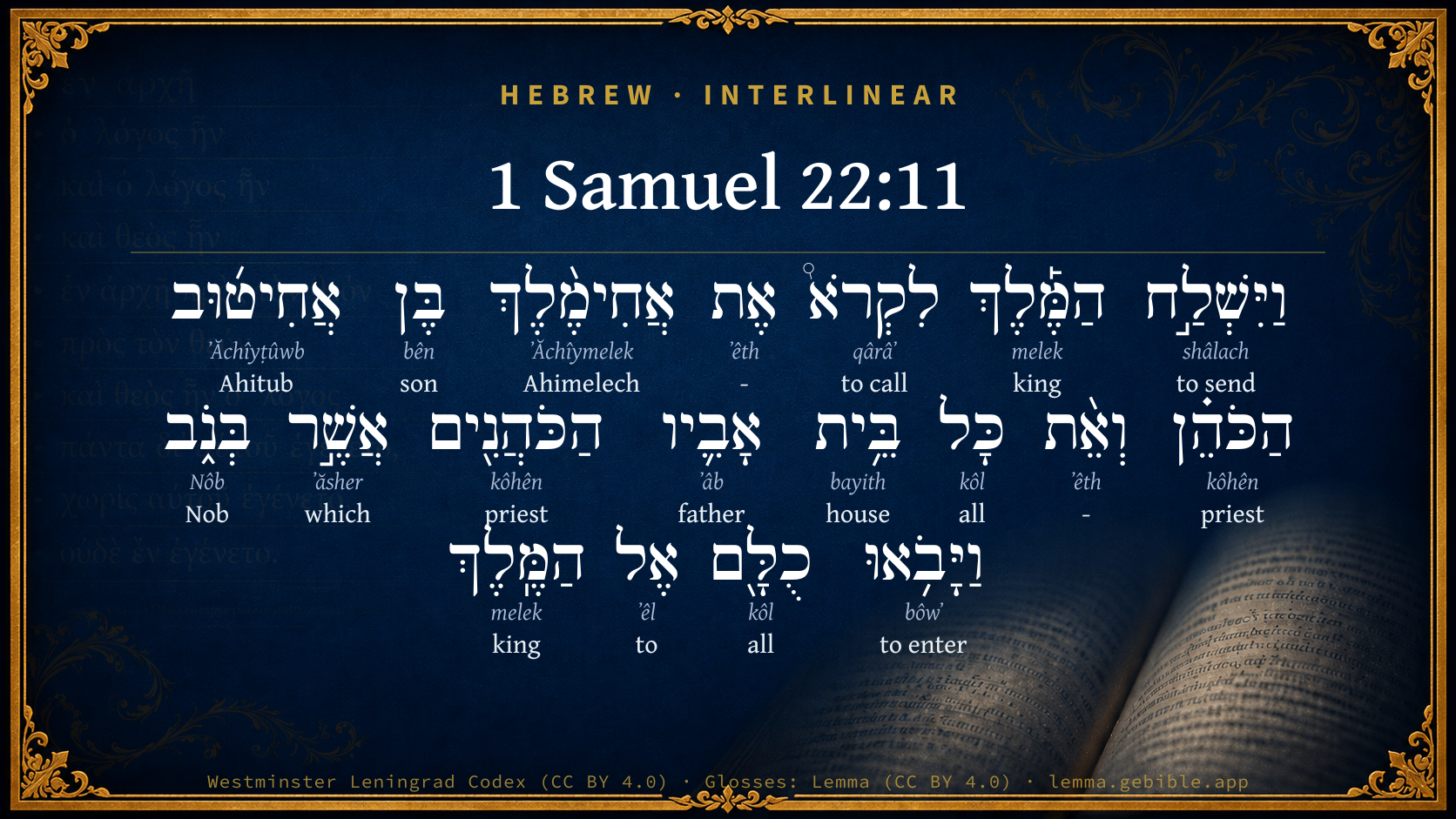
  1. וַיִּשְׁלַ֣ח shâlach H7971 “and · to send” Conjunction + Verb, Qal, Sequential Imperfect, 3rd Person, Masculine, Singular
  2. הַמֶּ֡לֶךְ melek H4428 “the · king” Particle, Definite Article + Noun, Common, Masculine, Singular, Absolute
  3. לִקְרֹא֩ qârâʼ H7121 “to call” Preposition + Verb, Qal, Infinitive Construct
  4. אֶת ʼêth H853 “-” Particle, Direct Object
  5. אֲחִימֶ֨לֶךְ ʼĂchîymelek H288 “Ahimelech” Noun, Proper
  6. בֶּן bên H1121 “son of” Noun, Common, Masculine, Singular, Construct
  7. אֲחִיט֜וּב ʼĂchîyṭûwb H285 “Ahitub” Noun, Proper
  8. הַכֹּהֵ֗ן kôhên H3548 “the · priest” Particle, Definite Article + Noun, Common, Masculine, Singular, Absolute
  9. וְאֵ֨ת ʼêth H853 “and · -” Conjunction + Particle, Direct Object
  10. כָּל kôl H3605 “all of” Noun, Common, Masculine, Singular, Construct
  11. בֵּ֥ית bayith H1004 “house of” Noun, Common, Masculine, Singular, Construct
  12. אָבִ֛יו ʼâb H1 “father · his” Noun, Common, Masculine, Singular, Construct + Suffix, Personal, 3rd Person, Masculine, Singular
  13. הַכֹּהֲנִ֖ים kôhên H3548 “the · priests” Particle, Definite Article + Noun, Common, Masculine, Plural, Absolute
  14. אֲשֶׁ֣ר ʼăsher H834 “which” Particle, Relative
  15. וַיָּבֹ֥אוּ bôwʼ H935 “and · to enter” Conjunction + Verb, Qal, Sequential Imperfect, 3rd Person, Masculine, Plural
  16. כֻלָּ֖ם kôl H3605 “all · their” Noun, Common, Masculine, Singular, Construct + Suffix, Personal, 3rd Person, Masculine, Plural
  17. אֶל ʼêl H413 “to” Preposition
  18. הַמֶּֽלֶךְ melek H4428 “the · king” Particle, Definite Article + Noun, Common, Masculine, Singular, Absolute

About this verse

These counts appear in no published source. They are computed here, from the morphology-tagged text and Lemma’s own curated glosses. What Lemma adds →

19
words
15
distinct lemmas
Historical
section

Notable vocabulary

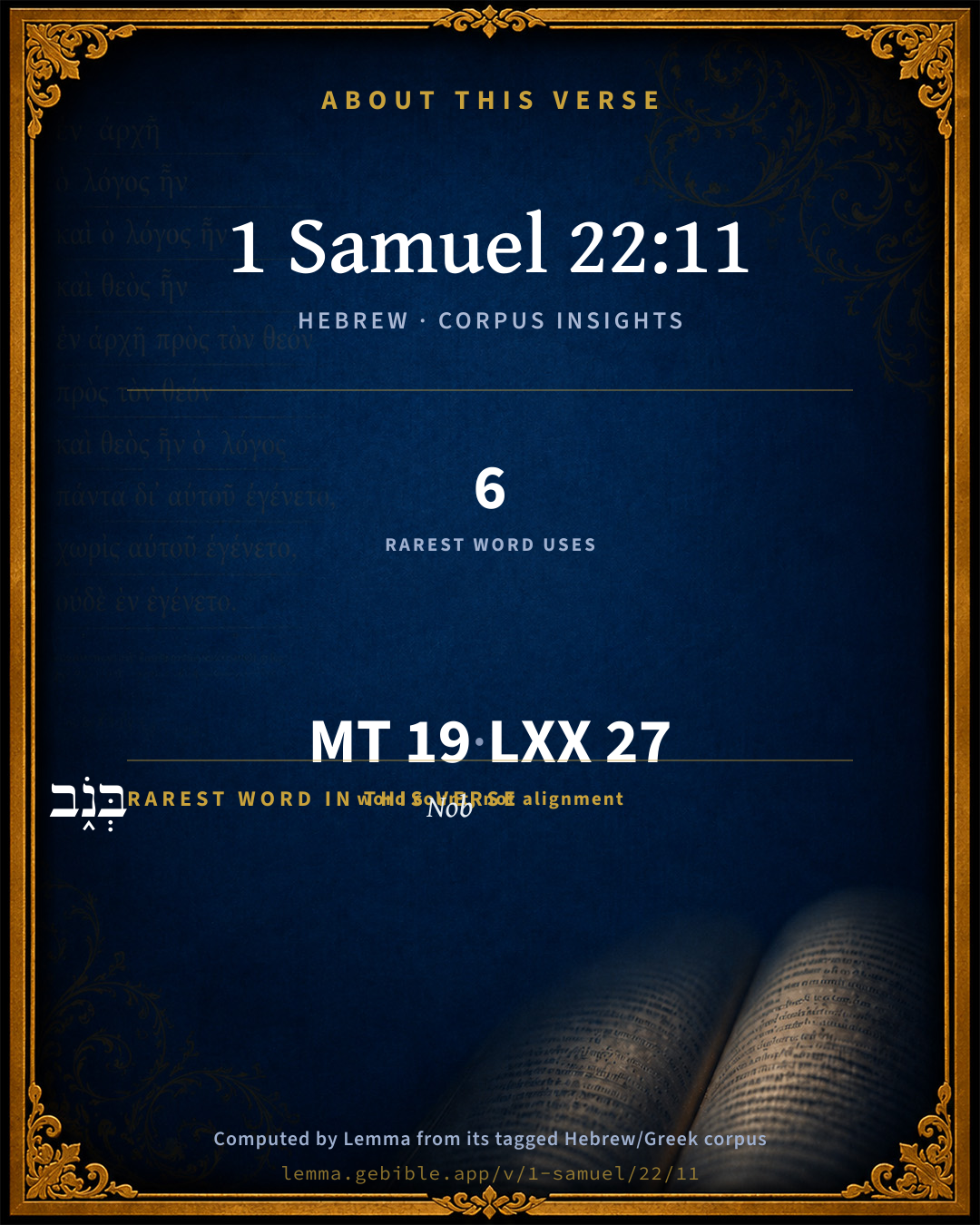
The rarest word here is בְּנֹ֑ב Nob H5011 — appearing just 6 times in the whole Hebrew Bible.

Shared distinctive vocabulary

בְּנֹ֑ב Nob H5011 occurs in 6 verses of the Hebrew Bible. Also found in:

Grammatical profile

  • 3 verbs
  • 12 nouns
  • 1 preposition
  • 3 particles

Verb forms

  • וַיִּשְׁלַ֣ח Qal · Sequential Imperfect
  • לִקְרֹא֩ Qal · Infinitive Construct
  • וַיָּבֹ֥אוּ Qal · Sequential Imperfect

Repetition

Words recur within this verse — often emphatic in Hebrew:

  • הַמֶּ֡לֶךְ king H4428 ×2
  • הַכֹּהֵ֗ן priest H3548 ×2
  • כָּל all H3605 ×2

Hebrew & Septuagint length

In English translation the verse runs 33 words from the Hebrew and 28 from the Septuagint (LXX English) — closely comparable.

A rough comparison of the two English renderings, which tokenize alike — not a word-level alignment.

Word counts can differ between the Hebrew and the Greek without any difference in meaning — e.g. the Hebrew direct-object marker אֵת has no separate Greek word, and Greek often adds the article ὁ.

In the original languages it is 19 Hebrew tokens and 27 Greek tokens — but the two are counted differently (Hebrew bundles its prefixes and suffixes into one token; the Greek is in lemma form), so that isn’t a like-for-like length.

Cross-references

1

Topical passages linked to 1 Samuel 22:11 in the Treasury of Scripture Knowledge — connected by theme and wording, ordered by reader-vote popularity; previews shown in the World English Bible.

Cross-references courtesy of OpenBible.info (CC BY 4.0).

Hebrew and Greek witnesses Masoretic Hebrew ↔ Greek Septuagint

The same verse in the two great witnesses to the Old Testament, shown verse-for-verse.

These are two independent witnesses, not word-aligned to each other, and the Septuagint is shown in lemma (dictionary) form.

Hebrew 1 Samuel 22:11 Masoretic · Westminster Leningrad Codex

וַיִּשְׁלַ֣ח הַמֶּ֡לֶךְ לִקְרֹא֩ אֶת אֲחִימֶ֨לֶךְ בֶּן אֲחִיט֜וּב הַכֹּהֵ֗ן וְאֵ֨ת כָּל בֵּ֥ית אָבִ֛יו הַכֹּהֲנִ֖ים אֲשֶׁ֣ר בְּנֹ֑ב וַיָּבֹ֥אוּ כֻלָּ֖ם אֶל הַמֶּֽלֶךְ

Then the king sent to call Ahimelech the priest, the son of Ahitub, and all his father's house, the priests who were in Nob: and they came all of them to the king.

World English Bible · Public Domain

Greek LXX 1 Samuel 22:11 Septuagint · lemma form

καί ἀποστέλλω ὁ βασιλεύς καλέω ὁ αβιμελεχ υἱός αχιτωβ καί πᾶς ὁ υἱός ὁ πατήρ αὐτός ὁ ἱερεύς ὁ ἐν νομβα καί παραγίγνομαι πᾶς πρός ὁ βασιλεύς

And the king sent to call Abimelech son of Achitob and all his father's sons, the priests that were in Nomba; and they all came to the king.

LXX2012 (modern English Septuagint) · Public Domain

Hebrew: Westminster Leningrad Codex (CC BY 4.0). Greek: Septuagint (public domain); English from LXX2012 (modern English Septuagint) (Public Domain). How the Septuagint differs from the Hebrew →

Targum (Aramaic paraphrase)

1

The Targum is the ancient Jewish Aramaic paraphrase of the Hebrew Scriptures — an interpretive translation, not the Hebrew text itself. Onkelos (literal) and Pseudo-Jonathan (expansive) render the Torah, and Jonathan the Prophets. Coverage is partial: where no permissively-licensed English translation exists for a verse, only the Aramaic is shown. This is verse-level text, not a word-by-word alignment to the Hebrew.

  1. Targum Jonathan Prophets (Joshua–Malachi)
    וּשְׁלַח מַלְכָּא לְמִקְרֵי יַת אֲחִימֶלֶךְ בַּר אֲחִיטוּב כַּהֲנָא וְיַת כָּל בֵּית אֲבוּהִי כַּהֲנַיָא דִי בְנוֹב וַאֲתוֹ כֻּלְהוֹן לְוַת מַלְכָּא:

    (no public-domain English translation for this verse)

    Targum Jonathan — Aramaic: “Mikraot Gedolot” (public domain). English: “Sefaria Community Translation” (CC0 1.0 (public-domain dedication)); “London "Chaldee Paraphrase," 1871” (public domain). Text via Sefaria.

Commentary

Notes on 1 Samuel 22:11 from classic Christian and Jewish commentators (each source and its license shown beneath its notes). The classic Christian expositions comment on the surrounding passage and are grouped to its opening verse, so a note may address several verses; the Jewish commentaries on the Tanakh (Rashi and others) are per-verse, so they appear only where the commentator wrote on this verse.

Lemma curates 59 commentaries, every one of them public domain or Creative Commons licensed, each selected and text-cleaned for this edition rather than reprinted as found. About our sources →

Trapp's Complete Commentary

John Trapp

1Sa 22:11 Then the king sent to call Ahimelech the priest, the son of Ahitub, and all his father’s house, the priests that [were] in Nob: and they came all of them to the king.

Ver. 11. Then the king sent to call Ahimelech.] Under a pretence of justice, but himself will needs be both his accuser and his judge; and let him make never so good an apology, he must die for it; that is resolved on.

And all his father’s house.] The remnant of Eli’s house, so long since doomed to destruction. {1Sa 2:31} If God’s word sleep, it shall not die; but, after long intermissions, breaks forth into those effects which we had forgotten to look for and ceased to fear.

John Trapp, A Commentary or Exposition upon All the Books of the Old and New Testament (1647–1656) — public domain. Text from a community e-Sword module.

Joseph Benson's Commentary

1Sa 22:11. The king sent to call Ahimelech and all his father’s house —

The priests of the house of Eli, whom God had threatened to cut off, chap. 1Sa 2:31; and which threatening, by a strange chain of providences, was now about to be fulfilled.

Joseph Benson's Commentary on the Old and New Testaments (1811–1818) — public domain. Text from a community e-Sword module.

Geneva Bible (1599)

Geneva Bible translators

Which were the remnant of the house of Eli, whose house God threatened to punish.

Geneva Bible (1599) marginal notes — public domain. Text via Bolls.life.

Ellicott's Commentary for English Readers

(11) Then the king sent to call Ahimelech.—This sending for all the priestly house to Gibeah when alone Ahimelech was to blame—if blame there was—looks as though Saul and Doeg had determined upon the wholesale massacre which followed.

A Bible Commentary for English Readers, edited by Charles John Ellicott (1878–1897) — public domain. Text from a community e-Sword module.

John Gill's Exposition

Then the king sent to call Ahimelech the priest, the son of Ahitub,.... Sent messengers to him, and summoned him to appear before him:

and all his father's house; the family of Eli, which God had threatened to destroy, and now the time was hastening on:

the priests that were in Nob; in which dwelt none but priests, at least these were the chief of the inhabitants, and therefore called the city of the priests, Sa1 22:19,

and they came all of them to the king; not being conscious of any evil they had committed, or that could be charged upon them; or otherwise they would not have appeared, but would have fled to David for protection.

John Gill's Exposition of the Whole Bible (1746–1763) — public domain (CC PDM 1.0). Text via the HelloAO Bible API.

Matthew Poole's English Annotations

All his father’s house; of the house of Eli, which God had threatened to cut off, 1Sa 2:31.

Matthew Poole's English Annotations on the Holy Bible (1683–1685) — public domain. Text from a community e-Sword/MySword module.

The Pulpit Commentary

Vers. 11-13. All his father"s house. Doeg"s suggestion that the priests were David"s allies at once arouses all Saul"s worst passions. As if he had determined from the first upon the massacre of the whole body, he sends not merely for Ahimelech, but forevery priest at Nob. Shortly afterwards they arrived, for Nob was close to Gibeah, and Saul himself arraigns them before the court for treason, and recapitulates the three points mentioned by Doeg as conclusive proofs of their guilt.

The Pulpit Commentary (1880–1919), ed. H.D.M. Spence-Jones & Joseph S. Exell — public domain. Text from a community e-Sword module.

John Wesley's Explanatory Notes

The priests - Of the house of Eli, which God had threatened to cut off, chap. ii, 31.

John Wesley, Explanatory Notes Upon the Whole Bible (1754–1765) — public domain. Text via the GEBible commentary corpus.

Keil & Delitzsch

C. F. Keil & F. Delitzsch

On receiving this information, Saul immediately summoned the priest Ahimelech and "all his father's house," i.e., the whole priesthood, to Nob, to answer for what they had done. To Saul's appeal, "Why have ye conspired against me, thou and the son of Jesse, by giving him bread?" Ahimelech, who was not conscious of any such crime, since David had come to him with a false pretext, and the priest had probably but very little knowledge of what took place at court, replied both calmly and worthily (Sa1 22:14): "And who of all thy servants is so faithful (proved, attested, as in Num 12:7) as David, and son-in-law of the king, and having access to thy private audience, and honoured in thy house?" The true explanation of אל־משׁמעתּך סר may be gathered from a comparison of Sa2 23:23 and Ch1 11:25, where משׁמעת occurs again, as the context clearly shows, in the sense of a privy councillor of the king, who hears his personal revelations and converses with him about them, so that it corresponds to our "audience." סוּר, lit. to turn aside from the way, to go in to any one, or to look after anything (Exo 3:3; Rut 4:1, etc.); hence in the passage before us "to have access," to be attached to a person. This is the explanation given by Gesenius and most of the modern expositors, whereas the early translators entirely misunderstood the passage, though they have given the meaning correctly enough at Sa2 23:23. But if this was the relation in which David stood to Saul, - and he had really done so for a long time, - there was nothing wrong in what the high priest had done for him; but he had acted according to the best of his knowledge, and quite conscientiously as a faithful subject of the king. Ahimelech then added still further (Sa1 22:15): "Did I then begin to inquire of God for him this day?" i.e., was it the first time that I had obtained the decision of God for David concerning important enterprises, which he had to carry out in the service of the king? "Far be from me," sc., any conspiracy against the king, like that of which I am accused. "Let not the king lay it as a burden upon thy servant, my whole father's house (the omission of the cop. ו before בּכל־כּית may be accounted for from the excitement of the speaker); for thy servant knows not the least of all this." בּכל־זאת, of all that Saul had charged him with.

Keil & Delitzsch — Biblical Commentary on the Old Testament (1861–1891) — public domain (CC PDM 1.0). Text via the HelloAO Bible API. (Old Testament only.)

unfoldingWord translationNotes

Door43 World Missions Community

in that you have given

"by giving"

rise up

"rebel" or "fight"

translationWords

king

send

priest

ancestor

house

Saul (OT)

lord

Jesse

bread

sword

God

raise

unfoldingWord translationNotes — © Distant Shores Media and the Door43 World Missions Community, licensed CC BY-SA 4.0. Source: git.door43.org/Door43/en_tn.

Lesson kit

Teaching starters — assembled from the data on this page, not authored interpretation. Every prompt links to the verse data it draws on. Edit before teaching.

1 Samuel, in the Historical, opens this verse with 19 words (15 distinct Hebrew lemmas). Its most distinctive word is Nôb (“Nob”). A historical commentator’s framing appears above. Read the whole chapter for the surrounding context.

Discussion questions

  1. What does “Nob” (Nôb) contribute to the verse as a whole?
  2. 1 Samuel 21:1 shares the word «Nob» with this verse. How do the two illuminate each other?
  3. “king” occurs 2× in this one verse. What is the effect of the repetition?
  4. These translations render this verse differently; the difference is in the English rendering, not the original. What questions does that raise?
  5. The verb «וַיִּשְׁלַ֣ח» is Qal Sequential Imperfect. How does its form color the action?
  6. Reading how Trapp's Complete Commentary and Joseph Benson's Commentary read this verse, where do the two commentators agree and where do they part?

Things to notice

Reading settings

Reading text

Shown beneath each verse's original-language words.

Old Testament
Old Testament edition

Read the OT as the Masoretic Hebrew (MT) or the Greek Septuagint (LXX).

English shown for the Greek Septuagint (in the Hebrew ↔ Greek comparison).

Comparing translations? Open the Compare panel on any verse page to stack up to four side by side.