
1 Samuel 19:7

Hebrew (Westminster Leningrad Codex) 1 Samuel 19:7 appears in the Hebrew Old Testament. The text above is from the Westminster Leningrad Codex. Each word links to its Strong’s number, a concise gloss, and parsing drawn from the Open Scriptures Hebrew Bible morphology. Click any word for its full Brown-Driver-Briggs (BDB) entry.
Download image
Cite this verse

1 Samuel 19:7 (World English Bible). Public Domain. Lemma interlinear Bible study tool, https://lemma.gebible.app/v/1-samuel/19/7.

Show BibTeX & RIS
BibTeX
RIS
English Translation
Jonathan called David, and Jonathan showed him all those things. Jonathan brought David to Saul, and he was in his presence, as before.
World English Bible · Public Domain
Download a study sheet

One document with this verse’s original text, its word-by-word gloss line, the meaning frame, cross-references with their text, attributed commentary, and full source and license credits — printable, and it pastes into notes with its structure intact.

This verse Autodidact and up

Study sheet (.html) Plain text (.txt)

A passage Seminary Student

Up to 50 verses in one chapter. A passage sheet keeps up to 6 commentary sources and 12 cross-references per verse, in the order this page ranks them, and says so on the sheet whenever that leaves anything out. Ask for a single verse and you get the Autodidact verse sheet above.

Everything on this page stays free to read, with no account — the sheet is a download of what is already on screen, not access to it.

Want to remove ads? Support Godless Engineer
Compare translations 3

The same verse in 3 English versions, stacked beneath the original-language interlinear above. Click any original word for its lexicon entry.

Each is an independent rendering of the whole verse — the interlinear is not word-aligned to these translations.

Highlighted words mark where these versions differ — a whole-verse word diff, not a word-by-word alignment.

  • World English Bible Public Domain
    Jonathan called David, and Jonathan showed him all those things. Jonathan brought David to Saul, and he was in his presence, as before.
  • King James Version Public Domain
    And Jonathan called David, and Jonathan showed him all those things. And Jonathan brought David to Saul, and he was in his presence, as in times past.
  • unfoldingWord Literal Text CC BY-SA 4.0
    And Jonathan called to David, and Jonathan declared to him all of these words. And Jonathan brought David to Saul, and he was to his face as yesterday and the third day.

unfoldingWord Literal Text — © unfoldingWord, licensed CC BY-SA 4.0. Word-aligned USFM3 via Door43 (git.door43.org/unfoldingWord/en_ult).

Versions to compare (up to 4)

3 of 4 selected

Show all 18 translations

Every available English version of this verse, each an independent rendering of the whole verse.

  • World English Bible Public Domain
    Jonathan called David, and Jonathan showed him all those things. Jonathan brought David to Saul, and he was in his presence, as before.
  • Berean Standard Bible Public Domain
    So Jonathan summoned David and told him all these things. Then Jonathan brought David to Saul to serve him as he had before.
  • Majority Standard Bible Public Domain
    So Jonathan summoned David and told him all these things. Then Jonathan brought David to Saul, and David was with Saul as before.
  • King James Version Public Domain
    And Jonathan called David, and Jonathan showed him all those things. And Jonathan brought David to Saul, and he was in his presence, as in times past.
  • American Standard Version (1901) Public Domain
    And Jonathan called David, and Jonathan showed him all those things. And Jonathan brought David to Saul, and he was in his presence, as beforetime.
  • Revised Version (1885) Public Domain
    And Jonathan called David, and Jonathan shewed him all those things. And Jonathan brought David to Saul, and he was in his presence, as beforetime.
  • Geneva Bible (1599) Public Domain
    So Ionathan called Dauid, and Ionathan shewed him all those words, and Ionathan brought Dauid to Saul, and hee was in his presence as in times past.
  • Douay-Rheims (1899) Public Domain
    Then Jonathan called David and told him all these words: and Jonathan brought in David to Saul, and he was before him, as he had been yesterday and the day before.
  • Young's Literal Translation Public Domain
    And Jonathan calleth for David, and Jonathan declareth to him all these words, and Jonathan bringeth in David unto Saul, and he is before him as heretofore.
  • Literal Standard Version CC BY-SA 4.0
    And Jonathan calls for David, and Jonathan declares all these words to him, and Jonathan brings in David to Saul, and he is before him as before.
  • Unlocked Literal Bible CC BY-SA 4.0
    Then Jonathan called David, and Jonathan told him all these things. Jonathan brought David to Saul, and he was in his presence as before.
  • unfoldingWord Literal Text CC BY-SA 4.0
    And Jonathan called to David, and Jonathan declared to him all of these words. And Jonathan brought David to Saul, and he was to his face as yesterday and the third day.
  • Darby Bible Public Domain
    Then Jonathan called David, and Jonathan declared to him all those things. And Jonathan brought David to Saul, and he was in his presence as previously.
  • World Messianic Bible Public Domain
    Jonathan called David, and Jonathan showed him all those things. Then Jonathan brought David to Saul, and he was in his presence as before.
  • Webster's Bible Public Domain
    And Jonathan called David, and Jonathan showed him all those things. And Jonathan brought David to Saul, and he was in his presence, as in times past.
  • Free Bible Version CC BY-SA 4.0
    Later Jonathan called David and told him all that had been said. Then he took him to Saul, and David worked for Saul as he had before.
  • Bible in Basic English Public Domain
    Then Jonathan sent for David and gave him word of all these things. And Jonathan took David to Saul, who kept him by his side as in the past.
  • JPS Tanakh (1917) Public Domain
    And Jonathan called David, and Jonathan told him all those things. And Jonathan brought David to Saul, and he was in his presence, as beforetime.

Literal Standard Version (2020), Covenant Press — licensed CC BY-SA 4.0. Text via the HelloAO Bible API (eBible.org). Unlocked Literal Bible (unfoldingWord) — licensed CC BY-SA 4.0. Text via the HelloAO Bible API (eBible.org). unfoldingWord Literal Text — © unfoldingWord, licensed CC BY-SA 4.0. Word-aligned USFM3 via Door43 (git.door43.org/unfoldingWord/en_ult). Free Bible Version, Dr. Jonathan Gallagher — licensed CC BY-SA 4.0. Text via the HelloAO Bible API (eBible.org).

Word by word

More ways to search: Search by grammar → Find every occurrence → Compare this word →

Practice this passage: Drill this verse → Learn its vocabulary →

כְּאֶתְמ֥וֹל
ʼethmôwl
H865
“like/as · yesterday”
Preposition + Noun, Common, Masculine, Singular, Absolute
Part of Speech
Preposition + Noun
Type
Common
Gender
Masculine
Number
Singular
State
Absolute
Full BDB Definition

Origin: probably from H853 or H854 and H4136

TWOT: 2521

yesterday, recently, formerly - yesterday - formerly (figuratively) - from yesterday, already (in phrase) - (TWOT +) before, before that time, before the time, heretofore, of late, of old, these days, time(s) past
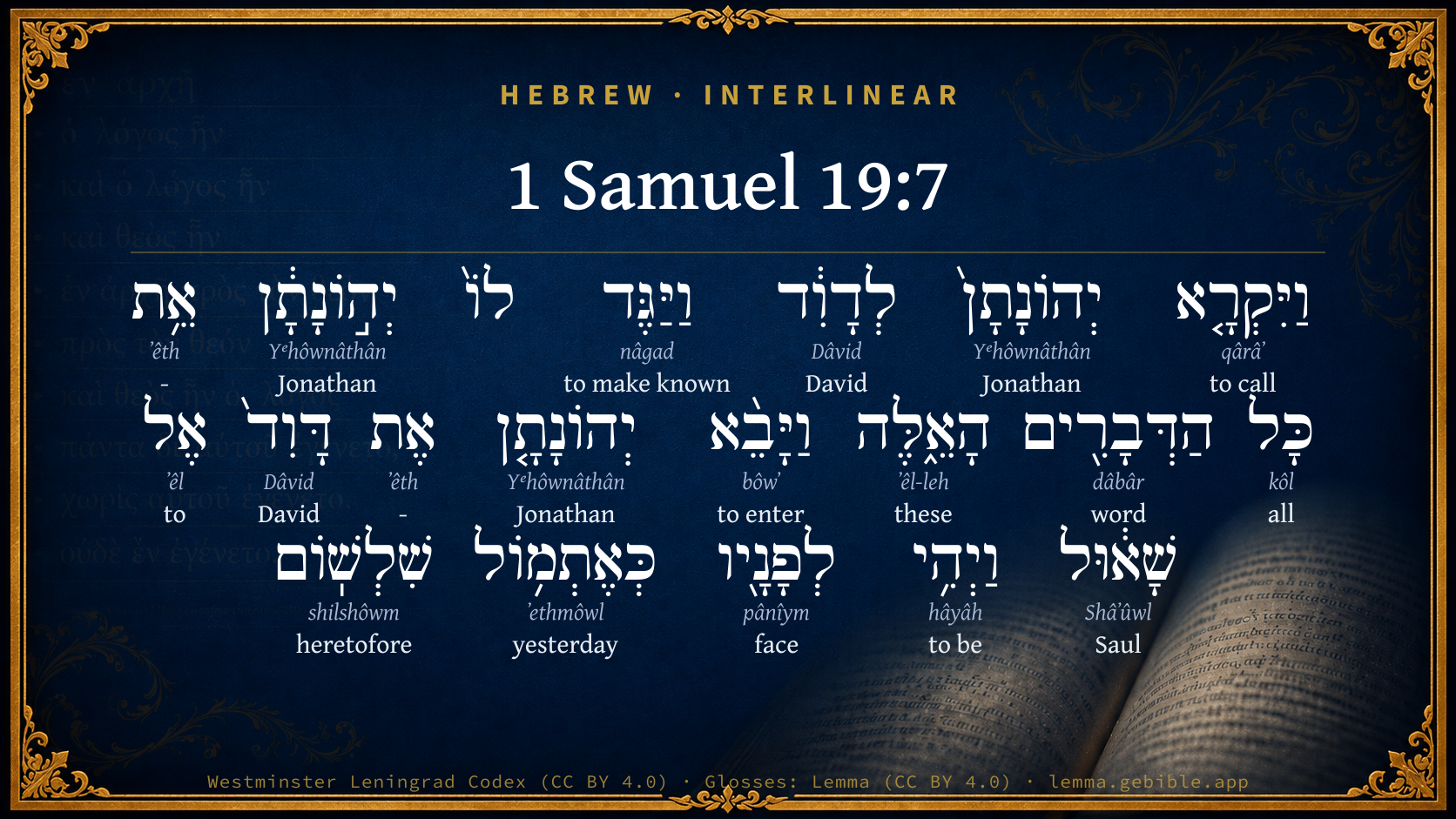
  1. וַיִּקְרָ֤א qârâʼ H7121 “and · to call” Conjunction + Verb, Qal, Sequential Imperfect, 3rd Person, Masculine, Singular
  2. יְהוֹנָתָן֙ Yᵉhôwnâthân H3083 “Jonathan” Noun, Proper
  3. לְדָוִ֔ד Dâvid H1732 “to/for · David” Preposition + Noun, Proper
  4. וַיַּגֶּד nâgad H5046 “and · to make known” Conjunction + Verb, Hiphil, Sequential Imperfect, 3rd Person, Masculine, Singular
  5. יְה֣וֹנָתָ֔ן Yᵉhôwnâthân H3083 “Jonathan” Noun, Proper
  6. אֵ֥ת ʼêth H853 “-” Particle, Direct Object
  7. כָּל kôl H3605 “all of” Noun, Common, Masculine, Singular, Construct
  8. הַדְּבָרִ֖ים dâbâr H1697 “the · words” Particle, Definite Article + Noun, Common, Masculine, Plural, Absolute
  9. הָאֵ֑לֶּה ʼêl-leh H428 “the · these” Particle, Definite Article + Pronoun, Demonstrative, Common, Plural
  10. וַיָּבֵ֨א bôwʼ H935 “and · to enter” Conjunction + Verb, Hiphil, Sequential Imperfect, 3rd Person, Masculine, Singular
  11. יְהוֹנָתָ֤ן Yᵉhôwnâthân H3083 “Jonathan” Noun, Proper
  12. אֶת ʼêth H853 “-” Particle, Direct Object
  13. דָּוִד֙ Dâvid H1732 “David” Noun, Proper
  14. אֶל ʼêl H413 “to” Preposition
  15. שָׁא֔וּל Shâʼûwl H7586 “Saul” Noun, Proper
  16. וַיְהִ֥י hâyâh H1961 “and · to be” Conjunction + Verb, Qal, Sequential Imperfect, 3rd Person, Masculine, Singular
  17. לְפָנָ֖יו pânîym H6440 “to/for · face(s) · his” Preposition + Noun, Common, Both, Plural, Construct + Suffix, Personal, 3rd Person, Masculine, Singular
  18. שִׁלְשֽׁוֹם shilshôwm H8032 “heretofore” Noun, Common, Masculine, Singular, Absolute

About this verse

These counts appear in no published source. They are computed here, from the morphology-tagged text and Lemma’s own curated glosses. What Lemma adds →

20
words
15
distinct lemmas
Historical
section

Notable vocabulary

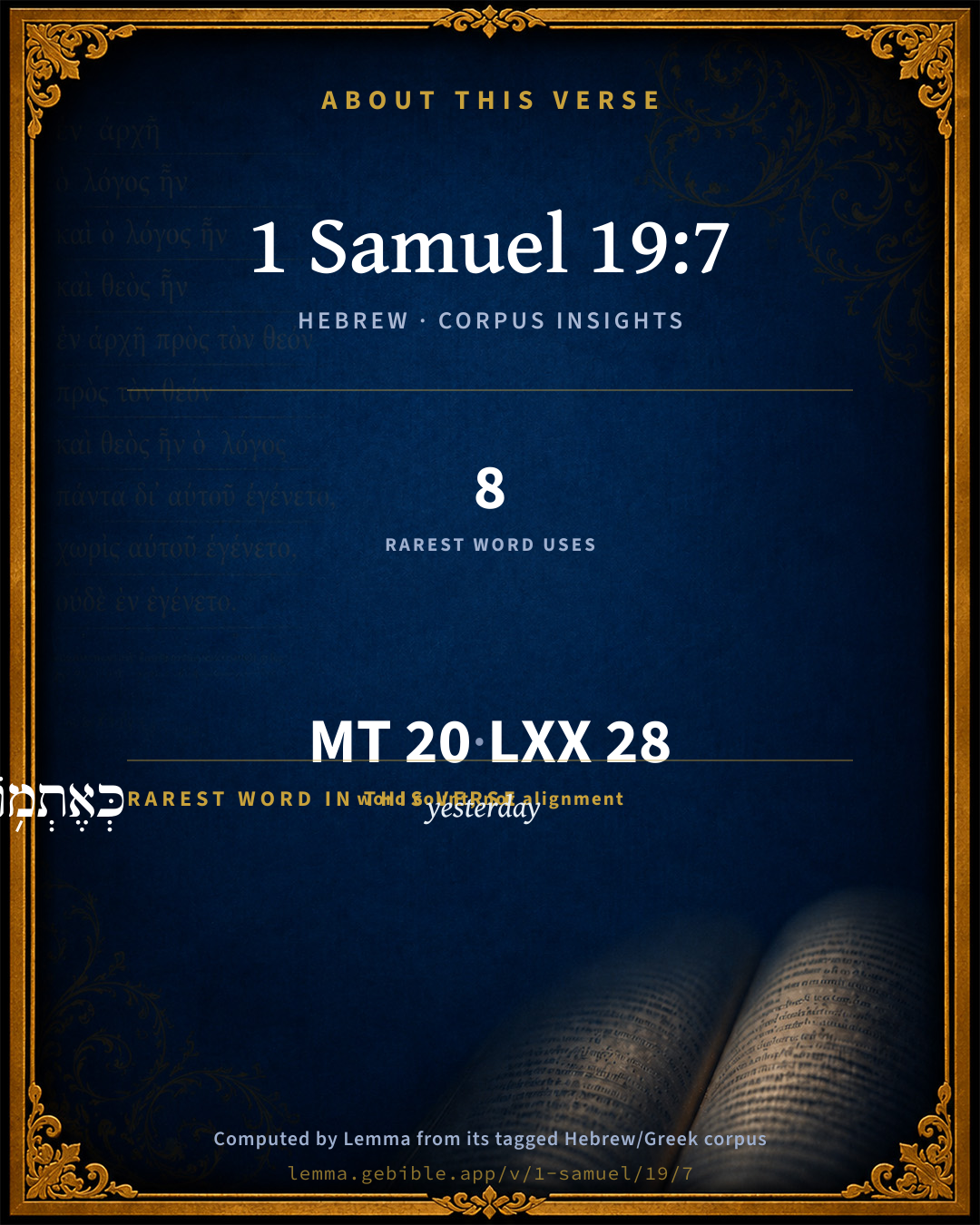
The rarest word here is כְּאֶתְמ֥וֹל yesterday H865 — appearing just 8 times in the whole Hebrew Bible.

Shared distinctive vocabulary

כְּאֶתְמ֥וֹל yesterday H865 occurs in 8 verses of the Hebrew Bible. Also found in:

Grammatical profile

  • 4 verbs
  • 11 nouns
  • 1 pronoun
  • 2 prepositions
  • 2 particles

Verb forms

  • וַיִּקְרָ֤א Qal · Sequential Imperfect
  • וַיַּגֶּד Hiphil · Sequential Imperfect
  • וַיָּבֵ֨א Hiphil · Sequential Imperfect
  • וַיְהִ֥י Qal · Sequential Imperfect

Repetition

Words recur within this verse — often emphatic in Hebrew:

  • יְהוֹנָתָן֙ Jonathan H3083 ×3
  • לְדָוִ֔ד David H1732 ×2

Hebrew & Septuagint length

In English translation the verse runs 23 words from the Hebrew and 26 from the Septuagint (LXX English) — closely comparable.

A rough comparison of the two English renderings, which tokenize alike — not a word-level alignment.

Word counts can differ between the Hebrew and the Greek without any difference in meaning — e.g. the Hebrew direct-object marker אֵת has no separate Greek word, and Greek often adds the article ὁ.

In the original languages it is 20 Hebrew tokens and 28 Greek tokens — but the two are counted differently (Hebrew bundles its prefixes and suffixes into one token; the Greek is in lemma form), so that isn’t a like-for-like length.

Cross-references

8

Topical passages linked to 1 Samuel 19:7 in the Treasury of Scripture Knowledge — connected by theme and wording, ordered by reader-vote popularity; previews shown in the World English Bible.

  • 1 Samuel 16:21 David came to Saul, and stood before him: and he loved him greatly; and he became his armor bearer.
  • 1 Samuel 18:2 Saul took him that day, and would let him go no more home to his father's house.
  • 1 Samuel 18:13 Therefore Saul removed him from him, and made him his captain over a thousand; and he went out and came in before the people.
  • 1 Samuel 18:10 It happened on the next day, that an evil spirit from God came mightily on Saul, and he prophesied in the midst of the house: and David played with his hand, as he did day by day. Saul had his spear in his hand;
  • Genesis 31:2 Jacob saw the expression on Laban's face, and, behold, it was not toward him as before.
  • Exodus 4:10 Moses said to Yahweh, "Oh, Lord, I am not eloquent, neither before now, nor since you have spoken to your servant; for I am slow of speech, and of a slow tongue."
  • 1 Chronicles 11:2 In times past, even when Saul was king, it was you who led out and brought in Israel: and Yahweh your God said to you, You shall be shepherd of my people Israel, and you shall be prince over my people Israel.
  • Isaiah 30:33 For a Topheth is prepared of old; yes, for the king it is made ready; he has made it deep and large; the pile of it is fire and much wood; the breath of Yahweh, like a stream of sulfur, does kindle it.

Cross-references courtesy of OpenBible.info (CC BY 4.0).

Hebrew and Greek witnesses Masoretic Hebrew ↔ Greek Septuagint

The same verse in the two great witnesses to the Old Testament, shown verse-for-verse.

These are two independent witnesses, not word-aligned to each other, and the Septuagint is shown in lemma (dictionary) form.

Hebrew 1 Samuel 19:7 Masoretic · Westminster Leningrad Codex

וַיִּקְרָ֤א יְהוֹנָתָן֙ לְדָוִ֔ד וַיַּגֶּד לוֹ֙ יְה֣וֹנָתָ֔ן אֵ֥ת כָּל הַדְּבָרִ֖ים הָאֵ֑לֶּה וַיָּבֵ֨א יְהוֹנָתָ֤ן אֶת דָּוִד֙ אֶל שָׁא֔וּל וַיְהִ֥י לְפָנָ֖יו כְּאֶתְמ֥וֹל שִׁלְשֽׁוֹם

Jonathan called David, and Jonathan showed him all those things. Jonathan brought David to Saul, and he was in his presence, as before.

World English Bible · Public Domain

Greek LXX 1 Samuel 19:7 Septuagint · lemma form

καί καλέω ιωναθαν ὁ δαυίδ καί ἀποἀγγέλλω αὐτός πᾶς ὁ ῥῆμα οὗτος καί εἰςἄγω ιωναθαν ὁ δαυίδ πρός σαούλ καί εἰμί ἐνώπιον αὐτός ὡσεί ἐχθές καί τρίτος ἡμέρα

And Jonathan called David, and told him all these words; and Jonathan brought David in to Saul, and he was before him as in former times.

LXX2012 (modern English Septuagint) · Public Domain

Hebrew: Westminster Leningrad Codex (CC BY 4.0). Greek: Septuagint (public domain); English from LXX2012 (modern English Septuagint) (Public Domain). How the Septuagint differs from the Hebrew →

Targum (Aramaic paraphrase)

1

The Targum is the ancient Jewish Aramaic paraphrase of the Hebrew Scriptures — an interpretive translation, not the Hebrew text itself. Onkelos (literal) and Pseudo-Jonathan (expansive) render the Torah, and Jonathan the Prophets. Coverage is partial: where no permissively-licensed English translation exists for a verse, only the Aramaic is shown. This is verse-level text, not a word-by-word alignment to the Hebrew.

  1. Targum Jonathan Prophets (Joshua–Malachi)
    וּקְרָא יְהוֹנָתָן לְדָוִד וְחַוֵי לֵיהּ יְהוֹנָתָן יַת כָּל פִּתְגָמַיָא הָאִלֵין וְאַיְתֵי יְהוֹנָתָן יַת דָוִד לְוַת שָׁאוּל וַהֲוָה מְשַׁמֵשׁ קֳדָמוֹהִי כְּמֵאִיתְמַלֵי וּמִדְקָדָמוֹהִי:

    (no public-domain English translation for this verse)

    Targum Jonathan — Aramaic: “Mikraot Gedolot” (public domain). English: “Sefaria Community Translation” (CC0 1.0 (public-domain dedication)); “London "Chaldee Paraphrase," 1871” (public domain). Text via Sefaria.

Commentary

Notes on 1 Samuel 19:7 from classic Christian and Jewish commentators (each source and its license shown beneath its notes). The classic Christian expositions comment on the surrounding passage and are grouped to its opening verse, so a note may address several verses; the Jewish commentaries on the Tanakh (Rashi and others) are per-verse, so they appear only where the commentator wrote on this verse.

Lemma curates 59 commentaries, every one of them public domain or Creative Commons licensed, each selected and text-cleaned for this edition rather than reprinted as found. About our sources →

Trapp's Complete Commentary

John Trapp

1Sa 19:7 And Jonathan called David, and Jonathan shewed him all those things. And Jonathan brought David to Saul, and he was in his presence, as in times past.

Ver. 7. And he was in his presence, as in times past.] But nothing so well assured of Saul’s favour, now restored, as the chief butler was of Pharaoh’s; or Essex of Queen Elizabeth’s: whom when she had first imprisoned and then enlarged, she no less loved him than before, after that he had signified to her Majesty that he kissed her royal hands, and the rod which had corrected him, not ruined him, &c. {a}

{a} Camden’s Elisab., 533.

John Trapp, A Commentary or Exposition upon All the Books of the Old and New Testament (1647–1656) — public domain. Text from a community e-Sword module.

Adam Clarke's Commentary

Verse 7. He was in his presence, as in times past.] By Jonathan's advice he had secreted himself on that day on which he was to have been assassinated: the king having sworn that he should not be slain, David resumes his place in the palace of Saul.

Adam Clarke's Commentary on the Bible (1810–1826) — public domain. Text from a community e-Sword/MySword module.

Ellicott's Commentary for English Readers

(7) As in times past.—The old life went on as before, and David seemingly was received on terms of intimacy and affection by the king, but a new cause was soon supplied which again lit up the slumbering fires of jealousy in the king’s heart. The next verse tells us of a successful campaign against the hereditary foes of Israel, in which, as usual, David was the hero.

A Bible Commentary for English Readers, edited by Charles John Ellicott (1878–1897) — public domain. Text from a community e-Sword module.

John Gill's Exposition

And Jonathan called David,.... Out of his lurking place in the field, after Saul was returned home:

and Jonathan showed him all these things: which had passed between him and his father, and particularly the oath he had made that he should not be slain:

and Jonathan brought David to Saul: introduced him at court again, and into the presence chamber of Saul; who, in appearance, received him courteously, and a reconciliation was seemingly made:

and he was in his presence as in times past; when he was first received at court, and in great esteem both with Saul and his courtiers.

John Gill's Exposition of the Whole Bible (1746–1763) — public domain (CC PDM 1.0). Text via the HelloAO Bible API.

Lesson kit

Teaching starters — assembled from the data on this page, not authored interpretation. Every prompt links to the verse data it draws on. Edit before teaching.

1 Samuel, in the Historical, opens this verse with 20 words (15 distinct Hebrew lemmas). Its most distinctive word is ʼethmôwl (“yesterday”). A historical commentator’s framing appears above. Read the whole chapter for the surrounding context.

Discussion questions

  1. What does “yesterday” (ʼethmôwl) contribute to the verse as a whole?
  2. How does 1 Samuel 4:7, which shares the word «yesterday», read alongside this verse?
  3. What does the repetition of “Jonathan” (3× in this one verse) do in this verse?
  4. These translations render this verse differently. What is at stake in choosing one wording over another?
  5. «וַיִּקְרָ֤א» is a Qal Sequential Imperfect verb. How does that grammatical form shape the action described?
  6. Compare how Trapp's Complete Commentary and Adam Clarke's Commentary read this verse. Where do they agree or differ?

Things to notice

Reading settings

Reading text

Shown beneath each verse's original-language words.

Old Testament
Old Testament edition

Read the OT as the Masoretic Hebrew (MT) or the Greek Septuagint (LXX).

English shown for the Greek Septuagint (in the Hebrew ↔ Greek comparison).

Comparing translations? Open the Compare panel on any verse page to stack up to four side by side.