Hosea 11:2

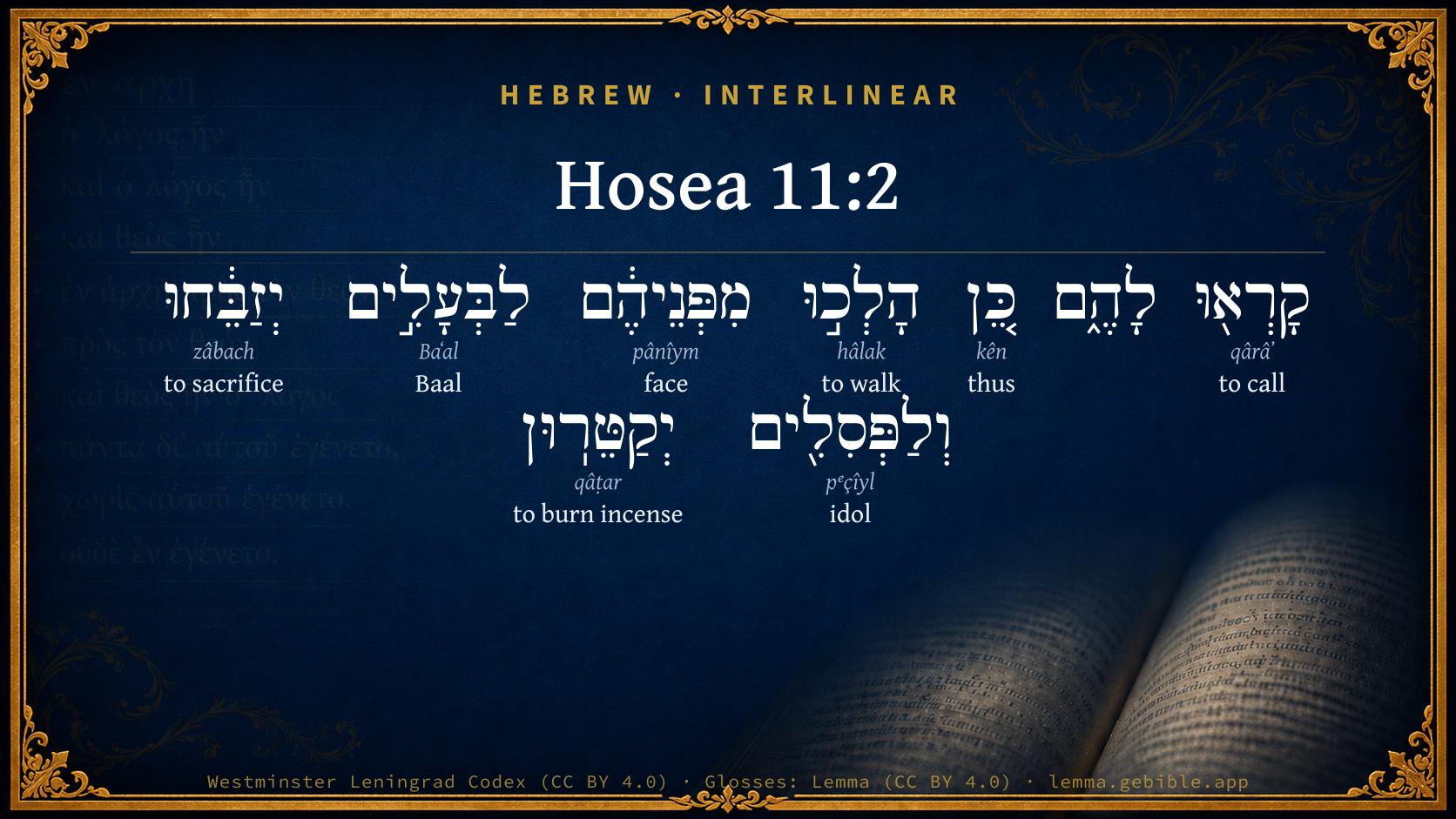
Hebrew (Westminster Leningrad Codex) Hosea 11:2 appears in the Hebrew Old Testament. The text above is from the Westminster Leningrad Codex. Each word links to its Strong’s number, a concise gloss, and parsing drawn from the Open Scriptures Hebrew Bible morphology. Click any word for its full Brown-Driver-Briggs (BDB) entry.
Download image
Cite this verse

Hosea 11:2 (World English Bible). Public Domain. Lemma interlinear Bible study tool, https://lemma.gebible.app/v/hosea/11/2.

Show BibTeX & RIS
BibTeX
RIS
English Translation
They called to them, so they went from them. They sacrificed to the Baals, And burned incense to engraved images.
World English Bible · Public Domain
Download a study sheet

One document with this verse’s original text, its word-by-word gloss line, the meaning frame, cross-references with their text, attributed commentary, and full source and license credits — printable, and it pastes into notes with its structure intact.

This verse Autodidact and up

Study sheet (.html) Plain text (.txt)

A passage Seminary Student

Up to 50 verses in one chapter. A passage sheet keeps up to 6 commentary sources and 12 cross-references per verse, in the order this page ranks them, and says so on the sheet whenever that leaves anything out. Ask for a single verse and you get the Autodidact verse sheet above.

Everything on this page stays free to read, with no account — the sheet is a download of what is already on screen, not access to it.

Want to remove ads? Support Godless Engineer
Compare translations 3

The same verse in 3 English versions, stacked beneath the original-language interlinear above. Click any original word for its lexicon entry.

Each is an independent rendering of the whole verse — the interlinear is not word-aligned to these translations.

Highlighted words mark where these versions differ — a whole-verse word diff, not a word-by-word alignment.

  • World English Bible Public Domain
    They called to them, so they went from them. They sacrificed to the Baals, And burned incense to engraved images.
  • King James Version Public Domain
    As they called them, so they went from them: they sacrificed unto Baalim, and burned incense to graven images.
  • unfoldingWord Literal Text CC BY-SA 4.0
    They called to them, thus they went from their faces. They kept sacrificing to the Baals and burning to the idols.

unfoldingWord Literal Text — © unfoldingWord, licensed CC BY-SA 4.0. Word-aligned USFM3 via Door43 (git.door43.org/unfoldingWord/en_ult).

Versions to compare (up to 4)

3 of 4 selected

Show all 18 translations

Every available English version of this verse, each an independent rendering of the whole verse.

  • World English Bible Public Domain
    They called to them, so they went from them. They sacrificed to the Baals, And burned incense to engraved images.
  • Berean Standard Bible Public Domain
    But the more I called Israel, the farther they departed from Me. They sacrificed to the Baals and burned incense to carved images.
  • Majority Standard Bible Public Domain
    But the more I called Israel, the farther they departed from Me. They sacrificed to the Baals and burned incense to carved images.
  • King James Version Public Domain
    As they called them, so they went from them: they sacrificed unto Baalim, and burned incense to graven images.
  • American Standard Version (1901) Public Domain
    The more `the prophets' called them, the more they went from them: they sacrificed unto the Baalim, and burned incense to graven images.
  • Revised Version (1885) Public Domain
    As they called them, so they went from them: they sacrificed unto the Baalim, and burned incense to graven images.
  • Geneva Bible (1599) Public Domain
    They called them, but they went thus from them: they sacrificed vnto Baalim, and burnt incense to images.
  • Douay-Rheims (1899) Public Domain
    As they called them, they went away from before their face: they offered victims to Baalim, and sacrificed to idols.
  • Young's Literal Translation Public Domain
    They have called to them rightly, They have gone from before them, To lords they do sacrifice, And to graven images they make perfume.
  • Literal Standard Version CC BY-SA 4.0
    They have called to them correctly, || They have gone from before them, || They sacrifice to lords, || And make incense to carved images.
  • Unlocked Literal Bible CC BY-SA 4.0
    The more they were called, the more they went away from me. They sacrificed to the Baals and burned incense to idols.
  • unfoldingWord Literal Text CC BY-SA 4.0
    They called to them, thus they went from their faces. They kept sacrificing to the Baals and burning to the idols.
  • Darby Bible Public Domain
    As they called them, so they went from them: they sacrificed unto the Baals, and burned incense to graven images.
  • World Messianic Bible Public Domain
    They called to them, so they went from them. They sacrificed to the Baals, and burned incense to engraved images.
  • Webster's Bible Public Domain
    As they called them, so they went from them: they sacrificed to Baalim, and burned incense to graven images.
  • Free Bible Version CC BY-SA 4.0
    As they called them, so they went from them: they sacrificed to the Baals and offered incense to idols.
  • Bible in Basic English Public Domain
    When I sent for them, then they went away from me; they made offerings to the Baals, burning perfumes to images.
  • JPS Tanakh (1917) Public Domain
    The more they called them, the more they went from them; they sacrificed unto the Baalim, and offered to graven images.

Literal Standard Version (2020), Covenant Press — licensed CC BY-SA 4.0. Text via the HelloAO Bible API (eBible.org). Unlocked Literal Bible (unfoldingWord) — licensed CC BY-SA 4.0. Text via the HelloAO Bible API (eBible.org). unfoldingWord Literal Text — © unfoldingWord, licensed CC BY-SA 4.0. Word-aligned USFM3 via Door43 (git.door43.org/unfoldingWord/en_ult). Free Bible Version, Dr. Jonathan Gallagher — licensed CC BY-SA 4.0. Text via the HelloAO Bible API (eBible.org).

Word by word

More ways to search: Search by grammar → Find every occurrence → Compare this word →

Practice this passage: Drill this verse → Learn its vocabulary →

וְלַפְּסִלִ֖ים
pᵉçîyl
H6456
“and · to/for the · idols”
Conjunction + Preposition, Determined + Noun, Common, Masculine, Plural, Absolute
Part of Speech
Conjunction + Preposition + Noun
Type
Common
Gender
Masculine
Number
Plural
State
Absolute
Full BDB Definition

Origin: from H6458

TWOT: 1788b

image, idol, graven image
  1. קָרְא֖וּ qârâʼ H7121 “to call” Verb, Qal, Perfect, 3rd Person, Common, Plural
  2. כֵּ֚ן kên H3651 “thus” Particle, Demonstrative
  3. הָלְכ֣וּ hâlak H1980 “to walk” Verb, Qal, Perfect, 3rd Person, Common, Plural
  4. מִפְּנֵיהֶ֔ם pânîym H6440 “from · face(s) · their” Preposition + Noun, Common, Both, Plural, Construct + Suffix, Personal, 3rd Person, Masculine, Plural
  5. לַבְּעָלִ֣ים Baʻal H1168 “to/for the · Baal” Preposition, Determined + Noun, Proper
  6. יְזַבֵּ֔חוּ zâbach H2076 “to sacrifice” Verb, Piel, Imperfect, 3rd Person, Masculine, Plural
  7. יְקַטֵּרֽוּן qâṭar H6999 “to burn incense” Verb, Piel, Imperfect, 3rd Person, Masculine, Plural + Suffix, n

About this verse

These counts appear in no published source. They are computed here, from the morphology-tagged text and Lemma’s own curated glosses. What Lemma adds →

9
words
8
distinct lemmas
Prophets
section

Notable vocabulary

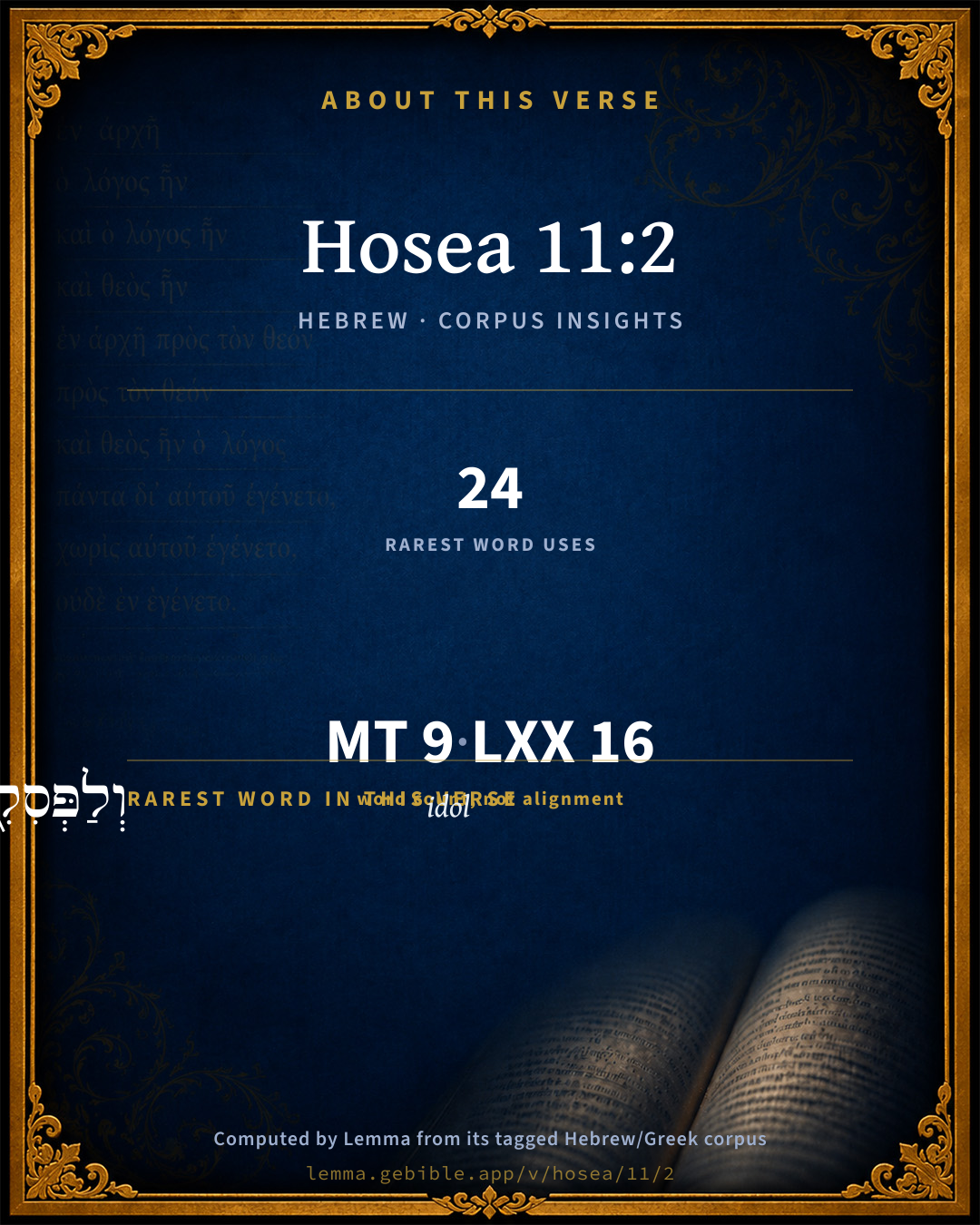
The rarest word here is וְלַפְּסִלִ֖ים idol H6456 — appearing just 24 times in the whole Hebrew Bible.

Shared distinctive vocabulary

וְלַפְּסִלִ֖ים idol H6456 occurs in 24 verses of the Hebrew Bible. Also found in:

Grammatical profile

  • 4 verbs
  • 3 nouns
  • 1 preposition
  • 1 particle

Verb forms

  • קָרְא֖וּ Qal · Perfect
  • הָלְכ֣וּ Qal · Perfect
  • יְזַבֵּ֔חוּ Piel · Imperfect
  • יְקַטֵּרֽוּן Piel · Imperfect

Hebrew & Septuagint length

In English translation the verse runs 20 words from the Hebrew and 20 from the Septuagint (LXX English) — the same length.

A rough comparison of the two English renderings, which tokenize alike — not a word-level alignment.

Word counts can differ between the Hebrew and the Greek without any difference in meaning — e.g. the Hebrew direct-object marker אֵת has no separate Greek word, and Greek often adds the article ὁ.

In the original languages it is 9 Hebrew tokens and 16 Greek tokens — but the two are counted differently (Hebrew bundles its prefixes and suffixes into one token; the Greek is in lemma form), so that isn’t a like-for-like length.

Cross-references

24

Topical passages linked to Hosea 11:2 in the Treasury of Scripture Knowledge — connected by theme and wording, ordered by reader-vote popularity; previews shown in the World English Bible.

  • Jeremiah 18:15 For my people have forgotten me, they have burned incense to false [gods]; and they have been made to stumble in their ways, in the ancient paths, to walk in byways, in a way not built up;
  • Hosea 2:13 I will visit on her the days of the Baals, To which she burned incense, When she decked herself with her earrings and her jewels, And went after her lovers, And forgot me," says Yahweh.
  • Isaiah 65:7 your own iniquities, and the iniquities of your fathers together, says Yahweh, who have burned incense on the mountains, and blasphemed me on the hills; therefore will I first measure their work into their bosom.
  • 2 Kings 17:13–16 Yet Yahweh testified to Israel, and to Judah, by every prophet, and every seer, saying, Turn you from your evil ways, and keep my commandments and my statutes, according to all the law which I commanded your fathers, and which I sent to you by my servants the prophets.
  • Hosea 11:7 My people are determined to turn from me. Though they call to the Most High, He certainly won't exalt them.
  • Hosea 13:1–2 When Ephraim spoke, there was trembling. He exalted himself in Israel, But when he became guilty in Baal, he died.
  • John 3:19 This is the judgment, that the light has come into the world, and men loved the darkness rather than the light; for their works were evil.
  • Acts 7:51 "You stiff-necked and uncircumcised in heart and ears, you always resist the Holy Spirit! As your fathers did, so you do.
  • Deuteronomy 29:2–4 Moses called to all Israel, and said to them, You have seen all that Yahweh did before your eyes in the land of Egypt to Pharaoh, and to all his servants, and to all his land;
  • Judges 10:6 The children of Israel again did that which was evil in the sight of Yahweh, and served the Baals, and the Ashtaroth, and the gods of Syria, and the gods of Sidon, and the gods of Moab, and the gods of the children of Ammon, and the gods of the Philistines; and they forsook Yahweh, and didn't serve him.
  • 1 Samuel 8:7–9 Yahweh said to Samuel, Listen to the voice of the people in all that they tell you; for they have not rejected you, but they have rejected me, that I should not be king over them.
  • 1 Kings 12:33 He went up to the altar which he had made in Bethel on the fifteenth day in the eighth month, even in the month which he had devised of his own heart: and he ordained a feast for the children of Israel, and went up to the altar, to burn incense.
  • 1 Kings 16:31–32 It happened, as if it had been a light thing for him to walk in the sins of Jeroboam the son of Nebat, that he took as wife Jezebel the daughter of Ethbaal king of the Sidonians, and went and served Baal, and worshiped him.
  • 1 Kings 18:19 Now therefore send, and gather to me all Israel to Mount Carmel, and the prophets of Baal four hundred fifty, and the prophets of the Asherah four hundred, who eat at Jezebel's table.
  • 2 Chronicles 36:15–16 Yahweh, the God of their fathers, sent to them by his messengers, rising up early and sending, because he had compassion on his people, and on his dwelling-place:
  • Nehemiah 9:30 Yet many years did you bear with them, and testified against them by your Spirit through your prophets: yet would they not give ear: therefore gave you them into the hand of the peoples of the lands.
  • Isaiah 30:9–11 For it is a rebellious people, lying children, children who will not hear the law of Yahweh;
  • Jeremiah 35:13 Thus says Yahweh of Hosts, the God of Israel: Go, and tell the men of Judah and the inhabitants of Jerusalem, Will you not receive instruction to listen to my words? says Yahweh.
  • Jeremiah 44:15–17 Then all the men who knew that their wives burned incense to other gods, and all the women who stood by, a great assembly, even all the people who lived in the land of Egypt, in Pathros, answered Jeremiah, saying,
  • Zechariah 7:11 But they refused to listen, and turned their backs, and stopped their ears, that they might not hear.
  • Luke 13:34 "Jerusalem, Jerusalem, that kills the prophets, and stones those who are sent to her! How often I wanted to gather your children together, like a hen gathers her own brood under her wings, and you refused!
  • Judges 2:13 They forsook Yahweh, and served Baal and the Ashtaroth.
  • Judges 3:7 The children of Israel did that which was evil in the sight of Yahweh, and forgot Yahweh their God, and served the Baals and the Asheroth.
  • 2 Corinthians 2:15–16 For we are a sweet aroma of Christ to God, in those who are saved, and in those who perish;

Cross-references courtesy of OpenBible.info (CC BY 4.0).

Hebrew and Greek witnesses Masoretic Hebrew ↔ Greek Septuagint

The same verse in the two great witnesses to the Old Testament, shown verse-for-verse.

These are two independent witnesses, not word-aligned to each other, and the Septuagint is shown in lemma (dictionary) form.

Hebrew Hosea 11:2 Masoretic · Westminster Leningrad Codex

קָרְא֖וּ לָהֶ֑ם כֵּ֚ן הָלְכ֣וּ מִפְּנֵיהֶ֔ם לַבְּעָלִ֣ים יְזַבֵּ֔חוּ וְלַפְּסִלִ֖ים יְקַטֵּרֽוּן

They called to them, so they went from them. They sacrificed to the Baals, And burned incense to engraved images.

World English Bible · Public Domain

Greek LXX Hosea 11:2 Septuagint · lemma form

καθώς μετακαλέω αὐτός οὕτως ἀποοἴχομαι ἐκ πρόσωπον ἐγώ αὐτός ὁ βααλιμ θύω καί ὁ γλυπτός θυμιάω

As I called them, so they departed from my presence: they sacrificed to Baalim, and burnt incense to graven images.

LXX2012 (modern English Septuagint) · Public Domain

On this verse, Haydock's Catholic Bible Commentary discusses the Septuagint’s reading. Read the note in Commentary ↓

Hebrew: Westminster Leningrad Codex (CC BY 4.0). Greek: Septuagint (public domain); English from LXX2012 (modern English Septuagint) (Public Domain). How the Septuagint differs from the Hebrew →

Targum (Aramaic paraphrase)

1

The Targum is the ancient Jewish Aramaic paraphrase of the Hebrew Scriptures — an interpretive translation, not the Hebrew text itself. Onkelos (literal) and Pseudo-Jonathan (expansive) render the Torah, and Jonathan the Prophets. Coverage is partial: where no permissively-licensed English translation exists for a verse, only the Aramaic is shown. This is verse-level text, not a word-by-word alignment to the Hebrew.

  1. Targum Jonathan Prophets (Joshua–Malachi)
    שְׁלָחֵית נְבִיֵי לַאֲלָפָא לְהוֹן וְאִינוּן טָעוּ מִקָבֵיל אַפֵּיהוֹן לְטַעֲוָתָא מְדַבְּחִין וּלְצַלְמָנַיָא מַסְקִין בּוּסְמִין:

    (no public-domain English translation for this verse)

    Targum Jonathan — Aramaic: “Mikraot Gedolot” (public domain). English: “Sefaria Community Translation” (CC0 1.0 (public-domain dedication)); “London "Chaldee Paraphrase," 1871” (public domain). Text via Sefaria.

Commentary

Notes on Hosea 11:2 from classic Christian and Jewish commentators (each source and its license shown beneath its notes). The classic Christian expositions comment on the surrounding passage and are grouped to its opening verse, so a note may address several verses; the Jewish commentaries on the Tanakh (Rashi and others) are per-verse, so they appear only where the commentator wrote on this verse.

Lemma curates 59 commentaries, every one of them public domain or Creative Commons licensed, each selected and text-cleaned for this edition rather than reprinted as found. About our sources →

Trapp's Complete Commentary

John Trapp

Hos 11:2 [As] they called them, so they went from them: they sacrificed unto Baalim, and burned incense to graven images.

Ver. 2. As they called them] i.e. As the prophets and ministers (whose names are here concealed, that the Word only may be glorified, as Act 13:48) called to them, to come out of spiritual Egypt, out of darkness to light, and from the power of Satan to God, that they might receive forgiveness of sins, and inheritance among the saints, by faith that is in Christ, Act 26:18.

So they went from them] They went a contrary way, as the child Samuel, when God called him, ran to Eli; or rather as the wilful Jews, when God would have gathered them, as the hen doth her chickens, they would not. When God called his natural Son out of Egypt, he came presently, Heb 10:7 Psa 40:7-8; not so his adopted sons; for they turned upon him the back, and not the face, Jer 2:27, they refused to be reformed, they hated to be healed. See Hos 7:1. {See Trapp on "Hos 7:1"} Nay, to make up the full measure of their sins, and to heighten their contempt,

They sacrificed unto Baalim, and burnt incense to graven images] Quasi aegre facturi Deo, as if they would despite God on purpose, and spit in his very face; commit the like villany in his presence, as the Irish rebels lately did, when they bound the husband to the bedpost, while they abused his wife before him. See the notes on Hos 2:1-23, and almost on every chapter where their idolatry is cried out upon, and their extreme ingratitude.

John Trapp, A Commentary or Exposition upon All the Books of the Old and New Testament (1647–1656) — public domain. Text from a community e-Sword module.

The Biblical Illustrator

Joseph S. Exell

Hos_11:2

They sacrificed unto Baalim, and burned incense to graven images.

Graven images

We read frequently of graven images and of molten images, and the words are become so familiar as names of idolatrous images that, although they axe not well chosen to express the Hebrew names, it seems not advisable to change them for others that might more exactly correspond with the original. The graven imago was not a thing wrought in metal by the tool of the workman we should now call an engraver; nor was the molten image an image made of metals or any ether substance, melted and shaped in a mould. In fact, the graven image and the molten image are the same thing under different names. The images of the ancient idolaters were first cut out of wood by the carpenter, as is very evident from the prophet Isaiah. This figure of wood was overlaid with plates either of gold or silver, or sometimes perhaps of an inferior metal, and in this finished state it was called a graven image (i.e., a carved image)

, in reference to the inner solid figure of wood, and a molten (i.e., an overlaid or covered)

image, in reference to the outer metalline case or cover. Sometimes both epithets are applied to it at once (Nah_1:14; Hab_2:18). The English word molten conveys a notion of melting or fusion. But this is not the case with the Hebrew word for which it is given. The Hebrew signifies to spread, or cover all over, either by pouring forth a substance in fusion, or in spreading a cloth over or before, or by hammering on metalline plates. (Bishop Horsley.)

The Biblical Illustrator, edited by Joseph S. Exell (c. 1880s–1900s) — public domain. Text from a community e-Sword module.

Joseph Benson's Commentary

Hos 11:2. As they called them, so, &c. — Or, The more they called them, or, they were called, so much the more they went from him; that is, the more earnestly the prophets called upon them to cleave steadfastly to the true God, (see Hos 11:7,) the more they were bent to depart from him to the worship of idols. They sacrificed to Baalim — See note on Hos 2:13. And burned incense to graven images — “We read frequently, in our English Bibles, of graven images, and of molten images. And the words are become so familiar, as names of idolatrous images, that, although they are not well chosen to express the Hebrew names, it seems not advisable to change them for others, that might more exactly correspond with the original. The graven image was not a thing wrought in metal by the tool of the workman we should now call an engraver; nor was the molten image an image made of metal, or any other substance melted, and shaped in a mould. In fact, the graven image and the molten image are the same thing under different names. The images of the ancient idolaters were first cut out of wood by the carpenter, as is very evident from the Prophet Isaiah. The figure of wood was overlaid with plates, either of gold or silver, or sometimes, perhaps, of an inferior metal. And in this finished state it was called a graven image, (that is, a carved image,) in reference to the inner solid figure of wood, and a molten (that is, an overlaid, or covered) image in reference to the outer metalline case, or covering. And sometimes both epithets are applied to it at once:” see Nah 1:14; Hab 2:18, and Bishop Horsley.

Joseph Benson's Commentary on the Old and New Testaments (1811–1818) — public domain. Text from a community e-Sword module.

Tyndale Open Study Notes

Tyndale Open Resources

11:2 In spite of God’s love, Israel had become a rebellious child, offering sacrifices to . . . Baal. The penalty for a rebellious son was death (Deut 21:18-21).

Tyndale Open Study Notes — © Tyndale Open Resources, licensed CC BY-SA 4.0. Text via the HelloAO Bible API.

Geneva Bible (1599)

Geneva Bible translators

They rebelled and went a contrary way when the Prophets called them to repentance.

Geneva Bible (1599) marginal notes — public domain. Text via Bolls.life.

Jamieson, Fausset & Brown

Robert Jamieson, A. R. Fausset & David Brown

As they called them--"they," namely, monitors sent by Me. "Called," in Hos 11:1, suggests the idea of the many subsequent calls by the prophets.

went from them--turned away in contempt (Jer 2:27).

Baalim--images of Baal, set up in various places.

Jamieson, Fausset & Brown — Commentary Critical and Explanatory on the Whole Bible (1871) — public domain (CC PDM 1.0). Text via the HelloAO Bible API.

John Calvin's Commentaries

The Prophet now repeats the ingratitude of the people in neglecting to keep in mind their redemption. The word, “called,” is here to be taken in a different sense. For God effectually called, as they say, the people, or his Son, from Egypt: he has again called by the outward voice or teaching through his Prophets. Hence, when he said before that he called his Son from Egypt, it ought to be understood, as they say, of actual liberation: but now when he says, They have called them, it is to be understood of teaching. The name of the Prophets is not expressed; but that they are intended is plain. And the Prophet seems designedly to have said in an indefinite manner, that the people had been called, that the indignity might appear more evident, as they had been called so often and by so many, and yet had refused. Hence they have called them When he thus speaks, he is not to be understood as referring to one or two men, or to a few, but as including a great number of men, doing this everywhere. Even thus now have they called them; that is, this people have been called, not once or twice, but constantly; and God has not only sent one messenger or preacher to call them, but there have been many Prophets, one after the other, often thus employed, and yet without any benefit. We now perceive what the Prophet meant.

They have called them, he says, so they went away from their presence The particle so, כן, can, is introduced here to enliven the description; for the Prophet points out, as by the fingers how wickedly they conspired to execute their own counsels, as if they wished purposely to show in an open manner their contempt. So they went away; when the Prophets called them to one course, they proceeded in an opposite one. We then see, that to point out thus their conduct was not superfluous, when he says, that they in this manner went away: and then he says, from their face Here he shows that the people sought hiding-places and shunned the light. We may indeed conclude from these words, that so great was the perverseness of the people, that they not only wished to be alienated from God, but also that they would have nothing to do with the Prophets. It is indeed a proof of extreme wickedness, when instruction itself is a weariness, and ministers cannot be endured; and no doubt the Prophet meant to set forth this sin of the people.

He afterwards says, that they sacrificed unto Baalim, and burnt incense to graven images In the former clause, he shows the contumacy of the Israelites, that they deigned not to give ear to God’s servants. He now adds, that they made incense to graven images, and also offered worship to their idols. By Baalim, as it has been already stated, the Prophet means the inferior gods. For no such stupidity prevailed among the people as not to think that there is some chief deity; nay, even profane Gentiles confessed that there is some supreme God. But they called their advocates (patronos) Baalim, as we see to be the case at this day under the Papacy, this same office is transferred to the dead; they are to procure for men the favour of God. The Papists then have no grounds for seeking an evasion by words; for the very same superstition prevails at this time among them, as prevailed formerly among Gentiles and the people of Israel. Here the Prophet enhances the wickedness of the people; for they not only contemptuously neglected every instruction in religion, but also openly perverted the whole worship of God, and abandoned themselves to all abominations, so as to burn incense to their own idols. Let us go on —

John Calvin's Commentaries (1540-1563) — public domain. Text from the Calvin Translation Society English edition (1840s-50s) via the Christian Classics Ethereal Library (ccel.org). Calvin's coverage is partial (roughly two-thirds of the Bible); uncommented books and verses are honest gaps, never fabricated. The 19th-century editor's footnotes and remarks are omitted so the notes are faithfully Calvin's own voice.

Ellicott's Commentary for English Readers

(2) As they (i.e., the prophets) called them, so they (Israel) went from them.—Sought to avoid the voice and presence of the men of God.

A Bible Commentary for English Readers, edited by Charles John Ellicott (1878–1897) — public domain. Text from a community e-Sword module.

The Cambridge Bible for Schools and Colleges

gen. ed. J. J. S. Perowne

2. As they called them, &c.] Or, The more they called them, &c. (comp. Hos_4:7). Since Israel disobeyed the first call by Moses, prophets were sent to repeat the call, but their preaching only seemed to increase Israel’s obstinacy (comp. Isa_6:9-10; Jer_7:25-26). What, then, was the good of prophecy? It kept up a church within the nation, and it developed ideas which bore fruit in due time.

unto Baalim, &c.] Rather, to the Baalim (see on Hos_2:13) … to the graven images.

The Cambridge Bible for Schools and Colleges (gen. ed. J. J. S. Perowne; Cambridge University Press, 1878–1918) — public domain. Text from a community e-Sword module.

John Gill's Exposition

As they called them, so they went from them,.... That is, the prophets of the Lord, the true prophets, called Israel to the worship and service of God; but they turned a deaf ear to them, and their backs upon them; and the more they called to them, the further they went from them, and from the way of their duty; see Hos 11:7. So the Targum,

"I sent the prophets to teach them, but they wandered from them;''

Moses and Aaron were sent unto them, and called them out of Egypt, but they hearkened not unto them; see Exo 6:9; in later times the prophets were sent unto them, to exhort them to their duty, and to reclaim them from their evil ways, but they despised and refused to attend to their advice and instructions; and this was continued to the times of Israel, or the ten tribes, departing from the house of David, and setting up idolatrous worship; and during their revolt and apostasy: but all in vain. So after Christ was called out of Egypt, he and his apostles, and John the Baptist before them, called them to hearken to him, but they turned away from them. Aben Ezra interprets it of the false prophets, who called them to idolatry, and they went after them. Schmidt understands it of the Israelites calling one another to it, and going after it, for their own sakes, and because it pleased them, and was agreeable to them;

they sacrificed to Baalim, and burnt incense to graven images: they joined themselves to Baalpeor, and worshipped the golden calf, fashioned with a graving tool, in the wilderness; they sacrificed to Baalim, one or another of them, in the times of the judges, and of Ahab, and committed idolatry with other graven images, of which burning incense is a part. And the Jews in Christ's time, instead of hearkening to him and his apostles, followed the traditions of the elders, and the dictates of the Scribes and Pharisees, who were their Baals, their lords and masters and they sought for life and righteousness by their own works, which was sacrificing to their net, and burning incense to their drag; all this was great ingratitude. Next follows a narrative of other benefits done to this people.

John Gill's Exposition of the Whole Bible (1746–1763) — public domain (CC PDM 1.0). Text via the HelloAO Bible API.

Albert Barnes' Notes on the Bible

As they called them, so they went from them - The prophet changes his tone, no longer speaking of that one first call of God to Israel as a whole, whereby He brought out Israel as one man, His one son; which one call he obeyed. Here he speaks of God’s manifold calls to the people, throughout their whole history, which they as often disobeyed, and not disobeyed only, but went contrariwise. “They called them.” Whether God employed Moses, or the judges, or priests, or kings, or prophets, to call them, it was all one. Whenever or by whomsoever they were called, they turned away in the opposite direction, to serve their idols. They proportioned and fitted, as it were, their disobedience to God’s long-suffering. : “Then chiefly they threw off obedience, despised their admonitions, and worked themselves up the more franticly to a zeal for the sin which they had begun.” “They,” God’s messengers, “called; so,” in like manner, “they went away from them. They sacrificed unto Baalim,” i. e., their many Baals, in which they cherished idolatry, cruelty, and fleshly sin. : So “when Christ came and called them manifoldly, as in the great day of the feast, “If any man thirst, let him come unto Me and drink,” the more diligently He called them, the more diligently they went away from Him, and returned to their idols, to the love and possession of riches and houses and pleasures, for whose sake they despised the truth.”

Albert Barnes' Notes on the Bible (1834–1885) — public domain. Text from a community e-Sword/MySword module.

Haydock's Catholic Bible Commentary

They called: viz., Moses and Aaron called: but they went away after other gods, and would not hear. (Challoner) --- Septuagint, "As I called them back, or (repeatedly; Greek: metekalesa. Grabe has, "he called;" meaning any of God’s ministers) so they rushed away from my presence." (Haydock) --- This sense appears preferable to the Hebrew. (Calmet)

George Leo Haydock (1774–1849), Haydock's Catholic Family Bible and Commentary, 1859 edition — public domain. Excludes Psalms (Douay-Rheims chapter numbering differs from Protestant) and Deuterocanonical books (Catholic canon only).

Matthew Poole's English Annotations

As they; Moses and Aaron, and other prophets, and holy, zealous judges and priests, as Samuel, &c.

Called; advised, persuaded, entreated, and urged by exhortations.

Them; the whole house of Israel, and among these the ten tribes, or Ephraim.

So they Israelites, called and entreated, especially they of that age when the division was made, and ever since.

Went from; frowardly and most disingenuously apostatized more and more, as the prophet, Isa 1:5. Horrible ingratitude so to requite God!

From them; from the prophets’ counsel and commands, delivered as they came from God.

They sacrificed unto Baalim; in the desert they began this apostacy, joined themselves to Baal-peor, Num 25:3, and worshipped the calf, Exo 32:4-6, and held on with obstinacy in it.

Graven images; images of their gods, before which they performed another part of religious worship, burning incense before them.

Matthew Poole's English Annotations on the Holy Bible (1683–1685) — public domain. Text from a community e-Sword/MySword module.

Whedon's Commentary on the Bible

Daniel D. Whedon

2. Jehovah’s love was met with bitter ingratitude.

As they called — R.V., “The more the prophets called.” The prophets is not in the Hebrew, but the Revisers were correct in supplying it as the subject (compare Hos_11:7). Jehovah did not cease calling when the efforts of Moses proved a partial failure; he raised up prophets (Amo_2:11-12), but the more earnestly these labored the more stubborn the resistance of the people (compare Isa_6:9-10; Jer_7:25-26). Notwithstanding the people’s obstinacy, the activity of the prophets was not a failure; it resulted in the preservation of a remnant out of which might grow a new nation of God.

Much did the prophets expect of this remnant, and much did it accomplish, though not all that the prophets expected. Nevertheless it prepared the way for him who alone was able to finish the work. A very slight change in the text, supported in part by LXX. and Peshitto, would give, “The more I called them, the more they went from me.”

Baalim — See on Hos_2:5.

Burned incense — See on Hos_2:13.

Graven images — See on Mic_5:13. Hos_11:1-2 aptly describe the religious history from the Exodus to the days of Hosea; on the one hand, the intense love and care of Jehovah, on the other, the persistent rebellion of the people.

Hos_11:3 presents the tender care of Jehovah under the figure of a parent’s gentle dealings with his child. I — Emphatic in Hebrew; in contrast to the Baalim.

Ephraim — The northern kingdom.

Taught… to go — Directed their footsteps in a providential way, kept them from falling and, when they did fall, helped them to rise again. Taking them by their arms —Literally (though the Hebrew form is peculiar), he took them upon his arms. R.V., following most ancient versions, “I took them on my arms.” A climax to the preceding. I lovingly taught the young child to walk, and when he grew weary I lovingly took him upon my arms and carried him (Isa_63:9; Deu_1:31).

They knew not — See on Hos_2:8.

That I healed them — A common figure in Hosea (Hos_5:13; Hos_6:1; Hos_7:1; compare Exo_15:26). To get the full meaning it is necessary to supply the thought, “When in their attempt to walk they fell and hurt themselves.”

Hos_11:4 contains a new figure of the fatherly care of Jehovah. “Israel is no longer the wanton young cattle of the previous chapter (Hos_10:11), which needs the yoke firmly fastened on the neck but a team of toiling oxen mounting some steep road.” Jehovah acted not the part of a cruel driver, but in a humane manner assisted the animal to accomplish its task.

Drew — Not drove; he lent a helping hand to the weary beast.

Cords of a man — Such as are adapted to a human being; these are bands (cords) of love — Used in a spirit of love. Through love he sought to control and guide.

Take off [“lift up”] the yoke on their jaws — While he gladly assisted the animal, he did not — and could not — take the whole task upon himself. The yoke remained upon the animal, but he placed it so it would not press too heavily upon the neck and jaws (cheeks) and make them sore. The manner of easing the yoke to which the prophet refers is not quite clear, since we do not know sufficiently the form of the ancient yoke.

I laid meat unto them [“food before them”] — Literally, and gently I laid food before them, or, better still, And I bent toward him and gave him food. The task done, plenty of food was given to the animal. Thus in an indulgent and compassionate manner Jehovah supplied the needs of his people.

Daniel D. Whedon (gen. ed.), Commentary on the Old and New Testaments (1874–1909) — public domain. Text from a community e-Sword module.

The Pulpit Commentary

As they called them, so they went from them: they sacrificed unto Baalim, and burned incense to graven images.

(1) Adverting to his own call mentioned in the first verse, God here refers to the many subsequent calls which he addressed to them through his servants the prophets and other messengers.

(2) The subject of the verb is erroneously understood by some, as, for example, Aben Ezra and Eichhorn, to be the idols, or their false priests or prophets; while

(3) Jerome is also mistaken in referring the words to the time of Israel"s rebelling when Moses and Aaron wished to lead them out of Egypt. The correct reference is that first stated, and the sense is that, instead of appreciating the invitations and monitions of the prophets of God, they showed their utter insensibility and thanklessness, turning away from them in contempt and scorn. Nay, the more the messengers of God called them, the more they turned a deaf ear to those who were their truest friends and best advisers. Pursuing their idolatrous practices, they sacrificed to Baal, that is to say, the various representations of that idol, and burned incense to their images, whether of wood or stone or precious metal. Thus Kimchi correctly comments as follows: "The prophets which I sent to them called to them morning and evening to turn to Jehovah, so (much the more) did they go away from them, not hearkening to their words nor desisting from their evil works." The word ke, even so, denoting the measure or relation, corresponds to r to be supplied in the first clause. The imperfects imply continuance of action or a general truth.

(4) The Septuagint rendering, followed by the Syriac, is ek proswpou mou autoi , "from my presence: they;" as if they had read on ynpmi instead of the present text.

The Pulpit Commentary (1880–1919), ed. H.D.M. Spence-Jones & Joseph S. Exell — public domain. Text from a community e-Sword module.

John Wesley's Explanatory Notes

They - Moses and Aaron, and other prophets. Called - Persuaded, intreated, and urged by exhortations, the whole house of Israel. From them - From the prophets counsel and commands. Baalim - In the desert they began this apostacy, and held on with obstinacy in it.

John Wesley, Explanatory Notes Upon the Whole Bible (1754–1765) — public domain. Text via the GEBible commentary corpus.

Rashi

Rabbi Shlomo Yitzchaki (Rashi)

The more they called to them, the more they went away from them As much as the prophets call to teach them the good way, so did they turn their backs to run away from them.

and they would slaughter sacrifices to the baalim. It is customary for Scripture to speak in this manner. Comp. (above 4:7) “The more they have increased, the more they have sinned against Me”; (Ex. 1:12) “And the more they afflicted them, the more they increased.”

Rashi on the Tanakh — English translations: “The Judaica Press complete Tanach with Rashi, translated by A. J. Rosenberg” (CC BY 4.0); “Pentateuch with Rashi's commentary by M. Rosenbaum and A.M. Silbermann, 1929-1934” (public domain); “The Metsudah Tanach series, Lakewood, N.J” (CC BY 4.0); and “The Book of Joshua, Metsudah Publications, 1997” (CC BY 4.0). Text via Sefaria.

Lesson kit

Teaching starters — assembled from the data on this page, not authored interpretation. Every prompt links to the verse data it draws on. Edit before teaching.

Hosea, in the Prophets, opens this verse with 9 words (8 distinct Hebrew lemmas). Its most distinctive word is pᵉçîyl (“idol”). A historical commentator’s framing appears above. Read the whole chapter for the surrounding context.

Discussion questions

  1. The word pᵉçîyl carries the sense “idol.” How does it shape the verse?
  2. Deuteronomy 7:5 shares the word «idol» with this verse. How do the two illuminate each other?
  3. These translations render this verse differently; the difference is in the English rendering, not the original. What questions does that raise?
  4. The verb «קָרְא֖וּ» is Qal Perfect. How does its form color the action?
  5. Reading how Trapp's Complete Commentary and The Biblical Illustrator read this verse, where do the two commentators agree and where do they part?

Things to notice

Reading settings

Reading text

Shown beneath each verse's original-language words.

Old Testament
Old Testament edition

Read the OT as the Masoretic Hebrew (MT) or the Greek Septuagint (LXX).

English shown for the Greek Septuagint (in the Hebrew ↔ Greek comparison).

Comparing translations? Open the Compare panel on any verse page to stack up to four side by side.