

1 Samuel 29:6

Hebrew (Westminster Leningrad Codex) 1 Samuel 29:6 appears in the Hebrew Old Testament. The text above is from the Westminster Leningrad Codex. Each word links to its Strong’s number, a concise gloss, and parsing drawn from the Open Scriptures Hebrew Bible morphology. Click any word for its full Brown-Driver-Briggs (BDB) entry.
Download image
Cite this verse

1 Samuel 29:6 (World English Bible). Public Domain. Lemma interlinear Bible study tool, https://lemma.gebible.app/v/1-samuel/29/6.

Show BibTeX & RIS
BibTeX
RIS
English Translation
Then Achish called David, and said to him, As Yahweh lives, you have been upright, and your going out and your coming in with me in the host is good in my sight; for I have not found evil in you since the day of your coming to me to this day: nevertheless the lords don't favor you.
World English Bible · Public Domain
Download a study sheet

One document with this verse’s original text, its word-by-word gloss line, the meaning frame, cross-references with their text, attributed commentary, and full source and license credits — printable, and it pastes into notes with its structure intact.

This verse Autodidact and up

Study sheet (.html) Plain text (.txt)

A passage Seminary Student

Up to 50 verses in one chapter. A passage sheet keeps up to 6 commentary sources and 12 cross-references per verse, in the order this page ranks them, and says so on the sheet whenever that leaves anything out. Ask for a single verse and you get the Autodidact verse sheet above.

Everything on this page stays free to read, with no account — the sheet is a download of what is already on screen, not access to it.

Want to remove ads? Support Godless Engineer
Compare translations 3

The same verse in 3 English versions, stacked beneath the original-language interlinear above. Click any original word for its lexicon entry.

Each is an independent rendering of the whole verse — the interlinear is not word-aligned to these translations.

Highlighted words mark where these versions differ — a whole-verse word diff, not a word-by-word alignment.

  • World English Bible Public Domain
    Then Achish called David, and said to him, As Yahweh lives, you have been upright, and your going out and your coming in with me in the host is good in my sight; for I have not found evil in you since the day of your coming to me to this day: nevertheless the lords don't favor you.
  • King James Version Public Domain
    Then Achish called David, and said unto him, Surely, as the LORD liveth, thou hast been upright, and thy going out and thy coming in with me in the host is good in my sight: for I have not found evil in thee since the day of thy coming unto me unto this day: nevertheless the lords favor thee not.
  • unfoldingWord Literal Text CC BY-SA 4.0
    So Achish called to David and said to him, “The life of Yahweh, that you upright, and your going out and your coming in with me in the camp good in my eyes, for I have not found evil in you from the day of your coming to me to this day. But in the eyes of the lords you not good.

unfoldingWord Literal Text — © unfoldingWord, licensed CC BY-SA 4.0. Word-aligned USFM3 via Door43 (git.door43.org/unfoldingWord/en_ult).

Versions to compare (up to 4)

3 of 4 selected

Show all 18 translations

Every available English version of this verse, each an independent rendering of the whole verse.

  • World English Bible Public Domain
    Then Achish called David, and said to him, As Yahweh lives, you have been upright, and your going out and your coming in with me in the host is good in my sight; for I have not found evil in you since the day of your coming to me to this day: nevertheless the lords don't favor you.
  • Berean Standard Bible Public Domain
    So Achish summoned David and told him, “As surely as the LORD lives, you have been upright in my sight, and it seems right that you should march in and out with me in the army, because I have found no fault in you from the day you came to me until this day. But you have no favor in the sight of the leaders.
  • Majority Standard Bible Public Domain
    So Achish summoned David and told him, “As surely as the LORD lives, you have been upright, and it seems right in my sight that you should march in and out with me in the army, because I have found no fault in you from the day you came to me until this day. But you are not good in the sight of the leaders.
  • King James Version Public Domain
    Then Achish called David, and said unto him, Surely, as the LORD liveth, thou hast been upright, and thy going out and thy coming in with me in the host is good in my sight: for I have not found evil in thee since the day of thy coming unto me unto this day: nevertheless the lords favor thee not.
  • American Standard Version (1901) Public Domain
    Then Achish called David, and said unto him, As Jehovah liveth, thou hast been upright, and thy going out and thy coming in with me in the host is good in my sight; for I have not found evil in thee since the day of thy coming unto me unto this day: nevertheless the lords favor thee not.
  • Revised Version (1885) Public Domain
    Then Achish called David, and said unto him, As the LORD liveth, thou hast been upright, and thy going out and thy coming in with me in the host is good in my sight: for I have not found evil in thee since the day of thy coming unto me unto this day: nevertheless the lords favour thee not.
  • Geneva Bible (1599) Public Domain
    Then Achish called Dauid, and said vnto him, As the Lord liueth, thou hast bene vpright and good in my sight, when thou wentest out and in with mee in the hoste, neither haue I founde euill with thee, since thou camest to me vnto this day, but the princes doe not fauour thee.
  • Douay-Rheims (1899) Public Domain
    Then Achis called David, and said to him: As the Lord liveth, thou art upright and good in my sight: and so is thy going out, and thy coming in with me in the army: and I have not found my evil in thee, since the day that thou camest to me unto this day: but thou pleasest not the lords.
  • Young's Literal Translation Public Domain
    And Achish calleth unto David, and saith unto him, `Jehovah liveth, surely thou `art' upright, and good in mine eyes is thy going out, and thy coming in, with me in the camp, for I have not found in thee evil from the day of thy coming in unto me till this day; and in the eyes of the princes thou art not good;
  • Literal Standard Version CC BY-SA 4.0
    And Achish calls to David and says to him, “YHWH lives, surely you [are] upright, and good in my eyes is your going out, and your coming in with me in the camp, for I have not found evil in you from the day of your coming to me until this day; but you are not good in the eyes of the princes;
  • Unlocked Literal Bible CC BY-SA 4.0
    Then Achish called David and said to him, “As Yahweh lives, you have been good, and your going out and your coming in with me in the army is good in my view; for I have found nothing wrong with you since the day of your coming to me to this very day. Nevertheless, the princes are not favorable to you.
  • unfoldingWord Literal Text CC BY-SA 4.0
    So Achish called to David and said to him, “The life of Yahweh, that you upright, and your going out and your coming in with me in the camp good in my eyes, for I have not found evil in you from the day of your coming to me to this day. But in the eyes of the lords you not good.
  • Darby Bible Public Domain
    And Achish called David, and said to him, [As] Jehovah liveth, thou art upright, and thy going out and thy coming in with me in the camp is acceptable to me; for I have not found evil in thee since the day of thy coming to me to this day; but thou art not acceptable to the lords.
  • World Messianic Bible Public Domain
    Then Achish called David and said to him, “As the LORD lives, you have been upright, and your going out and your coming in with me in the army is good in my sight; for I have not found evil in you since the day of your coming to me to this day. Nevertheless, the lords don’t favor you.
  • Webster's Bible Public Domain
    Then Achish called David, and said to him, Surely, as the LORD liveth, thou hast been upright, and thy going out and thy coming in with me in the host is good in my sight: for I have not found evil in thee from the day of thy coming to me to this day: nevertheless the lords favor thee not.
  • Free Bible Version CC BY-SA 4.0
    So Achish called David over and told him, “As the Lord lives, you are honest and you've done what's right as far as I can see. As far as I'm concerned you should march with me into battle because I haven't found any fault in you from the day you arrived until now. But the other leaders don't approve of you.
  • Bible in Basic English Public Domain
    Then Achish sent for David and said to him, By the living Lord, you are upright, and everything you have done with me in the army has been pleasing to me: I have seen no evil in you from the day when you came to me till now: but still, the lords are not pleased with you.
  • JPS Tanakh (1917) Public Domain
    Then Achish called David, and said unto him: 'As the LORD liveth, thou hast been upright, and thy going out and thy coming in with me in the host is good in my sight; for I have not found evil in thee since the day of thy coming unto me unto this day; nevertheless the lords favour thee not.

Literal Standard Version (2020), Covenant Press — licensed CC BY-SA 4.0. Text via the HelloAO Bible API (eBible.org). Unlocked Literal Bible (unfoldingWord) — licensed CC BY-SA 4.0. Text via the HelloAO Bible API (eBible.org). unfoldingWord Literal Text — © unfoldingWord, licensed CC BY-SA 4.0. Word-aligned USFM3 via Door43 (git.door43.org/unfoldingWord/en_ult). Free Bible Version, Dr. Jonathan Gallagher — licensed CC BY-SA 4.0. Text via the HelloAO Bible API (eBible.org).

Word by word

More ways to search: Search by grammar → Find every occurrence → Compare this word →

Practice this passage: Drill this verse → Learn its vocabulary →

אָכִ֜ישׁ
ʼĂkîysh
H397
“Achish”
Noun, Proper
Part of Speech
Noun
Type
Proper
Full BDB Definition

Origin: of uncertain derivation

TWOT: None

Achish = "I will blacken (or terrify)" or " only a man" - Philistine king of Gath
  1. וַיִּקְרָ֨א qârâʼ H7121 “and · to call” Conjunction + Verb, Qal, Sequential Imperfect, 3rd Person, Masculine, Singular
  2. אֶל ʼêl H413 “to” Preposition
  3. דָּוִ֗ד Dâvid H1732 “David” Noun, Proper
  4. וַיֹּ֣אמֶר ʼâmar H559 “and · to say” Conjunction + Verb, Qal, Sequential Imperfect, 3rd Person, Masculine, Singular
  5. אֵ֠לָיו ʼêl H413 “to · him” Preposition + Suffix, Personal, 3rd Person, Masculine, Singular
  6. חַי chay H2416 “living” Adjective, Adjective, Masculine, Singular, Absolute
  7. יְהוָ֞ה Yᵉhôvâh H3068 “LORD” Noun, Proper
  8. כִּי kîy H3588 “that” Conjunction
  9. יָשָׁ֣ר yâshâr H3477 “upright” Adjective, Adjective, Masculine, Singular, Absolute
  10. אַתָּ֗ה ʼattâh H859 “you” Pronoun, Personal, 2nd Person, Masculine, Singular
  11. וְט֣וֹב ṭôwb H2896 “and · good” Conjunction + Adjective, Adjective, Masculine, Singular, Absolute
  12. בְּ֠עֵינַי ʻayin H5869 “in/at · eyes · my” Preposition + Noun, Common, Both, Dual, Construct + Suffix, Personal, 1st Person, Common, Singular
  13. צֵאתְךָ֨ yâtsâʼ H3318 “to go out · you” Verb, Qal, Infinitive Construct + Suffix, Personal, 2nd Person, Masculine, Singular
  14. וּבֹאֲךָ֤ bôwʼ H935 “and · to enter · you” Conjunction + Verb, Qal, Infinitive Construct + Suffix, Personal, 2nd Person, Masculine, Singular
  15. אִתִּי֙ ʼêth H854 “with · me” Preposition + Suffix, Personal, 1st Person, Common, Singular
  16. בַּֽמַּחֲנֶ֔ה machăneh H4264 “in/at the · camp” Preposition, Determined + Noun, Common, Both, Singular, Absolute
  17. כִּ֠י kîy H3588 “that” Conjunction
  18. לֹֽא lôʼ H3808 “not” Particle, Negative
  19. מָצָ֤אתִֽי mâtsâʼ H4672 “to find” Verb, Qal, Perfect, 1st Person, Common, Singular
  20. רָעָ֔ה raʻ H7451 “evil” Noun, Common, Feminine, Singular, Absolute
  21. מִיּ֛וֹם yôwm H3117 “from · day of” Preposition + Noun, Common, Masculine, Singular, Construct
  22. בֹּאֲךָ֥ bôwʼ H935 “to enter · you” Verb, Qal, Infinitive Construct + Suffix, Personal, 2nd Person, Masculine, Singular
  23. אֵלַ֖י ʼêl H413 “to · me” Preposition + Suffix, Personal, 1st Person, Common, Singular
  24. עַד ʻad H5704 “until” Preposition
  25. הַיּ֣וֹם yôwm H3117 “the · day” Particle, Definite Article + Noun, Common, Masculine, Singular, Absolute
  26. הַזֶּ֑ה zeh H2088 “the · this” Particle, Definite Article + Pronoun, Demonstrative, Masculine, Singular
  27. וּבְעֵינֵ֥י ʻayin H5869 “and · in/at · eyes of” Conjunction + Preposition + Noun, Common, Both, Dual, Construct
  28. הַסְּרָנִ֖ים çeren H5633 “the · lords” Particle, Definite Article + Noun, Common, Masculine, Plural, Absolute
  29. לֹֽא lôʼ H3808 “not” Particle, Negative
  30. ט֥וֹב ṭôwb H2896 “good” Adjective, Adjective, Masculine, Singular, Absolute
  31. אָֽתָּה ʼattâh H859 “you” Pronoun, Personal, 2nd Person, Masculine, Singular

About this verse

These counts appear in no published source. They are computed here, from the morphology-tagged text and Lemma’s own curated glosses. What Lemma adds →

33
words
23
distinct lemmas
Historical
section

Notable vocabulary

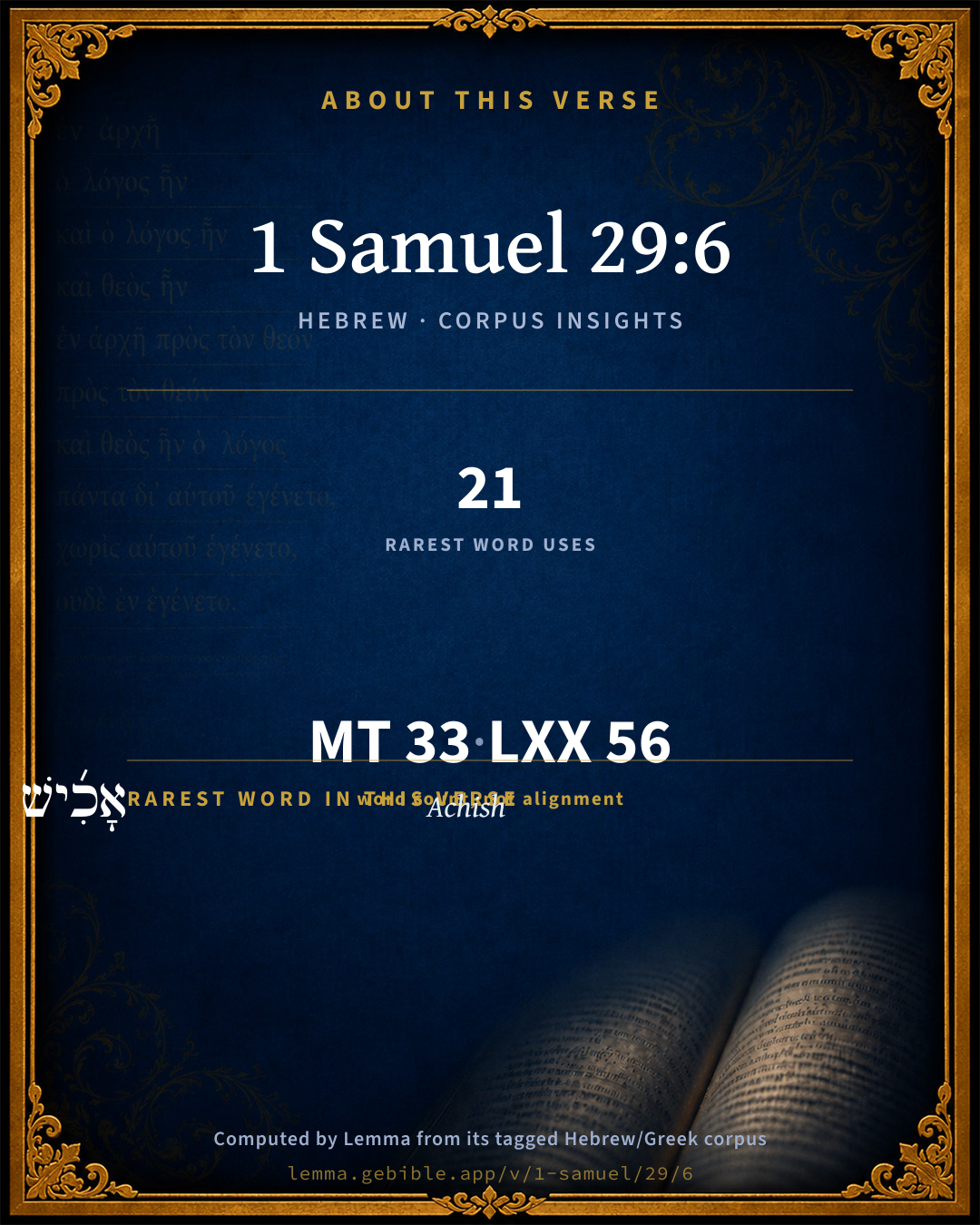
The rarest word here is אָכִ֜ישׁ Achish H397 — appearing just 21 times in the whole Hebrew Bible.

Shared distinctive vocabulary

אָכִ֜ישׁ Achish H397 occurs in 20 verses of the Hebrew Bible. Also found in:

Grammatical profile

  • 6 verbs
  • 10 nouns
  • 4 adjectives
  • 3 pronouns
  • 6 prepositions
  • 2 conjunctions
  • 2 particles

Verb forms

  • וַיִּקְרָ֨א Qal · Sequential Imperfect
  • וַיֹּ֣אמֶר Qal · Sequential Imperfect
  • צֵאתְךָ֨ Qal · Infinitive Construct
  • וּבֹאֲךָ֤ Qal · Infinitive Construct
  • מָצָ֤אתִֽי Qal · Perfect
  • בֹּאֲךָ֥ Qal · Infinitive Construct

Repetition

Words recur within this verse — often emphatic in Hebrew:

  • וְט֣וֹב good H2896 ×2
  • בְּ֠עֵינַי eye H5869 ×2
  • וּבֹאֲךָ֤ to enter H935 ×2
  • מִיּ֛וֹם day H3117 ×2
  • אֶל to H413 ×3
  • כִּי that H3588 ×2
  • אַתָּ֗ה you H859 ×2
  • לֹֽא not H3808 ×2

Hebrew & Septuagint length

In English translation the verse runs 58 words from the Hebrew and 68 from the Septuagint (LXX English) — closely comparable.

A rough comparison of the two English renderings, which tokenize alike — not a word-level alignment.

Word counts can differ between the Hebrew and the Greek without any difference in meaning — e.g. the Hebrew direct-object marker אֵת has no separate Greek word, and Greek often adds the article ὁ.

In the original languages it is 33 Hebrew tokens and 56 Greek tokens — but the two are counted differently (Hebrew bundles its prefixes and suffixes into one token; the Greek is in lemma form), so that isn’t a like-for-like length.

Cross-references

17

Topical passages linked to 1 Samuel 29:6 in the Treasury of Scripture Knowledge — connected by theme and wording, ordered by reader-vote popularity; previews shown in the World English Bible.

  • 2 Samuel 3:25 You know Abner the son of Ner, that he came to deceive you, and to know your going out and your coming in, and to know all that you do.
  • 2 Kings 19:27 But I know your sitting down, and your going out, and your coming in, and your raging against me.
  • 1 Samuel 20:3 David swore moreover, and said, Your father knows well that I have found favor in your eyes; and he says, Don't let Jonathan know this, lest he be grieved: but truly as Yahweh lives, and as your soul lives, there is but a step between me and death.
  • Psalms 121:8 Yahweh will keep your going out and your coming in, From this time forth, and forevermore.
  • Genesis 16:6 But Abram said to Sarai, "Behold, your maid is in your hand. Do to her whatever is good in your eyes." Sarai dealt harshly with her, and she fled from her face.
  • Numbers 27:17 who may go out before them, and who may come in before them, and who may lead them out, and who may bring them in; that the congregation of Yahweh not be as sheep which have no shepherd.
  • Deuteronomy 10:20 You shall fear Yahweh your God; him shall you serve; and to him shall you cleave, and by his name shall you swear.
  • Joshua 22:30 When Phinehas the priest, and the princes of the congregation, even the heads of the thousands of Israel that were with him, heard the words that the children of Reuben and the children of Gad and the children of Manasseh spoke, it pleased them well.
  • 1 Samuel 27:8–12 David and his men went up, and made a raid on the Geshurites, and the Girzites, and the Amalekites; for those [nations] were the inhabitants of the land, who were of old, as you go to Shur, even to the land of Egypt.
  • 1 Samuel 28:10 Saul swore to her by Yahweh, saying, As Yahweh lives, there shall no punishment happen to you for this thing.
  • 1 Samuel 29:3 Then said the princes of the Philistines, What [do] these Hebrews [here]? Achish said to the princes of the Philistines, Isn't this David, the servant of Saul the king of Israel, who has been with me these days, or [rather] these years, and I have found no fault in him since he fell away [to me] to this day?
  • Isaiah 37:28 But I know your sitting down, and your going out, and your coming in, and your raging against me.
  • Isaiah 65:16 so that he who blesses himself in the earth shall bless himself in the God of truth; and he who swears in the earth shall swear by the God of truth; because the former troubles are forgotten, and because they are hid from my eyes.
  • Jeremiah 12:16 It shall happen, if they will diligently learn the ways of my people, to swear by my name, As Yahweh lives; even as they taught my people to swear by Baal; then shall they be built up in the midst of my people.
  • Matthew 5:16 Even so, let your light shine before men; that they may see your good works, and glorify your Father who is in heaven.
  • 1 Peter 2:12 having good behavior among the nations, so in that which they speak against you as evil-doers, they may by your good works, which they see, glorify God in the day of visitation.
  • 1 Peter 3:16 having a good conscience; that, while you are spoken against as evildoers, they may be disappointed who curse your good manner of life in Christ.

Cross-references courtesy of OpenBible.info (CC BY 4.0).

Hebrew and Greek witnesses Masoretic Hebrew ↔ Greek Septuagint

The same verse in the two great witnesses to the Old Testament, shown verse-for-verse.

These are two independent witnesses, not word-aligned to each other, and the Septuagint is shown in lemma (dictionary) form.

Hebrew 1 Samuel 29:6 Masoretic · Westminster Leningrad Codex

וַיִּקְרָ֨א אָכִ֜ישׁ אֶל דָּוִ֗ד וַיֹּ֣אמֶר אֵ֠לָיו חַי יְהוָ֞ה כִּי יָשָׁ֣ר אַתָּ֗ה וְט֣וֹב בְּ֠עֵינַי צֵאתְךָ֨ וּבֹאֲךָ֤ אִתִּי֙ בַּֽמַּחֲנֶ֔ה כִּ֠י לֹֽא מָצָ֤אתִֽי בְךָ֙ רָעָ֔ה מִיּ֛וֹם בֹּאֲךָ֥ אֵלַ֖י עַד הַיּ֣וֹם הַזֶּ֑ה וּבְעֵינֵ֥י הַסְּרָנִ֖ים לֹֽא ט֥וֹב אָֽתָּה

Then Achish called David, and said to him, As Yahweh lives, you have been upright, and your going out and your coming in with me in the host is good in my sight; for I have not found evil in you since the day of your coming to me to this day: nevertheless the lords don't favor you.

World English Bible · Public Domain

Greek LXX 1 Samuel 29:6 Septuagint · lemma form

καί καλέω αγχους ὁ δαυίδ καί εἶπον αὐτός ζάω κύριος ὅτι εὐθής σύ καί ἀγαθός ἐν ὀφθαλμός ἐγώ καί ὁ ἔξοδος σύ καί ὁ εἴσοδος σύ μετά ἐγώ ἐν ὁ παρεμβολή καί ὅτι οὐ εὑρίσκω κατά σύ κακία ἀπό ὅς ἡμέρα ἥκω πρός ἐγώ ἕως ὁ σήμερον ἡμέρα καί ἐν ὀφθαλμός ὁ σατράπης οὐ ἀγαθός σύ

And Anchus called David, and said to him, As the Lord lives, you are right and approved in my eyes, and so is your going out and your coming in with me in the army, and I have not found any evil to charge against you from the day that you came to me until this day: but you are not approved in the eyes of the lords.

LXX2012 (modern English Septuagint) · Public Domain

Hebrew: Westminster Leningrad Codex (CC BY 4.0). Greek: Septuagint (public domain); English from LXX2012 (modern English Septuagint) (Public Domain). How the Septuagint differs from the Hebrew →

Targum (Aramaic paraphrase)

1

The Targum is the ancient Jewish Aramaic paraphrase of the Hebrew Scriptures — an interpretive translation, not the Hebrew text itself. Onkelos (literal) and Pseudo-Jonathan (expansive) render the Torah, and Jonathan the Prophets. Coverage is partial: where no permissively-licensed English translation exists for a verse, only the Aramaic is shown. This is verse-level text, not a word-by-word alignment to the Hebrew.

  1. Targum Jonathan Prophets (Joshua–Malachi)
    וּקְרָא אָכִישׁ לְדָוִד וַאֲמַר לֵיהּ קַיֵם הוּא יְיָ אֲרֵי כָשַׁר אַתְּ וְטַב בְּעֵינַי מַפְקָךְ וּמַעֲלָךְ עִמִי בְּמַשְׁרִיתָא אֲרֵי לָא אַשְׁכָּחִית בָּךְ מִדַעַם בִּישׁ מְיוֹמָא דַאֲתֵיתָא לְוָתִי עַד יוֹמָא הָדֵין וּבְעֵינֵי טוּרְנַיָא לָא תַקֵין אָתְּ:

    (no public-domain English translation for this verse)

    Targum Jonathan — Aramaic: “Mikraot Gedolot” (public domain). English: “Sefaria Community Translation” (CC0 1.0 (public-domain dedication)); “London "Chaldee Paraphrase," 1871” (public domain). Text via Sefaria.

Commentary

Notes on 1 Samuel 29:6 from classic Christian and Jewish commentators (each source and its license shown beneath its notes). The classic Christian expositions comment on the surrounding passage and are grouped to its opening verse, so a note may address several verses; the Jewish commentaries on the Tanakh (Rashi and others) are per-verse, so they appear only where the commentator wrote on this verse.

Lemma curates 59 commentaries, every one of them public domain or Creative Commons licensed, each selected and text-cleaned for this edition rather than reprinted as found. About our sources →

Matthew Henry's Commentary

If the reasons Achish had to trust David were stronger than the reasons which the princes offered why they should distrust him (as I do not see that, in policy, they were, for the princes were certainly in the right), yet Achish was but one of five, though the chief, and the only one that had the title of king; accordingly, in a council of war held on this occasion, he was over-voted, and obliged to dismiss David, though he was extremely fond of him. Kings cannot always do as they would, nor have such as they would about them.

I. The discharge Achish gives him is very honourable, and not a final discharge, but only from the present service. 1. He signifies the great pleasure and satisfaction he had taken in him and in his conversation: Thou art good in my sight as an angel of God, Sa1 29:9. Wise and good men will gain respect, wherever they go, from all that know how to make a right estimate of persons and things, though of different professions in religion. What Achish says of David, God, by the prophet, says of the house of David (Zac 12:8), that it shall be as the angel of the Lord. But the former is a court-compliment; the latter is a divine promise. 2. He gives him a testimonial of his good behaviour, Sa1 29:6. It is very full and in obliging terms: "Thou hast been upright, and thy whole conduct has been good in my sight, and I have not found evil in thee." Saul would not have given him such a testimonial, though he had done far more service to him than Achish. God's people should behave themselves always so inoffensively as if possible to get the good word of all they have dealings with; and it is a debt we owe to those who have acquitted themselves well to give them the praise of it. 3. He lays all the blame of his dismission upon the princes, who would by no means suffer him to continue in the camp. "The king loves thee entirely, and would venture his life in thy hand; but the lords favour thee not, and we must not disoblige them, nor can we oppose them; therefore return and go in peace." He had better part with his favourite than occasion a disgust among his generals and a mutiny in his army. Achish intimates a reason why they were uneasy. It was not so much for David's own sake as for the sake of his soldiers that attended him, whom he calls his master's servants (namely, Saul's), Sa1 29:10. They could trust him, but not them. (4.) He orders him to be gone early, as soon as it was light (Sa1 29:10), to prevent their further resentments, and the jealousies they would have been apt to conceive if he had lingered.

II. His reception of this discourse is very complimental; but, I fear, not without some degree of dissimulation. "What?" says David, "must I leave my lord the king, whom I am bound by office to protect, just now when he is going to expose himself in the field? Why may not I go and fight against the enemies of my lord the king?" Sa1 29:8. He seemed anxious to serve him when he was at this juncture really anxious to leave him, but he was not willing that Achish should know that he was. No one knows how strong the temptation is to compliment and dissemble which those are in that attend great men, and how hard it is to avoid it.

III. God's providence ordered it wisely and graciously for him. For, besides that the snare was broken and he was delivered out of the dilemma to which he was first reduced, it proved a happy hastening of him to the relief of his own city, which sorely wanted him, though he did not know it. Thus the disgrace which the lords of the Philistines put upon him prove, in more ways than one, an advantage to him. The steps of a good man ore ordered by the Lord, and he delighteth in his way. What he does with us we know not now, but we shall know hereafter, and shall see it was all for good.

Matthew Henry's Commentary on the Whole Bible (1708–1710) — public domain (CC PDM 1.0). Text via the HelloAO Bible API.

Trapp's Complete Commentary

John Trapp

1Sa 29:6 Then Achish called David, and said unto him, Surely, [as] the LORD liveth, thou hast been upright, and thy going out and thy coming in with me in the host [is] good in my sight: for I have not found evil in thee since the day of thy coming unto me unto this day: nevertheless the lords favour thee not.

Ver. 6. Surely, as the Lord liveth.] He swareth by Jehovah, of whom haply he had got some notions, either from the ancient patriarchs, or at least from David, whom haply he thought to please herewith; Diodate saith, he flattered with him; sure it is that David flattered grossly with Achish, {1Sa 29:8} which if Achish had known, he would never have said -

Thou hast been upright.] It is better, saith one, to live so as thine enemies may be amazed at thy virtues, than that thy friends should have cause to excuse thy vice.

Nevertheless the lords favour thee not.] Great men are not always good men. That was an extraordinary example of a nobleman of this nation, who in the worst of times, when he came into jeering company of great ones, would begin and own himself one of those they called Puritans, and so anticipated them. {a} "Not many mighty, not many noble are called": blessed be God that any are.

{a} Mr Burroughs on Hosea i. p. 307.

John Trapp, A Commentary or Exposition upon All the Books of the Old and New Testament (1647–1656) — public domain. Text from a community e-Sword module.

Joseph Benson's Commentary

1Sa 29:6. Achish said, Surely, as the Lord liveth — He swears by Jehovah, whom David worshipped, that he might be the more believed by him. Or perhaps he had learned something from David of the true God, though he worshipped other gods with him.

Joseph Benson's Commentary on the Old and New Testaments (1811–1818) — public domain. Text from a community e-Sword module.

Keil & Delitzsch

C. F. Keil & F. Delitzsch

After this declaration on the part of the princes, Achish was obliged to send David back.

Sa1 29:6-7

With a solemn assertion, - swearing by Jehovah to convince David all the more thoroughly of the sincerity of his declaration, - Achish said to him, "Thou art honourable, and good in my eyes (i.e., quite right in my estimation) are thy going out and coming in (i.e., all thy conduct) with me in the camp, for I have not found anything bad in thee; but in the eyes of the princes thou art not good (i.e., the princes do not think thee honourable, do not trust thee). Turn now, and go in peace, that thou mayest do nothing displeasing to the princes of the Philistines."

Sa1 29:8-9

Partly for the sake of vindicating himself against this suspicion, and partly to put the sincerity of Achish's words to the test, David replied, "What have I done, and what hast thou found in thy servant, since I was with thee till this day, that I am not to come and fight against the enemies of my lord the king?" These last words are also ambiguous, since the king whom David calls his lord might be understood as meaning either Achish or Saul. Achish, in his goodness of heart, applies them without suspicion to himself; for he assures David still more earnestly (Sa1 29:9), that he is firmly convinced of his uprightness. "I know that thou art good in my eyes as an angel of God," i.e., I have the strongest conviction that thou hast behaved as well towards me as an angel could; but the princes have desired thy removal.

Sa1 29:10

"And now get up early in the morning with the servants of thy lord (i.e., Saul, whose subjects David's men all were), who have come with thee; get ye up in the morning when it gets light for you (so that ye can see), and go."

Sa1 29:11

In accordance with this admonition, David returned the next morning into the land of the Philistines, i.e., to Ziklag; no doubt very light of heart, and praising God for having so graciously rescued him out of the disastrous situation into which he had been brought and not altogether without some fault of his own, rejoicing that "he had not committed either sin, i.e., had neither violated the fidelity which he owed to Achish, nor had to fight against the Israelites" (Seb. Schmidt).

Keil & Delitzsch — Biblical Commentary on the Old Testament (1861–1891) — public domain (CC PDM 1.0). Text via the HelloAO Bible API. (Old Testament only.)

Tyndale Open Study Notes

Tyndale Open Resources

29:6 by the Lord: Achish used the unique name of Israel’s God to prove his own sincerity. • a trustworthy ally: This assertion was not completely true, though Achish did not realize it (27:8-12).

Tyndale Open Study Notes — © Tyndale Open Resources, licensed CC BY-SA 4.0. Text via the HelloAO Bible API.

Geneva Bible (1599)

Geneva Bible translators

That is, wast conversant with me.

Hebrew, thou art not good in the eye of the princes.

Geneva Bible (1599) marginal notes — public domain. Text via Bolls.life.

Adam Clarke's Commentary

Verse 6. Thou hast been upright] So he thought, for as yet he had not heard of the above transaction; David having given him to understand that he had been fighting against Israel.

Adam Clarke's Commentary on the Bible (1810–1826) — public domain. Text from a community e-Sword/MySword module.

Ellicott's Commentary for English Readers

(6) Surely, as the Lord liveth.—This seems a strange oath for an idolatrous prince like the King of Gath to make use of—“By the life of Jehovah.” It was probably the equivalent of the real oath of Achish, unless, as Keil supposes, the Philistine friend of David, in his oath, used the formula which he thought would be most acceptable to David, whom he looked upon as injured falsely by the suspicion of the Philistine leaders.

A Bible Commentary for English Readers, edited by Charles John Ellicott (1878–1897) — public domain. Text from a community e-Sword module.

The Cambridge Bible for Schools and Colleges

gen. ed. J. J. S. Perowne

6–11. David dismissed from the army

6. as the Lord liveth] Either the exact wording of the speech is due to the historian, or Achish, to convince David of his sincerity, swears by the God of Israel.

thou hast been upright] Better, thou art upright.

thy going out, &c.] Thy company in this expedition would please me, for I have always found thee a faithful ally.

The Cambridge Bible for Schools and Colleges (gen. ed. J. J. S. Perowne; Cambridge University Press, 1878–1918) — public domain. Text from a community e-Sword module.

John Gill's Exposition

Then Achish called David,.... Being so near him, that he could call unto him himself, or he sent some person to him, to require his presence with him:

and said unto him, surely, as the Lord liveth; or "Jehovah liveth"; an oath by the true God, of whom Achish might have some knowledge, as he also had of angels, from his conversation with David; though the Heathens had a notion of a supreme Being, and yet worshipped other gods, and whom they called Jove, from this name of Jehovah. Kimchi observes, that all confess a first cause; and therefore when he swore to David, he swore by him in whom David believed, perhaps out of complaisance to him, or that David might pay the greater regard to his oath:

thou hast been upright; sincere, honest, faithful, and just in all his deportment; yet not so sincere as he thought him to be, witness the road he pretended he had taken against the south of Judah, Sa1 27:1,

and thy going out and thy coming in with me in the host is good in sight; his behaviour in the army, attending him as the keeper of his head, or captain of his bodyguard, was exceeding agreeable to him, and he could wish to have him continued:

for I have not found evil in thee, since the day of thy coming unto me unto this day; whatever he had done before to the Philistines, having greatly afflicted and distressed them in his wars with them, of which this seems to be an exception:

nevertheless, the lords favour thee not; or thou art not acceptable to them, yea, very offensive and disagreeable.

John Gill's Exposition of the Whole Bible (1746–1763) — public domain (CC PDM 1.0). Text via the HelloAO Bible API.

Albert Barnes' Notes on the Bible

As the Lord liveth - The swearing by Yahweh seems strange in the mouth of a Philistine. But probably not the very words, but only the sense of this and such like speeches, is preserved.

Albert Barnes' Notes on the Bible (1834–1885) — public domain. Text from a community e-Sword/MySword module.

Haydock's Catholic Bible Commentary

Lord. Hebrew Jehova. (Haydock) --- Achis speaks of the true God, as David was accustomed to do. (Salien) --- Perhaps he adored him, like his other gods; as the Israelites are accused of swearing by the Lord and by Melchom, Sophonias i. 5. --- The pagans often appealed to the gods of those with whom they were treating. (Calmet)

George Leo Haydock (1774–1849), Haydock's Catholic Family Bible and Commentary, 1859 edition — public domain. Excludes Psalms (Douay-Rheims chapter numbering differs from Protestant) and Deuterocanonical books (Catholic canon only).

Matthew Poole's English Annotations

As the Lord liveth; he swears by Jehovah; either because he did acknowledge their Jehovah to be a God, being, it may be, convinced and instructed therein by David, though he did worship Dagon with him, and above him: or because this was David’s God, and therefore he swore by him; partly out of complaisance with David, that he might receive his unwelcome message to him with less offence; and partly that this oath might gain more credit to his words with David.

Thy going out and thy coming in with me, i.e. thy whole conversation with me. See 1Sa 18:13, and many other places where that phrase is used.

Since the day of thy coming unto me; though before that time there was evil in thee towards me and my people.

Matthew Poole's English Annotations on the Holy Bible (1683–1685) — public domain. Text from a community e-Sword/MySword module.

The Pulpit Commentary

ACHISH SENDS DAVID AWAY (vers. 6-11).

Vers. 6, 7. As Jehovah liveth. These words are strange in the mouth of a Philistine, nor can we suppose that out of respect to David he would thus swear by David"s God. Probably they are the equivalent of the oath which Achish really used. He sends, however, David away with the utmost courtesy, assuring him that his own wish had been that he should remain with him, because all his conduct had been upright since he had come to him at Gath.

Vers. 6-11.

Escape from danger.

The facts are

1. Achish informs David of the remonstrance of the princes, and at the same time expresses confidence in his integrity.

2. On Achish urging his return from the scene of conflict, David professes to be surprised that he should be distrusted, and appeals to his past fidelity.

3. Being reassured of the confidence of Achish, and of the determination of the princes, David returns with his men. The relations of Achish and David appear to have been most honourable to both, and there is something beautiful in the respect and consideration with which this heathen ruler treats the refugee. He does his best to lessen the pain which he presumes the communication of the resolve of the princes will cause him, and sends him away with the strongest assurances of interest and confidence. On the other hand, while keenly feeling the implication of the princes, David displays in his self-vindication the art of a skilled diplomatist. He does not say that he wishes to go against Israel, or that he regrets not being permitted to go, but shrewdly asks whether, so far as concerns his past conduct while with Achish, he might not be trusted in conflict with a foe. There are several topics suggested by this discussion between the heathen king and the Hebrew refugee.

I The STING OF SUSPICION. David was hurt by the imputation of possible treachery. His sojourn among the Philistines had been marked by carefulness not to abuse their hospitality, and to fulfil the obligations incident to his position as a protected refugee. Also, as a pious Hebrew, he claimed to be far above the. uncircumcised in all that makes character noble and trustworthy. Moreover, the probability is he did not entertain thoughts of treachery, but rather in his conscious embarrassment was secretly praying to God for some escape from the dilemma of his position. Although, as a man of the world, he must have seen the legitimacy of their conclusion from their premises, yet this did not remove or lessen the sting of the suspicion of the princes. He was reaping the bitter fruit of his former act; and we have noticed under vers. 1-6 the element of chastisement in this pain. To every upright mind it is most distressing to be an object of suspicion, and especially among persons with whom friendship has been maintained. It eats away the joy and strength of the heart, and destroys much of our power with men. Happy is it for us if a good conscience is a private solace; but we should see to it that the suspicion is not warranted by any puzzling ambiguities in our words or deeds.

II FIDELITY IN ENGAGEMENTS. Achish, in strong language, testifies to the fidelity with which David had kept every engagement involved in his position in the country, and David himself appears to have been honestly conscious that in this matter he was upright. He had done his duty, and that is much to say in a world where so many temptations arise to induce selfish action, regardless of relative claims. It is of great importance in the social order that men understand their position to rulers, to neighbours, and to home, and with careful exactitude discharge the varied obligations resting on them with religious scrupulosity. It is hard to say what material loss, moral injury, and social and commercial disorganisation arise from laxity in keeping engagements. The ease with which some, even professing Christians, can disregard the obligations of their position in society and the Church, and also fail to meet undertakings deliberately made, is very painful to contemplate. We honour God when we "fulfil all righteousness." Our supposed fidelity in great things is deprived of much of its honour and glory by neglect of what are deemed the "minor moralities." Our Lord has taught us the connection between the two. "He that is faithful in the least is faithful also in much.

III THE INFLUENCE OF SUPERIOR CHARACTER. There is evident sincerity in the words of Achish when he says of David, "Thou hast been upright... I know that thou art good in my sight as an angel of God." The fact is, the force of David"s superior character as an enlightened Hebrew and a God fearing man was duly recognised by this heathen king. The disparity between the two men in point of spiritual enlightenment and holy aspiration was enormous. The peaceful, kindly disposition of Achish enabled him to live on such terms of intimacy with David as to feel the full force of his superiority. The highest form of character on earth is realised when great natural powers are fully permeated with the light and love of the Christian spirit; and in any case of moderate powers, elevation is attained in so far as the pure, loving mind of Christ rules the life. Such character is a silent formative power in society. Men who speak not of it consciously recognise its beauty and force. They feel its charm, its restraining power, its elevating tendency, its quickening and soothing effects. How blessed the influence of a missionary among degraded heathen! What power for good is exercised by many a devout pastor in village and city! Who can estimate the value of holy character in the master of workmen, the teacher of the young, the mother of a family, the statesman at the head of affairs?

IV CONCEALMENT OF THOUGHT. David complained to Achish of the suspicions of his lords, and was prepared to prove that nothing in his conduct since he had been amongst them gave the slightest ground for their imputation; but his defence was so carefully worded as to conceal from Achish the real thought of his heart. He simply reasoned from his known conduct to a general conclusion of fidelity to his protector; he said nothing of the private wish that he may not have to fight Israel, or of any hope that he shall escape the test of fidelity, or of his secret pleasure that a door of escape was opening. The form of the language, to one not keen in detecting shades of thought under general terms, might lead to the belief that he was referring to the impending battle, and so far perhaps David"s words may be challenged. Yet he only said what was generally true. He concealed the sentiments pertinent to the coming contest. This practice of concealing thought requires much watchfulness. We are not bound to let out all we think, nor are we to give faculties to men to understand what others would see at once, but we are bound not to design to give a wrong impression. Truthfulness lies in intent as also does falsehood.

V DOORS OF ESCAPE. After the fearful strain that must have been put on David"s feelings by the ambiguous position in which he had placed himself, it must have been an immense relief to see the door open for an honourable retreat. The Bible does not tell us all that God"s servants thought and felt and did; but judging from David"s usual conduct when in great straits, and from the references in the Psalms to times of trial, we may infer that during this painful and self-caused season of peril he cried from the depths of his heart for deliverance. It came, and the "salvation" was of the Lord. How this suggests to us the many escapes which God secures for us during our earthly course! What instances there are of the same Providence in the records of the Bible and the history of the Christian Church! And above all, there is now "an open door" set before us by which, if we will, we may escape from the degradation and woe of sin, and walk in the liberty of the children of God. "Escape for thy life," was once said to Lot. He gave heed, and was saved. He that hath an ear to heart let him now hear what the Spirit saith to the Churches.

The Pulpit Commentary (1880–1919), ed. H.D.M. Spence-Jones & Joseph S. Exell — public domain. Text from a community e-Sword module.

Kretzmann's Popular Commentary

Paul E. Kretzmann

David’s Return to the Land of the Philistines

v. 6. Then Achish called David and said unto him, Surely, as the Lord liveth, for he swore by the Lord of Israel, in order to emphasize the sincerity of his statement, thou hast been upright, and thy going out and thy coming in with me in the host is good in my sight, his entire behavior at all times had met with the approval of the Philistine king; for I have not found evil in thee since the day of thy coming unto me unto this day; nevertheless, the lords favor thee not, they refused to drop their suspicions against him.

v. 7. Wherefore, now, return and go in peace, that thou displease not the lords of the Philistines.

v. 8. And David said unto Achish, But what have I done? And what hast thou found in thy servant so long as I have been with thee, literally, "before thee," in thy presence, unto this day, that I may not go fight against the enemies of my lord the king? This was again ambiguous, and purposely so, for David would most assuredly not have fought against his own countrymen.

v. 9. And Achish, accepting David’s words as referring to himself, answered and said to David, I know that thou art good in my sight, as an angel of God, that was his impression and conviction, that David’s behavior would have done credit to an angel; notwithstanding the princes of the Philistines have said, He shall not go up with us to the battle.

v. 10. Wherefore, now, rise up early in the morning with thy master’s servants, the subjects of Saul, that are come with thee, and as soon as ye be up early in the morning, and have light, depart.

v. 11. So David and his men rose up early to depart in the morning, as soon as it was light enough to see, to return into the land of the Philistines, to Ziklag. And the Philistines went up to Jezreel, advancing to attack the army of Israel. God’s faithfulness in turning aside the evil results of David’s foolish move is a source of comfort also to us. He does not let us be tempted above that we are able; He spares us tests and temptations which would be too severe for us, which would endanger our faith. Moreover, the very children of the world who hate us are often instrumental, by God’s providence, in having God’s good and gracious will fulfilled in us.

Paul E. Kretzmann, Popular Commentary of the Bible (1921–1924) — public domain. Text from a community e-Sword module.

unfoldingWord translationNotes

Door43 World Missions Community

As Yahweh lives

This is an idiom. "As certainly as Yahweh lives" or "This is a true statement" (See: Idiom)

your going out and your coming in with me in the army is good

"I am happy to have you go out and come in with me and my army" or "It is good that you go everywhere with me and my army"

translationWords

call

David

Yahweh

life

prince

favor

peace

Philistines

unfoldingWord translationNotes — © Distant Shores Media and the Door43 World Missions Community, licensed CC BY-SA 4.0. Source: git.door43.org/Door43/en_tn.

Lesson kit

Teaching starters — assembled from the data on this page, not authored interpretation. Every prompt links to the verse data it draws on. Edit before teaching.

1 Samuel, in the Historical, opens this verse with 33 words (23 distinct Hebrew lemmas). Its most distinctive word is ʼĂkîysh (“Achish”). A historical commentator’s framing appears above. Read the whole chapter for the surrounding context.

Discussion questions

  1. How does “Achish” (ʼĂkîysh) shape what this verse is saying?
  2. How does 1 Samuel 21:10, which shares the word «Achish», read alongside this verse?
  3. What does the repetition of “good” (2× in this one verse) do in this verse?
  4. The translations on this page render this verse differently — a whole-verse word diff, not a word-by-word alignment. What might account for the different wordings?
  5. «וַיִּקְרָ֨א» is a Qal Sequential Imperfect verb. How does that grammatical form shape the action described?
  6. Compare how Matthew Henry's Commentary and Trapp's Complete Commentary read this verse. Where do they agree or differ?

Things to notice

Reading settings

Reading text

Shown beneath each verse's original-language words.

Old Testament
Old Testament edition

Read the OT as the Masoretic Hebrew (MT) or the Greek Septuagint (LXX).

English shown for the Greek Septuagint (in the Hebrew ↔ Greek comparison).

Comparing translations? Open the Compare panel on any verse page to stack up to four side by side.