
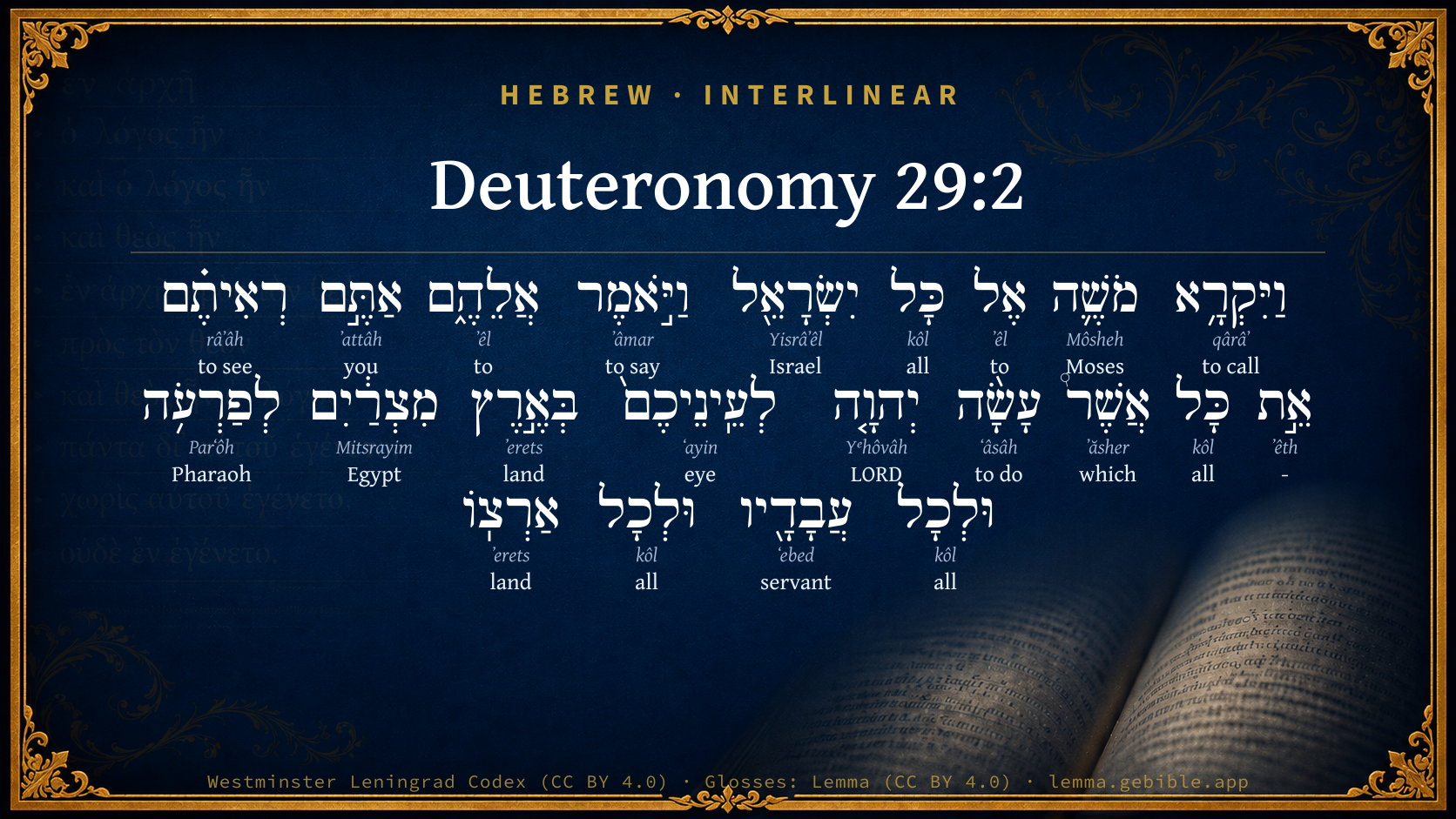
Deuteronomy 29:2

Hebrew (Westminster Leningrad Codex) Deuteronomy 29:2 appears in the Hebrew Old Testament. The text above is from the Westminster Leningrad Codex. Each word links to its Strong’s number, a concise gloss, and parsing drawn from the Open Scriptures Hebrew Bible morphology. Click any word for its full Brown-Driver-Briggs (BDB) entry.
Download image
Cite this verse

Deuteronomy 29:2 (World English Bible). Public Domain. Lemma interlinear Bible study tool, https://lemma.gebible.app/v/deuteronomy/29/2.

Show BibTeX & RIS
BibTeX
RIS
English Translation
Moses called to all Israel, and said to them, You have seen all that Yahweh did before your eyes in the land of Egypt to Pharaoh, and to all his servants, and to all his land;
World English Bible · Public Domain
Download a study sheet

One document with this verse’s original text, its word-by-word gloss line, the meaning frame, cross-references with their text, attributed commentary, and full source and license credits — printable, and it pastes into notes with its structure intact.

This verse Autodidact and up

Study sheet (.html) Plain text (.txt)

A passage Seminary Student

Up to 50 verses in one chapter. A passage sheet keeps up to 6 commentary sources and 12 cross-references per verse, in the order this page ranks them, and says so on the sheet whenever that leaves anything out. Ask for a single verse and you get the Autodidact verse sheet above.

Everything on this page stays free to read, with no account — the sheet is a download of what is already on screen, not access to it.

Want to remove ads? Support Godless Engineer
Compare translations 3

The same verse in 3 English versions, stacked beneath the original-language interlinear above. Click any original word for its lexicon entry.

Each is an independent rendering of the whole verse — the interlinear is not word-aligned to these translations.

Highlighted words mark where these versions differ — a whole-verse word diff, not a word-by-word alignment.

  • World English Bible Public Domain
    Moses called to all Israel, and said to them, You have seen all that Yahweh did before your eyes in the land of Egypt to Pharaoh, and to all his servants, and to all his land;
  • King James Version Public Domain
    And Moses called unto all Israel, and said unto them, Ye have seen all that the LORD did before your eyes in the land of Egypt unto Pharaoh, and unto all his servants, and unto all his land;
  • unfoldingWord Literal Text CC BY-SA 4.0
    And Moses called to all Israel and said to them, “You have seen everything that Yahweh did before your eyes in the land of Egypt to Pharaoh and to all his servants and to all his land—

unfoldingWord Literal Text — © unfoldingWord, licensed CC BY-SA 4.0. Word-aligned USFM3 via Door43 (git.door43.org/unfoldingWord/en_ult).

Versions to compare (up to 4)

3 of 4 selected

Show all 18 translations

Every available English version of this verse, each an independent rendering of the whole verse.

  • World English Bible Public Domain
    Moses called to all Israel, and said to them, You have seen all that Yahweh did before your eyes in the land of Egypt to Pharaoh, and to all his servants, and to all his land;
  • Berean Standard Bible Public Domain
    Moses summoned all Israel and proclaimed to them, “You have seen with your own eyes everything the LORD did in Egypt to Pharaoh, to all his officials, and to all his land.
  • Majority Standard Bible Public Domain
    Moses summoned all Israel and proclaimed to them, “You have seen with your own eyes everything the LORD did in Egypt to Pharaoh, to all his officials, and to all his land.
  • King James Version Public Domain
    And Moses called unto all Israel, and said unto them, Ye have seen all that the LORD did before your eyes in the land of Egypt unto Pharaoh, and unto all his servants, and unto all his land;
  • American Standard Version (1901) Public Domain
    And Moses called unto all Israel, and said unto them, Ye have seen all that Jehovah did before your eyes in the land of Egypt unto Pharaoh, and unto all his servants, and unto all his land;
  • Revised Version (1885) Public Domain
    And Moses called unto all Israel, and said unto them, Ye have seen all that the LORD did before your eyes in the land of Egypt unto Pharaoh, and unto all his servants, and unto all his land;
  • Geneva Bible (1599) Public Domain
    And Moses called all Israel, and said vnto them, Ye haue seene all that the Lord did before your eyes in the lande of Egypt vnto Pharaoh and vnto all his seruantes, and vnto all his lande,
  • Douay-Rheims (1899) Public Domain
    And Moses called all Israel, and said to them: You have seen all the things that the Lord did before you in the land of Egypt to Pharao, and to all his servants, and to his whole land.
  • Young's Literal Translation Public Domain
    And Moses calleth unto all Israel, and saith unto them, `Ye -- ye have seen all that which Jehovah hath done before your eyes in the land of Egypt, to Pharaoh, and to all his servants, and to all his land;
  • Literal Standard Version CC BY-SA 4.0
    And Moses calls to all Israel and says to them, “You have seen all that which YHWH has done before your eyes in the land of Egypt, to Pharaoh, and to all his servants, and to all his land—
  • Unlocked Literal Bible CC BY-SA 4.0
    Moses called to all Israel and said to them, “You have seen everything that Yahweh did before your eyes in the land of Egypt to Pharaoh, to all his servants, and to all his land—
  • unfoldingWord Literal Text CC BY-SA 4.0
    And Moses called to all Israel and said to them, “You have seen everything that Yahweh did before your eyes in the land of Egypt to Pharaoh and to all his servants and to all his land—
  • Darby Bible Public Domain
    And Moses called to all Israel, and said unto them, Ye have seen all that Jehovah did before your eyes in the land of Egypt to Pharaoh, and to all his bondmen, and to all his land:
  • World Messianic Bible Public Domain
    Moses called to all Israel, and said to them: Your eyes have seen all that the LORD did in the land of Egypt to Pharaoh, and to all his servants, and to all his land;
  • Webster's Bible Public Domain
    And Moses called to all Israel, and said to them, Ye have seen all that the LORD did before your eyes in the land of Egypt to Pharaoh, and to all his servants, and to all his land;
  • Free Bible Version CC BY-SA 4.0
    Moses called all the Israelites together and announced to them, You saw with your own eyes everything the Lord did in Egypt to Pharaoh, to all his officials, and to his whole country.
  • Bible in Basic English Public Domain
    And Moses said in the hearing of all Israel, You have seen all the Lord did before your eyes in the land of Egypt to Pharaoh and to all his servants and all his land;
  • JPS Tanakh (1917) Public Domain
    (29-1) And Moses called unto all Israel, and said unto them: Ye have seen all that the LORD did before your eyes in the land of Egypt unto Pharaoh, and unto all his servants, and unto all his land;

Literal Standard Version (2020), Covenant Press — licensed CC BY-SA 4.0. Text via the HelloAO Bible API (eBible.org). Unlocked Literal Bible (unfoldingWord) — licensed CC BY-SA 4.0. Text via the HelloAO Bible API (eBible.org). unfoldingWord Literal Text — © unfoldingWord, licensed CC BY-SA 4.0. Word-aligned USFM3 via Door43 (git.door43.org/unfoldingWord/en_ult). Free Bible Version, Dr. Jonathan Gallagher — licensed CC BY-SA 4.0. Text via the HelloAO Bible API (eBible.org).

Word by word

More ways to search: Search by grammar → Find every occurrence → Compare this word →

Practice this passage: Drill this verse → Learn its vocabulary →

לְפַרְעֹ֥ה
Parʻôh
H6547
“to/for · Pharaoh”
Preposition + Noun, Proper
Part of Speech
Preposition + Noun
Type
Proper
Full BDB Definition

Origin: of Egyptian derivation

TWOT: 1825

Pharaoh = "great house" - the common title of the king of Egypt
  1. וַיִּקְרָ֥א qârâʼ H7121 “and · to call” Conjunction + Verb, Qal, Sequential Imperfect, 3rd Person, Masculine, Singular
  2. מֹשֶׁ֛ה Môsheh H4872 “Moses” Noun, Proper
  3. אֶל ʼêl H413 “to” Preposition
  4. כָּל kôl H3605 “all of” Noun, Common, Masculine, Singular, Construct
  5. יִשְׂרָאֵ֖ל Yisrâʼêl H3478 “Israel” Noun, Proper
  6. וַיֹּ֣אמֶר ʼâmar H559 “and · to say” Conjunction + Verb, Qal, Sequential Imperfect, 3rd Person, Masculine, Singular
  7. אֲלֵהֶ֑ם ʼêl H413 “to · them” Preposition + Suffix, Personal, 3rd Person, Masculine, Plural
  8. אַתֶּ֣ם ʼattâh H859 “you” Pronoun, Personal, 2nd Person, Masculine, Plural
  9. רְאִיתֶ֗ם râʼâh H7200 “to see” Verb, Qal, Perfect, 2nd Person, Masculine, Plural
  10. אֵ֣ת ʼêth H853 “-” Particle, Direct Object
  11. כָּל kôl H3605 “all of” Noun, Common, Masculine, Singular, Construct
  12. אֲשֶׁר֩ ʼăsher H834 “which” Particle, Relative
  13. עָשָׂ֨ה ʻâsâh H6213 “to do” Verb, Qal, Perfect, 3rd Person, Masculine, Singular
  14. יְהוָ֤ה Yᵉhôvâh H3068 “LORD” Noun, Proper
  15. לְעֵֽינֵיכֶם֙ ʻayin H5869 “to/for · eyes · your” Preposition + Noun, Common, Both, Dual, Construct + Suffix, Personal, 2nd Person, Masculine, Plural
  16. בְּאֶ֣רֶץ ʼerets H776 “in/at · land of” Preposition + Noun, Common, Both, Singular, Construct
  17. מִצְרַ֔יִם Mitsrayim H4714 “Egypt” Noun, Proper
  18. וּלְכָל kôl H3605 “and · to/for · all of” Conjunction + Preposition + Noun, Common, Masculine, Singular, Construct
  19. עֲבָדָ֖יו ʻebed H5650 “servants · his” Noun, Common, Masculine, Plural, Construct + Suffix, Personal, 3rd Person, Masculine, Singular
  20. וּלְכָל kôl H3605 “and · to/for · all of” Conjunction + Preposition + Noun, Common, Masculine, Singular, Construct
  21. אַרְצֽוֹ ʼerets H776 “land · his” Noun, Common, Both, Singular, Construct + Suffix, Personal, 3rd Person, Masculine, Singular

About this verse

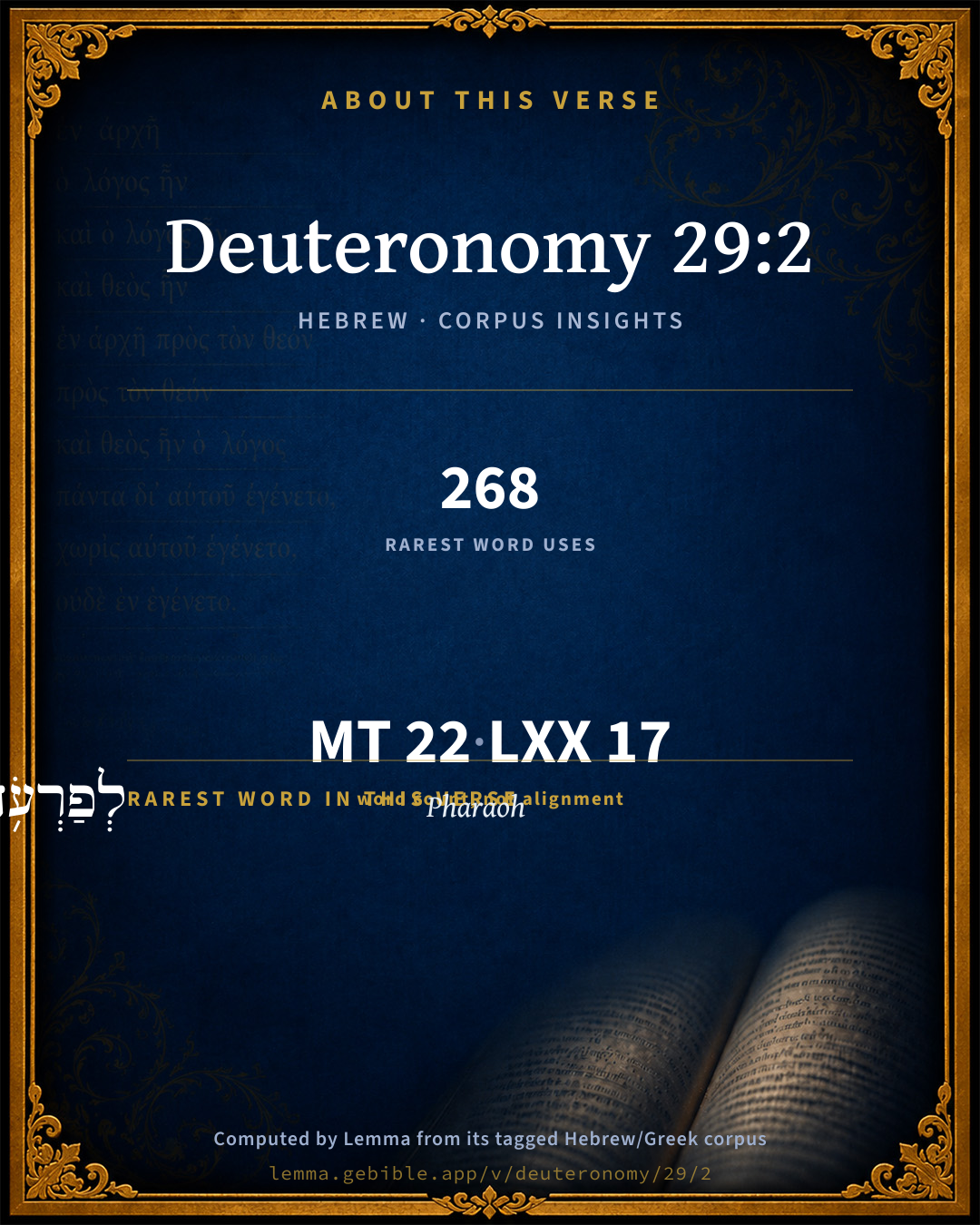
These counts appear in no published source. They are computed here, from the morphology-tagged text and Lemma’s own curated glosses. What Lemma adds →

22
words
17
distinct lemmas
Pentateuch
section

Grammatical profile

  • 4 verbs
  • 13 nouns
  • 1 pronoun
  • 2 prepositions
  • 2 particles

Verb forms

  • וַיִּקְרָ֥א Qal · Sequential Imperfect
  • וַיֹּ֣אמֶר Qal · Sequential Imperfect
  • רְאִיתֶ֗ם Qal · Perfect
  • עָשָׂ֨ה Qal · Perfect

Repetition

Words recur within this verse — often emphatic in Hebrew:

  • כָּל all H3605 ×4
  • בְּאֶ֣רֶץ land H776 ×2
  • אֶל to H413 ×2

Hebrew & Septuagint length

In English translation the verse runs 36 words from the Hebrew and 37 from the Septuagint (LXX English) — closely comparable.

A rough comparison of the two English renderings, which tokenize alike — not a word-level alignment.

Word counts can differ between the Hebrew and the Greek without any difference in meaning — e.g. the Hebrew direct-object marker אֵת has no separate Greek word, and Greek often adds the article ὁ.

In the original languages it is 22 Hebrew tokens and 17 Greek tokens — but the two are counted differently (Hebrew bundles its prefixes and suffixes into one token; the Greek is in lemma form), so that isn’t a like-for-like length.

Cross-references

5

Topical passages linked to Deuteronomy 29:2 in the Treasury of Scripture Knowledge — connected by theme and wording, ordered by reader-vote popularity; previews shown in the World English Bible.

  • Exodus 19:4 'You have seen what I did to the Egyptians, and how I bore you on eagles' wings, and brought you to myself.
  • Exodus 8:12 Moses and Aaron went out from Pharaoh, and Moses cried to Yahweh concerning the frogs which he had brought on Pharaoh.
  • Joshua 24:5–6 I sent Moses and Aaron, and I plagued Egypt, according to that which I did in the midst of it: and afterward I brought you out.
  • Psalms 78:43–51 How he set his signs in Egypt, His wonders in the field of Zoan,
  • Psalms 105:27–36 They performed miracles among them, And wonders in the land of Ham.

Cross-references courtesy of OpenBible.info (CC BY 4.0).

Hebrew and Greek witnesses Masoretic Hebrew ↔ Greek Septuagint

The same verse in the two great witnesses to the Old Testament, shown verse-for-verse.

These are two independent witnesses, not word-aligned to each other, and the Septuagint is shown in lemma (dictionary) form.

Hebrew Deuteronomy 29:2 Masoretic · Westminster Leningrad Codex

וַיִּקְרָ֥א מֹשֶׁ֛ה אֶל כָּל יִשְׂרָאֵ֖ל וַיֹּ֣אמֶר אֲלֵהֶ֑ם אַתֶּ֣ם רְאִיתֶ֗ם אֵ֣ת כָּל אֲשֶׁר֩ עָשָׂ֨ה יְהוָ֤ה לְעֵֽינֵיכֶם֙ בְּאֶ֣רֶץ מִצְרַ֔יִם לְפַרְעֹ֥ה וּלְכָל עֲבָדָ֖יו וּלְכָל אַרְצֽוֹ

Moses called to all Israel, and said to them, You have seen all that Yahweh did before your eyes in the land of Egypt to Pharaoh, and to all his servants, and to all his land;

World English Bible · Public Domain

Greek LXX Deuteronomy 29:2 Septuagint · lemma form

ὁ πειρασμός ὁ μέγας ὅς ὁράω ὁ ὀφθαλμός σύ ὁ σημεῖον καί ὁ τέρας ὁ μέγας ἐκεῖνος

And Moses called all the sons of Israel and said to them, You⌃ have seen all things that the Lord did in the land of Egypt before you to Pharao and his servants, and all his land;

LXX2012 (modern English Septuagint) · Public Domain

Hebrew: Westminster Leningrad Codex (CC BY 4.0). Greek: Septuagint (public domain); English from LXX2012 (modern English Septuagint) (Public Domain). How the Septuagint differs from the Hebrew →

Targum (Aramaic paraphrase)

2

The Targum is the ancient Jewish Aramaic paraphrase of the Hebrew Scriptures — an interpretive translation, not the Hebrew text itself. Onkelos (literal) and Pseudo-Jonathan (expansive) render the Torah, and Jonathan the Prophets. Coverage is partial: where no permissively-licensed English translation exists for a verse, only the Aramaic is shown. This is verse-level text, not a word-by-word alignment to the Hebrew.

  1. Targum Onkelos Torah (Genesis–Deuteronomy)
    נִסִין רַבְרְבִין דִי חֲזָאָה עֵינָךְ אָתַיָא וּמוֹפְתַיָא רַבְרְבַיָא הָאִנוּן

    (no public-domain English translation for this verse)

    Targum Onkelos — Aramaic: “Onkelos Genesis” (public domain); “Onkelos Exodus” (public domain); “Onkelos Leviticus” (public domain); “Onkelos Numbers” (public domain); “Onkelos Deuteronomy” (public domain). English: “Sefaria Community Translation” (CC0 1.0 (public-domain dedication)); “J.W. Etheridge. The Targums of Onkelos and Jonathan Ben Uzziel on the Pentateuch. London: Longmans, Green, 1862” (public domain). Text via Sefaria.

  2. Targum Pseudo-Jonathan Torah (Genesis–Deuteronomy)
    נִסִין רַבְרְבִין דַחֲמִיתוּן בְּעֵינֵיכוֹן אָתַיָא וְתִמְהַיָא רַבְרְבַיָא הָאִינוּן

    those great temptations, signs, and wonders which you saw with your eyes.

    Targum Pseudo-Jonathan — Aramaic: “Targum Jonathan on Genesis” (public domain); “Targum Jonathan on Exodus” (public domain); “Targum Jonathan on Leviticus” (public domain); “Targum Jonathan on Numbers” (public domain); “Targum Jonathan on Deuteronomy” (public domain). English: “The Targum of Jonathan ben Uzziel, trans. J. W. Etheridge, London, 1862” (public domain). Text via Sefaria.

Commentary

Notes on Deuteronomy 29:2 from classic Christian and Jewish commentators (each source and its license shown beneath its notes). The classic Christian expositions comment on the surrounding passage and are grouped to its opening verse, so a note may address several verses; the Jewish commentaries on the Tanakh (Rashi and others) are per-verse, so they appear only where the commentator wrote on this verse.

Lemma curates 59 commentaries, every one of them public domain or Creative Commons licensed, each selected and text-cleaned for this edition rather than reprinted as found. About our sources →

Ellicott's Commentary for English Readers

(2) And Moses called all Israel and said unto them.—The address in this chapter may be compared with that of Joshua to the people (as distinct from their heads and officers) in Joshua 24. The topics brought before them are simple. In Deu_29:2-3, the miracles of the Exodus; in Deu_29:5; Deu_29:7, the wilderness journey; in Deu_29:7-8, the conquest of Sihon and Og. All are appealed to, from the captains of the tribes (Deu_29:10), to the little ones (Deu_29:11), and the lowest slaves (Deu_29:11). And the point set before them is one simple thing, to accept Jehovah as their God. All this is very closely reproduced in Joshua 24 (see Notes in that place).

Ye have seen.—The pronoun is emphatic. Yourselves are witnesses. I need not repeat the story. (Comp. Deu_11:2-7.)

A Bible Commentary for English Readers, edited by Charles John Ellicott (1878–1897) — public domain. Text from a community e-Sword module.

Trapp's Complete Commentary

John Trapp

Deu 29:2 And Moses called unto all Israel, and said unto them, Ye have seen all that the LORD did before your eyes in the land of Egypt unto Pharaoh, and unto all his servants, and unto all his land;

Ver. 2. Moses called.] At several times it is like, these things were delivered, and not at once.

John Trapp, A Commentary or Exposition upon All the Books of the Old and New Testament (1647–1656) — public domain. Text from a community e-Sword module.

Joseph Benson's Commentary

Deu 29:2. Ye have seen all that the Lord did — Some of them had seen, when they were young, the plagues which God had brought upon Pharaoh and his people, in order to accomplish their deliverance; and others from them had understood these things, which is often termed seeing, both in the Scriptures and elsewhere.

Joseph Benson's Commentary on the Old and New Testaments (1811–1818) — public domain. Text from a community e-Sword module.

Keil & Delitzsch

C. F. Keil & F. Delitzsch

The introduction in Deu 29:2 resembles that in Deu 5:1. "All Israel" is the nation in all its members (see Deu 29:10, Deu 29:11). - Israel had no doubt seen the mighty acts of the Lord in Egypt (Deu 29:2 and Deu 29:3; cf. Deu 4:34; Deu 7:19), but Jehovah had not given them a heart, i.e., understanding, to perceive, eyes to see, and ears to hear, until this day. With this complaint, Moses does not intend to excuse the previous want of susceptibility on the part of the nation to the manifestations of grace on the part of the Lord, but simply to explain the necessity for the repeated allusion to the gracious acts of God, and to urge the people to lay them truly to heart. "By reproving the dulness of the past, he would stimulate them to a desire to understand: just as if he had said, that for a long time they had been insensible to so many miracles, and therefore they ought not to delay any longer, but to arouse themselves to hearken better unto God" (Calvin). The Lord had not yet given the people an understanding heart, because the people had not yet asked for it, simply because the need of it was not felt (cf. Deu 4:26).

Keil & Delitzsch — Biblical Commentary on the Old Testament (1861–1891) — public domain (CC PDM 1.0). Text via the HelloAO Bible API. (Old Testament only.)

Tyndale Open Study Notes

Tyndale Open Resources

29:2–30:20 Anticipating his death, Moses composed a farewell address, briefly reviewing Israel’s history since the Exodus. He charged the nation to pledge their fidelity to the Lord. This section of Deuteronomy makes it clear that grace is not just a New Testament doctrine: It undergirds every aspect of the Lord’s relationship with Israel.

Tyndale Open Study Notes — © Tyndale Open Resources, licensed CC BY-SA 4.0. Text via the HelloAO Bible API.

Jamieson, Fausset & Brown

Robert Jamieson, A. R. Fausset & David Brown

Moses called unto all Israel, . . . Ye have seen all that the Lord did, &c.--This appeal to the experience of the people, though made generally, was applicable only to that portion of them who had been very young at the period of the Exodus, and who remembered the marvellous transactions that preceded and followed that era. Yet, alas! those wonderful events made no good impression upon them (Deu 29:4). They were strangers to that grace of wisdom which is liberally given to all who ask it; and their insensibility was all the more inexcusable that so many miracles had been performed which might have led to a certain conviction of the presence and the power of God with them. The preservation of their clothes and shoes, the supply of daily food and fresh water--these continued without interruption or diminution during so many years' sojourn in the desert. They were miracles which unmistakably proclaimed the immediate hand of God and were performed for the express purpose of training them to a practical knowledge of, and habitual confidence in, Him. Their experience of this extraordinary goodness and care, together with their remembrance of the brilliant successes by which, with little exertion or loss on their part, God enabled them to acquire the valuable territory on which they stood, is mentioned again to enforce a faithful adherence to the covenant, as the direct and sure means of obtaining its promised blessings.

Jamieson, Fausset & Brown — Commentary Critical and Explanatory on the Whole Bible (1871) — public domain (CC PDM 1.0). Text via the HelloAO Bible API.

The Cambridge Bible for Schools and Colleges

gen. ed. J. J. S. Perowne

2. And Moses called … unto them] Son_5:1. For the rest cp. Deu_11:2. Ye is emphatic. Heb.: Ye, yourselves, have seen.

The Cambridge Bible for Schools and Colleges (gen. ed. J. J. S. Perowne; Cambridge University Press, 1878–1918) — public domain. Text from a community e-Sword module.

John Gill's Exposition

Moses called unto all Israel,.... He had been speaking before to the heads of them, and delivered at different times what is before recorded; but now he summoned the whole body of the people together, a solemn covenant being to be made between God and them; or such things being to be made known unto them as were of universal concernment:

and said unto them; what is in this chapter; which is only a preparation or introduction to what he had to declare unto them in the following:

ye have seen all that the Lord did before your eyes in the land of Egypt; the Targum of Jonathan is,"what the Word of the Lord did;''for all the wonderful things there done in Egypt were done by the essential Word of God, Christ, the Son of God; who appeared to Moses in the bush, and sent him to Egypt, and by him and Aaron wrought the miracles there; which many now present had seen, and were then old enough to take notice of, and could remember, though their fathers then in being were now dead:

unto Pharaoh and unto all his servants, and unto all his land; the plagues he inflicted on the person of Pharaoh, and on all his courtiers, and on all the people in Egypt, for they reached the whole land.

John Gill's Exposition of the Whole Bible (1746–1763) — public domain (CC PDM 1.0). Text via the HelloAO Bible API.

Whedon's Commentary on the Bible

Daniel D. Whedon

2. Ye have seen — As a people they had seen the wonderful works of God.

Daniel D. Whedon (gen. ed.), Commentary on the Old and New Testaments (1874–1909) — public domain. Text from a community e-Sword module.

The Pulpit Commentary

Moses addresses the nation as such, and reminds them of their dullness to apprehend the manifestations of God"s grace which had been so abundantly afforded in their past history, in order that he may arouse them to a better state of mind, and stimulate them to hearken to the voice of God in the future.

HOMILIES BY J. ORR. Vers. 2-9. Seeing, yet not seeing.

The Israelites had seen God"s mighty works (ver. 9), yet God had not given them a heart to perceive, nor eyes to see (ver. 4).

I NATURAL SIGHT WITHOUT SPIRITUAL DISCERNMENT. Moses accuses the people of blindness to the facts of their own history. These facts included:

1. God"s mighty works in Egypt; here, as in Deu_4:34 Deu_7:19, classified as temptations, signs, and wonders (vers. 2, 3).

2. God"s guidance of the people in the desert, which also was rife in signs and wonders (vers. 5, 6), and was a course of discipline (temptation, in sense of trial) throughout.

3. The victories over Sihon and Og (vers. 7, 8). No people ever saw so many miracles or passed through so extraordinary a curriculum as Israel did. Yet Moses says they had failed to apprehend the lessons of their history. Seeing, they saw not. (Mat_13:10-16) That generation may not have been so dull as the one which had preceded it, but even it had shown by recent rebellions (Num 20:, Num_20:21) how far it was from having laid earnestly to heart the lessons of God"s dealings with it. A like veil lies on every unspiritual mind. (2Co_3:13-18) The Bible is a book of riddles to it. (Luk_24:25-27, Luk_24:44-46) Christ is known only after the. (2Co_5:16) The lines of a Divine leading in the events of life are not recognized. Warnings are scorned; prosperity is misused; adversity hardens. There is outward experience of facts, but, as in Israel"s case, the Word preached does not profit, not being mixed with faith in them that hear it. (Heb_4:2)

II SPIRITUAL DISCERNMENT IS FROM GOD. Yet not arbitrarily given or withheld. It is given to those who feel their need of it, who seek it, and who act in faithfulness to the light already possessed. (Psa_25:9, Psa_25:12, 14 119:18; Mat_13:10-16; Joh_7:17) From none such will God withhold the "heart to perceive, and eyes to see." On the other hand, Divine illumination is indispensable to the knowledge of spiritual truth. (cf. Joh_6:45; 1Co_2:12-16; 2Co_4:6; Eph_1:17) As the poet"s eye is needed for the discernment of the poetic suggestions and analogies of nature, so is the spiritual eye needed to penetrate "the secret of the Lord." The eye in this case, as in the other, "sees only what it brings with it the power of seeing." And to gain this seeing eye, there must, as before remarked, be prayer prayer and obedience. Without these two golden keys, no thought, no labor, no learning, no cleverness, will enable us to force the gates of the inner sanctuary of truth. God"s world, God"s Word, God"s providence, will be alike mysterious; if spiritual instruction is offered, the reply will be "Doth he not speak parables?". J.O. (Eze_20:49)

The Pulpit Commentary (1880–1919), ed. H.D.M. Spence-Jones & Joseph S. Exell — public domain. Text from a community e-Sword module.

unfoldingWord translationNotes

Door43 World Missions Community

You have seen everything that Yahweh did before your eyes

Yahweh expected them to remember what Yahweh had done and they had seen it. Here the "eyes" represent the whole person and emphasize what the person has seen. AT: "You have seen all that Yahweh did so that you would see and remember what he did" (See: Synecdoche)

the great sufferings that your eyes saw

Here "eyes" emphasizes that Yahweh expected them to remember that they had seen it. AT: "you saw for yourselves that the people suffered terribly" (See: Synecdoche)

your eyes

Moses speaks to the Israelites as if they were one man, so the word "your" here is singular. (See: Forms of You)

the signs, and those great wonders

The words "signs" and "wonders" both refer to the plagues that Yahweh had sent upon Egypt. AT: "and all of the powerful things that Yahweh did" (See: Doublet)

Yahweh has not given you a heart to know, eyes to see, or ears to hear

The people do have hearts, eyes, and ears. This metonym says that Yahweh has not enabled them to understand from what they saw and heard who Yahweh is, and how and why they should obey him. (See: Metonymy)

given you a heart to know

This is an idiom. AT: "enabled you to understand" (See: Idiom)

translationWords

Moses

call

Israel

Egypt

Pharaoh

servant

suffer

miracle

heart

know

unfoldingWord translationNotes — © Distant Shores Media and the Door43 World Missions Community, licensed CC BY-SA 4.0. Source: git.door43.org/Door43/en_tn.

Lesson kit

Teaching starters — assembled from the data on this page, not authored interpretation. Every prompt links to the verse data it draws on. Edit before teaching.

Deuteronomy, in the Pentateuch, opens this verse with 22 words (17 distinct Hebrew lemmas). Its most distinctive word is Parʻôh (“Pharaoh”). A historical commentator’s framing appears above. Read the whole chapter for the surrounding context.

Discussion questions

  1. What does “Pharaoh” (Parʻôh) contribute to the verse as a whole?
  2. Exodus 19:4 shares this passage’s theme. How do the two illuminate each other?
  3. “all” occurs 4× in this one verse. What is the effect of the repetition?
  4. The translations on this page render this verse differently — a whole-verse word diff, not a word-by-word alignment. What might account for the different wordings?
  5. The verb «וַיִּקְרָ֥א» is Qal Sequential Imperfect. How does its form color the action?
  6. Reading how Ellicott's Commentary for English Readers and Trapp's Complete Commentary read this verse, where do the two commentators agree and where do they part?

Things to notice

Reading settings

Reading text

Shown beneath each verse's original-language words.

Old Testament
Old Testament edition

Read the OT as the Masoretic Hebrew (MT) or the Greek Septuagint (LXX).

English shown for the Greek Septuagint (in the Hebrew ↔ Greek comparison).

Comparing translations? Open the Compare panel on any verse page to stack up to four side by side.