
1 Samuel 17:8

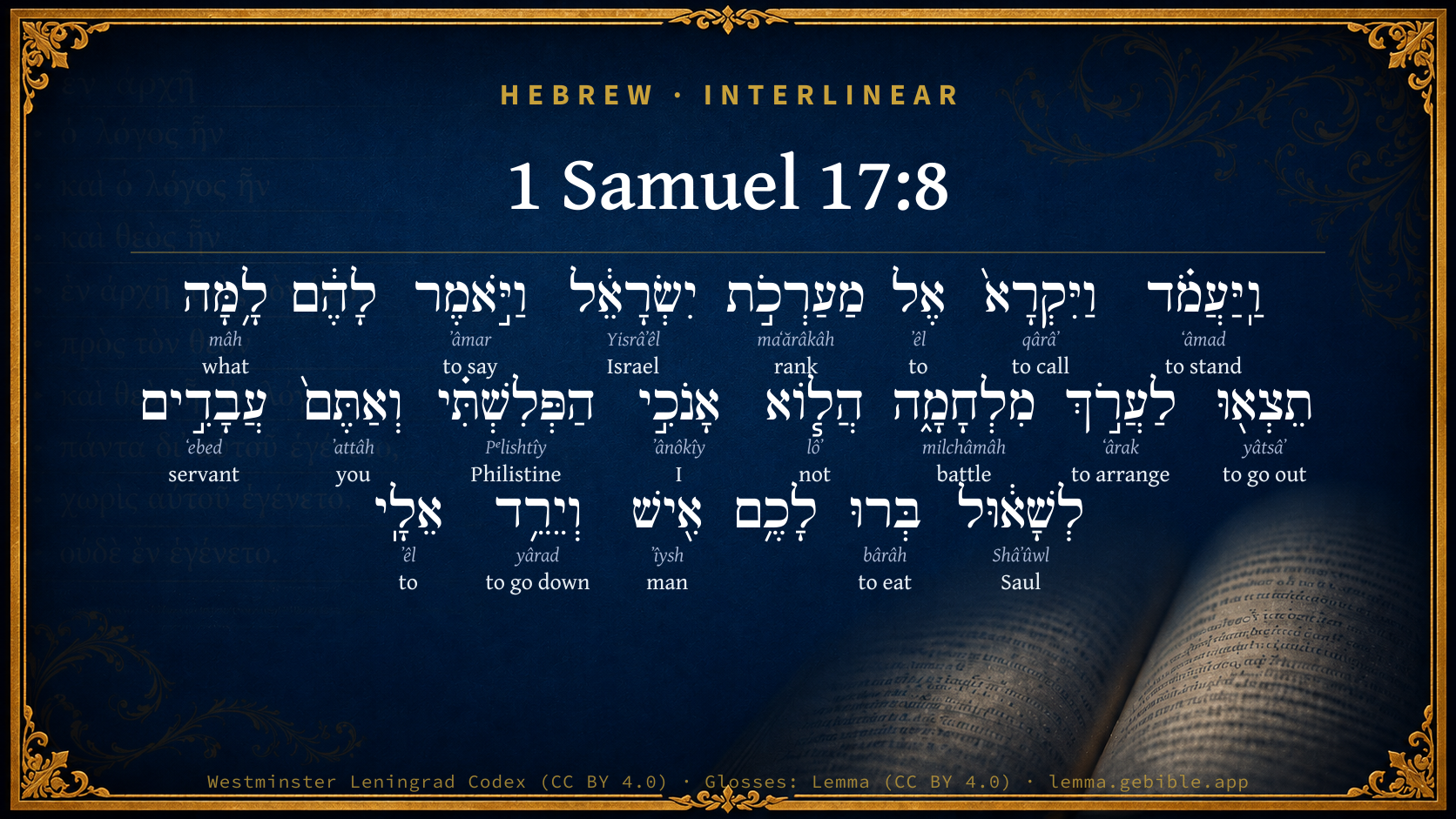
Hebrew (Westminster Leningrad Codex) 1 Samuel 17:8 appears in the Hebrew Old Testament. The text above is from the Westminster Leningrad Codex. Each word links to its Strong’s number, a concise gloss, and parsing drawn from the Open Scriptures Hebrew Bible morphology. Click any word for its full Brown-Driver-Briggs (BDB) entry.
Download image
Cite this verse

1 Samuel 17:8 (World English Bible). Public Domain. Lemma interlinear Bible study tool, https://lemma.gebible.app/v/1-samuel/17/8.

Show BibTeX & RIS
BibTeX
RIS
English Translation
He stood and cried to the armies of Israel, and said to them, Why are you come out to set your battle in array? am I not a Philistine, and you servants to Saul? choose you a man for you, and let him come down to me.
World English Bible · Public Domain
Highlights
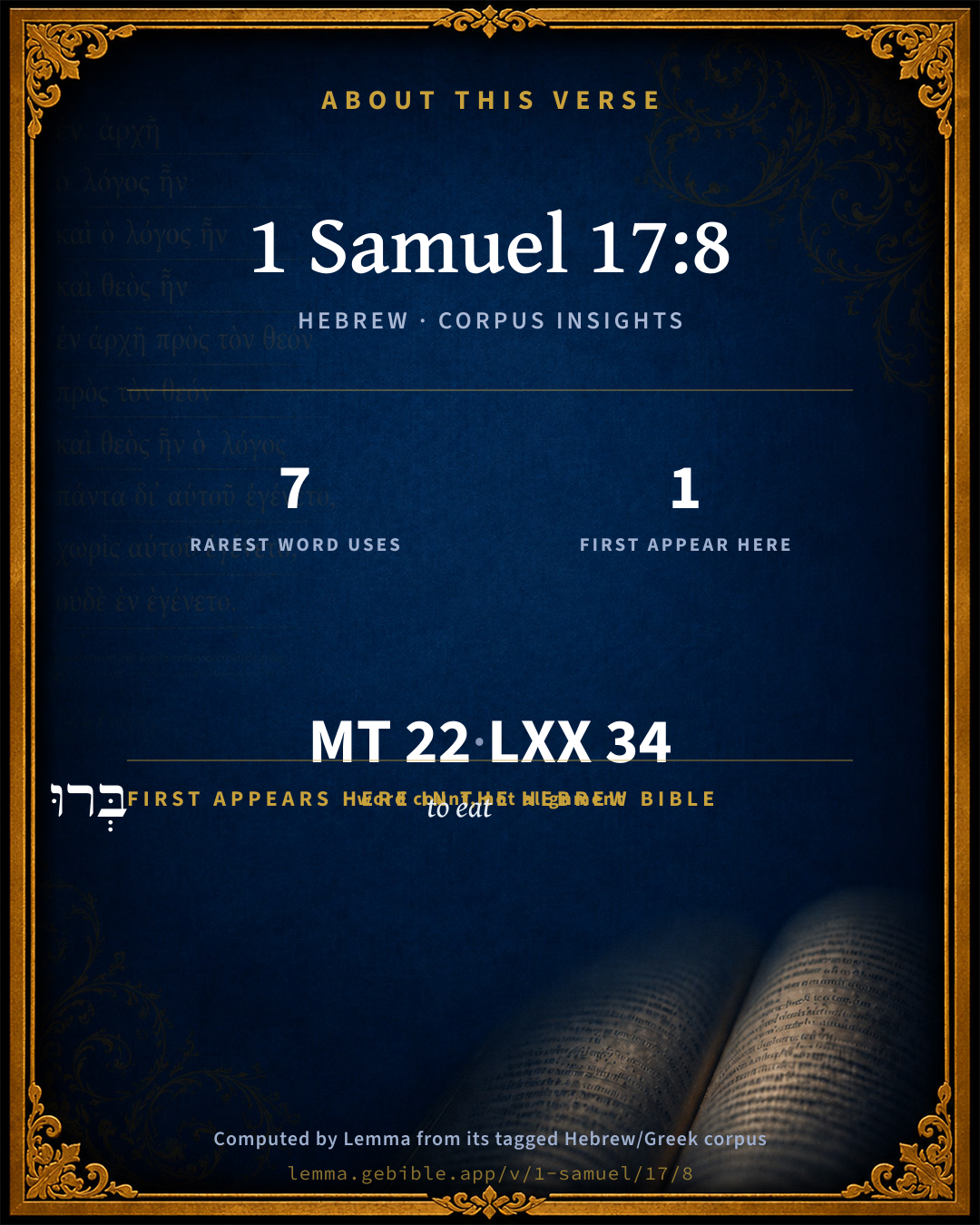
  • 1 first appearance in the Hebrew Bible
Full analysis ↓
Download a study sheet

One document with this verse’s original text, its word-by-word gloss line, the meaning frame, cross-references with their text, attributed commentary, and full source and license credits — printable, and it pastes into notes with its structure intact.

This verse Autodidact and up

Study sheet (.html) Plain text (.txt)

A passage Seminary Student

Up to 50 verses in one chapter. A passage sheet keeps up to 6 commentary sources and 12 cross-references per verse, in the order this page ranks them, and says so on the sheet whenever that leaves anything out. Ask for a single verse and you get the Autodidact verse sheet above.

Everything on this page stays free to read, with no account — the sheet is a download of what is already on screen, not access to it.

Want to remove ads? Support Godless Engineer
Compare translations 3

The same verse in 3 English versions, stacked beneath the original-language interlinear above. Click any original word for its lexicon entry.

Each is an independent rendering of the whole verse — the interlinear is not word-aligned to these translations.

Highlighted words mark where these versions differ — a whole-verse word diff, not a word-by-word alignment.

  • World English Bible Public Domain
    He stood and cried to the armies of Israel, and said to them, Why are you come out to set your battle in array? am I not a Philistine, and you servants to Saul? choose you a man for you, and let him come down to me.
  • King James Version Public Domain
    And he stood and cried unto the armies of Israel, and said unto them, Why are ye come out to set your battle in array? am not I a Philistine, and ye servants to Saul? choose you a man for you, and let him come down to me.
  • unfoldingWord Literal Text CC BY-SA 4.0
    And he stood and called out to the arrays of Israel, and he said to them, “Why have you come out to array for battle? I not the Philistine, and you, servants of Saul? Choose for yourselves a man, and let him come down to me.

unfoldingWord Literal Text — © unfoldingWord, licensed CC BY-SA 4.0. Word-aligned USFM3 via Door43 (git.door43.org/unfoldingWord/en_ult).

Versions to compare (up to 4)

3 of 4 selected

Show all 18 translations

Every available English version of this verse, each an independent rendering of the whole verse.

  • World English Bible Public Domain
    He stood and cried to the armies of Israel, and said to them, Why are you come out to set your battle in array? am I not a Philistine, and you servants to Saul? choose you a man for you, and let him come down to me.
  • Berean Standard Bible Public Domain
    And Goliath stood and shouted to the ranks of Israel, “Why do you come out and array yourselves for battle? Am I not a Philistine, and are you not servants of Saul? Choose one of your men and have him come down against me.
  • Majority Standard Bible Public Domain
    And Goliath stood and shouted to the ranks of Israel, “Why do you come out and array yourselves for battle? Am I not a Philistine, and are you not servants of Saul? Choose one of your men and have him come down against me.
  • King James Version Public Domain
    And he stood and cried unto the armies of Israel, and said unto them, Why are ye come out to set your battle in array? am not I a Philistine, and ye servants to Saul? choose you a man for you, and let him come down to me.
  • American Standard Version (1901) Public Domain
    And he stood and cried unto the armies of Israel, and said unto them, Why are ye come out to set your battle in array? am not I a Philistine, and ye servants to Saul? choose you a man for you, and let him come down to me.
  • Revised Version (1885) Public Domain
    And he stood and cried unto the armies of Israel, and said unto them, Why are ye come out to set your battle in array? am not I a Philistine, and ye servants to Saul? choose you a man for you, and let him come down to me.
  • Geneva Bible (1599) Public Domain
    And he stoode, and cried against the hoste of Israel, and saide vnto them, Why are yee come to set your battell in aray? am not I a Philistim, and you seruaunts to Saul? chuse you a man for you, and let him come downe to me.
  • Douay-Rheims (1899) Public Domain
    And standing he cried out to the bands of Israel, and said to them: Why are you come out prepared to fight? am not I a Philistine, and you the servants of Saul? Choose out a man of you, and let him come down and fight hand to hand.
  • Young's Literal Translation Public Domain
    And he standeth and calleth unto the ranks of Israel, and saith to them, `Why are ye come out to set in array the battle? `am' not I the Philistine, and ye servants to Saul? choose for you a man, and let him come down unto me;
  • Literal Standard Version CC BY-SA 4.0
    And he stands and calls to the ranks of Israel, and says to them, “Why do you come out to set in array for battle? [Am] I not the Philistine, and you the servants of Saul? Choose a man for yourselves, and let him come down to me;
  • Unlocked Literal Bible CC BY-SA 4.0
    He stood and shouted to the ranks of Israel, “Why have you come out to draw up for battle? Am not I a Philistine, and are you not servants of Saul? Choose a man for yourselves and let him come down to me.
  • unfoldingWord Literal Text CC BY-SA 4.0
    And he stood and called out to the arrays of Israel, and he said to them, “Why have you come out to array for battle? I not the Philistine, and you, servants of Saul? Choose for yourselves a man, and let him come down to me.
  • Darby Bible Public Domain
    And he stood and cried to the ranks of Israel, and said to them, Why are ye come out to set your battle in array? am not I the Philistine, and ye servants of Saul? choose for yourselves a man, and let him come down to me.
  • World Messianic Bible Public Domain
    He stood and cried to the armies of Israel, and said to them, “Why have you come out to set your battle in array? Am I not a Philistine, and you servants to Saul? Choose a man for yourselves, and let him come down to me.
  • Webster's Bible Public Domain
    And he stood and cried to the armies of Israel, and said to them, Why have ye come out to set your battle in array? am not I a Philistine, and ye servants to Saul? choose you a man for you, and let him come down to me.
  • Free Bible Version CC BY-SA 4.0
    Goliath stood and shouted at the lines of Israelite soldiers, “Why have you come and lined for battle? I am the Philistine, and you're Saul's servants. Pick one of your men and have him come down and fight me.
  • Bible in Basic English Public Domain
    He took up his position and in a loud voice said to the armies of Israel, Why have you come out to make war? Am I not a Philistine and you servants of Saul? Send out a man for yourselves and let him come down to me.
  • JPS Tanakh (1917) Public Domain
    And he stood and cried unto the armies of Israel, and said unto them: 'Why do ye come out to set your battle in array? am not I a Philistine, and ye servants to Saul? choose you a man for you, and let him come down to me.

Literal Standard Version (2020), Covenant Press — licensed CC BY-SA 4.0. Text via the HelloAO Bible API (eBible.org). Unlocked Literal Bible (unfoldingWord) — licensed CC BY-SA 4.0. Text via the HelloAO Bible API (eBible.org). unfoldingWord Literal Text — © unfoldingWord, licensed CC BY-SA 4.0. Word-aligned USFM3 via Door43 (git.door43.org/unfoldingWord/en_ult). Free Bible Version, Dr. Jonathan Gallagher — licensed CC BY-SA 4.0. Text via the HelloAO Bible API (eBible.org).

Word by word

More ways to search: Search by grammar → Find every occurrence → Compare this word →

Practice this passage: Drill this verse → Learn its vocabulary →

בְּרוּ
bârâh
H1262
“eat”
Verb, Qal, Imperative, 2nd Person, Masculine, Plural
Part of Speech
Verb
Stem
Qal
Form
Imperative
Person
2nd Person
Gender
Masculine
Number
Plural
Full BDB Definition

Origin: a primitive root

TWOT: 281

to eat, consume - (Qal) to eat - (Piel) for eating, devouring - (Hiphil) to cause to eat
  1. וַֽיַּעֲמֹ֗ד ʻâmad H5975 “and · to stand” Conjunction + Verb, Qal, Sequential Imperfect, 3rd Person, Masculine, Singular
  2. וַיִּקְרָא֙ qârâʼ H7121 “and · to call” Conjunction + Verb, Qal, Sequential Imperfect, 3rd Person, Masculine, Singular
  3. אֶל ʼêl H413 “to” Preposition
  4. מַעַרְכֹ֣ת maʻărâkâh H4634 “ranks of” Noun, Common, Feminine, Plural, Construct
  5. יִשְׂרָאֵ֔ל Yisrâʼêl H3478 “Israel” Noun, Proper
  6. וַיֹּ֣אמֶר ʼâmar H559 “and · to say” Conjunction + Verb, Qal, Sequential Imperfect, 3rd Person, Masculine, Singular
  7. לָ֥מָּה mâh H4100 “to/for · what” Preposition + Particle, Interrogative
  8. תֵצְא֖וּ yâtsâʼ H3318 “to go out” Verb, Qal, Imperfect, 2nd Person, Masculine, Plural
  9. לַעֲרֹ֣ךְ ʻârak H6186 “to arrange” Preposition + Verb, Qal, Infinitive Construct
  10. מִלְחָמָ֑ה milchâmâh H4421 “battle” Noun, Common, Feminine, Singular, Absolute
  11. הֲל֧וֹא lôʼ H3808 “not” Particle, Interrogative + Particle, Negative
  12. אָנֹכִ֣י ʼânôkîy H595 “I” Pronoun, Personal, 1st Person, Common, Singular
  13. הַפְּלִשְׁתִּ֗י Pᵉlishtîy H6430 “the · Philistine” Particle, Definite Article + Noun, Gentilic, Masculine, Singular, Absolute
  14. וְאַתֶּם֙ ʼattâh H859 “and · you” Conjunction + Pronoun, Personal, 2nd Person, Masculine, Plural
  15. עֲבָדִ֣ים ʻebed H5650 “servants” Noun, Common, Masculine, Plural, Absolute
  16. לְשָׁא֔וּל Shâʼûwl H7586 “to/for · Saul” Preposition + Noun, Proper
  17. אִ֖ישׁ ʼîysh H376 “man” Noun, Common, Masculine, Singular, Absolute
  18. וְיֵרֵ֥ד yârad H3381 “and · to go down” Conjunction + Verb, Qal, Jussive, 3rd Person, Masculine, Singular
  19. אֵלָֽי ʼêl H413 “to · me” Preposition + Suffix, Personal, 1st Person, Common, Singular

About this verse

These counts appear in no published source. They are computed here, from the morphology-tagged text and Lemma’s own curated glosses. What Lemma adds →

22
words
19
distinct lemmas
Historical
section

Notable vocabulary

The rarest word here is בְּרוּ to eat H1262 — appearing just 7 times in the whole Hebrew Bible.

First appearance in Scripture

This word makes its first canonical appearance in the Hebrew Bible here:

  • בְּרוּ to eat H1262

Shared distinctive vocabulary

בְּרוּ to eat H1262 occurs in 7 verses of the Hebrew Bible. Also found in:

Grammatical profile

  • 7 verbs
  • 7 nouns
  • 2 pronouns
  • 4 prepositions
  • 2 particles

Verb forms

  • וַֽיַּעֲמֹ֗ד Qal · Sequential Imperfect
  • וַיִּקְרָא֙ Qal · Sequential Imperfect
  • וַיֹּ֣אמֶר Qal · Sequential Imperfect
  • תֵצְא֖וּ Qal · Imperfect
  • לַעֲרֹ֣ךְ Qal · Infinitive Construct
  • בְּרוּ Qal · Imperative
  • וְיֵרֵ֥ד Qal · Jussive

Repetition

A word recurs within this verse — often emphatic in Hebrew:

  • אֶל to H413 ×2

Hebrew & Septuagint length

In English translation the verse runs 47 words from the Hebrew and 49 from the Septuagint (LXX English) — closely comparable.

A rough comparison of the two English renderings, which tokenize alike — not a word-level alignment.

Word counts can differ between the Hebrew and the Greek without any difference in meaning — e.g. the Hebrew direct-object marker אֵת has no separate Greek word, and Greek often adds the article ὁ.

In the original languages it is 22 Hebrew tokens and 34 Greek tokens — but the two are counted differently (Hebrew bundles its prefixes and suffixes into one token; the Greek is in lemma form), so that isn’t a like-for-like length.

Cross-references

4

Topical passages linked to 1 Samuel 17:8 in the Treasury of Scripture Knowledge — connected by theme and wording, ordered by reader-vote popularity; previews shown in the World English Bible.

  • 1 Samuel 8:17 He will take the tenth of your flocks: and you shall be his servants.
  • 1 Samuel 17:26 David spoke to the men who stood by him, saying, What shall be done to the man who kills this Philistine, and takes away the reproach from Israel? for who is this uncircumcised Philistine, that he should defy the armies of the living God?
  • 2 Samuel 11:11 Uriah said to David, The ark, and Israel, and Judah, abide in booths; and my lord Joab, and the servants of my lord, are encamped in the open field; shall I then go into my house, to eat and to drink, and to lie with my wife? as you live, and as your soul lives, I will not do this thing.
  • 1 Chronicles 21:3 Joab said, Yahweh make his people a hundred times as many as they are: but, my lord the king, aren't they all my lord's servants? why does my lord require this thing? why will he be a cause of guilt to Israel?

Cross-references courtesy of OpenBible.info (CC BY 4.0).

Hebrew and Greek witnesses Masoretic Hebrew ↔ Greek Septuagint

The same verse in the two great witnesses to the Old Testament, shown verse-for-verse.

These are two independent witnesses, not word-aligned to each other, and the Septuagint is shown in lemma (dictionary) form.

Hebrew 1 Samuel 17:8 Masoretic · Westminster Leningrad Codex

וַֽיַּעֲמֹ֗ד וַיִּקְרָא֙ אֶל מַעַרְכֹ֣ת יִשְׂרָאֵ֔ל וַיֹּ֣אמֶר לָהֶ֔ם לָ֥מָּה תֵצְא֖וּ לַעֲרֹ֣ךְ מִלְחָמָ֑ה הֲל֧וֹא אָנֹכִ֣י הַפְּלִשְׁתִּ֗י וְאַתֶּם֙ עֲבָדִ֣ים לְשָׁא֔וּל בְּרוּ לָכֶ֥ם אִ֖ישׁ וְיֵרֵ֥ד אֵלָֽי

He stood and cried to the armies of Israel, and said to them, Why are you come out to set your battle in array? am I not a Philistine, and you servants to Saul? choose you a man for you, and let him come down to me.

World English Bible · Public Domain

Greek LXX 1 Samuel 17:8 Septuagint · lemma form

καί ἵστημι καί ἀναβοάω εἰς ὁ παράταξις ἰσραήλ καί εἶπον αὐτός τίς ἐκπορεύομαι παρατάσσω πόλεμος ἐκ ἐναντίος ἐγώ οὐ ἐγώ εἰμί ἀλλόφυλος καί σύ εβραῖος ὁ σαούλ ἐκλέγω ἑαυτοῦ ἀνήρ καί καταβαίνω πρός ἐγώ

And he stood and cried to the army of Israel, and said to them, Why are you⌃ come forth to set yourselves in battle array against us? Am not I a Philistine, and you⌃ Hebrews of Saul? Choose for yourselves a man, and let him come down to me.

LXX2012 (modern English Septuagint) · Public Domain

Hebrew: Westminster Leningrad Codex (CC BY 4.0). Greek: Septuagint (public domain); English from LXX2012 (modern English Septuagint) (Public Domain). How the Septuagint differs from the Hebrew →

Targum (Aramaic paraphrase)

1

The Targum is the ancient Jewish Aramaic paraphrase of the Hebrew Scriptures — an interpretive translation, not the Hebrew text itself. Onkelos (literal) and Pseudo-Jonathan (expansive) render the Torah, and Jonathan the Prophets. Coverage is partial: where no permissively-licensed English translation exists for a verse, only the Aramaic is shown. This is verse-level text, not a word-by-word alignment to the Hebrew.

  1. Targum Jonathan Prophets (Joshua–Malachi)
    וְקָם וְאַכְרֵיז עַל סִדְרֵי יִשְׂרָאֵל וַאֲמַר לְהוֹן לְמָה תִפְקוּן לְסַדְרָא קְרָבָא הֲלָא אֲנָא פְלִשְׁתָּאָה וְאַתּוּן עַבְדִין לְשָׁאוּל (אֲנָא הוּא גָלְיָת פְּלִשְׁתְּאָה דְמִן גַת דִקְטָלִית תְּרֵין בְּנֵי עֵלִי כַּהֲנֵי חָפְנִי וּפִינְחָס וּשְׁבֵיתִי יַת אַרוֹן קֳיָמָא דַייָ וְאוֹבֵלִית יָתֵיהּ לְבֵית דָגוֹן טַעֲוָתִי וַהֲוָה תַמָן בְּקִירְוֵי פְלִשְׁתָּאֵי שַׁבְעָא יַרְחִין אַף כָּל קְרָב וּקְרָב דַהֲווֹ לְהוֹן לִפְלִשְׁתָּאֵי אֲנָא נָפֵיק בְּרֵישׁ חֵילָא וּנְצַחְנָא בִקְרָבָא וּרְמִינָא קְטִילִין כְּעַפְרָא דְאַרְעָא וְעַד כְּעַן לָא אַכְשָׁרוּ יָתִי פְּלִשְׁתָּאֵי לְמֶהֱוֵי רַב אַלְפָא עִלַוֵיהוֹן וְאַתּוּן בְּנֵי יִשְׂרָאֵל מַה גְבוּרָה עֲבַד לְכוֹן שָׁאוּל בַּר קִישׁ דְמִן גִבְעֲתָא דְמַנִיתוּן יָתֵיהּ מַלְכָּא עִלַוֵיכוֹן אִם גְבַר גִבָּר הוּא יֵיחוֹת וְיַעְבֵּיד קְרָבָא עִמִי וְאִם גְבַר חַלָשׁ הוּא) בְּחַרוּ לְכוֹן גַבְרָא וְיֵחוֹת לְוָתִי:

    (no public-domain English translation for this verse)

    Targum Jonathan — Aramaic: “Mikraot Gedolot” (public domain). English: “Sefaria Community Translation” (CC0 1.0 (public-domain dedication)); “London "Chaldee Paraphrase," 1871” (public domain). Text via Sefaria.

Commentary

Notes on 1 Samuel 17:8 from classic Christian and Jewish commentators (each source and its license shown beneath its notes). The classic Christian expositions comment on the surrounding passage and are grouped to its opening verse, so a note may address several verses; the Jewish commentaries on the Tanakh (Rashi and others) are per-verse, so they appear only where the commentator wrote on this verse.

Lemma curates 59 commentaries, every one of them public domain or Creative Commons licensed, each selected and text-cleaned for this edition rather than reprinted as found. About our sources →

Trapp's Complete Commentary

John Trapp

1Sa 17:8 And he stood and cried unto the armies of Israel, and said unto them, Why are ye come out to set [your] battle in array? [am] not I a Philistine, and ye servants to Saul? choose you a man for you, and let him come down to me.

Ver. 8. Am not I a Philistine?] Palesthinas ille; that famous Philistine, on whom all my nation leaneth and layeth their weight; who also have done for them so many exploits?

And ye servants to Saul?] Whom you look upon as a tall fellow, but to me he is a very dwarf, a Zany; of no prowess or power to look me in the face.

Choose you a man for you.] A champion, a dueller.

John Trapp, A Commentary or Exposition upon All the Books of the Old and New Testament (1647–1656) — public domain. Text from a community e-Sword module.

Joseph Benson's Commentary

1Sa 17:8-11. Let him come down to me — That the battle may be decided by us two alone. They were greatly afraid — This may seem strange, considering the glorious promises of God, and their late experience of divine assistance. And where was Jonathan, who, in the last war, had so bravely engaged a whole army of the Philistines? Doubtless he did not feel himself so stirred up of God as he did at that time. As the best, so the bravest of men, are no more than what God makes them. Jonathan must sit still now, because this honour is reserved for David.

Joseph Benson's Commentary on the Old and New Testaments (1811–1818) — public domain. Text from a community e-Sword module.

Jamieson, Fausset & Brown

Robert Jamieson, A. R. Fausset & David Brown

I defy the armies of Israel . . .; give me a man, that we may fight together--In cases of single combat, a warrior used to go out in front of his party, and advancing towards the opposite ranks, challenge someone to fight with him. If his formidable appearance, or great reputation for physical strength and heroism, deterred any from accepting the challenge, he used to parade himself within hearing of the enemy's lines, specify in a loud, boastful, bravado style, defying them, and pouring out torrents of abuse and insolence to provoke their resentment.

Jamieson, Fausset & Brown — Commentary Critical and Explanatory on the Whole Bible (1871) — public domain (CC PDM 1.0). Text via the HelloAO Bible API.

Adam Clarke's Commentary

Verse 8. I a Philistine] The Targum adds much to this speech. This is the substance: "I am Goliath the Philistine of Gath, who killed the two sons of Eli, Hophni and Phinehas the priests; and led into captivity the ark of the covenant of Jehovah, and placed it in the temple of Dagon my god; and it remained in the cities of the Philistines seven months. Also, in all our battles I have gone at the head of the army, and we conquered and cut down men, and laid them as low as the dust of the earth; and to this day the Philistines have not granted me the honour of being chief of a thousand men. And ye, men of Israel, what noble exploit has Saul, the son of Kish, of Gibeah, done, that ye should have made him king over you? If he be a hero, let him come down himself and fight with me; but if he be a weak or cowardly man, then choose you out a man that he may come down to me."

Adam Clarke's Commentary on the Bible (1810–1826) — public domain. Text from a community e-Sword/MySword module.

Ellicott's Commentary for English Readers

(8) Am not I a Philistine?—The literal rendering here gives a far more forcible reading: Am not I the Philistine? the famous warrior whom you know too well? The Targum of Jonathan adds here the proud boast of the giant warrior that it was he who had slain Hophni and Phinehas (the sons of Eli, the high priest), and had carried the Ark to the temple of Dagon. This Targum, although comparatively a late compilation, doubtless embodied many ancient national traditions.

And ye servants to Saul.—Thus taunting the soldiers of Israel with the memory of the former glory of their king. Will none of the famous servants of the warrior king dare to meet me?

Must we not deem it probable that the fact of the separation of the prophet from the king had been made public in Philistia, and that the present daring challenge was owing to their knowledge that the Spirit of the Lord—whom we know these enemies of the Hebrews dreaded with so awful a dread—had departed from Saul and his armies?

A Bible Commentary for English Readers, edited by Charles John Ellicott (1878–1897) — public domain. Text from a community e-Sword module.

The Cambridge Bible for Schools and Colleges

gen. ed. J. J. S. Perowne

8. am not I a Philistine] Rather, the Philistine; the representative of the nation. The Targum puts a long speech into Goliath’s month. “l am Goliath the Philistine of Gath, who slew the two sons of Eli the priest, Hophni and Phinehas, and carried away captive the ark of the covenant of the Lord, and brought it into the house of Dagon my error [i.e. idol], and it was there in the cities of the Philistines seven months. Moreover in all the wan of the Philistines I go forth at the head of the army, and we have been victorious in war, and have cast down the slain as the dust of the earth, and hitherto the Philistines have not honoured me, to make me captain of a thousand over them. But as for you children of Israel, what valiant deed has Saul the son of Kish of Gibeah wrought for you, that ye have made him king over you? If he be a valiant man, let him come down and do battle with me; but if he be a coward, choose you, &c.”

The Cambridge Bible for Schools and Colleges (gen. ed. J. J. S. Perowne; Cambridge University Press, 1878–1918) — public domain. Text from a community e-Sword module.

John Gill's Exposition

And he stood and cried unto the armies of Israel,.... He stood in the valley between the two armies, and cried with a loud voice that he might be heard; and as he was of such a monstrous stature, no doubt his voice was very strong and sonorous; and as the battalions of Israel designed by armies were posted on the mountain or hill, his voice would ascend, and be the more easily heard:

and said unto them, why are ye come out to set your battle in array? either as wondering at their boldness, to set themselves in battle array against the Philistines; or rather suggesting that it was needless, since the dispute between them might be issued by a single combat:

am not I a Philistine, and you servants to Saul? a common Philistine, according to Jarchi; not a captain of a hundred, or of a thousand; and yet would fight anyone of them, their general officers, or be they who they would; or rather, as Abarbinel, he was a prince among the Philistines, and king of Gath; and though he was, and it was usual with great persons to engage with their equals, yet he did not insist on that; but would engage with any man, though of an inferior rank, even with any of Saul's servants; and by calling the Israelites the servants of Saul, he might have some respect to Saul's arbitrary government over them; and since they must be servants and slaves, it was as well to be servants to the Philistines as to him:

choose you a man for you, and let him come down to me; according to Jarchi and the Targumist, the challenge first respects Saul their king; that if he was a man of fortitude and courage, let him come and engage with him; if not, choose another, and send him down into the valley to fight with him. These same writers represent him as blustering and bragging that he killed the two sons of Eli, Hophni and Phinehas, took the ark captive, and carried it into the temple of Dagon; that he had been used to go out with the armies of the Philistines, and had obtained victories, and slain many, and yet had never been made captain of a thousand among them; all which is improbable, and some of it notoriously false; for in every battle after the taking of the ark the Philistines had been beaten.

John Gill's Exposition of the Whole Bible (1746–1763) — public domain (CC PDM 1.0). Text via the HelloAO Bible API.

Haydock's Catholic Bible Commentary

Out; exulting, Ecclesiasticus xlvii. 5. (Menochius) --- Servants; I am free. (Haydock) --- Hand. Such combats were very common in ancient times. Paris and Menelaus, Hector and Ajax. The Horatii and Curiatii fought to decide the fate of contending nations. (Homer, Iliad Greek: g, and H.) --- (Livy i. 23.) (Calmet)

George Leo Haydock (1774–1849), Haydock's Catholic Family Bible and Commentary, 1859 edition — public domain. Excludes Psalms (Douay-Rheims chapter numbering differs from Protestant) and Deuterocanonical books (Catholic canon only).

Matthew Poole's English Annotations

That the battle may be decided by us two alone. Such offers were frequent in those times. And possibly he thought the valiant Jonathan, who had assaulted a whole army, would never have refused this challenge. But God so ordered the matter, that none should accept it, because he would reserve this honour for David, as a step to his kingdom.

Matthew Poole's English Annotations on the Holy Bible (1683–1685) — public domain. Text from a community e-Sword/MySword module.

Whedon's Commentary on the Bible

Daniel D. Whedon

8. Am not I a Philistine — In the Hebrew, Philistine is made emphatic by the article, but the word servants is without it. Thus: Am not I THE Philistine, etc. Am not I the great warrior of the Philistine army? Why then trouble the army with battle? I am empowered to decide alone the fortunes of the day.

Daniel D. Whedon (gen. ed.), Commentary on the Old and New Testaments (1874–1909) — public domain. Text from a community e-Sword module.

The Pulpit Commentary

Vers. 8-11. He stood and cried unto the armies. Literally, "the ranks," the word being the noun formed from the verb translated set in array, just below. The same word is used throughout (see vers. 10, 20, 21, 22, 26, 45). Am not I a Philistine? Hebrew, "the Philistine," the champion on their side. I defy the armies. Hebrew, "I have cast scorn or insult upon the ranks of Israel this day." The sense is not so much that he defied them as that they were dishonoured by not accepting his challenge. They were dismayed. That is, terrified, and made uncertain what to do. (comp. Jer_1:3-6) We have seen from Mr. Condor"s account that each army held an impregnable position on the two sides of the ravine, which neither could cross without the certainty of being defeated in the attempt by the other side. Under such circumstances there seemed no way of deciding the contest except by a single combat. But though Saul and his warriors were too terrified at Goliath"s appearance to venture to meet him, still they held their ground for forty days, inasmuch as it was evidently impossible for him to cross the ravine clad in such cumbrous armour, nor did the Philistines venture to make the attempt, us the Israelites would have taken them at a manifest disadvantage.

The Pulpit Commentary (1880–1919), ed. H.D.M. Spence-Jones & Joseph S. Exell — public domain. Text from a community e-Sword module.

John Wesley's Explanatory Notes

Come down - That the battle may be decided by us two alone.

John Wesley, Explanatory Notes Upon the Whole Bible (1754–1765) — public domain. Text via the GEBible commentary corpus.

unfoldingWord translationNotes

Door43 World Missions Community

Why have you come out to draw up for battle?

"Why have you come to fight in battle against us?" Goliath uses this question to mock the Israelites. AT: "You are fools if you think you can fight in battle against us!" (See: Rhetorical Question)

Am not I a Philistine, and are you not servants of Saul?

Goliath uses this question to mock the Israelites. When he says that he is a Philistine, he is implying that he is strong. AT: "I am a great Philistine, and you are merely servants of Saul." (See: Rhetorical Question)

translationWords

Israel

Philistines

servant

Saul (OT)

servant

unfoldingWord translationNotes — © Distant Shores Media and the Door43 World Missions Community, licensed CC BY-SA 4.0. Source: git.door43.org/Door43/en_tn.

Rashi

Rabbi Shlomo Yitzchaki (Rashi)

Why should you go out. [Why should] all of you go out to wage war? Let one representing all of you fight against me, and on the condition specified, i.e., "if he will be able to fight me, etc."

Am I not the Philistine. I am neither an officer over a hundred, nor an officer over a thousand. I am a Philistine like one of the others, even though I have fought many wars for them. I killed Chofni and Pinchas, and I captured the Ark, while you have become servants to Shaul, and he never saved you with his might.

Choose for yourselves. Choose [בָּרְרוּ] for yourselves.

A man. Shaul, and let him come down to me.

Rashi on the Tanakh — English translations: “The Judaica Press complete Tanach with Rashi, translated by A. J. Rosenberg” (CC BY 4.0); “Pentateuch with Rashi's commentary by M. Rosenbaum and A.M. Silbermann, 1929-1934” (public domain); “The Metsudah Tanach series, Lakewood, N.J” (CC BY 4.0); and “The Book of Joshua, Metsudah Publications, 1997” (CC BY 4.0). Text via Sefaria.

Lesson kit

Teaching starters — assembled from the data on this page, not authored interpretation. Every prompt links to the verse data it draws on. Edit before teaching.

1 Samuel, in the Historical, opens this verse with 22 words (19 distinct Hebrew lemmas). Its most distinctive word is bârâh (“to eat”). A historical commentator’s framing appears above. Read the whole chapter for the surrounding context.

Discussion questions

  1. What does “to eat” (bârâh) contribute to the verse as a whole?
  2. The word “to eat” first appears here in Scripture. What is being introduced at this debut?
  3. 2 Samuel 3:35 shares the word «to eat» with this verse. How do the two illuminate each other?
  4. “to” occurs 2× in this one verse. What is the effect of the repetition?
  5. These translations render this verse differently. What is at stake in choosing one wording over another?
  6. The verb «וַֽיַּעֲמֹ֗ד» is Qal Sequential Imperfect. How does its form color the action?
  7. Reading how Trapp's Complete Commentary and Joseph Benson's Commentary read this verse, where do the two commentators agree and where do they part?

Things to notice

Reading settings

Reading text

Shown beneath each verse's original-language words.

Old Testament
Old Testament edition

Read the OT as the Masoretic Hebrew (MT) or the Greek Septuagint (LXX).

English shown for the Greek Septuagint (in the Hebrew ↔ Greek comparison).

Comparing translations? Open the Compare panel on any verse page to stack up to four side by side.