1 Kings 12:3

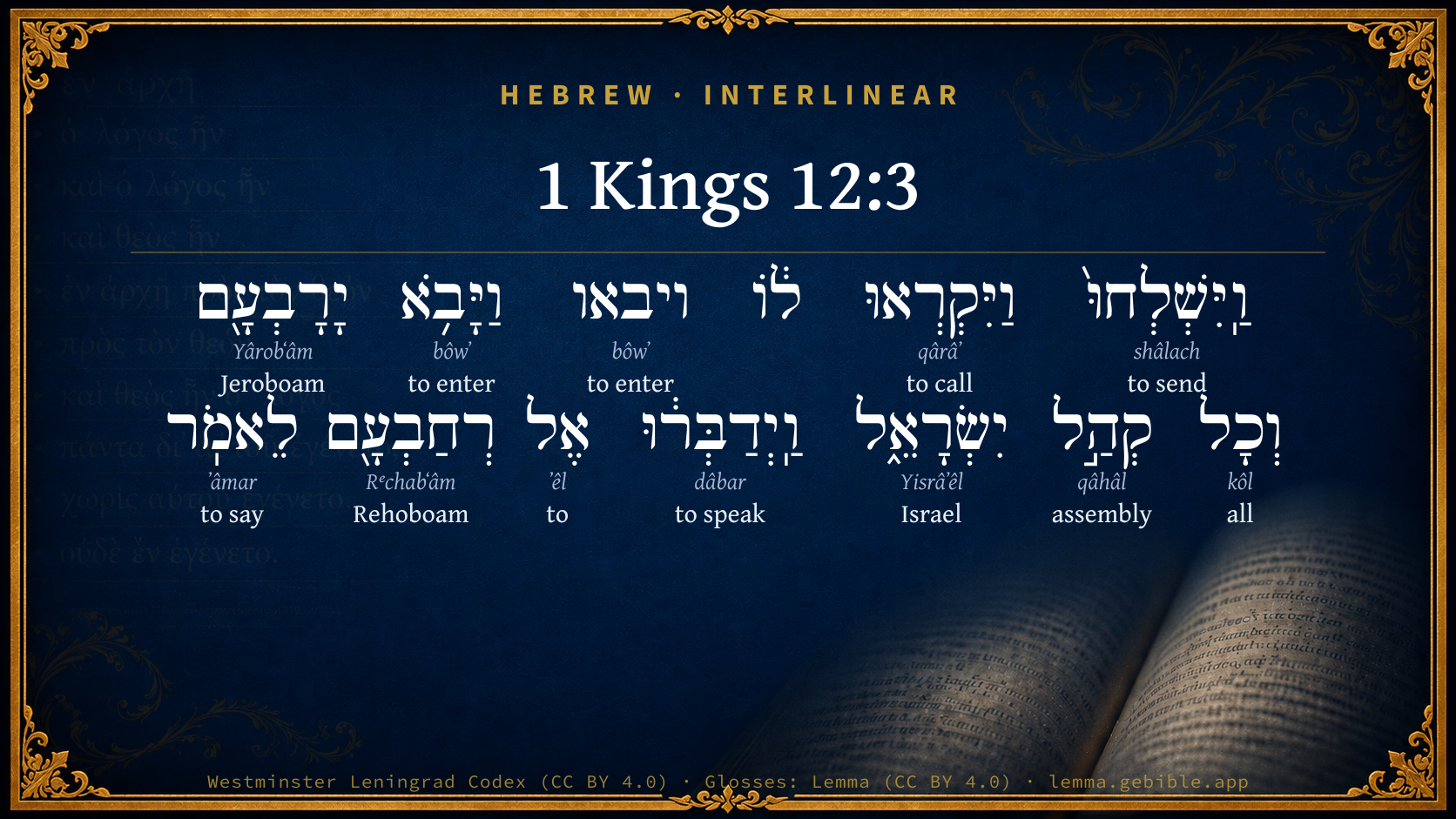
Hebrew (Westminster Leningrad Codex) 1 Kings 12:3 appears in the Hebrew Old Testament. The text above is from the Westminster Leningrad Codex. Each word links to its Strong’s number, a concise gloss, and parsing drawn from the Open Scriptures Hebrew Bible morphology. Click any word for its full Brown-Driver-Briggs (BDB) entry.
Download image
Cite this verse

1 Kings 12:3 (World English Bible). Public Domain. Lemma interlinear Bible study tool, https://lemma.gebible.app/v/1-kings/12/3.

Show BibTeX & RIS
BibTeX
RIS
English Translation
and they sent and called him), that Jeroboam and all the assembly of Israel came, and spoke to Rehoboam, saying,
World English Bible · Public Domain
Download a study sheet

One document with this verse’s original text, its word-by-word gloss line, the meaning frame, cross-references with their text, attributed commentary, and full source and license credits — printable, and it pastes into notes with its structure intact.

This verse Autodidact and up

Study sheet (.html) Plain text (.txt)

A passage Seminary Student

Up to 50 verses in one chapter. A passage sheet keeps up to 6 commentary sources and 12 cross-references per verse, in the order this page ranks them, and says so on the sheet whenever that leaves anything out. Ask for a single verse and you get the Autodidact verse sheet above.

Everything on this page stays free to read, with no account — the sheet is a download of what is already on screen, not access to it.

Want to remove ads? Support Godless Engineer
Compare translations 3

The same verse in 3 English versions, stacked beneath the original-language interlinear above. Click any original word for its lexicon entry.

Each is an independent rendering of the whole verse — the interlinear is not word-aligned to these translations.

Highlighted words mark where these versions differ — a whole-verse word diff, not a word-by-word alignment.

  • World English Bible Public Domain
    and they sent and called him), that Jeroboam and all the assembly of Israel came, and spoke to Rehoboam, saying,
  • King James Version Public Domain
    That they sent and called him. And Jeroboam and all the congregation of Israel came, and spake unto Rehoboam, saying,
  • unfoldingWord Literal Text CC BY-SA 4.0
    that they sent and they called for him. And Jeroboam came, and all of the assembly of Israel, and they spoke to Rehoboam, saying,

unfoldingWord Literal Text — © unfoldingWord, licensed CC BY-SA 4.0. Word-aligned USFM3 via Door43 (git.door43.org/unfoldingWord/en_ult).

Versions to compare (up to 4)

3 of 4 selected

Show all 18 translations

Every available English version of this verse, each an independent rendering of the whole verse.

  • World English Bible Public Domain
    and they sent and called him), that Jeroboam and all the assembly of Israel came, and spoke to Rehoboam, saying,
  • Berean Standard Bible Public Domain
    So they sent for Jeroboam, and he and the whole assembly of Israel came to Rehoboam and said,
  • Majority Standard Bible Public Domain
    So they sent for Jeroboam, and he and the whole assembly of Israel came to Rehoboam and said,
  • King James Version Public Domain
    That they sent and called him. And Jeroboam and all the congregation of Israel came, and spake unto Rehoboam, saying,
  • American Standard Version (1901) Public Domain
    and they sent and called him), that Jeroboam and all the assembly of Israel came, and spake unto Rehoboam, saying,
  • Revised Version (1885) Public Domain
    and they sent and called him;) that Jeroboam and all the congregation of Israel came, and spake unto Rehoboam, saying,
  • Geneva Bible (1599) Public Domain
    Then they sent and called him: and Ieroboam and all the Congregation of Israel came, and spake vnto Rehoboam, saying,
  • Douay-Rheims (1899) Public Domain
    And they sent and called him: and Jeroboam came, and all the multitude of Israel, and they spoke to Roboam, saying:
  • Young's Literal Translation Public Domain
    that they send and call for him; and they come -- Jeroboam and all the assembly of Israel -- and speak unto Rehoboam, saying,
  • Literal Standard Version CC BY-SA 4.0
    that they send and call for him; and they come—Jeroboam and all the assembly of Israel—and speak to Rehoboam, saying,
  • Unlocked Literal Bible CC BY-SA 4.0
    So they sent and called him, and Jeroboam and all the assembly of Israel came and said to Rehoboam,
  • unfoldingWord Literal Text CC BY-SA 4.0
    that they sent and they called for him. And Jeroboam came, and all of the assembly of Israel, and they spoke to Rehoboam, saying,
  • Darby Bible Public Domain
    and they sent and called him), that Jeroboam and all the congregation of Israel came and spoke to Rehoboam, saying,
  • World Messianic Bible Public Domain
    and they sent and called him), Jeroboam and all the assembly of Israel came, and spoke to Rehoboam, saying,
  • Webster's Bible Public Domain
    That they sent and called him. And Jeroboam and all the congregation of Israel came, and spoke to Rehoboam, saying,
  • Free Bible Version CC BY-SA 4.0
    The Israelite leaders sent for him. Jeroboam and the whole assembly of Israelites went to talk with Rehoboam.
  • Bible in Basic English Public Domain
    And all the men of Israel came to Rehoboam and said,
  • JPS Tanakh (1917) Public Domain
    and they sent and called him — that Jeroboam and all the congregation of Israel came, and spoke unto Rehoboam, saying:

Literal Standard Version (2020), Covenant Press — licensed CC BY-SA 4.0. Text via the HelloAO Bible API (eBible.org). Unlocked Literal Bible (unfoldingWord) — licensed CC BY-SA 4.0. Text via the HelloAO Bible API (eBible.org). unfoldingWord Literal Text — © unfoldingWord, licensed CC BY-SA 4.0. Word-aligned USFM3 via Door43 (git.door43.org/unfoldingWord/en_ult). Free Bible Version, Dr. Jonathan Gallagher — licensed CC BY-SA 4.0. Text via the HelloAO Bible API (eBible.org).

Word by word

More ways to search: Search by grammar → Find every occurrence → Compare this word →

Practice this passage: Drill this verse → Learn its vocabulary →

רְחַבְעָ֖ם
Rᵉchabʻâm
H7346
“Rehoboam”
Noun, Proper
Part of Speech
Noun
Type
Proper
Full BDB Definition

Origin: from H7337 and H5971

TWOT: None

Rehoboam = "a people has enlarged" - son of Solomon and the 1st king of Judah after the split up of the kingdom of Israel
  1. וַֽיִּשְׁלְחוּ֙ shâlach H7971 “and · to send” Conjunction + Verb, Qal, Sequential Imperfect, 3rd Person, Masculine, Plural
  2. וַיִּקְרְאוּ qârâʼ H7121 “and · to call” Conjunction + Verb, Qal, Sequential Imperfect, 3rd Person, Masculine, Plural
  3. ויבאו bôwʼ H935 “and · to enter” Conjunction + Verb, Qal, Sequential Imperfect, 3rd Person, Masculine, Plural
  4. וַיָּבֹ֥א bôwʼ H935 “and · to enter” Conjunction + Verb, Qal, Sequential Imperfect, 3rd Person, Masculine, Singular
  5. יָרָבְעָ֖ם Yârobʻâm H3379 “Jeroboam” Noun, Proper
  6. וְכָל kôl H3605 “and · all of” Conjunction + Noun, Common, Masculine, Singular, Construct
  7. קְהַ֣ל qâhâl H6951 “assembly of” Noun, Common, Masculine, Singular, Construct
  8. יִשְׂרָאֵ֑ל Yisrâʼêl H3478 “Israel” Noun, Proper
  9. וַֽיְדַבְּר֔וּ dâbar H1696 “and · to speak” Conjunction + Verb, Piel, Sequential Imperfect, 3rd Person, Masculine, Plural
  10. אֶל ʼêl H413 “to” Preposition
  11. לֵאמֹֽר ʼâmar H559 “to say” Preposition + Verb, Qal, Infinitive Construct

About this verse

These counts appear in no published source. They are computed here, from the morphology-tagged text and Lemma’s own curated glosses. What Lemma adds →

13
words
11
distinct lemmas
Historical
section

Shared distinctive vocabulary

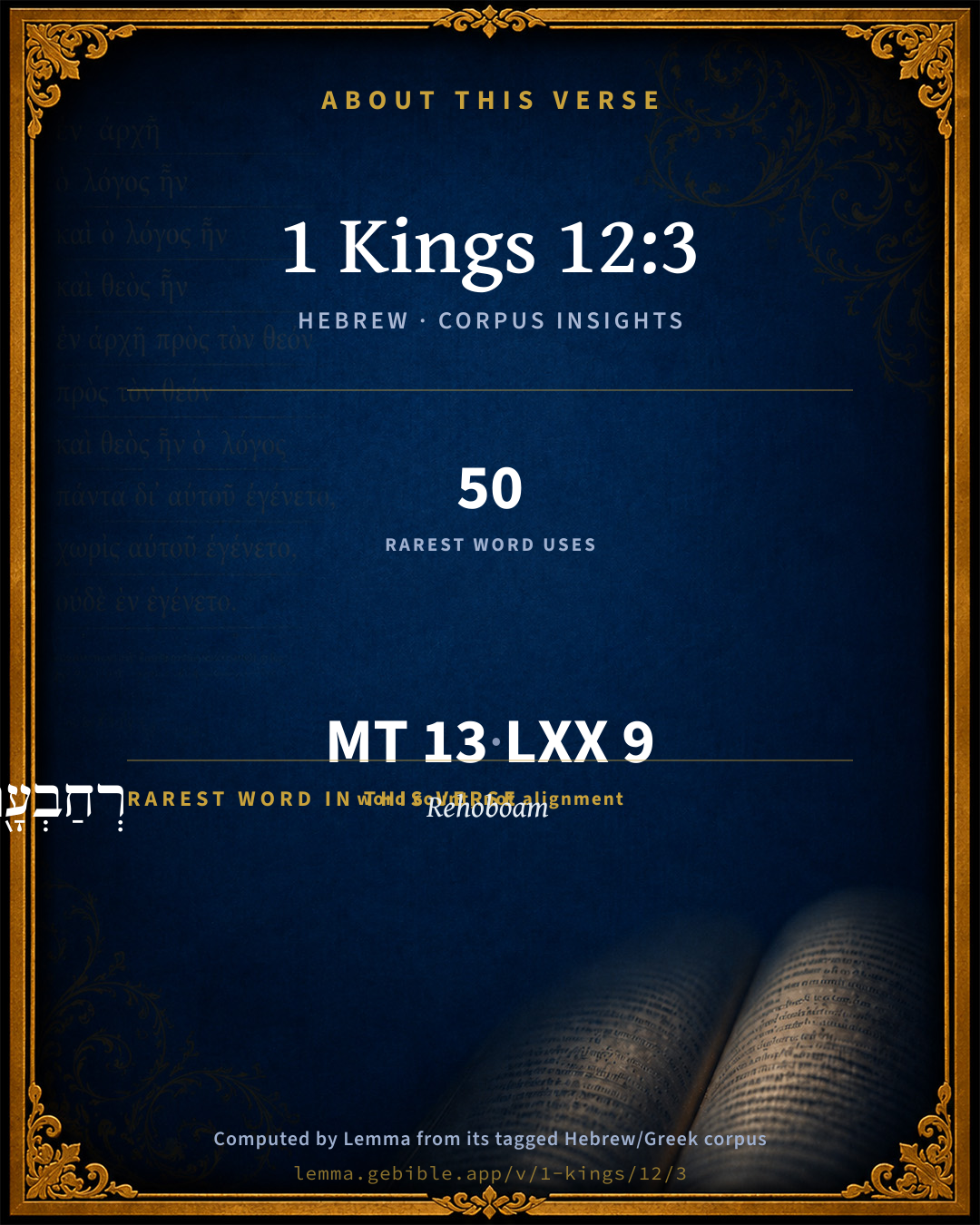
רְחַבְעָ֖ם Rehoboam H7346 occurs in 41 verses of the Hebrew Bible. Also found in:

Grammatical profile

  • 6 verbs
  • 5 nouns
  • 2 prepositions

Verb forms

  • וַֽיִּשְׁלְחוּ֙ Qal · Sequential Imperfect
  • וַיִּקְרְאוּ Qal · Sequential Imperfect
  • ויבאו Qal · Sequential Imperfect
  • וַיָּבֹ֥א Qal · Sequential Imperfect
  • וַֽיְדַבְּר֔וּ Piel · Sequential Imperfect
  • לֵאמֹֽר Qal · Infinitive Construct

Repetition

A word recurs within this verse — often emphatic in Hebrew:

  • ויבאו to enter H935 ×2

Hebrew & Septuagint length

In English translation the verse runs 20 words from the Hebrew and 14 from the Septuagint (LXX English) — the Septuagint runs noticeably shorter here. See the side-by-side →

A rough comparison of the two English renderings, which tokenize alike — not a word-level alignment.

Word counts can differ between the Hebrew and the Greek without any difference in meaning — e.g. the Hebrew direct-object marker אֵת has no separate Greek word, and Greek often adds the article ὁ.

In the original languages it is 13 Hebrew tokens and 9 Greek tokens — but the two are counted differently (Hebrew bundles its prefixes and suffixes into one token; the Greek is in lemma form), so that isn’t a like-for-like length.

Hebrew and Greek witnesses Masoretic Hebrew ↔ Greek Septuagint

The same verse in the two great witnesses to the Old Testament, shown verse-for-verse.

Here the Septuagint runs noticeably shorter than the Hebrew — LXX2012 (modern English Septuagint) 14 words vs World English Bible 20. A rough length comparison of the two English translations, not a word-level alignment — read both below.

These are two independent witnesses, not word-aligned to each other, and the Septuagint is shown in lemma (dictionary) form.

Hebrew 1 Kings 12:3 Masoretic · Westminster Leningrad Codex

וַֽיִּשְׁלְחוּ֙ וַיִּקְרְאוּ ל֔וֹ ויבאו וַיָּבֹ֥א יָרָבְעָ֖ם וְכָל קְהַ֣ל יִשְׂרָאֵ֑ל וַֽיְדַבְּר֔וּ אֶל רְחַבְעָ֖ם לֵאמֹֽר

and they sent and called him), that Jeroboam and all the assembly of Israel came, and spoke to Rehoboam, saying,

World English Bible · Public Domain

Greek LXX 1 Kings 12:3 Septuagint · lemma form

καί λαλέω ὁ λαός πρός ὁ βασιλεύς ροβοαμ λέγω

And the people spoke to king Roboam, saying, Your father made our yoke heavy;

LXX2012 (modern English Septuagint) · Public Domain

On this verse, The Cambridge Bible for Schools and Colleges discusses the Septuagint’s reading. Read the note in Commentary ↓

Hebrew: Westminster Leningrad Codex (CC BY 4.0). Greek: Septuagint (public domain); English from LXX2012 (modern English Septuagint) (Public Domain). How the Septuagint differs from the Hebrew →

Targum (Aramaic paraphrase)

1

The Targum is the ancient Jewish Aramaic paraphrase of the Hebrew Scriptures — an interpretive translation, not the Hebrew text itself. Onkelos (literal) and Pseudo-Jonathan (expansive) render the Torah, and Jonathan the Prophets. Coverage is partial: where no permissively-licensed English translation exists for a verse, only the Aramaic is shown. This is verse-level text, not a word-by-word alignment to the Hebrew.

  1. Targum Jonathan Prophets (Joshua–Malachi)
    וּשְׁלָחוּ וּקְרוֹ לֵיהּ וַאֲתָא יָרָבְעָם וְכָל קְהַל יִשְׂרָאֵל וּמַלִילוּ עִם רְחַבְעָם לְמֵימָר:

    (no public-domain English translation for this verse)

    Targum Jonathan — Aramaic: “Mikraot Gedolot” (public domain). English: “Sefaria Community Translation” (CC0 1.0 (public-domain dedication)); “London "Chaldee Paraphrase," 1871” (public domain). Text via Sefaria.

Commentary

Notes on 1 Kings 12:3 from classic Christian and Jewish commentators (each source and its license shown beneath its notes). The classic Christian expositions comment on the surrounding passage and are grouped to its opening verse, so a note may address several verses; the Jewish commentaries on the Tanakh (Rashi and others) are per-verse, so they appear only where the commentator wrote on this verse.

Lemma curates 59 commentaries, every one of them public domain or Creative Commons licensed, each selected and text-cleaned for this edition rather than reprinted as found. About our sources →

Trapp's Complete Commentary

John Trapp

1Ki 12:3 That they sent and called him. And Jeroboam and all the congregation of Israel came, and spake unto Rehoboam, saying,

Ver. 3. That they sent and called him.] This was the act of the multitude, that shallow brained, but great and many headed beast. Jeroboam they picked as one that had been a prime officer amongst them; one that had suffered banishment for speaking freely for them, that was a mighty man of valour, {1Ki 11:28} and that had God’s promise of the kingdom by the prophet Ahijah, who was also of the same tribe.

And Rehoboam and all the congregation.] An importable subsidy in Henry VIII’s time, procured by Cardinal Wolsey, was, by the Commons, denied to be paid. {a} Suffolk rose up in arms making Poverty their captain, as here the aggrieved Israelites did Jeroboam, one that was born of himself, and of whom it might be said, as it was once of Caligula, Non meliorem unquam servum fuisse, nec deteriorem dominum, that there was not a better servant than he, nor a worse lord.

{a} Speed.

John Trapp, A Commentary or Exposition upon All the Books of the Old and New Testament (1647–1656) — public domain. Text from a community e-Sword module.

Joseph Benson's Commentary

1Ki 12:3. They sent and called him — When the people sent Jeroboam word of Solomon’s death, they also sent a message to him to desire he would attend their general meeting at Shechem, and assist them to get their grievances redressed. For they judged that the presence and countenance of a man of such great interest and reputation might lay the greater obligation upon Rehoboam to grant them ease and relief. Some suppose that they had heard of what had passed between the Prophet Ahijah and him, and had an inclination to fulfil what the prophet had foretold to him; which is not unlikely. And all the congregation came — That is, all their elders, and the heads of their tribes. These, it appears, chose Jeroboam to be their speaker.

Joseph Benson's Commentary on the Old and New Testaments (1811–1818) — public domain. Text from a community e-Sword module.

The Cambridge Bible for Schools and Colleges

gen. ed. J. J. S. Perowne

3. that they sent] Better, And they sent: see the previous note. Josephus (Ant. viii. 8, i) calls this party οἱ τῶν ὄχλων ἄρχοντες, and represents them as sending to Jeroboam immediately after Solomon was dead. Clearly there was a feeling that some change was at hand, and the knowledge of Ahijah’s prophecies had not been confined to Jeroboam and Solomon. Hence men were prepared for what was coming.

and called him] Knowing that he would be ready to come, and that his ability and industry (described 1Ki_11:28 above) qualified him for a leader of their enterprise.

Jeroboam and all the congregation of Israel] The LXX. (Vat.) omits Jeroboam. But the object of sending for him was clearly that he might be the prime mover in the agitation, and by taking part in the popular petition he would prepare the way for the invitation sent to him as mentioned below in 1Ki_12:20.

The Cambridge Bible for Schools and Colleges (gen. ed. J. J. S. Perowne; Cambridge University Press, 1878–1918) — public domain. Text from a community e-Sword module.

John Gill's Exposition

That they sent and called him,.... That is, the people of Israel, some of the principal of them, especially of the tribe of Ephraim, sent messengers to him, and gave him an invitation to come to them at Shechem; or, they had sent (e), as Kimchi interprets it, which was the reason of his returning from Egypt, at least one of them:

and Jeroboam, and all the congregation of Israel, came; the chief men of them, the heads of the people; these, with Jeroboam at the head of them, who was come out of Egypt, came to Shechem, where Rehoboam was, and they had appointed to meet him:

and spake unto Rehoboam; one in the name of them all, perhaps Jeroboam:

saying; as follows.

(e) So Pagninus, Montanus.

John Gill's Exposition of the Whole Bible (1746–1763) — public domain (CC PDM 1.0). Text via the HelloAO Bible API.

Matthew Poole's English Annotations

They sent and called him: when the people sent him word of Solomon’s death, they also sent a summons for him to come to Shechem. Or as soon as he had heard the tidings of Solomon’s death from others, or from common fame; presently there came a solemn message to him from the people, who desired his presence and assistance, as it seems probable, from divers motives; some, that they might translate the kingdom from Rehoboam to him; and others only for this reason, that the presence and countenance of a man of so great interest and reputation, and one that had some claim or pretence upon the kingdom, might lay the greater obligation upon Rehoboam to grant their desires of ease and relief.

Matthew Poole's English Annotations on the Holy Bible (1683–1685) — public domain. Text from a community e-Sword/MySword module.

The Pulpit Commentary

That Heb. and they sent and called him. And Jeroboam and all the congregation of Israel came It has been held that this verse is largely an interpolation. The LXX Cod. Vat. has simply, And the people spake unto king Rehoboam, saying." Of more importance, however, is the fact that it is at direct variance with ver. 20, which places the appearance of Jeroboam on the scene after the revolt of the tribes. Indeed, these two verses can only be brought into agreement by the questionable device of understanding the "all Israel" of ver. 20 very differently from the same expression in ver. 1. If, however, we follow in this instance the LXX, which omits the name of Jeroboam both here and in ver. 12 (and which thereby implies that he was not one of the deputation to Rehoboam, but, as ver. 2 states, was at that time still in Egypt), the difficulty vanishes. Ver. 20 then becomes the natural and logical continuation of vers. 2, 3. "And Jeroboam dwelt in Egypt. And they sent and called him to the country. And when all Israel heard that Jeroboam was come again at their summons they sent and called him unto the congregation," etc. And in favour of the omission of Jeroboam"s name is the fact that the Hebrew text, both in ver. 3 and in ver. 12, betrays some little confusion. In ver. 3, the Cethib has WaboYw and WboYw in ver. 12, whereas the Keri has aboYw in both cases. The words look, that is to say, as if a singular nominative had been subsequently introduced, and spake unto Rehoboam, saying.

The Pulpit Commentary (1880–1919), ed. H.D.M. Spence-Jones & Joseph S. Exell — public domain. Text from a community e-Sword module.

John Wesley's Explanatory Notes

They sent - When the people sent him word of Solomon's death, they also sent a summons for him to come to Shechem. That the presence and countenance of a man of so great interest and reputation, might lay the greater obligation upon Rehoboam to grant them ease and relief.

John Wesley, Explanatory Notes Upon the Whole Bible (1754–1765) — public domain. Text via the GEBible commentary corpus.

unfoldingWord translationNotes

Door43 World Missions Community

called him

Here the word "him" refers to Jeroboam.

made our yoke heavy

A heavy yoke is a metaphor for very difficult labor and requirements. AT: "treated us cruelly" or "forced us to work very hard" (See: Metaphor)

translationWords

send

call

assembly

ancestor

yoke

works

servant

unfoldingWord translationNotes — © Distant Shores Media and the Door43 World Missions Community, licensed CC BY-SA 4.0. Source: git.door43.org/Door43/en_tn.

Lesson kit

Teaching starters — assembled from the data on this page, not authored interpretation. Every prompt links to the verse data it draws on. Edit before teaching.

1 Kings, in the Historical, opens this verse with 13 words (11 distinct Hebrew lemmas). Its most distinctive word is Rᵉchabʻâm (“Rehoboam”). The Greek Septuagint runs shorter here. A historical commentator’s framing appears above. Read the whole chapter for the surrounding context.

Discussion questions

  1. What does “Rehoboam” (Rᵉchabʻâm) contribute to the verse as a whole?
  2. How does 1 Kings 11:43, which shares the word «Rehoboam», read alongside this verse?
  3. What does the repetition of “to enter” (2× in this one verse) do in this verse?
  4. The Septuagint runs shorter here than the Hebrew. What might account for the difference?
  5. These translations render this verse differently. What is at stake in choosing one wording over another?
  6. «וַֽיִּשְׁלְחוּ֙» is a Qal Sequential Imperfect verb. How does that grammatical form shape the action described?
  7. Compare how Trapp's Complete Commentary and Joseph Benson's Commentary read this verse. Where do they agree or differ?

Things to notice

Reading settings

Reading text

Shown beneath each verse's original-language words.

Old Testament
Old Testament edition

Read the OT as the Masoretic Hebrew (MT) or the Greek Septuagint (LXX).

English shown for the Greek Septuagint (in the Hebrew ↔ Greek comparison).

Comparing translations? Open the Compare panel on any verse page to stack up to four side by side.