
1 Samuel 26:14

Hebrew (Westminster Leningrad Codex) 1 Samuel 26:14 appears in the Hebrew Old Testament. The text above is from the Westminster Leningrad Codex. Each word links to its Strong’s number, a concise gloss, and parsing drawn from the Open Scriptures Hebrew Bible morphology. Click any word for its full Brown-Driver-Briggs (BDB) entry.
Download image
Cite this verse

1 Samuel 26:14 (World English Bible). Public Domain. Lemma interlinear Bible study tool, https://lemma.gebible.app/v/1-samuel/26/14.

Show BibTeX & RIS
BibTeX
RIS
English Translation
and David cried to the people, and to Abner the son of Ner, saying, Don't you answer, Abner? Then Abner answered, Who are you who cries to the king?
World English Bible · Public Domain
Download a study sheet

One document with this verse’s original text, its word-by-word gloss line, the meaning frame, cross-references with their text, attributed commentary, and full source and license credits — printable, and it pastes into notes with its structure intact.

This verse Autodidact and up

Study sheet (.html) Plain text (.txt)

A passage Seminary Student

Up to 50 verses in one chapter. A passage sheet keeps up to 6 commentary sources and 12 cross-references per verse, in the order this page ranks them, and says so on the sheet whenever that leaves anything out. Ask for a single verse and you get the Autodidact verse sheet above.

Everything on this page stays free to read, with no account — the sheet is a download of what is already on screen, not access to it.

Want to remove ads? Support Godless Engineer
Compare translations 3

The same verse in 3 English versions, stacked beneath the original-language interlinear above. Click any original word for its lexicon entry.

Each is an independent rendering of the whole verse — the interlinear is not word-aligned to these translations.

Highlighted words mark where these versions differ — a whole-verse word diff, not a word-by-word alignment.

  • World English Bible Public Domain
    and David cried to the people, and to Abner the son of Ner, saying, Don't you answer, Abner? Then Abner answered, Who are you who cries to the king?
  • King James Version Public Domain
    And David cried to the people, and to Abner the son of Ner, saying, Answerest thou not, Abner? Then Abner answered and said, Who art thou that criest to the king?
  • unfoldingWord Literal Text CC BY-SA 4.0
    And David called to the people and to Abner, the son of Ner, saying, “Will you not answer, Abner?” And Abner answered and said, “Who you call to the king?”

unfoldingWord Literal Text — © unfoldingWord, licensed CC BY-SA 4.0. Word-aligned USFM3 via Door43 (git.door43.org/unfoldingWord/en_ult).

Versions to compare (up to 4)

3 of 4 selected

Show all 18 translations

Every available English version of this verse, each an independent rendering of the whole verse.

  • World English Bible Public Domain
    and David cried to the people, and to Abner the son of Ner, saying, Don't you answer, Abner? Then Abner answered, Who are you who cries to the king?
  • Berean Standard Bible Public Domain
    And David shouted to the troops and to Abner son of Ner, “Will you not answer me, Abner?” “Who calls to the king?” Abner replied.
  • Majority Standard Bible Public Domain
    And David shouted to the troops and to Abner son of Ner, “Will you not answer me, Abner?” “Who are you who calls to the king?” Abner replied.
  • King James Version Public Domain
    And David cried to the people, and to Abner the son of Ner, saying, Answerest thou not, Abner? Then Abner answered and said, Who art thou that criest to the king?
  • American Standard Version (1901) Public Domain
    and David cried to the people, and to Abner the son of Ner, saying, Answerest thou not, Abner? Then Abner answered and said, Who art thou that criest to the king?
  • Revised Version (1885) Public Domain
    and David cried to the people, and to Abner the son of Ner, saving, Answerest thou not, Abner? Then Abner answered and said, Who art thou that criest to the king?
  • Geneva Bible (1599) Public Domain
    And Dauid cryed to the people, and to Abner the sonne of Ner, saying, Hearest thou not, Abner? Then Abner answered, and said, Who art thou that cryest to the King?
  • Douay-Rheims (1899) Public Domain
    David cried to the people, and to Abner the son of Ner, saying: Wilt thou not answer, Abner? And Abner answering, said: Who art thou, that criest, and disturbest the king?
  • Young's Literal Translation Public Domain
    and David calleth unto the people, and unto Abner son of Ner, saying, `Dost thou not answer, Abner?' and Abner answereth and saith, `Who `art' thou `who' hast called unto the king?'
  • Literal Standard Version CC BY-SA 4.0
    and David calls to the people, and to Abner son of Ner, saying, “Do you not answer, Abner?” And Abner answers and says, “Who [are] you [who] have called to the king?”
  • Unlocked Literal Bible CC BY-SA 4.0
    David shouted out to the people and to Abner son of Ner; he said, “Do you not answer, Abner?” Then Abner answered and said, “Who are you who is shouting to the king?”
  • unfoldingWord Literal Text CC BY-SA 4.0
    And David called to the people and to Abner, the son of Ner, saying, “Will you not answer, Abner?” And Abner answered and said, “Who you call to the king?”
  • Darby Bible Public Domain
    And David cried to the people, and to Abner the son of Ner, saying, Answerest thou not, Abner? Then Abner answered and said, Who art thou that criest to the king?
  • World Messianic Bible Public Domain
    and David cried to the people, and to Abner the son of Ner, saying, “Don’t you answer, Abner?” Then Abner answered, “Who are you who calls to the king?”
  • Webster's Bible Public Domain
    And David cried to the people, and to Abner the son of Ner, saying, Answerest thou not, Abner? Then Abner answered and said, Who art thou that criest to the king?
  • Free Bible Version CC BY-SA 4.0
    He shouted down to the army and Abner, son of Ner, “Aren't you going to answer me, Abner?” “Who is that shouting, disturbing the king?” Abner called back.
  • Bible in Basic English Public Domain
    And crying out to the people and to Abner, the son of Ner, David said, Have you no answer to give, Abner? Then Abner said, Who is that crying out to the king?
  • JPS Tanakh (1917) Public Domain
    And David cried to the people, and to Abner the son of Ner, saying: 'Answerest thou not, Abner?' Then Abner answered and said: 'Who art thou that criest to the king?'

Literal Standard Version (2020), Covenant Press — licensed CC BY-SA 4.0. Text via the HelloAO Bible API (eBible.org). Unlocked Literal Bible (unfoldingWord) — licensed CC BY-SA 4.0. Text via the HelloAO Bible API (eBible.org). unfoldingWord Literal Text — © unfoldingWord, licensed CC BY-SA 4.0. Word-aligned USFM3 via Door43 (git.door43.org/unfoldingWord/en_ult). Free Bible Version, Dr. Jonathan Gallagher — licensed CC BY-SA 4.0. Text via the HelloAO Bible API (eBible.org).

Word by word

More ways to search: Search by grammar → Find every occurrence → Compare this word →

Practice this passage: Drill this verse → Learn its vocabulary →

נֵר֙
Nêr
H5369
“Ner”
Noun, Proper
Part of Speech
Noun
Type
Proper
Full BDB Definition

Origin: the same as H5216

TWOT: 1333a

Ner = "lamp" - son of Jehiel, father of Kish, and grandfather of king Saul - father of Abner, the uncle of Saul - perhaps the same as 1
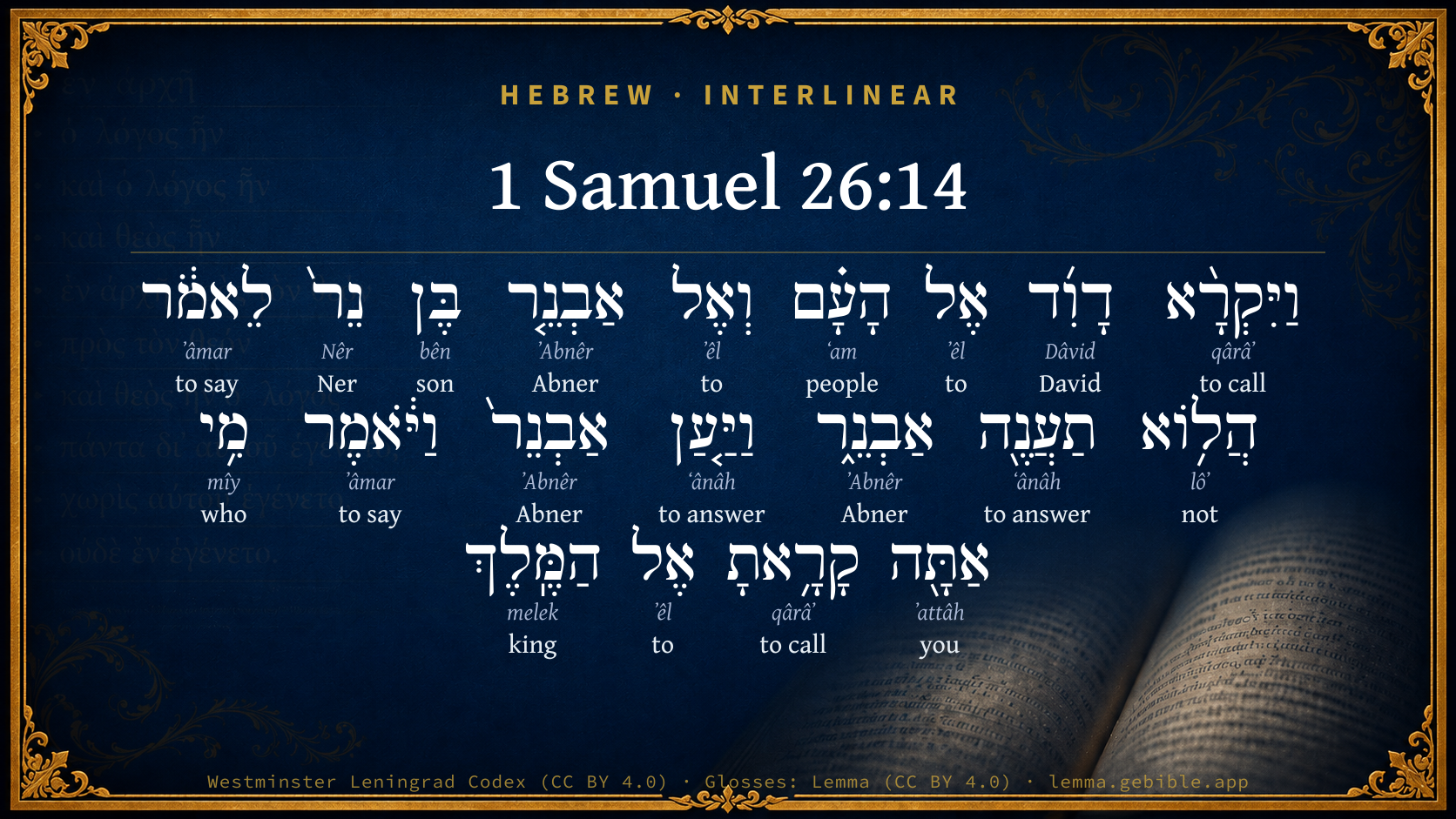
  1. וַיִּקְרָ֨א qârâʼ H7121 “and · to call” Conjunction + Verb, Qal, Sequential Imperfect, 3rd Person, Masculine, Singular
  2. דָוִ֜ד Dâvid H1732 “David” Noun, Proper
  3. אֶל ʼêl H413 “to” Preposition
  4. הָעָ֗ם ʻam H5971 “the · people” Particle, Definite Article + Noun, Common, Masculine, Singular, Absolute
  5. וְאֶל ʼêl H413 “and · to” Conjunction + Preposition
  6. אַבְנֵ֤ר ʼAbnêr H74 “Abner” Noun, Proper
  7. בֶּן bên H1121 “son of” Noun, Common, Masculine, Singular, Construct
  8. לֵאמֹ֔ר ʼâmar H559 “to say” Preposition + Verb, Qal, Infinitive Construct
  9. הֲל֥וֹא lôʼ H3808 “not” Particle, Interrogative + Particle, Negative
  10. תַעֲנֶ֖ה ʻânâh H6030 “to answer” Verb, Qal, Imperfect, 2nd Person, Masculine, Singular
  11. אַבְנֵ֑ר ʼAbnêr H74 “Abner” Noun, Proper
  12. וַיַּ֤עַן ʻânâh H6030 “and · to answer” Conjunction + Verb, Qal, Sequential Imperfect, 3rd Person, Masculine, Singular
  13. אַבְנֵר֙ ʼAbnêr H74 “Abner” Noun, Proper
  14. וַיֹּ֔אמֶר ʼâmar H559 “and · to say” Conjunction + Verb, Qal, Sequential Imperfect, 3rd Person, Masculine, Singular
  15. מִ֥י mîy H4310 “who” Particle, Interrogative
  16. אַתָּ֖ה ʼattâh H859 “you” Pronoun, Personal, 2nd Person, Masculine, Singular
  17. קָרָ֥אתָ qârâʼ H7121 “to call” Verb, Qal, Perfect, 2nd Person, Masculine, Singular
  18. אֶל ʼêl H413 “to” Preposition
  19. הַמֶּֽלֶךְ melek H4428 “the · king” Particle, Definite Article + Noun, Common, Masculine, Singular, Absolute

About this verse

These counts appear in no published source. They are computed here, from the morphology-tagged text and Lemma’s own curated glosses. What Lemma adds →

20
words
13
distinct lemmas
Historical
section

Notable vocabulary

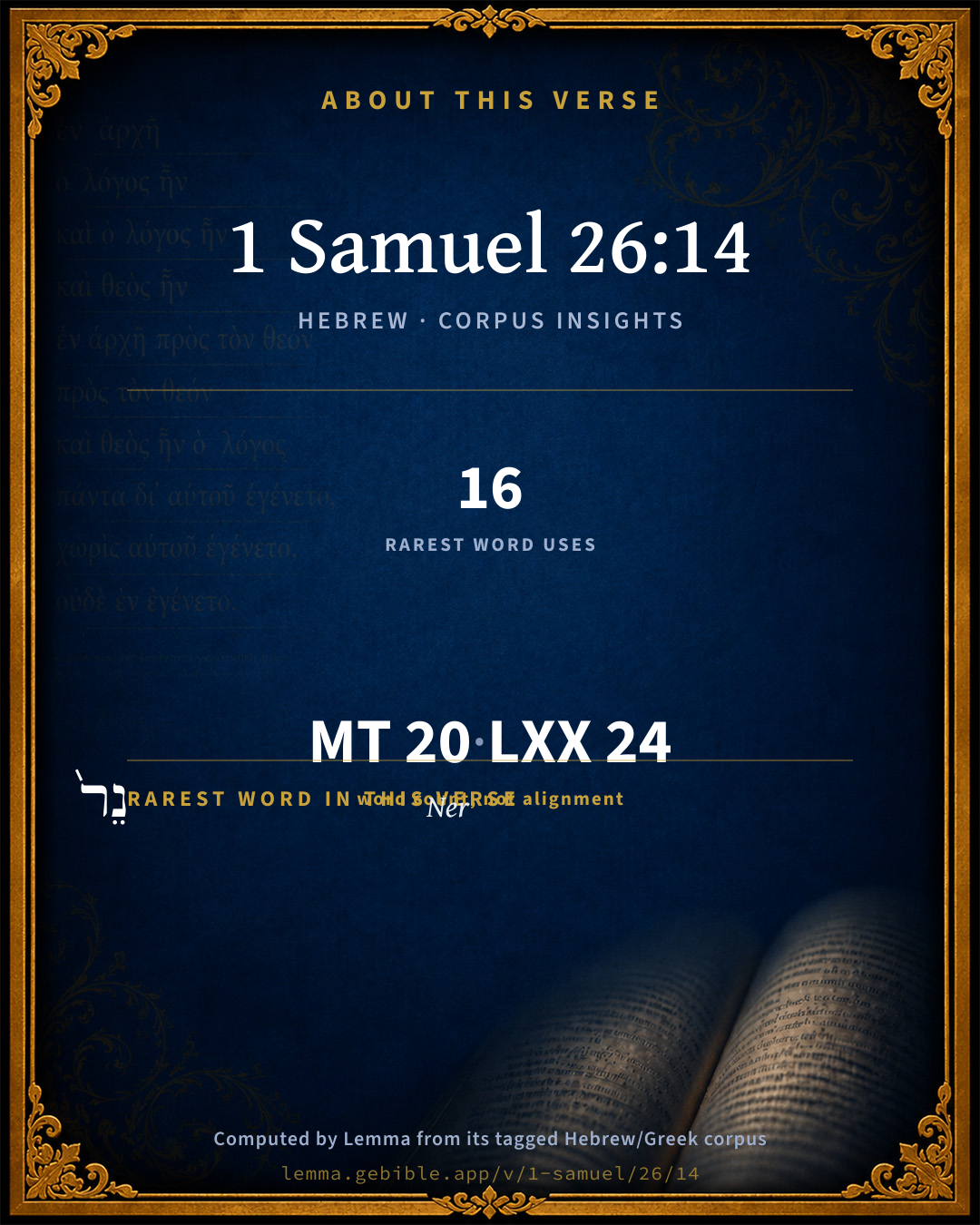
The rarest word here is נֵר֙ Ner H5369 — appearing just 16 times in the whole Hebrew Bible.

Shared distinctive vocabulary

נֵר֙ Ner H5369 occurs in 16 verses of the Hebrew Bible. Also found in:

Grammatical profile

  • 6 verbs
  • 8 nouns
  • 1 pronoun
  • 3 prepositions
  • 2 particles

Verb forms

  • וַיִּקְרָ֨א Qal · Sequential Imperfect
  • לֵאמֹ֔ר Qal · Infinitive Construct
  • תַעֲנֶ֖ה Qal · Imperfect
  • וַיַּ֤עַן Qal · Sequential Imperfect
  • וַיֹּ֔אמֶר Qal · Sequential Imperfect
  • קָרָ֥אתָ Qal · Perfect

Repetition

Words recur within this verse — often emphatic in Hebrew:

  • אַבְנֵ֤ר Abner H74 ×3
  • וַיִּקְרָ֨א to call H7121 ×2
  • לֵאמֹ֔ר to say H559 ×2
  • תַעֲנֶ֖ה to answer H6030 ×2
  • אֶל to H413 ×3

Hebrew & Septuagint length

In English translation the verse runs 29 words from the Hebrew and 26 from the Septuagint (LXX English) — closely comparable.

A rough comparison of the two English renderings, which tokenize alike — not a word-level alignment.

Word counts can differ between the Hebrew and the Greek without any difference in meaning — e.g. the Hebrew direct-object marker אֵת has no separate Greek word, and Greek often adds the article ὁ.

In the original languages it is 20 Hebrew tokens and 24 Greek tokens — but the two are counted differently (Hebrew bundles its prefixes and suffixes into one token; the Greek is in lemma form), so that isn’t a like-for-like length.

Hebrew and Greek witnesses Masoretic Hebrew ↔ Greek Septuagint

The same verse in the two great witnesses to the Old Testament, shown verse-for-verse.

These are two independent witnesses, not word-aligned to each other, and the Septuagint is shown in lemma (dictionary) form.

Hebrew 1 Samuel 26:14 Masoretic · Westminster Leningrad Codex

וַיִּקְרָ֨א דָוִ֜ד אֶל הָעָ֗ם וְאֶל אַבְנֵ֤ר בֶּן נֵר֙ לֵאמֹ֔ר הֲל֥וֹא תַעֲנֶ֖ה אַבְנֵ֑ר וַיַּ֤עַן אַבְנֵר֙ וַיֹּ֔אמֶר מִ֥י אַתָּ֖ה קָרָ֥אתָ אֶל הַמֶּֽלֶךְ

and David cried to the people, and to Abner the son of Ner, saying, Don't you answer, Abner? Then Abner answered, Who are you who cries to the king?

World English Bible · Public Domain

Greek LXX 1 Samuel 26:14 Septuagint · lemma form

καί προςκαλέω δαυίδ ὁ λαός καί ὁ αβεννηρ λαλέω λέγω οὐ ἀποκρίνω αβεννηρ καί ἀποκρίνω αβεννηρ καί εἶπον τίς εἰμί σύ ὁ καλέω ἐγώ

And David called to the people, and spoke to Abenner, saying, Will you not answer, Abenner? and Abenner answered and said, Who are you that call?

LXX2012 (modern English Septuagint) · Public Domain

Hebrew: Westminster Leningrad Codex (CC BY 4.0). Greek: Septuagint (public domain); English from LXX2012 (modern English Septuagint) (Public Domain). How the Septuagint differs from the Hebrew →

Targum (Aramaic paraphrase)

1

The Targum is the ancient Jewish Aramaic paraphrase of the Hebrew Scriptures — an interpretive translation, not the Hebrew text itself. Onkelos (literal) and Pseudo-Jonathan (expansive) render the Torah, and Jonathan the Prophets. Coverage is partial: where no permissively-licensed English translation exists for a verse, only the Aramaic is shown. This is verse-level text, not a word-by-word alignment to the Hebrew.

  1. Targum Jonathan Prophets (Joshua–Malachi)
    וּקְרָא דָוִד לְעַמָא וּלְאַבְנֵר בַּר נֵר לְמֵימַר הֲלָא תַעֲנֵי אַבְנֵר וַאֲתֵיב אַבְנֵר וַאֲמַר מַן דֵין דְקָרֵי בְּרֵישׁ מַלְכָּא:

    (no public-domain English translation for this verse)

    Targum Jonathan — Aramaic: “Mikraot Gedolot” (public domain). English: “Sefaria Community Translation” (CC0 1.0 (public-domain dedication)); “London "Chaldee Paraphrase," 1871” (public domain). Text via Sefaria.

Commentary

Notes on 1 Samuel 26:14 from classic Christian and Jewish commentators (each source and its license shown beneath its notes). The classic Christian expositions comment on the surrounding passage and are grouped to its opening verse, so a note may address several verses; the Jewish commentaries on the Tanakh (Rashi and others) are per-verse, so they appear only where the commentator wrote on this verse.

Lemma curates 59 commentaries, every one of them public domain or Creative Commons licensed, each selected and text-cleaned for this edition rather than reprinted as found. About our sources →

Trapp's Complete Commentary

John Trapp

1Sa 26:14 And David cried to the people, and to Abner the son of Ner, saying, Answerest thou not, Abner? Then Abner answered and said, Who [art] thou [that] criest to the king?

Ver. 14. Answerest thou not, Abner?] It seemeth that David had often called unto him, and that by name; for so men asleep are soonest waked.

That criest to the king,] i.e., To the disturbance of the king.

John Trapp, A Commentary or Exposition upon All the Books of the Old and New Testament (1647–1656) — public domain. Text from a community e-Sword module.

Tyndale Open Study Notes

Tyndale Open Resources

26:14 Abner: See study note on 20:25.

Tyndale Open Study Notes — © Tyndale Open Resources, licensed CC BY-SA 4.0. Text via the HelloAO Bible API.

Geneva Bible (1599)

Geneva Bible translators

Hebrew, Answerest.

Geneva Bible (1599) marginal notes — public domain. Text via Bolls.life.

Ellicott's Commentary for English Readers

(14) Who art thou that criest to the king?—The Vulg. rightly interprets with “Who art thou that criest and disquietest the king?” that is, disturbs the king’s rest with your shouting.

A Bible Commentary for English Readers, edited by Charles John Ellicott (1878–1897) — public domain. Text from a community e-Sword module.

The Cambridge Bible for Schools and Colleges

gen. ed. J. J. S. Perowne

14. that criest to the king] The Sept. omits “to the king;” but the Vulg. gives the sense rightly; “Who art thou that criest and disturbest the king?”

The Cambridge Bible for Schools and Colleges (gen. ed. J. J. S. Perowne; Cambridge University Press, 1878–1918) — public domain. Text from a community e-Sword module.

John Gill's Exposition

And David cried unto the people,.... To the army of Saul with a loud voice, that he might be heard:

and to Abner the son of Ner; particularly to him, because he was general of the army:

saying, answerest thou not, Abner? it seems he had called to him more than once, and he had returned no answer; perhaps not being thoroughly awake, or not knowing whose voice it was, and from whence it came:

then Abner answered and said, who art thou that criest to the king? but it does not appear that David called to the king, only to the people, and to Abner their general, and therefore may be better rendered, "by the king" (s); that is, near him, or "before him" (t), in his presence. Kimchi and Ben Melech explain it, upon the king, or over him; and the Targum is, at the head of the king; the meaning is, how he could act such a part as to call so loud within the king's hearing, as to disturb the king's rest, and awake him out of his sleep.

(s) "juxta regem", Vatablus (t) Ceram rege, Nodlus, p. 58. No. 284.

John Gill's Exposition of the Whole Bible (1746–1763) — public domain (CC PDM 1.0). Text via the HelloAO Bible API.

Matthew Poole's English Annotations

Or,

with or beside the king, i.e. so near to him, so as to disturb the king.

Matthew Poole's English Annotations on the Holy Bible (1683–1685) — public domain. Text from a community e-Sword/MySword module.

Whedon's Commentary on the Bible

Daniel D. Whedon

14. David cried to the people — “The people in these mountainous countries are able, from long practice, so to pitch their voices as to be heard distinctly at distances almost incredible. They talk with persons across enormous wadies, and give the most minute directions, which are perfectly understood. In the stillness of evening, after the people have returned home from their distant fields, the public crier of villages on Lebanon ascends the mountain side, above the place, or to the roof of some prominent house, and gives forth his proclamation with such distinctness that all can hear and understand it.” — Thomson.

Daniel D. Whedon (gen. ed.), Commentary on the Old and New Testaments (1874–1909) — public domain. Text from a community e-Sword module.

John Wesley's Explanatory Notes

Cried to the people - It is probable this was early in the morning.

John Wesley, Explanatory Notes Upon the Whole Bible (1754–1765) — public domain. Text via the GEBible commentary corpus.

Lesson kit

Teaching starters — assembled from the data on this page, not authored interpretation. Every prompt links to the verse data it draws on. Edit before teaching.

1 Samuel, in the Historical, opens this verse with 20 words (13 distinct Hebrew lemmas). Its most distinctive word is Nêr (“Ner”). A historical commentator’s framing appears above. Read the whole chapter for the surrounding context.

Discussion questions

  1. The word Nêr carries the sense “Ner.” How does it shape the verse?
  2. How does 1 Samuel 14:50, which shares the word «Ner», read alongside this verse?
  3. What does the repetition of “Abner” (3× in this one verse) do in this verse?
  4. These translations render this verse differently. What is at stake in choosing one wording over another?
  5. «וַיִּקְרָ֨א» is a Qal Sequential Imperfect verb. How does that grammatical form shape the action described?
  6. Compare how Trapp's Complete Commentary and Tyndale Open Study Notes read this verse. Where do they agree or differ?

Things to notice

Reading settings

Reading text

Shown beneath each verse's original-language words.

Old Testament
Old Testament edition

Read the OT as the Masoretic Hebrew (MT) or the Greek Septuagint (LXX).

English shown for the Greek Septuagint (in the Hebrew ↔ Greek comparison).

Comparing translations? Open the Compare panel on any verse page to stack up to four side by side.