Isaiah 13:3

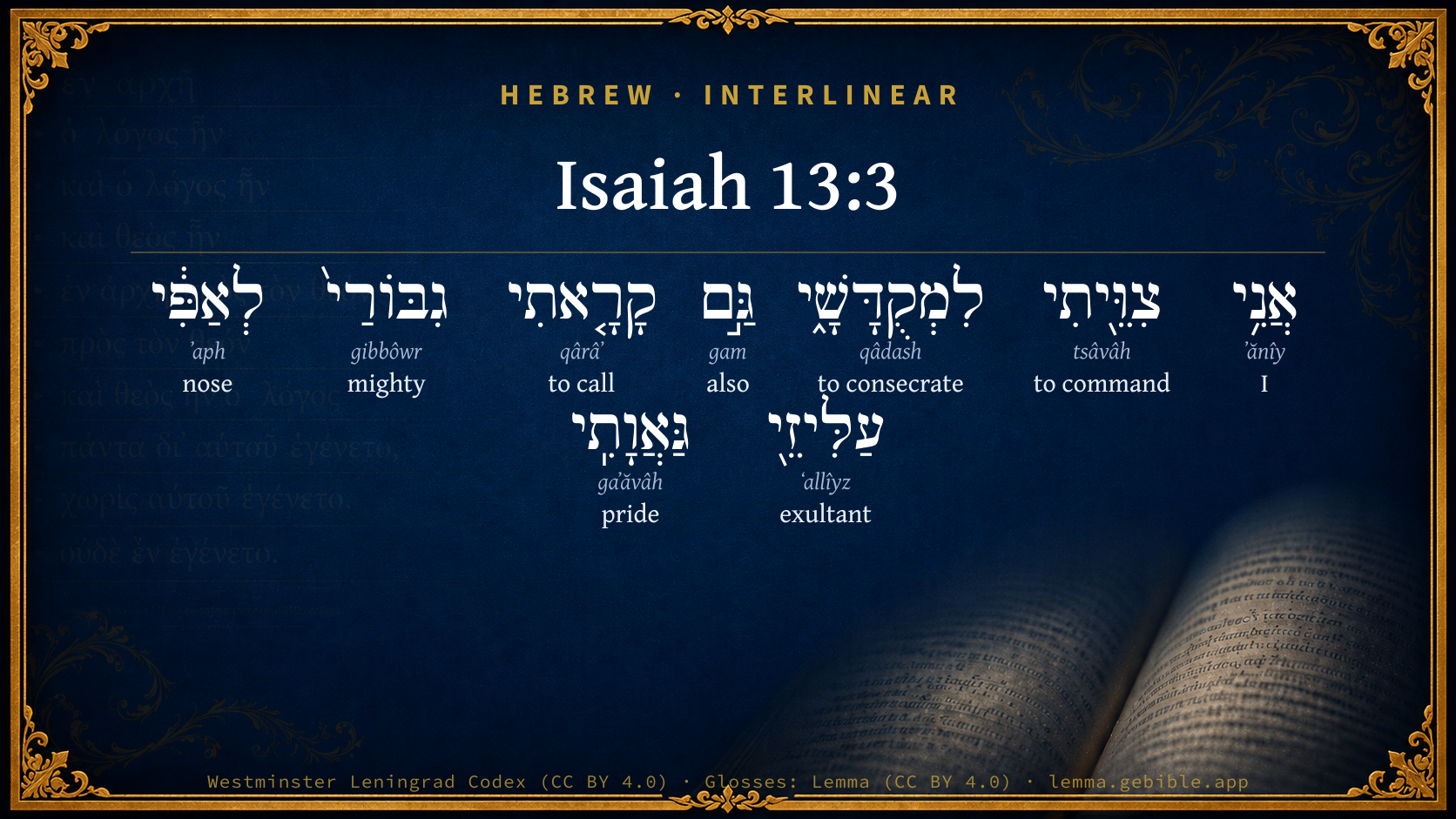
Hebrew (Westminster Leningrad Codex) Isaiah 13:3 appears in the Hebrew Old Testament. The text above is from the Westminster Leningrad Codex. Each word links to its Strong’s number, a concise gloss, and parsing drawn from the Open Scriptures Hebrew Bible morphology. Click any word for its full Brown-Driver-Briggs (BDB) entry.
Download image
Cite this verse

Isaiah 13:3 (World English Bible). Public Domain. Lemma interlinear Bible study tool, https://lemma.gebible.app/v/isaiah/13/3.

Show BibTeX & RIS
BibTeX
RIS
English Translation
I have commanded my consecrated ones, yes, I have called my mighty men for my anger, even my proudly exulting ones.
World English Bible · Public Domain
Highlights
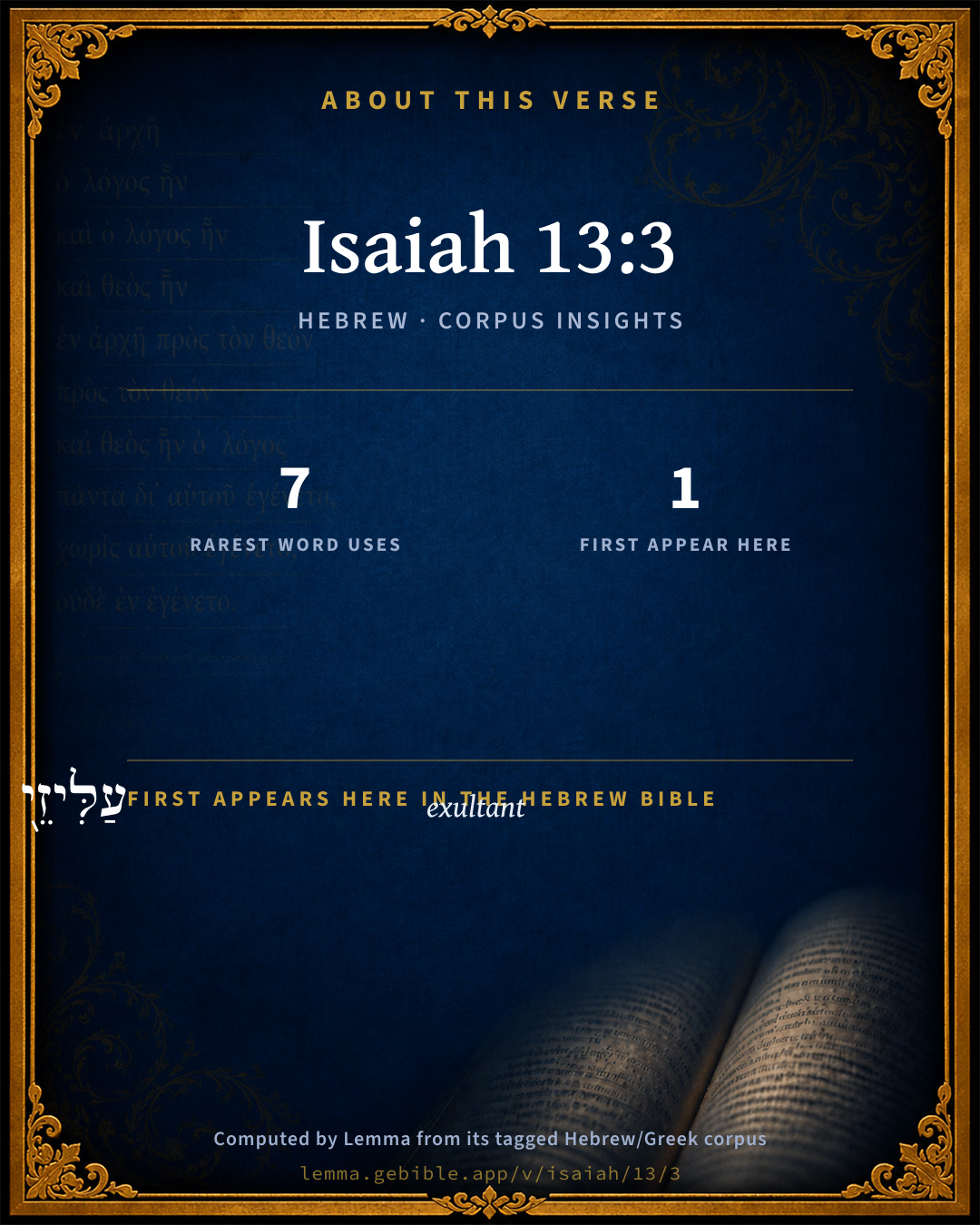
  • 1 first appearance in the Hebrew Bible
Full analysis ↓
Download a study sheet

One document with this verse’s original text, its word-by-word gloss line, the meaning frame, cross-references with their text, attributed commentary, and full source and license credits — printable, and it pastes into notes with its structure intact.

This verse Autodidact and up

Study sheet (.html) Plain text (.txt)

A passage Seminary Student

Up to 50 verses in one chapter. A passage sheet keeps up to 6 commentary sources and 12 cross-references per verse, in the order this page ranks them, and says so on the sheet whenever that leaves anything out. Ask for a single verse and you get the Autodidact verse sheet above.

Everything on this page stays free to read, with no account — the sheet is a download of what is already on screen, not access to it.

Want to remove ads? Support Godless Engineer
Compare translations 3

The same verse in 3 English versions, stacked beneath the original-language interlinear above. Click any original word for its lexicon entry.

Each is an independent rendering of the whole verse — the interlinear is not word-aligned to these translations.

Highlighted words mark where these versions differ — a whole-verse word diff, not a word-by-word alignment.

  • World English Bible Public Domain
    I have commanded my consecrated ones, yes, I have called my mighty men for my anger, even my proudly exulting ones.
  • King James Version Public Domain
    I have commanded my sanctified ones, I have also called my mighty ones for mine anger, even them that rejoice in my highness.
  • unfoldingWord Literal Text CC BY-SA 4.0
    I, I have commanded my consecrated ones; I have also called my warriors for my nose, the exultant ones of my majesty.

unfoldingWord Literal Text — © unfoldingWord, licensed CC BY-SA 4.0. Word-aligned USFM3 via Door43 (git.door43.org/unfoldingWord/en_ult).

Versions to compare (up to 4)

3 of 4 selected

Show all 18 translations

Every available English version of this verse, each an independent rendering of the whole verse.

  • World English Bible Public Domain
    I have commanded my consecrated ones, yes, I have called my mighty men for my anger, even my proudly exulting ones.
  • Berean Standard Bible Public Domain
    I have commanded My sanctified ones; I have even summoned My warriors to execute My wrath and exult in My triumph.
  • Majority Standard Bible Public Domain
    I have commanded My sanctified ones; I have even summoned My warriors to execute My wrath and exult in My triumph.
  • King James Version Public Domain
    I have commanded my sanctified ones, I have also called my mighty ones for mine anger, even them that rejoice in my highness.
  • American Standard Version (1901) Public Domain
    I have commanded my consecrated ones, yea, I have called my mighty men for mine anger, even my proudly exulting ones.
  • Revised Version (1885) Public Domain
    I have commanded my consecrated ones, yea, I have called my mighty men for mine anger, even my proudly exulting ones.
  • Geneva Bible (1599) Public Domain
    I haue commanded them, that I haue sanctified: and I haue called ye mightie to my wrath, and them that reioyce in my glorie.
  • Douay-Rheims (1899) Public Domain
    I have commanded my sanctified ones, and have called my strong ones in my wrath, them that rejoice in my glory.
  • Young's Literal Translation Public Domain
    I have given charge to My sanctified ones, Also I have called My mighty ones for Mine anger, Those rejoicing at Mine excellency.'
  • Literal Standard Version CC BY-SA 4.0
    I have given charge to My sanctified ones, || Also I have called My mighty ones for My anger, || Those rejoicing at My excellence.”
  • Unlocked Literal Bible CC BY-SA 4.0
    I have commanded my holy ones, yes, I have called my mighty men to execute my anger, even my proudly exulting ones.
  • unfoldingWord Literal Text CC BY-SA 4.0
    I, I have commanded my consecrated ones; I have also called my warriors for my nose, the exultant ones of my majesty.
  • Darby Bible Public Domain
    I have commanded my hallowed ones, I have also called my mighty men for mine anger, them that rejoice in my highness.
  • World Messianic Bible Public Domain
    I have commanded my consecrated ones; yes, I have called my mighty men for my anger, even my proudly exulting ones.
  • Webster's Bible Public Domain
    I have commanded my sanctified ones, I have also called my mighty ones for my anger, even them that rejoice in my highness.
  • Free Bible Version CC BY-SA 4.0
    I have ordered the ones I have chosen to attack; I have called my warriors to execute my furious judgment and to celebrate my triumph.
  • Bible in Basic English Public Domain
    I have given orders to my holy ones, I have sent out my men of war, those of mine who take pride in their power, to give effect to my wrath.
  • JPS Tanakh (1917) Public Domain
    I have commanded My consecrated ones, yea, I have called My mighty ones for mine anger, even My proudly exulting ones.

Literal Standard Version (2020), Covenant Press — licensed CC BY-SA 4.0. Text via the HelloAO Bible API (eBible.org). Unlocked Literal Bible (unfoldingWord) — licensed CC BY-SA 4.0. Text via the HelloAO Bible API (eBible.org). unfoldingWord Literal Text — © unfoldingWord, licensed CC BY-SA 4.0. Word-aligned USFM3 via Door43 (git.door43.org/unfoldingWord/en_ult). Free Bible Version, Dr. Jonathan Gallagher — licensed CC BY-SA 4.0. Text via the HelloAO Bible API (eBible.org).

Word by word

More ways to search: Search by grammar → Find every occurrence → Compare this word →

Practice this passage: Drill this verse → Learn its vocabulary →

עַלִּיזֵ֖י
ʻallîyz
H5947
“exultant of”
Adjective, Adjective, Masculine, Plural, Construct
Part of Speech
Adjective
Type
Adjective
Gender
Masculine
Number
Plural
State
Construct
Full BDB Definition

Origin: from H5937

TWOT: 1625b

exultant, jubilant
  1. אֲנִ֥י ʼănîy H589 “I” Pronoun, Personal, 1st Person, Common, Singular
  2. צִוֵּ֖יתִי tsâvâh H6680 “to command” Verb, Piel, Perfect, 1st Person, Common, Singular
  3. לִמְקֻדָּשָׁ֑י qâdash H6942 “to/for · consecrated · me” Preposition + Verb, Pual, Participle Passive, Masculine, Plural, Construct + Suffix, Personal, 1st Person, Common, Singular
  4. גַּ֣ם gam H1571 “also” Particle, Accusative
  5. קָרָ֤אתִי qârâʼ H7121 “to call” Verb, Qal, Perfect, 1st Person, Common, Singular
  6. גִבּוֹרַי֙ gibbôwr H1368 “mighty · my” Adjective, Adjective, Masculine, Plural, Construct + Suffix, Personal, 1st Person, Common, Singular
  7. לְאַפִּ֔י ʼaph H639 “to/for · nose · my” Preposition + Noun, Common, Masculine, Singular, Construct + Suffix, Personal, 1st Person, Common, Singular
  8. גַּאֲוָתִֽי gaʼăvâh H1346 “pride · my” Noun, Common, Feminine, Singular, Construct + Suffix, Personal, 1st Person, Common, Singular

About this verse

These counts appear in no published source. They are computed here, from the morphology-tagged text and Lemma’s own curated glosses. What Lemma adds →

9
words
9
distinct lemmas
Prophets
section

Notable vocabulary

The rarest word here is עַלִּיזֵ֖י exultant H5947 — appearing just 7 times in the whole Hebrew Bible.

First appearance in Scripture

This word makes its first canonical appearance in the Hebrew Bible here:

  • עַלִּיזֵ֖י exultant H5947

Shared distinctive vocabulary

עַלִּיזֵ֖י exultant H5947 occurs in 7 verses of the Hebrew Bible. Also found in:

Grammatical profile

  • 3 verbs
  • 2 nouns
  • 2 adjectives
  • 1 pronoun
  • 1 particle

Verb forms

  • צִוֵּ֖יתִי Piel · Perfect
  • לִמְקֻדָּשָׁ֑י Pual · Participle Passive
  • קָרָ֤אתִי Qal · Perfect

Hebrew & Septuagint length

In English translation the verse runs 21 words from the Hebrew and 21 from the Septuagint (LXX English) — the same length.

A rough comparison of the two English renderings, which tokenize alike — not a word-level alignment.

Word counts can differ between the Hebrew and the Greek without any difference in meaning — e.g. the Hebrew direct-object marker אֵת has no separate Greek word, and Greek often adds the article ὁ.

Cross-references

14

Topical passages linked to Isaiah 13:3 in the Treasury of Scripture Knowledge — connected by theme and wording, ordered by reader-vote popularity; previews shown in the World English Bible.

  • Joel 3:11 Hurry and come, all you surrounding nations, And gather yourselves together." Cause your mighty ones to come down there, Yahweh.
  • Jeremiah 51:20–24 You are my battle-axe and weapons of war: and with you will I break in pieces the nations; and with you will I destroy kingdoms;
  • Revelation 17:12–18 The ten horns that you saw are ten kings who have received no kingdom as yet, but they receive authority as kings, with the beast, for one hour.
  • Ezra 1:1–11 Now in the first year of Cyrus king of Persia, that the word of Yahweh by the mouth of Jeremiah might be accomplished, Yahweh stirred up the spirit of Cyrus king of Persia, so that he made a proclamation throughout all his kingdom, and [put it] also in writing, saying,
  • Ezra 6:1–22 Then Darius the king made a decree, and search was made in the house of the archives, where the treasures were laid up in Babylon.
  • Ezra 7:12–26 Artaxerxes, king of kings, to Ezra the priest, the scribe of the law of the God of heaven, perfect and so forth.
  • Psalms 149:2 Let Israel rejoice in him who made them. Let the children of Zion be joyful in their King.
  • Psalms 149:5–9 Let the saints rejoice in honor. Let them sing for joy on their beds.
  • Isaiah 23:11 He has stretched out his hand over the sea, he has shaken the kingdoms: Yahweh has given commandment concerning Canaan, to destroy the strongholds of it.
  • Isaiah 44:27–28 who says to the deep, Be dry, and I will dry up your rivers;
  • Isaiah 45:4–5 For Jacob my servant's sake, and Israel my chosen, I have called you by your name: I have surnamed you, though you have not known me.
  • Jeremiah 50:21–46 Go up against the land of Merathaim, even against it, and against the inhabitants of Pekod: kill and utterly destroy after them, says Yahweh, and do according to all that I have commanded you.
  • Revelation 18:20–19:7 Rejoice over her, O heaven, you saints, apostles, and prophets; for God has judged your judgment on her."
  • Revelation 18:4–8 I heard another voice from heaven, saying, "Come out of her, my people, that you have no participation in her sins, and that you don't receive of her plagues,

Cross-references courtesy of OpenBible.info (CC BY 4.0).

Hebrew and Greek witnesses Masoretic Hebrew ↔ Greek Septuagint

The same verse in the two great witnesses to the Old Testament, shown verse-for-verse.

These are two independent witnesses, not word-aligned to each other, and the Septuagint is shown in lemma (dictionary) form.

Hebrew Isaiah 13:3 Masoretic · Westminster Leningrad Codex

אֲנִ֥י צִוֵּ֖יתִי לִמְקֻדָּשָׁ֑י גַּ֣ם קָרָ֤אתִי גִבּוֹרַי֙ לְאַפִּ֔י עַלִּיזֵ֖י גַּאֲוָתִֽי

I have commanded my consecrated ones, yes, I have called my mighty men for my anger, even my proudly exulting ones.

World English Bible · Public Domain

Greek LXX Isaiah 13:3 Septuagint · lemma form

ἐγώ συντάσσω καί ἐγώ ἄγω αὐτός ἁγιάζω εἰμί καί ἐγώ ἄγω αὐτός γίγας ἔρχομαι πληρόω ὁ θυμός ἐγώ χαίρω ἅμα καί ὑβρίζω

I give command, and I bring them: giants are coming to fulfil my wrath, rejoicing at the same time and insulting.

LXX2012 (modern English Septuagint) · Public Domain

Hebrew: Westminster Leningrad Codex (CC BY 4.0). Greek: Septuagint (public domain); English from LXX2012 (modern English Septuagint) (Public Domain). How the Septuagint differs from the Hebrew →

Targum (Aramaic paraphrase)

1

The Targum is the ancient Jewish Aramaic paraphrase of the Hebrew Scriptures — an interpretive translation, not the Hebrew text itself. Onkelos (literal) and Pseudo-Jonathan (expansive) render the Torah, and Jonathan the Prophets. Coverage is partial: where no permissively-licensed English translation exists for a verse, only the Aramaic is shown. This is verse-level text, not a word-by-word alignment to the Hebrew.

  1. Targum Jonathan Prophets (Joshua–Malachi)
    אֲנָא פַקְּדִית לְמִזְמַנֵי אַף עַרְעֵית גִבָּרַי וְיִתְפָּרְעוּן מִנְהוֹן רוּגְזִי תּוּקְפִי וְתוּשְׁבַּחְתִּי:

    I have commanded those that are prepared by me, I have also called together my mighty ones, that they may avenge my wrath upon them, my strength, and my praise.

    Targum Jonathan — Aramaic: “Mikraot Gedolot” (public domain). English: “Sefaria Community Translation” (CC0 1.0 (public-domain dedication)); “London "Chaldee Paraphrase," 1871” (public domain). Text via Sefaria.

Commentary

Notes on Isaiah 13:3 from classic Christian and Jewish commentators (each source and its license shown beneath its notes). The classic Christian expositions comment on the surrounding passage and are grouped to its opening verse, so a note may address several verses; the Jewish commentaries on the Tanakh (Rashi and others) are per-verse, so they appear only where the commentator wrote on this verse.

Lemma curates 59 commentaries, every one of them public domain or Creative Commons licensed, each selected and text-cleaned for this edition rather than reprinted as found. About our sources →

Trapp's Complete Commentary

John Trapp

Isa 13:3 I have commanded my sanctified ones, I have also called my mighty ones for mine anger, [even] them that rejoice in my highness.

Ver. 3. I have commanded my sanctified ones,] i.e., I have by my secret instinct stirred up and set on my Medes and Persians, {Isa 13:17} whom in my decree I have set apart for this holy work of executing vengeance on the Babylonians.

I have also called my mighties.] My heroes, armed with my might.

Even them that rejoice in my highness.] Heb., Exultantes superbiae meos; my brave soldiers, whom I render victorious and triumphant.

John Trapp, A Commentary or Exposition upon All the Books of the Old and New Testament (1647–1656) — public domain. Text from a community e-Sword module.

Geneva Bible (1599)

Geneva Bible translators

That is, prepared and appointed to execute my judgments.

Which willingly go about to the work whereunto I appoint them, but how the wicked do this, read Isa. 10:6.

Geneva Bible (1599) marginal notes — public domain. Text via Bolls.life.

Jamieson, Fausset & Brown

Robert Jamieson, A. R. Fausset & David Brown

sanctified ones--the Median and Persian soldiers solemnly set apart by Me for the destruction of Babylon, not inwardly "sanctified," but designated to fulfil God's holy purpose (Jer 51:27-28; Joe 3:9, Joe 3:11; where the Hebrew for prepare war is "sanctify" war).

for mine anger--to execute it.

rejoice in my highness--"Those who are made to triumph for My honor" [HORSLEY]. The heathen Medes could not be said to "rejoice in God's highness" MAURER translates, "My haughtily exulting ones" (Zep 3:11); a special characteristic of the Persians [HERODOTUS,1.88]. They rejoiced in their own highness, but it was His that they were unconsciously glorifying.

Jamieson, Fausset & Brown — Commentary Critical and Explanatory on the Whole Bible (1871) — public domain (CC PDM 1.0). Text via the HelloAO Bible API.

Adam Clarke's Commentary

Verse 3. I have commanded my sanctified ones] מקדשי mekuddashai, the persons consecrated to this very purpose. Nothing can be plainer than that the verb כדש kadash, "to make holy," signifies also to consecrate or appoint to a particular purpose. Bishop Lowth translates, "my enrolled warriors." This is the sense.

Adam Clarke's Commentary on the Bible (1810–1826) — public domain. Text from a community e-Sword/MySword module.

Ellicott's Commentary for English Readers

(3) I have commanded my sanctified ones . . .—The word is applied even to the fierce tribes of the future destroyers, as being appointed, or consecrated, by Jehovah for that special work. The thought and the words (there translated “prepare”) appear in Jer_6:4; Jer_22:7; Jer_51:27. So in the later prophecies Cyrus appears as “the anointed” of the Lord (Isa_45:1).

Even them that rejoice in my highness.—In Zep_3:11 the same phrase occurs in a bad sense. Here, apparently, it denotes the proud consciousness of the invaders that they are doing God’s work.

A Bible Commentary for English Readers, edited by Charles John Ellicott (1878–1897) — public domain. Text from a community e-Sword module.

The Cambridge Bible for Schools and Colleges

gen. ed. J. J. S. Perowne

3. Jehovah speaks.

my sanctified (or consecrated) ones] In ancient times a campaign was inaugurated with religious ceremonies (1Sa_13:9; Jer_22:7; Jer_51:28 [R.V. marg.]) and each warrior was a consecrated man (1Sa_21:5).

them that rejoice in my highness] Translate as in R.V. my proudly exulting ones, Zep_3:11.

The Cambridge Bible for Schools and Colleges (gen. ed. J. J. S. Perowne; Cambridge University Press, 1878–1918) — public domain. Text from a community e-Sword module.

John Gill's Exposition

I have commanded my sanctified ones,.... The Medes and Persians, so called, not because sanctified by the Spirit of God, or made holy persons, through the regenerating and renewing grace of God, or purified by the blood of Christ, and prepared for glory; but because they were set apart in the mind and counsel of God for a special work and service, and were qualified by him with courage and strength to perform it, and therefore said to be his; and this command that was given them was not by a voice from heaven, or in a message by one of his prophets; but by a secret instinct, and, by the power of his providence, stirring them up to engage in such an enterprise (z).

I have also called my mighty ones; meaning Cyrus and Darius, and the officers of their armies, with the common soldiers, who were furnished with might and strength to do his will, to which they were called in his providence:

for mine anger; to execute his wrath upon the Babylonians; so the Targum,

"that they may avenge my wrath upon them:''

or, "in mine anger"; which being stirred up, put him upon calling those mighty ones to his service, and fitting them for it: literally it is, "to my nose" (a); to be before him, to be at his beck and will, and to minister his wrath and vengeance:

even them that rejoice in my highness; in doing that which tended to the exaltation and glory of God; they went cheerfully about the work, and exulted and triumphed in their success: or, "that rejoice my highness" (b); make me glad, because I am glorified by them. So seven angels, the Lord's holy and mighty ones, will be employed in pouring out the vials of his wrath on mystical Babylon, Rev 15:1.

(z) Vid. T. Bab. Beracot, fol. 8. 2. & Gloss. in ib. (a) "in ira mea", Vatablus; "ad iram meam", Junius & Tremellius, Piscator; "in naso meo", Montanus. (b) "exultantis celsitudinis meae", Montanus.

John Gill's Exposition of the Whole Bible (1746–1763) — public domain (CC PDM 1.0). Text via the HelloAO Bible API.

Albert Barnes' Notes on the Bible

I have commanded - This is the language of God in reference to those who were about to destroy Babylon. “He” claimed the control and direction of all their movements; and though the command was not understood by “them” as coming from him, yet it was by his direction, and in accordance with his plan (compare the notes at Isa 10:7; Isa 45:5-6). The “command” was not given by the prophets, or by an audible voice; but it was his secret purpose and direction that led them to this enterprise.

My sanctified ones - The Medes and Persians; not called ‘sanctified because they were holy, but because they were set apart by the divine intention and purpose to accomplish this. The word ‘sanctify’ (קדשׁ qâdash) often means “to set apart” - either to God; to an office; to any sacred use; or to any purpose of religion, or of accomplishing any of the divine plans. Thus, it means to dedicate one to the office of priest Exo 28:41; to set apart or dedicate an altar Exo 39:36; to dedicate a people Exo 19:10-14; to appoint, or institute a fast Joe 1:14; Joe 2:15; to sanctify a war Joe 3:9, that is, to prepare one’s-self for it, or make it ready. Here it means, that the Medes and Persians were set apart, in the purpose of God, to accomplish his designs in regard to Babylon (compare the note at Isa 10:5-6).

My mighty ones - Those who are strong; and who are so entirely under my direction, that they may be called mine.

For mine anger - To accomplish the purposes of my anger against Babylon.

Even them that rejoice in my highness - It cannot be supposed that the Medes and Persians really exulted, or rejoiced in God or in his plans, for it is evident that, like Sennacherib Isa. 10, they were seeking to accomplish their own purposes, and were not solicitous about the plans of God (compare the note at Isa 47:6). The word rendered ‘my highness’ (גאותי ga'ăvāthı̂y) means, properly, “my majesty,” or “glory.” When applied to people, as it often is, it means pride or arrogance. It means here, the high and exalted plan of God in regard to Babylon. It was a mighty undertaking; and one in which the power, the justice, and the dominion of God over nations would be evinced. In accomplishing this, the Medes and Persians would rejoice or exult, not as the fulfilling of the plan of God; but they would exult as if it were their own plan, though it would be really the glorious plan of God. Wicked people often exult in their success; they glory in the execution of their purposes; but they are really accomplishing the plans of God, and executing his great designs.

Albert Barnes' Notes on the Bible (1834–1885) — public domain. Text from a community e-Sword/MySword module.

Haydock's Catholic Bible Commentary

Sanctioned. The Medes and Persians were appointed by God to punish Babylon. (Worthington)

George Leo Haydock (1774–1849), Haydock's Catholic Family Bible and Commentary, 1859 edition — public domain. Excludes Psalms (Douay-Rheims chapter numbering differs from Protestant) and Deuterocanonical books (Catholic canon only).

Matthew Poole's English Annotations

My sanctified ones; the Medes and Persians, fitly so called, because they were solemnly designed and set apart by God for his own service, and for this holy work of executing his just vengeance upon them.

My mighty ones; those whom I have made mighty for this work.

In my highness; or, as others render it, in my glory, materially considered, to wit, in the doing of that work which tends much to the advancement of my glory, in destroying of the Babylonian empire. For otherwise the Medes had no regard to God nor to his glory, but only to their own carnal ends.

Matthew Poole's English Annotations on the Holy Bible (1683–1685) — public domain. Text from a community e-Sword/MySword module.

Whedon's Commentary on the Bible

Daniel D. Whedon

3. My sanctified ones — Not inwardly and consciously belonging to God as designated for this work, but in God’s order actually but unconsciously executing divine retribution on the Babylonian power. See Joe_3:9-10; Jer_22:7. The Persians destroyed idolatry. They were morally much in advance of the highest civilized powers in Mesopotamia. And it is quite probable, that at this conquest of Babylon, and their settlement over that country, the great moral recoil against idolatry was made complete among the exiled Jews.

Daniel D. Whedon (gen. ed.), Commentary on the Old and New Testaments (1874–1909) — public domain. Text from a community e-Sword module.

The Pulpit Commentary

I have commanded my sanctified ones. The pronoun "I" is emphatic myself." Not only will an external summons go forth, but God will lay his own orders on them whom he chooses for his instruments, and bid them come to the muster. All who carry out his purposes are, in a certain sense, "sanctified ones". (comp. Jer_22:7 Jer_51:27 Zep_1:7, etc.) Here the Modes and Persians are specially in. tended (see ver. 17). For mine anger; i.e. "for the purpose of executing my anger." Even them that rejoice in my highness; rather, my proudly exultant ones (Cheyne, Rosenm Gesenius). Aeschylus calls the Persians uperkompouv ("Persae," 1. 827); Herodotus, ubristav (1. 41). The high spirits, however, natural to gallant soldiers on going out to war, rather than any special haughtiness or arrogancy, are intended.

HOMILIES BY R. TUCK Ver. 3. The Lord"s sanctified ones.

This term is used of an army, regarded as being consecrated by the sacrifices which were offered at the beginning of the campaign. (comp. 2Sa_13:9) The assertion made by the prophet is that the Persian army was not really consecrated to Ahura-Mazda, but to Jehovah. Whatever might seem to be the bet, the fact really was that the Persians would fulfill Jehovah"s will and carry out Jehovah"s judgments, A "sanctified one" is, properly, one separated from self-interests and from other people"s concerns, in order that he might carry out God"s will. "Set apart by the purposes and providence of God, disengaged from other projects, that they might wholly apply themselves to something God would have clone: such as were qualified for that to which they were called, for what God employs men in, he does in some measure fit them for." We learn from this expression, and its connection, that we too may be set apart for God, we may be the Lord"s sanctified ones; and yet, on the one hand, the fact may be unrecognized, or, on the other, the fact may bring to us impulse and honor and the unspeakable joy of service.

I SET APART FOR GOD WITHOUT OUR KNOWING IT. As of Cyrus, the Lord"s anointed, it is said, "I girded thee, though thou hast not known me." But in this ease there can be no proper rewards, since the will of the man is not in harmony with the Divine will. God may use his creature man, just as he uses clouds and winds and waves, to fulfill his purposes, and there is no more to be said about it. We are the Lord"s tools, his rod, his staff. Willingly or unwillingly man must do the Lord"s bidding.

II SET APART FOR GOD WITH OUR OWN GLAD CONSENT. Then we come into the position of willing, loving servants; and then there can be rewards which take three forms. Such willingly sanctified ones

(1) are honored with yet further and higher trusts;

(2) are personally cultured by the doing of their life-work under such conditions; and

(3) are sure to receive, now in their hearts, and by-and-by in some open manner, the Master"s "Well done, good and faithful servants," the smile and the word of gracious approval. And such rewards are altogether independent of the particular character of the work for which we are set apart. It may be most trying and painful work, even work of judgment or retribution. No matter; the Divine recognition is ever of willingness and faithfulness. God rewards the true man, not the particular form the man"s service must take. R.T.

The Pulpit Commentary (1880–1919), ed. H.D.M. Spence-Jones & Joseph S. Exell — public domain. Text from a community e-Sword module.

John Wesley's Explanatory Notes

Sanctified ones - The Medes and Persians, so called, because they were set apart by God, for this holy work of executing his just vengeance. Mighty ones - Those whom I have made mighty for this work. Highness - Or, as others render it, in my glory, in the doing of that work which tends to the advancement of my glory. Tho' the Medes had no regard to God, but only to their own ends.

John Wesley, Explanatory Notes Upon the Whole Bible (1754–1765) — public domain. Text via the GEBible commentary corpus.

Keil & Delitzsch

C. F. Keil & F. Delitzsch

"I have summoned my sanctified ones, also called my heroes to my wrath, my proudly rejoicing ones." "To my wrath" is to be explained in accordance with Isa 10:5. To execute His wrath He had summoned His "sanctified ones" (mekuddâshim), i.e., according to Jer 22:7 (compare Jer 51:27-28), those who had already been solemnly consecrated by Him to go into the battle, and had called the heroes whom He had taken into His service, and who were His instruments in this respect, that they rejoiced with the pride of men intoxicated with victory (vid., Zep 1:7, cf., Isa 3:11). עליז is a word peculiarly Isaiah's; and the combination גאוה עליזי is so unusual, that we could hardly expect to find it employed by two authors who stood in no relation whatever to one another.

Keil & Delitzsch — Biblical Commentary on the Old Testament (1861–1891) — public domain (CC PDM 1.0). Text via the HelloAO Bible API. (Old Testament only.)

J. A. Alexander on Isaiah

Joseph Addison Alexander

The enemies thus summoned are described as chosen, designated instruments of the divine vengeance, and as already exulting in the certainty of their success. “I (myself) have given command (or a commission) to my consecrated (chosen and appointed instruments). Yes (literally, also), I have called (forth) my mighty ones (or heroes) for (the execution of) my wrath, my proud exalters.” Consecrated is here used in its primary and proper sense of separating, setting apart, or consecrating to a special use or service. To call out is here explained by some as denoting specially a call to military service. It may, however, have the general sense of summoning or calling upon by name. The last words of the verse, may be understood as a description of the confidence with which they anticipated victory; but most interpreters suppose an allusion to the natural character of the Persians as described by Croesus in Herodotus, by Herodotus himself and others.

Joseph Addison Alexander, The Prophecies of Isaiah (1846–1847; New York: Scribner, 1870–1878) — public domain. Text from a community e-Sword module.

Rashi

Rabbi Shlomo Yitzchaki (Rashi)

I commanded My appointed ones that they come and commence to incite them, and they are Persia and Media, the men of Cyrus and Darius, whom I appointed for this.

I summoned My heroes to [execute] My wrath To execute My wrath upon them, for they rejoice in My pride that I boast of them.

Rashi on the Tanakh — English translations: “The Judaica Press complete Tanach with Rashi, translated by A. J. Rosenberg” (CC BY 4.0); “Pentateuch with Rashi's commentary by M. Rosenbaum and A.M. Silbermann, 1929-1934” (public domain); “The Metsudah Tanach series, Lakewood, N.J” (CC BY 4.0); and “The Book of Joshua, Metsudah Publications, 1997” (CC BY 4.0). Text via Sefaria.

Ibn Ezra

Rabbi Abraham ibn Ezra

I. God is speaking.

למקדשי Those that are appointed by me for the purpose.

That rejoice in my highness. That are glad to show my might, or, whom I caused to rejoice in the power I gave them.

Ibn Ezra on the Tanakh — English translations: “Sefaria Community Translation” (CC0 1.0 (public-domain dedication)); “Yalkut, Sifsei Chachomim Chumash, Metsudah Publications, 2009” (CC BY 4.0); and “Commentary of Ibn Ezra on Isaiah - trans. by M. Friedlander, 1873” (public domain). Text via Sefaria.

Lesson kit

Teaching starters — assembled from the data on this page, not authored interpretation. Every prompt links to the verse data it draws on. Edit before teaching.

Isaiah, in the Prophets, opens this verse with 9 words (9 distinct Hebrew lemmas). Its most distinctive word is ʻallîyz (“exultant”). A historical commentator’s framing appears above. Read the whole chapter for the surrounding context.

Discussion questions

  1. What does “exultant” (ʻallîyz) contribute to the verse as a whole?
  2. The word “exultant” first appears here in Scripture. What is being introduced at this debut?
  3. Isaiah 22:2 shares the word «exultant» with this verse. How do the two illuminate each other?
  4. These translations render this verse differently. What is at stake in choosing one wording over another?
  5. The verb «צִוֵּ֖יתִי» is Piel Perfect. How does its form color the action?
  6. Reading how Trapp's Complete Commentary and Geneva Bible (1599) read this verse, where do the two commentators agree and where do they part?

Things to notice

Reading settings

Reading text

Shown beneath each verse's original-language words.

Old Testament
Old Testament edition

Read the OT as the Masoretic Hebrew (MT) or the Greek Septuagint (LXX).

English shown for the Greek Septuagint (in the Hebrew ↔ Greek comparison).

Comparing translations? Open the Compare panel on any verse page to stack up to four side by side.