
Deuteronomy 3:9

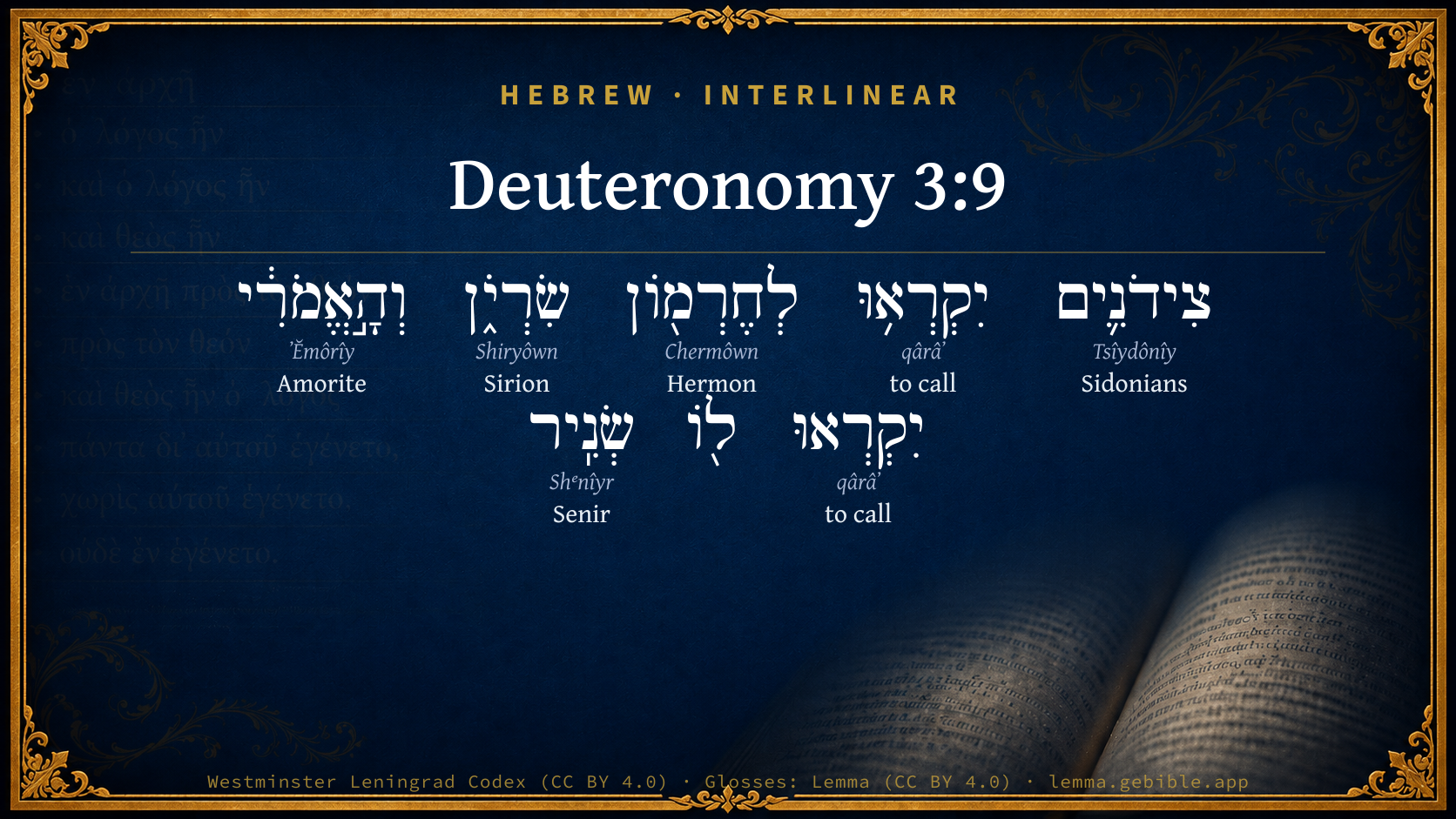
Hebrew (Westminster Leningrad Codex) Deuteronomy 3:9 appears in the Hebrew Old Testament. The text above is from the Westminster Leningrad Codex. Each word links to its Strong’s number, a concise gloss, and parsing drawn from the Open Scriptures Hebrew Bible morphology. Click any word for its full Brown-Driver-Briggs (BDB) entry.
Download image
Cite this verse

Deuteronomy 3:9 (World English Bible). Public Domain. Lemma interlinear Bible study tool, https://lemma.gebible.app/v/deuteronomy/3/9.

Show BibTeX & RIS
BibTeX
RIS
English Translation
([which] Hermon the Sidonians call Sirion, and the Amorites call it Senir;)
World English Bible · Public Domain
Highlights
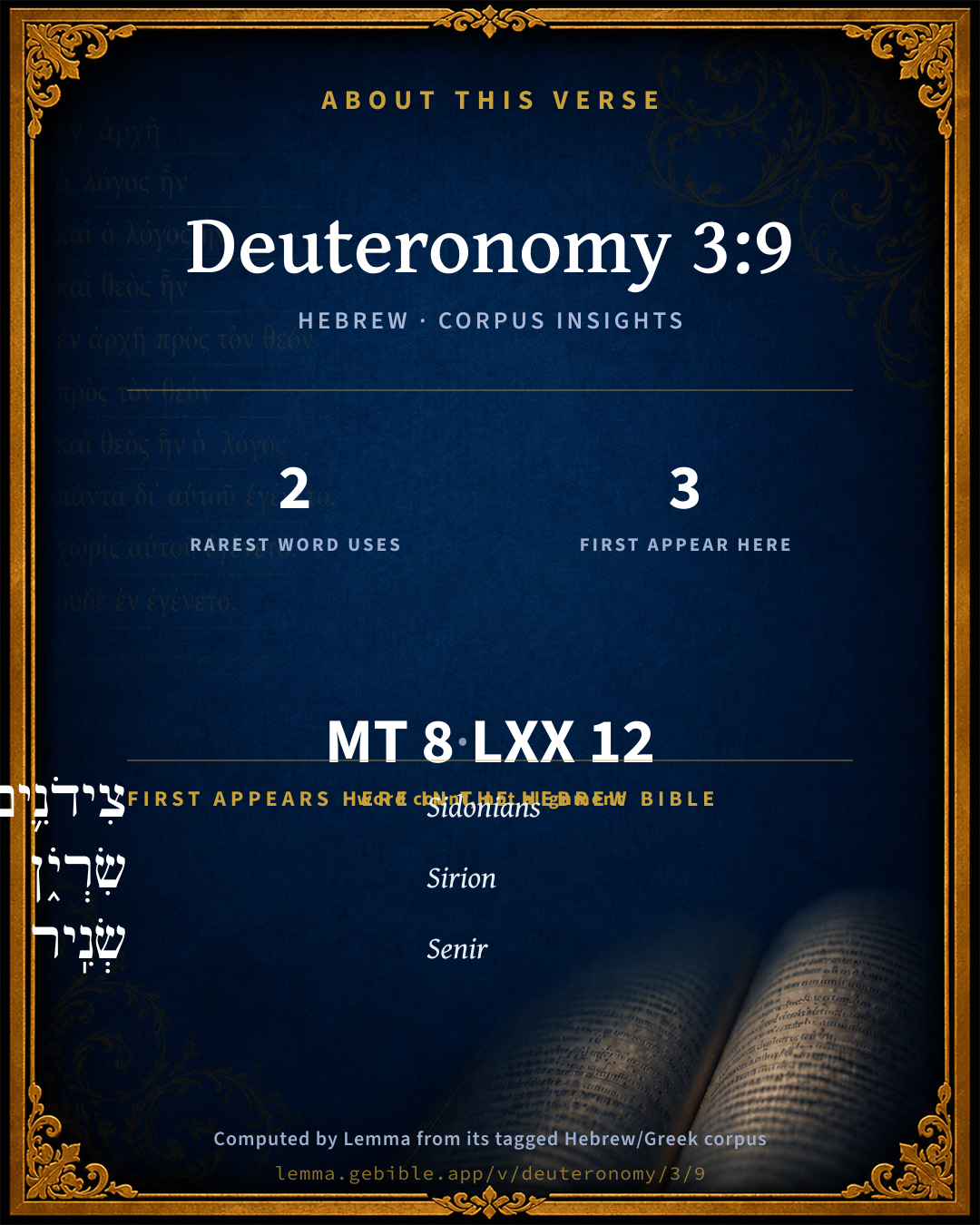
  • 3 first appearances in the Hebrew Bible
Full analysis ↓
Download a study sheet

One document with this verse’s original text, its word-by-word gloss line, the meaning frame, cross-references with their text, attributed commentary, and full source and license credits — printable, and it pastes into notes with its structure intact.

This verse Autodidact and up

Study sheet (.html) Plain text (.txt)

A passage Seminary Student

Up to 50 verses in one chapter. A passage sheet keeps up to 6 commentary sources and 12 cross-references per verse, in the order this page ranks them, and says so on the sheet whenever that leaves anything out. Ask for a single verse and you get the Autodidact verse sheet above.

Everything on this page stays free to read, with no account — the sheet is a download of what is already on screen, not access to it.

Want to remove ads? Support Godless Engineer
Compare translations 3

The same verse in 3 English versions, stacked beneath the original-language interlinear above. Click any original word for its lexicon entry.

Each is an independent rendering of the whole verse — the interlinear is not word-aligned to these translations.

Highlighted words mark where these versions differ — a whole-verse word diff, not a word-by-word alignment.

  • World English Bible Public Domain
    ([which] Hermon the Sidonians call Sirion, and the Amorites call it Senir;)
  • King James Version Public Domain
    (Which Hermon the Sidonians call Sirion; and the Amorites call it Shenir;)
  • unfoldingWord Literal Text CC BY-SA 4.0
    (the Sidonians call Hermon Sirion, and the Amorites call it Senir),

unfoldingWord Literal Text — © unfoldingWord, licensed CC BY-SA 4.0. Word-aligned USFM3 via Door43 (git.door43.org/unfoldingWord/en_ult).

Versions to compare (up to 4)

3 of 4 selected

Show all 18 translations

Every available English version of this verse, each an independent rendering of the whole verse.

  • World English Bible Public Domain
    ([which] Hermon the Sidonians call Sirion, and the Amorites call it Senir;)
  • Berean Standard Bible Public Domain
    which the Sidonians call Sirion but the Amorites call Senir—
  • Majority Standard Bible Public Domain
    which the Sidonians call Sirion but the Amorites call Senir—
  • King James Version Public Domain
    (Which Hermon the Sidonians call Sirion; and the Amorites call it Shenir;)
  • American Standard Version (1901) Public Domain
    (`which' Hermon the Sidonians call Sirion, and the Amorites call it Senir;)
  • Revised Version (1885) Public Domain
    (which Hermon the Sidonians call Sirion, and the Amorites call it Senir;)
  • Geneva Bible (1599) Public Domain
    (Which Hermon the Sidonians call Shirion, but the Amorites call it Shenir)
  • Douay-Rheims (1899) Public Domain
    Which the Sidonians call Sarion, and the Amorrhites Sanir:
  • Young's Literal Translation Public Domain
    (Sidonians call Hermon, Sirion; and the Amorites call it Senir,)
  • Literal Standard Version CC BY-SA 4.0
    (Sidonians call Hermon Sirion, and the Amorites call it Senir),
  • Unlocked Literal Bible CC BY-SA 4.0
    (Mount Hermon the Sidonians call Sirion, and the Amorites call it Senir)
  • unfoldingWord Literal Text CC BY-SA 4.0
    (the Sidonians call Hermon Sirion, and the Amorites call it Senir),
  • Darby Bible Public Domain
    (the Sidonians call Hermon Sirion, and the Amorites call it Senir):
  • World Messianic Bible Public Domain
    (The Sidonians call Hermon Sirion, and the Amorites call it Senir.)
  • Webster's Bible Public Domain
    (Which Hermon the Sidonians call Sirion; and the Amorites call it Shenir;)
  • Free Bible Version CC BY-SA 4.0
    (Mount Hermon is called Sirion by the Sidonians and Senir by the Amorites.)
  • Bible in Basic English Public Domain
    (By the Sidonians, Hermon is named Sirion, and by the Amorites Shenir;)
  • JPS Tanakh (1917) Public Domain
    which Hermon the Sidonians call Sirion, and the Amorites call it Senir —

Literal Standard Version (2020), Covenant Press — licensed CC BY-SA 4.0. Text via the HelloAO Bible API (eBible.org). Unlocked Literal Bible (unfoldingWord) — licensed CC BY-SA 4.0. Text via the HelloAO Bible API (eBible.org). unfoldingWord Literal Text — © unfoldingWord, licensed CC BY-SA 4.0. Word-aligned USFM3 via Door43 (git.door43.org/unfoldingWord/en_ult). Free Bible Version, Dr. Jonathan Gallagher — licensed CC BY-SA 4.0. Text via the HelloAO Bible API (eBible.org).

Word by word

More ways to search: Search by grammar → Find every occurrence → Compare this word →

Practice this passage: Drill this verse → Learn its vocabulary →

About this verse

These counts appear in no published source. They are computed here, from the morphology-tagged text and Lemma’s own curated glosses. What Lemma adds →

8
words
6
distinct lemmas
Pentateuch
section

Notable vocabulary

The rarest word here is שִׂרְיֹ֑ן Sirion H8303 — appearing just 2 times in the whole Hebrew Bible.

First appearance in Scripture

These words make their first canonical appearance in the Hebrew Bible here:

  • צִידֹנִ֛ים Sidonians H6722
  • שִׂרְיֹ֑ן Sirion H8303
  • שְׂנִֽיר Senir H8149

Shared distinctive vocabulary

שִׂרְיֹ֑ן Sirion H8303 occurs in 2 verses of the Hebrew Bible. Also found in:

Grammatical profile

  • 2 verbs
  • 5 nouns
  • 1 preposition

Verb forms

  • יִקְרְא֥וּ Qal · Imperfect
  • יִקְרְאוּ Qal · Imperfect

Repetition

A word recurs within this verse — often emphatic in Hebrew:

  • יִקְרְא֥וּ to call H7121 ×2

Hebrew & Septuagint length

In English translation the verse runs 12 words from the Hebrew and 12 from the Septuagint (LXX English) — the same length.

A rough comparison of the two English renderings, which tokenize alike — not a word-level alignment.

Word counts can differ between the Hebrew and the Greek without any difference in meaning — e.g. the Hebrew direct-object marker אֵת has no separate Greek word, and Greek often adds the article ὁ.

In the original languages it is 8 Hebrew tokens and 12 Greek tokens — but the two are counted differently (Hebrew bundles its prefixes and suffixes into one token; the Greek is in lemma form), so that isn’t a like-for-like length.

Cross-references

8

Topical passages linked to Deuteronomy 3:9 in the Treasury of Scripture Knowledge — connected by theme and wording, ordered by reader-vote popularity; previews shown in the World English Bible.

  • 1 Chronicles 5:23 The children of the half-tribe of Manasseh lived in the land: they increased from Bashan to Baal Hermon and Senir and Mount Hermon.
  • Psalms 29:6 He makes them also to skip like a calf; Lebanon and Sirion like a young, wild ox.
  • Psalms 133:3 Like the dew of Hermon, That comes down on the hills of Zion: For there Yahweh gives the blessing, Even life forevermore.
  • Song of Solomon 4:8 Come with me from Lebanon, my bride, With me from Lebanon. Look from the top of Amana, From the top of Senir and Hermon, From the lions' dens, From the mountains of the leopards.
  • Ezekiel 27:5 They have made all your planks of fir trees from Senir; they have taken a cedar from Lebanon to make a mast for you.
  • Deuteronomy 4:48–49 from Aroer, which is on the edge of the valley of the Arnon, even to Mount Sion (the same is Hermon),
  • Joshua 11:17 from Mount Halak, that goes up to Seir, even to Baal Gad in the valley of Lebanon under Mount Hermon: and all their kings he took, and struck them, and put them to death.
  • Psalms 89:12 The north and the south, you have created them. Tabor and Hermon rejoice in your name.

Cross-references courtesy of OpenBible.info (CC BY 4.0).

Hebrew and Greek witnesses Masoretic Hebrew ↔ Greek Septuagint

The same verse in the two great witnesses to the Old Testament, shown verse-for-verse.

These are two independent witnesses, not word-aligned to each other, and the Septuagint is shown in lemma (dictionary) form.

Hebrew Deuteronomy 3:9 Masoretic · Westminster Leningrad Codex

צִידֹנִ֛ים יִקְרְא֥וּ לְחֶרְמ֖וֹן שִׂרְיֹ֑ן וְהָ֣אֱמֹרִ֔י יִקְרְאוּ ל֖וֹ שְׂנִֽיר

([which] Hermon the Sidonians call Sirion, and the Amorites call it Senir;)

World English Bible · Public Domain

Greek LXX Deuteronomy 3:9 Septuagint · lemma form

ὁ φοίνικες ἐπιὀνομάζω ὁ αερμων σανιωρ καί ὁ ἀμορραῖος ἐπιὀνομάζω αὐτός σανιρ

The Phoenicians call Aermon Sanior, but the Amorite has called it Sanir.

LXX2012 (modern English Septuagint) · Public Domain

Hebrew: Westminster Leningrad Codex (CC BY 4.0). Greek: Septuagint (public domain); English from LXX2012 (modern English Septuagint) (Public Domain). How the Septuagint differs from the Hebrew →

Targum (Aramaic paraphrase)

2

The Targum is the ancient Jewish Aramaic paraphrase of the Hebrew Scriptures — an interpretive translation, not the Hebrew text itself. Onkelos (literal) and Pseudo-Jonathan (expansive) render the Torah, and Jonathan the Prophets. Coverage is partial: where no permissively-licensed English translation exists for a verse, only the Aramaic is shown. This is verse-level text, not a word-by-word alignment to the Hebrew.

  1. Targum Onkelos Torah (Genesis–Deuteronomy)
    צִידֹנָאֵי קְרָאָן לְחֶרְמוֹן סִרְיֹן וֶאֱמֹרָאֵי קְרָאָן לֵהּ טוּר תַּלְגָא

    (no public-domain English translation for this verse)

    Targum Onkelos — Aramaic: “Onkelos Genesis” (public domain); “Onkelos Exodus” (public domain); “Onkelos Leviticus” (public domain); “Onkelos Numbers” (public domain); “Onkelos Deuteronomy” (public domain). English: “Sefaria Community Translation” (CC0 1.0 (public-domain dedication)); “J.W. Etheridge. The Targums of Onkelos and Jonathan Ben Uzziel on the Pentateuch. London: Longmans, Green, 1862” (public domain). Text via Sefaria.

  2. Targum Pseudo-Jonathan Torah (Genesis–Deuteronomy)
    צִידוֹנָאֵי הֲוַון קְרַן לְחֶרְמוֹן טַוְורָא דְמַסְרֵי פֵּירוֹי וֶאֱמוֹרָאֵי קְרַן לֵיהּ טַוָור תַּלְגָא דְלָא פָּסִיק מִנֵיהּ תַּלְגָא לָא בְּקַיְיטָא וְלָא בְּסִתְוָוא

    The Sidonaee call Hermon the fruit-producing Mount, but the Amoraee call it the Snowy Mountain, because the snow never ceases from it either in summer or winter.

    Targum Pseudo-Jonathan — Aramaic: “Targum Jonathan on Genesis” (public domain); “Targum Jonathan on Exodus” (public domain); “Targum Jonathan on Leviticus” (public domain); “Targum Jonathan on Numbers” (public domain); “Targum Jonathan on Deuteronomy” (public domain). English: “The Targum of Jonathan ben Uzziel, trans. J. W. Etheridge, London, 1862” (public domain). Text via Sefaria.

Commentary

Notes on Deuteronomy 3:9 from classic Christian and Jewish commentators (each source and its license shown beneath its notes). The classic Christian expositions comment on the surrounding passage and are grouped to its opening verse, so a note may address several verses; the Jewish commentaries on the Tanakh (Rashi and others) are per-verse, so they appear only where the commentator wrote on this verse.

Lemma curates 59 commentaries, every one of them public domain or Creative Commons licensed, each selected and text-cleaned for this edition rather than reprinted as found. About our sources →

Joseph Benson's Commentary

Deu 3:9. Sirion — Elsewhere called mount Gilead, and Lebanon, and here Shenir, and Sirion, which several names were given to this one mountain, partly by several people, and partly in regard of several tops and parts of it.

Joseph Benson's Commentary on the Old and New Testaments (1811–1818) — public domain. Text from a community e-Sword module.

Tyndale Open Study Notes

Tyndale Open Resources

3:9 The alternative names Sirion and Senir suggest that Hermon was perhaps a later name given by the Israelites. Hermon is apparently related to the verb kharam, which means “to destroy” (see study note on 2:34), and perhaps describes the destruction summarized in 3:3-7.

Tyndale Open Study Notes — © Tyndale Open Resources, licensed CC BY-SA 4.0. Text via the HelloAO Bible API.

Jamieson, Fausset & Brown

Robert Jamieson, A. R. Fausset & David Brown

Hermon--now Jebel-Es-Sheick--the majestic hill on which the long and elevated range of Anti-Lebanon terminates. Its summit and the ridges on its sides are almost constantly covered with snow. It is not so much one high mountain as a whole cluster of mountain peaks, the highest in Palestine. According to the survey taken by the English Government Engineers in 1840, they were about 9376 feet above the sea. Being a mountain chain, it is no wonder that it should have received different names at different points from the different tribes which lay along the base--all of them designating extraordinary height: Hermon, the lofty peak; "Sirion," or in an abbreviated form "Sion" (Deu 4:48), the upraised, glittering; "Shenir," the glittering breastplate of ice.

Jamieson, Fausset & Brown — Commentary Critical and Explanatory on the Whole Bible (1871) — public domain (CC PDM 1.0). Text via the HelloAO Bible API.

Adam Clarke's Commentary

Verse 9. Hermon the Sidonians call - Shenir] I suppose this verse to have been a marginal remark, which afterwards got incorporated with the text, or an addition by Joshua or Ezra.

Adam Clarke's Commentary on the Bible (1810–1826) — public domain. Text from a community e-Sword/MySword module.

Ellicott's Commentary for English Readers

(9) Sirion.—(Sion,Deut.448.) Sirion, or Shirion, and Shenir, are thought to have similar meanings. But the Targum inteprets Shenir as the “rock of snow.” Shirion, according to Gesenius, means “glittering like a breastplate.” It would not be safe to assert that the mention of the Sidonian name of Hermon makes this verse an addition after Israel was in Palestine, though it might be so. The Jewish commentator Rashi points out that, including the name Sion (Deu_4:48), “this mountain has four names. Why mention them? To declare the praise of the land of Israel, which had four kingdoms glorifying themselves in it, and each of them saying, ‘It is called after my name!’” But there are several notes of this kind in the Pentateuch. (See Gen_23:2; Gen_31:47; Num_13:22; also Jos_14:15.)

A Bible Commentary for English Readers, edited by Charles John Ellicott (1878–1897) — public domain. Text from a community e-Sword module.

The Cambridge Bible for Schools and Colleges

gen. ed. J. J. S. Perowne

9. Archaeological Note. As a natural boundary, separating several nations, Ḥermôn has a name in the language of each. The Phoenicians, Heb. Ṣidonians, on the W. called it Siriôn (cp. Psa_29:6), the Amorites Senîr, its name in an inscription of Salmanassar II, Sanîru, when he crossed from the coast towards Damascus (Winckler, KAT(3)[114], 44, 190). These names may have been applied to different parts of the long Mt; in 1Ch_5:23, Senîr is joined with, but apparently distinct from, Ḥermôn, cp. Eze_27:5, Son_4:8; and Arab, geographers gave the name Jebel Sanîr to the part between Ba‘albeḳ and Ḥoms.

[114] 3) Die Keilinschriften und das AIte Testament, 3rd edition (1903), by H. Zimmern and H. Winckler.

The Cambridge Bible for Schools and Colleges (gen. ed. J. J. S. Perowne; Cambridge University Press, 1878–1918) — public domain. Text from a community e-Sword module.

John Gill's Exposition

Which Hermon the Sidonians call Sirion,.... Which name it has in Psa 29:6 a name the inhabitants of Sidon gave it, but for what reason it is not easy to say; however, that it was well known to Tyre and Sidon, appears from snow in summer time being brought to the former, as will be hereafter observed:

and the Amorites call it Shenir; in whose possession it was last. Bochart (k) thinks it had its name from the multitude of wild cats in it, Shunar in the Chaldee tongue being the name of that creature; but Jarchi says Shenir in the Canaanitish language signifies "snow"; so, in the Targums of Onkelos and Jonathan, it is called the mountain of snow; and the Hebrew who read to Jerom, and taught him, affirmed to him that this mountain hung over Paneas, from whence snow in summer time was brought to Tyre for pleasure (l), and the same is confirmed by Abulfeda (m). There is said to be upon the top of it a famous temple, which is used for worship by the Heathens, over against Paneas and Lebanon (n); and it is highly probable there was one even at this time, when it was possessed by the Amorites, since it is called Mount Baalhermon, Jdg 3:3, from the worship of Baal, or some other idol upon it, as it should seem. Besides these, it had another name, Mount Sion, Deu 4:48 but to be distinguished from Mount Zion near Jerusalem. The names of it in this place are very differently interpreted by Hillerus (o); though he thinks it had them all on account of the snow on it, which was as a net all over it; for Hermon, he observes, signifies a net, a dragnet, and Shenir an apron, and Sirion a coat of mail, all from the covering of this mount with snow.

(k) Hierozoic. par. 1. l. 3. c. 14. col. 865. (l) De loc. Heb. fol. 88. B, C. (m) Apud Reland. Palestin. Illustrat. par. 2. p. 920. (n) De loc. Heb. fol. 88. B, C. (o) Onomastic. Sacr. p. 561, 562, 786, 929.

John Gill's Exposition of the Whole Bible (1746–1763) — public domain (CC PDM 1.0). Text via the HelloAO Bible API.

Albert Barnes' Notes on the Bible

Hermon, the southern and culminating point of the range of Lebanon, was also the religious center of primaeval Syria. Its Baal sanctuaries not only existed but gave it a name before the Exodus. Hence, the careful specification of the various names by which the mountain was known. The Sidonian name of it might easily have become known to Moses through the constant traffic which had gone on from the most ancient times between Sidon and Egypt.

Albert Barnes' Notes on the Bible (1834–1885) — public domain. Text from a community e-Sword/MySword module.

Matthew Poole's English Annotations

Elsewhere called Mount Gilead, and Libanus or Lebanon, and here

Shenir, and Sirion, and, by abbreviation, Sion, Deu 4:48; which several names are given to this one mountain, partly by several people, and partly in regard of several tops and parts of it, whence

Shenir and Hermon are mentioned as distinct places, Son 4:8.

Matthew Poole's English Annotations on the Holy Bible (1683–1685) — public domain. Text from a community e-Sword/MySword module.

John Wesley's Explanatory Notes

Sirion - Elsewhere called Mount Gilead, and Lebanon, and here Shenir, and Sirion, which several names are given to this one mountain partly by several people, and partly in regard of several tops and parts of it.

John Wesley, Explanatory Notes Upon the Whole Bible (1754–1765) — public domain. Text via the GEBible commentary corpus.

Rashi

Rabbi Shlomo Yitzchaki (Rashi)

צידנים יקראו לחרמון וגו׳ THE SIDONIANS CALL HERMON SIRION — But in another passage it states, (Deuteronomy 4:48) “Even unto Mount Sion which is Hermon”. So you see it had four names. And why had they all to be written in Scripture? To tell the praise of the land of Israel: that there were four kingdoms (kings) priding themselves in this — one saying, "After me shall it be named", and another saying, "After me shall it be named" (Sifrei Devarim 37:10; cf. Chullin 60b).

שניר SHENIR — This signifies "snow" in the German language (Schnee) and in the Canaanite (Slav) language (Snih).

Rashi on the Tanakh — English translations: “The Judaica Press complete Tanach with Rashi, translated by A. J. Rosenberg” (CC BY 4.0); “Pentateuch with Rashi's commentary by M. Rosenbaum and A.M. Silbermann, 1929-1934” (public domain); “The Metsudah Tanach series, Lakewood, N.J” (CC BY 4.0); and “The Book of Joshua, Metsudah Publications, 1997” (CC BY 4.0). Text via Sefaria.

Ramban (Nachmanides)

Rabbi Moshe ben Nachman (Ramban / Nachmanides)

HERMON, THE SIDONIANS CALL SIRION, [AND THE AMORITES CALL IT SENIR]. “But in another place Scripture states, even unto Mount Sion which is Hermon. Thus you see that the mountain has four names [Hermon, Sirion, Senir and Sion. Scripture’s reference to this multiplicity of names is] to tell the praise of the Land of Israel because there were four kingdoms priding themselves in this; this one saying ‘After me shall it be called,’ and another saying, ‘After me shall it be called.’” This is Rashi’s language from the words of Agadah. It is indeed possible that this praise [that four nations were vying for this mountain] is correct but the main purport of the verse is to state that the Sidonians, children of Canaan’s firstborn, called Mount Hermon “Sirion” when it was formerly in their possession; and the Amorites, who now dwelled there and from whom Israel was to capture it, called it “Senir.” [Senir] is a Canaanite word for “snow,” as Rashi testified about it, and as Onkelos also rendered it, [“mountain of snow”]. And because it is a mountain of snow, also on account of its frigid temperature causing it to be bleak [and unapproachable], it is called Hermon [from the word cherem — “banned”], this being a surname of the mountain. Perhaps the name “Sirion” in the Sidonian language indicates this characteristic while the real name of the mountain [as mentioned by the Torah further on] is Sion. The verse stating, from the top of Senir and Hermon [which would seem to indicate that these were two separate mountains], really refers to two surnames of the [same] mountain and thus means “from the top of the snow and the bleakness,” or it may mean “from the top of Senir and from the whole mountain.” Similarly, that which is stated in the Book of Chronicles, And the children of the half-tribe of Menasheh dwelt in the land, from Bashan unto Baal-hermon and Senir and Mount Hermon where they increased also means “and Senir and the whole mountain which is Mount Hermon.” Baal-hermon, however, was a city or a tower which they called “Baal,” or perhaps it was the name of one of the Baal-idols that was worshipped there.It is possible that after Israel was in the Land, names of places were somewhat changed; this mountain was large — and they called the highest part of its summit Senir, and the second part thereof they called Hermon. Or they may be other mountains which people after the [period of the] Torah called by these names [Senir, Hermon — and they really represent two separate mountains, but the names mentioned in the Torah indicate different names of but one mountain, as explained above]. There are many cases like this. So also, and the Hermons from the hill Mizar [would indicate that there were other mountains by the name of Hermon, for otherwise we have no explanation why they called “the Hermons,” in the plural].

Ramban (Nachmanides) on the Tanakh — English translation: “Commentary on the Torah by Ramban (Nachmanides). Translated and annotated by Charles B. Chavel. New York, Shilo Pub. House, 1971-1976” (CC BY 4.0). Text via Sefaria.

Lesson kit

Teaching starters — assembled from the data on this page, not authored interpretation. Every prompt links to the verse data it draws on. Edit before teaching.

Deuteronomy, in the Pentateuch, opens this verse with 8 words (6 distinct Hebrew lemmas). Its most distinctive word is Shiryôwn (“Sirion”). A historical commentator’s framing appears above. Read the whole chapter for the surrounding context.

Discussion questions

  1. The word Shiryôwn carries the sense “Sirion.” How does it shape the verse?
  2. 3 words make their first appearance in Scripture here. What does this debut establish?
  3. How does Psalms 29:6, which shares the word «Sirion», read alongside this verse?
  4. What does the repetition of “to call” (2× in this one verse) do in this verse?
  5. These translations render this verse differently; the difference is in the English rendering, not the original. What questions does that raise?
  6. «יִקְרְא֥וּ» is a Qal Imperfect verb. How does that grammatical form shape the action described?
  7. Compare how Joseph Benson's Commentary and Tyndale Open Study Notes read this verse. Where do they agree or differ?

Things to notice

Reading settings

Reading text

Shown beneath each verse's original-language words.

Old Testament
Old Testament edition

Read the OT as the Masoretic Hebrew (MT) or the Greek Septuagint (LXX).

English shown for the Greek Septuagint (in the Hebrew ↔ Greek comparison).

Comparing translations? Open the Compare panel on any verse page to stack up to four side by side.