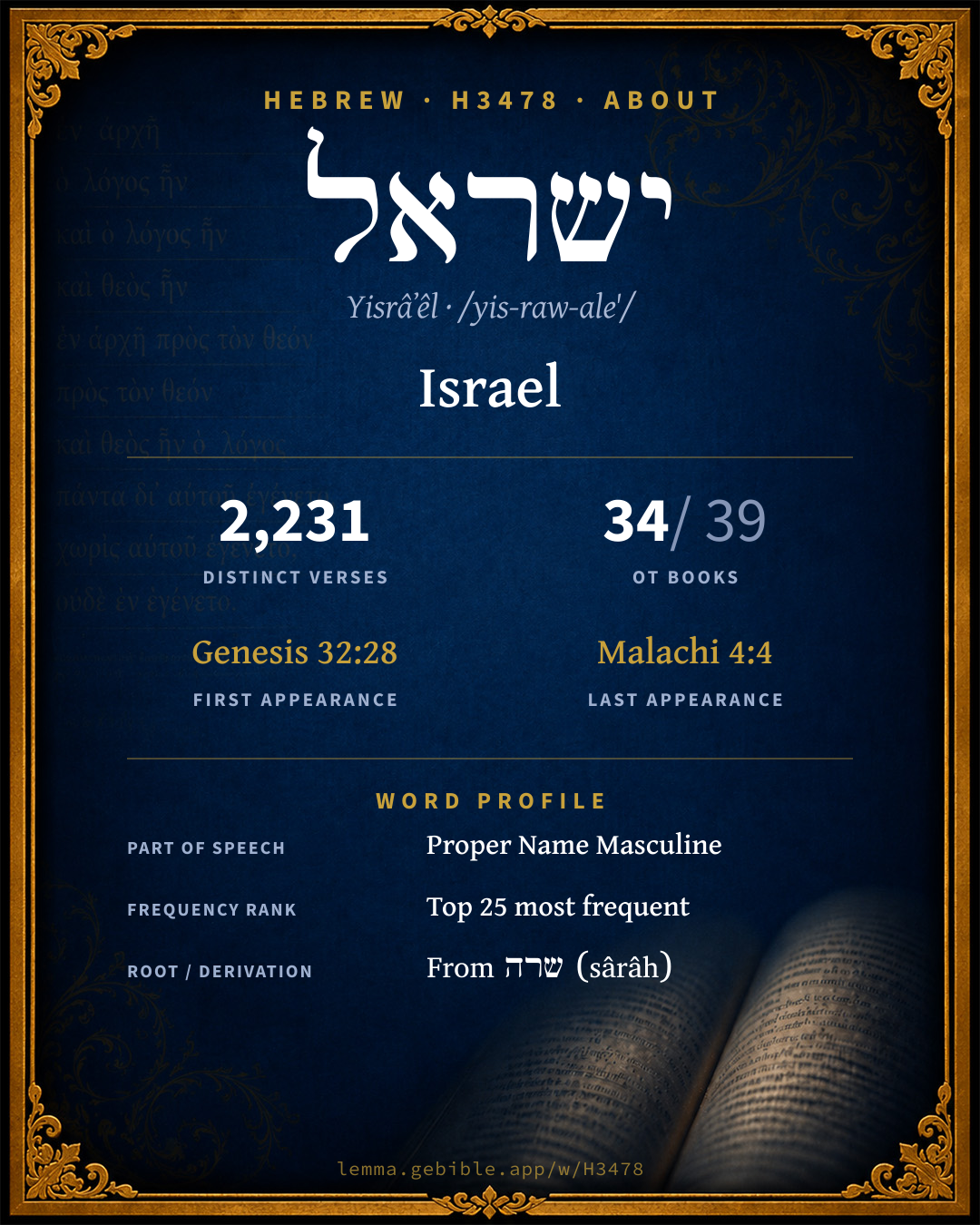
יִשְׂרָאֵל
Israel
BDB lists 3 entries for ‘Israel’ fuller range ↓
Full lexicon entry — Brown-Driver-Briggs (BDB)
From Brown-Driver-Briggs (BDB)
Where this word appears
Grammar key — what these labels mean
Part of speech
- Noun
- A naming word — a person, place, thing, or idea.
Noun type
- Proper
- A name of a specific person, place, or people (e.g. Abraham, Zion, Israel).
Every verse where H3478 appears in the Book of Leviticus — 59 distinct verses. Click any verse to open its interlinear word-by-word view. Verse text shown in the World English Bible for context — . Each verse’s Hebrew form is shown with its reference; the English is not keyword-highlighted, since the data carries no word-level English alignment. Use “Compare translations” on any verse to read it across multiple English versions. This concordance covers the Hebrew Bible; Septuagint (Greek Old Testament) occurrences are not indexed here.
Leviticus
- Leviticus 1:2 יִשְׂרָאֵל֙ n Proper "Speak to the children of Israel, and tell them, 'When anyone of you offers an offering to Yahweh, you shall offer your offering of the cattle, from the herd and from the flock.
- Leviticus 4:2 יִשְׂרָאֵ֘ל n Proper "Speak to the children of Israel, saying, 'If anyone sins unintentionally, in any of the things which Yahweh has commanded not to be done, and does any one of them:
- Leviticus 4:13 יִשְׂרָאֵל֙ n Proper "'If the whole congregation of Israel sins, and the thing is hidden from the eyes of the assembly, and they have done any of the things which Yahweh has commanded not to be done, and are guilty;
- Leviticus 7:23 יִשְׂרָאֵ֖ל n Proper "Speak to the children of Israel, saying, 'You shall eat no fat, of ox, or sheep, or goat.
- Leviticus 7:29 יִשְׂרָאֵ֖ל n Proper "Speak to the children of Israel, saying, 'He who offers the sacrifice of his peace offerings to Yahweh shall bring his offering to Yahweh out of the sacrifice of his peace offerings.
- Leviticus 7:34 יִשְׂרָאֵ֔ל יִשְׂרָאֵֽל n Proper n Proper For the waved breast and the heaved thigh I have taken from the children of Israel out of the sacrifices of their peace offerings, and have given them to Aaron the priest and to his sons as their portion forever from the children of Israel.'"
- Leviticus 7:36 יִשְׂרָאֵ֑ל n Proper which Yahweh commanded to be given them of the children of Israel, in the day that he anointed them. It is their portion forever throughout their generations.
- Leviticus 7:38 יִשְׂרָאֵ֗ל n Proper which Yahweh commanded Moses in Mount Sinai, in the day that he commanded the children of Israel to offer their offerings to Yahweh, in the wilderness of Sinai.
- Leviticus 9:1 יִשְׂרָאֵֽל n Proper It happened on the eighth day, that Moses called Aaron and his sons, and the elders of Israel;
- Leviticus 9:3 יִשְׂרָאֵ֖ל n Proper You shall speak to the children of Israel, saying, 'Take a male goat for a sin offering; and a calf and a lamb, both a year old, without blemish, for a burnt offering;
- Leviticus 10:6 יִשְׂרָאֵ֔ל n Proper Moses said to Aaron, and to Eleazar and to Ithamar, his sons, "Don't let the hair of your heads go loose, neither tear your clothes; that you don't die, and that he not be angry with all the congregation: but let your brothers, the whole house of Israel, bewail the burning which Yahweh has kindled.
- Leviticus 10:11 יִשְׂרָאֵ֑ל n Proper and that you are to teach the children of Israel all the statutes which Yahweh has spoken to them by Moses."
- Leviticus 10:14 יִשְׂרָאֵֽל n Proper The waved breast and the heaved thigh you shall eat in a clean place, you, and your sons, and your daughters with you: for they are given as your portion, and your sons' portion, out of the sacrifices of the peace offerings of the children of Israel.
- Leviticus 11:2 יִשְׂרָאֵ֖ל n Proper "Speak to the children of Israel, saying, 'These are the living things which you may eat among all the animals that are on the earth.
- Leviticus 12:2 יִשְׂרָאֵל֙ n Proper "Speak to the children of Israel, saying, 'If a woman conceives, and bears a male child, then she shall be unclean seven days; as in the days of her monthly period she shall be unclean.
- Leviticus 15:2 יִשְׂרָאֵ֔ל n Proper "Speak to the children of Israel, and tell them, 'When any man has a discharge from his body, because of his discharge he is unclean.
- Leviticus 15:31 יִשְׂרָאֵ֖ל n Proper "'Thus you shall separate the children of Israel from their uncleanness, so they will not die in their uncleanness, when they defile my tabernacle that is in their midst.'"
- Leviticus 16:5 יִשְׂרָאֵ֔ל n Proper He shall take from the congregation of the children of Israel two male goats for a sin offering, and one ram for a burnt offering
- Leviticus 16:16 יִשְׂרָאֵ֔ל n Proper and he shall make atonement for the Holy Place, because of the uncleanness of the children of Israel, and because of their transgressions, even all their sins; and so he shall do for the Tent of Meeting, that dwells with them in the midst of their uncleanness.
- Leviticus 16:17 יִשְׂרָאֵֽל n Proper There shall be no one in the Tent of Meeting when he enters to make atonement in the Holy Place, until he comes out, and has made atonement for himself and for his household, and for all the assembly of Israel.
- Leviticus 16:19 יִשְׂרָאֵֽל n Proper He shall sprinkle some of the blood on it with his finger seven times, and cleanse it, and make it holy from the uncleanness of the children of Israel.
- Leviticus 16:21 יִשְׂרָאֵ֔ל n Proper Aaron shall lay both his hands on the head of the live goat, and confess over him all the iniquities of the children of Israel, and all their transgressions, even all their sins; and he shall put them on the head of the goat, and shall send him away into the wilderness by the hand of a man who is in readiness.
- Leviticus 16:34 יִשְׂרָאֵל֙ n Proper "This shall be an everlasting statute for you, to make atonement for the children of Israel once in the year because of all their sins." It was done as Yahweh commanded Moses.
- Leviticus 17:2 יִשְׂרָאֵ֔ל n Proper "Speak to Aaron, and to his sons, and to all the children of Israel, and say to them: 'This is the thing which Yahweh has commanded,
- Leviticus 17:3 יִשְׂרָאֵ֔ל n Proper Whatever man there is of the house of Israel, who kills an ox, or lamb, or goat, in the camp, or who kills it outside the camp,
- Leviticus 17:5 יִשְׂרָאֵ֗ל n Proper This is to the end that the children of Israel may bring their sacrifices, which they sacrifice in the open field, that they may bring them to Yahweh, to the door of the Tent of Meeting, to the priest, and sacrifice them for sacrifices of peace offerings to Yahweh.
- Leviticus 17:8 יִשְׂרָאֵ֔ל n Proper "You shall say to them, 'Any man there is of the house of Israel, or of the strangers who live as foreigners among them, who offers a burnt offering or sacrifice,
- Leviticus 17:10 יִשְׂרָאֵ֗ל n Proper "'Any man of the house of Israel, or of the strangers who live as foreigners among them, who eats any kind of blood, I will set my face against that soul who eats blood, and will cut him off from among his people.
- Leviticus 17:12 יִשְׂרָאֵ֔ל n Proper Therefore I have said to the children of Israel, "No person among you shall eat blood, neither shall any stranger who lives as a foreigner among you eat blood."
- Leviticus 17:13 יִשְׂרָאֵ֗ל n Proper "'Whatever man there is of the children of Israel, or of the strangers who live as foreigners among them, who takes in hunting any animal or bird that may be eaten; he shall pour out its blood, and cover it with dust.
- Leviticus 17:14 יִשְׂרָאֵ֔ל n Proper For as to the life of all flesh, its blood is with its life: therefore I said to the children of Israel, "You shall not eat the blood of any kind of flesh; for the life of all flesh is its blood. Whoever eats it shall be cut off."
- Leviticus 18:2 יִשְׂרָאֵ֔ל n Proper "Speak to the children of Israel, and say to them, 'I am Yahweh your God.
- Leviticus 19:2 יִשְׂרָאֵ֛ל n Proper "Speak to all the congregation of the children of Israel, and tell them, 'You shall be holy; for I Yahweh your God am holy.
- Leviticus 20:2 יִשְׂרָאֵ֘ל יִשְׂרָאֵ֜ל בְּ/יִשְׂרָאֵ֗ל n Proper n Proper prep + n Proper "Moreover, you shall tell the children of Israel, 'Anyone of the children of Israel, or of the strangers who live as foreigners in Israel, who gives any of his seed to Molech; he shall surely be put to death. The people of the land shall stone him with stones.
- Leviticus 21:24 יִשְׂרָאֵֽל n Proper So Moses spoke to Aaron, and to his sons, and to all the children of Israel.
- Leviticus 22:2 יִשְׂרָאֵ֔ל n Proper "Tell Aaron and his sons to separate themselves from the holy things of the children of Israel, which they make holy to me, and that they not profane my holy name. I am Yahweh.
- Leviticus 22:3 יִשְׂרָאֵל֙ n Proper Tell them, 'If anyone of all your seed throughout your generations approaches the holy things, which the children of Israel make holy to Yahweh, having his uncleanness on him, that soul shall be cut off from before me. I am Yahweh.
- Leviticus 22:15 יִשְׂרָאֵ֑ל n Proper The priests shall not profane the holy things of the children of Israel, which they offer to Yahweh,
- Leviticus 22:18 יִשְׂרָאֵ֔ל יִשְׂרָאֵ֜ל בְּ/יִשְׂרָאֵ֗ל n Proper n Proper prep + n Proper "Speak to Aaron, and to his sons, and to all the children of Israel, and say to them, 'Whoever is of the house of Israel, or of the foreigners in Israel, who offers his offering, whether it be any of their vows, or any of their freewill offerings, which they offer to Yahweh for a burnt offering;
- Leviticus 22:32 יִשְׂרָאֵ֑ל n Proper You shall not profane my holy name, but I will be made holy among the children of Israel. I am Yahweh who makes you holy,
- Leviticus 23:2 יִשְׂרָאֵל֙ n Proper "Speak to the children of Israel, and tell them, 'The set feasts of Yahweh, which you shall proclaim to be holy convocations, even these are my set feasts.
- Leviticus 23:10 יִשְׂרָאֵל֙ n Proper "Speak to the children of Israel, and tell them, 'When you have come into the land which I give to you, and shall reap its the harvest, then you shall bring the sheaf of the first fruits of your harvest to the priest:
- Leviticus 23:24 יִשְׂרָאֵ֖ל n Proper "Speak to the children of Israel, saying, 'In the seventh month, on the first day of the month, shall be a solemn rest to you, a memorial of blowing of trumpets, a holy convocation.
- Leviticus 23:34 יִשְׂרָאֵ֖ל n Proper "Speak to the children of Israel, and say, 'On the fifteenth day of this seventh month is the feast of tents for seven days to Yahweh.
- Leviticus 23:42 בְּ/יִשְׂרָאֵ֔ל prep + n Proper You shall dwell in booths seven days. All who are native-born in Israel shall dwell in booths,
- Leviticus 23:43 יִשְׂרָאֵ֔ל n Proper that your generations may know that I made the children of Israel to dwell in booths, when I brought them out of the land of Egypt. I am Yahweh your God.'"
- Leviticus 23:44 יִשְׂרָאֵֽל n Proper Moses declared to the children of Israel the appointed feasts of Yahweh.
- Leviticus 24:2 יִשְׂרָאֵ֗ל n Proper "Command the children of Israel, that they bring to you pure olive oil beaten for the light, to cause a lamp to burn continually.
- Leviticus 24:8 יִשְׂרָאֵ֖ל n Proper Every Sabbath day he shall set it in order before Yahweh continually. It is on the behalf of the children of Israel an everlasting covenant.
- Leviticus 24:10 יִשְׂרָאֵ֑ל n Proper The son of an Israelite woman, whose father was an Egyptian, went out among the children of Israel; and the son of the Israelite woman and a man of Israel strove together in the camp.
- Leviticus 24:15 יִשְׂרָאֵ֖ל n Proper You shall speak to the children of Israel, saying, 'Whoever curses his God shall bear his sin.
- Leviticus 24:23 יִשְׂרָאֵל֒ יִשְׂרָאֵ֣ל n Proper n Proper Moses spoke to the children of Israel; and they brought forth him who had cursed out of the camp, and stoned him with stones. The children of Israel did as Yahweh commanded Moses.
- Leviticus 25:2 יִשְׂרָאֵל֙ n Proper "Speak to the children of Israel, and tell them, 'When you come into the land which I give you, then the land shall keep a Sabbath to Yahweh.
- Leviticus 25:33 יִשְׂרָאֵֽל n Proper The Levites may redeem the house that was sold, and the city of his possession, and it shall be released in the Jubilee; for the houses of the cities of the Levites are their possession among the children of Israel.
- Leviticus 25:46 יִשְׂרָאֵל֙ n Proper You may make them an inheritance for your children after you, to hold for a possession; of them may you take your slaves forever: but over your brothers the children of Israel you shall not rule, one over another, with harshness.
- Leviticus 25:55 יִשְׂרָאֵל֙ n Proper For to me the children of Israel are servants; they are my servants whom I brought forth out of the land of Egypt. I am Yahweh your God.
- Leviticus 26:46 יִשְׂרָאֵ֑ל n Proper These are the statutes, ordinances and laws, which Yahweh made between him and the children of Israel in Mount Sinai by Moses.
- Leviticus 27:2 יִשְׂרָאֵל֙ n Proper "Speak to the children of Israel, and say to them, 'When a man makes a vow, the persons shall be for Yahweh by your valuation.
- Leviticus 27:34 יִשְׂרָאֵ֑ל n Proper These are the commandments which Yahweh commanded Moses for the children of Israel on Mount Sinai.
About this entry
At a glance — auto-summarized from this page’s data, not written by a person. Every figure links to its source below. This summary describes the numbers; it doesn’t interpret them.
“Israel” is the headline sense of the Hebrew name ישראל (Yisrâʼêl). Scripture first uses it in Genesis 32:28. It appears 2,231 verses across 34 books of the Hebrew Bible, among its most common vocabulary. The sections below give every occurrence and version rendering.
Gloss history
Strong's 1890 vs modern scholarship
About this word
Strong's H3478 catalogs a Hebrew word from the Hebrew Old Testament.
These counts are not copied from any lexicon or concordance. They are computed here, from the morphology-tagged Hebrew Old Testament. What Lemma adds →
- 2,231
- distinct verses
- The word appears in 2,231 distinct verses.
- 34 / 39
- OT books
- The word appears in 34 of 39 Old Testament books.
- #16
- by frequency
- Top 25 most frequent Hebrew words (rank 16 of 8,640 Hebrew words by occurrence).
View all 2,231 occurrences in the concordance →
By section of the Old Testament
By traditional corpus
Conventional, traditional groupings — biblical authorship is debated, so this is a traditional corpus grouping, not an authorship claim. Each share is this word’s portion of its verses in that division of the Hebrew canon. Each figure is a share of the word’s 2,231 distinct verses.
- Prophets (Nevi'im) 1,317 verses · 59%
- Torah (Pentateuch) 533 verses · 24%
- Writings (Ketuvim) 381 verses · 17%
How translations render this word
Counts come from each version’s own published word-to-Strong’s tagging or interlinear alignment — an approximate guide to how each version renders this word, not a word-level alignment the data otherwise carries. Because each total is that version’s own tagged count, the per-version totals vary from one another and need not match the appearance or distinct-verse counts above. These counts may also differ from a printed concordance because Lemma counts each distinctly tagged rendering and does not collapse phrase taggings into a single head-word total. This is a fixed set of word-tagged versions (KJV, ASV, BSB, ULT) and does not change with the reading translation you choose elsewhere. Each version’s license is shown beside its name below (and on Sources).
BDB lists this Strong’s number as 2 distinct words (homographs). Each count above pools all of them and is not split by sense — see the Senses section below. A low-frequency rendering may belong to a different one of those words, not the primary meaning.
- King James Version†: Israel 2,121×, All israel 113×, Over israel 63×
- American Standard Version†: Israel 2,017×, All israel 107×, Over israel 62×
- Berean Standard Bible†: Israel 1,723×, Israelites 104×, One of israel 26×
- unfoldingWord Literal Text†: Israel 2,399×, The 17×, Against israel 13×
King James Version Public Domain
Renders H3478 across 2,505† tagged occurrences — most commonly:
Plus other, less common renderings. Plus 73 renderings that appear only once — usually multi-word phrases or single function words the recovered tagging swept in, not distinct renderings.
American Standard Version Public Domain
Renders H3478 across 2,505† tagged occurrences — most commonly:
Plus other, less common renderings. Plus 130 renderings that appear only once — usually multi-word phrases or single function words the recovered tagging swept in, not distinct renderings.
Berean Standard Bible Public Domain
Renders H3478 across 1,998† tagged occurrences — most commonly:
Plus other, less common renderings. Plus 46 renderings that appear only once — usually multi-word phrases or single function words the recovered tagging swept in, not distinct renderings. Not rendered by a distinct English word in 507 further occurrences.
unfoldingWord Literal Text CC BY-SA 4.0
Renders H3478 across 2,455† tagged occurrences — most commonly:
Plus 15 renderings that appear only once — usually multi-word phrases or single function words the recovered tagging swept in, not distinct renderings.
7 senses and sub-senses in the full BDB
What do BDB’s symbols mean?
BDB uses these scholarly abbreviations:
| Symbol | Meaning |
|---|---|
| 𝔊 | the Septuagint (the ancient Greek translation, LXX) |
| 𝔙 | the Vulgate (the Latin translation) |
| 𝔖 | the Syriac version (the Peshitta) |
| 𝔗 | the Targum (the Aramaic translation) |
| ψ | the Psalms |
| √ | root (the underlying root or stem) |
| ‖ | parallel passage (a synonymous or contrasted parallel) |
| † | the dagger: every passage where the word occurs is cited |
The 7 senses and sub-senses the full Brown-Driver-Briggs lexicon distinguishes for this word, in lexicon order (not ranked by frequency), with BDB’s own verbatim wording and sub-sense lettering. Shown in Hebrew script with BDB’s own scholarly abbreviations. The condensed entry is in the Lexicon Entry tab. See also the Forms in the corpus table below.
ישראל I , and deriv., v. sub i. שׂרה.
ישראל II
- 1. n.pr.m. second name of Jacob Gn 32:29 + 28 times Gn (JE), Ex 32:13 (JE), Ho 12:13; Ju 18:29; Ex 6:14; Nu 1:20; 26:5 (all P), 2 K 17:34 1 Ch 1:34 + 8 times Chr, ψ 105:23; בֵּית יִשׂ׳ Ru 4:11; בְּנֵי יִשׂ׳ (lit.) Gn 42:5 + 3 times E, 2 times P + Ex 1:7 (P; transition to wider use), 1 K 18:31 1 Ch 2:1 +; = 12 tribes Ex 28:9 + 7 times P; אֱלֹהֵי אַבְרָהָם יִצְחָק וְיִשׂ׳ †1 K 18:36; 1 Ch 29:18; 2 Ch 30:6. e.g. Genesis 32:29
- 2. n.pr.gent. (usually m. Ju 11:17 f. but f. 1 S 17:21; 2 S 24:9 [not ‖ 1 Ch 21:5], cf. Drad loc. AlbrZAW xvi (1896), 57 f.): name of Hebrew nation; usually der. from 1, but יִשׂ׳ more common in early usage than בְּנֵי יִשׂ׳ (v. בֵּן p. 120b): e.g. Judges 11:17
- a. (1) undivided kingdom; יִשׂ׳ Gn 47:27 (J), 49:7 (poem in J) + 108 times JE, Dt 1:1; 18:6; 33:10 (poem) + 76 times D, Gn 34:7 Ex 12:15 + 42 times P; Ju 5:2, 7(×2) + 104 times Ju, often 1 and 2 S, 1 K 1–12; כָּל־יִשׂ׳ of whole people 2 S 8:15 +, of whole army 11:1 +, opp. Judah 2:9 + (so also later). (2) יִשׂ׳ = N. tribes, disting. from Judah, even before disruption, 2 S 2:9, cf. v 10 3:10; 4:1; 5:5; 12:7; 20:1 1 K 1:35; 4:20; 5:5 +; so at disruption 12:16(×3), 18, 19; then usually of N. kingdom, till its fall, v 28; 24:7, 10 + very often K, Am 1:1; 2:6; 3:14 +, Ho 1:5; 4:15(×2); 5:3(×2), 5 +, Mi 1:13, etc. (3) יִשׂ׳ of S. kingdom, Judah, rarely bef. fall of Samaria Is 1:3; 8:18 Mi 1:14, 15, so בְּנֵי יִשׂ׳ 1 K 12:17; after fall of Sam., יִשׂ׳ (less often בְּנֵי יִשׂ׳) occurs of entire people, in reference to past or future 2 K 21:8; 23:22; Is 17:9 ψ 103:7; Je 2:3; 50:17, 19 +; יִשׂ׳ also = Judah Je 2:14, 31; 4:1 +, Ez 13:2, 4, 16; 14:1, 7, 9 +, Is 40:27; 41:8; 42:24 +, Ezr 2:59 = Ne 7:61, Ezr 2:70; 3:11 +, Ne 10:34; 10:3 +, ψ 14:7(×2) = 53:7(×2), 147:2; 149:2 +, etc. (4) usage in Chr: יִשׂ׳ of whole people 1 Ch 2:7 + 110 times, of N. kingdom 2 Ch 11:1 + 16 times, of Judah 12:6; 19:8 + 9 times (5) יִשׂ׳ personif. as עֶבֶד י׳, Is 44:1, 21; 49:3 e.g. Genesis 47:27
- b. בְּנֵי יִשׂ׳, (1) of undiv. people Ex 1:12 (J), 3:9 (E) + 72 times JE, Dt 3:18; 10:6 + 25 times D, Gn 32:33 + 327 times P; Ju 1:1 + 60 times Ju; seld. 1 and 2 Sm, 1 K 1–12; in 13–2 K 25 pass. in ref. to older hist. (rarely otherwise). (2) seldom of N. kingdom Am 2:11 + 9 times Am Ho, 2 Ch 13:12 + 7 times Chr. (3) of Judah (late) Ez 2:3; Ne 1:6(×2) Ezr 3:1; Jo 4:16 +, 2 Ch 31:5. e.g. Exodus 1:12
- c. בֵּית יִשׂ׳ Ex 16:31; 40:38 + 142 times (v. בַּיִת 5 d (δ); 81 times Ez, where = Judah; v. especially 37:16); שְׁנֵי בָֽתֵּי יִשׂ׳ Is 8:14. e.g. Exodus 16:31
- d. other phrases, v. sub אִישׁ, אֶרֶץ, בַּת, בְּתוּלָה, גְּבוּל, הַר, כִּסֵּא, מֶלֶךְ, נטה) מַטֶּה), יעד) עֵדָה), עַם, שֵׁבֶט; also (in epith. of י׳) sub אָבִיר, אוֹר, אֱלֹהִים, I. גָּאַל, מֶלֶךְ, מִקְוֶה (I. קוה), i. צוּר (V. צור), קָדוֹשׁ, I. רָעָה 1 d (3).
- e. יִשׂ׳ =the laity, opp. priests, etc. (late): Ezr 10:25; Ne 11:3; 1 Ch 9:2 כָּל־יִשׂ׳ Ezr 2:70; 10:5; הָעָם יִשׂ׳ 9:1; בְּנֵי יִשׂ׳ Ne 10:40, cf. שְׁאָר יִשׂ׳ 11:20. e.g. Ezra 10:25
Senses from the full Brown-Driver-Briggs lexicon (Brown, Driver, Briggs; Oxford 1906 — public domain), digitized via Sefaria, supplemented by the OpenScriptures HebrewLexicon (CC BY 4.0). Full attribution on Sources.
Word origin
I. n.pr., and deriv., v. sub i. שׂרה.
II. n.pr.m. et gent. Israel (E†l persisteth, persevereth (or juss. Let E†l persist) [usually contendeth (NesEg 60 ff.) or Let E†l contend (GrayProp. N. 218), but v. DrHastDict. Bib. Jacob 530]; on vocalization v. LagBN 131 f. Kit 1 Ch 4:16 (Hpt); MI5, + 5 times ישראל; in Egyptian Y-si-r-ʾl SteindorffZAW xvi (1896), 331, cf. BreastedBib. World ix (1897), 62 ff. PatonSyriac and Pal. 134; Assyrian Sir-ʾ-lai (= יִשְׂרְאֵלִי) SchrKG 356 ff., 364; COT Gn 36:31, 1 K 16:29.—On a poss. relation of יִשׂ׳ to n.pr. שָׂרַי, שָׂרָה v. RSK 257, 2nd ed. 34;—cf. שְׂרָיָה(וּ));—Ισραηλ:
— Brown-Driver-Briggs (Oxford 1906, public domain), digitized via Sefaria, supplemented by the OpenScriptures HebrewLexicon (CC BY 4.0). See Sources.
Derived from שרה (sârâh) (H8280) — to contend.
Jastrow Dictionary
A second Hebrew/Aramaic lexicon for comparison, covering Aramaic and post-biblical (Talmudic, Targumic, Midrashic) usage that the biblical-Hebrew BDB does not. Matched by lemma rather than by Strong’s number, so a lemma may carry more than one Jastrow headword (shown separately below), and the entries cover usage well beyond the Bible.
יִשְׂרָאֵל
- Israel.
- 1. I. (Jacob), the patriarch. Gen. R. s. 68 י׳ סבא the patriarch I. the patriarch I. (not the people); a. fr.
- 2. I., the people. Ber. 6ᵃ; a. fr.—שונאי י׳ the enemies of Israel, often euphem. for Israel. Ib. 32ᵃ נתמוטטו … של ש׳ י׳ the feet of Israel would totter (in judgment); a. fr.—V. כְּנֶסֶת.
- 3. י׳ (= בן י׳) an Israelite, a) one not belonging to the priestly or levitic tribe; b) a Jew, opp. נכרי, גוי. Gitt. V, 8. Tosef. Kidd. V, 3; a. fr.—Tosef. Ab. Zar. III, 5, sq. Ab. Zar. II, 6; a. fr.—בַּת י׳ an Israelitish woman. Tosef. l. c. 1; 3; a. fr.—Pl. יִשְׂרְאֵלוֹת (opp. to כַּהֲנוֹת, לְוִיּוֹת). Tosef. Snh. IV, 2.
A Dictionary of the Targumim, the Talmud Babli and Yerushalmi, and the Midrashic Literature (Marcus Jastrow; London, Luzac, 1903) — Public Domain. Digitized via Sefaria. Digitized via Sefaria. Full attribution on Sources.
Forms in the corpus
The 83 distinct written forms H3478 takes in the Hebrew Bible, most frequent first — each parse links to that state’s occurrences in the concordance. Hebrew forms include their vowel points and cantillation, so a single lemma takes many written forms.
| Form | Parsing | Example | Uses |
|---|---|---|---|
| יִשְׂרָאֵ֔ל | Noun, Proper | Amos 1:1 | 477 |
| יִשְׂרָאֵֽל | Noun, Proper | Amos 4:12 | 371 |
| יִשְׂרָאֵ֑ל | Noun, Proper | Amos 3:1 | 355 |
| יִשְׂרָאֵ֖ל | Noun, Proper | Amos 2:11 | 351 |
| יִשְׂרָאֵל֙ | Noun, Proper | Deuteronomy 5:1 | 212 |
| יִשְׂרָאֵ֗ל | Noun, Proper | Amos 3:12 | 155 |
| יִשְׂרָאֵ֛ל | Noun, Proper | Daniel 1:3 | 89 |
| יִשְׂרָאֵ֜ל | Noun, Proper | Amos 1:1 | 50 |
| בְּ/יִשְׂרָאֵ֑ל | Noun, Proper | Deuteronomy 25:10 | 34 |
| יִשְׂרָאֵ֣ל | Noun, Proper | Ezekiel 8:6 | 31 |
| בְּ/יִשְׂרָאֵֽל | Noun, Proper | Deuteronomy 17:4 | 30 |
| יִשְׂרָאֵל֒ | Noun, Proper | Amos 9:14 | 29 |
| בְּ/יִשְׂרָאֵ֔ל | Noun, Proper | Deuteronomy 22:21 | 27 |
| יִשְׂרָאֵ֤ל | Noun, Proper | Deuteronomy 21:8 | 26 |
| יִשְׂרָאֵ֥ל | Noun, Proper | Exodus 12:35 | 22 |
| יִשְׂרָאֵ֧ל | Noun, Proper | Deuteronomy 34:8 | 13 |
| יִ֠שְׂרָאֵל | Noun, Proper | Ezekiel 8:11 | 12 |
| יִשְׂרָאֵ֡ל | Noun, Proper | Ezekiel 14:4 | 12 |
| יִשְׂרָאֵל֮ | Noun, Proper | 1 Chronicles 5:1 | 12 |
| וְ/יִשְׂרָאֵ֖ל | Noun, Proper | Hosea 5:3 | 11 |
| יִשְׂרָאֵ֨ל | Noun, Proper | Deuteronomy 33:28 | 11 |
| לְ/יִשְׂרָאֵֽל | Noun, Proper | 1 Chronicles 21:3 | 11 |
| יִשְׂרָאֵ֘ל | Noun, Proper | Deuteronomy 31:7 | 9 |
| לְ/יִשְׂרָאֵ֑ל | Noun, Proper | Deuteronomy 33:10 | 9 |
| מִ/יִּשְׂרָאֵֽל | Noun, Proper | Deuteronomy 17:12 | 9 |
| בְּ/יִשְׂרָאֵ֖ל | Noun, Proper | Deuteronomy 34:10 | 8 |
| לְ/יִשְׂרָאֵ֔ל | Noun, Proper | Ezra 4:3 | 8 |
| לְ/יִשְׂרָאֵל֙ | Noun, Proper | Genesis 46:2 | 8 |
| יִ֭שְׂרָאֵל | Noun, Proper | Psalms 50:7 | 7 |
| מִ/יִּשְׂרָאֵ֑ל | Noun, Proper | 1 Samuel 4:21 | 6 |
| בְּ/יִשְׂרָאֵ֗ל | Noun, Proper | Ezekiel 39:11 | 5 |
| וְ/יִשְׂרָאֵֽל | Noun, Proper | 1 Chronicles 1:34 | 5 |
| יִ֝שְׂרָאֵ֗ל | Noun, Proper | Psalms 81:8 | 5 |
| לְ/יִשְׂרָאֵ֖ל | Noun, Proper | Ezra 8:29 | 5 |
| מִ/יִּשְׂרָאֵ֔ל | Noun, Proper | Exodus 12:15 | 5 |
| מִ/יִּשְׂרָאֵ֖ל | Noun, Proper | Deuteronomy 19:13 | 5 |
| וּ/לְ/יִשְׂרָאֵ֖ל | Noun, Proper | Exodus 18:1 | 4 |
| וְ/יִ֨שְׂרָאֵ֔ל | Noun, Proper | Amos 7:11 | 3 |
| וְ/יִשְׂרָאֵ֔ל | Noun, Proper | 1 Kings 18:36 | 3 |
| וְ/יִשְׂרָאֵ֣ל | Noun, Proper | Hosea 5:5 | 3 |
| יִשְׂרָ֫אֵ֥ל | Noun, Proper | Psalms 14:7 | 3 |
| יִשְׂרָאֵל֩ | Noun, Proper | 1 Samuel 4:1 | 3 |
| בְ/יִשְׂרָאֵ֔ל | Noun, Proper | Ezekiel 20:5 | 2 |
| בְ/יִשְׂרָאֵ֖ל | Noun, Proper | 1 Kings 19:18 | 2 |
| בְּ/יִשְׂרָאֵ֣ל | Noun, Proper | 2 Chronicles 34:21 | 2 |
| בְּ/יִשְׂרָאֵל֒ | Noun, Proper | Ezekiel 14:7 | 2 |
| וְ/יִשְׂרָאֵל֙ | Noun, Proper | 1 Chronicles 29:18 | 2 |
| וּ/בְ/יִשְׂרָאֵ֖ל | Noun, Proper | Isaiah 44:23 | 2 |
| יִשְׂרָאֵ֞ל | Noun, Proper | Daniel 9:7 | 2 |
| לְ/יִשְׂרָאֵ֛ל | Noun, Proper | Joshua 11:23 | 2 |
| לְ/יִשְׂרָאֵ֣ל | Noun, Proper | Psalms 81:4 | 2 |
| לְ/יִשְׂרָאֵ֥ל | Noun, Proper | Psalms 73:1 | 2 |
| מִ/יִּשְׂרָאֵ֗ל | Noun, Proper | 2 Chronicles 25:6 | 2 |
| מִ/יִּשְׂרָאֵל֙ | Noun, Proper | Hosea 8:6 | 2 |
| ב/ישראל | Noun, Proper | 2 Samuel 10:9 | 1 |
| בְ/יִשְׂרָאֵ֑ל | Noun, Proper | 1 Chronicles 10:1 | 1 |
| בְ/יִשְׂרָאֵ֗ל | Noun, Proper | Genesis 34:7 | 1 |
| בְ/יִשְׂרָאֵ֜ל | Noun, Proper | Judges 20:21 | 1 |
| בְ/יִשְׂרָאֵֽל | Noun, Proper | Psalms 78:21 | 1 |
| בְּ/יִשְׂרָ֫אֵ֥ל | Noun, Proper | Psalms 78:5 | 1 |
The 60 most common forms are shown; 23 rarer forms follow in the full concordance.
Same root — word family
Other BDB entries built from the same root as H3478, grouped by Strong’s listed origin. These share a root / origin per the lexicon — not necessarily a shared meaning. Each links to that word’s own entry.
Derives from
Shares the same root
Proper names from this root
People and places named from this root — a name, not an additional meaning of the word.
- שריה Sᵉrâyâh H8304 Seraiah
- Ισραηλ Israḗl G2474 Israel
- ישראל Yisrâʼêl H3479 Israel
- ישראלי Yisrᵉʼêlîy H3481 Israelite
Compare all same-root words → Showing 4 of 7 — not the complete family. 4 of the same-root words are proper names (people or places). They share a root, not necessarily a meaning.
Bible dictionary
Public-domain dictionary articles matched to this entry by name (Israel). A biblical name can be shared by more than one person or place, so an article may treat several.
Easton's Bible Dictionary · M. G. Easton, 1897
The name conferred on Jacob after the great prayer-struggle at Peniel (Gen. 32:28), because "as a prince he had power with God and prevailed." (See JACOB.) This is the common name given to Jacob's descendants. The whole people of the twelve tribes are called "Israelites," the "children of Israel" (Josh. 3:17; 7:25; Judg. 8:27; Jer. 3:21), and the "house of Israel" (Ex. 16:31; 40:38).
This name Israel is sometimes used emphatically for the true Israel (Ps. 73:1: Isa. 45:17; 49:3; John 1:47; Rom. 9:6; 11:26).
After the death of Saul the ten tribes arrogated to themselves this name, as if they were the whole nation (2 Sam. 2:9, 10, 17, 28; 3:10, 17; 19:40-43), and the kings of the ten tribes were called "kings of Israel," while the kings of the two tribes were called "kings of Judah."
After the Exile the name Israel was assumed as designating the entire nation.
Smith's Bible Dictionary · William Smith, 1863
(the prince that prevails with God).
+ The name given, (Genesis 32:28) to Jacob after his wrestling with the angel, (Hosea 12:4) at Peniel. Gesenius interprets Israel "soldier of God." + It became the national name of the twelve tribes collectively. They are so called in (Exodus 3:16) and afterward. + It is used in a narrower sense, excluding Judah, in (1 Samuel 11:8; 2 Samuel 20:1; 1 Kings 12:16) Thenceforth it was assumed and accepted as the name of the northern kingdom. + After the Babylonian captivity, the returned exiles resumed the name Israel as the designation of their nation. The name Israel is also used to denote lay-men, as distinguished from priests, Levites and other ministers. (Ezra 6:16; 9:1; 10:25; Nehemiah 11:3) etc.
Hitchcock's Bible Names Dictionary · Roswell D. Hitchcock, 1869
who prevails with God
Classic public-domain reference works; full attribution on Sources.
Septuagint verse parallels
This word appears in 2,113 verses that also exist in the Greek Old Testament (Septuagint), out of the 2,231 Hebrew verses it occurs in. You can read those verses in Greek by switching the Old Testament edition to the Septuagint.
Read these verses in the Septuagint
- Genesis 32:28
- Exodus 1:1
- Leviticus 1:2
- Numbers 1:2
- Deuteronomy 1:1
- Joshua 1:2
- Judges 1:1
- Ruth 2:12
- 1 Samuel 1:17
- 2 Samuel 1:3
- 1 Kings 1:3
- 2 Kings 1:1
This is a verse-level parallel only — the same verses exist in both the Hebrew and Greek Old Testaments. No word-level Hebrew↔Greek correspondence is claimed: the data carries no such alignment, so no Greek word is shown as this Hebrew word’s translation. Coverage is not total — the Septuagint omits the deuterocanon and renumbers the Psalms, so some Hebrew verses have no direct Greek parallel.