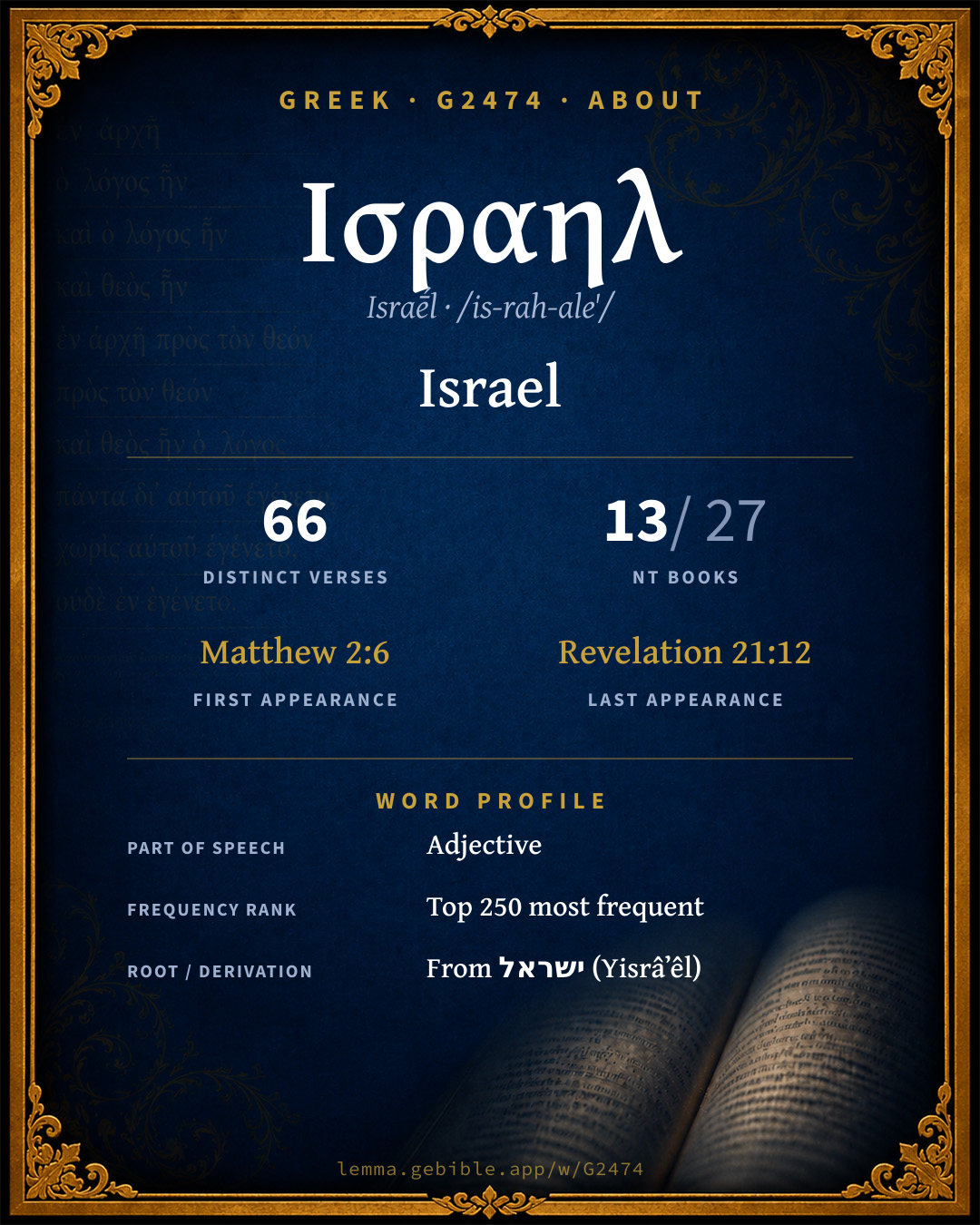
Ἰσραήλ
Israel
Thayer's lists 4 entries for ‘Israel’ fuller range ↓
Full lexicon entry — Thayer's Greek Lexicon
From Thayer's Greek Lexicon
Where this word appears
Every verse where G2474 appears — 66 distinct verses across 13 books. Click any verse to open its interlinear word-by-word view. Verse text shown in the World English Bible for context — . Each verse’s Greek form is shown with its reference; the English is not keyword-highlighted, since the data carries no word-level English alignment. Use “Compare translations” on any verse to read it across multiple English versions. This concordance covers the Greek New Testament; Septuagint (Greek Old Testament) occurrences of this word are not indexed here.
Matthew 12 verses
- Matthew 2:6 Ἰσραήλ n proper indecl 'You Bethlehem, land of Judah, Are in no way least among the princes of Judah: For out of you shall come forth a governor, Who shall shepherd my people, Israel.'"
- Matthew 2:20 Ἰσραήλ n proper indecl "Arise and take the young child and his mother, and go into the land of Israel, for those who sought the young child's life are dead."
- Matthew 2:21 Ἰσραήλ n proper indecl He arose and took the young child and his mother, and came into the land of Israel.
- Matthew 8:10 Ἰσραὴλ n proper indecl When Jesus heard it, he marveled, and said to those who followed, "Most assuredly I tell you, I haven't found so great a faith, not even in Israel.
- Matthew 9:33 Ἰσραήλ n proper indecl When the demon was cast out, the mute man spoke. The multitudes marveled, saying, "Nothing like this has ever been seen in Israel!"
- Matthew 10:6 Ἰσραήλ n proper indecl Rather, go to the lost sheep of the house of Israel.
- Matthew 10:23 Ἰσραὴλ n proper indecl But when they persecute you in this city, flee into the next, for most assuredly I tell you, you will not have gone through the cities of Israel, until the Son of Man has come.
- Matthew 15:24 Ἰσραήλ n proper indecl But he answered, "I wasn't sent to anyone but the lost sheep of the house of Israel."
- Matthew 15:31 Ἰσραήλ n proper indecl so that the multitude wondered when they saw the mute speaking, injured whole, lame walking, and blind seeing--and they glorified the God of Israel.
- Matthew 19:28 Ἰσραήλ n proper indecl Jesus said to them, "Most assuredly I tell you that you who have followed me, in the regeneration when the Son of Man will sit on the throne of his glory, you also will sit on twelve thrones, judging the twelve tribes of Israel.
- Matthew 27:9 Ἰσραήλ n proper indecl Then that which was spoken through Jeremiah the prophet was fulfilled, saying, "They took the thirty pieces of silver, The price of him upon whom a price had been set, Whom some of the children of Israel priced,
- Matthew 27:42 Ἰσραήλ n proper indecl "He saved others, but he can't save himself. If he is the King of Israel, let him come down from the cross now, and we will believe in him.
Mark 2 verses
Luke 12 verses
- Luke 1:16 Ἰσραὴλ n proper indecl He will turn many of the children of Israel to the Lord, their God.
- Luke 1:54 Ἰσραὴλ n proper indecl He has given help to Israel, his servant, that he might remember mercy,
- Luke 1:68 Ἰσραήλ n proper indecl "Blessed be the Lord, the God of Israel, For he has visited and worked redemption for his people;
- Luke 1:80 Ἰσραήλ n proper indecl The child was growing, and becoming strong in spirit, and was in the desert until the day of his public appearance to Israel.
- Luke 2:25 Ἰσραήλ n proper indecl Behold, there was a man in Jerusalem whose name was Simeon. This man was righteous and devout, looking for the consolation of Israel, and the Holy Spirit was on him.
- Luke 2:32 Ἰσραήλ n proper indecl A light for revelation to the Gentiles, And the glory of your people Israel."
- Luke 2:34 Ἰσραὴλ n proper indecl and Simeon blessed them, and said to Mary, his mother, "Behold, this child is set for the falling and the rising of many in Israel, and for a sign which is spoken against.
- Luke 4:25 Ἰσραήλ n proper indecl But truly I tell you, there were many widows in Israel in the days of Elijah, when the sky was shut up three years and six months, when a great famine came over all the land.
- Luke 4:27 Ἰσραὴλ n proper indecl There were many lepers in Israel in the time of Elisha the prophet, yet not one of them was cleansed, except Naaman, the Syrian."
- Luke 7:9 Ἰσραὴλ n proper indecl When Jesus heard these things, he marveled at him, and turned and said to the multitude who followed him, "I tell you, I have not found such great faith, no, not in Israel."
- Luke 22:30 Ἰσραήλ n proper indecl that you may eat and drink at my table in my Kingdom. You will sit on thrones, judging the twelve tribes of Israel."
- Luke 24:21 Ἰσραήλ n proper indecl But we were hoping that it was he who would redeem Israel. Yes, and besides all this, it is now the third day since these things happened.
John 4 verses
- John 1:31 Ἰσραήλ n proper indecl I didn't know him, but for this reason I came baptizing in water: that he would be revealed to Israel."
- John 1:50 Ἰσραήλ n proper indecl Jesus answered him, "Because I told you, 'I saw you underneath the fig tree,' do you believe? You will see greater things than these!"
- John 3:10 Ἰσραὴλ n proper indecl Jesus answered him, "Are you the teacher of Israel, and don't understand these things?
- John 12:13 Ἰσραήλ n proper indecl they took the branches of the palm trees, and went out to meet him, and cried out, "Hosanna! Blessed is he who comes in the name of the Lord, the King of Israel!"
Acts 15 verses
- Acts 1:6 Ἰσραήλ n proper indecl Therefore, when they had come together, they asked him, "Lord, are you now restoring the kingdom to Israel?"
- Acts 2:36 Ἰσραὴλ n proper indecl "Let all the house of Israel therefore know assuredly that God has made him both Lord and Christ, this Jesus whom you crucified."
- Acts 4:10 Ἰσραὴλ n proper indecl be it known to you all, and to all the people of Israel, that in the name of Jesus Christ of Nazareth, whom you crucified, whom God raised from the dead, in him does this man stand here before you whole.
- Acts 4:27 Ἰσραήλ n proper indecl For truly, in this city against your holy servant, Jesus, whom you anointed, both Herod and Pontius Pilate, with the Gentiles and the people of Israel, were gathered together
- Acts 5:21 Ἰσραήλ n proper indecl When they heard this, they entered into the temple about daybreak, and taught. But the high priest came, and those who were with him, and called the council together, and all the senate of the children of Israel, and sent to the prison to have them brought.
- Acts 5:31 Ἰσραὴλ n proper indecl God exalted him with his right hand to be a Prince and a Savior, to give repentance to Israel, and remission of sins.
- Acts 7:23 Ἰσραήλ n proper indecl But when he was forty years old, it came into his heart to visit his brothers, the children of Israel.
- Acts 7:37 Ἰσραήλ n proper indecl This is that Moses, who said to the children of Israel, 'The Lord our God will raise up a prophet for you from among your brothers, like me.'
- Acts 7:42 Ἰσραήλ n proper indecl But God turned, and gave them up to serve the host of the sky, as it is written in the book of the prophets, 'Did you offer to me slain animals and sacrifices Forty years in the wilderness, O house of Israel?
- Acts 9:15 Ἰσραήλ n proper indecl But the Lord said to him, "Go your way, for he is my chosen vessel to bear my name before the nations and kings, and the children of Israel.
- Acts 10:36 Ἰσραὴλ n proper indecl The word which he sent to the children of Israel, preaching good news of peace by Jesus Christ--he is Lord of all--
- Acts 13:17 Ἰσραὴλ n proper indecl The God of this people chose our fathers, and exalted the people when they stayed as aliens in the land of Egypt, and with an uplifted arm, he led them out of it.
- Acts 13:23 Ἰσραὴλ n proper indecl From this man's seed, God has brought salvation to Israel according to his promise,
- Acts 13:24 Ἰσραήλ n proper indecl before his coming, when John had first preached the baptism of repentance to Israel.
- Acts 28:20 Ἰσραὴλ n proper indecl For this cause therefore I asked to see you and to speak with you. For because of the hope of Israel I am bound with this chain."
Romans 9 verses
- Romans 9:6 Ἰσραήλ Ἰσραήλ n proper indecl n proper indecl But it is not as though the word of God has come to nothing. For they are not all Israel, that are of Israel.
- Romans 9:27 Ἰσραήλ Ἰσραὴλ n proper indecl n proper indecl Isaiah cries concerning Israel, "If the number of the children of Israel are as the sand of the sea, It is the remnant who will be saved;
- Romans 9:31 Ἰσραὴλ n proper indecl but Israel, following after a law of righteousness, didn't arrive at the law of righteousness.
- Romans 10:19 Ἰσραὴλ n proper indecl But I ask, didn't Israel know? First Moses says, "I will provoke you to jealousy with that which is no nation, With a nation void of understanding I will make you angry."
- Romans 10:21 Ἰσραὴλ n proper indecl But as to Israel he says, "All day long I stretched out my hands to a disobedient and contrary people."
- Romans 11:2 Ἰσραήλ n proper indecl God didn't reject his people, which he foreknew. Or don't you know what the Scripture says about Elijah? How he pleads with God against Israel:
- Romans 11:7 Ἰσραήλ n proper indecl What then? That which Israel seeks for, that he didn't obtain, but the chosen ones obtained it, and the rest were hardened.
- Romans 11:25 Ἰσραὴλ n proper indecl For I don't desire, brothers, to have you ignorant of this mystery, so that you won't be wise in your own conceits, that a partial hardening has happened to Israel, until the fullness of the Gentiles has come in,
- Romans 11:26 Ἰσραὴλ n proper indecl and so all Israel will be saved. Even as it is written, "There will come out of Zion the Deliverer, And he will turn away ungodliness from Jacob.
1 Corinthians 1 verse
2 Corinthians 2 verses
- 2 Corinthians 3:7 Ἰσραὴλ n proper indecl But if the service of death, written engraved on stones, came with glory, so that the children of Israel could not look steadfastly on the face of Moses for the glory of his face; which was passing away:
- 2 Corinthians 3:13 Ἰσραὴλ n proper indecl and not as Moses, who put a veil on his face, that the children of Israel wouldn't look steadfastly on the end of that which was passing away.
Galatians 1 verse
Ephesians 1 verse
Philippians 1 verse
Hebrews 3 verses
- Hebrews 8:8 Ἰσραὴλ n proper indecl For finding fault with them, he said, "Behold, the days come," says the Lord, "That I will make a new covenant with the house of Israel and with the house of Judah;
- Hebrews 8:10 Ἰσραὴλ n proper indecl "For this is the covenant that I will make with the house of Israel. After those days," says the Lord; "I will put my laws into their mind, I will also write them on their heart. I will be to them a God, And they will be to me a people.
- Hebrews 11:22 Ἰσραὴλ n proper indecl By faith, Joseph, when his end was near, made mention of the departure of the children of Israel; and gave instructions concerning his bones.
Revelation 3 verses
- Revelation 2:14 Ἰσραήλ n proper indecl But I have a few things against you, because you have there some who hold the teaching of Balaam, who taught Balak to throw a stumbling block before the children of Israel, to eat things sacrificed to idols, and to commit sexual immorality.
- Revelation 7:4 Ἰσραήλ n proper indecl I heard the number of those who were sealed, one hundred forty-four thousand, sealed out of every tribe of the children of Israel:
- Revelation 21:12 Ἰσραήλ n proper indecl having a great and high wall; having twelve gates, and at the gates twelve angels; and names written on them, which are the names of the twelve tribes of the children of Israel.
About this entry
At a glance — auto-summarized from this page’s data, not written by a person. Every figure links to its source below. This summary describes the numbers; it doesn’t interpret them.
“Israel” is the headline sense of the Greek name Ισραηλ (Israḗl). First canonically at Matthew 2:6, it enters the text early. It appears 66 verses across 13 books of the Greek New Testament, among its moderately common vocabulary. See 66-verse concordance and the renderings breakdown below.
Gloss history
Strong's 1890 vs modern scholarship
About this word
Strong's G2474 catalogs a Greek word from the Greek New Testament.
These counts are not copied from any lexicon or concordance. They are computed here, from the morphology-tagged Greek New Testament. What Lemma adds →
- 66
- distinct verses
- The word appears in 66 distinct verses.
- 13 / 27
- NT books
- The word appears in 13 of 27 New Testament books.
- #243
- by frequency
- Top 250 most frequent Greek words (rank 243 of 5,347 Greek words by occurrence).
View all 66 occurrences in the concordance →
By section of the New Testament
By traditional corpus
Conventional, traditional groupings — biblical authorship is debated, so this is a traditional corpus grouping, not an authorship claim. Some books belong to more than one corpus (Luke is in both the Gospels and the Lukan corpus, and so on), so these shares overlap and need not total 100%. Each figure is a share of the word’s 66 distinct verses.
- Gospels 30 verses · 45%
- Lukan (Luke–Acts) 27 verses · 41%
- Pauline corpus 15 verses · 23%
- Johannine 7 verses · 11%
- Hebrews 3 verses · 5%
- Revelation 3 verses · 5%
How translations render this word
Counts come from each version’s own published word-to-Strong’s tagging or interlinear alignment — an approximate guide to how each version renders this word, not a word-level alignment the data otherwise carries. Because each total is that version’s own tagged count, the per-version totals vary from one another and need not match the appearance or distinct-verse counts above. These counts may also differ from a printed concordance because Lemma counts each distinctly tagged rendering and does not collapse phrase taggings into a single head-word total. This is a fixed set of word-tagged versions (KJV, ASV, BSB, ULT) and does not change with the reading translation you choose elsewhere. Each version’s license is shown beside its name below (and on Sources).
- King James Version: Israel 69×
- American Standard Version: Israel 64×
- Berean Standard Bible: Israel 59×, Israelites 6×
- unfoldingWord Literal Text: Israel 67×
King James Version Public Domain
Renders G2474 across 70 tagged occurrences — most commonly:
Plus 1 rendering that appears only once — usually multi-word phrases or single function words the recovered tagging swept in, not distinct renderings.
American Standard Version Public Domain
Renders G2474 across 68 tagged occurrences — most commonly:
Plus 4 renderings that appear only once — usually multi-word phrases or single function words the recovered tagging swept in, not distinct renderings.
Berean Standard Bible Public Domain
Renders G2474 across 68 tagged occurrences — most commonly:
Plus 3 renderings that appear only once — usually multi-word phrases or single function words the recovered tagging swept in, not distinct renderings.
unfoldingWord Literal Text CC BY-SA 4.0
Renders G2474 across 68 tagged occurrences — most commonly:
Plus 1 rendering that appears only once — usually multi-word phrases or single function words the recovered tagging swept in, not distinct renderings.
Senses in Thayer's
The 4 senses Thayer's distinguishes for this word, in lexicon order (not ranked by frequency or importance). The full entry — with sub-senses — is in the Lexicon Entry tab.
- Israel = "he shall be a prince of God"
- the name given to the patriarch Jacob (and borne by him in addition to his former name)
- the family or descendants of Israel, the nation of Israel
- Christians, the Israel of God ( Gal 6:16 )
Word origin
Derived from ישראל (Yisrâʼêl) (H3478) — Israel.
Of hebrew origin [ H3478 ]; Israel (that is Jisrael ) the adopted name of Jacob including his descendants (literally or figuratively): - Israel.
— Strong’s Exhaustive Concordance (1890), public domain.
Forms in the corpus
The 2 distinct written forms G2474 takes in the Greek New Testament, most frequent first — each parse links to that case’s occurrences in the concordance.
| Form | Parsing | Example | Uses |
|---|---|---|---|
| Ἰσραήλ Israḗl | Noun, Proper, indeclinable | Matthew 2:6 | 38 |
| Ἰσραὴλ Israḕl | Noun, Proper, indeclinable | Matthew 8:10 | 30 |
Same root — word family
Other Thayer's entries built from the same root as G2474, grouped by Strong’s listed origin. These share a root / origin per the lexicon — not necessarily a shared meaning. Each links to that word’s own entry.
Derives from
Proper names from this root
People and places named from this root — a name, not an additional meaning of the word.
Compare all same-root words → Showing 4 of 5 — not the complete family. 4 of the same-root words are proper names (people or places). They share a root, not necessarily a meaning.
Bible dictionary
Public-domain dictionary articles matched to this entry by name (Israel). A biblical name can be shared by more than one person or place, so an article may treat several.
Easton's Bible Dictionary · M. G. Easton, 1897
The name conferred on Jacob after the great prayer-struggle at Peniel (Gen. 32:28), because "as a prince he had power with God and prevailed." (See JACOB.) This is the common name given to Jacob's descendants. The whole people of the twelve tribes are called "Israelites," the "children of Israel" (Josh. 3:17; 7:25; Judg. 8:27; Jer. 3:21), and the "house of Israel" (Ex. 16:31; 40:38).
This name Israel is sometimes used emphatically for the true Israel (Ps. 73:1: Isa. 45:17; 49:3; John 1:47; Rom. 9:6; 11:26).
After the death of Saul the ten tribes arrogated to themselves this name, as if they were the whole nation (2 Sam. 2:9, 10, 17, 28; 3:10, 17; 19:40-43), and the kings of the ten tribes were called "kings of Israel," while the kings of the two tribes were called "kings of Judah."
After the Exile the name Israel was assumed as designating the entire nation.
Smith's Bible Dictionary · William Smith, 1863
(the prince that prevails with God).
+ The name given, (Genesis 32:28) to Jacob after his wrestling with the angel, (Hosea 12:4) at Peniel. Gesenius interprets Israel "soldier of God." + It became the national name of the twelve tribes collectively. They are so called in (Exodus 3:16) and afterward. + It is used in a narrower sense, excluding Judah, in (1 Samuel 11:8; 2 Samuel 20:1; 1 Kings 12:16) Thenceforth it was assumed and accepted as the name of the northern kingdom. + After the Babylonian captivity, the returned exiles resumed the name Israel as the designation of their nation. The name Israel is also used to denote lay-men, as distinguished from priests, Levites and other ministers. (Ezra 6:16; 9:1; 10:25; Nehemiah 11:3) etc.
Hitchcock's Bible Names Dictionary · Roswell D. Hitchcock, 1869
who prevails with God
Classic public-domain reference works; full attribution on Sources.
Septuagint usage
The same Greek word Ισραηλ appears 2,469 times in the Greek Old Testament (Septuagint), across 2,182 verses in 33 books.
- 2,469
- LXX occurrences
- Tagged occurrences of this Greek word in the Septuagint.
- 2,182
- verses
- Distinct Septuagint verses containing this word.
- 33 / 39
- OT books
- The word appears in 33 of the 39 Old Testament books.
Sample Septuagint occurrences
- Genesis 32:29 ἰσραήλ
- Exodus 1:1 ἰσραήλ
- Leviticus 1:2 ἰσραήλ
- Numbers 1:2 ἰσραήλ
- Deuteronomy 1:1 ἰσραήλ
- Joshua 2:2 ἰσραήλ
- Judges 1:1 ἰσραήλ
- Ruth 2:12 ἰσραήλ
- 1 Samuel 1:17 ἰσραήλ
- 2 Samuel 1:3 ἰσραήλ
- 1 Kings 1:3 ἰσραήλ
- 2 Kings 1:1 ἰσραήλ
Septuagint occurrences (same lexeme)
Every verse where the same Strong’s number (G2474) appears in the Greek Septuagint — showing the first 50 of 2,182. Verse text shown in the World English Bible for context; the Greek form is the matched word — the English is not keyword-highlighted.
- Genesis 32:29 ἰσραήλ Jacob asked him, "Please tell me your name." He said, "Why is it that you ask what my name is?" He blessed him there.
- Genesis 32:33 ἰσραήλ
- Genesis 33:20 ἰσραήλ He erected an altar there, and called it El Elohe Israel.
- Genesis 34:7 ἰσραήλ The sons of Jacob came in from the field when they heard it. The men were grieved, and they were very angry, because he had done folly in Israel in lying with Jacob's daughter; which thing ought not to be done.
- Genesis 35:5 ἰσραήλ They traveled: and a terror of God was on the cities that were round about them, and they didn't pursue the sons of Jacob.
- Genesis 35:10 ἰσραήλ God said to him, "Your name is Jacob. Your name shall not be Jacob any more, but your name will be Israel." He named him Israel.
- Genesis 35:22 ἰσραήλ It happened, while Israel lived in that land, that Reuben went and lay with Bilhah, his father's concubine, and Israel heard of it. Now the sons of Jacob were twelve.
- Genesis 36:31 ἰσραήλ These are the kings who reigned in the land of Edom, before any king reigned over the children of Israel.
- Genesis 37:2 ἰσραήλ This is the history of the generations of Jacob. Joseph, being seventeen years old, was feeding the flock with his brothers. He was a boy with the sons of Bilhah and Zilpah, his father's wives. Joseph brought an evil report of them to their father.
- Genesis 37:13 ἰσραήλ Israel said to Joseph, "Aren't your brothers feeding the flock in Shechem? Come, and I will send you to them." He said to him, "Here I am."
- Genesis 37:14 ἰσραήλ He said to him, "Go now, see whether it is well with your brothers, and well with the flock; and bring me word again." So he sent him out of the valley of Hebron, and he came to Shechem.
- Genesis 42:5 ἰσραήλ The sons of Israel came to buy among those who came, for the famine was in the land of Canaan.
- Genesis 43:6 ἰσραήλ Israel said, "Why did you treat me so badly, telling the man that you had another brother?"
- Genesis 43:8 ἰσραήλ Judah said to Israel, his father, "Send the boy with me, and we will arise and go, so that we may live, and not die, both we, and you, and also our little ones.
- Genesis 43:11 ἰσραήλ Their father, Israel, said to them, "If it be so now, do this. Take from the choice fruits of the land in your bags, and carry down a present for the man, a little balm, a little honey, spices and myrrh, nuts, and almonds;
- Genesis 45:21 ἰσραήλ The sons of Israel did so. Joseph gave them wagons, according to the commandment of Pharaoh, and gave them provision for the way.
- Genesis 45:28 ἰσραήλ Israel said, "It is enough. Joseph my son is still alive. I will go and see him before I die."
- Genesis 46:1 ἰσραήλ Israel traveled with all that he had, and came to Beersheba, and offered sacrifices to the God of his father, Isaac.
- Genesis 46:2 ἰσραήλ God spoke to Israel in the visions of the night, and said, "Jacob, Jacob!" He said, "Here I am."
- Genesis 46:5 ἰσραήλ Jacob rose up from Beersheba, and the sons of Israel carried Jacob, their father, their little ones, and their wives, in the wagons which Pharaoh had sent to carry him.
- Genesis 46:8 ἰσραήλ These are the names of the children of Israel, who came into Egypt, Jacob and his sons: Reuben, Jacob's firstborn.
- Genesis 46:29 ἰσραήλ Joseph made ready his chariot, and went up to meet Israel, his father, in Goshen. He presented himself to him, and fell on his neck, and wept on his neck a good while.
- Genesis 46:30 ἰσραήλ Israel said to Joseph, "Now let me die, since I have seen your face, that you are still alive."
- Genesis 47:27 ἰσραήλ Israel lived in the land of Egypt, in the land of Goshen; and they got themselves possessions therein, and were fruitful, and multiplied exceedingly.
- Genesis 47:29 ἰσραήλ The time drew near that Israel must die, and he called his son Joseph, and said to him, "If now I have found favor in your sight, please put your hand under my thigh, and deal kindly and truly with me. Please don't bury me in Egypt,
- Genesis 47:31 ἰσραήλ He said, "Swear to me," and he swore to him. Israel bowed himself on the bed's head.
- Genesis 48:2 ἰσραήλ Someone told Jacob, and said, "Behold, your son Joseph comes to you," and Israel strengthened himself, and sat on the bed.
- Genesis 48:8 ἰσραήλ Israel saw Joseph's sons, and said, "Who are these?"
- Genesis 48:10 ἰσραήλ Now the eyes of Israel were dim for age, so that he couldn't see. He brought them near to him; and he kissed them, and embraced them.
- Genesis 48:11 ἰσραήλ Israel said to Joseph, "I didn't think I would see your face, and, behold, God has let me see your seed also."
- Genesis 48:13 ἰσραήλ Joseph took them both, Ephraim in his right hand toward Israel's left hand, and Manasseh in his left hand toward Israel's right hand, and brought them near to him.
- Genesis 48:14 ἰσραήλ Israel stretched out his right hand, and laid it on Ephraim's head, who was the younger, and his left hand on Manasseh's head, guiding his hands knowingly, for Manasseh was the firstborn.
- Genesis 48:20 ἰσραήλ He blessed them that day, saying, "In you will Israel bless, saying, 'God make you as Ephraim and as Manasseh'" He set Ephraim before Manasseh.
- Genesis 48:21 ἰσραήλ Israel said to Joseph, "Behold, I am dying, but God will be with you, and bring you again to the land of your fathers.
- Genesis 49:2 ἰσραήλ Assemble yourselves, and hear, you sons of Jacob; Listen to Israel, your father.
- Genesis 49:7 ἰσραήλ Cursed be their anger, for it was fierce; And their wrath, for it was cruel. I will divide them in Jacob, Scatter them in Israel.
- Genesis 49:16 ἰσραήλ "Dan will judge his people, As one of the tribes of Israel.
- Genesis 49:24 ἰσραήλ But his bow abode in strength, The arms of his hands were made strong, By the hands of the Mighty One of Jacob, (From there is the shepherd, the stone of Israel),
- Genesis 50:2 ἰσραήλ Joseph commanded his servants, the physicians, to embalm his father; and the physicians embalmed Israel.
- Genesis 50:25 ἰσραήλ Joseph took an oath of the children of Israel, saying, "God will surely visit you, and you shall carry up my bones from here."
- Exodus 1:1 ἰσραήλ Now these are the names of the sons of Israel, who came into Egypt (every man and his household came with Jacob):
- Exodus 1:7 ἰσραήλ The children of Israel were fruitful, and increased abundantly, and multiplied, and grew exceedingly mighty; and the land was filled with them.
- Exodus 1:9 ἰσραήλ He said to his people, "Behold, the people of the children of Israel are more and mightier than we.
- Exodus 1:12 ἰσραήλ But the more they afflicted them, the more they multiplied and the more they spread out. They were grieved because of the children of Israel.
- Exodus 1:13 ἰσραήλ The Egyptians ruthlessly made the children of Israel serve,
- Exodus 2:11 ἰσραήλ It happened in those days, when Moses had grown up, that he went out to his brothers, and looked at their burdens. He saw an Egyptian striking a Hebrew, one of his brothers.
- Exodus 2:23 ἰσραήλ It happened in the course of those many days, that the king of Egypt died, and the children of Israel sighed because of the bondage, and they cried, and their cry came up to God because of the bondage.
- Exodus 2:25 ἰσραήλ God saw the children of Israel, and God was concerned about them.
- Exodus 3:9 ἰσραήλ Now, behold, the cry of the children of Israel has come to me. Moreover I have seen the oppression with which the Egyptians oppress them.
- Exodus 3:10 ἰσραήλ Come now therefore, and I will send you to Pharaoh, that you may bring forth my people, the children of Israel, out of Egypt."
These are occurrences of the same Greek lexeme (G2474) in the Septuagint — not a translation of any one Hebrew word. The store carries no word-level Hebrew↔Greek alignment, so no Hebrew original is asserted here. Counts come from the recovered LXX Strong's tagging — high-frequency vocabulary is well covered, while rare or late forms may be untagged — so they reflect tagged occurrences and may slightly undercount.