Exodus 16:31

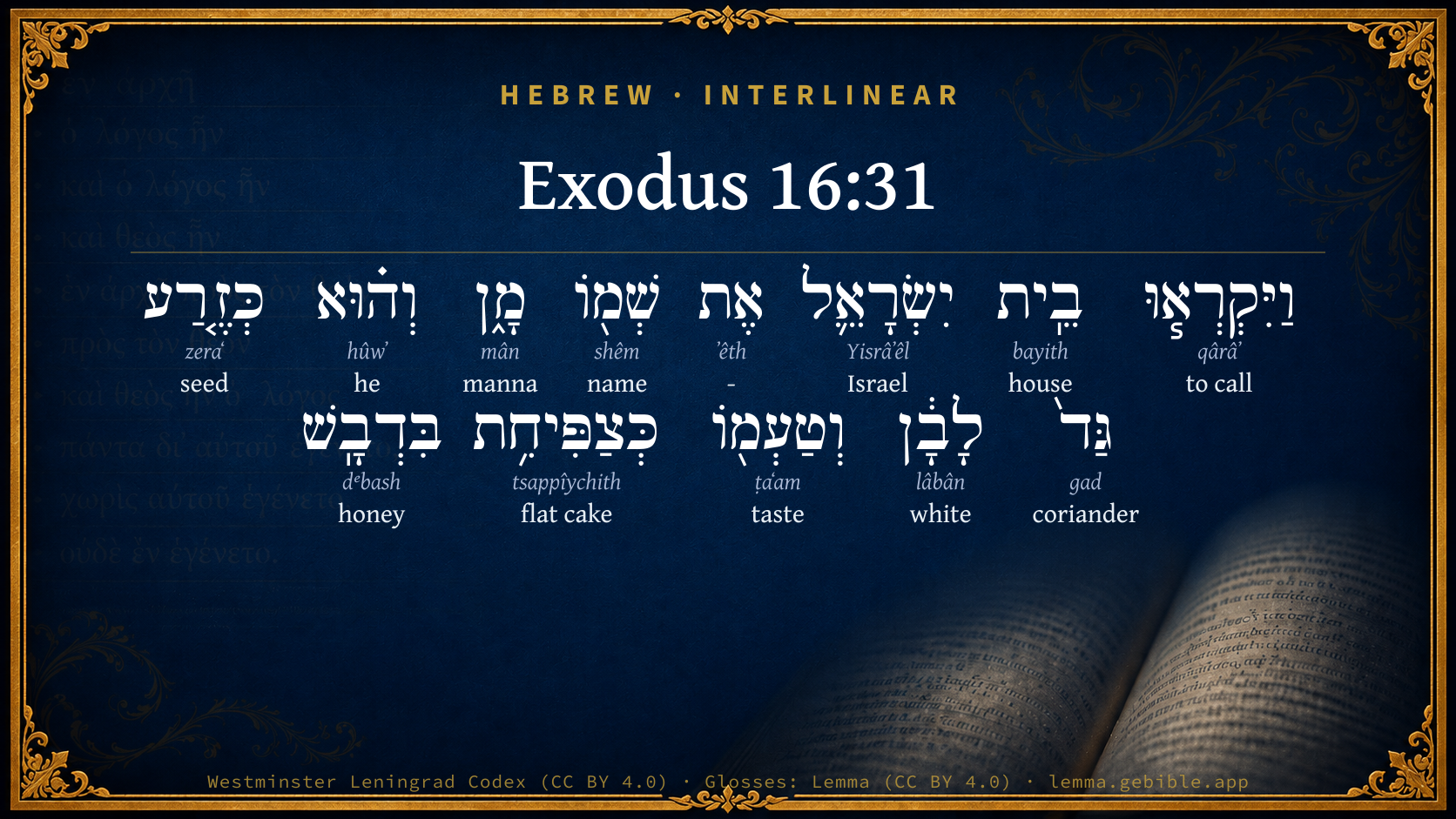
Hebrew (Westminster Leningrad Codex) Exodus 16:31 appears in the Hebrew Old Testament. The text above is from the Westminster Leningrad Codex. Each word links to its Strong’s number, a concise gloss, and parsing drawn from the Open Scriptures Hebrew Bible morphology. Click any word for its full Brown-Driver-Briggs (BDB) entry.
Download image
Cite this verse

Exodus 16:31 (World English Bible). Public Domain. Lemma interlinear Bible study tool, https://lemma.gebible.app/v/exodus/16/31.

Show BibTeX & RIS
BibTeX
RIS
English Translation
The house of Israel called the name of it Manna, and it was like coriander seed, white; and its taste was like wafers with honey.
World English Bible · Public Domain
Highlights
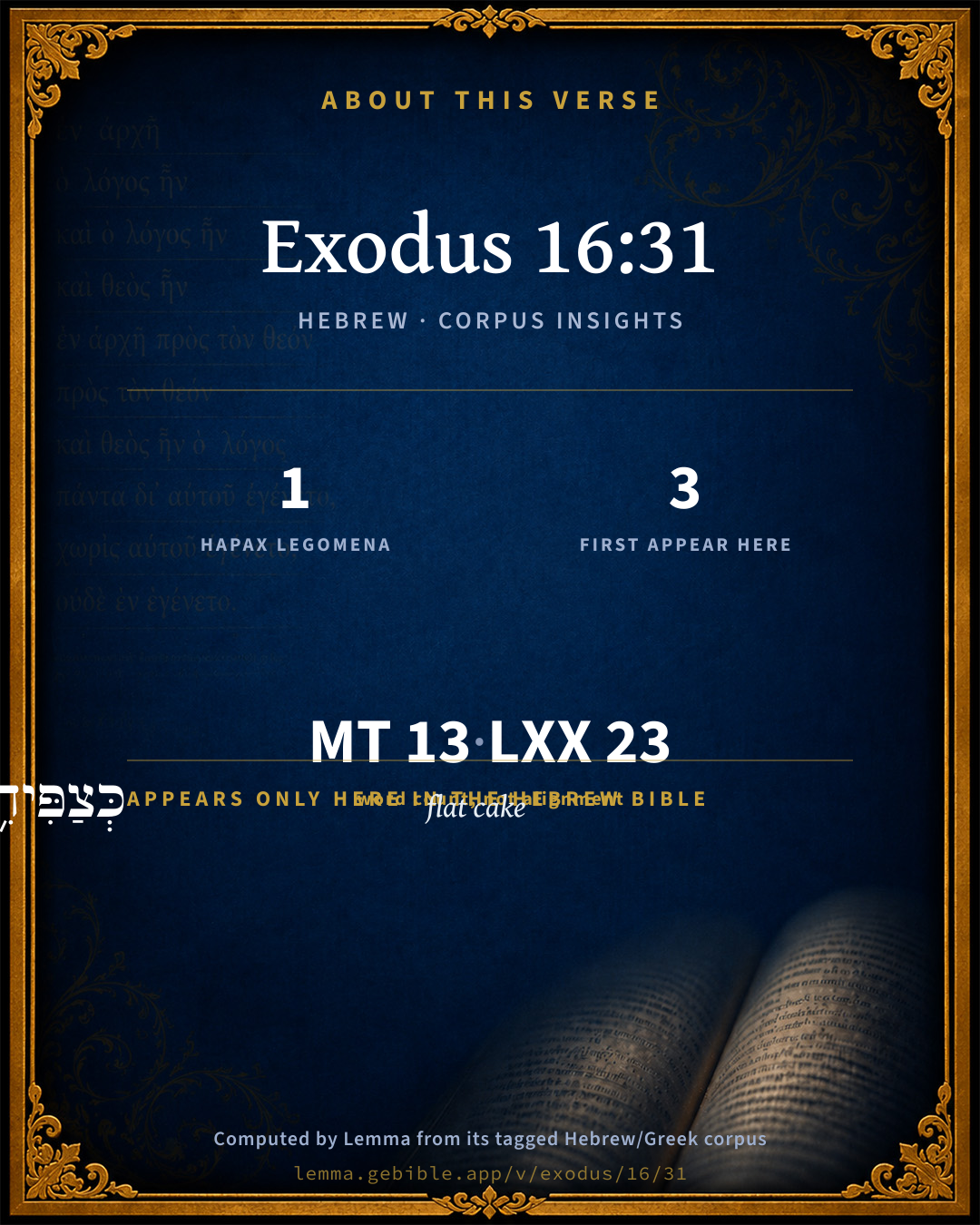
  • 1 hapax legomenon — only here in the Hebrew Bible
  • 3 first appearances in the Hebrew Bible
Full analysis ↓
Download a study sheet

One document with this verse’s original text, its word-by-word gloss line, the meaning frame, cross-references with their text, attributed commentary, and full source and license credits — printable, and it pastes into notes with its structure intact.

This verse Autodidact and up

Study sheet (.html) Plain text (.txt)

A passage Seminary Student

Up to 50 verses in one chapter. A passage sheet keeps up to 6 commentary sources and 12 cross-references per verse, in the order this page ranks them, and says so on the sheet whenever that leaves anything out. Ask for a single verse and you get the Autodidact verse sheet above.

Everything on this page stays free to read, with no account — the sheet is a download of what is already on screen, not access to it.

Want to remove ads? Support Godless Engineer
Compare translations 3

The same verse in 3 English versions, stacked beneath the original-language interlinear above. Click any original word for its lexicon entry.

Each is an independent rendering of the whole verse — the interlinear is not word-aligned to these translations.

Highlighted words mark where these versions differ — a whole-verse word diff, not a word-by-word alignment.

  • World English Bible Public Domain
    The house of Israel called the name of it Manna, and it was like coriander seed, white; and its taste was like wafers with honey.
  • King James Version Public Domain
    And the house of Israel called the name thereof Manna: and it was like coriander seed, white; and the taste of it was like wafers made with honey.
  • unfoldingWord Literal Text CC BY-SA 4.0
    And the house of Israel called its name “manna.” And it was like coriander seed, white, and its taste was like wafers with honey.

unfoldingWord Literal Text — © unfoldingWord, licensed CC BY-SA 4.0. Word-aligned USFM3 via Door43 (git.door43.org/unfoldingWord/en_ult).

Versions to compare (up to 4)

3 of 4 selected

Show all 18 translations

Every available English version of this verse, each an independent rendering of the whole verse.

  • World English Bible Public Domain
    The house of Israel called the name of it Manna, and it was like coriander seed, white; and its taste was like wafers with honey.
  • Berean Standard Bible Public Domain
    Now the house of Israel called the bread manna. It was white like coriander seed and tasted like wafers made with honey.
  • Majority Standard Bible Public Domain
    Now the house of Israel called the bread manna. It was white like coriander seed and tasted like wafers made with honey.
  • King James Version Public Domain
    And the house of Israel called the name thereof Manna: and it was like coriander seed, white; and the taste of it was like wafers made with honey.
  • American Standard Version (1901) Public Domain
    And the house of Israel called the name thereof Manna: and it was like coriander seed, white; and the taste of it was like wafers `made' with honey.
  • Revised Version (1885) Public Domain
    And the house of Israel called the name thereof Manna: and it was like coriander seed, white; and the taste of it was like wafers made with honey.
  • Geneva Bible (1599) Public Domain
    And the house of Israel called the name of it, MAN. and it was like to coriander seede, but white: and the taste of it was like vnto wafers made with hony.
  • Douay-Rheims (1899) Public Domain
    And the house of Israel called the name thereof Manna: and it was like coriander seed white, and the taste thereof like to flour with honey.
  • Young's Literal Translation Public Domain
    and the house of Israel call its name Manna, and it `is' as coriander seed, white; and its taste `is' as a cake with honey.
  • Literal Standard Version CC BY-SA 4.0
    and the house of Israel calls its name Manna, and it [is] as white coriander seed; and its taste [is] as a cake with honey.
  • Unlocked Literal Bible CC BY-SA 4.0
    The people of Israel called that food “manna.” It was white like coriander seed, and its taste was like wafers made with honey.
  • unfoldingWord Literal Text CC BY-SA 4.0
    And the house of Israel called its name “manna.” And it was like coriander seed, white, and its taste was like wafers with honey.
  • Darby Bible Public Domain
    And the house of Israel called its name Manna; and it was like coriander-seed, white; and the taste of it was like cake with honey.
  • World Messianic Bible Public Domain
    The house of Israel called its name “Manna”, and it was like coriander seed, white; and its taste was like wafers with honey.
  • Webster's Bible Public Domain
    And the house of Israel called its name Manna: and it was like coriander-seed, white; and the taste of it was like wafers made with honey.
  • Free Bible Version CC BY-SA 4.0
    The Israelites called the food manna. It was white like coriander seed and tasted like wafers with honey.
  • Bible in Basic English Public Domain
    And this bread was named manna by Israel: it was white, like a grain seed, and its taste was like cakes made with honey.
  • JPS Tanakh (1917) Public Domain
    And the house of Israel called the name thereof Manna; and it was like coriander seed, white; and the taste of it was like wafers made with honey.

Literal Standard Version (2020), Covenant Press — licensed CC BY-SA 4.0. Text via the HelloAO Bible API (eBible.org). Unlocked Literal Bible (unfoldingWord) — licensed CC BY-SA 4.0. Text via the HelloAO Bible API (eBible.org). unfoldingWord Literal Text — © unfoldingWord, licensed CC BY-SA 4.0. Word-aligned USFM3 via Door43 (git.door43.org/unfoldingWord/en_ult). Free Bible Version, Dr. Jonathan Gallagher — licensed CC BY-SA 4.0. Text via the HelloAO Bible API (eBible.org).

Word by word

More ways to search: Search by grammar → Find every occurrence → Compare this word →

Practice this passage: Drill this verse → Learn its vocabulary →

כְּצַפִּיחִ֥ת
tsappîychith
H6838
“like/as · flat cake”
Preposition + Noun, Common, Feminine, Singular, Absolute
Part of Speech
Preposition + Noun
Type
Common
Gender
Feminine
Number
Singular
State
Absolute
Full BDB Definition

Origin: from the same as H6835

TWOT: 1952b

flat cake, wafer
  1. וַיִּקְרְא֧וּ qârâʼ H7121 “and · to call” Conjunction + Verb, Qal, Sequential Imperfect, 3rd Person, Masculine, Plural
  2. בֵֽית bayith H1004 “house of” Noun, Common, Masculine, Singular, Construct
  3. יִשְׂרָאֵ֛ל Yisrâʼêl H3478 “Israel” Noun, Proper
  4. אֶת ʼêth H853 “-” Particle, Direct Object
  5. שְׁמ֖וֹ shêm H8034 “name · his” Noun, Common, Masculine, Singular, Construct + Suffix, Personal, 3rd Person, Masculine, Singular
  6. מָ֑ן mân H4478 “manna” Noun, Common, Masculine, Singular, Absolute
  7. וְה֗וּא hûwʼ H1931 “and · he” Conjunction + Pronoun, Personal, 3rd Person, Masculine, Singular
  8. כְּזֶ֤רַע zeraʻ H2233 “like/as · seed of” Preposition + Noun, Common, Masculine, Singular, Construct
  9. גַּד֙ gad H1407 “coriander” Noun, Common, Masculine, Singular, Absolute
  10. לָבָ֔ן lâbân H3836 “white” Adjective, Adjective, Masculine, Singular, Absolute
  11. וְטַעְמ֖וֹ ṭaʻam H2940 “and · taste · his” Conjunction + Noun, Common, Masculine, Singular, Construct + Suffix, Personal, 3rd Person, Masculine, Singular
  12. בִּדְבָֽשׁ dᵉbash H1706 “in/at · honey” Preposition + Noun, Common, Masculine, Singular, Absolute

About this verse

These counts appear in no published source. They are computed here, from the morphology-tagged text and Lemma’s own curated glosses. What Lemma adds →

13
words
13
distinct lemmas
Pentateuch
section

Notable vocabulary

1 hapax legomenon — a word that appears only here in the entire Hebrew Bible:

  • כְּצַפִּיחִ֥ת flat cake H6838

First appearance in Scripture

These words make their first canonical appearance in the Hebrew Bible here:

  • גַּד֙ coriander H1407
  • וְטַעְמ֖וֹ taste H2940
  • כְּצַפִּיחִ֥ת flat cake H6838

Shared distinctive vocabulary

גַּד֙ coriander H1407 occurs in 2 verses of the Hebrew Bible. Also found in:

Grammatical profile

  • 1 verb
  • 9 nouns
  • 1 adjective
  • 1 pronoun
  • 1 particle

Verb forms

  • וַיִּקְרְא֧וּ Qal · Sequential Imperfect

Hebrew & Septuagint length

In English translation the verse runs 25 words from the Hebrew and 28 from the Septuagint (LXX English) — closely comparable.

A rough comparison of the two English renderings, which tokenize alike — not a word-level alignment.

Word counts can differ between the Hebrew and the Greek without any difference in meaning — e.g. the Hebrew direct-object marker אֵת has no separate Greek word, and Greek often adds the article ὁ.

In the original languages it is 13 Hebrew tokens and 23 Greek tokens — but the two are counted differently (Hebrew bundles its prefixes and suffixes into one token; the Greek is in lemma form), so that isn’t a like-for-like length.

Cross-references

3

Topical passages linked to Exodus 16:31 in the Treasury of Scripture Knowledge — connected by theme and wording, ordered by reader-vote popularity; previews shown in the World English Bible.

  • Numbers 11:6–9 but now our soul is dried away; there is nothing at all save this manna to look on.
  • Exodus 16:15 When the children of Israel saw it, they said one to another, "What is it?" For they didn't know what it was. Moses said to them, "It is the bread which Yahweh has given you to eat."
  • Song of Solomon 2:3 As the apple tree among the trees of the wood, So is my beloved among the sons. I sat down under his shadow with great delight, His fruit was sweet to my taste.

Cross-references courtesy of OpenBible.info (CC BY 4.0).

Hebrew and Greek witnesses Masoretic Hebrew ↔ Greek Septuagint

The same verse in the two great witnesses to the Old Testament, shown verse-for-verse.

These are two independent witnesses, not word-aligned to each other, and the Septuagint is shown in lemma (dictionary) form.

Hebrew Exodus 16:31 Masoretic · Westminster Leningrad Codex

וַיִּקְרְא֧וּ בֵֽית יִשְׂרָאֵ֛ל אֶת שְׁמ֖וֹ מָ֑ן וְה֗וּא כְּזֶ֤רַע גַּד֙ לָבָ֔ן וְטַעְמ֖וֹ כְּצַפִּיחִ֥ת בִּדְבָֽשׁ

The house of Israel called the name of it Manna, and it was like coriander seed, white; and its taste was like wafers with honey.

World English Bible · Public Domain

Greek LXX Exodus 16:31 Septuagint · lemma form

καί ἐπιὀνομάζω ὁ υἱός ἰσραήλ ὁ ὄνομα αὐτός μαν εἰμί δέ ὡς σπέρμα κόριον λευκός ὁ δέ γεῦμα αὐτός ὡς ἐγκρίς ἐν μέλι

And the children of Israel called the name of it Man; and it was as white coriander seed, and the taste of it as a wafer with honey.

LXX2012 (modern English Septuagint) · Public Domain

On this verse, Ellicott's Commentary for English Readers discusses the Septuagint’s reading. Read the note in Commentary ↓

Hebrew: Westminster Leningrad Codex (CC BY 4.0). Greek: Septuagint (public domain); English from LXX2012 (modern English Septuagint) (Public Domain). How the Septuagint differs from the Hebrew →

Targum (Aramaic paraphrase)

2

The Targum is the ancient Jewish Aramaic paraphrase of the Hebrew Scriptures — an interpretive translation, not the Hebrew text itself. Onkelos (literal) and Pseudo-Jonathan (expansive) render the Torah, and Jonathan the Prophets. Coverage is partial: where no permissively-licensed English translation exists for a verse, only the Aramaic is shown. This is verse-level text, not a word-by-word alignment to the Hebrew.

  1. Targum Onkelos Torah (Genesis–Deuteronomy)
    וּקְרוֹ בֵית יִשְׂרָאֵל יָת שְׁמֵהּ מָן וְהוּא כְּבַר זְרַע גִדָא חִוָר וְטַעְמֵה כְּאִסְקְרֵיטָוָן בִּדְבָשׁ:

    (no public-domain English translation for this verse)

    Targum Onkelos — Aramaic: “Onkelos Genesis” (public domain); “Onkelos Exodus” (public domain); “Onkelos Leviticus” (public domain); “Onkelos Numbers” (public domain); “Onkelos Deuteronomy” (public domain). English: “Sefaria Community Translation” (CC0 1.0 (public-domain dedication)); “J.W. Etheridge. The Targums of Onkelos and Jonathan Ben Uzziel on the Pentateuch. London: Longmans, Green, 1862” (public domain). Text via Sefaria.

  2. Targum Pseudo-Jonathan Torah (Genesis–Deuteronomy)
    וּקְרוֹן בֵּית יִשְרָאֵל יַת שְׁמֵיהּ מַנָּא וְהוּא כְּבַר זְרַע כּוּסְבַּר חֵיוַר וְטַעֲמֵיהּ כַּאֲשִׁישְׁיַין בִּדְבָשׁ

    And the house of Israel called the name of it Manna; and it was like the seed of coriander, white, and the taste of it like preparations of honey.

    Targum Pseudo-Jonathan — Aramaic: “Targum Jonathan on Genesis” (public domain); “Targum Jonathan on Exodus” (public domain); “Targum Jonathan on Leviticus” (public domain); “Targum Jonathan on Numbers” (public domain); “Targum Jonathan on Deuteronomy” (public domain). English: “The Targum of Jonathan ben Uzziel, trans. J. W. Etheridge, London, 1862” (public domain). Text via Sefaria.

Commentary

Notes on Exodus 16:31 from classic Christian and Jewish commentators (each source and its license shown beneath its notes). The classic Christian expositions comment on the surrounding passage and are grouped to its opening verse, so a note may address several verses; the Jewish commentaries on the Tanakh (Rashi and others) are per-verse, so they appear only where the commentator wrote on this verse.

Lemma curates 59 commentaries, every one of them public domain or Creative Commons licensed, each selected and text-cleaned for this edition rather than reprinted as found. About our sources →

Trapp's Complete Commentary

John Trapp

Exo 16:31 And the house of Israel called the name thereof Manna: and it [was] like coriander seed, white; and the taste of it [was] like wafers [made] with honey.

Ver. 31. And the taste of it.] It had not all manner of good tastes, according to every man’s appetite, {Num 11:8} else why should the people lust and murmur as there they did? {Exo 16:4-5}

John Trapp, A Commentary or Exposition upon All the Books of the Old and New Testament (1647–1656) — public domain. Text from a community e-Sword module.

Joseph Benson's Commentary

Exo 16:31. It was like coriander-seed — In size, not in colour, for that is dark coloured, but this was white, as is here said, or like bdellium or pearl, Num 11:7; and its taste like wafers — Or little cakes made with honey; that is, when it was raw, for when it was dressed, it was like fresh oil. The reader ought to be informed, however, that the Hebrew word here used, and rendered coriander-seed, is of rather doubtful interpretation. It may possibly mean some other small seed.

Joseph Benson's Commentary on the Old and New Testaments (1811–1818) — public domain. Text from a community e-Sword module.

Geneva Bible (1599)

Geneva Bible translators

In form and figure, but not in color, Num. 11:7.

Geneva Bible (1599) marginal notes — public domain. Text via Bolls.life.

Adam Clarke's Commentary

Verse 31. Called the name thereof Manna] See Clarke on Ex 16:15.

Adam Clarke's Commentary on the Bible (1810–1826) — public domain. Text from a community e-Sword/MySword module.

Ellicott's Commentary for English Readers

(31) Manna.—Rather, man. (See Note on Exo_16:15.) “Manna” is a Greek form, first used by the LXX. translator of Numbers (Exo_11:6-7; Exo_11:9).

It was like coriander seed.—The appearance of the manna is compared above to hoar frost (Exo_16:14); here, and in Num_11:7, to coriander seed. The former account describes its look as it lay on the ground, the latter its appearance after it was collected and brought in. The coriander seed is “a small round grain, of a whitish or yellowish grey.” In Numbers it is further said that the colour was that of bdellium, which is a whitish resin.

The taste of it was like wafers made with honey.—In Numbers the taste is compared to that of fresh oil (Num_11:8). The wafers or cakes used by the Egyptians, Greeks, and other ancient nations as offerings, were ordinarily composed of fine wheaten flour, oil, and honey. According to a Jewish tradition which finds a place in the Book of Wisdom (Exo_16:20-21), the taste of the manna varied according to the wish of the eater, and “tempered itself to every man’s liking.”

A Bible Commentary for English Readers, edited by Charles John Ellicott (1878–1897) — public domain. Text from a community e-Sword module.

The Cambridge Bible for Schools and Colleges

gen. ed. J. J. S. Perowne

31. the house of Israel] Unusual: cf. Exo_40:38, Num_20:29, Jos_21:45 (all P). Lev_10:6; Lev_17:3; Lev_17:8; Lev_17:10; Lev_22:18 (P and H) are rather different.

like coriander seed] So Num_11:7. Coriander is an umbelliferous plant, which grows wild in Egypt and Palestine, producing small greyish white round seeds, about the size of a peppercorn, with a pleasant spicy flavour. The seeds are used largely in the East as a spice to mix with bread, and to give an aromatic flavour to sweetmeats (NHB. p. 440). In Num_11:8 the manna is also said to have resembled bdellium (Gen_2:12), i.e. the transparent wax-like gum or resin, valued for its fragrance, called by the Greeks βδέλλα.

wafers] Only here: LXX. ἐγκρίς, i.e. (Athen. xiv. 54, p. 645, cited by Kn.) pastry made with oil and honey. The root means in Arab. and Eth. to spread out. In Num_11:8 the taste of the manna is said to have been like a rich oily cake (לְשַׁד הַשֶּׁמֶן, i.e. oily richness; LXX. ἐγκρὶς ἐξ ἐλαίου, Vulg. panis oleatus; RVm. cakes baked with oil). Travellers state that the manna gathered from trees (see below) is used by the natives of the Sinaitic Peninsula as ‘a dainty instead of honey.’

31–34. A further description of the manna, and directions for a pot of it to be preserved in the sanctuary, as a witness to future generations how Israel had been sustained in the wilderness.

The Cambridge Bible for Schools and Colleges (gen. ed. J. J. S. Perowne; Cambridge University Press, 1878–1918) — public domain. Text from a community e-Sword module.

John Gill's Exposition

And Moses said unto Aaron, take a pot,.... The Targum of Jonathan calls it an earthen pot; and so Jarchi; which, if it could be supported, might be considered as an emblem of the ministers of the word, in whom, as in earthen vessels, the Gospel of Christ is put: Aben Ezra says, it was a vessel either of earth or brass, which latter is more likely for duration; since an earthen vessel can hardly be supposed to continue so long as this did, and much less a glass pot, as others take it to be: but the Septuagint version renders it a golden pot; and so it is said to be by Philo the Jew (a), and which is confirmed by the apostle, Heb 9:4 and which puts the thing out of question; and this may denote the word and ordinances which retain and hold forth Christ as the bread of life, and are a memorial of him, as evidently set forth, crucified, and slain, to future ages, comparable to gold; both for the preciousness of them, being more to be desired than gold, yea, than fine gold, and for the duration of them, they being to continue until the second coming of Christ:

and put an omer full of manna therein; the manna, and the full measure of it, according to a man's eating, was to be put into it, denoting that a full Christ, or Christ in all the fulness of his person and grace, is to be held forth in the word and ordinances to the eye of faith:

and lay it up before the Lord, to be kept for your generations; in a place where the Lord would hereafter fix the symbol of his presence, the ark, cherubim, and mercy seat; and may signify the presence of Christ with his Father, the efficacy of his blood, righteousness, and sacrifice, his mediation and intercession; for he is not only held forth in the word, for faith to look at, but he is before the throne as though he had been slain, Rev 5:6.

(a) De Cong. Quaer. Erud. Gratia, p. 438.

John Gill's Exposition of the Whole Bible (1746–1763) — public domain (CC PDM 1.0). Text via the HelloAO Bible API.

Albert Barnes' Notes on the Bible

manna - It was not indeed the common manna, as they then seem to have believed, but the properties which are noted in this passage are common to it and the natural product: in size, form and color it resembled the seed of the white coriander, a small round grain of a whitish or yellowish grey.

Albert Barnes' Notes on the Bible (1834–1885) — public domain. Text from a community e-Sword/MySword module.

Haydock's Catholic Bible Commentary

Manna. This miraculous food, with which the children of Israel were nourished and supported during their sojourning in the wilderness, was a figure of the bread of life, which we receive in the blessed sacrament, for the food and nourishment of our souls, during the time of our mortal pilgrimage, till we come to our eternal home, the true land of promise: where we shall keep an everlasting sabbath: and have no further need of sacraments. (Challoner) --- Seed in size, but white; whereas the seed of coriander is black. (Menochius) --- Samaritan, "like a grain of rice." --- Honey, or oil, Numbers xi. 8. (Calmet) --- This was the usual taste. But if any one liked another better, the manna assumed it, Wisdom xvi. 20. (Menochius)

George Leo Haydock (1774–1849), Haydock's Catholic Family Bible and Commentary, 1859 edition — public domain. Excludes Psalms (Douay-Rheims chapter numbering differs from Protestant) and Deuterocanonical books (Catholic canon only).

Matthew Poole's English Annotations

It was like coriander seed, in shape and figure, but not in colour, for that is dark-coloured, but this white, as it follows here, like bdellium, &c., Num 11:7.

The taste of it, when it was raw; but when it was drest it was like fresh oil, Num 11:8.

Matthew Poole's English Annotations on the Holy Bible (1683–1685) — public domain. Text from a community e-Sword/MySword module.

Whedon's Commentary on the Bible

Daniel D. Whedon

31. Like coriander seed — It lay on the ground in small seed-like, pearl-coloured grains. Though called bread it is not to be imagined as a loaf, but as like a grain or seed.

Daniel D. Whedon (gen. ed.), Commentary on the Old and New Testaments (1874–1909) — public domain. Text from a community e-Sword module.

The Pulpit Commentary

Vers. 31-36. THE APPEARANCE OF THE MANNA, ITS CONTINUANCE, AND ITS DEPOSITION IN THE TABERNACLE. In bringing the subject of the manna to a conclusion, the writer adds a few words.

1. On its appearance;

2. On its deposition by divine command in the Ark of the Covenant; and

3. On its continuance during the forty years of the wanderings.

It is evident that verses 32-34 cannot have been written until after the sojourn in Sinai, and the command to make a tabernacle (ch. 26.): as also that verse 35 cannot have been written till the arrival of the Israelites at the verge of the land of Canaan. But there is nothing in the passage that militates against the Mosaic authorship of the whole.

The house of Israel. This expression is unusual, and is not admitted by the Septuagint, the Syriac, or the Arabic versions, which all have "the children of Israel." Several Hebrew MSS. have bent, "sons," instead of beyth "house." Manna. Literally, as in the Septuagint, man the word used when they first beheld the substance (verse 15), and probably meaning "a gift.:" The elongated form manna, first appears in the Sept. rendering of Num_11:6, Num_11:7. It was like coriander seed. This is "a small round grain of a whitish or yellowish grey." The comparison is made again in Num_11:7, where it is added that the colour was that of bdellium either the gum so called, or possibly the pearl. The taste of it was like wafers made with honey. Such wafers or cakes were constantly used as offerings by the Egyptians, Greeks, and other nations. They were ordinarily compounded of meal, oil, and honey. Hence we can reconcile with the present passage the statement in Num_11:8, that "the taste of it was as the taste of fresh oil."

The Pulpit Commentary (1880–1919), ed. H.D.M. Spence-Jones & Joseph S. Exell — public domain. Text from a community e-Sword module.

Keil & Delitzsch

C. F. Keil & F. Delitzsch

The manna was "like coriander-seed, white; and the taste of it like cake with honey." גּד: Chald. גּידא; lxx κόριον; Vulg. coriandrum; according to Dioscorid. 3, 64, it was called γοίδ by the Carthaginians. צפּיחת is rendered ἔγκρις by the lxx; according to Athenaeus and the Greek Scholiasts, a sweet kind of confectionary made with oil. In Num 11:7-8, the manna is said to have had the appearance of bdellium, a fragrant and transparent resin, resembling wax (Gen 2:12). It was ground in handmills or pounded in mortars, and either boiled in pots or baked on the ashes, and tasted like השּׁמן לשׁד, "dainty of oil," i.e., sweet cakes boiled with oil.

This "bread of heaven" (Psa 78:24; Psa 105:40) Jehovah gave to His people for the first time at a season of the year and also in a place in which natural manna is still found. It is ordinarily met with in the peninsula of Sinai in the months of June and July, and sometimes even in May. It is most abundant in the neighbourhood of Sinai, in Wady Feirn and es Sheikh, also in Wady Gharandel and Taiyibeh, and some of the valleys to the south-east of Sinai (Ritter, 14, p. 676; Seetzen's Reise iii. pp. 76, 129). In warm nights it exudes from the branches of the tarfah-tree, a kind of tamarisk, and falls down in the form of small globules upon the withered leaves and branches that lie under the trees; it is then gathered before sunrise, but melts in the heat of the sun. In very rainy seasons it continues in great abundance for six weeks long; but in many seasons it entirely fails. It has the appearance of gum, and has a sweet, honey-like taste; and when taken in large quantities, it is said to act as a mild aperient (Burckhardt, Syr. p. 954; Wellsted in Ritter, p. 674). There are striking points of resemblance, therefore, between the manna of the Bible and the tamarisk manna. Not only was the locality in which the Israelites first received the manna the same as that in which it is obtained now; but the time was also the same, inasmuch as the 15th day of the second month (Exo 16:1) falls in the middle of our May, if not somewhat later. The resemblance in colour, form, and appearance is also unmistakeable; for, though the tamarisk manna is described as a dirty yellow, it is also said to be white when it falls upon stones. Moreover, it falls upon the earth in grains, is gathered in the morning, melts in the heat of the sun, and has the flavour of honey. But if these points of agreement suggest a connection between the natural manna and that of the Scriptures, the differences, which are universally admitted, point with no less distinctness of the miraculous character of the bread of heaven. This is seen at once in the fact that the Israelites received the manna for 40 years, in all parts of the desert, at every season of the year, and in sufficient quantity to satisfy the wants of so numerous a people. According to Exo 16:35, they ate manna "until they came to a land inhabited, unto the borders of the land of Canaan;" and according to Jos 5:11-12, the manna ceased, when they kept the Passover after crossing the Jordan, and ate of the produce of the land of Canaan on the day after the Passover. Neither of these statements is to be so strained as to be made to signify that the Israelites ate no other bread than manna for the whole 40 years, even after crossing the Jordan: they merely affirm that the Israelites received no more manna after they had once entered the inhabited land of Canaan; that the period of manna or desert food entirely ceased, and that of bread baked from corn, or the ordinary food of the inhabited country, commenced when they kept the Passover in the steppes of Jericho, and ate unleavened bread and parched cakes of the produce of the land as soon as the new harvest had been consecrated by the presentation of the sheaf of first-fruits to God.

But even in the desert the Israelites had other provisions at command. In the first place, they had brought large flocks and herds with them out of Egypt (Exo 12:38; Exo 17:3); and these they continued in possession of, not only at Sinai (Exo 34:3), but also on the border of Edom and the country to the east of the Jordan (Num 20:19; Num 32:1). Now, if the maintenance of these flocks necessitated, on the one hand, their seeking for grassy spots in the desert; on the other hand, the possession of cattle secured them by no means an insignificant supply of milk and flesh for food, and also of wool, hair, and skins for clothing. Moreover, there were different tribes in the desert at that very time, such as the Ishmaelites and Amalekites, who obtained a living for themselves from the very same sources which must necessarily have been within reach of the Israelites. Even now there are spots in the desert of Arabia where the Bedouins sow and reap; and no doubt there was formerly a much larger number of such spots than there are now, since the charcoal trade carried on by the Arabs has interfered with the growth of trees, and considerably diminished both the fertility of the valleys and the number and extent of the green oases (cf. Rppell, Nubien, pp. 190, 201, 256). For the Israelites were not always wandering about; but after the sentence was pronounced, that they were to remain for 40 years in the desert, they may have remained not only for months, but in some cases even for years, in certain places of encampment, where, if the soil allowed, they could sow, plant, and reap. There were many of their wants, too, that they could supply by means of purchases made either from the trading caravans that travelled through the desert, or from tribes that were settled there; and we find in one place an allusion made to their buying food and water from the Edomites (Deu 2:6-7). It is also very obvious from Lev 8:2; Lev 26:31-32; Lev 9:4; Lev 10:12; Lev 24:5., and Num 7:13., that they were provided with wheaten meal during their stay at Sinai.

(Note: Vide Hengstenberg's Geschichte Bileam's, p. 284ff. For the English translation, see "Hengstenberg on the Genuineness of Daniel, etc.," p. 566. Clark. 1847.)

But notwithstanding all these resources, the desert was "great and terrible" (Deu 9:19; Deu 8:15); so that, even though it is no doubt the fact that the want of food is very trifling in that region (cf. Burckhardt, Syria, p. 901), there must often have been districts to traverse, and seasons to endure, in which the natural resources were either insufficient for so numerous a people, or failed altogether. It was necessary, therefore, that God should interpose miraculously, and give His people bread and water and flesh by supernatural means. So that it still remains true, that God fed Israel with manna for 40 years, until their entrance into an inhabited country rendered it possible to dispense with these miraculous supplies. We must by no means suppose that the supply of manna was restricted to the neighbourhood of Sinai; for it is expressly mentioned after the Israelites had left Sinai (Num 11:7.), and even when they had gone round the land of Edom (Num 21:5). But whether it continued outside the true desert, - whether, that is to say, the Israelites were still fed with manna after they had reached the inhabited country, viz., in Gilead and Bashan, the Amoritish kingdoms of Sihon and Og, which extended to Edrei in the neighbourhood of Damascus, and where there was no lack of fields, and vineyards, and wells of water (Num 21:22), that came into the possession of the Israelites on their conquest of the land, - or during their encampment in the fields of Moab opposite to Jericho, where they were invited by the Moabites and Edomites to join in their sacrificial meals (Num 25:2), and where they took possession, after the defeat of the Midianites, of their cattle and all that they had, including 675,000 sheep and 72,000 beeves (Num 31:31.), - cannot be decided in the negative, as Hengstenberg supposes; still less can it be answered with confidence in the affirmative, as it has been by C. v. Raumer and Kurtz. For if, as even Kurtz admits, the manna was intended either to supply the want of bread altogether, or where there was bread to be obtained, though not in sufficient quantities, to make up the deficiency, it might be supposed that no such deficiency would occur in these inhabited and fertile districts, where, according to Jos 1:11, there were sufficient supplies, at hand to furnish ample provision for the passage across the Jordan. It is possible too, that as there were more trees in the desert at that time than there are now, and, in fact, more vegetation generally, there may have been supplies of natural manna in different localities, in which it is not met with at present, and that this manna harvest, instead of yielding only 5 or 7 cwt., as is the case now, produced considerably more.

(Note: The natural manna was not exclusively confined to the tamarisk, which seems to be the only tree in the peninsula of Sinai that yields it now; but, according to both ancient and modern testimony, it has been found in Persia, Chorasan, and other parts of Asia, dropping from other trees. Cf. Rosenmller ubi supra, and Ritter, 14, pp. 686ff.)

Nevertheless, the quantity which the Israelites gathered every day, - Viz. an omer a head, or at least 2 lbs., - still remains a divine miracle; though this statement in Exo 16:16. is not to be understood as affirming, that for 40 years they collected that quantity every day, but only, that whenever and wherever other supplies failed, that quantity could be and was collected day by day.

Moreover, the divine manna differed both in origin and composition from the natural produce of the tamarisk. Though the tamarisk manna resembles the former in appearance, colour, and taste, yet according to the chemical analysis to which it has been submitted by Mitscherlich, it contains no farina, but simply saccharine matter, so that the grains have only the consistency of wax; whereas those of the manna supplied to the Israelites were so hard that they could be ground in mills and pounded in mortars, and contained so much meal that it was made into cakes and baked, when it tasted like honey-cake, or sweet confectionary prepared with oil, and formed a good substitute for ordinary bread. There is no less difference in the origin of the two. The manna of the Israelites fell upon the camp with the morning dew (Exo 16:13, Exo 16:14; Num 11:9), therefore evidently out of the air, so that Jehovah might be said to have rained it from heaven (Exo 16:4); whereas the tamarisk manna drops upon the ground from the fine thin twigs of this shrub, and, in Ehrenberg's opinion, in consequence of the puncture of a small, yellow insect, called coccus maniparus. But it may possibly be produced apart from this insect, as Lepsius and Tischendorf found branches with a considerable quantity of manna upon them, and saw it drop from trees in thick adhesive lumps, without being able to discover any coccus near (see (Ritter, 14, pp. 675-6). Now, even though the manna of the Bible may be connected with the produce of the tamarisk, the supply was not so inseparably connected with these shrubs, as that it could only fall to the earth with the dew, as it was exuded from their branches. After all, therefore, we can neither deny that there was some connection between the two, nor explain the gift of the heavenly manna, as arising from an unrestricted multiplication and increase of this gift of nature. We rather regard the bread of heaven as the production and gift of the grace of God, which fills all nature with its powers and productions, and so applies them to its purposes of salvation, as to create out of that which is natural something altogether new, which surpasses the ordinary productions of nature, both in quality and quantity, as far as the kingdom of nature is surpassed by the kingdom of grace and glory.

Keil & Delitzsch — Biblical Commentary on the Old Testament (1861–1891) — public domain (CC PDM 1.0). Text via the HelloAO Bible API. (Old Testament only.)

unfoldingWord translationNotes

Door43 World Missions Community

coriander seed

Coriander is also known as cilantro. People dry the seeds and grind them into a powder and put it in food to give it flavor. (See: Translate Unknowns)

wafers

very thin biscuits or crackers

omer

2 liters (See: Biblical Volume)

bread

This refers to the bread that appeared as thin flakes on the ground each morning.

translationWords

Israel

manna

seed

honey

Moses

Yahweh

generation

descend

desert

Egypt

unfoldingWord translationNotes — © Distant Shores Media and the Door43 World Missions Community, licensed CC BY-SA 4.0. Source: git.door43.org/Door43/en_tn.

Rashi

Rabbi Shlomo Yitzchaki (Rashi)

והוא כזרע גד לבן AND IT WAS LIKE THE CORIANDER SEED, WHITE — a herb, the name of which is (in old French) coriandre; its seed is round and is not white, whilst the Manna was white. It follows therefore, that it is compared to coriander seed only in respect to its roundness — so that the meaning is: it was like coriander seed, and it was white (Yoma 75a).

כצפיחת LIKE FLAT CAKES — dough which is fried in honey. In the Mishnaic speech it is called אסקריטין (Pesachim 37a), and this is the translation of Onkelos here.

Rashi on the Tanakh — English translations: “The Judaica Press complete Tanach with Rashi, translated by A. J. Rosenberg” (CC BY 4.0); “Pentateuch with Rashi's commentary by M. Rosenbaum and A.M. Silbermann, 1929-1934” (public domain); “The Metsudah Tanach series, Lakewood, N.J” (CC BY 4.0); and “The Book of Joshua, Metsudah Publications, 1997” (CC BY 4.0). Text via Sefaria.

Lesson kit

Teaching starters — assembled from the data on this page, not authored interpretation. Every prompt links to the verse data it draws on. Edit before teaching.

Exodus, in the Pentateuch, opens this verse with 13 words (13 distinct Hebrew lemmas). Its most distinctive word is tsappîychith (“flat cake”). A historical commentator’s framing appears above. Read the whole chapter for the surrounding context.

Discussion questions

  1. How does “flat cake” (tsappîychith) shape what this verse is saying?
  2. 1 word here appears nowhere else in the Hebrew Bible. Why might the author reach for such rare wording?
  3. 3 words make their first appearance in Scripture here. What does this debut establish?
  4. How does Numbers 11:7, which shares the word «coriander», read alongside this verse?
  5. These translations render this verse differently; the difference is in the English rendering, not the original. What questions does that raise?
  6. «וַיִּקְרְא֧וּ» is a Qal Sequential Imperfect verb. How does that grammatical form shape the action described?
  7. Compare how Trapp's Complete Commentary and Joseph Benson's Commentary read this verse. Where do they agree or differ?

Things to notice

Reading settings

Reading text

Shown beneath each verse's original-language words.

Old Testament
Old Testament edition

Read the OT as the Masoretic Hebrew (MT) or the Greek Septuagint (LXX).

English shown for the Greek Septuagint (in the Hebrew ↔ Greek comparison).

Comparing translations? Open the Compare panel on any verse page to stack up to four side by side.