
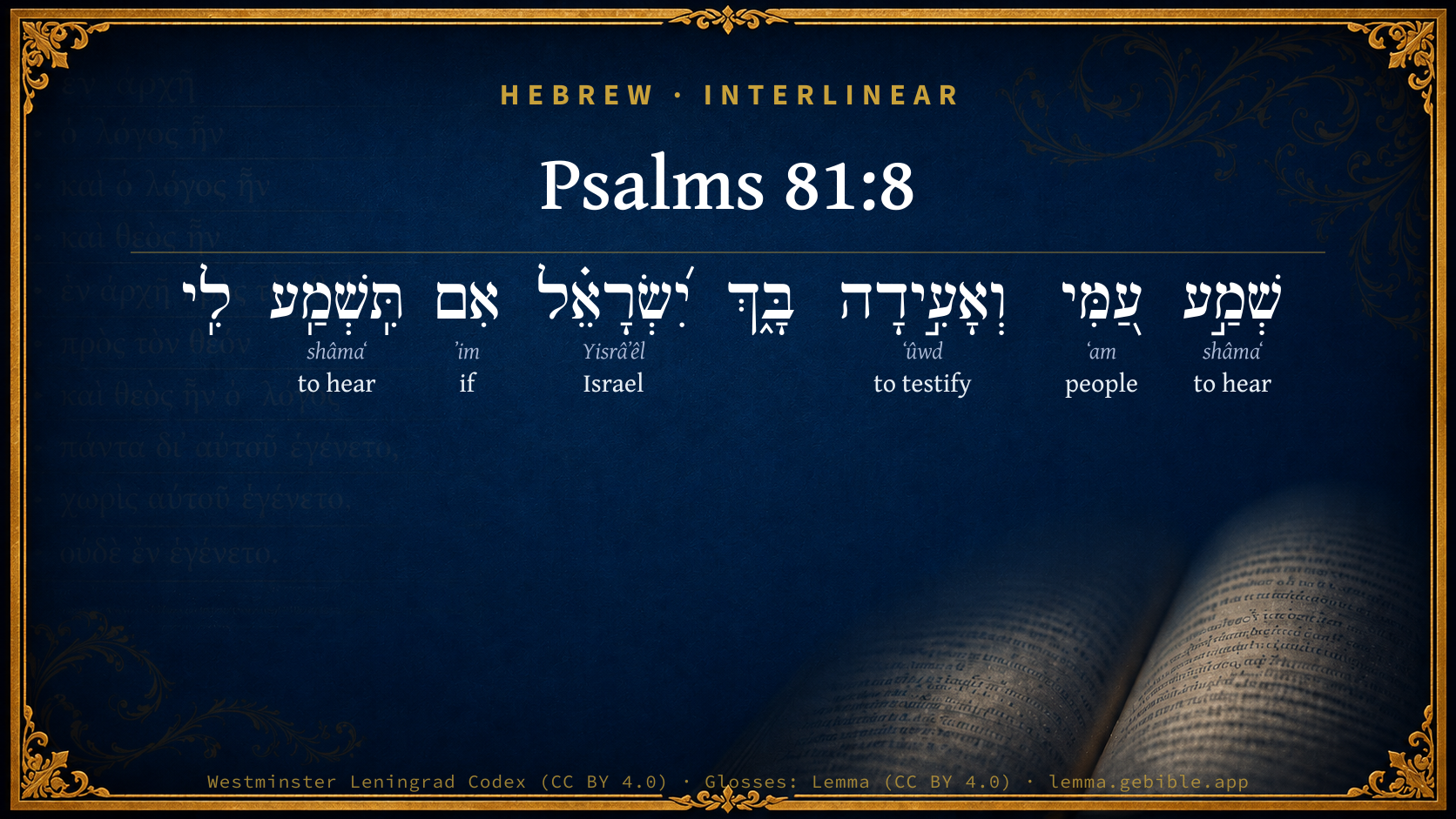
Psalms 81:8

Hebrew (Westminster Leningrad Codex) Psalms 81:8 appears in the Hebrew Old Testament. The text above is from the Westminster Leningrad Codex. Each word links to its Strong’s number, a concise gloss, and parsing drawn from the Open Scriptures Hebrew Bible morphology. Click any word for its full Brown-Driver-Briggs (BDB) entry.
Download image
Cite this verse

Psalms 81:8 (World English Bible). Public Domain. Lemma interlinear Bible study tool, https://lemma.gebible.app/v/psalms/81/8.

Show BibTeX & RIS
BibTeX
RIS
English Translation
"Hear, my people, and I will testify to you, Israel, if you would listen to me!
World English Bible · Public Domain
Download a study sheet

One document with this verse’s original text, its word-by-word gloss line, the meaning frame, cross-references with their text, attributed commentary, and full source and license credits — printable, and it pastes into notes with its structure intact.

This verse Autodidact and up

Study sheet (.html) Plain text (.txt)

A passage Seminary Student

Up to 50 verses in one chapter. A passage sheet keeps up to 6 commentary sources and 12 cross-references per verse, in the order this page ranks them, and says so on the sheet whenever that leaves anything out. Ask for a single verse and you get the Autodidact verse sheet above.

Everything on this page stays free to read, with no account — the sheet is a download of what is already on screen, not access to it.

Want to remove ads? Support Godless Engineer
Compare translations 3

The same verse in 3 English versions, stacked beneath the original-language interlinear above. Click any original word for its lexicon entry.

Each is an independent rendering of the whole verse — the interlinear is not word-aligned to these translations.

Highlighted words mark where these versions differ — a whole-verse word diff, not a word-by-word alignment.

  • World English Bible Public Domain
    "Hear, my people, and I will testify to you, Israel, if you would listen to me!
  • King James Version Public Domain
    Hear, O my people, and I will testify unto thee: O Israel, if thou wilt hearken unto me;
  • unfoldingWord Literal Text CC BY-SA 4.0
    Hear, my people, and let me testify against you. Israel, if you would listen to me!

unfoldingWord Literal Text — © unfoldingWord, licensed CC BY-SA 4.0. Word-aligned USFM3 via Door43 (git.door43.org/unfoldingWord/en_ult).

Versions to compare (up to 4)

3 of 4 selected

Show all 18 translations

Every available English version of this verse, each an independent rendering of the whole verse.

  • World English Bible Public Domain
    "Hear, my people, and I will testify to you, Israel, if you would listen to me!
  • Berean Standard Bible Public Domain
    Hear, O My people, and I will warn you: O Israel, if only you would listen to Me!
  • Majority Standard Bible Public Domain
    Hear, O My people, and I will warn you: O Israel, if only you would listen to Me!
  • King James Version Public Domain
    Hear, O my people, and I will testify unto thee: O Israel, if thou wilt hearken unto me;
  • American Standard Version (1901) Public Domain
    Hear, O my people, and I will testify unto thee: O Israel, if thou wouldest hearken unto me!
  • Revised Version (1885) Public Domain
    Hear, O my people, and I will testify unto thee: O Israel, if thou wouldest hearken unto me!
  • Geneva Bible (1599) Public Domain
    Heare, O my people, and I wil protest vnto thee: O Israel, if thou wilt hearken vnto me,
  • Douay-Rheims (1899) Public Domain
    Thou calledst upon me in affliction, and I delivered thee: I heard thee in the secret place of tempest: I proved thee at the waters of contradiction.
  • Young's Literal Translation Public Domain
    Hear, O My people, and I testify to thee, O Israel, if thou dost hearken to me:
  • Literal Standard Version CC BY-SA 4.0
    Hear, O My people, and I testify to you, || O Israel, if you listen to me:
  • Unlocked Literal Bible CC BY-SA 4.0
    Listen, my people, for I will warn you, Israel, if you would only listen to me!
  • unfoldingWord Literal Text CC BY-SA 4.0
    Hear, my people, and let me testify against you. Israel, if you would listen to me!
  • Darby Bible Public Domain
    Hear, my people, and I will testify unto thee; O Israel, if thou wouldest hearken unto me!
  • World Messianic Bible Public Domain
    “Hear, my people, and I will testify to you, Israel, if you would listen to me!
  • Webster's Bible Public Domain
    \\81:7\\Thou calledst in trouble, and I delivered thee; I answered thee in the secret place of thunder: I proved thee at the waters of Meribah. Selah.
  • Free Bible Version CC BY-SA 4.0
    My people, listen to my warnings! Israel, please listen to me!
  • Bible in Basic English Public Domain
    Give ear, O my people, and I will give you my word, O Israel, if you will only do as I say!
  • JPS Tanakh (1917) Public Domain
    (81-9) Hear, O My people, and I will admonish thee: O Israel, if thou wouldest hearken unto Me!

Literal Standard Version (2020), Covenant Press — licensed CC BY-SA 4.0. Text via the HelloAO Bible API (eBible.org). Unlocked Literal Bible (unfoldingWord) — licensed CC BY-SA 4.0. Text via the HelloAO Bible API (eBible.org). unfoldingWord Literal Text — © unfoldingWord, licensed CC BY-SA 4.0. Word-aligned USFM3 via Door43 (git.door43.org/unfoldingWord/en_ult). Free Bible Version, Dr. Jonathan Gallagher — licensed CC BY-SA 4.0. Text via the HelloAO Bible API (eBible.org).

Word by word

More ways to search: Search by grammar → Find every occurrence → Compare this word →

Practice this passage: Drill this verse → Learn its vocabulary →

וְאָעִ֣ידָה
ʻûwd
H5749
“and · to testify”
Conjunction + Verb, Hiphil, Cohortative, 1st Person, Common, Singular
Part of Speech
Conjunction + Verb
Stem
Hiphil
Form
Cohortative
Person
1st Person
Gender
Common
Number
Singular
Full BDB Definition

Origin: a primitive root

TWOT: 1576 , 1576d

to return, repeat, go about, do again - (Piel) to surround, go round and round - (Pilel) to restore, relieve - (Hithpalel) to be restored - to bear witness - (Qal) to bear witness, say again and again - (Hiphil) - to testify, bear witness - to cause to testify, take or call as witness, invoke - to protest, affirm solemnly, warn, exhort or enjoin solemnly, admonish, charge - (Hophal) to protest, give warning
  1. שְׁמַ֣ע shâmaʻ H8085 “hear” Verb, Qal, Imperative, 2nd Person, Masculine, Singular
  2. עַ֭מִּי ʻam H5971 “people · my” Noun, Common, Masculine, Singular, Construct + Suffix, Personal, 1st Person, Common, Singular
  3. יִ֝שְׂרָאֵ֗ל Yisrâʼêl H3478 “Israel” Noun, Proper
  4. אִם ʼim H518 “if” Conjunction
  5. תִּֽשְׁמַֽע shâmaʻ H8085 “to hear” Verb, Qal, Imperfect, 2nd Person, Masculine, Singular

About this verse

These counts appear in no published source. They are computed here, from the morphology-tagged text and Lemma’s own curated glosses. What Lemma adds →

8
words
5
distinct lemmas
Wisdom
section

Shared distinctive vocabulary

וְאָעִ֣ידָה to testify H5749 occurs in 40 verses of the Hebrew Bible. Also found in:

Grammatical profile

  • 3 verbs
  • 2 nouns
  • 2 prepositions
  • 1 conjunction

Verb forms

  • שְׁמַ֣ע Qal · Imperative
  • וְאָעִ֣ידָה Hiphil · Cohortative
  • תִּֽשְׁמַֽע Qal · Imperfect

Repetition

A word recurs within this verse — often emphatic in Hebrew:

  • שְׁמַ֣ע to hear H8085 ×2

Hebrew & Septuagint length

In English translation the verse runs 16 words from the Hebrew and 23 from the Septuagint (LXX English) — closely comparable.

A rough comparison of the two English renderings, which tokenize alike — not a word-level alignment.

Word counts can differ between the Hebrew and the Greek without any difference in meaning — e.g. the Hebrew direct-object marker אֵת has no separate Greek word, and Greek often adds the article ὁ.

Cross-references

11

Topical passages linked to Psalms 81:8 in the Treasury of Scripture Knowledge — connected by theme and wording, ordered by reader-vote popularity; previews shown in the World English Bible.

  • Psalms 50:7 "Hear, my people, and I will speak; Israel, and I will testify against you. I am God, your God.
  • Exodus 15:26 and he said, "If you will diligently listen to the voice of Yahweh your God, and will do that which is right in his eyes, and will pay attention to his commandments, and keep all his statutes, I will put none of the diseases on you, which I have put on the Egyptians; for I am Yahweh who heals you."
  • John 3:11 Most assuredly I tell you, we speak that which we know, and testify of that which we have seen, and you don't receive our witness.
  • Isaiah 1:19 If you are willing and obedient, You shall eat the good of the land;
  • Isaiah 55:3–4 Turn your ear, and come to me; hear, and your soul shall live: and I will make an everlasting covenant with you, even the sure mercies of David.
  • John 3:32–33 What he has seen and heard, of that he testifies; and no one receives his witness.
  • 1 John 5:9 If we receive the witness of men, the witness of God is greater; for this is God's testimony which he has testified concerning his Son.
  • Psalms 81:13 Oh that my people would listen to me, That Israel would walk in my ways!
  • Deuteronomy 5:27 Go you near, and hear all that Yahweh our God shall say: and speak you to us all that Yahweh our God shall speak to you; and we will hear it, and do it.
  • Deuteronomy 32:46 He said to them, Set your heart to all the words which I testify to you this day, which you shall command your children to observe to do, [even] all the words of this law.
  • Acts 20:21 testifying both to Jews and to Greeks repentance toward God, and faith toward our Lord Jesus.

Cross-references courtesy of OpenBible.info (CC BY 4.0).

Hebrew and Greek witnesses Masoretic Hebrew ↔ Greek Septuagint

The same verse in the two great witnesses to the Old Testament, shown verse-for-verse.

You’re reading Greek Psalm 80 (Hebrew Psalm 81). The Septuagint counts the superscription, so verse numbers can differ from the Hebrew — chapter-level alignment, not verse-by-verse. Numbering follows Rahlfs.

These are two independent witnesses, not word-aligned to each other, and the Septuagint is shown in lemma (dictionary) form.

Hebrew Psalms 81:8 Masoretic · Westminster Leningrad Codex

שְׁמַ֣ע עַ֭מִּי וְאָעִ֣ידָה בָּ֑ךְ יִ֝שְׂרָאֵ֗ל אִם תִּֽשְׁמַֽע לִֽי

"Hear, my people, and I will testify to you, Israel, if you would listen to me!

World English Bible · Public Domain

Greek LXX Greek Psalm 80:8 Septuagint · lemma form

ἐν θλῖψις ἐπικαλέω ἐγώ καί ῥύομαι σύ ἐπιἀκούω σύ ἐν ἀπόκρυφος καταιγίς δοκιμάζω σύ ἐπί ὕδωρ ἀντιλογία διάψαλμα

Hear, my people, and I will speak to you, O Israel; and I will testify to you: if you will listen to me;

LXX2012 (modern English Septuagint) · Public Domain

Hebrew: Westminster Leningrad Codex (CC BY 4.0). Greek: Septuagint (public domain); English from LXX2012 (modern English Septuagint) (Public Domain). How the Septuagint differs from the Hebrew →

Commentary

Notes on Psalms 81:8 from classic Christian and Jewish commentators (each source and its license shown beneath its notes). The classic Christian expositions comment on the surrounding passage and are grouped to its opening verse, so a note may address several verses; the Jewish commentaries on the Tanakh (Rashi and others) are per-verse, so they appear only where the commentator wrote on this verse.

Lemma curates 59 commentaries, every one of them public domain or Creative Commons licensed, each selected and text-cleaned for this edition rather than reprinted as found. About our sources →

Matthew Henry's Commentary

God, by the psalmist, here speaks to Israel, and in them to us, on whom the ends of the world are come.

I. He demands their diligent and serious attention to what he was about to say (Psa 81:8): "Hear, O my people! and who should hear me if my people will not? I have heard and answered thee; now wilt thou hear me? Hear what is said with the greatest solemnity and the most unquestionable certainty, for it is what I will testify unto thee. Do not only give me the hearing, but hearken unto me, that is, be advised by me, be ruled by me." Nothing could be more reasonably nor more justly expected, and yet God puts an if upon it: "If thou wilt hearken unto me. It is thy interest to do so, and yet it is questionable whether thou wilt or no; for thy neck is an iron sinew."

II. He puts them in mind of their obligation to him as the Lord their God and Redeemer (Psa 81:10): I am the Lord thy God, who brought thee out of the land of Egypt; this is the preface to the ten commandments, and a powerful reason for the keeping of them, showing that we are bound to it in duty, interest, and gratitude, all which bonds we break asunder if we be disobedient.

III. He gives them an abstract both of the precepts and of the promises which he gave them, as the Lord and their God, upon their coming out of Egypt. 1. The great command was that they should have no other gods before him (Psa 81:9): There shall no strange god be in thee, none besides thy own God. Other gods might well be called strange gods, for it was very strange that ever any people who had the true and living God for their God should hanker after any other. God is jealous in this matter, for he will not suffer his glory to be given to another; and therefore in this matter they must be circumspect, Exo 23:13. 2. The great promise was that God himself, as a God all-sufficient, would be nigh unto them in all that which they called upon him for (Deu 4:7), that, if they would adhere to him as their powerful protector and ruler, they should always find him their bountiful benefactor: "Open thy mouth wide and I will fill it, as the young ravens that cry open their mouths wide and the old ones fill them." See here, (1.) What is our duty - to raise our expectations from God and enlarge our desires towards him. We cannot look for too little from the creature nor too much from the Creator. We are not straitened in him; why therefore should we be straitened in our own bosoms? (2.) What is God's promise. I will fill thy mouth with good things, Psa 103:5. There is enough in God to fill our treasures (Pro 8:21), to replenish every hungry soul (Jer 31:25), to supply all our wants, to answer all our desires, and to make us completely happy. The pleasures of sense will surfeit and never satisfy (Isa 55:2); divine pleasures will satisfy and never surfeit. And we may have enough from God if we pray for it in faith. Ask, and it shall be given you. He gives liberally, and upbraids not. God assured his people Israel that it would be their own fault if he did not do as great and kind things for them as he had done for their fathers. Nothing should be thought too good, too much, to give them, if they would but keep close to God. He would moreover have given them such and such things, Sa2 12:8.

IV. He charges them with a high contempt of his authority as their lawgiver and his grace and favour as their benefactor, Psa 81:11. He had done much for them, and designed to do more; but all in vain: "My people would not hearken to my voice, but turned a deaf ear to all I said." Two things he complains of: - 1. Their disobedience to his commands. They did hear his voice, so as never any people did; but they would not hearken to it, they would not be ruled by it, neither by the law nor by the reason of it. 2. Their dislike of his covenant-relation to them: They would none of me. They acquiesced not in my word (so the Chaldee); God was willing to be to them a God, but they were not willing to be to him a people; they did not like his terms. "I would have gathered them, but they would not." They had none of him; and why had they not? It was not because they might not; they were fairly invited into covenant with God. It was not because they could not; for the word was nigh them, even in their mouth and in their heart. But it was purely because they would not. God calls them hi people, for they were bought by him, bound to him, his by a thousand ties, and yet even they had not hearkened, had not obeyed. "Israel, the seed of Jacob my friend, set me at nought, and would have none of me." Note, All the wickedness of the wicked world is owing to the wilfulness of the wicked will. The reason why people are not religious is because they will not be so.

V. He justifies himself with this in the spiritual judgments he had brought upon them (Psa 81:12): So I gave them up unto their own hearts' lusts, which would be more dangerous enemies and more mischievous oppressors to them than any of the neighbouring nations ever were. God withdrew his Spirit from them, took off the bridle of restraining grace, left them to themselves, and justly; they will do as they will, and therefore let them do as they will. Ephraim is joined to idols; let him alone. It is a righteous thing with God to give those up to their own hearts' lusts that indulge them, and give up themselves to be led by them; for why should his Spirit always strive? His grace is his own, and he is debtor to no man, and yet, as he never gave his grace to any that could say they deserved it, so he never took it away from any but such as had first forfeited it: They would none of me, so I gave them up; let them take their course. And see what follows: They walked in their own counsels, in the way of their heart and in the sight of their eye, both in their worships and in their conversations. "I left them to do as they would, and then they did all that was ill;" they walked in their own counsels, and not according to the counsels of God and his advice. God therefore was not the author of their sin; he left them to the lusts of their own hearts and the counsels of their own heads; if they do not well, the blame must lie upon their own hearts and the blood upon their own heads.

VI. He testifies his good-will to them in wishing they had done well for themselves. He saw how sad their case was, and how sure their ruin, when they were delivered up to their own lusts; that is worse than being given up to Satan, which may be in order to reformation (Ti1 1:20) and to salvation (Co1 5:5); but to be delivered up to their own hearts' lusts is to be sealed under condemnation. He that is filthy, let him be filthy still. What fatal precipices will not these hurry a man to! Now here God looks upon them with pity, and shows that it was with reluctance that he thus abandoned them to their folly and fate. How shall I give thee up, Ephraim? Hos 11:8, Hos 11:9. So here, O that my people had hearkened! See Isa 48:18. Thus Christ lamented the obstinacy of Jerusalem. If thou hadst known, Luk 19:42. The expressions here are very affecting (Psa 81:13-16), designed to show how unwilling God is that any should perish and desirous that all should come to repentance (he delights not in the ruin of sinful persons or nations), and also what enemies sinners are to themselves and what an aggravation it will be of their misery that they might have been happy upon such easy terms. Observe here,

1. The great mercy God had in store for his people, and which he would have wrought for them if they had been obedient. (1.) He would have given them victory over their enemies and would soon have completed the reduction of them. They should not only have kept their ground, but have gained their point, against the remaining Canaanites, and their encroaching vexatious neighbours (Psa 81:14): I should have subdued their enemies; and it is God only that is to be depended on for the subduing of our enemies. Not would had have put them to the expense and fatigue of a tedious war: he would soon have done it; for he would have turned his hand against their adversaries, and then they would not have been able to stand before them. It intimates how easily he would have done it and without any difficulty. With the turn of a hand, nay, with the breath of his mouth, shall he slay the wicked, Isa 11:4. If he but turn his hand, the haters of the Lord will submit themselves to him (Psa 81:15); and, though they are not brought to love him, yet they shall be made to fear him and to confess that he is too hard for them and that it is in vain to contend with him. God is honoured, and so is his Israel, by the submission of those that have been in rebellion against them, though it be but a forced and feigned submission. (2.) He would have confirmed and perpetuated their posterity, and established it upon sure and lasting foundations. In spite of all the attempts of their enemies against them, their time should have endured for ever, and they should never have been disturbed in the possession of the good land God had given them, much less evicted and turned out of possession. (3.) He would have given them great plenty of all good things (Psa 81:16): He should have fed them with the finest of the wheat, with the best grain and the best of the kind. Wheat was the staple commodity of Canaan, and they exported a great deal of it, Eze 27:17. He would not only have provided for them the best sort of bread, but with honey out of the rock would he have satisfied them. Besides the precious products of the fruitful soil, that there might not be a barren spot in all their land, even the clefts of the rock should serve for bee-hives and in them they should find honey in abundance. See Deu 32:13, Deu 32:14. In short, God designed to make them every way easy and happy.

2. The duty God required from them as the condition of all this mercy. He expected no more than that they should hearken to him, as a scholar to his teacher, to receive his instructions - as a servant to his master, to receive his commands; and that they should walk in his ways, those ways of the Lord which are right and pleasant, that they should observe the institutions of his ordinances and attend the intimations of his providence. There was nothing unreasonable in this.

3. Observe how the reason of the withholding of the mercy is laid in their neglect of the duty: If they had hearkened to me, I would soon have subdued their enemies. National sin or disobedience is the great and only thing that retards and obstructs national deliverance. When I would have healed Israel, and set every thing to-rights among them, then the iniquity of Ephraim was discovered, and so a stop was put to the cure, Hos 7:1. We are apt to say, "If such a method had been taken, such an instrument employed, we should soon have subdued our enemies:" but we mistake; if we had hearkened to God, and kept to our duty, the thing would have been done, but it is sin that makes our troubles long and salvation slow. And this is that which God himself complains of, and wishes it had been otherwise. Note, Therefore God would have us do our duty to him, that we may be qualified to receive favour from him. He delights in our serving him, not because he is the better for it, but because we shall be.

Matthew Henry's Commentary on the Whole Bible (1708–1710) — public domain (CC PDM 1.0). Text via the HelloAO Bible API.

Trapp's Complete Commentary

John Trapp

Psa 81:8 Hear, O my people, and I will testify unto thee: O Israel, if thou wilt hearken unto me;

Ver. 8. Hear, O my people, &c.] Notwithstanding thy many and mighty provocations at Meribah and elsewhere, I made a covenant with thee at Mount Sinai, and gave thee right judgments and true laws, good statutes and commandments, Neh 9:13.

John Trapp, A Commentary or Exposition upon All the Books of the Old and New Testament (1647–1656) — public domain. Text from a community e-Sword module.

The Biblical Illustrator

Joseph S. Exell

Psa_81:8

Blow up the trumpet in the new moon.

New-year resolutions

The savage and the child of civilization are alike in this, that they both draw their notions of time, and measure its lapse, by the movements of the heavenly bodies, thus fulfilling the primaeval prophecy that the sun, moon and stars should be for ever the means of marking time. The easiest of measures, and the one which would make the deepest impression on mans mind, would be the circle of the moons changes--the thin crescent, the half-circle, and the full orb. Next would be marked the course of the sun. This is most to be observed when the sun sets behind some cliff or precipitous range of rocks, and after a certain anniversary begins to daily sink behind the horizon beyond that point. The idea of a regular year would, when once suggested by the heavenly bodies, be aided in many lands by the altered appearance of summer and winter, and thus the prehistoric races found themselves supplied with sufficient chronology for their simple needs. But amongst those nations where the higher instincts of religion were felt there was a need for measuring the recurring periods of religious festivals. The Jewish people strictly observed the weekly festival of the Sabbath, which, by its very peculiarity of dividing time by seven days, seems to point at once to its Divine origin. But in keeping other festivals they were guided by a more complicated system to fix the feast of the Passover in connection with the Paschal Moon; and the other feasts, such as Pentecost, and that of Tabernacles, had a certain relation to the harvest season. In addition to these great feasts, it was ordained that sacrifices and offerings should be made in the Temple on the occasion of each new moon. It was also usual to summon worshippers to remember this duty by the sound of the silver trumpets echoing through the air, and blown by the sons of Aaron. In addition to the festivals observed at each new moon, there was a special day of solemn observation called the Feast of Trumpets, on the first new moon of the first month of the year--in fact, on what answered to our New Years Day. This day was fixed with the Jews in September, and with the mediaeval Christians it was observed on the 25th of March, and by modern usage on the 1st of January. It is of little importance on what particular day the year begins. The essence of the matter is that we are entering on a new cycle of days--on a new course of the earths journeying round its great central sun; that another milestone on the road of life is passed; that another division of our mortal existence is entered on. The words of the text seem to call on the Priesthood of the magnificent Temple of Solomon to take up their trumpets and rouse the people to the great duties of offering sacrifice and acknowledging God. There is no other instrument of music that has such a wonderful power of rousing and exhilarating the soul as the trumpet. Its shrill, wild, exulting tones have ever been valued in martial music, and that persons feelings must indeed be cold and stagnant whose enthusiasm is not awakened by the clarions sound. When the trumpet sounds the warrior ought to prepare himself for war. The imagery of the Christian conflict has lost its power by familiar usage, but it represents a great truth--the reality and force of temptation. Each new year will bring its temptations and difficulties. We should prepare to meet them by fresh resolves and more earnest prayers. (J. W. Hardman, LL. D.)

The new moon

The Jews thought a good deal of the new moon. When it first appeared they took note of it at once. Indeed, six times in the year they attached such importance to the appearance of the new moon that if any one saw it, and thought he was among the first to see it, he was expected to go to Jerusalem at once and state the fact to the Sanhedrim, who sat in the Hall of Polished Stones to receive the information. Those who went were carefully examined and cross-examined. If they had only seen the moon through a cloud, or anything like glass, or had only seen it reflected in water, their testimony could not be accepted. It was necessary that they should see it directly and clearly in the heavens above them. If no one saw the moon before the thirtieth day there was no special note taken of the fact, because they generally reckoned the month to be thirty days long, but if the new moon appeared on the 29th day of the month, special notice was taken of it, and a fire was lit upon the summit of Mount Olivet; then men who were on the watch on other summits kindled their fires, too, in order to show that they had noted the signal, and also in order to give the signal to those on other mountain tops; and thus from one end of the land to the other it was soon known that the new moon bad appeared before the thirtieth day. The Jews rejoiced exceedingly at the appearance of every new moon. It was a new beginning, and the Jews attached a great deal of importance to beginnings--the first fruits of the harvest, the oldest child in the family, etc. They consecrated the first of everything to God, and by so doing they felt they were consecrating all the rest. The first sheaves of harvest were consecrated for the whole harvest. They gave the first to God as aa acknowledgment of His right to all the rest. And so with regard to the months, they consecrated each month to God, by specially consecrating the first day of the month. Now, we may well follow their example in presenting the first of everything to God. I should like you to feel that you ought to give the beginning of your life to God as the Jews gave the first day of every month specially to Him. It is wonderful what is done by giving the beginning: so much depends upon how we begin. If every little boy here would give his heart to the Lord Jesus just now at the beginning of life, oh, what a blessing it would be! (D. Davies.)

The Biblical Illustrator, edited by Joseph S. Exell (c. 1880s–1900s) — public domain. Text from a community e-Sword module.

The Treasury of David

Charles H. Spurgeon

Ver. 8. Hear, O my people, and I will testify unto thee. What? Are the people so insensible as to be deaf to their God? So it would seem, for he earnestly asks a hearing. Are we not also at times quite as careless and immovable?

O Israel, if thou wilt hearken unto me. There is much in this "if." How low have they fallen who will not hearken unto God himself! The deaf adder is not more grovelling. We are not fond of being upbraided, we had rather avoid sharp and cutting truths; and, though the Lord himself rebuke us, we fly from his gentle reproofs.

None.

Ver. 8-10.

1. A compassionate Father, calling to his child: O my people, and I will testify unto thee: O Israel, if thou wilt hearken unto me.

2. A jealous sovereign, laying down his law: There shall no strange god be in thee.

3. An all sufficient Friend, challenging confidence: I am the Lord thy God: open thy mouth wide, and I will fill it. Richard Cecil. 1748-1810.

Ver. 8,11,13. The command, the disobedience, the regret.

Psalms 81:9*

Ver. 8-10. See Psalms on "Ps 81:8" for further information.

Psalms 81:10*

Ver. 8-10. See Psalms on "Ps 81:8" for further information.

Ver. 8,11,13. The command, the disobedience, the regret.

Ver. 8,11,13. The command, the disobedience, the regret.

Charles H. Spurgeon's The Treasury of David (1869–1885) — public domain. Psalms only. Text from a community e-Sword/MySword module.

Joseph Benson's Commentary

Psa 81:8-10. Hear, O my people — And who should hear me if my people will not? I have heard and answered thee, now wilt thou hear me? Hear what is said, with the greatest solemnity, and the most unquestionable certainty, for it is what I, the God of truth and love, thy lawgiver and thy judge, declare for thy profit. And I will testify unto thee — Concerning my will and thy duty. I will give thee statutes and judgments, in the execution of which thou mayest live and be happy for ever. This God did presently after he brought them from Meribah, even at Sinai. There shall no strange god be in thee — Thou shalt renounce all false gods, and false ways of worship, and shalt worship me only, and only in the manner which I shall prescribe. Thus, in effect, God addressed himself to Israel at Sinai, and thus he addressed himself to them when this Psalm was written, and thus he addresses his people in every age. He thus put them in remembrance of the first and great command, Thou shalt have no other gods before me; and of his claim to their obedience as their God and Saviour. Open thy mouth wide — That Isaiah , 1 st, Pray for my mercies; ask freely, and abundantly, and boldly, whatsoever you need, or in reason can desire. 2d, Receive the mercies which I am ready to give you. And I will fill it — I will grant them all upon condition of your obedience. Here then he testifies, that he is both able and willing to satisfy the utmost desires and wishes of such as would apply to him for blessings, especially spiritual blessings and comforts. “Behold then the rebellion, the ingratitude, and the folly of that man, who says to any creature, ‘Thou art my God;’ who bestoweth on the world that fear, love, and adoration, which are due only to its Creator and Redeemer; who wasteth his days in seeking after happiness, where all, by their inquietude, acknowledge that it is not to be found.” — Horne.

Joseph Benson's Commentary on the Old and New Testaments (1811–1818) — public domain. Text from a community e-Sword module.

J. A. Alexander on Psalms

Joseph Addison Alexander

9. (Psa 81:8) Hear, my people, and I will testify against thee, Israel, if thou wilt hearken to me. There is a strong resemblance between this verse and Psa 50:7. The conditional particle (if) in the last clause is by some taken optatively, Oh that thou wouldst hearken, or, as we might say in English, if thou wouldst but hearken. As examples of this usage, Psa 95:7; Psa 139:19, Pro 24:11, are cited. Other interpreters deny its existence and regard this as an instance of aposiopesis, if thou wilt hearken to me (thou shalt do well), like those in Exo 32:32, Luke xis. 42. See above, on Psa 27:13. A simpler and more natural construction than either is to make this the condition of the statement in the first clause. "I will speak, if thou wilt hear me."

Joseph Addison Alexander, The Psalms Translated and Explained (1850) — public domain. Text from a community e-Sword module.

Tyndale Open Study Notes

Tyndale Open Resources

81:8-10 God pleads with his people to remember the covenant and the Ten Commandments.

Tyndale Open Study Notes — © Tyndale Open Resources, licensed CC BY-SA 4.0. Text via the HelloAO Bible API.

Geneva Bible (1599)

Geneva Bible translators

He condemneth all assemblies, where the people are not attentive to hear God’s voice, and to give obedience to the same.

Geneva Bible (1599) marginal notes — public domain. Text via Bolls.life.

Adam Clarke's Commentary

Verse 8. Hear, O my people] These are nearly the same words with those spoken at the giving of the law, Ex 20:2.

Adam Clarke's Commentary on the Bible (1810–1826) — public domain. Text from a community e-Sword/MySword module.

John Calvin's Commentaries

8 Hear, O my people! The more effectually to touch the hearts of the people, God is here invested with the character of a teacher, and introduced as speaking familiarly in the midst of the congregation; and this is done for the purpose of instructing them, that all assemblies are unprofitable and trifling in which the voice of God stirring up men to faith and true godliness is not uttered. But let us proceed to the consideration of the words. This preface was intended to teach in a few words, that festival days were not purely and rightly observed unless the people listened with attention to the voice of God. In order to consecrate their hands, feet, eyes, and their whole persons, to his service, it behoved them, in the first place, to open their ears to his voice. Thus the lesson is taught that he acknowledges as his servants those only who are disposed to become learners. By the word protest he intimates that he covenants after a solemn manner, thereby to give his words the greater authority. The clause which follows, O Israel! if thou wilt hearken to me, is, I presume, an abrupt expression, similar to what is frequently employed in pathetic discourses, the ellipse serving to express the greater earnestness. Some connect it with the following verse in this way, O Israel! if thou wilt hearken to me, there will be no strange god in thee But it is rather to be viewed as the language of regret on the part of God. He indirectly intimates that he distrusts this obstinate and rebellious people, and can hardly indulge the hope that they will prove obedient and teachable.

John Calvin's Commentaries (1540-1563) — public domain. Text from the Calvin Translation Society English edition (1840s-50s) via the Christian Classics Ethereal Library (ccel.org). Calvin's coverage is partial (roughly two-thirds of the Bible); uncommented books and verses are honest gaps, never fabricated. The 19th-century editor's footnotes and remarks are omitted so the notes are faithfully Calvin's own voice.

Ellicott's Commentary for English Readers

(8) Hear, O my people.—The Divine voice here repeats the warnings so frequently uttered during the desert-wandering.

A Bible Commentary for English Readers, edited by Charles John Ellicott (1878–1897) — public domain. Text from a community e-Sword module.

The Cambridge Bible for Schools and Colleges

gen. ed. J. J. S. Perowne

8. Hear … and I will testify unto thee] Or, I will protest unto thee, of solemn warning and exhortation. Cp. Psa_50:7; and numerous passages in Deuteronomy, e.g. Deu_6:4; Deu_5:1; Deu_5:6; Deu_4:26; Deu_30:19, Deu_31:28.

if thou wilt hearken &c.] Better as R.V., if thou wouldest hearken unto me!

8–10. Israel’s duty of allegiance to Jehovah alone; the fundamental principle of the covenant. Israel in the wilderness is primarily addressed, but Israel of every age is included.

The Cambridge Bible for Schools and Colleges (gen. ed. J. J. S. Perowne; Cambridge University Press, 1878–1918) — public domain. Text from a community e-Sword module.

John Gill's Exposition

Hear, O my people, and I will testify unto thee,.... Of himself, his being, and perfections; what he was unto them, had done for them, and would do for them, as in the following verses: or "testify in thee" (d), bear witness to their spirits, that they were his people, and he was their God; this is a witness which the people of God have in themselves; it is the inward testimony of the Spirit; besides which, there is the outward testimony of the word, and which also may be here meant; for it may be rendered,

I will give a testimony to thee: the law is a testimony of the will of God to his people, what he would have done, or not done; and the Gospel is a testimony of his grace, and the whole word testifies of Christ, his person, offices, obedience, sufferings, and death: some render it, "testify against thee" (e), for their murmurings, rebellion, and idolatry, as in Psa 50:7 and they are called upon to hear the voice of God in his word, and in his providences, being his people; and as such he addresses them, which bespeaks interest in them, affection to them, and an acknowledgment of them, and carries in it a reason why they should hear him:

O Israel, if thou wilt hearken unto me; this explains who are meant by the Lord's people, Israel, the posterity of Jacob, a chosen and special people, who are exhorted not only to hear, but to hearken and to obey; suggesting, it would be well with them, if they did as in Psa 81:13, and some (f) take these words to be a wish, as there; "Israel, O that thou wouldest hearken unto me": see Isa 48:18.

(d) "testificabor in te", Gejerus. (e) "Ut testificer contra te", Schmidt. (f) So Michaelis, and Gussetius, and Genevenses, in ib. Comment. Ebr. p. 431.

John Gill's Exposition of the Whole Bible (1746–1763) — public domain (CC PDM 1.0). Text via the HelloAO Bible API.

Albert Barnes' Notes on the Bible

Hear, O my people, and I will testify unto thee ... - See the notes at the similar passage in Psa 50:7. God calls their attention to what he required of them; to what his law demanded; to what was the condition of their being his people and of securing his favor. What the demanded was, that they should acknowledge him; obey him; serve him; that there should be no strange god among them, and that they should worship no false god, Psa 81:9.

Albert Barnes' Notes on the Bible (1834–1885) — public domain. Text from a community e-Sword/MySword module.

Matthew Poole's English Annotations

I will testify unto thee, concerning my will and thy duty. I will give thee statutes and judgments, in the execution of which thou mayst live and be happy for ever. This God did presently after he brought them from Meribah, even at Sinai.

Matthew Poole's English Annotations on the Holy Bible (1683–1685) — public domain. Text from a community e-Sword/MySword module.

Whedon's Commentary on the Bible

Daniel D. Whedon

8. Testify unto thee—Testify concerning thee. I will witness to things deeply involving thy wellbeing.

If thou wilt hearken—The language expresses a doubt whether they would give audience, and implies a wish that they might, but that in any wise the things testified will not fail to have their judicial effect. The address throughout is made to the Israel of the desert, as if God spake to them at Meribah (Rephidim) after the miracle, but the application is here made to the Israel of the returned exiles then living.

Daniel D. Whedon (gen. ed.), Commentary on the Old and New Testaments (1874–1909) — public domain. Text from a community e-Sword module.

The Pulpit Commentary

Hear, O my people (comp. vers. 11, 13). Israel is still "God"s people," however rebellious (vers. 11, 12). God has not yet given them up. And I will testify unto thee; or, protest unto thee" (Kay, Cheyne). O Israel, if thou wilt hearken unto me; or, "if thou wouldst but hearken unto me!"

The Pulpit Commentary (1880–1919), ed. H.D.M. Spence-Jones & Joseph S. Exell — public domain. Text from a community e-Sword module.

John Wesley's Explanatory Notes

Testify - This God did presently after he brought them from Meribah, even at Sinai.

John Wesley, Explanatory Notes Upon the Whole Bible (1754–1765) — public domain. Text via the GEBible commentary corpus.

unfoldingWord translationNotes

Door43 World Missions Community

General Information:

Yahweh reminds the people what he said while they were in the desert.

for I will warn you

"because I am giving you a warning"

Israel

Here "Israel" represents the people of Israel. AT: "Israelites" or "people of Israel" (See: Metonymy)

if you would only listen to me!

"how I wish you would listen to me" or "but you must start listening to me!"

Open your mouth wide, and I will fill it

God taking care of all the needs of the people is spoken of as if he were a mother bird feeding her baby birds. (See: Metaphor)

translationWords

people of God

Israel

alien

false god

worship

Yahweh

God

Egypt

unfoldingWord translationNotes — © Distant Shores Media and the Door43 World Missions Community, licensed CC BY-SA 4.0. Source: git.door43.org/Door43/en_tn.

Rashi

Rabbi Shlomo Yitzchaki (Rashi)

In distress, you called to Me, all of you. You called from the distress of the labor of the burdens of Egypt, and I released you.

I answered you in secret with thunder You called in secret between Me and you, but I answered you with a voice of thunder; I made known My might and My awesome deeds in public.

I tried you by the waters of Meribah, forever Although it was revealed and tried before Me that you were destined to provoke Me with the waters of Meribah. So it was taught in Mechilta (Exod. 19:2).

Rashi on the Tanakh — English translations: “The Judaica Press complete Tanach with Rashi, translated by A. J. Rosenberg” (CC BY 4.0); “Pentateuch with Rashi's commentary by M. Rosenbaum and A.M. Silbermann, 1929-1934” (public domain); “The Metsudah Tanach series, Lakewood, N.J” (CC BY 4.0); and “The Book of Joshua, Metsudah Publications, 1997” (CC BY 4.0). Text via Sefaria.

Lesson kit

Teaching starters — assembled from the data on this page, not authored interpretation. Every prompt links to the verse data it draws on. Edit before teaching.

Psalms, in the Wisdom, opens this verse with 8 words (5 distinct Hebrew lemmas). Its most distinctive word is ʻûwd (“to testify”). A historical commentator’s framing appears above. Read the whole chapter for the surrounding context.

Discussion questions

  1. The word ʻûwd carries the sense “to testify.” How does it shape the verse?
  2. How does Genesis 43:3, which shares the word «to testify», read alongside this verse?
  3. What does the repetition of “to hear” (2× in this one verse) do in this verse?
  4. These translations render this verse differently. What is at stake in choosing one wording over another?
  5. «שְׁמַ֣ע» is a Qal Imperative verb. How does that grammatical form shape the action described?
  6. Compare how Matthew Henry's Commentary and Trapp's Complete Commentary read this verse. Where do they agree or differ?

Things to notice

Reading settings

Reading text

Shown beneath each verse's original-language words.

Old Testament
Old Testament edition

Read the OT as the Masoretic Hebrew (MT) or the Greek Septuagint (LXX).

English shown for the Greek Septuagint (in the Hebrew ↔ Greek comparison).

Comparing translations? Open the Compare panel on any verse page to stack up to four side by side.