
1 Kings 18:36

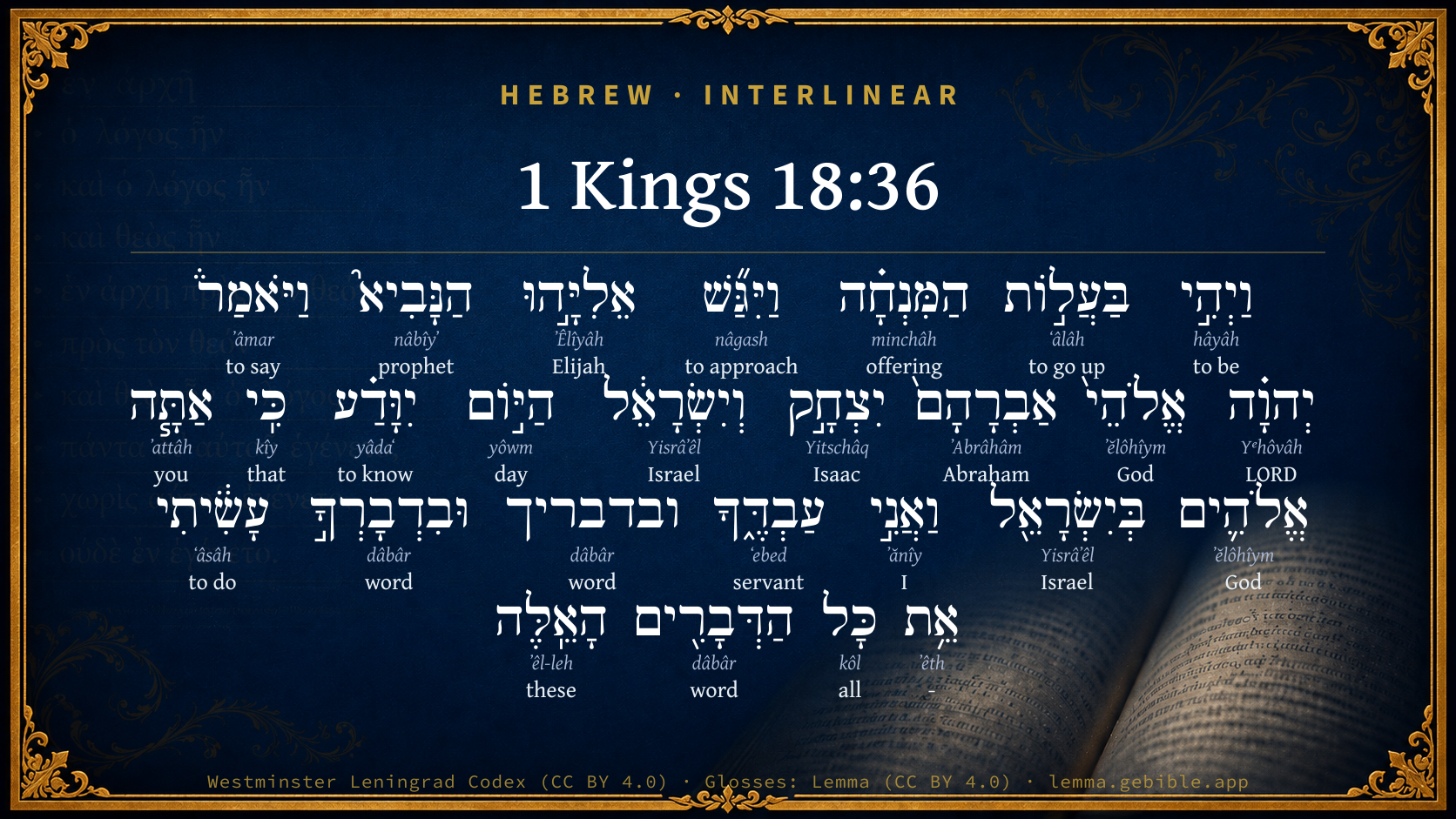
Hebrew (Westminster Leningrad Codex) 1 Kings 18:36 appears in the Hebrew Old Testament. The text above is from the Westminster Leningrad Codex. Each word links to its Strong’s number, a concise gloss, and parsing drawn from the Open Scriptures Hebrew Bible morphology. Click any word for its full Brown-Driver-Briggs (BDB) entry.
Download image
Cite this verse

1 Kings 18:36 (World English Bible). Public Domain. Lemma interlinear Bible study tool, https://lemma.gebible.app/v/1-kings/18/36.

Show BibTeX & RIS
BibTeX
RIS
English Translation
It happened at the time of the offering of the [evening] offering, that Elijah the prophet came near, and said, Yahweh, the God of Abraham, of Isaac, and of Israel, let it be known this day that you are God in Israel, and that I am your servant, and that I have done all these things at your word.
World English Bible · Public Domain
Download a study sheet

One document with this verse’s original text, its word-by-word gloss line, the meaning frame, cross-references with their text, attributed commentary, and full source and license credits — printable, and it pastes into notes with its structure intact.

This verse Autodidact and up

Study sheet (.html) Plain text (.txt)

A passage Seminary Student

Up to 50 verses in one chapter. A passage sheet keeps up to 6 commentary sources and 12 cross-references per verse, in the order this page ranks them, and says so on the sheet whenever that leaves anything out. Ask for a single verse and you get the Autodidact verse sheet above.

Everything on this page stays free to read, with no account — the sheet is a download of what is already on screen, not access to it.

Want to remove ads? Support Godless Engineer
Compare translations 3

The same verse in 3 English versions, stacked beneath the original-language interlinear above. Click any original word for its lexicon entry.

Each is an independent rendering of the whole verse — the interlinear is not word-aligned to these translations.

Highlighted words mark where these versions differ — a whole-verse word diff, not a word-by-word alignment.

  • World English Bible Public Domain
    It happened at the time of the offering of the [evening] offering, that Elijah the prophet came near, and said, Yahweh, the God of Abraham, of Isaac, and of Israel, let it be known this day that you are God in Israel, and that I am your servant, and that I have done all these things at your word.
  • King James Version Public Domain
    And it came to pass at the time of the offering of the evening sacrifice, that Elijah the prophet came near, and said, LORD God of Abraham, Isaac, and of Israel, let it be known this day that thou art God in Israel, and that I am thy servant, and that I have done all these things at thy word.
  • unfoldingWord Literal Text CC BY-SA 4.0
    And it happened at the offering of the grain offering that Elijah the prophet came near, and he said, “Yahweh, God of Abraham, Isaac, and Israel, let it be known today that you are God in Israel and I your servant and by your word I have done all these things.

unfoldingWord Literal Text — © unfoldingWord, licensed CC BY-SA 4.0. Word-aligned USFM3 via Door43 (git.door43.org/unfoldingWord/en_ult).

Versions to compare (up to 4)

3 of 4 selected

Show all 18 translations

Every available English version of this verse, each an independent rendering of the whole verse.

  • World English Bible Public Domain
    It happened at the time of the offering of the [evening] offering, that Elijah the prophet came near, and said, Yahweh, the God of Abraham, of Isaac, and of Israel, let it be known this day that you are God in Israel, and that I am your servant, and that I have done all these things at your word.
  • Berean Standard Bible Public Domain
    At the time of the evening sacrifice, Elijah the prophet approached the altar and said, “O LORD, God of Abraham, Isaac, and Israel, let it be known this day that You are God in Israel and that I am Your servant and have done all these things at Your command.
  • Majority Standard Bible Public Domain
    At the time of the evening sacrifice, Elijah the prophet approached the altar and said, “O LORD, God of Abraham, Isaac, and Israel, let it be known this day that You are God in Israel and that I am Your servant and have done all these things at Your command.
  • King James Version Public Domain
    And it came to pass at the time of the offering of the evening sacrifice, that Elijah the prophet came near, and said, LORD God of Abraham, Isaac, and of Israel, let it be known this day that thou art God in Israel, and that I am thy servant, and that I have done all these things at thy word.
  • American Standard Version (1901) Public Domain
    And it came to pass at the time of the offering of the `evening' oblation, that Elijah the prophet came near, and said, O Jehovah, the God of Abraham, of Isaac, and of Israel, let it be known this day that thou art God in Israel, and that I am thy servant, and that I have done all these things at thy word.
  • Revised Version (1885) Public Domain
    And it came to pass at the time of the offering of the evening oblation, that Elijah the prophet came near, and said, O LORD, the God of Abraham, of Isaac, and of Israel, let it be known this day that thou art God in Israel, and that I am thy servant, and that I have done all these things at thy word.
  • Geneva Bible (1599) Public Domain
    And when they should offer the euening sacrifice, Eliiah the Prophet came, and sayd, Lord God of Abraham, Izhak and of Israel, let it be knowen this day, that thou art the God of Israel, and that I am thy seruant, and that I haue done all these things at thy commandement.
  • Douay-Rheims (1899) Public Domain
    And when it was now time to offer the holocaust, Elias the prophet came near and said: O Lord God of Abraham, and Isaac, and Israel, shew this day that thou art the God of Israel, and I thy servant, and that according to thy commandment I have done all these things.
  • Young's Literal Translation Public Domain
    And it cometh to pass, at the going up of the `evening-'present, that Elijah the prophet cometh nigh and saith, `Jehovah, God of Abraham, Isaac, and Israel, to-day let it be known that Thou `art' God in Israel, and I Thy servant, that by Thy word I have done the whole of these things;
  • Literal Standard Version CC BY-SA 4.0
    And it comes to pass, at the going up of the [evening] present, that Elijah the prophet comes near and says, “YHWH, God of Abraham, Isaac, and Israel, let it be known today that You [are] God in Israel, and that I, Your servant, have done the whole of these things by Your word;
  • Unlocked Literal Bible CC BY-SA 4.0
    It happened at the time of the offering of the evening sacrifice, that Elijah the prophet came near and said, “Yahweh, the God of Abraham, of Isaac, and of Israel, let it be known this day that you are God in Israel, and that I am your servant, and that I have done all these things at your word.
  • unfoldingWord Literal Text CC BY-SA 4.0
    And it happened at the offering of the grain offering that Elijah the prophet came near, and he said, “Yahweh, God of Abraham, Isaac, and Israel, let it be known today that you are God in Israel and I your servant and by your word I have done all these things.
  • Darby Bible Public Domain
    And it came to pass at [the time of] the offering up of the oblation, that Elijah the prophet drew near, and said, Jehovah, God of Abraham, Isaac and Israel, let it be known this day that thou art God in Israel, and that I am thy servant, and that I have done all these things by thy word.
  • World Messianic Bible Public Domain
    At the time of the evening offering, Elijah the prophet came near and said, “LORD, the God of Abraham, of Isaac, and of Israel, let it be known today that you are God in Israel and that I am your servant, and that I have done all these things at your word.
  • Webster's Bible Public Domain
    And it came to pass at the time of the offering of the evening sacrifice, that Elijah the prophet came near, and said, LORD God of Abraham, Isaac, and of Israel, let it be known this day that thou art God in Israel, and that I am thy servant, and that I have done all these things at thy word.
  • Free Bible Version CC BY-SA 4.0
    At the time of the evening sacrifice, the prophet Elijah went over to the altar and prayed: “Lord, God of Abraham, Isaac, and Israel, demonstrate today that you are God in Israel, that I am your servant, and that everything I have done has been at your command.
  • Bible in Basic English Public Domain
    Then at the time of the offering, Elijah the prophet came near and said, O Lord, the God of Abraham, of Isaac, and of Israel, let it be seen this day that you are God in Israel, and that I am your servant, and that I have done all these things by your order.
  • JPS Tanakh (1917) Public Domain
    And it came to pass at the time of the offering of the evening offering, that Elijah the prophet came near, and said: 'O LORD, the God of Abraham, of Isaac, and of Israel, let it be known this day that Thou art God in Israel, and that I am Thy servant, and that I have done all these things at Thy word.

Literal Standard Version (2020), Covenant Press — licensed CC BY-SA 4.0. Text via the HelloAO Bible API (eBible.org). Unlocked Literal Bible (unfoldingWord) — licensed CC BY-SA 4.0. Text via the HelloAO Bible API (eBible.org). unfoldingWord Literal Text — © unfoldingWord, licensed CC BY-SA 4.0. Word-aligned USFM3 via Door43 (git.door43.org/unfoldingWord/en_ult). Free Bible Version, Dr. Jonathan Gallagher — licensed CC BY-SA 4.0. Text via the HelloAO Bible API (eBible.org).

Word by word

More ways to search: Search by grammar → Find every occurrence → Compare this word →

Practice this passage: Drill this verse → Learn its vocabulary →

אֵלִיָּ֣הוּ
ʼÊlîyâh
H452
“Elijah”
Noun, Proper
Part of Speech
Noun
Type
Proper
Full BDB Definition

Origin: from H410 and H3050

TWOT: None

Elijah or Eliah = "my God is Jehovah" or " Yah(u) is God" - the great prophet of the reign of Ahab - Benjamite son of Jeroham - a son of Elam with foreign wife during exile - a son of Harim, and priest, with foreign wife during exile
  1. וַיְהִ֣י hâyâh H1961 “and · to be” Conjunction + Verb, Qal, Sequential Imperfect, 3rd Person, Masculine, Singular
  2. בַּעֲל֣וֹת ʻâlâh H5927 “in/at · to go up” Preposition + Verb, Qal, Infinitive Construct
  3. הַמִּנְחָ֗ה minchâh H4503 “the · offering” Particle, Definite Article + Noun, Common, Feminine, Singular, Absolute
  4. וַיִּגַּ֞שׁ nâgash H5066 “and · to approach” Conjunction + Verb, Qal, Sequential Imperfect, 3rd Person, Masculine, Singular
  5. הַנָּבִיא֮ nâbîyʼ H5030 “the · prophet” Particle, Definite Article + Noun, Common, Masculine, Singular, Absolute
  6. וַיֹּאמַר֒ ʼâmar H559 “and · to say” Conjunction + Verb, Qal, Sequential Imperfect, 3rd Person, Masculine, Singular
  7. יְהוָ֗ה Yᵉhôvâh H3068 “LORD” Noun, Proper
  8. אֱלֹהֵי֙ ʼĕlôhîym H430 “God(s) of” Noun, Common, Masculine, Plural, Construct
  9. אַבְרָהָם֙ ʼAbrâhâm H85 “Abraham” Noun, Proper
  10. יִצְחָ֣ק Yitschâq H3327 “Isaac” Noun, Proper
  11. וְיִשְׂרָאֵ֔ל Yisrâʼêl H3478 “and · Israel” Conjunction + Noun, Proper
  12. הַיּ֣וֹם yôwm H3117 “the · day” Particle, Definite Article + Noun, Common, Masculine, Singular, Absolute
  13. יִוָּדַ֗ע yâdaʻ H3045 “to know” Verb, Niphal, Jussive, 3rd Person, Masculine, Singular
  14. כִּֽי kîy H3588 “that” Conjunction
  15. אַתָּ֧ה ʼattâh H859 “you” Pronoun, Personal, 2nd Person, Masculine, Singular
  16. אֱלֹהִ֛ים ʼĕlôhîym H430 “God(s)” Noun, Common, Masculine, Plural, Absolute
  17. בְּיִשְׂרָאֵ֖ל Yisrâʼêl H3478 “in/at · Israel” Preposition + Noun, Proper
  18. וַאֲנִ֣י ʼănîy H589 “and · I” Conjunction + Pronoun, Personal, 1st Person, Common, Singular
  19. עַבְדֶּ֑ךָ ʻebed H5650 “servant · your” Noun, Common, Masculine, Singular, Construct + Suffix, Personal, 2nd Person, Masculine, Singular
  20. ובדבריך dâbâr H1697 “and · in/at · words · your” Conjunction + Preposition + Noun, Common, Masculine, Plural, Construct + Suffix, Personal, 2nd Person, Masculine, Singular
  21. וּבִדְבָרְךָ֣ dâbâr H1697 “and · in/at · word · your” Conjunction + Preposition + Noun, Common, Masculine, Singular, Construct + Suffix, Personal, 2nd Person, Masculine, Singular
  22. עָשִׂ֔יתִי ʻâsâh H6213 “to do” Verb, Qal, Perfect, 1st Person, Common, Singular
  23. אֵ֥ת ʼêth H853 “-” Particle, Direct Object
  24. כָּל kôl H3605 “all of” Noun, Common, Masculine, Singular, Construct
  25. הַדְּבָרִ֖ים dâbâr H1697 “the · words” Particle, Definite Article + Noun, Common, Masculine, Plural, Absolute
  26. הָאֵֽלֶּה ʼêl-leh H428 “the · these” Particle, Definite Article + Pronoun, Demonstrative, Common, Plural

About this verse

These counts appear in no published source. They are computed here, from the morphology-tagged text and Lemma’s own curated glosses. What Lemma adds →

27
words
23
distinct lemmas
Historical
section

Grammatical profile

  • 6 verbs
  • 16 nouns
  • 3 pronouns
  • 1 conjunction
  • 1 particle

Verb forms

  • וַיְהִ֣י Qal · Sequential Imperfect
  • בַּעֲל֣וֹת Qal · Infinitive Construct
  • וַיִּגַּ֞שׁ Qal · Sequential Imperfect
  • וַיֹּאמַר֒ Qal · Sequential Imperfect
  • יִוָּדַ֗ע Niphal · Jussive
  • עָשִׂ֔יתִי Qal · Perfect

Repetition

Words recur within this verse — often emphatic in Hebrew:

  • ובדבריך word H1697 ×3
  • אֱלֹהֵי֙ God H430 ×2
  • וְיִשְׂרָאֵ֔ל Israel H3478 ×2

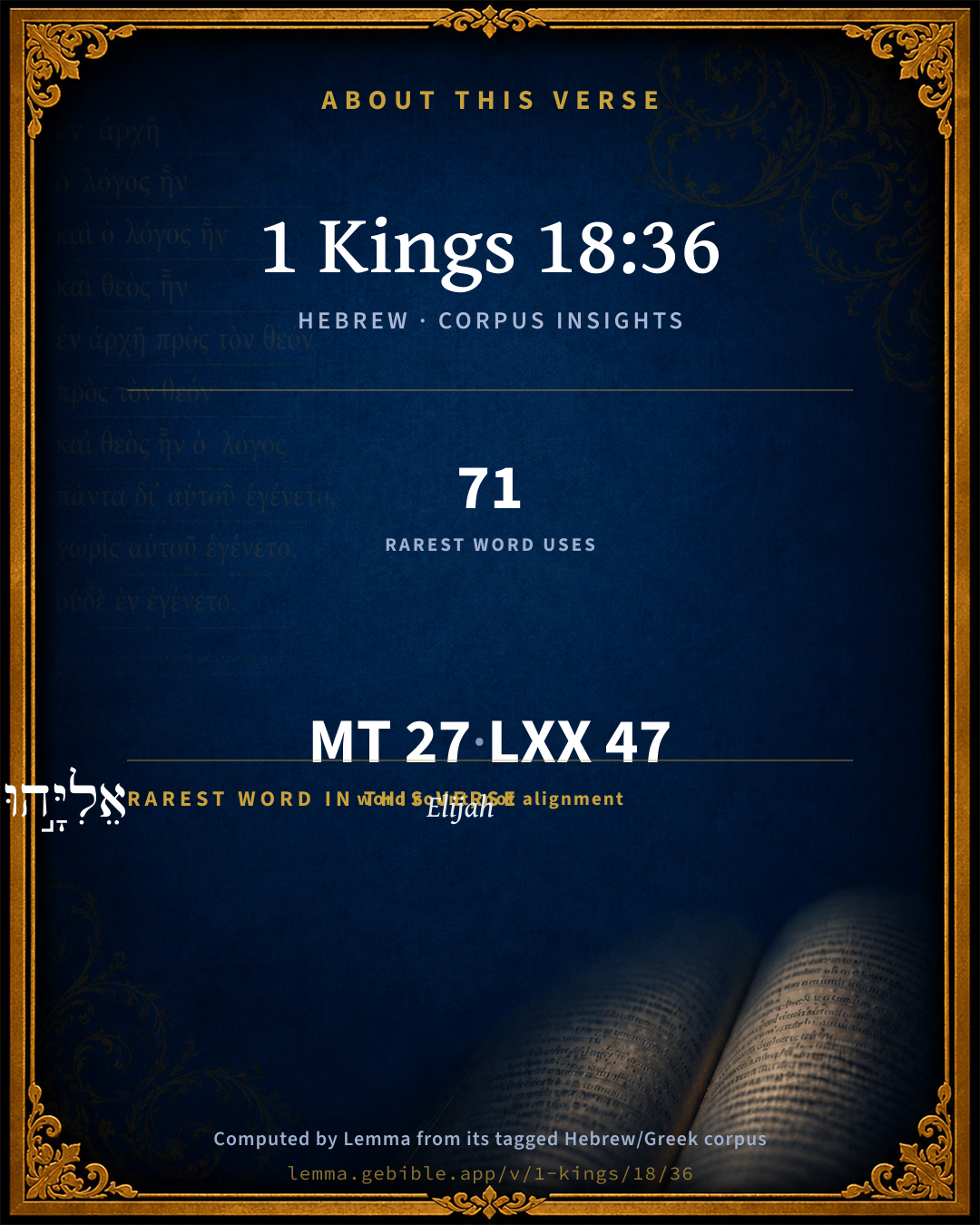
Hebrew & Septuagint length

In English translation the verse runs 59 words from the Hebrew and 56 from the Septuagint (LXX English) — closely comparable.

A rough comparison of the two English renderings, which tokenize alike — not a word-level alignment.

Word counts can differ between the Hebrew and the Greek without any difference in meaning — e.g. the Hebrew direct-object marker אֵת has no separate Greek word, and Greek often adds the article ὁ.

In the original languages it is 27 Hebrew tokens and 47 Greek tokens — but the two are counted differently (Hebrew bundles its prefixes and suffixes into one token; the Greek is in lemma form), so that isn’t a like-for-like length.

Cross-references

34

Topical passages linked to 1 Kings 18:36 in the Treasury of Scripture Knowledge — connected by theme and wording, ordered by reader-vote popularity; previews shown in the World English Bible.

  • 1 Kings 18:29 It was so, when midday was past, that they prophesied until the time of the offering of the [evening] offering; but there was neither voice, nor any to answer, nor any who regarded.
  • Exodus 3:6 Moreover he said, "I am the God of your father, the God of Abraham, the God of Isaac, and the God of Jacob." Moses hid his face; for he was afraid to look at God.
  • 2 Kings 19:19 Now therefore, Yahweh our God, save you us, I beg you, out of his hand, that all the kingdoms of the earth may know that you Yahweh are God alone.
  • 1 Kings 8:43 hear in heaven, your dwelling-place, and do according to all that the foreigner calls to you for; that all the peoples of the earth may know your name, to fear you, as does your people Israel, and that they may know that this house which I have built is called by my name.
  • Matthew 22:32 'I am the God of Abraham, and the God of Isaac, and the God of Jacob?' God is not the God of the dead, but of the living."
  • Psalms 83:18 That they may know that you alone, whose name is Yahweh, Are the Most High over all the earth.
  • Exodus 3:15–16 God said moreover to Moses, "You shall tell the children of Israel this, 'Yahweh, the God of your fathers, the God of Abraham, the God of Isaac, and the God of Jacob, has sent me to you.' This is my name forever, and this is my memorial to all generations.
  • Numbers 16:28–30 Moses said, Hereby you shall know that Yahweh has sent me to do all these works; for [I have] not [done them] of my own mind.
  • Ezekiel 36:23 I will sanctify my great name, which has been profaned among the nations, which you have profaned in the midst of them; and the nations shall know that I am Yahweh, says the Lord Yahweh, when I shall be sanctified in you before their eyes.
  • Daniel 8:13 Then I heard a holy one speaking; and another holy one said to that certain one who spoke, How long shall be the vision [concerning] the continual [burnt-offering], and the disobedience that makes desolate, to give both the sanctuary and the host to be trodden under foot?
  • Daniel 9:21 yes, while I was speaking in prayer, the man Gabriel, whom I had seen in the vision at the beginning, being caused to fly swiftly, touched me about the time of the evening offering.
  • Daniel 12:11 From the time that the continual [burnt offering] shall be taken away, and the abomination that makes desolate set up, there shall be one thousand two hundred ninety days.
  • John 11:42 I know that you always listen to me, but because of the multitude that stands around I said this, that they may believe that you sent me."
  • Acts 3:1 Peter and John were going up into the temple at the hour of prayer, the ninth hour.
  • Ephesians 1:17 that the God of our Lord Jesus Christ, the Father of glory, may give to you a spirit of wisdom and revelation in the knowledge of him;
  • Ephesians 3:14 For this cause, I bow my knees to the Father of our Lord Jesus Christ,
  • Genesis 26:24 Yahweh appeared to him the same night, and said, "I am the God of Abraham your father. Don't be afraid, for I am with you, and will bless you, and multiply your seed for my servant Abraham's sake."
  • Genesis 31:53 The God of Abraham, and the God of Nahor, the God of their father, judge between us." Then Jacob swore by the fear of his father, Isaac.
  • Genesis 32:9 Jacob said, "God of my father Abraham, and God of my father Isaac, Yahweh, who said to me, 'Return to your country, and to your relatives, and I will do you good.'
  • Exodus 29:39–41 The one lamb you shall offer in the morning; and the other lamb you shall offer at evening:
  • 1 Kings 18:21 Elijah came near to all the people, and said, "How long will you waver between the two sides? If Yahweh is God, follow him; but if Baal, then follow him." The people answered him not a word.
  • 1 Kings 22:28 Micaiah said, If you return at all in peace, Yahweh has not spoken by me. He said, Hear, you peoples, all of you.
  • 2 Kings 1:3 But the angel of Yahweh said to Elijah the Tishbite, Arise, go up to meet the messengers of the king of Samaria, and tell them, Is it because there is no God in Israel, that you go to inquire of Baal Zebub, the god of Ekron?
  • 2 Kings 1:6 They said to him, There came up a man to meet us, and said to us, Go, turn again to the king who sent you, and tell him, Thus says Yahweh, Is it because there is no God in Israel, that you send to inquire of Baal Zebub, the god of Ekron? therefore you shall not come down from the bed where you are gone up, but shall surely die.
  • 2 Kings 5:15 He returned to the man of God, he and all his company, and came, and stood before him; and he said, See now, I know that there is no God in all the earth, but in Israel: now therefore, please take a present from your servant.
  • 1 Chronicles 29:18 Yahweh, the God of Abraham, of Isaac, and of Israel, our fathers, keep this forever in the imagination of the thoughts of the heart of your people, and prepare their heart to you;
  • 2 Chronicles 20:6–7 and he said, Yahweh, the God of our fathers, aren't you God in heaven? and aren't you ruler over all the kingdoms of the nations? and in your hand is power and might, so that none is able to withstand you.
  • Ezra 9:4–5 Then were assembled to me everyone who trembled at the words of the God of Israel, because of the trespass of them of the captivity; and I sat confounded until the evening offering.
  • Psalms 67:1–2 May God be merciful to us, bless us, And cause his face to shine on us. Selah.
  • Psalms 141:2 Let my prayer be set before you like incense; The lifting up of my hands like the evening sacrifice.
  • Ezekiel 39:7 My holy name will I make known in the midst of my people Israel; neither will I allow my holy name to be profaned any more: and the nations shall know that I am Yahweh, the Holy One in Israel.
  • Genesis 46:3 He said, "I am God, the God of your father. Don't be afraid to go down into Egypt; for there I will make of you a great nation.
  • Acts 10:30 Cornelius said, "Four days ago, I was fasting until this hour, and at the ninth hour, I prayed in my house, and behold, a man stood before me in bright clothing,
  • 1 Samuel 17:46–47 This day will Yahweh deliver you into my hand; and I will strike you, and take your head from off you; and I will give the dead bodies of the host of the Philistines this day to the birds of the sky, and to the wild animals of the earth; that all the earth may know that there is a God in Israel,

Cross-references courtesy of OpenBible.info (CC BY 4.0).

Hebrew and Greek witnesses Masoretic Hebrew ↔ Greek Septuagint

The same verse in the two great witnesses to the Old Testament, shown verse-for-verse.

These are two independent witnesses, not word-aligned to each other, and the Septuagint is shown in lemma (dictionary) form.

Hebrew 1 Kings 18:36 Masoretic · Westminster Leningrad Codex

וַיְהִ֣י בַּעֲל֣וֹת הַמִּנְחָ֗ה וַיִּגַּ֞שׁ אֵלִיָּ֣הוּ הַנָּבִיא֮ וַיֹּאמַר֒ יְהוָ֗ה אֱלֹהֵי֙ אַבְרָהָם֙ יִצְחָ֣ק וְיִשְׂרָאֵ֔ל הַיּ֣וֹם יִוָּדַ֗ע כִּֽי אַתָּ֧ה אֱלֹהִ֛ים בְּיִשְׂרָאֵ֖ל וַאֲנִ֣י עַבְדֶּ֑ךָ ובדבריך וּבִדְבָרְךָ֣ עָשִׂ֔יתִי אֵ֥ת כָּל הַדְּבָרִ֖ים הָאֵֽלֶּה

It happened at the time of the offering of the [evening] offering, that Elijah the prophet came near, and said, Yahweh, the God of Abraham, of Isaac, and of Israel, let it be known this day that you are God in Israel, and that I am your servant, and that I have done all these things at your word.

World English Bible · Public Domain

Greek LXX 1 Kings 18:36 Septuagint · lemma form

καί ἀναβοάω ηλιου εἰς ὁ οὐρανός καί εἶπον κύριος ὁ θεός ἀβραάμ καί ισαακ καί ἰσραήλ ἐπιἀκούω ἐγώ κύριος ἐπιἀκούω ἐγώ σήμερον ἐν πῦρ καί γιγνώσκω πᾶς ὁ λαός οὗτος ὅτι σύ εἰμί κύριος ὁ θεός ἰσραήλ καΐἐγώ δοῦλος σύ καί διά σύ ποιέω ὁ ἔργον οὗτος

And Eliu cried aloud to the heaven, and said, Lord God of Abraam, and Isaac, and Israel, answer me, O Lord, answer me this day by fire, and let all this people know that you are the Lord, the God of Israel, and I am your servant, and for your sake I have wrought these works.

LXX2012 (modern English Septuagint) · Public Domain

On this verse, The Cambridge Bible for Schools and Colleges discusses the Septuagint’s reading. Read the note in Commentary ↓

Hebrew: Westminster Leningrad Codex (CC BY 4.0). Greek: Septuagint (public domain); English from LXX2012 (modern English Septuagint) (Public Domain). How the Septuagint differs from the Hebrew →

Targum (Aramaic paraphrase)

1

The Targum is the ancient Jewish Aramaic paraphrase of the Hebrew Scriptures — an interpretive translation, not the Hebrew text itself. Onkelos (literal) and Pseudo-Jonathan (expansive) render the Torah, and Jonathan the Prophets. Coverage is partial: where no permissively-licensed English translation exists for a verse, only the Aramaic is shown. This is verse-level text, not a word-by-word alignment to the Hebrew.

  1. Targum Jonathan Prophets (Joshua–Malachi)
    וַהֲוָה בְּמִיסַק מִנְחָתָא וּקְרִיב אֵלִיָהוּ נְבִיָא וַאֲמַר יְיָ אֱלָהֵיהּ דְאַבְרָהָם יִצְחָק וְיִשְׂרָאֵל יוֹמָא דֵין יִתְיְדַע אֲרֵי אַתְּ יְיָ דִשְׁכִנְתָּךְ שַׁרְיָא בְיִשְׂרָאֵל וַאֲַנָא עַבְדָךְ וּבְפִתְגָמָךְ עֲבָדִית יַת כָּל פִּתְגָמַיָא הָאִילֵין:

    (no public-domain English translation for this verse)

    Targum Jonathan — Aramaic: “Mikraot Gedolot” (public domain). English: “Sefaria Community Translation” (CC0 1.0 (public-domain dedication)); “London "Chaldee Paraphrase," 1871” (public domain). Text via Sefaria.

Commentary

Notes on 1 Kings 18:36 from classic Christian and Jewish commentators (each source and its license shown beneath its notes). The classic Christian expositions comment on the surrounding passage and are grouped to its opening verse, so a note may address several verses; the Jewish commentaries on the Tanakh (Rashi and others) are per-verse, so they appear only where the commentator wrote on this verse.

Lemma curates 59 commentaries, every one of them public domain or Creative Commons licensed, each selected and text-cleaned for this edition rather than reprinted as found. About our sources →

Trapp's Complete Commentary

John Trapp

1Ki 18:36 And it came to pass at [the time of] the offering of the [evening] sacrifice, that Elijah the prophet came near, and said, LORD God of Abraham, Isaac, and of Israel, let it be known this day that thou [art] God in Israel, and [that] I [am] thy servant, and [that] I have done all these things at thy word.

Ver. 36. That thou art God in Israel.] The Baalites’ prayers were not more tedious than Elijah’s was short, and yet more pithy than short; charging God with the care of his covenant, of his truth, of his glory. It was Elijah that spake loud. Oh, the strong cries of faith!

John Trapp, A Commentary or Exposition upon All the Books of the Old and New Testament (1647–1656) — public domain. Text from a community e-Sword module.

The Biblical Illustrator

Joseph S. Exell

1Ki_18:36

Elijah the prophet came near, and said, Lord God of Abraham, Isaac, and of Israel.

Elijahs creed

Let us consider the creed of this loftiest, sternest spirit of the true faith, as Dean Stanley called him. We may glean its articles from that prayer made under circumstances which would have tried the soul even of a sterner man than he. Three things may be read in this prayer:

1. A formula--Jehovah, the God of Abraham, of Isaac, and of Israel.

2. A personal relation between God and the prophet--Let it be known this day that I am Thy servant.

3. The fulfilment of a Divine purpose through the deeds of the man--And that I have done all these things at Thy word. Taking the prayer itself as a creed, we see embodied in it the formal, the personal, and the practical elements. Notice, first, that the prophet used a formula to express the foundation of his belief. He may have done it unconsciously, full of the idea for which it had stood now six hundred years. Had he not read it in the Law, heard it from the lips of priest and rabbi, and himself used it times without number? No one supposes that the prophet used the formula lightly or ignorantly. In this we might set him in contrast with ourselves. But no creed is complete which does not involve a personal relation between him who utters it and God. So, in this prayer, the relation between God as Lord and Elijah as prophet is clearly drawn. God was invoked to prove this very thing. As a servant, Elijah had taken his life in his hand long before. A man tells you he believes in God. Ask him what essential change of character would be produced by his parting with his belief. His servantship had already been proved by his implicit obedience to every command of God. Now he hid by the brook Cherith, and now tarried at Zarephath. A further element of faith involved in this formal supplication is that of co-operative work. In and through His servant God is fulfilling His purposes; Let it be known that I have done all these things at Thy word. We are not, of course, to make the Lord responsible for everything a good man does. A perfect trust does not shield the human agent from the just charge of misdemeanours. Every servant of God does the will of God. He starts or sustains a tendency, works destruction here, rescues life there, goes to the wilderness, returns to the town, is silent now, again thunders forth, as the Spirit wills, to bring to pass the true conception of God working in the world, without ceasing, to establish and maintain righteousness. So the war goes on, and will go on until the whole earth bows down before Him. Now, all this is made extremely simple in the prayer of the prophet: God is. God has a servant in me. God through me works His will. Let all men believe this, let their belief take hold of their life as it took hold of Elijahs, so that not to believe is death, and a new earth is in process, and the universal reign of Jehovah is visibly begun.

What have we more than had Elijah?

1. We have a new insight of the personality of God. Did not Elijah believe in God as a Person? We must insist that he did. But our vision is clearer. He felt the power of the Person in the still, small voice. That was his gospel. We know it in the conquering soul of the Christ. We behold the glory of the Divine Personality, and through Him know ourselves as individual members of the Divine household.

2. Again, we realise a new order of mercy. Once there was the relentless call for sacrifice. Elijah was an avenger. He could slay hundreds in one act. It would have been impossible for him to conceive of avenging justice turned into mercy. We, on the other hand, hear a voice pleading for infinitely worse offenders, Father, forgive them. The Divine expiation is sufficient to cover every sinner. It is ours to make the word of deliverance ring around the world, Come unto Me, and be free from condemnation.

3. Once more, the duty of every man is now more clear than it could have been in Elijahs day. Can any one, it may be asked, understand his duty more perfectly than did the prophet? Still, duty with us takes on the nature of universality and of privilege. (C. R. Seymour.)

Let it be known that I have done all these things at Thy word.

Elijahs plea

I. A firm ground for prayer.

1. You are a minister of God, or a worker in the cause of Christ, and you go forth and preach the Gospel with many tears and prayers, and you continue to use all means, such as Christ has ordained: do you say to yourself, May I expect to have fruit of all this? Of course you may. You are not sent on a frivolous errand you are not bidden to sow dead seed that will never spring up. But when that anxiety weighs heavily upon your heart, go you to the mercy-seat with this as one of your arguments, Lord, I have done according to Thy word.

2. Next, I would apply this teaching to a whole church. I am afraid many churches of Christ are not prospering. The congregations are thin, the church is diminishing, the prayer-meeting scantily attended, spiritual life low. If I can conceive of church in such a condition which, nevertheless, can say to God, We have done all these things at Thy word, I should expect to see that church soon revived in answer to prayer. The reason why some churches do not prosper is, because they have not done according to Gods word.

3. The same principle may be applied also to any individual believers who are in trouble through having done right.

4. I would like to apply this principle to the seeking sinner.

II. Self-examination as to whether or not you have done all these things at Gods word.

1. Let every worker here who has not been successful answer this question--Have you done all these things at Gods word?

2. Did you preach it rightly? That is to say, did you state it affectionately, earnestly, clearly, plainly?

3. And another question--Has there been an example to back your teaching? (C. H. Spurgeon.)

Whom to please

On a very cold night a gate-keeper at a railway depot demanded that each passenger show his ticket. Several bitterly complained of the delay and inconvenience. You are a very unpopular man to-night, said a spectator. I only care to be popular with one man, he replied, and that is the superintendent. In the same way Christians should take care that their actions are pleasing to God, and if they have to displease man, they must remember that we ought to obey God rather than men.

Obeying implicitly

I have stood, said Mr. Scott, on the deck of a ship while she was toiling up-stream, with wind and water against her, and I have gone up to the man at the wheel, and said, Jack, why dont you ease her off a point or two? You see how it would relieve her. But the answer was, No, I cant luff; that is the point of the compass the captain gave me, and I must keep her to it. But, man, I remonstrated, if you keep her as she is, soon the bulwarks will be stove in, and there is every chance that under this fearful strain she may spring a leak. That is none of my business; it is the captains look out. All I have to do is to obey his orders, was the mans answer. The captain, however, understood his business, and we arrived safe in harbour. Sometimes, if we do exactly as Christ commands, it appears as if our business would be ruined, our reputation lost--as if, indeed, we should be totally wrecked. That, however, is the captains look out. All we have to do is to implicitly obey.

The Biblical Illustrator, edited by Joseph S. Exell (c. 1880s–1900s) — public domain. Text from a community e-Sword module.

Joseph Benson's Commentary

1Ki 18:36-37. At the time of the offering of the evening sacrifice — This time he chose, that he might unite his prayers with the prayers of the godly Jews at Jerusalem, who at that time assembled together to pray. Lord God of Abraham, &c. — Hereby he shows his faith in God’s ancient covenant, and also reminds the people of their relation both to God and to the patriarchs, I have done these things — Brought this famine, gathered the people hither, and done what I have done, or am doing here, not in compliance with my own passions, but in obedience to thy command: for his shutting up heaven by his prayers, and afterward killing the priests of Baal, would of necessity expose him to great envy and reproach, which made this public vindication of his conduct necessary, as it was also effectual, being witnessed from heaven. That thou hast turned their heart back again — Let them feel so powerful a change in their hearts, that they may know it is thy work, and may show that they are brought back again to thee, the only living and true God, from whom they have revolted.

Joseph Benson's Commentary on the Old and New Testaments (1811–1818) — public domain. Text from a community e-Sword module.

Tyndale Open Study Notes

Tyndale Open Resources

18:36 At the appointed time of sacrifice to the Lord, Elijah prayed. He did not imitate the ecstatic behavior of the prophets of Baal but simply prayed to God in light of his promises to Abraham, Isaac, and Jacob (Gen 50:24; Exod 3:6, 15; 4:5; Num 32:11; Deut 9:27).

Tyndale Open Study Notes — © Tyndale Open Resources, licensed CC BY-SA 4.0. Text via the HelloAO Bible API.

Adam Clarke's Commentary

Verse 36. Lord God of Abraham] He thus addressed the Supreme Being, that they might know when the answer was given, that it was the same God whom the patriarchs and their fathers worshipped, and thus have their hearts turned back again to the true religion of their ancestors.

Adam Clarke's Commentary on the Bible (1810–1826) — public domain. Text from a community e-Sword/MySword module.

Ellicott's Commentary for English Readers

(36) Lord God of Abraham.—In this solemn and earnest invocation of God, as in Exo_3:15; Exo_6:2-3, the name JEHOVAH, describing God as He is in Himself—the One eternal self-existent Being—is united with the name which shows His special covenant with “Abraham, and Isaac, and Israel.” In His own nature incomprehensible to finite being, He yet reveals Himself in moral and spiritual relations with His people, through which they “know that which passeth knowledge.” The prominence of the name “Jehovah,” thrice repeated in this short prayer of Elijah, is significant as of the special mission, symbolised in his very name, so also of his immediate purpose. He desires to efface himself. The God of Israel is to show Himself as the true worker, not only in the outer sphere by miracle, but in the inner sphere by that conversion of the hearts of the people, which to the prophet’s eye is already effected. Like his antitype in the New Testament, Elijah is but a voice calling on men “to prepare the way of the Lord.”

A Bible Commentary for English Readers, edited by Charles John Ellicott (1878–1897) — public domain. Text from a community e-Sword module.

The Cambridge Bible for Schools and Colleges

gen. ed. J. J. S. Perowne

36. And it came to pass … evening sacrifice] R.V. oblation. This change follows on what was done in 1Ki_18:29. The LXX. omits this clause entirely. Elijah waited till the usual hour for the evening offering, that in this way his action might be in more accord with the order of worship which had been appointed in the Law, and so the people be put in mind of Jehovah’s worship which they had cast aside.

Elijah the prophet came near] He was no priest, but at such time the protesting prophet assumed all the functions of the priestly office. And the people would be in no way surprised, for the patriarchal rule, which allowed others than the tribe of Levi to come near to the altar, had not become obsolete, as we can see from the action of Solomon. The LXX. gives, instead of these words, ‘And Elijah cried unto heaven.’

Lord God of Abraham, Isaac [R.V. of Isaac], and of Israel] After these opening words of the invocation the LXX. adds ‘Hear me, O Lord, hear me this day by fire,’ and continues ‘and let all this people know, &c.’

at thy word] The LXX. explains by διὰ σὲ = ‘for thy sake.’

The Cambridge Bible for Schools and Colleges (gen. ed. J. J. S. Perowne; Cambridge University Press, 1878–1918) — public domain. Text from a community e-Sword module.

John Gill's Exposition

Then the fire of the Lord fell,.... An extraordinary fire from God out of heaven, as the effects of it show:

and consumed the burnt sacrifice; as it had done in former instances, Lev 9:24, and besides this, which is still more extraordinary,

and the wood, and the stones, and the dust; of the altar, thereby signifying that even such were not to be used any more:

and licked up the water that was in the trench; around the altar, see Kg1 18:32.

John Gill's Exposition of the Whole Bible (1746–1763) — public domain (CC PDM 1.0). Text via the HelloAO Bible API.

Albert Barnes' Notes on the Bible

At the time of the offering of the evening sacrifice - i. e., probably “the ninth hour,” or three o’clock. Thus there might still remain about five hours of light, during which the other events of the day were accomplished.

Lord God of Abraham, Isaac, and of Israel - This solemn address would carry back the thoughts of the pious to the burning bush of Horeb, and the words there spoken (marginal references), for there only had this mysterious formula been used before. Its use now was calculated to stir their faith and prepare them in some degree for God’s answering “by fire.”

That I have done all these things at thy word - i. e., “That I have been divinely directed in all that I have done publicly as a prophet, in proclaiming the drought, in gathering this assembly, and in proposing this trial; that I have not done them of my own mind” (marginal reference).

Albert Barnes' Notes on the Bible (1834–1885) — public domain. Text from a community e-Sword/MySword module.

Matthew Poole's English Annotations

At the time of the offering of the evening sacrifice; which time he chose, that he might unite his prayers with the prayers of the godly Jews at Jerusalem, who at that time assembled together to pray, Act 3:1.

That I have done all these things; brought this famine, gathered the people hither, and done what I have done, or am doing here. At thy word; not in compliance with my own passions, but in obedience to thy command, as thy agent and minister. For that action of shutting up heaven, and that of killing the priests of Baal, must needs expose him to great envy and reproach; which made this public vindication necessary, as it was also effectual, being witnessed from heaven.

Matthew Poole's English Annotations on the Holy Bible (1683–1685) — public domain. Text from a community e-Sword/MySword module.

Whedon's Commentary on the Bible

Daniel D. Whedon

36. At the time of… evening sacrifice — See note on 1Ki_18:29. We may render, at the offering of the sacrifice, that is, when all the preparations had been made, and all things were ready for the offering of the sacrifice. The preparations of Elijah in building an altar, digging the trench, and preparing for the sacrifice need not have occupied a great deal of time, for 1Ki_18:30; 1Ki_18:33-34, show that he had the people around him at command, and multitudes were doubtless ready to render him any assistance he desired.

God of Abraham, Isaac, and of Israel — Thus he turns the heart of the children to the fathers. Mal_4:6. Contrast the simplicity of his prayer with the frantic cries and orgies of the prophets of Baal.

Daniel D. Whedon (gen. ed.), Commentary on the Old and New Testaments (1874–1909) — public domain. Text from a community e-Sword module.

The Pulpit Commentary

And it came to pass at the time of the offering of the evening sacrifice see note on ver. 29, that Elijah the prophet this designation of Elijah is unusual. Cf. Mal_4:5. Elsewhere he is "the Tishbite," or the "man of God" came near, and said, Lord Heb. Jehovah. Not only does the sacred name stand at the head of his prayer, it is also mentioned thrice (LXX four times) God of Abraham, Isaac, and Israel Two things are to be noticed here: first, that this formula had only once before been used, and that by God Himself, before the giving of law, at the burning bush. It was when God revealed Himself in flaming fire that He had proclaimed Himself the God of Abraham, etc. Secondly, that the variation "Israel" is made designedly (cf. ver. 31), not only to proclaim the Lord as the "God of Israel" (cf., 1Ki_17:1) but also to suggest that the name and privileges of Israel belonged to all the sons of Jacob. The LXX adds, "Hear me, O Lord, hear me this day by fire most of whichis clearly borrowed from the next verse, let it be known this day that thou art God in Israel according to ver. 24, "the God that answereth by fire, etc., and that I am thy servant, and that I have done all these things according to thy word. LXX dia se. Not only the earlier proceedings of the day, but the three years" drought, etc. Keil would include the miracle about to be performed, but the people could hardly doubt that that, when done, was done according to the Divine word. It is interesting to compare with these words 1Ki_17:2, 1Ki_17:3, 1Ki_17:8, 1Ki_17:16, 1Ki_17:24, and 1Ki_18:1, all of which mention the "word of the Lord.

Vers. 36-40.

The Triumph.

While Elijah completed his preparations for offering up his sacrifice, the prophets of Baal, who had failed to vindicate their religion, were hoping that the servant of Jehovah likewise might fail. It was matter of history that Jehovah had answered by fire. (See Gen_4:5; Lev_9:24; Jud_1:6:21; 1Ch_21:26) About a century before this that fire came from heaven which was still kept burning upon the altar at Jerusalem. (2Ch_7:1) But Carmel is not Jerusalem; and Jehovah has not promised to record His name here. And, should Elijah fail, then would they fall upon him and destroy him. Yet, on the other hand, he is an extraordinary servant of Jehovah; his word concerning the rain and dew has come true; so may his confidence respecting this answer of fire be honoured. Such thoughts flashed through their minds; but the moment has arrived; the preparations are complete. Now observe

I THE PRAYER.

1. It is offered at the time of the evening sacrifice.

(1) The stated evening sacrifice is now on the temple altar. Elijah holds communion with that altar. He, too, though on Carmel, is a true worshipper of the God of David. There are differences in religious worship sanctioned by God which must not be accounted schism. Protestant Nonconformists are not necessarily schismatics.

(2) It is the "hour of prayer." Prayer should ascend with the sacrifice; Christ should be in an our supplications. The hour of prayer was the "ninth, (Act_3:1) that hour in which Jesus "cried with a loud voice, and yielded up his spirit". (Mat_27:50) So in submission must we yield up our spirits with his in prayer to God.

2. It pleads for the honour of God.

(1) It reminds Him of His covenant. "Jehovah Elohim of Abraham, Isaac, and of Israel." With these patriarchs He had established His covenant. They knew nothing of Baal"s covenants.

(2) "Let it be known this day that thou art God in Israel." Let those who will not acknowledge Thee be confounded. (See Jos_2:11) Let those who repent be reconciled to Thy favour.

(3) "Let it be known this day in Israel that I am thy servant, and that I have done all these things at thy word." Else to have so acted would have been the height of presumption. But with the authority of God mistrust would have been presumption. We are bound to believe the promises of God.

3. It sues for mercy to the penitent.

(1) "Hear me, O Jehovah, hear me, that this people may know that thou art Jehovah Elohim;" that Thou art the self existent, covenant keeping God.

(2) "And that thou hast turned their heart back again." The blessings of the covenant are conditioned upon faith. Without repentance there is no tame faith.

(3) How few are the words of this prayer! No vain repetitions. How wide the contrast with the clamour of Baal"s priests!

II THE RESPONSE.

1. Then the fire of the Lord fell.

(1) There was no mistake about it. It was indeed the "fire of Jehovah miraculous fire; for it worked downwards, contrary to the ordinary operation of fire, which works upwards. The sacrifice was soon consumed. Then the wood. The water was licked up. The very stones and dust were vitrified and volatilized.

(2) The destruction of the altar pointed to the pleasure of God that patriarchal high places should be removed, and that all Israel should henceforth worship at the Levitical altar of the temple at Jerusalem. This is the last instance on record in which God accepted a sacrifice offered on a patriarchal altar.

(3) But where now is Baal? Is not that celestial fire which was worshipped as a god completely in the hands of Jehovah?

2. The demonstration was irresistible.

(1) "When all the people saw it they fell upon their faces." Here was an act of reverence towards God. It was the sign also of their renunciation of Baal.

(2) This confession in symbol was accompanied by a corresponding confession in words. "And they said, Jehovah, he is the Elohim; Jehovah, he is the Elohim." Words are signs of a fuller expression.

(3) But words must be followed up by deeds. The prophets of Baal have now to be sacrificed. The law required this. (See Deu_13:1-11) They were accordingly slaughtered by the brook Kishon. Thus was returned upon their heads the slaughter of the prophets of the Lord. (See vers. 4, 18.)

(4) The retribution was complete. Some are of opinion, because the "prophets of Baal" only are mentioned, that the 400 prophets of Ashere were absent and escaped. But this does not follow, for the prophets of Ashere might be included under the designation "prophets of Baal," as Saul"s sons are included in his name. (See 1Sa_31:8; 2Sa_21:13) The prophets of Ashere certainly were present. (See vers. 19, 20; also 1Ki_19:1) Let us confess the Lord. In signs: observing His sacraments and ordinances of worship public and private. In words: confessing Him before men upon all fitting occasions. In deeds: bringing forth the fruits of good living, and sacrificing the idolatries that would lead us astray. J.A.M.

The Pulpit Commentary (1880–1919), ed. H.D.M. Spence-Jones & Joseph S. Exell — public domain. Text from a community e-Sword module.

John Wesley's Explanatory Notes

The evening sacrifice - This time he chose, that he might unite his prayers with the prayers of the godly Jews at Jerusalem, who at that time assembled together to pray. Lord God of, &c. - Hereby he shews faith in God's ancient covenant, and also reminds the people, of their relation both to God and to the patriarchs. Done these things - Brought this famine, gathered the people hither, and done what I have done, or am doing here; not in compliance with my own passions, but in obedience to thy command.

John Wesley, Explanatory Notes Upon the Whole Bible (1754–1765) — public domain. Text via the GEBible commentary corpus.

unfoldingWord translationNotes

Door43 World Missions Community

It happened

This phrase is used here to reference a significant and meaningful time of the day in the story. If your language has a way for doing this, you could consider using it here.

Yahweh, the God of Abraham, of Isaac, and of Israel

Here "Israel" is referring to Jacob. God changed Jacob's name to Israel (Genesis 32:28), and God named the nation of Jacob's descendants "Israel."

let it be known this day

This can be stated in active form. AT: "make these people know today" (See: Active or Passive)

Hear me ... hear me

This phrase is repeated to emphasize the appeal of Elijah to Yahweh.

turned their heart back again to yourself

The people's "heart" is a metonym for the affection and loyalty of the people. AT: "caused them to be loyal to you again" (See: Metonymy)

translationWords

sacrifice

Elijah

prophet

God

Abraham

Isaac

Jacob

know

kingdom of Israel

servant

word

turn

heart

unfoldingWord translationNotes — © Distant Shores Media and the Door43 World Missions Community, licensed CC BY-SA 4.0. Source: git.door43.org/Door43/en_tn.

Rashi

Rabbi Shlomo Yitzchaki (Rashi)

And at Your word have I done. That I sacrificed on a private altar during the period of the prohibition of [offering sacrifices on] private altars.

Rashi on the Tanakh — English translations: “The Judaica Press complete Tanach with Rashi, translated by A. J. Rosenberg” (CC BY 4.0); “Pentateuch with Rashi's commentary by M. Rosenbaum and A.M. Silbermann, 1929-1934” (public domain); “The Metsudah Tanach series, Lakewood, N.J” (CC BY 4.0); and “The Book of Joshua, Metsudah Publications, 1997” (CC BY 4.0). Text via Sefaria.

Lesson kit

Teaching starters — assembled from the data on this page, not authored interpretation. Every prompt links to the verse data it draws on. Edit before teaching.

1 Kings, in the Historical, opens this verse with 27 words (23 distinct Hebrew lemmas). Its most distinctive word is ʼÊlîyâh (“Elijah”). A historical commentator’s framing appears above. Read the whole chapter for the surrounding context.

Discussion questions

  1. The word ʼÊlîyâh carries the sense “Elijah.” How does it shape the verse?
  2. How does 1 Kings 18:29, which shares this passage’s theme, read alongside this verse?
  3. What does the repetition of “word” (3× in this one verse) do in this verse?
  4. These translations render this verse differently; the difference is in the English rendering, not the original. What questions does that raise?
  5. «וַיְהִ֣י» is a Qal Sequential Imperfect verb. How does that grammatical form shape the action described?
  6. Compare how Trapp's Complete Commentary and The Biblical Illustrator read this verse. Where do they agree or differ?

Things to notice

Reading settings

Reading text

Shown beneath each verse's original-language words.

Old Testament
Old Testament edition

Read the OT as the Masoretic Hebrew (MT) or the Greek Septuagint (LXX).

English shown for the Greek Septuagint (in the Hebrew ↔ Greek comparison).

Comparing translations? Open the Compare panel on any verse page to stack up to four side by side.