Ruth 2:12

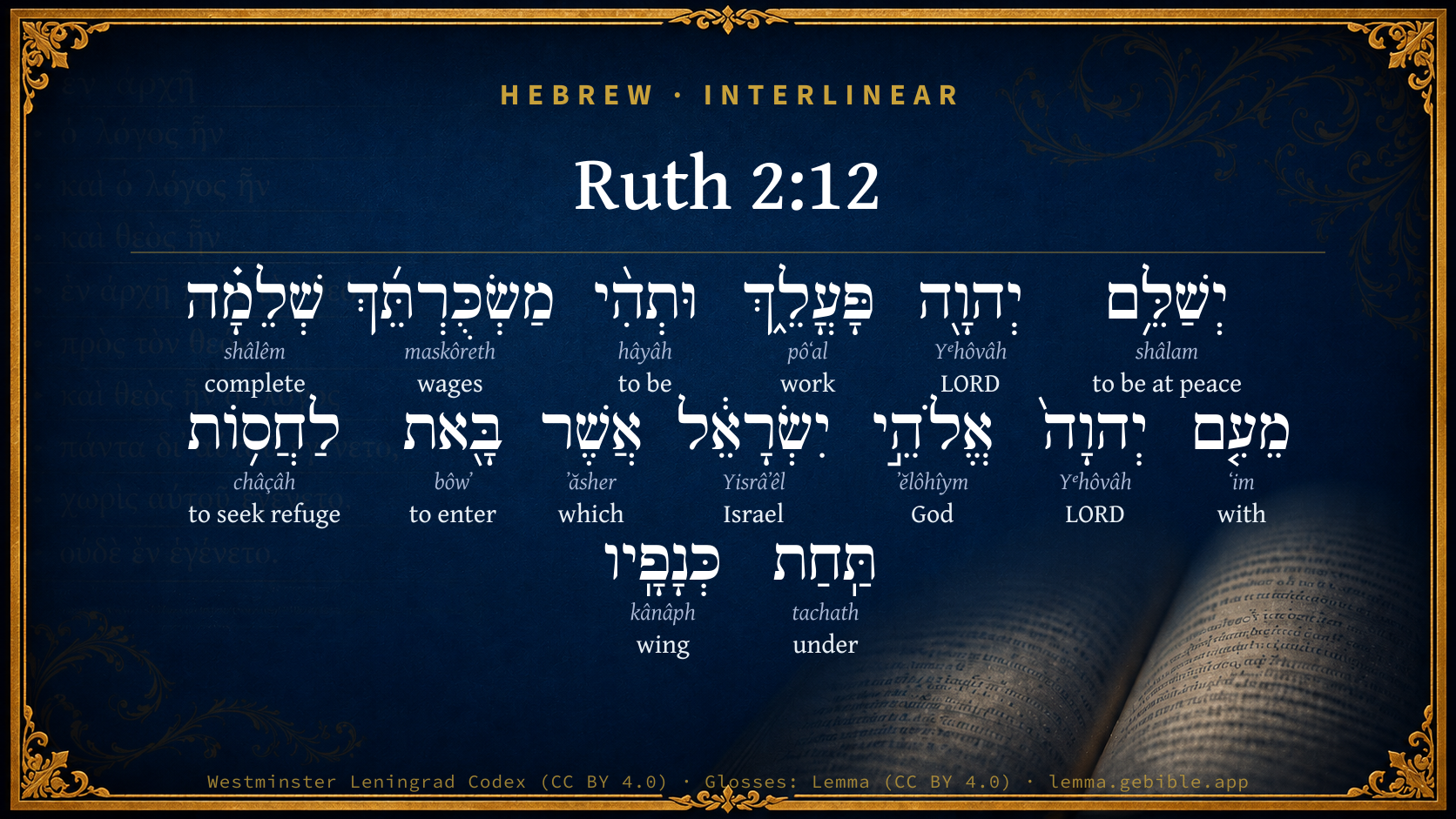
Hebrew (Westminster Leningrad Codex) Ruth 2:12 appears in the Hebrew Old Testament. The text above is from the Westminster Leningrad Codex. Each word links to its Strong’s number, a concise gloss, and parsing drawn from the Open Scriptures Hebrew Bible morphology. Click any word for its full Brown-Driver-Briggs (BDB) entry.
Download image
Cite this verse

Ruth 2:12 (World English Bible). Public Domain. Lemma interlinear Bible study tool, https://lemma.gebible.app/v/ruth/2/12.

Show BibTeX & RIS
BibTeX
RIS
English Translation
Yahweh recompense your work, and a full reward be given you of Yahweh, the God of Israel, under whose wings you are come to take refuge.
World English Bible · Public Domain
Download a study sheet

One document with this verse’s original text, its word-by-word gloss line, the meaning frame, cross-references with their text, attributed commentary, and full source and license credits — printable, and it pastes into notes with its structure intact.

This verse Autodidact and up

Study sheet (.html) Plain text (.txt)

A passage Seminary Student

Up to 50 verses in one chapter. A passage sheet keeps up to 6 commentary sources and 12 cross-references per verse, in the order this page ranks them, and says so on the sheet whenever that leaves anything out. Ask for a single verse and you get the Autodidact verse sheet above.

Everything on this page stays free to read, with no account — the sheet is a download of what is already on screen, not access to it.

Want to remove ads? Support Godless Engineer
Compare translations 3

The same verse in 3 English versions, stacked beneath the original-language interlinear above. Click any original word for its lexicon entry.

Each is an independent rendering of the whole verse — the interlinear is not word-aligned to these translations.

Highlighted words mark where these versions differ — a whole-verse word diff, not a word-by-word alignment.

  • World English Bible Public Domain
    Yahweh recompense your work, and a full reward be given you of Yahweh, the God of Israel, under whose wings you are come to take refuge.
  • King James Version Public Domain
    The LORD recompense thy work, and a full reward be given thee of the LORD God of Israel, under whose wings thou art come to trust.
  • unfoldingWord Literal Text CC BY-SA 4.0
    May Yahweh reward your work, and may your full wages come from Yahweh, the God of Israel, under whose wings you have come for refuge.”

unfoldingWord Literal Text — © unfoldingWord, licensed CC BY-SA 4.0. Word-aligned USFM3 via Door43 (git.door43.org/unfoldingWord/en_ult).

Versions to compare (up to 4)

3 of 4 selected

Show all 18 translations

Every available English version of this verse, each an independent rendering of the whole verse.

  • World English Bible Public Domain
    Yahweh recompense your work, and a full reward be given you of Yahweh, the God of Israel, under whose wings you are come to take refuge.
  • Berean Standard Bible Public Domain
    May the LORD repay your work, and may you receive a rich reward from the LORD, the God of Israel, under whose wings you have taken refuge.”
  • Majority Standard Bible Public Domain
    May the LORD repay your work, and may you receive a rich reward from the LORD, the God of Israel, under whose wings you have taken refuge.”
  • King James Version Public Domain
    The LORD recompense thy work, and a full reward be given thee of the LORD God of Israel, under whose wings thou art come to trust.
  • American Standard Version (1901) Public Domain
    Jehovah recompense thy work, and a full reward be given thee of Jehovah, the God of Israel, under whose wings thou art come to take refuge.
  • Revised Version (1885) Public Domain
    The LORD recompense thy work, and a full reward be given thee of the LORD, the God of Israel, under whose wings thou art come to take refuge.
  • Geneva Bible (1599) Public Domain
    The Lord recompense thy worke, and a ful reward be giuen thee of the Lord God of Israel, vnder whose wings thou art come to trust.
  • Douay-Rheims (1899) Public Domain
    The Lord render unto thee for thy work, and mayest thou receive a full reward of the Lord the God of Israel, to whom thou art come, and under whose wings thou art fled.
  • Young's Literal Translation Public Domain
    Jehovah doth recompense thy work, and thy reward is complete from Jehovah, God of Israel, under whose wings thou hast come to take refuge.'
  • Literal Standard Version CC BY-SA 4.0
    YHWH repays your work, and your reward is complete from YHWH, God of Israel, under whose wings you have come to take refuge.”
  • Unlocked Literal Bible CC BY-SA 4.0
    May Yahweh reward you for your deed. May you receive full payment from Yahweh, the God of Israel, under whose wings you have found refuge.”
  • unfoldingWord Literal Text CC BY-SA 4.0
    May Yahweh reward your work, and may your full wages come from Yahweh, the God of Israel, under whose wings you have come for refuge.”
  • Darby Bible Public Domain
    Jehovah recompense thy work, and let thy reward be full from Jehovah the God of Israel, under whose wings thou art come to take refuge.
  • World Messianic Bible Public Domain
    May the LORD repay your work, and a full reward be given to you from the LORD, the God of Israel, under whose wings you have come to take refuge.”
  • Webster's Bible Public Domain
    The LORD recompense thy work, and a full reward be given thee of the LORD God of Israel, under whose wings thou hast come to trust.
  • Free Bible Version CC BY-SA 4.0
    May the Lord fully reward you for all you've done—the Lord, the God of Israel, to whom you've come for protection.”
  • Bible in Basic English Public Domain
    The Lord give you a reward for what you have done, and may a full reward be given to you by the Lord, the God of Israel, under whose wings you have come to take cover.
  • JPS Tanakh (1917) Public Domain
    The LORD recompense thy work, and be thy reward complete from the LORD, the God of Israel, under whose wings thou art come to take refuge.'

Literal Standard Version (2020), Covenant Press — licensed CC BY-SA 4.0. Text via the HelloAO Bible API (eBible.org). Unlocked Literal Bible (unfoldingWord) — licensed CC BY-SA 4.0. Text via the HelloAO Bible API (eBible.org). unfoldingWord Literal Text — © unfoldingWord, licensed CC BY-SA 4.0. Word-aligned USFM3 via Door43 (git.door43.org/unfoldingWord/en_ult). Free Bible Version, Dr. Jonathan Gallagher — licensed CC BY-SA 4.0. Text via the HelloAO Bible API (eBible.org).

Word by word

More ways to search: Search by grammar → Find every occurrence → Compare this word →

Practice this passage: Drill this verse → Learn its vocabulary →

מַשְׂכֻּרְתֵּ֜ךְ
maskôreth
H4909
“wages · your”
Noun, Common, Feminine, Singular, Construct + Suffix, Personal, 2nd Person, Feminine, Singular
Part of Speech
Noun
Type
Common
Gender
Feminine
Number
Singular
State
Construct
Full BDB Definition

Origin: from H7936

TWOT: 2264 . 1d

wages
  1. יְשַׁלֵּ֥ם shâlam H7999 “to be at peace” Verb, Piel, Imperfect, 3rd Person, Masculine, Singular
  2. יְהוָ֖ה Yᵉhôvâh H3068 “LORD” Noun, Proper
  3. פָּעֳלֵ֑ךְ pôʻal H6467 “work · your” Noun, Common, Masculine, Singular, Construct + Suffix, Personal, 2nd Person, Feminine, Singular
  4. וּתְהִ֨י hâyâh H1961 “and · to be” Conjunction + Verb, Qal, Jussive, 3rd Person, Feminine, Singular
  5. שְׁלֵמָ֗ה shâlêm H8003 “complete” Adjective, Adjective, Feminine, Singular, Absolute
  6. מֵעִ֤ם ʻim H5973 “from · with” Preposition + Preposition
  7. יְהוָה֙ Yᵉhôvâh H3068 “LORD” Noun, Proper
  8. אֱלֹהֵ֣י ʼĕlôhîym H430 “God(s) of” Noun, Common, Masculine, Plural, Construct
  9. יִשְׂרָאֵ֔ל Yisrâʼêl H3478 “Israel” Noun, Proper
  10. אֲשֶׁר ʼăsher H834 “which” Particle, Relative
  11. בָּ֖את bôwʼ H935 “to enter” Verb, Qal, Perfect, 2nd Person, Feminine, Singular
  12. לַחֲס֥וֹת châçâh H2620 “to seek refuge” Preposition + Verb, Qal, Infinitive Construct
  13. תַּֽחַת tachath H8478 “under” Preposition
  14. כְּנָפָֽיו kânâph H3671 “wings · his” Noun, Common, Feminine, Plural, Construct + Suffix, Personal, 3rd Person, Masculine, Singular

About this verse

These counts appear in no published source. They are computed here, from the morphology-tagged text and Lemma’s own curated glosses. What Lemma adds →

15
words
14
distinct lemmas
Historical
section

Notable vocabulary

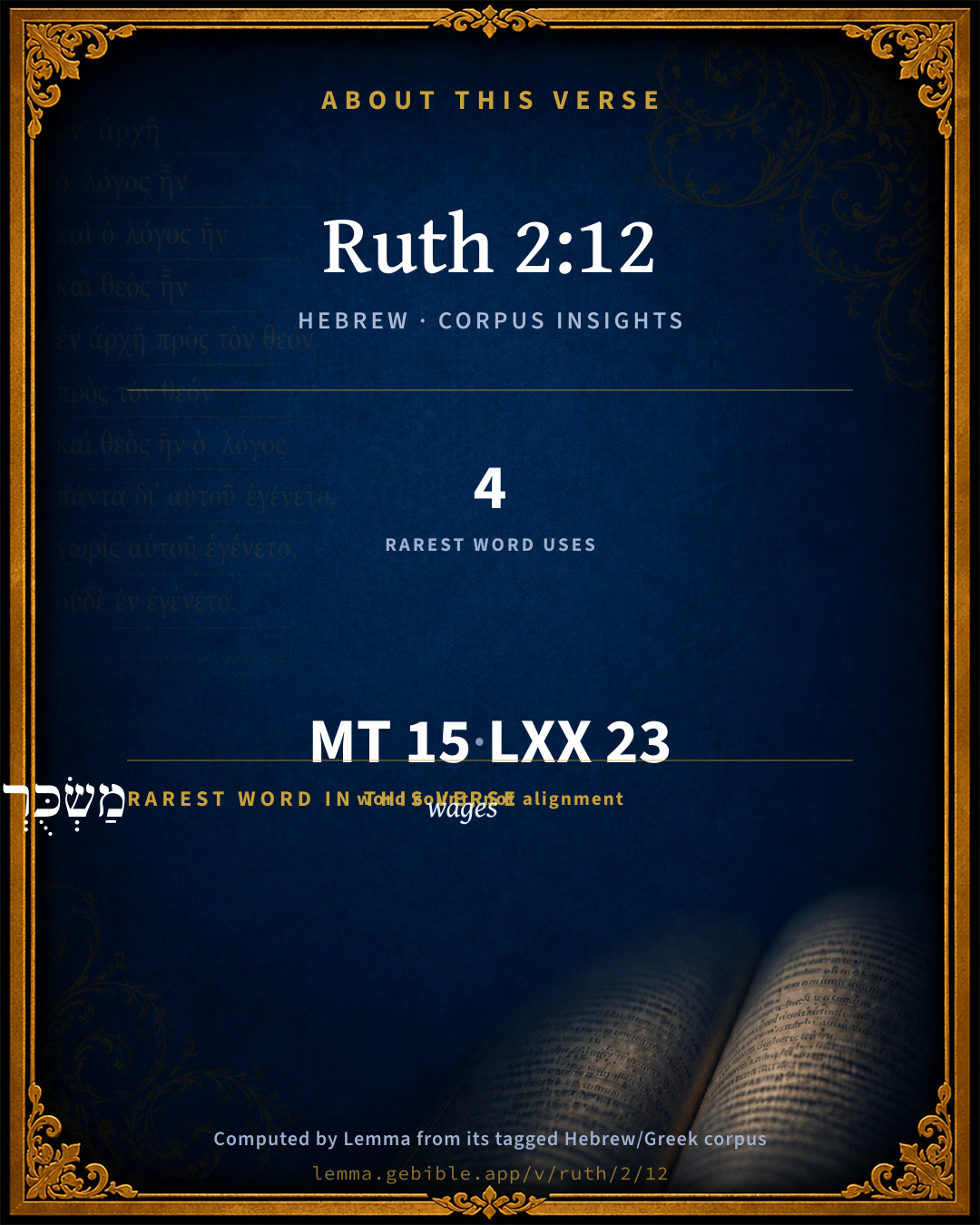
The rarest word here is מַשְׂכֻּרְתֵּ֜ךְ wages H4909 — appearing just 4 times in the whole Hebrew Bible.

Shared distinctive vocabulary

מַשְׂכֻּרְתֵּ֜ךְ wages H4909 occurs in 4 verses of the Hebrew Bible. Also found in:

Grammatical profile

  • 4 verbs
  • 7 nouns
  • 1 adjective
  • 2 prepositions
  • 1 particle

Verb forms

  • יְשַׁלֵּ֥ם Piel · Imperfect
  • וּתְהִ֨י Qal · Jussive
  • בָּ֖את Qal · Perfect
  • לַחֲס֥וֹת Qal · Infinitive Construct

Repetition

A word recurs within this verse — often emphatic in Hebrew:

  • יְהוָ֖ה LORD H3068 ×2

Hebrew & Septuagint length

In English translation the verse runs 26 words from the Hebrew and 28 from the Septuagint (LXX English) — closely comparable.

A rough comparison of the two English renderings, which tokenize alike — not a word-level alignment.

Word counts can differ between the Hebrew and the Greek without any difference in meaning — e.g. the Hebrew direct-object marker אֵת has no separate Greek word, and Greek often adds the article ὁ.

In the original languages it is 15 Hebrew tokens and 23 Greek tokens — but the two are counted differently (Hebrew bundles its prefixes and suffixes into one token; the Greek is in lemma form), so that isn’t a like-for-like length.

Cross-references

24

Topical passages linked to Ruth 2:12 in the Treasury of Scripture Knowledge — connected by theme and wording, ordered by reader-vote popularity; previews shown in the World English Bible.

  • Psalms 36:7 How precious is your loving kindness, God! The children of men take refuge under the shadow of your wings.
  • Psalms 91:4 He will cover you with his feathers. Under his wings you will take refuge. His faithfulness is your shield and rampart.
  • Psalms 63:7 For you have been my help. I will rejoice in the shadow of your wings.
  • Psalms 17:8 Keep me as the apple of your eye; Hide me under the shadow of your wings,
  • Psalms 61:4 I will dwell in your tent forever. I will take refuge in the shelter of your wings. Selah.
  • Hebrews 6:10 For God is not unrighteous, so as to forget your work and the labor of love which you showed toward his name, in that you served the saints, and still do serve them.
  • Psalms 57:1 Be merciful to me, God, be merciful to me, For my soul takes refuge in you. Yes, in the shadow of your wings, I will take refuge, Until disaster has passed.
  • Ruth 1:16 Ruth said, "Don't entreat me to leave you, and to return from following after you, for where you go, I will go; and where you lodge, I will lodge; your people shall be my people, and your God my God;
  • 1 Samuel 24:19 For if a man finds his enemy, will he let him go away unharmed? Therefore may Yahweh reward you good for that which you have done to me this day.
  • Hebrews 11:26 accounting the reproach of Christ greater riches than the treasures of Egypt; for he looked to the reward.
  • Proverbs 23:18 Indeed surely there is a future hope, And your hope will not be cut off.
  • Matthew 6:1 "Be careful that you don't do your charitable giving before men, to be seen by them, or else you have no reward from your Father who is in heaven.
  • Matthew 23:37 "Jerusalem, Jerusalem, who kills the prophets, and stones those who are sent to her! How often would I have gathered your children together, even as a hen gathers her chickens under her wings, and you would not!
  • 2 Timothy 4:8 From now on, there is stored up for me the crown of righteousness, which the Lord, the righteous judge, will give to me on that day; and not to me only, but also to all those who have loved his appearing.
  • Hebrews 11:6 Without faith it is impossible to be well pleasing to him, for he who comes to God must believe that he exists, and that he is a rewarder of those who seek him.
  • Psalms 19:11 Moreover by them is your servant warned. In keeping them there is great reward.
  • Psalms 58:11 So that men shall say, "Most assuredly there is a reward for the righteous. Most assuredly there is a God who judges the earth."
  • Proverbs 11:18 Wicked people earn deceitful wages, But one who sows righteousness reaps a sure reward.
  • Matthew 5:12 Rejoice, and be exceedingly glad, for great is your reward in heaven. For that is how they persecuted the prophets who were before you.
  • Luke 6:35 But love your enemies, and do good, and lend, expecting nothing back; and your reward will be great, and you will be children of the Most High; for he is kind toward the unthankful and evil.
  • 2 Timothy 1:18 (the Lord grant to him to find the Lord's mercy in that day); and in how many things he served at Ephesus, you know very well.
  • Matthew 10:41–42 He who receives a prophet in the name of a prophet will receive a prophet's reward: and he who receives a righteous man in the name of a righteous man will receive a righteous man's reward.
  • Luke 14:12–14 He also said to the one who had invited him, "When you make a dinner or a supper, don't call your friends, nor your brothers, nor your kinsmen, nor rich neighbors, or perhaps they might also return the favor, and pay you back.
  • Colossians 2:18 Let no one rob you of your prize by a voluntary humility and worshipping of the angels, dwelling in the things which he has not seen, vainly puffed up by his fleshly mind,

Cross-references courtesy of OpenBible.info (CC BY 4.0).

Hebrew and Greek witnesses Masoretic Hebrew ↔ Greek Septuagint

The same verse in the two great witnesses to the Old Testament, shown verse-for-verse.

These are two independent witnesses, not word-aligned to each other, and the Septuagint is shown in lemma (dictionary) form.

Hebrew Ruth 2:12 Masoretic · Westminster Leningrad Codex

יְשַׁלֵּ֥ם יְהוָ֖ה פָּעֳלֵ֑ךְ וּתְהִ֨י מַשְׂכֻּרְתֵּ֜ךְ שְׁלֵמָ֗ה מֵעִ֤ם יְהוָה֙ אֱלֹהֵ֣י יִשְׂרָאֵ֔ל אֲשֶׁר בָּ֖את לַחֲס֥וֹת תַּֽחַת כְּנָפָֽיו

Yahweh recompense your work, and a full reward be given you of Yahweh, the God of Israel, under whose wings you are come to take refuge.

World English Bible · Public Domain

Greek LXX Ruth 2:12 Septuagint · lemma form

ἀποτίνω κύριος ὁ ἐργασία σύ καί γίγνομαι ὁ μισθός σύ πλήρης παρά κύριος θεός ἰσραήλ πρός ὅς ἔρχομαι πείθω ὑπό ὁ πτέρυξ αὐτός

The Lord recompense your work; may a full reward be given you of the Lord God of Israel, to whom you have come to trust under his wings.

LXX2012 (modern English Septuagint) · Public Domain

Hebrew: Westminster Leningrad Codex (CC BY 4.0). Greek: Septuagint (public domain); English from LXX2012 (modern English Septuagint) (Public Domain). How the Septuagint differs from the Hebrew →

Commentary

Notes on Ruth 2:12 from classic Christian and Jewish commentators (each source and its license shown beneath its notes). The classic Christian expositions comment on the surrounding passage and are grouped to its opening verse, so a note may address several verses; the Jewish commentaries on the Tanakh (Rashi and others) are per-verse, so they appear only where the commentator wrote on this verse.

Lemma curates 59 commentaries, every one of them public domain or Creative Commons licensed, each selected and text-cleaned for this edition rather than reprinted as found. About our sources →

Trapp's Complete Commentary

John Trapp

Rth 2:12 The LORD recompense thy work, and a full reward be given thee of the LORD God of Israel, under whose wings thou art come to trust.

Ver. 12. The Lord recompense thy work.] Though Ruth lacked the world’s wealth, yet she lacked not good works, such as God regarded and rewarded too. Many Papists, and some as silly, have shrunk up good works to a hand-breadth, to giving of alms. Ruth had no alms to give, and yet her work was with the Lord, who heard this good man’s prayer for her, and gave her a full reward, yet not of merit, but of free grace and fatherly love, as a father rewardeth his son that serveth him.

And a full reward be given thee.] Fiat merces tua solida. {a} It was so when she became his wife, which he little thought of, when he thus heartily prayed for her, but especially when she came to heaven; whither that proud merit monger never came who said, Caelum gratis non accipiam, If I may not earn heaven, I will never have it of free gift. Let us "look to ourselves that we lose not the things that we have wrought, but that we receive a full reward." {2Jn 1:8}

Under whose wings thou art come to trust.] A metaphor usual in Scripture, from young birds hovering and covering under the dam’s wings. Ruth "coming to God, believed that God is, and that he is a rewarder of those that diligently seek him." {Heb 11:6} Fides est quae te pullastram, Christum gallinam facit, ut sub pennis eius speres; nam salus in pennis eius. {b}

{a} Vatab.

{b} Luther.

John Trapp, A Commentary or Exposition upon All the Books of the Old and New Testament (1647–1656) — public domain. Text from a community e-Sword module.

The Biblical Illustrator

Joseph S. Exell

Rth_2:12

The Lord recompense thy work, and a full reward be given thee.

Ruths reward; or, cheer for converts

I. what has the young convert done? We illustrate the subject by the instance of Ruth.

1. Many young converts deserve encouragement because they have left all their old associates. Ruth, no doubt, had many friends in her native country, but she tore herself away to cling to Naomi and her God.

2. Next, Ruth, having left her old companions, had come amongst strangers. She knew Naomi, but in the whole town of Bethlehem she knew no one else. She felt herself to be alone, though under the wings of Israels God. Boaz very properly felt that she should not think that courtesy and kindness had died out of Israel; and he made a point, though he was by far her superior in station, to go to her and speak a word of encouragement to her. Come, let us pluck up courage, and encourage every Ruth when she is timid among strangers. Let us help her to feel at home in Immanuels land.

3. The new convert is like Ruth in another respect: he is very lowly in his own eyes. Ruth had little self-esteem, and therefore she won the esteem of others. She felt herself to be a very inconsiderable person, to whom any kindness was a great favour; and so do young converts, if they are real and true.

4. Once more, the young convert is like Ruth because he has come to trust under the wings of Jehovah, the God of Israel. This is what our young converts have done: they have come, not to trust themselves, but to trust in Jesus. They have come to find a righteousness in Christ--aye, to find everything in Him.

II. what is the full reward of those who come to trust under the wings of God? I would answer that a full reward will come to us in that day when we lay down these bodies of flesh, that they may sleep in Jesus, while our unclothed spirits are absent from the body but present with the Lord. But there is a present reward, and to that Boaz referred. There is in this world a present recompense for the godly, notwithstanding the fact that many are the afflictions of the righteous. Even in losing the present life for Christs sake we are saving it, and self-denial and taking up the cross are but forms of blessedness. Do you ask me, How shall we be rewarded for trusting in the Lord?

1. I answer, first, by the deep peace of conscience which He will grant you. Can any reward be better than this? That, however, is only the beginning of the believers reward.

2. He that has come to trust in God shall be quiet from fear of evil. What a blessing that must be! He shall not be afraid of evil tidings; his heart is fixed, trusting in the Lord.

3. More than this: the man who trusts in God rests in Him with respect to all the supplies he now needs, or shall ever need.

4. Another part of the believers great gain lies in the consciousness that all things are working together for his good. Nothing is, after all, able to injure us. Neither pains of body, nor sufferings of mind, nor losses in business, nor cruel blows of death, can work us real ill. Is not this a reward for which a man may well forego the flatteries of sin?

5. Then, let me tell you, they that trust in God and follow Him have another full reward, and that is, the bliss of doing good. Can any happiness excel this?

6. Many other items make up the full of the reward; but perhaps the chief of all is communion with God.

III. what figure sets forth this full reward? I do not think that Boaz knew the full meaning of what he said. He could not foresee all that was appointed of the Lord. In the light of Ruths history we will read the good mans blessing. This poor stranger, Ruth, in coming to put her trust in the God of Israel, was giving up everything; yes, but she was also gaining everything. Ah! when you come to trust in Christ, you find in the Lord Jesus Christ one who is next of kin to you, who redeems your heritage, and unites you to Himself. (C. H. Spurgeon.)

Gods reward

A military gentleman once said to an excellent old minister in the North of Scotland, who was becoming infirm, Why, if I had power over the pension list, I would have you put on half-pay for your long and faithful services. He replied, Ah, my friend, your master may put you off with half-pay, but my Master will not serve me so meanly--He will give me full-pay. Through grace I expect a full reward.

Under whose wings thou art come to trust.

The wings of God

1. They were swift wings under which Ruth had come to trust. There is nothing in all the handiwork of God more curious than a birds wing. You have been surprised sometimes to see how far a bird can fly with one stroke of the wings; and, when it has food in prospect, or when it is affrighted, the pulsations of the birds wings are unimaginable for velocity. The English lords used to pride themselves on the speed of their falcons. These birds, when trained, had in them the dart of the lightning. How swift were the carrier-pigeons in the time of Anthony and at the siege of Jerusalem! Wonderful speed! A carrier-pigeon was thrown up at Rouen and came down at Ghent--ninety miles off in one hour. The carrier-pigeons were the telegraphs of the olden time. Swallows have been shot in our latitude having the undigested rice of Georgia swamps in their crops, showing that they had come four hundred miles in six hours. It has been estimated that, in the ten years of a swallows life, it flies far enough to have gone round the world eighty-nine times, so great is its velocity. And so the wings of the Almighty, spoken of in the text, are swift wings. They are swift when they drop upon the foe, and swift when they come to help Gods friends.

2. The wings under which Ruth had come to trust were very broad wings. There have been eagles shot on the Rocky Mountains with wings that were seven feet from tip to tip. When the king of the air sits on the crag the wings are spread over all the eaglets in the eyrie, and when the eagle starts from the rock the shadow is like the spreading of a storm cloud. So the wings of God are broad wings. They cover up all our wants, all our sorrows, all our sufferings. He puts one wing over our cradle, and He puts the other over our grave. Yes, it is not a desert in which we are placed; it is a nest. Sometimes it is a very hard nest, like that of the eagle, spread on the rock, with ragged moss and rough sticks, but still it is a nest; and, although it may be very hard under us, over us are the wings of the Almighty.

3. The wings under which Ruth came to trust were strong wings. The strength of a birds wing--of a sea-fowls wing, for example--you might guess from the fact that sometimes for five, six, or seven days it seems to fly without resting. There have been condors in the Andes that could overcome an ox or a stag. There have been eagles that have picked up children and swung them to the top of the cliffs. The flap of an eagles wing has death in it. There are birds whose wings are packed with strength to fly, to lift, to destroy. So the wings of God are strong wings. Mighty to save. Mighty to destroy.

4. The wings under which Ruth had come to trust were gentle wings. There is nothing softer than a feather. You have noticed when a bird returns from flight how gently it stoops over the nest. The young birds are not afraid of having their lives trampled out by the mother-bird; the old whip-poor-will drops into its nest of leaves, the oriole into its casket of bark, the humming-bird into its hammock of moss, gentle as the light. And so, says the psalmist, He shall cover thee with His wing. Oh, the gentleness of God! But even that figure does not fully set it forth; for I have sometimes looked into the birds nest and seen a dead bird, its life having been trampled out by the mother-bird. But no one that ever came under the feathers of the Almighty was trodden on. Blessed nest! warm nest! Why will men stay out in the cold to be shot of temptation and to be chilled by the blast, when there is this Divine shelter? (T. De Witt Talmage.)

Jehovahs wings

Some have imagined the reference to be to a hen, beneath whose wings her little birds flee for shelter and warmth, according to one memorable and touching comparison used by our Lord (Luk_13:34). It has been suggested by others that the allusion is to the mercyseat in the holy of holies in the ancient tabernacle, over which the wings of the cherubim stretched from the one extremity to the other, and above which the Divine glory shone with benignant radiance. Nothing could be more sublimely descriptive of dedication to the service of the true God--committing oneself to Him for providential protection and salvation, and seeking the loving fellowship of His Church--than coming to trust beneath Jehovahs wings. (A. Thomson, D. D.)

The Biblical Illustrator, edited by Joseph S. Exell (c. 1880s–1900s) — public domain. Text from a community e-Sword module.

Joseph Benson's Commentary

Rth 2:12. The Lord recompense thy work, &c. — Thy dutiful kindness to thy mother-in-law, and thy leaving thy country and kindred, and all things, to embrace the true religion. This implied such a work of divine grace wrought in her, and such a work of righteousness wrought by her, as was sure to be crowned with a full reward. Under whose wings thou art come to trust — That is, under whose protection and care. An allusion, either to hens, which protect and cherish their young ones under their wings; or to the wings of the cherubim, between which God dwelt.

Joseph Benson's Commentary on the Old and New Testaments (1811–1818) — public domain. Text from a community e-Sword module.

Scofield Reference Notes

C. I. Scofield

trust

(See Scofield "Psa 2:12").

The Scofield Reference Bible (1917 edition), notes by C. I. Scofield — public domain. Text from a community e-Sword module.

Geneva Bible (1599)

Geneva Bible translators

Signifying, that she shall never want anything, if she put her trust in God, and live under his protection.

Geneva Bible (1599) marginal notes — public domain. Text via Bolls.life.

Adam Clarke's Commentary

Verse 12. The Lord recompense thy work] The dutiful respect which thou hast paid to thy husband, and thy tender and affectionate attachment to thy aged mother-in-law.

And a full reward be given thee] This is spoken with great modesty and piety: The kindness I show thee is little in comparison of thy desert; God alone can give thee a full reward for thy kindness to thy husband and mother-in-law, and he will do it, because thou art come to trust under his wings-to become a proselyte to his religion. The metaphor is taken from the young of fowls, who, seeing a bird of prey, run to their mother to be covered by her wings from danger, and also to take shelter from storms, tempests, cold, &c. It is evident from this that Ruth had already attached herself to the Jewish religion.

Adam Clarke's Commentary on the Bible (1810–1826) — public domain. Text from a community e-Sword/MySword module.

Ellicott's Commentary for English Readers

(12) Boaz prays that God will recompense Ruth’s dutifulness to her mother-in-law, and the more seeing that she herself has put herself under His protection. Faith in Divine help and grace will win an undoubted recompense.

A Bible Commentary for English Readers, edited by Charles John Ellicott (1878–1897) — public domain. Text from a community e-Sword module.

The Cambridge Bible for Schools and Colleges

gen. ed. J. J. S. Perowne

12. the Lord recompense] Cf. Rth_1:8.

under whose wings … refuge] This beautiful idea is repeated in Psa_36:7; Psa_57:2; Psa_91:4; the figure is that of an eagle, Deu_32:11. May the God of Israel take care of the homeless stranger from a heathen country! The prayer was answered through the agency of him who uttered it—a fine touch, as Bertholet points out.

The Cambridge Bible for Schools and Colleges (gen. ed. J. J. S. Perowne; Cambridge University Press, 1878–1918) — public domain. Text from a community e-Sword module.

John Gill's Exposition

The Lord recompence thy work,.... The Targum adds, in this world; meaning the kind offices she had performed, and the good service she had done to her mother-in-law; nor is God unrighteous to forget the work and labour of love, which is shown by children to their parents; and though such works are not in themselves meritorious of any blessing from God here or hereafter, yet he is pleased of his own grace to recompence them, and return the good into their bosom manifold, it being acceptable in his sight:

and a full reward be given thee of the Lord God of Israel; the Targum adds, in the world to come; which is called the reward of the inheritance, Col 3:24 a reward not of debt, but of grace; and that will be a full one indeed, fulness of joy, peace, and happiness, an abundance of good things not to be conceived of, see Jo2 1:8,

under whose wings thou art come to trust; whom she professed to be her God, and whom she determined to serve and worship; whose grace and favour she expected, and to whose care and protection she committed herself: the allusion is either to fowls, which cover their young with their wings, and thereby keep them warm and comfortable, and shelter and protect them, see Psa 36:7 or to the wings of the cherubim overshadowing the mercy seat, Exo 25:20 and the phrase is now adopted by the Jews to express proselytism; and so the Targum here,"thou art come to be proselyted, and to be hid under the wings of the Shechinah of his glory,''or his glorious Shechinah.

John Gill's Exposition of the Whole Bible (1746–1763) — public domain (CC PDM 1.0). Text via the HelloAO Bible API.

Albert Barnes' Notes on the Bible

The similarity of expression here to Gen 15:1, and in Rth 2:11 to Gen 12:1, makes it probable that Boaz had the case of Abraham in his mind.

The Lord God of Israel - “Jehovah the God of Israel.” Compare Jos 14:14, where, as here, the force of the addition, the God of Israel, lies in the person spoken of being a foreigner (see Jdg 11:21 note).

Albert Barnes' Notes on the Bible (1834–1885) — public domain. Text from a community e-Sword/MySword module.

Haydock's Catholic Bible Commentary

Work. Booz doubted not but a full and eternal reward was due to good works. (Worthington) --- Fled. This similitude frequently occurs, (Psalm xxxv. 8., and Matthew xxiii. 37,) to denote protection. (Calmet). --- Chaldean, "Thou art come to be a proselyte, and to hide thyself under the shade of the majesty of his glory." (Menochius)

George Leo Haydock (1774–1849), Haydock's Catholic Family Bible and Commentary, 1859 edition — public domain. Excludes Psalms (Douay-Rheims chapter numbering differs from Protestant) and Deuterocanonical books (Catholic canon only).

Matthew Poole's English Annotations

Wings, i.e. protection and care, as Deu 32:11; Psa 17:8; 36:7; 91:4. An allusion either to hens, which protect and cherish their young ones under their wings; or to the wings of the cherubims, between which God dwelt.

Matthew Poole's English Annotations on the Holy Bible (1683–1685) — public domain. Text from a community e-Sword/MySword module.

Whedon's Commentary on the Bible

Daniel D. Whedon

12. Under whose wings thou art come to trust — Jehovah in his care for his people is represented as an eagle fluttering over her young, and spreading abroad her wings over them. Compare Deu_32:11; Psa_57:1; Psa_91:4. Boaz here speaks as the true Israelite, and recognises in Ruth the Moabitess a proselyte who has come to be incorporated with Jehovah’s chosen people.

Daniel D. Whedon (gen. ed.), Commentary on the Old and New Testaments (1874–1909) — public domain. Text from a community e-Sword module.

The Pulpit Commentary

May Yahveh requite thy work, arid may thy recompense be complete from Yahveh God of Israel, to trust under whose wings thou art come. Already there were streaks of light shooting athwart Boaz"s horizon. His very phraseology is getting tipped with unwonted beauty. He sees Ruth cowering trustfully under the outstretched wings of Him who is "good to all, and whose tender mercies are over all his works" in all lands. (see Psa_91:1-4) The metaphor, says Fuller, "is borrowed from a hen, which, with her clucking, summons together her straggling chickens, and then outstretcheth the fan of her wings to cover them." "Who would not," says Topsell, "forsake the shadow of all the trees in the world to be covered under "such" wings?

Vers. 12, 13. Lord recompense thy work, and a full reward be given thee." Here we see that the character of God is gloriously revealed. It is understood by Boaz that God is a God of "rewards," and we need not fear that a mistaken notion of rewards and punishments will prevail amongst students of the Bible. God"s highest blessings are given to the soul; but it remains true that even in the earthly life the outworking of duty is blessing.

I HERE IS THE HISTORIC NAME. "The Lord God of Israel." What memories cluster around that, significant sentence! We see in it a "miniature" of all Hebrew deliverance and mercy.

II HERE IS THE COMPREHENSIVE BLESSING. "A full reward." That must refer to the inner self to the consciousness of heroic fidelity and filial love. Many rewards are precious, but no reward is full that does not "bless us indeed.

III HERE IS THE HOMELY ANALOGY. "Under whose wings," &c. All nature is taken into the illustrative record of the inspired word. The wing! How strong without. How easily outspread. How "downy" within. So soft! so warm! The rain cannot reach through the outward covering. Notice how roof-like are the arrangements of the feathers, and notice also how ;complete is the canopy.

IV HERE IS THE PERSONAL TRUST. "Thou art come to trust." We must not forget not alone what God reveals himself as, to us, but what responsibility rests on us, to "rest in the Lord. W.M.S.

The Pulpit Commentary (1880–1919), ed. H.D.M. Spence-Jones & Joseph S. Exell — public domain. Text from a community e-Sword module.

John Wesley's Explanatory Notes

Wings - That is, protection and care. An allusion either to hens, which protect and cherish their young ones under their wings; or to the wings of the Cherubim, between which God dwelt.

John Wesley, Explanatory Notes Upon the Whole Bible (1754–1765) — public domain. Text via the GEBible commentary corpus.

Ibn Ezra

Rabbi Abraham ibn Ezra

Thy reward. Like "the tally of bricks," it is a noun from the intensive binyan (conjugation) with an additional mem (מ).

Ibn Ezra on the Tanakh — English translations: “Sefaria Community Translation” (CC0 1.0 (public-domain dedication)); “Yalkut, Sifsei Chachomim Chumash, Metsudah Publications, 2009” (CC BY 4.0); and “Commentary of Ibn Ezra on Isaiah - trans. by M. Friedlander, 1873” (public domain). Text via Sefaria.

Lesson kit

Teaching starters — assembled from the data on this page, not authored interpretation. Every prompt links to the verse data it draws on. Edit before teaching.

Ruth, in the Historical, opens this verse with 15 words (14 distinct Hebrew lemmas). Its most distinctive word is maskôreth (“wages”). A historical commentator’s framing appears above. Read the whole chapter for the surrounding context.

Discussion questions

  1. How does “wages” (maskôreth) shape what this verse is saying?
  2. Genesis 29:15 shares the word «wages» with this verse. How do the two illuminate each other?
  3. “LORD” occurs 2× in this one verse. What is the effect of the repetition?
  4. These translations render this verse differently. What is at stake in choosing one wording over another?
  5. The verb «יְשַׁלֵּ֥ם» is Piel Imperfect. How does its form color the action?
  6. Reading how Trapp's Complete Commentary and The Biblical Illustrator read this verse, where do the two commentators agree and where do they part?

Things to notice

Reading settings

Reading text

Shown beneath each verse's original-language words.

Old Testament
Old Testament edition

Read the OT as the Masoretic Hebrew (MT) or the Greek Septuagint (LXX).

English shown for the Greek Septuagint (in the Hebrew ↔ Greek comparison).

Comparing translations? Open the Compare panel on any verse page to stack up to four side by side.