Leviticus 10:11

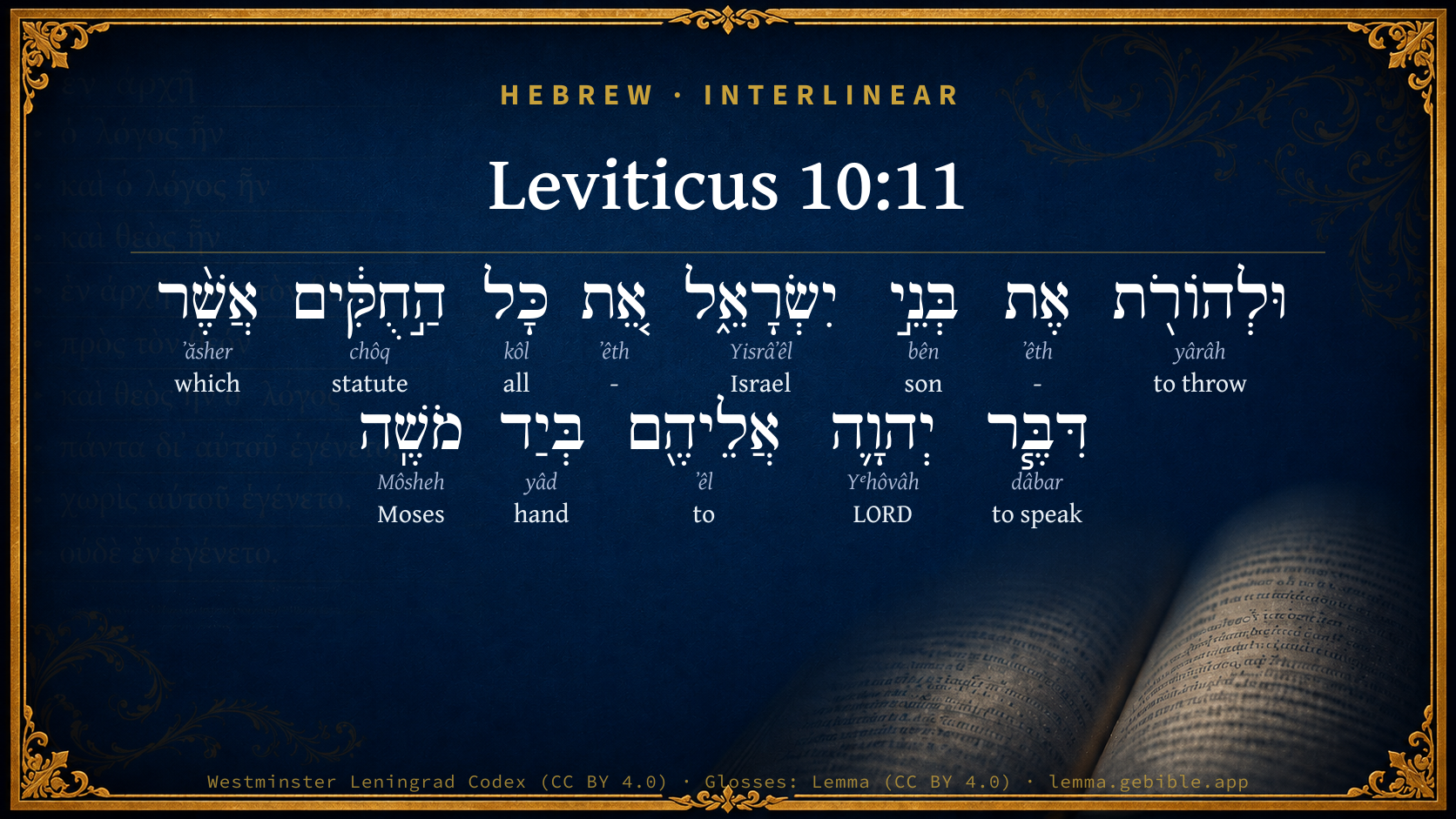
Hebrew (Westminster Leningrad Codex) Leviticus 10:11 appears in the Hebrew Old Testament. The text above is from the Westminster Leningrad Codex. Each word links to its Strong’s number, a concise gloss, and parsing drawn from the Open Scriptures Hebrew Bible morphology. Click any word for its full Brown-Driver-Briggs (BDB) entry.
Download image
Cite this verse

Leviticus 10:11 (World English Bible). Public Domain. Lemma interlinear Bible study tool, https://lemma.gebible.app/v/leviticus/10/11.

Show BibTeX & RIS
BibTeX
RIS
English Translation
and that you are to teach the children of Israel all the statutes which Yahweh has spoken to them by Moses."
World English Bible · Public Domain
Download a study sheet

One document with this verse’s original text, its word-by-word gloss line, the meaning frame, cross-references with their text, attributed commentary, and full source and license credits — printable, and it pastes into notes with its structure intact.

This verse Autodidact and up

Study sheet (.html) Plain text (.txt)

A passage Seminary Student

Up to 50 verses in one chapter. A passage sheet keeps up to 6 commentary sources and 12 cross-references per verse, in the order this page ranks them, and says so on the sheet whenever that leaves anything out. Ask for a single verse and you get the Autodidact verse sheet above.

Everything on this page stays free to read, with no account — the sheet is a download of what is already on screen, not access to it.

Want to remove ads? Support Godless Engineer
Compare translations 3

The same verse in 3 English versions, stacked beneath the original-language interlinear above. Click any original word for its lexicon entry.

Each is an independent rendering of the whole verse — the interlinear is not word-aligned to these translations.

Highlighted words mark where these versions differ — a whole-verse word diff, not a word-by-word alignment.

  • World English Bible Public Domain
    and that you are to teach the children of Israel all the statutes which Yahweh has spoken to them by Moses."
  • King James Version Public Domain
    And that ye may teach the children of Israel all the statutes which the LORD hath spoken unto them by the hand of Moses.
  • unfoldingWord Literal Text CC BY-SA 4.0
    and to teach the sons of Israel all the statutes that Yahweh has spoken to them by the hand of Moses.”

unfoldingWord Literal Text — © unfoldingWord, licensed CC BY-SA 4.0. Word-aligned USFM3 via Door43 (git.door43.org/unfoldingWord/en_ult).

Versions to compare (up to 4)

3 of 4 selected

Show all 18 translations

Every available English version of this verse, each an independent rendering of the whole verse.

  • World English Bible Public Domain
    and that you are to teach the children of Israel all the statutes which Yahweh has spoken to them by Moses."
  • Berean Standard Bible Public Domain
    so that you may teach the Israelites all the statutes that the LORD has given them through Moses.”
  • Majority Standard Bible Public Domain
    so that you may teach the Israelites all the statutes that the LORD has given them through Moses.”
  • King James Version Public Domain
    And that ye may teach the children of Israel all the statutes which the LORD hath spoken unto them by the hand of Moses.
  • American Standard Version (1901) Public Domain
    and that ye may teach the children of Israel all the statutes which Jehovah hath spoken unto them by Moses.
  • Revised Version (1885) Public Domain
    and that ye may teach the children of Israel all the statutes which the LORD hath spoken unto them by the hand of Moses.
  • Geneva Bible (1599) Public Domain
    And that ye may teach the children of Israel all the statutes which the Lord hath commanded them by the hand of Moses.
  • Douay-Rheims (1899) Public Domain
    And may teach the children of Israel all my ordinances which the Lord hath spoken to them by the hand of Moses.
  • Young's Literal Translation Public Domain
    and to teach the sons of Israel all the statutes which Jehovah hath spoken unto them by the hand of Moses.'
  • Literal Standard Version CC BY-SA 4.0
    and to teach the sons of Israel all the statutes which YHWH has spoken to them by the hand of Moses.”
  • Unlocked Literal Bible CC BY-SA 4.0
    so that you may teach the people of Israel all the statutes that Yahweh has commanded through Moses.”
  • unfoldingWord Literal Text CC BY-SA 4.0
    and to teach the sons of Israel all the statutes that Yahweh has spoken to them by the hand of Moses.”
  • Darby Bible Public Domain
    and that ye may teach the children of Israel all the statutes which Jehovah hath spoken to them by the hand of Moses.
  • World Messianic Bible Public Domain
    You are to teach the children of Israel all the statutes which the LORD has spoken to them by Moses.”
  • Webster's Bible Public Domain
    And that ye may teach the children of Israel all the statutes which the LORD hath spoken to them by the hand of Moses.
  • Free Bible Version CC BY-SA 4.0
    so you can teach the Israelites all the regulations that the Lord has given to them through Moses.”
  • Bible in Basic English Public Domain
    Teaching the children of Israel all the laws which the Lord has given them by the hand of Moses.
  • JPS Tanakh (1917) Public Domain
    and that ye may teach the children of Israel all the statutes which the LORD hath spoken unto them by the hand of Moses.'

Literal Standard Version (2020), Covenant Press — licensed CC BY-SA 4.0. Text via the HelloAO Bible API (eBible.org). Unlocked Literal Bible (unfoldingWord) — licensed CC BY-SA 4.0. Text via the HelloAO Bible API (eBible.org). unfoldingWord Literal Text — © unfoldingWord, licensed CC BY-SA 4.0. Word-aligned USFM3 via Door43 (git.door43.org/unfoldingWord/en_ult). Free Bible Version, Dr. Jonathan Gallagher — licensed CC BY-SA 4.0. Text via the HelloAO Bible API (eBible.org).

Word by word

More ways to search: Search by grammar → Find every occurrence → Compare this word →

Practice this passage: Drill this verse → Learn its vocabulary →

וּלְהוֹרֹ֖ת
yârâh
H3384
“and · to throw”
Conjunction + Preposition + Verb, Hiphil, Infinitive Construct
Part of Speech
Conjunction + Preposition + Verb
Stem
Hiphil
Form
Infinitive Construct
Full BDB Definition

Origin: a primitive root

TWOT: 910

to throw, shoot, cast, pour - (Qal) - to throw, cast - to cast, lay, set - to shoot arrows - to throw water, rain - (Niphal) to be shot - (Hiphil) - to throw, cast - to shoot - to point out, show - to direct, teach, instruct - to throw water, rain
  1. אֶת ʼêth H853 “-” Particle, Direct Object
  2. בְּנֵ֣י bên H1121 “sons of” Noun, Common, Masculine, Plural, Construct
  3. יִשְׂרָאֵ֑ל Yisrâʼêl H3478 “Israel” Noun, Proper
  4. אֵ֚ת ʼêth H853 “-” Particle, Direct Object
  5. כָּל kôl H3605 “all of” Noun, Common, Masculine, Singular, Construct
  6. הַ֣חֻקִּ֔ים chôq H2706 “the · statutes” Particle, Definite Article + Noun, Common, Masculine, Plural, Absolute
  7. אֲשֶׁ֨ר ʼăsher H834 “which” Particle, Relative
  8. דִּבֶּ֧ר dâbar H1696 “to speak” Verb, Piel, Perfect, 3rd Person, Masculine, Singular
  9. יְהוָ֛ה Yᵉhôvâh H3068 “LORD” Noun, Proper
  10. אֲלֵיהֶ֖ם ʼêl H413 “to · them” Preposition + Suffix, Personal, 3rd Person, Masculine, Plural
  11. בְּיַד yâd H3027 “in/at · hand of” Preposition + Noun, Common, Both, Singular, Construct
  12. מֹשֶֽׁה Môsheh H4872 “Moses” Noun, Proper

About this verse

These counts appear in no published source. They are computed here, from the morphology-tagged text and Lemma’s own curated glosses. What Lemma adds →

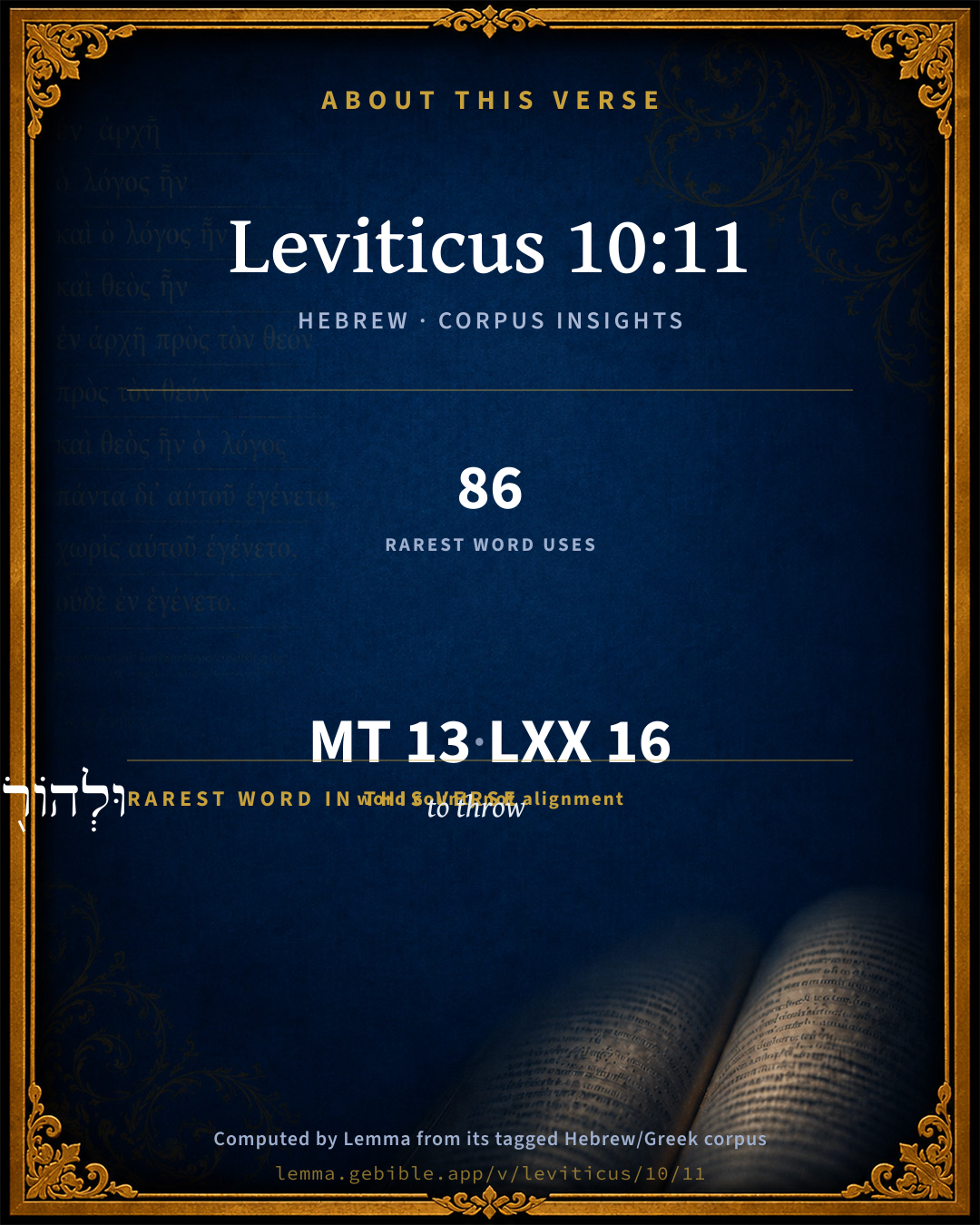
13
words
12
distinct lemmas
Pentateuch
section

Grammatical profile

  • 2 verbs
  • 7 nouns
  • 1 preposition
  • 3 particles

Verb forms

  • וּלְהוֹרֹ֖ת Hiphil · Infinitive Construct
  • דִּבֶּ֧ר Piel · Perfect

Hebrew & Septuagint length

In English translation the verse runs 21 words from the Hebrew and 18 from the Septuagint (LXX English) — closely comparable.

A rough comparison of the two English renderings, which tokenize alike — not a word-level alignment.

Word counts can differ between the Hebrew and the Greek without any difference in meaning — e.g. the Hebrew direct-object marker אֵת has no separate Greek word, and Greek often adds the article ὁ.

In the original languages it is 13 Hebrew tokens and 16 Greek tokens — but the two are counted differently (Hebrew bundles its prefixes and suffixes into one token; the Greek is in lemma form), so that isn’t a like-for-like length.

Cross-references

13

Topical passages linked to Leviticus 10:11 in the Treasury of Scripture Knowledge — connected by theme and wording, ordered by reader-vote popularity; previews shown in the World English Bible.

  • Malachi 2:7 For the priest's lips should keep knowledge, and they should seek the law at his mouth; for he is the messenger of Yahweh of Hosts.
  • Matthew 28:20 teaching them to observe all things that I commanded you. Behold, I am with you always, even to the end of the age." Amen.
  • Nehemiah 8:2 Ezra the priest brought the law before the assembly, both men and women, and all who could hear with understanding, on the first day of the seventh month.
  • Nehemiah 8:8 They read in the book, in the law of God, distinctly; and they gave the sense, so that they understood the reading.
  • Deuteronomy 24:8 Take heed in the plague of leprosy, that you observe diligently, and do according to all that the priests the Levites shall teach you: as I commanded them, so you shall observe to do.
  • Jeremiah 18:18 Then said they, Come, and let us devise devices against Jeremiah; for the law shall not perish from the priest, nor counsel from the wise, nor the word from the prophet. Come, and let us strike him with the tongue, and let us not give heed to any of his words.
  • Deuteronomy 33:10 They shall teach Jacob your ordinances, Israel your law: They shall put incense before you, Whole burnt offering on your altar.
  • Acts 20:27 for I didn't shrink from declaring to you the whole counsel of God.
  • 1 Thessalonians 4:2 For you know what charge we gave you through the Lord Jesus.
  • 2 Chronicles 17:9 They taught in Judah, having the book of the law of Yahweh with them; and they went about throughout all the cities of Judah, and taught among the people.
  • 2 Chronicles 30:22 Hezekiah spoke comfortably to all the Levites who had good understanding [in the service] of Yahweh. So they ate throughout the feast for the seven days, offering sacrifices of peace-offerings, and making confession to Yahweh, the God of their fathers.
  • Nehemiah 9:13–14 You came down also on Mount Sinai, and spoke with them from heaven, and gave them right ordinances and true laws, good statutes and commandments,
  • Jeremiah 2:8 The priests didn't say, Where is Yahweh? and those who handle the law didn't know me: the rulers also transgressed against me, and the prophets prophesied by Baal, and walked after things that do not profit.

Cross-references courtesy of OpenBible.info (CC BY 4.0).

Hebrew and Greek witnesses Masoretic Hebrew ↔ Greek Septuagint

The same verse in the two great witnesses to the Old Testament, shown verse-for-verse.

These are two independent witnesses, not word-aligned to each other, and the Septuagint is shown in lemma (dictionary) form.

Hebrew Leviticus 10:11 Masoretic · Westminster Leningrad Codex

וּלְהוֹרֹ֖ת אֶת בְּנֵ֣י יִשְׂרָאֵ֑ל אֵ֚ת כָּל הַ֣חֻקִּ֔ים אֲשֶׁ֨ר דִּבֶּ֧ר יְהוָ֛ה אֲלֵיהֶ֖ם בְּיַד מֹשֶֽׁה

and that you are to teach the children of Israel all the statutes which Yahweh has spoken to them by Moses."

World English Bible · Public Domain

Greek LXX Leviticus 10:11 Septuagint · lemma form

καί συνβιβάζω ὁ υἱός ἰσραήλ πᾶς ὁ νόμιμος ὅς λαλέω κύριος πρός αὐτός διά χείρ μωυσῆς

and to teach the children of Israel all the statutes, which the Lord spoke to them by Moses.

LXX2012 (modern English Septuagint) · Public Domain

Hebrew: Westminster Leningrad Codex (CC BY 4.0). Greek: Septuagint (public domain); English from LXX2012 (modern English Septuagint) (Public Domain). How the Septuagint differs from the Hebrew →

Targum (Aramaic paraphrase)

2

The Targum is the ancient Jewish Aramaic paraphrase of the Hebrew Scriptures — an interpretive translation, not the Hebrew text itself. Onkelos (literal) and Pseudo-Jonathan (expansive) render the Torah, and Jonathan the Prophets. Coverage is partial: where no permissively-licensed English translation exists for a verse, only the Aramaic is shown. This is verse-level text, not a word-by-word alignment to the Hebrew.

  1. Targum Onkelos Torah (Genesis–Deuteronomy)
    וּלְאַלָפָא יָת בְּנֵי יִשְׂרָאֵל יָת כָּל קְיָמַיָא דִי מַלִיל יְיָ לְהוֹן בִּידָא דְמֹשֶׁה

    (no public-domain English translation for this verse)

    Targum Onkelos — Aramaic: “Onkelos Genesis” (public domain); “Onkelos Exodus” (public domain); “Onkelos Leviticus” (public domain); “Onkelos Numbers” (public domain); “Onkelos Deuteronomy” (public domain). English: “Sefaria Community Translation” (CC0 1.0 (public-domain dedication)); “J.W. Etheridge. The Targums of Onkelos and Jonathan Ben Uzziel on the Pentateuch. London: Longmans, Green, 1862” (public domain). Text via Sefaria.

  2. Targum Pseudo-Jonathan Torah (Genesis–Deuteronomy)
    וּלְאַלָפָא יַת בְּנֵי יִשְרָאֵל יַת כָּל קְיָמָא דְמַלֵיל יְיָ לְהוֹן בִּידָא דְמשֶׁה

    and for teaching the children of Israel all the statutes which the Lord hath spoken to them by the hand of Mosheh.

    Targum Pseudo-Jonathan — Aramaic: “Targum Jonathan on Genesis” (public domain); “Targum Jonathan on Exodus” (public domain); “Targum Jonathan on Leviticus” (public domain); “Targum Jonathan on Numbers” (public domain); “Targum Jonathan on Deuteronomy” (public domain). English: “The Targum of Jonathan ben Uzziel, trans. J. W. Etheridge, London, 1862” (public domain). Text via Sefaria.

Commentary

Notes on Leviticus 10:11 from classic Christian and Jewish commentators (each source and its license shown beneath its notes). The classic Christian expositions comment on the surrounding passage and are grouped to its opening verse, so a note may address several verses; the Jewish commentaries on the Tanakh (Rashi and others) are per-verse, so they appear only where the commentator wrote on this verse.

Lemma curates 59 commentaries, every one of them public domain or Creative Commons licensed, each selected and text-cleaned for this edition rather than reprinted as found. About our sources →

Trapp's Complete Commentary

John Trapp

Lev 10:11 And that ye may teach the children of Israel all the statutes which the LORD hath spoken unto them by the hand of Moses.

Ver. 11. And that ye may teach.] The priest’s lips should both preserve knowledge and present it to the people; even all the counsel of God. {Mal 2:7 Act 20:27} "To give the knowledge of salvation by the remission of sins." {Luk 1:77}

John Trapp, A Commentary or Exposition upon All the Books of the Old and New Testament (1647–1656) — public domain. Text from a community e-Sword module.

Tyndale Open Study Notes

Tyndale Open Resources

10:11 The decrees that the Lord has given were laws that came directly from God, rather than from a court decision.

Tyndale Open Study Notes — © Tyndale Open Resources, licensed CC BY-SA 4.0. Text via the HelloAO Bible API.

Geneva Bible (1599)

Geneva Bible translators

Or, commission.

Geneva Bible (1599) marginal notes — public domain. Text via Bolls.life.

Ellicott's Commentary for English Readers

(11) And that ye may teach.—The priests were not only to keep sober to be able to decide the questions of ritual, but they were to teach the people, since the ceremonial law affected domestic life and social intercourse (Deu_33:10; Mal_2:7). For neglecting these duties, the prophet charges them :—“Her priests have violated my law, and have profaned my holy things: they have put no difference between the holy and the profane, neither have they showed difference [i.e., taught the people the difference] between the unclean and the clean” (Eze_22:26).

A Bible Commentary for English Readers, edited by Charles John Ellicott (1878–1897) — public domain. Text from a community e-Sword module.

John Gill's Exposition

And Moses spake unto Aaron, and unto Eleazar, and unto Ithamar, his sons that were left,.... Of the burning, as the Targum of Jonathan; who survived his other two sons that were burnt, who remained alive, not being concerned with them in their sin, and so shared not in their punishment:

take the meat offering that remaineth of the offerings of the Lord made by fire; for all but the handful that was burnt of that kind of offerings belonged to the priests, see Lev 6:14 this meat offering, according to Jarchi, was the meat offering of the eighth day, that is, of the consecration, or the day after it was finished, on which the above awful case happened, Lev 9:17 and also the meat offering of Nahshon the son of Amminadab, of the tribe of Judah, who offered his offering first at the dedication of the altar, on the day the tabernacle was set up, which he supposes was on this day, see Num 7:1, now these meat offerings were not as yet eaten, and which may be true of the first of them, wherefore Aaron and his sons, notwithstanding their mourning, are bid to take it:

and eat it without leaven beside the altar: the altar of burnt offering in the court of the tabernacle, as directed See Gill on Lev 6:16,

for it is most holy: and so might be eaten by none but holy persons, such as were devoted to sacred services, and only in the holy place, as follows; within hangings, where the most holy things were eaten, as Jarchi, that is, within the court of the tabernacle, which was made of hangings.

John Gill's Exposition of the Whole Bible (1746–1763) — public domain (CC PDM 1.0). Text via the HelloAO Bible API.

Matthew Poole's English Annotations

That ye may teach; be apt to teach aright, which drunken persons are very unfit to do.

Matthew Poole's English Annotations on the Holy Bible (1683–1685) — public domain. Text from a community e-Sword/MySword module.

Whedon's Commentary on the Bible

Daniel D. Whedon

11. That ye may teach — The priest was the earliest religious teacher of the Levitical law, “for the priest’s lips should keep knowledge, and they should seek the law at his mouth.” Mal_2:7. The two sides of the priestly vocation, teaching and offering, are embraced in Deu_33:10. The Pentateuch knows nothing of a scholastic inculcation of the divine laws; it knows no formal religious instruction at all except the reading of the law before the assembled people, at the feast of tabernacles, in the Sabbatic year. Deu_31:10-13. All religious teachers should be τελειοι, perfect, having their senses — internal and external — exercised to discern or discriminate both good and evil. Heb_5:14. Wine draws a film over the spiritual eye and confounds moral distinctions. If the priests have aught to do with wine in a lawful way, it is only that it may, in the holy place,” be poured unto the Lord for a drink offering.”

Num_28:7. Wine symbolizes joy. The joy of all believers is not the joy of earth but of heaven — of the sanctuary. “The joy of the Lord is your strength.”

Daniel D. Whedon (gen. ed.), Commentary on the Old and New Testaments (1874–1909) — public domain. Text from a community e-Sword module.

The Pulpit Commentary

That ye may teach the children of Israel. This shows that one part of the priest"s office was teaching the Law. (cf. Deu_24:8 Mal_2:7)

Ver. 11. That priests are teachers

is assumed all through the Old Testament. The contrast in this respect which has been found by some between the prophets and the priests, the former being the spiritual guides of the people, and the latter the organs of a dull ceremonial routine or even rude slayers of beasts, has no foundation in fact. It is true that the primary work of the priest was to teach by type and rite, and the primary work of the prophet to declare God"s will by word of mouth; but they were co-ordinate, not hostile, influences and powers, having the same end in view, which they carried out, partly by the same, partly by different means. If the prophet sharply reproves the priests, it is because they are bad priests, not because they are priests; (Mal_2:1) and when he strikes at the priest, he sometimes strikes at the prophet in the same breath. (Jer_5:30, Jer_5:31)

THE MINISTER OF THE GOSPEL IS THE SUCCESSOR AND REPRESENTATIVE OF BOTH PRIEST AND PROPHET. He has to conduct the public worship of God, which must always be a solemn occupation, though now disembarrassed of the minute regulations of the Judaic Law, and he is a channel through whom the Divine blessing flows; in this he represents the priest. He is the expounder and preacher of God"s Word; herein he represents the prophet. He teaches God"s commandments and applies them to the consciences of individuals; herein he does the work of both priest and prophet. But he holds a higher office than either one or the other, inasmuch as he is the dispenser of the gifts of the Holy Ghost for the good of man, which were purchased for man by Christ"s death, received by him of his Father at his ascension, anti shed forth upon his Church in the form of graces dispensed by the apostolic ministry. (see Eph_4:7-11)

Instruction as well as sacrifice.

These words point to

I A SECONDARY DUTY OF THE PRIESTHOOD INSTRUCTION. No doubt the primary object of their appointment was sacrifice. Their function was, first of all, to mediate between God and the people, to stand at his altar and present sacrifices unto him. But this did not constitute their whole duty; they were to "teach the children of Israel all the statutes which the Lord had spoken." No doubt the whole tribe of Levi was associated with the priesthood in "teaching Jacob the judgments and Israel the Law" of the Lord. (see Deu_33:8-11 Mal_2:7 Hos_4:6)

II THE TWOFOLD TASK THIS INSTRUCTION INVOLVED. The priests and Levites would have:

1. To make known the particular precepts of the Law, so that the people might bring their proper sacrifices, come at the appointed seasons to the sacred festivals, shun all those things which were prohibited, act rightly in their various domestic and social relations, etc.

2. To explain the spirit and significance of the ritual, so that when the worshippers came to the tabernacle they might not only go through the right forms, but also enter into the spirit of them; so that they should be affected by a sense of sin, by a hope of forgiveness, by a desire to dedicate themselves unto God, by a spirit of holy joy in God and of brotherly love toward their fallows. To communicate all the particulars of the Law, and leave uninterpreted their spiritual significance, would have been to omit an essential part of their sacred duty as religious instructors of the nation. We may be reminded of

III THE OBLIGATIONS OF THE CHRISTIAN MINISTRY. The privilege of those who minister for Christ is also twofold:

1. To lead souls with them to God; to suggest those thoughts and words through which the worshippers may address themselves to him and make their own personal, direct appeal to him.

2. To instruct in Christian truth. And this instruction is to combine two things: it is

(1) to make known the will of God as stated in the sacred Scriptures;

(2) to impress that will on the conscience of the congregation. The Christian minister seeks to enlighten and to enforce. Then he must leave those whom he serves, to act; they must then "bear their own burden." Thus we come to

IV THE DUTY OF THE CHRISTIAN CONGREGATION. That is, to avail themselves of the work of the minister.

1. To follow him spiritually and sympathetically to the throne of grace and, with him, draw nigh to God. in prayer.

2. To seek to understand the mind of God as it is stated and explained.

3. To apply to themselves and their own need. the exhortations which are given. C.

The Pulpit Commentary (1880–1919), ed. H.D.M. Spence-Jones & Joseph S. Exell — public domain. Text from a community e-Sword module.

John Wesley's Explanatory Notes

Ye may teach - Which drunken persons are very unfit to do.

John Wesley, Explanatory Notes Upon the Whole Bible (1754–1765) — public domain. Text via the GEBible commentary corpus.

Rashi

Rabbi Shlomo Yitzchaki (Rashi)

ולהורת AND TO TEACH [THE CHILDREN OF ISRAEL] — This informs us that an intoxicated person is forbidden to pronounce religious decisions. One might think that if he does so he is liable to the death penalty! It, however, says: “[Do not drink wine] thou (Aaron), nor thy sons with thee … lest ye die” — priests when they minister in a state of intoxication are punishable by death, but the Sages when they thus render decisions are not punishable by death (Sifra, Shemini, Section 1 6).

Rashi on the Tanakh — English translations: “The Judaica Press complete Tanach with Rashi, translated by A. J. Rosenberg” (CC BY 4.0); “Pentateuch with Rashi's commentary by M. Rosenbaum and A.M. Silbermann, 1929-1934” (public domain); “The Metsudah Tanach series, Lakewood, N.J” (CC BY 4.0); and “The Book of Joshua, Metsudah Publications, 1997” (CC BY 4.0). Text via Sefaria.

Lesson kit

Teaching starters — assembled from the data on this page, not authored interpretation. Every prompt links to the verse data it draws on. Edit before teaching.

Leviticus, in the Pentateuch, opens this verse with 13 words (12 distinct Hebrew lemmas). Its most distinctive word is yârâh (“to throw”). A historical commentator’s framing appears above. Read the whole chapter for the surrounding context.

Discussion questions

  1. What does “to throw” (yârâh) contribute to the verse as a whole?
  2. How does Malachi 2:7, which shares this passage’s theme, read alongside this verse?
  3. These translations render this verse differently. What is at stake in choosing one wording over another?
  4. «וּלְהוֹרֹ֖ת» is a Hiphil Infinitive Construct verb. How does that grammatical form shape the action described?
  5. Compare how Trapp's Complete Commentary and Tyndale Open Study Notes read this verse. Where do they agree or differ?

Things to notice

Reading settings

Reading text

Shown beneath each verse's original-language words.

Old Testament
Old Testament edition

Read the OT as the Masoretic Hebrew (MT) or the Greek Septuagint (LXX).

English shown for the Greek Septuagint (in the Hebrew ↔ Greek comparison).

Comparing translations? Open the Compare panel on any verse page to stack up to four side by side.