
Psalms 50:7

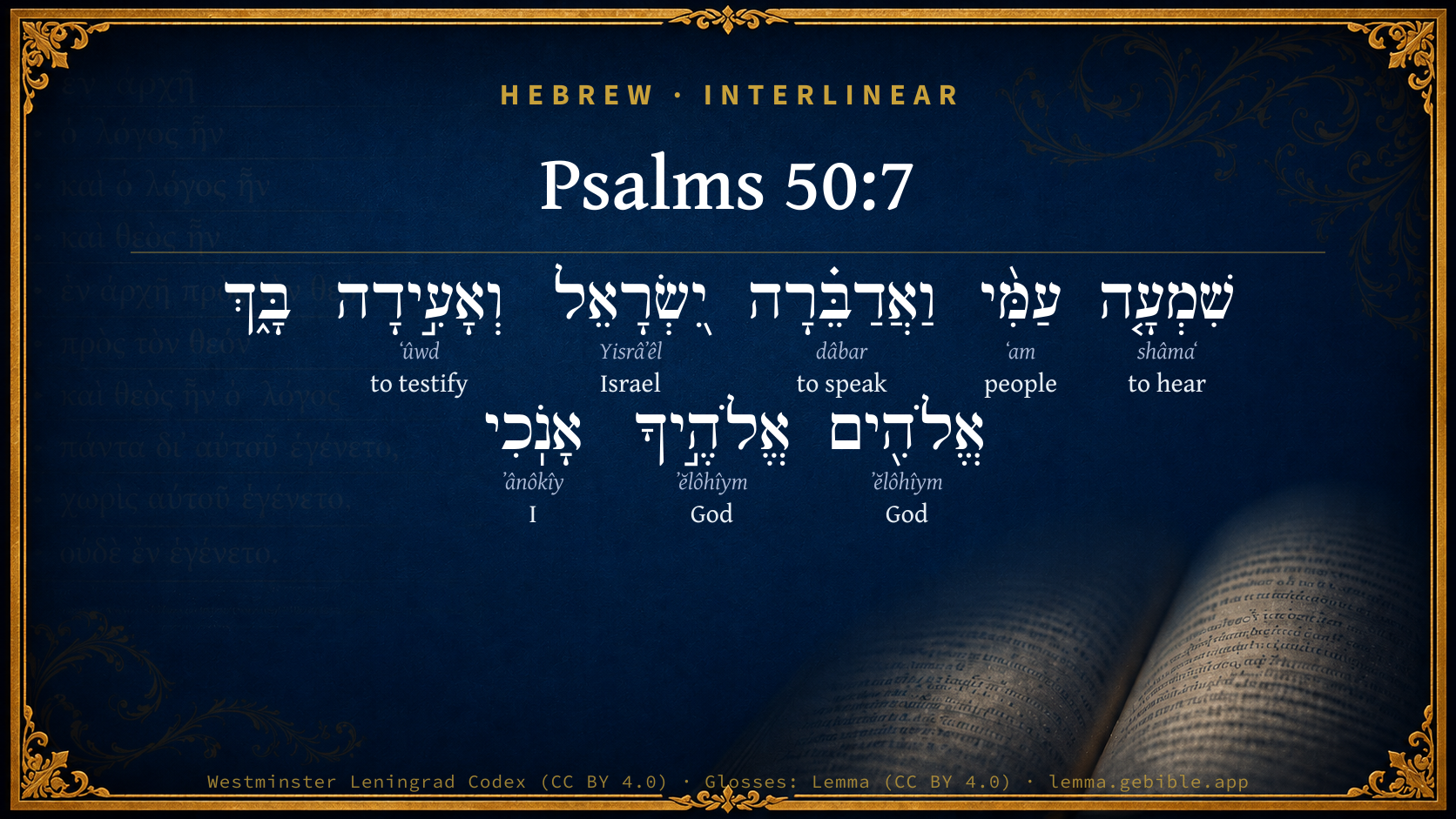
Hebrew (Westminster Leningrad Codex) Psalms 50:7 appears in the Hebrew Old Testament. The text above is from the Westminster Leningrad Codex. Each word links to its Strong’s number, a concise gloss, and parsing drawn from the Open Scriptures Hebrew Bible morphology. Click any word for its full Brown-Driver-Briggs (BDB) entry.
Download image
Cite this verse

Psalms 50:7 (World English Bible). Public Domain. Lemma interlinear Bible study tool, https://lemma.gebible.app/v/psalms/50/7.

Show BibTeX & RIS
BibTeX
RIS
English Translation
"Hear, my people, and I will speak; Israel, and I will testify against you. I am God, your God.
World English Bible · Public Domain
Download a study sheet

One document with this verse’s original text, its word-by-word gloss line, the meaning frame, cross-references with their text, attributed commentary, and full source and license credits — printable, and it pastes into notes with its structure intact.

This verse Autodidact and up

Study sheet (.html) Plain text (.txt)

A passage Seminary Student

Up to 50 verses in one chapter. A passage sheet keeps up to 6 commentary sources and 12 cross-references per verse, in the order this page ranks them, and says so on the sheet whenever that leaves anything out. Ask for a single verse and you get the Autodidact verse sheet above.

Everything on this page stays free to read, with no account — the sheet is a download of what is already on screen, not access to it.

Want to remove ads? Support Godless Engineer
Compare translations 3

The same verse in 3 English versions, stacked beneath the original-language interlinear above. Click any original word for its lexicon entry.

Each is an independent rendering of the whole verse — the interlinear is not word-aligned to these translations.

Highlighted words mark where these versions differ — a whole-verse word diff, not a word-by-word alignment.

  • World English Bible Public Domain
    "Hear, my people, and I will speak; Israel, and I will testify against you. I am God, your God.
  • King James Version Public Domain
    Hear, O my people, and I will speak; O Israel, and I will testify against thee: I am God, even thy God.
  • unfoldingWord Literal Text CC BY-SA 4.0
    “Hear, my people, and I will speak; Israel, and I will testify against you. I God, your God.

unfoldingWord Literal Text — © unfoldingWord, licensed CC BY-SA 4.0. Word-aligned USFM3 via Door43 (git.door43.org/unfoldingWord/en_ult).

Versions to compare (up to 4)

3 of 4 selected

Show all 18 translations

Every available English version of this verse, each an independent rendering of the whole verse.

  • World English Bible Public Domain
    "Hear, my people, and I will speak; Israel, and I will testify against you. I am God, your God.
  • Berean Standard Bible Public Domain
    “Hear, O My people, and I will speak, O Israel, and I will testify against you: I am God, your God.
  • Majority Standard Bible Public Domain
    “Hear, O My people, and I will speak, O Israel, and I will testify against you: I am God, your God.
  • King James Version Public Domain
    Hear, O my people, and I will speak; O Israel, and I will testify against thee: I am God, even thy God.
  • American Standard Version (1901) Public Domain
    Hear, O my people, and I will speak; O Israel, and I will testify unto thee: I am God, `even' thy God.
  • Revised Version (1885) Public Domain
    Hear, O my people, and I will speak; O Israel, and I will testify unto thee: I am God, even thy God.
  • Geneva Bible (1599) Public Domain
    Heare, O my people, and I wil speake: heare, O Israel, and I wil testifie vnto thee: for I am God, euen thy God.
  • Douay-Rheims (1899) Public Domain
    Hear, O my people, and I will speak: O Israel, and I will testify to thee: I am God, thy God.
  • Young's Literal Translation Public Domain
    Hear, O My people, and I speak, O Israel, and I testify against thee, God, thy God `am' I.
  • Literal Standard Version CC BY-SA 4.0
    Hear, O My people, and I speak, || O Israel, and I testify against you, || God—I [am] your God.
  • Unlocked Literal Bible CC BY-SA 4.0
    “Hear, my people, and I will speak; I am God, your God.
  • unfoldingWord Literal Text CC BY-SA 4.0
    “Hear, my people, and I will speak; Israel, and I will testify against you. I God, your God.
  • Darby Bible Public Domain
    Hear, my people, and I will speak; O Israel, and I will testify unto thee: I am God, thy God.
  • World Messianic Bible Public Domain
    “Hear, my people, and I will speak. Israel, I will testify against you. I am God, your God.
  • Webster's Bible Public Domain
    Hear, O my people, and I will speak; O Israel, and I will testify against thee: I am God, even thy God.
  • Free Bible Version CC BY-SA 4.0
    “My people, listen to what I have to say. I am bringing charges against you, Israel. I am God, your God!
  • Bible in Basic English Public Domain
    Give ear, O my people, to my words; O Israel, I will be a witness against you; I am God, even your God.
  • JPS Tanakh (1917) Public Domain
    'Hear, O My people, and I will speak; O Israel, and I will testify against thee: God, thy God, am I.

Literal Standard Version (2020), Covenant Press — licensed CC BY-SA 4.0. Text via the HelloAO Bible API (eBible.org). Unlocked Literal Bible (unfoldingWord) — licensed CC BY-SA 4.0. Text via the HelloAO Bible API (eBible.org). unfoldingWord Literal Text — © unfoldingWord, licensed CC BY-SA 4.0. Word-aligned USFM3 via Door43 (git.door43.org/unfoldingWord/en_ult). Free Bible Version, Dr. Jonathan Gallagher — licensed CC BY-SA 4.0. Text via the HelloAO Bible API (eBible.org).

Word by word

More ways to search: Search by grammar → Find every occurrence → Compare this word →

Practice this passage: Drill this verse → Learn its vocabulary →

וְאָעִ֣ידָה
ʻûwd
H5749
“and · to testify”
Conjunction + Verb, Hiphil, Cohortative, 1st Person, Common, Singular
Part of Speech
Conjunction + Verb
Stem
Hiphil
Form
Cohortative
Person
1st Person
Gender
Common
Number
Singular
Full BDB Definition

Origin: a primitive root

TWOT: 1576 , 1576d

to return, repeat, go about, do again - (Piel) to surround, go round and round - (Pilel) to restore, relieve - (Hithpalel) to be restored - to bear witness - (Qal) to bear witness, say again and again - (Hiphil) - to testify, bear witness - to cause to testify, take or call as witness, invoke - to protest, affirm solemnly, warn, exhort or enjoin solemnly, admonish, charge - (Hophal) to protest, give warning
  1. שִׁמְעָ֤ה shâmaʻ H8085 “hear” Verb, Qal, Imperative, 2nd Person, Masculine, Singular + Suffix, h
  2. עַמִּ֨י ʻam H5971 “people · my” Noun, Common, Masculine, Singular, Construct + Suffix, Personal, 1st Person, Common, Singular
  3. וַאֲדַבֵּ֗רָה dâbar H1696 “and · to speak” Conjunction + Verb, Piel, Cohortative, 1st Person, Common, Singular
  4. יִ֭שְׂרָאֵל Yisrâʼêl H3478 “Israel” Noun, Proper
  5. אֱלֹהִ֖ים ʼĕlôhîym H430 “God(s)” Noun, Common, Masculine, Plural, Absolute
  6. אֱלֹהֶ֣יךָ ʼĕlôhîym H430 “God(s) · your” Noun, Common, Masculine, Plural, Construct + Suffix, Personal, 2nd Person, Masculine, Singular
  7. אָנֹֽכִי ʼânôkîy H595 “I” Pronoun, Personal, 1st Person, Common, Singular

About this verse

These counts appear in no published source. They are computed here, from the morphology-tagged text and Lemma’s own curated glosses. What Lemma adds →

9
words
7
distinct lemmas
Wisdom
section

Shared distinctive vocabulary

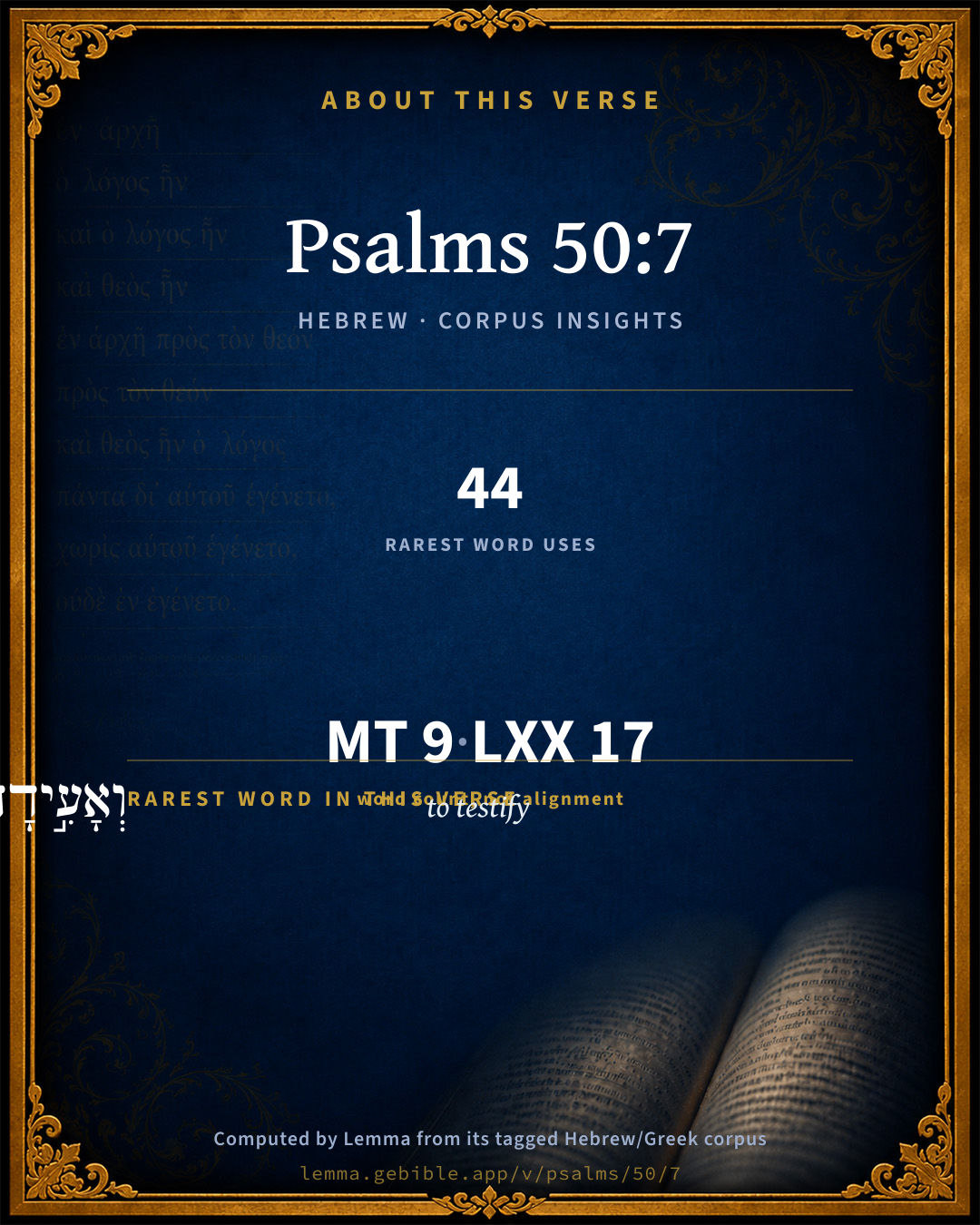
וְאָעִ֣ידָה to testify H5749 occurs in 40 verses of the Hebrew Bible. Also found in:

Grammatical profile

  • 3 verbs
  • 4 nouns
  • 1 pronoun
  • 1 preposition

Verb forms

  • שִׁמְעָ֤ה Qal · Imperative
  • וַאֲדַבֵּ֗רָה Piel · Cohortative
  • וְאָעִ֣ידָה Hiphil · Cohortative

Repetition

A word recurs within this verse — often emphatic in Hebrew:

  • אֱלֹהִ֖ים God H430 ×2

Hebrew & Septuagint length

In English translation the verse runs 19 words from the Hebrew and 22 from the Septuagint (LXX English) — closely comparable.

A rough comparison of the two English renderings, which tokenize alike — not a word-level alignment.

Word counts can differ between the Hebrew and the Greek without any difference in meaning — e.g. the Hebrew direct-object marker אֵת has no separate Greek word, and Greek often adds the article ὁ.

In the original languages it is 9 Hebrew tokens and 17 Greek tokens — but the two are counted differently (Hebrew bundles its prefixes and suffixes into one token; the Greek is in lemma form), so that isn’t a like-for-like length.

Cross-references

20

Topical passages linked to Psalms 50:7 in the Treasury of Scripture Knowledge — connected by theme and wording, ordered by reader-vote popularity; previews shown in the World English Bible.

  • Psalms 81:8 "Hear, my people, and I will testify to you, Israel, if you would listen to me!
  • Exodus 20:2 "I am Yahweh your God, who brought you out of the land of Egypt, out of the house of bondage.
  • Jeremiah 2:9 Therefore I will yet contend with you, says Yahweh, and with your children's children will I contend.
  • Exodus 19:5–6 Now therefore, if you will indeed obey my voice, and keep my covenant, then you shall be my own possession from among all peoples; for all the earth is mine;
  • Psalms 81:10–12 I am Yahweh, your God, Who brought you up out of the land of Egypt. Open your mouth wide, and I will fill it.
  • Deuteronomy 26:17–18 You have declared Yahweh this day to be your God, and that you would walk in his ways, and keep his statutes, and his commandments, and his ordinances, and listen to his voice:
  • Deuteronomy 31:19–21 Now therefore write you this song for you, and teach you it the children of Israel: put it in their mouths, that this song may be a witness for me against the children of Israel.
  • 1 Samuel 12:22–25 For Yahweh will not forsake his people for his great name's sake, because it has pleased Yahweh to make you a people to himself.
  • 2 Kings 17:13 Yet Yahweh testified to Israel, and to Judah, by every prophet, and every seer, saying, Turn you from your evil ways, and keep my commandments and my statutes, according to all the law which I commanded your fathers, and which I sent to you by my servants the prophets.
  • 2 Chronicles 28:5 Therefore Yahweh his God delivered him into the hand of the king of Syria; and they struck him, and carried away of his a great multitude of captives, and brought them to Damascus. He was also delivered into the hand of the king of Israel, who struck him with a great slaughter.
  • Nehemiah 9:29–30 and testified against them, that you might bring them again to your law. Yet they dealt proudly, and didn't listen to your commandments, but sinned against your ordinances, (which if a man do, he shall live in them), and withdrew the shoulder, and hardened their neck, and would not hear.
  • Psalms 49:1 Hear this, all you peoples. Listen, all you inhabitants of the world,
  • Isaiah 1:18 "Come now, and let us reason together," says Yahweh: "Though your sins be as scarlet, they shall be as white as snow. Though they be red like crimson, they shall be as wool.
  • Jeremiah 2:4–5 Hear you the word of Yahweh, O house of Jacob, and all the families of the house of Israel:
  • Ezekiel 20:5 and tell them, Thus says the Lord Yahweh: In the day when I chose Israel, and swore to the seed of the house of Jacob, and made myself known to them in the land of Egypt, when I swore to them, saying, I am Yahweh your God;
  • Ezekiel 20:7 I said to them, Cast you away every man the abominations of his eyes, and don't defile yourselves with the idols of Egypt; I am Yahweh your God.
  • Ezekiel 20:19–20 I am Yahweh your God: walk in my statutes, and keep my ordinances, and do them;
  • Micah 6:1–8 Listen now to what Yahweh says: "Arise, plead your case before the mountains, And let the hills hear what you have to say.
  • Zechariah 13:9 I will bring the third part into the fire, And will refine them as silver is refined, And will test them like gold is tested. They will call on my name, and I will hear them. I will say, 'It is my people;' And they will say, 'Yahweh is my God.'"
  • Malachi 3:5 I will come near to you to judgment; and I will be a swift witness against the sorcerers, and against the adulterers, and against the perjurers, and against those who oppress the hireling in his wages, the widow, and the fatherless, and who deprive the foreigner of justice, and don't fear me," says Yahweh of Hosts.

Cross-references courtesy of OpenBible.info (CC BY 4.0).

Hebrew and Greek witnesses Masoretic Hebrew ↔ Greek Septuagint

The same verse in the two great witnesses to the Old Testament, shown verse-for-verse.

You’re reading Greek Psalm 49 (Hebrew Psalm 50). The Septuagint counts the superscription, so verse numbers can differ from the Hebrew — chapter-level alignment, not verse-by-verse. Numbering follows Rahlfs.

These are two independent witnesses, not word-aligned to each other, and the Septuagint is shown in lemma (dictionary) form.

Hebrew Psalms 50:7 Masoretic · Westminster Leningrad Codex

שִׁמְעָ֤ה עַמִּ֨י וַאֲדַבֵּ֗רָה יִ֭שְׂרָאֵל וְאָעִ֣ידָה בָּ֑ךְ אֱלֹהִ֖ים אֱלֹהֶ֣יךָ אָנֹֽכִי

"Hear, my people, and I will speak; Israel, and I will testify against you. I am God, your God.

World English Bible · Public Domain

Greek LXX Greek Psalm 49:7 Septuagint · lemma form

ἀκούω λαός ἐγώ καί λαλέω σύ ἰσραήλ καί διαμαρτύρομαι σύ ὁ θεός ὁ θεός σύ εἰμί ἐγώ

Hear, my people, and I will speak to you, O Israel: and I will testify to you: I am God, your God.

LXX2012 (modern English Septuagint) · Public Domain

Hebrew: Westminster Leningrad Codex (CC BY 4.0). Greek: Septuagint (public domain); English from LXX2012 (modern English Septuagint) (Public Domain). How the Septuagint differs from the Hebrew →

Commentary

Notes on Psalms 50:7 from classic Christian and Jewish commentators (each source and its license shown beneath its notes). The classic Christian expositions comment on the surrounding passage and are grouped to its opening verse, so a note may address several verses; the Jewish commentaries on the Tanakh (Rashi and others) are per-verse, so they appear only where the commentator wrote on this verse.

Lemma curates 59 commentaries, every one of them public domain or Creative Commons licensed, each selected and text-cleaned for this edition rather than reprinted as found. About our sources →

Matthew Henry's Commentary

God is here dealing with those that placed all their religion in the observances of the ceremonial law, and thought those sufficient.

I. He lays down the original contract between him and Israel, in which they had avouched him to be their God, and he them to be his people, and so both parties were agreed (Psa 50:7): Hear, O my people! and I will speak. Note, It is justly expected that whatever others doe, when he speaks, his people should give ear; who will, if they do not? And then we may comfortably expect that God will speak to us when we are ready to hear what he says; even when he testifies against us in the rebukes and threatenings of his word and providences we must be forward to hear what he says, to hear even the rod and him that has appointed it.

II. He puts a slight upon the legal sacrifices, Psa 50:8, etc. Now,

1. This may be considered as looking back to the use of these under the law. God had a controversy with the Jews; but what was the ground of the controversy? Not their neglect of the ceremonial institutions; no, they had not been wanting in the observance of them, their burnt-offerings had been continually before God, they took a pride in them, and hoped by their offerings to procure a dispensation for their lusts, as the adulterous woman, Pro 7:14. Their constant sacrifices, they thought, would both expiate and excuse their neglect of the weightier matters of the law. Nay, if they had, in some degree, neglected these institutions, yet that should not have been the cause of God's quarrel with them, for it was but a small offence in comparison with the immoralities of their conversation. They thought God was mightily beholden to them for the many sacrifices they had brought to his altar, and that they had made him very much their debtor by them, as if he could not h have maintained his numerous family of priests without their contributions; but God here shows them the contrary, (1.) That he did not need their sacrifices. What occasion had he for their bullocks and goats who has the command of all the beasts of the forest, and the cattle upon a thousand hills (Psa 50:9, Psa 50:10), has an incontestable propriety in them and dominion over them, has them all always under his eye and within his reach, and can make what use he pleases of them; they all wait on him, and are all at his disposal? Psa 104:27-29. Can we add any thing to his store whose all the wild fowl and wild beasts are, the world itself and the fulness thereof? Psa 50:11, Psa 50:12. God's infinite self-sufficiency proves our utter insufficiency to add any thing to him. (2.) That he could not be benefited by their sacrifices. Their goodness, of this kind, could not possibly extend to him, nor, if they were in this matter righteous, was he the better (Psa 50:13): Will I eat the flesh of bulls? It is as absurd to think that their sacrifices could, of themselves, and by virtue of any innate excellency in them, add any pleasure of praise to God, as it would be to imagine that an infinite Spirit could be supported by meat and drink, as our bodies are. It is said indeed of the demons whom the Gentiles worshipped that they did eat the fat of their sacrifices, and drink the wine of their drink-offerings (Deu 32:38): they regaled themselves in the homage they robbed the true God of; but will the great Jehovah be thus entertained? No; to obey is better than sacrifice, and to love God and our neighbour better than all burnt-offerings, so much better that God by his prophets often told them that their sacrifices were not only not acceptable, but abominable, to him, while they lived in sin; instead of pleasing him, he looked upon them as a mockery, and therefore an affront and provocation to him; see Pro 15:8; Isa 1:11, etc.; Isa 66:3; Jer 6:20; Amo 5:21. They are therefore here warned not to rest in these performances; but to conduct themselves, in all other instances, towards God as their God.

2. This may be considered as looking forward to the abolishing of these by the gospel of Christ. Thus Dr. Hammond understands it. When God shall set up the kingdom of the Messiah he shall abolish the old way of worship by sacrifice and offerings; he will no more have those to be continually before him (Psa 50:8); he will no more require of his worshippers to bring him their bullocks and their goats, to be burnt upon his altar, Psa 50:9. For indeed he never appointed this as that which he had any need of, or took any pleasure in, for, besides that all we have is his already, he has far more beasts in the forest and upon the mountains, which we know nothing of nor have any property in, than we have in our folds; but he instituted it to prefigure the great sacrifice which his own Son should in the fulness of time offer upon the cross, to make atonement for sin, and all the other spiritual sacrifices of acknowledgment with which God, through Christ, will be well pleased.

III. He directs to the best sacrifices of prayer and praise as those which, under the law, were preferred before all burnt-offerings and sacrifices, and on which then the greatest stress was laid, and which now, under the gospel, come in the room of those carnal ordinances which were imposed until the times of reformation. He shows us here (Psa 50:14, Psa 50:15) what is good, and what the Lord our God requires of us, and will accept, when sacrifices are slighted and superseded. 1. We must make a penitent acknowledgment of our sins: Offer to God confession, so some read it, and understand it of the confession of sin, in order to our giving glory to God and taking shame to ourselves, that we may never return to it. A broken and contrite heart is the sacrifice which God will not despise, Psa 51:17. If the sin was not abandoned the sin-offering was not accepted. 2. We must give God thanks for his mercies to us: Offer to God thanksgiving, every day, often every day (seven times a day will I praise thee), and upon special occasions; and this shall please the Lord, if it come from a humble thankful heart, full of love to him and joy in him, better than an ox or bullock that has horns and hoofs, Psa 69:30, Psa 69:31. 3. We must make conscience of performing our covenants with him: Pay thy vows to the Most High, forsake thy sins, and do thy duty better, pursuant to the solemn promises thou has made him to that purport. When we give God thanks for any mercy we have received we must be sure to pay the vows we made to him when we were in the pursuit of the mercy, else our thanksgivings will not be accepted. Dr. Hammond applies this to the great gospel ordinance of the eucharist, in which we are to give thanks to God for his great love in sending his Son to save us, and to pay our vows of love and duty to him, and to give alms. Instead of all the Old Testament types of a Christ to come, we have that blessed memorial of a Christ already come. 4. In the day of distress we must address ourselves to God by faithful and fervent prayer (Psa 50:15): Call upon me in the day of trouble, and not upon any other god. Our troubles, though we see them coming from God's hand, must drive us to him, and not drive us from him. We must thus acknowledge him in all our ways, depend upon his wisdom, power, and goodness, and refer ourselves entirely to him, and so give him glory. This is a cheaper, easier, readier way of seeking his favour than by a peace-offering, and yet more acceptable. 5. When he, in answer to our prayers, delivers us, as he has promised to do in such way and time as he shall think fit, we must glorify him, not only by a grateful mention of his favour, but by living to his praise. Thus must we keep up our communion with God, meeting him with our prayers when he afflicts us and with our praises when he delivers us.

Matthew Henry's Commentary on the Whole Bible (1708–1710) — public domain (CC PDM 1.0). Text via the HelloAO Bible API.

Trapp's Complete Commentary

John Trapp

Psa 50:7 Hear, O my people, and I will speak; O Israel, and I will testify against thee: I [am] God, [even] thy God.

Ver. 7. Hear, O my people, and I will speak, &c.] What sweet and winning language is here for a preface! God’s proceedings against sinners, whom he might confound with his terrors, is with meekness and much mildness, Gen 3:9; Gen 3:11; Gen 4:9 Mat 22:11; Mat 26:50. Be we herein followers of God as dear children, Jos 7:19 Gal 6:1 2Ti 2:19.

O Israel, I will testify against thee] i.e. I will expostulate with thee, and convince thee. This is a mercy which the Lord vouchsafed our first parents when they had sinned; the serpent he would not so much as examine, but doomed him presently.

I am God] And should, therefore, have been better obeyed.

Even thy God] And, therefore, thou of all others shouldest have had more care, and not have despited me with seeming honours by presenting me with outside services.

John Trapp, A Commentary or Exposition upon All the Books of the Old and New Testament (1647–1656) — public domain. Text from a community e-Sword module.

Joseph Benson's Commentary

Psa 50:7. Hear, O my people, &c. — Having brought in God, as entering into judgment with them, he now gives an account of the process and of the sentence of the judge, whose words are contained in this and the following verses. O Israel, I will testify against thee — I will plead with thee, and declare my charge or endictment against thee. I am God, even thy God — Not only in general, but in a special manner, by that solemn covenant made at Sinai; whereby I avouched thee to be my peculiar people, and thou didst avouch me to be thy God.

Joseph Benson's Commentary on the Old and New Testaments (1811–1818) — public domain. Text from a community e-Sword module.

Keil & Delitzsch

C. F. Keil & F. Delitzsch

Exposition of the sacrificial Tra for the good of those whose holiness consists in outward works. The forms strengthened by ah, in Psa 50:7, describe God's earnest desire to have Israel for willing hearers as being quite as strong as His desire to speak and to bear witness. העיד בּ, obtestari aliquem, to come forward as witness, either solemnly assuring, or, as here and in the Psalm of Asaph, Psa 81:9, earnestly warning and punishing (cf. Arab. šahida with b, to bear witness against any one). On the Dagesh forte conjunctive in בּך, vid., Ges. ֗20, 2, a. He who is speaking has a right thus to stand face to face with Israel, for he is Elohim, the God of Israel - by which designation reference is made to the words אנכי יהוה אלהיך (Exo 20:2), with which begins the Law as given from Sinai, and which here take the Elohimic form (whereas in Psa 81:11 they remain unaltered) and are inverted in accordance with the context. As Psa 50:8 states, it is not the material sacrifices, which Israel continually, without cessation, offers, that are the object of the censuring testimony. ועולתיך, even if it has Mugrash, as in Baer, is not on this account, according to the interpretation given by the accentuation, equivalent to ועל־עולותיך (cf. on the other hand Psa 38:18); it is a simple assertory substantival clause: thy burnt-offerings are, without intermission, continually before Me. God will not dispute about sacrifices in their outward characteristics; for - so Psa 50:9 go on to say-He does not need sacrifices for the sake of receiving from Israel what He does not otherwise possess. His is every wild beast (חיתו, as in the Asaph Psa 79:2) of the forest, His the cattle בּהררי אלף, upon the mountains of a thousand, i.e., upon the thousand (and myriad) mountains (similar to מתי מספּר or מתי מעט), or: where they live by thousands (a similar combination to נבל עשׂור). Both explanations of the genitive are unsupported by any perfectly analogous instance so far as language is concerned; the former, however, is to be preferred on account of the singular, which is better suited to it. He knows every bird that makes its home on the mountains; ידע, as usually, of a knowledge which masters a subject, compasses it and makes it its own. Whatever moves about the fields if with Him, i.e., is within the range of His knowledge (cf. Job 27:11; Psa 10:13), and therefore of His power; זיז (here and in the Asaph Psa 80:14) from זאזא = זעזע, to move to and fro, like טיט from טיטע, to swept out, cf. κινώπετον, κνώδαλον, from κινεῖν. But just as little as God requires sacrifices in order thereby to enrich Himself, is there any need on His part that might be satisfied by sacrifices, Psa 50:12. If God should hunger, He would not stand in need of man's help in order to satisfy Himself; but He is never hungry, for He is the Being raised above all carnal wants. Just on this account, what God requires is not by any means the outward worship of sacrifice, but a spiritual offering, the worship of the heart, Psa 50:14. Instead of the שׁלמים, and more particularly זבח תּודה, Lev 7:11-15, and שׁלמי נדר, Lev 7:16 (under the generic idea of which are also included, strictly speaking, vowed thank-offerings), God desires the thanksgiving of the heart and the performance of that which has been vowed in respect of our moral relationship to Himself and to men; and instead of the עולה in its manifold forms of devotion, the prayer of the heart, which shall not remain unanswered, so that in the round of this λογικὴ λατρεία everything proceeds from and ends in εὐχαριστία. It is not the sacrifices offered in a becoming spirit that are contrasted with those offered without the heart (as, e.g., Sir. 32 [35]:1-9), but the outward sacrifice appears on the whole to be rejected in comparison with the spiritual sacrifice. This entire turning away from the outward form of the legal ceremonial is, in the Old Testament, already a predictive turning towards that worship of God in spirit and in truth which the new covenant makes alone of avail, after the forms of the Law have served as swaddling clothes to the New Testament life which was coming into being in the old covenant. This "becoming" begins even in the Tra itself, especially in Deuteronomy. Our Psalm, like the Chokma (Pro 21:3), and prophecy in the succeeding age (cf. Hos 6:6; Mic 6:6-8; Isa 1:11-15, and other passages), stands upon the standpoint of this concluding book of the Tra, which traces back all the requirements of the Law to the fundamental command of love.

Keil & Delitzsch — Biblical Commentary on the Old Testament (1861–1891) — public domain (CC PDM 1.0). Text via the HelloAO Bible API. (Old Testament only.)

J. A. Alexander on Psalms

Joseph Addison Alexander

7. (Psa 50:7) Hear, my people, and let me speak, and let me testify against thee. God, thy God, am I. The introductory description being ended, the divine judgment now begins. Let me speak, or I will speak, the peculiar form of the Hebrew verb, sometimes expressing strong desire and sometimes fixed determination. See above, on Ps. ii. 3. God is himself the witness against Israel, by whom the charge is to be proved, the heavens and the earth being only witnesses of the judicial scene or spectacle. I am not only God, but thy God, bound to thee by covenant, and reciprocally claiming thy allegiance. This may be added as a reason why he has a right to testify against them; or it may be the beginning of the testimony itself. "Let me testify against thee as thy God," or, "I will testify against thee, that I am thy God," although I am not so regarded or so treated.

Joseph Addison Alexander, The Psalms Translated and Explained (1850) — public domain. Text from a community e-Sword module.

Tyndale Open Study Notes

Tyndale Open Resources

50:7-13 The psalmist delivers a message against those who regard the sacrificial rituals as more important than having a proper heart attitude.

Tyndale Open Study Notes — © Tyndale Open Resources, licensed CC BY-SA 4.0. Text via the HelloAO Bible API.

Jamieson, Fausset & Brown

Robert Jamieson, A. R. Fausset & David Brown

I will testify--that is, for failure to worship aught.

thy God--and so, by covenant as well as creation, entitled to a pure worship.

Jamieson, Fausset & Brown — Commentary Critical and Explanatory on the Whole Bible (1871) — public domain (CC PDM 1.0). Text via the HelloAO Bible API.

Adam Clarke's Commentary

Verse 7. Hear, O my people] As they were now amply informed concerning the nature and certainty of the general judgment, and were still in a state of probation, Asaph proceeds to show them the danger to which they were exposed, and the necessity of repentance and amendment, that when that great day should arrive, they might be found among those who had made a covenant with God by sacrifice. And he shows them that the sacrifice with which God would be well pleased was quite different from the bullocks, he-goats, c., which they were in the habit of offering. In short, he shows here that God has intended to abrogate those sacrifices, as being no longer of any service: for when the people began to trust in them, without looking to the thing signified, it was time to put them away. When the people began to pay Divine honours to the brazen serpent, though it was originally an ordinance of God's appointment for the healing of the Israelites, it was ordered to be taken away called nehushtan, a bit of brass; and broken to pieces. The sacrifices under the Jewish law were of God's appointment; but now that the people began to put their trust in them, God despised them.

Adam Clarke's Commentary on the Bible (1810–1826) — public domain. Text from a community e-Sword/MySword module.

John Calvin's Commentaries

7. Hear, O my people! and I will speak. Hitherto the prophet has spoken as the herald of God, throwing out several expressions designed to alarm the minds of those whom he addressed. But from this to the end of the psalm God himself is introduced as the speaker; and to show the importance of the subject, he uses additional terms to awaken attention, calling them his own people, that he might challenge the higher authority to his words, and intimating, that the following address is not of a mere ordinary description, but an expostulation with them for the infraction of his covenant. Some read, I will testify against thee. But the reference, as we may gather from the common usage of Scripture, seems rather to be to a discussion of mutual claims. God would remind them of his covenant, and solemnly exact from them, as his chosen people, what was due according to the terms of it. He announces himself to be the God of Israel, that he may recall them to allegiance and subjection, and the repetition of his name is emphatical: as if he had said, When you would have me to submit to your inventions, how far is this audacity from that honor and reverence which belong to me? I am God, and therefore my majesty ought to repress presumption, and make all flesh keep silence when I speak; and among you, to whom I have made myself known as your God, I have still stronger claims to homage.

John Calvin's Commentaries (1540-1563) — public domain. Text from the Calvin Translation Society English edition (1840s-50s) via the Christian Classics Ethereal Library (ccel.org). Calvin's coverage is partial (roughly two-thirds of the Bible); uncommented books and verses are honest gaps, never fabricated. The 19th-century editor's footnotes and remarks are omitted so the notes are faithfully Calvin's own voice.

Ellicott's Commentary for English Readers

(7) Hear.—The actual judgment now opens, God asserting in impressive tones His right to preside: God, thy God, I . . . the Elohistic form of the more usual “Jehovah, thy God.”

A Bible Commentary for English Readers, edited by Charles John Ellicott (1878–1897) — public domain. Text from a community e-Sword module.

The Cambridge Bible for Schools and Colleges

gen. ed. J. J. S. Perowne

7. I will testify against thee] Or, I will protest unto thee, of solemn wanting and exhortation. Cp. Psa_81:8, another Asaphite Psalm.

I am God, even thy God] The words which stand at the head of the Decalogue, with God substituted for Jehovah by the Elohistic editor of the Psalm. Cp. Psa_81:10, where Jehovah is retained. They express the relation of Jehovah to Israel, upon which was founded His right to give them a law, and now to call them to account for their neglect of it.

7–15. The trial begins. God is the accuser as well as the judge. Israel’s sacrifices are unexceptionable, but it is not slain beasts which the Lord of all the earth desires, but the devotion of the heart, exhibited in thanksgiving and trust. The people as a whole are addressed. The duty which is enforced is their duty towards God, corresponding to the first Table of the Decalogue.

The Cambridge Bible for Schools and Colleges (gen. ed. J. J. S. Perowne; Cambridge University Press, 1878–1918) — public domain. Text from a community e-Sword module.

John Gill's Exposition

Hear, O my people,.... This is an address to the people of the Jews, whom God had chosen to be his people above all others, and who professed themselves to be his people; but now a "loammi", Hos 1:9, was about to be written upon them, being a people uncircumcised in heart and ears, refusing to hear the great Prophet of the church, him that spake from heaven;

and I will speak: by way of accusation and charge, and in judgment against them for their sins and transgressions;

O Israel, and I will testify against thee; or "to thee" (t); to thy face produce witnesses, and bring sufficient evidence to prove the things laid to thy charge,

I am God, even thy God; which is an aggravation of their sin against him, and is the reason why they should hearken to him; see Psa 81:10.

(t) "tibi", V. L. Vatablus; so Ainsworth.

John Gill's Exposition of the Whole Bible (1746–1763) — public domain (CC PDM 1.0). Text via the HelloAO Bible API.

Albert Barnes' Notes on the Bible

Hear, O my people, and I will speak - God himself is now introduced as speaking, and as stating the principles on which the judgment will proceed. The previous verses are introductory, or are designed to bring the scene of the judgment before the mind. The solemn scene now opens, and God himself speaks, especially as rebuking the disposition to rely on the mere forms of religion, while its spirituality and its power are denied. The purpose of the whole is, by asking how these things will appear in the judgment, to imply the vanity of “mere” forms of religion now. The particular address is made to the “people” of God, or to “Israel,” because the purpose of the psalmist was to rebuke the prevailing tendency to rely on outward forms.

O Israel, and I will testify against thee - In the judgment. In view of those scenes, and as “at” that time, I will “now” bear this solemn testimony against the views which you entertain on the subject of religion, and the practices which prevail in your worship.

I am God, even thy God - I am the true God, and therefore I have a right to speak; I am “thy” God - the God who has been the Protector of thy people - acknowledged as the God of the nation - and therefore I claim the right to declare the great principles which pertain to true worship, and which constitute true religion.

Albert Barnes' Notes on the Bible (1834–1885) — public domain. Text from a community e-Sword/MySword module.

Matthew Poole's English Annotations

Having brought in God as coming to judgment with them, he now gives an account of the process and of the sentence of the Judge, whose words are contained in this and the following verses.

I will testify against thee; I will plead with thee, and declare my charge or indictment against thee.

Even thy God; not only in general, as thou art my creature, but in a special manner, by many singular favours and obligations, and by that solemn covenant made at Sinai; whereby I avouched thee to be my peculiar people, and thou didst avouch me to be thy God, Deu 26:17,18.

Matthew Poole's English Annotations on the Holy Bible (1683–1685) — public domain. Text from a community e-Sword/MySword module.

The Treasury of David

Charles H. Spurgeon

Ver. 7-15. The address which follows is directed to the professed people of God. It is clearly, in the first place, meant for Israel; but is equally applicable to the visible church of God in every age. It declares the futility of external worship when spiritual faith is absent, and the mere outward ceremonial is rested in.

Ver. 7. Hear, O my people, and I will speak. Because Jehovah speaks and they are avowedly his own people, they are bound to give earnest heed. "Let me speak, "saith the great I AM. The heavens and earth are but listeners, the Lord is about both to testify and to judge. O Israel, and I will testify against thee. Their covenant name is mentioned to give point to the address; it was a double evil that the chosen nation should become so carnal, so unspiritual, so false, so heartless to their God. God himself, whose eyes sleep not, who is not misled by rumour, but sees for himself, enters on the scene as witness against his favoured nation. Alas! for us when God, even our fathers' God, testifies to the hypocrisy of the visible church. I am God, even thy God. He had taken them to be his peculiar people above all other nations, and they had in the most solemn manner avowed that he was their God. Hence the special reason for calling them to account. The law began with, "I am the Lord thy God, which brought thee up out of the land of Egypt, "and now the session of their judgment opens with the same reminder of their singular position, privilege, and responsibility. It is not only that Jehovah is God, but thy God, O Israel; this is that makes thee so amenable to his searching reproofs.

None.

Ver. 7. Sins of God's people specially against God, and only known to God. A searching subject.

Psalms 50:8*

Charles H. Spurgeon's The Treasury of David (1869–1885) — public domain. Psalms only. Text from a community e-Sword/MySword module.

Whedon's Commentary on the Bible

Daniel D. Whedon

7. Hear, O my people—The court and witnesses being called, (Psa_50:1-6,) the case is now opened. The charge is, that they had backslidden in heart, lost the spirituality of their religion, and their worship consisted only in empty forms. Compare Rev_2:1-5. In Psa_50:8-13 God is not to be understood as condemning their forms, as such, but only their substitution of forms for vital and heart piety. They had merged the spirit in the letter, the substance in the shadow, and thus their heartless worship became a lie. Comp. Mat_23:23

Daniel D. Whedon (gen. ed.), Commentary on the Old and New Testaments (1874–1909) — public domain. Text from a community e-Sword module.

The Pulpit Commentary

Vers. 7-15. continuance of this dramatic scene," as Professor Cheyne remarks, "scarcely answers to the commencement. The judgment seems to be adjourned, or to be left to the conscience of the defendants." The faithful are summoned, and appear, but not to receive unqualified commendation. (see Mat_25:31-40) Rather they receive a warning. The strong and prolonged depreciation of sacrifice (vers. 8-13) necessarily implies that in the religion of the time too much stress was laid upon it. We know that, in the heathen world, men sought to buy God"s favour by their sacrifices, some believing that, physically, the gods were nourished by the steam of the victims, others regarding them as laid under obligations which they could not disregard (Plato, "Rep.," it. Rawlinson, "Religions of the Ancient World," pp. 124, 125). We know, too, that, in the later monarchy, sacrifice to so great an extent superseded true spiritual worship among the Israelites themselves, that it became an offence to God, and was spoken of in terms of reprobation. (Isa_1:11-13 Isa_66:3) Already, it would seem, this tendency was manifesting itself, and a warning from Heaven was needed against it.

Hear, O my people, and I will speak. God will not speak to deaf ears. Unless men are ready to attend to him, he keeps silence. O Israel, and I will testify against thee; or, protest unto thee (Kay, Cheyne). I am God, even thy God. And therefore am entitled to be heard.

Vers. 7-21. True religion and its counterfeits.

The great evil to which Israel was exposed was the separation of religion from morality. This comes out lamentably in their history, and forms the burden of much of the teaching of their prophets. So in this psalm, which contains a powerful demonstration of the worthlessness of religion without godliness. The psalm may help us to consider true religion and its counterfeits.

I SUPERSTITION. (Ver. 7) Nothing in religion can be real and true but what is based on faith in the living God. What springs from fear without knowledge degenerates into the basest idolatries.

II FORMALISM. (Vers. 8-14) The heading of this psalm in our Bibles is very true and suggestive. "The pleasure of God is not in ceremonies, but in sincerity of obedience." To this all the prophets bear witness. Even ceremonies appointed by God himself become not only worthless, but odious, when they are observed without faith and love. (Isa_1:11-17)

III HYPOCRITICAL PROFESSION. (Vers, 16-21) There is much of this always in the world false profession, insincere obedience, unloving service. The evil effect on individuals, families, and society is terrible. With what righteous indignation are such hypocrites arraigned! and with what stern, resistless argument is the inconsistency and enormity of their conduct denounced! W.F.

The Pulpit Commentary (1880–1919), ed. H.D.M. Spence-Jones & Joseph S. Exell — public domain. Text from a community e-Sword module.

John Wesley's Explanatory Notes

Hear - Having brought in God, as coming to judgment, he now gives an account of the process and sentence of the judge. Testify - I will declare my charge against thee. Thy God - Not only in general, but in a special manner, by that solemn covenant made at Sinai; whereby I avouched thee to be my peculiar people, and thou didst avouch me to be thy God.

John Wesley, Explanatory Notes Upon the Whole Bible (1754–1765) — public domain. Text via the GEBible commentary corpus.

unfoldingWord translationNotes

Door43 World Missions Community

I will not reprove you for your sacrifices

"I will reprove you, but not for your sacrifices." God explains that their sacrifices are not the reason that he is reproving them.

reprove

tell someone he is guilty of doing wrong

your burnt offerings are always before me

This explains why God is not rebuking them for their sacrifices. The phrase "are always before me" refers to being in God's presence and means that his people are always sacrificing their burnt offerings to him. AT: "you are always sacrificing burnt offerings to me" (See: Idiom)

translationWords

people of God

sacrifice

burnt offering

unfoldingWord translationNotes — © Distant Shores Media and the Door43 World Missions Community, licensed CC BY-SA 4.0. Source: git.door43.org/Door43/en_tn.

Lesson kit

Teaching starters — assembled from the data on this page, not authored interpretation. Every prompt links to the verse data it draws on. Edit before teaching.

Psalms, in the Wisdom, opens this verse with 9 words (7 distinct Hebrew lemmas). Its most distinctive word is ʻûwd (“to testify”). A historical commentator’s framing appears above. Read the whole chapter for the surrounding context.

Discussion questions

  1. The word ʻûwd carries the sense “to testify.” How does it shape the verse?
  2. Genesis 43:3 shares the word «to testify» with this verse. How do the two illuminate each other?
  3. “God” occurs 2× in this one verse. What is the effect of the repetition?
  4. The translations on this page render this verse differently — a whole-verse word diff, not a word-by-word alignment. What might account for the different wordings?
  5. The verb «שִׁמְעָ֤ה» is Qal Imperative. How does its form color the action?
  6. Reading how Matthew Henry's Commentary and Trapp's Complete Commentary read this verse, where do the two commentators agree and where do they part?

Things to notice

Reading settings

Reading text

Shown beneath each verse's original-language words.

Old Testament
Old Testament edition

Read the OT as the Masoretic Hebrew (MT) or the Greek Septuagint (LXX).

English shown for the Greek Septuagint (in the Hebrew ↔ Greek comparison).

Comparing translations? Open the Compare panel on any verse page to stack up to four side by side.