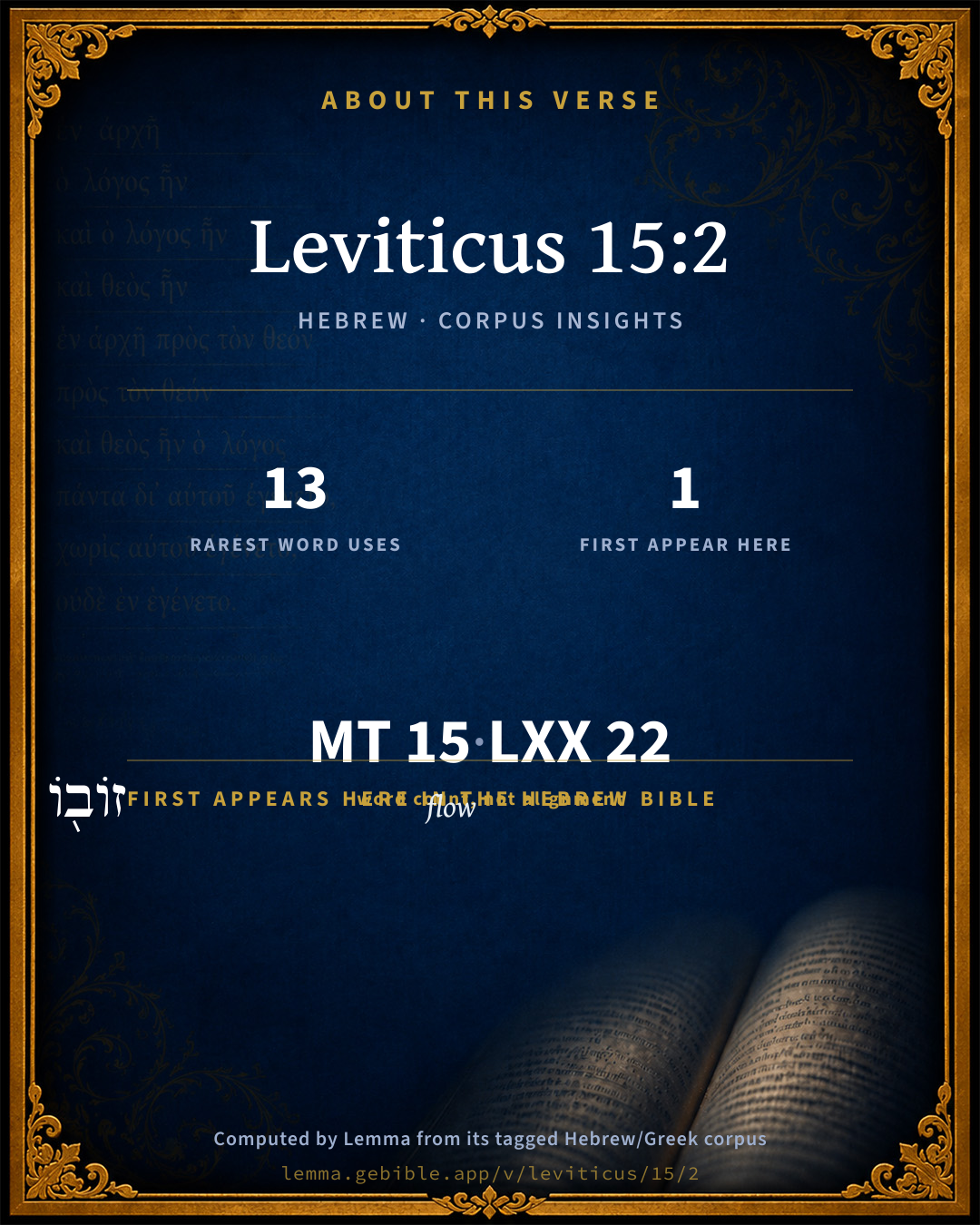
Leviticus 15:2

Hebrew (Westminster Leningrad Codex) Leviticus 15:2 appears in the Hebrew Old Testament. The text above is from the Westminster Leningrad Codex. Each word links to its Strong’s number, a concise gloss, and parsing drawn from the Open Scriptures Hebrew Bible morphology. Click any word for its full Brown-Driver-Briggs (BDB) entry.
Download image
Cite this verse

Leviticus 15:2 (World English Bible). Public Domain. Lemma interlinear Bible study tool, https://lemma.gebible.app/v/leviticus/15/2.

Show BibTeX & RIS
BibTeX
RIS
English Translation
"Speak to the children of Israel, and tell them, 'When any man has a discharge from his body, because of his discharge he is unclean.
World English Bible · Public Domain
Highlights
  • 1 first appearance in the Hebrew Bible
Full analysis ↓
Download a study sheet

One document with this verse’s original text, its word-by-word gloss line, the meaning frame, cross-references with their text, attributed commentary, and full source and license credits — printable, and it pastes into notes with its structure intact.

This verse Autodidact and up

Study sheet (.html) Plain text (.txt)

A passage Seminary Student

Up to 50 verses in one chapter. A passage sheet keeps up to 6 commentary sources and 12 cross-references per verse, in the order this page ranks them, and says so on the sheet whenever that leaves anything out. Ask for a single verse and you get the Autodidact verse sheet above.

Everything on this page stays free to read, with no account — the sheet is a download of what is already on screen, not access to it.

Want to remove ads? Support Godless Engineer
Compare translations 3

The same verse in 3 English versions, stacked beneath the original-language interlinear above. Click any original word for its lexicon entry.

Each is an independent rendering of the whole verse — the interlinear is not word-aligned to these translations.

Highlighted words mark where these versions differ — a whole-verse word diff, not a word-by-word alignment.

  • World English Bible Public Domain
    "Speak to the children of Israel, and tell them, 'When any man has a discharge from his body, because of his discharge he is unclean.
  • King James Version Public Domain
    Speak unto the children of Israel, and say unto them, When any man hath a running issue out of his flesh, because of his issue he is unclean.
  • unfoldingWord Literal Text CC BY-SA 4.0
    “Speak to the sons of Israel, and you shall say to them, ‘A man, a man, when he is flowing from his flesh, his flow—it unclean.

unfoldingWord Literal Text — © unfoldingWord, licensed CC BY-SA 4.0. Word-aligned USFM3 via Door43 (git.door43.org/unfoldingWord/en_ult).

Versions to compare (up to 4)

3 of 4 selected

Show all 18 translations

Every available English version of this verse, each an independent rendering of the whole verse.

  • World English Bible Public Domain
    "Speak to the children of Israel, and tell them, 'When any man has a discharge from his body, because of his discharge he is unclean.
  • Berean Standard Bible Public Domain
    “Say to the Israelites, ‘When any man has a bodily discharge, the discharge is unclean.
  • Majority Standard Bible Public Domain
    “Say to the Israelites, ‘When any man has a bodily discharge, the discharge is unclean.
  • King James Version Public Domain
    Speak unto the children of Israel, and say unto them, When any man hath a running issue out of his flesh, because of his issue he is unclean.
  • American Standard Version (1901) Public Domain
    Speak unto the children of Israel, and say unto them, When any man hath an issue out of his flesh, because of his issue he is unclean.
  • Revised Version (1885) Public Domain
    Speak unto the children of Israel, and say unto them, When any man hath an issue out of his flesh, because of his issue he is unclean.
  • Geneva Bible (1599) Public Domain
    Speake vnto the children of Israel, and say vnto them, Whosoeuer hath an issue from his flesh, is vncleane, because of his issue.
  • Douay-Rheims (1899) Public Domain
    Speak to the children of Israel, and say to them: The man that hath an issue of seed, shall be unclean.
  • Young's Literal Translation Public Domain
    `Speak unto the sons of Israel, and ye have said unto them, When there is an issue out of the flesh of any man, `for' his issue he `is' unclean;
  • Literal Standard Version CC BY-SA 4.0
    “Speak to the sons of Israel, and you have said to them: When there is discharging out of the flesh of any man, he [is] unclean [from] his discharge;
  • Unlocked Literal Bible CC BY-SA 4.0
    “Speak to the people of Israel, and say to them, 'When any man has an infected fluid that comes out of his body, he becomes unclean.
  • unfoldingWord Literal Text CC BY-SA 4.0
    “Speak to the sons of Israel, and you shall say to them, ‘A man, a man, when he is flowing from his flesh, his flow—it unclean.
  • Darby Bible Public Domain
    Speak unto the children of Israel, and say unto them, If any man have a flux from his flesh, because of his flux he is unclean.
  • World Messianic Bible Public Domain
    “Speak to the children of Israel, and tell them, ‘When any man has a discharge from his body, because of his discharge he is unclean.
  • Webster's Bible Public Domain
    Speak to the children of Israel, and say to them, When any man hath a running issue out of his flesh, because of his issue he is unclean.
  • Free Bible Version CC BY-SA 4.0
    “Tell the Israelites, When any man has a discharge from his genitals, the discharge is unclean.
  • Bible in Basic English Public Domain
    Say to the children of Israel: If a man has an unclean flow from his flesh, it will make him unclean.
  • JPS Tanakh (1917) Public Domain
    Speak unto the children of Israel, and say unto them: When any man hath an issue out of his flesh, his issue is unclean.

Literal Standard Version (2020), Covenant Press — licensed CC BY-SA 4.0. Text via the HelloAO Bible API (eBible.org). Unlocked Literal Bible (unfoldingWord) — licensed CC BY-SA 4.0. Text via the HelloAO Bible API (eBible.org). unfoldingWord Literal Text — © unfoldingWord, licensed CC BY-SA 4.0. Word-aligned USFM3 via Door43 (git.door43.org/unfoldingWord/en_ult). Free Bible Version, Dr. Jonathan Gallagher — licensed CC BY-SA 4.0. Text via the HelloAO Bible API (eBible.org).

Word by word

More ways to search: Search by grammar → Find every occurrence → Compare this word →

Practice this passage: Drill this verse → Learn its vocabulary →

זוֹב֖וֹ
zôwb
H2101
“flow · his”
Noun, Common, Masculine, Singular, Construct + Suffix, Personal, 3rd Person, Masculine, Singular
Part of Speech
Noun
Type
Common
Gender
Masculine
Number
Singular
State
Construct
Full BDB Definition

Origin: from H2100

TWOT: 534a

a flow, issue, discharge, flux - semen, discharge (venereal disease) (of men) - issue, flux (of woman)
  1. דַּבְּרוּ֙ dâbar H1696 “speak” Verb, Piel, Imperative, 2nd Person, Masculine, Plural
  2. אֶל ʼêl H413 “to” Preposition
  3. בְּנֵ֣י bên H1121 “sons of” Noun, Common, Masculine, Plural, Construct
  4. יִשְׂרָאֵ֔ל Yisrâʼêl H3478 “Israel” Noun, Proper
  5. וַאֲמַרְתֶּ֖ם ʼâmar H559 “and · to say” Conjunction + Verb, Qal, Sequential Perfect, 2nd Person, Masculine, Plural
  6. אֲלֵהֶ֑ם ʼêl H413 “to · them” Preposition + Suffix, Personal, 3rd Person, Masculine, Plural
  7. אִ֣ישׁ ʼîysh H376 “man” Noun, Common, Masculine, Singular, Absolute
  8. אִ֗ישׁ ʼîysh H376 “man” Noun, Common, Masculine, Singular, Absolute
  9. כִּ֤י kîy H3588 “that” Conjunction
  10. יִהְיֶה֙ hâyâh H1961 “to be” Verb, Qal, Imperfect, 3rd Person, Masculine, Singular
  11. זָ֣ב zûwb H2100 “flowing” Verb, Qal, Participle Active, Masculine, Singular, Absolute
  12. מִבְּשָׂר֔וֹ bâsâr H1320 “from · flesh · his” Preposition + Noun, Common, Masculine, Singular, Construct + Suffix, Personal, 3rd Person, Masculine, Singular
  13. טָמֵ֥א ṭâmêʼ H2931 “unclean” Adjective, Adjective, Masculine, Singular, Absolute
  14. הֽוּא hûwʼ H1931 “he” Pronoun, Personal, 3rd Person, Masculine, Singular

About this verse

These counts appear in no published source. They are computed here, from the morphology-tagged text and Lemma’s own curated glosses. What Lemma adds →

15
words
13
distinct lemmas
Pentateuch
section

Notable vocabulary

The rarest word here is זוֹב֖וֹ flow H2101 — appearing just 13 times in the whole Hebrew Bible.

First appearance in Scripture

This word makes its first canonical appearance in the Hebrew Bible here:

  • זוֹב֖וֹ flow H2101

Shared distinctive vocabulary

זוֹב֖וֹ flow H2101 occurs in 10 verses of the Hebrew Bible. Also found in:

Grammatical profile

  • 4 verbs
  • 6 nouns
  • 1 adjective
  • 1 pronoun
  • 2 prepositions
  • 1 conjunction

Verb forms

  • דַּבְּרוּ֙ Piel · Imperative
  • וַאֲמַרְתֶּ֖ם Qal · Sequential Perfect
  • יִהְיֶה֙ Qal · Imperfect
  • זָ֣ב Qal · Participle Active

Repetition

Words recur within this verse — often emphatic in Hebrew:

  • אִ֣ישׁ man H376 ×2
  • אֶל to H413 ×2

Hebrew & Septuagint length

In English translation the verse runs 25 words from the Hebrew and 26 from the Septuagint (LXX English) — closely comparable.

A rough comparison of the two English renderings, which tokenize alike — not a word-level alignment.

Word counts can differ between the Hebrew and the Greek without any difference in meaning — e.g. the Hebrew direct-object marker אֵת has no separate Greek word, and Greek often adds the article ὁ.

In the original languages it is 15 Hebrew tokens and 22 Greek tokens — but the two are counted differently (Hebrew bundles its prefixes and suffixes into one token; the Greek is in lemma form), so that isn’t a like-for-like length.

Cross-references

12

Topical passages linked to Leviticus 15:2 in the Treasury of Scripture Knowledge — connected by theme and wording, ordered by reader-vote popularity; previews shown in the World English Bible.

  • Leviticus 22:4 "'Whoever of the seed of Aaron is a leper or has an issue; he shall not eat of the holy things, until he is clean. Whoever touches anything that is unclean by the dead, or a man whose seed goes from him;
  • Numbers 5:2 "Command the children of Israel that they put out of the camp every leper, and everyone who has an issue, and whoever is unclean by the dead.
  • 2 Samuel 3:29 let it fall on the head of Joab, and on all his father's house; and let there not fail from the house of Joab one who has an issue, or who is a leper, or who leans on a staff, or who falls by the sword, or who lacks bread.
  • Matthew 9:20 Behold, a woman who had an issue of blood for twelve years came behind him, and touched the tassels of his garment;
  • Deuteronomy 4:7–8 For what great nation is there, that has a god so near to them, as Yahweh our God is whenever we call on him?
  • Nehemiah 9:13–14 You came down also on Mount Sinai, and spoke with them from heaven, and gave them right ordinances and true laws, good statutes and commandments,
  • Psalms 78:5 For he established a testimony in Jacob, And appointed a law in Israel, Which he commanded our fathers, That they should make them known to their children;
  • Psalms 147:19–20 He shows his word to Jacob; His statutes and his ordinances to Israel.
  • Mark 5:25 A certain woman, who had an issue of blood for twelve years,
  • Mark 7:20–23 He said, "That which proceeds out of the man, that defiles the man.
  • Luke 8:43 A woman who had a flow of blood for twelve years, who had spent all her living on physicians, and could not be healed by any,
  • Romans 3:2 Much in every way! Because first of all, they were entrusted with the oracles of God.

Cross-references courtesy of OpenBible.info (CC BY 4.0).

Hebrew and Greek witnesses Masoretic Hebrew ↔ Greek Septuagint

The same verse in the two great witnesses to the Old Testament, shown verse-for-verse.

These are two independent witnesses, not word-aligned to each other, and the Septuagint is shown in lemma (dictionary) form.

Hebrew Leviticus 15:2 Masoretic · Westminster Leningrad Codex

דַּבְּרוּ֙ אֶל בְּנֵ֣י יִשְׂרָאֵ֔ל וַאֲמַרְתֶּ֖ם אֲלֵהֶ֑ם אִ֣ישׁ אִ֗ישׁ כִּ֤י יִהְיֶה֙ זָ֣ב מִבְּשָׂר֔וֹ זוֹב֖וֹ טָמֵ֥א הֽוּא

"Speak to the children of Israel, and tell them, 'When any man has a discharge from his body, because of his discharge he is unclean.

World English Bible · Public Domain

Greek LXX Leviticus 15:2 Septuagint · lemma form

λαλέω ὁ υἱός ἰσραήλ καί εἶπον αὐτός ἀνήρ ἀνήρ ὅς ἐάν γίγνομαι ῥύσις ἐκ ὁ σῶμα αὐτός ὁ ῥύσις αὐτός ἀκάθαρτος εἰμί

Speak to the children of Israel, and you shall say to them, Whatever man shall have an issue out of his body, his issue is unclean.

LXX2012 (modern English Septuagint) · Public Domain

On this verse, Adam Clarke's Commentary discusses the Septuagint’s reading. Read the note in Commentary ↓

Hebrew: Westminster Leningrad Codex (CC BY 4.0). Greek: Septuagint (public domain); English from LXX2012 (modern English Septuagint) (Public Domain). How the Septuagint differs from the Hebrew →

Targum (Aramaic paraphrase)

2

The Targum is the ancient Jewish Aramaic paraphrase of the Hebrew Scriptures — an interpretive translation, not the Hebrew text itself. Onkelos (literal) and Pseudo-Jonathan (expansive) render the Torah, and Jonathan the Prophets. Coverage is partial: where no permissively-licensed English translation exists for a verse, only the Aramaic is shown. This is verse-level text, not a word-by-word alignment to the Hebrew.

  1. Targum Onkelos Torah (Genesis–Deuteronomy)
    מַלִילוּ עִם בְּנֵי יִשְׂרָאֵל וְתֵימְרוּן לְהוֹן גְבַר גְבַר אֲרֵי יְהֵי דָאִיב מִבִּשְׂרֵהּ דוֹבֵהּ מְסָאָב הוּא

    (no public-domain English translation for this verse)

    Targum Onkelos — Aramaic: “Onkelos Genesis” (public domain); “Onkelos Exodus” (public domain); “Onkelos Leviticus” (public domain); “Onkelos Numbers” (public domain); “Onkelos Deuteronomy” (public domain). English: “Sefaria Community Translation” (CC0 1.0 (public-domain dedication)); “J.W. Etheridge. The Targums of Onkelos and Jonathan Ben Uzziel on the Pentateuch. London: Longmans, Green, 1862” (public domain). Text via Sefaria.

  2. Targum Pseudo-Jonathan Torah (Genesis–Deuteronomy)
    מַלִילוּ עִם בְּנֵי יִשְרָאֵל וְתֵימְרוּן לְהוֹן גְבַר טְלֵי אוֹ גְבַר סִיב אַרוּם יְהֵי דָאִיב מִבִּשְרֵיהּ דְוָיֵיהּ חֲמָא תְּלַת זִימְנֵי מְסָאָב הוּא

    Speak with the sons of Israel, and say to them: A man, whether young or old, who hath a defluxion from his flesh, when he hath seen it three times, is unclean.

    Targum Pseudo-Jonathan — Aramaic: “Targum Jonathan on Genesis” (public domain); “Targum Jonathan on Exodus” (public domain); “Targum Jonathan on Leviticus” (public domain); “Targum Jonathan on Numbers” (public domain); “Targum Jonathan on Deuteronomy” (public domain). English: “The Targum of Jonathan ben Uzziel, trans. J. W. Etheridge, London, 1862” (public domain). Text via Sefaria.

Commentary

Notes on Leviticus 15:2 from classic Christian and Jewish commentators (each source and its license shown beneath its notes). The classic Christian expositions comment on the surrounding passage and are grouped to its opening verse, so a note may address several verses; the Jewish commentaries on the Tanakh (Rashi and others) are per-verse, so they appear only where the commentator wrote on this verse.

Lemma curates 59 commentaries, every one of them public domain or Creative Commons licensed, each selected and text-cleaned for this edition rather than reprinted as found. About our sources →

Trapp's Complete Commentary

John Trapp

Lev 15:2 Speak unto the children of Israel, and say unto them, When any man hath a running issue out of his flesh, [because of] his issue he [is] unclean.

Ver. 2. A running issue.] An involuntary flux of semin, such as David imprecateth upon Joab. {2Sa 3:29}

John Trapp, A Commentary or Exposition upon All the Books of the Old and New Testament (1647–1656) — public domain. Text from a community e-Sword module.

The Biblical Illustrator

Joseph S. Exell

Lev_15:2-33

Because of his issue he is unclean.

Human nature unclean

1. We learn, in a very striking manner, the intense holiness of the Divine presence. Not a soil, not a stain, not a speck can be tolerated for a moment in that thrice-hallowed region.

2. Again, we learn that human nature is the ever-flowing fountain of uncleanness. It is hopelessly defiled and defiling.

3. Finally, we learn, afresh, the expiatory value of the blood of Christ, and the cleansing, sanctifying virtues of the precious Word of God. When we think of the unsullied purity of the sanctuary, and then reflect upon natures irremediable defilement, and ask the question, However can we enter and dwell there? the answer is found in the blood and water which flowed from the side of a crucified Christ--a Christ who gave up His life unto death for us, that we might live by Him. (C. H. Mackintosh.)

Secret uncleanness

All the uncleannesses here enumerated are such as were, for the most part, unknown except to the individual alone. They must, therefore, refer to sins of solitude and secrecy. The lesson is here taught that we may be great sinners without anybody else knowing anything about it. There may be a very correct exterior life, and yet a secret cherishing of pride, and lust, and unbelief, and a secret painting of the walls with imagery, as much unfitting us for the society of the pure and good as any open and outbreaking wickedness. The lively imagination of a gay, poetic mind is not less sinful when it scatters forth its luscious images, than the dull, brutal feelings of the stupid, ignorant boor. Even the quiet and involuntary exudations of natural feeling are often to be numbered with the uncleanest things. It is amazing how deep-seated the contaminations of sin are. A man may be truly penitent. He may be set to be a good servant of God; and yet, every now and then, he will find the disgusting uncleanness of sin quietly and unintentionally escaping from him, contaminating himself and those who come in contact with him or touch what he has touched. His whole nature is yet so full of remaining corruption that the least agitation causes it to trickle over. He lies down to sleep, and presently he finds it in his dreams. He puts forth his hand to welcome a friend, and the very touch sometimes awakes wrong echoes in the soul. He is accidentally thrown into the mere neighbourhood of sin, and the very atmosphere about him seems at times to be laden with excitations of impurity. His depravity cleaves to him like an old sore. Nor are these secret and involuntary outflowings of corruption mere trifles, unworthy of notice. They are here set forth under images and types among the most offensive and disgusting. They are too loathsome for public recital--too hideous even for the mind to dwell upon. God intends thus to signify His deep abhorrence of our inherent corruptions. He means to intimate to us that we have reason to be ashamed and confounded at the secret disorder which still works in us. Nay, He yet adds to these defilements a judicial sentence. They were uncleannesses which excluded from the sanctuary and everything holy. They brought condemnation with them. And some of them were so bad as to need atonement by blood. We need, therefore, to be on our guard against the beginnings of evil. It is indeed melancholy that we, as Christians, still have so much impurity cleaving to us. But still it is not without its good effects. We need something to keep us humble, to drive us continually to the throne of grace, and to keep us ever mindful of our dependence upon the mercy of God. It helps to soften us towards the failings of others, and to make us charitable in our judgments of offenders. It helps greatly to reconcile us to the idea of dying. It contributes to make our dying day a blessed day, because it will put an everlasting end to these vexations. Then we shall be delivered. from the body of this death. (J. A. Seiss, D. D.)

Purity required

In tins chapter the defilement of sin is the leading thought. Here again there can be no doubt that there was a sanitary element in the regulations. Cleanliness is next to godliness is not, as some suppose, a Bible sentence, but it is beyond all question a Bible sentiment. The first all-embracing law of the Mosaic economy is, Be holy. And the second is like unto it, Be clean: clean in person, clean in garments, clean in house, clean in camp, clean everywhere. Who can tell how much the world owes to these health laws of Moses? It is certainly a curious thing, writes one who is an authority on the subject, worthy the notice of every student of the progress of the human race, whether his standpoint be religious or purely scientific, that the moving camp in the wilderness was governed by as strict and perfect a sanitary code as any sanitary commission could now devise. But in the Mosaic institutes the purity of the soul was ever kept before the mind as the main thing to be desired and secured. Our hearts sprinkled from an evil conscience, was always the first thing; our bodies washed with pure water was the second (Heb_10:22); and throughout the book of the law these two have been by God so joined together that no candid mind can put them asunder. (J. M. Gibson, D. D.)

Cleanliness a religious dut

y:--We get here an illustration of that which so often occurs in the law of Moses, viz., that duties of the lowest, humblest order are urged on the people by the highest and noblest sanctions. Common work may be dignified by great motives. It will be regarded by a wise Christian man as a part of his duty which is by no means to be neglected, to maintain order and unsullied cleanliness in person and home. (C. Clemance, D. D.)

The secret flow of sin from the natural heart, typified in the running issue

We are here taught the disgusting constancy with which our original, deep-seated corruption will naturally discover itself. In all situations, towards all persons, at all seasons, this filthiness of the secret soul may be traced. In Lev_15:4 the man is represented as unclean when he lieth down to sleep, or even to rest at noon. Ah! yonder lies a sinner, and the very ground under him is accursed. His very pillow may shortly become a spear under his throat; just as Jonahs rest soon became a tempestuous sea. A friend comes to see him and gently wakes him, but touches his couch in so doing, and becomes thereby unclean (verse 5); for the man is all polluted. However amiable the friend you visit, yet, if still in his unhealed corruption, your intercourse with him spreads its baleful influence over you. You have insensibly been injured by the contact. Oh, how we should watch our souls in mingling with a world lying in wickedness l Oh, how holy, how marvellously strong in holiness was Jesus, who breathed this polluted air and remained as holy as when He came! If the man leave the spot, and another occupy it, that other has seated himself in the sinners place (verse 6), and the memory of his sin is not gone. He is in contact with a polluted thing. As when one of us now reads the details of a sinners career, and our mind rests thereon, we are involved in this sin. If a physician (verse 7) or an attendant touch the sick mans flesh, he is in contact with sin, and becomes polluted. This legal consequence of any actual contact with the defiled shows us, no doubt, the danger and hazard of even attempting to aid the polluted. It is at the risk of being ourselves involved in their sin. Therefore it must be watchfully done, not boldly and adventurously. You breathe an impure atmosphere: proceed with caution. If (verse 8) any even accidental touch occur--as if the diseased man spit or sneeze, so as anything from him reaches the bystander, pollution is spread. An accidental word, a casual expression, an unexpected look, may suggest sin; and if it does, forthwith wash it all away ere evening comes. Let not the sun go down upon thy wrath. Leave no stain for a moment upon thy conscience. When the man rides forth, lo! yonder is a sinner; and his saddle is polluted; and the mattress he spread on the floor of his tent for a temporary rest in his journey (verse 10) is so polluted that the attendant who lifts it is defiled. Oh! sad, sad estate of man! In going out or coming in, in the house or by the way, his inward fountain of sin flows on unceasingly, and the Holy One of Israel follows him with His eye to mark him as a sinner. Nay, if he put his hand forth (verse 11) to touch any one-to give him a friendly welcome, or aid him in any work, he conveys pollution, unless he have first rinsed his hands in water. The sinner, whose natural heart is still unhealed, cannot do even a kind act without sin--his only mode of doing so would be washing in clean water. And the vessels he uses (verse 12)must be broken or rinsed in water; even as the earth, on which the sinner has stood as his theatre for committing evil shall be broken in pieces by the fire of the last day (All these things shall be dissolved, 2Pe_3:11), the trial by water being already past. (A. A. Bonar.)

Atonement required for secret sins

A full atonement is required for our inward, secret sins, as much as for open and flagrant sins. The sinful vision that our fancy spread out before us for a moment must be washed away by blood. The tendency which our soul felt to sympathise in that act of resentment or revenge must be washed away by blood. The hour, or minutes, we spent in brooding over our supposed hard lot must be redeemed by blood. The selfish wish we cherished for special prosperity in some undertaking that was to reflect its credit on us only, is to be washed away by blood. The proud aspiration, the sensual impulse, the world-loving eye or soul cast on earths glories, must be washed away by blood. The darkness, ignorance, suspicion, and misconception we entertain toward God and His salvation, retest be washed in blood. Behold, Thou desirest truth in the inward parts, and in the hidden part (hidden region of the soul) Thou shalt make me to know wisdom (Psa_51:6). (A. A. Bonar.)

Impurity a contagious evil

All those details of Divine precept, by which every person and article anywise brought into contact with the unclean man or woman became unclean, bring out the truth that impurity is an essentially communicable evil. It is so physically; let sinners look to it. It is so spiritually. How guilty in the very last degree are those who drive a nefarious trade in corrupt literature! How shameful to put indecent thought into print to pollute the young! How demoralising to the soul, how displeasing to God, how scrupulously to be avoided, the questionable conversation that borders on the indelicate and impure! (see Eph_5:3-4; Eph_5:12; Col_3:8). (W. Clarkson.)

Beware of contact with sinful persons

All this mystically teaches us to beware of courting or choosing the conversation of those that have received any tincture of vice, and not to contract acquaintance with any persons who we have reason to believe are not on good terms with God. There is such a venomous contagion in vice and immorality that familiarity with sinners does, of itself, make a man an associate in their practices: so saith the son of Sirach (Sir_13:1), and thus the apostle commands (1Ti_5:22). (Biblioth. Bibl.)

Plain speaking on the subject of purity

That plain speaking and plain dealing, such as we find here, was necessary, is amply proved by the history of the ancient world, and of the modern world too. The Bible is the only book that has exercised any considerable effect in keeping men and women pure. There are many books, where everything offensive to the ear is studiously avoided, which nevertheless are very poison to the soul. In the Bible, on the other hand, while there is not a little that is offensive to the ear, there is absolutely nothing that is poisonous to the spirit, unless the spirit has been poisoned already; for we must remember that while to the pure all things are pure, unto them that are defiled and unbelieving is m thing pure, but even their mind and conscience is defiled. There is absolutely nothing in the entire Bible that will not exert a holy and purifying influence on those who read it in the right spirit. And as a historical fact, such has been the result among those who have made these Scriptures their companion and counsellor. The Jews alone among the nations of antiquity had even the conception of purity as we understand it now. Consider for a moment whence we derive those exalted notions of purity which are widely prevalent in modern society, especially among Christian people. Even the purest and the best of Greek philosophers, those who in other respects have come nearest to Bible ethics, are wofully behind in regard to personal purity of heart and life, some of them tolerating and others approving that which enlightened Christian sentiment utterly condemns. Let any one fairly investigate the genesis and evolution of our modern ideas of chastity and purity and he will find that they are traceable chiefly to the Hebrew Scriptures as their source. And so the remarkable fact will present itself that to these very Scriptures, and largely to those parts of them which the corrupt imagination of certain cavillers finds an indecency which is all its own, we owe that very sentiment of delicacy which makes it impossible for us to read them aloud in public or in the family. (J. M. Gibson, D. D.)

.

The Biblical Illustrator, edited by Joseph S. Exell (c. 1880s–1900s) — public domain. Text from a community e-Sword module.

Joseph Benson's Commentary

Lev 15:2. A running issue — A grievous and loathsome disease, and generally the consequence of sin. Such a one was in a state of uncleanness all the time it was upon him. “If it proceeded merely from innocent, accidental causes,” says Maimonides, “as a strain in the back, carrying too great a burden, or violent leaping, the man was not defiled with it, nor concerned in this law.”

Joseph Benson's Commentary on the Old and New Testaments (1811–1818) — public domain. Text from a community e-Sword module.

Tyndale Open Study Notes

Tyndale Open Resources

15:2 bodily discharge (literally a flowing from his flesh): Most scholars interpret the word flesh as a euphemism for sexual organs and the symptoms described here as indicating an infection of gonorrhea. Others suggest that it refers to a discharge of semen or even diarrhea. A discharge of semen is unlikely, however, because that is singled out in 15:16-17 and required only washing with water. It is clear that this bodily discharge proceeded from “under the man” (15:10) and contaminated anything he sat on or lay upon (15:4, 6, 9).

Tyndale Open Study Notes — © Tyndale Open Resources, licensed CC BY-SA 4.0. Text via the HelloAO Bible API.

Geneva Bible (1599)

Geneva Bible translators

Whose seed either in sleeping, or else of weakness of nature issueth at his secret part.

Geneva Bible (1599) marginal notes — public domain. Text via Bolls.life.

Adam Clarke's Commentary

Verse 2. When any man hath a running issue] The cases of natural uncleanness, both of men and women, mentioned in this chapter, taken in a theological point of view, are not of such importance to us as to render a particular description necessary, the letter of the text being, in general, plain enough. The disease mentioned in the former part of this chapter appears to some to have been either the consequence of a very bad infection, or of some criminal indulgence; for they find that it might be communicated in a variety of ways, which they imagine are here distinctly specified. On this ground the person was declared unclean, and all commerce and connection with him strictly forbidden. The Septuagint version renders הזב hazzab, the man with the issue, by ὁ γονορῥυης, the man with a gonorrhoea, no less than nine times in this chapter; and that it means what in the present day is commonly understood by that disorder, taken not only in its mild but in its worst sense, they think there is little room to doubt. Hence they infer that a disease which is supposed to be comparatively recent in Europe, has existed almost from time immemorial in the Asiatic countries; that it ever has been, in certain measures, what it is now; and that it ever must be the effect of sensual indulgence, and illicit and extravagant intercourse between the sexes. The disgraceful disorder referred to here is a foul blot which the justice of God in the course of providence has made in general the inseparable consequent of these criminal indulgences, and serves in some measure to correct and restrain the vice itself. In countries where public prostitution was permitted, where it was even a religious ceremony among those who were idolaters, this disease must necessarily have been frequent and prevalent. When the pollutions and libertinism of former times are considered, it seems rather strange that medical men should have adopted the opinion, and consumed so much time in endeavouring to prove it, viz., that the disease is modern. It must have existed, in certain measures, ever since prostitution prevailed in the world; and this has been in every nation of the earth from its earliest era. That the Israelites might have received it from the Egyptians, and that it must, through the Baal-peor and Ashteroth abominations which they learned and practised, have prevailed among the Moabites, c., there can be little reason to doubt. Supposing this disease to be at all hinted at here, the laws and ordinances enjoined were at once wisely and graciously calculated to remove and prevent it. By contact, contagion of every kind is readily communicated and to keep the whole from the diseased must be essential to the check and eradication of a contagious disorder. This was the wise and grand object of this enlightened Legislator in the ordinances which he lays down in this chapter. I grant, however, that it was probably of a milder kind in ancient times; that it has gained strength and virulence by continuance; and that, associated with some foreign causes, it became greatly exacerbated in Europe about 1493, the time in which some have supposed it first began to exist, though there are strong evidences of it in this country ever since the eleventh century.

Adam Clarke's Commentary on the Bible (1810–1826) — public domain. Text from a community e-Sword/MySword module.

Ellicott's Commentary for English Readers

(2) A running issue out of his flesh.—Flesh, as is frequently the case, euphemistically denotes private parts. (See Gen_6:10; Gen_7:13; Lev_6:3; Lev_16:4; Eze_16:26; Eze_23:20, &c.)

Because of his issue he is unclean.—Better, his issue is unclean. Hence, any one coming in contact with it, or with the garment on which traces of the secretion are found, is thereby rendered unclean.

A Bible Commentary for English Readers, edited by Charles John Ellicott (1878–1897) — public domain. Text from a community e-Sword module.

The Cambridge Bible for Schools and Colleges

gen. ed. J. J. S. Perowne

The Uncleanness of Issues and their Cleansing

As regards men (1–18)

2. an issue out of his flesh] by flesh is here meant the private parts, as in Lev_6:10, Lev_16:4. Everything which a man in this condition touched was unclean, so that anyone coming in contact with the man, or with anything that he had touched, must wash his clothes and bathe himself in water, and was not considered purified until the evening.

The Cambridge Bible for Schools and Colleges (gen. ed. J. J. S. Perowne; Cambridge University Press, 1878–1918) — public domain. Text from a community e-Sword module.

John Gill's Exposition

Speak unto the children of Israel,.... From whence we learn, says the above mentioned writer, that these uncleannesses were only usual among the children of Israel, not among the Gentiles; that is, the laws respecting them were only binding on the one, and not on the other (s):

and say unto them, when any man; in the Hebrew text it is, "a man, a man", which the Targum of Jonathan paraphrases, a young man, and an old man:

hath a running issue out of his flesh; what physicians call a "gonorrhoea", and we, as in the margin of our Bibles, "the running of the reins":

because of his issue, he is unclean; in a ceremonial sense, though it arises from a natural cause; but if not from any criminal one, from a debauch, but from a strain, or some such like thing, the man was not defiled, otherwise he was; the Targum of Jonathan is,"if he sees it three times he is unclean;''so the Misnah (t).

(s) So Maimon. & Bartenora in Misn. Edaiot, c. 5. sect. 1. (t) Zabim, c. 1. sect. 1. Maimon. & Bartenora in ib.

John Gill's Exposition of the Whole Bible (1746–1763) — public domain (CC PDM 1.0). Text via the HelloAO Bible API.

Haydock's Catholic Bible Commentary

Issue of seed, shall be unclean. These legal uncleannesses were instituted in order to give the people a horror of carnal impurities. (Challoner) --- If the gonorrhœa, and the lawful act of marriage, (ver. 16,) and nocturnal delusions, (Deuteronomy xxiii. 10,) induce a kind of uncleanness---surely to imitate Onan is most detestable, Genesis xxviii. 9. (Tirinus) --- The Jews rank the latter crime with murder, and so does Tertullian. See Exodus xxi. 22.

George Leo Haydock (1774–1849), Haydock's Catholic Family Bible and Commentary, 1859 edition — public domain. Excludes Psalms (Douay-Rheims chapter numbering differs from Protestant) and Deuterocanonical books (Catholic canon only).

Matthew Poole's English Annotations

His secret parts, called

flesh, Lev 6:10; 12:3; Eze 16:26; 23:20.

Matthew Poole's English Annotations on the Holy Bible (1683–1685) — public domain. Text from a community e-Sword/MySword module.

Whedon's Commentary on the Bible

Daniel D. Whedon

2. Issue out of his flesh — The word flesh is here a euphemism for the part on which circumcision was performed. “My covenant shall be in your flesh.” Gen_17:13. The Targum of Palestine adds, “When the man hath seen the defluxion three times, he is unclean.” The Seventy have translated the “issue” by gonorrhea. Keil questions the existence of this disease in its syphilitic character at so early a period, and inclines to the theory of an involuntary flow, drop by drop, through weakness, and he suggests that its more appropriate name is blenorrhea urethrae, a catarrhal affection of the mucus membrane of the urethra.

Daniel D. Whedon (gen. ed.), Commentary on the Old and New Testaments (1874–1909) — public domain. Text from a community e-Sword module.

The Pulpit Commentary

Vers. 2-15. The first case of an issue. It appears to be identical with the disease called by physicians gonorrhea, or, perhaps, blenorrhea. (cf. Lev_22:4 Num_5:2)

The Pulpit Commentary (1880–1919), ed. H.D.M. Spence-Jones & Joseph S. Exell — public domain. Text from a community e-Sword module.

John Wesley's Explanatory Notes

A running issue - Commonly called the running of the reins, a grievous and loathsome disease, which is generally the consequence of sin.

John Wesley, Explanatory Notes Upon the Whole Bible (1754–1765) — public domain. Text via the GEBible commentary corpus.

Keil & Delitzsch

C. F. Keil & F. Delitzsch

The running issue from a man is not described with sufficient clearness for us to be able to determine with certainty what disease is referred to: "if a man becomes flowing out of his flesh, he is unclean in his flux." That even here the term flesh is not a euphemism for the organ of generation, as is frequently assumed, is evident from Lev 15:13, "he shall wash his clothes and bathe his flesh in water," when compared with Lev 16:23-24, Lev 16:28, etc., where flesh cannot possibly have any such meaning. The "flesh" is the body as in Lev 15:7, "whoever touches the flesh of him that hath the issue," as compared with Lev 15:19, "whosoever toucheth her." At the same time, the agreement between the law relating to the man with an issue and that concerning the woman with an issue (Lev 15:19, "her issue in her flesh") points unmistakeably to a secretion from the sexual organs. Only the seat of the disease is not more closely defined. The issue of the man is not a hemorrhoidal disease, for nothing is said about a flow of blood; still less is it a syphilitic suppuration (gonorrhaea virulenta), for the occurrence of this at all in antiquity is very questionable; but it is either a diseased flow of semen (gonorrhaea), i.e., an involuntary flow drop by drop arising from weakness of the organ, as Jerome and the Rabbins assume, or more probably, simply blenorrhaea urethrae, a discharge of mucus arising from a catarrhal affection of the mucous membrane of the urethra (urethritis). The participle זב יהיה is expressive of continued duration. In Lev 15:3 the uncleanness is still more closely defined: "whether his flesh run with his issue, or his flesh closes before his issue," i.e., whether the member lets the matter flow out or by closing retains it, "it is his uncleanness," i.e., in the latter case as well as the former it is uncleanness to him, he is unclean. For the "closing" is only a temporary obstruction, brought about by some particular circumstance.

Keil & Delitzsch — Biblical Commentary on the Old Testament (1861–1891) — public domain (CC PDM 1.0). Text via the HelloAO Bible API. (Old Testament only.)

Rashi

Rabbi Shlomo Yitzchaki (Rashi)

כי יהיה זב WHEN THERE BE A RUNNING ISSUE — One might think if there be a running issue from any portion of his body (e. g., ear, nose) he shall be unclean! Therefore it states מבשרו “from his flesh" (i.e. from some part of his flesh) and not from all parts of his flesh (the prefix מ is a partitive מ). Now, however, that Scripture has made a difference between one part of his flesh and another part of his flesh, I have the right to draw a conclusion: it (the Torah) pronounces uncleanness in a case of a man with a running issue (זב) and it pronounces uncleanness in a particular case of a woman with a running issue (זבה). How is it in the case of a זבה? Through that place in her body where she becomes unclean with a lighter uncleanness, viz., that of a נדה, she also becomes unclean with a more stringent uncleanness i.e. through זיבה, a continuance of the issue beyond the usual period! Similarly the זב: through the place where he becomes unclean with a lighter uncleanness, viz., קרי, (an involuntary emission of semen which makes him unclean only until evening; cf. v. 16), he also becomes unclean through a more stringent uncleanness, viz., זיבה (when he is unclean seven days and must bring a sacrifice; cf. vv. 13 ff. with 16 ff.; from the latter it is evident which part of the body is in question; it follows logically that the same part is here intended) (Sifra, Metzora Parashat Zavim, Section 1 5).

טמא‎ זובו HIS ISSUE IS UNCLEAN — This teaches regarding a drop (i.e. the semen itself) that it communicates uncleanness (and it is not only the man that has the issue who is unclean) (Sifra, Metzora Parashat Zavim, Section 1 8-9; Niddah 55a). The זב issue referred to here is similar to water of dough (that runs out of dough) made of barley and it is dissolved (fluid) being similar to the white of an addled egg (where the white and the yolk have run together); שכבת זרע, however, is viscid and looks like the white of an egg that has not become addled (Niddah 35b).

Rashi on the Tanakh — English translations: “The Judaica Press complete Tanach with Rashi, translated by A. J. Rosenberg” (CC BY 4.0); “Pentateuch with Rashi's commentary by M. Rosenbaum and A.M. Silbermann, 1929-1934” (public domain); “The Metsudah Tanach series, Lakewood, N.J” (CC BY 4.0); and “The Book of Joshua, Metsudah Publications, 1997” (CC BY 4.0). Text via Sefaria.

Lesson kit

Teaching starters — assembled from the data on this page, not authored interpretation. Every prompt links to the verse data it draws on. Edit before teaching.

Leviticus, in the Pentateuch, opens this verse with 15 words (13 distinct Hebrew lemmas). Its most distinctive word is zôwb (“flow”). A historical commentator’s framing appears above. Read the whole chapter for the surrounding context.

Discussion questions

  1. The word zôwb carries the sense “flow.” How does it shape the verse?
  2. The word “flow” first appears here in Scripture. What is being introduced at this debut?
  3. Leviticus 15:3 shares the word «flow» with this verse. How do the two illuminate each other?
  4. “man” occurs 2× in this one verse. What is the effect of the repetition?
  5. These translations render this verse differently. What is at stake in choosing one wording over another?
  6. The verb «דַּבְּרוּ֙» is Piel Imperative. How does its form color the action?
  7. Reading how Trapp's Complete Commentary and The Biblical Illustrator read this verse, where do the two commentators agree and where do they part?

Things to notice

Reading settings

Reading text

Shown beneath each verse's original-language words.

Old Testament
Old Testament edition

Read the OT as the Masoretic Hebrew (MT) or the Greek Septuagint (LXX).

English shown for the Greek Septuagint (in the Hebrew ↔ Greek comparison).

Comparing translations? Open the Compare panel on any verse page to stack up to four side by side.