Ezra 10:25

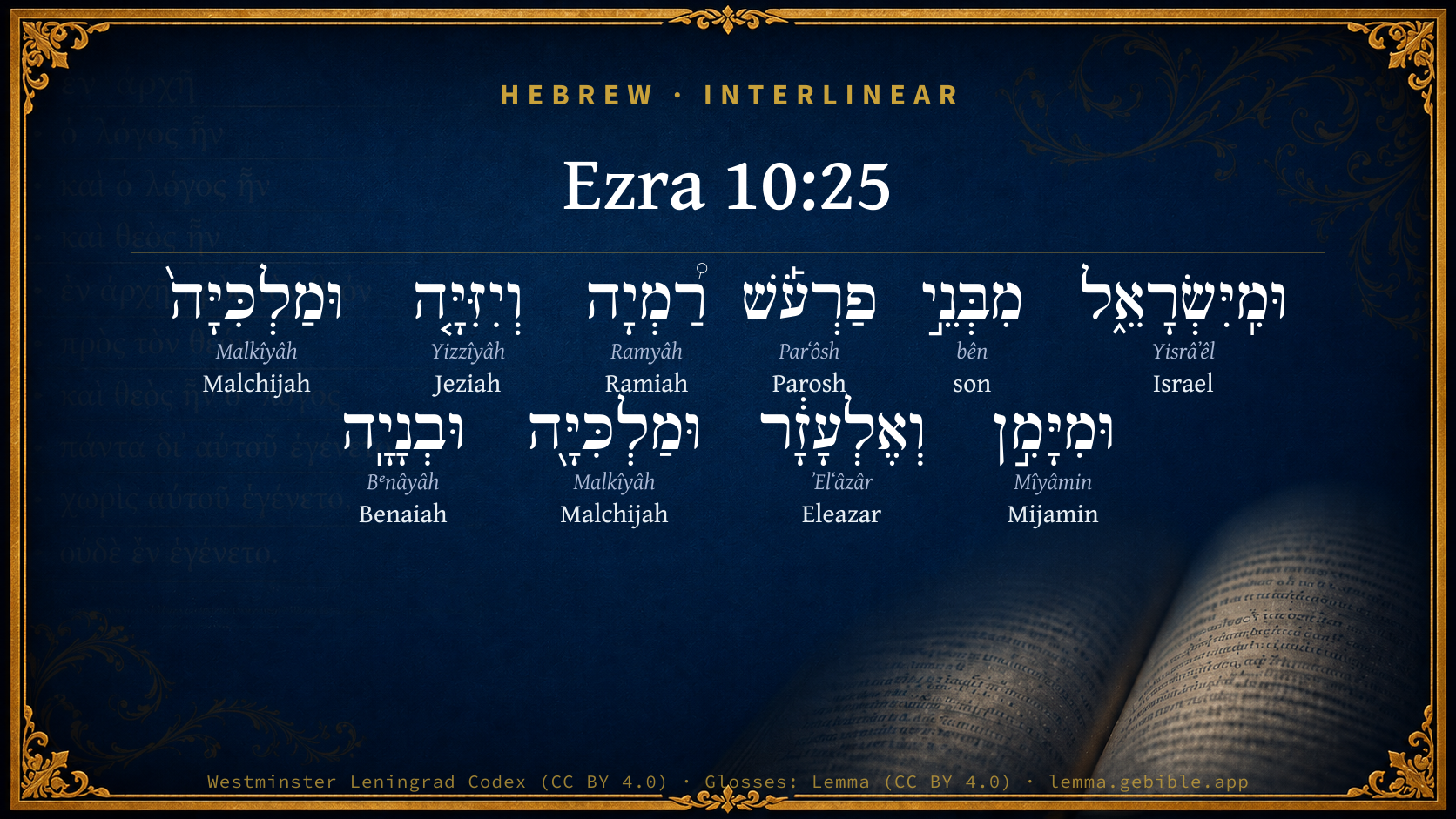
Hebrew (Westminster Leningrad Codex) Ezra 10:25 appears in the Hebrew Old Testament. The text above is from the Westminster Leningrad Codex. Each word links to its Strong’s number, a concise gloss, and parsing drawn from the Open Scriptures Hebrew Bible morphology. Click any word for its full Brown-Driver-Briggs (BDB) entry.
Download image
Cite this verse

Ezra 10:25 (World English Bible). Public Domain. Lemma interlinear Bible study tool, https://lemma.gebible.app/v/ezra/10/25.

Show BibTeX & RIS
BibTeX
RIS
English Translation
Of Israel: Of the sons of Parosh: Ramiah, and Izziah, and Malchijah, and Mijamin, and Eleazar, and Malchijah, and Benaiah.
World English Bible · Public Domain
Highlights
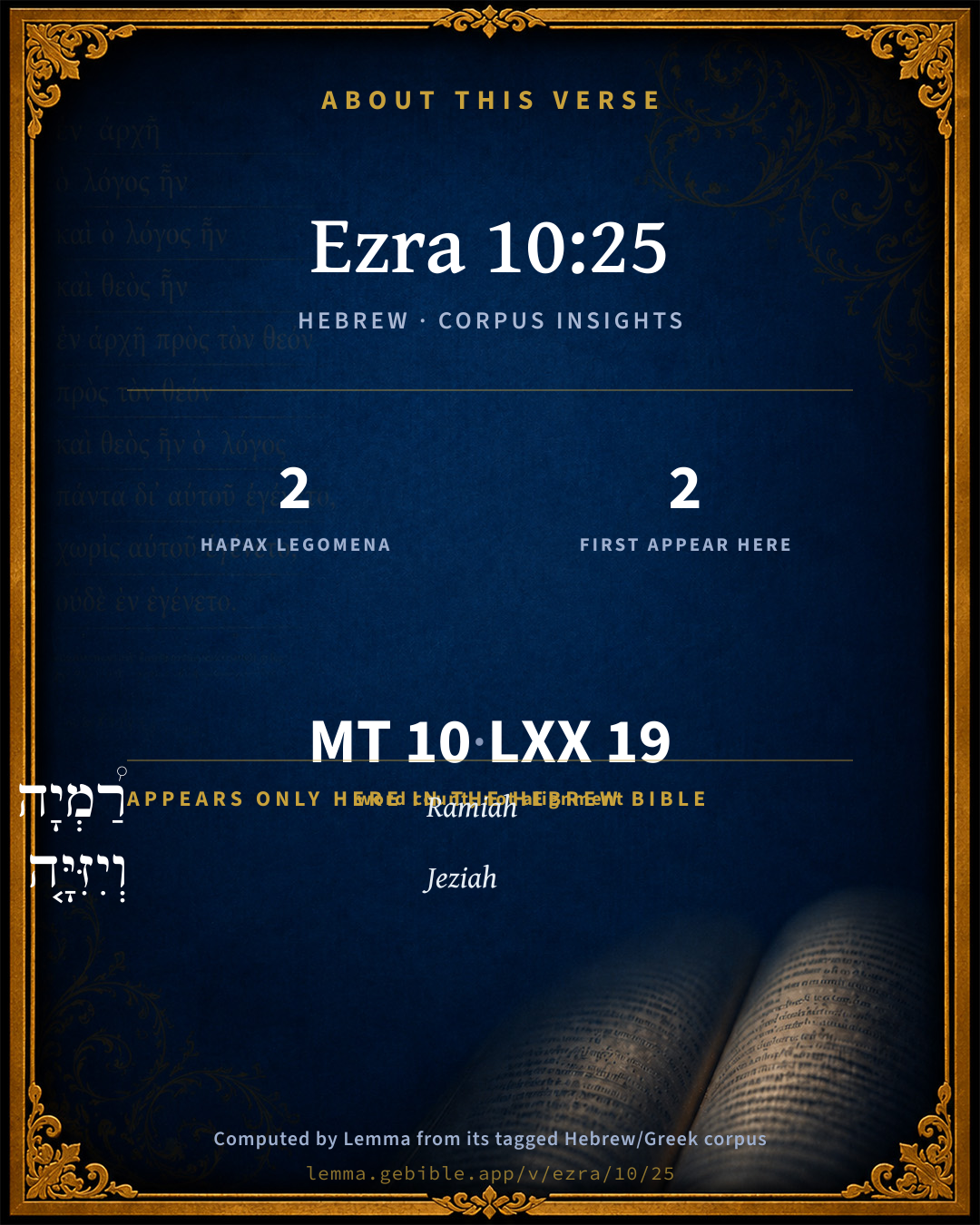
  • 2 hapax legomena — only here in the Hebrew Bible
  • 2 first appearances in the Hebrew Bible
Full analysis ↓
Download a study sheet

One document with this verse’s original text, its word-by-word gloss line, the meaning frame, cross-references with their text, attributed commentary, and full source and license credits — printable, and it pastes into notes with its structure intact.

This verse Autodidact and up

Study sheet (.html) Plain text (.txt)

A passage Seminary Student

Up to 50 verses in one chapter. A passage sheet keeps up to 6 commentary sources and 12 cross-references per verse, in the order this page ranks them, and says so on the sheet whenever that leaves anything out. Ask for a single verse and you get the Autodidact verse sheet above.

Everything on this page stays free to read, with no account — the sheet is a download of what is already on screen, not access to it.

Want to remove ads? Support Godless Engineer
Compare translations 3

The same verse in 3 English versions, stacked beneath the original-language interlinear above. Click any original word for its lexicon entry.

Each is an independent rendering of the whole verse — the interlinear is not word-aligned to these translations.

Highlighted words mark where these versions differ — a whole-verse word diff, not a word-by-word alignment.

  • World English Bible Public Domain
    Of Israel: Of the sons of Parosh: Ramiah, and Izziah, and Malchijah, and Mijamin, and Eleazar, and Malchijah, and Benaiah.
  • King James Version Public Domain
    Moreover of Israel: of the sons of Parosh; Ramiah, and Jeziah, and Malchiah, and Miamin, and Eleazar, and Malchijah, and Benaiah.
  • unfoldingWord Literal Text CC BY-SA 4.0
    And these were from Israel. From the sons of Parosh: Ramiah, and Izziah, and Malkijah, and Mijamin, and Eleazar, and Malkijah, and Benaiah.

unfoldingWord Literal Text — © unfoldingWord, licensed CC BY-SA 4.0. Word-aligned USFM3 via Door43 (git.door43.org/unfoldingWord/en_ult).

Versions to compare (up to 4)

3 of 4 selected

Show all 18 translations

Every available English version of this verse, each an independent rendering of the whole verse.

  • World English Bible Public Domain
    Of Israel: Of the sons of Parosh: Ramiah, and Izziah, and Malchijah, and Mijamin, and Eleazar, and Malchijah, and Benaiah.
  • Berean Standard Bible Public Domain
    And among the other Israelites, from the descendants of Parosh: Ramiah, Izziah, Malchijah, Mijamin, Eleazar, Malchijah, and Benaiah.
  • Majority Standard Bible Public Domain
    And among the other Israelites, from the descendants of Parosh: Ramiah, Izziah, Malchijah, Mijamin, Eleazar, Malchijah, and Benaiah.
  • King James Version Public Domain
    Moreover of Israel: of the sons of Parosh; Ramiah, and Jeziah, and Malchiah, and Miamin, and Eleazar, and Malchijah, and Benaiah.
  • American Standard Version (1901) Public Domain
    And of Israel: Of the sons of Parosh: Ramiah, and Izziah, and Malchijah, and Mijamin, and Eleazar, and Malchijah, and Benaiah.
  • Revised Version (1885) Public Domain
    And of Israel: of the sons of Parosh; Ramiah, and Izziah, and Malchijah, and Mijamin, and Eleazar, and Malchijah, and Benaiah.
  • Geneva Bible (1599) Public Domain
    And of Israel: of the sonnes of Parosh, Ramiah, and Iesiah, and Malchiah, and Miamin, and Eleazar, and Malchiiah, and Benaiah.
  • Douay-Rheims (1899) Public Domain
    And of Israel, of the sons of Pharos, Remeia, and Jezia, and Melchia, and Miamin, and Eliezer, and Melchia, and Banea.
  • Young's Literal Translation Public Domain
    And of Israel: of the sons of Parosh: Ramiah, and Jeziah, and Malchijah, and Miamin, and Eleazar, and Malchijah, and Benaiah.
  • Literal Standard Version CC BY-SA 4.0
    And of Israel: of the sons of Parosh: Ramiah, and Jeziah, and Malchijah, and Miamin, and Eleazar, and Malchijah, and Benaiah.
  • Unlocked Literal Bible CC BY-SA 4.0
    Among the rest of the Israelites—among the descendants of Parosh: Ramiah, Izziah, Malchijah, Mijamin, Eleazar, Malchijah, and Benaiah.
  • unfoldingWord Literal Text CC BY-SA 4.0
    And these were from Israel. From the sons of Parosh: Ramiah, and Izziah, and Malkijah, and Mijamin, and Eleazar, and Malkijah, and Benaiah.
  • Darby Bible Public Domain
    And of Israel; of the children of Parosh: Ramiah, and Jizzijah, and Malchijah, and Mijamin, and Eleazar, and Malchijah, and Benaiah.
  • World Messianic Bible Public Domain
    Of Israel: Of the sons of Parosh: Ramiah, Izziah, Malchijah, Mijamin, Eleazar, Malchijah, and Benaiah.
  • Webster's Bible Public Domain
    Moreover, of Israel: of the sons of Parosh; Ramiah, and Jeziah, and Malchiah, and Miamin, and Eleazar, and Malchijah, and Benaiah.
  • Free Bible Version CC BY-SA 4.0
    Among the Israelites: From the sons of Parosh: Ramiah, Izziah, Malkijah, Mijamin, Eleazar, Hashabiah, and Benaiah.
  • Bible in Basic English Public Domain
    And of Israel, the sons of Parosh, Ramiah and Izziah and Malchijah and Mijamin and Eleazar and Malchijah and Benaiah.
  • JPS Tanakh (1917) Public Domain
    And of Israel: of the sons of Parosh: Ramiah, and Izziah, and Malchijah, and Mijamin, and Eleazar, and Malchijah, and Benaiah.

Literal Standard Version (2020), Covenant Press — licensed CC BY-SA 4.0. Text via the HelloAO Bible API (eBible.org). Unlocked Literal Bible (unfoldingWord) — licensed CC BY-SA 4.0. Text via the HelloAO Bible API (eBible.org). unfoldingWord Literal Text — © unfoldingWord, licensed CC BY-SA 4.0. Word-aligned USFM3 via Door43 (git.door43.org/unfoldingWord/en_ult). Free Bible Version, Dr. Jonathan Gallagher — licensed CC BY-SA 4.0. Text via the HelloAO Bible API (eBible.org).

Word by word

More ways to search: Search by grammar → Find every occurrence → Compare this word →

Practice this passage: Drill this verse → Learn its vocabulary →

About this verse

These counts appear in no published source. They are computed here, from the morphology-tagged text and Lemma’s own curated glosses. What Lemma adds →

10
words
9
distinct lemmas
Historical
section

Notable vocabulary

2 hapax legomena — words that appear only here in the entire Hebrew Bible:

  • רַ֠מְיָה Ramiah H7422
  • וְיִזִּיָּ֤ה Jeziah H3150

First appearance in Scripture

These words make their first canonical appearance in the Hebrew Bible here:

  • רַ֠מְיָה Ramiah H7422
  • וְיִזִּיָּ֤ה Jeziah H3150

Shared distinctive vocabulary

וּמִיָּמִ֣ן Mijamin H4326 occurs in 4 verses of the Hebrew Bible. Also found in:

Grammatical profile

  • 10 nouns

Repetition

A word recurs within this verse — often emphatic in Hebrew:

  • וּמַלְכִּיָּה֙ Malchijah H4441 ×2

Hebrew & Septuagint length

In English translation the verse runs 20 words from the Hebrew and 21 from the Septuagint (LXX English) — closely comparable.

A rough comparison of the two English renderings, which tokenize alike — not a word-level alignment.

Word counts can differ between the Hebrew and the Greek without any difference in meaning — e.g. the Hebrew direct-object marker אֵת has no separate Greek word, and Greek often adds the article ὁ.

In the original languages it is 10 Hebrew tokens and 19 Greek tokens — but the two are counted differently (Hebrew bundles its prefixes and suffixes into one token; the Greek is in lemma form), so that isn’t a like-for-like length.

Cross-references

2

Topical passages linked to Ezra 10:25 in the Treasury of Scripture Knowledge — connected by theme and wording, ordered by reader-vote popularity; previews shown in the World English Bible.

  • Ezra 2:3 The children of Parosh, two thousand one hundred seventy-two.
  • Nehemiah 7:8 The children of Parosh, two thousand one hundred seventy-two.

Cross-references courtesy of OpenBible.info (CC BY 4.0).

Hebrew and Greek witnesses Masoretic Hebrew ↔ Greek Septuagint

The same verse in the two great witnesses to the Old Testament, shown verse-for-verse.

These are two independent witnesses, not word-aligned to each other, and the Septuagint is shown in lemma (dictionary) form.

Hebrew Ezra 10:25 Masoretic · Westminster Leningrad Codex

וּמִֽיִּשְׂרָאֵ֑ל מִבְּנֵ֣י פַרְעֹ֡שׁ רַ֠מְיָה וְיִזִּיָּ֤ה וּמַלְכִּיָּה֙ וּמִיָּמִ֣ן וְאֶלְעָזָ֔ר וּמַלְכִּיָּ֖ה וּבְנָיָֽה

Of Israel: Of the sons of Parosh: Ramiah, and Izziah, and Malchijah, and Mijamin, and Eleazar, and Malchijah, and Benaiah.

World English Bible · Public Domain

Greek LXX Ezra 10:25 Septuagint · lemma form

καί ἀπό ἰσραήλ ἀπό υἱός φορος ραμια καί ιαζια καί μελχια καί μεαμιν καί ελεαζαρ καί ασαβια καί βαναια

Also of Israel: of the sons of Phoros; Ramia, and Azia, and Melchia, and Meamin, and Eleazar, and Asabia, and Banaia.

LXX2012 (modern English Septuagint) · Public Domain

In the Septuagint this is one book — Esdras B (2 Esdras): Ezra is chapters 1–10, Nehemiah 11–23.

On this verse, Keil & Delitzsch discusses the Septuagint’s reading. Read the note in Commentary ↓

Hebrew: Westminster Leningrad Codex (CC BY 4.0). Greek: Septuagint (public domain); English from LXX2012 (modern English Septuagint) (Public Domain). How the Septuagint differs from the Hebrew →

Commentary

Notes on Ezra 10:25 from classic Christian and Jewish commentators (each source and its license shown beneath its notes). The classic Christian expositions comment on the surrounding passage and are grouped to its opening verse, so a note may address several verses; the Jewish commentaries on the Tanakh (Rashi and others) are per-verse, so they appear only where the commentator wrote on this verse.

Lemma curates 59 commentaries, every one of them public domain or Creative Commons licensed, each selected and text-cleaned for this edition rather than reprinted as found. About our sources →

The Cambridge Bible for Schools and Colleges

gen. ed. J. J. S. Perowne

25–43. Israel, or the laity

as distinguished from priests and Levites. Cf. Ezr_2:2 ‘the men of the people of Israel’. Ezr_9:1 ‘the people of Israel, and the priests and the Levites’.

Moreover of Israel] R.V. And of Israel. There is no variety to break the simplicity of the list. The names of the houses here mentioned have all been mentioned in chap. 2. Thus

Parosh (Ezr_10:25)

in Ezr_2:3 :

number of offenders

7

Elam (Ezr_10:26)

in Ezr_2:7

number of offenders

6

Zattu (Ezr_10:27)

in Ezr_2:8

number of offenders

6

Bebai (Ezr_10:28)

in Ezr_2:11

number of offenders

4

Bani (Ezr_10:29)

in Ezr_2:10

number of offenders

6

Pahath-Moab (Ezr_10:30)

in Ezr_2:6

number of offenders

8

Harim (Ezr_10:31)

in Ezr_2:32

number of offenders

8

Hashum (Ezr_10:33)

in Ezr_2:19

number of offenders

7

Bani (Ezr_10:34)

in Ezr_2:10

number of offenders

27

Nebo (Ezr_10:43)

in Ezr_2:29

number of offenders

7

In this list, as compared with that in Ezra 2, the following points may be observed:

(a) The house of Bani is twice mentioned (Ezr_10:29 and Ezr_10:33). This is almost certainly due to an early error in the text. The conjecture that the name of Bigvai (Ezr_2:14) or of Bezai (Ezr_2:17) should be, in one instance or the other, substituted for that of Bani is not improbable, especially as otherwise there are seven houses (Ezr_2:12-19) in succession not mentioned here.

(b) The disproportionately large number of offenders belonging to the second Bani (Ezr_10:34) makes it probable that we have lost the names of three other houses. It will be noticed that the ‘sons of Nebo’ are the only representatives of about twenty towns mentioned in Ezr_2:21-35.

(c) The order of the list of houses is here quite different from that of Ezra 2, an illustration probably of the faithfulness with which the various extant lists were reproduced.

The Cambridge Bible for Schools and Colleges (gen. ed. J. J. S. Perowne; Cambridge University Press, 1878–1918) — public domain. Text from a community e-Sword module.

Joseph Benson's Commentary

Ezr 10:25. Moreover of Israel — Of the people of Israel, distinguished from the priests and Levites hitherto named, who before, Ezr 10:9, were called Judah and Benjamin.

Joseph Benson's Commentary on the Old and New Testaments (1811–1818) — public domain. Text from a community e-Sword module.

Geneva Bible (1599)

Geneva Bible translators

Meaning, of the common people: for before he spake of the Priests and Levites.

Geneva Bible (1599) marginal notes — public domain. Text via Bolls.life.

Adam Clarke's Commentary

Verse 25. Moreover of Israel] That is, as Calmet observes, simple Israelites, to distinguish them from the priests, Levites, and singers, mentioned in Ezr 10:18; Ezr 10:23; Ezr 10:24.

Adam Clarke's Commentary on the Bible (1810–1826) — public domain. Text from a community e-Sword/MySword module.

Haydock's Catholic Bible Commentary

Israel. Laymen, (Calmet) not of the tribe of Levi. (Menochius)

George Leo Haydock (1774–1849), Haydock's Catholic Family Bible and Commentary, 1859 edition — public domain. Excludes Psalms (Douay-Rheims chapter numbering differs from Protestant) and Deuterocanonical books (Catholic canon only).

Matthew Poole's English Annotations

Of Israel, i.e. of the people of Israel, distinguished from the priests and the Levites hitherto named, who before were called Judah and Benjamin, Ezr 10:9, See Poole "Ezr 10:9".

Matthew Poole's English Annotations on the Holy Bible (1683–1685) — public domain. Text from a community e-Sword/MySword module.

Whedon's Commentary on the Bible

Daniel D. Whedon

25. Moreover of Israel — That is, of non-official or simple Israelites, as distinguished from the priests, Levites, and singers just mentioned. The names of the chief fathers of this list are all found in the list of those who returned from Babylon with Zerubbabel, chap. 2. The Bani of Ezr_10:34 is not to be identified with the Bani of Ezr_10:29. The latter is probably the Bani of Ezr_2:10, while the other is, perhaps, a corruption of Bezai, (of Ezr_2:17,) or possibly the name of some person not mentioned at all in the list of chapter 2.

Daniel D. Whedon (gen. ed.), Commentary on the Old and New Testaments (1874–1909) — public domain. Text from a community e-Sword module.

The Pulpit Commentary

Of Israel. i.e. "of the laity."

The Pulpit Commentary (1880–1919), ed. H.D.M. Spence-Jones & Joseph S. Exell — public domain. Text from a community e-Sword module.

John Wesley's Explanatory Notes

Of Israel - Of the people of Israel, distinguished from the priests and Levites hitherto named.

John Wesley, Explanatory Notes Upon the Whole Bible (1754–1765) — public domain. Text via the GEBible commentary corpus.

Keil & Delitzsch

C. F. Keil & F. Delitzsch

Of Israel, as distinguished from priests and Levites, i.e., of the laity. Of these latter are given in all eighty-six names, belonging to ten races, vv. 25-43, who returned with Zerubbabel. See Nos. 1, 5, 6, 9, 8, 4, 30, 17, and 27 of the survey of these races. ירמות in Ezr 10:29 should, according to the Chethiv, be read ירמות. - The twofold naming of sons of Bani in this list (Ezr 10:29 and Ezr 10:34) is strange, and Bani is evidently in one of these places a mistake for some other name. Bertheau supposes that Bigvai may have stood in the text in one of these places. The error undoubtedly lies in the second mention of Bani (Ezr 10:34), and consists not merely in the wrong transcription of this one name. For, while of every other race four, six, seven, or eight individuals are named, no less than seven and twenty names follow בּני מבּני, though all these persons could hardly have belonged to one race, unless the greater number of males therein had married strange wives. Besides, no names of inhabitants of cities of Judah and Benjamin are given in this list (as in Ezr 2:21-28, and Ezr 2:33-35), although it is stated in Ezr 10:7 and Ezr 10:14 that not only the men of Jerusalem, but also dwellers in other cities, had contracted these prohibited marriages, and been summoned to Jerusalem, that judgment might be pronounced in their several cases. These reasons make it probable that the twenty-seven persons enumerated in Ezr 10:34-42 were inhabitants of various localities in Judah, and not merely individuals belonging to a single house. This supposition cannot, however, be further corroborated, since even the lxx and 1 Esdr. read the name Bani in Ezr 10:27 and Ezr 10:34, nor can any conjecture respecting the correct reading laying claim to probability be ventured on. In the single names, the Greek texts of the Septuagint and 1 Esdras frequently differ from the Hebrew text, but the differences are almost all of a kind to furnish no material for criticism. A considerable number of these names reappear in the lists of names in the book of Nehemiah, but under circumstances which nowhere make the identity of the persons bearing them certain.

Keil & Delitzsch — Biblical Commentary on the Old Testament (1861–1891) — public domain (CC PDM 1.0). Text via the HelloAO Bible API. (Old Testament only.)

Lesson kit

Teaching starters — assembled from the data on this page, not authored interpretation. Every prompt links to the verse data it draws on. Edit before teaching.

Ezra, in the Historical, opens this verse with 10 words (9 distinct Hebrew lemmas). Its most distinctive word is Ramyâh (“Ramiah”). A historical commentator’s framing appears above. Read the whole chapter for the surrounding context.

Discussion questions

  1. What does “Ramiah” (Ramyâh) contribute to the verse as a whole?
  2. This verse holds 2 words here found nowhere else in the Hebrew Bible. What might the rare words draw attention to?
  3. 2 words here appear for the first time in Scripture. What is being introduced at this debut?
  4. 1 Chronicles 24:9 shares the word «Mijamin» with this verse. How do the two illuminate each other?
  5. “Malchijah” occurs 2× in this one verse. What is the effect of the repetition?
  6. These translations render this verse differently. What is at stake in choosing one wording over another?
  7. Reading how The Cambridge Bible for Schools and Colleges and Joseph Benson's Commentary read this verse, where do the two commentators agree and where do they part?

Things to notice

  • 2 words in this verse appear nowhere else in the Hebrew Bible.
  • 2 words make their first canonical appearance in Scripture here.
  • This verse counts 10 Hebrew ↔ 19 Greek words.
  • These translations choose different wording for 8 words in this verse.
  • “Malchijah” occurs 2× in this single verse.

Reading settings

Reading text

Shown beneath each verse's original-language words.

Old Testament
Old Testament edition

Read the OT as the Masoretic Hebrew (MT) or the Greek Septuagint (LXX).

English shown for the Greek Septuagint (in the Hebrew ↔ Greek comparison).

Comparing translations? Open the Compare panel on any verse page to stack up to four side by side.