Leviticus 17:2

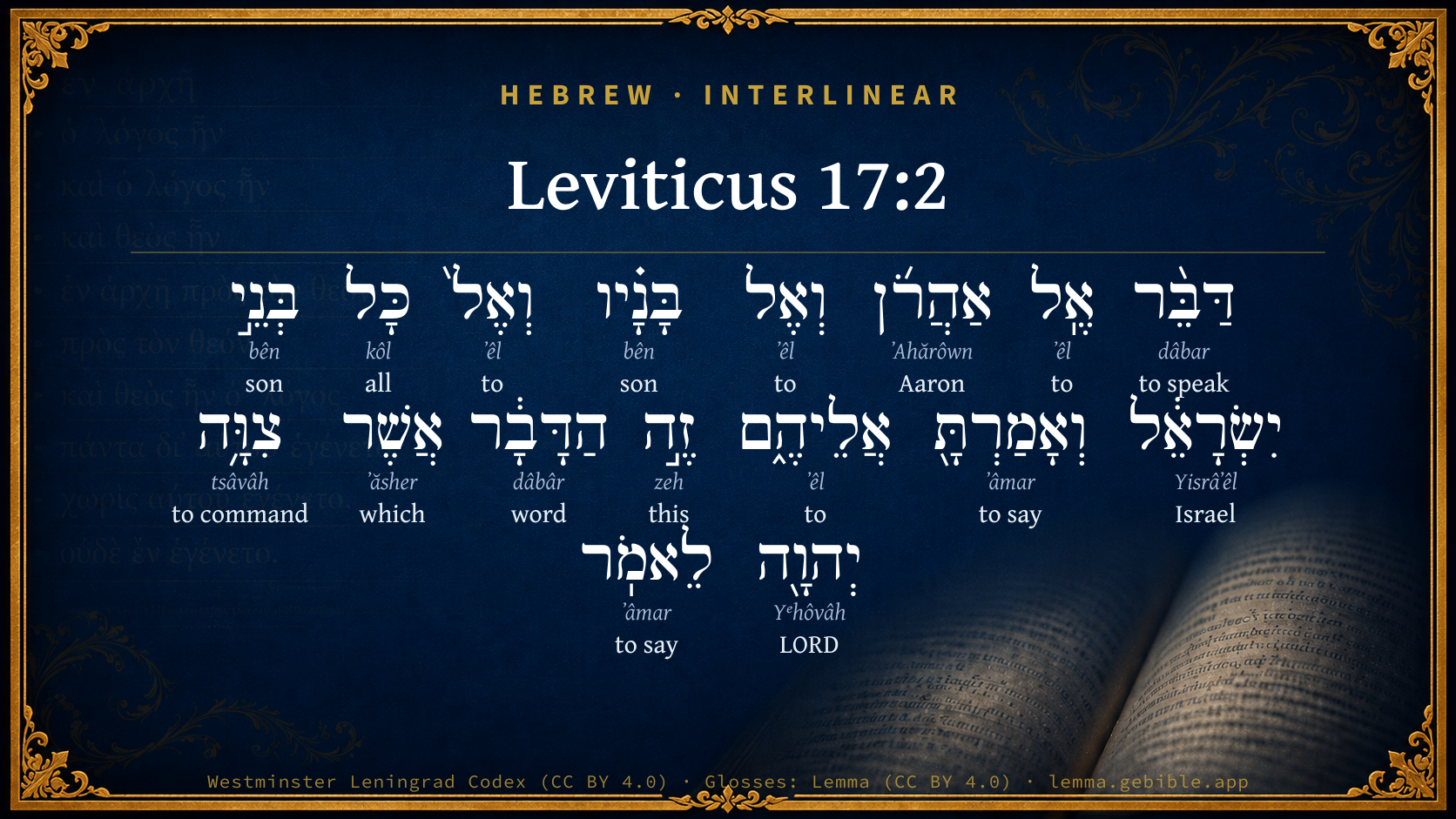
Hebrew (Westminster Leningrad Codex) Leviticus 17:2 appears in the Hebrew Old Testament. The text above is from the Westminster Leningrad Codex. Each word links to its Strong’s number, a concise gloss, and parsing drawn from the Open Scriptures Hebrew Bible morphology. Click any word for its full Brown-Driver-Briggs (BDB) entry.
Download image
Cite this verse

Leviticus 17:2 (World English Bible). Public Domain. Lemma interlinear Bible study tool, https://lemma.gebible.app/v/leviticus/17/2.

Show BibTeX & RIS
BibTeX
RIS
English Translation
"Speak to Aaron, and to his sons, and to all the children of Israel, and say to them: 'This is the thing which Yahweh has commanded,
World English Bible · Public Domain
Download a study sheet

One document with this verse’s original text, its word-by-word gloss line, the meaning frame, cross-references with their text, attributed commentary, and full source and license credits — printable, and it pastes into notes with its structure intact.

This verse Autodidact and up

Study sheet (.html) Plain text (.txt)

A passage Seminary Student

Up to 50 verses in one chapter. A passage sheet keeps up to 6 commentary sources and 12 cross-references per verse, in the order this page ranks them, and says so on the sheet whenever that leaves anything out. Ask for a single verse and you get the Autodidact verse sheet above.

Everything on this page stays free to read, with no account — the sheet is a download of what is already on screen, not access to it.

Want to remove ads? Support Godless Engineer
Compare translations 3

The same verse in 3 English versions, stacked beneath the original-language interlinear above. Click any original word for its lexicon entry.

Each is an independent rendering of the whole verse — the interlinear is not word-aligned to these translations.

Highlighted words mark where these versions differ — a whole-verse word diff, not a word-by-word alignment.

  • World English Bible Public Domain
    "Speak to Aaron, and to his sons, and to all the children of Israel, and say to them: 'This is the thing which Yahweh has commanded,
  • King James Version Public Domain
    Speak unto Aaron, and unto his sons, and unto all the children of Israel, and say unto them; This is the thing which the LORD hath commanded, saying,
  • unfoldingWord Literal Text CC BY-SA 4.0
    “Speak to Aaron and to his sons and to all the sons of Israel, and you shall say to them, ‘This the thing that Yahweh commanded, saying,

unfoldingWord Literal Text — © unfoldingWord, licensed CC BY-SA 4.0. Word-aligned USFM3 via Door43 (git.door43.org/unfoldingWord/en_ult).

Versions to compare (up to 4)

3 of 4 selected

Show all 18 translations

Every available English version of this verse, each an independent rendering of the whole verse.

  • World English Bible Public Domain
    "Speak to Aaron, and to his sons, and to all the children of Israel, and say to them: 'This is the thing which Yahweh has commanded,
  • Berean Standard Bible Public Domain
    “Speak to Aaron, his sons, and all the Israelites and tell them this is what the LORD has commanded:
  • Majority Standard Bible Public Domain
    “Speak to Aaron, his sons, and all the Israelites and tell them this is what the LORD has commanded:
  • King James Version Public Domain
    Speak unto Aaron, and unto his sons, and unto all the children of Israel, and say unto them; This is the thing which the LORD hath commanded, saying,
  • American Standard Version (1901) Public Domain
    Speak unto Aaron, and unto his sons, and unto all the children of Israel, and say unto them: This is the thing which Jehovah hath commanded, saying,
  • Revised Version (1885) Public Domain
    Speak unto Aaron, and unto his sons, and unto all the children of Israel, and say unto them; This is the thing which the LORD hath commanded, saying,
  • Geneva Bible (1599) Public Domain
    Speake vnto Aaron, and to his sonnes, and to all the children of Israel, and say vnto them, This is the thing which the Lord hath commanded, saying,
  • Douay-Rheims (1899) Public Domain
    Speak to Aaron and his sons, and to all the children of Israel, saying to them: This is the word, which the Lord hath commanded, saying:
  • Young's Literal Translation Public Domain
    `Speak unto Aaron, and unto his sons, and unto all the sons of Israel; and thou hast said unto them, This `is' the thing which Jehovah hath commanded, saying,
  • Literal Standard Version CC BY-SA 4.0
    “Speak to Aaron and to his sons, and to all the sons of Israel; and you have said to them: This [is] the thing which YHWH has commanded, saying,
  • Unlocked Literal Bible CC BY-SA 4.0
    “Speak to Aaron and to his sons, and to all the people of Israel. Tell them what Yahweh has commanded:
  • unfoldingWord Literal Text CC BY-SA 4.0
    “Speak to Aaron and to his sons and to all the sons of Israel, and you shall say to them, ‘This the thing that Yahweh commanded, saying,
  • Darby Bible Public Domain
    Speak unto Aaron, and unto his sons, and unto all the children of Israel, and say unto them, This is the thing which Jehovah hath commanded, saying,
  • World Messianic Bible Public Domain
    “Speak to Aaron, and to his sons, and to all the children of Israel, and say to them, ‘This is the thing which the LORD has commanded:
  • Webster's Bible Public Domain
    Speak to Aaron, and to his sons, and to all the children of Israel, and say to them, This is the thing which the LORD hath commanded, saying,
  • Free Bible Version CC BY-SA 4.0
    “Tell Aaron, his sons, and all the Israelites that this is what the Lord commands:
  • Bible in Basic English Public Domain
    Say to Aaron and to his sons and to all the children of Israel: This is the order which the Lord has given.
  • JPS Tanakh (1917) Public Domain
    Speak unto Aaron, and unto his sons, and unto all the children of Israel, and say unto them: This is the thing which the LORD hath commanded, saying:

Literal Standard Version (2020), Covenant Press — licensed CC BY-SA 4.0. Text via the HelloAO Bible API (eBible.org). Unlocked Literal Bible (unfoldingWord) — licensed CC BY-SA 4.0. Text via the HelloAO Bible API (eBible.org). unfoldingWord Literal Text — © unfoldingWord, licensed CC BY-SA 4.0. Word-aligned USFM3 via Door43 (git.door43.org/unfoldingWord/en_ult). Free Bible Version, Dr. Jonathan Gallagher — licensed CC BY-SA 4.0. Text via the HelloAO Bible API (eBible.org).

Word by word

More ways to search: Search by grammar → Find every occurrence → Compare this word →

Practice this passage: Drill this verse → Learn its vocabulary →

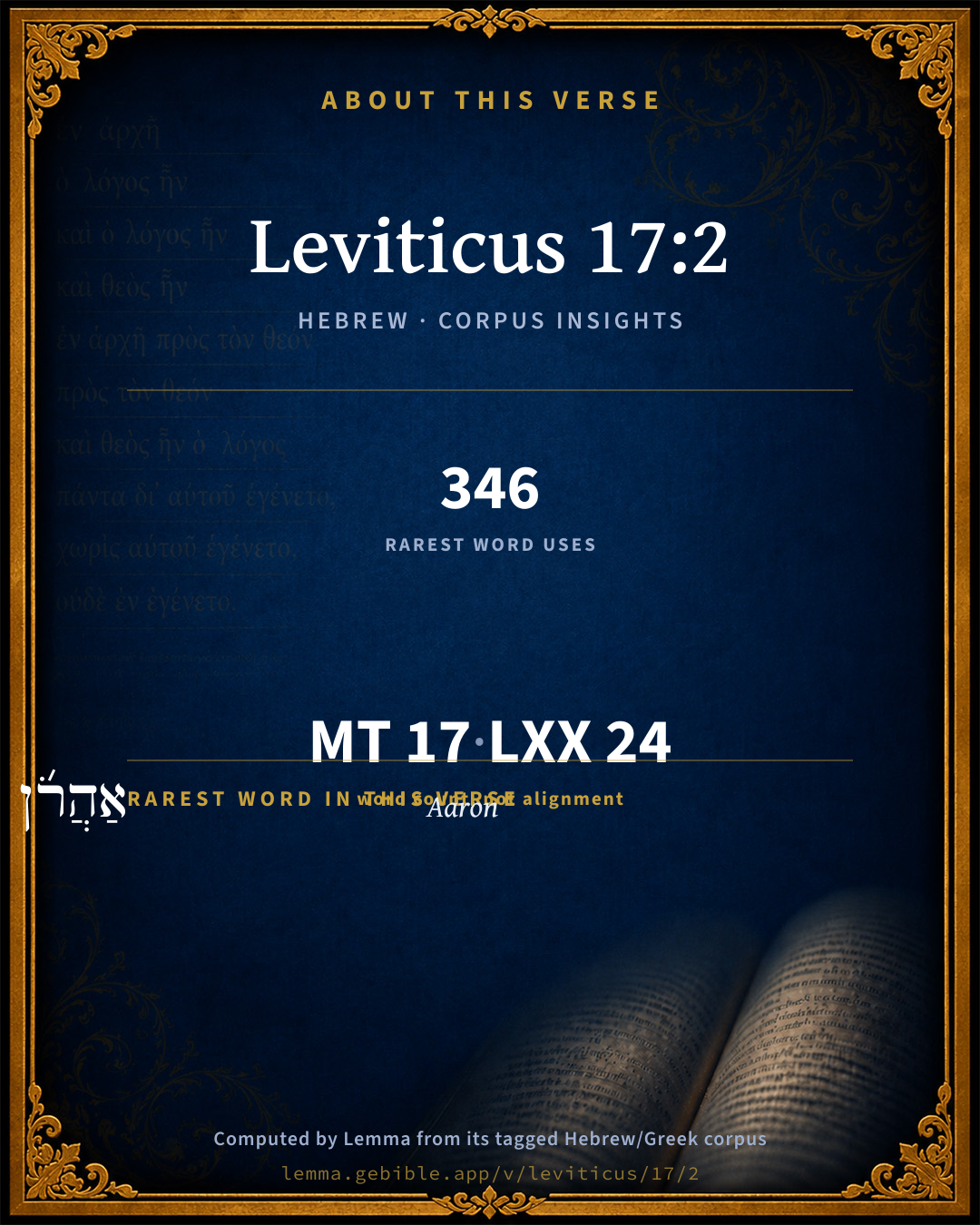
אַהֲרֹ֜ן
ʼAhărôwn
H175
“Aaron”
Noun, Proper
Part of Speech
Noun
Type
Proper
Full BDB Definition

Origin: of uncertain derivation

TWOT: 35

Aaron = "light bringer" - brother of Moses, a Levite and the first high priest
  1. דַּבֵּ֨ר dâbar H1696 “speak” Verb, Piel, Imperative, 2nd Person, Masculine, Singular
  2. אֶֽל ʼêl H413 “to” Preposition
  3. וְאֶל ʼêl H413 “and · to” Conjunction + Preposition
  4. בָּנָ֗יו bên H1121 “sons · his” Noun, Common, Masculine, Plural, Construct + Suffix, Personal, 3rd Person, Masculine, Singular
  5. וְאֶל֙ ʼêl H413 “and · to” Conjunction + Preposition
  6. כָּל kôl H3605 “all of” Noun, Common, Masculine, Singular, Construct
  7. בְּנֵ֣י bên H1121 “sons of” Noun, Common, Masculine, Plural, Construct
  8. יִשְׂרָאֵ֔ל Yisrâʼêl H3478 “Israel” Noun, Proper
  9. וְאָמַרְתָּ֖ ʼâmar H559 “and · to say” Conjunction + Verb, Qal, Sequential Perfect, 2nd Person, Masculine, Singular
  10. אֲלֵיהֶ֑ם ʼêl H413 “to · them” Preposition + Suffix, Personal, 3rd Person, Masculine, Plural
  11. זֶ֣ה zeh H2088 “this” Pronoun, Demonstrative, Masculine, Singular
  12. הַדָּבָ֔ר dâbâr H1697 “the · word” Particle, Definite Article + Noun, Common, Masculine, Singular, Absolute
  13. אֲשֶׁר ʼăsher H834 “which” Particle, Relative
  14. צִוָּ֥ה tsâvâh H6680 “to command” Verb, Piel, Perfect, 3rd Person, Masculine, Singular
  15. יְהוָ֖ה Yᵉhôvâh H3068 “LORD” Noun, Proper
  16. לֵאמֹֽר ʼâmar H559 “to say” Preposition + Verb, Qal, Infinitive Construct

About this verse

These counts appear in no published source. They are computed here, from the morphology-tagged text and Lemma’s own curated glosses. What Lemma adds →

17
words
12
distinct lemmas
Pentateuch
section

Grammatical profile

  • 4 verbs
  • 7 nouns
  • 1 pronoun
  • 4 prepositions
  • 1 particle

Verb forms

  • דַּבֵּ֨ר Piel · Imperative
  • וְאָמַרְתָּ֖ Qal · Sequential Perfect
  • צִוָּ֥ה Piel · Perfect
  • לֵאמֹֽר Qal · Infinitive Construct

Repetition

Words recur within this verse — often emphatic in Hebrew:

  • בָּנָ֗יו son H1121 ×2
  • וְאָמַרְתָּ֖ to say H559 ×2
  • אֶֽל to H413 ×4

Hebrew & Septuagint length

In English translation the verse runs 26 words from the Hebrew and 30 from the Septuagint (LXX English) — closely comparable.

A rough comparison of the two English renderings, which tokenize alike — not a word-level alignment.

Word counts can differ between the Hebrew and the Greek without any difference in meaning — e.g. the Hebrew direct-object marker אֵת has no separate Greek word, and Greek often adds the article ὁ.

In the original languages it is 17 Hebrew tokens and 24 Greek tokens — but the two are counted differently (Hebrew bundles its prefixes and suffixes into one token; the Greek is in lemma form), so that isn’t a like-for-like length.

Hebrew and Greek witnesses Masoretic Hebrew ↔ Greek Septuagint

The same verse in the two great witnesses to the Old Testament, shown verse-for-verse.

These are two independent witnesses, not word-aligned to each other, and the Septuagint is shown in lemma (dictionary) form.

Hebrew Leviticus 17:2 Masoretic · Westminster Leningrad Codex

דַּבֵּ֨ר אֶֽל אַהֲרֹ֜ן וְאֶל בָּנָ֗יו וְאֶל֙ כָּל בְּנֵ֣י יִשְׂרָאֵ֔ל וְאָמַרְתָּ֖ אֲלֵיהֶ֑ם זֶ֣ה הַדָּבָ֔ר אֲשֶׁר צִוָּ֥ה יְהוָ֖ה לֵאמֹֽר

"Speak to Aaron, and to his sons, and to all the children of Israel, and say to them: 'This is the thing which Yahweh has commanded,

World English Bible · Public Domain

Greek LXX Leviticus 17:2 Septuagint · lemma form

λαλέω πρός ἀαρών καί πρός ὁ υἱός αὐτός καί πρός πᾶς υἱός ἰσραήλ καί εἶπον πρός αὐτός οὗτος ὁ ῥῆμα ὅς ἐντέλλομαι κύριος λέγω

Speak to Aaron and to his sons, and to all the children of Israel, and you shall say to them, This is the word which the Lord has commanded, saying,

LXX2012 (modern English Septuagint) · Public Domain

Hebrew: Westminster Leningrad Codex (CC BY 4.0). Greek: Septuagint (public domain); English from LXX2012 (modern English Septuagint) (Public Domain). How the Septuagint differs from the Hebrew →

Targum (Aramaic paraphrase)

2

The Targum is the ancient Jewish Aramaic paraphrase of the Hebrew Scriptures — an interpretive translation, not the Hebrew text itself. Onkelos (literal) and Pseudo-Jonathan (expansive) render the Torah, and Jonathan the Prophets. Coverage is partial: where no permissively-licensed English translation exists for a verse, only the Aramaic is shown. This is verse-level text, not a word-by-word alignment to the Hebrew.

  1. Targum Onkelos Torah (Genesis–Deuteronomy)
    מַלֵל עִם אַהֲרֹן וְעִם בְּנוֹהִי וְעִם כָּל בְּנֵי יִשְׂרָאֵל וְתֵימַר לְהוֹן דֵין פִּתְגָמָא דִי פַקִיד יְיָ לְמֵימָר

    (no public-domain English translation for this verse)

    Targum Onkelos — Aramaic: “Onkelos Genesis” (public domain); “Onkelos Exodus” (public domain); “Onkelos Leviticus” (public domain); “Onkelos Numbers” (public domain); “Onkelos Deuteronomy” (public domain). English: “Sefaria Community Translation” (CC0 1.0 (public-domain dedication)); “J.W. Etheridge. The Targums of Onkelos and Jonathan Ben Uzziel on the Pentateuch. London: Longmans, Green, 1862” (public domain). Text via Sefaria.

  2. Targum Pseudo-Jonathan Torah (Genesis–Deuteronomy)
    מַלֵיל עִם אַהֲרן וְעִם בְּנוֹי וְעִם בְּנֵי יִשְרָאֵל וְתֵימַר לְהוֹן דֵין פִּתְגָמָא דְפַקֵיד יְיָ לְמֵימָר

    Speak with Aharon and with his sons, and with the sons of Israel, and tell them: This is the word which the Lord hath commanded, saying:

    Targum Pseudo-Jonathan — Aramaic: “Targum Jonathan on Genesis” (public domain); “Targum Jonathan on Exodus” (public domain); “Targum Jonathan on Leviticus” (public domain); “Targum Jonathan on Numbers” (public domain); “Targum Jonathan on Deuteronomy” (public domain). English: “The Targum of Jonathan ben Uzziel, trans. J. W. Etheridge, London, 1862” (public domain). Text via Sefaria.

Commentary

Notes on Leviticus 17:2 from classic Christian and Jewish commentators (each source and its license shown beneath its notes). The classic Christian expositions comment on the surrounding passage and are grouped to its opening verse, so a note may address several verses; the Jewish commentaries on the Tanakh (Rashi and others) are per-verse, so they appear only where the commentator wrote on this verse.

Lemma curates 59 commentaries, every one of them public domain or Creative Commons licensed, each selected and text-cleaned for this edition rather than reprinted as found. About our sources →

Trapp's Complete Commentary

John Trapp

Lev 17:2 Speak unto Aaron, and unto his sons, and unto all the children of Israel, and say unto them; This [is] the thing which the LORD hath commanded, saying,

Ver. 2. This is the thing which the Lord.] Who must be readily obeyed without evasion, or questioning.

John Trapp, A Commentary or Exposition upon All the Books of the Old and New Testament (1647–1656) — public domain. Text from a community e-Sword module.

The Biblical Illustrator

Joseph S. Exell

Lev_17:2-16

This is the thing which the Lord hath commanded.

Laws for holy living

From chap. 17. to chap. 23, everything relates to the duties, qualities, and associations of individuals in private life. This fact, coming as it does right after the great Day of Atonement, is very suggestive. It indicates that God contemplates much more respecting us than the mere pardon of our sins; that justification is not the whole intent of the Saviours redemptive services; and that there is to be a personal righteousness and purification which rests upon our own exertions. In Him was life, and His life is the light of men. Without some degree of conformity to Him, our religion is but a shadow and a name. For so it is written, If any man have not the Spirit of Christ, he is none of His. Let me invite attention, then, more specifically to the means and elements of a good and holy life, as they are shadowed forth in the chapters before us.

I. The principal, and, perhaps, the only permanent provision contained in this chapter, is that which respects the manner of treating blood. NO matter how or from what animal it came, it was always to be looked upon with consideration. The use of blood was not forbidden because it was unclean, but because it was sacred. It represents life. It is that by which life was redeemed. Now, it is easy to see how a law of this sort would work to solemnise, restrain, and soften the heart of a conscientious Jew. It would keep the solemn atonement before him whithersoever he went. The very huntsman would be met by it in the deep recesses of the forest. And if we desire to learn what constitutes the deepest essence of a Christian life, we here have it most beautifully typified. We must keep in view the blood of atonement. It is our clear and continual recognition of what Jesus has done for us that weakens temptation, disposes to duty, and prompts to the deeds of righteousness. I remember to have met with an affecting little incident in Roman history connected with the death of Manlius Capitolinus, a renowned consul and general, who was once proudly hailed as the saviour of Rome. It happened one night when the Gauls threatened to overwhelm the Capitol, that he bravely took his stand upon the wall where they came on with their attack, and there fought singly and alone until he had repelled them, and so saved the city from destruction. It so occurred that this distinguished man was afterwards accused of some great public fault, and put upon trial for his life. But just as the judges were about to pass sentence upon him, he looked up at the walls of the Capitol, which towered in view, and with tears in his eyes pointed to where he had fought for his accusers, and perilled his life for their safety. The people remembered the heroic achievement, and wept. No one had the heart to say aught against him, and the judges were compelled to forbear. Again he was tried, and with the same result. Nor could he be convicted until his trial was removed to some low and distant point, from which the Capitol was invisible. And so, while Calvary is in full view, in vain will earth and hell seek to bring the Christian into condemnation. One serious look at the Cross, and at the love which there, unaided and alone, when all was dark and lost, interposed for our salvation, is enough to break the power of passion at once, and to strike dead every guilty proceeding.

II. Passing to chap. 18., we find sundry laws, but all bearing upon two general points. The first relates to the customs of the egyptians, from among whom the jews came, and of the canaanites, whose land they were to inherit. Israel was to be a holy nation, and therefore was not to follow the ways of the unclean. The greatest danger of a purified man arises from his old habits and associations. It is not easy to turn a stream quite out of the channel in which it has been flowing for ages. It is a mighty work to revolutionise a character which has been forming for years, or to tear quite away from a long-continued routine which includes all our recollections of infancy, and in which our life took its chief attractions. The sow that has been washed, still has strong affections for the mire. The second grand element of a good Christian life, therefore, is a complete and thorough reformation with regard to old habits. If we have been in close intimacy with the vile, we must withdraw from their communion, and keep aloof from their wicked ways. If we have been giving way to bad passions, we must cut ourselves off from the occasions of our transgressions, and beware of putting ourselves into circumstances which invite temptation.

III. The other specifications of chap. 18. all relate to sexual purity. They typically refer to the necessity of a proper government of the affections. We may love, but we must love virtuously. We may cherish the most tender regards, but they must not rest upon criminal hopes. Our warmest feelings may be enlisted and indulged, but we must be cautious that they do not betray us into sin and shame. Even the secret thought of unchasteness, the hidden incontinent wish, the impure desire, the cherished hope of unclean gratifications, must be spurned and crucified as criminal before God, and crushed as an enemy to the peace and good of society. The heart must be kept with all diligence, for out of it are the issues of life. It is God who saith, Defile not yourselves in any of these things.

IV. We come now to chap. 19. Here we have quite a list of moral precepts, setting forth an extensive code of christian righteousness. The provisions of the preceding chapter were negative; these are mostly positive. In the one God shows us how we are to cease to do evil; in the other He instructs us how to do well.

V. A remark or two, now, upon chap. 20. We have been contemplating the laws of holy living. In this chapter we have Gods threatenings against those who violate them. It is a chapter of penalties. God is not only our adviser, but our Lord and Judge. His commands are not only gracious counsels, but authoritative laws. The gospel is indeed glad tidings--glad tidings of great joy. It is a call of mercy from the heavens to the suffering and the lost. But it is a call to holiness. And whilst it is a glorious savour of life unto life to them that yield to it, and walk in its light, it is a fearful savour of death unto death to those who despise or disobey it. (J. A. Seiss, D. D.)

Various regulations in chaps. 17-22.

First, in regard to those passages which caution the people against vices of special enormity, we must remember that they were about to be settled in dangerous proximity to peoples who were thoroughly corrupted by these very vices, and therefore the cautions were not by any means unnecessary. Accustomed as most of us are to the pure air of Christian society, in which, notwithstanding all the selfishness and sin that still abound, vices such as these are not so much as named, and the very possibility of them seems out of the question, it is difficult for us to imagine how different was the condition of society before these purifying influences were brought to bear on it, which issued from Mount Sinai first, and afterwards from Gennesarets shore and the place called Calvary. And when we find such warnings in the Book of Leviticus, we ought in the first place to feel humbled by the thought of the fearful lengths to which sin unrestrained by Divine grace will carry its wretched victim; and, in the second place, to lift up our hearts in gratitude to God, that in these latter days, though evil still abounds, we are nevertheless protected from such outrages to our moral and spiritual nature as those to which even the chosen people were exposed in the ancient times. On the other hand, it is pleasant to find in these chapters the evidence that the Mosaic Law came in many respects nearer to the morality of the New Testament than most people are willing to admit (see Lev_19:9-10; Lev_19:32-34). Finally, it is interesting to notice in these regulations, and throughout the entire law, the care which is taken to keep religion and morality closely wedded and welded together. I am the Lord your God is continually put forth, not as a creed article, but as an unanswerable argument for strictest obedience and the most scrupulous integrity. The relations of privilege which the people enjoyed are continually set forth as increasing their responsibility. To whom much is given, of them much shall be required, is a principle taken for granted all through. (J. M. Gibson, D. D.)

Before the Tabernacle of the Lord.

The grand principle of right action--God in everything

The principle which underlies this stringent law, as also the reason which is given for it, is of constant application in modern life. There was nothing wrong in itself in slaying an animal in one place more than another. It was abstractedly possible--as, likely enough, many an Israelite may have said to himself--that a man could just as really eat unto the Lord if he slaughtered and ate his animal in the field, as anywhere else. Nevertheless this was forbidden under the heaviest penalties. It teaches us that he who will be holy must not only abstain from that which is in itself always wrong, but must carefully keep himself from doing even lawful or necessary things in such a way, or under such associations and circumstances, as may outwardly compromise his Christian standing, or which may be proved by experience to have an almost unavoidable tendency toward sin. The laxity in such matters which prevails in the so-called Christian world argues little for the tone of spiritual life in our day in those who indulge in it, or allow it, or apologise for it it may be true enough, in a sense, that, as many say, there is no harm in this or that. Perhaps not; but what if experience have shown that, though in itself not sinful, a certain association or amusement almost always tends to worldliness, which is a form of idolatry? Or--to use the apostles illustration--what if one be seen, though with no intention of wrong, sitting at meat in an idols temple, and he whose conscience is weak be thereby emboldened to do what to him is sin? There is only one safe principle, now as in the days of Moses: everything must be brought before the Lord--used as from Him and for Him, and therefore used under such limitations and restrictions as His wise and holy law imposes. Only so shall we be safe; only so abide in living fellowship with God. (S. H. Kellogg, D. D.)

Peace-offerings unto the Lord.--

Dedication of food to God

Very beautiful and instructive was the direction that the Israelite, in the cases specified, should make his daily food a peace-offering. This involved a dedication of the daily food to the Lord; and in his receiving it back again then from the hand of God, the truth was visibly represented that our daily food is from God; while also, in the sacrificial acts which preceded the eating, the Israelite was continually reminded that it was upon the ground of an accepted atonement that even these everyday mercies were received. Such also should be, in spirit, the often neglected prayer before each of our daily meals. It should be ever offered with the remembrance of the precious blood which has purchased for us even the most common mercies; and should thus sincerely recognise What, in the confusing complexity of the second causes through which we receive our daily food, we so easily forget that the Lords Prayer is not a mere form of words when we say, Give us this day our daily bread; but that working behind, and in, and with, all these second causes, is the kindly providence of God, who, opening His hand, supplies the want of every living thing. And so, eating in grateful, loving fellowship with our Heavenly Father that which His bounty gives us, to His glory, every meal shall become, as it were, a sacramental remembrance of the Lord. We may have wondered at what we have read of the worldwide custom of the Mohammedan, who, whenever the knife of slaughter is lifted against a beast for food, utters his Bism Allah (In the name of the most merciful God); and not otherwise will regard his food as being made halal or lawful; and no doubt in all this, as in many a Christians prayer, there may often be little heart. But the thought in this ceremony is even this of Leviticus, and we do well to make it our own, eating even our daily food in the name of the most merciful God, and with uplifting of the heart in thankful worship toward Him. (S. H. Kellogg. D. D.)

For the life of the flesh is in the blood.--

The Scriptural doctrine of blood

Blood is one of the characteristic, regent words of Scripture, occurring in it more than four hundred times. A word so recurrent must mean something fundamental. In fact, it is the blood of Christ which is the basis of Christianity, the very pivot of the Christian religion.

I. First of all, let us ponder what in light of modern physiology is certainly a remarkable Scripture. Moses, in forbidding the eating of blood, assigns for his prohibition the following reason: For the life of the flesh is in the blood; and I have given it to you upon the altar, to make an atonement for your souls; for it is the blood that maketh an atonement for the soul (Lev_17:11).

1. The fact asserted: The life (soul) of the flesh is in the blood.

(1) This is, in fact, one of the instinctive beliefs of humanity; and instinct is often prophetic, holding latent history. How thoroughly the idea that blood is the seat of life has taken possession of the race is evident from such instinctive idioms as these: shedder of blood, man of blood, imbrue in blood, bloody-minded, blood-thirsty, avenger of blood, blood-guiltiness, cold-blooded, prince of the blood royal, blooded-stock, blood-relation, next of blood, consanguinity, sanguine of success, sanguine temperament, &c., &c. So that marvellous diviner and formulator of human instincts, Shakespeare--the word blood occurs seven hundred and thirty-one times in his plays--for example:--

Will all great Neptunes ocean wash this blood

Clean from my hand? No; this my hand will rather

The multitudinous seas incarnadine,

Making the green one red.

(Macbeth, II:2.)

Again--

Sluicd out his innocent soul through streams of blood:

Which blood, like sacrificing Abels, cries,

Even from the tongueless caverns of the earth,

To me, for justice and rough chastisement.

(King Richard II., I:1.)

So Englands poet-laureate--

Defects of doubt, and taints of blood.

(In Memoriam, 53.)

Again

Through all the years of April blood.

(In Memoriam, 108.)

So Virgil--

His purple life (purpuream animam) he poureth forth.

(AEneid, 9:349.)

So Homer, and very frequently, thus--

The soul comes floating in a tide of gore.

(Iliad, 4.537.)

Again--

He sobs his soul out in the gush of blood.

(Iliad, 16.419.)

Once more--

And the soul issued in the purple flood.

(Iliad, 16.624.)

So the Scriptural writers; for example: The voice of thy brothers blood crieth unto Me from the ground; Earth, cover not thou my blood; Deliver me from blood-guiltiness, O God; Precious shall their blood be in His sight; All the righteous blood shed upon the earth from the blood of righteous Abel unto the blood of Zachariah the son of Barachiah; I have sinned in that I have betrayed the innocent blood. How long, O Lord, holy and true, dost Thou not judge and avenge our blood on them that dwell on the earth? The blood being thus instinctively conceived as the seat of life, and so the representative of the soul or person, no wonder that blood has ever been regarded as a sacred thing. Here is the secret of the Mosaic prohibition to eat blood, a prohibition frequently repeated, and in Lev_17:10-14 with solemn minuteness of detail. The blood being regarded as the symbol and home of the personality, to eat it was to be guilty of sacrilegious cannibalism. Here is the key to that chivalrous, pathetic incident in Davids life: Be it far from me, O Lord, that I should do this; is not this the blood of the men that went in jeopardy of their lives? (2Sa_23:15-17). But the Divine prohibition was not peculiar to the Jews. A millennium before Moses, when the new stock of humanity, just escaped the Deluge, was still young, God commanded Noah, saying, Every moving thing that liveth shall be food for you . . . But flesh with the life (soul) thereof, which is the blood thereof, shall ye not eat (Gen_9:1-4). As the prohibition antedated the Mosaic Dispensation, so it postdated it. A score of years after Christ was crucified, a controversy arose in the Church at Antioch respecting the subjection of Gentile converts to circumcision and the Mosaic institutions generally (Act_15:1-35). So much for the instinctive belief that the life, or soul, of the flesh is in the blood.

(2) And modern science remarkably confirms this instinctive belief. The blood, in respect to its composition, consists of two principal parts: a liquid plasma, and countless microscopic corpuscles, or blood-discs, floating in it, by far the larger part of which are red, and the rest colourless. The office of the colourless corpuscles, called Leucocytes, is not yet distinctly understood. This thing, however, must be said about them, When blood is taken from the living system, these leucocytes, or white corpuscles, if kept at something like their normal temperature, present for some time remarkable life-like phenomena; they protrude and retract numerous arms or processes, and even move about from place to place, as though things of life; in fact, so much do the motions of these corpuscles resemble the protean changes in figure and motions of the microscopic Rhizopod called Amoeba, that they have received the name, amoeboid movements. The red corpuscles constitute nearly one half of the mass of the blood, tinging it so thoroughly as to give it its red colour. The office of these red globules, or blood discs, is, in the main, to serve as carriers of oxygen. To use the words of Prof. Flint, the red corpuscles are respiratory organs; taking up the greater part of the oxygen which is absorbed by the blood in its passage through the lungs, and conveying it to the tissues, where it is given up, and its place supplied by carbonic acid. One more remark must be made about these red blood discs. Although the diagnosis of blood stains is not yet sufficiently advanced to enable us in all cases to discriminate with absolute certainty between the blood corpuscles of man and those of all mammals, yet it is far enough advanced to enable the microscopical expert to pronounce, in certain eases, with accuracy on the character of blood stains in murder trials; thus converting these tiny globules, having a diameter of only 1/3200 of an inch, into solemn, resistless witnesses. The melancholy Dane is right:

Murder, though it have no tongue, will speak,

With most miraculous organ.

(Hamlet, II:2.)

Ay, blood will tell. Thus the blood is in an eminent sense the seat and organ of life. The language of Hervey, the demonstrator at least, if not the discoverer, of the circulation of the blood, is striking: The blood is the primigenial and principal part, because that in it and from it the fountain of motion and pulsation is derived; also because the animal heat or vital spirit is first radicated and implanted, and the soul takes up her mansion in it The blood is the genital part, the fountain of life, primum vivens, ultimum moriens. It is a solemn thing to observe the rhythmical systole and diastole of the heart, especially as recorded by that delicate instrument, the sphygmograph. The blood is a very river of life, the arterial and venous systems of circulation constituting an intricate network of canals, making the body a corporeal Amsterdam or human Venice. Each corpuscle is a barge, moving with various rates of speed in different parts of the body, toiling through the capillaries at the rate of two inches a minute, rushing through the arteries at the rate of from twelve to twenty feet a second, ceaselessly carrying on the organic functions of the body by perpetually exchanging freight, depositing at the depot of this and that tissue oxygen, and taking up carbonic acid. What money is to society, that blood is to the bodily system; it is the means of exchange, or the circulating medium. The scientific accuracy of the assertion, the life of the flesh is in the blood, is strikingly shown in such facts as blood-letting, strangling, fainting, pyoemia, or blood-poisoning, and especially transfusion--a sometimes beneficent surgical operation, in which blood from a strong and healthy person, or from one of the lower animals, is injected into the veins of a feeble or anaemic patient. The life or soul of the flesh is in the blood. Thus the Bible of Scripture and the Bible of Nature is one; Scripture announcing a truth, Nature echoing it.

2. The rite appointed: And I have given it to you upon the altar to make atonement for your souls.

(1) I have given it to you upon the altar. Blood is emphatically the characteristic thing in the Levitical ritual, the very basis of the old sacrificial economy. Particularly is this true of the eminently sacred rites of the paschal lamb, the sin-offering, the day of atonement, and the mercy-seat; all the significance of these elaborate ceremonies turned on the element of blood. Indeed, the writer of the letter to the Hebrews, summing up the Old Covenant in respect to ritual, expressly says, Almost all things are by the law purified with blood; and without shedding of blood there is no remission (Heb_9:22). The Old Testament is in very truth a scarlet dispensation.

(2) To atone for your souls. To atone; literally, to cover, hide, shelter. But in what sense to atone? Certainly not in the heathen sense of placating as with presents, or expiating as by offering a quid pro quo; but in the gracious sense of reconciling by sacrificial, vicarious interception.

3. The reason assigned: For it is the blood that maketh atonement--i.e., by the life thereof, in virtue of the soul in it.

(1) It is the blood that maketh an atonement. It atones not, of course, absolutely; for it is not possible that the blood of bulls and goats should take away the consciousness of sins. But the blood atones, so to speak, constructively, pictorially, prophetically.

(2) For the life (or soul) of the flesh is in the blood. And this on the principle that the blood, as being the seat of the life, is the representative of the person. Life for life, soul for soul; this is the meaning of the old sacrificial ritual. And it is all based on the admitted physiological principle--the life of the flesh is in the blood.

II. And now we have the key to the Scriptural doctrine of blood.

1. The blood of Jesus Christ it is which is the antitype or fulfilment of the blood of the Levitical victims. To prove this forms a great part of the argument of the Epistle to the Hebrews. Take chap. 9., Lev_9:13-14, as a typical specimen of the argument.

2. The blood of Jesus Christ is the antitypal, real atonement for our souls on the same principle which held under the Old Dispensation--the principle of vicarious representation. That is to say, Christs blood, as being the vehicle and representative of His own personality, was vicariously shed; and in this way He became the propitiation for the sins of the whole world. This, then, is the Scriptural doctrine of blood. It is based on the ancient Mosaic affirmation and on the modern scientific observation--The life of the flesh is in the blood. How significant now the New Testament allusions to the efficacy of Christs blood. For example: Purchased with His own blood; Set forth as a propitiation through faith in His blood; Justified by His blood; Redemption through His blood; Made peace through the blood of His Cross; Boldness to enter into the holiest through the blood of Jesus; The blood of sprinkling that speaketh better things than that of Abel; The blood of the everlasting Covenant; The blood of Jesus Christ His Son cleanseth us from all sin; Washed their robes and made them white in the blood of the Lamb, &c. Thus blood is the scarlet thread winding through both the Covenants, their crimson rubric. This, then, is the conclusion of the whole matter--blood is the natural, physiological basis of the Scriptural doctrine of the Atonement. Science inexorably holds us to orthodoxy in the prime, pivotal article of the Christian religion. (G. D. Boardman, D. D.)

Ye shall eat the blood of no manner of flesh.--

Restrictions respecting the use of blood

The moral and spiritual purpose of this law concerning the use of blood was apparently twofold. In the first place, it was intended to educate the people to a reverence for life, and purify them from that tendency to bloodthirstiness which has so often distinguished heathen nations, and especially those with whom Israel was to be brought in closest contact. But, secondly, and chiefly, it was intended everywhere and always to keep before the mind the sacredness of the blood as being the appointed means for the expiation of sin, given by God upon the altar to make atonement for the soul of the sinner, by reason of the life or soul with which it stood in such immediate relation. Not only were they, therefore, to abstain from the blood of such animals as could be offered on the altar, but even from that of those which could not be offered. Thus the blood was to remind them, every time they ate flesh, of the very solemn truth that without shedding of blood there was no remission of sin. The Israelite must never forget this, even in the heat and excitement of the chase; he must pause and carefully drain the blood from the creature he had slain, and reverently cover it with dust: a symbolic act which should ever put him in mind of the Divine ordinance--that the blood, the life, of a guiltless victim must be given in order to the forgiveness of sin. A lesson lies here for us regarding the sacredness of all that is associated with sacred things. All that is connected with God, and with His worship, especially all that is connected with His revelation of Himself for our salvation, is to be treated with the most profound reverence. (S. H. Kellogg, D. D.)

.

The Biblical Illustrator, edited by Joseph S. Exell (c. 1880s–1900s) — public domain. Text from a community e-Sword module.

Geneva Bible (1599)

Geneva Bible translators

Lest they should practice that idolatry, which they had learned among the Egyptians.

Geneva Bible (1599) marginal notes — public domain. Text via Bolls.life.

Ellicott's Commentary for English Readers

(2) And unto all the children of Israel.—To understand the import of this phrase, and its bearing upon the injunction in question, it is necessary to notice that the words “and unto all the children of Israel” are here used for the first time. Hitherto the Divine communications were made to (1) Moses alone, without his being ordered to speak to any one else (Lev_5:14, Lev_6:12, Lev_8:1, (Lev_14:1); (2) to Moses, with the command to speak to Aaron (Lev_16:1); (3) to Moses, with the command to speak to Aaron and his sons (Lev_6:1; Lev_6:17); (4) to Moses, with a command to speak to the children of Israel (Lev_1:1; Lev_4:1; Lev_7:28; Lev_12:1); (5) to Moses and Aaron conjointly, without being ordered to speak to the children of Israel (Lev_13:1; Lev_14:33); (6) to Moses and Aaron conjointly, who are ordered to speak to the children of Israel (Lev_11:1; Lev_15:1); and (7) Aaron alone is addressed (Lev_10:8). In the chapter before us, however, the communication is made to Moses alone, and he is commanded not only to impart its contents to Aaron and his sons—i.e., the priesthood—but “unto all the children of Israel,” or their representatives, at the same time. The pontiff and the priests are thus put on a level with the ordinary Israelite or the laity, as far as this regulation is concerned. There are only two other occasions on which this phrase is used again, viz., Lev_21:24; Lev_22:18.

This is the thing which the Lord hath commanded.—To emphasize the importance of the following law Moses is ordered by God to use this additional formula; whilst in other instances where it is used, when important statutes are enacted, Moses uses it of his own accord. (Comp. Exo_16:16; Exo_35:4; Lev_8:5; Lev_9:6; Num_30:2; Num_36:6.)

A Bible Commentary for English Readers, edited by Charles John Ellicott (1878–1897) — public domain. Text from a community e-Sword module.

John Gill's Exposition

Speak unto Aaron, and unto his sons,.... Who were now constituted priests, the business of whose office it was to offer the sacrifices of the people, ordinary and extraordinary:

and to all the children of Israel; who were all under obligation to sacrifices at certain times; under whom may be comprehended the Levites, who were not priests, and the strangers that sojourned in Israel, for these are concerned in the following law:

and say unto them; which is spoken to Moses, who was to say what follows to Aaron, and by him to his sons, and by his sons to the people of Israel, and by them to the strangers:

this is the thing which the Lord hath commanded; ordered to be observed as his will and pleasure by everyone of them:

saying; namely, what follows.

John Gill's Exposition of the Whole Bible (1746–1763) — public domain (CC PDM 1.0). Text via the HelloAO Bible API.

Ramban (Nachmanides)

Rabbi Moshe ben Nachman (Ramban / Nachmanides)

SPEAK UNTO AARON, AND UNTO HIS SONS, AND UNTO ALL THE CHILDREN OF ISRAEL. Since this section contains the warning that all offerings are to be brought only in the Tent of Meeting [i.e., in the Sanctuary Court], He therefore admonishes the priests who perform the rites of the offerings that they are not to perform the rites outside [the Sanctuary Court], and He also admonishes the Israelites that they should bring them there to G-d, and not offer them outside by themselves.The correct interpretation of this section is as our Rabbis have mentioned, that He forbade Israel whilst in the desert to eat an ordinary meal of meat [i.e., one which was not part of an offering], and they were to eat only the meat of peace-offerings [the fat portions and the blood of which] had been offered upon the altar of G-d. Therefore He said that whoever wants to slaughter any of the three kinds of animals from which all offerings are brought, namely, the ox, lamb, and goat, must bring them unto the door of the Tent of Meeting, and make them offerings of peace-offerings, bringing the fats and the blood upon the altar of G-d, and then he may eat the meat thereof according to the law [of peace-offerings, which is that the priest is given the breast and the right thigh, and the rest of the meat is eaten by the owner and his family for two days and the intervening night]. He further stated that if he slaughtered them in any other place, he is liable to the punishment of excision.. See Ramban further, 18:29 for the specific meaning of this form of punishment.It appears likely from the language of Scripture that at first [i.e., in Verse 3-7] He declared a person liable to the punishment of excision in the case of any slaughtering outside [the Sanctuary Court] even of unconsecrated animals, this being the prohibition against eating an ordinary meal of meat, and He stated that the reason for it is so that they should consecrate them to G-d and the priest shall sprinkle the blood upon the altar of the Eternal and burn on it the fat. Afterwards [in Verses 8-9] He warned against making an altar to G-d outside [the Sanctuary Court] and offering on it the peace-offerings mentioned [in Verse 5] or a burnt-offering, as used to be done with holy offerings at the time when the bamoth, Note 122 for full explanation of this term. were permitted, but they were to offer them to G-d in front of the door of the Tent of Meeting. Thus He ordered all slaughterings, whether of unconsecrated or consecrated animals, to be done only within [the Sanctuary Court]. Therefore He said in the Book of Deuteronomy, But when ye go over the Jordan, and dwell in the Land etc., then it shall come to pass that the place which the Eternal your G-d shall choose to cause His Name to dwell there, thither ye shall bring … your burnt-offerings, and your peace-offerings, stating further, Take heed to thyself that thou offer not thy burnt-offerings in every place that thou seest; but in the place which the Eternal shall choose etc., Verses 13-14. This was to state that the prohibition against slaughtering consecrated animals outside [the Sanctuary Court] remains in force as long as the Chosen House of G-d exists, were permitted. After the House of G-d was finally established in Jerusalem, the bamoth were again forbidden and never again permitted (Zebachim 112 b). but He permitted slaughtering of ordinary [unconsecrated] animals [at all places]. It is this which He states, However thou mayest slaughter and eat flesh in all thy gates, meaning to say that this prohibition stated here — not to slaughter unconsecrated animals at all, but rather to bring them all as peace-offerings upon the altar of G-d — will not apply in the Land. And He explained there the reason: When the Eternal thy G-d shall enlarge thy border etc., Verse 20. meaning to say that the prohibition was only in the beginning when they were in the desert, so that it was easier for them to bring all their offerings to the door of the Tent of Meeting, but after He will enlarge their border [and they will inhabit a wide area], they may eat an ordinary meal of meat by slaughtering [the animal] in their city, except for consecrated animals [which they must slaughter only in the Sanctuary Court]. This is the reason why He mentions here [in Verse 3], What man soever there be of the house of Israel, that slaughtereth … within the camp or that slaughtereth out of the camp. Thus He mentions also those who slaughter out of the camp, so that they [too] should be obliged to bring them to the door of the Tent of Meeting; for although an ordinary meal of meat will be permissible when G-d will enlarge their borders, because they are not near the place of the Sanctuary, He does not likewise permit it in the desert, even outside the camp, because they are not far from the altar of G-d as they will be in the Land when G-d will enlarge their borders, at which time He permitted them an ordinary meal of meat. This is the proper interpretation of these verses, and it corresponds to the opinion of Rabbi Yishmael on these sections of the Torah. From this section here originates [what Rabbi Yishmael] said, that “at first [i.e., as long as Israel was in the desert] they were forbidden to have an ordinary meal of meat.” This is the fitting interpretation of the verse by way of the plain meaning of Scripture. It [also] coincides with the saying of the Rabbis in the Agadah: “The Rabbis say: There are many things which the Holy One, blessed be He, prohibited, and in another place permitted them again. You may know this [from the following instance]. The Holy One, blessed be He, forbade Israel to slaughter and eat an animal unless they brought it to the door of the Sanctuary [and slaughtered it as a peace-offering]. Whence do I know this? Because it is written, and he hath not brought it into the door of the Tent of Meeting. What is written there? Blood shall be imputed unto that man etc. And here [in the Book of Deuteronomy] He again permitted it to them, as it is said, thou mayest eat flesh, after all the desire of thy soul., Verse 20. Whence do I know [that this applies to the time after their entry into the Land]? From that which is stated there on this subject, When the Eternal thy G-d shall enlarge thy border.”, Verse 20. As for that which Rashi has commented [here in Verse 3 on the expression, what man soever there be that slaughtereth an ox, or lamb etc.] that “Scripture is speaking of consecrated animals etc.” [while we have explained above that Verses 3-6 refer to ordinary animals, the answer is that Rashi here follows] the opinion of that Sage who says that an ordinary meal of meat was never prohibited at all [even when Israel was in the desert]. It is in accordance with that opinion that the Beraitha was taught in the Torath Kohanim, Chapters 6, and 9-10. but the explanation of the verses in a manner that accords with them, and the approach of the words of the Sages in the traditions, as well as in most places, is as we have explained.

Ramban (Nachmanides) on the Tanakh — English translation: “Commentary on the Torah by Ramban (Nachmanides). Translated and annotated by Charles B. Chavel. New York, Shilo Pub. House, 1971-1976” (CC BY 4.0). Text via Sefaria.

Lesson kit

Teaching starters — assembled from the data on this page, not authored interpretation. Every prompt links to the verse data it draws on. Edit before teaching.

Leviticus, in the Pentateuch, opens this verse with 17 words (12 distinct Hebrew lemmas). Its most distinctive word is ʼAhărôwn (“Aaron”). A historical commentator’s framing appears above. Read the whole chapter for the surrounding context.

Discussion questions

  1. What does “Aaron” (ʼAhărôwn) contribute to the verse as a whole?
  2. “son” occurs 2× in this one verse. What is the effect of the repetition?
  3. These translations render this verse differently. What is at stake in choosing one wording over another?
  4. The verb «דַּבֵּ֨ר» is Piel Imperative. How does its form color the action?
  5. Reading how Trapp's Complete Commentary and The Biblical Illustrator read this verse, where do the two commentators agree and where do they part?

Things to notice

Reading settings

Reading text

Shown beneath each verse's original-language words.

Old Testament
Old Testament edition

Read the OT as the Masoretic Hebrew (MT) or the Greek Septuagint (LXX).

English shown for the Greek Septuagint (in the Hebrew ↔ Greek comparison).

Comparing translations? Open the Compare panel on any verse page to stack up to four side by side.