
Leviticus 9:3

Hebrew (Westminster Leningrad Codex) Leviticus 9:3 appears in the Hebrew Old Testament. The text above is from the Westminster Leningrad Codex. Each word links to its Strong’s number, a concise gloss, and parsing drawn from the Open Scriptures Hebrew Bible morphology. Click any word for its full Brown-Driver-Briggs (BDB) entry.
Download image
Cite this verse

Leviticus 9:3 (World English Bible). Public Domain. Lemma interlinear Bible study tool, https://lemma.gebible.app/v/leviticus/9/3.

Show BibTeX & RIS
BibTeX
RIS
English Translation
You shall speak to the children of Israel, saying, 'Take a male goat for a sin offering; and a calf and a lamb, both a year old, without blemish, for a burnt offering;
World English Bible · Public Domain
Download a study sheet

One document with this verse’s original text, its word-by-word gloss line, the meaning frame, cross-references with their text, attributed commentary, and full source and license credits — printable, and it pastes into notes with its structure intact.

This verse Autodidact and up

Study sheet (.html) Plain text (.txt)

A passage Seminary Student

Up to 50 verses in one chapter. A passage sheet keeps up to 6 commentary sources and 12 cross-references per verse, in the order this page ranks them, and says so on the sheet whenever that leaves anything out. Ask for a single verse and you get the Autodidact verse sheet above.

Everything on this page stays free to read, with no account — the sheet is a download of what is already on screen, not access to it.

Want to remove ads? Support Godless Engineer
Compare translations 3

The same verse in 3 English versions, stacked beneath the original-language interlinear above. Click any original word for its lexicon entry.

Each is an independent rendering of the whole verse — the interlinear is not word-aligned to these translations.

Highlighted words mark where these versions differ — a whole-verse word diff, not a word-by-word alignment.

  • World English Bible Public Domain
    You shall speak to the children of Israel, saying, 'Take a male goat for a sin offering; and a calf and a lamb, both a year old, without blemish, for a burnt offering;
  • King James Version Public Domain
    And unto the children of Israel thou shalt speak, saying, Take ye a kid of the goats for a sin offering; and a calf and a lamb, both of the first year, without blemish, for a burnt offering;
  • unfoldingWord Literal Text CC BY-SA 4.0
    And to the sons of Israel, you will speak, saying, ‘Take a buck of the goats for a sin offering and a calf and a lamb, perfect sons of a year, for a burnt offering,

unfoldingWord Literal Text — © unfoldingWord, licensed CC BY-SA 4.0. Word-aligned USFM3 via Door43 (git.door43.org/unfoldingWord/en_ult).

Versions to compare (up to 4)

3 of 4 selected

Show all 18 translations

Every available English version of this verse, each an independent rendering of the whole verse.

  • World English Bible Public Domain
    You shall speak to the children of Israel, saying, 'Take a male goat for a sin offering; and a calf and a lamb, both a year old, without blemish, for a burnt offering;
  • Berean Standard Bible Public Domain
    Then speak to the Israelites and say, ‘Take a male goat for a sin offering, a calf and a lamb—both a year old and without blemish—for a burnt offering,
  • Majority Standard Bible Public Domain
    Then speak to the Israelites and say, ‘Take a male goat for a sin offering, a calf and a lamb—both a year old and without blemish—for a burnt offering,
  • King James Version Public Domain
    And unto the children of Israel thou shalt speak, saying, Take ye a kid of the goats for a sin offering; and a calf and a lamb, both of the first year, without blemish, for a burnt offering;
  • American Standard Version (1901) Public Domain
    And unto the children of Israel thou shalt speak, saying, Take ye a he-goat for a sin-offering; and a calf and a lamb, both a year old, without blemish, for a burnt-offering;
  • Revised Version (1885) Public Domain
    And unto the children of Israel thou shalt speak, saying, Take ye a he-goat for a sin offering; and a calf and a lamb, both of the first year, without blemish, for a burnt offering;
  • Geneva Bible (1599) Public Domain
    And vnto the children of Israel thou shalt speake, saying, Take yee an hee goate for a sinne offring, and a calfe, and a lambe, both of a yeere olde, without blemish for a burnt offring:
  • Douay-Rheims (1899) Public Domain
    And to the children of Israel thou shalt say: Take ye a he goat for sin, and a calf, and a lamb, both of a year old, and without blemish for a holocaust,
  • Young's Literal Translation Public Domain
    `And unto the sons of Israel thou dost speak, saying, Take ye a kid of the goats for a sin-offering, and a calf, and a lamb, sons of a year, perfect ones, for a burnt-offering,
  • Literal Standard Version CC BY-SA 4.0
    And you speak to the sons of Israel, saying, Take a kid of the goats for a sin-offering, and a calf, and a lamb, sons of a year, perfect ones, for a burnt-offering,
  • Unlocked Literal Bible CC BY-SA 4.0
    You must speak to the people of Israel and say, 'Take a male goat for a sin offering and a calf and a lamb, both a year old and without blemish, for a burnt offering;
  • unfoldingWord Literal Text CC BY-SA 4.0
    And to the sons of Israel, you will speak, saying, ‘Take a buck of the goats for a sin offering and a calf and a lamb, perfect sons of a year, for a burnt offering,
  • Darby Bible Public Domain
    and to the children of Israel shalt thou speak, saying, Take a buck of the goats for a sin-offering, and a calf and a lamb, yearlings, without blemish, for a burnt-offering;
  • World Messianic Bible Public Domain
    You shall speak to the children of Israel, saying, ‘Take a male goat for a sin offering; and a calf and a lamb, both a year old, without defect, for a burnt offering;
  • Webster's Bible Public Domain
    And to the children of Israel thou shalt speak, saying, Take ye a kid of the goats for a sin-offering; and a calf and a lamb, both of the first year, without blemish, for a burnt-offering;
  • Free Bible Version CC BY-SA 4.0
    Then tell the Israelites, ‘Bring the following offerings: a male goat as a sin offering; a calf and a lamb (both a year old and without defects), for a burnt offering;
  • Bible in Basic English Public Domain
    And say to the children of Israel: Take a he-goat for a sin-offering, and a young ox and a lamb, in their first year, without any mark on them, for a burned offering;
  • JPS Tanakh (1917) Public Domain
    And unto the children of Israel thou shalt speak, saying: Take ye a he-goat for a sin-offering; and a calf and a lamb, both of the first year, without blemish, for a burnt-offering;

Literal Standard Version (2020), Covenant Press — licensed CC BY-SA 4.0. Text via the HelloAO Bible API (eBible.org). Unlocked Literal Bible (unfoldingWord) — licensed CC BY-SA 4.0. Text via the HelloAO Bible API (eBible.org). unfoldingWord Literal Text — © unfoldingWord, licensed CC BY-SA 4.0. Word-aligned USFM3 via Door43 (git.door43.org/unfoldingWord/en_ult). Free Bible Version, Dr. Jonathan Gallagher — licensed CC BY-SA 4.0. Text via the HelloAO Bible API (eBible.org).

Word by word

More ways to search: Search by grammar → Find every occurrence → Compare this word →

Practice this passage: Drill this verse → Learn its vocabulary →

וְעֵ֨גֶל
ʻêgel
H5695
“and · calf”
Conjunction + Noun, Common, Masculine, Singular, Absolute
Part of Speech
Conjunction + Noun
Type
Common
Gender
Masculine
Number
Singular
State
Absolute
Full BDB Definition

Origin: from the same as H5696

TWOT: 1560a

calf, bull-calf
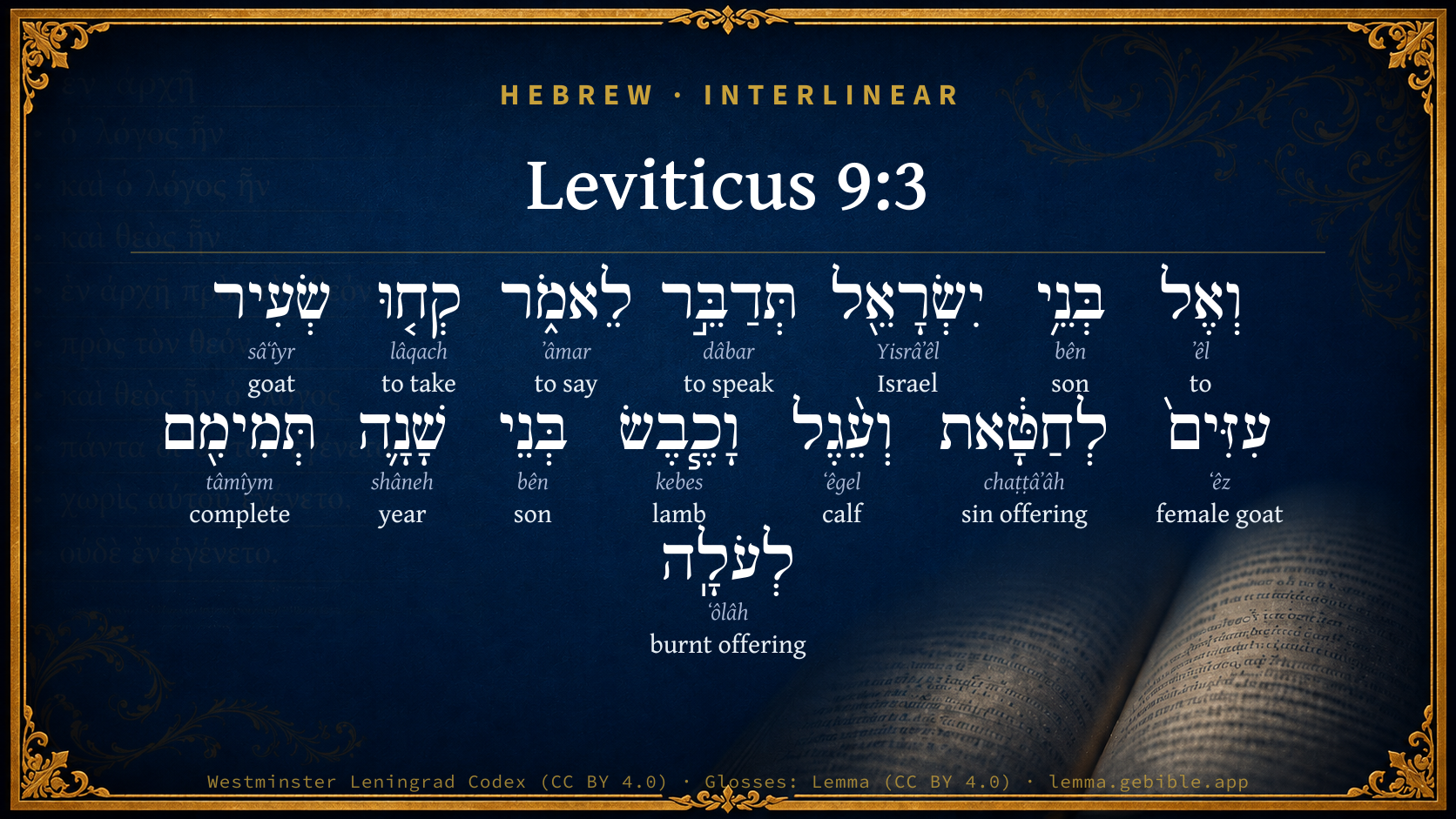
  1. וְאֶל ʼêl H413 “and · to” Conjunction + Preposition
  2. בְּנֵ֥י bên H1121 “sons of” Noun, Common, Masculine, Plural, Construct
  3. יִשְׂרָאֵ֖ל Yisrâʼêl H3478 “Israel” Noun, Proper
  4. תְּדַבֵּ֣ר dâbar H1696 “to speak” Verb, Piel, Imperfect, 2nd Person, Masculine, Singular
  5. לֵאמֹ֑ר ʼâmar H559 “to say” Preposition + Verb, Qal, Infinitive Construct
  6. קְח֤וּ lâqach H3947 “take” Verb, Qal, Imperative, 2nd Person, Masculine, Plural
  7. שְׂעִיר sâʻîyr H8163 “goat of” Noun, Common, Masculine, Singular, Construct
  8. עִזִּים֙ ʻêz H5795 “female goats” Noun, Common, Feminine, Plural, Absolute
  9. לְחַטָּ֔את chaṭṭâʼâh H2403 “to/for · sin offering” Preposition + Noun, Common, Feminine, Singular, Absolute
  10. וָכֶ֧בֶשׂ kebes H3532 “and · lamb” Conjunction + Noun, Common, Masculine, Singular, Absolute
  11. בְּנֵי bên H1121 “sons of” Noun, Common, Masculine, Plural, Construct
  12. שָׁנָ֛ה shâneh H8141 “year” Noun, Common, Feminine, Singular, Absolute
  13. תְּמִימִ֖ם tâmîym H8549 “complete” Adjective, Adjective, Masculine, Plural, Absolute
  14. לְעֹלָֽה ʻôlâh H5930 “to/for · burnt offering” Preposition + Noun, Common, Feminine, Singular, Absolute

About this verse

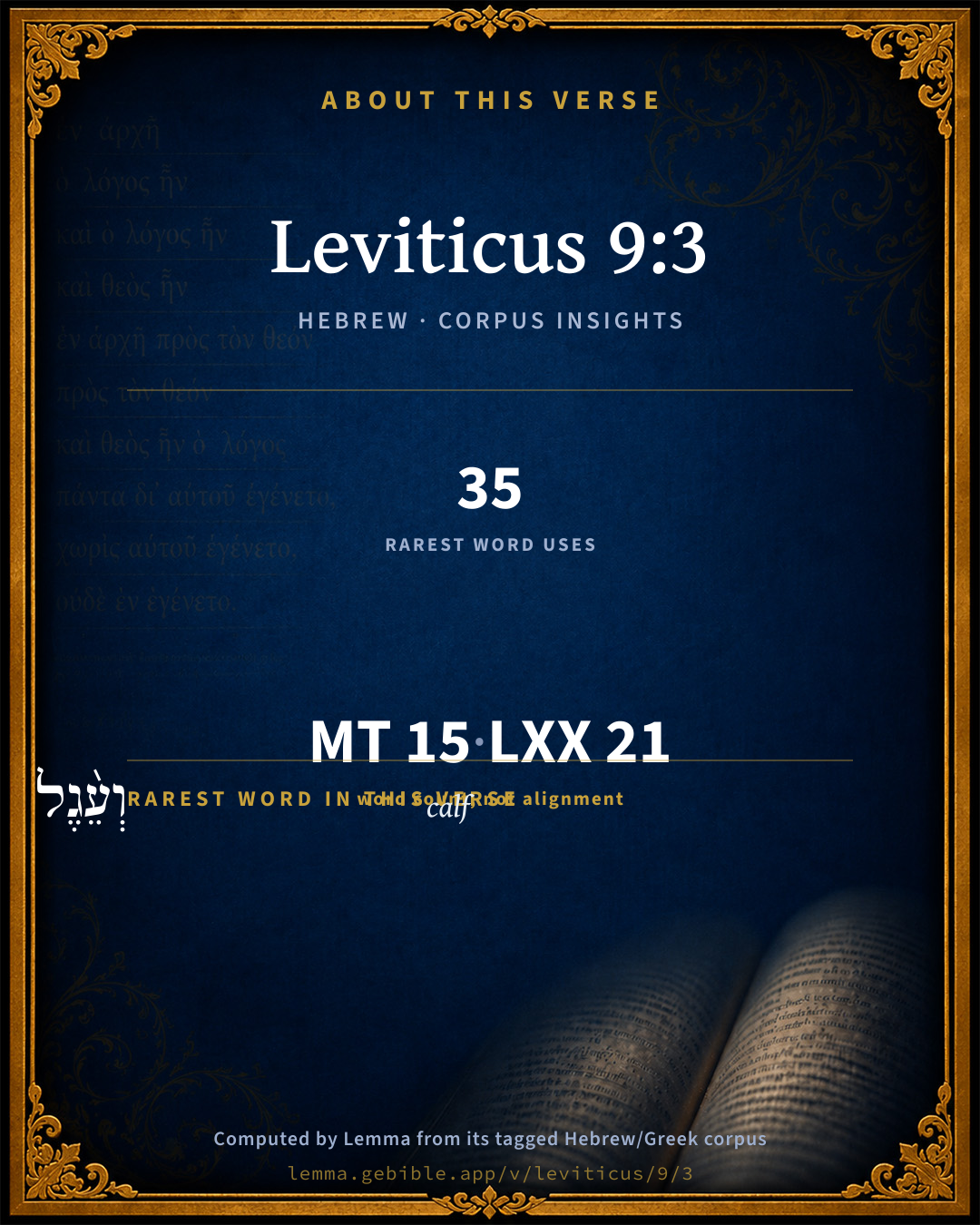
These counts appear in no published source. They are computed here, from the morphology-tagged text and Lemma’s own curated glosses. What Lemma adds →

15
words
14
distinct lemmas
Pentateuch
section

Shared distinctive vocabulary

וְעֵ֨גֶל calf H5695 occurs in 35 verses of the Hebrew Bible. Also found in:

Grammatical profile

  • 3 verbs
  • 10 nouns
  • 1 adjective
  • 1 preposition

Verb forms

  • תְּדַבֵּ֣ר Piel · Imperfect
  • לֵאמֹ֑ר Qal · Infinitive Construct
  • קְח֤וּ Qal · Imperative

Repetition

A word recurs within this verse — often emphatic in Hebrew:

  • בְּנֵ֥י son H1121 ×2

Hebrew & Septuagint length

In English translation the verse runs 33 words from the Hebrew and 34 from the Septuagint (LXX English) — closely comparable.

A rough comparison of the two English renderings, which tokenize alike — not a word-level alignment.

Word counts can differ between the Hebrew and the Greek without any difference in meaning — e.g. the Hebrew direct-object marker אֵת has no separate Greek word, and Greek often adds the article ὁ.

In the original languages it is 15 Hebrew tokens and 21 Greek tokens — but the two are counted differently (Hebrew bundles its prefixes and suffixes into one token; the Greek is in lemma form), so that isn’t a like-for-like length.

Cross-references

17

Topical passages linked to Leviticus 9:3 in the Treasury of Scripture Knowledge — connected by theme and wording, ordered by reader-vote popularity; previews shown in the World English Bible.

  • Ezra 6:17 They offered at the dedication of this house of God one hundred bulls, two hundred rams, four hundred lambs; and for a sin-offering for all Israel, twelve male goats, according to the number of the tribes of Israel.
  • Leviticus 4:23 if his sin, in which he has sinned, is made known to him, he shall bring as his offering a goat, a male without blemish.
  • Titus 2:14 who gave himself for us, that he might redeem us from all iniquity, and purify for himself a people for his own possession, zealous for good works.
  • 1 Peter 2:24 who his own self bore our sins in his body on the tree, that we, having died to sins, might live to righteousness; by whose stripes you were healed.
  • Revelation 5:9 They sang a new song, saying, "You are worthy to take the book, And to open its seals: For you were killed, And bought us for God with your blood, Out of every tribe, language, people, and nation,
  • Exodus 12:5 Your lamb shall be without blemish, a male a year old. You shall take it from the sheep, or from the goats:
  • Leviticus 12:6 "'When the days of her purification are completed, for a son, or for a daughter, she shall bring to the priest at the door of the Tent of Meeting, a year old lamb for a burnt offering, and a young pigeon, or a turtledove, for a sin offering:
  • Leviticus 14:10 "On the eighth day he shall take two male lambs without blemish, and one ewe lamb a year old without blemish, and three tenths of an ephah of fine flour for a meal offering, mingled with oil, and one log of oil.
  • Leviticus 16:5 He shall take from the congregation of the children of Israel two male goats for a sin offering, and one ram for a burnt offering
  • Leviticus 16:15 "Then he shall kill the goat of the sin offering, that is for the people, and bring his blood within the veil, and do with his blood as he did with the blood of the bull, and sprinkle it on the mercy seat, and before the mercy seat:
  • Leviticus 23:12 On the day when you wave the sheaf, you shall offer a male lamb without blemish a year old for a burnt offering to Yahweh.
  • Ezra 10:19 They gave their hand that they would put away their wives; and being guilty, [they offered] a ram of the flock for their guilt.
  • Isaiah 53:10 Yet it pleased Yahweh to bruise him; he has put him to grief: when you shall make his soul an offering for sin, he shall see [his] seed, he shall prolong his days, and the pleasure of Yahweh shall prosper in his hand.
  • Romans 8:3 For what the law couldn't do, in that it was weak through the flesh, God did, sending his own Son in the likeness of sinful flesh and for sin, he condemned sin in the flesh;
  • 2 Corinthians 5:21 For him who knew no sin he made to be sin on our behalf; so that in him we might become the righteousness of God.
  • Hebrews 9:26–28 or else he must have suffered often since the foundation of the world. But now once at the end of the ages, he has been revealed to put away sin by the sacrifice of himself.
  • 1 Peter 3:18 Because Christ also suffered for sins once, the righteous for the unrighteous, that he might bring you to God; being put to death in the flesh, but made alive in the spirit;

Cross-references courtesy of OpenBible.info (CC BY 4.0).

Hebrew and Greek witnesses Masoretic Hebrew ↔ Greek Septuagint

The same verse in the two great witnesses to the Old Testament, shown verse-for-verse.

These are two independent witnesses, not word-aligned to each other, and the Septuagint is shown in lemma (dictionary) form.

Hebrew Leviticus 9:3 Masoretic · Westminster Leningrad Codex

וְאֶל בְּנֵ֥י יִשְׂרָאֵ֖ל תְּדַבֵּ֣ר לֵאמֹ֑ר קְח֤וּ שְׂעִיר עִזִּים֙ לְחַטָּ֔את וְעֵ֨גֶל וָכֶ֧בֶשׂ בְּנֵי שָׁנָ֛ה תְּמִימִ֖ם לְעֹלָֽה

You shall speak to the children of Israel, saying, 'Take a male goat for a sin offering; and a calf and a lamb, both a year old, without blemish, for a burnt offering;

World English Bible · Public Domain

Greek LXX Leviticus 9:3 Septuagint · lemma form

καί ὁ γερουσία ἰσραήλ λαλέω λέγω λαμβάνω χίμαρος ἐκ αἴξ εἷς περί ἁμαρτία καί μοσχάριον καί ἀμνός ἐνιαύσιος εἰς ὁλοκάρπωσις ἄμωμος

And speak to the elders of Israel, saying, Take one kid of the goats for a sin-offering, and a young calf, and a lamb of a year old for a whole burnt offering, spotless,

LXX2012 (modern English Septuagint) · Public Domain

On this verse, Adam Clarke's Commentary discusses the Septuagint’s reading. Read the note in Commentary ↓

Hebrew: Westminster Leningrad Codex (CC BY 4.0). Greek: Septuagint (public domain); English from LXX2012 (modern English Septuagint) (Public Domain). How the Septuagint differs from the Hebrew →

Targum (Aramaic paraphrase)

2

The Targum is the ancient Jewish Aramaic paraphrase of the Hebrew Scriptures — an interpretive translation, not the Hebrew text itself. Onkelos (literal) and Pseudo-Jonathan (expansive) render the Torah, and Jonathan the Prophets. Coverage is partial: where no permissively-licensed English translation exists for a verse, only the Aramaic is shown. This is verse-level text, not a word-by-word alignment to the Hebrew.

  1. Targum Onkelos Torah (Genesis–Deuteronomy)
    וְעִם בְּנֵי יִשְׂרָאֵל תְּמַלֵל לְמֵימָר סִבוּ צְפִיר בַּר עִזִין לְחַטָאתָא וְעֵגֶל וְאִמָר בְּנֵי שְׁנָא שַׁלְמִין לַעֲלָתָא

    (no public-domain English translation for this verse)

    Targum Onkelos — Aramaic: “Onkelos Genesis” (public domain); “Onkelos Exodus” (public domain); “Onkelos Leviticus” (public domain); “Onkelos Numbers” (public domain); “Onkelos Deuteronomy” (public domain). English: “Sefaria Community Translation” (CC0 1.0 (public-domain dedication)); “J.W. Etheridge. The Targums of Onkelos and Jonathan Ben Uzziel on the Pentateuch. London: Longmans, Green, 1862” (public domain). Text via Sefaria.

  2. Targum Pseudo-Jonathan Torah (Genesis–Deuteronomy)
    וְעִם בְּנֵי יִשְרָאֵל תְּמַלֵיל לְמֵימָר סָבוּ בְּרַם אַתּוּן צְפִיר בַּר עִיזֵי מְטוֹל דְסַטָנָא מִימְתִיל בֵּיהּ מְטוֹל דְלָא יִשְׁתְּעֵי עֲלֵיכוֹן לִישָׁן תְּלִיתָאֵי עַל עֵיסַק צְפִיר בַּר עִיזֵי דִנְכִיסוּ שִׁבְטוֹי דְיַעֲקב וּרְמִיוּ יָתֵיהּ וְעִיבַד יָתֵיהּ לְחַטָאתָא וְעֵיגְלָא מְטוֹל דְאִשְׁתַּעְבַּדְתּוּן לְעֵיגְלָא וְאִימַר בַּר שַׁתֵּיהּ מְטוֹל דְיִדְכַּר לְכוֹן זְכוּתָא דְיִצְחָק דְכַפְתֵיהּ אָבוֹי הֵי כְאִמְרָא תְּרֵיהוֹן שַׁלְמִין לְעָלָתָא

    And to the children of Israel spoke he, saying: Take for yourselves a kid of the goats, because Satana resembles him, lest he recount against you the accusation concerning the kid of the goats, which the sons (tribes) of Jakob killed, (Gen. xxxvii. 31,) and offer him for a sin offering; and a calf, because ye worshipped the calf, (Exod. xxxii. 4,) and a lamb of the year, that there may be for you a memorial of the righteousness of Izhak, whom his father did bind as a lamb, both of them perfect, for a burnt offering;

    Targum Pseudo-Jonathan — Aramaic: “Targum Jonathan on Genesis” (public domain); “Targum Jonathan on Exodus” (public domain); “Targum Jonathan on Leviticus” (public domain); “Targum Jonathan on Numbers” (public domain); “Targum Jonathan on Deuteronomy” (public domain). English: “The Targum of Jonathan ben Uzziel, trans. J. W. Etheridge, London, 1862” (public domain). Text via Sefaria.

Commentary

Notes on Leviticus 9:3 from classic Christian and Jewish commentators (each source and its license shown beneath its notes). The classic Christian expositions comment on the surrounding passage and are grouped to its opening verse, so a note may address several verses; the Jewish commentaries on the Tanakh (Rashi and others) are per-verse, so they appear only where the commentator wrote on this verse.

Lemma curates 59 commentaries, every one of them public domain or Creative Commons licensed, each selected and text-cleaned for this edition rather than reprinted as found. About our sources →

Trapp's Complete Commentary

John Trapp

Lev 9:3 And unto the children of Israel thou shalt speak, saying, Take ye a kid of the goats for a sin offering; and a calf and a lamb, [both] of the first year, without blemish, for a burnt offering;

Ver. 3. Take ye a kid of the goats for a sin offering.] Quia gravis odor peccati. The smell of sin is grievous; it offendeth all God’s senses, yea, his very soul. {Isa 1:12-13, &c.}

John Trapp, A Commentary or Exposition upon All the Books of the Old and New Testament (1647–1656) — public domain. Text from a community e-Sword module.

Joseph Benson's Commentary

Lev 9:3. A sin-offering — For the people, for whose sin a young bullock was required, Lev 4:15; but that was for some particular sin; this was more general for all their sins. Besides, there being an eye here to the priest’s consecration and entrance into his office, it is no wonder if there be some difference in these sacrifices from those before prescribed.

Joseph Benson's Commentary on the Old and New Testaments (1811–1818) — public domain. Text from a community e-Sword module.

Adam Clarke's Commentary

Verse 3. Take ye a kid] In Le 4:14 a young bullock is commanded to be offered for the sin of the people; but here the offering is a kid, which was the sacrifice appointed for the sin of the ruler, Le 4:22-23, and hence some think that the reading of the Samaritan and the Septuagint is to be preferred. Speak unto the ELDERS of Israel, these being the only princes or rulers of Israel at that time; and for them it is possible this sacrifice was designed. It is however supposed that the sacrifice appointed Le 4:14 was for a particular sin, but this for sin in general; and that it is on this account that the sacrifices differ.

Adam Clarke's Commentary on the Bible (1810–1826) — public domain. Text from a community e-Sword/MySword module.

Ellicott's Commentary for English Readers

(3) And unto the children of Israel thou shalt speak.—That is, Aaron, who was now constituted high priest, was to give the orders about the sacrifices It will be seen that the elders of the people whom Moses summoned in Lev_9:1 to witness in behalf of the people the first ministrations of the priests, are here called “the children of Israel,” thus showing that the representatives acted for the people. Hence the two terms are interchanged (see Lev_8:2), which accounts for the fact that the Greek Version (LXX.) renders it here by “elders.”

A kid of the goats . . . and a calf.—Better, a shaggy-haired he-goat. (See Lev_4:23, &c.)

A Bible Commentary for English Readers, edited by Charles John Ellicott (1878–1897) — public domain. Text from a community e-Sword module.

The Cambridge Bible for Schools and Colleges

gen. ed. J. J. S. Perowne

3. And unto the children] LXX. and Sam. have ‘elders’ as in Lev_9:1.

The Cambridge Bible for Schools and Colleges (gen. ed. J. J. S. Perowne; Cambridge University Press, 1878–1918) — public domain. Text from a community e-Sword module.

John Gill's Exposition

And unto the children of Israel thou shalt speak,.... That is, Aaron should speak to them, for being now high priest, Moses had no more to do with the sacrifices of the people, but it was incumbent on Aaron to call upon them to bring them to him such as the Lord by this law required of them:

saying, take ye a kid of the goats for a sin offering; this creature fitly represented Christ as made sin, and an offering for sin, in the room of his people:

and a calf, and a lamb; both of them, as before observed, were proper emblems of Christ in his strength and innocence, sometimes called the fatted calf, and frequently the Lamb of God, Luk 15:23 Joh 1:29,

both of the first year, without blemish, for a burnt offering; denoting the tenderness of Christ, his spotless purity, and painful sufferings.

John Gill's Exposition of the Whole Bible (1746–1763) — public domain (CC PDM 1.0). Text via the HelloAO Bible API.

Haydock's Catholic Bible Commentary

Children. Samaritan and Septuagint, "the ancients," or princes of the people, for whom a he-goat is sacrificed. --- Old. Not above, though they might be younger.

George Leo Haydock (1774–1849), Haydock's Catholic Family Bible and Commentary, 1859 edition — public domain. Excludes Psalms (Douay-Rheims chapter numbering differs from Protestant) and Deuterocanonical books (Catholic canon only).

Matthew Poole's English Annotations

A sin-offering for the people, as it is expressed here Lev 9:15, for whose sin a young bullock was required, Lev 4:14; but that was for some particular sin, but this was more general and indefinite for all their sins. Besides, there being an eye here had to the priest’s consecration and entrance into his office, it is no wonder if there be some difference in these sacrifices from those before prescribed.

Matthew Poole's English Annotations on the Holy Bible (1683–1685) — public domain. Text from a community e-Sword/MySword module.

Whedon's Commentary on the Bible

Daniel D. Whedon

3. A kid of the goats — See Lev_23:19, note.

A burnt offering — Chap. 1 and Lev_6:9, notes.

Daniel D. Whedon (gen. ed.), Commentary on the Old and New Testaments (1874–1909) — public domain. Text from a community e-Sword module.

John Wesley's Explanatory Notes

A sin-offering - For the people, for whose sin a young bullock was required, chap. iv, 15, but that was for some particular sin; this was more general for all their sins. Besides, there being an eye here to the priest's consecration and entrance into his office, it is no wonder if there be some difference in these Sacrifices from those before prescribed.

John Wesley, Explanatory Notes Upon the Whole Bible (1754–1765) — public domain. Text via the GEBible commentary corpus.

unfoldingWord translationNotes

Door43 World Missions Community

General Information:

Moses continues speaking to Aaron.

You must speak to the people of Israel and say, 'Take a male goat ... will appear to you

Moses continues speaking to Aaron. This has a quotation within a quotation. A direct quotation can be stated as an indirect quotation. AT: "And tell the people of Israel to take a male goat ... will appear to all the people" (See:Quotes Within Quotes and Direct and Indirect Quotations)

a year old

"twelve months of age"

to sacrifice before Yahweh

"to sacrifice to Yahweh"

translationWords

Israel

goat

sin offering

cow

lamb

year

blemish

burnt offering

cow

ewe

peace offering

grain offering

oil

command

tent of meeting

assembly

unfoldingWord translationNotes — © Distant Shores Media and the Door43 World Missions Community, licensed CC BY-SA 4.0. Source: git.door43.org/Door43/en_tn.

Ramban (Nachmanides)

Rabbi Moshe ben Nachman (Ramban / Nachmanides)

And unto the children of Israel thou shalt speak. This means that Aaron is to speak to them thus, as it was His wish that Aaron should be the one who commands in the name of G-d, and that he should be the one who would bring the offerings, in order to elevate him in the eyes of the people. The correct interpretation is that the expression and unto the children of Israel thou shalt speak, means you [Aaron] and the elders mentioned [in Verse 1], since it was for that purpose that he called them,. so that they should speak to the children of Israel, as in the verse, And Moses called for all the elders of Israel, and said unto them: Draw out [and take you lambs]. Or it may be that [Moses] said to each of the elders, and unto the children of Israel thou shalt speak [the singular word thou thus referring to each one of the elders]. Accordingly, the meaning of the section is as follows: and he [Moses] said to Aaron: Take thee etc., and to [each of] the elders he said, and unto the children of Israel thou shalt speak. For one who speaks to many people usually addresses his command to each person individually, something like that which it is said, And I commanded you at that time, saying etc.: Ye shall pass over armed before your brethren. There are many such cases in the Book of Deuteronomy [where Moses speaks to the whole congregation, when his message is actually addressed to each person individually].Now Rabbi Abraham ibn Ezra wrote that the verse, And Moses said: This is the thing which the Eternal commanded that ye should do, means that “Moses had already told them, this is the thing.” If so, it is possible that the meaning of the verses be as follows: Moses called Aaron and his sons and the elders of Israel, and Moses said: This thing which the Eternal has commanded me ye should do, that the Glory of the Eternal may appear unto you; and he said unto Aaron: Take thee a bull-calf etc.; and unto the children of Israel thou shalt speak, saying: Take ye a he-goat for a sin-offering etc. Thus [Moses] spoke briefly at first [as in Verse 6] and then explained himself at the end [in Verses 2-4].But this is not correct. Rather, after Moses had mentioned to them the offerings [which they were required to bring on that day], and they brought that which Moses commanded, he said to them again, This is the thing which the Eternal commanded that ye should do, meaning that they should bring the offerings in the order that he would command them, and afterwards the Glory of the Eternal would appear to them. Now since he had said, for today the Eternal appeareth unto you, he went back and said that He would appear to them through His Glory.Now these offerings [which were brought on the eighth day after the completion of the seven-day consecration of the priests], were not mentioned in the section of And this is the thing that thou shalt do unto them to hallow them, to minister unto Me, for there He only gave the command about the consecration, and their days of consecration were completed with the seven days and their offerings, but now on the eighth day, they themselves brought the offerings [whereas on the seven days of the consecration, the offerings were brought by Moses]. Thus these offerings [brought on the eighth day] were a kind of initiation for the priests, as was the meal-offering of the baken cakes command for future generations [which were brought] on the day when he is anointed., Verse 13. I.e., on the day that the ordinary priests are installed into the priestly service. The High Priest, however, brought this meal-offering every day. Ramban thus suggests that the offerings brought on the eighth day [as explained in this section] were a sort of initiation, comparable to the meal-offering brought in future generations by the ordinary priest once in his lifetime, and by the High Priest every day.It is possible that it was in order to atone for the incident of the golden calf that He now gave them these added offerings, for at the time when He commanded the section of And this is the thing that thou shalt do unto them to hallow them, to minister unto Me, the golden calf had not yet been made, as I have explained, and therefore He did not mention them [these offerings] there. It is thus not as Rashi wrote there, that the bullock [offered on each of the seven days of consecration] was to atone for the incident of the golden calf, but these bullocks were to purify the altar, and for Aaron and his sons in order to hallow them, and it was this calf [brought] on the eighth day that was to atone for the incident of the golden calf. Thus Aaron’s offerings [on this eight day] were the same as his offerings on the Day of Atonement,. [namely, the bull-calf for a sin-offering, and a ram for a burnt-offering, as mentioned in the verse before us], and the people’s sin-offering [on this eighth day] was the same as their sin-offering on the Day of Atonement, namely, one he-goat for a sin-offering. So also have the Rabbis said in the Tosephta of the section of consecration, in the Torath Kohanim, 4. that this calf [brought on the eighth day] was to atone for the incident of the golden calf. Thus they interpreted: “For what reason did Israel bring more offerings [on this day] than Aaron? It was on account of what He said to them: ‘You [the people] have in your hands [sin] at the beginning, and you have in your hands [sin] at the end.’ You have sinned at the beginning, as it is written [when the brothers sold Joseph], and they killed a he-goat, and you have sinned at the end, as it is said, they have made them a molten calf. Therefore let them bring the he-goat [for a sin-offering] to atone for the incident connected with that of the he-goat, and let them bring a calf [as a burnt-offering] to atone for the incident of the golden calf.”It would appear that because the reason for Aaron’s sin-offering [on this eighth day] was the same as that of his sin-offering on the Day of Atonement, therefore he burnt it [outside the camp] as the one of the Day of Atonement is burnt, even though this sin-offering [of the eighth day] was “an outer sin-offering”, Note 52. Ramban’s concluding thought here — “for Moses did not explain that he should do so” — is thus to be understood as follows: Since Scripture does not relate that Moses commanded Aaron to burn his sin-offering outside the camp although it was not “an inner sin-offering,” the question arises why did Aaron do so [as stated in Verse 11]? It must be, Ramban suggests, because the reason for Aaron’s sin-offering on this eighth day of the initiation was the same as that of his sin-offering on the Day of Atonement, which being “an inner sin-offering” is rightfully burnt outside the camp, and hence Aaron on this eighth day did similarly. In the text following, Ramban will suggest that Aaron actually received this command from Moses, and the reason why Scripture did not mention it is explained in the text of Ramban. [while that of the Day of Atonement was “an inner sin-offering”], for Moses did not explain that he should do so. But perhaps Aaron was indeed so commanded, and [it is not mentioned because] Scripture did not want to prolong the matter, it being known that Aaron would only do what Moses said, and that Moses would only say what G-d had commanded.

Ramban (Nachmanides) on the Tanakh — English translation: “Commentary on the Torah by Ramban (Nachmanides). Translated and annotated by Charles B. Chavel. New York, Shilo Pub. House, 1971-1976” (CC BY 4.0). Text via Sefaria.

Lesson kit

Teaching starters — assembled from the data on this page, not authored interpretation. Every prompt links to the verse data it draws on. Edit before teaching.

Leviticus, in the Pentateuch, opens this verse with 15 words (14 distinct Hebrew lemmas). Its most distinctive word is ʻêgel (“calf”). A historical commentator’s framing appears above. Read the whole chapter for the surrounding context.

Discussion questions

  1. How does “calf” (ʻêgel) shape what this verse is saying?
  2. Exodus 32:4 shares the word «calf» with this verse. How do the two illuminate each other?
  3. “son” occurs 2× in this one verse. What is the effect of the repetition?
  4. The translations on this page render this verse differently — a whole-verse word diff, not a word-by-word alignment. What might account for the different wordings?
  5. The verb «תְּדַבֵּ֣ר» is Piel Imperfect. How does its form color the action?
  6. Reading how Trapp's Complete Commentary and Joseph Benson's Commentary read this verse, where do the two commentators agree and where do they part?

Things to notice

Reading settings

Reading text

Shown beneath each verse's original-language words.

Old Testament
Old Testament edition

Read the OT as the Masoretic Hebrew (MT) or the Greek Septuagint (LXX).

English shown for the Greek Septuagint (in the Hebrew ↔ Greek comparison).

Comparing translations? Open the Compare panel on any verse page to stack up to four side by side.