
1 Chronicles 5:1

Hebrew (Westminster Leningrad Codex) 1 Chronicles 5:1 appears in the Hebrew Old Testament. The text above is from the Westminster Leningrad Codex. Each word links to its Strong’s number, a concise gloss, and parsing drawn from the Open Scriptures Hebrew Bible morphology. Click any word for its full Brown-Driver-Briggs (BDB) entry.
Download image
Cite this verse

1 Chronicles 5:1 (World English Bible). Public Domain. Lemma interlinear Bible study tool, https://lemma.gebible.app/v/1-chronicles/5/1.

Show BibTeX & RIS
BibTeX
RIS
English Translation
The sons of Reuben the firstborn of Israel (for he was the firstborn; but, because he defiled his father's couch, his birthright was given to the sons of Joseph the son of Israel; and the genealogy is not to be reckoned after the birthright.
World English Bible · Public Domain
Download a study sheet

One document with this verse’s original text, its word-by-word gloss line, the meaning frame, cross-references with their text, attributed commentary, and full source and license credits — printable, and it pastes into notes with its structure intact.

This verse Autodidact and up

Study sheet (.html) Plain text (.txt)

A passage Seminary Student

Up to 50 verses in one chapter. A passage sheet keeps up to 6 commentary sources and 12 cross-references per verse, in the order this page ranks them, and says so on the sheet whenever that leaves anything out. Ask for a single verse and you get the Autodidact verse sheet above.

Everything on this page stays free to read, with no account — the sheet is a download of what is already on screen, not access to it.

Want to remove ads? Support Godless Engineer
Compare translations 3

The same verse in 3 English versions, stacked beneath the original-language interlinear above. Click any original word for its lexicon entry.

Each is an independent rendering of the whole verse — the interlinear is not word-aligned to these translations.

Highlighted words mark where these versions differ — a whole-verse word diff, not a word-by-word alignment.

  • World English Bible Public Domain
    The sons of Reuben the firstborn of Israel (for he was the firstborn; but, because he defiled his father's couch, his birthright was given to the sons of Joseph the son of Israel; and the genealogy is not to be reckoned after the birthright.
  • King James Version Public Domain
    Now the sons of Reuben the firstborn of Israel, (for he was the firstborn; but forasmuch as he defiled his father's bed, his birthright was given unto the sons of Joseph the son of Israel: and the genealogy is not to be reckoned after the birthright.
  • unfoldingWord Literal Text CC BY-SA 4.0
    And the sons of Reuben, the firstborn of Israel—for he was the firstborn, but when he defiled the couches of his father, his birthright was given to the sons of Joseph, the son of Israel, so he is not enrolled according to the birthright;

unfoldingWord Literal Text — © unfoldingWord, licensed CC BY-SA 4.0. Word-aligned USFM3 via Door43 (git.door43.org/unfoldingWord/en_ult).

Versions to compare (up to 4)

3 of 4 selected

Show all 18 translations

Every available English version of this verse, each an independent rendering of the whole verse.

  • World English Bible Public Domain
    The sons of Reuben the firstborn of Israel (for he was the firstborn; but, because he defiled his father's couch, his birthright was given to the sons of Joseph the son of Israel; and the genealogy is not to be reckoned after the birthright.
  • Berean Standard Bible Public Domain
    These were the sons of Reuben the firstborn of Israel. Though he was the firstborn, his birthright was given to the sons of Joseph son of Israel, because Reuben defiled his father’s bed. So he is not reckoned according to birthright.
  • Majority Standard Bible Public Domain
    These were the sons of Reuben the firstborn of Israel. Though he was the firstborn, his birthright was given to the sons of Joseph son of Israel, because Reuben defiled his father’s bed. So he is not reckoned according to birthright.
  • King James Version Public Domain
    Now the sons of Reuben the firstborn of Israel, (for he was the firstborn; but forasmuch as he defiled his father's bed, his birthright was given unto the sons of Joseph the son of Israel: and the genealogy is not to be reckoned after the birthright.
  • American Standard Version (1901) Public Domain
    And the sons of Reuben the first-born of Israel (for he was the first-born; but, forasmuch as he defiled his father's couch, his birthright was given unto the sons of Joseph the son of Israel; and the genealogy is not to be reckoned after the birthright.
  • Revised Version (1885) Public Domain
    And the sons of Reuben the firstborn of Israel, (for he was the firstborn; but, forasmuch as he defiled his father’s couch, his birthright was given unto the sons of Joseph the son of Israel; and the genealogy is not to be reckoned after the birthright.
  • Geneva Bible (1599) Public Domain
    The sonnes also of Reuben the eldest sonne of Israel (for he was the eldest, but had defiled his fathers bed, therefore his birthright was giuen vnto the sonnes of Ioseph the sonne of Israel, so that the genealogie is not rekoned after his birthright.
  • Douay-Rheims (1899) Public Domain
    Now the sons of Ruben the firstborn of Israel, (for he was his firstborn: but forasmuch as he defiled his father's bed, his first birthright was given to the sons of Joseph the son of Israel, and he was not accounted for the firstborn.
  • Young's Literal Translation Public Domain
    As to sons of Reuben, first-born of Israel -- for he `is' the first-born, and on account of his profaning the couch of his father hath his birthright been given to the sons of Joseph son of Israel, and `he is' not to be reckoned by genealogy for the birthright,
  • Literal Standard Version CC BY-SA 4.0
    As for sons of Reuben, firstborn of Israel—for he [is] the firstborn, and on account of his profaning the bed of his father his birthright has been given to the sons of Joseph son of Israel, and [he is] not to be reckoned by genealogy for the birthright,
  • Unlocked Literal Bible CC BY-SA 4.0
    The sons of Reuben the firstborn of Israel—now Reuben was Israel's firstborn, but his birthright was given to the sons of Joseph son of Israel because Reuben had defiled his father's couch. So he is not recorded as being the oldest son.
  • unfoldingWord Literal Text CC BY-SA 4.0
    And the sons of Reuben, the firstborn of Israel—for he was the firstborn, but when he defiled the couches of his father, his birthright was given to the sons of Joseph, the son of Israel, so he is not enrolled according to the birthright;
  • Darby Bible Public Domain
    And the sons of Reuben the firstborn of Israel (for he was the firstborn; but, inasmuch as he defiled his father's bed, his birthright was given to the sons of Joseph the son of Israel; but the genealogy is not registered according to the birthright,
  • World Messianic Bible Public Domain
    The sons of Reuben the firstborn of Israel (for he was the firstborn, but because he defiled his father’s couch, his birthright was given to the sons of Joseph the son of Israel; and the genealogy is not to be listed according to the birthright.
  • Webster's Bible Public Domain
    Now the sons of Reuben the first-born of Israel, (for he was the first-born; but, forasmuch as he defiled his father's bed, his birth-right was given to the sons of Joseph the son of Israel: and the genealogy is not to be reckoned after the birth-right.
  • Free Bible Version CC BY-SA 4.0
    The sons of Reuben the firstborn of Israel. (Though he was the firstborn, his birthright was given to the sons of Joseph son of Israel because he had defiled his father's bed. That is why Reuben is not listed in the genealogy according to birthright,
  • Bible in Basic English Public Domain
    And the sons of Reuben, the oldest son of Israel, (for he was the oldest son, but, because he made his father's bride-bed unclean, his birthright was given to the sons of Joseph, the son of Israel; but he is not to be given the place of the oldest.
  • JPS Tanakh (1917) Public Domain
    And the sons of Reuben the first-born of Israel — for he was the first-born; but, forasmuch as he defiled his father's couch, his birthright was given unto the sons of Joseph the son of Israel, yet not so that he was to be reckoned in the genealogy as first-born.

Literal Standard Version (2020), Covenant Press — licensed CC BY-SA 4.0. Text via the HelloAO Bible API (eBible.org). Unlocked Literal Bible (unfoldingWord) — licensed CC BY-SA 4.0. Text via the HelloAO Bible API (eBible.org). unfoldingWord Literal Text — © unfoldingWord, licensed CC BY-SA 4.0. Word-aligned USFM3 via Door43 (git.door43.org/unfoldingWord/en_ult). Free Bible Version, Dr. Jonathan Gallagher — licensed CC BY-SA 4.0. Text via the HelloAO Bible API (eBible.org).

Word by word

More ways to search: Search by grammar → Find every occurrence → Compare this word →

Practice this passage: Drill this verse → Learn its vocabulary →

יְצוּעֵ֣י
yâtsûwaʻ
H3326
“beds of”
Noun, Common, Masculine, Plural, Construct
Part of Speech
Noun
Type
Common
Gender
Masculine
Number
Plural
State
Construct
Full BDB Definition

Origin: passive participle of H3331

TWOT: 896a

couch, bed
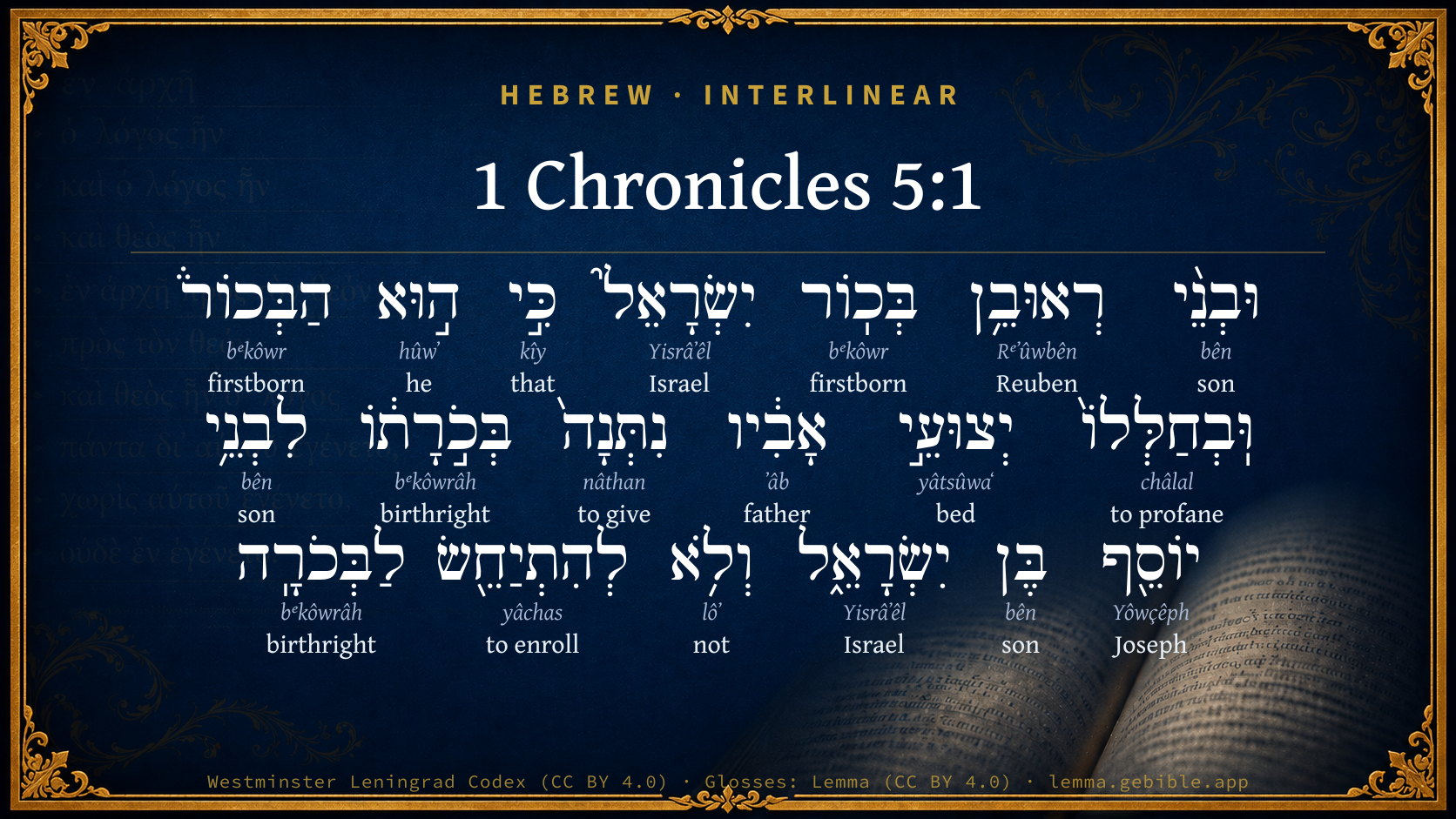
  1. וּבְנֵ֨י bên H1121 “and · sons of” Conjunction + Noun, Common, Masculine, Plural, Construct
  2. רְאוּבֵ֥ן Rᵉʼûwbên H7205 “Reuben” Noun, Proper
  3. בְּכֽוֹר bᵉkôwr H1060 “firstborn of” Noun, Common, Masculine, Singular, Construct
  4. יִשְׂרָאֵל֮ Yisrâʼêl H3478 “Israel” Noun, Proper
  5. כִּ֣י kîy H3588 “that” Conjunction
  6. ה֣וּא hûwʼ H1931 “he” Pronoun, Personal, 3rd Person, Masculine, Singular
  7. הַבְּכוֹר֒ bᵉkôwr H1060 “the · firstborn” Particle, Definite Article + Noun, Common, Masculine, Singular, Absolute
  8. וּֽבְחַלְּלוֹ֙ châlal H2490 “and · in/at · to profane · him” Conjunction + Preposition + Verb, Piel, Infinitive Construct + Suffix, Personal, 3rd Person, Masculine, Singular
  9. אָבִ֔יו ʼâb H1 “father · his” Noun, Common, Masculine, Singular, Construct + Suffix, Personal, 3rd Person, Masculine, Singular
  10. נִתְּנָה֙ nâthan H5414 “to give” Verb, Niphal, Perfect, 3rd Person, Feminine, Singular
  11. בְּכֹ֣רָת֔וֹ bᵉkôwrâh H1062 “birthright · his” Noun, Common, Both, Singular, Construct + Suffix, Personal, 3rd Person, Masculine, Singular
  12. לִבְנֵ֥י bên H1121 “to/for · sons of” Preposition + Noun, Common, Masculine, Plural, Construct
  13. יוֹסֵ֖ף Yôwçêph H3130 “Joseph” Noun, Proper
  14. בֶּן bên H1121 “son of” Noun, Common, Masculine, Singular, Construct
  15. יִשְׂרָאֵ֑ל Yisrâʼêl H3478 “Israel” Noun, Proper
  16. וְלֹ֥א lôʼ H3808 “and · not” Conjunction + Particle, Negative
  17. לְהִתְיַחֵ֖שׂ yâchas H3187 “to enroll” Preposition + Verb, Hithpael, Infinitive Construct
  18. לַבְּכֹרָֽה bᵉkôwrâh H1062 “to/for the · birthright” Preposition, Determined + Noun, Common, Both, Singular, Absolute

About this verse

These counts appear in no published source. They are computed here, from the morphology-tagged text and Lemma’s own curated glosses. What Lemma adds →

19
words
14
distinct lemmas
Historical
section

Notable vocabulary

The rarest word here is יְצוּעֵ֣י bed H3326 — appearing just 11 times in the whole Hebrew Bible.

Shared distinctive vocabulary

יְצוּעֵ֣י bed H3326 occurs in 8 verses of the Hebrew Bible. Also found in:

Grammatical profile

  • 3 verbs
  • 13 nouns
  • 1 pronoun
  • 1 conjunction
  • 1 particle

Verb forms

  • וּֽבְחַלְּלוֹ֙ Piel · Infinitive Construct
  • נִתְּנָה֙ Niphal · Perfect
  • לְהִתְיַחֵ֖שׂ Hithpael · Infinitive Construct

Repetition

Words recur within this verse — often emphatic in Hebrew:

  • וּבְנֵ֨י son H1121 ×3
  • בְּכֽוֹר firstborn H1060 ×2
  • יִשְׂרָאֵל֮ Israel H3478 ×2
  • בְּכֹ֣רָת֔וֹ birthright H1062 ×2

Hebrew & Septuagint length

In English translation the verse runs 44 words from the Hebrew and 45 from the Septuagint (LXX English) — closely comparable.

A rough comparison of the two English renderings, which tokenize alike — not a word-level alignment.

Word counts can differ between the Hebrew and the Greek without any difference in meaning — e.g. the Hebrew direct-object marker אֵת has no separate Greek word, and Greek often adds the article ὁ.

In the original languages it is 19 Hebrew tokens and 33 Greek tokens — but the two are counted differently (Hebrew bundles its prefixes and suffixes into one token; the Greek is in lemma form), so that isn’t a like-for-like length.

Cross-references

20

Topical passages linked to 1 Chronicles 5:1 in the Treasury of Scripture Knowledge — connected by theme and wording, ordered by reader-vote popularity; previews shown in the World English Bible.

  • Genesis 35:22 It happened, while Israel lived in that land, that Reuben went and lay with Bilhah, his father's concubine, and Israel heard of it. Now the sons of Jacob were twelve.
  • Genesis 29:32 Leah conceived, and bore a son, and she named him Reuben. For she said, "Because Yahweh has looked at my affliction. For now my husband will love me."
  • Genesis 48:15–22 He blessed Joseph, and said, "The God before whom my fathers Abraham and Isaac did walk, the God who has fed me all my life long to this day,
  • Genesis 49:3–4 "Reuben, you are my firstborn, my might, and the beginning of my strength; The pre-eminence of dignity, and the pre-eminence of power.
  • Exodus 6:14 These are the heads of their fathers' houses. The sons of Reuben the firstborn of Israel: Hanoch, and Pallu, Hezron, and Carmi; these are the families of Reuben.
  • 1 Chronicles 26:10 Also Hosah, of the children of Merari, had sons: Shimri the chief, (for though he was not the firstborn, yet his father made him chief),
  • 1 Corinthians 5:1 It is actually reported that there is sexual immorality among you, and such sexual immorality as is not even named among the Gentiles, that one has his father's wife.
  • Genesis 25:23 Yahweh said to her, Two nations are in your womb, Two peoples will be separated from your body. The one people will be stronger than the other people. The elder will serve the younger.
  • Genesis 46:8 These are the names of the children of Israel, who came into Egypt, Jacob and his sons: Reuben, Jacob's firstborn.
  • Leviticus 18:8 "'You shall not uncover the nakedness of your father's wife: it is your father's nakedness.
  • Leviticus 20:11 The man who lies with his father's wife has uncovered his father's nakedness: both of them shall surely be put to death; their blood shall be upon them.
  • Numbers 1:5 These are the names of the men who shall stand with you: Of Reuben: Elizur the son of Shedeur.
  • Numbers 16:1 Now Korah, the son of Izhar, the son of Kohath, the son of Levi, with Dathan and Abiram, the sons of Eliab, and On, the son of Peleth, sons of Reuben, took [men]:
  • Numbers 26:5 Reuben, the firstborn of Israel; the sons of Reuben: [of] Hanoch, the family of the Hanochites; of Pallu, the family of the Palluites;
  • Deuteronomy 21:17 but he shall acknowledge the firstborn, the son of the hated, by giving him a double portion of all that he has; for he is the beginning of his strength; the right of the firstborn is his.
  • Deuteronomy 27:20 Cursed be he who lies with his father's wife, because he has uncovered his father's skirt. All the people shall say, Amen.
  • Joshua 14:6 Then the children of Judah drew near to Joshua in Gilgal: and Caleb the son of Jephunneh the Kenizzite said to him, You know the thing that Yahweh spoke to Moses the man of God concerning me and concerning you in Kadesh-barnea.
  • 1 Samuel 16:6–11 It happened, when they had come, that he looked at Eliab, and said, Surely Yahweh's anointed is before him.
  • 1 Chronicles 2:1 These are the sons of Israel: Reuben, Simeon, Levi, and Judah, Issachar, and Zebulun,
  • Colossians 1:15 who is the image of the invisible God, the firstborn of all creation.

Cross-references courtesy of OpenBible.info (CC BY 4.0).

Hebrew and Greek witnesses Masoretic Hebrew ↔ Greek Septuagint

The same verse in the two great witnesses to the Old Testament, shown verse-for-verse.

These are two independent witnesses, not word-aligned to each other, and the Septuagint is shown in lemma (dictionary) form.

Hebrew 1 Chronicles 5:1 Masoretic · Westminster Leningrad Codex

וּבְנֵ֨י רְאוּבֵ֥ן בְּכֽוֹר יִשְׂרָאֵל֮ כִּ֣י ה֣וּא הַבְּכוֹר֒ וּֽבְחַלְּלוֹ֙ יְצוּעֵ֣י אָבִ֔יו נִתְּנָה֙ בְּכֹ֣רָת֔וֹ לִבְנֵ֥י יוֹסֵ֖ף בֶּן יִשְׂרָאֵ֑ל וְלֹ֥א לְהִתְיַחֵ֖שׂ לַבְּכֹרָֽה

The sons of Reuben the firstborn of Israel (for he was the firstborn; but, because he defiled his father's couch, his birthright was given to the sons of Joseph the son of Israel; and the genealogy is not to be reckoned after the birthright.

World English Bible · Public Domain

Greek LXX 1 Chronicles 5:1 Septuagint · lemma form

καί υἱός ρουβην πρωτότοκος ἰσραήλ ὅτι οὗτος ὁ πρωτότοκος καί ἐν ὁ ἀναβαίνω ἐπί ὁ κοίτη ὁ πατήρ αὐτός δίδωμι εὐλογία αὐτός ὁ υἱός αὐτός ιωσηφ υἱός ἰσραήλ καί οὐ γενεαλογέω εἰς πρωτοτόκια

And the sons of Ruben the firstborn of Israel (for he was the firstborn; but because of his going up to his father's couch, his father gave his blessing to his son Joseph, even the son of Israel; and he was not reckoned as firstborn;

LXX2012 (modern English Septuagint) · Public Domain

Hebrew: Westminster Leningrad Codex (CC BY 4.0). Greek: Septuagint (public domain); English from LXX2012 (modern English Septuagint) (Public Domain). How the Septuagint differs from the Hebrew →

Commentary

Notes on 1 Chronicles 5:1 from classic Christian and Jewish commentators (each source and its license shown beneath its notes). The classic Christian expositions comment on the surrounding passage and are grouped to its opening verse, so a note may address several verses; the Jewish commentaries on the Tanakh (Rashi and others) are per-verse, so they appear only where the commentator wrote on this verse.

Lemma curates 59 commentaries, every one of them public domain or Creative Commons licensed, each selected and text-cleaned for this edition rather than reprinted as found. About our sources →

Ellicott's Commentary for English Readers

I.—THE REUBENITES (1Ch_5:1-10).

(1) Reuben the firstborn of Israel.—See Gen_49:3 : “Reuben, my firstborn thou! my strength, and firstfruits of my manhood;” also Gen_29:32.

For he was the firstborn.—The parenthesis is an assertion of the legitimacy of the Davidic monarchy, as against the fact that both Reuben and Joseph had claims prior to those of Judah.

He defiled his father’s bed.—Gen_49:4, Jacob’s curse: “Bubbling like the waters, excel thou not! For thou wentest up thy father’s couches. Then thou defiledst my bed” (See Gen_35:22).

His birthright was given to the sons of Joseph.—The reading of some MSS., and the Syriac and Arabic, “to Joseph,” is probably original. This transfer of the rights of primogeniture is not elsewhere mentioned. It is, however, a fair inference from Jacob’s curse, and from the special blessing of Joseph (Gen_49:22-26) and of his two sons (Gen_48:15-20), considered in the light of historical fulfilment. Ephraim was always a leading tribe (Jdg_2:9; Jdg_4:5; Jdg_5:14; Jdg_8:1-2; Jdg_12:1; Jdg_12:15).

And the genealogy is not to be reckoned after the birthright.—Rather, though he was not to be registered as firstborn (literally, according to the primogeniture). The subject is Joseph or the sons of Joseph, who received the forfeited rights of Reuben, but not the first place in lists of the tribes. What those rights were is defined by Deu_21:15-17, which rules that the son of a hated wife—if he be firstborn (the case of Reuben, son of Leah), shall inherit a double portion, “for he is the firstfruits of his strength, the right of the firstborn is his;” words obviously referring to Gen_49:4-5.

A Bible Commentary for English Readers, edited by Charles John Ellicott (1878–1897) — public domain. Text from a community e-Sword module.

The Cambridge Bible for Schools and Colleges

gen. ed. J. J. S. Perowne

Ch. 1Ch_5:1-10. The Genealogy of Reuben

1. he defiled] Gen_35:22; Gen_49:4.

his birthright was given unto the sons of Joseph] Cp. Gen_48:5, “Ephraim and Manasseh, even as Reuben and Simeon, shall be mine”; words of Jacob which might be interpreted to mean that Reuben and Simeon are to be disinherited, and that Ephraim and Manasseh are to take their places.

the genealogy is not to be reckoned after the birthright] i.e. though the birthright of Reuben has been given to Joseph, yet the genealogy of Joseph is not to be given before that of Reuben. In 1Ch_5:2 it is shewn that Joseph, though possessing the birthright, was excelled by Judah. In this confusion of claims the natural order is followed and the genealogy of Reuben is given first.

The Cambridge Bible for Schools and Colleges (gen. ed. J. J. S. Perowne; Cambridge University Press, 1878–1918) — public domain. Text from a community e-Sword module.

Trapp's Complete Commentary

John Trapp

1Ch 5:1 Now the sons of Reuben the firstborn of Israel, (for he [was] the firstborn; but, forasmuch as he defiled his father’s bed, his birthright was given unto the sons of Joseph the son of Israel: and the genealogy is not to be reckoned after the birthright.

Ver. 1. But, forasmuch as he defiled his father’s bed.] {See Trapp on "Gen 35:22"}

But, forasmuch as he defiled his father’s bed.] He might well say as Lysimachus did, when for a draught of water he had parted with his kingdom, Ah, for how short a (sinful) pleasure, how great privileges and blessings have I forfeited!

His birthright.] That is, His double portion of inheritance: as for the dignity due to him, it was given to Judah.

Joseph the son of Israel,] i.e., His best beloved son.

John Trapp, A Commentary or Exposition upon All the Books of the Old and New Testament (1647–1656) — public domain. Text from a community e-Sword module.

The Biblical Illustrator

Joseph S. Exell

1Ch_5:1-2

Now the sons of Reuben, the firstborn of Israel.

Reubens rights transferred to Joseph

This incident is worth dwelling upon, only because it elucidates a special phase of the Divine government. God is not bound by arbitrary laws. Primogeniture can be changed in the court of heaven. Conduct is the only absolute guarantee of real and enduring primogeniture. Once in grace, always in grace, may be a glorious truth, but everything depends upon what is meant by being in grace. They are not all Israel that are called Israel. We can only prove that we were once in grace by continually living in grace. Any vital breach in the continuance will throw discredit upon the supposed reality of the origin. (J. Parker, D. D.)

The Biblical Illustrator, edited by Joseph S. Exell (c. 1880s–1900s) — public domain. Text from a community e-Sword module.

Joseph Benson's Commentary

1Ch 5:1. The son of Israel — This is added emphatically, because the sons of Joseph, Manasseh, and Ephraim were treated as if they had been the immediate sons of Jacob. The genealogy is not to be reckoned after the birthright — This is the second reason which showeth both why Reuben’s genealogy was not first mentioned, and if another tribe was to be ranked before it, why that was Judah, and not Joseph, because the order of their genealogy was not to be ruled by the birthright, but by a higher privilege, which was given to Judah.

Joseph Benson's Commentary on the Old and New Testaments (1811–1818) — public domain. Text from a community e-Sword module.

The Preacher's Complete Homiletical Commentary

Joseph S. Exell (gen. ed.)

CRITICAL NOTES.] This ch. contains Reuben, Gad, and the half of Manasseh east of Jordan, with two episodes, one on the wars of these tribes, and the other on the removal by Tilgath-pilneser. The upper Assyrian monarchy began 1273 B.C., the lower 747 B.C. [Murphy].

1Ch_5:1-10.—Reuben lost his birthright. The priesthood given to Levi; the double portion (Deu_21:17) to Joseph, whose sons, Ephraim and Manasseh, reckoned as distinct tribes. Judah had supremacy, 1Ch_5:2. Chief ruler, prince, i.e., David, and eventually Messiah (Mic_5:1). 1Ch_5:3, sons four, as Gen_46:9; Exo_6:14. 1Ch_5:4-6. The line of Joel. 1Ch_5:7. Brethren, kinsmen of Joel, chief was Jeiel. 1Ch_5:10. Hagarites, Hagarenes (Psa_83:6), a tribe of North Arabia, perhaps Agraioi of Strabo [Speak. Com.], or Ismaelites as descendants of Hagar.

1Ch_5:11-17.—Gad. Chiefs, 1Ch_5:12, and seven others, 1Ch_5:13. “Their pedigree traced back ten generations. For Buz and Ahi are really parts of one name, Buzahi, for which Sept. has Ahibuz by transposing parts. Not informed to what family Guni belonged” [Murphy], must have been contemporary with Solomon or David, therefore before the secession of ten tribes.

1Ch_5:18-22.—Wars of Eastern tribes with Arabs. Jetur and Nephish (Naphish) among descendants of Ismael in Chr. 1Ch_1:31, and in Gen_25:15. Of Nodab, nothing known. Hagarites made raids from desert. Hence war in self-defence. Confederate tribes prevailed over invaders. Booty indicates dense population and extensive campaign; “may be compared with that from Midianites (Num_31:32-35), and does not exceed amount which kings of Assyria constantly carried off in raids upon tribes of no great note or name” [Speak. Com.]. Captivity of Tiglath-pileser (2Ki_15:29).

1Ch_5:23-26.—Half Manasseh, north of Gad. Three names given of three parts or “summits” of Antilebanon. Valour or special bravery of Manassites (cf. ch. 1Ch_12:21). Famous, i.e., “men of names,” celebrated men. Transgressed, a long description in 2 Kings 17. He carried, i.e., Tilgath. Pul only levied tribute on the land. Deported to places named, as parts of region to which remainder of ten tribes removed by Shalmaneser.

HOMILETICS

THE FORFEITED BLESSING.—1Ch_5:1-3

Reuben, rash and impulsive, lost splendid position and power through passion (Gen_49:4).

I. The sin through which the blessing was lost. A most abominable and iniquitous act, worthy of death under law of Moses (Lev_18:8), and not to be mentioned among Christians (1Co_5:1). Sin dethrones from excellency, stamps disgrace upon character, and entails loss upon posterity.

II. The persons to whom the blessing was bestowed. Taken from one and given to another.

1. Joseph’s sons had double portion. Ephraim and Manasseh reckoned distinct tribes; blessed by the expressed will of Jacob (Gen_48:22) and in the partition of Canaan (Joshua 16, 17).

2. Judah had pre-eminence. Honour to Judah, and birthright to Joseph. One need not envy the other. (a) In power. The sceptre assigned to Judah (Gen_49:10). (b) In dignity. From him came chief ruler David first, and afterwards the Saviour. Those related to Christ, the Prince of Peace, have a better portion than men endowed with wealth and perishing honour.

III. The principle on which the blessing was given. The writer careful to explain why Judah was made supreme. “The genealogy not reckoned after the birthright;” not in natural, but in providential order; “not of blood, nor of the will of the flesh, nor of the will of man, but of God.”

THE LINE OF REUBEN.—1Ch_5:1-10

I. The chief of the tribe. The genealogy traced to Beerah, the head of the clan, when carried into Assyria (1Ch_5:6). What are termed “unfortunate positions” and “evil days” are controlled, if not created, by God. “My times are in thy hand.”

II. The privileges of the tribe. Degraded, but not entirely disinherited. Sullied honour not always lost happiness. Reuben’s sons had their share of honour and estate, were “valiant” in war, and “helped” in victory. Their inheritance received before Judah or Ephraim.

III. The enlargements of the tribe (1Ch_5:9-10). They increased in cattle and population, crowded out their neighbours, and extended conquests into the wilderness and near the Euphrates.

IV. The disinheritance of the tribe. The prediction exactly fulfilled in history, “Thou shalt not excel.” Reuben made no figure, and produced no judge, prophet, or eminent person. He lingered among the sheepfolds, preferred the shepherd’s pipe to the trumpet of battle. Robbed of pre-eminence, his individuality fades away. Remote from the centre of government and religion, he lost faith in Jehovah, “went after other gods,” and finally carried off into captivity.

UNITY AND ITS ACHIEVEMENTS.—1Ch_5:11-22

The three tribes united went to war and gained victory.

I. A description of the army (1Ch_5:18).

1. Courageous in character. “Sons of valour.”

2. Skilful in the use of weapons. “Men able to bear buckler and sword, and to shoot with the bow and skilful in war.”

3. Aggressive in spirit. “Went out to war.”

4. Great in number. “Four and forty thousand seven hundred and threescore.”

II. The method in which they fought (1Ch_5:20).

1. United in rank. “Men who could keep rank” (1Ch_12:3).

2. Earnest in prayer. “For they cried to God in the battle.”

3. Thoroughly reliant upon God. “They put their trust in him.” “They cried unto thee and were delivered; they trusted in thee and were not confounded.”

III. The success they achieved. Not only “helped” and “delivered,” but enriched.

1. The booty enormous. “They took away their cattle,” &c. (1Ch_5:21).

2. The slain numerous. “There fell down many slain,” &c. The Church united, courageous, and prayerful, ever victorious.

THE APOSTATE TRIBES.—1Ch_5:23-26

Special attention paid to this great sin of the tribes, this beginning of national evil and national suffering.

I. Shameful apostasy. A full description in 2 Kings 17 of idolatries, heathen and native.

1. Beginning in forgetfulness of God. “They transgressed against the God of their fathers” (1Ch_5:25). One known to them as a nation, venerated by their fathers and worthy of their service.

2. Ending in forsaking God. “Went a whoring after the gods of the people.” Forsaking their own God, they worshipped idols of the heathen. Man must have a god, will worship something, even if he adores himself. Whoring, a strong, emphatic word, indicative of special aggravation and intense jealousy.

II. Merited judgment. We have a full and impressive vindication of divine procedure. Patience exhausted, and God, whom they had forsaken, permitted captivity to cure national evils.

1. Utter defeat. (a) First God stirred up Pul, King of Assyria (1Ch_5:26). The first of northern sovereigns who invaded Palestine was bribed by silver to return (2Ki_15:16-20). Tribute was imposed, which caused prophetic protest, great dissatisfaction, and impoverished the kingdom by reducing its territory and its inhabitants. (b) Then Tiglath inflicted utter defeat. Valour and numbers of no avail. When God has left us, defence is gone.

2. Helpless exile. They were “carried away” into distance and slavery. God’s instruments, many and varied, to chastise. Idolatry most destructive sin to people loved and led by Jehovah. “Little children, keep yourselves from idols.”

HOMILETIC HINTS AND SUGGESTIONS

1Ch_5:2. Judah prevailed.

1. God in family history.

2. Persons giving pre-eminence to families, David and Messiah from Judah.

3. Grace distinguishing families in civil and religious matters, in national and individual life.

1Ch_5:18-20. Cried in battle. So did Jabez (ch. 4); Jehoshaphat (2 Chronicles 20); the thundering legion; the late King of Sweden, whose prayer before the great battle of Lutzen, where he fell, was, “Jesus, vouchsafe this day to be my strong helper, and give me courage to fight for the honour of thy name.” Prayer alone he held the surest piece of his whole armour [Trapp].

1Ch_5:25. Transgressed.

1. Danger of proximity to the world. The tribes on the borders had intercourse with neighbouring people, then drawn into sin.

2. Fearful consequences of yielding to enticements of the world. Cast off by God, invaded by enemies, and displaced by Providence. Be governed by faith, not by sense. Lot.

1Ch_5:26. Stirred up.

1. God’s influence over men’s spirit. Stirred up, moved, prompted. “The king’s heart,” the most absolute and uncontrollable will, “is in the hand of the Lord as rivers of water” (Pro_21:1).

2. God’s control over man’s conduct. Despotic rule, political projects, and ambitious wars directed to the fulfilment of his purpose. Pul restrained in conduct. “Howbeit he meaneth not so, neither doth his heart think so; but it is in his heart to destroy and cut off nations not a few” (Isa_10:7).

ILLUSTRATIONS TO CHAPTER 5

1Ch_5:2. Judah’s pre-eminence.

“Some must be great. Great officers will have

Great talents. And God gives to ev’ry man

The virtue, temper, understanding, taste,

That lifts him into life, and lets him fall

Just in the niche he was ordained to fill”

[Cowper].

1Ch_5:18. Valiant men. It is not the will of God that his people should be a timorous people [Mt. Henry].

1Ch_5:20. Helped. We are like William of Orange, with a few followers and an empty purse, making war against the master of half the world with the mines of Peru for a treasury. But like William, too, when questioned concerning our resources, we can reply, “Before we took up this cause we entered into a close alliance with the King of Kings” [Sword and Trowel].

1Ch_5:26. Carried away. When lesser warnings will not serve, God looks into his quiver for deadly arrows. Abuse of mercy ripens us for judgment [Nicholls].

“Heaven gives the needful but neglected call.

What day, what hour, but knocks at human hearts

To wake the soul to sense of future scenes?”

[Young]

The Preacher's Complete Homiletical Commentary (gen. ed. Joseph S. Exell; Funk & Wagnalls, c. 1892) — public domain (pre-1929). A full-Bible homiletical/sermon-outline anthology covering 65 of 66 books (2 John is absent from the source module). Text from a community e-Sword module.

Lange's Commentary on the Holy Scriptures

2. The Tribes of Reuben, Gad, and half-Manasseh: 1 Chronicles 5

α. The Tribe of Reuben: 1Ch_5:1-10

1Ch_5:1.And the sons of Reuben, the first-born of Israel,—for he was the first-born; but, because he defiled his father’s bed, his birthright was given to the sons of 2Joseph the son of Israel, though he was not to be registered as first-born. For Judah was mighty among his brethren, and of him was the prince; and Joseph 3had the birthright.—The sons of Reuben, the first-born of Israel: Hanoch and Pallu, Hezron and Carmi. 4The sons of Joel: Shemaiah his son, Gog his Song of Solomon , 5 Shimi his son. Micah his son, Reaiah his son, Baal his Song of Solomon 6 Beerah his son, whom Tilgath-pilneser king of Asshur carried away; he was prince among the Reubenites.

7And his brethren by their families, in the register after their generations: the chief Jeiel, and Zechariah 8 And Bela the son of Azaz, the son of Shema,the son of Joel; he dwelt in Aroer, even unto Nebo and Baal-meon. 9And eastward he dwelt unto the entrance into the wilderness from the river Euphrates;for their cattle multiplied in the land of Gilead. 10And in the days of Saul they made war with the Hagarites, and they fell by their hand; and they dwelt in their tents on all the east side of Gilead.

β. The Tribe of Gad: 1Ch_5:11-17

11And the sons of Gad dwelt over against them, in the land of Bashan, unto Salcah. 12Joel the chief, and Shapham the second, and Janai and Shaphat1 inBashan. 13And their brethren by their father-houses: Michael, and Meshullam, and Sheba, and Jorai, and Jachan, and Zia, and Eber, seven. 14These are the sons of Abihail the son of Huri, the son of Jaroah, the son of Gilead, the son 15of Michael, the son of Jeshishai, the son of Jahdo, the son of Buz. Ahi the son of Abdiel, the son of Guni, chief of their father-houses. 16And they dwelt in Gilead in Bashan, and in her daughters, and in all the suburbs of Sharon2 unto17their outgoings. All of them were registered in the days of Jotham king of Judah, and in the days of Jeroboam king of Israel.

γ. War of the Tribes of Reuben, Gad, and half-Manasseh with Arab Nations: 1Ch_5:18-22

And 18the sons of Reuben, and Gad, and the half-tribe of Manasseh, of valiant men bearing shield and sword, and drawing the bow, and skilful in war, were19forty and four thousand and seven hundred and sixty going forth to war. And they made war with the Hagarites, and Jetur, and Naphish, and Nodab. 20And they were helped against them, and the Hagarites were delivered into their hand, and all that were with them; for they cried to God in the battle, and He was entreated of them, because they trusted in Him. 21And they took their cattle; their camels fifty thousand, and sheep two hundred and fifty thousand,22and asses two thousand, and souls of men a hundred thousand. For many fell slain, because the war was of God; and they dwelt in their stead until the captivity.

δ. The half-Tribe of Manasseh: 1Ch_5:23-24

23And the sons of the half-tribe of Manasseh dwelt in the land, from Bashanunto Baal-hermon and Senir and Mount Hermon; these were many. 24And these were the heads of their father-houses, even Epher, and Ishi, and Eliel, and Azriel, and Jeremiah, and Hodaviah, and Jahdiel, valiant heroes, famous men, heads of father-houses.

ε. Carrying of the Three East-Jordanic Tribes into Exile: 1Ch_5:25-26

25And they were untrue to the God of their fathers, and lusted after the godsof the people of the land, whom the Lord destroyed before them. 26And the God of Israel stirred up the spirit of Pul king of Asshur, and the spirit of Tilgath-pilneser king of Asshur, and he carried them away, the Reubenites, and the Gadites, and the half-tribe of Manasseh, and brought them to Halah and Habor, and the mountain and the river Gozan, unto this day.

EXEGETICAL

Preliminary Remark.—The three east-jordanic tribes are closely connected by our genealogist on account of their common fate, not only by being here placed together, although by this arrangement the eastern half of Manasseh are severed from their western kindred, but also by the insertion of two historic episodes referring to the common doings and fortunes of the three. The first of these pieces is inserted between Gad and half-Manasseh; the second is transferred to the end, because it describes the catastrophe by which the three tribes lost their independence. “An endeavour after an equable distribution of the historical matter” (Berth.) may lie at the ground of this; for even to the genealogical account of the Reubenites a short war notice, 1Ch_5:10, is appended. But the notable thing is, that the more copious and important of these historical notices refer to the common acts and the common fall of the three (it is not observed that the tribe of Gad, in connection with whose generations the war report, 1Ch_5:18-22, is given, played a specially prominent part in it), by which our section is distinguished as one compact group from the genealogical series of our chapter.

1. The Tribe of Reuben: 1Ch_5:1-10.—The introductory 1Ch_5:1-2 treat of the birthright of Reuben in its relation to that of Joseph.—For he was the first-born; but because, etc. These words to the close of 1Ch_5:2 form a parenthesis, which, reminding us in its opening words of Gen_49:4, set forth the ground on which the birthright of Joseph is mentioned along with that of Reuben,—Though he was not to be registered as first-born, literally, “though not to register (לְ before הִתְיַחֵשׂ, to denote that which should take place; see Ew. § 237, c) for the first birth,” that is, in the rank of the first-born. The subject here is perhaps not Reuben (Sept., Vulg.), but Joseph, as Kimchi and other Rabbinical expositors justly observe; for the statement of the following verse refers to Joseph as the chief person spoken of here.

1Ch_5:2. For Judah was mighty among his brethren.גָּבַר, was strong, mighty, in numbers and influence; comp. Gen_49:8 ff.; Jdg_1:1, and 1Ch_2:-4.—And of him was the prince (namely, David, 1Ch_28:4; 1Sa_13:14; 1Sa_25:30), or, “and of him should be one of the princes” (Kamph.). This concealed reference to the Davidic kingdom that sprang from Judah reminds us in its form of Mic_5:1 (comp. מִמֶּנּוּ here with מִמְּךָ there, and לְנָגִיד with לִהְיוֹת מוֹשֵׁל there).—And Joseph had the birthright. To him were allowed two territories (according to the right of first birth, Deu_21:15-17), one for Ephraim and one for Manasseh.

1Ch_5:3. Hanoch and Pallu, Hezron and Carmi. So are the four sons of Reuben named Gen_46:9, Exo_6:14; comp. Num_26:5-7.

1Ch_5:4-6. The descendants of Joel, as a single line of Reubenites, which is carried through several generations. From which of the four sons this line descended, the author of the present list knew, and perhaps even the Chronist, who incorporated it into his work; but the knowledge is lost to after times.—Shemaiah his son, Gog his son, etc. The first after בְּנוֹ after שְׁמַעְיָה the Sept. has read as a nom. propr., and therefore inserted between Shemaiah and Gog another descendant of Joel, Βαναιά, whereby his whole descendants are increased from seven to eight,, though scarcely in accordance with the original text. The seven names occur also elsewhere, but only here in reference to the descendants of Reuben.

1Ch_5:6. Beerah his son, whom Tilgath-pilneser carried away. The Chronist always writes תִּלְגַת פִּלְנְאֶסֶר, whereas in 2 Kings the only form of writing is תִּגְלַת פִּלְאֶסָר (comp. the similar difference between “Nebuchadrezzar” of Jeremiah and Ezekiel and “Nebuchadnezzar” of the other books; see on Dan_1:1). Whether G. Oppert’s interpretation of the name = תִּגְלַת־ פַּלִּא־סְחַר, “prayer to the son of the Zodiac,” the Assyrian Hercules, be correct, or the certainly preferable one of Schrader (Tuklat-habalasar, “trust in the son of the house of grace,” or, “he who trusts in the house of grace,” that is, in the god Adar; comp. Schrader, Die Keilin-schriften und das AlteT., 1872, pp. 134 f., 237), the form used in the books of Kings appears the more original.—He was a prince among the Reubenites, that is, Beerah. He was prince of a family of Reubenites, not of the whole tribe; for the לְ (לָרְאוּבֵנִי) indicates a looser sort of connection than the relation of prince to the whole tribe, to be expressed by the stat. constr. The adjective form, “the Reubenite,” denotes here, as in 1Ch_5:26; 1Ch_26:32, generally those belonging to the tribe of Reuben; comp. 1Ch_5:18, גָּדִי, and 1Ch_4:2, הַצָּרְעָתִי, and similar forms in Chronicles.

1Ch_5:7-9. The brothers of Beerah, that is, the families among the descendants of Joel most nearly related to his family.—And his brethren by their families (before לְמִשְׁפְּחֹתָיו supply אִישׁ, every one by his family; comp. Num_2:34; Num_11:10), in the register after their generations (or order of birth): the chief Jeiel, etc. הָרֹאשׁ the head, the first, the chief of the family. Comp. 1Ch_5:12; 1Ch_9:17, where, however, this epithet stands after the name of the person in question, while in 1Ch_12:3, 1Ch_23:8, as here, it stands before.

1Ch_5:8. And Bela the son of Azaz, the son of Shema, the son of Joel; scarcely any other than the Joel of 1Ch_5:4. From him sprang Bela in the third generation, a clear proof that he belonged only in the wider sense to the brethren of Beerah, who descended from him in the seventh generation, and that he was at all events considerably older than the latter; see on 1Ch_5:10.—He dwelt in Aroer, even unto Nebo and Baal-meon. Aroer, now a ruin, Arrayr on the river Arnon (comp. Jos_12:2; Jos_13:9; Jos_13:16); Nebo, a place on Mount Nebo, in the range of Abarim, over against Jericho (Num_32:38; Num_33:47); Baal-meon, perhaps the ruins Myun, two miles south of Heshbon (comp. Num_32:38, where it is also found along with Nebo).

1Ch_5:9. And eastward he dwelt, unto the entrance into the wilderness from the river Euphrates, that is, to the line where the great wilderness begins, that extends from the Euphrates to the east border of Peræa, or Gilead as it is called in this verse; for Gilead (Gen_31:21; Gen_37:25; Jos_13:11; Jos_17:1; Jdg_5:17, etc.) is the general term usual in the Old Testament for the territory of Israel east of the Jordan; comp. on 1Ch_5:16.

1Ch_5:10. And in the days of Saul (the first king of Israel) they made war with the Hagarites (or Hagarenes; comp. Psa_83:7), the same North Arabian tribe that appears, 1Ch_5:19-20, as the adversary of the east-jordanic Israelites, perhaps the ’Αγραῖοι of Strabo, xiii. p. 767, occurring, according to Schrader, in the form Hagaranu (or Ha-ar-gi-‘i) several times in the Assyro- Babylonian cuneate inscriptions.—And they fell by their hand, or, even into their hands, of which the consequence was, that the victors dwelt in the tents of the vanquished (that is, occupied their country, Gen_9:27), “on all the east side of Gilead,” that is, on the whole east border of the land of Gilead and beyond it (with עַל־כָּל־פְּנֵי comp. עַל פְּנֵי, “close before,” Gen_16:12). Who are these conquerors? Are they the Reubenites in general, or only those of the family of Bela? Against the latter alternative, which is defended by Keil, appears to be the circumstance that in 1Ch_5:8-9 Bela is spoken of in the singular. But this singular begins even in 1Ch_5:9 b to pass into the plural (מִקְנֶיהֶם), and the mighty outspreading of the Belaites mentioned there seems intended to prepare for the notice of their war with their Hagarene neighbours. Moreover, the statement in 1Ch_5:8, that Bela was great-grandson of Joel, while Beerah was his descendant in the seventh generation, corresponds with the fact that this conquest of the Hagarites preceded the deportation of the Reubenites under Beerah by Tilgath-pilneser, 1Ch_5:6, some centuries. After the removal of a considerable portion of the Reubenites, so wide an outspreading of another Reubenite family as is here related would scarcely have taken place. We must therefore refer what is recorded from 1Ch_5:7 of the family of the brothers of Beerah, and especially of that of Bela, to a much earlier time than that which is related in 1Ch_5:6, because the narrative issues in the present notice of a war in the time of Saul; and there is no good ground why we should isolate this war notice, and regard it as an unconnected appendix to the genealogy of Reuben (against Berth. and others, and also against Hoffmann, Das gelobte Land in den Zeilten des getlhieilten Reichs, etc. 1871, p. 27).

2. The Tribe of Gad: 1Ch_5:11-17.—And the sons of Gad dwelt over against them in the land of Bashan, that is, over against the Reubenites dwelling beside the Dead Sea in the mountain-range of Abarim or Moab, and also beyond the Jordan in middle Gilead, which formed the southern part of the former kingdom of Og king of Bashan (Num_21:3; Deu_3:11). The extension of this tract inhabited by the Gadites to the east is shown to be considerable by the addition “unto Salchah”(as in Jos_13:11). For Salchah, now Sulkhad, lies on the southern slope of Jebel Hauran, six or seven hours east of Bozra, and therefore about thirty hours in a direct line east from Jordan.

1Ch_5:12. Joel the chief, and Shapham the second, and Janai and Shaphat in Bashan, that is, dwelling, the יָֽשְׁבוּ of the previous verse completing the sense here. It is uncertain how these four Gadite heads of families are genealogically connected with the immediate descendants of Gad named in Gen_46:16. The omission of those seven sons of Gad enumerated in Genesis (Ziphion, Haggi, Shuni, Ezbon, Eri, Arodi, Areli) is surprising, and raises the suspicion of a gap in the text. On the variant reading of the Sept. for וְשָׁפָט, see Crit. Note. As שָׁפָט occurs elsewhere as a proper name, for example, 1Ch_3:22, its retention here is the less doubtful.

1Ch_5:13. And their brethren by their father-houses, that is, by the families at whose head they stood, and which were named after them. For the plur. בֵּית אֲבוֹתֵיהֶם comp. on 1Ch_4:38 Luther has erroneously taken the phrase for a singular, and therefore translated, “and their brethren of the house of their fathers,” etc. The term “brethren” stands naturally in as wide a sense as in 1Ch_5:7. A statement of the country where they dwelt does not follow the names of these seven brothers of the four Gadite heads of families already named. But their pedigree is first given, 1Ch_5:14-15, through eight generations, terminating in a not otherwise known Buz, who has perhaps as little to do with his namesake the son of Nahor, Gen_22:21, as with the progenitor of Elihu, Job_32:2.

1Ch_5:15. Ahi, the son of Abdiel, the son of Guni, chief of their father-houses. This Ahi we may suppose to have lived at the beginning of the eighth century b.c., under Jeroboam 2. of Israel, or half a century later, under Jotham of Judah, as 1Ch_5:17 shows.

1Ch_5:16. And they dwelt in Gilead, in Bashan, and in her daughters, and in all the suburbs of Sharon unto their outgoings. The first of these designations of place is the widest and most general: it embraces both “Bashan and her daughters” and “the suburbs of Sharon;” see on 1Ch_5:9. The suffix in בִּבְנוֹתֶיהָ refers to both countries, the more extensive Gilead and the narrower Bashan forming merely the northern part of Gilead; and the “suburbs” or pastures (מִּגְרָשִׁים, as in Num_35:2 ff.; Jos_21:11 ff.; Eze_48:15) of Sharon are no doubt to be sought in Gilead, as nothing is known of a dwelling or a grazing of any Gadites on the well-known plain of Sharon, west of Jordan, between Cæsarea and Joppa (Son_2:1; Isa_33:9; Isa_35:2; Isa_65:10); and the “outgoings” of the suburbs of Sharon are not necessarily outgoings or boundaries on the sea, as Keil, referring to Jos_17:9, will have it; comp. on the contrary, Num_34:4-5. Kamph. is right, who at the same time mentions a plausible conjecture of the early expositors, that Shirion should be read for Sharon. But we see no reason why there should not be a Sharon east of the Jordan. Comp. Smith’s Bibl. Dict., Art. “Sharon.”

1Ch_5:17. All of them were registered in the days of Jotham, etc. “All of them” refers to the collective families of the Gadites from 1Ch_5:11, not merely to those mentioned 1Ch_5:13 ff. Of the two kings of the eighth century under whose reign the registration took place, that of the rightful kingdom of Judah is, contrary to the order of time, named first. We meet with no other notices of these two registrations of the tribe of Gad, of which that undertaken by Jeroboam 2 of Israel (825–784), at all events, coincides with the restoration of the old boundaries of the northern kingdom mentioned 2Ki_14:25 ff. A temporary subjection of the tribe of Gad by Jotham of Judah (759–743), or perhaps by his predecessor, the powerful Uzziah (811–759), as a prelude to the second registration here mentioned, is easily conceivable, because after Jeroboam’s death a long weakening of the northern kingdom by internal strife and anarchy ensued, from which it recovered under Pekah’s reign of twenty years (759–39). Comp. Keil, p. 77, where, however, Pekah’s reign, probably by an error of the press, is stated to be of only ten years’ duration.

3. War of the Tribes of Reuben, Gad, and half-Manasseh with Arab Tribes: 1Ch_5:18-22.—On the reason why this account is inserted here after the families of Gad, see Preliminary Remark.—Of valiant men, literally, of sons of valour (מִן בְּנֵי חַיִל; comp. גִּבּוֹרֵי חַיִל 1Ch_5:24). These and the following descriptions of the military prowess of these tribes are confirmed by 1Ch_12:8; 1Ch_12:21, at least with regard to Gad and half-Manasseh. With לְמוּדֵי מִלְחָמָה, comp. the partic. PualמְלֻמְּדֵיSon_3:8 and 1Ch_25:7. The number 44,760, which certainly rests on an exact numeration, nearly agrees with that given in Jos_4:13, but not with the added numbers yielding a far greater sum in Num_1:21; Num_1:25; Num_26:7; Num_26:18. The difference is explained by this, that the statements in Numbers refer to the time when the whole tribes of Reuben, Gad, and half-Manasseh were armed for war under Moses, and in a wandering state, and each of these tribes, at least of the first two, numbered more than 40,000 men fit for war, whereas the present statement, like that in Jos_4:13, refers to the time after they were settled beyond the Jordan, when the number of troops available for external service was naturally much smaller; comp. on 1Ch_21:5.

1Ch_5:19. And they made war with the Hagarites. The same tribe of northern Arabs with which Reuben alone, 1Ch_5:10, had been at war. The present common fight of all the tribes beyond the Jordan with this tribe is perhaps to be dated later than that of Reuben; comp. ver: 22.—And Jetur, and Naphish, and Nodab. The first two tribes (of which יְטוּר has given name to the district of Ituræa) occurred in 1Ch_1:31 and in Gen_25:15 as descendants of Ishmael. Nodab, also a Beduin tribe, occurs nowhere else. The name appears to signify “noble, princely,” and might possibly be the source of the Nabatæans (Arab,nabt) ; for to identify this at once with נְבָיוֹת, Gen_25:13, Isa_60:7, as is usually done, has its difficulties; comp. Chwolsohn, Die Sabier, i. 698; Quatremère, Les Nabatéens, Par. 1835; Muhlau, De prov. Aguri et Lemuelis orig. et indole, p. 28 f.

1Ch_5:20. And they were helped against them. וַיֵּעָֽזְרוּ, namely, of God; comp. 2Ch_26:15; Psa_28:7.—And all that were with them, namely, the Ituræans, etc., the confederates of the Hagarites.—And he was entreated of them. וְנַעְתּוֹר is not an unusual form of the perf. Niphal (for וְנֶעְתַּר, Isa_19:22), but, what alone suits for continued narrative, as here, infin. abs. Niph., with a perfect meaning ; comp. נַחְתּוֹם, Est_8:8; נַהֲֽפוֹךְ, Est_9:1.

1Ch_5:21. Camels, fifty thousand. Luther, Starke, and even Kamph., in Bunsen’s Bibelwerk, incorrectly (not observing the plur. חֲמִשִּׁים), “five thousand.” The enormous numbers, that are explained by the great riches in herds of the north Arabians, remind us of the like statements regarding the rich booty in the war with Midian, Num_31:11; Num_31:32 ff.

1Ch_5:22. For many fell slain. The greatness of the defeat which the foe sustained accounts for the extremely great value of the booty taken from them. On the further explanatory sentence, “for the war was of God,” comp. 2Ch_25:20; 1Sa_17:47.—And they dwelt in their stead, in the seats of the conquered tribes; unhindered, they made use of their abodes and pastures, “until the captivity,” until the deportation decreed by Tilgath-pilneser, 1Ch_5:6.

4. The half-Tribe of Manasseh: 1Ch_5:23-24.—From Bashan unto Baal-hermon and Senir and Mount Hermon. As Bashan is the district inhabited by Gad bordering on the south, 1Ch_5:12, it denotes here the south border, while Baal-hermon (Jdg_3:3, or “Baal-Gad under Hermon,” Jos_12:7; Jos_13:5), Senir (later, by the Arabs, Sunir; according to Eze_27:8, the name of a part of the Hermon range; according to Deu_3:9, an Amorite name for the whole of Hermon), and Mount Hermon (or Antilibanus, now Jebel esh Sheik) designate the north border. On account of this wide extent from south to north, and also in breadth, it is said of those belonging to this half-tribe, “these were many;” comp. Num_26:34, where the number of military age in this whole tribe is said to be 52,700.

1Ch_5:24. And these were the heads of their father-houses, even Epher. The ו before עֵפֶר may be rendered “even“; but it is surprising, and raises the suspicion that perhaps a name has fallen out. None of these heads of families of East Manasseh is otherwise known, so that we know nothing of the deeds for which they were called “valiant heroes, famous men.”

5. Carrying away into Exile of the three east-Jordanic Tribes: 1Ch_5:25-26.—And they were untrue, etc., namely, the three eastern tribes named in the following verse, and not merely the Manassites. For the terms, as for the fact, comp. 2Ki_17:7 ff.—The people of the land, whom the Lord had destroyed before them, are the Amorites and the subjects of Og of Bashan.

1Ch_5:26. And the God of Israel stirred up the spirit of Pul. וַיַּעַר, as 2Ch_21:16 (comp. 2Ch_36:22; Ezr_1:1; Ezr_1:5). L. Lavater justly remarks: in mentem illis dedit, movit eos, ut expeditionem facerent contra illos. Pul is, moreover, named as the beginner of the oppressions coming from Assyria (comp. 2Ki_15:19 f.); the removal itself is completed by Tiglath-pileser, as the sing. וַיַּגְלֵם, referring only to him, shows. Besides, the Assyriologists, especially Rawlinson, Schrader (p. 124 ff.), declare Pul to be the same with Tiglath-pileser, and his name a mere mutilation of the latter name, because the Assyrian inscriptions nowhere exhibit any such thing as a ruler Pul almost contemporary with Tiglath-pileser.—Carried them away, the Reubenites, etc. The suffix in וַיַּגְלֵם is more precisely defined by the following accusatives לָֽרְאוּבֵנִי וגו׳, introduced by ל (according to later usage); comp. Ew. § 277e.—And brought them to Halah and Habor, and the mountain and the river Gozan, unto this day. חְלַח, perhaps = כֶּלַח, Gen_10:11, at all events = Καλαχήνη, a region described by Strabo and Ptolemy: “On the east side of the Tigris, near Adiabene, north of Nineveh, on the borders of Armenia.” Not far from this Halah (the name of which occurs on the Assyrian monuments in the form Kal-hu; comp. Schrader, Die Keilenschriften und d. A, T. p. 20 f.) is to be sought חָבוֹר, perhaps a district in North Assyria, after which both the mountain Χαβώρας (Ptolem. vi. 1), near the Median border, and a river flowing into the Tigris (Khabur Chasaniœ, now Khabur), are named. We are not here to think of the Mesopotamian river Chaboras, rising at Nisibis, and falling into the Euphrates near Circesium, as its Hebrew name is כְּבָר, Eze_1:1. The river Gozan, also, is scarcely to be sought in Mesopotamia (where there is certainly a district Γαυζανῖτις, the present Kaushan, bordering on that river Chebar, and where also Schrader, p. 161, has pointed out a place Guzana, near Nisibis—Nasibina–in an Assyrian inscription), but perhaps in the border land of Assyria and Media, where the Median city Γαυζανία, mentioned by Ptol. vi. 2, lay, and where also a river Ozan (in full, Kizil-Ozan, the red Ozan) is found, the Mardos of the old Greeks, rising south-east of the lake Urumiah, forming the boundary of Assyria and Media, and falling into the Caspian Sea. As all these places point to the north of Assyria and to Media, so the term before the last, “the mountain,” appears to mean the Median highlands; and, indeed, הָרָא seems to be the Aramaic form for the Hebrew הָר, mountain, the popular designation in that region of the Median highlands (al Jebal among the Arabs); comp. also 2Ki_17:6, where, in place of הָרָא, the “cities of Media” (עָרֵי מָדָי) are named. Keil on our passage and on 2Ki_17:6, Bähr on the latter, Ew. (Gesch. iii. p. 318), M. Niebuhr (Gesch. Assurs und Babels), Wichelhaus (Das Exil der 10 Stämme,S right; while Thenius, Berth., Hitz. think, without sufficient grounds, of parts of Mesopotamia, near the Euphrates. Moreover, not merely the Chronist, but the sources used by him, appear to have assumed as the place to which Tiglath-pileser removed the tribes beyond the Jordan, the same region in the north of Assyria to which, 2Ki_17:6, some decennia afterwards, Shalmaneser transplanted the remaining tribes of the northern kingdom. Whether this statement be historically correct, or involve the confounding of two different events (as Berth, will have it), must remain undecided. From 2Ki_15:29, where the country to which Tiglath-pileser brought the 2½ tribes is simply called Asshur, the inaccuracy of the present statements cannot be proved.

d. The Family of the Levites, with a Statement of their Seats in the different Tribes.—1 Chronicles 5:27–6:66

1. The Family of Aaron, or the High-priestly Line to the Exile: 1 Chronicles 5:27–41

[1Ch_6:1 ff] 1 Chronicles 5:27, 28.The sons of Levi: Gershon, Kohath, and Merari. And the sons of 29Kohath: Amram, Izhar, and Hebron, and Uzziel. And the sons of Amram: Aaron, and Moses, and Miriam. And the sons of Aaron: Nadab and Abihu, 30Eleazar and Ithamar. Eleazar begat Phinehas, and Phinehas begat Abishua. 31, 32And Abishua begat Bukki, and Bukki begat Uzzi. And Uzzi begat Zerahiah, 33and Zerahiah begat Meraioth. Meraioth begat Amariah, and Amariah begat 34, 35Ahitub. And Abitub begat Zadok, and Zadok begat Ahimaaz. And Ahimaaz 36begat Azariah, and Azariah begat Johanan. And Johanan begat Azariah, he that served as priest in the house that Solomon built in Jerusalem. 37, 38And Azariah begat Amariah, and Amariah begat Ahitub. And 39Ahitub begat Zadok, and Zadok begat Shallum. And Shallum begat Hilkial 40and Hilkiah begat Azariah. And Azariah begat Seraiah, and Seraiah begat 41Jehozadak. And Jehozadak went away, when the Lord carried away Judah and Jerusalem by the hand of Nebuchadnezzar.

Footnotes:

[1]For וְשָׁפָט the Sept. read שֹׁפֵט or סֹפֵר; for it gives the words וְיַעְנַי וְשָׁפָט בַּבָּשָׁן by καὶ Γανὶν ὁ γραμματεύς ἐν Βασάν.

[2]For שָׁרוֹן the cod. Vat. of the Sept. has Γεριάμ (possibly from an original שִׁרְיוֹן; comp. Exeg. Note).

Lange's Commentary on the Holy Scriptures (Critical, Doctrinal, and Homiletical), ed. John Peter Lange, English translation edited by Philip Schaff (1864–1880) — public domain. Text from a community e-Sword module.

Tyndale Open Study Notes

Tyndale Open Resources

5:1-24 Chapter 5 records the genealogies for Reuben (5:1-10; cp. Gen 46:9), Gad (1 Chr 5:11-17), and Manasseh (5:23-24), the tribes of Israel that settled in Transjordan (the area east of the Jordan River).

5:1-2 Although Reuben was the oldest son of Israel, he did not receive his birthright because he had sexual relations with his father’s concubine (Gen 35:22). Jacob transferred this right to Joseph when he elevated Ephraim and Manasseh to full membership among the tribes (Gen 48:5). This gave Joseph the double portion that traditionally belonged to the firstborn (Deut 21:15-17). As Jacob foresaw, Judah surpassed his brothers and became the forefather of the ruling tribe (Gen 49:8-10). However, Reuben is still listed first (1 Chr 2:1).

Tyndale Open Study Notes — © Tyndale Open Resources, licensed CC BY-SA 4.0. Text via the HelloAO Bible API.

Geneva Bible (1599)

Geneva Bible translators

Because they were made two tribes, they had a double portion.

Geneva Bible (1599) marginal notes — public domain. Text via Bolls.life.

Matthew Henry's Commentary

We have here an extract out of the genealogies,

I. Of the tribe of Reuben, where we have,

1. The reason why this tribe is thus postponed. It is confessed that Reuben was the first-born of Israel, and, upon that account, might challenge the precedency; but he forfeited his birthright by defiling his father's concubine, and was, for that, sentenced not to excel, Gen 49:4. Sin lessens men, thrusts them down from their excellency. Seventh-commandment sins especially leave an indelible stain upon men's names and families, a reproach which time will not wipe away. Reuben's seed, to the last, bear the disgrace of Reuben's sin. Yet, though that tribe was degraded, it was not discarded or disinherited. The sullying of the honour of an Israelite is not the losing of his happiness. Reuben loses his birthright, yet it does not devolve upon Simeon the next in order; for it was typical, and therefore must attend, not the course of nature, but the choice of grace. The advantages of the birthright were dominion and a double portion. Reuben having forfeited these, it was thought too much that both should be transferred to any one, and therefore they were divided. (1.) Joseph had the double portion; for two tribes descended from him, Ephraim and Manasseh, each of whom had a child's part (for so Jacob by faith blessed them, Heb 11:21; Gen 48:15, Gen 48:22), and each of those tribes was as considerable, and made as good a figure, as any one of the twelve, except Judah. But, (2.) Judah had the dominion; on him the dying patriarch entailed the sceptre, Gen 49:10 Of him came the chief ruler, David first, and, in the fulness of time, Messiah the Prince, Mic 5:2. This honour was secured to Judah, though the birthright was Joseph's; and, having this, he needed not envy Joseph the double portion.

2. The genealogy of the princes of this tribe, the chief family of it (many, no doubt, being omitted), to Beerah, who was head of this clan when the king of Assyria carried them captive, Ch1 5:4-6. Perhaps he is mentioned as prince of the Reubenites at that time because he did not do his part to prevent the captivity.

3. The enlargement of the coasts of this tribe. They increasing, and their cattle being multiplied, they crowded out their neighbours the Hagarites, and extended their conquests, though not to the river Euphrates, yet to the wilderness which abutted upon that river, Ch1 5:9, Ch1 5:10. Thus God did for his people as he promised them: he cast out the enemy from before them by little and little, and gave them their land as they had occasion for it, Exo 23:30.

II. Of the tribe of Gad. Some great families of that tribe are here named (Ch1 5:12), seven that were the children of Abihail, whose pedigree is carried upwards from the son to the father (Ch1 5:14, Ch1 5:15), as that Ch1 5:4, Ch1 5:5, is brought downwards from father to son. These genealogies were perfected in the days of Jotham king of Judah, but were begun some years before, in the reign of Jeroboam II, king of Israel. What particular reason there was for taking these accounts then does not appear; but it was just before they were carried away captive by the Assyrians, as appears Kg2 15:29, Kg2 15:31. When the judgments of God were ready to break out against them for their wretched degeneracy and apostasy then were they priding themselves in their genealogies, that they were the children of the covenant; as the Jews, in our Saviour's time, who, when they were ripe for ruin, boasted, We have Abraham to our father. Or there might be a special providence in it, and a favourable intimation that though they were, for the present, cast out, they were not cast off for ever. What we design to call for hereafter we keep an inventory of.

Matthew Henry's Commentary on the Whole Bible (1708–1710) — public domain (CC PDM 1.0). Text via the HelloAO Bible API.

Adam Clarke's Commentary

CHAPTER V

The genealogies of Reuben, 1-10.

Of Gad, 11-17.

The exploits of Reuben, Gad, and the half tribe of Manasseh,

18-22.

The genealogy of the half tribe of Manasseh, 23, 24.

The idolatry of these tribes and their captivity by the

Assyrians, 25, 26.

NOTES ON CHAP. V

Verse 1. The sons of Reuben the first-born] As Reuben was the eldest son of Jacob, why was not his genealogy reviewed first? This verse answers the question; he lost the birth-right because of the transgression mentioned Ge 35:22; Ge 49:4, and the precedency was given to Judah; from him therefore came the chief ruler. This appears to be the meaning of the place.

Adam Clarke's Commentary on the Bible (1810–1826) — public domain. Text from a community e-Sword/MySword module.

John Gill's Exposition

Now the sons of Reuben, the firstborn of Israel,.... Are as follow in Ch1 5:3 where the account begins; for what comes between this and that is in a parenthesis:

for he was the firstborn; of Jacob by his wife Leah; that must be owned, and Jacob allows it, Gen 49:3 and yet the genealogy in this book begins not with him, as might on that account be expected; the reason follows:

but forasmuch as he defiled his father's bed: by lying with Bilhah his concubine:

his birthright was given unto the sons of Joseph the son of Israel; his beloved son by his beloved wife Rachel and so had a double portion given him; his two sons being equally ranked with the other sons of Jacob, and became distinct tribes, and each had their lot in the land of Canaan, see Gen 48:5 compared with Deu 21:17.

and the genealogy is not to be reckoned after the birthright; or, "but the genealogy", &c. (o); neither after the birthright of Reuben, which he had by nature, being Jacob's firstborn; nor after the birthright of Joseph, which be had by his father's gift, as it might be thought it should; the reason of which follows.

(o) "Nee tamen", Tigurine version.

John Gill's Exposition of the Whole Bible (1746–1763) — public domain (CC PDM 1.0). Text via the HelloAO Bible API.

Albert Barnes' Notes on the Bible

His birthright was given ... - In particular, the right of the first-born to a double inheritance Deu 21:17 was conferred on Joseph, both by the expressed will of Jacob Gen 48:22 and in the actual partition of Canaan Josh. 16–17. But though the birthright, as respecting its material privileges, passed to Joseph, its other rights, those of dignity and pre-eminence, fell to Judah; of whom came the chief ruler, an allusion especially to David, though it may reach further, and include a glance at the Messiah, the true “Ruler” of Israel Mic 5:2.

Albert Barnes' Notes on the Bible (1834–1885) — public domain. Text from a community e-Sword/MySword module.

Haydock's Catholic Bible Commentary

First-born, Genesis xlix. 4. (Worthington) --- He gives this reason for not beginning with him. (Calmet) --- And he. Protestants, "and the genealogy is not to be reckoned after the birth-right." (Haydock)

George Leo Haydock (1774–1849), Haydock's Catholic Family Bible and Commentary, 1859 edition — public domain. Excludes Psalms (Douay-Rheims chapter numbering differs from Protestant) and Deuterocanonical books (Catholic canon only).

Matthew Poole's English Annotations

For he was the first-born: these and the following words 1Ch 5:3, which are enclosed within a parenthesis, seem to be inserted here as an answer to a secret objection, or as a reason why Reuben’s genealogy was not set down first, but Judah’s was put before it, which is double; the first follows immediately, the other is in the last clause of this verse. His birthright, i.e. the right of the first-born, which, although it contain in it something of dominion, Gen 27:1,32, which Joseph had in his own person, Ge 49; yet principally consisted in having a double portion, as appears from Deu 21:17, which Joseph enjoyed both in his person and in his posterity, which had two parts of twelve in Canaan. And it is Joseph’s posterity which is here considered.

Unto the sons of Joseph; Ephraim and Manasseh, each having a distinct portion.

The sons of Israel: this is added emphatically, because they were reputed and treated as if they had been the immediate sons of Jacob; of which see Gen 48:5.

The genealogy is not to be reckoned after the birthright: this is the second reason, which showeth both why Reuben’s genealogy was not first mentioned; and if another tribe was to be ranked before it, why that was Judah, and not Joseph, as it might seem most fit for the former reason; because, saith he, the order of their genealogy was not to be ruled by the birthright but by a higher privilege, which was given to Judah, and which here follows.

Matthew Poole's English Annotations on the Holy Bible (1683–1685) — public domain. Text from a community e-Sword/MySword module.

Dummelow's Commentary on the Holy Bible

J. R. Dummelow

Genealogies (continued)

This chapter gives lists of the descendants of Reuben, the families of Gad, and the families of the eastern division of Manasseh.

1. His birthright] This was a portion of the inheritance, twice as great as that given to each of the other sons. The two children of Joseph together received the share which, in right of birth, should have been Reuben's, each being placed on a level with their uncles, the sons of Jacob: cp. Gen_48:5. And the genealogy] Joseph, though receiving Reuben's birthright, is not given precedence of him in the table of descent; and so Reuben's sons are enumerated before Joseph's.

2. For Judah prevailed, etc.] This v. explains why Judah's descendants were described before those of his elder brother Reuben: he was the ancestor of the royal line.

6. Tilgath-pilneser] i.e. Tiglath-pileser, whose invasion is described in 2Ki_15:29.

7. Were the chief, Jeiel, etc.] better, 'were, Jeiel the chief,' etc: cp. the expression in 1Ch_5:12.

8. Aroer, etc.] All the places named in this v. were E. of the Dead Sea.

9. The Reubenites touched the Syrian desert between the Euphrates and Palestine.

10. Hagarites] Arabian tribes who traced their descent to Hagar through Ishmael: cp. 1Ch_5:19 with 1Ch_1:31. The east land of Gilead] RV 'The land east of Gilead,' i.e. in the Syrian desert.

16. In Gilead in Bashan] perhaps, better, 'in Gilead, in Jabesh' (1Sa_11:1). Bashan was given to Manasseh (Jos_13:30). Suburbs] better, 'pasture lands,' and so elsewhere.

17. Jeroboam] i.e. Jeroboam II, whose reign was contemporaneous with at least part of Jotham's reign.

22. The captivity] i.e. the deportation of the eastern tribes by Tiglath-pileser: cp. 1Ch_5:6, 1Ch_5:26.

26. Pul.. and.. Tilgath-pilneser] The two names denote the same person, Pul being the proper name of a usurper who in 745 took possession of the Assyrian crown and assumed the title of Tiglath-pileser III (after an earlier sovereign). Halah, etc.] In 2Ki_15:29; 2Ki_17:6 these are the places to which the Israelites on the W. of Jordan were deported by Sargon in 722. Habor was the river Chaboras, Halah a city and Gozan a district near it, whilst Hara, if not a corruption, may represent Haran (Gen_11:31) on the Euphrates. The river Gozan] RV 'the river of Gozan.'

J. R. Dummelow, A Commentary on the Holy Bible (Macmillan, 1909) — public domain. Text from a community e-Sword module.

Whedon's Commentary on the Bible

Daniel D. Whedon

1, 2. —

His birthright was given unto… Joseph — This might be readily inferred from the censure of Reuben in Gen_49:4, compared with the ample blessings pronounced on Joseph, (Gen_49:22-26,) and the paternal gift of the “one portion above his brethren,” recorded Gen_48:22; but the transfer of Reuben’s birthright to Joseph is nowhere else expressly recorded. The birthright of the firstborn entitled its possessor to a double portion of the inheritance, (Deu_21:17,) and Joseph’s rights in this regard were conceded in the allotment of Canaan by his receiving the large territory assigned to Ephraim and Manasseh, the latter receiving two portions, one east and the other west of the Jordan.

The genealogy is not to be reckoned after the birth-right — Joseph’s honour in receiving the birthright did not, however, yield him the noblest genealogy, for in this respect Judah prevailed above his brethren, and was honoured in being the father of a line of kings the most celebrated in human history.

Of him came the chief ruler — The princely David, and the magnificent Solomon, and their descendants who reigned at Jerusalem, while dynasty after dynasty rose and fell in the kingdom of Israel, and also in Egypt, Assyria, and Babylonia. The chief ruler here doubtless refers particularly to David, but may also point to the prince Messiah, that greatest “ruler in Israel,” who came from “among the thousands of Judah.” Mic_5:2.

Daniel D. Whedon (gen. ed.), Commentary on the Old and New Testaments (1874–1909) — public domain. Text from a community e-Sword module.

The Pulpit Commentary

Vers. 1-10. THE SONS OF REUBEN. The tribe of Reuben is now taken third in order by the compiler, though Reuben was the first of all the sons of Israel. The distinct statements of vers. 1 and 2, respecting the degradation of Reuben and his loss of the rights of primogeniture, are not to be understood, however, as mentioned in any way to account for his standing third here. That Judah takes in any genealogy the first place needs no other apology than that contained in this passage, "Judah prevailed above his brethren, and of him came the chief ruler" (i.e. David, and in him "David"s greater Son and Lord"). And that Simeon is taken immediately after Judah was natural enough, both because the second place belonged to him, and because his tribe, in journeying, in settlement, and in acknowledged friendship, was so nearly related to that of Judah. It is as an important historical fact, a lesson and stern memento of crime, that the tale of Reuben is here as elsewhere told. Indeed, in the remarkably exalting language applied to Reuben (Gen_49:3) by the dying father in those "blessings" of his sons which were so marvellously living with prophecy, that "blessing" see. reed weighted with hard reality, and may really carry this meaning: "O Reuben I though thou art my firstborn, though my might and the beginning of my strength, though the excellency of dignity and the excellency of power," yet, because of thy boiling lust (Gen_35:22) "thou shall not excel." In that endowing charter of the patriarch"s deathbed, the birthright of Reuben is not in so many words given to Joseph and his sons, but what is given to Joseph is so abundant above the lot of all the others, that we find no difficulty in accepting the formal statement of the fact here first found in this passage. The large measure of promise meted to (Gen_49:8-12) rests, no doubt, upon the title already referred to. There would seem to be also a righteous moral reason in Joseph after all becoming heir to the birthright, inasmuch as he was the eldest child of her who was Israel"s real love, and who, but for deception and sharp practice, would have been his first wife. How he remembered her, and with what determined practical consequence, the affecting passage, Gen_48:1-7, Gen_48:16, Gen_48:21, Gen_48:22, sufficiently reveals; yet comp. Deu_21:15-17. The meaning of the last clause of ver. 1 is evidently that, though thusReuben was the natural firstborn, and Joseph had really the birthright, the registration did not proceed in this instance (probably partly for the very reason of the ambiguity) by the order of birthright, but everything yielded to the special call for precedence on the part of Judah (ver. 2).

HOMILIES BY W. CLARKSON Vers. 1-17.

The three threads of destiny.

is my destiny" is the creed of a foolish fatalism or else the halfhearted excuse of a soul sadly conscious of sin and failure. The full truth respecting a man"s or a nation"s destiny is that it depends on three factors circumstance, the Divine will, and character. This is well illustrated here.

I CIRCUMSTANCE. Mention is made of the birthright (ver. 1). Usually the eldest son enjoyed this, and, with this, dominion and a double share in the division of the estate. Through all the tribes of Israel, for succeeding generations, the authority and the possessions of individual men depended on their birth whose children they were and whether they were the firstborn or not. In the ease of Joseph"s sons (ver. 1), Manasseh and Ephraim had the headship of a most powerful tribe, because they were the sons of the estimable and beloved sons of Joseph. "The sons of Reuben" (ver. 3) took their share of honour and estate, whatever may have been left them by their father, etc. So with us in every age and land. What our fortune and future will be, in what society we shall move, what consideration we shall enjoy, etc., this depends largely on what men call "the accident of birth," the parentage from which we spring, on the circumstances in which we enter the world and in which we pass our earlier years. Circumstance is one thread of destiny. The fact is a reason why we should not pride ourselves on our good position; also why we should not despise others in positions much lower than our own.

II THE DIVINE WILL. "Judah prevailed above his brethren, and of him came the chief ruler" (ver. 2). And how came Judah to prevail? Was it not chiefly, if not wholly, by the distinguishing grace of God? He chose David to be the ruler, to be King of Israel, to be the ancestor of the Messiah (see Gen_49:8; Jud_1:1, 2; 1Ch_28:4) Our heritage here is, in part, chosen for us of God. (Psa_47:4) He determines our portion by

(1) the mental faculties and moral dispositions with which he endows us;

(2) the providential openings he provides for us;

(3) the direct Divine promptings with which he inspires us.

And since God has so much to do with our fortunes in this world, we should

(1) be humble in prosperity;

(2) be contented in lowliness;

(3) be submissive in adversity.

III CHARACTER. Reuben might have had a far more honourable and influential position than he and his posterity enjoyed. Circumstances favoured it; God would have been willing to sanction it. But he forfeited it by his sin (ver. 1). His shameful incontinence lowered the level of his fortunes and of those of his children. Had he been a better man he would have held a larger share of prominence and power. Character is a strong thread in the cord of human destiny. What we shall be in the world, to what we shall rise, and what heritage we shall leave to our children, all this depends in very large part indeed on the character we form in youth;

(1) purity,

(2) sobriety,

(3) honesty,

(4) diligence,

(5) sagacity,

(6) courage,

(7) civility (pleasantness of address),

these are the constituents of success. When these are absent, life must be a failure; when present, it is almost certain to be a success. But there is one thing not to be overlooked, viz. that we may make sure and must make sure of the destiny of the good and holy heritage of them that fear God"s Name." Apart from this, success is short-lived and superficial. With this, temporal misfortunes may be calmly borne, for beyond is an everlasting portion which will make these soon to be forgotten. C.

HOMILIES BY F. WHITFIELD

Vers. 1-8.

Reuben.

Reuben was the eldest son of Jacob. The birthright which was his, included dominion and a double portion; both of these were forfeited by sin (see Gen_49:3, Gen_49:4) and were transferred to Joseph. But as Joseph"s posterity was not mentioned first, the historian explains by saying that the genealogy was not to be reckoned by birthright, as the superior honour and privilege had been previously Conferred on Judah. This tribe had the pre-eminence over all the tribes, not on account of Judah himself, but because Christ, "the chief Ruler" (see ver. 2), was to come out of it. Reuben"s sin comes in here as a parenthesis. God will brand sin wherever he sees it. It is no trifle with him, nor does he ever forget it. Only one thing can blot it out the blood of the Lamb. We may forget it, but he will make it to Come in as a parenthesis in our own life or in that of our posterity, that we may learn what an evil and bitter thing it is, and that he will not trifle with it. But these fruits of sin, these parentheses, how they come in ages after, marring the brightest escutcheon, hindering our blessing, and tarnishing God"s glory! The curse of our crime is handed down through generations, and the innocent child is humiliated and thrown back and its fairest prospects blighted. Again we have Christ brought before us, at the opening of this chapter, in the prominence given to the tribe of Judah. The natural birthright is set aside. It is so always. Nature"s order is reversed in the kingdom of God. "The last shall be first, and the first shall be last." This is the law of God"s kingdom. Man"s rejected is God"s chosen. Grace, and not nature, takes the lead. Little did Reuben"s posterity judge of the chief reason why he was set aside. Little did Judah"s posterity know the chief reason for his pre-eminence. God was putting down one and raising up another with reference to the future manifestation and glory of his dear Son. To human eye this did not appear. Thus was God working behind the scenes, working out the counsels of his own will, and all with a view to the glory of Christ. So it is now. We see the sin of man as in Reuben; we see the counterworking of Satan, crossing, to all human appearance, the purposes of God; but behind all God is working. God is raising up one and putting down another, and all with reference to the advancement of the kingdom and glory of his dear Son. It does not appear so to our short-sighted judgment, but we are no judges of God"s ways and thoughts: "His ways are not our ways, nor his thoughts our thoughts." Behind every little event in your daily life God is working. And he is never more really carrying out his purposes of wisdom and grace and love than when those events seem to run counter to this end. Judge of God"s ways by the opposite. The more apparently opposed the more really he is there. W.

HOMILIES BY R. TUCK Ver. 1.

Instability.

For the earlier references to Reuben, see Gen_29:32 Gen_35:22 Gen_49:3, Gen_49:4; comp. Gen_48:15, Gen_48:22. The joy Leah felt at Reuben"s birth was not maintained as his character and disposition unfolded. The weakness of his character is fixed in a sentence by his father, "Unstable as water, thou shalt not excel." Evidently the one act of sin to which Jacob referred in illustration did but seal the impression which Jacob previously had of his firstborn son. This subject may be effectively introduced by a picture of the aged Jacob spending his failing strength in prophetic messages to his children. These were evidently based on paternal observation of their characteristic qualities, but they involve the seers power to discern how those qualities affect the future developments of each tribe. Compare Moses" prophecy concerning Reuben. (Deu_33:6) The figure of the water (unstable as water) is that of water boiling over, or swelling in flood, or driven up in storm; and includes. sudden passion, violent impulses, lack of self-restraint, as well as uncertainty, unsteadiness. The general lessons to be learned from this recalling of Reuben to mind may be thus set forth.

I EACH MAN HAS HIS PROVIDENTIAL PLACE. It is by no accident that men have their places in families as firstborn or younger sons, or that they belong to families of particular rank and class. These are all in the Divine arrangement. They fit into the precise endowments and possibilities of the individual, and the Divine method of his testing and culture by trial. Reuben was the firstborn, and in the faithful keeping of that place lay all the noble possibilities of his life. A man may come to occupy other places, and after failure may recover position and influence to some extent; but it should ever be deeply impressed upon us that our highest hopes and best possibilities of service to God and to our race must always depend on our recognizing, keeping, and worthily filling, our providential place.

II KEEPING THE PROVIDENTIAL PLACE DEPENDS ON CHARACTER, NOT CIRCUMSTANCE. Illustrate that the firstborn of a family often loses his place, and one of the younger members becomes practically the family head, the one on whom all depend. This may occur through such circumstances as the removal of the firstborn to a distance, but more often it is due to failure in the unfolding of character. Time shows that the firstborn cannot be relied on, cannot carry the family burden or help to realize the family hope. So, apart from all the plottings of Jacob, Esau, by reason of failure in character, failed from the family headship; and Reuben proves himself unfitted by his untamed impulsiveness for the place of influence and authority. The birthright is not taken away from a man, but the man loses it himself, or the providential workings shift all the honour and responsibility and dignity of it on to the worthy shoulders. It is largely true that a man wins and keeps what he deserves.

III THE ONE THING THAT MAKES MEN MISS OPPORTUNITY AND PLACE IS INSTABILITY. They cannot be steadfast, unmovable. " So much of men"s failure is not open and manifest wrong. Some of the saddest failures in life are of men who are morally good, but weak; men who cannot reach "patient continuance in well*doing." The Apostle James deals vigorously with this kind of failure, using the illustration of "water" or the sea-wave". (Jam_1:6-8) Instability may take a milder form, as uncertainty," inability to decide," "wavering;" or an intenser form, as is illustrated in Reuben: then it is unchecked impulse," tendency to passion," failure to restrain one"s self by righteous principle." But each form of the evil suffices to lose a man his place. Compare the Evangelist Mark. Not one great action, not one judge, prophet, or leader, from the tribe of Reuben is ever mentioned in history.

IV EXACTLY WHAT CHRISTIAN PRINCIPLE DOES FOR MEN IS TO GIVE THEM STRENGTH AND CONTINUANCE. Its work is to give the soul rootage, as it were, in God, so that the growth may be steadily upward and outward. It finds a foundation on which the whole building of character, fitly framed together, may grow into a holy temple. Its message is, "Be ye steadfast, unmovable," etc.; (1Co_15:58) and its models are the heroic martyrs who, strong in God, stand fast, and, having done all, stand. R.T.

The Pulpit Commentary (1880–1919), ed. H.D.M. Spence-Jones & Joseph S. Exell — public domain. Text from a community e-Sword module.

John Wesley's Explanatory Notes

The genealogies of Reuben, ver. 1-10. Of Gad, ver. 11-17. Joined together they conquer the Hagarites, ver. 18-22. Of the half tribe of Manasseh, ver. 23, 24. They are led captive by the king of Assyria, ver. 26, 26.

Sons of Israel - This is added emphatically, because they were treated as if they had been the immediate sons of Jacob. Not reckoned - This is the second reason, which sheweth both why Reuben's genealogy was not first mentioned; and if another tribe was to be ranked before it, why that was Judah, and not Joseph, because the order of their genealogy was not to be ruled by the birthright, but by an higher privilege, which was given to Judah.

John Wesley, Explanatory Notes Upon the Whole Bible (1754–1765) — public domain. Text via the GEBible commentary corpus.

Keil & Delitzsch

C. F. Keil & F. Delitzsch

Now the sons of Reuben, the firstborn of Israel,.... Are as follow in Ch1 5:3 where the account begins; for what comes between this and that is in a parenthesis:

for he was the firstborn; of Jacob by his wife Leah; that must be owned, and Jacob allows it, Gen 49:3 and yet the genealogy in this book begins not with him, as might on that account be expected; the reason follows:

but forasmuch as he defiled his father's bed: by lying with Bilhah his concubine:

his birthright was given unto the sons of Joseph the son of Israel; his beloved son by his beloved wife Rachel and so had a double portion given him; his two sons being equally ranked with the other sons of Jacob, and became distinct tribes, and each had their lot in the land of Canaan, see Gen 48:5 compared with Deu 21:17.

and the genealogy is not to be reckoned after the birthright; or, "but the genealogy", &c. (o); neither after the birthright of Reuben, which he had by nature, being Jacob's firstborn; nor after the birthright of Joseph, which be had by his father's gift, as it might be thought it should; the reason of which follows.

(o) "Nee tamen", Tigurine version.

Keil & Delitzsch — Biblical Commentary on the Old Testament (1861–1891) — public domain (CC PDM 1.0). Text via the HelloAO Bible API. (Old Testament only.)

Kretzmann's Popular Commentary

Paul E. Kretzmann

The Posterity of Reuben

v. 1. Now, the sons of Reuben, the first-born of Israel, (for he was the first-born; but, forasmuch as he defiled his father’s bed, in the matter of Bilha, his father’s secondary wife, Gen 35:22; Gen 49:4, his birthright was given unto the sons of Joseph, the son of Israel, Gen 48:15-22; and the genealogy is not to be reckoned after the birthright;

v. 2. for Judah prevailed above his brethren, being made the bearer of the Messianic promise, Gen 49:8-10, and of him came the chief ruler, the prince, or king, David, the reference at this point having Messianic significance; but the birthright, with its double portion, Deu 21:23, was Joseph’s;)

v. 3. the sons, I say, Reuben, the first-born of Israel, who was placed after Judah for the reason just mentioned, were Hanoch and Pallu, Hezron and Carmi.

v. 4. The sons of Joel, the head of one line of Reubenites: Shemaiah, his son; Gog, his son; Shimei, his son;

v. 5. Micah, his son; Reaia, his son; Baal, his, son;

v. 6. Beerah, his son, whom Tilgath-pilneser, king of Assyria, carried away captive; he was prince of the Reubenites, not of the whole tribe, but a very influential man among their families.

v. 7. And his brethren by their families, when the genealogy of their generations was reckoned, entered in the registers of the tribe, were the chief, the first or head of the family, Jeiel, and Zechariah.

v. 8. And Bela, the son of Azaz, the son of Shema (or Shemaiah), the son of Joel, who dwelt in Aroer, on the east side of Jordan, even unto Nebo, on the range of the same name, over against Jericho, and Baal-meon, farther to the east;

v. 9. and eastward he, the tribe of Reuben, inhabited unto the entering in of the wilderness from the river Euphrates, where the wilderness begins which extends from the Euphrates to the eastern border of Perea, because their cattle were multiplied in the land of Gilead, wherefore they were continually obliged to seek larger ranges for pasture.

v. 10. And in the days of Saul they made war with the Hagarites, the Bedouin descendants of Hagar, who fell by their hand; and they dwelt in their tents, more strongly in a nomadic or pastoral form of life than the other tribes, throughout all the east land of Gilead. The Reubenites, in consequence of God’s punishment, never obtained a position of prominence in the nation, but remained isolated in the east country.

Paul E. Kretzmann, Popular Commentary of the Bible (1921–1924) — public domain. Text from a community e-Sword module.

unfoldingWord translationNotes

Door43 World Missions Community

now Reuben

The word "now" is used here to mark the change from the lists of descendants to background information about Reuben. (See: Background Information)

but his birthright was given to the sons of Joseph son of Israel

This can be stated in active form. AT: "but Israel gave Reuben's birthright to the sons of Joseph, another of Israel's sons" (See: Active or Passive)

Reuben had defiled his father's couch

This is a polite way to speak about Reuben sleeping with his father's secondary wife. The couch is the place where a man and his wife would have slept together. (See: Euphemism and Metonymy)

So he is not recorded as being the oldest son

This can be stated in active form. AT: "So the family history does not list Reuben as the oldest son" (See: Active or Passive)

Hanok ... Pallu ... Hezron ... Karmi

These are the names of men. (See: How to Translate Names)

translationWords

Reuben

firstborn

Jacob

birthright

Joseph (OT)

defile

Judah

unfoldingWord translationNotes — © Distant Shores Media and the Door43 World Missions Community, licensed CC BY-SA 4.0. Source: git.door43.org/Door43/en_tn.

Rashi

Rabbi Shlomo Yitzchaki (Rashi)

And the sons of Reuben the firstborn of Israel Now if you ask: since he was the firstborn, why did the kingship not emanate from him? He was indeed the firstborn, but when he desecrated his father’s bed, his birthright was given to the sons of Joseph. Now if you ask, if so, why did the sons of Joseph not reign? He therefore says, “but not to be reckoned in the genealogy as the first born,” [i.e., the sons of Joseph were not meant] to take the share of the kingship, but only the birthright, because Judah was the most fit to reign even if Reuben had not defiled the birthright and it had not been taken from him.

Rashi on the Tanakh — English translations: “The Judaica Press complete Tanach with Rashi, translated by A. J. Rosenberg” (CC BY 4.0); “Pentateuch with Rashi's commentary by M. Rosenbaum and A.M. Silbermann, 1929-1934” (public domain); “The Metsudah Tanach series, Lakewood, N.J” (CC BY 4.0); and “The Book of Joshua, Metsudah Publications, 1997” (CC BY 4.0). Text via Sefaria.

Lesson kit

Teaching starters — assembled from the data on this page, not authored interpretation. Every prompt links to the verse data it draws on. Edit before teaching.

1 Chronicles, in the Historical, opens this verse with 19 words (14 distinct Hebrew lemmas). Its most distinctive word is yâtsûwaʻ (“bed”). A historical commentator’s framing appears above. Read the whole chapter for the surrounding context.

Discussion questions

  1. The word yâtsûwaʻ carries the sense “bed.” How does it shape the verse?
  2. How does Genesis 49:4, which shares the word «bed», read alongside this verse?
  3. What does the repetition of “son” (3× in this one verse) do in this verse?
  4. These translations render this verse differently; the difference is in the English rendering, not the original. What questions does that raise?
  5. «וּֽבְחַלְּלוֹ֙» is a Piel Infinitive Construct verb. How does that grammatical form shape the action described?
  6. Compare how Ellicott's Commentary for English Readers and The Cambridge Bible for Schools and Colleges read this verse. Where do they agree or differ?

Things to notice

Reading settings

Reading text

Shown beneath each verse's original-language words.

Old Testament
Old Testament edition

Read the OT as the Masoretic Hebrew (MT) or the Greek Septuagint (LXX).

English shown for the Greek Septuagint (in the Hebrew ↔ Greek comparison).

Comparing translations? Open the Compare panel on any verse page to stack up to four side by side.